EP2083020A1 - Verfahren zur Monomerrückgewinnung bei einem Polymerisationsverfahren - Google Patents
Verfahren zur Monomerrückgewinnung bei einem Polymerisationsverfahren Download PDFInfo
- Publication number
- EP2083020A1 EP2083020A1 EP08150410A EP08150410A EP2083020A1 EP 2083020 A1 EP2083020 A1 EP 2083020A1 EP 08150410 A EP08150410 A EP 08150410A EP 08150410 A EP08150410 A EP 08150410A EP 2083020 A1 EP2083020 A1 EP 2083020A1
- Authority
- EP
- European Patent Office
- Prior art keywords
- liquid
- stream
- hydrocarbons
- polymerization
- unreacted monomer
- Prior art date
- Legal status (The legal status is an assumption and is not a legal conclusion. Google has not performed a legal analysis and makes no representation as to the accuracy of the status listed.)
- Withdrawn
Links
- 239000000178 monomer Substances 0.000 title claims abstract description 183
- 238000006116 polymerization reaction Methods 0.000 title claims abstract description 96
- 238000000034 method Methods 0.000 title claims abstract description 67
- 230000008569 process Effects 0.000 title claims abstract description 66
- 238000011084 recovery Methods 0.000 title claims abstract description 29
- 239000007788 liquid Substances 0.000 claims abstract description 144
- 229930195733 hydrocarbon Natural products 0.000 claims abstract description 90
- 150000002430 hydrocarbons Chemical class 0.000 claims abstract description 90
- 239000012530 fluid Substances 0.000 claims abstract description 55
- 238000010521 absorption reaction Methods 0.000 claims abstract description 52
- 239000006096 absorbing agent Substances 0.000 claims abstract description 42
- 229920000098 polyolefin Polymers 0.000 claims abstract description 28
- 239000002002 slurry Substances 0.000 claims abstract description 24
- 238000000926 separation method Methods 0.000 claims abstract description 22
- 239000003085 diluting agent Substances 0.000 claims description 74
- 238000004821 distillation Methods 0.000 claims description 52
- 239000007789 gas Substances 0.000 claims description 36
- 239000004215 Carbon black (E152) Substances 0.000 claims description 28
- VLKZOEOYAKHREP-UHFFFAOYSA-N n-Hexane Chemical compound CCCCCC VLKZOEOYAKHREP-UHFFFAOYSA-N 0.000 claims description 21
- LIKMAJRDDDTEIG-UHFFFAOYSA-N 1-hexene Chemical compound CCCCC=C LIKMAJRDDDTEIG-UHFFFAOYSA-N 0.000 claims description 19
- 229920000642 polymer Polymers 0.000 claims description 18
- 238000010926 purge Methods 0.000 claims description 17
- 239000011261 inert gas Substances 0.000 claims description 16
- 239000007787 solid Substances 0.000 claims description 12
- 238000012685 gas phase polymerization Methods 0.000 claims description 9
- 239000002245 particle Substances 0.000 claims description 9
- TVMXDCGIABBOFY-UHFFFAOYSA-N octane Chemical compound CCCCCCCC TVMXDCGIABBOFY-UHFFFAOYSA-N 0.000 claims description 3
- 238000004519 manufacturing process Methods 0.000 abstract description 3
- NNPPMTNAJDCUHE-UHFFFAOYSA-N isobutane Chemical compound CC(C)C NNPPMTNAJDCUHE-UHFFFAOYSA-N 0.000 description 44
- VGGSQFUCUMXWEO-UHFFFAOYSA-N Ethene Chemical compound C=C VGGSQFUCUMXWEO-UHFFFAOYSA-N 0.000 description 31
- 239000005977 Ethylene Substances 0.000 description 31
- IJGRMHOSHXDMSA-UHFFFAOYSA-N Atomic nitrogen Chemical compound N#N IJGRMHOSHXDMSA-UHFFFAOYSA-N 0.000 description 22
- 239000001282 iso-butane Substances 0.000 description 22
- 150000001336 alkenes Chemical class 0.000 description 20
- 239000003054 catalyst Substances 0.000 description 18
- 238000003795 desorption Methods 0.000 description 12
- JRZJOMJEPLMPRA-UHFFFAOYSA-N olefin Natural products CCCCCCCC=C JRZJOMJEPLMPRA-UHFFFAOYSA-N 0.000 description 12
- 239000012071 phase Substances 0.000 description 12
- 229910052757 nitrogen Inorganic materials 0.000 description 11
- 239000004698 Polyethylene Substances 0.000 description 10
- 239000001257 hydrogen Substances 0.000 description 10
- 229910052739 hydrogen Inorganic materials 0.000 description 10
- -1 polyethylene Polymers 0.000 description 10
- WSFSSNUMVMOOMR-UHFFFAOYSA-N Formaldehyde Chemical compound O=C WSFSSNUMVMOOMR-UHFFFAOYSA-N 0.000 description 9
- UFHFLCQGNIYNRP-UHFFFAOYSA-N Hydrogen Chemical compound [H][H] UFHFLCQGNIYNRP-UHFFFAOYSA-N 0.000 description 9
- 239000002904 solvent Substances 0.000 description 8
- 229920000573 polyethylene Polymers 0.000 description 7
- 238000003860 storage Methods 0.000 description 7
- WSFSSNUMVMOOMR-NJFSPNSNSA-N methanone Chemical compound O=[14CH2] WSFSSNUMVMOOMR-NJFSPNSNSA-N 0.000 description 6
- 239000000203 mixture Substances 0.000 description 6
- 230000008901 benefit Effects 0.000 description 4
- 230000002902 bimodal effect Effects 0.000 description 4
- 238000006243 chemical reaction Methods 0.000 description 4
- 238000001816 cooling Methods 0.000 description 4
- 238000007334 copolymerization reaction Methods 0.000 description 4
- 239000007791 liquid phase Substances 0.000 description 4
- 231100000614 poison Toxicity 0.000 description 4
- 239000000376 reactant Substances 0.000 description 4
- VXNZUUAINFGPBY-UHFFFAOYSA-N 1-Butene Chemical compound CCC=C VXNZUUAINFGPBY-UHFFFAOYSA-N 0.000 description 3
- UHOVQNZJYSORNB-UHFFFAOYSA-N Benzene Chemical compound C1=CC=CC=C1 UHOVQNZJYSORNB-UHFFFAOYSA-N 0.000 description 3
- YXFVVABEGXRONW-UHFFFAOYSA-N Toluene Chemical compound CC1=CC=CC=C1 YXFVVABEGXRONW-UHFFFAOYSA-N 0.000 description 3
- 239000003426 co-catalyst Substances 0.000 description 3
- 238000010276 construction Methods 0.000 description 3
- 238000007865 diluting Methods 0.000 description 3
- 230000000694 effects Effects 0.000 description 3
- DMEGYFMYUHOHGS-UHFFFAOYSA-N heptamethylene Natural products C1CCCCCC1 DMEGYFMYUHOHGS-UHFFFAOYSA-N 0.000 description 3
- OFBQJSOFQDEBGM-UHFFFAOYSA-N n-pentane Natural products CCCCC OFBQJSOFQDEBGM-UHFFFAOYSA-N 0.000 description 3
- 230000007096 poisonous effect Effects 0.000 description 3
- 230000000379 polymerizing effect Effects 0.000 description 3
- QQONPFPTGQHPMA-UHFFFAOYSA-N propylene Natural products CC=C QQONPFPTGQHPMA-UHFFFAOYSA-N 0.000 description 3
- 125000004805 propylene group Chemical group [H]C([H])([H])C([H])([*:1])C([H])([H])[*:2] 0.000 description 3
- 239000004711 α-olefin Substances 0.000 description 3
- AFFLGGQVNFXPEV-UHFFFAOYSA-N 1-decene Chemical compound CCCCCCCCC=C AFFLGGQVNFXPEV-UHFFFAOYSA-N 0.000 description 2
- KWKAKUADMBZCLK-UHFFFAOYSA-N 1-octene Chemical compound CCCCCCC=C KWKAKUADMBZCLK-UHFFFAOYSA-N 0.000 description 2
- KAKZBPTYRLMSJV-UHFFFAOYSA-N Butadiene Chemical compound C=CC=C KAKZBPTYRLMSJV-UHFFFAOYSA-N 0.000 description 2
- RGSFGYAAUTVSQA-UHFFFAOYSA-N Cyclopentane Chemical compound C1CCCC1 RGSFGYAAUTVSQA-UHFFFAOYSA-N 0.000 description 2
- RRHGJUQNOFWUDK-UHFFFAOYSA-N Isoprene Chemical compound CC(=C)C=C RRHGJUQNOFWUDK-UHFFFAOYSA-N 0.000 description 2
- IMNFDUFMRHMDMM-UHFFFAOYSA-N N-Heptane Chemical compound CCCCCCC IMNFDUFMRHMDMM-UHFFFAOYSA-N 0.000 description 2
- 239000004743 Polypropylene Substances 0.000 description 2
- VYPSYNLAJGMNEJ-UHFFFAOYSA-N Silicium dioxide Chemical compound O=[Si]=O VYPSYNLAJGMNEJ-UHFFFAOYSA-N 0.000 description 2
- 238000009825 accumulation Methods 0.000 description 2
- 239000000654 additive Substances 0.000 description 2
- 150000001335 aliphatic alkanes Chemical class 0.000 description 2
- 150000004945 aromatic hydrocarbons Chemical class 0.000 description 2
- 238000009835 boiling Methods 0.000 description 2
- 238000005265 energy consumption Methods 0.000 description 2
- 238000001704 evaporation Methods 0.000 description 2
- 230000008020 evaporation Effects 0.000 description 2
- UAEPNZWRGJTJPN-UHFFFAOYSA-N methylcyclohexane Chemical compound CC1CCCCC1 UAEPNZWRGJTJPN-UHFFFAOYSA-N 0.000 description 2
- GDOPTJXRTPNYNR-UHFFFAOYSA-N methylcyclopentane Chemical compound CC1CCCC1 GDOPTJXRTPNYNR-UHFFFAOYSA-N 0.000 description 2
- 238000005457 optimization Methods 0.000 description 2
- 238000012856 packing Methods 0.000 description 2
- YWAKXRMUMFPDSH-UHFFFAOYSA-N pentene Chemical compound CCCC=C YWAKXRMUMFPDSH-UHFFFAOYSA-N 0.000 description 2
- 229920001155 polypropylene Polymers 0.000 description 2
- XDTMQSROBMDMFD-UHFFFAOYSA-N Cyclohexane Chemical compound C1CCCCC1 XDTMQSROBMDMFD-UHFFFAOYSA-N 0.000 description 1
- OTMSDBZUPAUEDD-UHFFFAOYSA-N Ethane Chemical compound CC OTMSDBZUPAUEDD-UHFFFAOYSA-N 0.000 description 1
- NHTMVDHEPJAVLT-UHFFFAOYSA-N Isooctane Chemical compound CC(C)CC(C)(C)C NHTMVDHEPJAVLT-UHFFFAOYSA-N 0.000 description 1
- CTQNGGLPUBDAKN-UHFFFAOYSA-N O-Xylene Chemical compound CC1=CC=CC=C1C CTQNGGLPUBDAKN-UHFFFAOYSA-N 0.000 description 1
- WGLPBDUCMAPZCE-UHFFFAOYSA-N Trioxochromium Chemical compound O=[Cr](=O)=O WGLPBDUCMAPZCE-UHFFFAOYSA-N 0.000 description 1
- 230000002745 absorbent Effects 0.000 description 1
- 239000002250 absorbent Substances 0.000 description 1
- 125000002723 alicyclic group Chemical group 0.000 description 1
- 125000001931 aliphatic group Chemical group 0.000 description 1
- XAGFODPZIPBFFR-UHFFFAOYSA-N aluminium Chemical compound [Al] XAGFODPZIPBFFR-UHFFFAOYSA-N 0.000 description 1
- 229910052782 aluminium Inorganic materials 0.000 description 1
- 239000002519 antifouling agent Substances 0.000 description 1
- 239000002216 antistatic agent Substances 0.000 description 1
- 230000015572 biosynthetic process Effects 0.000 description 1
- 239000001273 butane Substances 0.000 description 1
- IAQRGUVFOMOMEM-UHFFFAOYSA-N butene Natural products CC=CC IAQRGUVFOMOMEM-UHFFFAOYSA-N 0.000 description 1
- 229910052799 carbon Inorganic materials 0.000 description 1
- 125000004432 carbon atom Chemical group C* 0.000 description 1
- 230000003197 catalytic effect Effects 0.000 description 1
- 230000008859 change Effects 0.000 description 1
- 239000003795 chemical substances by application Substances 0.000 description 1
- 229910000423 chromium oxide Inorganic materials 0.000 description 1
- 238000007872 degassing Methods 0.000 description 1
- 230000001627 detrimental effect Effects 0.000 description 1
- 238000010790 dilution Methods 0.000 description 1
- 239000012895 dilution Substances 0.000 description 1
- JVSWJIKNEAIKJW-UHFFFAOYSA-N dimethyl-hexane Natural products CCCCCC(C)C JVSWJIKNEAIKJW-UHFFFAOYSA-N 0.000 description 1
- 238000011143 downstream manufacturing Methods 0.000 description 1
- 238000011010 flushing procedure Methods 0.000 description 1
- RYPKRALMXUUNKS-UHFFFAOYSA-N hex-2-ene Chemical compound CCCC=CC RYPKRALMXUUNKS-UHFFFAOYSA-N 0.000 description 1
- 125000004836 hexamethylene group Chemical group [H]C([H])([*:2])C([H])([H])C([H])([H])C([H])([H])C([H])([H])C([H])([H])[*:1] 0.000 description 1
- 150000002431 hydrogen Chemical class 0.000 description 1
- 239000003701 inert diluent Substances 0.000 description 1
- 239000000463 material Substances 0.000 description 1
- 239000012968 metallocene catalyst Substances 0.000 description 1
- GYNNXHKOJHMOHS-UHFFFAOYSA-N methyl-cycloheptane Natural products CC1CCCCCC1 GYNNXHKOJHMOHS-UHFFFAOYSA-N 0.000 description 1
- 238000012986 modification Methods 0.000 description 1
- 230000004048 modification Effects 0.000 description 1
- IJDNQMDRQITEOD-UHFFFAOYSA-N n-butane Chemical compound CCCC IJDNQMDRQITEOD-UHFFFAOYSA-N 0.000 description 1
- 238000005192 partition Methods 0.000 description 1
- 239000002574 poison Substances 0.000 description 1
- 239000002685 polymerization catalyst Substances 0.000 description 1
- 238000002360 preparation method Methods 0.000 description 1
- 238000004064 recycling Methods 0.000 description 1
- 238000010992 reflux Methods 0.000 description 1
- 229930195734 saturated hydrocarbon Natural products 0.000 description 1
- 239000000377 silicon dioxide Substances 0.000 description 1
- 239000000243 solution Substances 0.000 description 1
- 238000001179 sorption measurement Methods 0.000 description 1
- 230000000087 stabilizing effect Effects 0.000 description 1
- 239000007858 starting material Substances 0.000 description 1
- 239000000126 substance Substances 0.000 description 1
- 238000003786 synthesis reaction Methods 0.000 description 1
- 238000010977 unit operation Methods 0.000 description 1
- 238000013022 venting Methods 0.000 description 1
- 238000004260 weight control Methods 0.000 description 1
- 239000008096 xylene Substances 0.000 description 1
Images

Classifications
-
- C—CHEMISTRY; METALLURGY
- C08—ORGANIC MACROMOLECULAR COMPOUNDS; THEIR PREPARATION OR CHEMICAL WORKING-UP; COMPOSITIONS BASED THEREON
- C08F—MACROMOLECULAR COMPOUNDS OBTAINED BY REACTIONS ONLY INVOLVING CARBON-TO-CARBON UNSATURATED BONDS
- C08F210/00—Copolymers of unsaturated aliphatic hydrocarbons having only one carbon-to-carbon double bond
- C08F210/16—Copolymers of ethene with alpha-alkenes, e.g. EP rubbers
-
- C—CHEMISTRY; METALLURGY
- C08—ORGANIC MACROMOLECULAR COMPOUNDS; THEIR PREPARATION OR CHEMICAL WORKING-UP; COMPOSITIONS BASED THEREON
- C08F—MACROMOLECULAR COMPOUNDS OBTAINED BY REACTIONS ONLY INVOLVING CARBON-TO-CARBON UNSATURATED BONDS
- C08F6/00—Post-polymerisation treatments
- C08F6/001—Removal of residual monomers by physical means
-
- C—CHEMISTRY; METALLURGY
- C08—ORGANIC MACROMOLECULAR COMPOUNDS; THEIR PREPARATION OR CHEMICAL WORKING-UP; COMPOSITIONS BASED THEREON
- C08J—WORKING-UP; GENERAL PROCESSES OF COMPOUNDING; AFTER-TREATMENT NOT COVERED BY SUBCLASSES C08B, C08C, C08F, C08G or C08H
- C08J11/00—Recovery or working-up of waste materials
- C08J11/02—Recovery or working-up of waste materials of solvents, plasticisers or unreacted monomers
-
- C—CHEMISTRY; METALLURGY
- C08—ORGANIC MACROMOLECULAR COMPOUNDS; THEIR PREPARATION OR CHEMICAL WORKING-UP; COMPOSITIONS BASED THEREON
- C08F—MACROMOLECULAR COMPOUNDS OBTAINED BY REACTIONS ONLY INVOLVING CARBON-TO-CARBON UNSATURATED BONDS
- C08F10/00—Homopolymers and copolymers of unsaturated aliphatic hydrocarbons having only one carbon-to-carbon double bond
-
- C—CHEMISTRY; METALLURGY
- C08—ORGANIC MACROMOLECULAR COMPOUNDS; THEIR PREPARATION OR CHEMICAL WORKING-UP; COMPOSITIONS BASED THEREON
- C08J—WORKING-UP; GENERAL PROCESSES OF COMPOUNDING; AFTER-TREATMENT NOT COVERED BY SUBCLASSES C08B, C08C, C08F, C08G or C08H
- C08J2323/00—Characterised by the use of homopolymers or copolymers of unsaturated aliphatic hydrocarbons having only one carbon-to-carbon double bond; Derivatives of such polymers
- C08J2323/02—Characterised by the use of homopolymers or copolymers of unsaturated aliphatic hydrocarbons having only one carbon-to-carbon double bond; Derivatives of such polymers not modified by chemical after treatment
Definitions
- the present invention relates generally to olefin polymerization.
- the present relates to a process for optimizing the recovery of unreacted monomers from a polymerization process.
- Polyolefins such as polyethylene and polypropylene may be prepared by a gas phase or slurry polymerization process, which involves the polymerization of olefin monomer with the aid of catalyst and optionally, if required depending on the used catalyst, a co-catalyst.
- a polymerization effluent comprising polymer solids in a fluid that contains unreacted monomer, and optionally unreacted co-monomer.
- polyolefin processes are frequently involved with the separation between diluent such as isobutane, and monomers such as ethylene and inert gas like nitrogen, hydrogen...
- composition of the stream to be separated depends on the process, but gas phase as well as slurry process have, at one point of the process, the necessity to split these components in order to be able to recycle ethylene.
- Adsorption processes have been proposed to separate hydrocarbons from purge or vent gas streams produced by processes similar to polyethylene and polypropylene reactor systems.
- EP0722953 discloses recovery of hydrocarbons from product purge gas generated in the synthesis of a polyalkene product, comprises contacting the product purge gas comprising inert gas, unreacted alkene monomer, one or more heavy hydrocarbons, and one or more intermediate hydrocarbons, in a scrubber with a scrub liquid feed comprising at least one of the one or more intermediate hydrocarbons, thereby absorbing at least a portion of the one or more heavy hydrocarbons from the product purge gas into the scrub liquid.
- a vapor overhead comprising inert gas and at least a portion of the alkene monomer and an absorber bottoms scrub liquid comprising at least a portion of the one or more heavy hydrocarbons are removed from the absorption zone.
- the process disclosed in this document is cumbersome as it involves several counter-flow heat exchangers for recovering the alkene monomer from the vapor overhead.
- the present inventors have found that a separation process comprising an absorption - desorption cycle provided efficient monomer recovery and also respected the rules of simplicity and low energy consumption.
- the present process has the advantage of being a simplified process, which does not require several counter flow heat exchangers for recovering the unreacted monomers.
- the present invention concerns a process for the recovery of unreacted monomers from a polyolefin polymerization process, comprising the steps of
- the present invention also concerns a process for the recovery of unreacted monomers from a gas phase polymerization process, comprising the steps of
- the present invention also concerns a process for the recovery of unreacted monomers from a slurry polymerization process comprising the steps of
- the present invention concerns a process for the production of polyolefins comprising the steps of
- the invention provides a system for monomer recovery in a polyolefin polymerization process, wherein the fluid containing unreacted monomer recovered from the polymerization process is subjected to an absorption/desorption unit.
- such fluid containing unreacted monomer is issued from the effluent of an ethylene polymerization process.
- application of the present recovery process includes the benefits of simplicity and low energy consumption.
- the present invention concerns a process for the recovery of unreacted monomers from a polyolefin polymerization process, comprising the steps of
- said absorber bottoms scrub liquid comprising said C 4-10 hydrocarbons and at least a portion of said unreacted monomer is recycled to the polymerization reaction.
- said unreacted monomer is recovered from said absorber bottoms scrub liquid by first flashing to a reduced pressure said absorber bottoms scrub liquid, and separating the resulting flashed stream into a vapor containing the unreacted monomer and a liquid comprising said C 4-10 hydrocarbons.
- the vapor containing the unreacted monomer can then be compressed and recycled to said polymerization process.
- the liquid comprising said C 4-10 hydrocarbons is preferably cooled and pumped back to said absorption zone as the scrub liquid.
- the C 4-10 hydrocarbon is selected from hexane, hexene-1, or octane, preferably hexane or hexene-1.
- the fluid stream to be treated according to the present invention will generally be an overhead stream coming from a flash tank and/or purge columns of a polymerization reactor, wherein a stream containing solvent, polymer and unreacted monomers is flashed or otherwise treated to remove solvent or diluent and monomers therefrom.
- the polymerization process may be carried out in any type of polymerization system including, but not limited to, a solution, gas phase or slurry process, or combinations thereof.
- said polymerization reaction is a gas phase polymerization process.
- the process is therefore particularly useful in an alpha-olefin polymerization reactor wherein the polymerization is performed under high pressure, and more especially into a gas-phase alpha-olefin polymerization reactor such as for example into a gas-phase fluidized-bed reactor or in a gas-phase stirred reactor.
- a gas-phase alpha-olefin polymerization reactor such as for example into a gas-phase fluidized-bed reactor or in a gas-phase stirred reactor.
- said reactor is operated, for example under fluidized bed conditions.
- a continuous circulation of gas stream takes place between the reactor and an external cooling system.
- This gas stream is heated in the reactor by the heat of polymerization and this heat is removed from the recycle composition in another part of the cycle by a cooling system external to the reactor.
- the gaseous stream containing one or more monomers may be continuously cycled through a fluidized bed in the presence of a catalyst under reactive conditions.
- polymer product is withdrawn from the reactor; some gas is extracted from the reactor with the polymer. Fresh monomer is added to replace the polymerized monomer.
- other types of gas phase polymerization processes can also be used.
- a gas phase process can generates the polymer product together with a stream at low pressure that is mainly composed of monomer and nitrogen. Some other components like comonomer (butene, hexene, other alpha-olefins...) and hydrogen can also be present in the stream. Nitrogen and hydrogen have to be purged from this stream to avoid accumulation.
- ethylene is exemplified, but in a non-limitative manner.
- the typical composition of this stream comprises about 15 to 85 % of ethylene, about 15 to 85 % of nitrogen, about 0 to 5 % of comonomer and about 0 to 10% of hydrogen.
- the stream withdrawn together with the polymer from the polymerization process comprises at least 90 % ethylene + nitrogen with the ethylene/nitrogen ratio ranging from 1 ⁇ 2 to 2 (for example: ethylene for 30 to 60 % and N 2 from 60 to 30 %).
- the fluid stream generated by the separation of the polyolefin product from the polymerization fluid comprising unreacted monomers and optionally comonomers can be at low pressure ranging from about 1.5 to 5 bar and medium temperature ranging from about 50 to 100 °C.
- the present invention therefore also concerns a process for the recovery of unreacted monomers from a gas phase polymerization process, comprising the steps of
- nitrogen is the preferred purge gas
- any inert gas can be utilized as long as it is compatible with the withdrawal and handling of the polymer product and with downstream processing of the fluid stream.
- said vapor containing the unreacted monomer is compressed and recycled to said polymerization process.
- said liquid comprising said C 4-10 hydrocarbons is cooled and pumped back to said absorption zone as the scrub liquid.
- said fluid stream comprising unreacted monomers, purge gas and optionally comonomers is compressed and cooled prior to treatment in said gas-liquid absorption zone.
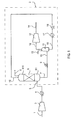
- FIG. 1 shows an absorption desorption unit 2, wherein a fluid stream 1 obtained by the separation of the polyolefin product from the polymerization fluid comprising unreacted monomers and optionally comonomers by purging said polymerization product with an inert gas (not shown) is treated.
- Said fluid stream 1 is compressed to 10 - 50 bar (preferably 15 to 30 bar) by compressor 3, and cooled by cooler 4 to yield cooled fluid stream 5.
- Said fluid stream 5 is introduced into the bottom 61 of scrub column 6 and is contacted therein with scrub liquid 19, which absorbs at least a portion of the unreacted monomers and is withdrawn as an absorber bottoms scrub liquid 7.
- the top 611 of the scrub column is fed with the scrub liquid 19.
- a gas 8 enriched in inert components is withdrawn from the top 611 of the scrub column 6 and can be further purged to the flare or reused in another part of the process (not shown).
- the absorber bottoms scrub liquid 7 recovered at the bottom 61 of the scrubber 6 comprises the scrub liquid and at least a portion of the unreacted monomer.
- This absorber bottoms scrub liquid 7 is sent to the desorption unit 11, and is first flashed to about 1 - 5 bar (preferably 1.5 - 3 bar) in an expansion valve 9.
- the flashed stream 10 is sent to the liquid -gas separator 11, wherein a gas phase comprising a major part of the unreacted monomer 12 is compressed up to 30 bar in compressor 13 is reused 14 as monomer in the polymerization.
- the liquid phase 16 withdrawn from the desorption unit 11 comprising the scrub liquid 19 is cooled in a cooler 17 and further pumped back by a pump 18 to the scrub column 6.
- the scrub liquid is able to dissolve ethylene, has little affinity for hydrogen and nitrogen and is preferably compatible with the polymerization process. In a preferred embodiment, there should be a high difference in boiling point between scrub liquid and the unreacted monomer to be recovered.
- said scrub liquid is preferably chosen form C4-C12 alkanes or alkenes, more preferably C6-C10 alkanes or alkenes, yet more preferably C6-C8 alkanes or alkenes.
- said polymerization reaction is a slurry polymerization process.
- the present invention is therefore also applicable to any process producing an effluent comprising a slurry of particulate polymer solids suspended in a liquid medium comprising a diluent and unreacted monomer.
- reaction processes include those, which have come to be known in the art as particle form polymerizations.
- the present invention relates to a separation process of a hydrocarbon-containing feed, wherein said hydrocarbon-containing feed stream comprising olefin monomer, co-monomer and hydrocarbon diluent is an effluent stream obtained from a polymerization process for preparing polyethylene, and preferably for preparing monomodal or bimodal polyethylene.
- Ethylene polymerizes in a liquid diluent in the presence of a catalyst, optionally a co-catalyst, optionally a co-monomer, optionally hydrogen and optionally other additives, thereby producing polymerization slurry.
- present invention is particularly suitable for the polymerization of ethylene in isobutane diluent.
- Suitable ethylene polymerization includes but is not limited to homopolymerization of ethylene, copolymerization of ethylene and a higher 1-olefin co-monomer such as 1-butene, 1-pentene, 1-hexene, 1-octene or 1-decene.
- said co-monomer is 1-hexene.
- the present invention is directed to the recovery process of unreacted monomer from vaporous stream, which is issued from the effluent of an ethylene polymerization reaction wherein reactants including the monomer ethylene, isobutane as hydrocarbon diluent, a catalyst, the co-monomer 1-hexene and hydrogen are used.
- the present invention particularly suitable for the recovery of unreacted monomers from polymerization process for preparing polyethylene, and preferably for preparing monomodal or bimodal polyethylene.
- separated monomer, hydrocarbon diluent and co-monomer are re-used in said polymerization process.
- Bimodal PE refers to PE that is manufactured using two reactors, which are connected to each other in series, the operating conditions being different in the two reactors.
- “Monomodal PE” is produced in a single reactor or using two reactors in series, with identical operating conditions.
- polymerization slurry or “polymer slurry” or “slurry” means substantially a multi-phase composition including at least polymer solids and a liquid phase and allows for a third phase (gas) to be at least locally present in the process, the liquid phase being the continuous phase.
- the solids include catalyst and a polymerized olefin, such as polyethylene.
- the liquids include an inert diluent, such as isobutane, dissolved monomer such as ethylene, co-monomer, molecular weight control agents, such as hydrogen, antistatic agents, antifouling agents, scavengers, and other process additives.
- the present invention is particularly suitable for polymerization process for the manufacture of particulate olefin polymers consisting of the catalytic polymerization of olefins such as C 2 to C 8 olefins in a diluent containing the monomer to be polymerized, the polymerization slurry being circulated in a loop reactor to which the starting material is fed and from which the polymer formed is removed.
- suitable monomers include but are not limited to those having 2 to 8 carbon atoms per molecule, such as ethylene, propylene, butylene, pentene, butadiene, isoprene, 1-hexene, 1-methylpentene and the like.
- the polymerization reaction can be carried out at a temperature of from 50 to 120 °C, preferably at temperature of from 70 to 115°C, more preferably at temperature of from 80 to 110°C, and at a pressure of from 20 to 100 bar, preferably at pressure of from 30 to 50 bar, more preferably at pressure of 37 to 45 bar.
- Suitable diluents are well known in the art and include but are not limited to hydrocarbon diluents such as aliphatic, cycloaliphatic and aromatic hydrocarbon solvents, .
- the preferred solvents are C 12 or lower, straight chain or branched chain, saturated hydrocarbons, C 5 to C 9 saturated alicyclic or aromatic hydrocarbons.
- solvents are butane, isobutane, pentane, hexane, heptane, cyclopentane, cyclohexane, cycloheptane, methyl cyclopentane, methyl cyclohexane, isooctane, benzene, toluene, xylene.
- said diluent is isobutane.
- other diluents may as well be applied according to the present invention.
- Suitable catalysts are well known in the art. According to the present invention, the term “catalyst” is defined herein as a substance that causes a change in the rate of a co-polymerization reaction without itself being consumed in the reaction. Examples of suitable catalysts include but are not limited to chromium oxide such as those supported on silica or aluminum, organometal catalysts including those known in the art as “Ziegler” or “Ziegler-Natta” catalysts, metallocene catalysts and the like.
- co-catalyst refers to materials that can be used in conjunction with a catalyst in order to improve the activity of the catalyst during the polymerization reaction.
- said polymerization reaction is a slurry polymerization process using isobutane as diluent and hexene as comonomer.
- the present invention therefore also concerns a process for the recovery of unreacted monomers from a slurry polymerization process comprising the steps of
- said overhead vapor stream of step (c) comprising unreacted monomer and light gas is compressed and cooled prior to treatment in said gas-liquid absorption zone.
- the present provides for a process for the recovery of unreacted monomer comprising stream comprising the steps of:
- the bottom stream of step (b) or (I) comprising C 4-10 hydrocarbons is combined with makeup scrub liquid and cooled to provide said scrub liquid feed to said gas-liquid absorption zone.
- said absorber bottoms scrub liquid is recycled to the polymerization reaction.
- said absorber bottoms scrub liquid is further treated to recover said unreacted monomer.
- said unreacted monomer is recovered from said absorber bottoms scrub liquid by first flashing to a reduced pressure said absorber bottoms scrub liquid, and separating the resulting flashed stream into a vapor containing the unreacted monomer and a liquid comprising said C 4-10 hydrocarbons.
- said vapor containing the unreacted monomer is compressed and recycled to said polymerization process, and said liquid comprising said C 4-10 hydrocarbons is cooled and pumped back to said absorption zone as the scrub liquid.
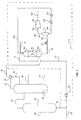
- Figure 2 shows an absorption desorption unit 210, wherein a fluid stream 34 obtained after distillation is treated.
- a fluid stream 20 comprising unreacted monomer, diluent and comonomers is recovered from a polymer slurry by separating at least a majority of the diluent and unreacted monomer and comonomers from the formed polymer (not shown).
- a presently preferred component stream separated according to the invention comprises monomer, such as ethylene, co-monomer, such as 1-hexene, and diluent, such as isobutane. It should be recognized however, that the recovery process of the present invention is equally applicable to other monomer, co-monomer and diluent systems so long as feed vapors comprise hydrocarbons, which permit separation by distillation. Traces of both heavier, e.g. oligomers, and lighter components such as formaldehyde, N 2 , H 2 , and components such as O 2 , CO and CO 2 are generally also present in such effluent streams. Said fluid stream 20 is distilled in a first distillation column 22.
- a bottom stream 24 comprising C 4-10 hydrocarbons, and an overhead stream 23 comprising unreacted monomer and diluent are withdrawn from said distillation column 22.
- Said first column is also referred as "Heavies column”.
- the bottom stream 24 of said column can be for example mainly hexene, which can be recycled back to the polymerization process or combined with a make up fluid 25 of scrub liquid.
- the overhead stream 23 is sent to a second column 28 (also referred as "lights column”).
- a second column 28 also referred as "lights column”
- Substantially pure isobutane, so-called “substantially olefin-free” isobutane is obtained as liquid bottom product 30.
- Light components such as formaldehyde, H 2 , N 2 , O 2 , CO and
- the overhead vapor stream 31 comprising unreacted monomer and diluent is removed from said distillation column 28 and cooled in a cooling unit 32.
- said overhead vapor stream comprises about 25 to 95 wt % ethylene, about 2 to 10 wt% ethane, about 5 to 30 wt % isobutane, about 0 to 1 wt % nitrogen and about 0 to 4 wt % hydrogen.
- the pressure of this stream is at about 5 - 20 bar, preferably 10 - 15 bar, and the temperature: -30 to + 30 °C, preferably -15 to + 15 °C.
- the cooled overhead vapor stream 34 is introduced into the bottom 350 of scrub column 35 and is contacted therein with scrub liquid 190, which absorbs at least a portion of the unreacted monomers and is withdrawn as an absorber bottoms scrub liquid 37.
- the top 351 of the scrub column 35 is fed with the scrub liquid 190.
- the bottom stream 24 comprising C 4-10 hydrocarbons (for example the comonomer bottom 24 of the heavies column 22), is combined with makeup scrub liquid 25 and cooled 26 to provide scrub liquid feed 27 to said scrub column 35.
- a gas 36 enriched in inert components is withdrawn from the top 351 of the scrub column 35 and can be further purged to the flare or reused in another part of the process (not shown).
- the absorber bottoms scrub liquid 37 recovered at the bottom 350 of the scrubber 35 comprises the scrub liquid and at least a portion of the unreacted monomer.
- This absorber bottoms scrub liquid 37 is sent to the desorption unit 110, and is first flashed to about 1 - 5 bar (preferably 1.5 - 3 bar) in an expansion valve 90.
- the flashed stream 100 is sent to the liquid -gas separator 110, wherein a gas phase comprising a major part of the unreacted monomer 120 is compressed up to 30 bar in compressor 130 is reused 140 as monomer in the polymerization.
- the liquid phase 160 withdrawn from the desorption unit 110 comprising the scrub liquid is cooled in a cooler 170 and further pumped back 190 by a pump 180 to the scrub column 35.
- Figure 3 shows an absorption unit 21, wherein a fluid stream 34 obtained after distillation is treated.
- a fluid stream 20 comprising unreacted monomer, diluent and comonomers is recovered from a polymer slurry.
- Said fluid stream 20 is distilled in a first distillation column 22.
- a bottom stream 24 comprising C 4-10 hydrocarbons, and an overhead stream 23 comprising unreacted monomer and diluent are withdrawn from said distillation column 22.
- the bottom stream 24 of said column can be for example mainly hexene, which can be recycled back to the polymerization process or combined with a make up fluid 25 of scrub liquid.
- the overhead stream 23 is sent to a second column 28 (also referred as "lights column”).
- Substantially pure isobutane so-called “substantially olefin-free” isobutane is obtained as liquid bottom product 30.
- Light components such as formaldehyde, H 2 , N 2 , O 2 , CO and CO 2 exit the distillation column 22 with unreacted monomers, and some residual isobutane as an overhead vapor stream 31.
- Remaining isobutane exits the column 28 as a liquid side stream 29. Both the substantially olefin-free isobutane diluent and the isobutane diluent are recycled and re-used in a polymerization process.
- the overhead vapor stream 31 comprising unreacted monomer and diluent is removed from said distillation column 28 and cooled in a cooling unit 32.
- the cooled overhead vapor stream 34 is introduced into the bottom 350 of scrub column 35 and is contacted therein with scrub liquid 27, which absorbs at least a portion of the unreacted monomers and is withdrawn as an absorber bottoms scrub liquid 37.
- the top 351 of the scrub column 35 is fed with the scrub liquid 27.
- the bottom stream 24 comprising C 4-10 hydrocarbons (for example the comonomer bottom 24 of the heavies column 22), is combined with makeup scrub liquid 25 and cooled 26 to provide scrub liquid feed 27 to said scrub column 35.
- the absorber bottoms scrub liquid 37 recovered at the bottom 350 of the scrubber 35 comprises the scrub liquid and at least a portion of the unreacted monomer. According to this embodiment said absorber bottoms scrub liquid 37 is recycled as such to the polymerization process.
- distillation zone separation column
- distillation column distillation column
- one or more of said distillation columns are tray columns.
- Such tray columns comprise a number of trays of various designs to hold up the liquid in order to provide better contact between vapor and liquid. Trays essentially act as a unit operation, each accomplishing a fraction of the separation between liquid and gas. It is clear that the more trays there are, the better the degree of separation, and thus the better column performance will be.
- Suitable distillation systems comprise distillation system having column(s) with a low number of trays, preferably lower than 25, even more preferred lower than 20.
- distillation columns with a low number of trays can be used in the present process
- improvements on the operation of the present systems, as explained into more detail below, permit to achieve a similar degree of separation as for columns with a higher number of trays.
- application of the present process includes the benefits of less energy usage and lower construction costs.
- one or more of said distillation columns are divided wall distillation column or divided wall column.
- Such column is a distillation vessel having a vertical partition separating one side from the other for a portion or all of the height of the vessel.
- such column comprises a larger number of trays, the use of such single column may be advantageous with regard to construction costs and energetic requirements.
- one or more of said distillation columns are packing columns.
- Packing column refers to column packed with inert solid particles.
- the fluid stream coming from the flash tanks also comprises traces of both heavier, e.g. oligomers, and lighter components including N 2 , H 2 , and light poisonous components such as O 2 , CO and CO 2 , and formaldehyde.
- Such components are herein also denoted as " poisonous components", because such components are detrimental for the activity of a catalyst. Re-introduction thereof into a polymerization reactor could greatly disturb catalyst activity and thus reduce polymerization efficiency. It is therefore of the utmost importance to have a recovery system adapted to recover essentially pure streams of (co-)monomer, and diluent, without substantial residual amount of such poisonous components for re-use in a polymerization process.
- the distillation zone is used for the separation of three main components, comonomer, diluent, and monomer.
- the major component is the diluent, with a part of 90 - 95 wt % of the feed stream of the distillation section.
- a first column splits all components heavier than the diluent (in bottom), the top of the column (overhead stream) is sent to a second column.
- the second column removes from the diluent lighter components, in order to get pure diluent.
- the top of the column i.e. the overhead stream
- an absorption/desorption unit to recover unreacted monomer therefrom.
- the feed stream is passed to a distillation column and subjected to distillation conditions adapted to remove a bottom stream comprising substantially olefin-free hydrocarbon diluent, optionally a side stream comprising hydrocarbon diluent, and an overhead vapor stream comprising olefin monomer, diluent and further components such as H 2 , N 2 , O 2 , CO, CO 2 and formaldehyde.
- Said overhead vapor stream is further contacted in an absorption zone with a scrub liquid comprising at least one C 4-10 hydrocarbons, thereby absorbing at least a portion of the unreacted monomers in said scrub liquid.
- said overhead vapor stream is cooled in a vent condenser prior to being contacted with the scrub liquid in said absorption zone.
- the bottom stream comprises substantially olefin-free hydrocarbon diluent.
- substantially olefin-free hydrocarbon diluent or “olefin-free diluent” or the like are used herein as synonyms to denote hydrocarbon diluent which contains less than 5000 ppm, and preferably less than 1000 ppm, and even more preferred less than 100 ppm of monomer and/or co-monomer.
- the bottom stream of olefin free hydrocarbon diluent, such as isobutane, issued from the distillation column can be sent to a storage tank and further used, e.g. for flushing conduits and circulation pumps in a polymerization reactor, or for catalyst preparation e.g. in mud pots.
- This olefin-free diluent can be recycled to a polymerization zone, whether homo-polymerization or co-polymerization, at any place of the process where pure diluent is requested, like the catalyst dilution.
- the side stream of hydrocarbon diluent issued from the distillation column is generally sent to a storage tank and further used.
- the amount of further components such as H 2 , N 2 , O 2 , CO and CO 2 , formaldehyde in the side stream is lower than 10 ppm, and preferably lower than 1 ppm, and even more preferred lower than 0.5 ppm.
- the amounts of monomer and/or co-monomer remaining in the side stream are lower than 25% and preferably lower than 10% and even more preferred lower than 5%. High amounts of monomer in the storage tank of the side-stream product may lead to evaporation and substantial monomer loss.
- the hydrocarbon diluent issued from the side stream exiting from the distillation zone is generally used as diluent in a polymerization reactor, either homo-polymerization or co-polymerization depending upon monomers being subjected to polymerization. It is in particular very suitable for use as diluent especially in a second polymerization reactor when polymerizing under bimodal operation, or in a first as well as a second reactor, when polymerizing under monomodal operation.
- said overhead vapor stream is further contacted in an absorption zone with a scrub liquid comprising at least one C 4-10 hydrocarbons, thereby absorbing at least a portion of the unreacted monomers in said scrub liquid.
- said overhead vapor stream is cooled prior to being contacted with the scrub liquid in said absorption zone.
- the above-described processes according to the present invention can be further optimized. Said optimization may consists in maximizing the overhead stream (e.g. b3) obtained from the distillation column by adapting the ratio of the bottom stream flow removed from the distillation column to the feed stream flow introduced in the distillation column.
- said ratio is lower than or equal to 1.0, and preferably comprised between 0.3 and 1.0, and more preferably between 0.4 and 0.95, and may for instance comprise 0.4, 0.5, 0.6, 0.7, 0.8 or 0.9.
- the ratio set point of bottom stream flow to feed stream flow which is suitable according to the present process, can be adjusted manually or automatically, to ensure enough olefin free diluent product and suitable venting to the ethylene recovery unit to remove light components.
- the ratio can be adapted by adapting the reflux to the distillation column. Said optimization may also consist in diluting the side stream obtained in the distillation column with the bottom stream obtained in the distillation column.
- the bottom stream of olefin free hydrocarbon diluent issued from the distillation column, and the side stream of hydrocarbon diluent are both sent to separate storage tanks. Diluting the side stream with the bottom stream permits to control the level of product in the storage tanks for the side-stream product and for the bottom-stream product. Diluting the side stream with the bottom stream is further required in view of controlling the ratio of the bottom stream flow to the feed stream flow.
- distillation column improvements to the operation of the distillation column include improvements for stabilizing the distillation conditions in the distillation column. For that, a further step can be provided of re-boiling a portion of the bottom stream obtained in the distillation column under controlled steam flow rate and returning said re-boiled portion to the distillation column.
- the rate of the steam flow can be controlled in function of the temperature in the distillation column.
- the steam flow rate is controlled in function of the temperature on a tray located in the lower half of the column, i.e. equal to or lower than 1 ⁇ 2 of the height of the column, and even more preferred located in the lower quarter of the column, i.e. equal to or lower than 1 ⁇ 4 of the height of the column.
- this temperature is used as an input parameter in a temperature controller system driving and controlling the reboiler steam flow rate.
- the controller parameters have been chosen so as to obtain a relatively slow reaction of the controller system.
- the sump level of the distillation column can be adapted to the bottom stream flow by means of a level controller.
- the embodiments of the present invention provide improved methods for recovering unreacted monomer such as ethylene or propylene from polyolefin polymerization process.
- unreacted monomers are recovered by absorption in a liquid comprising C 4-10 hydrocarbon, which is compatible with the polyolefin reactor operation.
- the present process has the advantage of being a simplified process which does not require several counter flow heat exchangers for recovering the unreacted monomers.
- the use of absorption desorption unit allows a decoupling of the scrub loop and the reactor itself.
- the efficiency of absorption can be adjusted by the ratio between the flow rates of absorption liquid and gas sent to the scrub unit. This ratio is fixed based on the targeted recovery of ethylene, and is independent of the flow rate of scrub liquid acceptable in the reactor.
- Example 1 refers to the Figure 1 .
- the stream coming from the reactor degassing system is compressed up to 23 barg and then cooled to 5 °C.
- This stream has the following composition: 51 wt % nitrogen, 43 wt % ethylene and 6 wt % 1-hexene..
- This gaseous stream is sent to the scrub unit.
- the scrubber is a column with 3 trays.
- the scrub unit is fed with hexane used as example of absorption liquid; absorbent flow rate equals 2 times the gas flow rate.
- the temperature of the scrub unit is variable, between -20 °C and + 10 °C.
- the monomer recovered by the scrub unit varies between 30 % (at 10 °C) and 40 % (at -20 °C). This stream is then flashed and ethylene is desorbed, hexane is recycled back to the scrubber.
- This low recovery rate is representative of a situation where a high purge of poisons is targeted.
- Example 2 also refers to the Figure 1 .
- the gas inlet of the scrub unit is unchanged in terms of composition, pressure and temperature compared to example 1.
- the scrub liquid is still hexane, at 0°C and its flow rate is now variable, from 0.3 to 6 times the gas flow rate.
- the recovery factor of ethylene varies between 15 % and 80 %, depending on the ratio liquid/gas.
Landscapes
- Chemical & Material Sciences (AREA)
- Health & Medical Sciences (AREA)
- Chemical Kinetics & Catalysis (AREA)
- Medicinal Chemistry (AREA)
- Polymers & Plastics (AREA)
- Organic Chemistry (AREA)
- Life Sciences & Earth Sciences (AREA)
- Sustainable Development (AREA)
- Addition Polymer Or Copolymer, Post-Treatments, Or Chemical Modifications (AREA)
- Gas Separation By Absorption (AREA)
- Production Of Liquid Hydrocarbon Mixture For Refining Petroleum (AREA)
- Polymerisation Methods In General (AREA)
Priority Applications (7)
| Application Number | Priority Date | Filing Date | Title |
|---|---|---|---|
| EP08150410A EP2083020A1 (de) | 2008-01-18 | 2008-01-18 | Verfahren zur Monomerrückgewinnung bei einem Polymerisationsverfahren |
| PCT/EP2009/050516 WO2009090254A1 (en) | 2008-01-18 | 2009-01-16 | Process for monomer recovery from a polymerization process |
| EP09701996.2A EP2231718B1 (de) | 2008-01-18 | 2009-01-16 | Verfahren zur monomergewinnung aus einem polymerisierungsverfahren |
| US12/811,848 US8636831B2 (en) | 2008-01-18 | 2009-01-16 | Process for monomer recovery from a polymerization process |
| KR1020107013510A KR101197501B1 (ko) | 2008-01-18 | 2009-01-16 | 중합 공정으로부터 모노머를 회수하기 위한 공정 |
| CN2009801018353A CN101910212B (zh) | 2008-01-18 | 2009-01-16 | 从聚合过程回收单体的方法 |
| US14/097,842 US9273169B2 (en) | 2008-01-18 | 2013-12-05 | Process for monomer recovery from a polymerization process |
Applications Claiming Priority (1)
| Application Number | Priority Date | Filing Date | Title |
|---|---|---|---|
| EP08150410A EP2083020A1 (de) | 2008-01-18 | 2008-01-18 | Verfahren zur Monomerrückgewinnung bei einem Polymerisationsverfahren |
Publications (1)
| Publication Number | Publication Date |
|---|---|
| EP2083020A1 true EP2083020A1 (de) | 2009-07-29 |
Family
ID=39473220
Family Applications (2)
| Application Number | Title | Priority Date | Filing Date |
|---|---|---|---|
| EP08150410A Withdrawn EP2083020A1 (de) | 2008-01-18 | 2008-01-18 | Verfahren zur Monomerrückgewinnung bei einem Polymerisationsverfahren |
| EP09701996.2A Not-in-force EP2231718B1 (de) | 2008-01-18 | 2009-01-16 | Verfahren zur monomergewinnung aus einem polymerisierungsverfahren |
Family Applications After (1)
| Application Number | Title | Priority Date | Filing Date |
|---|---|---|---|
| EP09701996.2A Not-in-force EP2231718B1 (de) | 2008-01-18 | 2009-01-16 | Verfahren zur monomergewinnung aus einem polymerisierungsverfahren |
Country Status (5)
| Country | Link |
|---|---|
| US (2) | US8636831B2 (de) |
| EP (2) | EP2083020A1 (de) |
| KR (1) | KR101197501B1 (de) |
| CN (1) | CN101910212B (de) |
| WO (1) | WO2009090254A1 (de) |
Cited By (11)
| Publication number | Priority date | Publication date | Assignee | Title |
|---|---|---|---|---|
| WO2012051268A1 (en) * | 2010-10-15 | 2012-04-19 | Chevron Phillips Chemical Company Lp | Improved ethylene separation |
| WO2012141974A1 (en) * | 2011-04-12 | 2012-10-18 | Chevron Phillips Chemical Company Lp | System and method for processing reactor polymerization effluent |
| WO2013154882A1 (en) * | 2012-04-13 | 2013-10-17 | Chevron Phillips Chemical Company Lp | Ethylene recovery by absorption |
| WO2013154907A3 (en) * | 2012-04-13 | 2014-01-03 | Chevron Phillips Chemical Company Lp | Component separations in polymerization |
| US9108147B2 (en) | 2010-10-15 | 2015-08-18 | Chevron Phillips Chemical Company Lp | Component separations in polymerization |
| US9180405B2 (en) | 2010-10-15 | 2015-11-10 | Chevron Phillips Chemical Company Lp | Ethylene recovery by absorption |
| WO2017102303A1 (en) * | 2015-12-15 | 2017-06-22 | Sabic Global Technologies B.V. | Olefin polymerization process |
| CN107849168A (zh) * | 2015-07-31 | 2018-03-27 | 埃克森美孚化学专利公司 | 从烯烃聚合方法中回收未反应的单体 |
| WO2019099134A1 (en) * | 2017-11-17 | 2019-05-23 | Exxonmobil Chemical Patents Inc. | Gas-phase olefin polymerization process |
| WO2023117754A1 (de) | 2021-12-23 | 2023-06-29 | Röhm Gmbh | Verfahren zur herstellung von alkylmethacrylaten mit verbesserter ausbeute und verminderten emissionen flüchtiger organischer verbindungen |
| WO2025002964A1 (en) | 2023-06-27 | 2025-01-02 | Sabic Global Technologies B.V. | Olefin polymerization process |
Families Citing this family (26)
| Publication number | Priority date | Publication date | Assignee | Title |
|---|---|---|---|---|
| WO2011045701A1 (en) * | 2009-10-16 | 2011-04-21 | Sasol Technology (Proprietary) Limited | Separation of components from a multi-component hydrocarbon stream which includes ethylene |
| CN102389643B (zh) * | 2011-08-05 | 2013-12-11 | 浙江大学 | 一种烯烃聚合物生产中排放气回收的方法及装置 |
| EP2780141B1 (de) * | 2011-11-14 | 2015-09-16 | Borealis AG | Entfernung von flüchtigen verbindungen aus polymerkörnern durch dampfdestillierung |
| KR101534149B1 (ko) | 2013-11-29 | 2015-07-03 | 롯데케미칼 주식회사 | 폴리올레핀의 정제 방법 |
| KR101568186B1 (ko) * | 2014-01-06 | 2015-11-11 | 대림산업 주식회사 | 에틸렌과 알파-올레핀의 중합 장치 및 제조방법 |
| US12614211B2 (en) | 2015-04-13 | 2026-04-28 | Comcast Cable Communications, Llc | Presence detection and targeted content |
| KR101928766B1 (ko) * | 2015-06-09 | 2018-12-13 | 주식회사 엘지화학 | 에틸렌을 회수하기 위한 분리방법 및 분리공정 시스템 |
| WO2017141088A1 (en) * | 2016-02-18 | 2017-08-24 | Sabic Global Technologies B.V. | Processes for separating light components from monochloromethane |
| US10251022B2 (en) | 2016-02-18 | 2019-04-02 | Comcast Cable Communications, Llc | Systems and methods for low energy beacon management |
| US10165397B2 (en) | 2016-02-18 | 2018-12-25 | Comcast Cable Communications, Llc | Proximity detection and targeted communications |
| CN105949500B (zh) * | 2016-06-07 | 2019-10-25 | 中国石油集团东北炼化工程有限公司吉林设计院 | 用于橡胶生产中的废溶剂处理方法 |
| WO2018208375A1 (en) * | 2017-05-09 | 2018-11-15 | Exxonmobil Chemical Patents Inc. | Linear alpha olefin process including solvent purification using dividing wall distillation column |
| WO2019027565A1 (en) * | 2017-08-01 | 2019-02-07 | Exxonmobil Chemical Patents Inc. | METHODS OF RECOVERING POLYOLEFIN SOLIDS |
| CN111133011B (zh) * | 2017-08-01 | 2022-12-27 | 埃克森美孚化学专利公司 | 聚烯烃固体回收方法 |
| WO2019027566A1 (en) * | 2017-08-01 | 2019-02-07 | Exxonmobil Chemical Patents Inc. | METHODS OF RECOVERING POLYOLEFIN SOLIDS |
| CN111148771B (zh) * | 2017-08-01 | 2023-07-18 | 埃克森美孚化学专利公司 | 聚烯烃固体回收的方法 |
| US11149096B2 (en) | 2017-12-04 | 2021-10-19 | Borealis Ag | Method of recovering olefins in a solution polymerization process |
| KR102340279B1 (ko) | 2017-12-04 | 2021-12-17 | 보레알리스 아게 | 용액중합공정에서 올레핀을 회수하는 방법 |
| US10730032B2 (en) | 2018-05-16 | 2020-08-04 | Chevron Phillips Chemical Company Lp | Polymer flake degassing system and methods |
| WO2019241341A1 (en) | 2018-06-15 | 2019-12-19 | Univation Technologies, Llc | Separations system for recovering hydrocarbons from synthesis of polyethylene polymers |
| KR102670190B1 (ko) * | 2019-06-24 | 2024-05-28 | 보레알리스 아게 | 회수율이 개선된 폴리프로필렌의 제조 공정 |
| CA3146404C (en) | 2019-07-08 | 2023-09-05 | Borealis Ag | Polymerization process |
| CN113402355B (zh) * | 2021-04-26 | 2022-06-24 | 中国石油化工股份有限公司 | 一种从丙烯聚合物浆液中回收丙烯单体和惰性稀释剂的装置和方法 |
| CN114011103B (zh) * | 2021-10-21 | 2023-03-28 | 金聚合科技(宁波)有限公司 | 一种用于洗涤聚烯烃的系统和方法 |
| WO2023091854A1 (en) * | 2021-11-22 | 2023-05-25 | Exxonmobil Chemical Patents Inc. | Reactor vent control to avoid vent column breakthrough |
| JP2025537637A (ja) * | 2022-11-23 | 2025-11-20 | エルジー・ケム・リミテッド | 共役ジエン系単量体の回収方法 |
Citations (3)
| Publication number | Priority date | Publication date | Assignee | Title |
|---|---|---|---|---|
| US3969470A (en) * | 1975-04-21 | 1976-07-13 | E. I. Du Pont De Nemours And Company | Process for recycling hydrogen when making blends of olefin copolymers |
| EP0722953A1 (de) | 1995-01-20 | 1996-07-24 | Air Products And Chemicals, Inc. | Rückgewinnung von Kohlenwasserstoffen aus Reinigungsgas von Polyalkenprodukten |
| WO1996027634A1 (en) * | 1995-03-03 | 1996-09-12 | Advanced Extraction Technologies, Inc. | Absorption process for rejection of reactor byproducts and recovery of monomers from waste gas streams in olefin polymerization processes |
Family Cites Families (1)
| Publication number | Priority date | Publication date | Assignee | Title |
|---|---|---|---|---|
| US4589957A (en) * | 1983-08-25 | 1986-05-20 | Phillips Petroleum Company | Monomer and diluent recovery |
-
2008
- 2008-01-18 EP EP08150410A patent/EP2083020A1/de not_active Withdrawn
-
2009
- 2009-01-16 US US12/811,848 patent/US8636831B2/en not_active Expired - Fee Related
- 2009-01-16 WO PCT/EP2009/050516 patent/WO2009090254A1/en not_active Ceased
- 2009-01-16 EP EP09701996.2A patent/EP2231718B1/de not_active Not-in-force
- 2009-01-16 CN CN2009801018353A patent/CN101910212B/zh not_active Expired - Fee Related
- 2009-01-16 KR KR1020107013510A patent/KR101197501B1/ko not_active Expired - Fee Related
-
2013
- 2013-12-05 US US14/097,842 patent/US9273169B2/en not_active Expired - Fee Related
Patent Citations (3)
| Publication number | Priority date | Publication date | Assignee | Title |
|---|---|---|---|---|
| US3969470A (en) * | 1975-04-21 | 1976-07-13 | E. I. Du Pont De Nemours And Company | Process for recycling hydrogen when making blends of olefin copolymers |
| EP0722953A1 (de) | 1995-01-20 | 1996-07-24 | Air Products And Chemicals, Inc. | Rückgewinnung von Kohlenwasserstoffen aus Reinigungsgas von Polyalkenprodukten |
| WO1996027634A1 (en) * | 1995-03-03 | 1996-09-12 | Advanced Extraction Technologies, Inc. | Absorption process for rejection of reactor byproducts and recovery of monomers from waste gas streams in olefin polymerization processes |
Cited By (28)
| Publication number | Priority date | Publication date | Assignee | Title |
|---|---|---|---|---|
| US9180405B2 (en) | 2010-10-15 | 2015-11-10 | Chevron Phillips Chemical Company Lp | Ethylene recovery by absorption |
| US9790298B2 (en) | 2010-10-15 | 2017-10-17 | Chevron Phillips Chemical Company, Lp | Component separations in polymerization |
| US9598514B2 (en) | 2010-10-15 | 2017-03-21 | Chevron Phillips Chemical Company Lp | Component separations in polymerization |
| US8410329B2 (en) | 2010-10-15 | 2013-04-02 | Chevron Phillips Chemical Company Lp | Ethylene separation |
| US9580370B2 (en) | 2010-10-15 | 2017-02-28 | Chevron Phillips Chemical Company Lp | Ethylene recovery by absorption |
| US9399608B2 (en) | 2010-10-15 | 2016-07-26 | Chevron Phillips Chemical Company Lp | Ethylene recovery by absorption |
| US9284430B2 (en) | 2010-10-15 | 2016-03-15 | Chevron Phillips Chemical Company Lp | Component separations in polymerization |
| WO2012051268A1 (en) * | 2010-10-15 | 2012-04-19 | Chevron Phillips Chemical Company Lp | Improved ethylene separation |
| US9187383B2 (en) | 2010-10-15 | 2015-11-17 | Chevron Phillips Chemical Company Lp | Component separations in polymerization |
| US9108147B2 (en) | 2010-10-15 | 2015-08-18 | Chevron Phillips Chemical Company Lp | Component separations in polymerization |
| US8680219B2 (en) | 2011-04-12 | 2014-03-25 | Chevron Phillips Chemical Company Lp | System and method for processing reactor polymerization effluent |
| WO2012141974A1 (en) * | 2011-04-12 | 2012-10-18 | Chevron Phillips Chemical Company Lp | System and method for processing reactor polymerization effluent |
| US8686097B2 (en) | 2011-04-12 | 2014-04-01 | Chevron Phillips Chemical Company Lp | System and method for processing reactor polymerization effluent |
| US8362161B2 (en) | 2011-04-12 | 2013-01-29 | Chevron Phillips Chemical Company Lp | System and method for processing reactor polymerization effluent |
| US8492492B2 (en) | 2011-04-12 | 2013-07-23 | Chevron Phillips Chemical Company Lp | System and method for processing reactor polymerization effluent |
| WO2013154907A3 (en) * | 2012-04-13 | 2014-01-03 | Chevron Phillips Chemical Company Lp | Component separations in polymerization |
| RU2619690C2 (ru) * | 2012-04-13 | 2017-05-17 | ШЕВРОН ФИЛЛИПС КЕМИКАЛ КОМПАНИ ЭлПи | Разделение компонентов при полимеризации |
| WO2013154882A1 (en) * | 2012-04-13 | 2013-10-17 | Chevron Phillips Chemical Company Lp | Ethylene recovery by absorption |
| RU2623433C2 (ru) * | 2012-04-13 | 2017-06-26 | ШЕВРОН ФИЛЛИПС КЕМИКАЛ КОМПАНИ ЭлПи | Извлечение этилена путем абсорбции |
| CN107849168B (zh) * | 2015-07-31 | 2020-07-14 | 埃克森美孚化学专利公司 | 从烯烃聚合方法中回收未反应的单体 |
| CN107849168A (zh) * | 2015-07-31 | 2018-03-27 | 埃克森美孚化学专利公司 | 从烯烃聚合方法中回收未反应的单体 |
| US10640582B2 (en) | 2015-12-15 | 2020-05-05 | Sabic Global Technologies B.V. | Olefin polymerization process |
| WO2017102303A1 (en) * | 2015-12-15 | 2017-06-22 | Sabic Global Technologies B.V. | Olefin polymerization process |
| WO2019099134A1 (en) * | 2017-11-17 | 2019-05-23 | Exxonmobil Chemical Patents Inc. | Gas-phase olefin polymerization process |
| CN111356703A (zh) * | 2017-11-17 | 2020-06-30 | 埃克森美孚化学专利公司 | 气相烯烃聚合方法 |
| US11117980B2 (en) | 2017-11-17 | 2021-09-14 | Exxonmobil Chemical Patents Inc. | Polymerization processes |
| WO2023117754A1 (de) | 2021-12-23 | 2023-06-29 | Röhm Gmbh | Verfahren zur herstellung von alkylmethacrylaten mit verbesserter ausbeute und verminderten emissionen flüchtiger organischer verbindungen |
| WO2025002964A1 (en) | 2023-06-27 | 2025-01-02 | Sabic Global Technologies B.V. | Olefin polymerization process |
Also Published As
| Publication number | Publication date |
|---|---|
| EP2231718B1 (de) | 2014-03-19 |
| US20110046323A1 (en) | 2011-02-24 |
| US9273169B2 (en) | 2016-03-01 |
| CN101910212B (zh) | 2012-07-25 |
| KR20100086504A (ko) | 2010-07-30 |
| WO2009090254A1 (en) | 2009-07-23 |
| US8636831B2 (en) | 2014-01-28 |
| KR101197501B1 (ko) | 2012-11-09 |
| EP2231718A1 (de) | 2010-09-29 |
| US20140094575A1 (en) | 2014-04-03 |
| CN101910212A (zh) | 2010-12-08 |
Similar Documents
| Publication | Publication Date | Title |
|---|---|---|
| US9273169B2 (en) | Process for monomer recovery from a polymerization process | |
| US10435487B2 (en) | Method for optimizing energy efficiency in a polymerization process | |
| US9394383B2 (en) | Monomer/diluent recovery | |
| EP2016985A1 (de) | Verfahren zur Optimierung der Trennung eines kohlenwasserstoffhaltigen Zufuhrstroms | |
| US7759457B2 (en) | Polymerisation process | |
| CA2832717C (en) | System and method for processing reactor polymerization effluent | |
| EP2295474A1 (de) | Verfahren zum Wiederherstellen eines Produktstroms, der von einem kohlenwasserstoffhaltigen Zufuhrstrom getrennt wurde | |
| RU2619690C2 (ru) | Разделение компонентов при полимеризации | |
| US10941227B2 (en) | Gas phase olefins polymerization process operating in condensing mode | |
| WO2025131660A1 (en) | Vent gas recovery improvement |
Legal Events
| Date | Code | Title | Description |
|---|---|---|---|
| PUAI | Public reference made under article 153(3) epc to a published international application that has entered the european phase |
Free format text: ORIGINAL CODE: 0009012 |
|
| AK | Designated contracting states |
Kind code of ref document: A1 Designated state(s): AT BE BG CH CY CZ DE DK EE ES FI FR GB GR HR HU IE IS IT LI LT LU LV MC MT NL NO PL PT RO SE SI SK TR |
|
| AX | Request for extension of the european patent |
Extension state: AL BA MK |
|
| AKX | Designation fees paid | ||
| REG | Reference to a national code |
Ref country code: DE Ref legal event code: 8566 |
|
| STAA | Information on the status of an ep patent application or granted ep patent |
Free format text: STATUS: THE APPLICATION IS DEEMED TO BE WITHDRAWN |
|
| 18D | Application deemed to be withdrawn |
Effective date: 20100130 |