EP2083365A1 - Verfahren zum optimieren des strukturellen entwurfs eines zusammengesetzten versteiften panels - Google Patents
Verfahren zum optimieren des strukturellen entwurfs eines zusammengesetzten versteiften panels Download PDFInfo
- Publication number
- EP2083365A1 EP2083365A1 EP06820038A EP06820038A EP2083365A1 EP 2083365 A1 EP2083365 A1 EP 2083365A1 EP 06820038 A EP06820038 A EP 06820038A EP 06820038 A EP06820038 A EP 06820038A EP 2083365 A1 EP2083365 A1 EP 2083365A1
- Authority
- EP
- European Patent Office
- Prior art keywords
- stiffened panel
- failure modes
- simulation
- design
- structural design
- Prior art date
- Legal status (The legal status is an assumption and is not a legal conclusion. Google has not performed a legal analysis and makes no representation as to the accuracy of the status listed.)
- Ceased
Links
Images
Classifications
-
- G—PHYSICS
- G06—COMPUTING OR CALCULATING; COUNTING
- G06F—ELECTRIC DIGITAL DATA PROCESSING
- G06F30/00—Computer-aided design [CAD]
- G06F30/20—Design optimisation, verification or simulation
- G06F30/23—Design optimisation, verification or simulation using finite element methods [FEM] or finite difference methods [FDM]
-
- G—PHYSICS
- G06—COMPUTING OR CALCULATING; COUNTING
- G06F—ELECTRIC DIGITAL DATA PROCESSING
- G06F2113/00—Details relating to the application field
- G06F2113/26—Composites
Definitions
- the present invention relates to process for optimizing the structural design of a stiffened composite material panel such as a skin of a torsion box of an aeronautical structure.
- the use of composite materials in the design of aeronautical structures began timidly after the Second World War.
- the first materials basically glass fibers embedded in polyester resins, were used in the design of secondary structure elements, such as radomes, protection of antennae and hulls.
- the constant evolution of the developments of new materials has led to the progressive use thereof in more components of the airplane.
- the composite materials that are most used in the aeronautical industry consist of fibers or fiber bundles embedded in a matrix of thermosetting or thermoplastic resin, in the form of a preimpregnated or "prepreg" material.
- the present invention provides a computer-aided process for carrying out the structural design of a stiffened panel made of a composite material, optimizing a target variable, comprising the following steps:
- simulation expert modules of families of failure modes enables the overall optimization of the structure for all the possible failure criteria and their interactions, whereby it is achieved that the result of the process is very close to the end design of the structure.
- a relevant feature of the present invention is that the mentioned interactions can lead and in fact do lead to nonlinear evolutions and potential discontinuities of the safety margin and therefore to a greater complexity of the optimizing process.
- the approach to a structural optimization problem basically consists of the search for a minimum of a target function.
- the target function is the minimum structural weight, subject to a series of conditions that must be fulfilled simultaneously, such as positive safety margins, specific design criteria, manufacturing restrictions, and stiffness restrictions to prevent aeroelastic phenomena, etc.
- an optimization problem of the type being considered can be formulated by means of the expression min f(x i ) in which f is the target function, (in this case, it will preferably be the minimum weight)
- x i are the variables of the problem and g j (x i ) are the restrictions.
- the material of the structural element object of the optimization is isotropic
- the number of variables involved in the problem is considerably smaller than in the case of using composite materials.
- An embodiment of the present invention for obtaining an optimized design of a reinforced skin of a torsion box of an aeronautical structure will be described below, describing said skin in the first place.
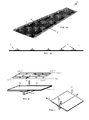
- the primary function of the skin 9 of the torsion box of an aeronautical structure like the one represented in Figure 1 belonging to a lifting element, wing or stabilizer of an aircraft is to form a continuous surface supporting and distributing the aerodynamic pressure induced by lifting the element. These aerodynamic forces act normally to the skin.
- the wing or stabilizer behaves like a cantilever beam, giving rise to an internal distribution of the shear forces, bending and torsional moments along the span. While the axial and bending loads are supported by the combined action of the panels and stringers of the skin, the shear forces and torsional moments acting on the wing are supported by the panels of the skin and the webs of the stringers. In other words, the skins are subjected to the combined action of:
- the structural configuration of skin 9 that is most used to support the mentioned combination of loads consists of a panel 11, with a very reduced curvature forced by the aerodynamic profile, supported in the ribs and stringers with a certain degree of rotation restriction and longitudinally stiffened by means of stringers 13.
- the panel 11 is built by means of stacking carbon fiber layers pre-impregnated in resin.
- the layers are very thin, (thicknesses less than 0.25 mm), and are formed by carbon filaments all of which are oriented in a same direction (tape), or in two directions (fabric), and embedded in uncured resin.
- Each layer is oriented in the predefined direction, typically fixing 4 stacking directions: 0°, 90°, +45° and -45°, although said rule is not fixed.
- the amount of layers in each direction will be fixed by the mechanical properties required by the designer.
- the manufacture of the stringer 13 is carried out in the same manner.
- the joint between both elements can be carried out curing both elements jointly or using an intermediate adhesive. In any of the two cases, for analytical purposes and given the high quality of the obtained joint, it can be considered that both elements work jointly.
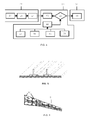
- the preparation phase 21 comprises in turn two steps:
- the starting point of the preparation phase 21 will be a GFEM 23 of the torsion box and external loads applied therein.
- the topology of the problem will be an initial datum, topology being understood as the geometric location of the different elements forming the box:
- the GFEM 23 can include all the elements of the torsion box. In other words, any transformation of the original model used will not be necessary to obtain internal loads of the structure.
- the skin 9 can be continuous or have openings.
- the only essential requirement will be the separate idealization of stiffeners and skin panels, as well as the correct delimiting thereof by means of the idealization of stringers and ribs.
- the GFEM 23 of the skin 9 it is not necessary for the GFEM 23 of the skin 9 to include properties of the elements, thicknesses, materials, areas, etc. However, it is essential to define the 0° orientation of the material, i.e., the axis on which the stacking orientation of the composite material layers will be defined.
- the second step of the preparation phase 21 is obtaining the SM 25 of the skin 9 which is based on the structural element concept.
- the structural element 17 is defined as the smallest part of the skin 9 working jointly which, as shown in Figure 2 , is formed by a section of stringer S m , limited by the ribs R n and R n+1 and its two adjoining panels 15, 15' (reaching from stringer S m to the adjacent stringer S m+1 or S m-1 ), which can be idealized by one or several finite elements ( Figure 2 shows three elements for each panel 15, 15').
- SM 25 contains, for each structural element 17, all the relevant information for the structural analysis process mentioned below:
- Table 1 shows some starting geometric data of the skin example shown in Figure 5 consisting of three panels and two T-shaped stringers. Table 1 Starting dimensions Stringer root width (mm) 70 Stringer root thickness (mm) 4 Stringer web height (mm) 65 Stringer web thickness (mm) 3 Panel thickness (mm) 8
- Table 2 shows some data of the starting stacking of the panels of the skin example shown in Figure 5 .
- Table 2 Starting dimensions Percentage of layers at 0° 55 Percentage of layers at 45° 35 Percentage of layers at 90° 10
- safety margins exceeding 1.0 are established for the following failure modes:
- the third step of the preparation phase 21 is the definition of the design variables and the restrictions 27.
- the definition of a design variable means identifying a previously defined feature in the "structural element" 17, which will be subjected to the analysis of sensitivity which the latter has on the result of the structural analysis.
- the optimization motor will compute the variation of the safety margin of each associated failure criterion before a unit variation of the value of the variable. This will allow directing the process towards the structural variants with minimum weight in relation to the established variable.
- the restrictions are defined as a variability range or dimension of a parameter, which may or may not be a design variable.
- the thickness of the panel may be defined as a design variable and at the same time define a minimum and/or maximum value thereof as a restriction.
- a minimum value for the stringer area - panel area ratio which does not necessarily have to be a design variable, could be defined as a restriction.
- Another type of restriction that must be defined is the maximum ratio of the values of design variables corresponding to contiguous elements, such that it complies with the design rules ensuring that the component can be manufactured.
- a parameter is defined as a design variable, it will mean that it will be object of the sensitivity analysis with respect to the safety margins, whereas if it is defined as a restriction, it will only verify the compliance thereof by means of the optimal solution.
- the simulation phase 51 comprises applying the SM 25 of an optimization motor 53 in an iterative loop 52, which uses simulation modules 55 of families of failure modes relating to stability 57, damage tolerance 59, repair capacity 61 or other causes 63, modifying in each step of the loop 52 the values of the design variable selected for the purpose of minimizing the weight of the skin 9.
- the skin 9 subjected to the mentioned loads may collapse in several typical manners:
- simulation expert module 55 is limited by the following parameters:
- each of the failure modes has a simulation expert module 55 associated thereto. This provides the process with great flexibility due to the following reasons:
- the simulation phase 51 is carried out in the following steps:
- the last phase 91 of the process of optimizing the structural design of the skin 9 according to the present invention is the phase of presenting the results of the optimal solution 93.
- Table 3 shows the variation of the weight of the skin in a simulation phase 52 in which the optimal solution is reached in six iterations.
- Table 4 in turn shows the evolution of the optimization variables used.
- Table 4 Starting dimensions Optimized dimensions Stringer root width (mm) 70 76 Stringer root thickness(mm) 4 2.4 Stringer web height (mm) 65 51 Stringer web thickness (mm) 3 1.7 Panel thickness (mm) 8 3 Percentage of layers at 0° 55 40 Percentage of layers at 90° 10 20
- the process of optimization is fixed for the extension of the stringer root, reducing its thickness, for a reduction both of the stiffener web height and thickness, thus decreasing its inertia, and for a reduction of the panel thickness and for a less directional laminate.
- the process of optimizing all the structural elements susceptible to being defined in a complete skin can be extremely expensive and complex, but furthermore taking into account the restrictions imposed by the manufacturing process, it may give rise to optimal but unfeasible solutions.
- the SM 25 is not implemented at the level of the structural element 17 but rather at the regional level, this being understood as a group of structural elements 17 having one or more common design parameters, both restrictions and optimization variables being understood as such.
- Figure 6 shows a subdivision in regions of 19 of the skin 9.
- the present invention is applicable to the design of aircraft components such as horizontal and vertical stabilizers, outer and inner wings, including high-lift surfaces such as elevators and rudders, flaps, slats, comprising within their architecture elements formed by stiffening panels with a small curvature.
- the process according to the present invention can be used for:
Landscapes
- Engineering & Computer Science (AREA)
- Physics & Mathematics (AREA)
- Theoretical Computer Science (AREA)
- Computer Hardware Design (AREA)
- Evolutionary Computation (AREA)
- Geometry (AREA)
- General Engineering & Computer Science (AREA)
- General Physics & Mathematics (AREA)
- Moulding By Coating Moulds (AREA)
- Management, Administration, Business Operations System, And Electronic Commerce (AREA)
Applications Claiming Priority (1)
| Application Number | Priority Date | Filing Date | Title |
|---|---|---|---|
| PCT/ES2006/070166 WO2008053052A1 (es) | 2006-10-31 | 2006-10-31 | Proceso para optimizar el diseño estructural de un panel rigidizado de material compuesto |
Publications (2)
| Publication Number | Publication Date |
|---|---|
| EP2083365A1 true EP2083365A1 (de) | 2009-07-29 |
| EP2083365A4 EP2083365A4 (de) | 2013-12-18 |
Family
ID=39331358
Family Applications (1)
| Application Number | Title | Priority Date | Filing Date |
|---|---|---|---|
| EP06820038.5A Ceased EP2083365A4 (de) | 2006-10-31 | 2006-10-31 | Verfahren zum optimieren des strukturellen entwurfs eines zusammengesetzten versteiften panels |
Country Status (3)
| Country | Link |
|---|---|
| US (1) | US7668701B2 (de) |
| EP (1) | EP2083365A4 (de) |
| WO (1) | WO2008053052A1 (de) |
Cited By (2)
| Publication number | Priority date | Publication date | Assignee | Title |
|---|---|---|---|---|
| CN110096789A (zh) * | 2019-04-26 | 2019-08-06 | 南京中人能源科技有限公司 | 一种导流罩刚度和稳定性确定方法 |
| CN110414039A (zh) * | 2019-06-13 | 2019-11-05 | 首钢集团有限公司 | 一种半挂车轻量化处理方法、装置及电子设备 |
Families Citing this family (24)
| Publication number | Priority date | Publication date | Assignee | Title |
|---|---|---|---|---|
| FR2911202B1 (fr) * | 2007-01-05 | 2009-02-13 | Airbus France Sas | Procede d'optimisation de panneaux raidis sous contraintes ' |
| GB0811554D0 (en) * | 2008-06-24 | 2008-07-30 | Airbus Uk Ltd | Method of designing a composite panel |
| JP5361336B2 (ja) | 2008-11-06 | 2013-12-04 | キヤノン株式会社 | X線乳房撮影装置 |
| GB0820800D0 (en) * | 2008-11-13 | 2008-12-24 | Airbus Uk Ltd | Method of designing a composite laminate |
| FR2950178B1 (fr) * | 2009-09-14 | 2021-10-22 | Airbus Operations Sas | Procede d'analyse structurale de panneaux en materiau isotrope de type raidis par des poches triangulaires |
| ES2383668B1 (es) * | 2009-11-26 | 2013-05-03 | Airbus Operations, S.L. | Union de elementos de estructuras aeronauticas con otros elementos termoplasticos |
| ES2397875B1 (es) * | 2010-03-15 | 2014-01-27 | Airbus Operations, S.L. | Método multi-daños para la optimización de un diseño estructural. |
| GB201108692D0 (en) | 2011-05-24 | 2011-07-06 | Airbus Uk Ltd | A method, apparatus and computer program product for determining the strain induced at a selected point in a stiffened panel structure in response to a load |
| SE537320C2 (sv) * | 2011-06-16 | 2015-04-07 | Bassoe Technology Ab | Borrtorn med förstyvat skal samt havsplattform |
| US8703269B2 (en) | 2012-02-14 | 2014-04-22 | Gulfstream Aerospace Corporation | Reinforced composite structures for aircrafts and methods for making the same |
| CN102799704B (zh) * | 2012-05-21 | 2014-06-18 | 湖南大学 | 一种拼焊板车门的优化设计方法 |
| US20150142149A1 (en) * | 2013-11-15 | 2015-05-21 | Collier Research and Development Corporation | Method and computer-based tool for composite-structure fabrication design |
| CN104443048B (zh) * | 2014-11-28 | 2017-05-10 | 奇瑞汽车股份有限公司 | 一种车身钣金件结构加强的设计方法 |
| CN105718621B (zh) * | 2014-12-18 | 2019-12-27 | 中国航空工业集团公司沈阳发动机设计研究所 | 一种发动机外部支架优化设计方法 |
| US10878139B2 (en) * | 2015-07-27 | 2020-12-29 | The Boeing Company | Composite joint optimization |
| CN107563036B (zh) * | 2017-08-25 | 2020-08-11 | 北京汽车集团有限公司 | 复合材料失效模式信息输出方法及装置 |
| CN108009323B (zh) * | 2017-11-22 | 2020-06-02 | 北京航空航天大学 | 一种基于多工况失效载荷的复合材料结构不确定优化方法 |
| DE102018104122A1 (de) | 2018-02-23 | 2019-08-29 | Airbus Operations Gmbh | Verbundstrukturelement |
| CN108897953A (zh) * | 2018-06-28 | 2018-11-27 | 东汉新能源汽车技术有限公司 | 前盖板优化设计方法及装置 |
| CN111046487B (zh) * | 2019-11-20 | 2023-10-03 | 中国商用飞机有限责任公司北京民用飞机技术研究中心 | 一种复合材料蒙皮结构的硬涂层阻尼减振方法 |
| CN113011014B (zh) * | 2021-03-03 | 2023-02-24 | 西北工业大学 | 一种复合材料铺层优化方法及系统 |
| CN117454705B (zh) * | 2023-11-07 | 2024-07-19 | 北京航空航天大学 | 机翼结构/材料多尺度气动弹性优化方法、装置及介质 |
| EP4685048A1 (de) | 2024-07-23 | 2026-01-28 | AIRBUS HELICOPTERS DEUTSCHLAND GmbH | Bauplatte mit kohlenstoffverbundlagen |
| CN119378285B (zh) * | 2025-01-02 | 2025-06-06 | 长江三峡集团实业发展(北京)有限公司 | 储气库围岩加筋参数的设计方法、装置、设备和介质 |
Family Cites Families (1)
| Publication number | Priority date | Publication date | Assignee | Title |
|---|---|---|---|---|
| US7010472B1 (en) * | 1997-05-12 | 2006-03-07 | Mcdonnell Douglas Corporation | Knowledge driven composite design optimization process and system therefor |
-
2006
- 2006-10-31 EP EP06820038.5A patent/EP2083365A4/de not_active Ceased
- 2006-10-31 WO PCT/ES2006/070166 patent/WO2008053052A1/es not_active Ceased
- 2006-12-14 US US11/639,368 patent/US7668701B2/en active Active
Non-Patent Citations (4)
| Title |
|---|
| JADHAV ET AL: "Parametric optimization of grid-stiffened composite panels for maximizing their performance under transverse loading", COMPOSITE STRUCTURES, ELSEVIER SCIENCE LTD, GB, vol. 77, no. 3, 6 September 2005 (2005-09-06), pages 353-363, XP005755525, ISSN: 0263-8223, DOI: 10.1016/J.COMPSTRUCT.2005.07.015 * |
| See also references of WO2008053052A1 * |
| TAY T E ET AL: "Damage progression by the element-failure method (EFM) and strain invariant failure theory (SIFT)", COMPOSITES SCIENCE AND TECHNOLOGY, ELSEVIER, UK, vol. 65, no. 6, 1 May 2005 (2005-05-01), pages 935-944, XP004749121, ISSN: 0266-3538, DOI: 10.1016/J.COMPSCITECH.2004.10.022 * |
| VASILIEV V V ET AL: "Anisogrid composite lattice structures for spacecraft and aircraft applications", COMPOSITE STRUCTURES, ELSEVIER SCIENCE LTD, GB, vol. 76, no. 1-2, 1 October 2006 (2006-10-01), pages 182-189, XP028009981, ISSN: 0263-8223, DOI: 10.1016/J.COMPSTRUCT.2006.06.025 [retrieved on 2006-10-01] * |
Cited By (2)
| Publication number | Priority date | Publication date | Assignee | Title |
|---|---|---|---|---|
| CN110096789A (zh) * | 2019-04-26 | 2019-08-06 | 南京中人能源科技有限公司 | 一种导流罩刚度和稳定性确定方法 |
| CN110414039A (zh) * | 2019-06-13 | 2019-11-05 | 首钢集团有限公司 | 一种半挂车轻量化处理方法、装置及电子设备 |
Also Published As
| Publication number | Publication date |
|---|---|
| US20080103740A1 (en) | 2008-05-01 |
| EP2083365A4 (de) | 2013-12-18 |
| US7668701B2 (en) | 2010-02-23 |
| WO2008053052A1 (es) | 2008-05-08 |
Similar Documents
| Publication | Publication Date | Title |
|---|---|---|
| US7668701B2 (en) | Process for optimizing the structural design of a stiffened composite material panel | |
| EP3043275B1 (de) | Verfahren zur beseitigung von grenzflächenverzerrungen in einer verbundstruktur | |
| Kassapoglou | Design and analysis of composite structures: with applications to aerospace structures | |
| Shaw et al. | Optimisation of composite corrugated skins for buckling in morphing aircraft | |
| Brooks et al. | High-fidelity multipoint aerostructural optimization of a high aspect ratio tow-steered composite wing | |
| CN110816807B (zh) | 细长结构、具有细长结构的结构组装件以及支撑结构载荷的方法 | |
| CN108563916B (zh) | 飞行器机翼机身薄壁结构初始尺寸优化设计方法 | |
| Aabid et al. | Structural analysis of three-dimensional wings using finite element method | |
| Michaud et al. | Structural design and optimization of an aircraft morphing wing: Composite skin | |
| Schuhmacher et al. | Multidisciplinary design optimization of a regional aircraft wing box | |
| Frediani et al. | The lifting system of a PrandtlPlane, part 3: Structures made in composites | |
| Dababneh et al. | Design, analysis and optimization of thin walled semi-monocoque wing structures using different structural idealization in the preliminary design phase | |
| Liu et al. | Optimization of composite stiffened panels subject to compression and lateral pressure using a bi-level approach | |
| RU2431189C2 (ru) | Способ оптимизации процесса проектирования конструкции композиционной панели, усиленной элементами жесткости | |
| Bach et al. | Structural optimization of composite wings in an automated multi-disciplinary environment | |
| Gramüller et al. | Design process and manufacturing of an unmanned blended wing-body aircraft | |
| Butler | Composites affordability initiative | |
| Blair et al. | Optimal Composite Structural Design of Unmanned Aerial System Wings | |
| Kirubakaran et al. | Aircraft wing weight optimization by composite material structure design configuration | |
| Dubovikov et al. | Comparative Weight Analysis of Fuselage Sections with Different Structure Layouts | |
| Liu et al. | Optimum Buckling Design for Composite Wing Cover Panels with Manufacturing Constraints | |
| Abdo et al. | Conceptual design of stringer stiffened compression panels | |
| Bayandor et al. | Parametric optimisation of composite shell structures for an aircraft Krueger flap | |
| Bakunowicz et al. | Effect of stiffeners on nature of post-critical deformations of thin-walled composite aircraft structures: A combined numerical-experimental study | |
| Martins-Pacheco et al. | A high-fidelity MDO framework applied to the design of a high aspect-ratio transport wing |
Legal Events
| Date | Code | Title | Description |
|---|---|---|---|
| PUAI | Public reference made under article 153(3) epc to a published international application that has entered the european phase |
Free format text: ORIGINAL CODE: 0009012 |
|
| 17P | Request for examination filed |
Effective date: 20090527 |
|
| AK | Designated contracting states |
Kind code of ref document: A1 Designated state(s): AT BE BG CH CY CZ DE DK EE ES FI FR GB GR HU IE IS IT LI LT LU LV MC NL PL PT RO SE SI SK TR |
|
| RIN1 | Information on inventor provided before grant (corrected) |
Inventor name: GOMEZ LOPEZ, JOSE CARLOS Inventor name: RODRIGUEZ SANCHEZ, JOSEANTONIO Inventor name: MEIZOSO LATOVA, DANIEL |
|
| DAX | Request for extension of the european patent (deleted) | ||
| RAP1 | Party data changed (applicant data changed or rights of an application transferred) |
Owner name: AIRBUS OPERATIONS S.L. |
|
| A4 | Supplementary search report drawn up and despatched |
Effective date: 20131120 |
|
| RIC1 | Information provided on ipc code assigned before grant |
Ipc: G06F 17/50 20060101AFI20131114BHEP |
|
| STAA | Information on the status of an ep patent application or granted ep patent |
Free format text: STATUS: EXAMINATION IS IN PROGRESS |
|
| 17Q | First examination report despatched |
Effective date: 20171009 |
|
| REG | Reference to a national code |
Ref country code: DE Ref legal event code: R003 |
|
| STAA | Information on the status of an ep patent application or granted ep patent |
Free format text: STATUS: THE APPLICATION HAS BEEN REFUSED |
|
| 18R | Application refused |
Effective date: 20190302 |