EP2084825B1 - Procédé pour contrer une interférence de transmissions haut débit - Google Patents
Procédé pour contrer une interférence de transmissions haut débit Download PDFInfo
- Publication number
- EP2084825B1 EP2084825B1 EP06824559.6A EP06824559A EP2084825B1 EP 2084825 B1 EP2084825 B1 EP 2084825B1 EP 06824559 A EP06824559 A EP 06824559A EP 2084825 B1 EP2084825 B1 EP 2084825B1
- Authority
- EP
- European Patent Office
- Prior art keywords
- power
- communication service
- communication
- transmission interval
- time transmission
- Prior art date
- Legal status (The legal status is an assumption and is not a legal conclusion. Google has not performed a legal analysis and makes no representation as to the accuracy of the status listed.)
- Not-in-force
Links
- 238000000034 method Methods 0.000 title claims description 36
- 230000005540 biological transmission Effects 0.000 title claims description 21
- 238000004891 communication Methods 0.000 claims description 114
- 230000003993 interaction Effects 0.000 claims description 29
- 230000003247 decreasing effect Effects 0.000 claims description 10
- 238000004590 computer program Methods 0.000 claims description 5
- 125000000205 L-threonino group Chemical group [H]OC(=O)[C@@]([H])(N([H])[*])[C@](C([H])([H])[H])([H])O[H] 0.000 description 4
- 230000009471 action Effects 0.000 description 4
- 230000000694 effects Effects 0.000 description 3
- 230000008859 change Effects 0.000 description 2
- 239000002699 waste material Substances 0.000 description 2
- 230000001186 cumulative effect Effects 0.000 description 1
- 230000001934 delay Effects 0.000 description 1
- 230000001419 dependent effect Effects 0.000 description 1
- 238000005315 distribution function Methods 0.000 description 1
- 230000006870 function Effects 0.000 description 1
- 230000014509 gene expression Effects 0.000 description 1
- 238000012986 modification Methods 0.000 description 1
- 230000004048 modification Effects 0.000 description 1
- 230000003287 optical effect Effects 0.000 description 1
- 239000013307 optical fiber Substances 0.000 description 1
- 230000008569 process Effects 0.000 description 1
- 239000004065 semiconductor Substances 0.000 description 1
Images


Classifications
-
- H—ELECTRICITY
- H04—ELECTRIC COMMUNICATION TECHNIQUE
- H04W—WIRELESS COMMUNICATION NETWORKS
- H04W52/00—Power management, e.g. Transmission Power Control [TPC] or power classes
- H04W52/04—Transmission power control [TPC]
- H04W52/18—TPC being performed according to specific parameters
- H04W52/22—TPC being performed according to specific parameters taking into account previous information or commands
- H04W52/223—TPC being performed according to specific parameters taking into account previous information or commands predicting future states of the transmission
-
- H—ELECTRICITY
- H04—ELECTRIC COMMUNICATION TECHNIQUE
- H04W—WIRELESS COMMUNICATION NETWORKS
- H04W52/00—Power management, e.g. Transmission Power Control [TPC] or power classes
- H04W52/04—Transmission power control [TPC]
- H04W52/06—TPC algorithms
- H04W52/12—Outer and inner loops
-
- H—ELECTRICITY
- H04—ELECTRIC COMMUNICATION TECHNIQUE
- H04W—WIRELESS COMMUNICATION NETWORKS
- H04W52/00—Power management, e.g. Transmission Power Control [TPC] or power classes
- H04W52/04—Transmission power control [TPC]
- H04W52/06—TPC algorithms
- H04W52/16—Deriving transmission power values from another channel
-
- H—ELECTRICITY
- H04—ELECTRIC COMMUNICATION TECHNIQUE
- H04W—WIRELESS COMMUNICATION NETWORKS
- H04W52/00—Power management, e.g. Transmission Power Control [TPC] or power classes
- H04W52/04—Transmission power control [TPC]
- H04W52/30—Transmission power control [TPC] using constraints in the total amount of available transmission power
- H04W52/36—Transmission power control [TPC] using constraints in the total amount of available transmission power with a discrete range or set of values, e.g. step size, ramping or offsets
-
- H—ELECTRICITY
- H04—ELECTRIC COMMUNICATION TECHNIQUE
- H04W—WIRELESS COMMUNICATION NETWORKS
- H04W52/00—Power management, e.g. Transmission Power Control [TPC] or power classes
- H04W52/04—Transmission power control [TPC]
- H04W52/30—Transmission power control [TPC] using constraints in the total amount of available transmission power
- H04W52/34—TPC management, i.e. sharing limited amount of power among users or channels or data types, e.g. cell loading
- H04W52/346—TPC management, i.e. sharing limited amount of power among users or channels or data types, e.g. cell loading distributing total power among users or channels
-
- H—ELECTRICITY
- H04—ELECTRIC COMMUNICATION TECHNIQUE
- H04W—WIRELESS COMMUNICATION NETWORKS
- H04W52/00—Power management, e.g. Transmission Power Control [TPC] or power classes
- H04W52/04—Transmission power control [TPC]
- H04W52/30—Transmission power control [TPC] using constraints in the total amount of available transmission power
- H04W52/36—Transmission power control [TPC] using constraints in the total amount of available transmission power with a discrete range or set of values, e.g. step size, ramping or offsets
- H04W52/362—Aspects of the step size
-
- H—ELECTRICITY
- H04—ELECTRIC COMMUNICATION TECHNIQUE
- H04W—WIRELESS COMMUNICATION NETWORKS
- H04W52/00—Power management, e.g. Transmission Power Control [TPC] or power classes
- H04W52/04—Transmission power control [TPC]
- H04W52/30—Transmission power control [TPC] using constraints in the total amount of available transmission power
- H04W52/36—Transmission power control [TPC] using constraints in the total amount of available transmission power with a discrete range or set of values, e.g. step size, ramping or offsets
- H04W52/367—Power values between minimum and maximum limits, e.g. dynamic range
Definitions
- the present invention relates to a method and an arrangement in a communication system, and in particular to an arrangement allowing for efficiently utilizing radio resources in a communication network as well as a method for such utilization.
- the invention further relates to a computer-readable medium containing computer program for efficiently utilizing radio resources in a communication network.
- Telecommunication systems according to the 3GPP-standard offer high and variable bitrates and are capable of providing new types of services to the users, involving real-time audio and video, still images and text, e.g. news, sport results and weather forecasts .
- HSDPA High Speed Downlink Packet Access
- the system capacity and the peak data rates are increased in the downlink direction, and the transfer delays are reduced.
- the user In order to be able to use the HSDPA service, the user must have a user equipment that is HSDPA capable, otherwise the user can only use DCH services provided by earlier releases of the standard.
- the dedicated channel (DCH) services according to an earlier release of the standard and the high speed downlink packet access (HSDPA, hereinafter referred to as HS) services can be run simultaneously in a same cell with a same carrier.
- HS high speed downlink packet access
- TTIs HS time transmission intervals
- GRR delay sensitive low bit-rate HS Guaranteed Bit-Rate
- the signal to interference ratio (SIR) target is adjusted by an outer loop power control (OLPC) in order to reach the block error rate (BLER) target
- the DCH power is adjusted by an inner loop power control (ILPC) in order to reach the SIR target.
- the ILPC combats the fast interference fluctuation.
- the OLPC combats the influence of the environment and user equipment (UE) mobility which can not be completely conquered by the ILPC.
- the OLPC execution period depends on the DCH TTI length.
- the first solution is that all the remaining power resource can be allocated as the available power resource for HS service.
- the second solution is to allocate a certain fixed available power for HS services. In this solution, there is a fixed amount of power resources reserved for HS services. The power interaction between HS and DCH services exists in these two solutions and this power interaction could be more serious in the first solution than in the second solution. This means that additional measures could be taken to handle such power interaction to improve the system performance.
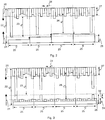
- the power interaction between HS and DCH service is shown Figure 2 , in which the HS power is denoted 20 and the DCH power 21.
- the total available power is denoted 22.
- the mean value of the HS power and the mean value of the DCH power are denoted 27 and 28 respectively.
- the HS operation area is represented with 23 and the unused power is shown as 26.
- the DCH TTI denoted with 25, is 20 ms, e.g. DCH Circuit switched (CS) speech
- the OLPC execution period is 20 ms and the ILPC is performed once per slot.
- both the HS-SCCH and HS-DSCH power are adjusted once per TTI, denoted with 24, i.e., 3 time slots.
- the ILPC frequency is higher than that of the HS-SCCH and HS-DSCH power adjustment, the ILPC could not effectively combat the interference peak in the first time slot of the HS TTI 24 when a sudden large HS power is allocated and sometimes could not be fast enough to combat the HS interference in the following 2 consecutive slots. That's because the sudden HS power increase (in dB) could be several times as the ILPC up step (in dB). This means that the probability of DCH block error occurring is much higher when a sudden high HS pulse (clear from fig.
- the target SIR is increased in a large step (shown with small arrows pointing upwards), while when a block for the UE is right, the target SIR is decreased in a much smaller step (shown with small arrows pointing downwards). Even though such kind of high HS pulse may happen at a very low frequency, the OLPC adjusts the target SIR for DCH services to a relatively high level in order to reach the BLER target. Afterwards, for most HS TTIs 24 with very low HS Tx power, the SIR target for most DCH users is much higher than necessary, which is obviously a power waste.
- US 2002/0105923 discloses a method for pre-emptively protecting mobile units within a wireless communication system from interference caused by sudden high speed data transmission within the system. The method includes detecting an imminent high speed data transmission in at least one particular cell of the system.
- it is an objective with the present invention to provide an improved method of efficiently utilizing radio resources in a communication network comprising a communication network node communicating with one or more user equipments over a radio interface, wherein at least two communication services are provided on said radio interface, each having a certain amount of power allocated in an interactively way.
- Another objective with the present invention is to provide an improved communication network node arranged to efficiently utilize radio resources in a communication network and to communicate with one or more user equipments over a radio interface, wherein at least two communication services are provided on said radio interface, each having a certain amount of power allocated in an interactively way.
- a still further objective with the present invention is to provide an improved computer-readable medium of efficiently utilizing radio resources in a communication network comprising a communication network node communicating with one or more user equipments over a radio interface, wherein at least two communication services are provided on said radio interface, each having a certain amount of power allocated in an interactively way.
- the interaction is minimized by pre-adjusting the DCH power based on the prediction of the HS pulse. And, thus, the unnecessarily high DCH power level caused by HS power fluctuation can be reduced, which results in the decrease of average non-HS power and therefore more available power for HS services.
- the interaction is minimized by improving the outer loop power control.
- the unnecessarily high DCH SIR target can be quickly adjusted to the required level after HS pulse disappears, which results in the lower power waste for DCH users.
- the interaction is minimized by decreasing the peak to average power ratio caused by HS power fluctuation.
- the required QoS of HS services can be reached.
- Both the inter-cell and intra-cell interference are decreased.
- the QoS trade-off between HS and DCH service is also partly controlled by the dynamic adjustment of the HS power limit.
- the interaction is minimized by pre-adjusting the DCH power based on the prediction of the HS pulse and decreasing the peak to average power ratio caused by HS power fluctuation.
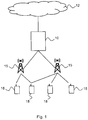
- FIG. 1 depicts a communication system such as a WCDMA communication system including a Radio Access Network (RAN), such as the UMTS Terrestrial Radio Access Network (UTRAN) architecture, comprising at least one Radio Base Station (RBS) (or Node B) 15 (two are shown in figure 1 ) connected to one or more Radio Network Controllers (RNCs) 10.
- the RAN is connected to a Core network (CN) 12.
- the RAN and the CN 12 provide communication and control for a plurality of user equipments (UE) 18 that each uses downlink (DL) channels and uplink (UL) channels.
- DL downlink
- UL uplink
- the RBS 15 transmits to each user equipment 18 at respective power level.
- the user equipments 18 transmit data to the RBS 15 at respective power level.
- the communication system is herein described as a WCDMA communication system.
- the skilled person realizes that the inventive method and arrangement works very well on other communication systems as well.
- the present invention relates to a combined HS (first communication service) and DCH (second communication service) scenario and discloses a method and an arrangement of efficiently utilizing radio resources in a communication network, comprising a communication network node, such as a radio base station 15, communicating with one or more user equipments 18 over a radio interface, wherein at least two communication services, i.e. DCH and HS, are provided on said radio interface, each having a certain amount of power allocated in an interactively way.
- the method comprises the step of minimizing said interaction between said at least two communication services when allocating power to said at least two communication services.
- FIG. 3 A first preferred embodiment of minimizing the interaction between the DCH and the HS services according to the present invention is shown in figure 3 , in which the HS power is denoted 20 and the DCH power 21.
- the total available power is denoted 22.
- the mean values of the HS power and the DCH power are denoted 27 and 28 respectively.
- the HS operation area is represented with 23 and the unused power is shown as 26.
- the HS TTI is denoted 24 and the DCH TTI is denoted 25.
- Reference number 28 shows the mean value of the DCH power when no action has been taken, i.e. according to prior art, while the mean value of the DCH power when the first preferred embodiment of the present invention has been used is shown with 31 and, thus 32 shows the saved DCH power.
- the coming HS pulse is combated by pre-adjusting the DCH power based on the prediction of the HS pulse so that the sudden HS power increase does not result in an obvious increase of the error probability for the DCH data block.
- P' DPCH(k),next is the Tx power for DPCH k after the pre-adjustment.
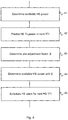
- B is the pre-adjustment factor for HS pulse combating, which can be determined, for example, in the following way, also shown in figure 4 :
- P tot is the total available cell power.
- P HS available,next is the available HS power in the next HS TTI without the DCH power pre-adjustment.
- P Hs,next is the total HS Tx power in the next HS TTI without the DCH power pre-adjustment.
- P' HS available,next is the available HS power in the next HS TTI based on the pre-adjusted DCH power.
- P CCH is the total Tx power for common control channel.
- P HS,curr is the HS Tx power in the current HS TTI.
- P nonHS.curr is the non-HS Tx power in the current HS TTI.
- N is the number of DCH channels.
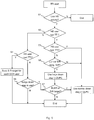
- the OLPC is improved.
- the SIR target is adjusted to the necessary level quickly after the high HS pulse disappears.
- this method works well with low HS traffic load of the low-activity HS services.
- the very high HS pulse is rare. Hence it is resource wasteful from the power perspective to stay at a very high SIR target for a relatively long time by using the conventional jump algorithm after the high HS pulse disappears.
- FIG. 6 A third preferred embodiment of minimizing the interaction between the DCH and the HS services is shown in Figure 6 , in which the HS power is denoted 20 and the DCH power 21.
- the total available power is denoted 22.
- the mean values of the HS power and the DCH power are denoted 27 and 28 respectively.
- the HS operation area is represented with 23 and the unused power is shown as 26.
- the HS TTI is denoted 24 and the DCH TTI is denoted 25.
- Reference number 28 shows the mean value of the DCH power when no action has been taken, i.e. according to prior art, while the mean value of the DCH power when the third preferred embodiment of the present invention has been used is shown with 61 and, thus, 62 shows the saved DCH power.
- the peak to average power ratio is decreased, shown as 63, so that the sudden high HS power pulse does not happen.
- P HS,limit 64 a dynamic power limit for HS services
- the DCH service can reach the BLER target with a much lower target SIR, which results in a lower average DCH power 61.
- the required HS power can be used as the HS power limit.
- An exemplifying procedure to evaluate the Hs power limit P HS,limit for each HS priority class, shown in figure 7 is as follows:
- T HS limit is the period of HS power limit adjustment.
- ⁇ up is the up step and ⁇ down is the down step for P HS,limit adjustment.
- the delay threshold T Delay_thres is determined by the delay requirement of HS services and therefore can be different for different HS priority classes.
- the delay value t Delay less than T Delay_thres means that more than enough HS power is reserved for this priority class and therefore P HS,limit for this priority class should be decreased. Otherwise, the delay value t Delay larger than T Delay_thres means the target ratio of HS users with this priority can not be reached so that the HS power limit for this priority class should be increased.
- P HS,limit is a kind of jump algorithm.
- a fourth preferred embodiment of the present invention the first and the third preferred embodiments of the present invention are combined. That is, the DCH power is pre-adjusted as described above in relation to the first preferred embodiment and a dynamic HS power limit is set and evaluated as described above in relation to the third preferred embodiment.
- the invention can additionally be considered to be embodied entirely within any form of computer-readable storage medium, an example of which is shown in fig. 8 and denoted 80, having stored therein an appropriate set of instructions for use by or in connection with an instruction-execution system, apparatus or device, such as computer-based system, processor-containing system, or other system that can fetch instructions from a medium and execute the instructions.
- a "computer-readable medium” 30 can be any means that can contain, store, communicate, propagate, or transport the program for use by or in connection with the instruction-execution system, apparatus or device.
- the computer-readable medium 30 can be, for example but not limited to, an electronic, magnetic, optical, electromagnetic, infrared, or semiconductor system, apparatus, device or propagation medium.
- the computer-readable medium include an electrical connection having one or more wires, a portable computer diskette, a random access memory (RAM), a read only memory (ROM), an erasable programmable read only memory (EPROM or Flash memory), an optical fibre, and a portable compact disc read only memory (CD-ROM).
- RAM random access memory
- ROM read only memory
- EPROM or Flash memory erasable programmable read only memory
- CD-ROM compact disc read only memory
- a computer-readable medium containing computer program for efficiently utilizing radio resources in a communication network, comprising a communication network node communicating with one or more user equipments over a radio interface, wherein at least two communication services are provided on said radio interface, each having a certain amount of power allocated in an interactively way, is provided wherein the computer program performs the step of minimizing said interaction between said at least two communication services when allocating power to said at least two communication services.
Landscapes
- Engineering & Computer Science (AREA)
- Computer Networks & Wireless Communication (AREA)
- Signal Processing (AREA)
- Mobile Radio Communication Systems (AREA)
Claims (11)
- Procédé d'utilisation efficace de ressources radio dans un réseau de communication, comprenant un noeud de réseau de communication communiquant avec un ou plusieurs équipements utilisateurs sur une interface radio, dans lequel au moins deux services de communication sont fournis sur ladite interface radio, chacun ayant une certaine quantité de puissance allouée d'une manière interactive, caractérisé en ce que le procédé comprend l'étape de :- minimisation d'une interaction de puissance entre lesdits au moins deux services de communication lors de l'allocation de puissance auxdits au moins deux services de communication, l'étape de minimisation de ladite interaction comprenant en outre les étapes de :- détermination de la puissance disponible pour un premier service de communication dans un intervalle de transmission en temps suivant dudit premier service de communication, le premier service de communication étant un service à grande vitesse, HS ;- prédiction d'une puissance de transmission dudit premier service de communication dans l'intervalle de transmission en temps suivant sur la base de ladite puissance disponible déterminée ;- détermination d'un facteur de pré-ajustement sur la base de ladite puissance de transmission prédite ;- utilisation dudit facteur afin de pré-ajuster la puissance dudit second service de communication, le second service de communication étant un service de un canal dédié, DCH ;- détermination de la puissance disponible pour ledit premier service de communication lorsque ladite puissance dudit second service de communication a été pré-ajustée ;- planification des utilisateurs dudit premier service de communication sur la base de ladite puissance disponible pour ledit premier service de communication lorsque ladite puissance dudit second service de communication a été pré-ajustée.
- Procédé selon la revendication 1, caractérisé en ce que l'étape de minimisation de ladite interaction comprend l'étape de :- amélioration d'un contrôle de puissance en boucle externe dans ledit réseau de communication en ajustant une cible de rapport signal/interférence pour ledit second service de communication à un niveau prédéterminé après disparition d'une crête de puissance dans ledit premier service de communication.
- Procédé selon la revendication 2, caractérisé en ce que le procédé comprend en outre les étapes de :- vérification du fait qu'il existe des utilisateurs de premier service de communication planifiés dans un dernier intervalle de transmission en temps ;- en présence d'utilisateurs de premier service de communication planifiés dans le dernier intervalle de transmission en temps et d'utilisateurs de premier service de communication planifiés dans l'intervalle de transmission en temps suivant, au moyen d'une étape de réduction de puissance normale dans ledit contrôle de puissance en boucle externe ;- en présence d'utilisateurs de premier service de communication planifiés dans le dernier intervalle de transmission en temps mais en l'absence d'utilisateurs de premier service de communication planifiés dans l'intervalle de transmission en temps suivant et, si pour chaque utilisateur dudit second service de communication, une cible de rapport signal/interférence courante est plus grande qu'une cible de rapport signal/interférence d'origine, utilisation d'une étape de réduction de puissance plus importante que la normale dans ledit contrôle de puissance en boucle externe ;- en présence d'utilisateurs de premier service de communication planifiés dans le dernier intervalle de transmission en temps, mais en l'absence d'utilisateurs de premier service de communication planifiés dans l'intervalle de transmission en temps suivant et, si pour chaque utilisateur dudit second service de communication, la cible de rapport signal/interférence courante est plus petite que la cible de rapport signal/interférence d'origine, utilisation de l'étape de réduction de puissance normale dans ledit contrôle de puissance en boucle externe ;- en l'absence d'utilisateurs de premier service de communication planifiés dans le dernier intervalle de transmission en temps, mais en présence d'utilisateurs de premier service de communication planifiés dans l'intervalle de transmission en temps suivant, sauvegarde pour chaque utilisateur d'une cible de rapport signal/interférence dudit second service de communication ;- en l'absence d'utilisateurs de premier service de communication planifiés dans le dernier intervalle de transmission en temps et en l'absence d'utilisateurs de premier service de communication planifiés dans l'intervalle de transmission en temps suivant, vérification du fait qu'une étape de réduction de puissance plus importante que la normale est déjà utilisée dans ledit contrôle de puissance en boucle externe ;- si une étape de réduction de puissance plus importante que la normale est déjà utilisée dans ledit contrôle de puissance en boucle externe et qu'une erreur de bloc se produit ou que la cible signal/interférence dudit second service de communication est atteinte, utilisation de l'étape de réduction de puissance normale dans ledit contrôle de puissance en boucle externe.
- Procédé selon la revendication 1, caractérisé en ce que l'étape de minimisation de ladite interaction comprend l'étape de :- réduction d'un rapport de puissance crête à moyenne en définissant une limite de puissance dynamique pour ledit premier service de communication.
- Procédé selon la revendication 4, caractérisé en ce que ladite limite de puissance est ajustée périodiquement sur la base d'un état de canal de transmission et d'une charge dudit premier service de communication.
- Procédé selon la revendication 1, caractérisé en ce que l'étape de minimisation de ladite interaction comprend les étapes de :- prédiction du moment où une crête de puissance se produira dans ledit premier service de communication ;- pré-ajustement de la puissance dudit second service de communication sur la base de ladite prédiction ; et- réduction d'un rapport de puissance crête à moyenne en définissant une limite de puissance dynamique pour ledit premier service de communication.
- Noeud de réseau de communication (15) conçu pour utiliser de manière efficace les ressources radio dans un réseau de communication et pour communiquer avec un ou plusieurs équipements utilisateurs (18) sur une interface radio, dans lequel au moins deux services de communication sont fournis sur ladite interface radio, chacun ayant une certaine quantité de puissance allouée d'une manière interactive, caractérisé en ce que le noeud de réseau de communication (15) comprend un moyen pour minimiser une interaction de puissance entre lesdits au moins deux services de communication lors de l'allocation de puissance auxdits au moins deux services de communication, dans lequel ledit moyen pour minimiser ladite interaction comprend :un moyen pour déterminer la puissance disponible pour un premier service de communication dans l'intervalle de transmission en temps suivant dudit premier service de communication, le premier service de communication étant un service à grande vitesse, HS ;un moyen pour prédire une puissance de transmission dudit premier service de communication dans l'intervalle de transmission en temps suivant sur la base de ladite puissance disponible déterminée ;un moyen pour déterminer un facteur de pré-ajustement sur la base de ladite puissance de transmission prédite ;un moyen pour utiliser ledit facteur afin de pré-ajuster la puissance d'un second service de communication, le second service de communication étant un service de canal dédié, DCH ;un moyen pour déterminer la puissance disponible pour ledit premier service de communication lorsque ladite puissance dudit second service de communication a été pré-ajustée ;un moyen pour planifier les utilisateurs dudit premier service de communication sur la base de ladite puissance disponible pour ledit premier service de communication lorsque ladite puissance dudit second service de communication a été pré-ajustée.
- Noeud de réseau de communication (15) selon la revendication 7, caractérisé en ce que ledit moyen de minimisation de ladite interaction comprend :- un moyen pour améliorer un contrôle de puissance en boucle externe dans ledit réseau de communication conçu pour ajuster une cible de rapport signal/interférence pour ledit second service de communication à un niveau prédéterminé après disparition d'une crête de puissance dans ledit premier service de communication.
- Noeud de réseau de communication (15) selon la revendication 7, caractérisé en ce que ledit moyen de minimisation de ladite interaction comprend :- un moyen pour réduire un rapport de puissance crête à moyenne conçu pour définir une limite de puissance dynamique pour ledit premier service de communication.
- Noeud de réseau de communication (15) selon la revendication 7, caractérisé en ce que ledit moyen pour minimiser ladite interaction comprend :- un moyen pour prédire le moment où une crête de puissance se produira dans ledit premier service de communication ;- un moyen pour pré-ajuster la puissance dudit second service de communication sur la base de ladite prédiction ; et- un moyen pour réduire un rapport de puissance crête à moyenne conçu pour définir une limite de puissance dynamique pour ledit premier service de communication.
- Support lisible par ordinateur contenant un programme informatique pour utiliser de manière efficace les ressources radio dans un réseau de communication, comprenant un noeud de réseau de communication communiquant avec un ou plusieurs équipements utilisateurs sur une interface radio, dans lequel au moins deux services de communication sont fournis sur ladite interface radio, chacun ayant une certaine quantité de puissance allouée d'une manière interactive, caractérisé en ce que le programme informatique effectue l'étape de :- minimisation de l'interaction de puissance entre lesdits au moins deux services de communication lors de l'affectation de puissance auxdits au moins deux services de communication,- détermination de la puissance disponible pour ledit premier service de communication dans l'intervalle de transmission en temps suivant d'un premier service de communication, le premier service de communication étant un service à grande vitesse, HS ;- prédiction d'une puissance de transmission dudit premier service de communication dans l'intervalle de transmission en temps suivant sur la base de ladite puissance disponible déterminée ;- détermination d'un facteur de pré-ajustement sur la base de ladite puissance de transmission prédite ;- utilisation dudit facteur afin de pré-ajuster la puissance d'un second service de communication, le second service de communication étant un service de canal dédié, DCH ;- détermination de la puissance disponible pour ledit premier service de communication lorsque ladite puissance dudit second service de communication a été pré-ajustée ;- planification d'utilisateurs dudit premier service de communication sur la base de ladite puissance disponible pour ledit premier service de communication lorsque ladite puissance dudit second service de communication a été pré-ajustée.
Applications Claiming Priority (1)
| Application Number | Priority Date | Filing Date | Title |
|---|---|---|---|
| PCT/SE2006/050490 WO2008063107A1 (fr) | 2006-11-20 | 2006-11-20 | Procédé pour contrer une interférence de transmissions haut débit |
Publications (3)
| Publication Number | Publication Date |
|---|---|
| EP2084825A1 EP2084825A1 (fr) | 2009-08-05 |
| EP2084825A4 EP2084825A4 (fr) | 2014-08-27 |
| EP2084825B1 true EP2084825B1 (fr) | 2018-05-09 |
Family
ID=39429951
Family Applications (1)
| Application Number | Title | Priority Date | Filing Date |
|---|---|---|---|
| EP06824559.6A Not-in-force EP2084825B1 (fr) | 2006-11-20 | 2006-11-20 | Procédé pour contrer une interférence de transmissions haut débit |
Country Status (4)
| Country | Link |
|---|---|
| US (1) | US8208423B2 (fr) |
| EP (1) | EP2084825B1 (fr) |
| CN (1) | CN101542932B (fr) |
| WO (1) | WO2008063107A1 (fr) |
Families Citing this family (17)
| Publication number | Priority date | Publication date | Assignee | Title |
|---|---|---|---|---|
| MY148784A (en) * | 2007-04-30 | 2013-05-31 | Ericsson Telefon Ab L M | Method and arrangement in communication networks |
| JP5565082B2 (ja) | 2009-07-31 | 2014-08-06 | ソニー株式会社 | 送信電力決定方法、通信装置及びプログラム |
| JP5531767B2 (ja) | 2009-07-31 | 2014-06-25 | ソニー株式会社 | 送信電力制御方法、通信装置及びプログラム |
| JP5429036B2 (ja) | 2009-08-06 | 2014-02-26 | ソニー株式会社 | 通信装置、送信電力制御方法、及びプログラム |
| JP5353812B2 (ja) * | 2009-08-12 | 2013-11-27 | ソニー株式会社 | 通信制御方法、通信装置、及びプログラム |
| US9871544B2 (en) | 2013-05-29 | 2018-01-16 | Microsoft Technology Licensing, Llc | Specific absorption rate mitigation |
| US10893488B2 (en) | 2013-06-14 | 2021-01-12 | Microsoft Technology Licensing, Llc | Radio frequency (RF) power back-off optimization for specific absorption rate (SAR) compliance |
| US10044095B2 (en) | 2014-01-10 | 2018-08-07 | Microsoft Technology Licensing, Llc | Radiating structure with integrated proximity sensing |
| US9813997B2 (en) | 2014-01-10 | 2017-11-07 | Microsoft Technology Licensing, Llc | Antenna coupling for sensing and dynamic transmission |
| US9769769B2 (en) | 2014-06-30 | 2017-09-19 | Microsoft Technology Licensing, Llc | Detecting proximity using antenna feedback |
| US9785174B2 (en) * | 2014-10-03 | 2017-10-10 | Microsoft Technology Licensing, Llc | Predictive transmission power control for back-off |
| US9871545B2 (en) | 2014-12-05 | 2018-01-16 | Microsoft Technology Licensing, Llc | Selective specific absorption rate adjustment |
| US10013038B2 (en) | 2016-01-05 | 2018-07-03 | Microsoft Technology Licensing, Llc | Dynamic antenna power control for multi-context device |
| US10461406B2 (en) | 2017-01-23 | 2019-10-29 | Microsoft Technology Licensing, Llc | Loop antenna with integrated proximity sensing |
| US10224974B2 (en) | 2017-03-31 | 2019-03-05 | Microsoft Technology Licensing, Llc | Proximity-independent SAR mitigation |
| US10917856B2 (en) * | 2018-09-07 | 2021-02-09 | Parallel Wireless, Inc. | Statistical projection for controlling BLER |
| WO2022084376A1 (fr) * | 2020-10-22 | 2022-04-28 | Telefonaktiebolaget Lm Ericsson (Publ) | Commande de puissance pour canaux multiples et hiérarchisation de puissance |
Family Cites Families (18)
| Publication number | Priority date | Publication date | Assignee | Title |
|---|---|---|---|---|
| US6360079B2 (en) * | 1997-02-12 | 2002-03-19 | Interdigital Technology Corporation | Global channel power control to minimize spillover in a wireless communication environment |
| FI102703B1 (fi) * | 1997-03-27 | 1999-01-29 | Nokia Telecommunications Oy | Kanavan allokointimenetelmä |
| US6278701B1 (en) * | 1998-07-10 | 2001-08-21 | Verizon Laboratories Inc. | Capacity enhancement for multi-code CDMA with integrated services through quality of services and admission control |
| JP2003520550A (ja) * | 2000-01-17 | 2003-07-02 | サムスン エレクトロニクス カンパニー リミテッド | 非同期符号分割多重接続通信システムの逆方向同期伝送方式に対する直交符号割り当て装置及び方法 |
| CN1157881C (zh) | 2000-11-07 | 2004-07-14 | 华为技术有限公司 | 一种移动通信系统中负载平衡预处理的方法 |
| EP1223769B1 (fr) * | 2001-01-13 | 2010-10-06 | Samsung Electronics Co., Ltd. | Procédé et appareil de commande de puissance pour un système de communication à accès multiple à large bande à repartition par code utilisant un schema d'accès pour paquets descendants à grande vitesse |
| US7061891B1 (en) * | 2001-02-02 | 2006-06-13 | Science Applications International Corporation | Method and system for a remote downlink transmitter for increasing the capacity and downlink capability of a multiple access interference limited spread-spectrum wireless network |
| US6781969B2 (en) * | 2001-02-08 | 2004-08-24 | Motorola, Inc. | Preemptive power-up method for protecting system users from sudden high speed data |
| KR100892312B1 (ko) * | 2002-01-05 | 2009-04-08 | 엘지전자 주식회사 | 이동 통신 시스템에서 하향공유제어채널 전력 제어 방법 |
| JP3980029B2 (ja) * | 2002-06-13 | 2007-09-19 | ノキア コーポレイション | チャネル化コード及び電力の適応確保のための方法、システム、及びネットワークエンティティ |
| TWI237459B (en) * | 2002-10-17 | 2005-08-01 | Interdigital Tech Corp | Power control for communications systems utilizing high speed shared channels |
| DE602004032430D1 (de) * | 2003-03-26 | 2011-06-09 | Interdigital Tech Corp | Drahtloses mehrzellenkommunikationssystem und verfahren zur verwaltung der betriebsmittelleistung zur bereitstellung von schnellen abwärtsstreckenpaketzugangsdiensten |
| US20040213185A1 (en) * | 2003-04-25 | 2004-10-28 | Seong-Jun Oh | System and method of controlling forward link transmit power |
| US7197327B2 (en) * | 2004-03-10 | 2007-03-27 | Interdigital Technology Corporation | Adjustment of target signal-to-interference in outer loop power control for wireless communication systems |
| FR2869496B1 (fr) * | 2004-04-26 | 2006-08-11 | Nortel Networks Ltd | Procede de controle de puissance d'emission sur des canaux de communication et station de base pour la mise en oeuvre du procede |
| EP1825629B1 (fr) * | 2004-12-17 | 2013-03-06 | Telefonaktiebolaget L M Ericsson (Publ) | Commande de niveau de puissance pour acces par paquets de canal partage en liaison descendante haut debit |
| US20060203724A1 (en) * | 2005-03-08 | 2006-09-14 | Donna Ghosh | Multi-carrier, multi-flow, reverse link medium access control for a communication system |
| US7408895B2 (en) * | 2005-04-20 | 2008-08-05 | Interdigital Technology Corporation | Method and apparatus for scheduling transmissions via an enhanced dedicated channel |
-
2006
- 2006-11-20 CN CN2006800564277A patent/CN101542932B/zh not_active Expired - Fee Related
- 2006-11-20 WO PCT/SE2006/050490 patent/WO2008063107A1/fr not_active Ceased
- 2006-11-20 US US12/513,952 patent/US8208423B2/en active Active
- 2006-11-20 EP EP06824559.6A patent/EP2084825B1/fr not_active Not-in-force
Non-Patent Citations (1)
| Title |
|---|
| None * |
Also Published As
| Publication number | Publication date |
|---|---|
| EP2084825A4 (fr) | 2014-08-27 |
| US20100067419A1 (en) | 2010-03-18 |
| WO2008063107A1 (fr) | 2008-05-29 |
| CN101542932A (zh) | 2009-09-23 |
| CN101542932B (zh) | 2012-11-21 |
| US8208423B2 (en) | 2012-06-26 |
| EP2084825A1 (fr) | 2009-08-05 |
Similar Documents
| Publication | Publication Date | Title |
|---|---|---|
| US8208423B2 (en) | Method and arrangement for efficiently utilizing radio resources in a communication system | |
| CN100499917C (zh) | 分组通信系统、分组通信方法、基站、移动站、控制装置 | |
| EP2314108B1 (fr) | Positionnement de décalage de puissance de référence adaptatif sur la base de conditions système | |
| US8687576B2 (en) | Dynamic bandwidth allocation control in a multi-access radio communication system | |
| US7983687B2 (en) | Signal to interference ratio error as a load instability indicator for load control in cellular systems | |
| US8583163B2 (en) | Transport format combination selecting method, wireless communication system, and mobile station | |
| US8045527B2 (en) | Load estimation for a cell in a wireless network | |
| US8559999B2 (en) | Channel quality prediction in HSDPA systems | |
| JP2009527140A (ja) | 連続接続性送信における適応プリアンブル長 | |
| US20050208960A1 (en) | Apparatus and a method for distributing a transmission power in a cellular communications network | |
| US20100182940A1 (en) | User Terminal Power Shortage Indication | |
| EP1796331A1 (fr) | Appareil et procédé pour le contrôle d'admission d'appel | |
| US20090154400A1 (en) | Radio network controlling method, radio communication system and radio network controller | |
| US20060019672A1 (en) | Transmitting data in a wireless network | |
| KR20050044168A (ko) | 이동통신 시스템에서 단말의 데이터 레이트 스케쥴링 장치및 방법 | |
| US20060135189A1 (en) | Method of controlling a received signal strength target in a wireless communication system | |
| US20050135289A1 (en) | Apparatus and method for data rate transmission of user equipment in mobile communication system | |
| KR20050119619A (ko) | 이동통신 시스템에서 향상된 상향링크 전용 채널의효율적인 스케쥴링 방법 및 장치 | |
| US8259756B2 (en) | Method and arrangement in a mobile telecommunication network | |
| US8301954B2 (en) | Method and arrangement in a communication network system | |
| Zan et al. | Fair and Power-Efficient Channel-Dependent Scheduling for CDMA Packet Networks. | |
| HK1106884A (en) | Transport format combination selecting method, wireless communication system, and mobile station |
Legal Events
| Date | Code | Title | Description |
|---|---|---|---|
| PUAI | Public reference made under article 153(3) epc to a published international application that has entered the european phase |
Free format text: ORIGINAL CODE: 0009012 |
|
| 17P | Request for examination filed |
Effective date: 20090408 |
|
| AK | Designated contracting states |
Kind code of ref document: A1 Designated state(s): AT BE BG CH CY CZ DE DK EE ES FI FR GB GR HU IE IS IT LI LT LU LV MC NL PL PT RO SE SI SK TR |
|
| RIN1 | Information on inventor provided before grant (corrected) |
Inventor name: HU, RONG Inventor name: WANG, HAI Inventor name: LIU, JINHUA |
|
| DAX | Request for extension of the european patent (deleted) | ||
| A4 | Supplementary search report drawn up and despatched |
Effective date: 20140730 |
|
| RIC1 | Information provided on ipc code assigned before grant |
Ipc: H04B 7/005 20060101AFI20140724BHEP Ipc: H04W 52/36 20090101ALI20140724BHEP Ipc: H04W 52/22 20090101ALI20140724BHEP Ipc: H04W 52/34 20090101ALI20140724BHEP Ipc: H04W 52/12 20090101ALI20140724BHEP Ipc: H04W 52/16 20090101ALI20140724BHEP |
|
| GRAP | Despatch of communication of intention to grant a patent |
Free format text: ORIGINAL CODE: EPIDOSNIGR1 |
|
| STAA | Information on the status of an ep patent application or granted ep patent |
Free format text: STATUS: GRANT OF PATENT IS INTENDED |
|
| INTG | Intention to grant announced |
Effective date: 20171219 |
|
| GRAS | Grant fee paid |
Free format text: ORIGINAL CODE: EPIDOSNIGR3 |
|
| GRAA | (expected) grant |
Free format text: ORIGINAL CODE: 0009210 |
|
| STAA | Information on the status of an ep patent application or granted ep patent |
Free format text: STATUS: THE PATENT HAS BEEN GRANTED |
|
| AK | Designated contracting states |
Kind code of ref document: B1 Designated state(s): AT BE BG CH CY CZ DE DK EE ES FI FR GB GR HU IE IS IT LI LT LU LV MC NL PL PT RO SE SI SK TR |
|
| REG | Reference to a national code |
Ref country code: GB Ref legal event code: FG4D |
|
| REG | Reference to a national code |
Ref country code: CH Ref legal event code: EP Ref country code: AT Ref legal event code: REF Ref document number: 998448 Country of ref document: AT Kind code of ref document: T Effective date: 20180515 |
|
| REG | Reference to a national code |
Ref country code: IE Ref legal event code: FG4D |
|
| REG | Reference to a national code |
Ref country code: DE Ref legal event code: R096 Ref document number: 602006055372 Country of ref document: DE |
|
| REG | Reference to a national code |
Ref country code: NL Ref legal event code: MP Effective date: 20180509 |
|
| REG | Reference to a national code |
Ref country code: LT Ref legal event code: MG4D |
|
| PG25 | Lapsed in a contracting state [announced via postgrant information from national office to epo] |
Ref country code: BG Free format text: LAPSE BECAUSE OF FAILURE TO SUBMIT A TRANSLATION OF THE DESCRIPTION OR TO PAY THE FEE WITHIN THE PRESCRIBED TIME-LIMIT Effective date: 20180809 Ref country code: FI Free format text: LAPSE BECAUSE OF FAILURE TO SUBMIT A TRANSLATION OF THE DESCRIPTION OR TO PAY THE FEE WITHIN THE PRESCRIBED TIME-LIMIT Effective date: 20180509 Ref country code: SE Free format text: LAPSE BECAUSE OF FAILURE TO SUBMIT A TRANSLATION OF THE DESCRIPTION OR TO PAY THE FEE WITHIN THE PRESCRIBED TIME-LIMIT Effective date: 20180509 Ref country code: ES Free format text: LAPSE BECAUSE OF FAILURE TO SUBMIT A TRANSLATION OF THE DESCRIPTION OR TO PAY THE FEE WITHIN THE PRESCRIBED TIME-LIMIT Effective date: 20180509 Ref country code: LT Free format text: LAPSE BECAUSE OF FAILURE TO SUBMIT A TRANSLATION OF THE DESCRIPTION OR TO PAY THE FEE WITHIN THE PRESCRIBED TIME-LIMIT Effective date: 20180509 |
|
| PG25 | Lapsed in a contracting state [announced via postgrant information from national office to epo] |
Ref country code: NL Free format text: LAPSE BECAUSE OF FAILURE TO SUBMIT A TRANSLATION OF THE DESCRIPTION OR TO PAY THE FEE WITHIN THE PRESCRIBED TIME-LIMIT Effective date: 20180509 Ref country code: GR Free format text: LAPSE BECAUSE OF FAILURE TO SUBMIT A TRANSLATION OF THE DESCRIPTION OR TO PAY THE FEE WITHIN THE PRESCRIBED TIME-LIMIT Effective date: 20180810 Ref country code: LV Free format text: LAPSE BECAUSE OF FAILURE TO SUBMIT A TRANSLATION OF THE DESCRIPTION OR TO PAY THE FEE WITHIN THE PRESCRIBED TIME-LIMIT Effective date: 20180509 |
|
| REG | Reference to a national code |
Ref country code: AT Ref legal event code: MK05 Ref document number: 998448 Country of ref document: AT Kind code of ref document: T Effective date: 20180509 |
|
| PG25 | Lapsed in a contracting state [announced via postgrant information from national office to epo] |
Ref country code: EE Free format text: LAPSE BECAUSE OF FAILURE TO SUBMIT A TRANSLATION OF THE DESCRIPTION OR TO PAY THE FEE WITHIN THE PRESCRIBED TIME-LIMIT Effective date: 20180509 Ref country code: PL Free format text: LAPSE BECAUSE OF FAILURE TO SUBMIT A TRANSLATION OF THE DESCRIPTION OR TO PAY THE FEE WITHIN THE PRESCRIBED TIME-LIMIT Effective date: 20180509 Ref country code: SK Free format text: LAPSE BECAUSE OF FAILURE TO SUBMIT A TRANSLATION OF THE DESCRIPTION OR TO PAY THE FEE WITHIN THE PRESCRIBED TIME-LIMIT Effective date: 20180509 Ref country code: AT Free format text: LAPSE BECAUSE OF FAILURE TO SUBMIT A TRANSLATION OF THE DESCRIPTION OR TO PAY THE FEE WITHIN THE PRESCRIBED TIME-LIMIT Effective date: 20180509 Ref country code: DK Free format text: LAPSE BECAUSE OF FAILURE TO SUBMIT A TRANSLATION OF THE DESCRIPTION OR TO PAY THE FEE WITHIN THE PRESCRIBED TIME-LIMIT Effective date: 20180509 Ref country code: CZ Free format text: LAPSE BECAUSE OF FAILURE TO SUBMIT A TRANSLATION OF THE DESCRIPTION OR TO PAY THE FEE WITHIN THE PRESCRIBED TIME-LIMIT Effective date: 20180509 Ref country code: RO Free format text: LAPSE BECAUSE OF FAILURE TO SUBMIT A TRANSLATION OF THE DESCRIPTION OR TO PAY THE FEE WITHIN THE PRESCRIBED TIME-LIMIT Effective date: 20180509 |
|
| PGFP | Annual fee paid to national office [announced via postgrant information from national office to epo] |
Ref country code: DE Payment date: 20181128 Year of fee payment: 13 |
|
| REG | Reference to a national code |
Ref country code: DE Ref legal event code: R097 Ref document number: 602006055372 Country of ref document: DE |
|
| PG25 | Lapsed in a contracting state [announced via postgrant information from national office to epo] |
Ref country code: IT Free format text: LAPSE BECAUSE OF FAILURE TO SUBMIT A TRANSLATION OF THE DESCRIPTION OR TO PAY THE FEE WITHIN THE PRESCRIBED TIME-LIMIT Effective date: 20180509 |
|
| PGFP | Annual fee paid to national office [announced via postgrant information from national office to epo] |
Ref country code: FR Payment date: 20181127 Year of fee payment: 13 Ref country code: GB Payment date: 20181127 Year of fee payment: 13 |
|
| PLBE | No opposition filed within time limit |
Free format text: ORIGINAL CODE: 0009261 |
|
| STAA | Information on the status of an ep patent application or granted ep patent |
Free format text: STATUS: NO OPPOSITION FILED WITHIN TIME LIMIT |
|
| 26N | No opposition filed |
Effective date: 20190212 |
|
| PG25 | Lapsed in a contracting state [announced via postgrant information from national office to epo] |
Ref country code: SI Free format text: LAPSE BECAUSE OF FAILURE TO SUBMIT A TRANSLATION OF THE DESCRIPTION OR TO PAY THE FEE WITHIN THE PRESCRIBED TIME-LIMIT Effective date: 20180509 |
|
| REG | Reference to a national code |
Ref country code: CH Ref legal event code: PL |
|
| PG25 | Lapsed in a contracting state [announced via postgrant information from national office to epo] |
Ref country code: MC Free format text: LAPSE BECAUSE OF FAILURE TO SUBMIT A TRANSLATION OF THE DESCRIPTION OR TO PAY THE FEE WITHIN THE PRESCRIBED TIME-LIMIT Effective date: 20180509 Ref country code: LU Free format text: LAPSE BECAUSE OF NON-PAYMENT OF DUE FEES Effective date: 20181120 |
|
| REG | Reference to a national code |
Ref country code: BE Ref legal event code: MM Effective date: 20181130 |
|
| REG | Reference to a national code |
Ref country code: IE Ref legal event code: MM4A |
|
| PG25 | Lapsed in a contracting state [announced via postgrant information from national office to epo] |
Ref country code: LI Free format text: LAPSE BECAUSE OF NON-PAYMENT OF DUE FEES Effective date: 20181130 Ref country code: CH Free format text: LAPSE BECAUSE OF NON-PAYMENT OF DUE FEES Effective date: 20181130 |
|
| PG25 | Lapsed in a contracting state [announced via postgrant information from national office to epo] |
Ref country code: IE Free format text: LAPSE BECAUSE OF NON-PAYMENT OF DUE FEES Effective date: 20181120 |
|
| PG25 | Lapsed in a contracting state [announced via postgrant information from national office to epo] |
Ref country code: BE Free format text: LAPSE BECAUSE OF NON-PAYMENT OF DUE FEES Effective date: 20181130 |
|
| PG25 | Lapsed in a contracting state [announced via postgrant information from national office to epo] |
Ref country code: TR Free format text: LAPSE BECAUSE OF FAILURE TO SUBMIT A TRANSLATION OF THE DESCRIPTION OR TO PAY THE FEE WITHIN THE PRESCRIBED TIME-LIMIT Effective date: 20180509 |
|
| PG25 | Lapsed in a contracting state [announced via postgrant information from national office to epo] |
Ref country code: PT Free format text: LAPSE BECAUSE OF FAILURE TO SUBMIT A TRANSLATION OF THE DESCRIPTION OR TO PAY THE FEE WITHIN THE PRESCRIBED TIME-LIMIT Effective date: 20180509 |
|
| REG | Reference to a national code |
Ref country code: DE Ref legal event code: R119 Ref document number: 602006055372 Country of ref document: DE |
|
| PG25 | Lapsed in a contracting state [announced via postgrant information from national office to epo] |
Ref country code: CY Free format text: LAPSE BECAUSE OF FAILURE TO SUBMIT A TRANSLATION OF THE DESCRIPTION OR TO PAY THE FEE WITHIN THE PRESCRIBED TIME-LIMIT Effective date: 20180509 Ref country code: HU Free format text: LAPSE BECAUSE OF FAILURE TO SUBMIT A TRANSLATION OF THE DESCRIPTION OR TO PAY THE FEE WITHIN THE PRESCRIBED TIME-LIMIT; INVALID AB INITIO Effective date: 20061120 |
|
| PG25 | Lapsed in a contracting state [announced via postgrant information from national office to epo] |
Ref country code: IS Free format text: LAPSE BECAUSE OF FAILURE TO SUBMIT A TRANSLATION OF THE DESCRIPTION OR TO PAY THE FEE WITHIN THE PRESCRIBED TIME-LIMIT Effective date: 20180909 |
|
| GBPC | Gb: european patent ceased through non-payment of renewal fee |
Effective date: 20191120 |
|
| PG25 | Lapsed in a contracting state [announced via postgrant information from national office to epo] |
Ref country code: FR Free format text: LAPSE BECAUSE OF NON-PAYMENT OF DUE FEES Effective date: 20191130 Ref country code: GB Free format text: LAPSE BECAUSE OF NON-PAYMENT OF DUE FEES Effective date: 20191120 Ref country code: DE Free format text: LAPSE BECAUSE OF NON-PAYMENT OF DUE FEES Effective date: 20200603 |