EP2084959B1 - Viehstall mit natürlicher Lüftung - Google Patents
Viehstall mit natürlicher Lüftung Download PDFInfo
- Publication number
- EP2084959B1 EP2084959B1 EP09001198A EP09001198A EP2084959B1 EP 2084959 B1 EP2084959 B1 EP 2084959B1 EP 09001198 A EP09001198 A EP 09001198A EP 09001198 A EP09001198 A EP 09001198A EP 2084959 B1 EP2084959 B1 EP 2084959B1
- Authority
- EP
- European Patent Office
- Prior art keywords
- shed
- accommodation
- livestock
- ventilation
- manure
- Prior art date
- Legal status (The legal status is an assumption and is not a legal conclusion. Google has not performed a legal analysis and makes no representation as to the accuracy of the status listed.)
- Not-in-force
Links
- 230000004308 accommodation Effects 0.000 title claims abstract 28
- 244000144972 livestock Species 0.000 title claims abstract 26
- 238000009423 ventilation Methods 0.000 title claims abstract 23
- 238000000034 method Methods 0.000 claims abstract 6
- 244000144977 poultry Species 0.000 claims abstract 2
- 210000003608 fece Anatomy 0.000 claims 4
- 239000010871 livestock manure Substances 0.000 claims 4
- 238000000926 separation method Methods 0.000 claims 2
- 241001465754 Metazoa Species 0.000 abstract 1
- 238000005399 mechanical ventilation Methods 0.000 abstract 1
- 230000008092 positive effect Effects 0.000 abstract 1
- 230000036642 wellbeing Effects 0.000 abstract 1
Images





Classifications
-
- A—HUMAN NECESSITIES
- A01—AGRICULTURE; FORESTRY; ANIMAL HUSBANDRY; HUNTING; TRAPPING; FISHING
- A01K—ANIMAL HUSBANDRY; AVICULTURE; APICULTURE; PISCICULTURE; FISHING; REARING OR BREEDING ANIMALS, NOT OTHERWISE PROVIDED FOR; NEW BREEDS OF ANIMALS
- A01K1/00—Housing animals; Equipment therefor
- A01K1/0041—Rotary, round or circular animal barns
-
- A—HUMAN NECESSITIES
- A01—AGRICULTURE; FORESTRY; ANIMAL HUSBANDRY; HUNTING; TRAPPING; FISHING
- A01K—ANIMAL HUSBANDRY; AVICULTURE; APICULTURE; PISCICULTURE; FISHING; REARING OR BREEDING ANIMALS, NOT OTHERWISE PROVIDED FOR; NEW BREEDS OF ANIMALS
- A01K1/00—Housing animals; Equipment therefor
- A01K1/0047—Air-conditioning, e.g. ventilation, of animal housings
-
- A—HUMAN NECESSITIES
- A01—AGRICULTURE; FORESTRY; ANIMAL HUSBANDRY; HUNTING; TRAPPING; FISHING
- A01K—ANIMAL HUSBANDRY; AVICULTURE; APICULTURE; PISCICULTURE; FISHING; REARING OR BREEDING ANIMALS, NOT OTHERWISE PROVIDED FOR; NEW BREEDS OF ANIMALS
- A01K31/00—Housing birds
- A01K31/22—Poultry runs ; Poultry houses, including auxiliary features, e.g. feeding, watering, demanuring
-
- F—MECHANICAL ENGINEERING; LIGHTING; HEATING; WEAPONS; BLASTING
- F24—HEATING; RANGES; VENTILATING
- F24F—AIR-CONDITIONING; AIR-HUMIDIFICATION; VENTILATION; USE OF AIR CURRENTS FOR SCREENING
- F24F11/00—Control or safety arrangements
- F24F11/0001—Control or safety arrangements for ventilation
Definitions
- the present invention relates to a livestock accommodation which is provided with a shed, and in particular to a livestock accommodation for keeping poultry.
- livestock accommodations are already known, see e.g. US-A-1658663 and GB-A-1223268 .
- Known livestock accommodations generally consist of a shed, or a number of sheds, in which livestock is kept.
- an outside accommodation is provided in which the animals can stay for a determined period of time.
- This outside accommodation is usually separate from the livestock accommodation and can consist of a piece of land or meadow where the animals can eat, move and so on.
- infectious diseases such as for instance avian influenza. This creates a conflict between the well-being of animals on the one hand and public health in general on the other.
- a fan is here arranged in the shed which draws in air from the outside environment and blows it into the shed. The air can leave the shed via a ventilation opening.
- a second fan can be provided which blows air from the shed to the outside.
- the present invention has for its object to provide a livestock accommodation wherein the above stated problems do not occur, or at least do so to lesser extent.
- Such a livestock accommodation comprises a shed extending in radial direction relative to a central hall.
- the shed is provided with a first ventilation opening which is in contact with the central hall and a second ventilation opening which is in contact with the air outside the shed.
- the central hall is provided with a plurality of controllable third ventilation openings which are in contact with the outside air and which are distributed substantially uniformly along an outer periphery of the central hall.
- Such a livestock accommodation provides the option of natural ventilation of a shed. This can be achieved by closing third ventilation openings which are directed into the wind and opening ventilation openings directed away from the wind.
- the flow profile of the air around the central hall creates a suction force in the ventilation openings directed away from the wind, the so-called chimney effect, which draws air out of the central hall.
- This air flows out of the shed via the first ventilation opening(s). Inside the shed fresh air is drawn in from outside via the second ventilation opening(s).
- the livestock accommodation therefore comprises an anemometer as well as a control unit connected to this meter.
- the control unit is connected to said controllable third ventilation openings and comprises a control for the purpose of obtaining natural ventilation, wherein the control comprises the functions of closing controllable third ventilation openings which are directed into the wind and opening controllable third ventilation openings directed away from the wind.
- the anemometer is not coupled to the control unit, but wherein the measured wind direction and/or speed is entered into the control unit, is also possible, but does not fall within the scope of the claimed invention.
- the livestock accommodation comprises a plurality of sheds as described above.
- the sheds are herein placed such that they extend radially relative to the central hall.
- the central hall can hereby also serve to combine varying services and techniques.
- the central hall can serve as central discharge for eggs and/or manure.
- the eggs come for instance from the sheds and are transported from these sheds to the central hall where a central processing can take place. This does away with the necessity of collecting and/or processing the eggs separately in each shed. This also results in a more efficient livestock accommodation.
- the heat of the air drawn in by the natural ventilation is preferably reused.
- the central hall comprises a fan for drawing in outside air in addition to a heat exchanger for exchanging heat between the indrawn outside air and air coming from a shed.
- the air from the shed which is heated by the animals, can therefore be used to heat the indrawn outside air.
- This heat can be used in various ways.
- the livestock accommodation comprises a manure storage device, also referred to as manure drying system, which is preferably placed in or around the central hall and which is adapted to store manure from a shed, wherein the manure storage device comprises an air supply for supplying the indrawn outside air and/or air coming from a shed to the stored manure.
- the costs of manure disposal are related to the weight of the manure. It is therefore recommended to extract as much moisture as possible from the manure.
- the above mentioned indrawn outside air and/or air coming from a shed are heated. Blowing this warm air through the manure dries it, whereby the weight of the manure decreases.
- a shed comprises a fourth ventilation opening for controlling the airflow of the indrawn outside air to the shed.
- the indrawn outside air which is preferably heated by the heat exchanger, is fed back to the shed, optionally in order to heat it.
- This air generally has a lower air humidity than the air already present in the shed. This feedback can be particularly advantageous when the temperature of the outside air is considerably lower than the desired temperature in the shed.
- the above-mentioned air from a shed for the purpose of drying manure is preferably air comprising a mixture of indrawn air heated by the heat exchanger and fed back to the shed by a fourth ventilation opening and air heated in the shed.
- This latter air consists mainly of air drawn in by means of the chimney effect through a second ventilation opening.
- At least one ventilation opening from the group consisting of the first, second and fourth ventilation openings can preferably be controlled by the control unit. It is particularly advantageous that all ventilation openings are controllable. A good balance can hereby be achieved between, among other factors, the air flow rate, the manure heating or manure drying and the shed heating.
- a shed comprises one or more temperature meters which are connected to the control unit, wherein the control unit is adapted to control at least one of the first, second, third and/or fourth ventilation openings for the purpose of obtaining a preset temperature in the shed. It is thus possible to regulate ventilation and temperature inside a shed, and in particular independently of each other. Use can be made here of information about the outside air, originating for instance from a weather station. The desired conditions can be achieved more quickly using this information.
- the above-mentioned anemometer can be included in such a weather station.
- a shed For the purpose of stimulating the natural ventilation it is advantageous when a shed is provided with a roof which increases in height in a direction toward the central hall. Because warm air rises, a natural flow toward the hall is obtained. A further favourable effect is obtained by placing the first ventilation opening close to the roof of the shed.
- an advantageous arrangement of the livestock accommodation can be obtained when sheds of the plurality of sheds are separated from each other and wherein an intermediate space comprises an outside accommodation for livestock. It is possible to use the outside accommodation as day accommodation and the corresponding sheds as night accommodation.
- a possible embodiment can consist of sheds which are substantially bar-shaped and which extend radially relative to the central hall.
- the space created as a result can be used as outside accommodation for animals, and in particular for the animals which are generally accommodated in one of the adjacent sheds.
- Such a space can possibly serve as grass pasture for cows and/or sheep or a space for foraging chickens.
- a shed is provided with a wall which forms a separation between the shed and the outside accommodation, and wherein the wall can be opened substantially in its entirety, for instance in that it is slidable or can be rolled up. When closed, this wall preferably isolates the shed from the outside accommodation. It must be noted that the wall can also consist of doors which can be opened. Both options can relate to the wall as a whole or only to a part thereof. Such a preferably insulated wall can also serve as second ventilation opening, this doing away with the necessity for separate ventilation openings in addition to said wall.
- the outside accommodation is preferably provided on a side remote from the central hall with an air-transmitting opening.
- Windbreak netting is a particularly advantageous material here for closing the opening, because the air transmission is retained and the wind, which may blow onto the netting, is broken by this latter, for instance by reducing the air speed, whereby the living conditions in the outside accommodation remain pleasant.
- the outside accommodation is preferably also covered.
- a light-transmitting covering In order to keep the living conditions inside the outside accommodation as natural as possible it is possible to opt for a light-transmitting covering. It is also possible to opt for a covering which is substantially watertight. It is in any case advantageous when the covering is closed to the extent that excreta from other animals located outside the outside accommodation, such as for instance birds flying over, cannot penetrate into the outside accommodation. Possible infection by these animals is hereby prevented.
- a further development of the outside accommodation comprises a fenced outlying area adjacent thereto, for instance the edge of a wood.
- the above-mentioned windbreak netting can here form a separation between the outside accommodation and the outlying area. It is advantageous if the windbreak netting can be at least partially opened, for instance in that it can be at least partially rolled up or in that a door is incorporated therein.
- the animals can hereby be kept in the outside accommodation at the time of an infectious disease, such as for instance avian influenza or swine fever.
- a livestock accommodation as discussed above is particularly suitable for keeping poultry. It is also advantageous if the outside accommodation is provided with artificial grass. For instance in the case of chickens an outside accommodation is hereby obtained which is easy to clean and which also ensures optimal foraging behaviour.
- the present invention also provides a method for ventilating a livestock accommodation as described above, which is characterized in that this method comprises the steps of closing controllable third ventilation openings which are directed into the wind and opening controllable third ventilation openings which are directed away from the wind.
- the method further comprises the step of controlling the airflow in a shed by means of controlling at least one ventilation opening of the group consisting of the first, second and fourth ventilation openings.
- Another or further preferred method comprises of measuring the temperature in a shed, determining a difference between the measured temperature and a predetermined temperature and modifying said control of the airflow subject to the difference.
- FIG. 1B Shown in the left-hand shed in figure 1B is an air tube 35 provided with a mechanical fan. Using this fan warm air can be extracted from the shed, see arrow 37, and can then be used to dry the manure. Such a tube can be arranged in each shed. Also shown are temperature meters 36 which provide information about the temperature to a control unit (not shown) . This control unit, which likewise receives wind information from an anemometer) can bring about the desired temperature and/or ventilation in the shed by controlling the different ventilation openings 4,6,7 and/or 16 (see figure 2B ).
- Ventilation openings 7 are distributed regularly along the outer periphery of central hall 3, it is possible to achieve such a chimney effect irrespective of the wind direction.
- FIGS 2A and 2B show further developments of the general embodiments of figures 1A and 1B .
- Shown here is an interior view of central hall 3.
- a manure storage device 11 for the manure coming from sheds 2 is arranged in this hall 3.
- the manure is transported on conveyor belts 12 from shed 2 to manure storage device 11.
- a cost-saving can be achieved by drying the manure by making use of indrawn outside air preferably heated by the heat exchanger.
- This outside air is drawn into central hall 3 by a fan 13.
- a heat exchanger 15 Before the air is carried by means of a pipe system 14 to sheds 2 and/or manure storage device 11, it is heated by a heat exchanger 15, this heat exchange being provided between the warm air coming from sheds 2 and the outside air.
- the heated air can also be fed back to sheds 2 in order to maintain the temperature in sheds 2 in cold weather.
- This airflow can be controlled by means of fourth ventilation openings 16 or by the heat exchanger 15 itself.
- the fourth ventilation opening is embodied as a controllable screen. It is also possible to use the warm air from the shed to dry the manure. This air can optionally be mixed with the air heated by the heat exchanger and fed back into the shed. An example of such a device is obtained when the fourth ventilation opening is combined with an air tube as shown in figure 1B .
- FIG. 3 shows an embodiment of a livestock accommodation wherein use is made of the space available between sheds 2.
- the central hall 3 is connected to five sheds 2.
- Outside accommodations 17 are arranged between these sheds.
- One opening 18 is used for the supply and removal of goods to and from central hall 3.
- Two outside accommodations 17' are arranged adjacently of opening 18.
- a more efficient method can be obtained by combining a plurality of sheds 2 and a central hall 3. If the sheds are used for instance to keep poultry, eggs that are laid can be removed to the central hall. It is thus hereby possible to suffice with one device for packing the eggs, this in contrast to one device per shed if the sheds are not connected to each other.
- sheds 2 are provided with roofs which increase in height in a direction toward central hall 3. Warm air which rises in the shed will therefore flow in the direction of central hall 3 due to the form of the roof.
- the sheds 2 in figure 1 are further substantially identical. This simplifies the construction of livestock accommodation 1.
- FIGs 4A and 4B show detail views of an embodiment of a shed and an outside accommodation of the livestock accommodation of figure 3 .
- Each shed is provided with a wall 21 which can be opened substantially in its entirety.
- the wall 21 can be rolled up in guides 22.
- the livestock in shed 2 hereby gains access to outside accommodation 17.
- wall 21 likewise has the function of second ventilation opening.
- Outside accommodation 17 is covered. Animals are hereby protected from extreme rainfall and/or diseases which are for instance spread by excreta from for instance birds. It is also possible to adapt the covering such that it can be opened, for instance by means of a roller mechanism. Such techniques are known.
- the outside accommodation is bounded by windbreak netting 23.
- Closable openings 24, for instance a door opening, are incorporated in windbreak netting 23.
- Animals can enter the natural outlying area through these opening.
- a natural outlying area is here understood to mean an area with natural planting such as trees and bushes. This area can comprise an area of natural origin or it can comprise vegetation planted for this purpose. The opportunity to spend time in such a natural outlying area enhances the well-being of the animals.
- the animals should however remain inside the outside accommodation 17 in the case of infectious diseases such as swine fever or avian influenza.
- Sheds 2 comprise doors 25 so that access to the sheds is made possible for vehicles. It is also recommended to provide the sheds with a lengthwise wall (not shown). This wall divides a shed into two substantially identical parts. The two parts each correspond to another outside accommodation. The animals hereby have the option of choosing a different shed. This also prevents animals walking to sheds adjoining another outside accommodation.
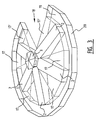
- Figure 5A shows a top view of an embodiment of a manure discharge/storage device 26.
- Device 26 comprises an assembly of a number of conveyor belts 27. These belts are placed increasing in height as shown in the side view of figure 5B .
- Conveyor belts 27 transport manure 28 as according to arrows 29. This manure comes for instance from a conveyor belt 12 which carries manure out of a shed 2 as shown in figure 2A .
- a buffer of manure 28 is obtained with the circular embodiment.
- a separate conveyor belt 30 is incorporated in the device for the purpose of discharging manure 28 out of livestock accommodation 1. This belt 30 can be placed as according to arrow 31 in the conveyor belt assembly. Belt 30 herein collects manure 28 falling from a conveyor belt 27 as shown in figure 5B .
- ventilation containers 32 are provided to which the above discussed indrawn, preferably heated outside air is supplied. These ventilation containers 32 comprise openings through which air can flow through or along the manure 28. Conveyor belts 27 are possibly provided with openings through which the air can flow. The combination of ventilation containers 32 and the conveyor belt assembly results in a particularly advantageous device for the purpose of efficient drying of manure.
- Figure 5C shows a top view of another embodiment of manure storage device 26.
- the individual conveyor belts 27 are here combined to form a continuous manure carousel with preferably one circular platform 27 provided with perforations for passage of air.
- manure is delivered by conveyor belt 12.
- the manure carousel is revolving here. It is otherwise possible for manure to be supplied simultaneously from different sheds. The manure will not generally form a uniform layer.
- a manure unit 33 having a blade which distributes the manure over conveyor belt 12 such that a uniformly thick layer is obtained.
- Manure unit 33 can engage all manure by rotating the manure carousel. Once a homogenous layer has been obtained the manure carousel can be stopped, although this is not essential.
- the warm air can then be blown through the manure.
- this warm air comes from tubes 35, see also figure 1 .
- This air is blown into an aerating container 34. This can be brought to (over)pressure so that the air can be pressed through the manure through the perforations in the platform.
- Feed of manure by conveyor belt 12 can thus take place simultaneously with the discharge of the manure by conveyor belt 30.
- a control can further be provided which tracks which part of the carousel is carrying dried manure and which part is carrying manure that has just been supplied. Such a control can then control manure unit 33 for the purpose of carrying out the correct operation, such as levelling or discharge.
- a carousel When a carousel is completely filled, it can be set into rotation in order to discharge the manure. The thus created empty spaces can herein be simultaneously replenished with fresh manure. A continuous process can likewise be obtained by adjusting the rotation speed to the desired drying time.
- Conveyor belt 12, platform 27 and discharge conveyor 30 are preferably controlled by a control unit which can provide for the required adjustment. This control unit can then be coupled to or incorporated in the above-mentioned control unit for the ventilation. An increased ventilation will after all shorten the drying time, whereby the capacity of the manure carousel will increase.
- the manure carousel is thus placed under shed 2 around central hall 3, see also the sectional view of figure 6 .
- This latter figure also shows that air tube 35 runs through a bend under the manure. Air is supplied from below the manure. The air which is blown through the manure is preferably discharged to the outside.
- Manure unit 33 is further provided with means such as a blade for the purpose of removing the manure from the manure carousel after drying thereof and optionally unloading the manure onto manure conveyor belt 30.
- the manure carousel is once again set into rotation here.
Landscapes
- Life Sciences & Earth Sciences (AREA)
- Environmental Sciences (AREA)
- Zoology (AREA)
- Animal Husbandry (AREA)
- Biodiversity & Conservation Biology (AREA)
- Engineering & Computer Science (AREA)
- Chemical & Material Sciences (AREA)
- Birds (AREA)
- Combustion & Propulsion (AREA)
- Mechanical Engineering (AREA)
- General Engineering & Computer Science (AREA)
- Housing For Livestock And Birds (AREA)
- Medicines Containing Material From Animals Or Micro-Organisms (AREA)
- Ventilation (AREA)
Claims (14)
- Unterbringung (1) für Viehbestand, die eine Halle oder einen Schuppen (2) aufweist, die oder der sich in radialer Richtung relativ zu einer zentralen Halle (3) erstreckt, wobei die Halle oder der Schuppen versehen ist mit:einer ersten Lüftungsöffnung (6), die in Kontakt mit der zentralen Halle ist;einer zweiten Lüftungsöffnung (4), die in Kontakt mit der Luft außerhalb der Halle oder des Schuppens ist;wobei die zentrale Halle mit einer Mehrzahl von steuerbaren dritten Lüftungsöffnungen (7) versehen ist, die mit der Außenluft in Kontakt sind und die im Wesentlichen gleichförmig entlang des äußeren Umfangs der zentralen Halle verteilt sind;dadurch gekennzeichnet, dass die Unterbringung für Viehbestand ein Anemometer und auch eine Steuereinheit aufweist, die mit diesem Messinstrument verbunden sind, welche Steuereinheit mit den dritten steuerbaren Lüftungsöffnungen verbunden ist, und welche Unterbringung für Viehbestand eine Steuerung für den Zweck, natürliche Lüftung zu erhalten, aufweist, wobei die Steuerung die Funktionen aufweist, steuerbare dritte Lüftungsöffnungen zu schließen, die in den Wind gerichtet sind, und steuerbare dritte Lüftungsöffnungen zu schließen, die vom Wind weggerichtet sind.
- Unterbringung für Viehbestand nach Anspruch 1, dadurch gekennzeichnet, dass die Unterbringung für Viehbestand eine Mehrzahl von Hallen oder Schuppen aufweist, wie sie in Anspruch 1 definiert sind.
- Unterbringung für Viehbestand nach Anspruch 2, dadurch gekennzeichnet, dass die zentrale Halle ein Gebläse (13) zum Hereinziehen von Außenluft zusätzlich zu einem Wärmetauscher (15) zum Austauschen von Wärme zwischen der hereingezogenen Außenluft und Luft aufweist, die von einer Halle oder einem Schuppen kommt.
- Unterbringung für Viehbestand nach Anspruch 3, dadurch gekennzeichnet, dass die Unterbringung für Viehbestand eine Dungspeichereinrichtung (11, 26) aufweist, die vorzugsweise in der oder um die zentrale Halle herum angeordnet ist und die dazu ausgebildet ist, Dung von einer Halle oder einem Schuppen zu speichern, wobei die Dungspeichereinrichtung eine Luftzufuhr zum Zuführen der hineingezogenen Außenluft und/oder Luft, die von einer Halle oder einem Schuppen kommt, zu dem gespeicherten Dung aufweist.
- Unterbringung für Viehbestand nach Anspruch 3 oder 4, dadurch gekennzeichnet, dass eine Halle oder ein Schuppen eine vierte Lüftungsöffnung (16) zum Steuern der Luftströmung der hereingezogenen Außenluft zur Halle oder zum Schuppen aufweist.
- Unterbringung für Viehbestand nach Anspruch 5, dadurch gekennzeichnet, dass die vierte Lüftungsöffnung durch die Steuereinheit gesteuert werden kann.
- Unterbringung für Viehbestand nach einem der Ansprüche 1 bis 6, dadurch gekennzeichnet, dass wenigstens eine Lüftungsöffnung von der Lüftungsgruppe, die aus den ersten und zweiten Lüftungsöffnungen besteht, außerdem durch die Steuereinheit gesteuert werden kann.
- Unterbringung für Viehbestand nach einem der Ansprüche 1 bis 7, dadurch gekennzeichnet, dass eine Halle oder ein Schuppen ein oder mehrere Temperaturmessgeräte (36) aufweist, die mit der Steuereinheit verbunden sind, wobei die Steuereinheit dazu ausgebildet ist, wenigstens eine der ersten, zweiten, dritten und/oder vierten Lüftungsöffnungen zum Zweck zu steuern, eine voreingestellte Temperatur in der Halle oder dem Schuppen zu erhalten.
- Unterbringung für Viehbestand nach einem der Ansprüche 2 bis 8, dadurch gekennzeichnet, dass die Hallen oder Schuppen der Mehrzahl von vorzugsweise identischen Hallen oder Schuppen voneinander getrennt sind, und wobei ein Zwischenraum eine Unterbringung im Freien für Viehbestand aufweist, wobei vorzugsweise eine Halle oder ein Schuppen eine Wand (21) aufweist, die eine Trennung zwischen der Halle oder dem Schuppen und der Unterbringung im Freien für Viehbestand bildet, wobei die Wand im Wesentlichen vollständig geöffnet werden kann.
- Unterbringung für Viehbestand nach Anspruch 9, dadurch gekennzeichnet, dass die Unterbringung im Freien abgedeckt ist und an einer Seite entfernt von der zentralen Halle mit windbrechendem Geflecht (23) versehen ist, wobei die Unterbringung im Freien vorzugsweise an ein eingezäuntes natürliches außenliegendes Gebiet angrenzt, wobei das windbrechende Geflecht vorzugsweise die Trennung bildet und wenigstens teilweise geöffnet werden kann.
- Unterbringung für Viehbestand nach einem der Ansprüche 1 bis 10, dadurch gekennzeichnet, dass die Unterbringung für Viehbestand dazu ausgebildet ist, Geflügel zu halten.
- Verfahren zum Lüften einer Unterbringung für Viehbestand nach Anspruch 1, dadurch gekennzeichnet, dass das Verfahren die Schritte aufweist:steuerbare dritte Lüftungsöffnungen zu schließen, die in den Wind gerichtet sind;steuerbare dritte Lüftungsöffnungen zu öffnen, die vom Wind weggerichtet sind.
- Verfahren nach Anspruch 12, das weiter dazu ausgebildet ist, eine Unterbringung für Viehbestand zu lüften, wie sie in Anspruch 5 definiert ist, dadurch gekennzeichnet, dass das Verfahren weiter den Schritt aufweist, die Luftströmung in einer Halle oder einem Schuppen dadurch zu steuern, dass wenigstens eine Lüftungsöffnung der Gruppe gesteuert wird, die aus den ersten, zweiten und vierten Lüftungsöffnungen besteht.
- Verfahren nach Anspruch 13, das weiter die Schritte aufweist, eine Temperatur in einer Halle oder einem Schuppen zu messen, einen Unterschied zwischen der gemessenen Temperatur und einer vorbestimmten Temperatur zu bestimmen und die Steuerung der Luftströmung in Abhängigkeit von diesem Unterschied zu ändern.
Applications Claiming Priority (1)
| Application Number | Priority Date | Filing Date | Title |
|---|---|---|---|
| NL1034968A NL1034968C2 (nl) | 2008-01-29 | 2008-01-29 | Veehouderij met natuurlijke ventilatie. |
Publications (2)
| Publication Number | Publication Date |
|---|---|
| EP2084959A1 EP2084959A1 (de) | 2009-08-05 |
| EP2084959B1 true EP2084959B1 (de) | 2010-11-10 |
Family
ID=39709287
Family Applications (1)
| Application Number | Title | Priority Date | Filing Date |
|---|---|---|---|
| EP09001198A Not-in-force EP2084959B1 (de) | 2008-01-29 | 2009-01-29 | Viehstall mit natürlicher Lüftung |
Country Status (4)
| Country | Link |
|---|---|
| EP (1) | EP2084959B1 (de) |
| AT (1) | ATE487374T1 (de) |
| DE (1) | DE602009000315D1 (de) |
| NL (1) | NL1034968C2 (de) |
Families Citing this family (1)
| Publication number | Priority date | Publication date | Assignee | Title |
|---|---|---|---|---|
| GB2499568A (en) * | 2012-01-20 | 2013-08-28 | Vion Food Group Ltd | Poultry enclosure |
Family Cites Families (4)
| Publication number | Priority date | Publication date | Assignee | Title |
|---|---|---|---|---|
| US1658663A (en) * | 1926-09-22 | 1928-02-07 | Rudolf R Blesie | Ventilator |
| US2039562A (en) * | 1933-05-22 | 1936-05-05 | James Mfg Co | Round ended building |
| GB1223268A (en) * | 1968-10-26 | 1971-02-24 | John Edward Chapple | Improvements in kennels for felines or canines and other like animals |
| US6295765B1 (en) * | 2000-07-14 | 2001-10-02 | Michael H. Busch | Movable shelter |
-
2008
- 2008-01-29 NL NL1034968A patent/NL1034968C2/nl not_active IP Right Cessation
-
2009
- 2009-01-29 AT AT09001198T patent/ATE487374T1/de not_active IP Right Cessation
- 2009-01-29 DE DE602009000315T patent/DE602009000315D1/de active Active
- 2009-01-29 EP EP09001198A patent/EP2084959B1/de not_active Not-in-force
Also Published As
| Publication number | Publication date |
|---|---|
| DE602009000315D1 (de) | 2010-12-23 |
| NL1034968C2 (nl) | 2009-07-30 |
| ATE487374T1 (de) | 2010-11-15 |
| EP2084959A1 (de) | 2009-08-05 |
Similar Documents
| Publication | Publication Date | Title |
|---|---|---|
| EP1898697B1 (de) | Verfahren und gerät zur verminderung von ammoniak, kohlendioxid und pathogenen in hühnerställen | |
| Kettlewell et al. | A review of broiler chicken catching and transport systems | |
| US8490579B2 (en) | Animal shelter structures | |
| US4239020A (en) | House and method for livestock raising | |
| US4151811A (en) | Housing apparatus for animals | |
| CN205124694U (zh) | 林下养鸡的轮牧鸡舍 | |
| CN109874682B (zh) | 一种羊用饲养生产系统 | |
| WO2018002901A1 (en) | Container for hatching of incubated eggs in a poultry house | |
| RU2369092C1 (ru) | Способ содержания кур и устройство для его осуществления | |
| EP2084959B1 (de) | Viehstall mit natürlicher Lüftung | |
| ES3018787T3 (en) | Straw litter, straw litter stall and method for producing a straw litter | |
| CN206658805U (zh) | 一种鸡舍 | |
| EP0965266A1 (de) | Vorrichtung zum Halten von Geflügel. | |
| Bhadauria | Different types of poultry housing system for tropical climate | |
| CN205337204U (zh) | 一种方便通风换气的肉鸡舍 | |
| CN210841141U (zh) | 一种用于养殖蛋鸡的集装箱房舍 | |
| EP1968376B1 (de) | Tierunterkunftsstruktur | |
| RU177368U1 (ru) | Клетка-автомат для птицы | |
| AU2012265581B2 (en) | Animal shelter structure | |
| FI61357C (fi) | Foerfarande foer torkning av faerskt graes och liknande | |
| RU2361394C2 (ru) | Способ содержания домашней птицы | |
| RU2038769C1 (ru) | Передвижной павильон круглогодичного содержания пчел | |
| EP2316263A1 (de) | Hühnerstall und Verfahren zur Aufzucht von Hühnern | |
| CN117941611A (zh) | 一种智慧环保养猪机 | |
| KR20020059299A (ko) | 가축 사육장 |
Legal Events
| Date | Code | Title | Description |
|---|---|---|---|
| PUAI | Public reference made under article 153(3) epc to a published international application that has entered the european phase |
Free format text: ORIGINAL CODE: 0009012 |
|
| AK | Designated contracting states |
Kind code of ref document: A1 Designated state(s): AT BE BG CH CY CZ DE DK EE ES FI FR GB GR HR HU IE IS IT LI LT LU LV MC MK MT NL NO PL PT RO SE SI SK TR |
|
| AX | Request for extension of the european patent |
Extension state: AL BA RS |
|
| 17P | Request for examination filed |
Effective date: 20100121 |
|
| AKX | Designation fees paid |
Designated state(s): AT BE BG CH CY CZ DE DK EE ES FI FR GB GR HR HU IE IS IT LI LT LU LV MC MK MT NL NO PL PT RO SE SI SK TR |
|
| GRAP | Despatch of communication of intention to grant a patent |
Free format text: ORIGINAL CODE: EPIDOSNIGR1 |
|
| GRAS | Grant fee paid |
Free format text: ORIGINAL CODE: EPIDOSNIGR3 |
|
| GRAA | (expected) grant |
Free format text: ORIGINAL CODE: 0009210 |
|
| AK | Designated contracting states |
Kind code of ref document: B1 Designated state(s): AT BE BG CH CY CZ DE DK EE ES FI FR GB GR HR HU IE IS IT LI LT LU LV MC MK MT NL NO PL PT RO SE SI SK TR |
|
| REG | Reference to a national code |
Ref country code: GB Ref legal event code: FG4D |
|
| REG | Reference to a national code |
Ref country code: CH Ref legal event code: EP |
|
| REG | Reference to a national code |
Ref country code: IE Ref legal event code: FG4D |
|
| REF | Corresponds to: |
Ref document number: 602009000315 Country of ref document: DE Date of ref document: 20101223 Kind code of ref document: P |
|
| REG | Reference to a national code |
Ref country code: NL Ref legal event code: T3 |
|
| LTIE | Lt: invalidation of european patent or patent extension |
Effective date: 20101110 |
|
| PG25 | Lapsed in a contracting state [announced via postgrant information from national office to epo] |
Ref country code: NO Free format text: LAPSE BECAUSE OF FAILURE TO SUBMIT A TRANSLATION OF THE DESCRIPTION OR TO PAY THE FEE WITHIN THE PRESCRIBED TIME-LIMIT Effective date: 20110210 Ref country code: LT Free format text: LAPSE BECAUSE OF FAILURE TO SUBMIT A TRANSLATION OF THE DESCRIPTION OR TO PAY THE FEE WITHIN THE PRESCRIBED TIME-LIMIT Effective date: 20101110 |
|
| PG25 | Lapsed in a contracting state [announced via postgrant information from national office to epo] |
Ref country code: BG Free format text: LAPSE BECAUSE OF FAILURE TO SUBMIT A TRANSLATION OF THE DESCRIPTION OR TO PAY THE FEE WITHIN THE PRESCRIBED TIME-LIMIT Effective date: 20110210 Ref country code: CY Free format text: LAPSE BECAUSE OF FAILURE TO SUBMIT A TRANSLATION OF THE DESCRIPTION OR TO PAY THE FEE WITHIN THE PRESCRIBED TIME-LIMIT Effective date: 20101110 Ref country code: LV Free format text: LAPSE BECAUSE OF FAILURE TO SUBMIT A TRANSLATION OF THE DESCRIPTION OR TO PAY THE FEE WITHIN THE PRESCRIBED TIME-LIMIT Effective date: 20101110 Ref country code: FI Free format text: LAPSE BECAUSE OF FAILURE TO SUBMIT A TRANSLATION OF THE DESCRIPTION OR TO PAY THE FEE WITHIN THE PRESCRIBED TIME-LIMIT Effective date: 20101110 Ref country code: AT Free format text: LAPSE BECAUSE OF FAILURE TO SUBMIT A TRANSLATION OF THE DESCRIPTION OR TO PAY THE FEE WITHIN THE PRESCRIBED TIME-LIMIT Effective date: 20101110 Ref country code: SE Free format text: LAPSE BECAUSE OF FAILURE TO SUBMIT A TRANSLATION OF THE DESCRIPTION OR TO PAY THE FEE WITHIN THE PRESCRIBED TIME-LIMIT Effective date: 20101110 Ref country code: SI Free format text: LAPSE BECAUSE OF FAILURE TO SUBMIT A TRANSLATION OF THE DESCRIPTION OR TO PAY THE FEE WITHIN THE PRESCRIBED TIME-LIMIT Effective date: 20101110 Ref country code: PT Free format text: LAPSE BECAUSE OF FAILURE TO SUBMIT A TRANSLATION OF THE DESCRIPTION OR TO PAY THE FEE WITHIN THE PRESCRIBED TIME-LIMIT Effective date: 20110310 Ref country code: IS Free format text: LAPSE BECAUSE OF FAILURE TO SUBMIT A TRANSLATION OF THE DESCRIPTION OR TO PAY THE FEE WITHIN THE PRESCRIBED TIME-LIMIT Effective date: 20110310 Ref country code: HR Free format text: LAPSE BECAUSE OF FAILURE TO SUBMIT A TRANSLATION OF THE DESCRIPTION OR TO PAY THE FEE WITHIN THE PRESCRIBED TIME-LIMIT Effective date: 20101110 |
|
| PG25 | Lapsed in a contracting state [announced via postgrant information from national office to epo] |
Ref country code: GR Free format text: LAPSE BECAUSE OF FAILURE TO SUBMIT A TRANSLATION OF THE DESCRIPTION OR TO PAY THE FEE WITHIN THE PRESCRIBED TIME-LIMIT Effective date: 20110211 |
|
| PG25 | Lapsed in a contracting state [announced via postgrant information from national office to epo] |
Ref country code: EE Free format text: LAPSE BECAUSE OF FAILURE TO SUBMIT A TRANSLATION OF THE DESCRIPTION OR TO PAY THE FEE WITHIN THE PRESCRIBED TIME-LIMIT Effective date: 20101110 Ref country code: ES Free format text: LAPSE BECAUSE OF FAILURE TO SUBMIT A TRANSLATION OF THE DESCRIPTION OR TO PAY THE FEE WITHIN THE PRESCRIBED TIME-LIMIT Effective date: 20110221 Ref country code: CZ Free format text: LAPSE BECAUSE OF FAILURE TO SUBMIT A TRANSLATION OF THE DESCRIPTION OR TO PAY THE FEE WITHIN THE PRESCRIBED TIME-LIMIT Effective date: 20101110 |
|
| PG25 | Lapsed in a contracting state [announced via postgrant information from national office to epo] |
Ref country code: RO Free format text: LAPSE BECAUSE OF FAILURE TO SUBMIT A TRANSLATION OF THE DESCRIPTION OR TO PAY THE FEE WITHIN THE PRESCRIBED TIME-LIMIT Effective date: 20101110 Ref country code: PL Free format text: LAPSE BECAUSE OF FAILURE TO SUBMIT A TRANSLATION OF THE DESCRIPTION OR TO PAY THE FEE WITHIN THE PRESCRIBED TIME-LIMIT Effective date: 20101110 Ref country code: DK Free format text: LAPSE BECAUSE OF FAILURE TO SUBMIT A TRANSLATION OF THE DESCRIPTION OR TO PAY THE FEE WITHIN THE PRESCRIBED TIME-LIMIT Effective date: 20101110 Ref country code: SK Free format text: LAPSE BECAUSE OF FAILURE TO SUBMIT A TRANSLATION OF THE DESCRIPTION OR TO PAY THE FEE WITHIN THE PRESCRIBED TIME-LIMIT Effective date: 20101110 Ref country code: MC Free format text: LAPSE BECAUSE OF NON-PAYMENT OF DUE FEES Effective date: 20110131 |
|
| PLBE | No opposition filed within time limit |
Free format text: ORIGINAL CODE: 0009261 |
|
| STAA | Information on the status of an ep patent application or granted ep patent |
Free format text: STATUS: NO OPPOSITION FILED WITHIN TIME LIMIT |
|
| 26N | No opposition filed |
Effective date: 20110811 |
|
| REG | Reference to a national code |
Ref country code: IE Ref legal event code: MM4A |
|
| REG | Reference to a national code |
Ref country code: DE Ref legal event code: R097 Ref document number: 602009000315 Country of ref document: DE Effective date: 20110811 |
|
| PG25 | Lapsed in a contracting state [announced via postgrant information from national office to epo] |
Ref country code: MT Free format text: LAPSE BECAUSE OF FAILURE TO SUBMIT A TRANSLATION OF THE DESCRIPTION OR TO PAY THE FEE WITHIN THE PRESCRIBED TIME-LIMIT Effective date: 20101110 Ref country code: IT Free format text: LAPSE BECAUSE OF FAILURE TO SUBMIT A TRANSLATION OF THE DESCRIPTION OR TO PAY THE FEE WITHIN THE PRESCRIBED TIME-LIMIT Effective date: 20101110 |
|
| PG25 | Lapsed in a contracting state [announced via postgrant information from national office to epo] |
Ref country code: IE Free format text: LAPSE BECAUSE OF NON-PAYMENT OF DUE FEES Effective date: 20110129 |
|
| PG25 | Lapsed in a contracting state [announced via postgrant information from national office to epo] |
Ref country code: MK Free format text: LAPSE BECAUSE OF FAILURE TO SUBMIT A TRANSLATION OF THE DESCRIPTION OR TO PAY THE FEE WITHIN THE PRESCRIBED TIME-LIMIT Effective date: 20101110 |
|
| PG25 | Lapsed in a contracting state [announced via postgrant information from national office to epo] |
Ref country code: LU Free format text: LAPSE BECAUSE OF NON-PAYMENT OF DUE FEES Effective date: 20110129 |
|
| REG | Reference to a national code |
Ref country code: CH Ref legal event code: PL |
|
| PG25 | Lapsed in a contracting state [announced via postgrant information from national office to epo] |
Ref country code: TR Free format text: LAPSE BECAUSE OF FAILURE TO SUBMIT A TRANSLATION OF THE DESCRIPTION OR TO PAY THE FEE WITHIN THE PRESCRIBED TIME-LIMIT Effective date: 20101110 |
|
| PG25 | Lapsed in a contracting state [announced via postgrant information from national office to epo] |
Ref country code: LI Free format text: LAPSE BECAUSE OF NON-PAYMENT OF DUE FEES Effective date: 20130131 Ref country code: HU Free format text: LAPSE BECAUSE OF FAILURE TO SUBMIT A TRANSLATION OF THE DESCRIPTION OR TO PAY THE FEE WITHIN THE PRESCRIBED TIME-LIMIT Effective date: 20101110 Ref country code: CH Free format text: LAPSE BECAUSE OF NON-PAYMENT OF DUE FEES Effective date: 20130131 |
|
| REG | Reference to a national code |
Ref country code: FR Ref legal event code: PLFP Year of fee payment: 8 |
|
| REG | Reference to a national code |
Ref country code: FR Ref legal event code: PLFP Year of fee payment: 9 |
|
| REG | Reference to a national code |
Ref country code: FR Ref legal event code: PLFP Year of fee payment: 10 |
|
| PGFP | Annual fee paid to national office [announced via postgrant information from national office to epo] |
Ref country code: FR Payment date: 20210125 Year of fee payment: 13 |
|
| PGFP | Annual fee paid to national office [announced via postgrant information from national office to epo] |
Ref country code: DE Payment date: 20210127 Year of fee payment: 13 Ref country code: GB Payment date: 20210128 Year of fee payment: 13 |
|
| PGFP | Annual fee paid to national office [announced via postgrant information from national office to epo] |
Ref country code: NL Payment date: 20220126 Year of fee payment: 14 Ref country code: BE Payment date: 20220127 Year of fee payment: 14 |
|
| REG | Reference to a national code |
Ref country code: DE Ref legal event code: R119 Ref document number: 602009000315 Country of ref document: DE |
|
| GBPC | Gb: european patent ceased through non-payment of renewal fee |
Effective date: 20220129 |
|
| PG25 | Lapsed in a contracting state [announced via postgrant information from national office to epo] |
Ref country code: GB Free format text: LAPSE BECAUSE OF NON-PAYMENT OF DUE FEES Effective date: 20220129 Ref country code: DE Free format text: LAPSE BECAUSE OF NON-PAYMENT OF DUE FEES Effective date: 20220802 |
|
| PG25 | Lapsed in a contracting state [announced via postgrant information from national office to epo] |
Ref country code: FR Free format text: LAPSE BECAUSE OF NON-PAYMENT OF DUE FEES Effective date: 20220131 |
|
| REG | Reference to a national code |
Ref country code: NL Ref legal event code: MM Effective date: 20230201 |
|
| REG | Reference to a national code |
Ref country code: BE Ref legal event code: MM Effective date: 20230131 |
|
| PG25 | Lapsed in a contracting state [announced via postgrant information from national office to epo] |
Ref country code: NL Free format text: LAPSE BECAUSE OF NON-PAYMENT OF DUE FEES Effective date: 20230201 |
|
| PG25 | Lapsed in a contracting state [announced via postgrant information from national office to epo] |
Ref country code: BE Free format text: LAPSE BECAUSE OF NON-PAYMENT OF DUE FEES Effective date: 20230131 |