EP2085683A1 - Lichtemittierendes system - Google Patents
Lichtemittierendes system Download PDFInfo
- Publication number
- EP2085683A1 EP2085683A1 EP07800789A EP07800789A EP2085683A1 EP 2085683 A1 EP2085683 A1 EP 2085683A1 EP 07800789 A EP07800789 A EP 07800789A EP 07800789 A EP07800789 A EP 07800789A EP 2085683 A1 EP2085683 A1 EP 2085683A1
- Authority
- EP
- European Patent Office
- Prior art keywords
- light emitting
- light
- substrate
- reflective structure
- chips
- Prior art date
- Legal status (The legal status is an assumption and is not a legal conclusion. Google has not performed a legal analysis and makes no representation as to the accuracy of the status listed.)
- Withdrawn
Links
Images






Classifications
-
- F—MECHANICAL ENGINEERING; LIGHTING; HEATING; WEAPONS; BLASTING
- F21—LIGHTING
- F21V—FUNCTIONAL FEATURES OR DETAILS OF LIGHTING DEVICES OR SYSTEMS THEREOF; STRUCTURAL COMBINATIONS OF LIGHTING DEVICES WITH OTHER ARTICLES, NOT OTHERWISE PROVIDED FOR
- F21V29/00—Protecting lighting devices from thermal damage; Cooling or heating arrangements specially adapted for lighting devices or systems
- F21V29/50—Cooling arrangements
- F21V29/70—Cooling arrangements characterised by passive heat-dissipating elements, e.g. heat-sinks
- F21V29/74—Cooling arrangements characterised by passive heat-dissipating elements, e.g. heat-sinks with fins or blades
- F21V29/76—Cooling arrangements characterised by passive heat-dissipating elements, e.g. heat-sinks with fins or blades with essentially identical parallel planar fins or blades, e.g. with comb-like cross-section
- F21V29/763—Cooling arrangements characterised by passive heat-dissipating elements, e.g. heat-sinks with fins or blades with essentially identical parallel planar fins or blades, e.g. with comb-like cross-section the planes containing the fins or blades having the direction of the light emitting axis
-
- F—MECHANICAL ENGINEERING; LIGHTING; HEATING; WEAPONS; BLASTING
- F21—LIGHTING
- F21K—NON-ELECTRIC LIGHT SOURCES USING LUMINESCENCE; LIGHT SOURCES USING ELECTROCHEMILUMINESCENCE; LIGHT SOURCES USING CHARGES OF COMBUSTIBLE MATERIAL; LIGHT SOURCES USING SEMICONDUCTOR DEVICES AS LIGHT-GENERATING ELEMENTS; LIGHT SOURCES NOT OTHERWISE PROVIDED FOR
- F21K9/00—Light sources using semiconductor devices as light-generating elements, e.g. using light-emitting diodes [LED] or lasers
-
- F—MECHANICAL ENGINEERING; LIGHTING; HEATING; WEAPONS; BLASTING
- F21—LIGHTING
- F21Y—INDEXING SCHEME ASSOCIATED WITH SUBCLASSES F21K, F21L, F21S and F21V, RELATING TO THE FORM OR THE KIND OF THE LIGHT SOURCES OR OF THE COLOUR OF THE LIGHT EMITTED
- F21Y2115/00—Light-generating elements of semiconductor light sources
- F21Y2115/10—Light-emitting diodes [LED]
-
- H—ELECTRICITY
- H10—SEMICONDUCTOR DEVICES; ELECTRIC SOLID-STATE DEVICES NOT OTHERWISE PROVIDED FOR
- H10H—INORGANIC LIGHT-EMITTING SEMICONDUCTOR DEVICES HAVING POTENTIAL BARRIERS
- H10H20/00—Individual inorganic light-emitting semiconductor devices having potential barriers, e.g. light-emitting diodes [LED]
- H10H20/80—Constructional details
- H10H20/85—Packages
- H10H20/855—Optical field-shaping means, e.g. lenses
-
- H—ELECTRICITY
- H10—SEMICONDUCTOR DEVICES; ELECTRIC SOLID-STATE DEVICES NOT OTHERWISE PROVIDED FOR
- H10H—INORGANIC LIGHT-EMITTING SEMICONDUCTOR DEVICES HAVING POTENTIAL BARRIERS
- H10H20/00—Individual inorganic light-emitting semiconductor devices having potential barriers, e.g. light-emitting diodes [LED]
- H10H20/80—Constructional details
- H10H20/85—Packages
- H10H20/855—Optical field-shaping means, e.g. lenses
- H10H20/856—Reflecting means
-
- H—ELECTRICITY
- H10—SEMICONDUCTOR DEVICES; ELECTRIC SOLID-STATE DEVICES NOT OTHERWISE PROVIDED FOR
- H10W—GENERIC PACKAGES, INTERCONNECTIONS, CONNECTORS OR OTHER CONSTRUCTIONAL DETAILS OF DEVICES COVERED BY CLASS H10
- H10W72/00—Interconnections or connectors in packages
- H10W72/851—Dispositions of multiple connectors or interconnections
- H10W72/874—On different surfaces
- H10W72/884—Die-attach connectors and bond wires
-
- H—ELECTRICITY
- H10—SEMICONDUCTOR DEVICES; ELECTRIC SOLID-STATE DEVICES NOT OTHERWISE PROVIDED FOR
- H10W—GENERIC PACKAGES, INTERCONNECTIONS, CONNECTORS OR OTHER CONSTRUCTIONAL DETAILS OF DEVICES COVERED BY CLASS H10
- H10W74/00—Encapsulations, e.g. protective coatings
Definitions
- the present invention relates to a light emitting system, light emitting apparatus and forming method thereof, and in particular to a light emitting system, light emitting apparatus, which have light emitting rows, and forming method thereof.
- LED Light emitting diodes
- a voltage is applied to a diode to drive a combination of electrons and holes in the diode, and releases energy in the form of a photon.
- fluorescent features may be added into the LED to adjust wavelength (color) or intensity of the emitted light.
- White light LEDs have been widely applied in illumination products. Compared with the conventional incandescent lamps and fluorescent lamps, white light LEDs have advantages of lower heat, lower power consumption, longer operating lifespan, faster response time and smaller size. Therefore, white light LEDs are expected to be used mainstream in illumination products moving forward.
- the conventional light emitting module is formed by a package comprising a single light emitting chip surrounded by a reflective cup.
- the conventional light emitting module prevents the heat dissipation problem experienced by multi-chips on a substrate. Additionally, the conventional light emitting module prevents light emitted from sides of a light emitting chip to be blocked by that of an adjacent light emitting chip, which if not prevented, would reduce light emitting efficiency.
- the conventional light emitting chip package increases the conventional light emitting module dramatically for a plurality of light emitting chips. Because the conventional light emitting chip package can not be reduced, an improved substrate and light emitting module is needed.
- An exemplary embodiment of a light emitting system comprising at least a light emitting module comprises a substrate, and light emitting rows supported by the substrate, wherein each light emitting row has unassembled light emitting chips, surrounded by a reflective structure, and a transparent lens is disposed above the light emitting rows for mixing lights emitted from the light emitting rows to form a light source.
- Each light emitting row may comprise unassembled light emitting chips. Therefore, area of the light emitting module can be reduced. Additionally, each light emitting row may be surrounded by a reflective structure. Therefore, light emitting efficiency of the light emitting module can be improved.
- the light emitting module further comprises a light emitting material layer in at least one of the light emitting rows, covering the unassembled light emitting chips.
- the light emitting material layer further comprises light emitting powders, wherein at least one part of the light emitting powders is clotted without adhesive.
- the light emitting module further comprises a protective layer mounted in the reflective structure, covering the light emitting material layer.
- the light emitting material layer continuously covers the unassembled light emitting chips, and extends to an inner wall of the reflective structure.
- a bottom of the reflective structure is bonded to the substrate by an adhesive, and the adhesive is mixed with light emitting powders.
- a first light emitting chip and an adjacent second light emitting chip of at least one of the light emitting rows have a minimum distance, wherein each of the first light emitting chip and the second light emitting chip comprises at least one side, the minimum distance makes a projection plane of the side of the first light emitting chip and the side of the second light emitting chip substantially not overlapped.
- a first light emitting chip and an adjacent second light emitting chip of at least one of the light emitting rows have a minimum distance, wherein each of the first light emitting chip and the second light emitting chip comprises at least one side, and the minimum distance makes an overlapped portion between a projection plane of the side of the first light emitting chip and the side of the second light emitting chip substantially smaller than 70% of the projection plane of the side of the first light emitting chip.
- a light emitting chip of at least one of the light emitting rows comprises sides, and an incident light emitted by each side of the light emitting chip faces to a side of the reflective structure without being blocked by the other light emitting chips.
- the light emitting chip of at least one of the light emitting rows comprises two vertices on a diagonal, and the two vertices are on an axis parallel to the reflective structure or on a line parallel to the axis.
- the light emitting rows comprise a light emitting row emitting light with greater color temperature and a light emitting row emitting light with lower color temperature.
- At least one light emitting row is covered by a light emitting material layer and emits a first light in the reflective structure, and at least one light emitting row not comprising the light emitting material layer emits a second light, wherein the first light and the second light are mixed by the transparent lens to form a third light.
- the substrate comprises a metal substrate, and the substrate further comprises a metal insulating layer thereon, wherein the metal insulating layer further comprises a patterned conductive layer to electrically connect the light emitting chips, and an interface between the patterned conductive layer and the metal insulating layer does not comprise a sealing layer or an insulating oil film.
- the metal insulating layer has holes, and the holes are covered by an insulating oil film.
- a top surface of the metal insulating layer totally does not comprise the sealing layer or an insulating oil film formed thereon.
- the substrate comprises an aluminum substrate
- the metal insulating layer comprises a porous aluminum oxide layer without a hydro-thermal sealing process or cured material sealing process.
- the patterned conductive layer is formed by curing a silver paste.
- the insulating oil film is formed by methylsilicon oil.
- the substrate is formed by a silicon carbide material.
- a projection plane of the transparent lens facing to the substrate has a polygonal shape.
- a first light emitting row emits a first light with a first color temperature
- a second light emitting emits a second light with a second color temperature
- the first light and the second light are mixed by the transparent lens to form a third light with a third color temperature
- the third color temperature is between the first and second color temperatures.
- the transparent lens comprises rectangular, square, hexagonal or octagonal transparent lens, and the substrate outside of the transparent lens further comprises a circuit region thereon.
- the light emitting module further comprises a frame mounted on the substrate, the frame comprises an inner frame surrounding the light emitting rows serving as a reflective structure, and an outer frame surrounds the circuit region.
- a dimension of the transparent lens is smaller than the frame, and an inner surface of the transparent lens facing to the light emitting rows is a rough surface.
- the light emitting module further comprises a circuit pattern on the substrate to electrically connect to the light emitting chips, and extend to a region of the substrate outside of the reflective structure, and a conductive block on the region of the substrate outside of the reflective structure to electrically connect to the circuit pattern.
- a light emitting system further comprises a shell body having a opening, a supporting plate mounted on the opening of the shell body to form an accommodation space, wherein the light emitting module is mounted on an outer side of the supporting plate by a collapsible method, and the accommodation space comprises a heat dissipation portion therein and is bonded to an inner side of the supporting plate.
- the heat dissipation portion further comprises heat pipes bonded to the inner side of the supporting plate, wherein the supporting plate serves as a heat dissipation plate, and heat slugs bond to the inner side of the supporting plate with the heat pipes embedded therein.
- Another exemplary embodiment of a light emitting system further comprises cooling fins or a cellular ceramic cooling structure bonded to the inner side of the supporting plate and the heat slugs.
- a light emitting system further comprises a heat dissipation device without power bonded on the shell body or in the accommodation space.
- the light emitting row surrounded by at least one the reflective structures comprises at least two light emitting chips.
- one light emitting chip of at least one the light emitting rows comprises two connecting sides, and the two connecting sides face a sidewall of the reflective structure with a tilted angle.
- one light emitting chip of at least one the light emitting rows comprises a long side and a short side, wherein a light emitted from the long side of the light emitting chip substantially faces a sidewall of the reflective structure or faces a sidewall of the reflective structure with a tilted angle, without being blocked by the other light emitting chips.
- One embodiment of a light emitting system of the invention may improve light emitting efficiency and heat dissipation efficiency.
- Embodiments of the invention herein incorporate PCT patent application Ser. number PCT/CN 2007/001966 and PCT patent application Ser. number PCT/CN 2006/003037 by the inventor for references.
- the following embodiments describe a method for fabricating a substrate, and a light emitting module having a reflective structure and a heat dissipation method thereof, and an illumination device constructed by light emitting modules, wherein it is to be understood that the invention is not limited to the disclosed embodiments.
- a region surrounded by the reflective structure indicates a closed structure.
- a region surrounded by the reflective structure may have, for example, a rectangular or square shape, but is not limited to the disclosed embodiments.
- the region surrounded by the reflective structure may have a circular shape.
- the region surrounded by the reflective structure may have an arbitrary shape.
- the reflective structure may collect light emitted form sides of light emitting chips.
- the light emitting chips may be constructed by light emitting diodes, which can emit a specific light.
- the unassembled light emitting chips usually mean that the light emitting chips are not configured with a sealing layer or a reflective cup, or the light emitting chips are bare chips. Additionally, a row of the light emitting rows indicates a space substantially along a specific direction, but is not limited to a longitudinal direction, transverse direction or line direction.
- Light emitting module having a reflective structure
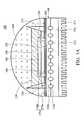
- FIG. 1A shows an embodiment of a light emitting module having a reflective structure of the invention.
- a light emitting module 100 comprises a substrate 102 used to support at least one light emitting row 130.
- Each light emitting row 130 has unassembled light emitting chips 104, for example, light emitting diode chips.
- Each light emitting row 130 is surrounded by a reflective structure 110.
- the reflective structure 110 comprises a row space corresponding to the reflective structure to mount the light emitting chips 104 on the substrate 102 in the row space.
- each light emitting row 130 may further comprise an inner covering layer 108 mounted in the reflective structure 110, covering the light emitting chips 104.
- the unassembled light emitting chips usually mean that the light emitting chips are not configured with a sealing layer or a reflective cup, or the light emitting chips are bare chips. Therefore, previous area required is not needed Because the unassembled light emitting chips and area of the light emitting module may be reduced. Additionally, the light emitting chips may be arranged in many light emitting rows, and each light emitting row may be surrounded by a reflective structure. When compared with each light emitting chip being surrounded by a ring-shaped reflective structure, each light emitting row of one embodiment of the light emitting chips and the reflective structure may have a shorter distance. Also, a light emitted from a light emitting chip may irradiate to the adjacent reflective structure more easily, without being blocked by other light emitting chips.
- At least one light emitting row may optionally comprise a light emitting material layer 106 in at least one of the light emitting rows, covering the light emitting chips 104.
- the light emitting material layer 106 may be constructed of fluorescent powders.
- the light emitting material layer 106 may continuously cover the unassembled light emitting chips 104, and extend to an inner wall of the reflective structure 110.
- at least one part of the light emitting material layer 106 may be clotted without adhesive.
- at least one part of the light emitting material layer 106 may be clotted by Van der Waals force through a baking method.
- the light emitting material layer 106 may totally cover a top surface and sides of the light emitting chips 104 in a light emitting row.
- the light emitting module may further comprise an inner covering layer 108 mounted in the reflective structure 110, covering the light emitting chips 104.
- the inner covering layer 108 may serve as a protective layer.
- a region surrounded by the reflective structure 110 may have a polygonal shape, for example, a rectangular or pentagonal shape. Also, the region surrounded by the reflective structure 110 may have a circular or elliptic shape.
- the inner covering layer (protective layer) 108 may be formed by coating soft polymer materials such as silicone in the reflective structure 110. Also, the inner covering layer (protective layer) 108 may be formed by embedding a hard glass layer, epoxy or other transparent plastic material layers, for example, polycarbonate (PC) or polyethylene (PE), into the reflective structure 110 and be laminated on the light emitting chips 104 or the light emitting material layer 106. The inner covering layer (protective layer) 108 is used to prevent the light emitting material layer 106 from peeling or water vapor permeation.
- PC polycarbonate
- PE polyethylene
- a direction of emitting light from the light emitting chip 104 may be adjusted by the reflective structure 110 using, for example, blocking, reflecting, collecting or focusing methods. Therefore, when the light emitting material layer 106 does not totally cover the sides of the light emitting chips 104, light leakage on the sides of the light emitting chips 104 may not be an issue, and color shift problem of the light emitting chips 104 may be improved.
- the reflective structure 110 may generally comprise a metal material with a reflective plane or a plastic feature with a reflective material layer formed thereon.
- the reflective structure 110 may comprise a plastic feature with Cr, Ni, Ag, ZnF or MgSO 4 formed thereon using a selective electroplating method.
- the heat dissipation efficiency of the light emitting module may be improved if the reflective structure 110 is a material of better heat dissipation efficiency, for example, a metal layer with a reflective plane formed by surface polishing.
- a transparent lens 200 may be disposed above the light emitting rows 130, covering the substrate 102, the light emitting chip 104, the inner covering layer (protective layer) 108 and the reflective structure 110, for mixing lights emitted from the light emitting rows 130 to form a light source.
- the transparent lens 200 may comprise other materials, for example, PC, PE, acrylic, glass, and polycarbonate for light transparency requirements. Light transparency is related to wavelength of light, different wavelengths of light correspond to different light transparencies.
- the transparent lens 200 may also comprise colored transparent lenses to improve light contrast.
- the transparent lens 200 may be closely bonded to an outer frame of the substrate 102 or the reflective structure 110 to form a closed-chamber.
- the closed-chamber may comprise a vacuum atmosphere or be filled with inert gas for stability.
- another inner covering layer may be filled in the closed-chamber above the protective layer 108, further filling in a space above the reflective structure 110 to avoid water vapor permeation.
- the protective layer may be formed after covering the transparent lens 200 on the substrate 102 by filling silicon to cover the light emitting material layer 106 and fill the closed-chamber. Therefore, forming an integral protective layer without an interface.
- an inner side of the reflective structure 110 and a surface of the substrate 102 may have an angle ⁇ between about 0° to 90°, preferably about 45°.
- the reflective structure 110 may comprise metal, for example, stainless steel.
- the reflective structure 110 may comprise plastic or resin, for example, silicon. Additionally, the reflective structure 110 may comprise other materials, for example, PC, PE, acrylic, glass, and polycarbonate.
- a coating layer may be selectively formed on a surface of the reflective structure 110 for reflection.
- no glue is between the fluorescent powders in the light emitting material layer 106. Therefore, the light emitting efficiency may be improved.
- the number of light emitting chips 104 may be defined by requirements. In this embodiment, the chip is a light emitting diode.
- a region surrounded by the reflective structure 110 may have a shape that is defined by requirements, for example, a rectangular shape, circular shape or the like.
- the shape of the reflective structure 110 may be arbitrarily designed, and the shape of the cross section of the reflective structure 110 may comprise of, for example, a trapezoid, triangle, arc or the like.
- a region surrounded by the reflective structure 110 may have arbitrary shapes.
- a stripe-shaped reflective structure 110 may be formed to match space for back light modules.
- the substrate 102 may comprise metal materials, for example, aluminum (Al).
- the substrate 102 may comprise silicon carbide (SiC) or ceramic materials having aluminum oxide (Al 2 O 3 ). Other ceramic materials having better heat conductivity may also be used for the substrate 102.
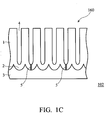
- a metal insulating layer 160 comprising one or more than one exposed holes, for example, a metal oxide layer, may be formed on a surface of the substrate 102 as shown in FIG. 1B .
- the metal insulating layer 160 may be formed by anodizing an aluminum (Al) substrate 3 to form a porous aluminum oxide layer 1 with a thickness of about 30 ⁇ m to 50 ⁇ m.
- the porous aluminum oxide layer 1 may comprise a plurality of cell-shaped holes 4.
- the porous aluminum oxide layer 1 is isolated from the Al substrate 3 by a barrier layer 2.
- the aforementioned formation of the metal insulating layer 160 may reduce heat resistance of the substrate 102 because the metal insulating layer 160 and the substrate 102 are bonded closely. Therefore, heat dissipation efficiency of the substrate 102 may be improved. In other words, the substrate 102 may have better heat dissipation efficiency. Therefore, one embodiment of the substrate 102 of the invention may improve the problem of heat dissipation for many chips disposed on a substrate.
- the sealing process may comprise a hydro-thermal sealing process or a cured material sealing process.
- the hydro-thermal sealing process is performed by immersing the Al substrate into hot water with a temperature above about 90°C for 30 minutes to 60 minutes.
- the aluminum oxide layer of the Al substrate may react with water to form alumina hydrate, sealing the hole of the aluminum oxide layer. Therefore, forming a sealing layer and improving wear resistance of the Al substrate.
- the cured material sealing process is performed by coating a resin or melting a paraffin wax to seal the hole of the aluminum oxide layer. Next, the coated resin or melted paraffin wax is cured to form a sealing layer.
- the aluminum oxide layer after the sealing process is performed, is subjected to a subsequent thermal process, however, the aluminum oxide layer is easily broken because of water evaporation or the stress resulting from the thermal expansion coefficient difference among the sealing layer, the Al substrate and the aluminum oxide layer.
- a break 5 may be formed as shown in FIG. 1C , and a leakage path may occur.
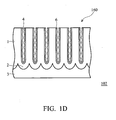
- the anodized substrate is not subjected the hydro-thermal sealing process or cured material sealing process, but immersed in an insulating oil as shown in FIG. 1D before forming a subsequent patterned conductive layer by the thermal process.
- an insulating oil film covers the holes 4, the remaining insulating oil film on a top surface of the substrate is then removed. Therefore, no sealing layer or insulating oil film is above the top surface of the substrate before a patterned conductive layer is formed by the thermal process.
- the insulating oil may have a temperature range from a room temperature to 150°C, preferably below about 300°C.
- a patterned conductive layer 170 is formed on a surface of the metal insulating layer 160 of the substrate 102.
- the patterned conductive layer 170 may comprise a contact pad 170a.
- the contact pad 170a is electrically connected to the light emitting chip 104 through a conductive wire 190.
- the patterned conductive layer 170 serves as a circuit pattern.
- a carrying portion 170b may be selectively formed on the surface of the metal insulating layer 160 to support the light emitting chip 104 so that the height of a bottom of the light emitting chip 104 is aligned with that of the contact pad 170a.
- the light emitting chip 104 may be mounted on the carrying portion 170b by laser soldering the patterned conductive layer 170.
- a metal material may be formed on the metal insulating layer 160 by an electroplating or magnetron sputtering method to form a patterned conductive layer 170.
- a conductive ink may be formed on the metal insulating layer 160 by a screen printing method. Next, the conductive ink may be cured to form a patterned conductive layer 170 on the metal insulating layer 160.
- the conductive ink may comprise a conductor filled thermosetting polymer resin ink, for example, a silver paste composite disclosed in US patent Ser. number 5,859,581 .
- Another embodiment of fabricating the patterned conductive layer 170 comprising a contact pad 170a and a carrying portion 170b, which is closely bonded to the light emitting chip 104 may comprise curing a silver paste using a thermal process with a temperature range from 400°C to 600°C. Generally, adhesion of the silver paste may be improved by mixing in glass powder or resin materials.
- the patterned conductive layer 170 may be formed by the silver paste, which is formed by Indium (In) mixed with silver and glass powder, to improve heat conductivity.
- the thermal process may damage the thin metal insulating layer, resulting in a leakage path. Therefore, the substrate 102 is not only subjected the hydro-thermal sealing process or cured material sealing process before the patterned conductive layer 170 is formed, but also immersed in an insulating oil after a subsequent patterned conductive layer is formed by the thermal process as shown in FIG. 1D .
- the substrate 102 may be immersed in a methyl silicone oil to reduce stress difference between the metal substrate 102 and the metal insulating layer 160 at a high temperature. Meanwhile, the insulating oil may fill into the holes 4 again for substrate insulation.
- the metal insulating layer 160 when the metal insulating layer 160 is formed by anodizing a surface of the substrate 102 (Al substrate 102), and the conductive ink is printed on the metal insulating layer 160 to form a patterned conductive layer 170 by a curing method, the Al substrate 102, with temperature at about 350 °C or below, may be immersed in the insulating oil to reduce stress difference between the metal substrate 102 and the metal insulating layer 160 at a high temperature. Therefore, reducing leakage path of the substrate 102, and improving substrate insulation.
- the patterned conductive layer 170 for example, silver paste
- the aluminum oxide layer 160 for example, Al 2 O 3
- the aluminum oxide layer 160 is broken with penetration of the silver paste and a leakage path may be formed because of internal stress difference between the Al substrate 102 and the aluminum oxide layer 160 during a high temperature (400°C to 600°C) of the silver paste curing process.
- the substrate 102 may be immerged into insulating oil before the substrate has fully cooled down.
- the insulating oil may have a temperature range of about 100°C to 150°C, preferably below about 350°C.
- the cooling procedure of the Al substrate 102 may have a range of about 5 minutes to 30 minutes.
- the insulating oil film remaining on the surface of the substrate 102 may optionally be removed again. Therefore, leaving no sealing layer or insulating oil film on the substrate 102 or between the patterned conductive layer 170 and the metal insulating layer 160. It should be noted that the sealing layer is formed by the sealing process, and not formed by exposing the substrate 102 to the ambient environment.
- the substrate 102 may comprise a heat dissipation portion 180 on a bottom of the substrate 102, accommodating one or more heat pipes 112 for heat dissipation of the light emitting chip 104.
- a surface of the heat dissipation portion 180 may comprise one or more recesses 102a to accommodate the heat pipes 112.
- the light emitting module 100 may further optionally comprise a heat dissipation portion 114.
- the heat dissipation portion 114 is disposed below the substrate 102, wherein the dissipating portion 114 may be closely bonded to the heat pipes 112 and the substrate 102 through corresponding recesses 112a.
- the bottom surface of the heat dissipation portion 114 may comprise cooling fins or cellular ceramic cooling structures 115 to improve heat dissipation efficiency. If the substrate 102 is formed of silicon carbide (SiC), the substrate 102 can co-fire and integrate with the cellular ceramic cooling structures 11, which are also formed of silicon carbide, by sintering.
- a bottom of the reflective structure 110 is bonded on the substrate 102 by an adhesive 150.
- the adhesive 150 has a specific height after curing. Side light emitted from sides of the light emitting chip 104 may be incident into an interface between the reflective structure 110 and the substrate 102. Therefore, it does not matter whether the adhesive 150 is formed of transparent or opaque materials, light incident into the interface between the reflective structure 110 and the substrate 102 will not be reflected by the reflective structure 110. Thus, reducing light emitting efficiency of the light emitting row.
- a plurality of light emitting powders may be mixed into the adhesive 150, for example, a transparent resin.
- the side light emitting into the interface between the reflective structure 110 and the substrate 102 may react with the light emitting powders in the adhesive 150 to generate another light incident into the light emitting row. Therefore, improving light emitting efficiency of the light emitting row.
- FIG. 2B illustrates an arrangement of an embodiment of light emitting chips in light emitting rows.
- the conventional light emitting module is formed by a package of a single light emitting chip surrounded by a reflective cup.
- a multi-chip arrangement is not adopted by the conventional light emitting module because sides of each light emitting chip would block the light emitted from sides of other light emitting chips. Therefore, reducing light emitting efficiency of the light emitting row.
- one embodiment of an arrangement of the unassembled light emitting chips may be used for the aforementioned light emitting module.
- the light emitting module may comprise light emitting rows 130a and 130b. Each of the light emitting rows is surrounded by a reflective structure 110.
- the light emitting row 130b may comprise light emitting chips, for example, light emitting chips 104a and 104b, which are supported by a substrate 102.
- a side of the reflective structure 110 may comprise a reflective plane to reflect light L emitted from the light emitting chips.
- the side 124a of the light emitting chip 104a has a projection plane substantially, but not fully, overlapped with that of the corresponding side 124b of the light emitting chip 104b.
- the side 124a of the light emitting chip 104a has a projection plane substantially not overlapped with that of the corresponding side 124b of the light emitting chip 104b. Therefore, achieving maximum light emitting efficiency.
- the term “substantially not fully overlapped” means that an overlapped portion between the projection plane of the side 124a of the light emitting chip 104a and the corresponding side 124b of the light emitting chip 104b is substantially smaller than 90% of the projection plane of the side 124a of the light emitting chip 104a.
- the term “substantially not overlapped” means that an overlapped portion between the projection plane of the side 124a of the light emitting chip 104a and the corresponding side 124b of the light emitting chip 104b is substantially smaller than 10% of the projection plane of the side 124a of the light emitting chip 104a.
- the light emitting module has better light emitting efficiency if an overlapped portion between the projection plane of the side 124a of the light emitting chip 104a and the corresponding side 124b of the light emitting chip 104b is substantially smaller than 50% of the projection plane of the side 124a of the light emitting chip 104a.
- the light emitting module has the maximum light emitting efficiency if an overlapped portion between the projection plane of the side 124a of the light emitting chip 104a and the corresponding side 124b of the light emitting chip 104b is substantially smaller than 50% of the projection plane of the side 124a of the light emitting chip 104a.
- the overlapped portion between the projection plane of the side 124a of the light emitting chip 104a and the corresponding side 124b of the light emitting chip 104b is substantially smaller than 70% of the projection plane of the side 124a of the light emitting chip 104a.
- the light emitting chip may be formed by a polygonal light emitting chip, for example, a rectangular or hexagonal light emitting chip, which is dependant upon chip cutting technology.
- greater light emitting efficiency can be achieved if an incident light L is emitted from as much sides of the light emitting chip as possible and substantially faces to a side of the reflective structure with a tilted angle and without being blocked by other light emitting chips. Further, maximum light emitting efficiency can be achieved if an incident light L is emitted from every side of the light emitting chip as possible and substantially faces to a side of the reflective structure with a tilted angle and without being blocked by other light emitting chips. Due to high density light emitting chip requirements, however, a portion of the incident light emitted from sides of the light emitting chip may be blocked by the other light emitting chips. And the blocked percentage may be defined as the described percentage of the overlapped portion.
- the two adjacent light emitting chips 104a and 104b may have a minimum distance P, for example, a distance between the two adjacent light emitting chips 104a and 104b.
- the minimum distance P may be adjusted so that a projection plane A1 of the side of the light emitting chip 104b is substantially not overlapped with or not fully overlapped with a projection plane A2 of the side of the light emitting chip 104a.
- the overlapped portion is substantially smaller than 10% of the projection plane, preferably 0%.
- the overlapped portion is substantially smaller than 70% of the projection plane, preferably smaller than 50%.
- an arrangement of the light emitting chips may comprise arranging the light emitting chips with proper spacing, and making incident light from every side of at least two adjacent light emitting chips face a side of the reflective structure with a tilted angle. Therefore, achieving greater light emitting efficiency.
- the light emitting chip 104a may be arranged in a diamond arrangement to avoid the projection planes of the adjacent two light emitting chips to be too overlapped and block emitting light.
- the light emitting chips are polygonal light emitting chips
- the light emitting chips may be arranged in a row with their diagonals, which are respectively formed by extending lines joining two nonadjacent vertices of the light emitting chip, are parallel to the side of the reflective structure 110.
- each of the light emitting chips may comprise two diagonal vertices. And the two vertices of the light emitting chip are on an axis parallel to an inner side of the reflective structure or on a line parallel to the axis.
- the light emitting chip 104a may be disposed by arranging two adjacent sides of the light emitting chip 104a to face the side of the reflective structure with a tilted angle. Therefore, light emitted from the two adjacent sides of the light emitting chip 104a may face the side of a reflective structure. Additionally, when each side of the light emitting chip has different lengths with each other, the light emitting chip may be disposed by arranging the longest side, which emits light with the largest light emitting area, to face the side of the reflective structure or face the side of the reflective structure with a tilted angle.
- the arrangement of the light emitting chips may guide the light emitted from the sides of a light emitting chip to substantially face the reflective plane of the reflective structure without being blocked by other light emitting chips. Therefore, improving light emitting efficiency.
- At least two rows of light emitting chips 130a and 130b are surround by the reflective structure 110 for heat dissipation and the light emitted from one light emitting chip is not blocked by other light emitting chips.
- Number of chips, chip density, brightness or color temperature of the two rows of light emitting chips 130a and 130b may be different.
- the arrangement of a light emitting chip 104e of the two rows of light emitting chips 130a and 130b may be in, for example, dislocation, and are not limited to a side by side or symmetric arrangement.
- adjacent light emitting chips 104a, 104b, 104c and 104d in the two rows of light emitting chips 130a and 130b comprise at least one side.
- a projection plane of a side of the light emitting chip 104b is substantially not overlapped or not fully overlapped with a projection plane of a corresponding side of the light emitting chip 104c or 104d.
- the overlapped portion may be smaller than 10% of the projection plane of a side of the light emitting chip 104b, preferably 0%.
- the overlapped portion may be smaller than 70% of the projection plane of a side of the light emitting chip 104b, preferably 50%.
- embodiments of the arrangement of the light emitting chips as shown in FIG. 2B may also used in embodiments of the arrangement of the light emitting chips as shown in FIG. 2C .
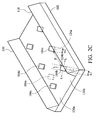
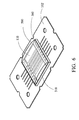
- the light emitting module further comprises a frame 310 mounted on the substrate 102.
- the frame 310 may be integrated with the reflective structure 110 to surround the light emitting rows, for example, the light emitting rows 130a and 130b.
- the surface of the substrate 102 on the sides of the frame 310 may comprise a circuit region 300 thereon for electrical connection between the light emitting chips in each light emitting row and a power.
- FIG. 4 illustrates a diagram of one embodiment of a light emitting module of the invention.
- the frame 310 may comprise an inner frame 310a surrounding the light emitting rows, and an outer frame 310b surrounding the circuit region 300.
- the substrate 102 may be thinned down to form a planar substrate 102' for easier assembly and reduce volume of the light emitting module. Additionally, because one embodiment of the light emitting device is planarized and modulized, the assembly of the light emitting device is improved.
- circuit patterns such as conducting wires 302, which are used to electrically connect to the light emitting chips, may extend to the planar substrate 102' outside of the reflective structure, for example, the substrate 102' outside of the circuit region 300.
- the conducting wires 302 may be electrically connected to a conductive block 301.
- the conductive block 301 may be formed by covering a planar copper or aluminum layer on the conducting wires 302. Alternatively, the conductive block 301 may substitute a portion of the conducting wires 302 to connect to the power more easily and reduce resistance of the conducting wires 302.
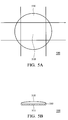
- FIGS. 5A, 5B and 6 illustrate an embodiment of a transparent lens 500 of the invention and assembling method thereof.
- the transparent lens 500 covers the while light emitting rows, mounted on the frame 310 comprising the reflective structure 110.
- a projective plane of the transparent lens 500, which faces to the substrate 102' may serve as a spotlight region,
- the projective plane may comprise a polygon plane, for example, a square, hexagon or octagon plane.
- Each light emitting row may emit uniform light with a circular shape.
- the transparent lens 500 may comprise colored transparent lenses to adjust the color temperature of the emitting light.
- FIGS. 5A and 5B illustrate fabrication of the transparent lens 500.
- the fabrication of the transparent lens 500 comprises providing a circular or elliptic transparent lens.
- the four arc sides 530 are cut and a polygonal transparent lens 510 is left, for example, a rectangular, square or octagonal transparent lens 510.
- the transparent lens 500 may be bond to a bottom transparent layer 550 to avoid cracking if the transparent lens 500 is too thin.
- a projective plane area of the octagonal transparent lens 510 occupies only half or one-third of a projective plane area of an original circular or elliptic transparent lens.
- a hexagonal transparent lens 510 may occupy only one-third to half the area of an original circular transparent lens.
- An additional area may be increased on the substrate 102' to accommodate the circuit region 300.
- an octagonal transparent lens with a smaller size combined with a wider rectangular reflective structure with a larger size a silicon material is put into a vacuum machine to pump air in the silicon material.
- the silicon material is coated in a frame between an inner surface of the octagonal transparent lens and the rectangular reflective structure.
- the unnecessary silicon material and air flows over a gap between edges of the octagonal transparent lens and the rectangular reflective structure. Therefore, the light emitting module is completely formed by filling an inner covering layer between the transparent lens and the light emitting material layer or the protective layer with no air remaining in the closed-chamber.
- each light emitting row can be formed as a light source through the reflective structure 110 and the transparent lens 500.
- an inner surface 515, which faces the light emitting module, of the transparent lens 500 may be optionally preformed a roughness treatment.
- Light emitted from each light emitting row would begin to diffuse earlier because the inner surface 515 is close to a light emitting lath of the light emitting chip.
- bulges, recesses or lines formed on the inner surface 515 by the roughness treatment may increase scattering angle of light after reflection. Therefore, light transmittance of the transparent lens 500 may be improved by 10%.
- the rough inner surface 515 of the transparent lens 500 makes light emitted from the light emitting rows have multiple refraction and have about a 180° scattering range. Therefore, softening the light from the light source from the light emitting module for illumination.
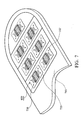
- FIG. 7 illustrates an embodiment of illumination equipment, for example, a street light or table lamp, constructed by light emitting modules of the invention.
- illumination equipment may comprise a shell body 710 having an opening.
- a supporting plate 720 is mounted on the opening of the shell body 710 to form an accommodation space.
- a plurality of light emitting modules 600 is mounted on an outer surface of the supporting plate 720 by a collapsible fixed device 730.
- light emitting modules 600 are mounted on the outer surface of the supporting plate 720 by using screws, to screw into screw holes of the substrate 102 and the supporting plate 720.
- the substrate 102 may serve as a portion of the shell body 710.
- an aluminum substrate may be used to form the integral shell body 710 and the substrate 102.
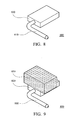
- FIGS. 7 and 10 illustrate diagrams showing inner and outer sides of one embodiment of illumination equipment of the invention.
- One embodiment of illumination equipment of the invention comprises a plurality of light emitting modules 600.
- Each light emitting module 600 comprises a plurality of light emitting rows and light emitting chips. Therefore, a heat dissipation portion 800 may be disposed on the accommodation space of the shell body.
- the heat dissipation portion 800 is commonly used for the entire light emitting chips in the shell body.
- a heat dissipation area of each light emitting chip may comprise the entire heat dissipation portion 800. Therefore, decreasing the possibility for a single light emitting chip to fail because of less frequent heat dissipation problems.
- a heat dissipation path may comprise a substrate 102', the supporting plate 720, which may also serve as a heat dissipation plate, and the heat dissipation portion 800 bonded to an inner side of the supporting plate 720.
- the heat dissipation portion 800 may comprise one or more heat pipes 810 and heat slugs 820.
- the heat pipe 810 is L-shaped. Therefore, one side of the heat pipe 810 may be bonded to the inner side of the supporting plate 720.
- Another side of the heat pipe 810 may be formed through the heat slugs 820 for heat transmission of the light emitting module to the heat slugs 820, and the heat slugs 820 may also be bonded to the inner surface of the supporting plate 720 to dissipate heat from the supporting plate 720.
- the heat dissipation path may extend to an outer apparatus outside of the shell body. Additionally, a heat dissipation device may not have power bonded on the shell body or in the accommodation space to increase heat dissipation efficiency.
- a film oscillating device for example a metal or alloy leaf spring, may be disposed in the accommodation space of the chamber.
- a wind power or thermal power (solar power) driven van may be optionally disposed outside of the shell body to reduce the temperature of the shell body using natural wind or thermal energy in the atmosphere.
- the heat pipes 810 may increase heat dissipation efficiency.
- the heat pipes 810 may comprise a body having a vacuum chamber.
- the body may be formed of heat dissipation materials, for example, copper or aluminum.
- the vacuum chamber is filled with a heat transfer fluid, for example, water or wick, distributed on the inner side of the vacuum chamber. Therefore, when the heat transfer fluid in the heat pipes 810 is close to a heat source, the heat transfer fluid may flow to two ends of the body. Next, the heat transfer fluid on the two ends of the body is cooled. The cooling heat transfer fluid is then pulled back to a location of the heat source again by capillarity for heat transference.
- the heat slugs 820 and the supporting plate 720 is generally formed by metals with good heat dissipation efficiency, for example, aluminum, copper or alloys.
- the heat dissipation portion 800 may further comprise a heat dissipation device 830, for example, a cooling fin.
- the heat dissipation device 830 is generally formed by copper.
- the heat dissipation device 830 may optionally comprise a cellular ceramic cooling structure sintered by silicon carbide (SiC).
- SiC silicon carbide
- the heat dissipation device 830 may be bonded to the heat slugs 820 and the supporting plate 720 to achieve better heat dissipation efficiency.
- An adhesive for bonding the heat dissipation portion 800 and other heat dissipation devices is chosen under consideration for heat dissipation efficiency to avoid blocking the heat dissipation path.
- putty comprising unsaturated polyester may serve as the adhesive.
- one embodiment of the light emitting module may comprise a plurality of light emitting rows.
- a first light emitting row may be chosen to emit a first light with a first color temperature
- a second light emitting row may emit a second light with a second color temperature.
- the first light and the second light are mixed by a transparent lens to form a third light with a third color temperature.
- the first light and the second light are mixed by a colored transparent lens to form a third light with a third color temperature.
- the colored transparent lens may have a color harmony effect in different color temperatures.
- the third color temperature is between the first and second color temperatures.
- a plurality of light emitting rows with different color temperatures may be disposed on a substrate 102'.
- the reflective structure and the transparent lens may mix light emitted from the light emitting rows with different color temperatures, forming a mixed light source. Therefore, the color temperature of the light emitted from each light emitting row may be adjusted to achieve color temperature requirements of the mixed light source. For example, a warmer light source has a color temperature below about 3000 K, a middle light source has a color temperature of about 3000 K to 6500 K, and a colder light source has a color temperature above about 6500 K.
- a percentage of a lower color temperature light emitting row 130a may be greater than that of a higher color temperature light emitting row 130b.
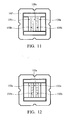
- FIG. 12 illustrates another embodiment of light emitting row with different color temperatures.
- white light emitting rows 132a that cover a light emitting material may be arranged with red yellow (low color temperature) or blue (high color temperature) light emitting rows 132b, without covering a light emitting material to form a warmer light source with lower color temperature or colder light source with higher color temperature.
- a method for manufacturing one embodiment of a light emitting module comprises the steps described as below. The sequence of the steps can be adjusted for manufacturing process requirements and is not limited to the disclosed embodiments.
- a substrate 102 is provided.
- the substrate 102 may comprise metal substrates, for example, aluminum substrates.
- An anodizing process is performed on the substrate 102 to form an aluminum (A1) substrate having a planarized aluminum oxide layer 160.
- the planarized aluminum oxide layer 160 may comprise a plurality of holes 4.
- the substrate 102 is immersed in an insulating oil to form an insulating oil film 6 that covers a top surface of the aluminum oxide layer 160 and the holes 4.
- the insulating oil film on the top surface of the aluminum oxide layer 160 is then removed.
- a patterned conductive layer 170 is formed on a surface of the substrate 102, and light emitting chips 104 arranged in rows on the substrate 102 or a carrying portion 170b are mounted.
- An arrangement of the light emitting chips comprise light emitted from sides of the light emitting chips to face a side of a reflective structure, by reducing an overlapped portion of a projection plane of one light emitting chip and other light emitting chips.
- the substrate 102 may be immerged into an insulating oil 6 having a temperature range below about 300°C, for example, 100°C to 150°C, to reduce internal stresses among different material layers.
- the holes 4 may be filled by the insulating oil film again to prevent generation of a possible leakage path 5. The insulating oil film on the metal oxide layer is then removed.
- a light emitting module may comprise a reflective structure 110 having a plurality row spaces.
- the reflective structure 110 may be formed by a plastic reflective structure with a reflective plane, for example, a Cr or Ag, coating thereon.
- the reflective structure 110 is disposed on the substrate 102 to accommodate light emitting chips 104 of the light emitting rows.
- the reflective structure 110 may be integrated on a frame 310 as shown in FIG. 4 .
- the frame 310 may comprise an inner frame 310a and an outer frame 310b.
- a plurality of fluorescent powders may be mixed into the adhesive, which is used to bond the reflective structure 110 and the substrate 102.
- the side light emitting into the interface between the reflective structure 110 and the substrate 102 may react with the fluorescent powders in the adhesive to generate another light incident into the light emitting row.
- fluorescent powders may be coated in the row spaces of the light emitting rows by a spray coating method.
- the fluorescent powders may be mixed with a liquid without adhesive to form a composite liquid.
- the composite liquid is filled in the inner frame 310a of the reflective structure 110 by using, for example, a dropping method,.
- the composite liquid is then removed using, for example, a baking method.
- the fluorescent powders may be clotted by Van der Waals force to form a light emitting material layer 106.
- the light emitting material layer 106 may be attached to the light emitting chips 104 of the reflective structure 110. Therefore, the light emitting material layer 106 may be formed, wherein the light emitting material layer 106 may continuously cover the light emitting chips 104 and extend to an inner wall of the reflective structure 110.
- the fluorescent powders may be nanorized by uniform mixing with a liquid without adhesive to form a composite liquid. Another mixing method for uniformity is to mix an organic solvent with the liquid without adhesive so that mixing with the fluorescent powders are more uniform. Next, the liquid and the organic solvent are removed to clot the fluorescent powders, forming a fluorescent powder layer.
- the fluorescent powder layer may attach to the light emitting chips 104 of the reflective structure 110.
- the organic solvent may comprise paraffin wax or resin oil.
- the organic solvent may be removed by a thermal process with a temperature of about 450°C .
- the reflective structure 110 may improve deposition velocity of the fluorescent powders by the conventional deposition method.
- the reflective structure 110 may allow a little composite liquid to remain on the inner frame 310a.
- the remaining composite liquid may be removed more quickly to form a light emitting material layer 106 by a baking method.
- the light emitting material layer 106 may attach to the light emitting chips 104 of the reflective structure 110. Therefore, improving process efficiency.
- the inner covering layer 108 may be formed by filling a silicon protective layer or an epoxy layer or embedding a hard glass layer in the reflective structure 110, and then laminating the light emitting material layer 106.
- a transparent lens 500 is provided covering the entire reflective structure 110.
- the transparent lens 500 may have a rectangular or polygonal shape by cutting to reduce an occupied area of the substrate.
- a closed-chamber between the transparent lens 500 and the reflective structure 110 may be filled with another inner covering layer to avoid water vapor permeation.
- the inner covering layer may be formed by filling silicon to cover the light emitting material layer 106, and fill the closed-chamber after covering the transparent lens 200 on the reflective structure 110.
- planarized light emitting modules may be constructed with a supporting plate 720 of a shell body as shown in FIG. 7 , by a collapsible method to form a light emitting system.
Landscapes
- Engineering & Computer Science (AREA)
- General Engineering & Computer Science (AREA)
- Physics & Mathematics (AREA)
- Microelectronics & Electronic Packaging (AREA)
- Optics & Photonics (AREA)
- Led Device Packages (AREA)
Applications Claiming Priority (3)
| Application Number | Priority Date | Filing Date | Title |
|---|---|---|---|
| PCT/CN2006/003037 WO2008043207A1 (fr) | 2006-10-08 | 2006-11-13 | Système électroluminescent, appareil électroluminescent et procédé de formation associé |
| PCT/CN2007/001966 WO2008043233A1 (en) | 2006-10-08 | 2007-06-22 | Lighting system, lighting module and method of manufacure therefore |
| PCT/CN2007/002570 WO2008058446A1 (fr) | 2006-11-13 | 2007-08-24 | Système d'émission de lumière |
Publications (1)
| Publication Number | Publication Date |
|---|---|
| EP2085683A1 true EP2085683A1 (de) | 2009-08-05 |
Family
ID=39401312
Family Applications (1)
| Application Number | Title | Priority Date | Filing Date |
|---|---|---|---|
| EP07800789A Withdrawn EP2085683A1 (de) | 2006-11-13 | 2007-08-24 | Lichtemittierendes system |
Country Status (4)
| Country | Link |
|---|---|
| EP (1) | EP2085683A1 (de) |
| AU (1) | AU2007321634A1 (de) |
| CA (1) | CA2658679A1 (de) |
| WO (1) | WO2008058446A1 (de) |
Cited By (6)
| Publication number | Priority date | Publication date | Assignee | Title |
|---|---|---|---|---|
| WO2011037876A1 (en) * | 2009-09-25 | 2011-03-31 | Cree, Inc. | Lighting device having heat dissipation element |
| ITMI20100185A1 (it) * | 2010-02-08 | 2011-08-09 | Bevilacqua Carlotta De | Apparecchio di illuminazione a led con dissipazione termica migliorata. |
| EP2383509A1 (de) * | 2010-04-30 | 2011-11-02 | Tridonic Jennersdorf GmbH | LED-Modul mit Linse zum Erzeugen einer nicht rotationssymmetrischen Lichtverteilung |
| WO2012011617A1 (ko) * | 2010-07-19 | 2012-01-26 | 티티엠주식회사 | 엘이디 패키지 방열용 나노유체 베이퍼챔버 |
| KR101113456B1 (ko) * | 2009-12-18 | 2012-02-22 | 이상갑 | 발열소자용 방열장치의 제조방법 |
| EP2466350A1 (de) * | 2010-12-17 | 2012-06-20 | Samsung LED Co., Ltd. | LED-Lichtquellenmodul und Anzeigevorrichtung damit |
Families Citing this family (5)
| Publication number | Priority date | Publication date | Assignee | Title |
|---|---|---|---|---|
| US8261375B1 (en) | 2003-06-19 | 2012-09-11 | Reaux Brian K | Method of forming a protective covering for the face and eyes |
| US8044427B2 (en) * | 2008-06-24 | 2011-10-25 | Dicon Fiberoptics, Inc. | Light emitting diode submount with high thermal conductivity for high power operation |
| DE102009006184A1 (de) | 2009-01-27 | 2010-07-29 | Vishay Electronic Gmbh | Beleuchtungseinheit |
| US8752980B2 (en) | 2009-05-27 | 2014-06-17 | Hong-Yuan Technology Co., Ltd. | Illumination system and method of manufacturing multi-chip package structure for light emitting diodes |
| US9478587B1 (en) | 2015-12-22 | 2016-10-25 | Dicon Fiberoptics Inc. | Multi-layer circuit board for mounting multi-color LED chips into a uniform light emitter |
Family Cites Families (8)
| Publication number | Priority date | Publication date | Assignee | Title |
|---|---|---|---|---|
| US5859581A (en) | 1997-06-20 | 1999-01-12 | International Resistive Company, Inc. | Thick film resistor assembly for fan controller |
| CN100392879C (zh) * | 2004-02-23 | 2008-06-04 | 弘元科技有限公司 | 发光装置及其制造方法和制造系统 |
| CN2741193Y (zh) * | 2004-04-08 | 2005-11-16 | 吴裕朝 | 发光二极管装置、发光二极管散热系统及包含其之照明装置 |
| KR100576865B1 (ko) * | 2004-05-03 | 2006-05-10 | 삼성전기주식회사 | 백라이트용 발광 다이오드 어레이 모듈 및 이를 구비한백라이트 유닛 |
| KR100677551B1 (ko) * | 2005-01-05 | 2007-02-02 | 삼성전자주식회사 | Led 패키지, 조명계 및 이를 채용한 프로젝션 시스템 |
| CN2821373Y (zh) * | 2005-05-25 | 2006-09-27 | 光瀚光电股份有限公司 | 发光二极管面状光源模组 |
| WO2008043207A1 (fr) | 2006-10-08 | 2008-04-17 | Hong-Yuan Technology Co., Ltd. | Système électroluminescent, appareil électroluminescent et procédé de formation associé |
| WO2008043233A1 (en) | 2006-10-08 | 2008-04-17 | Hong-Yuan Technology Co., Ltd. | Lighting system, lighting module and method of manufacure therefore |
-
2007
- 2007-08-24 AU AU2007321634A patent/AU2007321634A1/en not_active Abandoned
- 2007-08-24 CA CA002658679A patent/CA2658679A1/en not_active Abandoned
- 2007-08-24 WO PCT/CN2007/002570 patent/WO2008058446A1/zh not_active Ceased
- 2007-08-24 EP EP07800789A patent/EP2085683A1/de not_active Withdrawn
Cited By (10)
| Publication number | Priority date | Publication date | Assignee | Title |
|---|---|---|---|---|
| WO2011037876A1 (en) * | 2009-09-25 | 2011-03-31 | Cree, Inc. | Lighting device having heat dissipation element |
| US9982847B2 (en) | 2009-09-25 | 2018-05-29 | Cree, Inc. | Lighting device having heat dissipation element |
| KR101113456B1 (ko) * | 2009-12-18 | 2012-02-22 | 이상갑 | 발열소자용 방열장치의 제조방법 |
| ITMI20100185A1 (it) * | 2010-02-08 | 2011-08-09 | Bevilacqua Carlotta De | Apparecchio di illuminazione a led con dissipazione termica migliorata. |
| WO2011095438A1 (en) * | 2010-02-08 | 2011-08-11 | Carlotta De Bevilacqua | Led lighting apparatus with improved thermal dissipation |
| EP2534414A1 (de) * | 2010-02-08 | 2012-12-19 | Carlotta De Bevilacqua | Led-beleuchtungsvorrichtung mit verbesserter wärmeableitung |
| EP2383509A1 (de) * | 2010-04-30 | 2011-11-02 | Tridonic Jennersdorf GmbH | LED-Modul mit Linse zum Erzeugen einer nicht rotationssymmetrischen Lichtverteilung |
| WO2012011617A1 (ko) * | 2010-07-19 | 2012-01-26 | 티티엠주식회사 | 엘이디 패키지 방열용 나노유체 베이퍼챔버 |
| EP2466350A1 (de) * | 2010-12-17 | 2012-06-20 | Samsung LED Co., Ltd. | LED-Lichtquellenmodul und Anzeigevorrichtung damit |
| US8602626B2 (en) | 2010-12-17 | 2013-12-10 | Samsung Electronics Co., Ltd. | LED light source module and display apparatus including the same |
Also Published As
| Publication number | Publication date |
|---|---|
| CA2658679A1 (en) | 2008-05-22 |
| AU2007321634A1 (en) | 2008-05-22 |
| WO2008058446A1 (fr) | 2008-05-22 |
Similar Documents
| Publication | Publication Date | Title |
|---|---|---|
| US20140060906A1 (en) | Light emitting system | |
| CA2658679A1 (en) | Light emitting system | |
| JP3976063B2 (ja) | 発光装置 | |
| JP4675906B2 (ja) | 発光素子搭載用基板、発光素子収納用パッケージ、発光装置および照明装置 | |
| CN100359708C (zh) | 发光装置及照明装置 | |
| CN100414698C (zh) | 表面安装电源的发光晶粒封装 | |
| TWI433344B (zh) | 發光裝置及照明裝置 | |
| CN100411207C (zh) | 发光装置及照明装置 | |
| JP4789672B2 (ja) | 発光装置および照明装置 | |
| JP3978451B2 (ja) | 発光装置 | |
| JP3872490B2 (ja) | 発光素子収納パッケージ、発光装置および照明装置 | |
| KR20050041986A (ko) | 발광소자 수납용 패키지, 발광장치, 및 조명장치 | |
| EP2553330A1 (de) | Beleuchtungsvorrichtung | |
| JP2006066657A (ja) | 発光装置および照明装置 | |
| JP2006049814A (ja) | 発光装置および照明装置 | |
| JP2006100441A (ja) | 発光素子収納用パッケージおよび発光装置ならびに照明装置 | |
| JP5036222B2 (ja) | 発光装置 | |
| JP4948818B2 (ja) | 発光装置および照明装置 | |
| JP4948841B2 (ja) | 発光装置および照明装置 | |
| JP4847793B2 (ja) | 発光装置 | |
| JP4010340B2 (ja) | 発光装置 | |
| JP2006156604A (ja) | 発光装置および照明装置 | |
| JP4659515B2 (ja) | 発光素子搭載用基板,発光素子収納用パッケージ,発光装置および照明装置 | |
| TWI389595B (zh) | 承載基板結構及其製造方法 | |
| CN101482230B (zh) | 具有承载基板的结构的制造方法 |
Legal Events
| Date | Code | Title | Description |
|---|---|---|---|
| PUAI | Public reference made under article 153(3) epc to a published international application that has entered the european phase |
Free format text: ORIGINAL CODE: 0009012 |
|
| 17P | Request for examination filed |
Effective date: 20090615 |
|
| AK | Designated contracting states |
Kind code of ref document: A1 Designated state(s): AT BE BG CH CY CZ DE DK EE ES FI FR GB GR HU IE IS IT LI LT LU LV MC MT NL PL PT RO SE SI SK TR |
|
| DAX | Request for extension of the european patent (deleted) | ||
| STAA | Information on the status of an ep patent application or granted ep patent |
Free format text: STATUS: THE APPLICATION IS DEEMED TO BE WITHDRAWN |
|
| 18D | Application deemed to be withdrawn |
Effective date: 20120301 |