EP2086152A2 - Procédé et dispositif de traitement de données dans des processus de retransmission - Google Patents
Procédé et dispositif de traitement de données dans des processus de retransmission Download PDFInfo
- Publication number
- EP2086152A2 EP2086152A2 EP20090150030 EP09150030A EP2086152A2 EP 2086152 A2 EP2086152 A2 EP 2086152A2 EP 20090150030 EP20090150030 EP 20090150030 EP 09150030 A EP09150030 A EP 09150030A EP 2086152 A2 EP2086152 A2 EP 2086152A2
- Authority
- EP
- European Patent Office
- Prior art keywords
- retransmission
- received signal
- harq
- retransmission process
- processes
- Prior art date
- Legal status (The legal status is an assumption and is not a legal conclusion. Google has not performed a legal analysis and makes no representation as to the accuracy of the status listed.)
- Withdrawn
Links
Images





Classifications
-
- H—ELECTRICITY
- H04—ELECTRIC COMMUNICATION TECHNIQUE
- H04L—TRANSMISSION OF DIGITAL INFORMATION, e.g. TELEGRAPHIC COMMUNICATION
- H04L1/00—Arrangements for detecting or preventing errors in the information received
- H04L1/12—Arrangements for detecting or preventing errors in the information received by using return channel
- H04L1/16—Arrangements for detecting or preventing errors in the information received by using return channel in which the return channel carries supervisory signals, e.g. repetition request signals
- H04L1/18—Automatic repetition systems, e.g. Van Duuren systems
- H04L1/1812—Hybrid protocols; Hybrid automatic repeat request [HARQ]
-
- H—ELECTRICITY
- H04—ELECTRIC COMMUNICATION TECHNIQUE
- H04L—TRANSMISSION OF DIGITAL INFORMATION, e.g. TELEGRAPHIC COMMUNICATION
- H04L1/00—Arrangements for detecting or preventing errors in the information received
- H04L1/12—Arrangements for detecting or preventing errors in the information received by using return channel
- H04L1/16—Arrangements for detecting or preventing errors in the information received by using return channel in which the return channel carries supervisory signals, e.g. repetition request signals
- H04L1/18—Automatic repetition systems, e.g. Van Duuren systems
- H04L1/1822—Automatic repetition systems, e.g. Van Duuren systems involving configuration of automatic repeat request [ARQ] with parallel processes
-
- H—ELECTRICITY
- H04—ELECTRIC COMMUNICATION TECHNIQUE
- H04L—TRANSMISSION OF DIGITAL INFORMATION, e.g. TELEGRAPHIC COMMUNICATION
- H04L1/00—Arrangements for detecting or preventing errors in the information received
- H04L1/12—Arrangements for detecting or preventing errors in the information received by using return channel
- H04L1/16—Arrangements for detecting or preventing errors in the information received by using return channel in which the return channel carries supervisory signals, e.g. repetition request signals
- H04L1/18—Automatic repetition systems, e.g. Van Duuren systems
- H04L1/1829—Arrangements specially adapted for the receiver end
- H04L1/1835—Buffer management
Definitions
- the present invention relates to a communications system in which a retransmission process can be carried out between a sending-side communication device and a receiving-side communication device and, more particularly, to method and device for processing data in retransmission processes on the receiving side and a communication device using the method.
- Hybrid automatic repeat request is an important technology to efficiently prevent loss of data in those mobile communications systems that employ packet transmission schemes, for example, high-speed packet transmission schemes such as High Speed Downlink Packet Access (HSDPA) and Enhance Uplink Dedicated Channel (EUDCH)/High Speed Uplink Packet Access (HSUPA).
- high-speed packet transmission schemes such as High Speed Downlink Packet Access (HSDPA) and Enhance Uplink Dedicated Channel (EUDCH)/High Speed Uplink Packet Access (HSUPA).
- HARQ is a type of ARQ error control method in which, with ARQ and error correction coding being combined, a request (NACK transmission) is made to retransmit data that has failed to be decoded.
- a communication device on the receiving side stores a data packet in which an error is detected and combines a retransmitted data packet with the stored data packet, whereby reception performance can be enhanced.
- Known HAPQ methods include Chase Combining, Incremental Redundancy, and the like (see 3GPP TR 25.848 V4.0.0 (2001-03), pp. 8-28) .
- CC-HARQ Chase Combining
- IR-HARQ Incremental Redundancy
- FIG. 1A is a schematic diagram showing an example of a transmission procedure according to CC-HARQ
- FIG. 1B is a schematic diagram showing an example of a transmission procedure according to IR-HARQ.
- retransmitted is the same coded packet that was transmitted for the first time.
- a sending side transmits a coded packet (S + Parity1 + Parity2) composed of a systematic bit sequence S and two parity bit sequences Parity1 and Prity2, as shown in FIG. 1A .
- a receiving side decodes the coded packet received and, if an error is detected, sends NACK feedback to the sending side.
- the sending side upon receipt of NACK, retransmits the same coded packet as the previous one (here, S + Parity1 + Parity2).
- the receiving side has stored the previous coded packet in which an error was detected.
- the receiving side combines the retransmitted coded packet with the previous coded packet and then decodes the packet.
- the probability of success in decoding can be increased.
- a sending side first transmits a coded packet (S) of a systematic bit sequence S, as shown in FIG. 1B .
- a receiving side decodes the received coded packet (S) and, when an error is detected, sends NACK feedback to the sending side.
- the sending side upon receipt of NACK, transmits a coded packet of one of parity bit sequences Parity1 and Parity2 obtained by puncture (here, a coded packet (Parity1)).
- the receiving side performs decoding based on the received coded packet (Parity1) and the previously received coded packet (S).
- the sending side transmits the other remaining coded packet (here, a coded packet (Parity2)).
- the receiving side performs decoding based on the coded packet (S) first received and the parity bit sequences Parity1 and Parity2 received through retransmission. As described above, since a puncture pattern to be used varies with each retransmission, a different coded bit sequence is transmitted each time.
- selective repeat mode As to modes of retransmission sequence in HARQ, selective repeat mode, stop-and-wait mode, and the like are known. In the selective repeat mode, only those packets that have been received in error are retransmitted. It is possible to have multiple HARQ processes operate in parallel by setting a larger number of packets than the number of those packets that can be transmitted within a feedback delay time. Accordingly, the selective repeat mode has the advantage that the channel resources of the system can be efficiently used.
- the stop-and-wait mode is the simplest and has the advantage that it requires very little control overhead. However, it has the drawback of reduced efficiency because the sending side needs to wait for feedback information from the receiving side.
- N-channel stop-and-wait HARQ has been proposed in which a plurality of stop-and-wait protocols operate in parallel (hereinafter, this mode will be referred to as "multi-stop-and-wait mode") (see 3GPP TR 25.848 V4.0.0 (2001-03), pp. 8-28).
- multi-stop-and-wait mode increases efficiency on the whole and consequently makes it possible to use the resources of the system without waste.
- the buffer size required for a HARQ buffer corresponding to each HARQ process depends on the maximum transmission rate, coding rate, number of bits for each soft symbol received, and the like. Accordingly, the total HARQ buffer size required is the sum total of the individual HARQ buffer sizes. Assuming that N is the number of HARQ processes and the individual HARQ buffer sizes are equal to each other, the total HARQ buffer size is N times the individual HARQ buffer size.
- control overhead is large because it is necessary for the sending side to identify each packet for transmission. Moreover, on the receiving side, since a soft symbol needs to be kept for each received packet, it is necessary to secure as large a memory capacity as can accommodate a maximum number of packets that can be handled.
- the probability that each HARQ process succeeds in data transmission is determined by a plurality of factors, such as channel quality at the time of reception, transmission power, modulation method and coding method, and other factors affecting the reception quality of a data packet.
- N HARQ processes exist concurrently, with p being the target error rate during data transport.
- FIG. 2 is a diagram showing variations of HARQ process failure probability, in relation to the HARQ operation point and the number of HARQ processes failing at the same time.
- the total HARQ buffer size grows with an increase in the individual HARQ buffer size or in the number of HARQ processes. Moreover, in mobile communication, transmission and reception of data packets can be performed at high rates exceeding several megabits per second. It is conceivable that as this transmission bit rate continues increasing also in the future, more efficient HARQ techniques are employed, resulting in larger and larger HARQ buffer sizes being required. In general, as the HARQ buffer size grows, the size of a communication device such as a modem chip set also grows, resulting in the cost of the communication device also increasing. Not only the size of the communication device, power consumption also rises with an increase in the required HARQ buffer capacity.
- the memory resource used for the multiple retransmission processes is not efficiently used. This leads to an unnecessary increase in the device size and power consumption.
- an object of the present invention is to provide a method for processing data in retransmission processes by which the efficiency of memory usage in the retransmission processes can be increased, as well as a device using the method.
- a method for processing data in a plurality of retransmission processes in a receiving-side communication device comprising: determining whether a reception buffer for retransmission process is able to store a received signal; when the reception buffer for retransmission process is unable to store the received signal, discarding at least part of an existing received signal corresponding to a retransmission process in progress from the reception buffer for retransmission process; and storing the received signal in the reception buffer for retransmission process.
- a device for processing data in a plurality of retransmission processes in a receiving side comprising: a storage section for storing a received signal for retransmission process; a determination section for determining whether the storage section is able to store a received signal; a controller controlling such that, when the storage section is unable to store the received signal, at least part of an existing received signal corresponding to a retransmission process in progress is discarded from the storage section so as to store the received signals in the storage section.
- FIG. 3A is a block diagram showing a schematic configuration of a retransmission process control circuit in a communication device according to a first exemplary embodiment of the present invention.
- FIG. 3B is a time chart to describe the operations of a method for processing data in multiple retransmission processes according to the first exemplary embodiment.
- the number (n) of retransmission processes and the number (m) of memory areas shown here are examples for description purpose and are not limited to six and three, respectively.
- An error detection section 11 detects an error in a received signal stored in the buffer 10 and outputs the result of this detection to a retransmission process control section 12.
- the retransmission process control section 12 adds to (ADD), deletes from (DELETE), or discards from (DISCARD) the buffer 10 a received signal corresponding to each retransmission process.
- ADD is performed when the buffer 10 has a sufficient free area, and a new received signal is stored in this free area.
- DELETE is performed when no error is detected in a received signal, and the received signal in question is deleted from the buffer 10 (release of a corresponding area of the buffer 10).
- DISCARD is performed when a new received signal occurs while the buffer 10 does not have as large a free area as required. In this case, at least one process is selected among ongoing retransmission processes, and the received signal corresponding to this selected process is deleted from the buffer 10 (release of a corresponding area of the buffer 10).
- the retransmission process control section 12 deletes from the buffer 10 a received signal in which no error is detected and, at the same time, returns feedback information indicative of a normal reception (e.g., ACK) to the sending side (originator) of this received signal.
- a normal reception e.g., ACK
- the retransmission process control section 12 returns feedback information indicative of a reception in error (e.g., NACK) to the originator of this received signal while keeping this received signal in the buffer 10.
- the originator upon being notified of the reception in error, retransmits the retransmission target signal in accordance with the retransmission process in question.
- the retransmission process control section 12 has the error detection section 11 carry out error detection using the retransmitted received signal and the previously received signal.
- a received signal to be subjected to a retransmission process P1 is added to the buffer 10 at the time point t1 and, when the normal reception thereof is confirmed by the error detection section 11, is deleted at the time point t2.
- the period between the ADD point t1 and the DELETE point t2 is the length of buffer occupation made by the received signal in the retransmission process P1.
- a retransmission process P2 is similar. Specifically, a received signal is added to the buffer 10 at the time point t2 and, when the normal reception thereof is confirmed, is deleted at the time point t3.
- a retransmission process P3 is selected as a target of DISCARD.
- a received signal to be subjected to the retransmission process P3 is added to the buffer 10 but, later on, is discarded to empty the buffer area when a received signal to be subjected to a subsequent retransmission process P6 is added.
- a received signal is added to the memory area B1 of the buffer 10 at the time point t3.
- an error is detected by the error detection section 11, in which case the received signal in question is kept in the memory area B1 and feedback information NACK is returned to the originator.
- the retransmission process P3 falls in a retransmission wait state.
- a received signal is added to the memory area B2 of the buffer 10 at the time point t4, and an error is assumed to be detected also in this received signal, which is therefore kept in the memory area B2.
- a received signal to be subjected to a retransmission process P5 is added to the memory area B3 of the buffer 10 at the time point t5, at which point there is no free area left in the buffer 10.
- the retransmission process control section 12 selects as a target of DISCARD one of the retransmission processes P3, P4, and P5 that are using the buffer 10, and discards the received signal corresponding to the selected retransmission process from the buffer 10.
- This retransmission process as a target of DISCARD can be selected based on various criteria. For example, the oldest one of the retransmission processes P3, P4, and P5 can be selected. However, since the existence of a retransmission process depends on whether or not an error is detected, it is also preferred to select a retransmission process in which the corresponding received signal has the lowest quality. In this event, preferably, the cumulative value of reception quality in each retransmission process is used. Other adoptable criteria for selection include factors affecting the reception quality.
- the retransmission process P3 is a target of DISCARD.
- a target of DISCARD is the process in which the corresponding received signal has the lowest reception quality among the reception qualities Q3, Q4 and Q5 corresponding to the retransmission processes P3, P4 and P5, respectively. It is also possible to use two criteria concurrently, as in a case where if there are a plurality of lowest-reception-quality processes, the oldest one of these processes is selected. Here, it is assumed that the retransmission process P3 is selected.
- the retransmission process control section 12 Upon selection of the retransmission process P3 as a target of DISCARD, the retransmission process control section 12 discards the corresponding received signal stored in the memory area B1 of the buffer 10 at the time point t6, and adds the received signal in the new retransmission process P6 to the memory area B1 of the buffer 10.
- a free area is created by discarding an existing retransmission process based on a certain criterion or criteria of selection, whereby a retransmission process for a new received signal can be accepted. Accordingly, it is possible to carry out multiple retransmission processes by using the memory areas B1 to B3 that are fewer in number than the retransmission processes P1 to P6. In other words, it is possible to handle n retransmission processes by using a memory capacity that is equivalent to m ( ⁇ n) retransmission processes.
- the termination of the retransmission process P3 on the receiving side disables the originator from receiving feedback information with regard to the retransmission process P3.
- the originator transmits again the signal to retransmit in accordance with the retransmission process P3.
- this received signal is added to the buffer 10 as a received signal to be subjected to a new retransmission process.
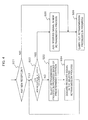
- FIG. 4 is a flow chart showing a schematic procedure of a retransmission process control method according to the present exemplary embodiment.
- the retransmission process control section 12 upon knowing the occurrence of a new received signal (S21: YES) , determines whether or not it is possible to add this new received signal to the buffer 10 (S22).
- the retransmission process control section 12 selects one of retransmission processes currently in progress, based on a criterion of selection as described above (S23), and discards the received signal in the selected retransmission process from the buffer 10 (S24). After thus discarding the received signal in the selected retransmission process, the control goes back to the step S22, where the retransmission process control section 12 determines whether or not it is possible to add the new received signal in question.
- the retransmission process control section 12 adds this new received signal to be subjected to a new retransmission process to the buffer 10 (S25) and then carries out multiple retransmission processes as described above (S26). If there is no occurrence of a new received signal (S21: NO), the multiple retransmission processes currently in progress continue to be carried out (S26).
- FIG. 5 is a block diagram showing a schematic configuration of a radio communication device according to an example of the present invention.
- a HARQ process will be illustrated as an example of a retransmission process, and that reception quality will be used as the criterion for selecting a process as a target of DISCARD.
- a sending-side radio communication device (not shown) encodes data for transmission, modulates a coded packet to generate a transmission signal, and transmits the transmission signal through radio, and that on the receiving side, the coded packet demodulated from the received signal is stored in a HARQ reception buffer as a target of retransmission in a HARQ process.
- a reception section 101 of the radio communication device includes a demodulator, which demodulates a RF signal received from the sending-side radio communication device to generate a soft-decision output (hereinafter, referred to as "soft symbol"), and measures the reception quality of the received signal (here, the signal-to-interference ratio SIR).
- the received soft symbols for a received packet are stored in a HARQ reception buffer 102 and then output to a decoder 103.
- the HARQ reception buffer 102 has a predetermined number (m) of memory units (areas), of which a specified number of memory units are assigned to one HARQ process.
- the decoder 103 decodes a received packet from the soft symbols thereof and outputs the decoded data packet to an upper layer. At this time, the decoder 103 notifies a HARQ control section 104 of a result of error determination, which indicates whether the decoding is normally complete or has ended in failure.
- the HARQ control section 104 controls a predetermined number (n) of HARQ processes, based on synchronous HARQ processing in which a HARQ process is determined based on time.
- the HARQ control section 104 controls the HARQ processes while referring to the reception quality SIR as the criterion of selection and controls the HARQ reception buffer 102 to perform ADD, DELETE, selective DISCARD and the like of the respective received signals of the HARQ processes.
- the HARQ control section 104 stores soft symbols of a new coded packet in the HARQ reception buffer 102 when memory units are available to store the soft symbols in question.
- the HARQ control section 104 when new soft symbols are received in a state where all the memory units of the HARQ reception buffer 102 are occupied, the HARQ control section 104, while referring to the reception quality SIR as the criterion of selection, selects one of HARQ processes then in progress as a target of DISCARD and discards the soft symbols corresponding to the selected HARQ process from the HARQ reception buffer 102.
- the reception quality SIR used as the criterion of selection may be a cumulative value of reception quality of the soft symbols received from the ADD time point up until the current time point in the HARQ process in question.
- the lowest-cumulative-reception-quality HARQ process is selected as a target process of DISCARD.
- the use of the cumulative value makes it possible to average the variations of the reception quality, and hence make accurate determination of the reception quality in the entire HARQ process in question.
- the HARQ control section 104 deletes the soft symbols in question from the HARQ reception buffer 102 and returns feedback information indicative of a normal reception (ACK) to the sending-side communication device through a transmission section 105.
- the HARQ control section 104 keeps the soft symbols in question in the HARQ reception buffer 102 until decoding is successfully done or the soft symbols are discarded, and returns feedback information indicative of a reception in error (NACK) to the sending-side communication device through the transmission section 105.
- NACK reception in error
- a function similar to the HARQ control section 104 can also be implemented by executing a computer program on a program-controlled processor.
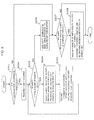
- FIG. 6 is a flow chart showing the HARQ process control by the radio communication device according to the present example .
- the HARQ control section 104 calculates a number "required,” which is the number of memory units required, by adding a number "add,” which is the number of memory units to be assigned to the new reception, to a number "occupied,” which is the number of memory units currently occupied in the HARQ reception buffer 102 (S202).
- the HARQ control section 104 When the number “required” exceeds the total number of the memory units of the HARQ reception buffer 102 (S203: YES), the HARQ control section 104 carries out selective DISCARD. First, of the ongoing HARQ processes, the HARQ control section 104 selects a process in which the corresponding soft symbols have the lowest reception quality, and discards the soft symbols corresponding to the selected HARQ process from the HARQ reception buffer 102 (S204). Thus, a number “discard,” which is the number of the memory units having stored the discarded soft symbols, is subtracted from the number "occupied,” whereby a new number “required” is calculated (S205). Then, the comparison at the step S203 is carried out again, and the steps S204 and S205 are repeated as described above until the number "required” becomes equal to or below the total number of the memory units.
- the HARQ control section 104 stores the new received soft symbols into unoccupied memory units of the HARQ reception buffer 102 (S206). Subsequently, the HARQ control section 104 determines whether or not there are soft symbols successfully decoded (S207). If there is soft symbols successfully decoded (S207: YES), the HARQ control section 104 deletes the soft symbols in question from the HARQ reception buffer 102, reduces the number "occupied” by the number of the memory units used by the deleted soft symbols, and returns feedback information (ACK) to the sending-side communication device through the transmission section 105 (S208). The step S208 is not carried out when there is no soft symbol successfully decoded. Additionally, the steps S207 and 208 are also carried out when no new reception occurs in the process k (S201: NO).
- FIG. 7A is a schematic diagram showing the memory capacity of the HARQ reception buffer 102
- FIG. 7B is a state transition diagram of the HARQ reception buffer 102 to describe an example of the operations in the multi-stop-andwait mode in the present specific example.
- the HARQ reception buffer 102 can accommodate only as many soft symbols as correspond to a maximum of three HARQ processes at a time. According to the present specific example, however, even if the HARQ reception buffer 102 with such a small capacity is used, six HARQ processes can be controlled satisfactorily. Note that the number (n) of HARQ processes, the number (m) of memory units, and the number of memory units assigned to each HARQ process shown here are merely examples for description purposes and are not limited to six, nine, and three, respectively.
- TIMING represents time slots according to a timing clock in the radio communication device shown in FIG. 5 .
- a transmission by each HARQ process is carried out in a period of two time slots.
- a transmission by a first HARQ process #0 is carried out in the period corresponding to the timings 0 and 1.
- TTI Transmission Time Interval
- a TTI is not limited to two time slots but may correspond to three or more time slots.
- the received soft symbols are decoded by the decoder 103 during the timings 1 to 4, and it is assumed that the decoding is successfully done.
- the time period for which the corresponding soft symbols occupy the HARQ reception buffer 102 is between the timings 1 to 4 inclusive.
- a HARQ process #1 is also an example of the case where decoding succeeds.
- a HARQ process #2 is an example of the case where decoding ends in failure.
- the received soft symbols are decoded by the decoder 103, and it is assumed that the decoding has ended in failure.
- the time period for which the soft symbols occupy the HARQ reception buffer 102 is between the timings 5 to 20 inclusive.
- the received soft symbols in the HARQ process #1 in question are added to the released memory units at the timing 15.
- the soft symbols in the HARQ process discarded are next transmitted, it is handled not as the retransmitted soft symbols but as newly received soft symbols.
- FIG. 8A is a schematic diagram showing the capacity (the number of the memory units) of a HARQ reception buffer used in conventional multiple-HARQ-process control
- FIG. 8B is a state transition diagram of the HARQ reception buffer to describe an example of the operations of the conventional multiple-HARQ-process control in the multi-stop-and-wait mode.
- the conventional operations are basically similar to the operations described above with reference to FIG. 7B except that a step of selective DISCARD is not included in this conventional multiple-HARQ-process control.
- the HARQ reception buffer can accept the new HARQ process. That is, it is possible to efficiently handle n HARQ processes by using a memory capacity corresponding to m ( ⁇ n) processes. Accordingly, the efficiency of memory resource usage can be greatly increased.
- all received soft symbols in one retransmission process are discarded when selective DISCAERD is performed.
- a multiple-retransmission-process control method when soft symbols in a retransmission process are discarded, control is performed such that additional redundant information only is discarded (partial DISCARD).
- FIG. 9A is a block diagram showing a schematic configuration of a retransmission process control circuit in a communication device according to the second exemplary embodiment of the present invention.
- FIG. 9B is a time chart to describe the operations in the multiple-retransmission-process control method according to the second exemplary embodiment. It is assumed that each of memory areas B1, B2 and so on of a buffer 10 stores a received signal to be subjected to a retransmission process, that is, any one of a systematic bit sequence S, additional redundant information Parity1, and additional redundant information Parity2. Note that, in this case, a received signal to be subjected to error detection is any one of the following: S, (S + Parity1), (S + Parity2), and (S + Parity1 + Parity2).
- An error detection section 11 detects an error in a received signal stored in the buffer 10 and outputs the result of this detection to a retransmission process control section 20.
- the retransmission process control section 20 performs ADD, DELETE, or partial DISCARD of a received signal corresponding to a retransmission process.
- ADD of a received signal and DELETE of a received signal are performed as in the first exemplary embodiment.
- Partial DISCARD of a received signal is performed when a new received signal occurs in a state where the buffer 10 does not have as large a free area as required. Specifically, at least one process is selected among retransmission processes in progress, and the received signal Parity1 or Parity2, or both of them, corresponding to the additional redundant information in the selected process is discarded from the buffer 10 (release of a corresponding area of the buffer 10).
- the retransmission process control section 20 When no error is detected in a received signal, the retransmission process control section 20 deletes the received signal in question and returns feedback information indicative of a normal reception (e.g., ACK) to the originator of this received signal.
- the retransmission process control section 20 returns feedback information indicative of a reception in error (e.g., NACK) to the originator of the received signal, while keeping the received signal in the buffer 10.
- the originator upon knowing the reception in error, transmits again the signal to retransmit (here, Parity1 or Parity2) in accordance with the retransmission process.
- error detection On the receiving side, upon receipt of this retransmitted signal, error detection is carried out by using the retransmitted received signal and the previously received signal.
- a received signal (S) of a systematic bit sequence S to be subjected to a retransmission process P1 is added to the memory area B1 of the buffer 10 at the time point t1, and it is assumed that an error is detected by the error detection section 11.
- the received signal (S) is kept in the memory area B1, and feedback information NACK is returned to the originator.
- a parity bit sequence Parity1 is retransmitted from the originator, and that a received signal (Parity2) thereof is added to the memory area B2 of the buffer 10 at the time point t3.
- the buffer 10 falls in a state where the received signal (S) is kept in the memory area B1 and the received signal (Parity1) is kept in the memory area B2, individually. In this state, it is assumed that a parity bit sequence Parity2 is retransmitted from the originator, that the received signal (Parity2) thereof is added to the memory area B3 of the buffer 10 at the time point t5, and that this causes a shortage of free area in the buffer 10 with the result that three memory areas required for a new retransmission process cannot be secured.
- the retransmission process control section 20 selects as a target of DISCARD one of the retransmission processes that are using the buffer 10, and performs partial DISCARD by discarding the received signal (Parity1) and/or received signal (Parity2) corresponding to the selected retransmission process from the buffer 10.
- various methods can be used as in the first exemplary embodiment, such as 1) selecting the oldest process, 2) selecting the lowest-reception-quality process, and 3) selecting a process based on 1) and 2).
- the retransmission process P1 is selected as a target of partial DISCARD.
- the retransmission process control section 20 Upon selection of the retransmission process P1 as a target of partial DISCARD, the retransmission process control section 20 performs partial DISCARD at the time point t6 by discarding the received signal (Parity1) stored in the memory area B2 of the buffer 10 and/or the received signal (Parity2) stored in the memory area B3, whereby the retransmission process control section 20 can add the received signal of the new retransmission process Px to the memory area B2 and/or memory area B3 of the buffer 10.
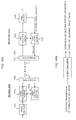
- FIG. 10A is a schematic block diagram of a packet data communications system using the radio communication device according to the example of the present invention
- FIG. 10B is a block diagram showing a turbo encoder, which is an example of an encoder.
- the radio communication device shown in FIG. 5 is used on the receiving side. Therefore, in FIGS. 5 and 10A , those blocks that have similar functions are denoted by the same reference numerals.
- a turbo encoder 301 in the sending-side device upon receipt of an input of a series of data packets for transmission from an upper layer, performs error correction encoding on each one of these packets, thereby generating coded data packets.
- the coded data packets are stored in a HARQ transmission buffer 302. Under the control of a HARQ control section 303, these packets are subjected to, for example, QPSK modulation by a transceiver section 304 and then transmitted out through a radio channel.
- a transceiver section (101, 105) in the receiving-side device demodulates a received RF signal and outputs received soft symbols of each encoded data packet to a HARQ reception buffer 102.
- the received soft symbols are stored in the HARQ reception buffer 102 and decoded by a turbo decoder 103.
- the turbo decoder 103 decodes the received soft symbols and outputs the received data packet to an upper layer. At this time, the turbo decoder 103 returns to a HARQ control section 104 a result of error determination indicating whether the decoding is normally complete or an error is detected.
- the HARQ control section 104 In the case where the received result of error determination indicates normal decoding, the HARQ control section 104 returns ACK as feedback information to the sending-side communication device and, at the same time, deletes the corresponding soft symbols stored in the HARQ reception buffer 102. In the case where the received result of error determination indicates error occurrence, the HARQ control section 104 returns NACK as feedback information to the sending-side communication device and keeps the corresponding soft symbols stored in the HARQ reception buffer 102 until decoding is successfully done or the soft symbols in question are selectively/partially discarded.
- the HARQ control section 303 on the sending-side device carries out retransmission control in accordance with the feedback information received from the receiving-side device. Specifically, when NACK is received, the HARQ control section 303 retransmits a corresponding coded data packet stored in the HARQ transmission buffer 302. When ACK is received, the HARQ control section 303 continues transmission processing.
- Such sending- and receiving-side radio communication devices can be used for, for example, radio communication sections of a base station (Node B or eNB) and of a mobile station/user equipment (UE) in a mobile communications system.
- Node B or eNB Node B or eNB
- UE mobile station/user equipment
- the present invention is applicable to a radio communications system including a retransmission function and, more particularly, for example, to a base station and a mobile station in a mobile communications system.
- An example 1 is a method for processing data in a plurality of retransmission processes in a receiving-side communication device, comprising:
- An example 2 is a method according to example 1, wherein at least one retransmission process is selected as a target of discarding from a plurality of retransmission processes in progress.
- An example 3 is a method according to example 2, wherein a retransmission process having lowest reception quality is selected as a target of discarding among the retransmission processes in progress.
- An example 4 is a method according to example 2 or 3, wherein an oldest retransmission process is selected as a target of discarding among the retransmission processes in progress.
- An example 5 is a method according to any of examples 1-4, wherein the existing received signal related to the retransmission process which is a target of discarding is discarded in entirety.
- An example 6 is a method according to any of examples 1-4, wherein the existing received signal related to the retransmission process which is a target of discarding is discarded in part.
- An example 1 is a device for processing data in a plurality of retransmission processes in a receiving side, comprising:
- An example 8 is a device according to example 7, wherein the controller selects at least one retransmission process as a target of discarding from a plurality of retransmission processes in progress.
- An example 9 is a device according to example 8, wherein the controller selects a retransmission process having lowest reception quality as a target of discarding among the retransmission processes in progress.
- An example 10 is a device according to example 8 or 9, wherein the controller selects an oldest retransmission process as a target of discarding among the retransmission processes in progress.
- An example 11 is a device according to any of examples 7-10, wherein the controller discards the existing received signal in entirety, wherein the existing received signal is related to the retransmission process which is a target of discarding.
- An example 12 is a device according to any of examples 7-10, wherein the controller discards the existing received signal in part, wherein the existing received signal is related to the retransmission process which is a target of discarding.
- An example 13 is a system which allows retransmission process between a sending-side communication device and a receiving-side communication device, wherein the receiving-side communication device comprises:
- An example 14 is a system according to example 13, wherein the controller selects at least one retransmission process as a target of discarding from a plurality of retransmission processes in progress.
- An example 15 is a system according to example 14, wherein the controller selects a retransmission process having lowest reception quality as a target of discarding among the retransmission processes in progress.
- An example 16 is a system according to example 14 or 15, wherein the controller selects an oldest retransmission process as a target of discarding among the retransmission processes in progress.
- An example 17 is a system according to any of examples 13-16, wherein the controller discards the existing received signal in entirety, wherein the existing received signal is related to the retransmission process which is a target of discarding.
- An example 18 is a system according to any of examples 13-16, wherein the controller discards the existing received signal in part, wherein the existing received signal is related to the retransmission process which is a target of discarding.
- An example 19 is a method for processing data in a plurality of hybrid automatic repeat request (HARQ) processes in a receiving-side communication device, comprising:
- An example 20 is a device for processing data in a plurality of hybrid automatic repeat request (HARQ) processes in a receiving side, comprising:
- An example 21 is a program, embodied in a recording medium, for instructing a computer to process data in a plurality of retransmission processes in a receiving-side communications device, comprising:
Landscapes
- Engineering & Computer Science (AREA)
- Computer Networks & Wireless Communication (AREA)
- Signal Processing (AREA)
- Detection And Prevention Of Errors In Transmission (AREA)
- Mobile Radio Communication Systems (AREA)
- Communication Control (AREA)
Applications Claiming Priority (1)
| Application Number | Priority Date | Filing Date | Title |
|---|---|---|---|
| JP2008020604A JP2009182780A (ja) | 2008-01-31 | 2008-01-31 | 再送プロセスのデータ処理方法およびそれを用いた通信装置 |
Publications (2)
| Publication Number | Publication Date |
|---|---|
| EP2086152A2 true EP2086152A2 (fr) | 2009-08-05 |
| EP2086152A3 EP2086152A3 (fr) | 2014-08-27 |
Family
ID=40512913
Family Applications (1)
| Application Number | Title | Priority Date | Filing Date |
|---|---|---|---|
| EP20090150030 Withdrawn EP2086152A3 (fr) | 2008-01-31 | 2009-01-05 | Procédé et dispositif de traitement de données dans des processus de retransmission |
Country Status (4)
| Country | Link |
|---|---|
| US (1) | US20090199061A1 (fr) |
| EP (1) | EP2086152A3 (fr) |
| JP (1) | JP2009182780A (fr) |
| CN (1) | CN101499891A (fr) |
Cited By (6)
| Publication number | Priority date | Publication date | Assignee | Title |
|---|---|---|---|---|
| EP2328296A1 (fr) * | 2009-11-30 | 2011-06-01 | Telefonaktiebolaget L M Ericsson (Publ) | Procédure HARQ avec traitement de bits variables stockés |
| WO2013131558A1 (fr) * | 2012-03-06 | 2013-09-12 | Huawei Technologies Co., Ltd. | Procédé de compression de valeurs logicielles |
| EP2663011A4 (fr) * | 2011-01-07 | 2015-04-01 | Ntt Docomo Inc | Procédé de contrôle de communication, système de communication mobile et dispositif terminal mobile |
| RU2545999C2 (ru) * | 2010-05-21 | 2015-04-10 | ЗетТиИ Корпорейшн | Способ, устройство и система для передачи информации в виде данных |
| WO2018210407A1 (fr) * | 2017-05-16 | 2018-11-22 | Nokia Technologies Oy | Gestion de tampon de processus de retransmission flexible |
| US20230246749A1 (en) * | 2022-02-01 | 2023-08-03 | Qualcomm Incorporated | Hybrid automatic repeat request (harq) buffer management |
Families Citing this family (12)
| Publication number | Priority date | Publication date | Assignee | Title |
|---|---|---|---|---|
| US8429479B2 (en) * | 2009-09-16 | 2013-04-23 | Intel Corporation | Method and system to increase the throughput of a hybrid automatic repeat request (HARQ) protocol |
| CN102065484B (zh) * | 2009-11-12 | 2013-07-03 | 中兴通讯股份有限公司 | 用于混合自动重传请求合并的数据存储方法和装置 |
| EP2506481A1 (fr) * | 2009-11-24 | 2012-10-03 | Fujitsu Limited | Récepteur, procédé de réception et programme de commande de réception |
| EP2339774B1 (fr) * | 2009-12-23 | 2012-11-14 | Blue Wonder Communications GmbH | Procédé pour décoder des paquets de données dans un système de communication sans fil |
| US8341504B2 (en) | 2010-03-11 | 2012-12-25 | Microsoft Corporation | Fast and reliable wireless communication |
| US8595605B2 (en) | 2010-08-20 | 2013-11-26 | Qualcomm Incorporated | Systems and methods for memory management |
| CN102916787B (zh) * | 2011-08-01 | 2018-01-26 | 中兴通讯股份有限公司 | ARQ Discard消息优化的方法及设备 |
| US20150172023A1 (en) * | 2013-12-13 | 2015-06-18 | Qualcomm Incorporated | Process for discarding pending harq processes |
| US9369242B2 (en) * | 2013-12-23 | 2016-06-14 | Qualcomm Incorporated | Discarding of hybrid automatic repeat request (HARQ) processes |
| US9729283B2 (en) * | 2014-05-08 | 2017-08-08 | Intel IP Corporation | Systems, methods and devices for flexible retransmissions |
| CN105528310B (zh) * | 2015-12-04 | 2018-08-14 | 上海兆芯集成电路有限公司 | 用于高速串行总线的弹性缓冲器和弹性缓冲的方法 |
| CN109565368B (zh) * | 2016-08-09 | 2020-11-27 | 华为技术有限公司 | 数据传输方法和通信装置 |
Citations (1)
| Publication number | Priority date | Publication date | Assignee | Title |
|---|---|---|---|---|
| JP2008020604A (ja) | 2006-07-12 | 2008-01-31 | Hitachi Ltd | 道路地図作成プログラム、地図作成装置及び位置表示システム |
Family Cites Families (15)
| Publication number | Priority date | Publication date | Assignee | Title |
|---|---|---|---|---|
| JPS5979655A (ja) * | 1982-10-27 | 1984-05-08 | Toshiba Corp | デ−タ伝送システム |
| US5936939A (en) * | 1995-05-22 | 1999-08-10 | Fore Systems, Inc. | Digital network including early packet discard mechanism with adjustable threshold |
| JPH1188355A (ja) * | 1997-09-09 | 1999-03-30 | Fujitsu Ltd | 伝送セルの通過制御方法および装置 |
| TW463092B (en) * | 1998-03-20 | 2001-11-11 | Accton Technology Corp | Quasi-pushout method with upper layer packet discarding discipline and packet communication system implementing the method |
| US6741559B1 (en) * | 1999-12-23 | 2004-05-25 | Nortel Networks Limited | Method and device for providing priority access to a shared access network |
| JP4116470B2 (ja) * | 2002-03-06 | 2008-07-09 | ヒューレット・パッカード・カンパニー | メディア・ストリーミング配信システム |
| JP3880497B2 (ja) * | 2002-09-27 | 2007-02-14 | Necインフロンティア株式会社 | Lan通信システム |
| JP2005033399A (ja) * | 2003-07-10 | 2005-02-03 | Fujitsu Ltd | パケット送受信装置 |
| US20050175012A1 (en) * | 2004-02-06 | 2005-08-11 | Telefonaktiebolaget L.M. Ericsson (Publ) | System and method for transmitting and receiving data frames in a NAK-based window protocol |
| JP2006293969A (ja) * | 2005-03-17 | 2006-10-26 | Fujitsu Ltd | データ転送装置 |
| US20070005248A1 (en) * | 2005-06-29 | 2007-01-04 | Intel Corporation | Data reconstruction in link-based interconnects |
| MX2008001797A (es) * | 2005-08-12 | 2008-04-09 | Samsung Electronics Co Ltd | Metodo y aparato para transmitir y/o recibir datos via red inalambrica y un dispositivo inalambrico. |
| JP4575265B2 (ja) * | 2005-09-29 | 2010-11-04 | 株式会社東芝 | 無線通信装置 |
| US8874114B2 (en) * | 2006-11-10 | 2014-10-28 | Mitsubishi Electric Corporation | Mobile communications system, mobile station and base station |
| JP5087939B2 (ja) * | 2007-02-02 | 2012-12-05 | 富士通株式会社 | 無線通信装置、送信方法 |
-
2008
- 2008-01-31 JP JP2008020604A patent/JP2009182780A/ja not_active Withdrawn
-
2009
- 2009-01-05 EP EP20090150030 patent/EP2086152A3/fr not_active Withdrawn
- 2009-01-14 US US12/353,612 patent/US20090199061A1/en not_active Abandoned
- 2009-01-23 CN CNA2009100085418A patent/CN101499891A/zh active Pending
Patent Citations (1)
| Publication number | Priority date | Publication date | Assignee | Title |
|---|---|---|---|---|
| JP2008020604A (ja) | 2006-07-12 | 2008-01-31 | Hitachi Ltd | 道路地図作成プログラム、地図作成装置及び位置表示システム |
Non-Patent Citations (1)
| Title |
|---|
| 3GPP TR 25.848 V4.0.0, March 2001 (2001-03-01), pages 8 - 28 |
Cited By (11)
| Publication number | Priority date | Publication date | Assignee | Title |
|---|---|---|---|---|
| EP2328296A1 (fr) * | 2009-11-30 | 2011-06-01 | Telefonaktiebolaget L M Ericsson (Publ) | Procédure HARQ avec traitement de bits variables stockés |
| WO2011064106A3 (fr) * | 2009-11-30 | 2011-10-27 | Telefonaktiebolaget L M Ericsson (Publ) | Procédure harq avec traitement de bits mous mémorisés |
| US8850283B2 (en) | 2009-11-30 | 2014-09-30 | Telefonaktiebolaget L M Ericsson (Publ) | HARQ procedure with processing of stored soft-bits |
| RU2545999C2 (ru) * | 2010-05-21 | 2015-04-10 | ЗетТиИ Корпорейшн | Способ, устройство и система для передачи информации в виде данных |
| US9667433B2 (en) | 2010-05-21 | 2017-05-30 | Zte Corporation | Method, device and mobile broadcast business management system for transmitting data information |
| EP2663011A4 (fr) * | 2011-01-07 | 2015-04-01 | Ntt Docomo Inc | Procédé de contrôle de communication, système de communication mobile et dispositif terminal mobile |
| WO2013131558A1 (fr) * | 2012-03-06 | 2013-09-12 | Huawei Technologies Co., Ltd. | Procédé de compression de valeurs logicielles |
| WO2018210407A1 (fr) * | 2017-05-16 | 2018-11-22 | Nokia Technologies Oy | Gestion de tampon de processus de retransmission flexible |
| CN110870238A (zh) * | 2017-05-16 | 2020-03-06 | 诺基亚技术有限公司 | 灵活的重传过程缓冲管理 |
| US20230246749A1 (en) * | 2022-02-01 | 2023-08-03 | Qualcomm Incorporated | Hybrid automatic repeat request (harq) buffer management |
| US12549295B2 (en) * | 2022-02-01 | 2026-02-10 | Qualcomm Incorporated | Hybrid automatic repeat request (HARQ) buffer management |
Also Published As
| Publication number | Publication date |
|---|---|
| JP2009182780A (ja) | 2009-08-13 |
| US20090199061A1 (en) | 2009-08-06 |
| CN101499891A (zh) | 2009-08-05 |
| EP2086152A3 (fr) | 2014-08-27 |
Similar Documents
| Publication | Publication Date | Title |
|---|---|---|
| EP2086152A2 (fr) | Procédé et dispositif de traitement de données dans des processus de retransmission | |
| EP2093921B1 (fr) | Procédé et produit pour la gestion de la mémoire dans un système de communication HARQ | |
| KR100459557B1 (ko) | 고속 순방향 패킷 접속 통신 시스템에서 데이터 상태정보를 나타내기 위한 혼화 자동 재전송 요구 채널 번호할당 방법 | |
| CN102461049B (zh) | 用于无线系统的harq缓冲器管理和反馈设计的方法 | |
| CN1951053B (zh) | 无线通信网中改进的递增冗余操作 | |
| JP4242060B2 (ja) | ディジタル通信システムにおける方法および構成 | |
| JP5481201B2 (ja) | フィードバック情報をマルチキャストする方法および機器 | |
| US6425105B1 (en) | Bidirectional ARQ apparatus and method | |
| US9763231B2 (en) | Fixed HS-DSCH or E-DCH allocation for VOIP (or HS-DSCH without HS-SCCH/E-DCH without E-DPCCH) | |
| US7065068B2 (en) | Multi channel stop and wait ARQ communication method and apparatus | |
| JPWO2010029763A1 (ja) | 中継装置及び中継方法 | |
| JP2006067099A (ja) | 伝送時間測定方法、伝送制御方法及び伝送時間測定機能を備えた移動通信システム | |
| EP1701465A2 (fr) | Verfahren und Vorrichtung zur Fehlerrückgewinnung eines Steuerungskanals in einem drahtlosen Kommunikationssystem | |
| JP4677751B2 (ja) | 無線装置および自動再送方法 | |
| JP4077333B2 (ja) | 無線送信装置及び無線送信方法 | |
| US9292375B2 (en) | Memory management method and apparatus for receiving multi channel hybrid automatic repeat request (HARQ) packet | |
| EP4080802A1 (fr) | Dispositif de communication à capacité harq et procédé associé | |
| JP4708982B2 (ja) | 再送制御方法及び受信側装置 | |
| JP4081043B2 (ja) | 無線送信装置、無線受信装置、無線送信方法及び無線受信方法 | |
| CN102882664B (zh) | 用于在无线通信系统中提供自主重传的方法和系统 | |
| JP2008227666A (ja) | 移動無線装置 |
Legal Events
| Date | Code | Title | Description |
|---|---|---|---|
| PUAI | Public reference made under article 153(3) epc to a published international application that has entered the european phase |
Free format text: ORIGINAL CODE: 0009012 |
|
| AK | Designated contracting states |
Kind code of ref document: A2 Designated state(s): AT BE BG CH CY CZ DE DK EE ES FI FR GB GR HR HU IE IS IT LI LT LU LV MC MK MT NL NO PL PT RO SE SI SK TR |
|
| AX | Request for extension of the european patent |
Extension state: AL BA RS |
|
| PUAL | Search report despatched |
Free format text: ORIGINAL CODE: 0009013 |
|
| AK | Designated contracting states |
Kind code of ref document: A3 Designated state(s): AT BE BG CH CY CZ DE DK EE ES FI FR GB GR HR HU IE IS IT LI LT LU LV MC MK MT NL NO PL PT RO SE SI SK TR |
|
| AX | Request for extension of the european patent |
Extension state: AL BA RS |
|
| RIC1 | Information provided on ipc code assigned before grant |
Ipc: H04L 1/18 20060101AFI20140721BHEP |
|
| AKX | Designation fees paid |
Designated state(s): GB |
|
| AXX | Extension fees paid |
Extension state: RS Extension state: AL Extension state: BA |
|
| REG | Reference to a national code |
Ref country code: DE Ref legal event code: R108 |
|
| REG | Reference to a national code |
Ref country code: DE Ref legal event code: R108 Effective date: 20150506 |
|
| STAA | Information on the status of an ep patent application or granted ep patent |
Free format text: STATUS: THE APPLICATION IS DEEMED TO BE WITHDRAWN |
|
| 18D | Application deemed to be withdrawn |
Effective date: 20150228 |