EP2086163A2 - Dispositif de signature, dispositif de vérification, programme, procédé de signature, procédé de vérification, et système - Google Patents
Dispositif de signature, dispositif de vérification, programme, procédé de signature, procédé de vérification, et système Download PDFInfo
- Publication number
- EP2086163A2 EP2086163A2 EP08022421A EP08022421A EP2086163A2 EP 2086163 A2 EP2086163 A2 EP 2086163A2 EP 08022421 A EP08022421 A EP 08022421A EP 08022421 A EP08022421 A EP 08022421A EP 2086163 A2 EP2086163 A2 EP 2086163A2
- Authority
- EP
- European Patent Office
- Prior art keywords
- signature
- value
- data
- hash value
- processing
- Prior art date
- Legal status (The legal status is an assumption and is not a legal conclusion. Google has not performed a legal analysis and makes no representation as to the accuracy of the status listed.)
- Withdrawn
Links
- 238000012795 verification Methods 0.000 title claims description 124
- 238000000034 method Methods 0.000 title claims description 32
- 238000012545 processing Methods 0.000 claims abstract description 188
- 230000008878 coupling Effects 0.000 claims abstract description 26
- 238000010168 coupling process Methods 0.000 claims abstract description 26
- 238000005859 coupling reaction Methods 0.000 claims abstract description 26
- 238000004364 calculation method Methods 0.000 claims description 4
- 238000007620 mathematical function Methods 0.000 abstract description 29
- 238000005516 engineering process Methods 0.000 abstract description 8
- 238000000605 extraction Methods 0.000 abstract description 6
- 230000006870 function Effects 0.000 description 32
- 238000010586 diagram Methods 0.000 description 28
- 238000009825 accumulation Methods 0.000 description 24
- 238000013500 data storage Methods 0.000 description 15
- 238000012544 monitoring process Methods 0.000 description 9
- 230000005540 biological transmission Effects 0.000 description 8
- 238000004891 communication Methods 0.000 description 7
- 238000004422 calculation algorithm Methods 0.000 description 5
- 239000000284 extract Substances 0.000 description 4
- 230000008901 benefit Effects 0.000 description 2
- 238000005315 distribution function Methods 0.000 description 2
- 238000007726 management method Methods 0.000 description 2
- 230000004044 response Effects 0.000 description 2
- 230000002411 adverse Effects 0.000 description 1
- 238000006243 chemical reaction Methods 0.000 description 1
- 230000006835 compression Effects 0.000 description 1
- 238000007906 compression Methods 0.000 description 1
- 230000001419 dependent effect Effects 0.000 description 1
- 238000010348 incorporation Methods 0.000 description 1
- 230000005764 inhibitory process Effects 0.000 description 1
- 238000003780 insertion Methods 0.000 description 1
- 230000037431 insertion Effects 0.000 description 1
- 238000012986 modification Methods 0.000 description 1
- 230000004048 modification Effects 0.000 description 1
Images





Classifications
-
- H—ELECTRICITY
- H04—ELECTRIC COMMUNICATION TECHNIQUE
- H04L—TRANSMISSION OF DIGITAL INFORMATION, e.g. TELEGRAPHIC COMMUNICATION
- H04L9/00—Cryptographic mechanisms or cryptographic arrangements for secret or secure communications; Network security protocols
- H04L9/32—Cryptographic mechanisms or cryptographic arrangements for secret or secure communications; Network security protocols including means for verifying the identity or authority of a user of the system or for message authentication, e.g. authorization, entity authentication, data integrity or data verification, non-repudiation, key authentication or verification of credentials
- H04L9/3236—Cryptographic mechanisms or cryptographic arrangements for secret or secure communications; Network security protocols including means for verifying the identity or authority of a user of the system or for message authentication, e.g. authorization, entity authentication, data integrity or data verification, non-repudiation, key authentication or verification of credentials using cryptographic hash functions
-
- H—ELECTRICITY
- H04—ELECTRIC COMMUNICATION TECHNIQUE
- H04L—TRANSMISSION OF DIGITAL INFORMATION, e.g. TELEGRAPHIC COMMUNICATION
- H04L9/00—Cryptographic mechanisms or cryptographic arrangements for secret or secure communications; Network security protocols
- H04L9/32—Cryptographic mechanisms or cryptographic arrangements for secret or secure communications; Network security protocols including means for verifying the identity or authority of a user of the system or for message authentication, e.g. authorization, entity authentication, data integrity or data verification, non-repudiation, key authentication or verification of credentials
- H04L9/3247—Cryptographic mechanisms or cryptographic arrangements for secret or secure communications; Network security protocols including means for verifying the identity or authority of a user of the system or for message authentication, e.g. authorization, entity authentication, data integrity or data verification, non-repudiation, key authentication or verification of credentials involving digital signatures
Definitions
- the present invention relates to a technology of generating a signature from a plurality of pieces of data and verifying the generated signature.
- a video monitoring system which collectively monitors remote places by installing monitoring cameras in areas to be monitored, and transmitting videos taken by the monitoring cameras to a monitoring center such as a security company through the Internet
- a digital signature so that a video of a large data size (e.g., JPEG or MPEG) can be stored in an accumulation server installed in the monitoring center for a long period of time, and evidence admissibility of the stored video can be secured.
- a video of a large data size e.g., JPEG or MPEG
- the server on the signature verification side calculates a hash value of the selected data, and couples the hash value of the selected data with the hash value of the unselected data to perform signature verification.
- the data selected to be extracted and stored, the hash value of the data unselected to be extracted and stored, and the signature value generated from the hash values of all the pieces of data are transmitted as signed data to the server on the signature verification side.
- a signature length becomes longer.
- the longer signature length takes up much of a storage area, greatly affecting efficiency of transmission/reception adversely, and extending a period of time for signature verification.
- the present invention provides an efficient signature technology which is capable of arbitrary extraction and storage from a plurality of pieces of data and which can make a signature length relatively short.
- processing of calculating a hash value from a coupled value obtained by coupling together hash values calculated from each of the plurality of pieces of data is repeated to calculate one hash value, a signature value is calculated from the calculated one hash value, and a signature is generated from information for specifying the signature value and the hash values coupled before the signature value is calculated.
- a signature device which generates a signature for each of a plurality of pieces of data, includes a control unit.
- the control unit performs: first processing of calculating a hash value from the each of the plurality of pieces of data; second processing of repeating processing of calculating a hash value from a coupled value obtained by coupling together calculated hash values to calculate one hash value; third processing of calculating a signature value from the one hash value by using a signing key; and fourth processing of generating, for one piece of data contained in the plurality of pieces of data, a signature containing the signature value and all hash values each of which coupled to each of another hash value calculated including the one piece of data until the one hash value is calculated.
- the present invention can provide the efficient signature technology which is capable of the arbitrary extraction and storage from the plurality of pieces of data and which can make the signature length relatively short.
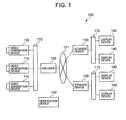
- FIG. 1 is a schematic diagram of a video monitoring system 100 according to a first embodiment of the present invention.
- the video monitoring system 100 includes a video generation device 110, an encoder 120, an accumulation device 130, a display device 140, and a verification device 150.
- the video generation device 110 and the encoder 120 can transmit and receive information with each other via a network 170.
- the encoder 120 and the accumulation device 130 can transmit and receive information with each other via a network 171.
- the accumulation device 130 and the display device 140 can transmit and receive information with each other via a network 172.
- the verification device 150 is not coupled to any one of the networks 170 to 172. However, the verification device 150 can be coupled to at least one of the networks 170 to 172.
- the video generation device 110 includes a video processing unit (not shown) including a camera equipped with an image pickup element.
- the video generation device 110 has a distribution function of storing video data in a storage unit, and distributing the video data via the network 171 to at least one of another video generation device 110, the accumulation device 130, and the display device 140 in response to a request from at least one of another video generation device 110, the accumulation device 130, and the display device 140 or based on judgment of the video generation device 110 itself.
- the judgment of the video generation device 110 indicates, for example, a case where a moving object is detected based on a difference.
- the encoder 120 has a function of converting video data into a format suited to network transmission. For example, when the video data is an analog signal, the encoder 120 performs digital conversion processing, or compression processing according to a transmission band of the network 171.
- This embodiment has been described in a manner that the video generation device 110 and the encoder 120 are separate devices. However, the video generation device 110 and the encoder 120 may be realized in the same device (casing).
- the accumulation device 130 includes a storage control unit (not shown) which receives video data distributed from the video generation device 110 or another accumulation device 130 to store the video data in a storage unit.
- the storage control unit of the accumulation device 130 can arbitrarily extract at least one of a plurality of pieces of received video data to store the video data in the storage unit.
- the video data that have not been extracted is discarded without being stored in the storage unit.
- setting of the number of pieces of video data to be extracted and stored may be accepted by the accumulation device 130, or the number of pieces of video data may be determined by the video generation device 110 to be set in the accumulation device 130.
- the accumulation device 130 has a distribution function of distributing video data to another accumulation device 130 or the display device 140 via the network 172 in response to a video request from at least one of another accumulation device 130 and the display device 140, or based on judgment of the accumulation device 130 itself.
- the display device 140 includes a display processing unit (not shown) which controls processing of receiving video data from the accumulation device 130 to display the video data.
- the display processing unit can arbitrarily extract at least one of a plurality of pieces of received video data to store the video data in a storage unit. Video data that has not been extracted is discarded.
- setting of the number of pieces of video data to be extracted and stored may be accepted by the display device 140, or the number of pieces of video data may be determined by the video generation device 110 or the accumulation device 130 to be set in the display device 140.
- any one of the video generation device 110, encoder 120, accumulation device 130, and display device 140 described above further includes functional units of a signature device 180 described below to be used as the signature device 180.
- signed video data generated in any one of the video generation device 110, the encoder 120, the accumulation device 130, and the display device 140 is extracted to be stored in any one of the video generation device 110, the encoder 120, the accumulation device 130, and the display device 140, and the extracted and stored signed video data is verified by the verification device 150 as described below. As a result, validity of the video data can be proved.
- FIG. 2 is a schematic diagram of the signature device 180.
- the signature device 180 includes a storage unit 181, a control unit 186, an input unit 191, an output unit 192, and a transmission/reception unit 193.
- the storage unit 181 includes a signing key storage unit 182, a verification key storage unit 183, a video data storage unit 184, and a signed data storage unit 185.
- the signing key storage unit 182 stores a signing key sk for adding a signature to video data.
- the verification key storage unit 183 stores a verification key pk for verifying the signature generated by using the signing key sk.
- the video data storage unit 184 stores a plurality of pieces of video data taken by the video generation device 110 and converted into a predetermined data format.
- the signed data storage unit 185 stores signed video data generated from the video data by a signature processing unit 189 described below.
- the control unit 186 includes an overall control unit 187, a video processing unit 188, the signature processing unit 189, and a mathematical function computing unit 190.
- the overall control unit 187 controls overall processing in the signature device 180.
- the video processing unit 188 stores video data taken by the video generation device 110 in the video data storage unit 184.
- the signature processing unit 189 adds a signature to the video data stored in the video data storage unit 184 to generate signed video data, and to store the signed video data in the signed data storage unit 185.
- the mathematical function computing unit 190 calculates a hash value of input data by using a predetermined hash function.
- the mathematical function computing unit 190 generates a signature value of input data by using a predetermined signature generation function (mathematical function) and the signing key sk stored in the signing key storage unit 182.
- FIG. 3 (schematic diagram illustrating signature generation processing) an outline of processing of generating signed video data executed in the signature processing unit 189 and the mathematical function computing unit 190 according to this embodiment is given.
- signed video data are generated with respect to eight pieces of video data M 1 , M 2 , ..., and M 8 .
- a hash-tree structure in which two hash values calculated from the video data are coupled together to calculate another hash value is employed.
- the signature processing unit 189 calculates values h 0,j
- the signature processing unit 189 repeats the processing of calculating hash values with respect to h k,j
- the signature processing unit 189 generates signatures containing the hash value coupled to the hash value calculated from arbitrary video data M i , the calculated signature value ⁇ , and information specifying numbers of the video data M i (positions of input to hash tree), and adds the signatures to the video data M i to generate signed video data.
- hash values coupled to hash values (in FIG. 3 , h 0,5 , h 1 , 3 , and h 2 , 2 ) calculated from the video data M 5 are h 0,6 , h 1,4 , and h 2,1 , and thus these hash values are contained in a signature.
- These hash values are contained in the signature so that an order of coupling to the hash values calculated from the video data M 5 can be known (in this embodiment, contained in signature in coupling order).
- the plurality of pieces of video data M 1 , ..., and M 8 does not necessarily correspond to videos which are time-sequentially continuous.
- the input unit 191 receives input of information.
- the output unit 192 outputs information.
- the transmission/reception unit 193 is an interface which transmits/receives information via the network.
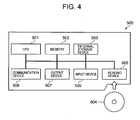
- the signature device 180 described above can be realized by, for example, as illustrated in FIG. 4 (schematic diagram of computer 500), the general computer 500 which includes a central processing unit (CPU) 501, a memory 502, an external storage device 503 such as a hard disk drive (HDD), a reading device 505 which reads information from a portable storage medium 504 such as a compact disk read-only memory (CD-ROM) or a digital versatile disk read-only memory (DVD-ROM) , an input device 506 such as a keyboard or a mouse, an output device 507 such as a display, and a communication device 508 such as a network interface card (NIC) which enables coupling to a communication network.
- NIC network interface card
- the storage unit 181 can be realized in a manner that the CPU 501 uses the memory 502 or the external storage device 503.
- the control unit 186 can be realized by loading a predetermined program stored in the external storage device 503 to the memory 502 to execute the predetermined program by the CPU 501.
- the input unit 191 can be realized in a manner that the CPU 501 uses the input device 506.
- the output unit 192 can be realized in a manner that the CPU 501 uses the output device 507.
- the transmission/reception unit 193 can be realized in a manner that the CPU 501 uses the communication device 508.
- the predetermined program may be downloaded from the storage medium 504 via the reading device 505 or from the network via the communication device 508 to the external storage device 503, and loaded to the memory 502 to be executed by the CPU 501.
- the predetermined program may be directly loaded from the storage medium 504 via the reading device 505 or from the network via the communication device 508 to the memory 502 to be executed by the CPU 501.
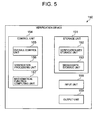
- FIG. 5 is a schematic diagram of the verification device 150.
- the verification device 150 includes a storage unit 151, a control unit 154, an input unit 158, and an output unit 159.
- the storage unit 151 includes a verification key storage unit 152 and a signed data storage unit 153.
- the verification key storage unit 152 stores the verification key pk for verifying signed video data generated by the signature device 180.
- the signed data storage unit 153 stores the signed video data generated by the signature device 180.
- the control unit 154 includes an overall control unit 155, a verification processing unit 156 and a mathematical function computing unit 157.
- the overall control unit 155 controls overall processing in the verification device 150.
- the verification processing unit 156 verifies the signed video data stored in the signed data storage unit 153.
- the mathematical function computing unit 157 calculates a hash value of input data by using a predetermined hash function.
- the mathematical function computing unit 157 generates decrypted data from an input signature value by using a predetermined signature verification function and the verification key pk stored in the verification key storage unit 152.
- FIG. 6 (schematic diagram illustrating verification processing) an outline of processing of verifying signed video data executed in the verification processing unit 156 and the mathematical function computing unit 157 according to this embodiment is given.
- the verification processing unit 156 extracts the video data M i from signed video data, and inputs the video data M i to the mathematical function computing unit 157 to calculate a 0-th level hash value h 0,i of the hash tree.
- a hash value h 1,3 is calculated from a value (h 0,5
- the verification processing unit 156 repeats the processing described above until all hash values contained in the signed video data are coupled to calculate a hash value h 3,1 in the end.
- the verification processing unit 156 inputs the signature value ⁇ contained in the signed video data and the verification key pk stored in the verification key storage unit 152 to the mathematical function computing unit 157. Then, the mathematical function computing unit 157 calculates a verification value from the signature value ⁇ by using the verification key pk.
- the verification processing unit 156 judges, when the calculated hash value h 3,1 matches the calculated verification value, that validity of the video data M i has been verified.
- the input unit 158 receives input of information.
- the output unit 159 outputs information.
- the verification device 150 described above can be realized by, for example, the general computer 500 as illustrated in FIG. 4 .
- the storage unit 151 can be realized in a manner that the CPU 501 uses the memory 502 or the external storage device 503.
- the control unit 154 can be realized by loading a predetermined program stored in the external storage device 503 to the memory 502 to execute the predetermined program by the CPU 501.
- the input unit 158 can be realized in a manner that the CPU 501 uses the input device 506.
- the output unit 159 can be realized in a manner that the CPU 501 uses the output device 507.
- the predetermined program may be downloaded from the storage medium 504 via the reading device 505 or from the network via the communication device 508 to the external storage device 503, and loaded to the memory 502 to be executed by the CPU 501.
- the predetermined program may be directly loaded from the storage medium 504 via the reading device 505 or from the network via the communication device 508 to the memory 502 to be executed by the CPU 501.
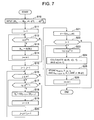
- FIG. 7 is a flowchart illustrating the processing of generating signed video data by the signature device 180.
- the signature processing unit 189 of the signature device 180 obtains a plurality of pieces of video data M 1 , ..., and M k (k is a natural number of 2 m , and m is a natural number of 1 or larger) from the video data storage unit 184, and the signing key sk from the signing key storage unit 182 to secure signature storage areas s[1], ..., and s[k] in the storage unit 181 (S10).
- the signature processing unit 189 substitutes 1 for a counter i (S11).
- h denotes a cryptographic hash function such as SHA-256.
- the signature processing unit 189 increments i by 1 (i ⁇ i+1) (S14), and returns to Step S12 to repeat the processing.
- Step S15 the signature processing unit 189 substitutes 1(i ⁇ 1) for the counter i, and 1(j ⁇ 1) for a counter j.
- the signature processing unit 189 judges whether or not j ⁇ m is established (S16), and proceeds to Step S17 if j ⁇ m is established (Yes in Step S16), or to Step S21 if j ⁇ m is not established (No in Step S16).
- Step S17 the signature processing unit 189 judges whether or not i ⁇ 2 m-j is established, and proceeds to Step S18 if i ⁇ 2 m-j is established (Yes in Step S17), or to Step S20 if i ⁇ 2 m-j is not established (No in Step S17).
- Step S18 the signature processing unit 189 inputs a value (h j-1,2i-1
- h j-1,2i ) obtained by coupling together a hash value h j-1 , 2i-1 , and a hash value h j-1,2i to the mathematical function computing unit 190. Then, the mathematical function computing unit 190 calculates a hash value h j h(h j-i,2i-1
- the signature processing unit 189 increments i by 1 (i ⁇ i+1) (S19), and returns to Step S17 to repeat the processing.
- Step S20 the signature processing unit 189 increments j by 1 (j ⁇ j+1), resets i to an initial value (i ⁇ 1), and returns to Step S16 to repeat the processing.
- Step S21 the signature processing unit 189 calculates the signature value ⁇ from a hash value h m,1 by using the signing key sk.
- the signature processing unit 189 resets i to the initial value (i ⁇ 1) (S22).
- the signature processing unit 189 judges whether or not 1 ⁇ i ⁇ 2 m is established (S23), and proceeds to Step S24 if 1 ⁇ i ⁇ 2 m is established (Yes in Step S23), or finishes the processing if 1 ⁇ i ⁇ 2 m is not established (No in Step S23).
- Step S24 the signature processing unit 189 calculates a(i,0), a (i, 1), ..., and a (i, m-i) by using an algorithm illustrated in FIG. 8 to specify a hash value to be contained in a signature (S24).
- the signature processing unit 189 substitutes (h 0,a(i,0) , h 1,a(i , 1 ), ..., h m-1,a(i,m-1) , m, i, ⁇ ) for s[i] as signatures of the video data M i (S25).
- FIG. 8 is a flowchart illustrating processing of calculating a sequence of numbers for specifying hash values to be contained in a signature.
- the signature processing unit 189 substitutes i for a(i,0)(a(i,0) ⁇ i) (S31).
- the signature processing unit 189 judges whether or not a (i, 0) is an even number (S32), and proceeds to Step S33 if a(i,0) is an even number (Yes in Step S32), or to Step S34 if a(i,0) is an odd number (No in Step S32).
- Step S33 the signature processing unit 189 substitutes a(i,0)-1 for a(i,0)(a(i,0) ⁇ a(i,0)-1).
- Step S34 the signature processing unit 189 substitutes a(i,0)+1 for a(i,0) (a(i,0) ⁇ a(i,0)+1).
- the signature processing unit 189 initializes the counter j(j ⁇ 1) (S35).
- the signature processing unit 189 judges whether or not j ⁇ m-1 is established (S36), and proceeds to Step S37 if j ⁇ m-1 is established (Yes in Step S36), or to Step S44 if j ⁇ m-1 is not established (No in Step S36).
- Step S37 the signature processing unit 189 judges whether or not a(i,j-1) is an even number, and proceeds to Step S38 if a(i,j-1) is an even number (Yes in Step S37), or to Step S39 if a(i,j-1) is an odd number (No in Step S37).
- Step S38 the signature processing unit 189 substitutes a(i,j-1)/2 for b(i,j-1) (b(i,j-1) ⁇ a(i,j-1)/2).
- Step S39 the signature processing unit 189 substitutes a(i,j-1)-1/2 for b(i,j-1) (b(i,j-1) ⁇ a(i,j-1)-1/2).
- the signature processing unit 189 judges whether or not b(i,j-1) is an even number (S40), and proceeds to Step S41 if b(i,j-1) is an even number (Yes in Step S40), or to Step S42 if b(i,j-1) is an odd number (No in Step S40).
- Step S41 the signature processing unit 189 substitutes b(i,j-1)-1 for a(i,j) (a(i,j) ⁇ b(i,j-1)-1).
- Step S42 the signature processing unit 189 substitutes b(i,j-1)+1 for a(i,j) (a(i,j) ⁇ b(i,j-1)+1).
- the signature processing unit 189 increments j by 1 (j ⁇ j+1) (S43), and returns to Step S36 to repeat the processing.
- Step S44 the signature processing unit 189 specifies a hash value based on a calculated sequence of numbers a(i,0), ..., a(i,m-1).
- signatures S 1 , ..., and S k are generated from the video data M 1 , ..., and M k .
- a reference image or video data containing the reference image is used in the case of MPEG 4.
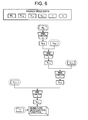
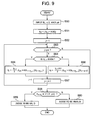
- FIG. 9 is a flowchart illustrating verification processing for signed video data (Mi,Si) executed in the verification device 150.
- the verification processing unit 156 substitutes 1 for the counter j (j ⁇ 1) (S52).
- the verification processing unit 156 judges whether or not j ⁇ m is established (S53), and proceeds to Step S54 if j ⁇ m is established (Yes in Step S53), or to Step S58 if j ⁇ m is not established (No in Step S53).
- Step S54 the verification processing unit 156 judges whether or not b j-1 is an even number, and proceeds to Step S55 if b j-1 is an even number (Yes in Step S54), or to Step S56 if b j-1 is an odd number (No in Step S54).
- B j b j
- B j-1 b j-1
- a j-1 a j-1 apply.
- B j b j
- B j-1 b j-1
- a j-1 a j-1 apply.
- the verification processing unit 156 substitutes j+1 for j(j ⁇ j+1) (S57), and returns to Step S53 to repeat the processing.
- B m b m applies.
- this embodiment enables easy verification even when the video message M i and the signature S i corresponding to the video message M i are arbitrarily selected to be stored.
- the signature S[i] contains a number i.
- a hash value h 0,5 is calculated for the video data M 5
- a hash value h 1 , 3 is calculated for h 0,5
- h 0,6 obtained by coupling together the calculated hash value h 0,5 and the hash value h 0,6 contained in the signature.
- the signature s [i] contains the logarithm m of the number of signature targets where a base is 2. It is because, when generation and verification of a signature described in this embodiment are realized by software, a value indicating how many hash values are contained in the signature s[i] is necessary.
- m is used for judging the number of hash values contained in the signature s[i].
- a hash function h is used up to the second level of the hash tree, and a hash function H is used at the third level (last level) of the hash tree.
- the same hash function e.g., SHA-256
- the hash function H and the portion of the signature generation function may be replaced by a signature method such as RSA-PSS or ECDSA to be used.
- a signature is generated including the last level of the hash tree of FIGS. 3 and 6 (h 2,1
- the present invention is not limited to this.
- a hash value of data m i M i
- r i coupling a predetermined value r i to each piece of video data M i (1 ⁇ i ⁇ k) may be set at the 0-th level of the hash tree.
- an arbitrary value can be used.
- a MAC address or an IP address of the signature device 180, or time of signature generation can be used.
- time of signature generation time, day, month, and year
- data m i not only validity of the video data but also validity of the signature device 180 or the time of the signature generation can be verified.
- the data to be signed is video data.
- the data to be signed may be other data.
- a reason why the signature method according to this embodiment has high security is as follows.
- the signature method e.g., RSA-PSS or ECDSA
- hash function H and portion of signature generation function is cryptographically secure (security can be proved)
- a hash function is an ideal random function (random oracle model)
- cryptographic security of the above-mentioned signature generation/verification method for the plurality of pieces of data can be proved (security can be proved).
- a reason why the signature method according to this embodiment has high efficiency is as follows. As described above, in public key cryptography, its mathematical function takes longest processing time, and the processing time required for the hash function is considerably short as compared with the processing times required for the mathematical function. Thus, when signatures are generated for a plurality of pieces of video data M 1 , ..., and M k , according to this embodiment, a mathematical function (signature function or signature verification function) has to be calculated only once in the signature method described above, and processing time can be shortened.
- signatures can be generated for an arbitrary number of a plurality of pieces of video data.
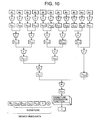
- one hash value is calculated from the pieces of video data of the number of a maximum power of 2 (M 1 to M 8 in FIG. 10 ) among a plurality of pieces of signature data (M 1 to M 11 in FIG. 10 ) by the same method as that of FIG. 3
- one hash value (second hash value) is calculated from the remaining video data (M 9 to M 11 in FIG. 10 ), and lastly the first and second hash values are coupled together to calculate a hash value to be input to the signature generation function.
- hash value calculation is carried out until one hash value can be calculated without any coupling at a specific level of the hash tree.
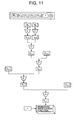
- FIG. 11 Schematic diagram illustrating verification processing
- verification can be carried out as in the case of FIG. 6 .
- the second embodiment of the present invention is different from the first embodiment in a signature device 280.
- items concerning the signature device 280 is described below.
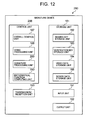
- FIG. 12 is a schematic diagram of the signature device 280 according to the second embodiment of the present invention.
- the signature device 280 includes a storage unit 181, a control unit 286, an input unit 191, an output unit 192, and a transmission/reception unit 193.
- the control unit 286 is different from that of the first embodiment. Thus, items concerning the control unit 286 are described below.
- the control unit 286 includes an overall control unit 187, a video processing unit 188, a signature processing unit 289, and a mathematical function computing unit 190.
- the signature processing unit 289 is different from that of the first embodiment. Thus, items concerning the signature processing unit 289 is described below.
- the signature processing unit 289 generates, when the number of pieces of video data stored in a video data storage unit 184 is not a power of 2, new specific data, sets the number of pieces of video data to be signed to a power of 2, and generates a signature by the same method as that of the first embodiment.
- the data newly generated by the signature processing unit 289 may be a predetermined fixed value or a random number.
- FIG. 13 is a flowchart illustrating signature generation processing executed in the signature device 280.
- the signature processing unit 289 of the signature device 280 obtains *Datainfo, a signing key istate_s, a random number generation seed seed_r[sLen], and a signature storage area sign[n][fLen] (S70).
- n of signature targets varies (can vary) from one signature generation to another.
- fLen dependent on n can also vary.
- *Datainfo is a storage area for storing a plurality of pieces of video data M 1 , ..., and M n to be signed, the number n of signature targets, and a byte length Len i of each piece of video data M i described above, and an area size for video data storage is fixed in advance (e.g., 1 Mbytes).
- the plurality of pieces of video data M 1 , ..., and M n are not limited to videos generated by the same video generation device 110, but may be videos generated by a plurality of different video generation devices 110.
- the plurality of pieces of video data M 1 , ..., and M n are not limited to time-sequentially continuous video data generated by the same video generation device 110.
- signatures are generated for the plurality of pieces of time-sequentially continuous video data
- the plurality of pieces of time-sequentially continuous video data M 1 , ..., and M n only have to be stored in the storage area *Datainfo.
- the plurality of pieces of time-sequentially continuous video data M 1 , ..., and M n are stored by a unit called a group of videos (GOV).
- M i may be one frame such as a reference image (Intra-coded frame: I-frame) or a difference image (Predicted frame: P-frame), or one GOV.
- M 1 may be a reference image
- M 2 may be difference images of M 1
- M 3 may be a reference image (different from M 1 )
- M 2 may be difference images of M 3 .
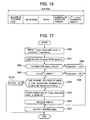
- the signature storage area sign[n][fLen] has, for example, a format similar to that illustrated in FIG. 15 (schematic diagram illustrating format of signature storage area).
- An algorithm identifier (algID) illustrated in FIG. 16 is an area for storing a value corresponding to a signature method used for signature generation.
- the value corresponding to the signature method is predetermined to be, for example, 0x00 when there is no signature, 0x01 for RSA-PSS, and 0x02 for ECDSA.
- a key ID illustrated in FIG. 16 is an area used for checking whether or not a signing key used for signature generation is valid.
- Step S70 the signature processing unit 289 judges whether or not n ⁇ NMAX is established (S71), and proceeds to Step S72 if n ⁇ NMAX is established (Yes in Step S71), or to Step S83 if n ⁇ NMAX is not established (No in Step S71).
- Step S83 the signature processing unit 289 outputs -100 indicating an error to the output unit 192 to finish the processing.
- the signature processing unit 289 substitutes h (pxq) for temp (S72).
- the signature processing unit 289 initializes a counter j(j ⁇ 1) (S73).
- the signature processing unit 289 judges whether or not j ⁇ n is established (S74), and proceeds to Step S75 if j ⁇ n is established (Yes in Step S74), or to Step S77 if j ⁇ n is not established (No in Step S74).
- Step S75 the signature processing unit 289 substitutes temp for a key ID (keyID j ).
- the signature processing unit 289 increments j by 1 (j ⁇ j+1) (S76), and returns to Step S74 to repeat the processing.
- Step S77 the signature processing unit 289 calculates m which satisfies 2 m-1 ⁇ n ⁇ 2 m .
- the signature processing unit 289 judges whether or not n ⁇ 2 m is established (S78), and proceeds to Step S79 if n ⁇ 2 m is established (Yes in Step S78), or to Step S80 if n ⁇ 2 m is not established (No in Step S78).
- the signature processing unit 289 dynamically secures an area h j,k (1 ⁇ j ⁇ m, and 1 ⁇ k ⁇ 2 m-j ) for signature generation calculation, and checks whether or not the area has successfully been secured (S80) .
- the signature processing unit 289 proceeds to Step S81 if the area has successfully been secured (Yes in Step S80), or to Step S84 if the area has not successfully been secured (No in Step S80).
- Step S84 the signature processing unit 289 outputs -100 indicating an error to the output unit 192 to finish the processing.
- Step S81 the signature processing unit 289 determines a signature method, generates signatures for the plurality of pieces of video data M 1 , ..., and M n , istate_s, seed_r[sLen], and sign[fLen][1], ..., and sign[fLen][n] by using the algorithm illustrated in FIG. 7 , and substitutes a value corresponding to the used signature method for an algorithm identifier.
- the signature processing unit 289 releases the area secured in Step S80 (S82) to finish the processing.
- areas are secured for all the pieces of data short for a power of 2 in Step S79. Not limited to this, however, for example, an area may be secured when a hash value to be coupled is necessary.
- FIG. 17 is a flowchart illustrating verification processing executed in the verification device 150.
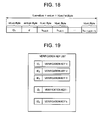
- a procedure of calculating whether or not a signature ⁇ is "valid" from s[i] having a format illustrated in FIG. 18 (schematic diagram illustrating format of s [i]) including video data *data and signatures (h 0,a ( i,0 ), h 1,a(i, 1) , ..., h m-1,a(i,m-1), m, n, i, ⁇ ) of the video data *data generated in the signature device 280, and a verification key pk is described.
- a verification processing unit 156 of the verification device 150 obtains the video data *data, a byte length dataLen of the video data *data, a signature sign[fLen] of the video data *data, and a verification key istate_p (S90).
- the verification processing unit 156 takes out a key ID (keyID j ) from sign[fLen] (S91).
- the verification processing unit 156 checks validity of the public key istate_p by using the public key istate_p and the keyID j (S92). The verification processing unit 156 proceeds to Step S93 if valid (Yes in Step S92), or to Step S98 if not valid (No in Step S92).
- N is called an RSA modulus.
- the keyID J is an area for storing a part (or all parts) of a hash(N) of the RSA modulus N beforehand. It is presumed that a part (or all parts) of the hash value h(N) is stored during signature generation.
- h(N) is calculated from the verification key (N, e), and a part (or all parts) of the h(N) is compared with a part (or all parts) of the hash value h(N) of the RSA modulus N stored beforehand in the keyID j .
- the verification key is judged to be valid if matched, or the verification key is judged to be invalid (not valid) if not matched.
- the keyID j plays a role of not only checking the validity of the verification key but also efficiently retrieving a verification key necessary for signature verification.
- the verification device 150 ties a set of a verification key corresponding to a signing key of the plurality of video generation devices 110, the encoder 120, the accumulation device 130 or the display device 140, and a part (or all parts) of h (N) with a string to hold the set as a list by, for example, a method illustrated in FIG. 19 (schematic diagram illustrating verification key management method) beforehand.
- a verification key (referred to as verification key i) corresponding to an ID (referred to as ID i ) of the verification key list matching the value stored in the keyID j can be efficiently retrieved.
- Step S98 the verification processing unit 156 substitutes -201 indicating an error for outputdata to proceed to Step S97.
- Step S99 the verification processing unit 156 substitutes -201 indicating an error for outputdata to proceed to Step S97.
- Step S94 the verification processing unit 156 dynamically secures an area for signature verification calculation to check whether or not the area has successfully been secured.
- the verification processing unit 156 proceeds to Step S95 if the area has successfully been secured (Yes in Step S94), or to Step S100 if area securing has failed (No in Step S94).
- Step S100 the verification processing unit 156 outputs -101 indicating an error to the output unit 159 to finish the processing.
- Step S95 the verification processing unit 156 performs signature verification for (*data, dataLen[2], sign[fLen], istate_p) by using the algorithm illustrated in FIG. 9 .
- the verification processing unit 156 releases the area secured in Step S94 (S96).
- Step S97 the verification processing unit 156 outputs 0 indicating a normal end to the output unit 159 to finish the processing.
- This embodiment has been described by way of only the case where the signature of the verification target has been input. However, a case where there is no signature data added to video data may occur.
- the user may take out video data and signature data from any one of the video generation device 110, the encoder 120, the accumulation device 130, and the display device 140 to an external storage device such as a USB memory or an external HDD, and take out no signature by mistake during movement to the verification device 150, or the user may delete a signature by mistake.
- a high-order function e.g., verification processing unit 156 that loads the signature verification function according to this embodiment may check addition of no signature to display inhibition of signature verification.
- the hash function h and the hash function H illustrated in FIG. 3 may be the same hash function (e.g., SHA-256) and, in application to a real system, the hash function H and the portion of the signature generation function may be replaced by a signature method such as RSA-PSS or ECDSA to be used.
- SHA-256 hash function
- ECDSA ECDSA
- a method used for signature generation may not be determined in Step S81 of FIG. 13 .
- a signature method to be used may be determined beforehand, and a value corresponding to the signature method to be used may be input together with a message *Datainfo or a signing key istate_s in Step S70.
- an output value or a return value (outputdata) of signature verification may be a value different from the value according to this embodiment as long as what error has occurred can be understood based on the output value or the return value.
- the signature generation and verification with high security and efficiency can be carried out corresponding to the arbitrary extraction and storage from the plurality of pieces of video data.
Landscapes
- Engineering & Computer Science (AREA)
- Computer Security & Cryptography (AREA)
- Computer Networks & Wireless Communication (AREA)
- Signal Processing (AREA)
- Storage Device Security (AREA)
- Debugging And Monitoring (AREA)
Applications Claiming Priority (1)
| Application Number | Priority Date | Filing Date | Title |
|---|---|---|---|
| JP2008021790A JP2009182864A (ja) | 2008-01-31 | 2008-01-31 | 署名装置、検証装置、プログラム、署名方法、検証方法及びシステム |
Publications (2)
| Publication Number | Publication Date |
|---|---|
| EP2086163A2 true EP2086163A2 (fr) | 2009-08-05 |
| EP2086163A3 EP2086163A3 (fr) | 2010-03-24 |
Family
ID=40651310
Family Applications (1)
| Application Number | Title | Priority Date | Filing Date |
|---|---|---|---|
| EP08022421A Withdrawn EP2086163A3 (fr) | 2008-01-31 | 2008-12-23 | Dispositif de signature, dispositif de vérification, programme, procédé de signature, procédé de vérification, et système |
Country Status (3)
| Country | Link |
|---|---|
| US (1) | US20090199010A1 (fr) |
| EP (1) | EP2086163A3 (fr) |
| JP (1) | JP2009182864A (fr) |
Cited By (1)
| Publication number | Priority date | Publication date | Assignee | Title |
|---|---|---|---|---|
| CN114710705A (zh) * | 2017-07-18 | 2022-07-05 | 谷歌有限责任公司 | 用于保护和验证视频文件的方法、系统和介质 |
Families Citing this family (11)
| Publication number | Priority date | Publication date | Assignee | Title |
|---|---|---|---|---|
| JP5381543B2 (ja) * | 2009-09-18 | 2014-01-08 | 富士通株式会社 | データ処理装置、署名処理プログラム、検証プログラム、及び署名プログラム |
| US10862690B2 (en) | 2014-09-30 | 2020-12-08 | Telefonaktiebolaget Lm Ericsson (Publ) | Technique for handling data in a data network |
| JP2016122917A (ja) * | 2014-12-24 | 2016-07-07 | パナソニックIpマネジメント株式会社 | 署名生成装置、署名検証装置、署名生成方法及び署名検証方法 |
| EP3259873B1 (fr) | 2015-02-20 | 2018-12-12 | Telefonaktiebolaget LM Ericsson (publ) | Procédé de fourniture d'une valeur de hachage pour un élément de données, dispositif électronique et programme informatique |
| PT3259871T (pt) * | 2015-02-20 | 2020-11-10 | Ericsson Telefon Ab L M | Método para proporcionar um valor de dispersão para uma parte de dados, dispositivo eletrónico e programa de computador |
| EP3281145B1 (fr) | 2015-04-10 | 2019-11-06 | Telefonaktiebolaget LM Ericsson (publ) | Chemins de vérification de feuilles d'un arbre |
| US10511598B2 (en) * | 2016-03-29 | 2019-12-17 | Intel Corporation | Technologies for dynamic loading of integrity protected modules into secure enclaves |
| EP3376705A1 (fr) * | 2017-03-17 | 2018-09-19 | Koninklijke Philips N.V. | Dispositif et procédé de multiplication en point de courbe elliptique en boîte blanche |
| JP6959155B2 (ja) * | 2017-05-15 | 2021-11-02 | パナソニック インテレクチュアル プロパティ コーポレーション オブ アメリカPanasonic Intellectual Property Corporation of America | 検証方法、検証装置およびプログラム |
| WO2018211757A1 (fr) * | 2017-05-15 | 2018-11-22 | パナソニック インテレクチュアル プロパティ コーポレーション オブ アメリカ | Procédé de vérification, dispositif de vérification et programme de vérification |
| US12388654B2 (en) * | 2022-12-21 | 2025-08-12 | Nxp B.V. | Method for superflous hash usage in hash-based signatures |
Citations (4)
| Publication number | Priority date | Publication date | Assignee | Title |
|---|---|---|---|---|
| WO1997016905A1 (fr) | 1995-11-02 | 1997-05-09 | Silvio Micali | Systeme arborescent de revocation de certificats |
| US20050114666A1 (en) | 1999-08-06 | 2005-05-26 | Sudia Frank W. | Blocked tree authorization and status systems |
| JP2007028014A (ja) | 2005-07-13 | 2007-02-01 | Fuji Xerox Co Ltd | デジタル署名プログラム、デジタル署名システム、デジタル署名方法、署名検証方法 |
| US20070248226A1 (en) | 2006-04-25 | 2007-10-25 | The University Of Hong Kong | System and method for fast and scalable multimedia authentication in real time environment |
Family Cites Families (5)
| Publication number | Priority date | Publication date | Assignee | Title |
|---|---|---|---|---|
| US6959384B1 (en) * | 1999-12-14 | 2005-10-25 | Intertrust Technologies Corporation | Systems and methods for authenticating and protecting the integrity of data streams and other data |
| JP2002215029A (ja) * | 2001-01-22 | 2002-07-31 | Seiko Epson Corp | 情報認証装置及びこれを使用したデジタルカメラ |
| US20020184504A1 (en) * | 2001-03-26 | 2002-12-05 | Eric Hughes | Combined digital signature |
| US7315866B2 (en) * | 2003-10-02 | 2008-01-01 | Agency For Science, Technology And Research | Method for incremental authentication of documents |
| JP4359622B2 (ja) * | 2007-01-22 | 2009-11-04 | 富士通株式会社 | 電子署名プログラム、および電子署名装置 |
-
2008
- 2008-01-31 JP JP2008021790A patent/JP2009182864A/ja active Pending
- 2008-12-12 US US12/333,823 patent/US20090199010A1/en not_active Abandoned
- 2008-12-23 EP EP08022421A patent/EP2086163A3/fr not_active Withdrawn
Patent Citations (4)
| Publication number | Priority date | Publication date | Assignee | Title |
|---|---|---|---|---|
| WO1997016905A1 (fr) | 1995-11-02 | 1997-05-09 | Silvio Micali | Systeme arborescent de revocation de certificats |
| US20050114666A1 (en) | 1999-08-06 | 2005-05-26 | Sudia Frank W. | Blocked tree authorization and status systems |
| JP2007028014A (ja) | 2005-07-13 | 2007-02-01 | Fuji Xerox Co Ltd | デジタル署名プログラム、デジタル署名システム、デジタル署名方法、署名検証方法 |
| US20070248226A1 (en) | 2006-04-25 | 2007-10-25 | The University Of Hong Kong | System and method for fast and scalable multimedia authentication in real time environment |
Non-Patent Citations (1)
| Title |
|---|
| CHUNG KEI WONG ET AL.: "Digital Signatures for Flows and Mul- ticasts", IEEE/ ACM TRANSACTIONS ON NETWORKING, vol. 7, no. 4, 1 August 1999 (1999-08-01) |
Cited By (3)
| Publication number | Priority date | Publication date | Assignee | Title |
|---|---|---|---|---|
| CN114710705A (zh) * | 2017-07-18 | 2022-07-05 | 谷歌有限责任公司 | 用于保护和验证视频文件的方法、系统和介质 |
| CN114710705B (zh) * | 2017-07-18 | 2023-12-15 | 谷歌有限责任公司 | 用于保护和验证视频文件的方法、系统和介质 |
| US12218920B2 (en) | 2017-07-18 | 2025-02-04 | Google Llc | Methods, systems, and media for protecting and verifying video files |
Also Published As
| Publication number | Publication date |
|---|---|
| EP2086163A3 (fr) | 2010-03-24 |
| JP2009182864A (ja) | 2009-08-13 |
| US20090199010A1 (en) | 2009-08-06 |
Similar Documents
| Publication | Publication Date | Title |
|---|---|---|
| EP2086163A2 (fr) | Dispositif de signature, dispositif de vérification, programme, procédé de signature, procédé de vérification, et système | |
| US8738917B2 (en) | Image data verification | |
| US10880310B2 (en) | Method for proving retrievability of information | |
| US11418677B2 (en) | Method for preventing image modification, image capturing device and image verification method | |
| US7535488B2 (en) | Image data verification system | |
| Dutta et al. | Securing the deluge network programming system | |
| JP5383297B2 (ja) | 署名装置 | |
| US20120096564A1 (en) | Data integrity protecting and verifying methods, apparatuses and systems | |
| US8312284B1 (en) | Verifiable timestamping of data objects, and applications thereof | |
| KR20120053398A (ko) | 컨텐츠를 검증하기 위한 서명 장치와 검증 장치를 포함하는 검증 시스템 및 검증 방법 | |
| CN111339040B (zh) | 一种数据文件的云存储方法、装置、设备及存储介质 | |
| TW201325179A (zh) | 數位檔案存證方法及系統 | |
| CN1741449B (zh) | 数据处理系统及其控制方法、计算机程序和可读记录介质 | |
| US8429469B2 (en) | Method and apparatus for remotely verifying memory integrity of a device | |
| US20030196086A1 (en) | Information processing apparatus, information processing system, information processing method, storage medium and program | |
| US20090313425A1 (en) | Memory control apparatus, content playback apparatus, control method and recording medium | |
| JP3788976B2 (ja) | データ登録システム、データ登録方法及びプログラム | |
| JP5518668B2 (ja) | 電子署名用鍵管理装置、電子署名用鍵管理方法、電子署名用鍵管理プログラム | |
| US7930544B2 (en) | Data processing apparatus and its method | |
| GB2450574A (en) | Batch verification of multiple signature data | |
| CN115720168B (zh) | 针对云端加密数据的去重和完整性验证方法 | |
| CN117556476A (zh) | 一种数据验证方法、装置、设备及介质 | |
| CN108596050A (zh) | 图像的签名方法和装置以及验签方法和装置 | |
| US12489648B2 (en) | Methods and systems for streaming block templates with cross-references | |
| KR20180012129A (ko) | 영상 수집 장치, 그리고 서버를 포함하는 인증 시스템 및 이를 이용한 인증 방법 |
Legal Events
| Date | Code | Title | Description |
|---|---|---|---|
| PUAI | Public reference made under article 153(3) epc to a published international application that has entered the european phase |
Free format text: ORIGINAL CODE: 0009012 |
|
| AK | Designated contracting states |
Kind code of ref document: A2 Designated state(s): AT BE BG CH CY CZ DE DK EE ES FI FR GB GR HR HU IE IS IT LI LT LU LV MC MT NL NO PL PT RO SE SI SK TR |
|
| AX | Request for extension of the european patent |
Extension state: AL BA MK RS |
|
| PUAL | Search report despatched |
Free format text: ORIGINAL CODE: 0009013 |
|
| 17P | Request for examination filed |
Effective date: 20100211 |
|
| AK | Designated contracting states |
Kind code of ref document: A3 Designated state(s): AT BE BG CH CY CZ DE DK EE ES FI FR GB GR HR HU IE IS IT LI LT LU LV MC MT NL NO PL PT RO SE SI SK TR |
|
| AX | Request for extension of the european patent |
Extension state: AL BA MK RS |
|
| 17Q | First examination report despatched |
Effective date: 20100629 |
|
| AKX | Designation fees paid |
Designated state(s): DE GB |
|
| STAA | Information on the status of an ep patent application or granted ep patent |
Free format text: STATUS: THE APPLICATION IS DEEMED TO BE WITHDRAWN |
|
| 18D | Application deemed to be withdrawn |
Effective date: 20160701 |