EP2086524B1 - Composition pharmaceutique anticonvulsive transnasale - Google Patents
Composition pharmaceutique anticonvulsive transnasale Download PDFInfo
- Publication number
- EP2086524B1 EP2086524B1 EP07833718.5A EP07833718A EP2086524B1 EP 2086524 B1 EP2086524 B1 EP 2086524B1 EP 07833718 A EP07833718 A EP 07833718A EP 2086524 B1 EP2086524 B1 EP 2086524B1
- Authority
- EP
- European Patent Office
- Prior art keywords
- diazepam
- weight
- administration
- formulation
- transnasal
- Prior art date
- Legal status (The legal status is an assumption and is not a legal conclusion. Google has not performed a legal analysis and makes no representation as to the accuracy of the status listed.)
- Not-in-force
Links
Images

Classifications
-
- A—HUMAN NECESSITIES
- A61—MEDICAL OR VETERINARY SCIENCE; HYGIENE
- A61K—PREPARATIONS FOR MEDICAL, DENTAL OR TOILETRY PURPOSES
- A61K47/00—Medicinal preparations characterised by the non-active ingredients used, e.g. carriers or inert additives; Targeting or modifying agents chemically bound to the active ingredient
- A61K47/06—Organic compounds, e.g. natural or synthetic hydrocarbons, polyolefins, mineral oil, petrolatum or ozokerite
- A61K47/08—Organic compounds, e.g. natural or synthetic hydrocarbons, polyolefins, mineral oil, petrolatum or ozokerite containing oxygen, e.g. ethers, acetals, ketones, quinones, aldehydes, peroxides
- A61K47/14—Esters of carboxylic acids, e.g. fatty acid monoglycerides, medium-chain triglycerides, parabens or PEG fatty acid esters
-
- A—HUMAN NECESSITIES
- A61—MEDICAL OR VETERINARY SCIENCE; HYGIENE
- A61K—PREPARATIONS FOR MEDICAL, DENTAL OR TOILETRY PURPOSES
- A61K31/00—Medicinal preparations containing organic active ingredients
- A61K31/33—Heterocyclic compounds
- A61K31/395—Heterocyclic compounds having nitrogen as a ring hetero atom, e.g. guanethidine or rifamycins
- A61K31/55—Heterocyclic compounds having nitrogen as a ring hetero atom, e.g. guanethidine or rifamycins having seven-membered rings, e.g. azelastine, pentylenetetrazole
- A61K31/551—Heterocyclic compounds having nitrogen as a ring hetero atom, e.g. guanethidine or rifamycins having seven-membered rings, e.g. azelastine, pentylenetetrazole having two nitrogen atoms, e.g. dilazep
- A61K31/5513—1,4-Benzodiazepines, e.g. diazepam or clozapine
-
- A—HUMAN NECESSITIES
- A61—MEDICAL OR VETERINARY SCIENCE; HYGIENE
- A61K—PREPARATIONS FOR MEDICAL, DENTAL OR TOILETRY PURPOSES
- A61K9/00—Medicinal preparations characterised by special physical form
- A61K9/10—Dispersions; Emulsions
- A61K9/107—Emulsions ; Emulsion preconcentrates; Micelles
-
- A—HUMAN NECESSITIES
- A61—MEDICAL OR VETERINARY SCIENCE; HYGIENE
- A61P—SPECIFIC THERAPEUTIC ACTIVITY OF CHEMICAL COMPOUNDS OR MEDICINAL PREPARATIONS
- A61P21/00—Drugs for disorders of the muscular or neuromuscular system
- A61P21/02—Muscle relaxants, e.g. for tetanus or cramps
-
- A—HUMAN NECESSITIES
- A61—MEDICAL OR VETERINARY SCIENCE; HYGIENE
- A61P—SPECIFIC THERAPEUTIC ACTIVITY OF CHEMICAL COMPOUNDS OR MEDICINAL PREPARATIONS
- A61P25/00—Drugs for disorders of the nervous system
- A61P25/08—Antiepileptics; Anticonvulsants
Definitions
- the present invention relates to a transnasal anticonvulsive pharmaceutical composition. More specifically, the present invention relates to an anticonvulsive pharmaceutical composition for transmucosal delivery of diazepam having improved solubility and transmucosal permeability of diazepam.
- SE Status epilepticus
- SE a prolonged epileptic seizure
- SE refers to a serious neurological emergency which may lead to the mortality rate of from 3 to 35% in the total SE patients.
- the primary goal of the treatment of SE resides in the rapid management of pathological seizure activity since the longer that an episode of status epilepticus remains untreated, the more difficult it is to control and the greater the risk of permanent brain damage.
- critical to the management of the patients is a prompt treatment involving administration of a pharmaceutical composition in the form of a proper pharmaceutical formulation containing an active drug ingredient at an adequate dose.
- IV administration of anticonvulsants is the most rapid way to suppress epileptic convulsions.
- other routes of administration may be highly desirable when intravenous administration is inconvenient or is delayed, for instance, because of technical difficulties such as requirements for sterile equipment and trained personnel, and because of the probable development of phlebitis.
- intravenous administration of such medication is often associated with hypotension, cardiac dysrhythmia or central nervous system (CNS) depression.
- CNS central nervous system
- US Patent No. 4863720 issued to Burghardt, discloses a sublingual sprayable pharmaceutical preparation wherein the active drug ingredient can be a benzodiazepine.
- Such preparations preferably contain polyethylene glycol (PEG), and ethanol, di- and/ or triglycerides of fatty acids and a pharmaceutically acceptable propellant gas are required components.
- Intranasal administration has an advantage in that drugs of interest may be administered readily and simply to achieve systemic or topical effects, as required.
- the major problem associated with intranasal drug administration is the fact that most drug molecules diffuse poorly and slowly through the nasal mucous membrane and thus the desired level of the therapeutic agent cannot be achieved by means of simple transnasal administration.
- An additional limitation concerning nasal administration is that it is typically limited to a small volume. That is, it is generally not possible to administer the drug at a dose level of more than approximately 150 ⁇ l per nostril. Volumes of the formulation exceeding the above level will be drained out and swallowed into the pharynx. Hence, it is necessary that the required dose of the drug is provided in such a volume.
- the intranasal drug absorption rate can be increased by co-administration of the desired drug with a chemical adjuvant or a penetration enhancer.
- a chemical adjuvant or a penetration enhancer for example, Lau and Slattery ( Lau et al., Int. J. Pharm., 54: 171-174 (1989 )) have attempted an intranasal administration of a benzodiazepine such as diazepam by dissolving it in a variety of solvents such as triacetin, dimethylsulfoxide, PEG 400, Cremophor EL, Lipal-9-LA, isopropyl adipate and Azone.
- Cremophor EL was found to have the lowest irritability for nasal mucosal tissues, but the nasal absorption of the drug with the use of such a vehicle in humans was rather slow (T of 1.4 hours) and the peak concentration was max low, as compared to that observed after IV administration.
- US Patent No. 6,627,211 discloses a composition for transnasal administration of diazepam via a solubilized preparation wherein diazepam is dissolved using an aliphatic alcohol, glycol and water as a polar solvent.
- US Patent Application No. 2005-0002987 A1 discloses a microemulsion for transnasal administration of diazepam wherein diazepam is dissolved using an emulsion vehicle comprised of equal amounts of a fatty acid and water with the remainder being a hydrophilic surfactant, and a polar solvent, e.g. glycol.
- the pharmaceutical preparation disclosed in US Patent No. 6,627,211 is a solubilized preparation wherein an aliphatic alcohol, a glycol as a polar solvent, and ethanol are used in large amounts. According to this art, when a small amount of diazepam is contained in the preparation, it is possible to enhance the transmucosal permeability of diazepam.
- the preparation disclosed in US Patent Application No. 2005-0002987 A1 is a microemulsion preparation using equal amounts of a fatty acid ester and water and large amounts of a hydrophilic surfactant, and a polar solvent, e.g. glycol and an alcohol.
- the concentration of diazepam in the preparation is 41 mg/mL and therefore diazepam can be dissolved up to an about 4.1 % concentration, thus resulting in an increased solubility of diazepam as compared to the preparation of US Patent No. 6,627,211 .
- this pharmaceutical formulation suffers from a decreased transmucosal permeability, and therefore also requires transnasal administration of diazepam at a large volume so as to deliver an effective concentration of the drug, thus causing an inconvenience associated with a need of repeated administration.
- a pharmaceutical composition for transmucosal administration of diazepam having improved solubility and transmucosal permeability of diazepam.
- Such compositions and a method of treatment are provided in accordance with the present invention.
- a transnasal anticonvulsive pharmaceutical composition comprising from 4 to 6% by weight of diazepam as an active ingredient, from 8 to 12% by weight of water, from 35 to 45 % by weight of fatty acid ester which is a mixture of caprylocaproyl macrogel-8-glycerides and ethyl laurate in a weight ratio of from 4.5:3.5 to 5.5:2.5, from 30 to 45% by weight of diethylene glycol monoethyl ether, from 12 to 17% by weight of ethanol and from 0.5 to 1.2% by weight of sodium glycocholate.
- transnasal anticonvulsive pharmaceutical compositions in accordance withg the present invention comprise diazepam as an active ingredient, water, a fatty acid ester, diethylene glycol monoethyl ether, ethanol and sodium glycocholate, wherein the weight of the fatty acid ester is at least 2-fold higher than that of water and is also at least 2-fold higher than that of ethanol.
- the diazepam-containing transnasal anti-convulsive microemulsion formulations of the present invention possess superior characteristics as compared to similar formulations disclosed in the literature as described above.
- a diazepam-containing transnasal anticonvulsive microemulsion formulation comprising a minimized content of water and ethanol, a fatty acid ester as a main ingredient and diethylene glycol monoethyl ether exhibits an improved diazepam solubility of up to 6%, as compared to the preparations of US Patent No. 6,627,211 (2.5%) and US Patent Application No. 2005-0002987 A1 (4.1%), and also exhibits a 2.2-fold increase of the in vitro transmucosal permeability as compared to that of US Patent No. 6,627,211 .
- the present invention has been completed based on these findings.
- the pharmaceutical composition of the present invention comprises diazepam as an active ingredient, water, a fatty acid ester, diethylene glycol monoethyl ether, ethanol and sodium glycocholate, wherein the weight of the fatty acid ester is at least 2-fold higher than that of water and is also at least 2-fold higher than that of ethanol. Reducing the weight of the fatty acid ester below these levels may undesirably result in a loss of transparency and decreased stability of the resulting microemulsion.
- the amount of the fatty acid ester in the composition is 2 to 4 times the weight of water present and is 2 to 3.5 times the weight of ethanol.
- Diazepam an anticonvulsive active ingredient contained in the composition of the present invention, is contained in an amount of from 4 to 6% by weight, based on the total weight of the composition.
- fatty acid esters examples include caprylocaproyl macrogol-8-glycerides and ethyl laurate. These materials are used in combination.
- the fatty acid ester is contained in an amount of from 35 to 45% by weight, based on the total weight of the composition. Most preferably, the fatty acid ester is contained in a range of from about 38 to 42% by weight, based on the total weight of the composition.
- the fatty acid ester is a mixture of caprylocaproyl macrogol-8-glycerides and ethyl laurate in a weight ratio of 4.5:3.5 to 5.5:2.5.
- the sum of water and ethanol is preferably from about 20 to 30% by weight, based on the total weight of the composition.
- Sodium glycocholate is contained in an amount of from 0.5 to 1.2% by weight, based on the total weight of the composition.
- Diethylene glycol monoethyl ether is contained in an amount of from 30 to 45% by weight, based on the total weight of the composition.
- Diethylene glycol monoethyl ether that can be used in the present invention is commercially available and may include, for example Transcutol P (trade name, produced and sold by Gattefosse, Westwood, NJ, USA).
- the transnasal anticonvulsive pharmaceutical composition of the present invention is comprised of from about 4 to 6% by weight of diazepam, from 8 to 12% by weight of water, from 35 to 45% by weight of fatty acid ester, from 30 to 45% by weight of diethylene glycol monoethyl ether and from about 12 to 17% by weight of ethanol.
- the subject emulsions are formed by conventional techniques.
- the subject emulsions may be prepared as follws.
- the oil (ethyl laurate) and surfactant/ cosurfactant Transcutol/caprylocaproyl macrogol-8-glycerides/Ethanol
- the oil/surfactant /cosurfactant mixture is then titrated with an accurate amount of distilled water in a drop-wise under the constant and thorough mixing (under sonication) to form a clear microemulsion.
- a 1% w/v sodium glycocholate (SGC; Sigma-Aldrich) is prepared by dissolving 1 gram of SGC in a sufficient amount of the above basic microemulsion to make 100 mL.
- the diazpam-inoorporating microemulsions are prepared by dissolving the weighed amount of the drug powder (e.g., 2 g, 4 g, and 6 g) into a sufficient amount of 1% SGC (w/v)/ME to make a total 100 mL of a clear drug microemulsion preparation.
- transnasal anticonvulsive pharmaceutical composition of the present invention greatly facilitates administration of the drug.
- a simple sprayer, dropper or nebulizer will provide prompt and convenient delivery of the medicaments, in particular, for the emergency treatment of acute convulsive episodes of epilepsy.
- transnasal administration often provides an improved duration of anticonvulsive effects.
- the therapeutic effects and duration of the drug can be more efficiently and accurately controlled by a single- and multiple-dose administration of the preparation of the invention.
- the present invention has been described with respect to an anticonvulsant as a model compound, it will be appreciated that it is also applicable to other biologically active agents that may be administered to various mucous membranes of humans and animals.
- the nasal mucous membrane used in the in vitro experiment was obtained from New Zealand White rabbits, weighing 2.5 to 3.0 kg. Rabbits were sacrificed by intravenous (IV) injection of pentobarbital sodium. The nasal septum was carefully removed from a bone block using surgical scissors and a bone-cutting saw. Two pieces of the nasal mucous membrane were then carefully stripped from the nasal septum without touching the center of the membrane surface and washed with a normal saline solution. The mucous membrane was mounted between two half-cells of a glass diffusion cell system. The exposed area of the nasal mucous membrane was approximately 0.196 cm 2 .
- test solution or suspension (3.5 mL) was introduced into the mucosal side of the membrane in the donor comportment while 3.5 mL of a mixture of 10% ethanol, 40% propylene glycol and 50% isotonic phosphate buffer solution (pH 7.4) was added to the receptor compartment.
- the entire diffusion system was maintained at 37°C throughout the experiment.
- 100 ⁇ l of the receptor solution was withdrawn for the assay and refilled with an equal volume of a fresh receptor medium to keep the volume constant.
- the steady-state flux value was calculated from the linear slope obtained by plotting a cumulative amount of a drug permeated as a function of time. Each experiment was carried out in at least duplicate.
- this study has employed a high-pressure liquid chromatography system equipped with a multi-solvent delivery system (Model 600E, Waters Associates, Milford, MA, USA), an auto-injector (Model 717 Plus, Waters Associates), a photodiode array detector (Model 996, Waters Associates), a reverse phase symmetric C 18 column (150 mm x 3.9 mm ID, 5 ⁇ m), and a Millenium 2010 software computer system.
- a multi-solvent delivery system Model 600E, Waters Associates, Milford, MA, USA
- an auto-injector Model 717 Plus, Waters Associates
- a photodiode array detector Model 996, Waters Associates
- a reverse phase symmetric C 18 column 150 mm x 3.9 mm ID, 5 ⁇ m
- Millenium 2010 software computer system a Millenium 2010 software computer system.
- the mobile phases and UV wavelengths utilized for the analysis of diazepam were 70% methanol and 30% water at 254 nm; 60% methanol and 40% water at 252 nm; and 25% acetonitrile and 75% water at 262 nm, respectively. This experimental method was used in Example 3.
- the transnasal preparation disclosed in US Patent No. 6,627,211 (Formulation 1) and a microemulsion preparation using a vehicle system of the present invention (Formulation 2) were prepared. Both preparations were formulated to contain an equal weight of diazepam.
- the diazepam preparation of US Patent No. 6,627,211 was prepared by adding 1% sodium glycocholate to a co-solvent vehicle consisting of 30% ethanol (ETOH), 60% propylene glycol (PG) and 10% water (WT), followed by addition of 1% diazepam (Formulation 1).
- a preparation containing 1% diazepam was prepared using a microemulsion vehicle system (see Table 1) of the present invention (Formulation 2).
- a microemulsion vehicle system see Table 1 of the present invention (Formulation 2).
- Labrasol available from Gattefosse, Westwood, NJ, USA
- diethyl glycol monoethyl ether Transcutol P (available from Gattefosse, Westwood, NJ, USA) was used.
- Other reagents including ethyl laurate, ethanol and sodium glycocholate were purchased from Sigma Chemical.
- Table 1 Composition of Formulation 2 Ingredients Contents (wt%) Capryloraproyl macrogol-8-glycerides 25.0 Diethyl glycol monoethyl ether 37.5 Ethyl laurate 15.0 Ethanol 12.5 Distilled water 10.0 Sodium glycocholate 1.0
- This injectable formulation (10 mg/2 mL) was purchased from Elkins-Sinn, Inc. (Cherry Hill, NJ, USA) which was prepared with propylene glycol (0.4 mL), alcohol (0.1 mL), benzyl alcohol (0.015 mL), sodium benzoate/benzoic acid (50 mg), and water for injection q.s. to make a volume of 1 mL (Formulation 3).
- transnasal preparation of US Patent No. 6,627,211 (Formulation 4, 2% diazepam)
- a transnasal preparation of US Patent Application No. 2005-0002987 A1 (Formulation 5, 4% diazepam)
- a microemulsion preparation using a vehicle system of the present invention (Formulation 6, 6% diazepam) were prepared, respectively. All of the preparations were formulated to contain diazepam in an amount (weight) showing a maximum solubility.
- the diazepam preparation of US Patent No. 6,627,211 was prepared by adding 1% sodium glycocholate to a co-solvent vehicle consisting of 30% ethanol (ETOH), 60% propylene glycol (PG) and 10% water (WT), followed by addition of 2% diazepam (Formulation 4).
- the diazepam preparation of US Patent Application No. 2005-0002987 A1 was prepared by adding 4% diazepam to a microemulsion vehicle consisting of 15% ethyl laurate, 23.3% polysorbate-80, 23.3% propylene glycol, 23.4% ethanol and 15% water, according to Formula A of Examples thereof (Formulation 5).
- a preparation containing 6% diazepam was prepared as described in Example 2 using a microemulsion vehicle system of the present invention (Formulation 6).
- IV intravenous
- transnasal (TN) administration each rabbit has received 2 mg/kg of diazepam by spraying the required volumes of Formulations 4, 5 and 6 into each nostril of animals within 5 sec, using a Pfeiffer spray device.
- Blood samples (1 mL) were collected from ear veins of rabbits at time points of 0, 2, 5, 10, 20, 30, 45, 60, and 120 min after the IV and TN administration. From the blood samples, plasma was separated by centrifugation and stored at -20°C until analysis.
- plasma samples 0.5 mL were accurately transferred into 1.5 mL polypropylene centrifuge tubes. After adding methanol (0.5ml) and acetonitrile (0.5ml) to the plasma samples, the mixture was vortexed for 30 sec and centrifuged at 4000 rpm for 10 min. The plasma concentration of diazepam was analyzed by HPLC. The analysis was performed with the Waters HPLC as described in Example 1. The column used in this study was a 3.9 mm x 150 mm x 5 ⁇ m symmetric C column. The mobile phase was a mixture of 50% methanol: 10% acetonitrile: 40% phosphate buffer (pH 3.5) (v/v).
- the flow rate of the mobile phase was 1 mL/min and the UV detection was made at 229 nm.
- the detection limit for diazepam was 15 ng/mL.
- the bioavailability data obtained in this manner is given in Table 3 below.
- the bioavailability and pharmacokinetic profiles, obtained after administration of a single IV administration preparation (Formulation 3), Formulations 4 and 5 for transnasal administration of diazepam according to the conventional prior art and the transnasal preparation of the present invention (Formulation 6), are depicted in FIG. 1 .
- Formulation 4 As can be seen from the results of Table 3 below, the bioavailability of Formulation 4 is higher than that of Formulation 6. However, as discussed hereinbefore, a maximum diazepam solubility of Formulation 4 is about 2% and that of Formulation 5 is about 4%, whereas that of Formulation 6 is about 6%. Therefore, Formulations 4 and 5 require transnasal administration two times or more so as to exert desired therapeutic effects, whereas Formulation 6 can exhibit desired effects even with a single transnasal administration and therefore is significantly advantageous for market commercialization.
- Table 3 Bioavailability of transnasal formulations over 1 hour Formulations Bioavailability (F, %) b Formulation 3 (for injection, IV) a 100 Formulation 4 ( US Patent No. 6,627,211 ) 65.0 Formulation 5 ( US Patent Application No. 2005-0002987 A1 ) 50.3 Formulation 6 (Vehicle of Invention) 56.2 a IV Formulation 3: 0.5% Diazepam Injection, USP, Elkins-Sinn, Inc. (PG/ETOH/Benzyl Alcohol/Sodium Benzoate/Benzoic Acid/Water for Injection) b AUC: Area under curve, for 1 hour
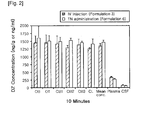
- mice were weighed and restrained in rabbit restrainers. Thirty rabbits were divided into two groups, i.e., an intravenous (IV) injection group and a transnasal (TN) administration group, each consisting of 15 animals.
- TN administration group each rabbit has received 2 mg/kg of diazepam by spraying Formulation 6 into each nostril of animals within 5 sec, using a Pfeiffer spray device. Brain samples were respectively collected at time points of 5, 10, 20, 40 and 60 minutes after the IV injection (Formulation 3) and TN administration (Formulation 6). Three animals were used for each sampling time.
- Plasma samples were collected from ear veins of rabbits at the same time points. Thereafter, animals were sacrificed, and 1 mL of cerebral spinal fluid (CSF) was collected using a cisternal puncture. Then, the brain was isolated from the cranium of the animal. The thus-isolated brain was immediately washed with physiological saline to remove the clotted blood, wiped with Kimberly-Clarks wipe, and immediately stored at -40°C until analysis.
- CSF cerebral spinal fluid
- OB olfactory bulb
- OT olfactory tract
- CB1 anterior section of cerebrum
- CB2 middle section of cerebrum
- CB3 posterior section of cerebrum
- CB3 cerebellum
- the cerebrum including CB1, CB2 and CB3 sections accounts for 72.4% of the total brain volume, and cerebellum (CL) accounts for 20.3%.
- the olfactory tract (OT) and olfactory bulb (OB) account for 4.7% and 2.6% of the total brain volume, respectively.
- the total brain weight of individual rabbits weighing 2.5 to 3 kg is in the range of 7 to 10 g, which corresponds to 0.3% of the total body weight. For accurate analysis, each brain region was carefully separated and subjected to the weight determination within an error range of ⁇ 0.1 mg.
- SPE solid phase extraction
- LC/MS Perkin Elmer Sciex API 150EX mass spectrometer
- Table 4 [Table 4] [Table 4 Chemical stability of diazepam in the formulation of the Invention (Formulation 6). Time (Weeks) Retention (%, 7°C) Retention (%, 25°C) Retention (%, 45°C) Starting point (zero time) 100.0 100.0 100.0 1 100.5 100.1 100.3 2 100.6 100.7 100.4 3 100.4 100.3 100.2 4 100.0 100.2 100.0 6 100.9 100.1 100.1 8 100.7 100.4 100.3 20 100.2 100.1 99.9
- transnasal anticonvulsive compositions of conventional prior art US Patent No. 6,627,211 and US Patent Application No. 2005-0002987 A1 have required repeating administration more than two times so as to reach a therapeutically effective concentration of diazepam, whereas the transnasal anticonvulsive composition of the present invention can reach a therapeutically effective concentration of diazepam even with a single administration and is therefore meaningful in that the convenience of use for patients is significantly enhanced.
- the anticonvulsive pharmaceutical composition for transmucosal delivery of diazepam comprises a minimized content of water and ethanol, a fatty acid ester as a main ingredient and diethylene glycol monoethyl ether, and exhibits improved diazepam solubility and transmucosal permeability by using a small amount of water and ethanol.
Landscapes
- Health & Medical Sciences (AREA)
- Chemical & Material Sciences (AREA)
- Animal Behavior & Ethology (AREA)
- Veterinary Medicine (AREA)
- Public Health (AREA)
- General Health & Medical Sciences (AREA)
- Pharmacology & Pharmacy (AREA)
- Medicinal Chemistry (AREA)
- Life Sciences & Earth Sciences (AREA)
- Epidemiology (AREA)
- Engineering & Computer Science (AREA)
- Chemical Kinetics & Catalysis (AREA)
- General Chemical & Material Sciences (AREA)
- Organic Chemistry (AREA)
- Nuclear Medicine, Radiotherapy & Molecular Imaging (AREA)
- Neurology (AREA)
- Bioinformatics & Cheminformatics (AREA)
- Pain & Pain Management (AREA)
- Neurosurgery (AREA)
- Biomedical Technology (AREA)
- Orthopedic Medicine & Surgery (AREA)
- Physical Education & Sports Medicine (AREA)
- Dispersion Chemistry (AREA)
- Oil, Petroleum & Natural Gas (AREA)
- Medicinal Preparation (AREA)
- Pharmaceuticals Containing Other Organic And Inorganic Compounds (AREA)
Claims (4)
- Une composition pharmaceutique anticonvulsivante transnasale comprenant de 4 à 6% en poids de diazépam comme ingrédient actif, de 8 à 12% en poids d'eau, de 35 à 45% en poids d'un ester d'acide gras qui est un mélange de caprylocaproyle macrogol-8-glycérides et de laurate d'éthyle dans un rapport pondéral allant de 4,5:3,5 à 5,5:2,5, de 30 à 45% en poids d'éther monoéthylique de diéthylène-glycol, de 12 à 17% en poids d'éthanol et de 0,5 à 1,2% en poids de glycocholate de sodium.
- La composition selon la revendication 1, dans laquelle l'ester d'acide gras est contenu en une quantité allant d'environ 38 à 42% en poids, par rapport au poids total de la composition.
- La composition selon la revendication 1 ou 2, pour une utilisation dans une méthode de traitement des convulsions.
- Utilisation d'une composition selon la revendication 1 ou 2, dans la fabrication d'un médicament pour traiter les convulsions.
Applications Claiming Priority (2)
| Application Number | Priority Date | Filing Date | Title |
|---|---|---|---|
| US11/599,767 US7745430B2 (en) | 2006-11-15 | 2006-11-15 | Transnasal anticonvulsive pharmaceutical composition |
| PCT/KR2007/005410 WO2008060051A1 (fr) | 2006-11-15 | 2007-10-31 | Composition pharmaceutique anticonvulsive transnasale |
Publications (3)
| Publication Number | Publication Date |
|---|---|
| EP2086524A1 EP2086524A1 (fr) | 2009-08-12 |
| EP2086524A4 EP2086524A4 (fr) | 2012-03-28 |
| EP2086524B1 true EP2086524B1 (fr) | 2014-11-05 |
Family
ID=39369962
Family Applications (1)
| Application Number | Title | Priority Date | Filing Date |
|---|---|---|---|
| EP07833718.5A Not-in-force EP2086524B1 (fr) | 2006-11-15 | 2007-10-31 | Composition pharmaceutique anticonvulsive transnasale |
Country Status (10)
| Country | Link |
|---|---|
| US (1) | US7745430B2 (fr) |
| EP (1) | EP2086524B1 (fr) |
| JP (1) | JP5288211B2 (fr) |
| KR (1) | KR101512733B1 (fr) |
| CN (1) | CN101534804B (fr) |
| CA (1) | CA2678225C (fr) |
| DK (1) | DK2086524T3 (fr) |
| ES (1) | ES2529432T3 (fr) |
| MX (1) | MX2009005218A (fr) |
| WO (1) | WO2008060051A1 (fr) |
Families Citing this family (5)
| Publication number | Priority date | Publication date | Assignee | Title |
|---|---|---|---|---|
| US8507468B2 (en) * | 2007-10-02 | 2013-08-13 | Robert Orr | Intranasal anti-convulsive compositions and methods |
| KR101517415B1 (ko) * | 2008-05-14 | 2015-05-07 | 에스케이바이오팜 주식회사 | 난용성 항경련제를 함유하는 경비 항경련성 약학 조성물 |
| EP2691100A4 (fr) * | 2011-03-31 | 2014-09-24 | Acorda Therapeutics Inc | Compositions pharmaceutiques intranasales de benzodiazépine |
| WO2017149536A1 (fr) * | 2016-02-29 | 2017-09-08 | Tel Hashomer Medical Research Infrastructure And Services Ltd. | Utilisation d'acides biliaires et de sels biliaires comme agents antibactériens pour l'inhibition de conjugaison bactérienne et de transfert de gène horizontal |
| WO2019182745A1 (fr) | 2018-03-19 | 2019-09-26 | Bryn Pharma, LLC | Formulations pour la pulvérisation d'épinéphrine |
Family Cites Families (5)
| Publication number | Priority date | Publication date | Assignee | Title |
|---|---|---|---|---|
| WO1987005210A1 (fr) | 1986-03-10 | 1987-09-11 | Kurt Burghart | Produit pharmaceutique et son procede de preparation |
| US4950664A (en) * | 1988-09-16 | 1990-08-21 | Rugby-Darby Group Companies, Inc. | Nasal administration of benzodiazepine hypnotics |
| US6761903B2 (en) * | 1999-06-30 | 2004-07-13 | Lipocine, Inc. | Clear oil-containing pharmaceutical compositions containing a therapeutic agent |
| AU778896B2 (en) * | 1999-07-26 | 2004-12-23 | Sk Biopharmaceuticals Co., Ltd. | Transnasal anticonvulsive compositions and modulated process |
| JP2006527764A (ja) * | 2003-06-17 | 2006-12-07 | エスケー コーポレイション | ジアゼパムを含有する経鼻マイクロエマルジョン |
-
2006
- 2006-11-15 US US11/599,767 patent/US7745430B2/en not_active Expired - Fee Related
-
2007
- 2007-10-31 CN CN2007800423521A patent/CN101534804B/zh not_active Expired - Fee Related
- 2007-10-31 CA CA2678225A patent/CA2678225C/fr not_active Expired - Fee Related
- 2007-10-31 KR KR1020097009483A patent/KR101512733B1/ko not_active Expired - Fee Related
- 2007-10-31 WO PCT/KR2007/005410 patent/WO2008060051A1/fr not_active Ceased
- 2007-10-31 DK DK07833718.5T patent/DK2086524T3/en active
- 2007-10-31 EP EP07833718.5A patent/EP2086524B1/fr not_active Not-in-force
- 2007-10-31 ES ES07833718.5T patent/ES2529432T3/es active Active
- 2007-10-31 MX MX2009005218A patent/MX2009005218A/es active IP Right Grant
- 2007-10-31 JP JP2009537070A patent/JP5288211B2/ja not_active Expired - Fee Related
Also Published As
| Publication number | Publication date |
|---|---|
| JP2010509394A (ja) | 2010-03-25 |
| CA2678225A1 (fr) | 2008-05-22 |
| CN101534804B (zh) | 2013-05-08 |
| KR101512733B1 (ko) | 2015-04-21 |
| EP2086524A1 (fr) | 2009-08-12 |
| JP5288211B2 (ja) | 2013-09-11 |
| KR20090081381A (ko) | 2009-07-28 |
| MX2009005218A (es) | 2009-05-28 |
| CN101534804A (zh) | 2009-09-16 |
| DK2086524T3 (en) | 2015-02-09 |
| US20080113970A1 (en) | 2008-05-15 |
| CA2678225C (fr) | 2014-10-21 |
| EP2086524A4 (fr) | 2012-03-28 |
| ES2529432T3 (es) | 2015-02-20 |
| WO2008060051A1 (fr) | 2008-05-22 |
| US7745430B2 (en) | 2010-06-29 |
Similar Documents
| Publication | Publication Date | Title |
|---|---|---|
| RU2264209C2 (ru) | Назальные противосудорожные композиции и способ введения противосудорожных агентов | |
| EP0272097B1 (fr) | Formulations nasales et leur procédé de préparation | |
| ES2199338T3 (es) | Composiciones farmaceuticas en emulsion, que contienen (3'-desoxi-3'-oxo-mebmt)1-(val)2-ciclosporin. | |
| KR101517415B1 (ko) | 난용성 항경련제를 함유하는 경비 항경련성 약학 조성물 | |
| EP2121025B1 (fr) | Procédés et compositions pour l'administration d'un agent thérapeutique | |
| US20160354368A1 (en) | Topical formulations for delivery of hedgehog inhibitor compounds and use thereof | |
| DK2086524T3 (en) | Transnasal anticonvulsant pharmaceutical composition | |
| CA2529489C (fr) | Microemulsions transnasales contenant de la diazepame |
Legal Events
| Date | Code | Title | Description |
|---|---|---|---|
| PUAI | Public reference made under article 153(3) epc to a published international application that has entered the european phase |
Free format text: ORIGINAL CODE: 0009012 |
|
| 17P | Request for examination filed |
Effective date: 20090515 |
|
| AK | Designated contracting states |
Kind code of ref document: A1 Designated state(s): AT BE BG CH CY CZ DE DK EE ES FI FR GB GR HU IE IS IT LI LT LU LV MC MT NL PL PT RO SE SI SK TR |
|
| DAX | Request for extension of the european patent (deleted) | ||
| RAP1 | Party data changed (applicant data changed or rights of an application transferred) |
Owner name: SK BIOPHARMACEUTICALS CO., LTD. |
|
| A4 | Supplementary search report drawn up and despatched |
Effective date: 20120227 |
|
| RIC1 | Information provided on ipc code assigned before grant |
Ipc: A61P 21/02 20060101ALI20120221BHEP Ipc: A61K 47/10 20060101ALI20120221BHEP Ipc: A61K 9/72 20060101AFI20120221BHEP Ipc: A61K 47/14 20060101ALI20120221BHEP Ipc: A61K 31/5513 20060101ALI20120221BHEP |
|
| GRAP | Despatch of communication of intention to grant a patent |
Free format text: ORIGINAL CODE: EPIDOSNIGR1 |
|
| INTG | Intention to grant announced |
Effective date: 20140526 |
|
| GRAS | Grant fee paid |
Free format text: ORIGINAL CODE: EPIDOSNIGR3 |
|
| GRAA | (expected) grant |
Free format text: ORIGINAL CODE: 0009210 |
|
| AK | Designated contracting states |
Kind code of ref document: B1 Designated state(s): AT BE BG CH CY CZ DE DK EE ES FI FR GB GR HU IE IS IT LI LT LU LV MC MT NL PL PT RO SE SI SK TR |
|
| REG | Reference to a national code |
Ref country code: GB Ref legal event code: FG4D |
|
| REG | Reference to a national code |
Ref country code: CH Ref legal event code: EP |
|
| REG | Reference to a national code |
Ref country code: AT Ref legal event code: REF Ref document number: 694224 Country of ref document: AT Kind code of ref document: T Effective date: 20141115 |
|
| REG | Reference to a national code |
Ref country code: IE Ref legal event code: FG4D |
|
| REG | Reference to a national code |
Ref country code: DE Ref legal event code: R096 Ref document number: 602007039181 Country of ref document: DE Effective date: 20141218 |
|
| REG | Reference to a national code |
Ref country code: DK Ref legal event code: T3 Effective date: 20150203 |
|
| REG | Reference to a national code |
Ref country code: CH Ref legal event code: NV Representative=s name: FIAMMENGHI-FIAMMENGHI, CH |
|
| REG | Reference to a national code |
Ref country code: NL Ref legal event code: T3 |
|
| REG | Reference to a national code |
Ref country code: ES Ref legal event code: FG2A Ref document number: 2529432 Country of ref document: ES Kind code of ref document: T3 Effective date: 20150220 |
|
| REG | Reference to a national code |
Ref country code: LT Ref legal event code: MG4D |
|
| PG25 | Lapsed in a contracting state [announced via postgrant information from national office to epo] |
Ref country code: PT Free format text: LAPSE BECAUSE OF FAILURE TO SUBMIT A TRANSLATION OF THE DESCRIPTION OR TO PAY THE FEE WITHIN THE PRESCRIBED TIME-LIMIT Effective date: 20150305 Ref country code: LT Free format text: LAPSE BECAUSE OF FAILURE TO SUBMIT A TRANSLATION OF THE DESCRIPTION OR TO PAY THE FEE WITHIN THE PRESCRIBED TIME-LIMIT Effective date: 20141105 Ref country code: IS Free format text: LAPSE BECAUSE OF FAILURE TO SUBMIT A TRANSLATION OF THE DESCRIPTION OR TO PAY THE FEE WITHIN THE PRESCRIBED TIME-LIMIT Effective date: 20150305 Ref country code: FI Free format text: LAPSE BECAUSE OF FAILURE TO SUBMIT A TRANSLATION OF THE DESCRIPTION OR TO PAY THE FEE WITHIN THE PRESCRIBED TIME-LIMIT Effective date: 20141105 |
|
| PG25 | Lapsed in a contracting state [announced via postgrant information from national office to epo] |
Ref country code: GR Free format text: LAPSE BECAUSE OF FAILURE TO SUBMIT A TRANSLATION OF THE DESCRIPTION OR TO PAY THE FEE WITHIN THE PRESCRIBED TIME-LIMIT Effective date: 20150206 Ref country code: SE Free format text: LAPSE BECAUSE OF FAILURE TO SUBMIT A TRANSLATION OF THE DESCRIPTION OR TO PAY THE FEE WITHIN THE PRESCRIBED TIME-LIMIT Effective date: 20141105 Ref country code: PL Free format text: LAPSE BECAUSE OF FAILURE TO SUBMIT A TRANSLATION OF THE DESCRIPTION OR TO PAY THE FEE WITHIN THE PRESCRIBED TIME-LIMIT Effective date: 20141105 Ref country code: LV Free format text: LAPSE BECAUSE OF FAILURE TO SUBMIT A TRANSLATION OF THE DESCRIPTION OR TO PAY THE FEE WITHIN THE PRESCRIBED TIME-LIMIT Effective date: 20141105 Ref country code: CY Free format text: LAPSE BECAUSE OF FAILURE TO SUBMIT A TRANSLATION OF THE DESCRIPTION OR TO PAY THE FEE WITHIN THE PRESCRIBED TIME-LIMIT Effective date: 20141105 |
|
| PG25 | Lapsed in a contracting state [announced via postgrant information from national office to epo] |
Ref country code: SK Free format text: LAPSE BECAUSE OF FAILURE TO SUBMIT A TRANSLATION OF THE DESCRIPTION OR TO PAY THE FEE WITHIN THE PRESCRIBED TIME-LIMIT Effective date: 20141105 Ref country code: EE Free format text: LAPSE BECAUSE OF FAILURE TO SUBMIT A TRANSLATION OF THE DESCRIPTION OR TO PAY THE FEE WITHIN THE PRESCRIBED TIME-LIMIT Effective date: 20141105 Ref country code: CZ Free format text: LAPSE BECAUSE OF FAILURE TO SUBMIT A TRANSLATION OF THE DESCRIPTION OR TO PAY THE FEE WITHIN THE PRESCRIBED TIME-LIMIT Effective date: 20141105 Ref country code: RO Free format text: LAPSE BECAUSE OF FAILURE TO SUBMIT A TRANSLATION OF THE DESCRIPTION OR TO PAY THE FEE WITHIN THE PRESCRIBED TIME-LIMIT Effective date: 20141105 |
|
| REG | Reference to a national code |
Ref country code: DE Ref legal event code: R097 Ref document number: 602007039181 Country of ref document: DE |
|
| PLBE | No opposition filed within time limit |
Free format text: ORIGINAL CODE: 0009261 |
|
| STAA | Information on the status of an ep patent application or granted ep patent |
Free format text: STATUS: NO OPPOSITION FILED WITHIN TIME LIMIT |
|
| 26N | No opposition filed |
Effective date: 20150806 |
|
| REG | Reference to a national code |
Ref country code: FR Ref legal event code: PLFP Year of fee payment: 9 |
|
| PG25 | Lapsed in a contracting state [announced via postgrant information from national office to epo] |
Ref country code: SI Free format text: LAPSE BECAUSE OF FAILURE TO SUBMIT A TRANSLATION OF THE DESCRIPTION OR TO PAY THE FEE WITHIN THE PRESCRIBED TIME-LIMIT Effective date: 20141105 |
|
| REG | Reference to a national code |
Ref country code: AT Ref legal event code: UEP Ref document number: 694224 Country of ref document: AT Kind code of ref document: T Effective date: 20141105 |
|
| PG25 | Lapsed in a contracting state [announced via postgrant information from national office to epo] |
Ref country code: LU Free format text: LAPSE BECAUSE OF FAILURE TO SUBMIT A TRANSLATION OF THE DESCRIPTION OR TO PAY THE FEE WITHIN THE PRESCRIBED TIME-LIMIT Effective date: 20151031 |
|
| PG25 | Lapsed in a contracting state [announced via postgrant information from national office to epo] |
Ref country code: MC Free format text: LAPSE BECAUSE OF FAILURE TO SUBMIT A TRANSLATION OF THE DESCRIPTION OR TO PAY THE FEE WITHIN THE PRESCRIBED TIME-LIMIT Effective date: 20141105 |
|
| REG | Reference to a national code |
Ref country code: IE Ref legal event code: MM4A |
|
| PG25 | Lapsed in a contracting state [announced via postgrant information from national office to epo] |
Ref country code: IE Free format text: LAPSE BECAUSE OF NON-PAYMENT OF DUE FEES Effective date: 20151031 |
|
| REG | Reference to a national code |
Ref country code: FR Ref legal event code: PLFP Year of fee payment: 10 |
|
| PG25 | Lapsed in a contracting state [announced via postgrant information from national office to epo] |
Ref country code: BG Free format text: LAPSE BECAUSE OF FAILURE TO SUBMIT A TRANSLATION OF THE DESCRIPTION OR TO PAY THE FEE WITHIN THE PRESCRIBED TIME-LIMIT Effective date: 20141105 Ref country code: HU Free format text: LAPSE BECAUSE OF FAILURE TO SUBMIT A TRANSLATION OF THE DESCRIPTION OR TO PAY THE FEE WITHIN THE PRESCRIBED TIME-LIMIT; INVALID AB INITIO Effective date: 20071031 |
|
| PG25 | Lapsed in a contracting state [announced via postgrant information from national office to epo] |
Ref country code: MT Free format text: LAPSE BECAUSE OF FAILURE TO SUBMIT A TRANSLATION OF THE DESCRIPTION OR TO PAY THE FEE WITHIN THE PRESCRIBED TIME-LIMIT Effective date: 20141105 |
|
| REG | Reference to a national code |
Ref country code: FR Ref legal event code: PLFP Year of fee payment: 11 |
|
| PGFP | Annual fee paid to national office [announced via postgrant information from national office to epo] |
Ref country code: NL Payment date: 20170929 Year of fee payment: 11 |
|
| PGFP | Annual fee paid to national office [announced via postgrant information from national office to epo] |
Ref country code: TR Payment date: 20171010 Year of fee payment: 11 Ref country code: FR Payment date: 20171031 Year of fee payment: 11 Ref country code: DK Payment date: 20171025 Year of fee payment: 11 |
|
| PGFP | Annual fee paid to national office [announced via postgrant information from national office to epo] |
Ref country code: AT Payment date: 20171027 Year of fee payment: 11 Ref country code: GB Payment date: 20171101 Year of fee payment: 11 Ref country code: BE Payment date: 20171027 Year of fee payment: 11 Ref country code: CH Payment date: 20171101 Year of fee payment: 11 Ref country code: ES Payment date: 20171122 Year of fee payment: 11 Ref country code: IT Payment date: 20171020 Year of fee payment: 11 |
|
| PGFP | Annual fee paid to national office [announced via postgrant information from national office to epo] |
Ref country code: DE Payment date: 20171229 Year of fee payment: 11 |
|
| REG | Reference to a national code |
Ref country code: DE Ref legal event code: R119 Ref document number: 602007039181 Country of ref document: DE |
|
| REG | Reference to a national code |
Ref country code: DK Ref legal event code: EBP Effective date: 20181031 |
|
| REG | Reference to a national code |
Ref country code: CH Ref legal event code: PL |
|
| REG | Reference to a national code |
Ref country code: NL Ref legal event code: MM Effective date: 20181101 |
|
| REG | Reference to a national code |
Ref country code: AT Ref legal event code: MM01 Ref document number: 694224 Country of ref document: AT Kind code of ref document: T Effective date: 20181031 |
|
| GBPC | Gb: european patent ceased through non-payment of renewal fee |
Effective date: 20181031 |
|
| REG | Reference to a national code |
Ref country code: BE Ref legal event code: FP Effective date: 20150204 Ref country code: BE Ref legal event code: MM Effective date: 20181031 |
|
| PG25 | Lapsed in a contracting state [announced via postgrant information from national office to epo] |
Ref country code: DE Free format text: LAPSE BECAUSE OF NON-PAYMENT OF DUE FEES Effective date: 20190501 Ref country code: NL Free format text: LAPSE BECAUSE OF NON-PAYMENT OF DUE FEES Effective date: 20181101 |
|
| PG25 | Lapsed in a contracting state [announced via postgrant information from national office to epo] |
Ref country code: FR Free format text: LAPSE BECAUSE OF NON-PAYMENT OF DUE FEES Effective date: 20181031 Ref country code: CH Free format text: LAPSE BECAUSE OF NON-PAYMENT OF DUE FEES Effective date: 20181031 Ref country code: LI Free format text: LAPSE BECAUSE OF NON-PAYMENT OF DUE FEES Effective date: 20181031 Ref country code: BE Free format text: LAPSE BECAUSE OF NON-PAYMENT OF DUE FEES Effective date: 20181031 |
|
| PG25 | Lapsed in a contracting state [announced via postgrant information from national office to epo] |
Ref country code: IT Free format text: LAPSE BECAUSE OF NON-PAYMENT OF DUE FEES Effective date: 20181031 Ref country code: GB Free format text: LAPSE BECAUSE OF NON-PAYMENT OF DUE FEES Effective date: 20181031 Ref country code: DK Free format text: LAPSE BECAUSE OF NON-PAYMENT OF DUE FEES Effective date: 20181031 Ref country code: AT Free format text: LAPSE BECAUSE OF NON-PAYMENT OF DUE FEES Effective date: 20181031 |
|
| REG | Reference to a national code |
Ref country code: ES Ref legal event code: FD2A Effective date: 20191204 |
|
| PG25 | Lapsed in a contracting state [announced via postgrant information from national office to epo] |
Ref country code: ES Free format text: LAPSE BECAUSE OF NON-PAYMENT OF DUE FEES Effective date: 20181101 |
|
| PG25 | Lapsed in a contracting state [announced via postgrant information from national office to epo] |
Ref country code: TR Free format text: LAPSE BECAUSE OF NON-PAYMENT OF DUE FEES Effective date: 20181031 |