EP2086540B1 - Composés de triazolopyridine pour le traitement de maladies dégénératives et inflammatoires - Google Patents
Composés de triazolopyridine pour le traitement de maladies dégénératives et inflammatoires Download PDFInfo
- Publication number
- EP2086540B1 EP2086540B1 EP07857236A EP07857236A EP2086540B1 EP 2086540 B1 EP2086540 B1 EP 2086540B1 EP 07857236 A EP07857236 A EP 07857236A EP 07857236 A EP07857236 A EP 07857236A EP 2086540 B1 EP2086540 B1 EP 2086540B1
- Authority
- EP
- European Patent Office
- Prior art keywords
- substituted
- unsubstituted
- alkyl
- pyridin
- compounds
- Prior art date
- Legal status (The legal status is an assumption and is not a legal conclusion. Google has not performed a legal analysis and makes no representation as to the accuracy of the status listed.)
- Not-in-force
Links
- 0 Cc1c(*)[n]2nc(*)nc2c(N**)c1C Chemical compound Cc1c(*)[n]2nc(*)nc2c(N**)c1C 0.000 description 15
- ICTSXHANZPPYOY-UHFFFAOYSA-O C=C(CN1c(cc2)ccc2N)[NH2+]CC1=C Chemical compound C=C(CN1c(cc2)ccc2N)[NH2+]CC1=C ICTSXHANZPPYOY-UHFFFAOYSA-O 0.000 description 1
- AEULREGQSFMELN-UHFFFAOYSA-N CC(C)CCN(CC1)CCN1c(cc1)ccc1Nc(c1ncn[n]11)ccc1Cl Chemical compound CC(C)CCN(CC1)CCN1c(cc1)ccc1Nc(c1ncn[n]11)ccc1Cl AEULREGQSFMELN-UHFFFAOYSA-N 0.000 description 1
- MYNSZXKVYJVUJV-UHFFFAOYSA-N CC(C)CCN(CC1)CCN1c(cc1)ccc1Nc1ccc(C(C=CN2)=CC2=O)[n]2ncnc12 Chemical compound CC(C)CCN(CC1)CCN1c(cc1)ccc1Nc1ccc(C(C=CN2)=CC2=O)[n]2ncnc12 MYNSZXKVYJVUJV-UHFFFAOYSA-N 0.000 description 1
- CRLKNBUQRZOYSE-UHFFFAOYSA-N CC(C)N(CC1)CCN1c(cc1)ccc1N Chemical compound CC(C)N(CC1)CCN1c(cc1)ccc1N CRLKNBUQRZOYSE-UHFFFAOYSA-N 0.000 description 1
- YBDRFJXGJQULGH-UHFFFAOYSA-N CC(C=CN1)=CC1=O Chemical compound CC(C=CN1)=CC1=O YBDRFJXGJQULGH-UHFFFAOYSA-N 0.000 description 1
- YWXFVWFNTKLKBM-UHFFFAOYSA-N CCC(CC)N(CC1)CCN1c(cc1)ccc1NC(C1=CC(C)CN(C)N11)=CC=C1Cl Chemical compound CCC(CC)N(CC1)CCN1c(cc1)ccc1NC(C1=CC(C)CN(C)N11)=CC=C1Cl YWXFVWFNTKLKBM-UHFFFAOYSA-N 0.000 description 1
- PSDYCHJXOSOWGE-UHFFFAOYSA-N CCCN(CC1)CCN1C(C=C1)=CCC1Nc1ccc(-c2ccnc(O)c2)[n]2ncnc12 Chemical compound CCCN(CC1)CCN1C(C=C1)=CCC1Nc1ccc(-c2ccnc(O)c2)[n]2ncnc12 PSDYCHJXOSOWGE-UHFFFAOYSA-N 0.000 description 1
- MWDUPPUMXCIRET-UHFFFAOYSA-N CCN(CC1)CCN1c(cc1)ccc1Nc1ccc(-c(cc2)ccc2C(N)=O)[n]2ncnc12 Chemical compound CCN(CC1)CCN1c(cc1)ccc1Nc1ccc(-c(cc2)ccc2C(N)=O)[n]2ncnc12 MWDUPPUMXCIRET-UHFFFAOYSA-N 0.000 description 1
- QFBRNZRJRDUJTQ-UHFFFAOYSA-N CN(CC1)CCN1c(cc1)ccc1Nc1ccc(-c(cc2)cc(F)c2C(N)=O)[n]2ncnc12 Chemical compound CN(CC1)CCN1c(cc1)ccc1Nc1ccc(-c(cc2)cc(F)c2C(N)=O)[n]2ncnc12 QFBRNZRJRDUJTQ-UHFFFAOYSA-N 0.000 description 1
- QLCMKTBNUHIHDZ-UHFFFAOYSA-N CN(CC1)CCN1c(cc1)ccc1Nc1ccc(C(C=CN2)=CC2=O)[n]2ncnc12 Chemical compound CN(CC1)CCN1c(cc1)ccc1Nc1ccc(C(C=CN2)=CC2=O)[n]2ncnc12 QLCMKTBNUHIHDZ-UHFFFAOYSA-N 0.000 description 1
- XSAGMILOZYDJJG-JTQLQIEISA-N C[C@@H](CN(C1)c(ccc([N+]([O-])=O)c2)c2F)N(C)C1=C Chemical compound C[C@@H](CN(C1)c(ccc([N+]([O-])=O)c2)c2F)N(C)C1=C XSAGMILOZYDJJG-JTQLQIEISA-N 0.000 description 1
- GRDOIYSQDVCGNQ-UHFFFAOYSA-N NC(c1cccc(-c([n]2ncnc22)ccc2Nc(cc2)ccc2N2CCOCC2)c1)=O Chemical compound NC(c1cccc(-c([n]2ncnc22)ccc2Nc(cc2)ccc2N2CCOCC2)c1)=O GRDOIYSQDVCGNQ-UHFFFAOYSA-N 0.000 description 1
- OSFDXYVWIQEZHA-UHFFFAOYSA-N Nc1nc(Cl)ccc1Br Chemical compound Nc1nc(Cl)ccc1Br OSFDXYVWIQEZHA-UHFFFAOYSA-N 0.000 description 1
- GGXIOSCUHASSOL-UHFFFAOYSA-N Nc1nc(Cl)ccc1I Chemical compound Nc1nc(Cl)ccc1I GGXIOSCUHASSOL-UHFFFAOYSA-N 0.000 description 1
- JRMGLWFQAXSADD-UHFFFAOYSA-N O/N=C/Nc1nc(Cl)ccc1I Chemical compound O/N=C/Nc1nc(Cl)ccc1I JRMGLWFQAXSADD-UHFFFAOYSA-N 0.000 description 1
- QGYSMVXRMDEULY-UHFFFAOYSA-N O=C(c(cc1)ccc1Nc1ccc(C(C=CN2)=CC2=O)[n]2ncnc12)N1CCOCC1 Chemical compound O=C(c(cc1)ccc1Nc1ccc(C(C=CN2)=CC2=O)[n]2ncnc12)N1CCOCC1 QGYSMVXRMDEULY-UHFFFAOYSA-N 0.000 description 1
- JZPYXCNELUZXRU-UHFFFAOYSA-N O=C(c(cc1)ncc1Nc1ccc(C(C=CN2)=CC2=O)[n]2ncnc12)N1CCOCC1 Chemical compound O=C(c(cc1)ncc1Nc1ccc(C(C=CN2)=CC2=O)[n]2ncnc12)N1CCOCC1 JZPYXCNELUZXRU-UHFFFAOYSA-N 0.000 description 1
- UTQJLODJKPZEGC-UHFFFAOYSA-N O=C(c(nc1)ncc1Nc1ccc(C(C=CN2)=CC2=O)[n]2c1ncc2)N1CCOCC1 Chemical compound O=C(c(nc1)ncc1Nc1ccc(C(C=CN2)=CC2=O)[n]2c1ncc2)N1CCOCC1 UTQJLODJKPZEGC-UHFFFAOYSA-N 0.000 description 1
- XMJKUIZQCFZELH-UHFFFAOYSA-N O=C1NC=CC(c([n]2ncnc22)ccc2Nc(cc2)ccc2N(CC2)CCN2C2CCC2)=C1 Chemical compound O=C1NC=CC(c([n]2ncnc22)ccc2Nc(cc2)ccc2N(CC2)CCN2C2CCC2)=C1 XMJKUIZQCFZELH-UHFFFAOYSA-N 0.000 description 1
Classifications
-
- C—CHEMISTRY; METALLURGY
- C07—ORGANIC CHEMISTRY
- C07D—HETEROCYCLIC COMPOUNDS
- C07D471/00—Heterocyclic compounds containing nitrogen atoms as the only ring hetero atoms in the condensed system, at least one ring being a six-membered ring with one nitrogen atom, not provided for by groups C07D451/00 - C07D463/00
- C07D471/02—Heterocyclic compounds containing nitrogen atoms as the only ring hetero atoms in the condensed system, at least one ring being a six-membered ring with one nitrogen atom, not provided for by groups C07D451/00 - C07D463/00 in which the condensed system contains two hetero rings
- C07D471/04—Ortho-condensed systems
-
- A—HUMAN NECESSITIES
- A61—MEDICAL OR VETERINARY SCIENCE; HYGIENE
- A61P—SPECIFIC THERAPEUTIC ACTIVITY OF CHEMICAL COMPOUNDS OR MEDICINAL PREPARATIONS
- A61P1/00—Drugs for disorders of the alimentary tract or the digestive system
- A61P1/02—Stomatological preparations, e.g. drugs for caries, aphtae, periodontitis
-
- A—HUMAN NECESSITIES
- A61—MEDICAL OR VETERINARY SCIENCE; HYGIENE
- A61P—SPECIFIC THERAPEUTIC ACTIVITY OF CHEMICAL COMPOUNDS OR MEDICINAL PREPARATIONS
- A61P1/00—Drugs for disorders of the alimentary tract or the digestive system
- A61P1/16—Drugs for disorders of the alimentary tract or the digestive system for liver or gallbladder disorders, e.g. hepatoprotective agents, cholagogues, litholytics
-
- A—HUMAN NECESSITIES
- A61—MEDICAL OR VETERINARY SCIENCE; HYGIENE
- A61P—SPECIFIC THERAPEUTIC ACTIVITY OF CHEMICAL COMPOUNDS OR MEDICINAL PREPARATIONS
- A61P11/00—Drugs for disorders of the respiratory system
-
- A—HUMAN NECESSITIES
- A61—MEDICAL OR VETERINARY SCIENCE; HYGIENE
- A61P—SPECIFIC THERAPEUTIC ACTIVITY OF CHEMICAL COMPOUNDS OR MEDICINAL PREPARATIONS
- A61P17/00—Drugs for dermatological disorders
- A61P17/06—Antipsoriatics
-
- A—HUMAN NECESSITIES
- A61—MEDICAL OR VETERINARY SCIENCE; HYGIENE
- A61P—SPECIFIC THERAPEUTIC ACTIVITY OF CHEMICAL COMPOUNDS OR MEDICINAL PREPARATIONS
- A61P19/00—Drugs for skeletal disorders
- A61P19/02—Drugs for skeletal disorders for joint disorders, e.g. arthritis, arthrosis
-
- A—HUMAN NECESSITIES
- A61—MEDICAL OR VETERINARY SCIENCE; HYGIENE
- A61P—SPECIFIC THERAPEUTIC ACTIVITY OF CHEMICAL COMPOUNDS OR MEDICINAL PREPARATIONS
- A61P19/00—Drugs for skeletal disorders
- A61P19/08—Drugs for skeletal disorders for bone diseases, e.g. rachitism, Paget's disease
- A61P19/10—Drugs for skeletal disorders for bone diseases, e.g. rachitism, Paget's disease for osteoporosis
-
- A—HUMAN NECESSITIES
- A61—MEDICAL OR VETERINARY SCIENCE; HYGIENE
- A61P—SPECIFIC THERAPEUTIC ACTIVITY OF CHEMICAL COMPOUNDS OR MEDICINAL PREPARATIONS
- A61P25/00—Drugs for disorders of the nervous system
-
- A—HUMAN NECESSITIES
- A61—MEDICAL OR VETERINARY SCIENCE; HYGIENE
- A61P—SPECIFIC THERAPEUTIC ACTIVITY OF CHEMICAL COMPOUNDS OR MEDICINAL PREPARATIONS
- A61P29/00—Non-central analgesic, antipyretic or antiinflammatory agents, e.g. antirheumatic agents; Non-steroidal antiinflammatory drugs [NSAID]
-
- A—HUMAN NECESSITIES
- A61—MEDICAL OR VETERINARY SCIENCE; HYGIENE
- A61P—SPECIFIC THERAPEUTIC ACTIVITY OF CHEMICAL COMPOUNDS OR MEDICINAL PREPARATIONS
- A61P35/00—Antineoplastic agents
- A61P35/04—Antineoplastic agents specific for metastasis
-
- A—HUMAN NECESSITIES
- A61—MEDICAL OR VETERINARY SCIENCE; HYGIENE
- A61P—SPECIFIC THERAPEUTIC ACTIVITY OF CHEMICAL COMPOUNDS OR MEDICINAL PREPARATIONS
- A61P43/00—Drugs for specific purposes, not provided for in groups A61P1/00-A61P41/00
-
- A—HUMAN NECESSITIES
- A61—MEDICAL OR VETERINARY SCIENCE; HYGIENE
- A61P—SPECIFIC THERAPEUTIC ACTIVITY OF CHEMICAL COMPOUNDS OR MEDICINAL PREPARATIONS
- A61P9/00—Drugs for disorders of the cardiovascular system
- A61P9/04—Inotropic agents, i.e. stimulants of cardiac contraction; Drugs for heart failure
-
- A—HUMAN NECESSITIES
- A61—MEDICAL OR VETERINARY SCIENCE; HYGIENE
- A61P—SPECIFIC THERAPEUTIC ACTIVITY OF CHEMICAL COMPOUNDS OR MEDICINAL PREPARATIONS
- A61P9/00—Drugs for disorders of the cardiovascular system
- A61P9/10—Drugs for disorders of the cardiovascular system for treating ischaemic or atherosclerotic diseases, e.g. antianginal drugs, coronary vasodilators, drugs for myocardial infarction, retinopathy, cerebrovascula insufficiency, renal arteriosclerosis
Definitions
- the present invention relates to a class of triazolopyridine compounds capable of binding to the active site of a serine/threonine kinase, and which can be used to treat conditions involving the degradation of extra-cellular matrix (ECM), such as joint degeneration and diseases involving such degradation and/or inflammation.
- ECM extra-cellular matrix
- Diseases involving the degradation of extra-cellular matrix include, but are not limited to, psoriatic arthritis, juvenile arthritis, early arthritis, reactive arthritis, osteoarthritis, ankylosing spondylitis, osteoporosis, musculoskeletal diseases like tendonitis and periodontal disease, cancer metastasis, airway diseases (COPD, asthma), renal and liver fibrosis, cardio-vascular diseases like atherosclerosis and heart failure, and neurological diseases like neuroinflammation and multiple sclerosis.
- Diseases involving primarily joint degeneration include, but are not limited to, psoriatic arthritis, juvenile arthritis, early arthritis, reactive arthritis, osteoarthritis, and ankylosing spondylitis.
- RA Rheumatoid arthritis
- RA is an auto-immune disease
- the initial trigger(s) mediate, in a predisposed host, a cascade of events that leads to the activation of various cell types (B-cells, T-cells, macrophages, fibroblasts, endothelial cells, dendritic cells and others).
- various cytokines is observed in the joints and tissues surrounding the joint (e.g. TNF- ⁇ , IL-6, IL-1, IL-15, IL-18 and others).
- TNF- ⁇ , IL-6, IL-1, IL-15, IL-18 and others As the disease progresses, the cellular activation and cytokine production cascade becomes self-perpetuating. At this early stage, the destruction of joint structures is already very clear. Thirty percent of the patients have radiographic evidence of bone erosions at the time of diagnosis and this proportion increases to 60 percent after two years.
- the pannus mediates the degradation of the adjacent cartilage, leading to the narrowing of the joint space, and has the potential to invade adjacent bone and cartilage.
- bone and cartilage tissues are composed mainly of collagen type I or II, respectively, the pannus' destructive and invasive properties are mediated by the secretion of collagenolytic proteases, principally the matrix metalloproteinases (MMPs).
- MMPs matrix metalloproteinases
- the erosion of the bone under and adjacent to the cartilage is also part of the RA process, and results principally from the presence of osteoclasts at the interface of bone and pannus.
- Osteoclasts are multinucleated cells that, upon adhesion to the bone tissue, form a closed compartment, within which the osteoclasts secrete proteases (cathepsin K, MMP9) that degrade the bone tissue.
- the osteoclast population in the joint is abnormally increased by osteoclast formation from precursor cells induced by the secretion of the receptor activator of NF ⁇ B ligand (RANKL) by activated SFs and T-cells.
- RNKL NF ⁇ B ligand
- Collagen type I and collagen type II are the main components of bone and cartilage, respectively.
- Collagen proteins typically organize into multimeric structures referred to as collagen fibrils. Native collagen fibrils are very resistant to proteolytic cleavage.
- MMPs and cathepsins.
- cathepsin K which is active mainly in osteoclasts, is the best characterized.
- MMP1, MMP2, MMP8 MMP13 and MMP 14 are known to have collagenolytic properties.
- MMP1 represents a highly relevant collagen degrading protein.
- cytokines relevant in the RA pathology e.g. TNF- ⁇ and IL1ß
- MMP1 expression by SFs therefore is a relevant readout in the field of RA as it is indicative for the activation of SFs towards an erosive phenotype that, in vivo, is responsible for cartilage degradation. Inhibition of the MMP1 expression by SFs represents a valuable therapeutic approach towards the treatment of RA.
- the activity of the ECM-degrading proteins can also be causative or correlate with the progression of various diseases different from RA, as e.g. other diseases that involve the degradation of the joints. These diseases include, but are not limited to, psoriatic arthritis, juvenile arthritis, early arthritis, reactive arthritis, osteoarthritis, and ankylosing spondylitis.
- osteoporosis musculoskeletal diseases like tendonitis and periodontal disease
- cancer metastasis Coussens et al., 2002
- COPD airway diseases
- asthma a chronic hepatitis C
- cardio-vascular diseases like atherosclerosis and heart failure
- neurological diseases like neuroinflammation and multiple sclerosis (Rosenberg, 2002).
- Patients suffering from such diseases may benefit from stabilizing the ECM (by protecting it from degradation).
- TAK1 Transforming growth factor- ⁇ activated kinase 1
- MA3K mitogen-activated protein kinase kinase kinase family
- Drosophila TAK1 is required for both c-jun N-terminal kinase and NF ⁇ B activation in response to immune challenge by gram-negative bacteria infection (Vidal et al., 2001; Boutros et al., 2002).
- TAK1 has also been shown to function as a critical upstream molecule of NF ⁇ B and MAPK signaling in various mammalian cell types after stimulation with IL1, TNF and lipopolysaccharide, which activates Toll-like receptor (TLR) signaling (Ninomiya-Tsuji et al., 1999; Sakurai et al., 1999; Irie et al., 2000; Blonska et al., 2005; Shim et al., 2005; Dong et al., 2006).
- TAK1 was shown to be required for RANKL induced osteoclast differentiation (Mizukami et al., 2002; Huang et al., 2006).
- TAK1 is recruited to TRAF6 complexes in response to IL1R, TLR and RANKL signaling or to TRAF2 complexes in response to TNFR stimulation.
- Activated TAK1 phosphorylates MAPK kinases (MAP2K) MKK4 and MKK3/6, which in turn can activate JNK and p38 mitogen-activated protein kinase, leading to the activation of the activator protein 1 (AP1) transcription factor.
- MAPK kinases MAPK kinases
- MKK4 and MKK3/6 MAPK kinases
- JNK and p38 mitogen-activated protein kinase leading to the activation of the activator protein 1 (AP1) transcription factor.
- IKK I ⁇ B kinase
- TAK1 was indispensable for cellular responses to B cell receptor cross-linking and T cell development, survival and function (Sato et al., 2005; Wan et al., 2006). It has also recently been shown that siRNA-mediated knock-down of TAK1 in the human SW1353 chondrosarcoma cell line significantly reduced IL1 triggered expression of MMP1 and MMP13, enzymes involved in ECM degradation in arthritis (Klatt et al. 2006). Taken together, these findings suggest critical roles for TAK1 in inflammatory and immunological responses.
- TAK1 is a key molecule in pro-inflammatory signaling pathways
- TAK1 inhibition can be expected to be effective in diseases associated with inflammation and tissue destruction such as rheumatoid arthritis.
- the present invention relates to a class of triazolopyridine compounds that inhibit pro-inflammatory cytokine-driven MMP1 expression in RA synovial fibroblasts and that are capable of inhibiting TAK1 kinase activity.
- the present invention is based on the discovery that inhibitors of matrix metalloproteinase 1 (MMP1) expression, such as the compounds of the present invention, are useful for the treatment of diseases involving ECM degradation, joint degradation and/or inflammation, for example multiple sclerosis, rheumatoid arthritis and osteoarthritis. These compounds may also be described as inhibitors of TAK1 activity.
- the present invention also provides methods for the production of these compounds, pharmaceutical compositions comprising these compounds and methods for treating diseases involving ECM degradation, joint degradation and/or inflammation by administering a compound of the invention.
- the present matrix metalloproteinase expression inhibiting compounds of the present invention are described generally as phenyl-[1,2,4]triazolo[1,5-a]pyridin-8-yl-amines substituted in the 5-position by an aromatic group capable of accepting electrons from, and an 8-amino substituent capable of donating electrons to, the [1,2,4]triazolo[1,5-a]pyridine ring.
- the present invention relates to compounds having anti-inflammatory properties in a mammalian cell, according to formula (III): wherein
- Another aspect of this invention relates to the use of the present compound in a therapeutic method, a pharmaceutical composition, and the manufacture of such composition, useful for the treatment of a disease involving inflammation, and in particular, a disease characteristic of abnormal MMP expression.
- This invention also relates to processes for the preparation of the present compounds.
- Figure 1 This diagram shows the striking histological differences between a healthy joint and that of a RA patient.
- FIG. 1 This chart shows the increased expression of MMP1 in synovial fibroblasts triggered with cytokines involved in rheumatoid arthritis pathology.
- FIG. 3 shows the dose-dependent inhibition of the "TNF- ⁇ -based trigger"-induced expression of MMP1 by SFs by a known anti-inflammatory compound.
- halo such as fluoro, chloro, bromo
- -CN -CF 3 , -OH, -OCF 3 , O-CHF 2 , C 1 -C 6 alkyl, C 2 -C 6 alkenyl, C 3 -C 6 alkynyl, C 1 -C 6 alkoxy, aryl and di-C 1 -C 6 alkylamino.
- groups and “radicals” can be considered interchangeable when used herein.
- analogue means one analogue or more than one analogue.
- 'Acyl' refers to a radical -C(O)R 20 , where R 20 is hydrogen, alkyl, cycloalkyl, cycloheteroalkyl, aryl, arylalkyl, heteroalkyl, heteroaryl, heteroarylalkyl as defined herein.
- Representative examples include, but are not limited to, formyl, acetyl, cylcohexylcarbonyl, cyclohexylmethylcarbonyl, benzoyl, benzylcarbonyl and the like.
- 'Acylamino' refers to a radical -NR 21 C(O)R 22 , where R 21 is hydrogen, alkyl, cycloalkyl, cycloheteroalkyl, aryl, arylalkyl, heteroalkyl, heteroaryl, heteroarylalkyl and R 22 is hydrogen, alkyl, alkoxy, cycloalkyl, cycloheteroalkyl, aryl, arylalkyl, heteroalkyl, heteroaryl or heteroarylalkyl, as defined herein.
- Representative examples include, but are not limited to, formylamino, acetylamino, cyclohexylcarbonylamino, cyclohexylmethyl-carbonylamino, benzoylamino, benzylcarbonylamino and the like.
- 'Acyloxy' refers to the group -OC(O)R 23 where R 23 is hydrogen, alkyl, aryl or cycloalkyl.
- alkoxy' refers to the group -OR 24 where R 24 is alkyl.
- Particular alkoxy groups include, by way of example, methoxy, ethoxy, n-propoxy, isopropoxy, n-butoxy, tert-butoxy, sec-butoxy, n-pentoxy, n-hexoxy, 1,2-dimethylbutoxy, and the like.
- Particular alkoxy groups are lower alkoxy, i.e. with between 1 and 6 carbon atoms.
- Substituted alkoxy' includes those groups recited in the definition of "substituted” herein, and particularly refers to an alkoxy group having 1 or more substituents, for instance from 1 to 5 substituents, and particularly from 1 to 3 substituents, selected from the group consisting of acyl, acylamino, acyloxy, alkoxy, substituted alkoxy, alkoxycarbonyl, alkoxycarbonylamino, amino, substituted amino, aminocarbonyl, aminocarbonylamino, aminocarbonyloxy, aryl, aryloxy, azido, carboxyl, cyano, cycloalkyl, substituted cycloalkyl, halogen, heteroaryl, hydroxyl, keto, nitro, thioalkoxy, substituted thioalkoxy, thioaryloxy, thioketo, thiol, alkyl-S(O)-, aryl-S(O)-, alkyl-S(
- 'Alkoxycarbonylamino' refers to the group -NR 25 C(O)OR 26 , where R 25 is hydrogen, alkyl, aryl or cycloalkyl, and R 26 is alkyl or cycloalkyl.
- 'Alkyl' means straight or branched aliphatic hydrocarbon having 1 to about 20 carbon atoms. Preferred alkyl has 1 to about 12 carbon atoms. More preferred is lower alkyl which has 1 to 6 carbon atoms. Most preferred are groups such as methyl, ethyl and propyl. Branched means that one or more lower alkyl groups such as methyl, ethyl or propyl is attached to a linear alkyl chain.
- Cl-C6 alkyl includes both branched and straight chain groups, exemplary straight chain groups include ethyl, propyl, butyl, exemplary branched chain groups include isopropyl, isoamyl, and the like.
- Substituted alkyl' includes those groups recited in the definition of "substituted” herein, and particularly refers to an alkyl group having 1 or more substituents, for instance from 1 to 5 substituents, and particularly from 1 to 3 substituents, selected from the group consisting of acyl, acylamino, acyloxy, alkoxy, substituted alkoxy, alkoxycarbonyl, alkoxycarbonylamino, amino, substituted amino, aminocarbonyl, aminocarbonylamino, aminocarbonyloxy, aryl, aryloxy, azido, carboxyl, cyano, cycloalkyl, substituted cycloalkyl, halogen, hydroxyl, heteroaryl, keto, nitro, thioalkoxy, substituted thioalkoxy, thioaryloxy, thioketo, thiol, alkyl-S(O)-, aryl-S(O)-, alkyl-S(
- 'Alkylene' refers to divalent alkene radical groups having 1 to 11 carbon atoms and more particularly 1 to 6 carbon atoms which can be straight-chained or branched. This term is exemplified by groups such as methylene (-CH 2 -), ethylene (-CH 2 CH 2 -), the propylene isomers (e.g., -CH 2 CH 2 CH 2 - and - CH(CH 3 )CH 2 -) and the like.
- 'Substituted alkylene' includes those groups recited in the definition of 'substituted' herein, and particularly refers to an alkylene group having 1 or more substituents, for instance from 1 to 5 substituents, and particularly from 1 to 3 substituents, selected from the group consisting of acyl, acylamino, acyloxy, alkoxy, substituted alkoxy, alkoxycarbonyl, alkoxycarbonylamino, amino, substituted amino, aminocarbonyl, amino-carbonylamino, aminocarbonyloxy, aryl, aryloxy, azido, carboxyl, cyano, halogen, hydroxyl, keto, nitro, thioalkoxy, substituted thioalkoxy, thioaryloxy, thioketo, thiol, alkyl-S(O)-, aryl-S(O)-, alkyl-S(O) 2 - and aryl-S(O) 2 -
- alkenyl' refers to monovalent olefinically (unsaturated) hydrocarbon groups preferably having 2 to 11 carbon atoms, particularly, from 2 to 8 carbon atoms, and more particularly, from 2 to 6 carbon atoms, which can be straight-chained or branched and having at least 1 and particularly from 1 to 2 sites of olefinic unsaturation.
- Substituted alkenyl' includes those groups recited in the definition of "substituted” herein, and particularly refers to an alkenyl group having 1 or more substituents, for instance from 1 to 5 substituents, and particularly from 1 to 3 substituents, selected from the group consisting of acyl, acylamino, acyloxy, alkoxy, substituted alkoxy, alkoxycarbonyl, alkoxycarbonylamino, amino, substituted amino, aminocarbonyl, aminocarbonylamino, aminocarbonyloxy, aryl, aryloxy, azido, carboxyl, cyano, cycloalkyl, substituted cycloalkyl, halogen, hydroxyl, keto, nitro, thioalkoxy, substituted thioalkoxy, thioaryloxy, thioketo, thiol, alkyl-S(O)-, aryl-S(O)-, alkyl-S(O)
- Alkynyl' refers to acetylenically or alkynically (unsaturated) hydrocarbon groups particularly having 2 to 11 carbon atoms and more particularly 2 to 6 carbon atoms which can be straight-chained or branched and having at least 1 and particularly from 1 to 2 sites of alkynyl unsaturation.
- alkynyl groups include acetylenic, ethynyl (-C ⁇ CH), propargyl (-CH 2 C ⁇ CH), and the like.
- Substituted alkynyl' includes those groups recited in the definition of "substituted" herein, and particularly refers to an alkynyl group having 1 or more substituents, for instance from 1 to 5 substituents, and particularly from 1 to 3 substituents, selected from the group consisting of acyl, acylamino, acyloxy, alkoxy, substituted alkoxy, alkoxycarbonyl, alkoxycarbonylamino, amino, substituted amino, aminocarbonyl, aminocarbonylamino, aminocarbonyloxy, aryl, aryloxy, azido, carboxyl, cyano, cycloalkyl, substituted cycloalkyl, halogen, hydroxyl, keto, nitro, thioalkoxy, substituted thioalkoxy, thioaryloxy, thioketo, thiol, alkyl-S(O)-, aryl-S(O)-, alkyl-S(
- 'Alkanoyl' refers to the group R 27 -C(O)-, where R 27 is hydrogen or alkyl as defined above.
- 'Aryl' refers to a monovalent aromatic hydrocarbon group derived by the removal of one hydrogen atom from a single carbon atom of a parent aromatic ring system.
- aryl refers to an aromatic ring structure, mono-cyclic or poly-cyclic that includes from 5 to 12 ring members, more usually 5 to 10. Where the aryl group is a monocyclic ring system it preferentially contains 6 carbon atoms.
- Typical aryl groups include, but are not limited to, groups derived from aceanthrylene, acenaphthylene, acephenanthrylene, anthracene, azulene, benzene, chrysene, coronene, fluoranthene, fluorene, hexacene, hexaphene, hexalene, as-indacene, s-indacene, indane, indene, naphthalene, octacene, octaphene, octalene, ovalene, penta-2,4-diene, pentacene, pentalene, pentaphene, perylene, phenalene, phenanthrene, picene, pleiadene, pyrene, pyranthrene, rubicene, triphenylene, trinaphthalene and the like.
- Particularly aryl groups include
- 'Bicycloaryl' refers to a monovalent aromatic hydrocarbon group derived by the removal of one hydrogen atom from a single carbon atom of a parent bicycloaromatic ring system.
- Typical bicycloaryl groups include, but are not limited to, groups derived from indane, indene, naphthalene, tetrahydronaphthalene, and the like. Particularly, an aryl group comprises from 8 to 11 carbon atoms.
- Aryl' includes those groups recited in the definition of 'substituted' herein, and particularly refers to an aryl group that may optionally be substituted with 1 or more substituents, for instance from 1 to 5 substituents, particularly 1 to 3 substituents, selected from the group consisting of acyl, acylamino, acyloxy, alkenyl, substituted alkenyl, alkoxy, substituted alkoxy, alkoxycarbonyl, alkyl, substituted alkyl, alkynyl, substituted alkynyl, amino, substituted amino, aminocarbonyl, aminocarbonylamino, aminocarbonyloxy, aryl, aryloxy, azido, carboxyl, cyano, cycloalkyl, substituted cycloalkyl, halogen, hydroxyl, nitro, thioalkoxy, substituted thioalkoxy, thioaryloxy, thiol, alkyl-S(
- 'Alkaryl' or 'arylalkyl' refers to an aryl group, as defined above, substituted with one or more alkyl groups, as defined above.
- 'Substituted Aralkyl' or 'substituted arylalkyl' refers to an alkyl group, as defined above, substituted with one or more aryl groups, as defined above.
- 'Aryloxy' refers to -O-aryl groups wherein 'aryl' is as defined above.
- 'Alkylamino' refers to the group alkyl-NR 28 R 29 , wherein each of R 28 and R 29 are independently selected from hydrogen and alkyl.
- 'Arylamino' refers to the group aryl-NR 30 R 31 , wherein each of R 30 and R 31 are independently selected from hydrogen, aryl and heteroaryl.
- Alkoxycarbonyl' refers to a radical -C(O)-alkoxy where alkoxy is as defined herein.
- 'Alkylarylamino' refers to a radical -NR 33 R 34 where R 33 represents an alkyl or cycloalkyl group and R 34 is an aryl as defined herein.
- 'Amino' refers to the radical -NH 2 .
- 'Substituted amino' includes those groups recited in the definition of 'substituted' herein, and particularly refers to the group -N(R 36 ) 2 where each R 36 is independently selected from the group consisting of hydrogen, alkyl, substituted alkyl, alkenyl, substituted alkenyl, alkynyl, substituted alkynyl, aryl, cycloalkyl, substituted cycloalkyl, and where both R groups are joined to form an alkylene group.
- both R groups are hydrogen
- -N(R 36 ) 2 is an amino group.
- 'Aminocarbonyl' refers to the group -C(O)NR 37 R 37 where each R 37 is independently hydrogen, alkyl, aryl and cycloalkyl, or where the R 37 groups are joined to form an alkylene group.
- 'Aminocarbonylamino' refers to the group -NR 38 C(O)NR 38 R 38 where each R 38 is independently hydrogen, alkyl, aryl or cycloalkyl, or where two R groups are joined to form an alkylene group.
- 'Aminocarbonyloxy' refers to the group -OC(O)NR 39 R 39 where each R 39 is independently hydrogen, alkyl, aryl or cycloalky, or where the R groups are joined to form an alkylene group.
- 'Arylamino' means a radical -NHR 40 where R 40 represents an aryl group as defined herein.
- 'Azido' refers to the radical -N 3 .
- Carbamoyl' refers to the radical -C(O)N(R 42 ) 2 where each R 42 group is independently hydrogen, alkyl, cycloalkyl or aryl, as defined herein, which may be optionally substituted as defined herein.
- a particular carbamoyl group is -C(O)NH 2 .
- Carboxy' refers to the radical -C(O)OH.
- 'Cycloalkyl' refers to cyclic non-aromatic hydrocarbyl groups having from 4 to about 7 carbon atoms and having a single cyclic ring, which optionally can be substituted with from I to 3 alkyl groups.
- Such cycloalkyl groups include, by way of example, single ring structures such as cyclopropyl, cyclobutyl, cyclopentyl, cyclooctyl, 1-methylcyclopropyl, 2-methylcyclopentyl, 2-methylcyclooctyl, and the like.
- 'Substituted cycloalkyl' includes those groups recited in the definition of 'substituted' herein, and particularly refers to a cycloalkyl group having 1 or more substituents, for instance from 1 to 5 substituents, and particularly from 1 to 3 substituents, selected from the group consisting of acyl, acylamino, acyloxy, alkoxy, substituted alkoxy, alkoxycarbonyl, alkoxycarbonylamino, amino, substituted amino, aminocarbonyl, aminocarbonylamino, aminocarbonyloxy, aryl, aryloxy, azido, carboxyl, cyano, cycloalkyl, substituted cycloalkyl, halogen, hydroxyl, keto, nitro, thioalkoxy, substituted thioalkoxy, thioaryloxy, thioketo, thiol, alkyl-S(O)-, aryl-S(O)-, al
- 'Cycloalkenyl' refers to cyclic hydrocarbyl groups having from 3 to 10 carbon atoms and having a single cyclic ring or multiple condensed rings, including fused and bridged ring systems and having at least one and particularly from 1 to 2 sites of olefinic unsaturation.
- Such cycloalkenyl groups include, by way of example, single ring structures such as cyclohexenyl, cyclopentenyl, cyclopropenyl, and the like.
- 'Cyano' refers to the radical -CN.
- 'Dialkylamino' means a radical -NR 44 R 45 where R 44 and R 45 independently represent an alkyl, substituted alkyl, aryl, substituted aryl, cycloalkyl, substituted cycloalkyl, cycloheteroalkyl, substituted cycloheteroalkyl, heteroaryl, or substituted heteroaryl group as defined herein.
- 'Ethylene' refers to substituted or unsubstituted -(C-C)-.
- 'Halo' or 'halogen' refers to fluoro (F), chloro (Cl), bromo (Br) and iodo (I).
- Preferred halo groups are either fluoro or chloro.
- 'Hydrogen' means in the context of a substituent that -H is present at the compound position and also includes its isotope, deuterium.
- 'Hydroxy' refers to the radical -OH.
- 'Nitro' refers to the radical -NO 2 .
- 'Substituted' refers to a group in which one or more hydrogen atoms are each independently replaced with the same or different substituent(s).
- R 52 and R 53 may be hydrogen and at least one of R 52 and R 53 is each independently selected from alkyl, alkenyl, alkynyl, cycloheteroalkyl, alkanoyl, alkoxy, aryloxy, heteroaryloxy, alkylamino, arylamino, heteroarylamino, NR 54 COR 55 , NR 54 SOR 55 , NR 54 SO 2 R 57 , COOalkyl, COOaryl, CONR 54 R 55 , CONR 54 OR 55 , NR 54 R 55 , SO 2 NR 54 R 55 , S-alkyl S-alkyl, SOalkyl, SO 2 alkyl, Saryl, SOaryl, SO 2 aryl; or R 52 and R 53 may be joined to form a cyclic ring (saturated or unsaturated) from 5 to 8 atoms, optionally containing one or more heteroatoms selected from the group
- R 54 , R 55 , and R 56 are independently hydrogen, alkyl, alkenyl, alkynyl, perfluoroalkyl, cycloalkyl, cycloheteroalkyl, aryl, substituted aryl, heteroaryl, substituted or hetero alkyl or the like.
- Hetero when used to describe a compound or a group present on a compound means that one or more carbon atoms in the compound or group have been replaced by a nitrogen, oxygen, or sulfur heteroatom. Hetero may be applied to any of the hydrocarbyl groups described above such as alkyl, e.g. heteroalkyl, cycloalkyl, e.g. cycloheteroalkyl, aryl, e.g. heteroaryl, cycloalkenyl, cycloheteroalkenyl, and the like having from 1 to 5, and especially from 1 to 3 heteroatoms.
- Heteroaryl' means an aromatic ring structure, mono-cyclic or polycyclic, that includes one or more heteroatoms and 5 to 12 ring members, more usually 5 to 10 ring members.
- the heteroaryl group can be, for example, a five membered or six membered monocyclic ring or a bicyclic structure formed from fused five and six membered rings or two fused six membered rings or, by way of a further example, two fused five membered rings.
- Each ring may contain up to about four heteroatoms typically selected from nitrogen, sulphur and oxygen.
- the heteroaryl ring will contain up to 4 heteroatoms, more typically up to 3 heteroatoms, more usually up to 2, for example a single heteroatom.
- the heteroaryl ring contains at least one ring nitrogen atom.
- the nitrogen atoms in the heteroaryl rings can be basic, as in the case of an imidazole or pyridine, or essentially non-basic as in the case of an indole or pyrrole nitrogen. In general the number of basic nitrogen atoms present in the heteroaryl group, including any amino group substituents of the ring, will be less than five.
- Examples of five membered monocyclic heteroaryl groups include but are not limited to pyrrole, furan, thiophene, imidazole, furazan, oxazole, oxadiazole, oxatriazole, isoxazole, thiazole, isothiazole, pyrazole, triazole and tetrazole groups.
- Examples of six membered monocyclic heteroaryl groups include but are not limited to pyridine, pyrazine, pyridazine, pyrimidine and triazine.
- bicyclic heteroaryl groups containing a five membered ring fused to another five membered ring include but are not limited to imidazothiazole and imidazoimidazole.
- bicyclic heteroaryl groups containing a six membered ring fused to a five membered ring include but are not limited to benzfuran, benzthiophene, benzimidazole, benzoxazole, isobenzoxazole, benzisoxazole, benzthiazole, benzisothiazole, isobenzofuran, indole, isoindole, isoindolone, indolizine, indoline, isoindoline, purine (e.g., adenine, guanine), indazole, pyrazolopyrimidine, triazolopyrimidine, benzodioxole and pyrazolopyridine groups.
- bicyclic heteroaryl groups containing two fused six membered rings include but are not limited to quinoline, isoquinoline, chroman, thiochroman, chromene, isochromene, chroman, isochroman, benzodioxan, quinolizine, benzoxazine, benzodiazine, pyridopyridine, quinoxaline, quinazoline, cinnoline, phthalazine, naphthyridine and pteridine groups.
- Particular heteroaryl groups are those derived from thiophene, pyrrole, benzothiophene, benzofuran, indole, pyridine, quinoline, imidazole, oxazole and pyrazine.
- heteroaryls examples include the following: wherein each Y is selected from carbonyl, N, NR 58 , O, and S; and R 58 is independently hydrogen, alkyl, cycloalkyl, cycloheteroalkyl, aryl, heteroaryl, heteroalkyl or the like.
- R 58 is independently hydrogen, alkyl, cycloalkyl, cycloheteroalkyl, aryl, heteroaryl, heteroalkyl or the like.
- the term 'heteroaryl' includes 'bicycloheteroaryl' as defined below.
- bicycloheteroaryl refers to a monovalent bicycloheteroaromatic group derived by the removal of one hydrogen atom from a single atom of a parent bicycloheteroaromatic ring system.
- Typical bicycloheteroaryl groups include, but are not limited to, groups derived from benzofuran, benzimidazole, benzindazole, benzdioxane, chromene, chromane, cinnoline, phthalazine, indole, indoline, indolizine, isobenzofuran, isochromene, isoindole, isoindoline, isoindolone, isoquinoline, benzothiazole, benzoxazole, naphthyridine, benzoxadiazole, pteridine, purine, benzopyran, benzpyrazine, pyridopyrimidine, quinazoline, quinoline,
- the bicycloheteroaryl group is between 9-11 membered bicycloheteroaryl, with 5-10 membered heteroaryl being particularly preferred.
- Particular bicycloheteroaryl groups are those derived from benzothiophene, benzofuran, benzothiazole, indole, quinoline, isoquinoline, benzimidazole, benzoxazole and benzdioxane.
- heterocycloalkyl refers to a 4-7 membered, stable heterocyclic non-aromatic ring and fused rings containing one or more heteroatoms independently selected from N, O and S.
- a fused heterocyclic ring system may include carbocyclic rings and need only include one heterocyclic ring.
- heterocyclic rings include, but are not limited to, morpholine, piperidine (e.g. 1-piperidinyl, 2-piperidinyl, 3-piperidinyl and 4-piperidinyl), pyrrolidine (e.g.
- thiomorpholine and its S-oxide and S,S-dioxide particularly thiomorpholine
- Still further examples include azetidine, piperidone, piperazone, and N-alkyl piperidines such as N-methyl piperidine.
- heterocycloalkyl groups are shown in the following illustrative examples: wherein each X is selected from CR 58 2 , NR 58 , O and S; and each Y is selected from NR 58 , O and S; and R 58 is independently hydrogen, alkyl, cycloalkyl, heterocycloalkyl, aryl, heteroaryl, heteroalkyl or the like.
- heterocycloalkyl rings may be optionally substituted with one or more groups selected from the group consisting of acyl, acylamino, acyloxy, alkoxy, substituted alkoxy, alkoxycarbonyl, alkoxycarbonylamino, amino, substituted amino, aminocarbonyl, aminocarbonylamino, aminocarbonyloxy, aryl, aryloxy, azido, carboxyl, cyano, cycloalkyl, substituted cycloalkyl, halogen, hydroxyl, keto, nitro, thioalkoxy, substituted thioalkoxy, thioaryloxy, thioketo, thiol, alkyl-S(O)-, arylS(O)-, alkyl-S(O) 2 - and aryl-S(O) 2 -.
- Substituting groups include carbonyl or thiocarbonyl which provide, for example, lactam and urea derivatives. The term
- heterocycloalkenyls include the following: wherein each X is selected from CR 58 2 , NR 58 , O and S; and each Y is selected from carbonyl, N, NR 58 , O and S; and R 58 is independently hydrogen, alkyl, cycloalkyl, cycloheteroalkyl, aryl, heteroaryl, heteroalkyl or the like.
- Examples of representative aryl having hetero atoms containing substitution include the following: wherein each X is selected from C-R 58 2 , NR 58 , O and S; and each Y is selected from carbonyl, NR 58 , O and S; and R 58 is independently hydrogen, alkyl, cycloalkyl, cycloheteroalkyl, aryl, heteroaryl, heteroalkyl or the like.
- Hetero substituent' refers to a halo, O, S or N atom-containing functionality that may be present as an R4 in a R4C group present as substituents directly on a ring atom of the compounds of this invention or may be present as a substituent in the "substituted" aryl and aliphatic groups present in the compounds.
- hetero substituents examples include:
- 'Hydrogen bond donor' group refers to a group containg O-H, N-H functionality.
- Examples of "hydrogen bond donor” groups include -OH, -NH 2 , and -NH-R 59a and wherein R 59a is alkyl, cycloalkyl, aryl, or heteroaryl.
- 'Thioalkoxy' refers to the group -SR 60 where R 60 is alkyl.
- 'Substituted thioalkoxy' includes those groups recited in the definition of 'substituted' herein, and particularly refers to a thioalkoxy group having 1 or more substituents, for instance from 1 to 5 substituents, and particularly from 1 to 3 substituents, selected from the group consisting of acyl, acylamino, acyloxy, alkoxy, substituted alkoxy, alkoxycarbonyl, alkoxycarbonylamino, amino, substituted amino, aminocarbonyl, aminocarbonylamino, aminocarbonyloxy, aryl, aryloxy, azido, carboxyl, cyano, cycloalkyl, substituted cycloalkyl, halogen, hydroxyl, keto, nitro, thioalkoxy, substituted thioalkoxy, thioaryloxy, thioketo, thiol, alkyl-S(O)-, aryl-S(O)-, al
- 'Thioaryloxy' refers to the group -SR 64 where R 64 is aryl.
- 'Thiol' refers to the group -SH.
- heterocyclic ring may have one to four heteroatoms so long as the heteroaromatic ring is chemically feasible and stable.
- 'Pharmaceutically acceptable means approved by a regulatory agency of the Federal or a state government or the corresponding agency in countries other than the United States, or that is listed in the U.S. Pharmacopoeia or other generally recognized pharmacopoeia for use in animals, and more particularly, in humans.
- 'Pharmaceutically acceptable salt' refers to a salt of a compound of the invention that is pharmaceutically acceptable and that possesses the desired pharmacological activity of the parent compound.
- such salts are non-toxic may be inorganic or organic acid addition salts and base addition salts.
- such salts include: (1) acid addition salts, formed with inorganic acids such as hydrochloric acid, hydrobromic acid, sulfuric acid, nitric acid, phosphoric acid, and the like; or formed with organic acids such as acetic acid, propionic acid, hexanoic acid, cyclopentanepropionic acid, glycolic acid, pyruvic acid, lactic acid, malonic acid, succinic acid, malic acid, maleic acid, fumaric acid, tartaric acid, citric acid, benzoic acid, 3-(4-hydroxybenzoyl) benzoic acid, cinnamic acid, mandelic acid, methanesulfonic acid, ethanesulfonic acid, 1,2-ethane-disulfonic acid, 2-hydroxyethanesulfonic acid, benzenesulfonic acid, 4-chlorobenzenesulfonic acid, 2-naphthalenesulfonic acid, 4-toluenesulfonic acid
- Salts further include, by way of example only, sodium, potassium, calcium, magnesium, ammonium, tetraalkylammonium, and the like; and when the compound contains a basic functionality, salts of non toxic organic or inorganic acids, such as hydrochloride, hydrobromide, tartrate, mesylate, acetate, maleate, oxalate and the like.
- pharmaceutically acceptable cation refers to a non toxic, acceptable cationic counter-ion of an acidic functional group. Such cations are exemplified by sodium, potassium, calcium, magnesium, ammonium, tetraalkylammonium cations, and the like.
- 'Pharmaceutically acceptable vehicle' refers to a diluent, adjuvant, excipient or carrier with which a compound of the invention is administered.
- 'Preventing' or 'prevention' refers to a reduction in risk of acquiring a disease or disorder (i.e., causing at least one of the clinical symptoms of the disease not to develop in a subject that may be exposed to or predisposed to the disease but does not yet experience or display symptoms of the disease).
- This term encompasses the term 'prophylaxis', which means a measure taken for the prevention of a disease.
- Prodrugs' refers to compounds, including derivatives of the compounds of the invention,which have cleavable groups and become by solvolysis or under physiological conditions the compounds of the invention which are pharmaceutically active in vivo.
- Such examples include, but are not limited to, choline ester derivatives and the like, N-alkylmorpholine esters and the like.
- Solvate' refers to forms of the compound that are associated with a solvent, usually by a solvolysis reaction. This physical association includes hydrogen bonding.
- solvents include water, ethanol, acetic acid and the like.
- the compounds of the invention may be prepared e.g. in crystalline form and may be solvated or hydrated. Suitable solvates include pharmaceutically acceptable solvates, such as hydrates, and further include both stoichiometric solvates and non-stoichiometric solvates. In certain instances the solvate will be capable of isolation, for example when one or more solvent molecules are incorporated in the crystal lattice of the crystalline solid. "Solvate” encompasses both solution-phase and isolable solvates. Representative solvates include hydrates, ethanolates and methanolates.
- 'Subject' includes humans.
- the terms 'human', 'patient' and 'subject' are used interchangeably herein.
- Therapeutically effective amount means the amount of a compound that, when administered to a subject for treating a disease, is sufficient to effect such treatment for the disease.
- the "therapeutically effective amount” can vary depending on the compound, the disease and its severity, and the age, weight, etc., of the subject to be treated.
- the terms "therapeutically effective amount” or "effective TAK1-inhibiting amount” is intended to mean that effective amount of an compound of the present invention that will bring about a biologically meaningful decrease in the production of TAK1 in the subject's disease affected tissues, such that cartilage or joint degradation and/or inflammation is meaningfully reduced.
- a compound having MMP1-inhibiting properties or a "MMP1-inhibiting compound” means a compound of the present invention that provided to a cell in effective amounts is able to cause a biologically meaningful decrease in the production of MMP1 in such cells.
- 'Treating' or 'treatment' of any disease or disorder refers, in one embodiment, to ameliorating the disease or disorder (i.e., arresting or reducing the development of the disease or at least one of the clinical symptoms thereof).
- “treating” or “treatment” refers to ameliorating at least one physical parameter, which may not be discernible by the subject.
- “treating” or “treatment” refers to modulating the disease or disorder, either physically, (e.g., stabilization of a discernible symptom), physiologically, (e.g., stabilization of a physical parameter), or both.
- “treating” or “treatment” refers to delaying the onset of the disease or disorder.
- Prodrugs include acid derivatives well know to practitioners of the art, such as, for example, esters prepared by reaction of the parent acid with a suitable alcohol, or amides prepared by reaction of the parent acid compound with a substituted or unsubstituted amine, or acid anhydrides, or mixed anhydrides.
- Simple aliphatic or aromatic esters, amides and anhydrides derived from acidic groups pendant on the compounds of this invention are preferred prodrugs.
- double ester type prodrugs such as (acyloxy)alkyl esters or ((alkoxycarbonyl)oxy)alkylesters.
- Preferred are the C 1 to C 8 alkyl, C 2 -C 8 alkenyl, aryl, C 7 -C 12 substituted aryl, and C 7 -C 12 arylalkyl esters.
- the term 'isotopic variant' refers to a compound that contains unnatural proportions of isotopes at one or more of the atoms that constitute such compound.
- an 'isotopic variant' of a compound can contain one or more non-radioactive isotopes, such as for example, deuterium ( 2 H or D), carbon-13 ( 13 C), nitrogen-15 ( 15 N), or the like.
- non-radioactive isotopes such as for example, deuterium ( 2 H or D), carbon-13 ( 13 C), nitrogen-15 ( 15 N), or the like.
- the following atoms, where present may vary, so that for example, any hydrogen may be 2 H/D, any carbon may be 13 C, or any nitrogen may be 15 N, and that the presence and placement of such atoms may be determined within the skill of the art.
- the invention may include the preparation of isotopic variants with radioisotopes, in the instance for example, where the resulting compounds may be used for drug and/or substrate tissue distribution studies.
- the radioactive isotopes tritium, i.e. 3 H, and carbon-14, i.e. 14 C, are particularly useful for this purpose in view of their ease of incorporation and ready means of detection.
- compounds may be prepared that are substituted with positron emitting isotopes, such as 11 C, 18 F, 15 O and 13 N, and would be useful in Positron Emission Topography (PET) studies for examining substrate receptor occupancy.
- PET Positron Emission Topography
- Stereoisomers that are not mirror images of one another are termed 'diastereomers' and those that are non-superimposable mirror images of each other are termed 'enantiomers'.
- a compound has an asymmetric center, for example, it is bonded to four different groups, a pair of enantiomers is possible.
- An enantiomer can be characterized by the absolute configuration of its asymmetric center and is described by the R- and S-sequencing rules of Cahn and Prelog, or by the manner in which the molecule rotates the plane of polarized light and designated as dextrorotatory or levorotatory (i.e., as (+) or (-)-isomers respectively).
- a chiral compound can exist as either individual enantiomer or as a mixture thereof. A mixture containing equal proportions of the enantiomers is called a 'racemic mixture'.
- 'Tautomers' refer to compounds that are interchangeable forms of a particular compound structure, and that vary in the displacement of hydrogen atoms and electrons. Thus, two structures may be in equilibrium through the movement of ⁇ electrons and an atom (usually H).
- enols and ketones are tautomers because they are rapidly interconverted by treatment with either acid or base.
- Another example of tautomerism is the aci- and nitro- forms of phenylnitromethane, that are likewise formed by treatment with acid or base.
- Tautomeric forms may be relevant to the attainment of the optimal chemical reactivity and biological activity of a compound of interest.
- the compounds of this invention may possess one or more asymmetric centers; such compounds can therefore be produced as individual (R)- or (S)- stereoisomers or as mixtures thereof. Unless indicated otherwise, the description or naming of a particular compound in the specification and claims is intended to include both individual enantiomers and mixtures, racemic or otherwise, thereof. The methods for the determination of stereochemistry and the separation of stereoisomers are well-known in the art.
- the present invention relates to a class of triazolopyridine compounds capable of binding to the active site of a serine/threonine kinase, the expression of which is involved in the pathway resulting in the degradation of extra-cellular matrix (ECM), which is a causative factor in joint degeneration and diseases involving such degradation and/or inflammation.
- ECM extra-cellular matrix
- the invention relates to compounds of Formula III: R1 wherein
- CY is selected from substituted phenyl, substituted pyridyl, and substituted pyrimidine.
- CY is selected from: wherein R 1 is as described for formula III; the subscript n1 is selected from 1-4; and each R 1b is independently selected from hydrogen, substituted or unsubstituted C 1 -C 6 alkyl, C 1 -C 6 alkoxy, C 1 -C 6 haloalkyl, cyano, and halo.
- the subscript n1 is selected from 1-2; and each R 1b is independently selected from hydrogen, C 1 -C 6 alkyl, C 1 -C 6 haloalkyl and halo.
- n1 is selected from 1-2; and each R 1b is independently selected from hydrogen, Me, CF 3 , Cl and F.
- CY is: and wherein R 1 is as described for formula III; and each R 1b1 , R 1b2 , R 1b3 , and R 1b4 is independently selected from hydrogen, substituted or unsubstituted C 1 -C 6 alkyl, C 1 -C 6 alkoxy, C 1 -C 6 haloalkyl, cyano, and halo.
- each R 1b1 , R 1b2 , R 1b3 , and R 1b4 is H.
- one of R 1b1 , R 1b2 , R 1b3 , and R 1b4 is Me, Cl, F or CF 3 ; and the rest are H.
- two of R 1b1 , R 1b2 , R 1b3 , and R 1b4 are Cl, or F; and the rest are H.
- R 3 , R 4 and R 5 are all H.
- CY is selected from substituted phenyl, substituted pyridyl, and substituted pyrimidine; and R 1 is
- the compound is according to formula IIIa, IIIb, IIIc or IIId: wherein L and R 1a are as described above; the subscript n1 is selected from 1-4; and each R 1b is independently selected from hydrogen, substituted or unsubstituted C 1 -C 6 alkyl, C 1 -C 6 alkoxy, C 1 -C 6 haloalkyl, cyano, and halo.
- each R 1b is independently selected from Me, Et, Pr, iso-Pr, Cl, F, CN, OMe, OEt, CF 3, CF 2 CF 3 and OCF 3 .
- L is -CO- or SO 2 -; and R 1a is selected from substituted or unsubstituted C 1 -C 6 alkyl, substituted or unsubstituted cycloalkyl, substituted or unsubstituted aryl, substituted or unsubstituted heterocycloalkyl, substituted or unsubstituted heteroaryl, substituted or unsubstituted aralkyl, and substituted or unsubstituted heteroarylalkyl.
- L is -CO- or SO 2 -; and R 1a is substituted or unsubstituted amino.
- L is -CO- or SO 2 -; and R 1a is substituted or unsubstituted alkylamino, substituted or unsubstituted dialkylamino, substituted or unsubstituted cycloalkylamino, substituted or unsubstituted arylamino, substituted or unsubstituted aralkylamino, substituted or unsubstituted heteroarylamino, or substituted or unsubstituted heteroarylalkylamino.
- L is a bond, -CO-, SO 2 , and -(CH 2 ) ml -; the subscript ml is selected from 1-4; and R 1a is and wherein the ring P is substituted or unsubstituted heterocycloalkyl.
- the ring P is substituted or unsubstituted: and wherein R 1c is selected from hydrogen, halo, hydroxyl, substituted or unsubstituted alkyl, substituted or unsubstituted cycloalkyl and substituted or unsubstituted heterocycloalkyl; provided that R 1C is other than halo or hydroxyl when it is attached to N.
- R 1c is alkyl or haloalkyl. In another embodiment, R 1c is Me, Et, i-Pr, n-Pr, 3-pentyl, 3-methylbutyl, CF 3 , CH 2 CF 2 , CH 2 CH 2 F, 1-methylpropyl, cyclopropyl, cyclobutyl, or cyclohexyl.
- R 1c is substituted or unsubstituted heterocycloalkyl.
- R 1c is substituted or unsubstituted piperidine, piperazine, or pyrrolidine.
- R 1c is substituted piperidine, piperazine, or pyrrolidine; and the substitution is selected from C 1 -C 6 alkyl, hydroxyl and halo. In another embodiment, the substitution is selected from Me, OH, Cl and F.
- R 1c is and wherein R 1c1 is selected from hydrogen, halo, hydroxyl, and substituted or unsubstituted C 1 -C 6 alkyl, provided that R 1c1 is other than halo or hydroxyl when it is attached to N.
- R 1c is and wherein R 1c1 is selected from hydrogen, halo, hydroxyl, and substituted or unsubstituted alkyl.
- R 1c is and wherein R 1c1 is selected from hydrogen, halo, hydroxyl, and substituted or unsubstituted alkyl.
- R 1c1 is H, Me, Cl or F.
- R 1a is ring P substituted with (R 1d ) n2 ; and wherein each R 1d is H, C 1 -C 6 alkyl, halo, C 1 -C 6 haloalkyl, CN, C 1 -C 6 alkoxy or C 1 -C 6 haloalkoxy and n2 is 0, 1, or 2.
- each R 1d is independently selected from H, Me, Et, Pr, iso-Pr, Cl, F, CN, OMe, OEt, CF 3 , CF 2 CF 3 or OCF 3.
- R 1a is wherein R 1c1 is H, OH or Me.
- the compound is according to formula IVa, IVb, IVc, or IVd: and wherein L is bond, -CO-, SO 2 , and -(CH 2 ) m1 -; the subscript ml is selected from 1-4; the ring P is as described in the preceding paragraph; each R 1b is independently selected from hydrogen, substituted or unsubstituted C 1 -C 6 alkyl, C 1 -C 6 alkoxy, cyano, and halo; the subscript n1 is selected from 1-4; and R 2 is independently selected from substituted or unsubstituted aryl and heteroaryl; or a pharmaceutically acceptable salt or solvate thereof; and stereoisomers, isotopic variants and tautomers thereof.
- the compound is according to formula IVa.
- L is a bond
- L is -CO-.
- L is -SO 2 -.
- L is -CH 2 -.
- the ring P is substituted or unsubstituted pyrrolidine, thiomorpholine, piperidine, morpholine or piperazine.
- the ring P is substituted or unsubstituted piperidine, morpholine or piperazine.
- each R 1b is H.
- n1 is 1 and R 1b is selected from Me, Et, Pr, iso-Pr, Cl, F, CN, OMe, or CF 3 .
- the compound is according to formula Va, Vb, Vc, Vd, Ve, Vf, Vg, Vh or Vi: and wherein R 2 is as described for formula III; Ya is C or N, Yb is C-R 1c , O, S, SO 2 or N-R 1c , each R 1b is independently selected from Me, Et, Pr, iso-Pr, Cl, F, CN, OMe, OEt, CF 3 , CF 2 CF 3 and OCF 3 , R 1c is hydrogen, substituted or unsubstituted C 1 -C 6 alkyl or substituted or unsubstituted cycloalkyl, each R 1d is independently selected from H, Me, Et, Pr, iso-Pr, Cl, F, CN, OMe, OEt, CF 3 , CF 2 CF 3 and OCF 3 , each n1 is independently an integer between 0 and 2 and each n2
- Yb is O.
- Yb is N-R 1c .
- Yb is CR 1c and Ya is N.
- Ya is N
- Yb is CR 1c
- R 1c is substituted or unsubstituted piperidine.
- the compound is according to formula VIa, VIb, VIc, VId, Ve, VIf, VIg, VIh, VIi, VIj, VIk or VIl: and wherein R 2 is as described for formula III; each R 1b is independently selected from Me, Et, Pr, iso-Pr, Cl, F, CN, OMe, OEt, CF 3 , CF 2 CF 3 and OCF 3 and R 1c is selected from hydrogen, substituted or unsubstituted alkyl or substituted or unsubstituted cycloalkyl and substituted or unsubstituted heterocycloalkyl; each R 1d is independently selected from H, Me, Et, Pr, iso-Pr, Cl, F, CN, OMe, OEt, CF 3 , CF 2 CF 3 and OCF 3 , each n1 is independently an integer between 0 and 2 and each n2 is independently an integer between 0 and 2.
- the compounds are according to to formulae VIa, VId, VIg or VIh.
- R 1c is H.
- R 1c is substituted or unsubstituted C 1 -C 6 alkyl, substituted or unsubstituted cycloalkyl or substituted or unsubstituted heterocycloalkyl.
- R 1c is Me, Et, Pr, i-Pr, t-Bu, i-Bu, i-pentyl, cyclopropyl, cyclobutyl, cyclopentyl, cyclohexyl, cyclopropylmethyl or piperidine.
- R 1c is piperidine substituted by one or more OH, Me or F.
- R 1c is piperidine substituted by one or more OH, Me or F.
- the compound is according to formula VIm, VIn, or VIo: and wherein R 2 is as described for formula III; R1 b , R 1d , n1 and n2 are as described for formulae Va-Vi; and R 1c1 is H, Me, F, Cl, or OH.
- the compound is according to formula VIIa, VIIb, VIIc, VIId, VIIe, or VIf: and wherein R 2 is as described for formula III.
- the compound is according to Formula VIIa or VIId.
- the compound is according to formula VIIIa, VIIIb, VIIIc, VIIId, VIIIe, VIIIf, VIIIg, VIIIh, VIIIi: and wherein R 2 is as described for formula III; A is CH or N; and R 1c is hydrogen, substituted or unsubstituted alkyl, substituted or unsubstituted aryl, substituted or unsubstituted aralkyl, substituted or unsubstituted heteroaryl or substituted or unsubstituted cycloalkyl.
- the compounds are according to Formula VIIIa, VIIId or VIIIg.
- R 1c is H.
- R 1c is substituted or unsubstituted alkyl or substituted or unsubstituted cycloalkyl.
- R 1c is Me, Et, Pr, i-Pr, t-Bu, i-Bu, i-pentyl, cyclopropyl, cyclobutyl, cyclopentyl, cyclohexyl, or cyclopropylmethyl.
- R 1c is substituted or unsubstituted aryl, aralkyl or heteroaryl.
- R 1c is substituted or unsubstituted phenyl, benzyl or pyridyl.
- the compound is according to formula IXa or IXb: and wherein R 2 is as described for formula III; each R a and R b is independently hydrogen, substituted or unsubstituted alkyl, substituted or unsubstituted aryl, substituted or unsubstituted aralkyl, substituted or unsubstituted heteroaryl or substituted or unsubstituted cycloalkyl.
- R a is H.
- R a is Me, Et or n-Pr.
- R b is substituted or unsubstituted alkyl or substituted or unsubstituted cycloalkyl.
- R b is Me, Et, Pr, i-Pr, t-Bu, i-Bu, i-pentyl, cyclopropyl, cyclobutyl, cyclopentyl, cyclohexyl, or cyclopropylmethyl.
- Rb is substituted or unsubstituted heterocycloalkyl.
- Rb is substituted pyrrolidine.
- Rb is pyrrolidine substituted by benzyl.
- R b is substituted or unsubstituted aryl, aralkyl or heteroaryl.
- R b is substituted or unsubstituted phenyl, benzyl or pyridyl.
- R 2 is selected from substituted or unsubstituted aryl.
- R 2 is selected from substituted or unsubstituted phenyl.
- R 2 is selected from substituted or unsubstituted heteroaryl.
- R 2 is selected from substituted or unsubstituted phenyl, pyridyl, indolyl, isoindolyl, pyrrolyl, furanyl, thienyl, pyrazolyl, oxazolyl, and thiazolyl.
- R 2 is
- R 2 is and each of A 1 , A 2 and A 3 is independently selected from S, O, N, NR 9a , and CR 9a ; each of R 9a is independently H or substituted or unsubstituted C 1 -C 6 alkyl; and R 9b is CONH 2 , CONHMe, or CN.
- R 2 is
- R 2 is
- R 2 is and wherein the subscript m is selected from 1-4 and each R 9d is independently H, substituted or unsubstituted C1-C6 alkyl or halo.
- R 2 is and wherein the subscript m is selected from 1-4 and each R 9d is independently H, substituted or unsubstituted alkyl or halo.
- R 2 is and wherein the subscript m is selected from 1-3 and each R 9d is independently H, substituted or unsubstituted alkyl or halo.
- R 2 is as described above and each R 9d is H.
- R 2 is as described above; and m is 1 or 2; and each R 9d is Me, Cl or F.
- the compound is according to Formulae Xa, Xb or Xc: wherein Ya is C or N, Yb is C-R 1c , O, S, SO 2 or N-R 1c , each R 1b is independently selected from Me, Et, Pr, iso-Pr, Cl, F, CN, OMe, OEt, CF 3 , CF 2 CF 3 and OCF 3 and R 1c is selected from hydrogen, substituted or unsubstituted C 1 -C 6 alkyl, substituted or unsubstituted cycloalkyl and substituted or unsubstituted heterocycloalkyl; each R 1d is independently selected from H, Me, Et, Pr, iso-Pr, Cl, F, CN, OMe, OEt, CF 3 , CF 2 CF 3 and OCF 3 , each n1 is independently an integer between 0 and 2 and each n2 is independently an integer between 0 and 2.
- Yb is O.
- Yb is N-R 1c .
- Yb is CR 1c and Ya is N.
- the compound is according to formula XIa, XIb, XIc, XId, XIe, XIf, XIg, XIh, XIi, XIj, XIk or XIl and wherein R 1c is hydrogen, substituted or unsubstituted alkyl, substituted or unsubstituted cycloalkyl, or substituted or unsubstituted heterocycloalkyl and wherein each R 1b is independently selected from Me, Et, Pr, iso-Pr, Cl, F, CN, OMe, OEt, CF 3 , CF 2 CF 3 and OCF 3 each R 1d is independently selected from H, Me, Et, Pr, iso-Pr, Cl, F, CN, OMe, OEt, CF 3 , CF 2 CF 3 and OCF 3 , each n1 is independently an integer between 0 and 2 and each n2
- the compounds are according to formulae XIa, XId, XIg or XIj
- R 1c is substituted or unsubstituted alkyl, substituted or unsubstituted cycloalkyl, or substituted or unsubstituted heterocycloalkyl.
- R 1c is Me, Et, Pr, i-Pr, t-Bu, i-Bu, i-pentyl, cyclopropyl, cyclobutyl, cyclopentyl, cyclohexyl, cyclopropylmethyl or piperidine.
- R 1c is piperidine substituted by one or more OH, Me or F.
- R 1c is piperidine substituted by one or more OH, Me or F.
- the compound is according to formula XIm, XIn, or XIo, and wherein R 2 is as described for formula III; R1 b , R 1d , n1 and n2 are as described for formulae Va-Vi; and R 1C1 is H, Me, F, Cl, or OH.
- the compound is according to formula XIIa, XIIb, XIIc, XIId, XIIe, or XIIf:
- the compounds are according to Formulae Xa or Xd.
- the compound is according to formula XIIIa, XIIIb, XIIIc, XIIId, XIIIe, or XIIIf: wherein A is CH or N; and R 1c is hydrogen, substituted or unsubstituted alkyl, substituted or unsubstituted aryl, substituted or unsubstituted aralkyl, substituted or unsubstituted heteroaryl or substituted or unsubstituted cycloalkyl.
- the compounds are according to formulae XIIa or XIId.
- the compounds are according to formulae XIIIa or XIIId.
- R 1c is H.
- R 1c is substituted or unsubstituted C 1 -C 6 alkyl or substituted or unsubstituted cycloalkyl.
- R 1c is Me, Et, Pr, i-Pr, t-Bu, i-Bu, i-pentyl, cyclopropyl, cyclobutyl, cyclopentyl, cyclohexyl, or cyclopropylmethyl.
- R 1c is substituted or unsubstituted aryl, aralkyl or heteroaryl.
- R 1c is substituted or unsubstituted phenyl, benzyl or pyridyl.
- the compound is according to formula XIVa, or XIVb: and wherein each R a and R b is independently hydrogen, substituted or unsubstituted alkyl, substituted or unsubstituted aryl, substituted or unsubstituted aralkyl, substituted or unsubstituted heteroaryl or substituted or unsubstituted cycloalkyl.
- R a is H.
- R 3 is Me, Et or n-Pr.
- R b is substituted or unsubstituted alkyl or substituted or unsubstituted cycloalkyl.
- R b is Me, Et, Pr, i-Pr, t-Bu, i-Bu, i-pentyl, cyclopropyl, cyclobutyl, cyclopentyl, cyclohexyl, or cyclopropylmethyl.
- R b is substituted or unsubstituted aryl, aralkyl or heteroaryl.
- R b is substituted or unsubstituted phenyl, benzyl or pyridyl.
- R b is substituted or unsubstituted heterocycloalkyl.
- Rb is substituted pyrrolidine.
- Rb is pyrrolidine substituted by benzyl.
- the compound is according to formula XVa, XVb, XVc, XVd, XVe, XVf, XVg, XVh, XVi, XVj, XVk or XVl: and wherein R 1b is selected from Me, Et, Pr, iso-Pr, Cl, F, CN, OMe, OEt, CF 3 , CF 2 CF 3 or OCF 3 , R 1c is hydrogen, substituted or unsubstituted alkyl and substituted or unsubstituted cycloalkyl, each R 1d is independently selected from H, Me, Et, Pr, iso-Pr, Cl, F, CN, OMe, OEt, CF 3 , CF 2 CF 3 and OCF 3 , each n1 is independently an integer between 0 and 2 and each n2 is independently an integer between 0 and 2.
- the compounds are according to formulae XVa, XVd, XVg or XVj.
- R 1c is H.
- R 1c is substituted or unsubstituted alkyl, substituted or unsubstituted cycloalkyl or substituted or unsubstituted heterocycloalkyl.
- R 1c is Me, Et, Pr, i-Pr, t-Bu, i-Bu, i-pentyl, cyclopropyl, cyclobutyl, cyclopentyl, cyclohexyl, cyclopropylmethyl or piperidine.
- R 1c is piperidine substituted by one or more OH, Me or F.
- R 1c is piperidine substituted by one or more OH, Me or F.
- the compound is according to formula XVm, XVn, or XVo, and wherein R 2 is as described for formula III; R 1 , R 1d , n1 and n2 are as described for formulae Va-Vi; and R 1c1 is H, Me, F, Cl, or OH.
- the compound is according to formula XVIa, XVIb, XVIc, XVId, XVIe, or XVIf:
- the compound is according to formula XVIIa, XVIIb, XVIIc, XVIId, XVIIe, or XVIIf: wherein A is CH or N; and R 1c is hydrogen, substituted or unsubstituted alkyl, substituted or unsubstituted aryl, substituted or unsubstituted aralkyl, substituted or unsubstituted heteroaryl or substituted or unsubstituted cycloalkyl.
- the compounds are according to formulae XVIa or XVId.
- the compounds are according to formulae XVIIa or XVIId.
- R 1c is H.
- R 1c is substituted or unsubstituted C 1 -C 6 alkyl or substituted or unsubstituted cycloalkyl.
- R 1c is Me, Et, Pr, i-Pr, t-Bu, i-Bu, i-pentyl, cyclopropyl, cyclobutyl, cyclopentyl, cyclohexyl, or cyclopropylmethyl.
- R 1c is substituted or unsubstituted aryl, aralkyl or heteroaryl.
- R 1c is substituted or unsubstituted phenyl, benzyl or pyridyl.
- the compound is according to formula XVIIIa, or XVIIIb: and wherein each R a and R b is independently hydrogen, substituted or unsubstituted alkyl, substituted or unsubstituted aryl, substituted or unsubstituted aralkyl, substituted or unsubstituted heteroaryl or substituted or unsubstituted cycloalkyl.
- R a is H.
- R a is Me, Et or n-Pr.
- R b is substituted or unsubstituted C 1 -C 6 alkyl or substituted or unsubstituted cycloalkyl.
- R b is Me, Et, Pr, i-Pr, t-Bu, i-Bu, i-pentyl, cyclopropyl, cyclobutyl, cyclopentyl, cyclohexyl, or cyclopropylmethyl.
- R b is substituted or unsubstituted aryl, aralkyl or heteroaryl.
- R b is substituted or unsubstituted phenyl, benzyl or pyridyl.
- R b is substituted or unsubstituted heterocycloalkyl.
- R b is substituted pyrrolidine.
- R b is pyrrolidine substituted by benzyl.
- the compound is according to formula XIXa, XIXb, XIXc, XIXd, XIXe, XIXf, XIXg, XIXh or XIXi: and wherein each R 1b1 , R 1b2 , R 1b3 and R 1b4 is independently hydrogen, F or CF 3 , each R 1g is indepdendently H, OH or Me, each R 1h is indepdently H, Me or F, p is 0, 1 or 2 and q is 0, 1 or 2.
- R 1b1 , R 1b2 , R 1b3 and R 1b4 are H.
- R 1b1 , R 1b2 , R 1b3 and R 1b4 are H.
- R 1b1 , R 1b2 , R 1b3 and R 1b4 are H.
- R 1h is Me and q is 2.
- p is 1 and R 1g is OH or Me.
- q is 1 or 2 and R 1g is Me or F.
- the compound is according to formula XXa, XXb, XXc, XXd, or XXe: and wherein each R 1f and R 1g is hydrogen or F.
- the compound is according to formula XXIa, XXIb, XXIc, XXId, XXIe, or XXIf: and wherein each R 1f and R 1g is hydrogen or F.
- the compound is according to formula XXIIa, XXIIb, XXIIc, XXIId, XXIIe, or XXIIf: and wherein each R 1f and R 1g is hydrogen or F.
- each R 1f and R 1g is H.
- R 1f is F and R 1g is H.
- R 1f is H and R 1g is F.
- a compound for use according to the invention may contain one or more asymmetric carbon atoms and may exist in racemic and optically active forms. It will be understood by a person of skill in the art that the present invention includes both the racemic mixture and each enantiomer in isolated form. A compound according to an embodiment of the invention may be in trans or cis form.
- Prodrugs of a compound according to an embodiment of the invention such as an ester or amide thereof may be formed.
- a prodrug is a compound that may be converted under physiological conditions or by solvolysis to a compound according to an embodiment of the invention or to a pharmaceutically acceptable salt of a compound according to an embodiment of the invention.
- a prodrug may be inactive when administered to a subject but is converted in vivo to an active compound of the invention.
- prodrugs refers to those prodrugs of the compounds useful in the present invention, which are, within the scope of sound medical judgment, suitable for use in contact with the tissues of patients with undue toxicity, irritation, allergic response commensurate with a reasonable benefit/risk ratio, and effective for their intended use of the compounds of the invention.
- prodrug means a compound that is transformed in vivo to yield an effective compound useful in the present invention or a pharmaceutically acceptable salt, hydrate or solvate thereof. The transformation may occur by various mechanisms, such as through hydrolysis in blood.
- the compounds bearing metabolically cleavable groups have the advantage that they may exhibit improved bioavailability as a result of enhanced solubility and/or rate of absorption conferred upon the parent compound by virtue of the presence of the metabolically cleavable group, thus, such compounds act as prodrugs.
- a thorough discussion is provided in Design of Prodrugs, H. Bundgaard, ed., Elsevier (1985 ); Methods in Enzymology; K. Widder et al, Ed., Academic Press, 42, 309-396 (1985 ); A Textbook of Drug Design and Development, Krogsgaard-Larsen and H.
- the present invention relates also to a method of treatment or prevention of inflammatory diseases, which comprises administering to a subject in need thereof, a therapeutically effective amount of compound of the invention.
- the present invention relates also to a method of treatment or prevention of inflammatory diseases, which comprises administering to a subject in need thereof, a therapeutically effective amount of an inhibitor of TAK1 according to Formula III.
- Another aspect of the present method invention relates to a method of treatment or prophylaxis of a condition characterized by abnormal MMP1 expression, which comprises administering a therapeutically effective amount of a compound which inhibits MMP1 expression according to Formula III.
- a further aspect of the present method invention is a method of treatment or prophylaxis of a condition selected from diseases involving degradation of extra-cellular matrix, which comprises administering a therapeutically effective MMP 1 expression-inhibiting amount of a compound according to Formula III.
- a yet further aspect of the present method invention is a method of treatment or prophylaxis of a condition selected from diseases involving abnormal cellular expression of MMP1, which comprises administering a therapeutically effective MMP expression-inhibiting amount of a compound according to Formula III.
- a special embodiment of the present method invention is a method of treatment or prevention of RA, which comprises administering to a subject in need thereof, a therapeutically effective amount of a compound according to Formula III.
- This invention also relates to the use of the present compounds in the manufacture of a medicament for treatment or prophylaxis of a condition prevented, ameliorated or eliminated by administration of an inhibitor of TAK1 which is a compound of the invention, or a condition characterized by abnormal collagenase activity, or a condition selected from diseases involving inflammation, most preferably in for the treatment of rheumatoid arthritis.
- Administration of the compound of the present invention to the subject patient includes both self-administration and administration by another person.
- the patient may be in need of treatment for an existing disease or medical condition, or may desire prophylactic treatment to prevent or reduce the risk for diseases and medical conditions affected by a disturbance in bone metabolism.
- the compound of the present invention may be delivered to the subject patient orally, transdermally, via inhalation, injection, nasally, rectally or via a sustained release formulation.
- a preferred regimen of the present method comprises the administration to a subject in suffering from a disease condition characterized by inflammation, of an effective matrix metalloprotease inhibiting amount of a compound of the present invention for a period of time sufficient to reduce the abnormal levels of extracellular matrix degradation in the patient, and preferably terminate, the self-perpetuating processes responsible for said degradation.
- a special embodiment of the method comprises administering of an effective MMP1 expression-inhibiting amount of a compound of the present invention to a subject patient suffering from or susceptible to the development of rheumatoid arthritis, for a period of time sufficient to reduce or prevent, respectively, collagen and bone degradation in the joints of said patient, and preferably terminate, the self-perpetuating processes responsible for said degradation.
- Toxicity and therapeutic efficacy of such compounds can be determined by standard pharmaceutical procedures in cell cultures or experimental animals, e.g., for determining the LD 50 (the dose lethal to 50% of the population) and the ED 50 (the dose therapeutically effective in 50% of the population).
- the dose ratio between toxic and therapeutic effects is the therapeutic index and it can be expressed as the ratio LD 50 /ED 50 .
- Compounds that exhibit large therapeutic indices are preferred. While compounds that exhibit toxic side effects may be used, care should be taken to design a delivery system that targets such compounds to the site of affected tissue in order to minimize potential damage to uninfected cells and, thereby, reduce side effects.
- the data obtained from the cell culture assays and animal studies can be used in formulating a range of dosage for use in humans.
- the dosage of such compounds lies preferably within a range of circulating concentrations that include the ED 50 with little or no toxicity.
- the dosage may vary within this range depending upon the dosage form employed and the route of administration utilized.
- the therapeutically effective dose can be estimated initially from cell culture assays.
- a dose may be formulated in animal models to achieve a circulating plasma concentration range that includes the IC 50 (i.e., the concentration of the test compound which achieves a half-maximal inhibition of symptoms) as determined in cell culture.
- IC 50 i.e., the concentration of the test compound which achieves a half-maximal inhibition of symptoms
- levels in plasma may be measured, for example, by high performance liquid chromatography.
- a preferred therapeutically effective amount of the compound of the present invention to administer to a subject patient is about 0.1 mg/kg to about 10 mg/kg administered from once to three times a day.
- an effective regimen of the present method may administer about 5 mg to about 1000 mg of said compound of the present invention from once to three times a day.
- the specific dose level for any particular subject patient will depend upon a variety of factors including the age, body weight, general health, sex, diet, time of administration, route of administration, rate of excretion, drug combination and the severity of the particular inflammatory condition. A consideration of these factors is well within the purview of the ordinarily skilled clinician for the purpose of determining the therapeutically effective or prophylactically effective dosage amount needed to prevent, counter, or arrest the progress of the condition.
- compositions suitable for administration typically comprise at least one compound of the invention and at least one pharmaceutically acceptable carrier.
- pharmaceutically acceptable carrier is intended to include solid carriers such as lactose, magnesium stearate, terra alba, sucrose, talc, stearic acid, gelatin, agar, pectin, acacia or the like; and liquids such as vegetable oils, arachis oil and sterile water, or the like, any and all solvents, dispersion media, coatings, antibacterial and antifungal agents, isotonic and absorption delaying agents, and the like, compatible with pharmaceutical administration.
- compositions are not to be construed as limiting.
- the use of such media and agents for pharmaceutically active substances is well known in the art. Except insofar as any conventional media or agent is incompatible with the active compound, use thereof in the compositions is contemplated. Supplementary active compounds can also be incorporated into the compositions.
- a pharmaceutical composition of the invention is formulated to be compatible with its intended route of administration.
- routes of administration include parenteral, e.g., intravenous, intradermal, subcutaneous, oral (e.g., inhalation), transdermal (topical), transmucosal, and rectal administration.
- Solutions or suspensions used for parenteral, intradermal, or subcutaneous application can include the following components: a sterile diluent such as water for injection, saline solution, fixed oils, polyethylene glycols, glycerine, propylene glycol or other synthetic solvents; antibacterial agents such as benzyl alcohol or methyl parabens; antioxidants such as ascorbic acid or sodium bisulfite; chelating agents such as ethylenediaminetetraacetic acid; buffers such as acetates, citrates or phosphates and agents for the adjustment of tonicity such as sodium chloride or dextrose.
- the pH can be adjusted with acids or bases, such as hydrochloric acid or sodium hydroxide.
- the parenteral preparation can be enclosed in ampoules, disposable syringes or multiple dose vials made of glass or plastic.
- compositions suitable for injectable use include sterile aqueous solutions (where water soluble) or dispersions and sterile powders for the extemporaneous preparation of sterile injectable solutions or dispersion.
- suitable carriers include physiological saline, bacteriostatic water, Cremophor ELTM (BASF, Parsippany, NJ) or phosphate buffered saline (PBS).
- the composition must be sterile and should be fluid to the extent that easy syringability exists. It must be stable under the conditions of manufacture and storage and must be preserved against the contaminating action of microorganisms such as bacteria and fungi.
- the carrier can be a solvent or dispersion medium containing, for example, water, ethanol, polyol (for example, glycerol, propylene glycol, and liquid polyetheylene glycol, and the like), and suitable mixtures thereof.
- the proper fluidity can be maintained, for example, by the use of a coating such as lecithin, by the maintenance of the required particle size in the case of dispersion and by the use of surfactants.
- Prevention of the action of microorganisms can be achieved by various antibacterial and antifungal agents, for example, parabens, 'chlorobutanol, phenol, ascorbic acid, thimerosal, and the like.
- isotonic agents for example, sugars, polyalcohols such as manitol, sorbitol, sodium chloride in the composition.
- Prolonged absorption of the injectable compositions can be brought about by including in the composition an agent which delays absorption, for example, aluminum mono stearate and gelatin.
- Sterile injectable solutions can be prepared by incorporating the active compound (e.g., a compound according to an embodiment of the invention) in the required amount in an appropriate solvent with one or a combination of ingredients enumerated above, as required, followed by filtered sterilization.
- dispersions are prepared by incorporating the active compound into a sterile vehicle which contains a basic dispersion medium and the required other ingredients from those enumerated above.
- the preferred methods of preparation are vacuum drying and freeze-drying which yields a powder of the active ingredient plus any additional desired ingredient from a previously sterile-filtered solution thereof.
- Oral compositions generally include an inert diluent or an edible carrier. They can be enclosed in gelatin capsules or compressed into tablets. For the purpose of oral therapeutic administration, the active compound can be incorporated with excipients and used in the form of tablets, troches, or capsules. Oral compositions can also be prepared using a fluid carrier for use as a mouthwash, wherein the compound in the fluid carrier is applied orally and swished and expectorated or swallowed.
- compositions can contain any of the following ingredients, or compounds of a similar nature: a binder such as microcrystalline cellulose, gum tragacanth or gelatin; an excipient such as starch or lactose, a disintegrating agent such as alginic acid, Primogel, or corn starch; a lubricant such as magnesium stearate or Sterotes; a glidant such as colloidal silicon dioxide; a sweetening agent such as sucrose or saccharin; or a flavoring agent such as peppermint, methyl salicylate, or orange flavoring.
- a binder such as microcrystalline cellulose, gum tragacanth or gelatin
- an excipient such as starch or lactose, a disintegrating agent such as alginic acid, Primogel, or corn starch
- a lubricant such as magnesium stearate or Sterotes
- a glidant such as colloidal silicon dioxide
- a sweetening agent such as sucrose or saccharin
- the compounds are delivered in the form of an aerosol spray from pressured container or dispenser which contains a suitable propellant, e.g., a gas such as carbon dioxide, or a nebulizer.
- a suitable propellant e.g., a gas such as carbon dioxide, or a nebulizer.
- Systemic administration can also be by transmucosal or transdermal means.
- penetrants appropriate to the barrier to be permeated are used in the formulation.
- penetrants are generally known in the art, and include, for example, for transmucosal administration, detergents, bile salts, and fusidic acid derivatives.
- Transmucosal administration can be accomplished through the use of nasal sprays or suppositories.
- the active compounds are formulated into ointments, salves, gels, or creams as generally known in the art.
- the compounds can also be prepared in the form of suppositories (e.g., with conventional suppository bases such as cocoa butter and other glycerides) or retention enemas for rectal delivery.
- suppositories e.g., with conventional suppository bases such as cocoa butter and other glycerides
- retention enemas for rectal delivery.
- the active compounds are prepared with carriers that will protect the compound against rapid elimination from the body, such as a controlled release formulation, including implants and microencapsulated delivery systems.
- a controlled release formulation including implants and microencapsulated delivery systems.
- Biodegradable, biocompatible polymers can be used, such as ethylene vinyl acetate, polyanhydrides, polyglycolic acid, collagen, polyorthoesters, and polylactic acid. Methods for preparation of such formulations will be apparent to those skilled in the art.
- the materials can also be obtained commercially from Alza Corporation and Nova Pharmaceuticals, Inc.
- Liposomal suspensions (including liposomes targeted to infected cells with monoclonal antibodies to viral antigens) can also be used as pharmaceutically acceptable carriers. These can be prepared according to methods known to those skilled in the art.
- Dosage unit form refers to physically discrete units suited as unitary dosages for the subject to be treated; each unit containing a predetermined quantity of active compound calculated to produce the desired therapeutic effect in association with the required pharmaceutical carrier.
- the specification for the dosage unit forms of the invention are dictated by and directly dependent on the unique characteristics of the active compound and the particular therapeutic effect to be achieved, and the limitations inherent in the art of compounding such an active compound for the treatment of individuals.
- compositions can be included in a container, pack, or dispenser together with instructions for administration.
- a compound according to an embodiment of the invention may be provided as a salt, preferably as a pharmaceutically acceptable salt of compounds of formula III.
- pharmaceutically acceptable salts of these compounds include those derived from organic acids such as acetic acid, malic acid, tartaric acid, citric acid, lactic acid, oxalic acid, succinic acid, fumaric acid, maleic acid, benzoic acid, salicylic acid, phenylacetic acid, mandelic acid, methanesulphonic acid, benzenesulphonic acid and p -toluenesulphonic acid, mineral acids such as hydrochloric and sulphuric acid and the like, giving methanesulphonate, benzenesulphonate, p-toluenesulphonate, hydrochloride and sulphate, and the like, respectively or those derived from bases such as organic and inorganic bases.
- suitable inorganic bases for the formation of salts of compounds for this invention include the hydroxides, carbonates, and bicarbonates of ammonia, lithium, sodium, calcium, potassium, aluminium, iron, magnesium, zinc and the like. Salts can also be formed with suitable organic bases.
- bases suitable for the formation of pharmaceutically acceptable base addition salts with compounds of the present invention include organic bases which are nontoxic and strong enough to form salts.
- Such organic bases are already well known in the art and may include amino acids such as arginine and lysine, mono-, di-, or trihydroxyalkylamines such as mono-, di-, and triethanolamine, choline, mono-, di-, and trialkylamines, such as methylamine, dimethylamine, and trimethylamine, guanidine; N- methylglucosamine; N -methylpiperazine; morpholine; ethylenediamine; N -benzylphenethylamine; tris(hydroxymethyl) aminomethane; and the like.
- amino acids such as arginine and lysine, mono-, di-, or trihydroxyalkylamines such as mono-, di-, and triethanolamine, choline, mono-, di-, and trialkylamines, such as methylamine, dimethylamine, and trimethylamine, guanidine; N- methylglucosamine; N -methylpiperazine; morpholine; ethylenediamine
- Salts of compounds according to an embodiment of the invention may be prepared in a conventional manner using methods well known in the art.
- Acid addition salts of said basic compounds may be prepared by dissolving the free base compounds according to the first or second aspects of the invention in aqueous or aqueous alcohol solution or other suitable solvents containing the required acid.
- a base salt of said compound may be prepared by reacting said compound with a suitable base. The acid or base salt may separate directly or can be obtained by concentrating the solution e.g. by evaporation.
- the compounds of this invention may also exist in solvated or hydrated forms.
- LC-MS/UV/ELS analysis was performed on instrumentation consisting of Shimadzu LC-10AD vp series HPLC pumps and dual wavelength UV detector, a Gilson 215 autosampler, a Sedex 75c evaporative light scattering (ELS) detector, and a PE/Sciex API 150EX mass spectrometer.
- the ELS detector was set to a temperature of 40°C and a N 2 pressure of 3.3 atm.
- the gain setting on the ELS detector was varied as necessary, in order to keep the output signal within a quantifiable range.
- the Turbo IonSpray source was employed on the API 150 with an ion spray voltage of 5 kV, a temperature of 300 °C, and orifice and ring voltages of 5 V and 175 V respectively. Positive ions were scanned in Q1 from 160 to 650 m/z. 5.0 ⁇ L injections were performed for each sample, on either a 4.6x50mm or 4.6x100mm Phenomenex Gemini 5 ⁇ m C18 column.
- the first mobile phase system consisted of 10.0 mM ammonium carbonate in HPLC grade water (A) and neat HPLC grade acetonitrile (B).
- the second system consisted of 0.1% formic acid in HPLC grade water (A) and 0.075% formic acid in HPLC grade acetonitrile (B). These mobile phases were approximately pH 8.5 and 3.8 respectively. Gradients used with each method are shown in Tables 1 and 2. Various issues arose during purification and analysis of these compounds, including apparent degradation under basic conditions, and lack of retention under acidic conditions. Therefore, several different methods were employed.
- Analytical data were processed and analyzed using proprietary automation routines, including integration via PE/Sciex Anlayst software, and organization of data via Microsoft Excel. Correlation was performed between MS and UV chromatograms through the creation of an extracted ion chromatogram (XIC) for the mass of interest with a width of 1.0 m/z.
- the intensity of a peak in the XIC was required to be at least 1,000,000 counts per scan (cps) in order to be identified as representing the designed compound.
- the retention time of this XIC peak was then compared to the integration of the UV chromatogram, and the purity assigned as representative of the designed product, if the offset of the UV peak from the XIC retention time was ⁇ 0.06 minutes.
- a compound according to the present invention can be produced according to the following scheme.
- 6-Chloro-pyridin-2-ylamine (5g, 38.89 mmol) is dissolved in chloroform (250 mL) and a solution of bromine (1.33 mL, 26 mmol) in chloroform (50 mL) is slowly added over a one hour period. During the addition a precipitate (hydrobromide salt of the starting material) forms. After stirring overnight the reaction mixture is filtered, the filtrate is evaporated and the residue is partitioned between ethyl acetate and 1 M sodium carbonate solution.
- N -dimethylformamidine (1.89 g, 6.89 mmol) in methanol (30 mL) is added hydroxylamine hydrochloride (0.67 g, 9.65 mmol) in one portion.
- the reaction is stirred at room temperature for 1 hour.
- the solvent is evaporated and the solid residue is treated with cold (ice cooling) water and collected by filtration.
- the precipitate is washed with water (2x) and petroleum ether (2x) and dried in vacuo yielding the title compound (1.62 g, 94 %) as a white solid.
- N -(3-Bromo-6-chloro-pyridin-2-yl)- N '-hydroxyformamidine (1.62 g, 6.47 mmol) is treated for one hour and 45 minutes with polyphosphoric acid (20 g) at 80 °C. After cooling to room temperature, water (200 mL) is added to the reaction mixture. The resulting solution is brought to pH 8 by careful addition of solid NaHCO 3 in small portions. The clear solution is extracted three times with dichloromethane. The organic phase is dried over MgSO 4 , filtered and evaporated. The solid residue (1.44 g) is purified by flash chromatography (silica gel, 4:4:0.7 petroleum ether: dichloromethane: ethyl acetate) to give the title compound (0.75 g) as a solid.
- the crude product is recrystalized from DCM/hexanes (1:4) and the solid that forms collected by filtration to provide N -(6-chloro-3-iodopyridin-2-yl)pivalamide as a white crystalline solid (17.2 g).
- the filtrate is evaporated and the residue chromatographed on a silica gel column (hexanes/EtOAc, 9/1) to provide an additional product (2.5 g).
- Overall 19.7 g (78% yield) of N -(6-chloro-3-iodopyridin-2-yl)pivalamide is obtained.
- N -(6-chloro-3-iodopyridin-2-yl)pivalamide (17.0 g, 50.2 mmol) in dioxane (80 mL) is added 2 N aqueous HCl (50 mL) and the resulting mixture is stirred at 105 °C for 2 h. After cooling to RT, the reaction mixture is slowly poured into a saturated aqueous NaHCO 3 solution (200 mL) and the resulting mixture is extracted with ethyl acetate (400 mL x 3).
- reaction mixture After cooling to rt, the reaction mixture is filtered, and the solids are washed with DCM/MeOH (9:1, 100 mL). The combined organic solution is evaporated to provide a black residue that is purified by silica gel column chromatography (hexanes/DCM/EtOAc/ 2N NH 3 in MeOH, 25:20:5:1 elution) to afford the product as a light brown solid (4.51 g, 76%).
- Pd(dppf)Cl 2 (21 mg, 0.028 mmol, 0.03 eq), potassium acetate (277 mg, 1.03 mmol, 2.82 mmol, 3 eq), 4,4,4',4',5,5,5',5'-octamethyl-2,2'-bi(1,3,2-dioxaborolane) (263 mg, 1.1 eq), and 4-bromo-2-fluorobenzamide (205 mg, 0.94 mmol, 1.0 eq) are suspended in anhydrous dioxane (2 mL) in a 5-mL microwave vial and the mixture is purged with nitrogen for 1 min.
- the resulting slurry is heated for 20 min at 90 °C in a microwave (Biotage Initiator, Absorption high).
- DCM (2 mL) is added to the dark brown reaction mixture and the resulting suspension is filtered.
- the precipitate collected on the frit is washed with DCM (2 x 5 mL) and the solid residue remaining in the microwave tube is washed with DCM (2 x 2 mL).
- the DCM washes and filtrates are combined.
- Celite (1.5 g) is added to the organic extracts and the solvent is evaporated on a rotary evaporator to provide a free-flowing powder.
- trans -2,5-Dimethylpiperazine (4.81 g, 42.1 mmol) and 1,2-difluoro-4-nitrobenzene (10.00 g, 62.9 mmol) are dissolved in 60 mL of dry acetonitrile and refluxed for 3 h, upon which a yellow precipitate forms on the bottom of the flask.
- the crude reaction mixture is concentrated in vacuo and the residue is chromatographed (silica gel, 10% MeOH in CH 2 Cl 2 ) to give 4.32 g (17.0 mmol, 40%) of racemic -1-(2-fluoro-4-nitrophenyl)- trans -2,5-dimethylpiperazine as a yellow solid.
- racemic -[ trans -2,5-dimethyl-1-(4-nitrophenyl)piperazine] (6.34 g, 31%) is prepared according to the method described above for the synthesis of racemic-1-(2-fluoro-4- nitrophenyl)- trans -2,5-dimethylpiperazine by treatment of 1-fluoro-4-nitrobenzene (12.3 g, 87.5 mmol) with trans -2,5-dimethylpiperazine (10.0 g, 87.5 mmol).
- LCMS-ESI (m/z): calcd for C 12 H 17 N 3 O 2 , [M+H] + 235; found, 236.
- racentic-1-(2-Fluoro-4-nitrophenyl)- trans -2,5-dimethylpiperazine (5.71 g, 24.3 mmol) and formalin (24 mL) are dissolved in 70 mL of acetonitrile. The solution is cooled to 0 °C and 2.44 g of NaBH 3 CN (38.8 mmol) is added in small portions. Acetic acid (2 mL) is added until no further effervescence is observed. The crude reaction mixture is then filtered through a thick plug of silica gel that is rinsed with 10% MeOH in CH 2 Cl 2 . Concentration in vacuo gives a yellow solid that is further purified by addition of ethyl acetate and filtration.
- the combined aqueous extracts are extracted with DCE (2 x 50 mL), and the combined DCE extracts are filtered through a phase separation tube.
- the filtrate is concentrated on a rotary evaporator and the yellow oil obtained dried under vacuum for a further 2 h.
- the product is used in the next step without further purification.
- LCMS Purity 80% by ELS detection; LCMS-ESI (m / z): calcd for C 13 H 19 N 3 O 2 249.1; [M+H] + found, 250.3.
- the phases are separated and DCM phase is again washed with saturated aqueous solution of NaHCO 3 (50 mL).
- the combined aqueous NaHCO 3 extracts are extracted with DCM (2 x 50 mL), the combined DCM extracts are dried over MgSO 4 , filtered through a filtration tube, and the solvent is evaporated to provide a viscous oil that partially solidified on standing.
- the residue is triturated with hexanes (25 mL) and resulting slurry stirred at room temperature for 48 h.
- the resulting mixture was stirred for 20 min, the phases separated, and the DCM extract washed with saturated aqueous NaHCO 3 solution (25 mL), and 0% aqueous brine solution (25 mL) (50 mL total of aqueous soln in one wash).
- the phases were separated and the DCM extract dried by passing through a short column of MgSO 4 .
- the MgSO 4 was rinsed with two portions of DCM (25 mL), and the combined DCM extracts evaporated on a rotary evaporator. To the residue obtained was added hexanes (25 mL) and the slurry stirred at rt for 24 h.
- N- (4-(4-Cyclobutylpiperazin-1-yl)phenyl)-5-(2-methoxypyridin-4-yl)-[1,2,4]triazolo[1,5- a ]pyridin-8-amine, pyridine hydrochloride (10.7 eq), and water (two drops) are added to a 5-mL vial.
- the vial is capped and heated with stirring at 150°C for 2 h.
- reaction mixture is purified by silica gel column chromatography (gradient elution with 3-5% 2 N NH 3 in MeOH /DCM) to provide 4-(8-(4-(4-cyclobutylpiperazin-1-yl)phenylamino)-[1,2,4]triazolo[1,5- a ]pyridin-5-yl)pyridin-2(1H)- one (46 mg).
- the compound is obtained as a by-product of the demethylation of N -(4-(4-cyclopropylpiperazin-1-yl)phenyl)-5-(2-methoxypyridin-4-yl)-[1,2,4]triazolo[1,5-cr] pyridin-8-amine using pyridine hydrochloride at 150°C.
- a suspension of 5-chloro-[1,2,4]triazolo[1,5-a]pyridin-8-yl)-(4-morpholin-4-yl-phenyl)-amine (70 mg, 212 ⁇ mol), 4-carbamoyl benzeneboronic acid (42 mg, 254 ⁇ mol), Pd(PPh 3 ) 4 (25 mg, 21 ⁇ mol) and NaO'Bu (82 mg, 848 ⁇ mol) in 0.8 mL of DMF/water (3:1, degassed) is degassed for 5 min in a sealed tube. The tube is sealed and the reaction mixture heated at 90 °C overnight.
- a suspension of 5-chloro-[1,2,4]triazolo[1,5-a]pyridin-8-yl)-[4-(4-methyl-piperazin-1-yl)-phenyl]-amine (50 mg, 146 ⁇ mol), 4-(4,4,5,5-tetramethyl-1,3,2-dioxaborolan-2-yl)-1H-pyrazole (57 mg, 290 ⁇ mol), Pd(PPh 3 ) 4 (42 mg, 40 ⁇ mol) and NaO t Bu (56 mg, 580 ⁇ mol) in 1 mL of DMF/water (4:1, degassed) is degassed for 1 min in a sealed tube. The tube is sealed and the reaction mixture heated at 110 °C for three hours.
- a suspension of 4-(5-chloro-[1,2,4]triazolo[1,5-a]pyridin-8-ylamino)-N-pyridin-3-ylmethyl-benzamide (50 mg, 132 ⁇ mol), 4-(4,4,5,5-tetramethyl-1,3,2-dioxaborolan-2-yl)-1H-pyrazole (51 mg, 260 ⁇ mol), Pd(PPh 3 ) 4 (46 mg, 40 ⁇ mol) and NaO t Bu (51 mg, 530 ⁇ mol) in 1.2 mL of DMF/water (5:1, degassed) is degassed for 1 min in a sealed tube. The tube is sealed and the reaction mixture heated at 110 °C for 3.5 hours.
- a suspension of 5-chloro-[1,2,4]triazolo[1,5-a]pyridin-8-yl)-[4-(4-methyl-piperazin-1-yl)-phenyl]-amine (50 mg, 146 ⁇ mol), 2-methoxypyridin-4-boronic acid (45 mg, 290 ⁇ mol), Pd(PPh 3 ) 4 (51 mg, 40 ⁇ mol) and NaO t Bu (56 mg, 580 ⁇ mol) in 1.2 mL of DMF/water (5:1, degassed) is degassed for I min in a scaled tube. The tube is sealed and the reaction mixture heated at 110 °C for seven hours. The reaction is complete after 3 hours (HPLC).
- a suspension of 4-(5-chloro-[1,2,4]triazolo[1,5-a]pyridin-8-ylamino)-N-pyridin-3-ylmethyl-benzamide (50 mg, 132 ⁇ mol), 2-methoxypyridin-4-boronic acid (40 mg, 260 ⁇ mol), Pd(PPh 3 ) 4 (46 mg, 40 ⁇ mol) and NaO t Bu (51 mg, 530 ⁇ mol) in 1.2 mL of DMF/water (5:1, degassed) is degassed for 1 min in a sealed tube. The tube is sealed and the reaction mixture heated at 110 °C for five hours.
- a suspension of (5-chloro-[1,2,4]triazolo[1,5-a]pyridin-8-yl)-[4-(4-methyl-piperazin-1-yl)-phenyl]-amin (50 mg, 146 ⁇ mol), 2-Fluoro-4-(4,4,5,5-tetramethyl-[1,3,2]dioxaborolan-2-yl)-benzamide (97 mg, 360 ⁇ mol), Pd(PPh 3 ) 4 (51 mg, 40 ⁇ mol) and NaO t Bu (56 mg, 580 ⁇ mol) in 1.2 mL of DMF/water (5:1, degassed) is degassed for 1 min in a sealed tube.
- the tube is sealed and the reaction mixture heated at 110 °C for forty minutes in the microwave (CEM explorer) and then at the same temperature for thirty minutes in an oil bath. After evaporation of the solvents the residue is taken up in dichloromethane, filtered and evaporated. The crude product is purified by flash chromatography (silica gel, dichloromethane/7N NH 3 in methanol 97:3 to 90:10) and triturated (3x with ethyl acetate) affording the title compound (12 mg) as a solid.
- a suspension of (5-chloro-[1,2,4]triazolo[1,5-a]pyridin-8-yl)-(4-morpholin-4-yl-phenyl)-amine (60 mg, 182 ⁇ mol), 4-(4,4,5,5-tetramethyl-1,3,2-dioxaborolan-2-yl)-1H-pyrazole (71 mg, 365 ⁇ mol), Pd(PPh 3 ) 4 (53 mg, 46 ⁇ mol) and NaO t Bu (70 mg, 739 ⁇ mol) in 3 mL of DMF/water (2:1, degassed) is degassed for 1 min in a sealed tube. The tube is sealed and the reaction mixture heated at 110 °C for 24 hours.
- the ECM-degrading activity of cells may be induced to allow proper detection of this activity, and to achieve a clearer read-out.
- the cells of choice are mammalian synovial fibroblasts and the triggers that may be used to induce the ECM-degrading activity are cytokines or combination of cytokines relevant in the field of arthritis: for instance TNF- ⁇ , IL1 ⁇ , IL6, OSM, IL17, and MIFI- ⁇ . This list is not comprehensive due to the plethora of cytokines potentially involved in the RA pathogenesis (Smolen and Steiner, 2003).
- the trigger applied should be a mixture of factors generated by contacting cytokine-producing cells relevant in the field of arthritis, such as monocytes, macrophages, T-cells, and B-cells, with a trigger.
- the cytokine-producing cells will respond to the contact by producing a complex and unbiased mixture of factors. If the cytokine-producing cell used is also found in a pannus, and the cytokine applied to produce this trigger is found in the synovial fluid of rheumatoid arthritis patients, the mixture of factors ultimately produced will contain part of the factors that are present in the joints of arthritis patients.
- MMPs Matrix Metallo Proteases possess various physiological roles, as e.g. the maturation of other proteases, growth factors, and the degradation of extra-cellular matrix components.
- MMP1 is one of the members of the MMP family that is able to degrade native collagen, the main component of bone and cartilage.
- An increased expression of MMP1 by synovial fibroblasts (SFs) is diagnostic for the progression of the arthritic disease and is predictive for erosive processes in the joint (Cunnane et al., 2001).
- MMP1 by SFs can be increased by the activation of SFs with triggers relevant for rheumatoid arthritis, as cytokines like TNF- ⁇ or IL1 ⁇ (Andreakos et al., 2003).
- triggers relevant for rheumatoid arthritis as cytokines like TNF- ⁇ or IL1 ⁇ (Andreakos et al., 2003).
- measurement of the levels of MMP1 produced by activated SFs is a readout that is highly relevant in the context of RA as this event reflects the level of activation of SFs towards an erosive phenotype as it is seen in the pannus.
- Compounds that are able to reduce MMP1 expression in activated SFs are thus potential drug candidates for the treatment of RA.
- Compounds can reduce MMP1 expression because they are inhibiting targets involved in pathways resulting in increased MMP1 expression.
- kinases One class of targets are kinases. Kinases that are inhibited with reasonable potency by compounds that inhibit MMP1 expression in activated SFs and that can be proven to be involved in MMP1 regulation are likely to be the drug target for the compounds and considered a relevant RA drug target. Proof that a kinase is involved in MMP1 regulation can come from experiments that show that reduced expression and/or activity of a candidate drug target in activated SFs leads to reduction in MMP1 expression by these cells. Several state of the art methods can be used like but not limited to use of siRNA or dominant negatives.
- a 384-well format ELISA for measurement of MMP1 is developed.
- Various primary antibodies are tested, as well as various ELISA protocols.
- the following protocol is developed and validated to measure MMP1 levels in SF supernatant in 384 well plates: white Lumitrac 600 384 well plates (Greiner) are coated with 2 ⁇ g/mL anti-MMP1 antibody MAB1346 (Chemicon).
- the antibody is diluted in buffer 40 (1.21 g Tris base (Sigma), 0.58 g NaCl (Calbiochem) and 5 mL 10% NaN 3 (Sigma) in I L milliQ water and adjusted to pH 8.5).
- casein buffer is removed from ELISA plates and replaced by 50 ⁇ L/well EC buffer (4 g casein, 2.13 g Na 2 HPO 4 (Sigma), 2 g bovine albumin (Sigma), 0.69 g NaH 2 PO 4 H 2 O (Sigma), 0.5 g CHAPS (Roche), 23.3 g NaCl, 4 mL 0.5 M EDTA pH 8 (Invitrogen), 5 mL 10% NaN 3 in 1 L milliQ and adjusted to pH 7.0). 0.25 mM DTT (Sigma) is added to the thawed sample plates. After removal of the EC buffer, 20 ⁇ L of sample is transferred to the ELISA plates.
- MMP1 expression by SFs upon treatment with cytokines relevant in the field of RA (TNF- ⁇ , IL1 ⁇ and OSM) or a combination thereof is shown in Figure 2 as white bars.
- SFs are seeded in 96 well plates, 3,000 cells/well. 24 h later, the medium is changed to M199 medium supplemented with 1% FBS.
- cytokines or combinations thereof are added to the cultures, each cytokine being added to a final concentration of 25 ng/mL. 72 h after cytokine addition, the supernatant is collected and processed in the MMP1 ELISA as described in the protocol given above.
- the induction of the MMP1 expression by SFs triggered with the supernatants of TNF- ⁇ -treated THP1 cells is stronger (>4.5 fold induction) as compared to the SFs triggered with recombinant TNF- ⁇ alone (3-fold induction) and almost equals the 5-fold induction obtained by a mixture of 3 purified cytokines (TNF- ⁇ , IL1 ⁇ b, OSM).
- TNF- ⁇ , IL1 ⁇ b, OSM 3 purified cytokines
- TNF- ⁇ -blockers as Infliximab and Ethanercept show some efficacy in the treatment of RA patients
- the THP-1 cells are representative for monocytes / macrophages present in the joint of RA patients
- the TNF- ⁇ -based trigger mixture prepared by contacting THP-1 cells with TNF- ⁇ will contain factors present in the joints of RA patients and subsequently is relevant to RA.
- This TNF- ⁇ -based complex trigger further referred to as the 'complex trigger', will further be used as basis for the ⁇ MMP assay'.
- THP-1 cells are used between passage 8 and 16.
- THP-1 cells are routinely grown in suspension cultures in RPMI supplemented with 10% heat-inactivated FBS (Invitrogen). The cultures are diluted twice a week to a cell density of 2E5 cells/mL, avoiding cell density to exceed 1.5E5 cells/mL.
- THP1 cells are seeded in M199 medium supplemented with 1% heat-inactivated FBS at a density of 1E6 cells/ml.
- Recombinant human TNF- ⁇ (PeproTech) is added to final concentration of 50 ng/mL and cells are incubated at 37°C, 5% CO2.
- Dexamethasone a potent anti-inflammatory agent that also strongly reduces collagen-induced arthritis in rodents (Yang et al., 2004) (Figure 3).
- Dexamethasone is shown to dose-dependently reduce amounts of MMP1 produced by complex trigger activated SFs. SFs are seeded at a density of 3000 cells/well in 96 well plates. 24hrs after seeding, increasing concentrations of dexamethasone are added to the cells.
- SFs were acquired at passage 1 from a commercial supplier (Cell applications, Inc.). SFs are cultured in DMEM supplemented with 10% heat-inactivated FBS, 1x penicillin/streptomycin (Invitrogen) at 37 °C, 10% CO 2 until passage 6. Aliquots of the cells are frozen and cryopreserved in liquid nitrogen. Starting from a cryopreserved aliquot, cells are further expanded by sub-culturing cells at 1/3 ratio every week. Cells between passage 10 and 12 are routinely used in compound testing according to following protocol.
- RASFs are seeded in 96 well plates (flat bottom, tissue culture treated, Greiner) at a density of 3000 cells/ well in complete synovial growth medium (Cell Applications).
- Day 5 the medium is completely removed from the cells, and replaced by 81 ⁇ L of M199 medium supplemented with 1% heat-inactivated FBS followed by addition of 10 ⁇ L compound out of the intermediate work stock. After an incubation period of 90 minutes, which allows the compounds to equilibrate and enter the cells, cells are stimulated with either TNF- ⁇ or 'complex trigger'.
- TNF- ⁇ trigger is added in a volume of 10 to obtain final concentration of 10 ng/mL.
- TNF- ⁇ stock (PeproTech) at 10 ⁇ g/mL was diluted to 100 ng/mL TNF- ⁇ in M199 medium supplemented with 1% FBS.
- 'Complex trigger' mix is added in a volume of 20 ⁇ L to obtain a final concentration of 12.5%.
- 'complex trigger' mix is diluted to 80% with M199 medium supplemented with 1% FBS.
- 20 ⁇ L of the cell supernatant is then processed in the MMP1 ELISA as described above, delivering raw data (RLU: relative luminescence units).
- a maximal signal control in which the cells are activated by TNF- ⁇ (or the complex trigger) but only the 0.2% DMSO vehicle (and thus no compound) is added.
- This control indicates the maximal level of MMP 1 that can be achieved in the test.
- a minimal signal control is also included in these experiments. Here, cells are not triggered. This control returns the basal MMP1 levels produced by the RASFs.
- the percent inhibition of the MMP1 expression achieved by the compounds is then calculated based on the RLU data returned by the ELISA with following formula: [[(maximal MMP1 levels - minimal MMP1 levels) - (MMP1 level compound X at concentration Y- minimal MMP1 levels)]/(maximal MMP1 levels - minimal MMP1 levels)]x100. Based on these percent inhibition data obtained in at least two independent experiments for the compounds, compounds are ranked as inactive (-), active (+), more active (++) and strongly active (+++). See Table A.
- active TAK1-TAB1 fusion protein was used from Upstate (Cat.No, 14-600).
- Kinase reactions are set up in 96-well polypropylene plates in 25 ⁇ L containing 0.5 mU TAK1-TAB1 fusion protein, 5 ⁇ M ATP, 0.01 ⁇ Ci/ ⁇ L [ 33 P]- ⁇ -ATP, 0.1 mg/mL casein substrate in 1x reaction buffer containing 10 mM MOPS pH 7.0, 1mM EDTA.
- Enzyme mix is made by combining 5 ⁇ L 5x reaction buffer (40 mM MOPS pH 7.0, 1mM EDTA), 5 ⁇ L casein (Sigma) diluted in H 2 0 to 0.5 mg/mL and 1 ⁇ L of TAK1-TAB1 fusion protein that was prediluted to 0.5 mU/ ⁇ L in 1x enzyme dilution buffer (20 mM MOPS pH 7.0, 0.1 mM EDTA, 0.01% Brij-35, 5% glycerol, 1mM DTT, 1mg/ml BSA).
- the reactions are started by the addition of 9 ⁇ L of mixture containing ATP (20.83 uM) and [ 33 P]- ⁇ -ATP (0.028 ⁇ Ci/ ⁇ L).
- the assay is stopped 90 minutes after incubation at 30°C by the addition of 25 ⁇ L phosphoric acid (150 mM).
- the label incorporated into the casein substrate is separated from labeled unincorporated ATP by filtration onto 96-well filter plates using a harvester device. After 6 washes with 75 mM phosphoric acid, the bottom of the filter plates are sealed, and incorporated label is quantified after addition of 40 ⁇ L scintillation fluid using TopCount. Percent inhibition is calculated relative to control reactions which do not contain inhibitor.
Landscapes
- Health & Medical Sciences (AREA)
- Organic Chemistry (AREA)
- Chemical & Material Sciences (AREA)
- Pharmacology & Pharmacy (AREA)
- Animal Behavior & Ethology (AREA)
- Medicinal Chemistry (AREA)
- Nuclear Medicine, Radiotherapy & Molecular Imaging (AREA)
- Chemical Kinetics & Catalysis (AREA)
- Bioinformatics & Cheminformatics (AREA)
- Life Sciences & Earth Sciences (AREA)
- General Chemical & Material Sciences (AREA)
- General Health & Medical Sciences (AREA)
- Public Health (AREA)
- Veterinary Medicine (AREA)
- Engineering & Computer Science (AREA)
- Rheumatology (AREA)
- Physical Education & Sports Medicine (AREA)
- Cardiology (AREA)
- Orthopedic Medicine & Surgery (AREA)
- Heart & Thoracic Surgery (AREA)
- Gastroenterology & Hepatology (AREA)
- Pulmonology (AREA)
- Neurology (AREA)
- Neurosurgery (AREA)
- Pain & Pain Management (AREA)
- Hospice & Palliative Care (AREA)
- Vascular Medicine (AREA)
- Biomedical Technology (AREA)
- Urology & Nephrology (AREA)
- Oncology (AREA)
- Immunology (AREA)
- Dermatology (AREA)
- Pharmaceuticals Containing Other Organic And Inorganic Compounds (AREA)
- Nitrogen Condensed Heterocyclic Rings (AREA)
Claims (19)
- Composé selon la formule III :
 R1 représente H, un halogène, un alkyle en C1-C6, un alcoxy en C1-C6, CF3, CN, un hétérocycloalkyle facultativement substitué, un cycloalkyle facultativement substitué, un aryle monocyclique facultativement substitué, un hétéroaryle monocyclique facultativement substitué, CNHNRaRb, -CORa, -ORa, -OC(O)-(alkyle en C1-C6) ; (CH2)aCOORa, C(O)NRaRb, S(O)2(CH2)aN(RaRb), S Ra, SO(CH2)aNRaRb, S(O)2-Ra, SORa, (CH2)aNRaRb, (CH2)aN(Ra) S(O)2-(alkyle en C1-C6), (CH2)aNRaS (O)-(alkyle en C1-C6) , NRaCO-Rb, ou NH-CO-CO-ORa ; dont chacun peut être facultativement substitué par un ou plusieurs groupes choisis parmi H, un halogène, OH, un alkyle en C1-C6, NH2, N(alkyle en C1-C6) - (alkyle en C1-C6), un h é t érocycloalkyle, un cycloalkyle et CF3 ;R2 est choisi parmi un aryle substitué ou non substitué, et un hétéroaryle substitué ou non substitué ;R3, R4 et R5 sont choisis parmi H, OH, OMe, OC3H5, F, Cl, Me, Et, SO2Me, CF3 et OCF3 ;CY est choisi parmi un aryle substitué ou non substitué, un pyridyle substitué ou non substitué, et une pyrimidine substituée ou non substituée ;Ra et Rb chacun indépendamment représentent H, un halogène, un alkyle en C1-C6, (CH2)a-N(alkyle en C1-C6) - (alkyle en C1-C6) , (CH2)a-(aryle monocyclique), (CH2)a-(hétéroaryle monocyclique), (CH2)a-cycloalkyle ou (CH2)a-hétérocycloalkyle, dont chacun peut être facultativement substitué par un ou plusieurs groupes choisis parmi un halogène, -OH, un alkyle en C1-C6, un (alkyle en C1-C6)-O-(alkyle en C1-C6) , un alcoxy en C1-C6, -NH2, -NRcRd, N RcCORd, un hétéroaryle, un hétérocycloalkyle, un hétérocycloalkyle substitué ou -CF3 ; ou Ra et R peuvent, s'ils sont liés au même atome de carbone, représenter conjointement avec l'azote auquel ils sont liés un groupe hétérocycloalkyle qui peut être facultativement substitué par un ou plusieurs groupes choisis parmi un halogène, -OH, un alkyle en C1-C6, un alcoxy en C1-C6, -NH2, -NRcRd, -NRcCORd, -C(O)NRcRd, un aryle facultativement substitué, un aralkyle facultativement substitué, un hétéroaryle facultativement substitué, un cycloalkyle facultativement substitué et -CF3 ;Rc et Rd représentent chacun indépendamment H, ou un alkyle en C1-C6 ; et"a" est 0, 1, 2 ou 3 ;ou un sel pharmaceutiquement acceptable, ou un solvate de celui-ci ; ou des stéréoisomères, des variants isotopiques ou des tautomères de celui-ci.
 - Composé selon la revendication 1, caractérisé en ce que CY est choisi parmi un phényle substitué, un pyridyle substitué, et une pyrimidine substituée ; et R1 est-L-R1a ; et oùL est choisi parmi une liaison, un alkylène, -CO-, et -SO2- ; etR1a est choisi parmi un alkyle en C1-C6 substitué ou non substitué, un cycloalkyle substitué ou non substitué, un aryle substitué ou non substitué, un hétérocycloalkyle substitué ou non substitué, un hétéroaryle substitué ou non substitué, un amino substitué ou non substitué, un aralkyle substitué ou non substitué, un hétéroarylalkyle substitué ou non substitué et un aminoalkyle substitué ou non substitué.
- Composé selon la revendication 2, caractérisé en ce que le composé est selon la formule IIIa, IIIb, IIIc ou IIId :

- Composé selon la revendication 2 ou 3, caractérisé en ce que L est -CO- ou SO2- ; et R1a est un alkylamino substitué ou non substitué, un dialkylamino substitué ou non substitué, un cycloalkylamino substitué ou non substitué, un arylamino substitué ou non substitué, un aralkylamino substitué ou non substitué, un hétéroarylamino substitué ou non substitué, et un hétéroarylalkylamino substitué ou non substitué.
- Composé selon la revendication 1, caractérisé en ce que le composé est selon la formule VIa, VIb, VIc, VId, VIe, VIf, VIg, VIh, VIi, VIj, VIk ou VIl :


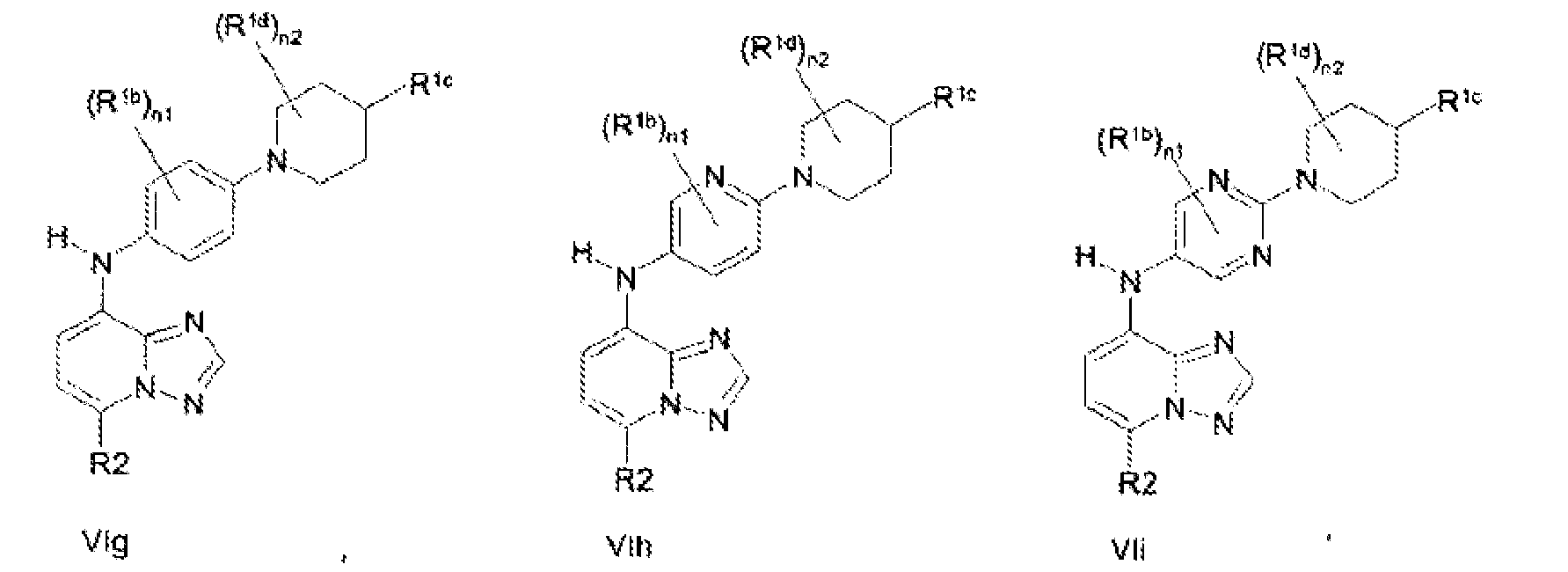
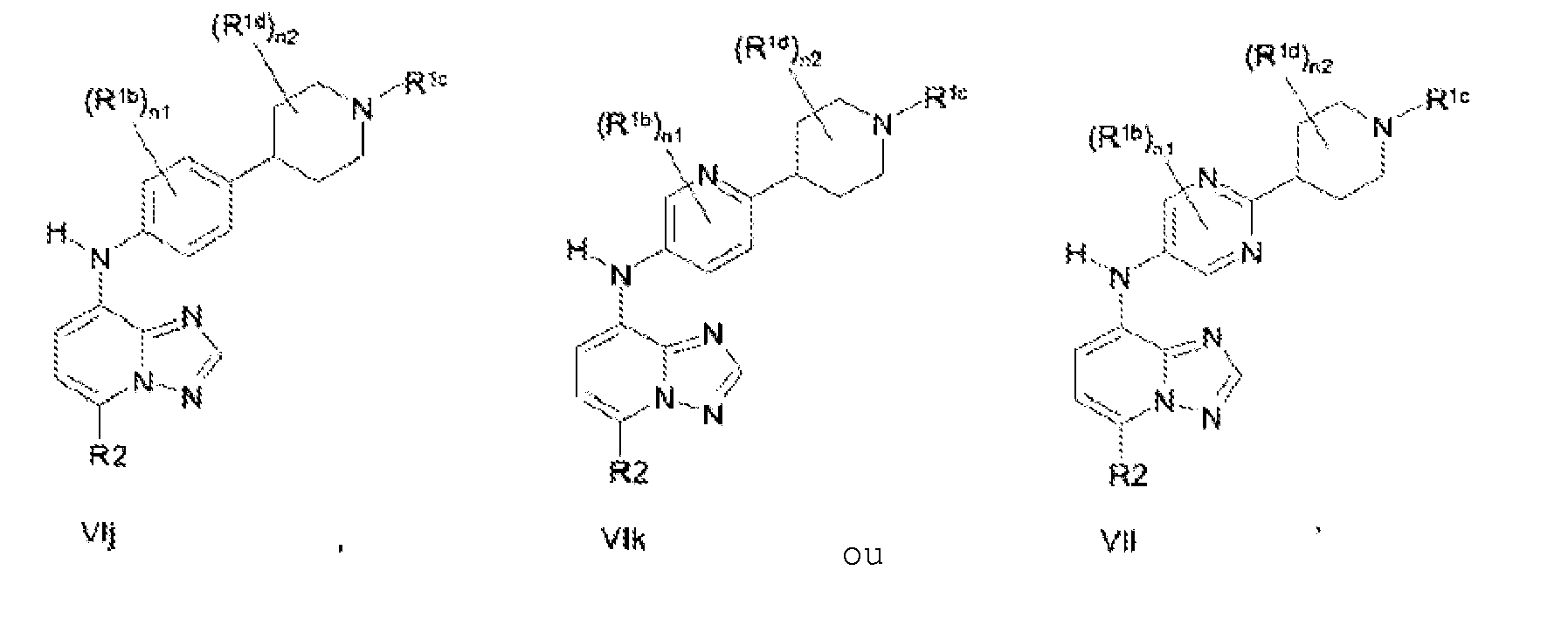
- Composé selon la revendication 5, caractérisé en ce que le composé est selon les formules VId-VIl et où R1c est un alkyle substitué ou non substitué, un cycloalkyle substitué ou non substitué ou un hétérocycloalkyle substitué ou non substitué.
- Composé selon la revendication 1, caractérisé en ce que le composé est selon la formule VIIIa, VIIIb, VIIIc, VIIId, VIIIe, VIIIf, VIIIg, VIIIh, ou VIIIi :


- Composé selon la revendication 7, caractérisé en ce que R1c est un alkyle substitué ou non substitué ou un cycloalkyle substitué ou non substitué.
- Composé selon la revendication 7, caractérisé en ce que R1c est un aryle, aralkyle ou hétéroaryle substitué ou non substitué.
- Composé selon la revendication 1, caractérisé en ce que le composé est selon la formule IXa ou IXb :

- Composé selon la revendication 10, caractérisé en ce que Rb est un alkyle en C1-C6 substitué ou non substitué ou un cycloalkyle substitué ou non substitué.
- Composé selon la revendication 10, caractérisé en ce que Rb est un hétérocycloalkyle substitué ou non substitué, ou un aryle, aralkyle ou hétéroaryle substitué ou non substitué.
- Composé selon la revendication 12, caractérisé en ce que Rb est un phényle, benzyle ou pyridyle substitué ou non substitué.
- Composé selon l'une quelconque des revendications 1 à 13, caractérisé en ce que R2 est choisi parmi un aryle substitué ou non substitué.
- Composé selon l'une quelconque des revendications 1 à 13, caractérisé en ce que R2 est choisi parmi un hétéroaryle substitué ou non substitué.
- Composé selon la revendication 15, caractérisé en ce que R2 est

- Composition pharmaceutique comprenant une quantité thérapeutiquement efficace d'un composé inhibant l'expression de métalloprotéinase de matrice selon l'une quelconque des revendications 1 à 16, en mélange avec un véhicule pharmaceutiquement acceptable.
- Utilisation d'un composé selon l'une quelconque des revendications 1 à 17, dans la fabrication d'un médicament pour le traitement ou la prophylaxie d'une affection choisie parmi des maladies impliquant une inflammation.
- Utilisation selon la revendication 18, caractérisée en ce que ladite maladie est la polyarthrite rhumatoïde.
Applications Claiming Priority (2)
| Application Number | Priority Date | Filing Date | Title |
|---|---|---|---|
| US86814406P | 2006-12-01 | 2006-12-01 | |
| PCT/EP2007/063106 WO2008065198A1 (fr) | 2006-12-01 | 2007-11-30 | Composés de triazolopyridine pour le traitement de maladies dégénératives et inflammatoires |
Publications (3)
| Publication Number | Publication Date |
|---|---|
| EP2086540A1 EP2086540A1 (fr) | 2009-08-12 |
| EP2086540B1 true EP2086540B1 (fr) | 2011-01-19 |
| EP2086540B8 EP2086540B8 (fr) | 2011-03-02 |
Family
ID=38983774
Family Applications (1)
| Application Number | Title | Priority Date | Filing Date |
|---|---|---|---|
| EP07857236A Not-in-force EP2086540B8 (fr) | 2006-12-01 | 2007-11-30 | Composés de triazolopyridine pour le traitement de maladies dégénératives et inflammatoires |
Country Status (6)
| Country | Link |
|---|---|
| US (1) | US7977352B2 (fr) |
| EP (1) | EP2086540B8 (fr) |
| JP (1) | JP2010511018A (fr) |
| AT (1) | ATE495743T1 (fr) |
| DE (1) | DE602007012133D1 (fr) |
| WO (1) | WO2008065198A1 (fr) |
Families Citing this family (43)
| Publication number | Priority date | Publication date | Assignee | Title |
|---|---|---|---|---|
| ES2411930T3 (es) | 2008-02-20 | 2013-07-09 | Actelion Pharmaceuticals Ltd. | Compuestos antibióticos azatricíclicos |
| KR101592046B1 (ko) | 2008-02-22 | 2016-02-05 | 액테리온 파마슈티칼 리미티드 | 옥사졸리디논 유도체 |
| JO3041B1 (ar) * | 2008-07-25 | 2016-09-05 | Galapagos Nv | مركبات جديدة مفيدة لمعالجة الأمراض التنكسية والالتهابية |
| DK2344495T3 (en) | 2008-10-07 | 2015-02-02 | Actelion Pharmaceuticals Ltd | TRICYCLIC OXAZOLIDINON ANTIBIOTIC COMPOUNDS |
| RU2516701C2 (ru) | 2008-10-10 | 2014-05-20 | Актелион Фармасьютиклз Лтд | Оксазолидиниловые антибиотики |
| EP2438066A2 (fr) | 2009-06-05 | 2012-04-11 | Cephalon, Inc. | Préparation et utilisation de dérivés de 1,2,4-triazolo[1,5a]pyridine |
| JP2011168582A (ja) * | 2010-01-21 | 2011-09-01 | Ishihara Sangyo Kaisha Ltd | トリアゾロピリジン誘導体又はその塩、それらの製造方法及びそれらを含有する有害生物防除剤 |
| PE20161323A1 (es) | 2013-09-05 | 2016-11-25 | Hoffmann La Roche | Compuestos de triazolopiridina, composiciones y metodos de uso de los mismos |
| US9527835B2 (en) | 2014-02-13 | 2016-12-27 | Incyte Corporation | Cyclopropylamines as LSD1 inhibitors |
| JP6602779B2 (ja) | 2014-02-13 | 2019-11-06 | インサイト・コーポレイション | Lsd1阻害剤としてのシクロプロピルアミン類 |
| EP3105218B1 (fr) | 2014-02-13 | 2019-09-25 | Incyte Corporation | Cyclopropylamines en tant qu'inhibiteurs de lsd1 |
| EP3105219B9 (fr) | 2014-02-13 | 2018-10-03 | Incyte Corporation | Cyclopropylamines en tant qu'inhibiteurs de lsd1 |
| WO2016007731A1 (fr) | 2014-07-10 | 2016-01-14 | Incyte Corporation | Imidazopyridines et imidazopyrazines à utiliser en tant qu'inhibiteurs de lsd1 |
| US9695180B2 (en) | 2014-07-10 | 2017-07-04 | Incyte Corporation | Substituted imidazo[1,2-a]pyrazines as LSD1 inhibitors |
| US9695167B2 (en) | 2014-07-10 | 2017-07-04 | Incyte Corporation | Substituted triazolo[1,5-a]pyridines and triazolo[1,5-a]pyrazines as LSD1 inhibitors |
| US9758523B2 (en) | 2014-07-10 | 2017-09-12 | Incyte Corporation | Triazolopyridines and triazolopyrazines as LSD1 inhibitors |
| EP3277689B1 (fr) | 2015-04-03 | 2019-09-04 | Incyte Corporation | Composés hétérocycliques utilisés en tant qu'inhibiteurs de lsd1 |
| MY189367A (en) | 2015-08-12 | 2022-02-08 | Incyte Corp | Salts of an lsd1 inhibitor |
| TWI833686B (zh) | 2016-04-22 | 2024-03-01 | 美商英塞特公司 | Lsd1 抑制劑之調配物 |
| WO2018000549A1 (fr) * | 2016-06-29 | 2018-01-04 | 四川大学华西医院 | Dérivé [1,2,4] triazolo [1,5-a] pyridine et sa forme cristalline |
| US10071079B2 (en) | 2016-06-29 | 2018-09-11 | Bristol-Myers Squibb Company | [1,2,4]triazolo[1,5-a]pyridinyl substituted indole compounds |
| MX391344B (es) | 2016-07-30 | 2025-03-21 | Bristol Myers Squibb Co | Compuestos indol sustituidos con dimetoxifenilo como inhibidores de receptores tipo toll 7, 8 o 9 (tlr7, tlr8 o tlr9). |
| KR102519535B1 (ko) | 2016-09-09 | 2023-04-06 | 브리스톨-마이어스 스큅 컴퍼니 | 피리딜 치환된 인돌 화합물 |
| CN109715631B (zh) | 2016-09-16 | 2022-02-18 | 德国亥姆霍兹慕尼黑中心健康与环境研究中心(有限公司) | Traf 6抑制剂 |
| ES2921020T3 (es) | 2017-08-04 | 2022-08-16 | Bristol Myers Squibb Co | Compuestos de indol sustituidos con [1,2,4]triazolo[4,3-a]piridinilo |
| CN110997656B (zh) | 2017-08-04 | 2023-04-14 | 百时美施贵宝公司 | 用作tlr7/8/9抑制剂的取代的吲哚化合物 |
| CN111448190B (zh) | 2017-11-14 | 2023-09-26 | 百时美施贵宝公司 | 取代的吲哚化合物 |
| BR112020011668A2 (pt) | 2017-12-15 | 2020-11-17 | Bristol-Myers Squibb Company | compostos de éter de indol substituído |
| FI3728252T3 (fi) | 2017-12-18 | 2023-10-18 | Bristol Myers Squibb Co | 4-atsaindoliyhdisteitä |
| JP7313354B2 (ja) | 2017-12-19 | 2023-07-24 | ブリストル-マイヤーズ スクイブ カンパニー | Tlr阻害剤として有用なアミド置換されたインドール化合物 |
| BR112020012084A2 (pt) | 2017-12-19 | 2020-11-24 | Bristol-Myers Squibb Company | compostos de indol substituído úteis como inibidores de tlr |
| WO2019126082A1 (fr) | 2017-12-19 | 2019-06-27 | Bristol-Myers Squibb Company | Composés de 6-azaindole |
| BR112020011984A2 (pt) | 2017-12-20 | 2020-11-17 | Bristol-Myers Squibb Company | compostos de amino indol úteis como inibidores de tlr |
| CA3085942A1 (fr) | 2017-12-20 | 2019-06-27 | Bristol-Myers Squibb Company | Composes d'indole a substitution aryle et heteroaryle |
| US11299501B2 (en) | 2017-12-20 | 2022-04-12 | Bristol-Myers Squibb Company | Diazaindole compounds |
| US10968200B2 (en) | 2018-08-31 | 2021-04-06 | Incyte Corporation | Salts of an LSD1 inhibitor and processes for preparing the same |
| CN112955450A (zh) | 2018-10-24 | 2021-06-11 | 百时美施贵宝公司 | 经取代的吲哚和吲唑化合物 |
| ES2963696T3 (es) | 2018-10-24 | 2024-04-01 | Bristol Myers Squibb Co | Compuestos diméricos de indol sustituidos |
| EP3965888B1 (fr) | 2019-05-09 | 2024-08-21 | Bristol-Myers Squibb Company | Composés de benzimidazolone substitués |
| WO2021067326A1 (fr) | 2019-10-01 | 2021-04-08 | Bristol-Myers Squibb Company | Composés hétéroaryle bicycliques substitués |
| CN114829350B (zh) | 2019-10-04 | 2024-05-28 | 百时美施贵宝公司 | 经取代的咔唑化合物 |
| JP7818011B2 (ja) * | 2020-10-16 | 2026-02-19 | レラファイド バイオサイエンシーズ, インコーポレイテッド | Malt1モジュレーターおよびその使用 |
| CN121866258A (zh) * | 2023-08-18 | 2026-04-14 | 薛定谔公司 | 治疗癌症的方法 |
Family Cites Families (10)
| Publication number | Priority date | Publication date | Assignee | Title |
|---|---|---|---|---|
| US6355653B1 (en) * | 1999-09-06 | 2002-03-12 | Hoffmann-La Roche Inc. | Amino-triazolopyridine derivatives |
| AU2003249477A1 (en) | 2002-08-13 | 2004-02-25 | Warner-Lambert Company Llc | Heterobicylcic metalloproteinase inhibitors |
| US7576085B2 (en) | 2002-09-23 | 2009-08-18 | Schering Corporation | Imidazopyrazines as cyclin dependent kinase inhibitors |
| NZ538685A (en) | 2002-09-23 | 2008-02-29 | Schering Corp | Imidazopyrazines as cyclin dependent kinase inhibitors |
| EP1711498A2 (fr) | 2004-01-26 | 2006-10-18 | Altana Pharma AG | 1,2,4-triazolo¬1,5-a|pyridines inhibant la secretion d'acide gastrique |
| AU2005260031B2 (en) * | 2004-06-25 | 2008-10-09 | Amgen Inc. | Condensed triazoles and indazoles useful in treating citokines mediated diseases and other diseases |
| US20070117804A1 (en) | 2005-11-10 | 2007-05-24 | Schering Corporation | Imidazopyrazines as protein kinase inhibitors |
| US7893058B2 (en) | 2006-05-15 | 2011-02-22 | Janssen Pharmaceutica Nv | Imidazolopyrazine compounds useful for the treatment of degenerative and inflammatory diseases |
| PT2029602E (pt) | 2006-05-31 | 2010-07-08 | Galapagos Nv | Compostos de triazolopirazina uteis para o tratamento de doenãas degenerativas e inflamatërias |
| JP2010511019A (ja) | 2006-12-01 | 2010-04-08 | ガラパゴス・ナムローゼ・フェンノートシャップ | 変性疾患及び炎症性疾患の治療に有用なイミダゾロピリジン化合物 |
-
2007
- 2007-11-30 WO PCT/EP2007/063106 patent/WO2008065198A1/fr not_active Ceased
- 2007-11-30 DE DE602007012133T patent/DE602007012133D1/de active Active
- 2007-11-30 EP EP07857236A patent/EP2086540B8/fr not_active Not-in-force
- 2007-11-30 US US11/998,817 patent/US7977352B2/en not_active Expired - Fee Related
- 2007-11-30 JP JP2009538725A patent/JP2010511018A/ja active Pending
- 2007-11-30 AT AT07857236T patent/ATE495743T1/de not_active IP Right Cessation
Also Published As
| Publication number | Publication date |
|---|---|
| US20090105242A1 (en) | 2009-04-23 |
| WO2008065198A1 (fr) | 2008-06-05 |
| ATE495743T1 (de) | 2011-02-15 |
| EP2086540B8 (fr) | 2011-03-02 |
| EP2086540A1 (fr) | 2009-08-12 |
| JP2010511018A (ja) | 2010-04-08 |
| DE602007012133D1 (de) | 2011-03-03 |
| US7977352B2 (en) | 2011-07-12 |
Similar Documents
| Publication | Publication Date | Title |
|---|---|---|
| EP2086540B1 (fr) | Composés de triazolopyridine pour le traitement de maladies dégénératives et inflammatoires | |
| US7951818B2 (en) | Imidazolopyridine compounds useful for the treatment of degenerative and inflammatory diseases | |
| US8138193B2 (en) | Fused pyrazine compounds useful for the treatment of degenerative and inflammatory diseases | |
| US8148369B2 (en) | Fused pyrazine compounds useful for the treatment of degenerative and inflammatory diseases | |
| US8178530B2 (en) | Imidazolopyrazine compounds useful for the treatment of degenerative and inflammatory diseases | |
| US20090137549A1 (en) | Novel compounds useful for the treatment of degenerative & inflamatory diseases | |
| IL271104A (en) | The traumatic compounds as inhibitors and fines | |
| MXPA02003364A (es) | Compuestos heterociclicos utiles como inhibidores de las cinasas de tirosina. | |
| CA2877543A1 (fr) | Derives d'imidazopyrazine en tant que modulateurs de l'activite tnf | |
| EP2760863A1 (fr) | Dérivés de pyrazolo[4,3-c]pyridine comme inhibiteurs de kinases | |
| AU2013292950A1 (en) | Nitrogenous heterocyclic derivatives and their application in drugs | |
| CA2878792A1 (fr) | Inhibition d'enzymes | |
| MD3728207T2 (ro) | Chinazolinone ca inhibitori PARP14 | |
| US8012983B2 (en) | Substituted triazolopyrazines useful for the treatment of degenerative and inflammatory diseases | |
| WO2008100620A2 (fr) | Modulateurs de la cathepsine s à la tétrahydro-pyrazolo-pyridine aminopropyle bicycliques | |
| TWI464170B (zh) | 5-酮基-5,8-二氫吡啶并[2,3-d]嘧啶衍生物,其製備及其治療用途 | |
| CA3112330A1 (fr) | Inhibiteurs de hdac1, 2 | |
| JP5570434B2 (ja) | Par1阻害剤としてのイミダゾピリダジン類、その製造、及び薬剤としての使用 | |
| WO2009071707A1 (fr) | Nouveaux composés utiles pour le traitement de maladies dégénératives et inflammatoires | |
| CA3037141A1 (fr) | Composes d'heteroaryle carboxamide en tant qu'inhibiteurs de ripk2 |
Legal Events
| Date | Code | Title | Description |
|---|---|---|---|
| PUAI | Public reference made under article 153(3) epc to a published international application that has entered the european phase |
Free format text: ORIGINAL CODE: 0009012 |
|
| 17P | Request for examination filed |
Effective date: 20090604 |
|
| AK | Designated contracting states |
Kind code of ref document: A1 Designated state(s): AT BE BG CH CY CZ DE DK EE ES FI FR GB GR HU IE IS IT LI LT LU LV MC MT NL PL PT RO SE SI SK TR |
|
| RIN1 | Information on inventor provided before grant (corrected) |
Inventor name: KROLL, FRIEDRICH ERICH KARL Inventor name: BURRITT, ANDREW Inventor name: TAO, XUELIANG Inventor name: MARTINA, SEBASTIEN LAURENT XAVIER Inventor name: EDWARDS, PAUL JOHN Inventor name: SCHMIDT, WOLFGANG Inventor name: BIRAULT, VERONIQUE Inventor name: ANDREWS, MARTIN JAMES INGLIS |
|
| RIN1 | Information on inventor provided before grant (corrected) |
Inventor name: BURRITT, ANDREW Inventor name: KROLL, FRIEDRICH ERICH KARL Inventor name: ANDREWS, MARTIN JAMES INGLIS Inventor name: EDWARDS, PAUL JOHN Inventor name: SCHMIDT, WOLFGANG Inventor name: BIRAULT, VERONIQUE Inventor name: MARTINA, SEBASTIEN LAURENT XAVIER Inventor name: TAO, XUELIANG |
|
| 17Q | First examination report despatched |
Effective date: 20100119 |
|
| DAX | Request for extension of the european patent (deleted) | ||
| GRAP | Despatch of communication of intention to grant a patent |
Free format text: ORIGINAL CODE: EPIDOSNIGR1 |
|
| GRAS | Grant fee paid |
Free format text: ORIGINAL CODE: EPIDOSNIGR3 |
|
| GRAA | (expected) grant |
Free format text: ORIGINAL CODE: 0009210 |
|
| AK | Designated contracting states |
Kind code of ref document: B1 Designated state(s): AT BE BG CH CY CZ DE DK EE ES FI FR GB GR HU IE IS IT LI LT LU LV MC MT NL PL PT RO SE SI SK TR |
|
| REG | Reference to a national code |
Ref country code: GB Ref legal event code: FG4D |
|
| REG | Reference to a national code |
Ref country code: CH Ref legal event code: EP |
|
| REG | Reference to a national code |
Ref country code: IE Ref legal event code: FG4D |
|
| RAP2 | Party data changed (patent owner data changed or rights of a patent transferred) |
Owner name: GALAPAGOS N.V. |
|
| REF | Corresponds to: |
Ref document number: 602007012133 Country of ref document: DE Date of ref document: 20110303 Kind code of ref document: P |
|
| REG | Reference to a national code |
Ref country code: DE Ref legal event code: R096 Ref document number: 602007012133 Country of ref document: DE Effective date: 20110303 |
|
| REG | Reference to a national code |
Ref country code: NL Ref legal event code: T3 |
|
| LTIE | Lt: invalidation of european patent or patent extension |
Effective date: 20110119 |
|
| PG25 | Lapsed in a contracting state [announced via postgrant information from national office to epo] |
Ref country code: ES Free format text: LAPSE BECAUSE OF FAILURE TO SUBMIT A TRANSLATION OF THE DESCRIPTION OR TO PAY THE FEE WITHIN THE PRESCRIBED TIME-LIMIT Effective date: 20110430 Ref country code: GR Free format text: LAPSE BECAUSE OF FAILURE TO SUBMIT A TRANSLATION OF THE DESCRIPTION OR TO PAY THE FEE WITHIN THE PRESCRIBED TIME-LIMIT Effective date: 20110420 Ref country code: PT Free format text: LAPSE BECAUSE OF FAILURE TO SUBMIT A TRANSLATION OF THE DESCRIPTION OR TO PAY THE FEE WITHIN THE PRESCRIBED TIME-LIMIT Effective date: 20110519 Ref country code: LV Free format text: LAPSE BECAUSE OF FAILURE TO SUBMIT A TRANSLATION OF THE DESCRIPTION OR TO PAY THE FEE WITHIN THE PRESCRIBED TIME-LIMIT Effective date: 20110119 Ref country code: IS Free format text: LAPSE BECAUSE OF FAILURE TO SUBMIT A TRANSLATION OF THE DESCRIPTION OR TO PAY THE FEE WITHIN THE PRESCRIBED TIME-LIMIT Effective date: 20110519 Ref country code: LT Free format text: LAPSE BECAUSE OF FAILURE TO SUBMIT A TRANSLATION OF THE DESCRIPTION OR TO PAY THE FEE WITHIN THE PRESCRIBED TIME-LIMIT Effective date: 20110119 Ref country code: SE Free format text: LAPSE BECAUSE OF FAILURE TO SUBMIT A TRANSLATION OF THE DESCRIPTION OR TO PAY THE FEE WITHIN THE PRESCRIBED TIME-LIMIT Effective date: 20110119 |
|
| PG25 | Lapsed in a contracting state [announced via postgrant information from national office to epo] |
Ref country code: CY Free format text: LAPSE BECAUSE OF FAILURE TO SUBMIT A TRANSLATION OF THE DESCRIPTION OR TO PAY THE FEE WITHIN THE PRESCRIBED TIME-LIMIT Effective date: 20110119 Ref country code: PL Free format text: LAPSE BECAUSE OF FAILURE TO SUBMIT A TRANSLATION OF THE DESCRIPTION OR TO PAY THE FEE WITHIN THE PRESCRIBED TIME-LIMIT Effective date: 20110119 Ref country code: AT Free format text: LAPSE BECAUSE OF FAILURE TO SUBMIT A TRANSLATION OF THE DESCRIPTION OR TO PAY THE FEE WITHIN THE PRESCRIBED TIME-LIMIT Effective date: 20110119 Ref country code: BG Free format text: LAPSE BECAUSE OF FAILURE TO SUBMIT A TRANSLATION OF THE DESCRIPTION OR TO PAY THE FEE WITHIN THE PRESCRIBED TIME-LIMIT Effective date: 20110419 Ref country code: FI Free format text: LAPSE BECAUSE OF FAILURE TO SUBMIT A TRANSLATION OF THE DESCRIPTION OR TO PAY THE FEE WITHIN THE PRESCRIBED TIME-LIMIT Effective date: 20110119 Ref country code: SI Free format text: LAPSE BECAUSE OF FAILURE TO SUBMIT A TRANSLATION OF THE DESCRIPTION OR TO PAY THE FEE WITHIN THE PRESCRIBED TIME-LIMIT Effective date: 20110119 |
|
| PG25 | Lapsed in a contracting state [announced via postgrant information from national office to epo] |
Ref country code: EE Free format text: LAPSE BECAUSE OF FAILURE TO SUBMIT A TRANSLATION OF THE DESCRIPTION OR TO PAY THE FEE WITHIN THE PRESCRIBED TIME-LIMIT Effective date: 20110119 Ref country code: DK Free format text: LAPSE BECAUSE OF FAILURE TO SUBMIT A TRANSLATION OF THE DESCRIPTION OR TO PAY THE FEE WITHIN THE PRESCRIBED TIME-LIMIT Effective date: 20110119 |
|
| PLBE | No opposition filed within time limit |
Free format text: ORIGINAL CODE: 0009261 |
|
| STAA | Information on the status of an ep patent application or granted ep patent |
Free format text: STATUS: NO OPPOSITION FILED WITHIN TIME LIMIT |
|
| PG25 | Lapsed in a contracting state [announced via postgrant information from national office to epo] |
Ref country code: SK Free format text: LAPSE BECAUSE OF FAILURE TO SUBMIT A TRANSLATION OF THE DESCRIPTION OR TO PAY THE FEE WITHIN THE PRESCRIBED TIME-LIMIT Effective date: 20110119 Ref country code: CZ Free format text: LAPSE BECAUSE OF FAILURE TO SUBMIT A TRANSLATION OF THE DESCRIPTION OR TO PAY THE FEE WITHIN THE PRESCRIBED TIME-LIMIT Effective date: 20110119 Ref country code: RO Free format text: LAPSE BECAUSE OF FAILURE TO SUBMIT A TRANSLATION OF THE DESCRIPTION OR TO PAY THE FEE WITHIN THE PRESCRIBED TIME-LIMIT Effective date: 20110119 |
|
| 26N | No opposition filed |
Effective date: 20111020 |
|
| PG25 | Lapsed in a contracting state [announced via postgrant information from national office to epo] |
Ref country code: IT Free format text: LAPSE BECAUSE OF FAILURE TO SUBMIT A TRANSLATION OF THE DESCRIPTION OR TO PAY THE FEE WITHIN THE PRESCRIBED TIME-LIMIT Effective date: 20110119 |
|
| REG | Reference to a national code |
Ref country code: DE Ref legal event code: R097 Ref document number: 602007012133 Country of ref document: DE Effective date: 20111020 |
|
| PG25 | Lapsed in a contracting state [announced via postgrant information from national office to epo] |
Ref country code: MC Free format text: LAPSE BECAUSE OF NON-PAYMENT OF DUE FEES Effective date: 20111130 |
|
| REG | Reference to a national code |
Ref country code: CH Ref legal event code: PL |
|
| PG25 | Lapsed in a contracting state [announced via postgrant information from national office to epo] |
Ref country code: LI Free format text: LAPSE BECAUSE OF NON-PAYMENT OF DUE FEES Effective date: 20111130 Ref country code: CH Free format text: LAPSE BECAUSE OF NON-PAYMENT OF DUE FEES Effective date: 20111130 |
|
| REG | Reference to a national code |
Ref country code: IE Ref legal event code: MM4A |
|
| REG | Reference to a national code |
Ref country code: AT Ref legal event code: MK05 Ref document number: 495743 Country of ref document: AT Kind code of ref document: T Effective date: 20110119 |
|
| PG25 | Lapsed in a contracting state [announced via postgrant information from national office to epo] |
Ref country code: IE Free format text: LAPSE BECAUSE OF NON-PAYMENT OF DUE FEES Effective date: 20111130 |
|
| PGFP | Annual fee paid to national office [announced via postgrant information from national office to epo] |
Ref country code: FR Payment date: 20121130 Year of fee payment: 6 Ref country code: DE Payment date: 20121128 Year of fee payment: 6 |
|
| PG25 | Lapsed in a contracting state [announced via postgrant information from national office to epo] |
Ref country code: MT Free format text: LAPSE BECAUSE OF FAILURE TO SUBMIT A TRANSLATION OF THE DESCRIPTION OR TO PAY THE FEE WITHIN THE PRESCRIBED TIME-LIMIT Effective date: 20110119 |
|
| PGFP | Annual fee paid to national office [announced via postgrant information from national office to epo] |
Ref country code: BE Payment date: 20121113 Year of fee payment: 6 Ref country code: GB Payment date: 20121128 Year of fee payment: 6 |
|
| PGFP | Annual fee paid to national office [announced via postgrant information from national office to epo] |
Ref country code: NL Payment date: 20121110 Year of fee payment: 6 |
|
| PG25 | Lapsed in a contracting state [announced via postgrant information from national office to epo] |
Ref country code: LU Free format text: LAPSE BECAUSE OF NON-PAYMENT OF DUE FEES Effective date: 20111130 |
|
| PG25 | Lapsed in a contracting state [announced via postgrant information from national office to epo] |
Ref country code: TR Free format text: LAPSE BECAUSE OF FAILURE TO SUBMIT A TRANSLATION OF THE DESCRIPTION OR TO PAY THE FEE WITHIN THE PRESCRIBED TIME-LIMIT Effective date: 20110119 |
|
| PG25 | Lapsed in a contracting state [announced via postgrant information from national office to epo] |
Ref country code: HU Free format text: LAPSE BECAUSE OF FAILURE TO SUBMIT A TRANSLATION OF THE DESCRIPTION OR TO PAY THE FEE WITHIN THE PRESCRIBED TIME-LIMIT Effective date: 20110119 |
|
| BERE | Be: lapsed |
Owner name: GALAPAGOS N.V. Effective date: 20131130 |
|
| REG | Reference to a national code |
Ref country code: NL Ref legal event code: V1 Effective date: 20140601 |
|
| GBPC | Gb: european patent ceased through non-payment of renewal fee |
Effective date: 20131130 |
|
| REG | Reference to a national code |
Ref country code: FR Ref legal event code: ST Effective date: 20140731 |
|
| PG25 | Lapsed in a contracting state [announced via postgrant information from national office to epo] |
Ref country code: DE Free format text: LAPSE BECAUSE OF NON-PAYMENT OF DUE FEES Effective date: 20140603 Ref country code: NL Free format text: LAPSE BECAUSE OF NON-PAYMENT OF DUE FEES Effective date: 20140601 |
|
| REG | Reference to a national code |
Ref country code: DE Ref legal event code: R119 Ref document number: 602007012133 Country of ref document: DE Effective date: 20140603 |
|
| PG25 | Lapsed in a contracting state [announced via postgrant information from national office to epo] |
Ref country code: BE Free format text: LAPSE BECAUSE OF NON-PAYMENT OF DUE FEES Effective date: 20131130 |
|
| PG25 | Lapsed in a contracting state [announced via postgrant information from national office to epo] |
Ref country code: GB Free format text: LAPSE BECAUSE OF NON-PAYMENT OF DUE FEES Effective date: 20131130 Ref country code: FR Free format text: LAPSE BECAUSE OF NON-PAYMENT OF DUE FEES Effective date: 20131202 |