EP2087807A2 - Bigoudi doté de substances thermochromes - Google Patents
Bigoudi doté de substances thermochromes Download PDFInfo
- Publication number
- EP2087807A2 EP2087807A2 EP09152146A EP09152146A EP2087807A2 EP 2087807 A2 EP2087807 A2 EP 2087807A2 EP 09152146 A EP09152146 A EP 09152146A EP 09152146 A EP09152146 A EP 09152146A EP 2087807 A2 EP2087807 A2 EP 2087807A2
- Authority
- EP
- European Patent Office
- Prior art keywords
- curler
- thermochromic
- plastic
- base body
- hair
- Prior art date
- Legal status (The legal status is an assumption and is not a legal conclusion. Google has not performed a legal analysis and makes no representation as to the accuracy of the status listed.)
- Withdrawn
Links
Images


Classifications
-
- A—HUMAN NECESSITIES
- A45—HAND OR TRAVELLING ARTICLES
- A45D—HAIRDRESSING OR SHAVING EQUIPMENT; EQUIPMENT FOR COSMETICS OR COSMETIC TREATMENTS, e.g. FOR MANICURING OR PEDICURING
- A45D2/00—Hair-curling or hair-waving appliances ; Appliances for hair dressing treatment not otherwise provided for
- A45D2/12—Hair winders or hair curlers for use parallel to the scalp, i.e. flat-curlers
Definitions
- the invention relates to a hair curler for winding human hair, comprising a base body of a formative shaped part having a central region with a winding surface for winding a hair part, wherein the curler has a first thermochromic substance which at a temperature increase when passing through a first temperature range by a occurring color change indicates a first temperature.
- a curler of the type described above is known from the German patent application DE 198 43 800 A1 known.
- the curler has a main body, which preferably consists of plastic and is covered with a foam layer.
- the foam as part of the hair curler can contain a temperature-activatable substance, suitably a thermochromic color concentrate, which shows a color change when the temperature rises when a predetermined temperature is reached.
- hair curlers are known in numerous forms and design options, for example from the German patent applications DE 102 41 772 A1 . DE 199 18 742 A1 or DE 37 13 280 A1 , Such curlers are used to wind up human hair to create curls. They usually have a base body from a formative molding made of hard or soft plastic or metal. Basic body made of hard plastic or metal are usually very stable in shape and thus little yielding and deformable. Basic body of soft plastic, in particular of plastic foam, can be resiliently compressed, bent or otherwise deformed and converted into a corresponding shape. Basic metal body can also consist of metal mesh. Likewise, injection-molded plastic body can be provided with a plurality of openings.
- All of these basic bodies usually have a central region which has a winding surface for winding up a hair section.
- the hair section is brought in the known manner either by applying the hair tips or the head end of the hairline on the winding surface and added by appropriate twisting or winding on the winding surface.
- the invention has for its object to provide a hair curler, which gives the user of the curler on the head of a decision aid, when a hair dryer and when a cooling process should be terminated or can.
- a problem with using known hair curlers is to maintain appropriate temperatures and / or times during which the hair curler is attached to the head after winding a hair piece.
- a foehn process takes place, which is to be carried out over a certain time and with an increase in temperature of the wound-up hair part and the curler so that the stability of the curl is favored or ensured as possible.
- a foehn process is usually followed by a chilling process, ie a period of time in which the hair curler remains intact with the wound hair on the head until the desired temperature reduction has taken place. Only then does it make sense to start the unwinding process to create beautiful and permanently shaped curls receive.
- the unwrapping process is initiated too early, there is the risk that the curl shape will be at least partially destroyed or impaired.
- the invention is based on the idea, at least a portion of the body or other component of the hair curler with a first thermochromic substance indicating a temperature increase by passing a temperature range by a color change occurring a first temperature or a first temperature range, and a second thermochromic substance that indicates a second temperature or a second temperature range at a temperature decrease when passing through a lower second temperature range by an occurring color change.
- the new curler is particularly well suited for home use. However, it can also be used by professionals in hairdressing salons, etc.
- thermochromic substances can be incorporated into the material of the base body, so that the entire base body has the thermochromic substance as an ingredient. But it is also possible to apply the thermochromic substances only on a part of the body. It is even possible to use the thermochromic substance on another component of the hair curler than the main body, for example on an adhesive strip which surrounds the main body, or on a transverse pin which serves to fasten the main body to the head.
- the thermochromic substances can also be applied by coating at least on a part of the main body or the curler. This is especially true when a relatively hard plastic or even a metal is used as the material for the main body or another part of the curler.
- thermochromic substances should be used on a part of the main body or the curler, which remains well visible even after winding a hair part.
- the end regions of the basic body are suitable in which the hair curler is grasped and handled when the hair section is wound up. It is also sufficient if only one of these end regions is provided on the outside with the thermochromic substances or the thermochromic plastics. It is also possible to arrange only the first thermochromic substance in the first end region and only the second thermochromic substance in the second end region. In this way, the first end region indicates the desired temperature during blow-drying and the second end region indicates the desired temperature during cooling.
- the end regions may be for the user, e.g. B. by a label to be marked accordingly.
- thermochromic substances depend on the temperature or temperature range at which the color changes occurring are desired.
- the thermochromic substances do not show the color change in a digital manner at a very specific temperature, but rather within a certain temperature range.
- the first occurring color change is thus used in temperature increase, to indicate by reaching the temperature that a termination of the Föhnvorgangs is useful to avoid too high temperatures and thus occurring impairments of the hair.
- the second thermochromic substance with the second occurring color change is reversed used in lowering the temperature, as it makes sense in particular for a sufficiently low temperature and the course of an associated cooling time. Cooling times in the range of 12 to 20 minutes are sought, at the end of which room temperature or a temperature slightly above room temperature in the range from 20 to 30 ° C., in particular from about 24 to 27 ° C., can be reached.
- thermochromic plastics are adjusted, selected and possibly used in a mixture of two thermochromic plastics at the same time that both the blow-drying and the cooling-occurring color change on one and the same curler can be seen.
- the main body can have at least about 2 to 6%, in particular about 4%, of the two thermochromic plastics.
- the thermochromic plastics may, for. B. be mixed with the base material of the body.
- Suitable materials for the production of the body are plastics such as polypropylene, polyethylene, polystyrene, acrylic, polyvinyl chloride, polyamide, polyethylene terephthalate, polyester o. The like. In question. These materials apply both to injection molded basic bodies as well as those basic body, which consist of appropriate plastic foam. As plastic foams in particular polyethylene foam, ethylene vinyl acetate foam, polyurethane foam, polyether-amide block copolymers foam, polyester-amide block copolymers foam and polyether foam come into question. In particular, a material for the production of the main body shows good results, which z. B. consists of 92% polypropylene and 8% thermochromic additives. The thermochromic additives may in particular consist of 82% polypropylene and 18% microencapsulated thermochromic substance. The thermochromic substances may also be, for example, polyethylene, polypropylene, polystyrene, etc.
- the invention is generally directed to the use of a plurality of thermochromic substances on at least a portion of a hair curler for indicating a temperature at a temperature elevation and a temperature at a temperature decrease.
- the in Fig. 1 Curler 1 shown has a base body 2, which may be formed as gestaltconferencedes molding, for example as a molded plastic, metal or the like.
- the base body 2 is preferably hollow.
- the two mounting portions 4 have mutually same diameter, which is designed to be larger than the diameter of the central region 3, so that the curler 1, the shape of a coil or Roller gets with both ends radially outwardly projecting edge parts.
- the two attachment regions 4 are preferably covered circumferentially by a hook band 5 over their entire axial extent. Such hook bands 5 are known as part of hook and loop fasteners.
- the hooks 6 can be created in particular by cut slings.
- the central region 3, but also the attachment regions 4 on the main body 2, can be provided with a multiplicity of perforations 7.
- Fig. 2 shows the wound position of the curler 1 on a human head 8 in the scalp 9, the remaining hair on the head 8 are not shown. It is indicated only a single wound hair, which is wound into a curl 10. It is understood that the winding process of such a curl 10 starts at the hair tips.
- a portion of a spiked band 11 is applied.
- the spikes of the spiked band 11 are formed comparatively shorter in the radial direction than the hooks 6 of the hook band 5 in each attachment region 4.
- the barbed band 11 extends only over a certain part of the axial length of the central region 3. It serves to fix the hair tips there and to begin the winding process.
- the curler 1 according to Fig. 2 may have the following dimensional relationships.
- the central region 3 has a diameter 12 of 32 mm.
- the central region 3 extends over an axial length 13 of 40 mm.
- the two attachment portions 4 have a diameter 14 of 40 mm and each have an axial length 15 of 10 mm.
- the hooks 6 may extend in the radial direction by about 3 mm.
- the spines of the spiked band 11 can be 1.5 mm long.
- the main body 2 of the embodiment according to Fig. 2 is designed as a one-piece molding. Only the two sections of the hook band 5 and the barbed tape 11 are connected by a welded connection to the base body 2, wherein at the same time the two ends of each band section are joined together.
- Fig. 3 shows an embodiment of the curler 1 in a smaller size, so provided for winding shorter hair parts on a smaller diameter.
- the curler 1 is formed in three parts.
- the main body 2 is assembled from a continuous pipe section 16 and two rings 17 over the axial length of the curler 1.
- the assembly can be favored by an adhesive or snap connection.
- the attached rings 17 then form the attachment regions 4 and thus also provide the diameter jump to the middle region 3.
- the middle region 3 can be provided with a corrugation 18 in order to favor the application of the hair at the beginning of a winding process.
- the diameter and Length relations are slightly changed here. It is a curler 1 comparatively smaller size.
- the diameter jump is compared to the embodiment of Fig. 2 or the size shown there reduced.
- the main body 2 of the curler 1 is made of a material 19, which may preferably be a plastic. Suitable examples are polypropylene, polyethylene, polystyrene, acrylic-styrene, polyvinyl chloride, polyamide, polyethylene terephthalate, o. The like., Or a corresponding plastic foam.
- the material 19 for the preparation of the main body 2 may be mixed with a first thermochromic substance 20 and / or a second thermochromic substance 35, wherein the entire main body 2 of the curler 1 according to Fig. 1 may consist of this material 19.
- thermochromic plastics 21, 36 may also be attached to another component of the curler 1 as the main body 2.
- the rings 17 may be made of a material to which the thermochromic plastics 21 are added. Also, a coating of the rings 17 on the outside is sufficient.
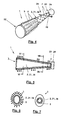
- the Fig. 4 to 7 illustrate another embodiment of the curler 1.
- This illustrated curler 1 has a base body 2 on.
- the main body 2 here has a conical or frustoconical basic shape.
- the curler 1 or the main body 2 extends over its length from a starting end 22 to its other end 23.
- the beginning end 22 denotes the end which has the comparatively larger cross section.
- the base body 2 and thus the curler 1 at its beginning end 22 has an oval cross-section of relatively large diameter, which decreases continuously in the direction of its other end 23.
- the main body 2 may be formed in particular as a hollow body. It can be made of plastic or metal exist and usually has a sufficient dimensional stability and rigidity.
- the main body 2 may be perforated lattice-like over its entire length or may also have circular perforations 7.
- the main body 2 or the curler 1 has a thickening 24 in the region of its other end 23.
- the thickening 24 is formed here as an approximately spherical approach. It can be made in one piece with the main body 2 by injection molding.
- the thickening 24 has a larger diameter than corresponds to the main body 2 in the region of its other end 23.
- the thickening 24 fulfills two functions. On the one hand, it prevents slippage of a strand of hair during or after the winding process. On the other hand can be easily grab on the thickening 24 of curlers 1 and handle, in particular, the hair strand to wind up.
- a portion of a hook band 5 is provided and fixed.
- the hook tape 5 is formed in a conventional manner, approximately similar to how it is used for hook and loop fasteners.
- the hook tape 5 has individual, approximately radially projecting bent hooks 6 or mushroom-shaped thickened spines on its circumference.
- the strip of hook tape 5 takes in the in Fig. 4 illustrated embodiment, about half of the axial length of the curler 1 or body 2 a. But it is also possible to make the hook band 5 shorter or comparatively longer.
- the curler 1 also includes a fastening device 25.
- the fastening device 25 here consists of a needle 26 which can optionally be inserted transversely through corresponding openings 7 in the main body 2, when the winding process of the hair strand is completed.
- the base body 2 may consist entirely or partially of thermochromic plastics 21, 36.
- thermochromic plastics 21, 36 it is possible to arrange the thermochromic plastics 21, 36 in the area of the thickening 24 or even only on the needle 26, ie always in such places, on which the free top view also in wound hair strand is possible to easily recognize the color change during blow-drying or after cooling.
- the in the 8 and 9 Curler 1 shown has a base body 2 of flexible plastic foam, which has a certain recovery capacity.
- the main body 2 has rod-shaped, elongated shape and is formed in cross-section over its entire length either circular or at least approximately square.
- the base body 2 has a surface which may be open-pored and rough, so that the hair to be wound up will bear well on this surface and be grasped by it.
- a flexible wire core 27 is arranged, that is a piece of flexible wire, which can be permanently deformed.
- the two ends 28 of the wire core 27 are bent over or loop-shaped in order to reduce the risk of injury.
- the wire core 27 may be surrounded in its central region by a pipe section 29, through which the wire core 27 is reinforced.
- the main body 2 ultimately has a rigid central portion 31 which is not bendable and end portions 32 which are bendable.
- the plastic foam material of the main body 2 is continuously uniformly shaped, so that the differences in the bendability are caused only by the wire core 27.
- a hair portion 33 may be wound in the form of a curl.
- thermochromic substance 20 in particular a thermochromic plastic 21
- thermochromic substance 35 in particular a thermochromic plastic 36
- main body 2 or another part of the curler 1 is not made of plastic, but for example of metal, in particular in the form of a wire grid o. ⁇ ., Was generated.
- the material 19 for the production of the main body 2 or another component of the curler 1 may be plastic, which can be brought by injection molding in the appropriate shape.
- the plastic can also be applied in the form of a plastic foam, in particular in the embodiment of 8 and 9 , Suitable plastics are polypropylene, polyethylene, polystyrene, acrylstyrene, polyvinyl chloride, polyamide, polyethylene terephthalate or the like, also in foamed form.
- thermochromic substances 20, 35 in particular thermochromic plastics 21, 36 are used, which, however, represents only one component of the material or appears in the form of a coating applied to the surface 34.
- a coating 34 can also be applied to the needle 26 of the fastening device 25, for example.
Landscapes
- Hair Curling (AREA)
Applications Claiming Priority (1)
| Application Number | Priority Date | Filing Date | Title |
|---|---|---|---|
| DE102008007539A DE102008007539B4 (de) | 2008-02-05 | 2008-02-05 | Lockenwickler und seine Verwendung |
Publications (2)
| Publication Number | Publication Date |
|---|---|
| EP2087807A2 true EP2087807A2 (fr) | 2009-08-12 |
| EP2087807A3 EP2087807A3 (fr) | 2010-12-15 |
Family
ID=40671157
Family Applications (1)
| Application Number | Title | Priority Date | Filing Date |
|---|---|---|---|
| EP09152146A Withdrawn EP2087807A3 (fr) | 2008-02-05 | 2009-02-05 | Bigoudi doté de substances thermochromes |
Country Status (3)
| Country | Link |
|---|---|
| US (1) | US20090194129A1 (fr) |
| EP (1) | EP2087807A3 (fr) |
| DE (1) | DE102008007539B4 (fr) |
Cited By (1)
| Publication number | Priority date | Publication date | Assignee | Title |
|---|---|---|---|---|
| EP2253652A1 (fr) * | 2009-04-27 | 2010-11-24 | Schaum-Chemie Wilhelm Bauer GmbH & Co. KG | Mousse de polyuréthane et son utilisation ainsi que procédé de fabrication d'une mousse de polyuréthane |
Families Citing this family (11)
| Publication number | Priority date | Publication date | Assignee | Title |
|---|---|---|---|---|
| CN202588727U (zh) * | 2012-05-28 | 2012-12-12 | 沧州贞帝化妆用具有限公司 | 化妆刷 |
| US10477956B2 (en) | 2013-08-20 | 2019-11-19 | HCT Group Holdings Limited | Cosmetic systems |
| US9801460B2 (en) | 2013-11-04 | 2017-10-31 | HCT Group Holdings Limited | Retractable cosmetic implement with multiple positions |
| USD767903S1 (en) | 2014-09-22 | 2016-10-04 | HCT Group Holdings Limited | Cosmetic brush |
| USD779140S1 (en) | 2014-10-23 | 2017-02-14 | HCT Group Holdings Limited | Brush cleansing mitt |
| US9826824B2 (en) | 2014-10-23 | 2017-11-28 | HCT Group Holdings Limited | Cosmetic brush cleaning aid |
| US10786060B2 (en) * | 2015-02-20 | 2020-09-29 | Phyllis A. Reile | Hairstyle enhancing accessory |
| USD778069S1 (en) | 2015-03-18 | 2017-02-07 | HCT Group Holdings Limited | Dual ended kabuki brush |
| USD787835S1 (en) | 2015-03-18 | 2017-05-30 | HCT Group Holdings Limited | Multi-head dual end cosmetic applicator |
| US12495891B1 (en) | 2018-03-22 | 2025-12-16 | Nashara Frazier | Hair styling tool and method of use |
| US11259614B1 (en) * | 2018-04-10 | 2022-03-01 | Hair4Good, Llc. | Hair roller |
Citations (4)
| Publication number | Priority date | Publication date | Assignee | Title |
|---|---|---|---|---|
| DE3713280A1 (de) | 1986-05-27 | 1987-12-03 | Heinz G Juenemann Gmbh & Co Kg | Buegelloser stabfoermiger lockenwickler |
| DE19843800A1 (de) | 1998-09-24 | 2000-04-13 | Siegfried Mueller | Lockenwickler für Dauer- oder Wasserwellen und Verfahren zum Aufbringen einer Dauer- oder Wasserwelle |
| DE19918742A1 (de) | 1999-04-24 | 2000-11-02 | Juenemann Gmbh | Lockenwickler zum Aufwickeln menschlichen Haares |
| DE10241772A1 (de) | 2002-09-10 | 2004-03-25 | Jüma-Kunststoff-Vertriebsgesellschaft Mbh | Lockenwinkler zum Aufwickeln menschlichen Haares |
Family Cites Families (11)
| Publication number | Priority date | Publication date | Assignee | Title |
|---|---|---|---|---|
| DE7415396U (de) * | 1974-11-21 | Mostowy H | Lockenwickler | |
| CH458643A (fr) * | 1967-06-07 | 1968-06-30 | Sobico Inc | Bigoudi |
| DE4422085C1 (de) * | 1994-06-24 | 1995-12-14 | Braun Ag | Vorsatzteil, insbesondere Pulsator, und Haartrockner |
| US5689896A (en) * | 1994-06-24 | 1997-11-25 | Braun Aktiengesellschaft | Pulsator for a hair dryer |
| US5606983A (en) * | 1994-12-02 | 1997-03-04 | Monty; Lawrence P. | Hair care appliance with thermochromic hair curlers and method of manufacturing same |
| US5692528A (en) * | 1995-01-11 | 1997-12-02 | Brenn-Albertoni; Gemma | Hair curler for forming natural waving of hair |
| GB2327878B (en) * | 1997-08-04 | 2001-04-04 | Kerry Garner | Hair styling brush and method of use |
| US6443163B1 (en) * | 2001-03-14 | 2002-09-03 | Juenemann Gmbh | Hair curler for winding up human hair |
| DE20105612U1 (de) * | 2000-12-21 | 2002-05-02 | Wiegner, Georg, Kowloon, Hong Kong | Wärmeabgebender Handhabungsgegenstand |
| DE10064429C1 (de) * | 2000-12-21 | 2002-10-31 | Georg Wiegner | Wärmeabgebender Handhabungsgegenstand |
| US20030150469A1 (en) * | 2002-02-14 | 2003-08-14 | Myers George C. | Hair curler device |
-
2008
- 2008-02-05 DE DE102008007539A patent/DE102008007539B4/de not_active Expired - Fee Related
-
2009
- 2009-02-05 EP EP09152146A patent/EP2087807A3/fr not_active Withdrawn
- 2009-02-05 US US12/366,139 patent/US20090194129A1/en not_active Abandoned
Patent Citations (4)
| Publication number | Priority date | Publication date | Assignee | Title |
|---|---|---|---|---|
| DE3713280A1 (de) | 1986-05-27 | 1987-12-03 | Heinz G Juenemann Gmbh & Co Kg | Buegelloser stabfoermiger lockenwickler |
| DE19843800A1 (de) | 1998-09-24 | 2000-04-13 | Siegfried Mueller | Lockenwickler für Dauer- oder Wasserwellen und Verfahren zum Aufbringen einer Dauer- oder Wasserwelle |
| DE19918742A1 (de) | 1999-04-24 | 2000-11-02 | Juenemann Gmbh | Lockenwickler zum Aufwickeln menschlichen Haares |
| DE10241772A1 (de) | 2002-09-10 | 2004-03-25 | Jüma-Kunststoff-Vertriebsgesellschaft Mbh | Lockenwinkler zum Aufwickeln menschlichen Haares |
Cited By (1)
| Publication number | Priority date | Publication date | Assignee | Title |
|---|---|---|---|---|
| EP2253652A1 (fr) * | 2009-04-27 | 2010-11-24 | Schaum-Chemie Wilhelm Bauer GmbH & Co. KG | Mousse de polyuréthane et son utilisation ainsi que procédé de fabrication d'une mousse de polyuréthane |
Also Published As
| Publication number | Publication date |
|---|---|
| DE102008007539A1 (de) | 2009-08-27 |
| DE102008007539B4 (de) | 2010-03-18 |
| EP2087807A3 (fr) | 2010-12-15 |
| US20090194129A1 (en) | 2009-08-06 |
Similar Documents
| Publication | Publication Date | Title |
|---|---|---|
| DE102008007539B4 (de) | Lockenwickler und seine Verwendung | |
| DE69708952T2 (de) | Verfahren zum Befestigen von Haaren und dafür geeignetes Gerät | |
| EP1304946A1 (fr) | Element d'enroulement de boucles servant a mettre en forme la chevelure, et element de maintien destine a un element d'enroulement de boucles de ce type | |
| EP0460452A1 (fr) | Boucleur de cheveux | |
| DE2807797A1 (de) | Lockenwickler | |
| DE2748764A1 (de) | Lockenwickler | |
| DE10241772B4 (de) | Lockenwickler zum Aufwickeln menschlichen Haares | |
| DE3003612A1 (de) | Lockenwickler | |
| DE19600453C2 (de) | Haftwickler zum Aufwickeln menschlichen Haares | |
| DE19918742C2 (de) | Lockenwickler zum Aufwickeln menschlichen Haares | |
| DE3713280C2 (fr) | ||
| DE19845924C1 (de) | Lockenwickler zum Aufwickeln menschlichen Haares | |
| DE102006023556B4 (de) | Lockenwickler zum Aufwickeln menschlichen Haares | |
| DE8613182U1 (de) | Lockenwickler | |
| DE3813261A1 (de) | Verfahren zum herstellen von spiralfoermigen haarlocken und ein geraet zum durchfuehren dieses verfahrens | |
| DE29610568U1 (de) | Haarwickler | |
| DE9421281U1 (de) | Lockenwickler | |
| DE19540684C2 (de) | Lockenwickler | |
| DE820190C (de) | Lockenwickler | |
| AT392574B (de) | Geraet zum herstellen von spiralfoermig gedrehten haarlocken und verfahren dazu | |
| DE3145467A1 (de) | Frisurwickler | |
| DE29513984U1 (de) | Haarwickler | |
| DE3139779A1 (de) | "lockenwickler" | |
| AT398689B (de) | Lockenwickler | |
| AT391057B (de) | Geraet und verfahren zum herstellen spiralfoermig gedrehter haarlocken |
Legal Events
| Date | Code | Title | Description |
|---|---|---|---|
| PUAI | Public reference made under article 153(3) epc to a published international application that has entered the european phase |
Free format text: ORIGINAL CODE: 0009012 |
|
| AK | Designated contracting states |
Kind code of ref document: A2 Designated state(s): AT BE BG CH CY CZ DE DK EE ES FI FR GB GR HR HU IE IS IT LI LT LU LV MC MK MT NL NO PL PT RO SE SI SK TR |
|
| AX | Request for extension of the european patent |
Extension state: AL BA RS |
|
| PUAL | Search report despatched |
Free format text: ORIGINAL CODE: 0009013 |
|
| AK | Designated contracting states |
Kind code of ref document: A3 Designated state(s): AT BE BG CH CY CZ DE DK EE ES FI FR GB GR HR HU IE IS IT LI LT LU LV MC MK MT NL NO PL PT RO SE SI SK TR |
|
| AX | Request for extension of the european patent |
Extension state: AL BA RS |
|
| 17P | Request for examination filed |
Effective date: 20110610 |
|
| AKX | Designation fees paid |
Designated state(s): CH DE FR GB LI |
|
| 17Q | First examination report despatched |
Effective date: 20111209 |
|
| GRAP | Despatch of communication of intention to grant a patent |
Free format text: ORIGINAL CODE: EPIDOSNIGR1 |
|
| INTG | Intention to grant announced |
Effective date: 20160426 |
|
| STAA | Information on the status of an ep patent application or granted ep patent |
Free format text: STATUS: THE APPLICATION IS DEEMED TO BE WITHDRAWN |
|
| 18D | Application deemed to be withdrawn |
Effective date: 20160907 |