EP2088092A1 - Couvercle et son procédé de fabrication - Google Patents
Couvercle et son procédé de fabrication Download PDFInfo
- Publication number
- EP2088092A1 EP2088092A1 EP08405031A EP08405031A EP2088092A1 EP 2088092 A1 EP2088092 A1 EP 2088092A1 EP 08405031 A EP08405031 A EP 08405031A EP 08405031 A EP08405031 A EP 08405031A EP 2088092 A1 EP2088092 A1 EP 2088092A1
- Authority
- EP
- European Patent Office
- Prior art keywords
- sealing layer
- carrier material
- printed
- lid
- sealing
- Prior art date
- Legal status (The legal status is an assumption and is not a legal conclusion. Google has not performed a legal analysis and makes no representation as to the accuracy of the status listed.)
- Withdrawn
Links
- 238000000034 method Methods 0.000 title claims abstract description 16
- 238000004519 manufacturing process Methods 0.000 title claims abstract description 8
- 238000007789 sealing Methods 0.000 claims abstract description 82
- 239000012876 carrier material Substances 0.000 claims abstract description 45
- 239000004922 lacquer Substances 0.000 claims abstract description 21
- 229910052751 metal Inorganic materials 0.000 claims abstract description 16
- 239000002184 metal Substances 0.000 claims abstract description 16
- 229920000642 polymer Polymers 0.000 claims abstract description 7
- 239000002985 plastic film Substances 0.000 claims abstract description 6
- 229920006255 plastic film Polymers 0.000 claims abstract description 6
- 230000004888 barrier function Effects 0.000 claims abstract description 5
- 239000000919 ceramic Substances 0.000 claims abstract 2
- 238000007639 printing Methods 0.000 claims description 62
- 239000000463 material Substances 0.000 claims description 53
- 239000011888 foil Substances 0.000 claims description 19
- 239000010408 film Substances 0.000 claims description 15
- 239000012173 sealing wax Substances 0.000 claims description 15
- 239000000758 substrate Substances 0.000 claims description 10
- 230000008569 process Effects 0.000 claims description 7
- 229920002678 cellulose Polymers 0.000 claims description 6
- 239000001913 cellulose Substances 0.000 claims description 6
- 239000002131 composite material Substances 0.000 claims description 6
- 229920000098 polyolefin Polymers 0.000 claims description 5
- 239000013039 cover film Substances 0.000 claims description 4
- 239000011521 glass Substances 0.000 claims description 3
- 229920002554 vinyl polymer Polymers 0.000 claims description 3
- 229920001577 copolymer Polymers 0.000 claims description 2
- 239000007789 gas Substances 0.000 claims description 2
- 239000000203 mixture Substances 0.000 claims description 2
- 229920000058 polyacrylate Polymers 0.000 claims description 2
- 239000012815 thermoplastic material Substances 0.000 claims 2
- 229920003023 plastic Polymers 0.000 description 14
- 239000004033 plastic Substances 0.000 description 14
- -1 polyethylene Polymers 0.000 description 10
- 239000000853 adhesive Substances 0.000 description 5
- 230000001070 adhesive effect Effects 0.000 description 5
- 229910052782 aluminium Inorganic materials 0.000 description 5
- XAGFODPZIPBFFR-UHFFFAOYSA-N aluminium Chemical compound [Al] XAGFODPZIPBFFR-UHFFFAOYSA-N 0.000 description 5
- 239000000565 sealant Substances 0.000 description 5
- 239000002904 solvent Substances 0.000 description 5
- 239000004952 Polyamide Substances 0.000 description 4
- 239000004698 Polyethylene Substances 0.000 description 4
- 239000004743 Polypropylene Substances 0.000 description 4
- 238000004049 embossing Methods 0.000 description 4
- 238000004806 packaging method and process Methods 0.000 description 4
- 229920002647 polyamide Polymers 0.000 description 4
- 229920000573 polyethylene Polymers 0.000 description 4
- 239000005020 polyethylene terephthalate Substances 0.000 description 4
- 229920000139 polyethylene terephthalate Polymers 0.000 description 4
- 229920001155 polypropylene Polymers 0.000 description 4
- 230000001681 protective effect Effects 0.000 description 4
- RYGMFSIKBFXOCR-UHFFFAOYSA-N Copper Chemical compound [Cu] RYGMFSIKBFXOCR-UHFFFAOYSA-N 0.000 description 3
- 230000008901 benefit Effects 0.000 description 3
- 229910052802 copper Inorganic materials 0.000 description 3
- 239000010949 copper Substances 0.000 description 3
- 238000007646 gravure printing Methods 0.000 description 3
- 239000003973 paint Substances 0.000 description 3
- 239000004800 polyvinyl chloride Substances 0.000 description 3
- PAYRUJLWNCNPSJ-UHFFFAOYSA-N Aniline Chemical compound NC1=CC=CC=C1 PAYRUJLWNCNPSJ-UHFFFAOYSA-N 0.000 description 2
- IKZZIQXKLWDPCD-UHFFFAOYSA-N but-1-en-2-ol Chemical compound CCC(O)=C IKZZIQXKLWDPCD-UHFFFAOYSA-N 0.000 description 2
- 239000006185 dispersion Substances 0.000 description 2
- 235000020188 drinking water Nutrition 0.000 description 2
- 239000003651 drinking water Substances 0.000 description 2
- 230000000694 effects Effects 0.000 description 2
- 235000013305 food Nutrition 0.000 description 2
- 235000011389 fruit/vegetable juice Nutrition 0.000 description 2
- 235000012055 fruits and vegetables Nutrition 0.000 description 2
- 238000010030 laminating Methods 0.000 description 2
- 229920000728 polyester Polymers 0.000 description 2
- 229920000915 polyvinyl chloride Polymers 0.000 description 2
- 239000005033 polyvinylidene chloride Substances 0.000 description 2
- 238000002360 preparation method Methods 0.000 description 2
- 230000002829 reductive effect Effects 0.000 description 2
- 125000006850 spacer group Chemical group 0.000 description 2
- 235000013618 yogurt Nutrition 0.000 description 2
- 229920000298 Cellophane Polymers 0.000 description 1
- 239000004821 Contact adhesive Substances 0.000 description 1
- 241001295925 Gegenes Species 0.000 description 1
- 240000008415 Lactuca sativa Species 0.000 description 1
- 229920001328 Polyvinylidene chloride Polymers 0.000 description 1
- 229910000831 Steel Inorganic materials 0.000 description 1
- 150000001252 acrylic acid derivatives Chemical class 0.000 description 1
- 239000002318 adhesion promoter Substances 0.000 description 1
- 235000013361 beverage Nutrition 0.000 description 1
- 239000007767 bonding agent Substances 0.000 description 1
- 238000003490 calendering Methods 0.000 description 1
- 229910010293 ceramic material Inorganic materials 0.000 description 1
- 239000003795 chemical substances by application Substances 0.000 description 1
- 235000019219 chocolate Nutrition 0.000 description 1
- 239000003086 colorant Substances 0.000 description 1
- 230000007797 corrosion Effects 0.000 description 1
- 238000005260 corrosion Methods 0.000 description 1
- 239000007822 coupling agent Substances 0.000 description 1
- 235000015142 cultured sour cream Nutrition 0.000 description 1
- 235000013365 dairy product Nutrition 0.000 description 1
- 235000021185 dessert Nutrition 0.000 description 1
- 230000006866 deterioration Effects 0.000 description 1
- 235000011869 dried fruits Nutrition 0.000 description 1
- 239000000796 flavoring agent Substances 0.000 description 1
- 235000019634 flavors Nutrition 0.000 description 1
- 230000006872 improvement Effects 0.000 description 1
- 235000015094 jam Nutrition 0.000 description 1
- 235000012054 meals Nutrition 0.000 description 1
- 150000004767 nitrides Chemical class 0.000 description 1
- 235000019645 odor Nutrition 0.000 description 1
- 238000010422 painting Methods 0.000 description 1
- 230000036961 partial effect Effects 0.000 description 1
- 229920002689 polyvinyl acetate Polymers 0.000 description 1
- 238000004080 punching Methods 0.000 description 1
- 230000000284 resting effect Effects 0.000 description 1
- 230000002441 reversible effect Effects 0.000 description 1
- 239000005060 rubber Substances 0.000 description 1
- 235000012045 salad Nutrition 0.000 description 1
- 238000000926 separation method Methods 0.000 description 1
- 229910052710 silicon Inorganic materials 0.000 description 1
- 239000010703 silicon Substances 0.000 description 1
- 239000007787 solid Substances 0.000 description 1
- 235000021262 sour milk Nutrition 0.000 description 1
- 238000004544 sputter deposition Methods 0.000 description 1
- 239000010959 steel Substances 0.000 description 1
- 239000010409 thin film Substances 0.000 description 1
- 239000012780 transparent material Substances 0.000 description 1
- 239000008256 whipped cream Substances 0.000 description 1
- 238000004804 winding Methods 0.000 description 1
Images

Classifications
-
- B—PERFORMING OPERATIONS; TRANSPORTING
- B65—CONVEYING; PACKING; STORING; HANDLING THIN OR FILAMENTARY MATERIAL
- B65D—CONTAINERS FOR STORAGE OR TRANSPORT OF ARTICLES OR MATERIALS, e.g. BAGS, BARRELS, BOTTLES, BOXES, CANS, CARTONS, CRATES, DRUMS, JARS, TANKS, HOPPERS, FORWARDING CONTAINERS; ACCESSORIES, CLOSURES, OR FITTINGS THEREFOR; PACKAGING ELEMENTS; PACKAGES
- B65D77/00—Packages formed by enclosing articles or materials in preformed containers, e.g. boxes, cartons, sacks or bags
- B65D77/10—Container closures formed after filling
- B65D77/20—Container closures formed after filling by applying separate lids or covers, i.e. flexible membrane or foil-like covers
- B65D77/2024—Container closures formed after filling by applying separate lids or covers, i.e. flexible membrane or foil-like covers the cover being welded or adhered to the container
-
- B—PERFORMING OPERATIONS; TRANSPORTING
- B65—CONVEYING; PACKING; STORING; HANDLING THIN OR FILAMENTARY MATERIAL
- B65D—CONTAINERS FOR STORAGE OR TRANSPORT OF ARTICLES OR MATERIALS, e.g. BAGS, BARRELS, BOTTLES, BOXES, CANS, CARTONS, CRATES, DRUMS, JARS, TANKS, HOPPERS, FORWARDING CONTAINERS; ACCESSORIES, CLOSURES, OR FITTINGS THEREFOR; PACKAGING ELEMENTS; PACKAGES
- B65D2577/00—Packages formed by enclosing articles or materials in preformed containers, e.g. boxes, cartons, sacks, bags
- B65D2577/10—Container closures formed after filling
- B65D2577/20—Container closures formed after filling by applying separate lids or covers
- B65D2577/2016—Reinforcing ribs in the central part of the closure
Definitions
- the invention relates to a lid made of a carrier material, one, based on a container to which the lid is applied, inwardly-facing sealing layer of a printed on the substrate sealing wax for sealing the one shoulder having container, wherein the inwardly facing side of the carrier material the sealing layer has in the form of a print image corresponding to the shoulder of the container and a print pattern of a sealing lacquer or polymer-containing lacquer is printed on the carrier material within the area delimited by the sealing layer.
- a method for producing the lid is also a method for producing the lid.
- containers such as deep-drawn, injection-molded or otherwise shaped container to provide at the opening with a flat annular shoulder and such containers, especially after filling, to cover, the lid over the entire surface rests on the shoulder and, for example, by sealing or adhesively attached to the shoulder peelbar and sealing.
- Such containers, trays, meal trays, for example with one or more compartments, cups, small packs, etc. are known, for example, for packaging food of all kinds, e.g. Dairy products, in particular yoghurt, whipped cream, sour milk, sour cream, creamer, ready-made preparations of salads or semi- or canned goods, precooked or otherwise prepared dishes, beverages, such as fruit and vegetable juices or drinking water.
- the lids are punched and stacked, for example, from an endless lid material present.
- the stack of lids are fed to a packaging machine and the isolated or unstacked lids are continuously sealed onto the already filled containers.
- the provided with a sealing layer lid are sealed by means of a sealing tool in the shoulder region of the container on the container edge.
- the separation or destacking of the lid by removal from the lid stack is from the packaging machines not always performed reliably because the adjacent lid can adhere to each other unwanted. For example, by embossing the lid material, the effect of sticking together can be prevented. However, embossing on the lid material has a negative effect on the printed image on the outside of the lid.
- the lid material can be made of a variety of materials, depending on the requirements. Typical examples are metal foils which are coated on one or both sides with plastic. Other lid materials contain or consist of plastics in the form of monofilms or multilayer laminates. Other lidding materials may be cellulosic materials such as cellophane or paper. Also used are laminates of metal and plastic films.
- the lidding material is provided over its entire surface with a sealing layer, such as a sealing wax or a sealing foil, the sealing layer being provided, for example, at least on the side facing the finished package, i. pointing towards the container interior, is attached.
- the lid material subsequently serves as an information and advertising medium. For this reason, the lid material is provided on its outside with a pressure.
- the printing can be arranged on the uppermost layer facing outward on a finished container as a so-called straight printing.
- the printing can also be covered with a protective lacquer or with a protective film or the uppermost layer of the lid material can be made of transparent material and printed on the back (so-called counterpressure).
- the print images can be one or more colors and applied in a printing press.
- the lid material is produced, for example, in such a way that a carrier, such as a metal foil, a plastic foil or a plastic foil composite, is processed by laminating or calendering with one or more further layers to form a multi-layer composite. On the on the finished container inside facing side of the lid material is applied by painting or laminating the sealant layer. After these processing steps, the lid material present, for example, as a roll is passed through a printing machine. On the later side of the container to the outside facing side of the lid material can thus be attached to a print. In addition, an embossing step is to be provided which gives the lid material, for example, a worm embossing.
- EP-A-0 847 933 discloses a lid material for containers, wherein the sealing layer is applied in the form of a printed image on the lid material and the printed image corresponds to the shoulder region of the container. The lidding material is sealed over the sealing layer against the shoulder region of the container.
- lid materials A disadvantage of older known methods for the production of lid materials is the high cost of materials for the full-surface coverage of the lid material with sealable material, although only a small percentage of this sealable material is ultimately needed for the sealed seam.
- the lid material In the cases described here, the lid material must be embossed and the embossed lid material, resp. the lid made of it, give the printed image only unfavorably.
- a lid of a carrier material wherein the inwardly facing side of the carrier material has a sealing layer in the form of the shoulder of the container corresponding printed image and within the bounded by the sealing layer a printed pattern of a sealing wax or polymer-containing lacquer is printed on the carrier material.
- the invention has for its object to provide a cover of the type mentioned, which allows an economical use of sealing wax, can be reliably separated from a stack of covers and can be produced to save material without sacrificing quality.
- the inventive solution of the problem results in that the thickness of the print pattern printed on the carrier material is greater than the thickness of the sealing layer.
- the height of the printing pattern preferably has 3 to 7 times, in particular 4 to 6 times, the height of the sealing layer.
- the height of the sealing layer is about 2 to 5 microns and the height of the print pattern at about 15 to 30 microns.
- the carrier material may be a monofilm of plastic or a multilayer composite of two or more plastic layers or a metal foil or a multilayer composite of at least one metal foil or and at least one plastic film.
- the carrier material can also consist of cellulose-containing material or contain cellulose-containing material.
- the cellulose-containing material may be coated on one or both sides, for example, with plastic or may be metallized or may have a plastic layer on one side and a metallized layer on the other side.
- the plastics of the carrier material may be, for example, a polyolefin, such as polyethylene (PE) or polypropylene (PP), polyamide (PA), polyethylene terephthalate (PET) or polyvinyl chloride (PVC).
- the support material may have a thickness of, for example, 12-500 ⁇ m, wherein the support materials made of plastic films or metal foils or of metal and plastic films preferably have a thickness of 12-150 ⁇ m, while cover materials containing cellulose-containing materials have a thickness of 40-500 ⁇ m, for example exhibit.
- the carrier materials are in particular so flexible that they can be wound into coils.
- Preferred support materials comprise a transparent, opaque or opaque film or a film composite, of at least one plastic of the series of polyesters, polyolefins, such as polyethylene or polypropylene, polyamide or of cellglass or of a metal foil or of a plastic-coated metal foil or a laminate of paper with a plastic layer, such as a PET layer, which in turn may be metallised.
- the carrier material may also have a barrier to gases, vapors and moisture.
- Barrier layers may, in addition to the metal foils mentioned, be, for example, films of plastics, such as polyvinylidene chloride (PVDC) or ethylvinyl alcohol (EVOH), or a layer of ceramic materials, such as the oxides or nitrides of silicon or aluminum, be in thin layer, eg in the range of 10 to 500 nm, have been deposited on a carrier film in a vacuum thin film process.
- PVDC polyvinylidene chloride
- EVOH ethylvinyl alcohol
- ceramic materials such as the oxides or nitrides of silicon or aluminum
- a print can be arranged on the - at the later finished container - outwardly facing side of the lid.
- the printing of the substrate can be done with all known printing methods, such as book, offset, flexo, screen, heli and copper gravure.
- the choice of which printing process to use depends on the desired print quality, the respective technical conditions and the number of copies.
- the printing on the outside of the support material may, for example, additionally be overcoated by means of a protective lacquer or by means of a Kaschierzsstoffs or an adhesive may also be a transparent film, for example of polyethylene terephthalate, polyamide, polyolefins, such as polyethylene or polypropylene or a glass layer, but then in general Improvement of the protection of the printed image in reverse printing is printed on the carrier material are laminated.
- a sealing layer and a printed pattern are applied on the side of the lid facing the inside of the container, which is a finished container.
- the sealing layer and the printing pattern are mounted in the form of printed images on the carrier material.
- the sealant layer can be used in a prepended or backreaded printing press, i. before or after the production of the outside printed image, are applied to the substrate.
- the print pattern may be in the same or a pre-set or back-fed press, i. simultaneously with, before or after the generation of the sealing layer, are applied to the carrier material.
- the printing pattern is expediently applied using the same printing form which prints on the sealing layer.
- the printing pattern can advantageously be made of a primer and / or bonding agent and a sealing wax or can only be from a sealing wax.
- a primer or adhesion promoter and a sealing lacquer Preference is given to the use of a primer or adhesion promoter and a sealing lacquer.
- the primer and the sealing wax are successively applied in a printing machine, for example by a book, offset, flexo, screen, heli, gravure or copper gravure, preferably by a flexographic or gravure printing on the substrate.
- the print pattern has a high negative proportion, which means that, for example, only 0.1 to 20%, suitably 1 to 10%, of the inwardly facing surface of the lid is covered with the print pattern and the remaining area is free from the print pattern.
- the printing pattern is preferably constructed from circular ring segments arranged on concentric circles.
- the print pattern can also be a uniform or non-uniformly distributed dot or line grid.
- the sealant layer may contain or consist of a sealing wax.
- suitable polymers for the sealant layer and the print pattern are polyolefins, vinyl polymers, acrylic polymers, their copolymers or mixtures thereof.
- the sealing layer, as well as the Printed patterns may also contain the sealing lacquer and a primer or primer, for example of a polyester or a vinyl polymer. The primer or primer is advantageously applied to the carrier and the sealing wax on the primer or primer.
- dispersions or lacquers both solvent-based and solvent-free lacquers, such as polymer-containing lacquers, e.g. based on PVC, PVC / PVAC, PVDC or acrylates, for forming the printing pattern.
- the solids content in the paints should be as high as possible and the proportion of solvents should be as low as possible.
- the dispersions and paints must be druckmaschinen published.
- the sealing layer and the printing pattern are applied continuously by means of a printing process to the carrier material present as a cover film strip in the film running direction, the height of the printing pattern being 3 to 7 times, preferably 4 to 6 times Has thickness of the sealing layer. Then the lids are punched out and stacked.
- the thickness of the sealing layer is adjusted to about 2 to 5 microns and the thickness of the printing pattern to about 15 to 30 microns.
- the sealing layer and the print pattern are expediently applied simultaneously to the carrier material in a single operation.
- the printing patterns succeeding one another in the film running direction can be printed on the carrier material rotated by an angular amount relative to the respective preceding printing pattern.
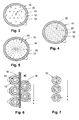
- cover 10 has a carrier material 12 with an outer side printing 14 and the printing overlapping protective lacquer layer 16.
- the carrier material 12 On the inner side of the lid, the carrier material 12 has an annular sealing layer 18 applied to the carrier material 12 by means of a printing process and within the area bounded by the sealing layer 18 a printing pattern 20 of spacer elements likewise applied to the carrier material 12 by means of a printing process concentric with each other arranged circles lying ring segments 22nd
- the annular printed image of the sealing layer 18 corresponds to an annular shoulder 36 forming an upper edge termination of a container 30 characterized by a bottom 32 and a side wall 34 projecting therefrom.
- a food or drink such as yoghurt, Jam, Dried fruit, a chocolate preparation or other dessert or with drinking water or fruit and vegetable juices
- the container 30 is covered with the lid 10, and the lid 10 is over the shoulder 36 of the container 30 resting annular seal layer 18 against the edge of the container 30th sealed.
- the lid 10 is provided with a tear tab 11 for peeling the lid 10 sealed onto the container rim and thus opening the container 30.
- the height a of the printed annular sealing layer 18 is less than the height b of the printed pattern 20 or serving as spacers ring segments 22.
- the sealing layer 18 On the side facing against the container 30 and the container inner side of the substrate 12 is in the Shoulder 36 of the container 30, the sealing layer 18 according to or approximately corresponding to the image of the annular shoulder 36 of the container 30 applied. Accordingly, the sealing layer 18 is applied to the carrier material 12 only on the lid 10 or substantially only at the points in contact with the shoulder 36. This is indicated schematically by the dotted lines. In the example shown, the sealing layer 18 has been printed annularly on the carrier material 12. It will be understood that the printed image of the sealing layer 18 may slightly deviate from the shoulder 36 of the container 30.
- the printed image of the sealing layer for example, 1 to 50% narrower than the width of the shoulder 36 of the container 30.
- the printing pattern 20 is also formed, for example, by printing a sealing lacquer.
- a sealing lacquer In the case of corrosion-sensitive cover materials, for example metal foils, it is advisable to apply a primer over the entire surface of the carrier material 12 as protection against aggressive products.
- Fig. 3 to 5 show cover 10 with various other print patterns 20.
- the individual spacer elements consist of dots 24.
- the printing pattern 20 is printed on the carrier material 12 within the annular sealing layer 18.
- the print pattern 20 can be seen in the form of a grid of individual lines or strips 26 in a parallel or radial arrangement.
- the print pattern 20 is printed on the substrate 12 within the annular seal layer 18 also in this case.
- the strength of the sealed seam can be adjusted by the choice of the sealing tool, the sealing pressure and the sealing temperature.
- the sealing seam may also be provided with marking aids, for example in the form of weaker sealed partial areas in the sealed seam or by serrated sealing seam edges.
- the printed seal layer 18 may also be a bond with an adhesive, such as a contact adhesive or a heat and / or pressure-setting adhesive applied, with the proviso that the adhesive can be processed in a printing unit and the adhesive printed on the substrate 12 can be.
- the material advantage is a material advantage, in particular in that the sealing lacquer is applied only sparsely to the places where it is actually needed.
- the primer or coupling agent is in amounts of from 0.2 to 30 g / m 2 , preferably 1 to 20 g / m 2
- the sealing wax in amounts of from 0.5 to 30 g / m 2 , preferably 1.5 to 20 g / m 2 applied. Since the primer or the sealant usually has to be incorporated in a solvent for processing in the printing press, the amount of solvent to be evaporated is reduced considerably. This is expressed both in the energy requirement and in the amount of solvent.
- the present method is furthermore advantageous because the production of the lid material requires less machine operation.
- the sealing layer 18 does not have to be applied separately as a layer or film, but can be applied in the same operation in the same press when attaching the print pattern 20 in the same operation.
- the printing pattern 20 spaces the lids 10 in a stack, and mutual adhesion of the lids 10 is effectively inhibited. This unembossed lid in the stack of covers in packaging machines are reliably machine accessible.
- the sealing layer 18 is present on the lid 10 substantially only in the region of the shoulder 36 of the container 30 to be closed, the risk is minimized that pass from the sealing layer 18 into the container contents and influence, for example, the container contents by odors or flavors.
- FIG. 6 shown section of a present in tape cover sheet 40 are the printed images for the annular sealing layer 18, viewed in the film running direction x, arranged overlapping.
- This overlapping arrangement - in the drawing, the overlapping area is shown hatched - leads to a saving of lid material, such as aluminum foil when used as a carrier material, and thus to an economically justifiable design of the costs.
- the sealing layer 18 now has the same height as the printing pattern 20 within the area bounded by the sealing layer 18, the overlap in the winding of the printed cover film 40 leads to a material structure and thus to a constant "thick spot" in the wound cover film, which for example a plastic deformation of the aluminum and as a result to a deterioration of Maschinenellkeit the lid foil leads.
- the height b of the printing pattern 20 which according to the invention is greater than the height a of the sealing layer 18, the abovementioned material structure does not occur in the overlapping area.
- Fig. 7 are on a belt-shaped cover material in the film running direction x successive print pattern 20 with respect to the preceding pattern each rotated by a certain angular amount, so that after a punching to cover 10 no identical geometries are superimposed.
- This is achieved by corresponding rotation of the print motifs in the running direction of the printing cylinder within a printing cylinder circumference. With this rotation of the print motifs, the surface pressure of the punched lid in a stack is significantly reduced and material impressions are thus avoided.
- the print motif can be carried out thereby material-saving with respect to the required sealing wax.
- the printing cylinder is manufactured so that the annular sealing layer 18 and the printing pattern 20 can be printed with the same paint but in different thicknesses.
- the printing original for the sealing layer 18 having a height of e.g. 4 microns engraved on the printing cylinder and for the printing pattern 20 with a height of e.g. Engraved 25 ⁇ m.
Landscapes
- Engineering & Computer Science (AREA)
- Mechanical Engineering (AREA)
- Laminated Bodies (AREA)
- Closures For Containers (AREA)
Priority Applications (9)
| Application Number | Priority Date | Filing Date | Title |
|---|---|---|---|
| EP08405031A EP2088092A1 (fr) | 2008-02-05 | 2008-02-05 | Couvercle et son procédé de fabrication |
| RU2010136660/12A RU2010136660A (ru) | 2008-02-05 | 2009-01-19 | Крышка и способ ее изготовления |
| MX2010008488A MX2010008488A (es) | 2008-02-05 | 2009-01-19 | Cubierta y metodo para la produccion de la misma. |
| EP09707722A EP2240387A1 (fr) | 2008-02-05 | 2009-01-19 | Couvercle et procédé de fabrication de celui-ci |
| US12/865,960 US20110000917A1 (en) | 2008-02-05 | 2009-01-19 | Cover and method for the production thereof |
| PCT/EP2009/000292 WO2009097961A1 (fr) | 2008-02-05 | 2009-01-19 | Couvercle et procédé de fabrication de celui-ci |
| CA2713953A CA2713953A1 (fr) | 2008-02-05 | 2009-01-19 | Couvercle et procede de fabrication de celui-ci |
| ARP090100360A AR070557A1 (es) | 2008-02-05 | 2009-02-04 | Tapa y procedimiento para su fabricacion |
| ZA2010/05599A ZA201005599B (en) | 2008-02-05 | 2010-08-05 | Cover and method for the production thereof |
Applications Claiming Priority (1)
| Application Number | Priority Date | Filing Date | Title |
|---|---|---|---|
| EP08405031A EP2088092A1 (fr) | 2008-02-05 | 2008-02-05 | Couvercle et son procédé de fabrication |
Publications (1)
| Publication Number | Publication Date |
|---|---|
| EP2088092A1 true EP2088092A1 (fr) | 2009-08-12 |
Family
ID=39596505
Family Applications (1)
| Application Number | Title | Priority Date | Filing Date |
|---|---|---|---|
| EP08405031A Withdrawn EP2088092A1 (fr) | 2008-02-05 | 2008-02-05 | Couvercle et son procédé de fabrication |
Country Status (1)
| Country | Link |
|---|---|
| EP (1) | EP2088092A1 (fr) |
Cited By (1)
| Publication number | Priority date | Publication date | Assignee | Title |
|---|---|---|---|---|
| WO2016086937A1 (fr) * | 2014-12-02 | 2016-06-09 | Danapak Flexibles A/S | Feuille formant couvercle, procédé de fabrication, et emballage |
Citations (7)
| Publication number | Priority date | Publication date | Assignee | Title |
|---|---|---|---|---|
| CH673827A5 (en) * | 1987-08-27 | 1990-04-12 | Alcan Rorschach Ag | Sealable beaker closure pieces - consists of lid with tear off strip and central profiled section |
| EP0847933A1 (fr) | 1996-12-11 | 1998-06-17 | Alusuisse Technology & Management AG | Matériau de couvercle |
| EP0983947A1 (fr) | 1998-09-01 | 2000-03-08 | Alusuisse Technology & Management AG | Couvercle et procédé pour sa fabrication |
| DE20112124U1 (de) * | 2001-07-21 | 2001-10-11 | Hueck Folien GmbH & Co. KG, 92712 Pirk | Behälter |
| DE20300352U1 (de) * | 2003-01-11 | 2003-03-13 | Tscheulin-Rothal GmbH, 79331 Teningen | Zentral punktförmige bedruckte Deckelelemente |
| WO2003066240A2 (fr) * | 2002-02-06 | 2003-08-14 | Degens Gmbh & Co. Kg | Opercule pour la fermeture d'un contenant et son procede de production |
| EP1340694A2 (fr) * | 2002-02-28 | 2003-09-03 | Teich Aktiengesellschaft | Opercule laminé pour gobelet ayant une surface imprimée |
-
2008
- 2008-02-05 EP EP08405031A patent/EP2088092A1/fr not_active Withdrawn
Patent Citations (7)
| Publication number | Priority date | Publication date | Assignee | Title |
|---|---|---|---|---|
| CH673827A5 (en) * | 1987-08-27 | 1990-04-12 | Alcan Rorschach Ag | Sealable beaker closure pieces - consists of lid with tear off strip and central profiled section |
| EP0847933A1 (fr) | 1996-12-11 | 1998-06-17 | Alusuisse Technology & Management AG | Matériau de couvercle |
| EP0983947A1 (fr) | 1998-09-01 | 2000-03-08 | Alusuisse Technology & Management AG | Couvercle et procédé pour sa fabrication |
| DE20112124U1 (de) * | 2001-07-21 | 2001-10-11 | Hueck Folien GmbH & Co. KG, 92712 Pirk | Behälter |
| WO2003066240A2 (fr) * | 2002-02-06 | 2003-08-14 | Degens Gmbh & Co. Kg | Opercule pour la fermeture d'un contenant et son procede de production |
| EP1340694A2 (fr) * | 2002-02-28 | 2003-09-03 | Teich Aktiengesellschaft | Opercule laminé pour gobelet ayant une surface imprimée |
| DE20300352U1 (de) * | 2003-01-11 | 2003-03-13 | Tscheulin-Rothal GmbH, 79331 Teningen | Zentral punktförmige bedruckte Deckelelemente |
Cited By (1)
| Publication number | Priority date | Publication date | Assignee | Title |
|---|---|---|---|---|
| WO2016086937A1 (fr) * | 2014-12-02 | 2016-06-09 | Danapak Flexibles A/S | Feuille formant couvercle, procédé de fabrication, et emballage |
Similar Documents
| Publication | Publication Date | Title |
|---|---|---|
| EP0983947B2 (fr) | Couvercle et procédé pour sa fabrication | |
| WO2009097961A1 (fr) | Couvercle et procédé de fabrication de celui-ci | |
| EP1010641B2 (fr) | Couvercle pour la fermeture de récipients | |
| EP2152512B1 (fr) | Matériel d'emballage | |
| EP0847933B1 (fr) | Procédé de fabrication d'un matériau de couvercle et son utilisation | |
| EP0891861B2 (fr) | Matériau pour emballage et couvercle | |
| EP1737753B1 (fr) | Couvercle avec ouverture de distribution, destine a la fermeture de recipients | |
| DE60122593T2 (de) | Hermetisch geschlossener behälter und verfahren zu seiner herstellung | |
| CH684081A5 (de) | Durchdrückpackung. | |
| EP0939037A1 (fr) | Matériau d'emballage | |
| CH683175A5 (de) | Verpackung. | |
| EP2040915B1 (fr) | Matériau composite, procédé de fabrication et utilisation dudit matériau comme matériau d'emballage | |
| EP1935805A1 (fr) | Couvercle avec impression à surface rugueuse | |
| EP2088092A1 (fr) | Couvercle et son procédé de fabrication | |
| EP2251194A1 (fr) | Couvercle de récipient | |
| EP1732754B1 (fr) | Etiquette de protection pour la production d'un récipient étanche | |
| EP2149447A1 (fr) | Procédé de fabrication d'une bande de matériau ayant une structure de surface | |
| DE202011110824U1 (de) | Folie und deren Verwendung als Deckel für Verpackungen und Behälter | |
| EP1472010A2 (fr) | Opercule pour la fermeture d'un contenant et son procede de production | |
| DE20300352U1 (de) | Zentral punktförmige bedruckte Deckelelemente | |
| WO2001074685A1 (fr) | Element de couvercle pour fermer des recipients prevus pour contenir des produits alimentaires liquides | |
| EP0221842B1 (fr) | Orifice verseur dans un couvercle d'un conteneur avec opercule arrachable et fabrication de cet orifice | |
| CH700867A2 (de) | Behälterdeckel. | |
| DE102019211476A1 (de) | Verfahren mit einbringen eines lochs in ein flächenförmiges substrat zur herstellung formstabiler nahrungsmittelbehälter mittels rotierender werkzeuge einer stanzeinrichtung | |
| EP1714906A1 (fr) | Opercule muni d'aspérités |
Legal Events
| Date | Code | Title | Description |
|---|---|---|---|
| PUAI | Public reference made under article 153(3) epc to a published international application that has entered the european phase |
Free format text: ORIGINAL CODE: 0009012 |
|
| AK | Designated contracting states |
Kind code of ref document: A1 Designated state(s): AT BE BG CH CY CZ DE DK EE ES FI FR GB GR HR HU IE IS IT LI LT LU LV MC MT NL NO PL PT RO SE SI SK TR |
|
| AX | Request for extension of the european patent |
Extension state: AL BA MK RS |
|
| AKX | Designation fees paid | ||
| RAP1 | Party data changed (applicant data changed or rights of an application transferred) |
Owner name: 3A TECHNOLOGY & MANAGEMENT AG |
|
| STAA | Information on the status of an ep patent application or granted ep patent |
Free format text: STATUS: THE APPLICATION IS DEEMED TO BE WITHDRAWN |
|
| REG | Reference to a national code |
Ref country code: DE Ref legal event code: 8566 |
|
| 18D | Application deemed to be withdrawn |
Effective date: 20100213 |