EP2088151A1 - Complexe de l'or, procédé pour la production du complexe de l'or et élément électroluminescent ultraviolet organique utilisant le complexe de l'or - Google Patents
Complexe de l'or, procédé pour la production du complexe de l'or et élément électroluminescent ultraviolet organique utilisant le complexe de l'or Download PDFInfo
- Publication number
- EP2088151A1 EP2088151A1 EP07830318A EP07830318A EP2088151A1 EP 2088151 A1 EP2088151 A1 EP 2088151A1 EP 07830318 A EP07830318 A EP 07830318A EP 07830318 A EP07830318 A EP 07830318A EP 2088151 A1 EP2088151 A1 EP 2088151A1
- Authority
- EP
- European Patent Office
- Prior art keywords
- group
- carbon atoms
- atom
- gold complex
- complex according
- Prior art date
- Legal status (The legal status is an assumption and is not a legal conclusion. Google has not performed a legal analysis and makes no representation as to the accuracy of the status listed.)
- Withdrawn
Links
Images
Classifications
-
- C—CHEMISTRY; METALLURGY
- C07—ORGANIC CHEMISTRY
- C07F—ACYCLIC, CARBOCYCLIC OR HETEROCYCLIC COMPOUNDS CONTAINING ELEMENTS OTHER THAN CARBON, HYDROGEN, HALOGEN, OXYGEN, NITROGEN, SULFUR, SELENIUM OR TELLURIUM
- C07F1/00—Compounds containing elements of Groups 1 or 11 of the Periodic Table
-
- C—CHEMISTRY; METALLURGY
- C07—ORGANIC CHEMISTRY
- C07F—ACYCLIC, CARBOCYCLIC OR HETEROCYCLIC COMPOUNDS CONTAINING ELEMENTS OTHER THAN CARBON, HYDROGEN, HALOGEN, OXYGEN, NITROGEN, SULFUR, SELENIUM OR TELLURIUM
- C07F1/00—Compounds containing elements of Groups 1 or 11 of the Periodic Table
- C07F1/12—Gold compounds
-
- C—CHEMISTRY; METALLURGY
- C09—DYES; PAINTS; POLISHES; NATURAL RESINS; ADHESIVES; COMPOSITIONS NOT OTHERWISE PROVIDED FOR; APPLICATIONS OF MATERIALS NOT OTHERWISE PROVIDED FOR
- C09K—MATERIALS FOR MISCELLANEOUS APPLICATIONS, NOT PROVIDED FOR ELSEWHERE
- C09K11/00—Luminescent materials, e.g. electroluminescent or chemiluminescent
- C09K11/06—Luminescent materials, e.g. electroluminescent or chemiluminescent containing organic luminescent materials
-
- H—ELECTRICITY
- H10—SEMICONDUCTOR DEVICES; ELECTRIC SOLID-STATE DEVICES NOT OTHERWISE PROVIDED FOR
- H10K—ORGANIC ELECTRIC SOLID-STATE DEVICES
- H10K50/00—Organic light-emitting devices
-
- H—ELECTRICITY
- H10—SEMICONDUCTOR DEVICES; ELECTRIC SOLID-STATE DEVICES NOT OTHERWISE PROVIDED FOR
- H10K—ORGANIC ELECTRIC SOLID-STATE DEVICES
- H10K85/00—Organic materials used in the body or electrodes of devices covered by this subclass
- H10K85/30—Coordination compounds
- H10K85/341—Transition metal complexes, e.g. Ru(II)polypyridine complexes
-
- C—CHEMISTRY; METALLURGY
- C09—DYES; PAINTS; POLISHES; NATURAL RESINS; ADHESIVES; COMPOSITIONS NOT OTHERWISE PROVIDED FOR; APPLICATIONS OF MATERIALS NOT OTHERWISE PROVIDED FOR
- C09K—MATERIALS FOR MISCELLANEOUS APPLICATIONS, NOT PROVIDED FOR ELSEWHERE
- C09K2211/00—Chemical nature of organic luminescent or tenebrescent compounds
- C09K2211/10—Non-macromolecular compounds
- C09K2211/1003—Carbocyclic compounds
- C09K2211/1007—Non-condensed systems
-
- C—CHEMISTRY; METALLURGY
- C09—DYES; PAINTS; POLISHES; NATURAL RESINS; ADHESIVES; COMPOSITIONS NOT OTHERWISE PROVIDED FOR; APPLICATIONS OF MATERIALS NOT OTHERWISE PROVIDED FOR
- C09K—MATERIALS FOR MISCELLANEOUS APPLICATIONS, NOT PROVIDED FOR ELSEWHERE
- C09K2211/00—Chemical nature of organic luminescent or tenebrescent compounds
- C09K2211/10—Non-macromolecular compounds
- C09K2211/1018—Heterocyclic compounds
- C09K2211/1025—Heterocyclic compounds characterised by ligands
- C09K2211/1044—Heterocyclic compounds characterised by ligands containing two nitrogen atoms as heteroatoms
-
- C—CHEMISTRY; METALLURGY
- C09—DYES; PAINTS; POLISHES; NATURAL RESINS; ADHESIVES; COMPOSITIONS NOT OTHERWISE PROVIDED FOR; APPLICATIONS OF MATERIALS NOT OTHERWISE PROVIDED FOR
- C09K—MATERIALS FOR MISCELLANEOUS APPLICATIONS, NOT PROVIDED FOR ELSEWHERE
- C09K2211/00—Chemical nature of organic luminescent or tenebrescent compounds
- C09K2211/18—Metal complexes
- C09K2211/188—Metal complexes of other metals not provided for in one of the previous groups
-
- H—ELECTRICITY
- H10—SEMICONDUCTOR DEVICES; ELECTRIC SOLID-STATE DEVICES NOT OTHERWISE PROVIDED FOR
- H10K—ORGANIC ELECTRIC SOLID-STATE DEVICES
- H10K2101/00—Properties of the organic materials covered by group H10K85/00
- H10K2101/10—Triplet emission
-
- H—ELECTRICITY
- H10—SEMICONDUCTOR DEVICES; ELECTRIC SOLID-STATE DEVICES NOT OTHERWISE PROVIDED FOR
- H10K—ORGANIC ELECTRIC SOLID-STATE DEVICES
- H10K50/00—Organic light-emitting devices
- H10K50/10—OLEDs or polymer light-emitting diodes [PLED]
- H10K50/11—OLEDs or polymer light-emitting diodes [PLED] characterised by the electroluminescent [EL] layers
-
- H—ELECTRICITY
- H10—SEMICONDUCTOR DEVICES; ELECTRIC SOLID-STATE DEVICES NOT OTHERWISE PROVIDED FOR
- H10K—ORGANIC ELECTRIC SOLID-STATE DEVICES
- H10K50/00—Organic light-emitting devices
- H10K50/10—OLEDs or polymer light-emitting diodes [PLED]
- H10K50/11—OLEDs or polymer light-emitting diodes [PLED] characterised by the electroluminescent [EL] layers
- H10K50/125—OLEDs or polymer light-emitting diodes [PLED] characterised by the electroluminescent [EL] layers specially adapted for multicolour light emission, e.g. for emitting white light
-
- H—ELECTRICITY
- H10—SEMICONDUCTOR DEVICES; ELECTRIC SOLID-STATE DEVICES NOT OTHERWISE PROVIDED FOR
- H10K—ORGANIC ELECTRIC SOLID-STATE DEVICES
- H10K85/00—Organic materials used in the body or electrodes of devices covered by this subclass
- H10K85/10—Organic polymers or oligomers
- H10K85/111—Organic polymers or oligomers comprising aromatic, heteroaromatic, or aryl chains, e.g. polyaniline, polyphenylene or polyphenylene vinylene
- H10K85/113—Heteroaromatic compounds comprising sulfur or selene, e.g. polythiophene
- H10K85/1135—Polyethylene dioxythiophene [PEDOT]; Derivatives thereof
-
- H—ELECTRICITY
- H10—SEMICONDUCTOR DEVICES; ELECTRIC SOLID-STATE DEVICES NOT OTHERWISE PROVIDED FOR
- H10K—ORGANIC ELECTRIC SOLID-STATE DEVICES
- H10K85/00—Organic materials used in the body or electrodes of devices covered by this subclass
- H10K85/10—Organic polymers or oligomers
- H10K85/141—Organic polymers or oligomers comprising aliphatic or olefinic chains, e.g. poly N-vinylcarbazol, PVC or PTFE
-
- H—ELECTRICITY
- H10—SEMICONDUCTOR DEVICES; ELECTRIC SOLID-STATE DEVICES NOT OTHERWISE PROVIDED FOR
- H10K—ORGANIC ELECTRIC SOLID-STATE DEVICES
- H10K85/00—Organic materials used in the body or electrodes of devices covered by this subclass
- H10K85/30—Coordination compounds
- H10K85/371—Metal complexes comprising a group IB metal element, e.g. comprising copper, gold or silver
Definitions
- the present invention relates to a novel gold complex which is useful as a luminescent material, etc. for an organic ultraviolet electroluminescent device (organic ultraviolet electroluminescent device), etc. and a process for preparing the same, and an organic ultraviolet electroluminescent device using said gold complex.
- An ultraviolet luminescent element is expected to be used for various uses, for example, an irradiation light source for a resin-curing analysis or a marker for medical use, an excitation light source of a photocatalyst, or a constitutional part for realizing a white color LED.
- an ultraviolet luminescent device which emits light of a short wavelength region at an ultraviolet region
- inorganic nitride semiconductors such as GaN (gallium nitride), InGaN (indium gallium nitride), AlGaN (aluminum gallium nitride), etc., have been used, but those using an organic material have not yet been known.
- an organic EL device organic electroluminescent device
- a fluorescent material which utilizes light-emission from a singlet excitation of a light-emission molecule has mainly been used, and for the purpose of accomplishing higher efficiency, lots of research and development of a phosphorescence luminescent material which utilizes light-emission from a triplet excitation have been carried out.
- Non-Patent Literature 1 As a phosphorescence luminescent material which emits light at an ultraviolet region, for example, only one example of an iridium complex has been reported (for example, see Non-Patent Literature 1). There is disclosed a synthetic method for preparing the same only with an extremely low yield, so that it can be considered to be difficultly applied to an industrial purpose. On the other hand, with regard to a gold complex, it has been known that it emits light at a blue color region (for example, see Patent Literature 1), but it has not been reported about light emission at an ultraviolet region. A practically applicable organic ultraviolet luminescent material has a merit that it is easy in manufacturing a device as compared with an "RGB pixelization" which is a system of the conventional organic EL full color device.
- color conversion matrix method which is superior in light emitting efficiency and color reproducibility to another system of "white color filtration method"
- a higher efficiency is expected to be accomplished by replacing an organic blue color luminescent material which is an excitation light source with an ultraviolet luminescent material having a higher energy, whereby it is to be a most suitable colorization method for realizing a larger-sized organic EL television in the future.
- the present invention is to provide a novel gold complex (having phosphorescence emission at an ultraviolet region of 400 nm or less, and having a high melting point of 200°C or higher which can endure joule heat generating at the time of applying a voltage after preparation of a device) which is useful for a luminescent material to be used for an organic ultraviolet electric field luminescent device (organic ultraviolet electroluminescent device), etc., and a process for preparing the same, and an organic ultraviolet electroluminescent device using said gold complex.
- L represents a nitrogen-containing heterocyclic carbene ligand
- X represents an alkyl group, cycloalkyl group, alkoxycarbonyl group, aryloxycarbonyl group, alkylaminocarbonyl group, arylaminocarbonyl group, arylalkylaminocarbonyl group, alkylmercaptocarbonyl group, arylmercaptocarbonyl group, alkylsulfonyl group, or arylsulfonyl group, provided that one or a plural number of hydrogen atoms on the carbon atom(s) of X may be substituted by a halogen atom, alkyl group, cycloalkyl group, aryl group, aralkyl group, alkoxy group, aryloxy group, arylmercapto group, arylmercapto group or substituted amino group.
- a process for preparing the above-mentioned gold complex which comprises reacting a substituted ethynylgold-phosphine complex and a nitrogen-containing heterocyclic carbene ligand.
- an organic electroluminescent device which comprises an organic electroluminescent device in which a light emitting layer or a plural number of organic compound-thin layers containing a light emitting layer is/are provided between a pair of electrodes, and at least one layer of the organic compound-thin layers contains the above-mentioned gold complex.
- a novel gold complex useful as a luminescent material for an organic ultraviolet electroluminescent device, etc. and a process for preparing the same, and an organic ultraviolet electroluminescent device using said gold complex.
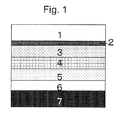
- Fig. 1 is a diagrammatic view of an electroluminescent device described in Example 8, and in the figure, reference numeral 1 designates a glass substrate, 2 designates an ITO film (positive electrode), 3 designates a hole transport layer, 4 designates a light emitting layer, 5 designates a hole block layer, 6 designates an Al electrode and 7 designates an electron transport layer.
- reference numeral 1 designates a glass substrate
- 2 designates an ITO film (positive electrode)
- 3 designates a hole transport layer
- 4 designates a light emitting layer
- 5 designates a hole block layer
- 6 designates an Al electrode
- 7 designates an electron transport layer.
- L represents a nitrogen-containing heterocyclic carbene ligand
- X represents an alkyl group, cycloalkyl group, alkoxycarbonyl group, aryloxycarbonyl group, alkylaminocarbonyl group, arylaminocarbonyl group, arylalkylaminocarbonyl group, alkylmercaptocarbonyl group, arylmercaptocarbonyl group, alkylsulfonyl group or arylsulfonyl group.
- an alkyl group having 1 to 10 carbon atoms is preferred, and there may be mentioned, for example, a methyl group, ethyl group, propyl group, butyl group, pentyl group, hexyl group, heptyl group, octyl group, nonyl group, decyl group, etc.
- substituents also include its isomers such as an isopropyl group, isobutyl group, tert-butyl group, etc.
- a cycloalkyl group having 3 to 12 carbon atoms is preferred, and there may be mentioned, for example, a cyclopropyl group, cyclobutyl group, cyclopentyl group, cyclohexyl group, cycloheptyl group, cyclooctyl group, cyclononyl group, cyclodecyl group, cycloundecyl group, cyclododecyl group, etc.
- alkoxycarbonyl group an alkoxycarbonyl group having 2 to 10 carbon atoms is preferred, and there may be mentioned, for example, a methoxycarbonyl group, ethoxycarbonyl group, propoxycarbonyl group, butoxycarbonyl group, pentoxycarbonyl group, isopropoxycarbonyl group, isobutoxycarbonyl group, tert-butoxycarbonyl group, etc.
- an aryloxycarbonyl group having 7 to 11 carbon atoms is preferred, and there may be mentioned, for example, a phenoxycarbonyl group, tolyloxycarbonyl group, naphthyloxycarbonyl group, etc.
- alkylaminocarbonyl group an alkylaminocarbonyl group having 2 to 10 carbon atoms is preferred, and there may be mentioned, for example, a dimethylaminocarbonyl group, diethylaminocarbonyl group, dipropylaminocarbonyl group, etc.
- an arylaminocarbonyl group having 7 to 18 carbon atoms is preferred, and there may be mentioned, for example, a phenylaminocarbonyl group, diphenylaminocarbonyl group, ditolylaminocarbonyl group, naphthylaminocarbonyl group, etc.
- an arylalkylaminocarbonyl group having 8 to 18 carbon atoms is preferred, and there may be mentioned, for example, a phenylmethylaminocarbonyl group, phenylethylaminocarbonyl group, tolylmethylaminocarbonyl group, tolylethylaminocarbonyl group, naphthylmethylaminocarbonyl group, naphthylethylaminocarbonyl group, etc.
- alkylmercaptocarbonyl group an alkylmercaptocarbonyl group having 2 to 18 carbon atoms is preferred, and there may be mentioned, for example, a methylmercaptocarbonyl group, ethylmercaptocarbonyl group, propylmercaptocarbonyl group, etc.
- an arylmercaptocarbonyl group having 7 to 18 carbon atoms is preferred, and there may be mentioned, for example, a phenylmercaptocarbonyl group, tolylmercaptocarbonyl group, naphthylmercaptocarbonyl group, etc.
- alkylsulfonyl group an alkylsulfonyl group having 1 to 12 carbon atoms is preferred, and there may be mentioned, for example, a methylsulfonyl group, ethylsulfonyl group, propylsulfonyl group, etc.
- an arylsulfonyl group having 6 to 18 carbon atoms is preferred, and there may be mentioned, for example, a phenylsulfonyl group, tolylsulfonyl group, naphthylsulfonyl group, etc.
- One or a plural number of hydrogen atoms on the carbon atom(s) of X may be substituted by a halogen atom, alkyl group, cycloalkyl group, alkenyl group, aryl group, aralkyl group, alkoxy group, aryloxy group, arylmercapto group, arylmercapto group or substituted amino group.
- halogen atom there may be mentioned a fluorine atom, chlorine atom, bromine atom and iodine atom.
- an alkyl group having 1 to 20 carbon atoms, particularly 1 to 12 carbon atoms is preferred, and there may be mentioned, for example, a methyl group, ethyl group, propyl group, butyl group, pentyl group, hexyl group, heptyl group, octyl group, nonyl group, decyl group, undecyl group, dodecyl group, etc.
- substituents also include their isomers.
- a cycloalkyl group having 3 to 7 carbon atoms is particularly preferred, and there may be mentioned, for example, a cyclopropyl group, cyclobutyl group, cyclopentyl group, cyclohexyl group, cycloheptyl group, etc.
- alkenyl group an alkenyl group having 2 to 20 carbon atoms, particularly 2 to 12 carbon atoms is preferred, and there may be mentioned, for example, a vinyl group, propenyl group, butenyl group, pentenyl group, hexenyl group, heptenyl group, octenyl group, nonenyl group, decenyl group, undecenyl group, dodecenyl group, etc. These substituents also include their isomers.
- an aryl group having 6 to 20 carbon atoms, particularly 6 to 16 carbon atoms is preferred, and there may be mentioned, for example, a phenyl group, tolyl group, xylyl group, naphthyl group, dimethylnaphthyl group, anthryl group, phenanthryl group, fluorenyl group, pyrenyl group, etc.
- substituents also include their isomers.
- an aralkyl group having 7 to 20 carbon atoms is preferred, and there may be mentioned, for example, a benzyl group, naphthylmethyl group, indenylmethyl group, biphenylmethyl group, etc.
- an alkoxy group having 1 to 10 carbon atoms is particularly preferred, and there may be mentioned, for example, a methoxy group, ethoxy group, propoxy group, butoxy group, pentanoxy group, hexanoxy group, heptanoxy group, octanoxy group, nonanoxy group, decanoxy group, etc.
- substituents also include their isomers.
- an aryloxy group having 6 to 14 carbon atoms is particularly preferred, and there may be mentioned, for example, a phenoxy group, tolyloxy group, xylyloxy group, naphthoxy group, etc. These substituents also include their isomers.
- alkylmercapto group an alkylmercapto group having 1 to 6 carbon atoms is preferred, and there may be mentioned, for example, a methylmercapto group, ethylmercapto group, propylmercapto group, butylmercapto group, pentylmercapto group and hexylmercapto group. These substituents also include their isomers.
- an arylmercapto group having 6 to 14 carbon atoms is preferred, and there may be mentioned, for example, a phenylmercapto group, tolylmercapto group, xylylmercapto group, naphthylmercapto group, etc. These substituents also include their isomers.
- a substituted amino group having 1 to 14 carbon atoms is preferred and there may be mentioned, for example, a methylamino group, ethylamino group, propylamino group, butylamino group, dimethylamino group, diethylamino group, dipropylamino group, phenylamino group, tolylamino group, xylylamino group, naphthylamino group, phenylmethylamino group, phenylethylamino group, diphenylamino group, ditolylamino group, dixylylamino group, etc.
- substituents also include their isomers.
- a cyclopentene ring As a ring which is formed by the above-mentioned adjacent groups to be bonded, there may be mentioned, for example, a cyclopentene ring, cyclohexene ring, cycloheptene ring, benzene ring, naphthalene ring, tetrahydrofuran ring, benzopyrane ring, N-methylpyrrolidine ring, N-methylpiperidine ring, etc.
- At least one gold complex selected from the following (1) to (10) is preferred.
- a gold complex in which X is selected from an alkyl group having 1 to 10 carbon atoms and a cycloalkyl group having 3 to 12 carbon atoms, and one or a plural number of hydrogen atoms on the carbon atom(s) of X may be substituted by a fluorine atom, chlorine atom, bromine atom, iodine atom, alkyl group having 1 to 20 carbon atoms, cycloalkyl group having 3 to 7 carbon atoms, alkenyl group having 2 to 20 carbon atoms, aryl group having 6 to 20 carbon atoms, aralkyl group having 7 to 20 carbon atoms, alkoxy group having 1 to 10 carbon atoms, aryloxy group having 6 to 14 carbon atoms, alkylmercapto group having 1 to 6 carbon atoms, arylmercapto group having 6 to 14 carbon atoms or substituted amino group having 1 to 14
- a gold complex in which X is selected from an alkoxycarbonyl group having 2 to 10 carbon atoms, and one or a plural number of hydrogen atoms on the carbon atom(s) of X may be substituted by a fluorine atom, chlorine atom, bromine atom, iodine atom, alkyl group having 1 to 20 carbon atoms, cycloalkyl group having 3 to 7 carbon atoms, alkenyl group having 2 to 20 carbon atoms, aryl group having 6 to 20 carbon atoms, aralkyl group having 7 to 20 carbon atoms, alkoxy group having 1 to 10 carbon atoms, aryloxy group having 6 to 14 carbon atoms, alkylmercapto group having 1 to 6 carbon atoms, arylmercapto group having 6 to 14 carbon atoms or substituted amino group having 1 to 14 carbon atoms.
- a gold complex in which X is selected from an aryloxylcarbonyl group having 7 to 11 carbon atoms, and one or a plural number of hydrogen atoms on the carbon atom(s) of X may be substituted by a fluorine atom, chlorine atom, bromine atom, iodine atom, alkyl group having 1 to 20 carbon atoms, cycloalkyl group having 3 to 7 carbon atoms, alkenyl group having 2 to 20 carbon atoms, aryl group having 6 to 20 carbon atoms, aralkyl group having 7 to 20 carbon atoms, alkoxy group having 1 to 10 carbon atoms, aryloxy group having 6 to 14 carbon atoms, alkylmercapto group having 1 to 6 carbon atoms, arylmercapto group having 6 to 14 carbon atoms or substituted amino group having 1 to 14 carbon atoms.
- a gold complex in which X is selected from an alkylaminocarbonyl group having 2 to 10 carbon atoms, and one or a plural number of hydrogen atoms on the carbon atom(s) of X may be substituted by a fluorine atom, chlorine atom, bromine atom, iodine atom, alkyl group having 1 to 20 carbon atoms, cycloalkyl group having 3 to 7 carbon atoms, alkenyl group having 2 to 20 carbon atoms, aryl group having 6 to 20 carbon atoms, aralkyl group having 7 to 20 carbon atoms, alkoxy group having 1 to 10 carbon atoms, aryloxy group having 6 to 14 carbon atoms, alkylmercapto group having 1 to 6 carbon atoms, arylmercapto group having 6 to 14 carbon atoms or substituted amino group having 1 to 14 carbon atoms.
- a gold complex in which X is selected from an arylaminocarbonyl group having 7 to 18 carbon atoms, and one or a plural number of hydrogen atoms on the carbon atom(s) of X may be substituted by a fluorine atom, chlorine atom, bromine atom, iodine atom, alkyl group having 1 to 20 carbon atoms, cycloalkyl group having 3 to 7 carbon atoms, alkenyl group having 2 to 20 carbon atoms, aryl group having 6 to 20 carbon atoms, aralkyl group having 7 to 20 carbon atoms, alkoxy group having 1 to 10 carbon atoms, aryloxy group having 6 to 14 carbon atoms, alkylmercapto group having 1 to 6 carbon atoms, arylmercapto group having 6 to 14 carbon atoms or substituted amino group having 1 to 14 carbon atoms.
- a gold complex in which X is selected from an arylalkylaminocarbonyl group having 8 to 18 carbon atoms, and one or a plural number of hydrogen atoms on the carbon atom(s) of X may be substituted by a fluorine atom, chlorine atom, bromine atom, iodine atom, alkyl group having 1 to 20 carbon atoms, cycloalkyl group having 3 to 7 carbon atoms, alkenyl group having 2 to 20 carbon atoms, aryl group having 6 to 20 carbon atoms, aralkyl group having 7 to 20 carbon atoms, alkoxy group having 1 to 10 carbon atoms, aryloxy group having 6 to 14 carbon atoms, alkylmercapto group having 1 to 6 carbon atoms, arylmercapto group having 6 to 14 carbon atoms or substituted amino group having 1 to 14 carbon atoms.
- a gold complex in which X is selected from an alkylmercaptocarbonyl group having 2 to 18 carbon atoms, and one or a plural number of hydrogen atoms on the carbon atom(s) of X may be substituted by a fluorine atom, chlorine atom, bromine atom, iodine atom, alkyl group having 1 to 20 carbon atoms, cycloalkyl group having 3 to 7 carbon atoms, alkenyl group having 2 to 20 carbon atoms, aryl group having 6 to 20 carbon atoms, aralkyl group having 7 to 20 carbon atoms, alkoxy group having 1 to 10 carbon atoms, aryloxy group having 6 to 14 carbon atoms, alkylmercapto group having 1 to 6 carbon atoms, arylmercapto group having 6 to 14 carbon atoms or substituted amino group having 1 to 14 carbon atoms.
- a gold complex in which X is selected from an arylmercaptocarbonyl group having 7 to 18 carbon atoms, and one or a plural number of hydrogen atoms on the carbon atom(s) of X may be substituted by a fluorine atom, chlorine atom, bromine atom, iodine atom, alkyl group having 1 to 20 carbon atoms, cycloalkyl group having 3 to 7 carbon atoms, alkenyl group having 2 to 20 carbon atoms, aryl group having 6 to 20 carbon atoms, aralkyl group having 7 to 20 carbon atoms, alkoxy group having 1 to 10 carbon atoms, aryloxy group having 6 to 14 carbon atoms, alkylmercapto group having 1 to 6 carbon atoms, arylmercapto group having 6 to 14 carbon atoms or substituted amino group having 1 to 14 carbon atoms.
- a gold complex in which X is selected from an alkylsulfonyl group having 1 to 12 carbon atoms, and one or a plural number of hydrogen atoms on the carbon atom(s) of X may be substituted by a fluorine atom, chlorine atom, bromine atom, iodine atom, alkyl group having 1 to 20 carbon atoms, cycloalkyl group having 3 to 7 carbon atoms, alkenyl group having 2 to 20 carbon atoms, aryl group having 6 to 20 carbon atoms, aralkyl group having 7 to 20 carbon atoms, alkoxy group having 1 to 10 carbon atoms, aryloxy group having 6 to 14 carbon atoms, alkylmercapto group having 1 to 6 carbon atoms, arylmercapto group having 6 to 14 carbon atoms or substituted amino group having 1 to 14 carbon atoms.
- a gold complex in which X is selected from an arylsulfonyl group having 6 to 18 carbon atoms, and one or a plural number of hydrogen atoms on the carbon atom(s) of X may be substituted by a fluorine atom, chlorine atom, bromine atom, iodine atom, alkyl group having 1 to 20 carbon atoms, cycloalkyl group having 3 to 7 carbon atoms, alkenyl group having 2 to 20 carbon atoms, aryl group having 6 to 20 carbon atoms, aralkyl group having 7 to 20 carbon atoms, alkoxy group having 1 to 10 carbon atoms, aryloxy group having 6 to 14 carbon atoms, alkylmercapto group having 1 to 6 carbon atoms, arylmercapto group having 6 to 14 carbon atoms or substituted amino group having 1 to 14 carbon atoms.
- nitrogen-containing heterocyclic carbene ligand is represented by the formula (2) or (3):
- R 1 and R 2 may be the same or different from each other, and each represent an alkyl group, cycloalkyl group, polycycloalkyl group or aryl group
- R 3 , R 4 , R 5 and R 6 may be the same or different from each other, and each represent a hydrogen atom, halogen atom, alkyl group, alkenyl group, aryl group, aralkyl group, alkoxy group, aryloxy group, nitro group, cyano group or dialkylamino group, and adjacent groups may be bonded together to form a ring; provided that an optional hydrogen atom(s) of R 1 to R 6 may be substituted by a halogen atom, alkyl group, cycloalkyl group, alkenyl group, aryl group, aralkyl group, alkoxy group or aryloxy group.
- R 1 and R 2 each represent an alkyl group, cycloalkyl group, polycycloalkyl group or aryl group, and the alkyl group, cycloalkyl group and aryl group have the same meanings as those defined in the alkyl group, cycloalkyl group and aryl group which is/are to substitute one or a plural number of hydrogen atom(s) on the carbon atom(s) of the above-mentioned X.
- a polycycloalkyl group having 6 to 10 carbon atoms is preferred, and there may be mentioned a bicyclo-[2.1.1]-hexyl group, bicyclo-[2.2.1]-heptyl group, bicyclo-[2.2.2]-octyl group, bicyclo-[3.3.0]-octyl group, bicyclo-[4.3.0]-nonyl group, bicyclo-[4.4.0]-octyl group, adamantyl group, etc.
- R 3 , R 4 , R 5 and R 6 each represent a hydrogen atom, halogen atom, alkyl group, alkenyl group, aryl group, aralkyl group, alkoxy group, aryloxy group, nitro group, cyano group or dialkylamino group, and the alkyl group, alkenyl group, aryl group, aralkyl group, alkoxy group, aryloxy group or dialkylamino group have the same meanings as those defined in the substituent(s) which is/are to substitute one or a plural number of hydrogen atom(s) on the carbon atom(s) of the above-mentioned X.
- R 1 and R 2 each represent an alkyl group having 1 to 20 carbon atoms, cycloalkyl group having 3 to 7 carbon atoms, polycycloalkyl group having 6 to 10 carbon atoms or aryl group having 6 to 20 carbon atoms
- R 3 , R 4 , R 5 and R 6 each represent a hydrogen atom, halogen atom, alkyl group having 1 to 20 carbon atoms, alkenyl group having 2 to 20 carbon atoms, aryl group having 6 to 20 carbon atoms, aralkyl group having 7 to 20 carbon atoms, alkoxy group having 1 to 10 carbon atoms, aryloxy group having 6 to 14 carbon atoms, nitro group, cyano group or dialkylamino group having 2 to 10 carbon atoms.
- R 1 , R 2 , R 3 , R 4 , R 5 and R 6 may be substituted by a halogen atom, alkyl group, cycloalkyl group, alkenyl group, aryl group, aralkyl group, alkoxy group or aryloxy group, and these groups have the same meanings as those defined in the substituent(s) which is/are to substitute one or a plural number of hydrogen atom(s) on the carbon atom(s) of the above-mentioned X.
- R 1 and R 2 a tert-butyl group, 2,6-diisopropylphenyl group, 2,4,6-trimethylphenyl group or adamantyl group is preferred, and as R 3 , R 4 , R 5 and R 6 , a hydrogen atom or halogen atom, particularly a chlorine atom is preferred.
- N-containing heterocyclic carbene ligand (L) in the present invention may be mentioned a ligand, for example, represented by the formula (4) to (13):
- the gold complex represented by the formula (1) of the present invention can be obtained, for example, by a reaction scheme (1):
- X and L have the same meanings as defined above, and P represents a monodentate phosphine ligand, in which a substituted ethynylgold-phosphine complex and a nitrogen-containing heterocyclic carbene ligand (L) are reacted (This reaction proceeds with yield of substantially 80% or higher).
- monodentate phosphine ligand there may be mentioned, for example, bis(pentafluorophenyl)phenylphosphine, (4-bromophenyl)-diphenylphosphine, diallylphenylphosphine, dicyclohexylphenylphosphine, diethylphenylphosphine, 4-(dimethylamino)phenyldiphenylphosphine, dimethylphenylphosphine, diphenyl(2-methoxyphenyl)phosphine, diphenyl(pentafluorophenyl)-phosphine, diphenylpropylphosphine, diphenyl-2-pyridylphosphine, diphenyl(p-tolyl)phosphine, diphenylvinylphosphine, ethyldiphenylphosphine, isopropyldipheny
- X and P have the same meanings as defined above, and Y represents a halogen atom, in which a gold-halogenophosphine complex and a substituted phenylethyne are reacted (for example, see Journal of Chemical Society, Dalton Trans., 1986, 411 .).
- This reaction proceeds with yield of about 90% or higher. Accordingly, in the reaction of the present invention, the reaction proceeds with high yield of about 70% or higher with the two steps to provide a desired gold complex.
- the above-mentioned gold-halogenophosphine complex can be synthesized by a method conventionally known in the art (for example, see Lecture on Experimental Chemistry, 4th edition, published by MARUZEN Co., Ltd., p. 455, vol. 18 (1991 )).
- nitrogen-containing heterocyclic carbene ligand a commercially available product may be used as such, or, for example, that synthesized according to the conventionally known method may be used (for example, see J. Am. Chem. Soc., 114, 5530 (1992 ) and WO 98/27064 A ).
- X has the same meaning as defined above, a commercially available product may be used, or it may be synthesized by the conventionally known substituted ethyne synthesis method (for example, see Comprehensive Organic Transformation VCH Publishers, Inc. p.283, (1989 )).
- an amount of the nitrogen-containing heterocyclic carbene ligand to be used is preferably 1 to 3 mol, more preferably 1 to 1.5 mol based on 1 mol of the substituted ethynylgold-plosphine complex.
- the solvent to be used for the synthesis of the gold complex according to the present invention is not specifically limited so long as it does not interfere the reaction, and there may be used, for example, an ether such as tetrahydrofuran, furan, dioxane, tetrahydropyrane, diethyl ether, diisopropyl ether, dibutyl ether, etc., an aliphatic hydrocarbon such as pentane, hexane, heptane, octane, etc.; an aromatic hydrocarbon such as benzene, toluene, xylene, etc.; a halogenated aliphatic hydrocarbon such as dichloromethane, dichloroethane, dichloropropane, etc.; a halogenated aromatic hydrocarbon such as chlorobenzene, etc.
- solvents may be used singly or in combination of two or more kinds in admixture.
- An amount of the above-mentioned solvent to be used may be optionally adjusted depending on a degree of uniformity or condition of stirring of the reaction mixture, and it is preferably 1 to 30L, more preferably 5 to 20L based on 1 mol of the substituted ethynylgold-phosphine complex.
- Synthesis of the gold complex of the present invention can be carried out, for example, by a method in which the substituted ethynylgold-phosphine complex, the nitrogen-containing heterocyclic carbene ligand (which is formed by a reaction of a nitrogen-containing heterocyclic hydrohalide and a base) and a solvent are mixed, and reacted while stirring, etc.
- a reaction temperature at that time is preferably 0 to 120°C, more preferably 20 to 100°C, and a reaction pressure is not specifically limited.
- the gold complex of the present invention can be isolated and formed after completion of the reaction by the conventionally known method, for example, neutralization, extraction, filtration, concentration, distillation, recrystallization, sublimation, chromatography, etc.
- the gold complex of the present invention showed phosphorescence emission in an ultraviolet region with an emission maximum wavelength of 360 to 380 nm and CIE color coordinates of (0.162, 0.060) to (0.176, 0.116) in chloroform at a temperature of 77K (Kelvin) under ultraviolet ray irradiation. According to this fact, it is suggested that said gold complex can be suitable used as a luminescent material for an organic ultraviolet luminescent device and an electroluminescent device.
- a melting point of the gold complex of the present invention is 200°C or higher, so that it is suggested that it can be suitably used as an organic electroluminescent device.
- ultraviolet EL device organic ultraviolet electroluminescent device
- the ultraviolet EL device of the present invention contains said gold complex in at least one layer of the organic compound-thin layers, and the ultraviolet EL device is an ultraviolet EL device preferably having a single layer or a plural number of layers of the organic compound layer(s) between a pair of electrodes.
- the organic compound layer means a light emitting layer, an electron injection layer or a hole transport layer.
- the ultraviolet EL device of a single layer type has a light emitting layer between an anode and a cathode.
- the light emitting layer contains a luminescent material, and may further contain a hole injection material or an electron injection material for transporting holes injected from the anode or electrons injected from the cathode to the luminescent material.
- Examples of the organic ultraviolet EL device of a multilayer type may include, for example, those having a multilayer stacked structure such as (anode/hole injection layer/light emitting layer/cathode), (anode/light emitting layer/electron injection layer/cathode) or (anode/hole injection layer/light emitting layer/electron injection layer/cathode), etc.
- the light emitting layer may contain, in addition to the gold complex represented by the formula (I), for example, at least one material selected from the group consisting of conventionally known organic light emitting device materials (for example, phthalocyanine derivatives, naphthalocyanine derivatives, porphyrin derivatives, oxazole, oxadiazole, triazole, imidazole, imidazolone, imidazolethione, pyrazoline, pyrazolone, tetrahydroimidazole, oxazole, oxadiazole, hydrazone, acylhydrazone, polyarylalkane, stilbene, butadiene, benzidine type triphenylamine, styrylamine type triphenylamine, diamine type triphenylamine, etc., and a derivative thereof, and polyvinylcarbazole, polysilane, polystyrene, polyvinylnaphthalene, conductive polymer, fluorenone, an
- An amount of said gold complex to be added to the organic compound layer is 0.005 to 1 g, more preferably 0.01 g to 0.20 g based on 1 g of the organic compound layer.
- the luminescent material(s), other doping material(s), hole injection material(s) and electron injection material(s) can be used in combination.
- each of the hole injection layer, light emitting layer and electron injection layer may be comprised of two or more layers.
- a layer which injects holes from the electrode is called hole injection layer
- a layer which receives holes from the hole injection layer and transports the holes to the light emitting layer is called hole transport layer.
- a layer which injects electrons from the electrode is called electron injection layer
- a layer which receives electrons from the electron injection layer and transports the electrons to the light emitting layer is called electron transport layer.
- An effective hole injection material among the conventionally known hole injection materials which can be used in the organic ultraviolet EL device of the present invention is an aromatic tertiary amine derivative or a phthalocyanine derivative, and specifically, there may be mentioned, for example, an aromatic tertiary amine derivative such as triphenylamine, tritolylamine, tolyldiphenylamine, N,N'-diphenyl-N,N'-(3-methylphenyl)-1,1'-biphenyl-4,4'-diamine (hereinafter referred to as TPD), N,N,N',N'-(4-methylphenyl)-1,1'-phenyl-4,4'-diamine, N,N,N',N'-(4-methylphenyl)-1,1'-biphenyl-4,4'-diamine, N,N-diphenyl-N,N'-di- ⁇ -naphthyl-1,1'-biphenyl-4
- a metal complex compound or a nitrogen-containing 5-membered ring derivative preferably oxazole, thiazole, oxadiazole, thiadiazole or triazole derivatives
- a metal complex compound such as 8-hydroxyquinolinate lithium, bis(8-hydroxyquinolinato)zinc, bis(8-hydroxyquinolinato)copper, bis(8-hydroxyquinolinato)manganese, tris(8-hydroxyquinolinato)aluminum (hereinafter referred to as Alq 3 .), tris(2-methyl-8-hydroxyquinolinato)aluminum, tris(8-hydroxy-quinolinato)gallium, bis(10-hydroxybenzo[h]quinolinato)beryllium, bis(10-hydroxy-benzo[h]quinolinato)zinc, bis(2-methyl-8-quinolinato)chlorogallium,
- an inorganic compound layer may be provided between the light emitting layer and the electrode for the purpose of improving a charge injection property.
- an alkali metal fluoride such as LiF, etc.
- an alkaline earth metal fluoride such as BaF 2 , SrF 2 , etc.
- an alkali metal oxide such as Li 2 O, etc.
- an alkaline earth metal oxide such as RaO, SrO, etc.
- the conductive material to be used for the anode of the organic ultraviolet EL device there may be mentioned those having a work function of larger than around 4 eV, for example, carbon atom, aluminum, vanadium, iron, cobalt, nickel, tungsten, silver, gold, platinum, palladium and an alloy thereof, a metal oxide to be used for an ITO (a substance in which 5 to 10% of tin oxide is added to indium oxide) substrate or a NESAa substrate such as tin oxide, indium oxide, etc., and further an organic conductive resin such as polythiophene or polypyrrole, etc.
- ITO a substance in which 5 to 10% of tin oxide is added to indium oxide
- NESAa substrate such as tin oxide, indium oxide, etc.
- organic conductive resin such as polythiophene or polypyrrole, etc.
- a material wherein a work function of a conductive material to be used for an anode is not less than 0.1 eV larger than a work function of a conductive material to be used for a cathode of said device.
- the conductive material to be used for the cathode there may be used those having a work function of smaller than around 4eV, for example, magnesium, calcium, tin, lead, titanium, yttrium, lithium, ruthenium, manganese, aluminum, etc., or an alloy thereof.
- the alloy there may be mentioned magnesium/silver, magnesium/- indium, lithium/aluminum, etc.
- a ratio of the alloy is controlled by the temperature of a deposition source, atmosphere, vacuum degree, etc., and is not particularly limited.
- a material wherein a work function of a conductive material to be used for a cathode is not less than 0.1 eV smaller than a work function of a conductive material to be used for an anode of said device.
- the anode and the cathode may be constituted by a layer constitution of two layers or more, if necessary.
- the organic ultraviolet EL device of the present invention at least one surface thereof is desirably transparent in the light emission wavelength region of the device. Also, the substrate is desirably transparent.
- the transparent electrode can be obtained by using the above-mentioned conductive material, and setting conditions so that a predetermined light-transmittance is ensured by a method such as deposition or sputtering, etc.
- An electrode at the light-emitting surface is desirably set a light transmission rate of 10% or higher.
- the substrate is not particularly limited so long as it has mechanical and thermal strengths, and has transparency, and a glass substrate or a transparent resin film is used.
- the transparent resin film there may be mentioned, for example, polyethylene, ethylene-vinyl acetate copolymer, ethylene-vinyl alcohol copolymer, polypropylene, polystyrene, polymethyl methacrylate, polyvinyl chloride, polyvinyl alcohol, polyvinylbutyral, Nylon, polyether etherketone, polysulfone, polyether sulfone, tetrafluoroethylene-perfluoroalkylvinyl ether copolymer, polyvinyl fluoride, tetrafluoroethylene-ethylene copolymer, tetrafluoroethylene-hexafluoropropylene copolymer, polychlorotrifluoroethylene, polyvinylidene fluoride, polyester, polycarbonate, polyurethane, polyimide, polyetherimide, polyimide, polypropylene, etc.
- To the organic ultraviolet EL device of the present invention may be provided a protective layer on the surface of the device to improve stability against temperature, humidity, atmosphere, etc., or whole devices may be protected by silicone oil, resin, etc.
- each layer of the organic ultraviolet EL device either of a dry film-forming method such as vacuum deposition, sputtering, plasma, ion plating, etc., or a wet film-forming method such as spin coating, dipping, flow coating, etc., can be applied.
- a film thickness is not particularly limited, and preferably 5 nm to 10 ⁇ m, more preferably 10 nm to 0.2 ⁇ m.
- said gold complex is dissolved or dispersed in a solvent such as ethanol, chloroform, tetrahydrofuran, dioxane, etc., and formed on each layer to prepare a thin film.
- a solvent such as ethanol, chloroform, tetrahydrofuran, dioxane, etc.
- a thin film can be prepared by using a vacuum deposition device at a vacuum degree of 2x10 -3 Pa or lower and making a substrate temperature room temperature, a gold complex of the present invention placed in a deposition cell is heated and said material is evaporated.
- a thermocouple contacted to a deposition cell or a noncontact infrared thermometer, etc. is suitably used to control a temperature of the deposition source.
- a deposition thickness meter is suitably used to control a deposited amount.
- the deposition thickness meter suitably used are those in which a quartz crystal oscillator provided at the opposed position to a deposition source is used, a weight of a deposited film attached to the surface of the above-mentioned quartz crystal oscillator is measured by the change in an oscillation frequency of said oscillator, and a film thickness is obtained from the measured weight with a real time.
- Co-deposition of a host material such as CBP, etc., and the gold complex of the present invention can be carried out by using respective deposition sources and controlling temperatures thereof independently.
- a resin including a photoconductive resin such as a polystyrene, polycarbonate, polyacrylate, polyester, polyamide, polyurethane, polysulfone, polymethyl methacrylate, polymethyl acrylate, cellulose, etc., and a copolymer thereof; a photoconductive resin such as a poly-N-vinylcarbazole, polysilane, etc., a conductive resin such as polythiophene, polypyrrole, etc., and an additive such as an antioxidant, an ultraviolet ray absorber, a plasticizer, etc., for the purpose of improving film-forming property, preventing from causing pin holes of the film, etc.
- a photoconductive resin such as a polystyrene, polycarbonate, polyacrylate, polyester, polyamide, polyurethane, polysulfone, polymethyl methacrylate, polymethyl acrylate, cellulose, etc., and a copolymer thereof
- a photoconductive resin such as a poly-N-viny
- the organic ultraviolet EL device of the present invention can be expected to be used as an irradiation light source of a resin curing analysis or a marker for medical use, an excitation light source of a photocatalyst, or a constitutional part for realizing a white color LED, and further as an excitation light source for a full color organic EL device which is expected to be used for a display device for a high performance flat panel color display.
- a hole transport layer 3 (film thickness: 27 nm) comprising Baytron PAI4083 (hereinafter abbreviated to as Baytron) manufactured by TA Chemical Co., Ltd. was formed on the above-mentioned substrate by spin casting.
- Spin casting was carried out by using a spin coater ACT-300D manufactured by Active Co., with a rotation rate of 1000 rpm, and the cast film was dried in a vacuum oven maintained at 100 to 120°C with the substrate for one hour.
- a light emitting layer 4 (Film thickness: 47 nm) containing 5.6% by weight of [Au(IPr)(CyE)] in a poly-2-vinylnaphthalene (available from Polymer Source Co., Mn: 195000, Mw/Mn 1.5) was prepared on the hole transport layer 3 by spin casting from a chloroform solution with a solid content of 0.4% by weight.
- a hole block layer 5 comprising 3-(4-biphenylyl)-4-phenyl-5-tertiary-butylphenyl-1,2,4-triazole (hereinafter abbreviated to as TAZ) with a thickness of 30 nm, an electron transport layer 6 comprising lithium fluoride (hereinafter abbreviated to as LiF) of 0.5 nm, and aluminum (Al) as an electrode 7 of 100 nm were successively vacuum deposited on the light emitting layer 4 to prepare an electroluminescent device.
- VPC-260F manufactured by ULVAC KIKO Inc.
- Vacuum deposition was carried out by charging a starting material in a crucible placed opposing to the substrate, and heating the starting material with the crucible.
- an interelectrode voltage was raised by performing energization making the ITO electrode 2 of the above-mentioned device as a positive electrode and making the Al electrode 7 as a negative electrode, the device started blue light luminescence of the degree which can be clearly recognized by the naked eye from near +12 V and light luminescence was carried out in 1.52 cd/m 2 at +34 V. Efficiency of a current relating to the light luminescence of this device was determined by the following formula.
- the current efficiency thus determined was 0.015 cd/A at +36V.
- the present invention is to provide a novel gold complex useful as a luminescent material for an organic ultraviolet electric field luminescent device (organic ultraviolet electroluminescent device), etc., and a process for preparing the same, and an organic ultraviolet electroluminescent device using said gold complex.
Landscapes
- Chemical & Material Sciences (AREA)
- Organic Chemistry (AREA)
- Engineering & Computer Science (AREA)
- Materials Engineering (AREA)
- Crystallography & Structural Chemistry (AREA)
- Inorganic Chemistry (AREA)
- Physics & Mathematics (AREA)
- Optics & Photonics (AREA)
- Electroluminescent Light Sources (AREA)
Applications Claiming Priority (2)
| Application Number | Priority Date | Filing Date | Title |
|---|---|---|---|
| JP2006288385 | 2006-10-24 | ||
| PCT/JP2007/070584 WO2008050733A1 (fr) | 2006-10-24 | 2007-10-23 | Complexe de l'or, procédé pour la production du complexe de l'or et élément électroluminescent ultraviolet organique utilisant le complexe de l'or |
Publications (2)
| Publication Number | Publication Date |
|---|---|
| EP2088151A1 true EP2088151A1 (fr) | 2009-08-12 |
| EP2088151A4 EP2088151A4 (fr) | 2011-09-14 |
Family
ID=39324530
Family Applications (1)
| Application Number | Title | Priority Date | Filing Date |
|---|---|---|---|
| EP07830318A Withdrawn EP2088151A4 (fr) | 2006-10-24 | 2007-10-23 | Complexe de l'or, procédé pour la production du complexe de l'or et élément électroluminescent ultraviolet organique utilisant le complexe de l'or |
Country Status (7)
| Country | Link |
|---|---|
| US (1) | US20100237770A1 (fr) |
| EP (1) | EP2088151A4 (fr) |
| JP (1) | JP5251514B2 (fr) |
| KR (1) | KR101426109B1 (fr) |
| CN (1) | CN101528755B (fr) |
| TW (1) | TWI429651B (fr) |
| WO (1) | WO2008050733A1 (fr) |
Cited By (1)
| Publication number | Priority date | Publication date | Assignee | Title |
|---|---|---|---|---|
| WO2011098522A1 (fr) * | 2010-02-11 | 2011-08-18 | Cynora Gmbh | Utilisation de complexes d'or dans les dispositifs optoélectroniques |
Families Citing this family (13)
| Publication number | Priority date | Publication date | Assignee | Title |
|---|---|---|---|---|
| JP5594139B2 (ja) * | 2008-07-18 | 2014-09-24 | 宇部興産株式会社 | 置換エチニル金−含窒素へテロ環カルベン錯体の製造法 |
| GB201009656D0 (en) * | 2010-06-09 | 2010-07-21 | Univ St Andrews | Carboxylation catalysts |
| CN103814035A (zh) | 2011-09-12 | 2014-05-21 | 新日铁住金化学株式会社 | 具有含硅四元环构造的有机场致发光元件用材料及有机场致发光元件 |
| WO2013038843A1 (fr) | 2011-09-12 | 2013-03-21 | 新日鉄住金化学株式会社 | Élément électroluminescent organique |
| JP5914500B2 (ja) | 2011-09-12 | 2016-05-11 | 新日鉄住金化学株式会社 | 有機電界発光素子 |
| US9865829B2 (en) | 2011-12-12 | 2018-01-09 | Nippon Steel & Sumikin Chemical Co., Ltd. | Organic electroluminescent element material and organic electroluminescent element using same |
| KR102005723B1 (ko) | 2012-03-12 | 2019-07-31 | 닛테츠 케미컬 앤드 머티리얼 가부시키가이샤 | 유기 전계 발광 소자 |
| KR102014888B1 (ko) | 2012-06-28 | 2019-08-27 | 닛테츠 케미컬 앤드 머티리얼 가부시키가이샤 | 유기 전계발광 소자용 재료 및 유기 전계발광 소자 |
| CN104471734B (zh) | 2012-07-19 | 2016-11-09 | 新日铁住金化学株式会社 | 有机电场发光元件 |
| US8530685B1 (en) | 2012-07-30 | 2013-09-10 | General Electric Company | Monodentate gold ethynyl complexes |
| TWI599570B (zh) | 2012-09-28 | 2017-09-21 | 新日鐵住金化學股份有限公司 | Compounds for organic electroluminescent devices and organic electroluminescent devices |
| CN104871336B (zh) * | 2012-12-18 | 2017-08-08 | 默克专利有限公司 | 具有稠合环系的发光体 |
| US12180230B2 (en) * | 2017-11-28 | 2024-12-31 | University Of Southern California | Carbene compounds and organic electroluminescent devices |
Family Cites Families (8)
| Publication number | Priority date | Publication date | Assignee | Title |
|---|---|---|---|---|
| DE4447066A1 (de) * | 1994-12-29 | 1996-07-04 | Hoechst Ag | Heterocyclische Carbene enthaltende Metallkomplexverbindungen |
| AU5530998A (en) | 1996-12-18 | 1998-07-15 | E.I. Du Pont De Nemours And Company | Relatively stable (1,3-disubstitutedimidazol-2-ylidene)-type carbenes |
| DE10148722A1 (de) * | 2001-10-02 | 2003-04-10 | Bayer Ag | Neue Übergangsmetall-Komplexe mit Diamino-Carbenliganden und deren Einsatz in Übergangsmetallkatalysierten Reaktionen |
| DE10152989A1 (de) * | 2001-10-26 | 2003-05-08 | Bayer Ag | Komplexe N-heterocyslischer Carbene und ihre Verwendung |
| TWI287939B (en) * | 2002-11-15 | 2007-10-01 | Showa Denko Kk | Organic light-emitting device material and organic light-emitting device |
| JP2006083353A (ja) * | 2004-09-17 | 2006-03-30 | Konica Minolta Holdings Inc | 有機エレクトロルミネッセンス素子材料、有機エレクトロルミネッセンス素子、表示装置及び照明装置 |
| CN101111499B (zh) * | 2005-01-31 | 2012-05-23 | 宇部兴产株式会社 | 取代乙炔基金-含氮杂环卡宾络合物和使用其的有机场致发光器件 |
| JP5169825B2 (ja) * | 2006-05-25 | 2013-03-27 | 宇部興産株式会社 | 置換フェニルエチニル金−含窒素へテロ環カルベン錯体 |
-
2007
- 2007-10-23 CN CN2007800392400A patent/CN101528755B/zh not_active Expired - Fee Related
- 2007-10-23 TW TW096139607A patent/TWI429651B/zh not_active IP Right Cessation
- 2007-10-23 US US12/446,935 patent/US20100237770A1/en not_active Abandoned
- 2007-10-23 WO PCT/JP2007/070584 patent/WO2008050733A1/fr not_active Ceased
- 2007-10-23 EP EP07830318A patent/EP2088151A4/fr not_active Withdrawn
- 2007-10-23 JP JP2008540987A patent/JP5251514B2/ja not_active Expired - Fee Related
- 2007-10-23 KR KR1020097010539A patent/KR101426109B1/ko not_active Expired - Fee Related
Cited By (2)
| Publication number | Priority date | Publication date | Assignee | Title |
|---|---|---|---|---|
| WO2011098522A1 (fr) * | 2010-02-11 | 2011-08-18 | Cynora Gmbh | Utilisation de complexes d'or dans les dispositifs optoélectroniques |
| US9059415B2 (en) | 2010-02-11 | 2015-06-16 | Cynora Gmbh | Use of gold complexes in optoelectronic devices |
Also Published As
| Publication number | Publication date |
|---|---|
| US20100237770A1 (en) | 2010-09-23 |
| CN101528755A (zh) | 2009-09-09 |
| JPWO2008050733A1 (ja) | 2010-02-25 |
| TW200833700A (en) | 2008-08-16 |
| TWI429651B (zh) | 2014-03-11 |
| KR20090083399A (ko) | 2009-08-03 |
| EP2088151A4 (fr) | 2011-09-14 |
| KR101426109B1 (ko) | 2014-08-05 |
| CN101528755B (zh) | 2012-07-04 |
| JP5251514B2 (ja) | 2013-07-31 |
| WO2008050733A1 (fr) | 2008-05-02 |
Similar Documents
| Publication | Publication Date | Title |
|---|---|---|
| EP2088151A1 (fr) | Complexe de l'or, procédé pour la production du complexe de l'or et élément électroluminescent ultraviolet organique utilisant le complexe de l'or | |
| JP4117093B2 (ja) | 有機エレクトロルミネッセンス素子用材料およびそれを使用した有機エレクトロルミネッセンス素子 | |
| JP3797310B2 (ja) | 有機エレクトロルミネッセンス素子用材料およびそれを使用した有機エレクトロルミネッセンス素子 | |
| JP4002040B2 (ja) | 有機エレクトロルミネッセンス素子 | |
| JP3873707B2 (ja) | 有機エレクトロルミネッセンス素子用材料およびそれを使用した有機エレクトロルミネッセンス素子 | |
| JPWO2013011955A1 (ja) | 遅延蛍光材料およびそれを用いた有機エレクトロルミネッセンス素子 | |
| JP2013253121A (ja) | 遅延蛍光材料、それを用いた有機エレクトロルミネッセンス素子および化合物 | |
| JP2004339134A (ja) | アリールアミン化合物及びそれを用いた有機エレクトロルミネッセンス素子 | |
| KR20010093121A (ko) | 유기 전기발광 소자 | |
| KR20020062932A (ko) | 신규한 스티릴 화합물 및 유기 전기발광 소자 | |
| JP5533645B2 (ja) | 置換エチニル金−環状アルキルアミノカルベン錯体及び有機エレクトロルミネッセンス素子 | |
| US8137821B2 (en) | Substituted ethynyl gold-nitrogen containing heterocyclic carbene complex and organic electroluminescent device using the same | |
| KR100617457B1 (ko) | 아릴포스핀 옥사이드 화합물 및 이를 이용한유기전계발광소자 | |
| JP4918810B2 (ja) | 置換フェニルエチニル銅−含窒素へテロ環カルベン錯体及びそれを用いた有機エレクトロルミネッセンス素子 | |
| JP2010254642A (ja) | ジベンゾカルコゲニルピラゾールイリジウム錯体、それよりなる発光材料およびそれを含有する有機el素子 | |
| JP5857967B2 (ja) | 金カルベン錯体及び有機エレクトロルミネッセンス素子 | |
| JPWO2008153088A1 (ja) | 有機エレクトロルミネッセンス素子及び素子用材料 | |
| KR100841253B1 (ko) | 방향족 아민 화합물 및 이를 이용한 유기 전기발광 소자 | |
| JP5880083B2 (ja) | 白金スルフィド錯体及び有機エレクトロルミネッセンス素子 | |
| JP2002371271A (ja) | 有機エレクトロルミネッセンス素子用材料およびそれを使用した有機エレクトロルミネッセンス素子 | |
| JP2002363548A (ja) | 有機エレクトロルミネッセンス素子用材料およびそれを使用した有機エレクトロルミネッセンス素子 | |
| JP2007306020A (ja) | 有機エレクトロルミネッセンス素子 | |
| JP2009024175A (ja) | 有機エレクトロルミネッセンス素子用材料およびそれを使用した有機エレクトロルミネッセンス素子 | |
| JP2006290750A (ja) | 新規クマリニルエチン金錯体及び当該金錯体を用いた有機エレクトロルミネッセンス素子 | |
| JP2003003164A (ja) | 有機エレクトロルミネッセンス素子用材料およびそれを使用した有機エレクトロルミネッセンス素子 |
Legal Events
| Date | Code | Title | Description |
|---|---|---|---|
| PUAI | Public reference made under article 153(3) epc to a published international application that has entered the european phase |
Free format text: ORIGINAL CODE: 0009012 |
|
| 17P | Request for examination filed |
Effective date: 20090520 |
|
| AK | Designated contracting states |
Kind code of ref document: A1 Designated state(s): AT BE BG CH CY CZ DE DK EE ES FI FR GB GR HU IE IS IT LI LT LU LV MC MT NL PL PT RO SE SI SK TR |
|
| DAX | Request for extension of the european patent (deleted) | ||
| A4 | Supplementary search report drawn up and despatched |
Effective date: 20110817 |
|
| RIC1 | Information provided on ipc code assigned before grant |
Ipc: C09K 11/06 20060101ALI20110810BHEP Ipc: H01L 51/50 20060101ALI20110810BHEP Ipc: C07F 1/12 20060101AFI20110810BHEP |
|
| 17Q | First examination report despatched |
Effective date: 20120829 |
|
| STAA | Information on the status of an ep patent application or granted ep patent |
Free format text: STATUS: THE APPLICATION IS DEEMED TO BE WITHDRAWN |
|
| 18D | Application deemed to be withdrawn |
Effective date: 20130109 |