EP2090182A1 - Verfahren zur Verbesserung des Aromas eines astaxanthinhaltigen Extrakts - Google Patents
Verfahren zur Verbesserung des Aromas eines astaxanthinhaltigen Extrakts Download PDFInfo
- Publication number
- EP2090182A1 EP2090182A1 EP09001218A EP09001218A EP2090182A1 EP 2090182 A1 EP2090182 A1 EP 2090182A1 EP 09001218 A EP09001218 A EP 09001218A EP 09001218 A EP09001218 A EP 09001218A EP 2090182 A1 EP2090182 A1 EP 2090182A1
- Authority
- EP
- European Patent Office
- Prior art keywords
- astaxanthin
- ethanol
- flavor
- extract
- containing extract
- Prior art date
- Legal status (The legal status is an assumption and is not a legal conclusion. Google has not performed a legal analysis and makes no representation as to the accuracy of the status listed.)
- Withdrawn
Links
- 235000013793 astaxanthin Nutrition 0.000 title claims abstract description 130
- JEBFVOLFMLUKLF-IFPLVEIFSA-N Astaxanthin Natural products CC(=C/C=C/C(=C/C=C/C1=C(C)C(=O)C(O)CC1(C)C)/C)C=CC=C(/C)C=CC=C(/C)C=CC2=C(C)C(=O)C(O)CC2(C)C JEBFVOLFMLUKLF-IFPLVEIFSA-N 0.000 title claims abstract description 127
- 239000001168 astaxanthin Substances 0.000 title claims abstract description 127
- 229940022405 astaxanthin Drugs 0.000 title claims abstract description 127
- MQZIGYBFDRPAKN-ZWAPEEGVSA-N astaxanthin Chemical compound C([C@H](O)C(=O)C=1C)C(C)(C)C=1/C=C/C(/C)=C/C=C/C(/C)=C/C=C/C=C(C)C=CC=C(C)C=CC1=C(C)C(=O)[C@@H](O)CC1(C)C MQZIGYBFDRPAKN-ZWAPEEGVSA-N 0.000 title claims abstract description 119
- 239000000284 extract Substances 0.000 title claims abstract description 68
- 238000000034 method Methods 0.000 title claims abstract description 38
- 239000000796 flavoring agent Substances 0.000 title claims abstract description 32
- 235000019634 flavors Nutrition 0.000 title claims abstract description 32
- LFQSCWFLJHTTHZ-UHFFFAOYSA-N Ethanol Chemical compound CCO LFQSCWFLJHTTHZ-UHFFFAOYSA-N 0.000 claims abstract description 139
- 238000002156 mixing Methods 0.000 claims abstract description 29
- 239000000203 mixture Substances 0.000 claims abstract description 29
- 239000007787 solid Substances 0.000 claims abstract description 27
- 238000001035 drying Methods 0.000 claims abstract description 5
- 241000168525 Haematococcus Species 0.000 claims description 24
- 239000007858 starting material Substances 0.000 abstract description 2
- 239000000047 product Substances 0.000 description 39
- 239000000126 substance Substances 0.000 description 24
- 235000008210 xanthophylls Nutrition 0.000 description 21
- 235000014113 dietary fatty acids Nutrition 0.000 description 20
- 239000000194 fatty acid Substances 0.000 description 20
- 229930195729 fatty acid Natural products 0.000 description 20
- 238000011156 evaluation Methods 0.000 description 18
- -1 fatty acid esters Chemical class 0.000 description 18
- 229960005375 lutein Drugs 0.000 description 15
- 238000003756 stirring Methods 0.000 description 14
- KBPHJBAIARWVSC-XQIHNALSSA-N trans-lutein Natural products CC(=C/C=C/C=C(C)/C=C/C=C(C)/C=C/C1=C(C)CC(O)CC1(C)C)C=CC=C(/C)C=CC2C(=CC(O)CC2(C)C)C KBPHJBAIARWVSC-XQIHNALSSA-N 0.000 description 14
- FJHBOVDFOQMZRV-XQIHNALSSA-N xanthophyll Natural products CC(=C/C=C/C=C(C)/C=C/C=C(C)/C=C/C1=C(C)CC(O)CC1(C)C)C=CC=C(/C)C=CC2C=C(C)C(O)CC2(C)C FJHBOVDFOQMZRV-XQIHNALSSA-N 0.000 description 14
- KFZMGEQAYNKOFK-UHFFFAOYSA-N Isopropanol Chemical compound CC(C)O KFZMGEQAYNKOFK-UHFFFAOYSA-N 0.000 description 12
- 239000007789 gas Substances 0.000 description 11
- 239000000243 solution Substances 0.000 description 11
- 150000003735 xanthophylls Chemical class 0.000 description 11
- 239000002994 raw material Substances 0.000 description 10
- 230000001953 sensory effect Effects 0.000 description 10
- CSCPPACGZOOCGX-UHFFFAOYSA-N Acetone Chemical compound CC(C)=O CSCPPACGZOOCGX-UHFFFAOYSA-N 0.000 description 9
- 235000021466 carotenoid Nutrition 0.000 description 9
- 150000001747 carotenoids Chemical class 0.000 description 9
- 238000000605 extraction Methods 0.000 description 9
- 238000001914 filtration Methods 0.000 description 9
- 150000002632 lipids Chemical class 0.000 description 9
- 230000007935 neutral effect Effects 0.000 description 9
- 239000002904 solvent Substances 0.000 description 9
- HEDRZPFGACZZDS-UHFFFAOYSA-N Chloroform Chemical compound ClC(Cl)Cl HEDRZPFGACZZDS-UHFFFAOYSA-N 0.000 description 8
- 241000195493 Cryptophyta Species 0.000 description 8
- 241000168517 Haematococcus lacustris Species 0.000 description 7
- KBPHJBAIARWVSC-RGZFRNHPSA-N lutein Chemical compound C([C@H](O)CC=1C)C(C)(C)C=1\C=C\C(\C)=C\C=C\C(\C)=C\C=C\C=C(/C)\C=C\C=C(/C)\C=C\[C@H]1C(C)=C[C@H](O)CC1(C)C KBPHJBAIARWVSC-RGZFRNHPSA-N 0.000 description 7
- 238000005259 measurement Methods 0.000 description 7
- CURLTUGMZLYLDI-UHFFFAOYSA-N Carbon dioxide Chemical compound O=C=O CURLTUGMZLYLDI-UHFFFAOYSA-N 0.000 description 6
- 239000003960 organic solvent Substances 0.000 description 6
- SATICYYAWWYRAM-VNKDHWASSA-N (E,E)-hepta-2,4-dienal Chemical compound CC\C=C\C=C\C=O SATICYYAWWYRAM-VNKDHWASSA-N 0.000 description 5
- 235000013305 food Nutrition 0.000 description 5
- 238000004519 manufacturing process Methods 0.000 description 5
- 235000015097 nutrients Nutrition 0.000 description 5
- 239000000049 pigment Substances 0.000 description 5
- 239000002244 precipitate Substances 0.000 description 5
- IJGRMHOSHXDMSA-UHFFFAOYSA-N Atomic nitrogen Chemical compound N#N IJGRMHOSHXDMSA-UHFFFAOYSA-N 0.000 description 4
- IAZDPXIOMUYVGZ-UHFFFAOYSA-N Dimethylsulphoxide Chemical compound CS(C)=O IAZDPXIOMUYVGZ-UHFFFAOYSA-N 0.000 description 4
- 239000011324 bead Substances 0.000 description 4
- 229910002092 carbon dioxide Inorganic materials 0.000 description 4
- 150000004665 fatty acids Chemical class 0.000 description 4
- 235000012680 lutein Nutrition 0.000 description 4
- 239000001656 lutein Substances 0.000 description 4
- ORAKUVXRZWMARG-WZLJTJAWSA-N lutein Natural products CC(=C/C=C/C=C(C)/C=C/C=C(C)/C=C/C1=C(C)CCCC1(C)C)C=CC=C(/C)C=CC2C(=CC(O)CC2(C)C)C ORAKUVXRZWMARG-WZLJTJAWSA-N 0.000 description 4
- 238000012360 testing method Methods 0.000 description 4
- 241000195628 Chlorophyta Species 0.000 description 3
- OKKJLVBELUTLKV-UHFFFAOYSA-N Methanol Chemical compound OC OKKJLVBELUTLKV-UHFFFAOYSA-N 0.000 description 3
- 150000001514 astaxanthins Chemical class 0.000 description 3
- 238000002425 crystallisation Methods 0.000 description 3
- 239000003814 drug Substances 0.000 description 3
- 150000002148 esters Chemical group 0.000 description 3
- 230000004907 flux Effects 0.000 description 3
- 125000002887 hydroxy group Chemical group [H]O* 0.000 description 3
- VLKZOEOYAKHREP-UHFFFAOYSA-N n-Hexane Chemical compound CCCCCC VLKZOEOYAKHREP-UHFFFAOYSA-N 0.000 description 3
- 238000002360 preparation method Methods 0.000 description 3
- 238000000746 purification Methods 0.000 description 3
- XLYOFNOQVPJJNP-UHFFFAOYSA-N water Substances O XLYOFNOQVPJJNP-UHFFFAOYSA-N 0.000 description 3
- CUXYLFPMQMFGPL-BGDVVUGTSA-N (9Z,11E,13Z)-octadecatrienoic acid Chemical compound CCCC\C=C/C=C/C=C\CCCCCCCC(O)=O CUXYLFPMQMFGPL-BGDVVUGTSA-N 0.000 description 2
- LQJBNNIYVWPHFW-UHFFFAOYSA-N 20:1omega9c fatty acid Natural products CCCCCCCCCCC=CCCCCCCCC(O)=O LQJBNNIYVWPHFW-UHFFFAOYSA-N 0.000 description 2
- 235000005881 Calendula officinalis Nutrition 0.000 description 2
- 241000238558 Eucarida Species 0.000 description 2
- 241000733385 Haematococcus capensis Species 0.000 description 2
- 241000500726 Haematococcus droebakensis Species 0.000 description 2
- 241000500309 Haematococcus zimbabwiensis Species 0.000 description 2
- LRHPLDYGYMQRHN-UHFFFAOYSA-N N-Butanol Chemical compound CCCCO LRHPLDYGYMQRHN-UHFFFAOYSA-N 0.000 description 2
- ZQPPMHVWECSIRJ-UHFFFAOYSA-N Oleic acid Natural products CCCCCCCCC=CCCCCCCCC(O)=O ZQPPMHVWECSIRJ-UHFFFAOYSA-N 0.000 description 2
- CDBYLPFSWZWCQE-UHFFFAOYSA-L Sodium Carbonate Chemical compound [Na+].[Na+].[O-]C([O-])=O CDBYLPFSWZWCQE-UHFFFAOYSA-L 0.000 description 2
- 240000000785 Tagetes erecta Species 0.000 description 2
- MCMNRKCIXSYSNV-UHFFFAOYSA-N Zirconium dioxide Chemical compound O=[Zr]=O MCMNRKCIXSYSNV-UHFFFAOYSA-N 0.000 description 2
- 239000003463 adsorbent Substances 0.000 description 2
- 238000005273 aeration Methods 0.000 description 2
- MBMBGCFOFBJSGT-KUBAVDMBSA-N all-cis-docosa-4,7,10,13,16,19-hexaenoic acid Chemical compound CC\C=C/C\C=C/C\C=C/C\C=C/C\C=C/C\C=C/CCC(O)=O MBMBGCFOFBJSGT-KUBAVDMBSA-N 0.000 description 2
- DTOSIQBPPRVQHS-PDBXOOCHSA-N alpha-linolenic acid Chemical compound CC\C=C/C\C=C/C\C=C/CCCCCCCC(O)=O DTOSIQBPPRVQHS-PDBXOOCHSA-N 0.000 description 2
- YZXBAPSDXZZRGB-DOFZRALJSA-N arachidonic acid Chemical compound CCCCC\C=C/C\C=C/C\C=C/C\C=C/CCCC(O)=O YZXBAPSDXZZRGB-DOFZRALJSA-N 0.000 description 2
- 230000006399 behavior Effects 0.000 description 2
- 230000005587 bubbling Effects 0.000 description 2
- 239000001569 carbon dioxide Substances 0.000 description 2
- 238000005119 centrifugation Methods 0.000 description 2
- UFMZWBIQTDUYBN-UHFFFAOYSA-N cobalt dinitrate Chemical compound [Co+2].[O-][N+]([O-])=O.[O-][N+]([O-])=O UFMZWBIQTDUYBN-UHFFFAOYSA-N 0.000 description 2
- 239000002537 cosmetic Substances 0.000 description 2
- 230000008025 crystallization Effects 0.000 description 2
- POULHZVOKOAJMA-UHFFFAOYSA-N dodecanoic acid Chemical compound CCCCCCCCCCCC(O)=O POULHZVOKOAJMA-UHFFFAOYSA-N 0.000 description 2
- 230000000694 effects Effects 0.000 description 2
- ZQPPMHVWECSIRJ-MDZDMXLPSA-N elaidic acid Chemical compound CCCCCCCC\C=C\CCCCCCCC(O)=O ZQPPMHVWECSIRJ-MDZDMXLPSA-N 0.000 description 2
- 230000001339 gustatory effect Effects 0.000 description 2
- KEMQGTRYUADPNZ-UHFFFAOYSA-N heptadecanoic acid Chemical compound CCCCCCCCCCCCCCCCC(O)=O KEMQGTRYUADPNZ-UHFFFAOYSA-N 0.000 description 2
- IPCSVZSSVZVIGE-UHFFFAOYSA-N hexadecanoic acid Chemical compound CCCCCCCCCCCCCCCC(O)=O IPCSVZSSVZVIGE-UHFFFAOYSA-N 0.000 description 2
- 239000012535 impurity Substances 0.000 description 2
- QXJSBBXBKPUZAA-UHFFFAOYSA-N isooleic acid Natural products CCCCCCCC=CCCCCCCCCC(O)=O QXJSBBXBKPUZAA-UHFFFAOYSA-N 0.000 description 2
- 239000000463 material Substances 0.000 description 2
- WQEPLUUGTLDZJY-UHFFFAOYSA-N n-Pentadecanoic acid Natural products CCCCCCCCCCCCCCC(O)=O WQEPLUUGTLDZJY-UHFFFAOYSA-N 0.000 description 2
- 229910052757 nitrogen Inorganic materials 0.000 description 2
- 239000003921 oil Substances 0.000 description 2
- SECPZKHBENQXJG-FPLPWBNLSA-N palmitoleic acid Chemical compound CCCCCC\C=C/CCCCCCCC(O)=O SECPZKHBENQXJG-FPLPWBNLSA-N 0.000 description 2
- IJTNSXPMYKJZPR-UHFFFAOYSA-N parinaric acid Chemical compound CCC=CC=CC=CC=CCCCCCCCC(O)=O IJTNSXPMYKJZPR-UHFFFAOYSA-N 0.000 description 2
- CNVZJPUDSLNTQU-SEYXRHQNSA-N petroselinic acid Chemical compound CCCCCCCCCCC\C=C/CCCCC(O)=O CNVZJPUDSLNTQU-SEYXRHQNSA-N 0.000 description 2
- FGIUAXJPYTZDNR-UHFFFAOYSA-N potassium nitrate Chemical compound [K+].[O-][N+]([O-])=O FGIUAXJPYTZDNR-UHFFFAOYSA-N 0.000 description 2
- 238000001556 precipitation Methods 0.000 description 2
- 238000011084 recovery Methods 0.000 description 2
- 239000006228 supernatant Substances 0.000 description 2
- 239000000725 suspension Substances 0.000 description 2
- GWHCXVQVJPWHRF-KTKRTIGZSA-N (15Z)-tetracosenoic acid Chemical compound CCCCCCCC\C=C/CCCCCCCCCCCCCC(O)=O GWHCXVQVJPWHRF-KTKRTIGZSA-N 0.000 description 1
- DTRGDWOPRCXRET-UHFFFAOYSA-N (9Z,11E,13E)-4-Oxo-9,11,13-octadecatrienoic acid Natural products CCCCC=CC=CC=CCCCCC(=O)CCC(O)=O DTRGDWOPRCXRET-UHFFFAOYSA-N 0.000 description 1
- CUXYLFPMQMFGPL-UHFFFAOYSA-N (9Z,11E,13E)-9,11,13-Octadecatrienoic acid Natural products CCCCC=CC=CC=CCCCCCCCC(O)=O CUXYLFPMQMFGPL-UHFFFAOYSA-N 0.000 description 1
- OYHQOLUKZRVURQ-NTGFUMLPSA-N (9Z,12Z)-9,10,12,13-tetratritiooctadeca-9,12-dienoic acid Chemical compound C(CCCCCCC\C(=C(/C\C(=C(/CCCCC)\[3H])\[3H])\[3H])\[3H])(=O)O OYHQOLUKZRVURQ-NTGFUMLPSA-N 0.000 description 1
- DTRGDWOPRCXRET-SUTYWZMXSA-N (9e,11e,13e)-4-oxooctadeca-9,11,13-trienoic acid Chemical compound CCCC\C=C\C=C\C=C\CCCCC(=O)CCC(O)=O DTRGDWOPRCXRET-SUTYWZMXSA-N 0.000 description 1
- WRIDQFICGBMAFQ-UHFFFAOYSA-N (E)-8-Octadecenoic acid Natural products CCCCCCCCCC=CCCCCCCC(O)=O WRIDQFICGBMAFQ-UHFFFAOYSA-N 0.000 description 1
- OXEDXHIBHVMDST-UHFFFAOYSA-N 12Z-octadecenoic acid Natural products CCCCCC=CCCCCCCCCCCC(O)=O OXEDXHIBHVMDST-UHFFFAOYSA-N 0.000 description 1
- WXBXVVIUZANZAU-UHFFFAOYSA-N 2E-decenoic acid Natural products CCCCCCCC=CC(O)=O WXBXVVIUZANZAU-UHFFFAOYSA-N 0.000 description 1
- FPAQLJHSZVFKES-UHFFFAOYSA-N 5-Eicosenoic acid Natural products CCCCCCCCCCCCCCC=CCCCC(O)=O FPAQLJHSZVFKES-UHFFFAOYSA-N 0.000 description 1
- FPAQLJHSZVFKES-FOCLMDBBSA-N 5E-eicosenoic acid Chemical compound CCCCCCCCCCCCCC\C=C\CCCC(O)=O FPAQLJHSZVFKES-FOCLMDBBSA-N 0.000 description 1
- QSBYPNXLFMSGKH-UHFFFAOYSA-N 9-Heptadecensaeure Natural products CCCCCCCC=CCCCCCCCC(O)=O QSBYPNXLFMSGKH-UHFFFAOYSA-N 0.000 description 1
- DPUOLQHDNGRHBS-UHFFFAOYSA-N Brassidinsaeure Natural products CCCCCCCCC=CCCCCCCCCCCCC(O)=O DPUOLQHDNGRHBS-UHFFFAOYSA-N 0.000 description 1
- UXVMQQNJUSDDNG-UHFFFAOYSA-L Calcium chloride Chemical compound [Cl-].[Cl-].[Ca+2] UXVMQQNJUSDDNG-UHFFFAOYSA-L 0.000 description 1
- 239000004215 Carbon black (E152) Substances 0.000 description 1
- 241000238571 Cladocera Species 0.000 description 1
- 241000238424 Crustacea Species 0.000 description 1
- GZZPOFFXKUVNSW-UHFFFAOYSA-N Dodecenoic acid Natural products OC(=O)CCCCCCCCCC=C GZZPOFFXKUVNSW-UHFFFAOYSA-N 0.000 description 1
- KCXVZYZYPLLWCC-UHFFFAOYSA-N EDTA Chemical compound OC(=O)CN(CC(O)=O)CCN(CC(O)=O)CC(O)=O KCXVZYZYPLLWCC-UHFFFAOYSA-N 0.000 description 1
- 241000196324 Embryophyta Species 0.000 description 1
- URXZXNYJPAJJOQ-UHFFFAOYSA-N Erucic acid Natural products CCCCCCC=CCCCCCCCCCCCC(O)=O URXZXNYJPAJJOQ-UHFFFAOYSA-N 0.000 description 1
- 241000239366 Euphausiacea Species 0.000 description 1
- 239000005639 Lauric acid Substances 0.000 description 1
- 229910021380 Manganese Chloride Inorganic materials 0.000 description 1
- GLFNIEUTAYBVOC-UHFFFAOYSA-L Manganese chloride Chemical compound Cl[Mn]Cl GLFNIEUTAYBVOC-UHFFFAOYSA-L 0.000 description 1
- 241001465754 Metazoa Species 0.000 description 1
- AFCARXCZXQIEQB-UHFFFAOYSA-N N-[3-oxo-3-(2,4,6,7-tetrahydrotriazolo[4,5-c]pyridin-5-yl)propyl]-2-[[3-(trifluoromethoxy)phenyl]methylamino]pyrimidine-5-carboxamide Chemical compound O=C(CCNC(=O)C=1C=NC(=NC=1)NCC1=CC(=CC=C1)OC(F)(F)F)N1CC2=C(CC1)NN=N2 AFCARXCZXQIEQB-UHFFFAOYSA-N 0.000 description 1
- 229910004619 Na2MoO4 Inorganic materials 0.000 description 1
- 239000005642 Oleic acid Substances 0.000 description 1
- 235000021314 Palmitic acid Nutrition 0.000 description 1
- 235000021319 Palmitoleic acid Nutrition 0.000 description 1
- 241000238070 Pandalus borealis Species 0.000 description 1
- CNVZJPUDSLNTQU-UHFFFAOYSA-N Petroselaidic acid Natural products CCCCCCCCCCCC=CCCCCC(O)=O CNVZJPUDSLNTQU-UHFFFAOYSA-N 0.000 description 1
- 240000004808 Saccharomyces cerevisiae Species 0.000 description 1
- 235000021355 Stearic acid Nutrition 0.000 description 1
- 241000239252 Tigriopus Species 0.000 description 1
- UWHZIFQPPBDJPM-FPLPWBNLSA-M Vaccenic acid Natural products CCCCCC\C=C/CCCCCCCCCC([O-])=O UWHZIFQPPBDJPM-FPLPWBNLSA-M 0.000 description 1
- 235000021322 Vaccenic acid Nutrition 0.000 description 1
- 238000002835 absorbance Methods 0.000 description 1
- 239000002253 acid Substances 0.000 description 1
- NIXOWILDQLNWCW-UHFFFAOYSA-N acrylic acid group Chemical group C(C=C)(=O)O NIXOWILDQLNWCW-UHFFFAOYSA-N 0.000 description 1
- JAZBEHYOTPTENJ-JLNKQSITSA-N all-cis-5,8,11,14,17-icosapentaenoic acid Chemical compound CC\C=C/C\C=C/C\C=C/C\C=C/C\C=C/CCCC(O)=O JAZBEHYOTPTENJ-JLNKQSITSA-N 0.000 description 1
- CUXYLFPMQMFGPL-SUTYWZMXSA-N all-trans-octadeca-9,11,13-trienoic acid Chemical compound CCCC\C=C\C=C\C=C\CCCCCCCC(O)=O CUXYLFPMQMFGPL-SUTYWZMXSA-N 0.000 description 1
- 235000020661 alpha-linolenic acid Nutrition 0.000 description 1
- IJTNSXPMYKJZPR-WVRBZULHSA-N alpha-parinaric acid Natural products CCC=C/C=C/C=C/C=CCCCCCCCC(=O)O IJTNSXPMYKJZPR-WVRBZULHSA-N 0.000 description 1
- 230000003078 antioxidant effect Effects 0.000 description 1
- 229940114079 arachidonic acid Drugs 0.000 description 1
- 235000021342 arachidonic acid Nutrition 0.000 description 1
- QVGXLLKOCUKJST-UHFFFAOYSA-N atomic oxygen Chemical compound [O] QVGXLLKOCUKJST-UHFFFAOYSA-N 0.000 description 1
- FRHBOQMZUOWXQL-UHFFFAOYSA-K azane;2-hydroxypropane-1,2,3-tricarboxylate;iron(3+) Chemical compound N.[Fe+3].[O-]C(=O)CC(O)(CC([O-])=O)C([O-])=O FRHBOQMZUOWXQL-UHFFFAOYSA-K 0.000 description 1
- 238000007664 blowing Methods 0.000 description 1
- 239000001110 calcium chloride Substances 0.000 description 1
- 229910001628 calcium chloride Inorganic materials 0.000 description 1
- 239000012159 carrier gas Substances 0.000 description 1
- KJDZDTDNIULJBE-QXMHVHEDSA-N cetoleic acid Chemical compound CCCCCCCCCC\C=C/CCCCCCCCCC(O)=O KJDZDTDNIULJBE-QXMHVHEDSA-N 0.000 description 1
- 229910052927 chalcanthite Inorganic materials 0.000 description 1
- 230000008859 change Effects 0.000 description 1
- SECPZKHBENQXJG-UHFFFAOYSA-N cis-palmitoleic acid Natural products CCCCCCC=CCCCCCCCC(O)=O SECPZKHBENQXJG-UHFFFAOYSA-N 0.000 description 1
- KRKNYBCHXYNGOX-UHFFFAOYSA-N citric acid Chemical compound OC(=O)CC(O)(C(O)=O)CC(O)=O KRKNYBCHXYNGOX-UHFFFAOYSA-N 0.000 description 1
- 150000001875 compounds Chemical class 0.000 description 1
- 238000001816 cooling Methods 0.000 description 1
- 238000010908 decantation Methods 0.000 description 1
- 230000003247 decreasing effect Effects 0.000 description 1
- 230000006866 deterioration Effects 0.000 description 1
- 150000005690 diesters Chemical class 0.000 description 1
- 238000010790 dilution Methods 0.000 description 1
- 239000012895 dilution Substances 0.000 description 1
- ZPWVASYFFYYZEW-UHFFFAOYSA-L dipotassium hydrogen phosphate Chemical compound [K+].[K+].OP([O-])([O-])=O ZPWVASYFFYYZEW-UHFFFAOYSA-L 0.000 description 1
- 229910000396 dipotassium phosphate Inorganic materials 0.000 description 1
- RFCSPHPIGYWVCG-UHFFFAOYSA-N docos-5-enoic acid Chemical compound CCCCCCCCCCCCCCCCC=CCCCC(O)=O RFCSPHPIGYWVCG-UHFFFAOYSA-N 0.000 description 1
- 235000020669 docosahexaenoic acid Nutrition 0.000 description 1
- 229940090949 docosahexaenoic acid Drugs 0.000 description 1
- 235000020673 eicosapentaenoic acid Nutrition 0.000 description 1
- 229960005135 eicosapentaenoic acid Drugs 0.000 description 1
- JAZBEHYOTPTENJ-UHFFFAOYSA-N eicosapentaenoic acid Natural products CCC=CCC=CCC=CCC=CCC=CCCCC(O)=O JAZBEHYOTPTENJ-UHFFFAOYSA-N 0.000 description 1
- 230000008030 elimination Effects 0.000 description 1
- 238000003379 elimination reaction Methods 0.000 description 1
- 229910052564 epsomite Inorganic materials 0.000 description 1
- DPUOLQHDNGRHBS-KTKRTIGZSA-N erucic acid Chemical compound CCCCCCCC\C=C/CCCCCCCCCCCC(O)=O DPUOLQHDNGRHBS-KTKRTIGZSA-N 0.000 description 1
- 239000002031 ethanolic fraction Substances 0.000 description 1
- 239000003925 fat Substances 0.000 description 1
- 235000019197 fats Nutrition 0.000 description 1
- 125000005313 fatty acid group Chemical group 0.000 description 1
- 230000002349 favourable effect Effects 0.000 description 1
- 239000000706 filtrate Substances 0.000 description 1
- LQJBNNIYVWPHFW-QXMHVHEDSA-N gadoleic acid Chemical compound CCCCCCCCCC\C=C/CCCCCCCC(O)=O LQJBNNIYVWPHFW-QXMHVHEDSA-N 0.000 description 1
- 235000013402 health food Nutrition 0.000 description 1
- XLYOFNOQVPJJNP-ZSJDYOACSA-N heavy water Substances [2H]O[2H] XLYOFNOQVPJJNP-ZSJDYOACSA-N 0.000 description 1
- 229930195733 hydrocarbon Natural products 0.000 description 1
- 150000002430 hydrocarbons Chemical class 0.000 description 1
- 230000003301 hydrolyzing effect Effects 0.000 description 1
- 239000011261 inert gas Substances 0.000 description 1
- 239000004615 ingredient Substances 0.000 description 1
- 239000004313 iron ammonium citrate Substances 0.000 description 1
- 235000000011 iron ammonium citrate Nutrition 0.000 description 1
- YAQXGBBDJYBXKL-UHFFFAOYSA-N iron(2+);1,10-phenanthroline;dicyanide Chemical compound [Fe+2].N#[C-].N#[C-].C1=CN=C2C3=NC=CC=C3C=CC2=C1.C1=CN=C2C3=NC=CC=C3C=CC2=C1 YAQXGBBDJYBXKL-UHFFFAOYSA-N 0.000 description 1
- 229960004488 linolenic acid Drugs 0.000 description 1
- 239000007788 liquid Substances 0.000 description 1
- 239000011565 manganese chloride Substances 0.000 description 1
- 229940057059 monascus purpureus Drugs 0.000 description 1
- QIQXTHQIDYTFRH-UHFFFAOYSA-N octadecanoic acid Chemical compound CCCCCCCCCCCCCCCCCC(O)=O QIQXTHQIDYTFRH-UHFFFAOYSA-N 0.000 description 1
- OQCDKBAXFALNLD-UHFFFAOYSA-N octadecanoic acid Natural products CCCCCCCC(C)CCCCCCCCC(O)=O OQCDKBAXFALNLD-UHFFFAOYSA-N 0.000 description 1
- 235000014593 oils and fats Nutrition 0.000 description 1
- 229960002969 oleic acid Drugs 0.000 description 1
- 235000021313 oleic acid Nutrition 0.000 description 1
- 230000003287 optical effect Effects 0.000 description 1
- 239000001301 oxygen Substances 0.000 description 1
- 229910052760 oxygen Inorganic materials 0.000 description 1
- 235000013970 phaffia yeast Nutrition 0.000 description 1
- 239000011148 porous material Substances 0.000 description 1
- 230000003389 potentiating effect Effects 0.000 description 1
- 230000008569 process Effects 0.000 description 1
- BDERNNFJNOPAEC-UHFFFAOYSA-N propan-1-ol Chemical compound CCCO BDERNNFJNOPAEC-UHFFFAOYSA-N 0.000 description 1
- 230000009467 reduction Effects 0.000 description 1
- 238000011160 research Methods 0.000 description 1
- WBHHMMIMDMUBKC-XLNAKTSKSA-N ricinelaidic acid Chemical compound CCCCCC[C@@H](O)C\C=C\CCCCCCCC(O)=O WBHHMMIMDMUBKC-XLNAKTSKSA-N 0.000 description 1
- 229960003656 ricinoleic acid Drugs 0.000 description 1
- FEUQNCSVHBHROZ-UHFFFAOYSA-N ricinoleic acid Natural products CCCCCCC(O[Si](C)(C)C)CC=CCCCCCCCC(=O)OC FEUQNCSVHBHROZ-UHFFFAOYSA-N 0.000 description 1
- 229910000029 sodium carbonate Inorganic materials 0.000 description 1
- 239000011684 sodium molybdate Substances 0.000 description 1
- TVXXNOYZHKPKGW-UHFFFAOYSA-N sodium molybdate (anhydrous) Chemical compound [Na+].[Na+].[O-][Mo]([O-])(=O)=O TVXXNOYZHKPKGW-UHFFFAOYSA-N 0.000 description 1
- 239000008117 stearic acid Substances 0.000 description 1
- 229960004274 stearic acid Drugs 0.000 description 1
- 238000000194 supercritical-fluid extraction Methods 0.000 description 1
- 239000008399 tap water Substances 0.000 description 1
- 235000020679 tap water Nutrition 0.000 description 1
- 239000013076 target substance Substances 0.000 description 1
- TUNFSRHWOTWDNC-HKGQFRNVSA-N tetradecanoic acid Chemical compound CCCCCCCCCCCCC[14C](O)=O TUNFSRHWOTWDNC-HKGQFRNVSA-N 0.000 description 1
- 230000001988 toxicity Effects 0.000 description 1
- 231100000419 toxicity Toxicity 0.000 description 1
- WXBXVVIUZANZAU-CMDGGOBGSA-N trans-2-decenoic acid Chemical compound CCCCCCC\C=C\C(O)=O WXBXVVIUZANZAU-CMDGGOBGSA-N 0.000 description 1
- AQWHMKSIVLSRNY-UHFFFAOYSA-N trans-Octadec-5-ensaeure Natural products CCCCCCCCCCCCC=CCCCC(O)=O AQWHMKSIVLSRNY-UHFFFAOYSA-N 0.000 description 1
- UWHZIFQPPBDJPM-BQYQJAHWSA-N trans-vaccenic acid Chemical compound CCCCCC\C=C\CCCCCCCCCC(O)=O UWHZIFQPPBDJPM-BQYQJAHWSA-N 0.000 description 1
- 150000003626 triacylglycerols Chemical class 0.000 description 1
- CUXYLFPMQMFGPL-UYWAGRGNSA-N trichosanic acid Natural products CCCCC=C/C=C/C=CCCCCCCCC(=O)O CUXYLFPMQMFGPL-UYWAGRGNSA-N 0.000 description 1
- NWONKYPBYAMBJT-UHFFFAOYSA-L zinc sulfate Chemical compound [Zn+2].[O-]S([O-])(=O)=O NWONKYPBYAMBJT-UHFFFAOYSA-L 0.000 description 1
- 229910000368 zinc sulfate Inorganic materials 0.000 description 1
- 239000011686 zinc sulphate Substances 0.000 description 1
Images

Classifications
-
- A—HUMAN NECESSITIES
- A61—MEDICAL OR VETERINARY SCIENCE; HYGIENE
- A61K—PREPARATIONS FOR MEDICAL, DENTAL OR TOILETRY PURPOSES
- A61K31/00—Medicinal preparations containing organic active ingredients
- A61K31/12—Ketones
- A61K31/122—Ketones having the oxygen directly attached to a ring, e.g. quinones, vitamin K1, anthralin
-
- A—HUMAN NECESSITIES
- A23—FOODS OR FOODSTUFFS; TREATMENT THEREOF, NOT COVERED BY OTHER CLASSES
- A23L—FOODS, FOODSTUFFS OR NON-ALCOHOLIC BEVERAGES, NOT OTHERWISE PROVIDED FOR; PREPARATION OR TREATMENT THEREOF
- A23L33/00—Modifying nutritive qualities of foods; Dietetic products; Preparation or treatment thereof
- A23L33/10—Modifying nutritive qualities of foods; Dietetic products; Preparation or treatment thereof using additives
-
- A—HUMAN NECESSITIES
- A23—FOODS OR FOODSTUFFS; TREATMENT THEREOF, NOT COVERED BY OTHER CLASSES
- A23L—FOODS, FOODSTUFFS OR NON-ALCOHOLIC BEVERAGES, NOT OTHERWISE PROVIDED FOR; PREPARATION OR TREATMENT THEREOF
- A23L33/00—Modifying nutritive qualities of foods; Dietetic products; Preparation or treatment thereof
- A23L33/10—Modifying nutritive qualities of foods; Dietetic products; Preparation or treatment thereof using additives
- A23L33/105—Plant extracts, their artificial duplicates or their derivatives
-
- A—HUMAN NECESSITIES
- A61—MEDICAL OR VETERINARY SCIENCE; HYGIENE
- A61K—PREPARATIONS FOR MEDICAL, DENTAL OR TOILETRY PURPOSES
- A61K36/00—Medicinal preparations of undetermined constitution containing material from algae, lichens, fungi or plants, or derivatives thereof, e.g. traditional herbal medicines
- A61K36/02—Algae
- A61K36/05—Chlorophycota or chlorophyta (green algae), e.g. Chlorella
-
- A—HUMAN NECESSITIES
- A61—MEDICAL OR VETERINARY SCIENCE; HYGIENE
- A61P—SPECIFIC THERAPEUTIC ACTIVITY OF CHEMICAL COMPOUNDS OR MEDICINAL PREPARATIONS
- A61P17/00—Drugs for dermatological disorders
- A61P17/18—Antioxidants, e.g. antiradicals
-
- A—HUMAN NECESSITIES
- A61—MEDICAL OR VETERINARY SCIENCE; HYGIENE
- A61P—SPECIFIC THERAPEUTIC ACTIVITY OF CHEMICAL COMPOUNDS OR MEDICINAL PREPARATIONS
- A61P39/00—General protective or antinoxious agents
- A61P39/06—Free radical scavengers or antioxidants
Definitions
- the present invention relates to a method for improving the flavor of an astaxanthin-containing extract and to a flavor-improved astaxanthin-containing extract obtained by the method.
- Astaxanthin is a carotenoid imparting a red color, and is known to have a potent antioxidative effect. For this reason, it is used as a pigment in food, cosmetics, health food products, and pharmaceuticals.
- Some astaxanthins are chemically synthesized, and astaxanthins are also naturally occurring.
- Naturally-occurring astaxanthins are extracted, for example, from Eucarida such as euphausiids and Pandalus borealis , from Phaffia yeast, and from algae.
- astaxanthin cannot be produced efficiently from Eucarida such as euphausiids or from yeast because of their low astaxanthin content.
- algae are encysted as a result of a change in their external environment and accumulate astaxanthin within the algal cells. Thus, production of astaxanthin from algae has been investigated.
- astaxanthin often is present as a monoester or diester in which a fatty acid is esterified with one or both of the two hydroxyl groups.
- monoester forms are usually present in large quantities.
- the free form in which no fatty acid is bound to any hydroxyl group is present in very minute quantities.
- ester forms When compared with the free form, such ester forms generally have great stability against light, oxygen, and other similar conditions, are easy to handle during production, and may be absorbed readily into the body of animals fed with the astaxanthin.
- fatty acid esters of xanthophylls such as astaxanthin require special consideration during their production because they are similar in various chemical behaviors to triglycerides and diglycerides, which are neutral lipids having ester bonds to fatty acids.
- xanthophyll-producing algae produce the above-mentioned neutral lipids in large quantities concurrently with the production of xanthophylls.
- neutral lipids will be extracted in combination with xanthophylls, and in larger quantities than the xanthophylls.
- neutral lipids containing xanthophylls at a low concentration (10 wt% or less) will be recovered. Therefore, in order to obtain a high concentration of astaxanthin, it is necessary to separate the fatty acid esters of astaxanthin from the neutral lipids, both of which have similar chemical behaviors. Moreover, these neutral lipids containing xanthophylls at a low concentration (10 wt% or less) have an odor or malodor coming from the raw material from which the xanthophyll is obtained, and elimination of such an odor is also important in broadening the range of applications for the astaxanthin product.
- An example of a method for recovering xanthophylls from large quantities of fats and oils (neutral lipids) is a crystallization method.
- Japanese Laid-Open Patent Publication No. 7-118226 discloses a method of purifying astaxanthin by crystallizing astaxanthin from a chloroform solution containing astaxanthin.
- WO 97/23436 discloses a method of purifying xanthophylls by hydrolyzing an oil-containing component extracted from marigold flower petals to form a xanthophyll diester, then converting the xanthophyll diester into a xanthophyll in the free form, and crystallizing the xanthophyll in the free form.
- crystallization by using chloroform is not suitable for use in food production processes because of the toxicity of chloroform and other problems.
- crystallization has the following problems: the concentration of a substance desired to be crystallized has to be not less than a specific concentration; substances other than the desired substance may crystallize out; the purity of the crystallized product is low when the target substance is not likely to form a crystalline structure; and so on.
- both of the above-described methods crystallize the free form of xanthophylls, and are incapable of providing xanthophylls in the form of a mixture of xanthophyll fatty acid esters.
- a marigold flower extract is dissolved in a warm alcohol, the solution is filtered to remove insolubles, the filtrate is then cooled to obtain a lutein fatty acid ester as a precipitate.
- a xanthophyll ester extracted with a hydrocarbon solvent is mixed with an alcohol to dissolve impurities, the dissolved impurities are removed, and then, a trans-xanthophyll ester is obtained.
- a material containing a carotenoid pigment is hydrolyzed, washed with an organic solvent (e.g., ethanol or supercritical carbon dioxide) in which carotenoids are very insoluble.
- organic solvent e.g., ethanol or supercritical carbon dioxide
- the present invention provides a method for improving the flavor of an astaxanthin-containing extract comprising the steps of:
- the astaxanthin-containing extract is an extract from a green alga.
- the green alga is a unicellular alga belonging to the genus Haematococcus.
- the amount of ethanol added in the mixing step is preferably 1 to 100 parts by weight, more preferably 2 to 50 parts by weight, further preferably 4 to 30 parts by weight, to 1 part by weight of the astaxanthin-containing extract.
- the purity of ethanol added in the mixing step is 99% (v/v) or higher.
- the temperature of the ethanol mixture in the collecting step is 10°C or lower.
- the mixing step is performed at a temperature of 60°C or lower, preferably at a temperature between 5°C and 50°C.
- the present invention also provides a flavor-improved astaxanthin-containing extract obtained by any of the above-described method.
- an astaxanthin-containing extract having improved flavor as a result of the removal of odor or malodor derived from the raw material containing astaxanthin can be obtained by a very simple process. Therefore, the flavor-improved astaxanthin-containing extract of the present invention can be preferably used as an ingredient of food products and pharmaceuticals, i.e., applications in which flavors are a matter of concern.
- the term "astaxanthin” means at least one compound selected from the group consisting of the free form of astaxanthin, astaxanthin fatty acid monoesters, and astaxanthin fatty acid diesters.
- fatty acids in astaxanthin fatty acid esters include lauric acid, myristic acid, pentadecanoic acid, palmitic acid, palmitoleic acid, heptadecanoic acid, elaidic acid, ricinoleic acid, petroselinic acid, vaccenic acid, eleostearic acid, punicic acid, licanic acid, parinaric acid, gadoleic acid, 5-eicosenoic acid, 5-docosenoic acid, cetoleic acid, erucic acid, 5,13-docosaclienoic acid, selacholeic acid, decenoic acid, dodecenoic acid, oleic acid, stearic acid, eicosapenta
- the term "astaxanthin-containing extract” refers to an astaxanthin-containing oily substance extracted from a naturally occurring product.
- the oily substance may be a viscous liquid as well as a solid.
- the oily substance may be an oily substance that has been subjected to only extraction (i.e., other than extraction, neither concentration nor purification of astaxanthin has been performed), or may be an oily substance that has already been subjected to concentration or purification.
- the naturally-occurring products include red yeast; the shell of crustaceans such as Tigriopus (red water flea) and krills; and microalgae such as green algae, all of which contain astaxanthin.
- an extract from a green alga is preferably used.
- the green alga has an ability to produce astaxanthin.
- unicellular algae belonging to the genus Haematococcus are preferably used.
- preferred green algae include Haematococcus pluvialis (H. pluvialis ), Haematococcus lacustris (H. lacustris ), Haematococcus capensis (H. capensis ), Haematococcus droebakensi (H. droebakensi ), and Haematococcus zimbabwiensis ( H. zimbabwiensis ).
- an astaxanthin-containing extract from a green alga is produced in the following manner. First, an encysted green alga is cultivated in a nutrient medium with a supply of carbon dioxide under irradiation with light at a photosynthetically active photon flux input of, for example, 8000 ⁇ mol-photon/m 3 /s or more, and then an astaxanthin-containing oily substance is extracted.
- a means for extracting the astaxanthin-containing oily substance there is no particular limitation on the means for extracting the astaxanthin-containing oily substance, and a means commonly used by those skilled in the art is employed.
- the astaxanthin-containing oily substance is extracted from the cultivated green alga by extraction with a solvent, mechanical breaking (e.g., with a bead beater), squeezing, or a combination thereof.
- a solvent it is possible to use an organic solvent such as chloroform, hexane, acetone, methanol, or ethanol.
- the oily substance may be extracted by supercritical extraction. In the case where a solvent is used in extraction, the solvent is removed after the extraction by a means commonly used by those skilled in the art.
- Algae such as Haematococcus
- astaxanthin which is a xanthophyll
- astaxanthin is extracted together with the neutral lipids.
- concentration of astaxanthin in oily substances derived from algae varies depending on the extraction solvent or the extraction method, the astaxanthin concentration is generally about 1 to 10 wt%.
- astaxanthin in algae is mainly composed of astaxanthin fatty acid monoesters, which account for at least 50 wt%, more preferably 60 wt% or more, and even more preferably 70 wt% or more of the entire xanthophyll content. Astaxanthin fatty acid diesters are contained in an amount of about 15 to 30 wt%, and the free form of astaxanthin is often 1 wt% or less.
- an astaxanthin-containing oily substance derived from an alga belonging to the genus Haematococcus of green algae, preferably Haematococcus pluvialis is preferably used as the astaxanthin-containing extract.
- the method for improving a flavor of an astaxanthin-containing extract of the present invention includes the steps of:
- an ethanol-soluble component having a characteristic odor derived from the raw material from which the astaxanthin-containing extract is obtained is removed, and an ethanol-insoluble component containing the astaxanthin is recovered.
- an astaxanthin-containing extract is first mixed with ethanol.
- the astaxanthin-containing extract used is an astaxanthin-containing oily substance extracted from a naturally-occurring product as described above.
- the amount of ethanol used in mixing is 0.5 to 1000 parts by weight, preferably 1 to 100 parts by weight, more preferably 2 to 50 parts by weight, even more preferably 4 to 30 parts by weight, and still more preferably 6 to 20 parts by weight to 1 part by weight of the astaxanthin-containing extract.
- the purity of ethanol used in the present invention is preferably 98% (v/v) or higher, more preferably 99% (v/v) or higher, and even more preferably 99.5% (v/v) or higher.
- mixing is performed by stirring, shaking, and so on. Since the purpose of this mixing step is to dissolve in ethanol any substance contained in the astaxanthin-containing extract that is readily soluble in ethanol, mixing or stirring does not have to be performed to a particularly great extent, and for example, gentle stirring is sufficient for this purpose. Mixing to an extent similar to that of mixing commonly performed by those skilled in the art, e.g., stirring with a stirring blade or a magnetic stirrer, mixing by ultrasonic irradiation, or shaking with a shaker, is sufficient.
- the mixing step is performed at a temperature sufficiently high so that the viscosity of the astaxanthin-containing extract is reduced so as to facilitate mixing with ethanol, but at a temperature not so high that oils and fats in the astaxanthin-containing extract may be degraded, resulting in deterioration of the flavor as well as a reduction in the yield of astaxanthin.
- Mixing is preferably performed at a temperature of 60°C or lower and more preferably between 5°C and 50°C.
- the solid is precipitated and collected from the ethanol mixture.
- the temperature of the ethanol mixture at the time of precipitation and collection is preferably room temperature or lower, more preferably 10°C or lower, and even more preferably 5°C or lower.
- the ethanol mixture may also be allowed to stand so as to facilitate the collection of the solid. There is no particular limitation on the standing time. For example, in the case where the ethanol mixture is allowed to stand at 5°C, the solid is precipitated within about 1 to 48 hours.
- the precipitated solid is collected by, for example, filtration, centrifugation, or decantation. Then, residual ethanol is removed from the collected solid by drying under reduced pressure or by, for example, blowing an inert gas such as nitrogen into the collected solid.
- the flavor-improved astaxanthin-containing extract obtained in the above-described manner contains astaxanthin usually in an amount of at least 10 wt%, preferably at least 15 wt%, more preferably at least 20 wt%, and even more preferably at least 25 wt% in terms of the free form, although the astaxanthin content varies depending on the concentration of astaxanthin in the astaxanthin-containing extract, i.e., the starting material.
- the astaxanthin in the flavor-improved extract is in the form of free astaxanthin, astaxanthin fatty acid monoester, astaxanthin fatty acid diester, or a mixture thereof depending on the astaxanthin contained in the raw material of the astaxanthin-containing extract.
- the raw material is a Haematococcus alga
- more than half of astaxanthin may be fatty acid monoesters.
- the characteristic odor derived from the raw material is reduced to such an extent that the odor is only slightly perceptible or nearly or completely unperceptible.
- DMSO dimethyl sulfoxide
- Haematococcus pluvialis K0084 strain was inoculated into a medium (a low nutrient medium) containing the components shown in Table 1 below.
- Table 1 Components g/L KNO 3 0.41 K 2 HPO 4 0.04 MgSO 4 ⁇ 7H 2 O 0.075 CaCl 2 ⁇ 2H 2 O 0.036 Citric acid (anhydrous) 0.006 Ammonium iron (III) citrate 0.006 EDTA ⁇ 2Na 0.001 Na 2 CO 3 0.02 CuSO 4 ⁇ 5H 2 O 0.00286 H 3 BO 4 0.00181 MnCl 2 ⁇ 4H 2 O 0.00022 ZnSO 4 ⁇ 7H 2 O 0.00008 Na 2 MoO 4 0.000021 Co(NO 3 ) 2 ⁇ 6H 2 O 0.000000494
- 1 L of the low nutrient medium was placed in a 1.5 L flat culture flask, and the encysted K0084 strains were inoculated into the medium.
- the K0084 strains were cultivated for 7 days at 25°C under irradiation with light at a photosynthetically active photon flux input of 25000 ⁇ mol-p/m 3 /s using a white fluorescent lamp, while bubbling a gas containing 3 vol% of CO 2 into the medium at a rate of 0.5 L/minute (i.e., at an aeration rate of 0.5 vvm).
- the encysted K0084 strains were collected, and adjusted so that the concentration of the encysted K0084 strains in the low nutrient medium was 1.5 ⁇ 10 6 cells/mL.
- the encysted K0084 strains were cultivated for 21 days at 25°C under irradiation with light at a photosynthetically active photon flux input of 25000 ⁇ mol-p/m 3 /s using six white fluorescent lamps provided on each side of the flat culture tank while bubbling a gas containing 3 vol% of CO 2 into the medium at a rate of 5 L/minute (i.e., at an aeration rate of 0.5 vvm).
- the culture suspension was removed, and algal cells in the suspension were washed with water and taken into a tube designed for exclusive use with a bead beater. After adding zirconia beads into this tube, 50 mL of ethanol was added thereto, and the algal cells were beaten with the bead beater.
- the beaten product was separated into a supernatant and a precipitate by a centrifugation, and the supernatant was collected. Another 50 mL of ethanol was added to the precipitate, and the same operation as described above was repeated until the color of the precipitate became almost completely white. The collected ethanol fractions were combined, and ethanol was removed under reduced pressure to obtain a green alga extract. The concentration of astaxanthin in this extract was 13.1 wt% in terms of the free form.
- Example 2 The same procedure as in Example 1 was performed except that the standing temperature of the solution of the Haematococcus alga extract in ethanol as in Example 1 was room temperature. Thus, 5.0 g of a dry product having an astaxanthin content of 34.8 wt% in terms of free form was obtained (yield: 44%).
- Haematococcus alga extract had a strongly perceptible characteristic odor, the characteristic odor was reduced to an only slightly perceptible extent or a nearly unperceptible extent by the ethanol treatment.
- Fig. 1 shows the relationship between the amounts of ethanol used and the concentration of astaxanthin in the obtained dry products. It should be noted that Fig. 1 also shows the results for the dry products obtained in Examples 1 and 2. Moreover, Table 3 shows the results of the sensory evaluation of the flavor of the dry products obtained in Example 4 in conjunction with the concentration and the yield of astaxanthin. Table 3 Amount of ethanol used (parts by weight) Astaxanthin in the obtained dry product Evaluation of flavor Concentration (wt%) (in terms of free form) Yield (%) 2 4 16 76 4 3 20 72 6 2 22 66 8 2 24 62 10 2 30 49 15 2 34 43 20 1 41 41 30 1 52 32 40 1 51 15 50 1 56 16
- a mixture containing 10 parts by weight of ethanol (purity: 99.5% (v/v) or higher) added to 1 part by weight of the Haematococcus alga extract obtained in Reference Example 1 was prepared.
- a second mixture was prepared in the same manner except that 10 parts of 2-propanol were used instead of the ethanol.
- Each mixture was sufficiently mixed by stirring with a stirring blade. After each resultant solution was allowed to stand for 3 hours at 5°C, the solution was sufficiently stirred again.
- This solution was poured all at once into a Buchner funnel in which a filter paper (quantitative filter paper ⁇ 90 mm, No. 5C; manufactured by Advantec Toyo Kaisha, Ltd.) was placed, and a precipitated solid was collected by filtration under reduced pressure.
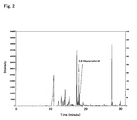
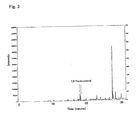
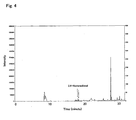
- the characteristic odor coming from a raw material containing astaxanthin is derived from a plurality of odorous substances.
- One of the causative substances is 2,4-heptadienal.
- 2,4-Heptadienal is thought to be one of the substances that cause the foul odor of tap water (see Toshiyuki Kataoka, the summaries of the 47-th JWWA Research Conference and Symposium held by the Japan Water Works Association, 1996, pp. 472-473 ).
- each of the samples was placed into a gastight vial, and ventilated with nitrogen to a headspace of the vial while keeping the samples warm at 60°C to collect a gas discharged from the vial. Then, 1 L of the collected gas was passed through an adsorbent (NeedlEx; manufactured by Shinwa Chemical Industries Ltd.) to adsorb the odorous component onto the adsorbent. The adsorbed odorous component was analyzed with a gas chromatograph (GC) equipped with a flame ionization detector (FID). The conditions of the analysis were as follows:
- Figs. 2 to 4 show respective gas chromatograms. As can be seen from these gas chromatograms, 2,4-heptadienal in the flavor-improved products considerably decreased when compared with that in the untreated product. The results were in good agreement with the results of the sensory evaluation.
- the flavor of an astaxanthin-containing extract having a characteristic odor derived from a raw material can be improved. Therefore, the resultant flavor-improved astaxanthin-containing extract can be suitably used in the field of food products, pharmaceuticals, cosmetics, etc.
Landscapes
- Health & Medical Sciences (AREA)
- Life Sciences & Earth Sciences (AREA)
- Chemical & Material Sciences (AREA)
- Engineering & Computer Science (AREA)
- Natural Medicines & Medicinal Plants (AREA)
- Veterinary Medicine (AREA)
- Mycology (AREA)
- Medicinal Chemistry (AREA)
- Biotechnology (AREA)
- Public Health (AREA)
- Pharmacology & Pharmacy (AREA)
- Animal Behavior & Ethology (AREA)
- General Health & Medical Sciences (AREA)
- Food Science & Technology (AREA)
- Botany (AREA)
- Epidemiology (AREA)
- Nutrition Science (AREA)
- Polymers & Plastics (AREA)
- Nuclear Medicine, Radiotherapy & Molecular Imaging (AREA)
- Alternative & Traditional Medicine (AREA)
- Biochemistry (AREA)
- Organic Chemistry (AREA)
- General Chemical & Material Sciences (AREA)
- Chemical Kinetics & Catalysis (AREA)
- Microbiology (AREA)
- Medical Informatics (AREA)
- Dermatology (AREA)
- Toxicology (AREA)
- Bioinformatics & Cheminformatics (AREA)
- Coloring Foods And Improving Nutritive Qualities (AREA)
- Seasonings (AREA)
- Acyclic And Carbocyclic Compounds In Medicinal Compositions (AREA)
Applications Claiming Priority (2)
| Application Number | Priority Date | Filing Date | Title |
|---|---|---|---|
| JP2008021589 | 2008-01-31 | ||
| JP2008295537A JP2009201503A (ja) | 2008-01-31 | 2008-11-19 | アスタキサンチン含有抽出物の香味改善方法 |
Publications (1)
| Publication Number | Publication Date |
|---|---|
| EP2090182A1 true EP2090182A1 (de) | 2009-08-19 |
Family
ID=40577720
Family Applications (1)
| Application Number | Title | Priority Date | Filing Date |
|---|---|---|---|
| EP09001218A Withdrawn EP2090182A1 (de) | 2008-01-31 | 2009-01-29 | Verfahren zur Verbesserung des Aromas eines astaxanthinhaltigen Extrakts |
Country Status (3)
| Country | Link |
|---|---|
| US (1) | US20090197971A1 (de) |
| EP (1) | EP2090182A1 (de) |
| JP (1) | JP2009201503A (de) |
Cited By (1)
| Publication number | Priority date | Publication date | Assignee | Title |
|---|---|---|---|---|
| US9687422B2 (en) | 2012-10-02 | 2017-06-27 | Jx Nippon Oil & Energy Corporation | Method for producing carotenoid-containing composition, and carotenoid-containing composition |
Families Citing this family (1)
| Publication number | Priority date | Publication date | Assignee | Title |
|---|---|---|---|---|
| FR3007837B1 (fr) * | 2013-06-26 | 2015-07-17 | Roquette Freres | Compositions de farine de microalgues de qualite sensorielle optimisee |
Citations (12)
| Publication number | Priority date | Publication date | Assignee | Title |
|---|---|---|---|---|
| US4048203A (en) | 1976-12-06 | 1977-09-13 | Thomas Philip | Purification of lutein-fatty acid esters from plant materials |
| JPH07118226A (ja) | 1993-10-21 | 1995-05-09 | Kuraray Co Ltd | アスタキサンチンの精製法 |
| JPH07304979A (ja) | 1994-05-12 | 1995-11-21 | Sanei Gen F F I Inc | カロテノイド色素の精製法 |
| JPH07304978A (ja) | 1994-05-12 | 1995-11-21 | Sanei Gen F F I Inc | カロテノイド色素の製法 |
| JPH07304977A (ja) | 1994-05-12 | 1995-11-21 | Sanei Gen F F I Inc | 安定性の優れたカロテノイド色素の製造法 |
| JPH0948927A (ja) | 1995-08-04 | 1997-02-18 | Sanei Gen F F I Inc | カロテノイド色素の精製法 |
| WO1997023436A1 (en) | 1995-12-21 | 1997-07-03 | Kemin Foods, L.C. | A process for the formation, isolation and purification of comestible xanthophyll crystals from plants |
| WO1999054408A1 (en) | 1998-04-20 | 1999-10-28 | Inexa, Industria Extractora C.A. | Trans-xanthophyll ester concentrates of enhanced purity and methods of making same |
| WO2001083437A1 (en) * | 2000-05-04 | 2001-11-08 | Haitai Food Products Co., Ltd. | Process for extracting astaxanthin pigment from yeast and extracted pigment thereof |
| JP2002030068A (ja) | 2000-07-19 | 2002-01-29 | Riken Vitamin Co Ltd | ルテイン脂肪酸エステルの精製方法 |
| EP1800674A1 (de) * | 2005-12-14 | 2007-06-27 | Yamaha Hatsudoki Kabushiki Kaisha | Mittel zur Verhinderung des metabolischen Syndroms |
| CA2647451A1 (en) * | 2006-03-28 | 2007-10-11 | Asahi Kasei Pharma Corporation | Process for the production of carotenoid compositions |
-
2008
- 2008-11-19 JP JP2008295537A patent/JP2009201503A/ja active Pending
-
2009
- 2009-01-28 US US12/361,175 patent/US20090197971A1/en not_active Abandoned
- 2009-01-29 EP EP09001218A patent/EP2090182A1/de not_active Withdrawn
Patent Citations (12)
| Publication number | Priority date | Publication date | Assignee | Title |
|---|---|---|---|---|
| US4048203A (en) | 1976-12-06 | 1977-09-13 | Thomas Philip | Purification of lutein-fatty acid esters from plant materials |
| JPH07118226A (ja) | 1993-10-21 | 1995-05-09 | Kuraray Co Ltd | アスタキサンチンの精製法 |
| JPH07304979A (ja) | 1994-05-12 | 1995-11-21 | Sanei Gen F F I Inc | カロテノイド色素の精製法 |
| JPH07304978A (ja) | 1994-05-12 | 1995-11-21 | Sanei Gen F F I Inc | カロテノイド色素の製法 |
| JPH07304977A (ja) | 1994-05-12 | 1995-11-21 | Sanei Gen F F I Inc | 安定性の優れたカロテノイド色素の製造法 |
| JPH0948927A (ja) | 1995-08-04 | 1997-02-18 | Sanei Gen F F I Inc | カロテノイド色素の精製法 |
| WO1997023436A1 (en) | 1995-12-21 | 1997-07-03 | Kemin Foods, L.C. | A process for the formation, isolation and purification of comestible xanthophyll crystals from plants |
| WO1999054408A1 (en) | 1998-04-20 | 1999-10-28 | Inexa, Industria Extractora C.A. | Trans-xanthophyll ester concentrates of enhanced purity and methods of making same |
| WO2001083437A1 (en) * | 2000-05-04 | 2001-11-08 | Haitai Food Products Co., Ltd. | Process for extracting astaxanthin pigment from yeast and extracted pigment thereof |
| JP2002030068A (ja) | 2000-07-19 | 2002-01-29 | Riken Vitamin Co Ltd | ルテイン脂肪酸エステルの精製方法 |
| EP1800674A1 (de) * | 2005-12-14 | 2007-06-27 | Yamaha Hatsudoki Kabushiki Kaisha | Mittel zur Verhinderung des metabolischen Syndroms |
| CA2647451A1 (en) * | 2006-03-28 | 2007-10-11 | Asahi Kasei Pharma Corporation | Process for the production of carotenoid compositions |
Non-Patent Citations (3)
| Title |
|---|
| DATABASE WPI Week 199604, Derwent World Patents Index; AN 1996-036020, XP002526253 * |
| DATABASE WPI Week 199717, Derwent World Patents Index; AN 1997-188448, XP002526252 * |
| TOSHIYUKI KATAOKA: "47-th JWWA Research Conference and Symposium held", 1996, JAPAN WATER WORKS ASSOCIATION, pages: 472 - 473 |
Cited By (1)
| Publication number | Priority date | Publication date | Assignee | Title |
|---|---|---|---|---|
| US9687422B2 (en) | 2012-10-02 | 2017-06-27 | Jx Nippon Oil & Energy Corporation | Method for producing carotenoid-containing composition, and carotenoid-containing composition |
Also Published As
| Publication number | Publication date |
|---|---|
| JP2009201503A (ja) | 2009-09-10 |
| US20090197971A1 (en) | 2009-08-06 |
Similar Documents
| Publication | Publication Date | Title |
|---|---|---|
| EP3196313B1 (de) | Mikroalgenextrakt mit omega3-mehrfachungesättigten fettsäuren und verfahren zur extraktion von öl aus mikroorganismen | |
| US5612485A (en) | High cis beta-carotene composition | |
| CN101496561A (zh) | 改善含虾青素提取物的气味的方法 | |
| WO1999020587A1 (en) | Process for extraction and purification of lutein, zeaxanthin and rare carotenoids from marigold flowers and plants | |
| WO2000005395A1 (de) | Verfahren zur präparativen gewinnung von fettsäuren aus biomasse durch in- situ-extraktion-reaktion-chromatographie mit verdichteten gasen | |
| US9315434B2 (en) | Method for preparing a composition rich in lutein produced by microalgae | |
| JP2019506133A (ja) | 微細藻類からフコキサンチンおよび/またはポリサッカライドを生産するための改善されたプロセス | |
| JP5795572B2 (ja) | 種々の植物からカロテノイド結晶を分離する方法 | |
| EP3208257B1 (de) | Verfahren zur harnstoffrückgewinnung in einem harnstoffadduktverfahren | |
| EP2090182A1 (de) | Verfahren zur Verbesserung des Aromas eines astaxanthinhaltigen Extrakts | |
| DE60018427T2 (de) | Verfahren zur herstellung von lykopen | |
| CN100368395C (zh) | 从万寿菊油树脂中分离提纯高含量叶黄素脂肪酸酯的方法 | |
| US6057484A (en) | Method of obtaining a composition containing 9-cis β-carotene in high-purity | |
| WO2010063256A2 (de) | Verfahren zur herstellung von carotinoiden | |
| JPH07304977A (ja) | 安定性の優れたカロテノイド色素の製造法 | |
| CN118340743A (zh) | 一种高稳定性长链不饱和化合物的组合物及其制备方法和用途 | |
| JPH07304978A (ja) | カロテノイド色素の製法 | |
| JP2010105959A (ja) | 高純度9−シス−β−カロチン含有組成物及びその製法 | |
| EP3858152B1 (de) | Verfahren zur langzeitlagerung von chlorophyll enthaltendem extrakt | |
| JP7058877B2 (ja) | 脂質抽出物の製造方法 | |
| EP1852417A1 (de) | Verfahren zur gewinnung von xanthophyll | |
| JP2015204764A (ja) | 無色カロテノイドの製造方法 | |
| US20130302365A1 (en) | Extraction of oil-soluble pigment from micro-organisms | |
| EP1724337A1 (de) | Verfahren zur Konservierung der Xantophylle in Algenzellen | |
| US20080293975A1 (en) | Method of Recovering Xanthophyll |
Legal Events
| Date | Code | Title | Description |
|---|---|---|---|
| PUAI | Public reference made under article 153(3) epc to a published international application that has entered the european phase |
Free format text: ORIGINAL CODE: 0009012 |
|
| AK | Designated contracting states |
Kind code of ref document: A1 Designated state(s): AT BE BG CH CY CZ DE DK EE ES FI FR GB GR HR HU IE IS IT LI LT LU LV MC MK MT NL NO PL PT RO SE SI SK TR |
|
| AX | Request for extension of the european patent |
Extension state: AL BA RS |
|
| 17P | Request for examination filed |
Effective date: 20091008 |
|
| AKX | Designation fees paid |
Designated state(s): AT BE BG CH CY CZ DE DK EE ES FI FR GB GR HR HU IE IS IT LI LT LU LV MC MK MT NL NO PL PT RO SE SI SK TR |
|
| STAA | Information on the status of an ep patent application or granted ep patent |
Free format text: STATUS: THE APPLICATION HAS BEEN WITHDRAWN |
|
| 18W | Application withdrawn |
Effective date: 20110209 |