EP2090268A2 - Pied en prothèse - Google Patents
Pied en prothèse Download PDFInfo
- Publication number
- EP2090268A2 EP2090268A2 EP09001495A EP09001495A EP2090268A2 EP 2090268 A2 EP2090268 A2 EP 2090268A2 EP 09001495 A EP09001495 A EP 09001495A EP 09001495 A EP09001495 A EP 09001495A EP 2090268 A2 EP2090268 A2 EP 2090268A2
- Authority
- EP
- European Patent Office
- Prior art keywords
- lamina
- foot
- prosthetic foot
- final
- curved
- Prior art date
- Legal status (The legal status is an assumption and is not a legal conclusion. Google has not performed a legal analysis and makes no representation as to the accuracy of the status listed.)
- Granted
Links
Images

Classifications
-
- A—HUMAN NECESSITIES
- A61—MEDICAL OR VETERINARY SCIENCE; HYGIENE
- A61F—FILTERS IMPLANTABLE INTO BLOOD VESSELS; PROSTHESES; DEVICES PROVIDING PATENCY TO, OR PREVENTING COLLAPSING OF, TUBULAR STRUCTURES OF THE BODY, e.g. STENTS; ORTHOPAEDIC, NURSING OR CONTRACEPTIVE DEVICES; FOMENTATION; TREATMENT OR PROTECTION OF EYES OR EARS; BANDAGES, DRESSINGS OR ABSORBENT PADS; FIRST-AID KITS
- A61F2/00—Filters implantable into blood vessels; Prostheses, i.e. artificial substitutes or replacements for parts of the body; Appliances for connecting them with the body; Devices providing patency to, or preventing collapsing of, tubular structures of the body, e.g. stents
- A61F2/50—Prostheses not implantable in the body
- A61F2/60—Artificial legs or feet or parts thereof
- A61F2/66—Feet; Ankle joints
-
- A—HUMAN NECESSITIES
- A61—MEDICAL OR VETERINARY SCIENCE; HYGIENE
- A61F—FILTERS IMPLANTABLE INTO BLOOD VESSELS; PROSTHESES; DEVICES PROVIDING PATENCY TO, OR PREVENTING COLLAPSING OF, TUBULAR STRUCTURES OF THE BODY, e.g. STENTS; ORTHOPAEDIC, NURSING OR CONTRACEPTIVE DEVICES; FOMENTATION; TREATMENT OR PROTECTION OF EYES OR EARS; BANDAGES, DRESSINGS OR ABSORBENT PADS; FIRST-AID KITS
- A61F2/00—Filters implantable into blood vessels; Prostheses, i.e. artificial substitutes or replacements for parts of the body; Appliances for connecting them with the body; Devices providing patency to, or preventing collapsing of, tubular structures of the body, e.g. stents
- A61F2/50—Prostheses not implantable in the body
- A61F2/76—Means for assembling, fitting or testing prostheses, e.g. for measuring or balancing
-
- A—HUMAN NECESSITIES
- A61—MEDICAL OR VETERINARY SCIENCE; HYGIENE
- A61F—FILTERS IMPLANTABLE INTO BLOOD VESSELS; PROSTHESES; DEVICES PROVIDING PATENCY TO, OR PREVENTING COLLAPSING OF, TUBULAR STRUCTURES OF THE BODY, e.g. STENTS; ORTHOPAEDIC, NURSING OR CONTRACEPTIVE DEVICES; FOMENTATION; TREATMENT OR PROTECTION OF EYES OR EARS; BANDAGES, DRESSINGS OR ABSORBENT PADS; FIRST-AID KITS
- A61F2/00—Filters implantable into blood vessels; Prostheses, i.e. artificial substitutes or replacements for parts of the body; Appliances for connecting them with the body; Devices providing patency to, or preventing collapsing of, tubular structures of the body, e.g. stents
- A61F2/50—Prostheses not implantable in the body
- A61F2002/5072—Prostheses not implantable in the body having spring elements
- A61F2002/5079—Leaf springs
-
- A—HUMAN NECESSITIES
- A61—MEDICAL OR VETERINARY SCIENCE; HYGIENE
- A61F—FILTERS IMPLANTABLE INTO BLOOD VESSELS; PROSTHESES; DEVICES PROVIDING PATENCY TO, OR PREVENTING COLLAPSING OF, TUBULAR STRUCTURES OF THE BODY, e.g. STENTS; ORTHOPAEDIC, NURSING OR CONTRACEPTIVE DEVICES; FOMENTATION; TREATMENT OR PROTECTION OF EYES OR EARS; BANDAGES, DRESSINGS OR ABSORBENT PADS; FIRST-AID KITS
- A61F2/00—Filters implantable into blood vessels; Prostheses, i.e. artificial substitutes or replacements for parts of the body; Appliances for connecting them with the body; Devices providing patency to, or preventing collapsing of, tubular structures of the body, e.g. stents
- A61F2/50—Prostheses not implantable in the body
- A61F2/60—Artificial legs or feet or parts thereof
- A61F2/66—Feet; Ankle joints
- A61F2002/6614—Feet
- A61F2002/665—Soles
-
- A—HUMAN NECESSITIES
- A61—MEDICAL OR VETERINARY SCIENCE; HYGIENE
- A61F—FILTERS IMPLANTABLE INTO BLOOD VESSELS; PROSTHESES; DEVICES PROVIDING PATENCY TO, OR PREVENTING COLLAPSING OF, TUBULAR STRUCTURES OF THE BODY, e.g. STENTS; ORTHOPAEDIC, NURSING OR CONTRACEPTIVE DEVICES; FOMENTATION; TREATMENT OR PROTECTION OF EYES OR EARS; BANDAGES, DRESSINGS OR ABSORBENT PADS; FIRST-AID KITS
- A61F2/00—Filters implantable into blood vessels; Prostheses, i.e. artificial substitutes or replacements for parts of the body; Appliances for connecting them with the body; Devices providing patency to, or preventing collapsing of, tubular structures of the body, e.g. stents
- A61F2/50—Prostheses not implantable in the body
- A61F2/60—Artificial legs or feet or parts thereof
- A61F2/66—Feet; Ankle joints
- A61F2002/6614—Feet
- A61F2002/6657—Feet having a plate-like or strip-like spring element, e.g. an energy-storing cantilever spring keel
- A61F2002/6678—L-shaped
Definitions
- the present invention relates to a prosthetic walking foot.
- the present invention relates to a prosthetic foot dedicated to lower limb-amputated subjects of considerable mobility and dynamicity, and hence normally dedicated to young or middle aged subjects.
- prosthetic feet providing energy return were launched on the market, these, by using composite materials such as carbon fibre, being able to store energy during the initial foot bearing phase, i.e. during so-called loading, and to return it during the subsequent ground support phase, known as the response, before take-off.
- such prosthetic feet present an L-shaped lamina defining the front part of the foot, and a rear lamina defining the rear part or heel of the foot.
- the technical aim of the present invention is therefore to provide a prosthetic foot which enables the stated technical drawbacks of the known art to be eliminated.
- an object of the invention is to provide a prosthetic foot which simulates the functional behaviour of the human foot to a better extent than traditional prosthetic feet.
- Another object of the invention is to provide a prosthetic foot which ensures good plantar flexure.
- a further object of the invention is to provide a prosthetic foot which enables energy to be returned at every moment during ground bearing, and in particular during the final propulsive thrust, when the prosthetic foot is at toe-off.
- a further object of the invention is to provide a prosthetic foot in which energy return is more effective than with commercially available feet.
- the prosthetic foot of the invention must have sufficient strength to satisfy the ISO 10328 standard, while at the same time being flexible to enable the load to be applied and handled to produce smooth natural walking.
- the foot of the new invention comprises four main laminas:
- the lower lamina consists of:
- the rear lamina consists of:
- the one or two upper laminas have a similar profile and consist of:
- the connector connects the rear lamina to the upper lamina by a fixing, for example with nuts and bolts and, together with the upper laminas-lower lamina fixing, provides working continuity for the laminas and load transmission between the laminas during walking.
- a fixing for example with nuts and bolts and, together with the upper laminas-lower lamina fixing, provides working continuity for the laminas and load transmission between the laminas during walking.
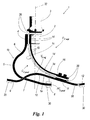
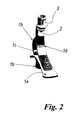
- the prosthetic foot (1) consists of four laminas: a lower lamina (1 a), a rear lamina (1 b) and two upper laminas (1 c and 1 d) positioned superposed, parallel and spaced apart.
- the rear lamina 1 b and the upper and lower laminas 1 c and 1 d are all fixed together at an upper end thereof to a pyramidal connector (2), which consists of a single piece of titanium or aluminium, by which the applied load is transferred to the prosthetic foot (1) by a tube (3).
- the rear lamina (1 b) consists of the following portions positioned in series: a straight first portion (4) in proximity to the connector (2) and to the neck of the virtual ankle, a curved second portion (5) with its concavity facing frontwards, positioned in proximity to the virtual heel and with centre of curvature (C Ipost ), a third portion (6) connecting the first two together, a straight portion (7) and a curved final portion (8) terminating at about the centre of the foot (PC Ipost ); this final portion (8) of the rear lamina (1b) is positioned below the humped portion (10) located between the initial portion (9) defining the under-heel and the final portion (12) defining the foot front of the lower lamina (1 a).
- the width of the cross-section of said lamina (1b), from the portion (4) to the portion (7), is constant (the cross-section is substantially rectangular), to increase after straddling the lower lamina (1 a), until attaining the maximum width in the final portion (the cross-section is still substantially rectangular, but with its long sides of greater dimensions than the preceding cross-sections); at the portion (8) the lamina width is almost equal to the maximum width to the foot front, to ensure greater stability in mid-stance compared with traditional feet.
- a 3 mm thick pad (30) of elastomeric material is positioned below the final portion of the rear lamina; this prevents direct contact between the lamina and the aesthetic polyurethane covering within which the prosthetic foot is housed during use.
- the lower lamina (1 a) consists of a curved portion (9) of upwardly facing concavity (when the foot is in its normal use configuration) and representing the under-heel, a curved humped portion (10) representing the plantar arch with its vertex (V linf ) located on a central axis (31) of the connector along which the user's weight is discharged, this axis (31) in practice being the loading straight line, and a straight portion (11) connecting the portion (10) to the final portion (12) defining the foot front, which presents an upward concavity and possibly an inflection.
- the lower lamina (1 a) and the upper lamina or laminas (1 c and 1 d) are connected together at a region of the lower lamina (1 a) interposed between the initial portion (9) and the final portion (12).
- the lower lamina (1 a) presents an aperture or slot (32) through which the rear lamina (1 b) passes.
- the aperture or slot (32) is provided in the intermediate humped portion (10) of the lower lamina (1 a).
- the rear lamina (1b) presents an aperture through which the lower lamina (1 a) passes.
- Two pads (30) of elastomeric material are positioned below the portions (9) and (12) to prevent direct contact between the carbon fibre laminas and the aesthetic polyurethane covering within which the prosthetic foot is housed. These pads have a thickness of 3 mm.
- the rear lamina (1 b) presents an elastomeric material pad (34) consisting of a 3 mm thick rubber block interposed between the top of its final portion (8) and the bottom of the lower lamina (1 a), to prevent direct contact during loading, which could cause it to wear.
- Aluminium spacers (36) are used in the fixing region at the ankle neck and at the foot front to prevent contact between the different laminas.
- the overall length of the lower lamina (1 a) is approximately equal to the length of a natural foot; it will evidently differ depending on the characteristics of each user and hence on the size of the prosthetic foot chosen on that basis.
- the width of the cross-section of the lower lamina (1 a) narrows from the portion (9) (which defines the heel) to the humped portion (10) (which defines the plantar arch), to then widen to reach its maximum value at the tip (38), which bounds the portions 11 and 12 of the lower lamina (1a) and is indicative of the 5 th virtual metatarsus, corresponding with the maximum width of the foot front.
- Each of the upper laminas (1 c and 1 d) comprises the following portions in series: a straight portion (14) fixed to the connector (2) and positioned in proximity to the virtual ankle, a curved portion (15) with centre of curvature C Ipost and a straight portion (16) in which two holes are present for fixing the two upper laminas (1 c, 1 d) to the lower lamina (1a).
- the use of two upper laminas achieves good elasticity characteristics associated with high strength, without the upper laminas being too rigid.
- the lamina thicknesses are preferably constant for all laminas, being determined on the basis of the applied load and hence of the user weight and mobility level.
- the connector is fixed to the front of the rear lamina (1b) and of the upper lamina or laminas (1c, 1 d).
- the axis (31) of this connector which coincides with the force application axis when the prosthetic foot is worn, passes close to the vertex (V linf ) of the humped portion (10) of the lower lamina (1a).
- the foot dimensions vary for the five classes according to the shoe size number of the user subject: class I No. 35-36, class II No. 37-38, class III No. 39-40, class IV No. 41-42, class V No. 43-44. Other classes are also possible.
- the material with which this prosthetic foot is produced enables energy to be absorbed and released, it being a composite material such as carbon fibre fabric, aramid fibre fabric, glass fibre fabric, Kevlar and other fibre fabrics, impregnated with epoxy, acrylic or other resin.
- the morphology of the prosthetic foot of the invention ensures that at least two laminas operate in each resting phase.
- the weight When in the dynamic condition, the weight is always discharged onto at least two laminas, which vary depending on the resting phase.
- the rear lamina (1 b) and the upper laminas (1 c and 1 d) operate.
- the lower lamina (1 a) and the upper laminas (1 c and 1 d) work in synergy.
- the portion (9) of the lower lamina (1 a) (which defines the under-heel) ensures load acceptance and absorption and, by virtue of the two upper laminas (1 c and 1 d) secured to the lower lamina by fixings, performs the function of the front tibial muscle which ensures control of foot "rolling" and hence the heel contact with the ground until the foot front portion (12) of the lower lamina (1 a) has completely contacted the ground.
- the rear lamina (1 b) begins to load and to generate propulsive energy, facilitating passage from mid-stance to the final contact of the portion (12) of the lower lamina (1 a) (which defines the foot front).
- the rear lamina (1 b) performs the function of the Achilles heel and hence of the soleus muscle which acts in eccentric contraction during the second rolling, to stabilize the resting of the foot in the sagittal plane.
- the rear flexure of the prosthetic ankle which enables the portion (9) of the lower lamina (1 a) (which defines the under-heel) to separate, and contact to pass to just the portion (12) of the lower lamina (1 a) (which defines the foot front), is ensured by the flexure of the rear lamina and the two upper laminas.
- the two upper laminas (1 c and 1 d) release the energy stored in the previous phase, to facilitate the propulsive thrust of the portion (12) of the lower lamina (1 a) (i.e. of the virtual foot front); this ensures effective toe-off and plantar flexure, in contrast to traditional feet which present a limited plantar flexure, of about 10°.
- the shape and positioning of the laminas also ensure stability during the static phase with natural resting.
- the weight is discharged onto the portion (9) of the lower lamina (1 a) (which simulates the under-heel) and onto the portion (12) of said lower lamina (1 a) (which simulates the foot front) and onto the portion (8) of the rear lamina (1 b) (which simulates the intermediate bearing region).
- the use of three or four laminas connected together enables the functionality of the human foot to be simulated and enables continuous absorption/return of energy by the foot such as to provide "completely assisted" walking by the prosthetic foot, at each moment of its resting on the ground.
- the prosthetic foot always operates via at least two laminas, of which one absorbs and the other returns energy.
- the device is arranged to be housed within an aesthetic covering having the shape of the human foot.
- the two upper laminas 1 c and 1 d can be replaced by a single lamina or by more than two laminas, depending on the elasticity and strength characteristics required; thus one, two or even more upper laminas can be used, depending on the characteristics of the user.
- the foot presents a diagram of the vertical force discharged to the ground with the characteristic double humped pattern typical of the human foot, but presents a special characteristic which differentiates it therefrom and also from other traditional prosthetic feet: the first hump is lower during load acceptance, while the second hump is higher such that there is a greater propulsive thrust and a more effective plantar flexure than with traditional feet.
Landscapes
- Health & Medical Sciences (AREA)
- Transplantation (AREA)
- Biomedical Technology (AREA)
- Cardiology (AREA)
- Oral & Maxillofacial Surgery (AREA)
- Engineering & Computer Science (AREA)
- Heart & Thoracic Surgery (AREA)
- Vascular Medicine (AREA)
- Life Sciences & Earth Sciences (AREA)
- Animal Behavior & Ethology (AREA)
- General Health & Medical Sciences (AREA)
- Public Health (AREA)
- Veterinary Medicine (AREA)
- Orthopedic Medicine & Surgery (AREA)
- Prostheses (AREA)
Applications Claiming Priority (1)
| Application Number | Priority Date | Filing Date | Title |
|---|---|---|---|
| IT000226A ITMI20080226A1 (it) | 2008-02-13 | 2008-02-13 | Piede protesico da camminare |
Publications (3)
| Publication Number | Publication Date |
|---|---|
| EP2090268A2 true EP2090268A2 (fr) | 2009-08-19 |
| EP2090268A3 EP2090268A3 (fr) | 2010-06-23 |
| EP2090268B1 EP2090268B1 (fr) | 2011-10-26 |
Family
ID=40291635
Family Applications (1)
| Application Number | Title | Priority Date | Filing Date |
|---|---|---|---|
| EP09001495A Active EP2090268B1 (fr) | 2008-02-13 | 2009-02-04 | Pied en prothèse |
Country Status (6)
| Country | Link |
|---|---|
| US (1) | US8221506B2 (fr) |
| EP (1) | EP2090268B1 (fr) |
| AT (1) | ATE530149T1 (fr) |
| DK (1) | DK2090268T3 (fr) |
| ES (1) | ES2376402T3 (fr) |
| IT (1) | ITMI20080226A1 (fr) |
Families Citing this family (26)
| Publication number | Priority date | Publication date | Assignee | Title |
|---|---|---|---|---|
| US8574314B2 (en) * | 2003-09-30 | 2013-11-05 | Bioquest Prosthetics Llc | Resilient prosthetic and orthotic components which incorporate a plurality of sagittally oriented struts |
| US7347877B2 (en) * | 2004-05-28 | 2008-03-25 | össur hf | Foot prosthesis with resilient multi-axial ankle |
| US20160100960A1 (en) * | 2012-11-27 | 2016-04-14 | Ability Dynamics, Llc | Compression heel prosthetic foot |
| US12011373B2 (en) | 2007-09-19 | 2024-06-18 | Proteor USA, LLC | Mounting bracket for connecting a prosthetic limb to a prosthetic foot |
| US10405998B2 (en) | 2007-09-19 | 2019-09-10 | Ability Dynamics Llc | Mounting bracket for connecting a prosthetic limb to a prosthetic foot |
| US11020248B2 (en) | 2007-09-19 | 2021-06-01 | Proteor USA, LLC | Vacuum system for a prosthetic foot |
| US8366790B2 (en) * | 2007-10-19 | 2013-02-05 | American Prosthetic Components, Llc | Prosthetic foot with energy returning heel and keel |
| US20100206348A1 (en) * | 2009-02-13 | 2010-08-19 | Demetrios Markou | Crutch |
| US9028559B2 (en) * | 2011-09-26 | 2015-05-12 | össur hf | Frictionless vertical suspension mechanism for prosthetic feet |
| US9017421B2 (en) | 2011-12-01 | 2015-04-28 | össur hf | Prosthetic foot with dual foot blades and vertically offset toe |
| US8961618B2 (en) | 2011-12-29 | 2015-02-24 | össur hf | Prosthetic foot with resilient heel |
| GB2500063A (en) * | 2012-03-09 | 2013-09-11 | Jason Mcinulty | Motorcycle footwear sole |
| EP2879623B1 (fr) | 2012-08-01 | 2019-11-27 | Ossur Hf | Module de cheville prosthétique |
| US9561118B2 (en) | 2013-02-26 | 2017-02-07 | össur hf | Prosthetic foot with enhanced stability and elastic energy return |
| CN106659573B (zh) | 2014-06-30 | 2019-08-27 | 奥苏尔公司 | 假足及足部覆盖件 |
| USD795433S1 (en) | 2015-06-30 | 2017-08-22 | Össur Iceland Ehf | Prosthetic foot cover |
| CN106618815B (zh) * | 2015-10-28 | 2018-10-23 | 上海理工大学 | 一体化地形自适应假脚 |
| US20170281372A1 (en) * | 2016-04-04 | 2017-10-05 | Fillauer Composites Llc | Apparatus and method for a split toe blade |
| EP3315099A1 (fr) | 2016-10-28 | 2018-05-02 | Roadrunnerfoot Engineering S.r.l. | Pied prothétique |
| US10874528B2 (en) * | 2017-03-09 | 2020-12-29 | Matthew J. Habecker | Foot prosthesis with dynamic variable keel resistance |
| USD915596S1 (en) | 2018-04-10 | 2021-04-06 | Össur Iceland Ehf | Prosthetic foot with tapered fasteners |
| WO2020012503A1 (fr) * | 2018-07-13 | 2020-01-16 | Gosakan Haripriya Sumana | Prothèse de pied d'appui médian |
| US20210228384A1 (en) * | 2018-07-13 | 2021-07-29 | Haripriya Sumana Gosakan | Lightweight prosthetic foot |
| USD904617S1 (en) * | 2018-09-10 | 2020-12-08 | Össur Iceland Ehf | Prosthetic foot |
| US12201537B2 (en) | 2020-11-30 | 2025-01-21 | Össur Iceland Ehf | Prosthetic foot with layers of fibrous material |
| IT202100011426A1 (it) * | 2021-05-05 | 2022-11-05 | Nicola Granaldi | "protesi piede" |
Family Cites Families (9)
| Publication number | Priority date | Publication date | Assignee | Title |
|---|---|---|---|---|
| US6071313A (en) * | 1991-02-28 | 2000-06-06 | Phillips; Van L. | Split foot prosthesis |
| US5376139A (en) * | 1992-09-21 | 1994-12-27 | Pitkin; Mark R. | Artificial foot and ankle |
| US5653767A (en) * | 1992-11-17 | 1997-08-05 | Medonics, Llc | Prosthetic foot |
| US5653768A (en) * | 1994-01-21 | 1997-08-05 | Bruce Kania | Dual cantilevered leaf spring structure |
| US6241776B1 (en) * | 1997-08-04 | 2001-06-05 | Roland Christensen | Prosthetic foot with reinforcing member |
| US5944760A (en) * | 1997-08-04 | 1999-08-31 | Roland J. Christensen Family Limited Partnership | Prosthetic foot with reinforcing member |
| GB2361645A (en) * | 2000-04-26 | 2001-10-31 | Blatchford & Sons Ltd | Prosthetic foot |
| US20020077706A1 (en) * | 2000-08-30 | 2002-06-20 | Phillips Van L. | Energy storing foot prosthesis with improved plantar flexion |
| US6942704B2 (en) * | 2003-08-29 | 2005-09-13 | S & L, Inc. | Prosthetic foot |
-
2008
- 2008-02-13 IT IT000226A patent/ITMI20080226A1/it unknown
-
2009
- 2009-02-03 US US12/364,814 patent/US8221506B2/en active Active - Reinstated
- 2009-02-04 EP EP09001495A patent/EP2090268B1/fr active Active
- 2009-02-04 ES ES09001495T patent/ES2376402T3/es active Active
- 2009-02-04 DK DK09001495.2T patent/DK2090268T3/da active
- 2009-02-04 AT AT09001495T patent/ATE530149T1/de active
Also Published As
| Publication number | Publication date |
|---|---|
| ITMI20080226A1 (it) | 2009-08-14 |
| EP2090268A3 (fr) | 2010-06-23 |
| ES2376402T3 (es) | 2012-03-13 |
| DK2090268T3 (da) | 2012-02-20 |
| US8221506B2 (en) | 2012-07-17 |
| EP2090268B1 (fr) | 2011-10-26 |
| US20090204231A1 (en) | 2009-08-13 |
| ATE530149T1 (de) | 2011-11-15 |
Similar Documents
| Publication | Publication Date | Title |
|---|---|---|
| EP2090268B1 (fr) | Pied en prothèse | |
| US6712860B2 (en) | Lower leg prosthesis | |
| US8167956B2 (en) | Bracket-fixable running foot for lower limb prosthesis | |
| EP2095731B1 (fr) | Chaussures avec accumulation d'énergie | |
| US8574314B2 (en) | Resilient prosthetic and orthotic components which incorporate a plurality of sagittally oriented struts | |
| RU2345737C2 (ru) | Протез стопы с настраиваемыми характеристиками | |
| KR20060072123A (ko) | 로우 프로필 의족 | |
| EP2760380A2 (fr) | Appareil et procédés de stockage et de libération de l'énergie d'une prothèse | |
| US6702859B1 (en) | Dynamic prosthetic foot with multiple load points and anterior/posterior upper sections | |
| US6702860B1 (en) | Dynamic prosthetic foot with multiple load points on upper section and sole | |
| RU2055549C1 (ru) | Каркас искусственной стопы | |
| KR101699400B1 (ko) | 중력성 신발 | |
| Fergason et al. | Custom design in lower limb prosthetics for athletic activity | |
| RU2348380C2 (ru) | Протез стопы с настраиваемыми функциональными характеристиками | |
| RU2380011C1 (ru) | Обувь с аккумулированием энергии | |
| US20180116825A1 (en) | Prosthetic foot | |
| CN210541949U (zh) | 一种低踝型蓄能碳纤维脚芯 | |
| KR101260286B1 (ko) | 이동에서 발생된 저장 에너지를 이용하는 신발, 그러한 신발의 이동, 점핑 또는 런닝의 스타트 스퍼트 방법 | |
| ITBG20090020A1 (it) | Piede protesico da camminare | |
| WO2009094712A1 (fr) | Orthèse appropriée pour une utilisation dans le traitement de la fasciite plantaire | |
| EP3315099A1 (fr) | Pied prothétique | |
| CN101543436A (zh) | 二次储能假脚 | |
| ITBG20090016A1 (it) | Piede protesico da camminare | |
| WO2017145181A1 (fr) | Système de prothèse de jambe | |
| Ojala | Biomechanical analysis of transfemoral amputee's sprint running and block start |
Legal Events
| Date | Code | Title | Description |
|---|---|---|---|
| PUAI | Public reference made under article 153(3) epc to a published international application that has entered the european phase |
Free format text: ORIGINAL CODE: 0009012 |
|
| AK | Designated contracting states |
Kind code of ref document: A2 Designated state(s): AT BE BG CH CY CZ DE DK EE ES FI FR GB GR HR HU IE IS IT LI LT LU LV MC MK MT NL NO PL PT RO SE SI SK TR |
|
| AX | Request for extension of the european patent |
Extension state: AL BA RS |
|
| PUAL | Search report despatched |
Free format text: ORIGINAL CODE: 0009013 |
|
| AK | Designated contracting states |
Kind code of ref document: A3 Designated state(s): AT BE BG CH CY CZ DE DK EE ES FI FR GB GR HR HU IE IS IT LI LT LU LV MC MK MT NL NO PL PT RO SE SI SK TR |
|
| AX | Request for extension of the european patent |
Extension state: AL BA RS |
|
| 17P | Request for examination filed |
Effective date: 20101112 |
|
| AKX | Designation fees paid |
Designated state(s): AT BE BG CH CY CZ DE DK EE ES FI FR GB GR HR HU IE IS IT LI LT LU LV MC MK MT NL NO PL PT RO SE SI SK TR |
|
| GRAP | Despatch of communication of intention to grant a patent |
Free format text: ORIGINAL CODE: EPIDOSNIGR1 |
|
| RIC1 | Information provided on ipc code assigned before grant |
Ipc: A61F 2/76 20060101ALI20110318BHEP Ipc: A61F 2/66 20060101AFI20110318BHEP |
|
| GRAS | Grant fee paid |
Free format text: ORIGINAL CODE: EPIDOSNIGR3 |
|
| GRAA | (expected) grant |
Free format text: ORIGINAL CODE: 0009210 |
|
| AK | Designated contracting states |
Kind code of ref document: B1 Designated state(s): AT BE BG CH CY CZ DE DK EE ES FI FR GB GR HR HU IE IS IT LI LT LU LV MC MK MT NL NO PL PT RO SE SI SK TR |
|
| REG | Reference to a national code |
Ref country code: GB Ref legal event code: FG4D |
|
| REG | Reference to a national code |
Ref country code: CH Ref legal event code: EP |
|
| REG | Reference to a national code |
Ref country code: IE Ref legal event code: FG4D |
|
| REG | Reference to a national code |
Ref country code: DE Ref legal event code: R096 Ref document number: 602009003207 Country of ref document: DE Effective date: 20120105 |
|
| REG | Reference to a national code |
Ref country code: NL Ref legal event code: T3 |
|
| REG | Reference to a national code |
Ref country code: SE Ref legal event code: TRGR |
|
| REG | Reference to a national code |
Ref country code: DK Ref legal event code: T3 |
|
| REG | Reference to a national code |
Ref country code: NO Ref legal event code: T2 Effective date: 20111026 |
|
| REG | Reference to a national code |
Ref country code: ES Ref legal event code: FG2A Ref document number: 2376402 Country of ref document: ES Kind code of ref document: T3 Effective date: 20120313 |
|
| LTIE | Lt: invalidation of european patent or patent extension |
Effective date: 20111026 |
|
| REG | Reference to a national code |
Ref country code: CH Ref legal event code: NV Representative=s name: R. A. EGLI & CO. PATENTANWAELTE |
|
| PG25 | Lapsed in a contracting state [announced via postgrant information from national office to epo] |
Ref country code: IS Free format text: LAPSE BECAUSE OF FAILURE TO SUBMIT A TRANSLATION OF THE DESCRIPTION OR TO PAY THE FEE WITHIN THE PRESCRIBED TIME-LIMIT Effective date: 20120226 Ref country code: LT Free format text: LAPSE BECAUSE OF FAILURE TO SUBMIT A TRANSLATION OF THE DESCRIPTION OR TO PAY THE FEE WITHIN THE PRESCRIBED TIME-LIMIT Effective date: 20111026 |
|
| PG25 | Lapsed in a contracting state [announced via postgrant information from national office to epo] |
Ref country code: LV Free format text: LAPSE BECAUSE OF FAILURE TO SUBMIT A TRANSLATION OF THE DESCRIPTION OR TO PAY THE FEE WITHIN THE PRESCRIBED TIME-LIMIT Effective date: 20111026 Ref country code: SI Free format text: LAPSE BECAUSE OF FAILURE TO SUBMIT A TRANSLATION OF THE DESCRIPTION OR TO PAY THE FEE WITHIN THE PRESCRIBED TIME-LIMIT Effective date: 20111026 Ref country code: HR Free format text: LAPSE BECAUSE OF FAILURE TO SUBMIT A TRANSLATION OF THE DESCRIPTION OR TO PAY THE FEE WITHIN THE PRESCRIBED TIME-LIMIT Effective date: 20111026 Ref country code: PL Free format text: LAPSE BECAUSE OF FAILURE TO SUBMIT A TRANSLATION OF THE DESCRIPTION OR TO PAY THE FEE WITHIN THE PRESCRIBED TIME-LIMIT Effective date: 20111026 Ref country code: PT Free format text: LAPSE BECAUSE OF FAILURE TO SUBMIT A TRANSLATION OF THE DESCRIPTION OR TO PAY THE FEE WITHIN THE PRESCRIBED TIME-LIMIT Effective date: 20120227 Ref country code: GR Free format text: LAPSE BECAUSE OF FAILURE TO SUBMIT A TRANSLATION OF THE DESCRIPTION OR TO PAY THE FEE WITHIN THE PRESCRIBED TIME-LIMIT Effective date: 20120127 |
|
| REG | Reference to a national code |
Ref country code: CH Ref legal event code: PCOW Free format text: ROADRUNNERFOOT ENGINEERING S.R.L.;69, VIALE JENNER;20159 MILANO (IT) |
|
| PG25 | Lapsed in a contracting state [announced via postgrant information from national office to epo] |
Ref country code: CY Free format text: LAPSE BECAUSE OF FAILURE TO SUBMIT A TRANSLATION OF THE DESCRIPTION OR TO PAY THE FEE WITHIN THE PRESCRIBED TIME-LIMIT Effective date: 20111026 |
|
| PG25 | Lapsed in a contracting state [announced via postgrant information from national office to epo] |
Ref country code: BG Free format text: LAPSE BECAUSE OF FAILURE TO SUBMIT A TRANSLATION OF THE DESCRIPTION OR TO PAY THE FEE WITHIN THE PRESCRIBED TIME-LIMIT Effective date: 20120126 Ref country code: SK Free format text: LAPSE BECAUSE OF FAILURE TO SUBMIT A TRANSLATION OF THE DESCRIPTION OR TO PAY THE FEE WITHIN THE PRESCRIBED TIME-LIMIT Effective date: 20111026 Ref country code: EE Free format text: LAPSE BECAUSE OF FAILURE TO SUBMIT A TRANSLATION OF THE DESCRIPTION OR TO PAY THE FEE WITHIN THE PRESCRIBED TIME-LIMIT Effective date: 20111026 Ref country code: CZ Free format text: LAPSE BECAUSE OF FAILURE TO SUBMIT A TRANSLATION OF THE DESCRIPTION OR TO PAY THE FEE WITHIN THE PRESCRIBED TIME-LIMIT Effective date: 20111026 |
|
| PG25 | Lapsed in a contracting state [announced via postgrant information from national office to epo] |
Ref country code: IT Free format text: LAPSE BECAUSE OF FAILURE TO SUBMIT A TRANSLATION OF THE DESCRIPTION OR TO PAY THE FEE WITHIN THE PRESCRIBED TIME-LIMIT Effective date: 20111026 Ref country code: RO Free format text: LAPSE BECAUSE OF FAILURE TO SUBMIT A TRANSLATION OF THE DESCRIPTION OR TO PAY THE FEE WITHIN THE PRESCRIBED TIME-LIMIT Effective date: 20111026 |
|
| PLBE | No opposition filed within time limit |
Free format text: ORIGINAL CODE: 0009261 |
|
| STAA | Information on the status of an ep patent application or granted ep patent |
Free format text: STATUS: NO OPPOSITION FILED WITHIN TIME LIMIT |
|
| PG25 | Lapsed in a contracting state [announced via postgrant information from national office to epo] |
Ref country code: MC Free format text: LAPSE BECAUSE OF NON-PAYMENT OF DUE FEES Effective date: 20120229 |
|
| 26N | No opposition filed |
Effective date: 20120727 |
|
| REG | Reference to a national code |
Ref country code: IE Ref legal event code: MM4A |
|
| REG | Reference to a national code |
Ref country code: DE Ref legal event code: R097 Ref document number: 602009003207 Country of ref document: DE Effective date: 20120727 |
|
| PG25 | Lapsed in a contracting state [announced via postgrant information from national office to epo] |
Ref country code: IE Free format text: LAPSE BECAUSE OF NON-PAYMENT OF DUE FEES Effective date: 20120204 |
|
| PG25 | Lapsed in a contracting state [announced via postgrant information from national office to epo] |
Ref country code: MK Free format text: LAPSE BECAUSE OF FAILURE TO SUBMIT A TRANSLATION OF THE DESCRIPTION OR TO PAY THE FEE WITHIN THE PRESCRIBED TIME-LIMIT Effective date: 20111026 |
|
| PG25 | Lapsed in a contracting state [announced via postgrant information from national office to epo] |
Ref country code: FI Free format text: LAPSE BECAUSE OF FAILURE TO SUBMIT A TRANSLATION OF THE DESCRIPTION OR TO PAY THE FEE WITHIN THE PRESCRIBED TIME-LIMIT Effective date: 20111026 |
|
| PG25 | Lapsed in a contracting state [announced via postgrant information from national office to epo] |
Ref country code: MT Free format text: LAPSE BECAUSE OF FAILURE TO SUBMIT A TRANSLATION OF THE DESCRIPTION OR TO PAY THE FEE WITHIN THE PRESCRIBED TIME-LIMIT Effective date: 20111026 |
|
| PG25 | Lapsed in a contracting state [announced via postgrant information from national office to epo] |
Ref country code: TR Free format text: LAPSE BECAUSE OF FAILURE TO SUBMIT A TRANSLATION OF THE DESCRIPTION OR TO PAY THE FEE WITHIN THE PRESCRIBED TIME-LIMIT Effective date: 20111026 |
|
| PG25 | Lapsed in a contracting state [announced via postgrant information from national office to epo] |
Ref country code: LU Free format text: LAPSE BECAUSE OF NON-PAYMENT OF DUE FEES Effective date: 20120204 |
|
| PG25 | Lapsed in a contracting state [announced via postgrant information from national office to epo] |
Ref country code: HU Free format text: LAPSE BECAUSE OF FAILURE TO SUBMIT A TRANSLATION OF THE DESCRIPTION OR TO PAY THE FEE WITHIN THE PRESCRIBED TIME-LIMIT Effective date: 20090204 |
|
| REG | Reference to a national code |
Ref country code: FR Ref legal event code: PLFP Year of fee payment: 8 |
|
| PG25 | Lapsed in a contracting state [announced via postgrant information from national office to epo] |
Ref country code: BE Free format text: LAPSE BECAUSE OF NON-PAYMENT OF DUE FEES Effective date: 20170228 |
|
| REG | Reference to a national code |
Ref country code: FR Ref legal event code: PLFP Year of fee payment: 9 |
|
| REG | Reference to a national code |
Ref country code: FR Ref legal event code: PLFP Year of fee payment: 10 |
|
| PGFP | Annual fee paid to national office [announced via postgrant information from national office to epo] |
Ref country code: NO Payment date: 20230209 Year of fee payment: 15 |
|
| PG25 | Lapsed in a contracting state [announced via postgrant information from national office to epo] |
Ref country code: NO Free format text: LAPSE BECAUSE OF NON-PAYMENT OF DUE FEES Effective date: 20240229 |
|
| PG2D | Information on lapse in contracting state deleted |
Ref country code: BE |
|
| PGFP | Annual fee paid to national office [announced via postgrant information from national office to epo] |
Ref country code: NL Payment date: 20250820 Year of fee payment: 17 |
|
| PGFP | Annual fee paid to national office [announced via postgrant information from national office to epo] |
Ref country code: ES Payment date: 20250821 Year of fee payment: 17 |
|
| PGFP | Annual fee paid to national office [announced via postgrant information from national office to epo] |
Ref country code: DE Payment date: 20250826 Year of fee payment: 17 |
|
| PGFP | Annual fee paid to national office [announced via postgrant information from national office to epo] |
Ref country code: BE Payment date: 20250825 Year of fee payment: 17 Ref country code: GB Payment date: 20250826 Year of fee payment: 17 |
|
| PGFP | Annual fee paid to national office [announced via postgrant information from national office to epo] |
Ref country code: FR Payment date: 20250825 Year of fee payment: 17 Ref country code: AT Payment date: 20250820 Year of fee payment: 17 |
|
| PGFP | Annual fee paid to national office [announced via postgrant information from national office to epo] |
Ref country code: SE Payment date: 20250821 Year of fee payment: 17 Ref country code: CH Payment date: 20250825 Year of fee payment: 17 |
|
| PGFP | Annual fee paid to national office [announced via postgrant information from national office to epo] |
Ref country code: DK Payment date: 20260617 Year of fee payment: 18 |