EP2090325A2 - Procédé de désinfection de l'air à l'aide d'ions négatifs d'oxygène et dispositif permettant sa mise en oeuvre - Google Patents
Procédé de désinfection de l'air à l'aide d'ions négatifs d'oxygène et dispositif permettant sa mise en oeuvre Download PDFInfo
- Publication number
- EP2090325A2 EP2090325A2 EP07852039A EP07852039A EP2090325A2 EP 2090325 A2 EP2090325 A2 EP 2090325A2 EP 07852039 A EP07852039 A EP 07852039A EP 07852039 A EP07852039 A EP 07852039A EP 2090325 A2 EP2090325 A2 EP 2090325A2
- Authority
- EP
- European Patent Office
- Prior art keywords
- air
- oxygen
- electrode
- negative ions
- alpha particles
- Prior art date
- Legal status (The legal status is an assumption and is not a legal conclusion. Google has not performed a legal analysis and makes no representation as to the accuracy of the status listed.)
- Withdrawn
Links
- 239000001301 oxygen Substances 0.000 title claims abstract description 80
- 229910052760 oxygen Inorganic materials 0.000 title claims abstract description 80
- 238000000034 method Methods 0.000 title claims abstract description 36
- 230000000249 desinfective effect Effects 0.000 title claims abstract description 17
- -1 oxygen ions Chemical class 0.000 title 1
- 150000002500 ions Chemical class 0.000 claims abstract description 82
- QVGXLLKOCUKJST-UHFFFAOYSA-N atomic oxygen Chemical compound [O] QVGXLLKOCUKJST-UHFFFAOYSA-N 0.000 claims abstract description 79
- 239000002245 particle Substances 0.000 claims abstract description 73
- 238000004659 sterilization and disinfection Methods 0.000 claims abstract description 48
- 239000003574 free electron Substances 0.000 claims abstract description 20
- 230000007935 neutral effect Effects 0.000 claims abstract description 16
- 239000000443 aerosol Substances 0.000 claims abstract description 14
- 238000007664 blowing Methods 0.000 claims abstract description 9
- 239000004020 conductor Substances 0.000 claims abstract description 5
- 230000005684 electric field Effects 0.000 claims abstract description 5
- 241000700605 Viruses Species 0.000 abstract description 21
- 238000009423 ventilation Methods 0.000 abstract description 10
- 208000002979 Influenza in Birds Diseases 0.000 abstract description 9
- 206010064097 avian influenza Diseases 0.000 abstract description 9
- 230000000694 effects Effects 0.000 abstract description 8
- 241000894006 Bacteria Species 0.000 abstract 2
- 241000233866 Fungi Species 0.000 abstract 2
- 230000003247 decreasing effect Effects 0.000 abstract 1
- 230000000415 inactivating effect Effects 0.000 abstract 1
- 238000000746 purification Methods 0.000 abstract 1
- MWUXSHHQAYIFBG-UHFFFAOYSA-N nitrogen oxide Inorganic materials O=[N] MWUXSHHQAYIFBG-UHFFFAOYSA-N 0.000 description 18
- 238000012360 testing method Methods 0.000 description 11
- 244000000010 microbial pathogen Species 0.000 description 8
- 230000002779 inactivation Effects 0.000 description 7
- CBENFWSGALASAD-UHFFFAOYSA-N Ozone Chemical compound [O-][O+]=O CBENFWSGALASAD-UHFFFAOYSA-N 0.000 description 5
- 241000287828 Gallus gallus Species 0.000 description 3
- 241001465754 Metazoa Species 0.000 description 3
- 230000005262 alpha decay Effects 0.000 description 3
- 235000013330 chicken meat Nutrition 0.000 description 3
- 239000007789 gas Substances 0.000 description 3
- 230000001717 pathogenic effect Effects 0.000 description 3
- 244000144977 poultry Species 0.000 description 3
- 235000013594 poultry meat Nutrition 0.000 description 3
- 239000000758 substrate Substances 0.000 description 3
- 238000006243 chemical reaction Methods 0.000 description 2
- 238000010276 construction Methods 0.000 description 2
- 238000002474 experimental method Methods 0.000 description 2
- 239000000463 material Substances 0.000 description 2
- 229910052751 metal Inorganic materials 0.000 description 2
- 239000002184 metal Substances 0.000 description 2
- 244000052769 pathogen Species 0.000 description 2
- 230000002285 radioactive effect Effects 0.000 description 2
- 238000011160 research Methods 0.000 description 2
- OYEHPCDNVJXUIW-FTXFMUIASA-N 239Pu Chemical compound [239Pu] OYEHPCDNVJXUIW-FTXFMUIASA-N 0.000 description 1
- 241000283690 Bos taurus Species 0.000 description 1
- 238000004458 analytical method Methods 0.000 description 1
- 230000004071 biological effect Effects 0.000 description 1
- 229940088623 biologically active substance Drugs 0.000 description 1
- 238000004364 calculation method Methods 0.000 description 1
- 238000004113 cell culture Methods 0.000 description 1
- 239000003795 chemical substances by application Substances 0.000 description 1
- 230000000120 cytopathologic effect Effects 0.000 description 1
- 239000000428 dust Substances 0.000 description 1
- 238000010891 electric arc Methods 0.000 description 1
- 230000005611 electricity Effects 0.000 description 1
- 238000001914 filtration Methods 0.000 description 1
- 244000053095 fungal pathogen Species 0.000 description 1
- 238000010438 heat treatment Methods 0.000 description 1
- 238000000752 ionisation method Methods 0.000 description 1
- 230000005865 ionizing radiation Effects 0.000 description 1
- 239000007788 liquid Substances 0.000 description 1
- 239000002932 luster Substances 0.000 description 1
- 238000012423 maintenance Methods 0.000 description 1
- 238000004519 manufacturing process Methods 0.000 description 1
- 244000005700 microbiome Species 0.000 description 1
- 230000003647 oxidation Effects 0.000 description 1
- 238000007254 oxidation reaction Methods 0.000 description 1
- 238000005036 potential barrier Methods 0.000 description 1
- 230000002265 prevention Effects 0.000 description 1
- 238000005215 recombination Methods 0.000 description 1
- 230000006798 recombination Effects 0.000 description 1
- 238000005070 sampling Methods 0.000 description 1
- 238000000926 separation method Methods 0.000 description 1
- 239000000725 suspension Substances 0.000 description 1
- 231100000331 toxic Toxicity 0.000 description 1
- 230000002588 toxic effect Effects 0.000 description 1
Images

Classifications
-
- A—HUMAN NECESSITIES
- A61—MEDICAL OR VETERINARY SCIENCE; HYGIENE
- A61L—METHODS OR APPARATUS FOR STERILISING MATERIALS OR OBJECTS IN GENERAL; DISINFECTION, STERILISATION OR DEODORISATION OF AIR; CHEMICAL ASPECTS OF BANDAGES, DRESSINGS, ABSORBENT PADS OR SURGICAL ARTICLES; MATERIALS FOR BANDAGES, DRESSINGS, ABSORBENT PADS OR SURGICAL ARTICLES
- A61L9/00—Disinfection, sterilisation or deodorisation of air
- A61L9/16—Disinfection, sterilisation or deodorisation of air using physical phenomena
- A61L9/22—Ionisation
-
- A—HUMAN NECESSITIES
- A61—MEDICAL OR VETERINARY SCIENCE; HYGIENE
- A61L—METHODS OR APPARATUS FOR STERILISING MATERIALS OR OBJECTS IN GENERAL; DISINFECTION, STERILISATION OR DEODORISATION OF AIR; CHEMICAL ASPECTS OF BANDAGES, DRESSINGS, ABSORBENT PADS OR SURGICAL ARTICLES; MATERIALS FOR BANDAGES, DRESSINGS, ABSORBENT PADS OR SURGICAL ARTICLES
- A61L9/00—Disinfection, sterilisation or deodorisation of air
- A61L9/16—Disinfection, sterilisation or deodorisation of air using physical phenomena
- A61L9/18—Radiation
Definitions
- the present invention relates to a method and device for disinfecting air and aerosol media using negative ions of oxygen to inactivate and destroy highly pathogenic microorganisms and viruses including virus of avian influenza H5N1.
- Invention can be used in forced ventilation systems of residential, commercial and industrial buildings.
- a number of methods use ionization of air by bombarding the air with a beam of electrons originating from gas discharge at a high voltage of electric field.
- A.L.Chizhevsky developed a luster of glowing discharge known from his book: A.L. Chizhevsky's book "A Guide on Application of Ionized Air", Moscow, Gosplanizdat, 1959 [1].
- the method has a low disinfection rate because ions fall out quickly on negative electrode and surfaces of objects in a premise and do not contact with the air.
- the method requires high voltage of about 100 kV and produces high concentration of ozone and nitrogen oxides.
- Patent JP 3221076 [3] discloses storing an ion generating material containing therein a radio-active isotope with alpha- decays, in a container, and introducing ions generated from the material and discharged from the container, into an ionization room or into an ionization utilizing facility by means of a blower.
- these methods have a number of shortages main of which is a low and indefinite concentration of negative ions of oxygen.
- the Russian Patent RU2061501 [4] describes gas ionizer consisting of a generating electrode with metal needles connected with a high voltage source, an extract electrode and at least one accelerating electrode connected with the generating electrode via voltage divider.
- the generating electrode form free electrons, then negative ions are collected from the area of air ionization close to the generating electrode, after that these ions are accelerated and blown into the volume of air that should be treated.
- the methods require high voltages of at least 25 kV.
- the purpose of the present invention is to overcome the above-mentioned drawbacks and more particularly to increase air disinfection rate and improve quality of air disinfection.
- the solution of these problems is directed at creating the method for achieving the following technical effects: (a) inactivation of 100% of viruses and pathogenic microorganisms contained in the air and aerosol before the air is blown into premises through ventilation system during one passage of air through the air feeding ventilation system and (b) partial inactivation of viruses and pathogenic microorganisms which are already in the premises.
- Another technical problem solved by the present invention is prevention of abrasive wear of a source of alpha-particles by abrasive particles contained in the air.
- positive ions of air are reduced to neutral molecules at the surface of an electrode having negative electric charge
- energy of free electrons contained in the air is reduced by electric field that is parallel to the air flow, providing forming of negative ions of oxygen whereas concentration of negative ions of oxygen is reduced before the air is blown into premises by reducing the negative ions of oxygen to neutral molecules of oxygen at the surface of an electrode having positive electric charge.
- the concentration of negative ions of oxygen in the air is provided within the range of 600 to 50,000 cm -3 with an unipolarity coefficient approximating 0 directly before blowing the disinfected air into premises.
- Inactivation of 100% of viruses and pathogenic microorganisms is provided by creating a high concentration of negative ions of oxygen in the disinfected air provided the concentration reaches the level of at least 20 ⁇ 10 6 cm -3 . This makes it possible to inactivate up to 100% of viruses and pathogenic microorganisms them within the shortest time possible due to oxidation effect.
- the presented embodiment of the invention allows to inactivate about 100% of viruses and pathogenic microorganisms within the period of time of 4.0 to 36.0 seconds.
- concentration of negative ions of oxygen in the air is provided the following way.
- disinfected air is processed by a stream of alpha particles, causing the impact ionization of air molecules and resulting in forming positive ions and free electrons.
- the free electrons are trapped by neutral molecules and atoms of oxygen, these electrons attach to these molecules and atoms resulting in forming negative ions of oxygen in the air, provided that the energy of free electrons lies within the range of energy of oxygen's affinity to electron that is 0.4 .. 2.0 eV.
- Positive ions are reduced to neutral molecules on one or more electrodes which are made in a form of a conducting mesh, through which the air flows.
- a negative electric charge is supplied to the conducting mesh from a direct voltage source.
- a potential barrier created by negatively charged mesh reduces kinetic energy of electrons to the energy of electron's affinity to a molecule and an atom of oxygen, which allows them to interact effectively with oxygen of the air. This results in forming negative ions of oxygen.
- the parts of the device should be manufactured of non-conducting material.
- Negative ions of oxygen provide disinfecting effect during the period of 4.0 - 36.0 seconds. This period of time is determined through a conversion of linear velocity of the air flow in the ionization chamber where sources of alpha particles are mounted into the volume velocity (air rate) of air flow in an air disinfection chamber.
- the present method is embodied in a device comprising consecutively interconnected air inlet duct, an ionization chamber, an air disinfection chamber and an air outlet for distribution of disinfected air into premises whereas at least one source of alpha particles is mounted in the ionization chamber by mounting the source of alpha particles on at least one plate.
- Two electrodes are mounted at the entrance of the disinfection chamber behind the plate along the air flow, whereas the electrodes are made of conducting mesh mounted across the air flow and connected to a negative terminal of a direct voltage source, the positive terminal of which is earthed.
- At least one electrode made of conducting mesh is mounted in the air outlet used for distribution of the air into premises, whereas the said electrode is connected to a positive terminal of direct voltage source, the negative terminal of which is earthed.
- the walls of the ionization chamber, air disinfection chamber and the plates are made of non-conducting material.
- depressions are made in the plate in which the sources of alpha particles are mounted, whereas the depth of a depression is at least 2 mm greater than the thickness of the source of alpha particles.
- the distance between the alpha particles source and the nearest electrode is less than 20 mm.
- the voltage at the electrodes is within 0.2 - 10 kV range whereas exact voltage is selected depending on the size of the cells of the mesh electrode.
- the length L of the air duct constituting the air disinfection chamber where negative ions of oxygen are used whereas the air disinfection chamber ends at the nearest electrode mounted in the air outlet for distribution of disinfected air into premises is greater than L ⁇ TV , where V is an average linear velocity of air flow in the air outlet - disinfection chamber, and the time T is in the range of 4.0 ⁇ T ⁇ 36.0 seconds.
- At least two mesh electrodes are mounted across air flow in the space between sources of alpha particles and the air outlet duct, i.e. in the air disinfection chamber, whereas the said electrodes are connected to the negative terminal of direct voltage source, the positive terminal of which is earthed. Due to that the positive ions of air are reduced to neutral molecules at the first said electrode. The energy of free electrons contained in the air is reduced to a required level that depends on the negative potential maintained on the mesh electrode and on the distance between the electrode and the source of alpha particles nearest to each other.
- Mounting the mesh electrode and the nearest source of alpha particles at a distance of no more than 20 mm provides the distribution of electrons by velocities with an average energy in the range of 0.4 to 2.0 eV.
- This range of energy provides trapping of free electrons by molecules and atoms of oxygen and attachment of trapped electrons to atoms and molecules of oxygen due to the energy of electrons being within the electron's energy affinity to oxygen. This forms negative ions of oxygen.
- the alpha particles sources are mounted on the plates located parallel to the air flow.
- Free path of alpha particles in the air depends on their energy defined by an isotope used in the alpha particles source. Free path of alpha particles in the air is several centimeters. This value can be determined from standard tables. For example, an isotope P 239 has a maximum energy of emitted alpha particles at the level of 5.1 MeV, whereas an average free path of alpha particles in the air is 50 mm.
- a distance between the plates with sources of alpha-particles, as well as a distance between the extreme plates with sources of alpha-particles and side walls of the ionization chamber should not exceed a free path of alpha particles. Otherwise, entire volume of air will not be treated by alpha particles. In one of the embodiments when sources of alpha particles are mounted on both sides of the plates, the entire air will be treated by alpha particles, provided the gap between the plates is no more than double free path of alpha particles in the air.
- Mounting sources of alpha particles in the depressions of the plates allows to avoid abrasive wear of alpha particles sources and tear of isotope particles by abrasive particles contained in the air flow. This also allows to select the optimal energy of alpha particles.
- At least one mesh electrode mounted across the air flow in the air outlet used for distribution of air in premises is connected to a positive terminal of direct voltage source, the negative terminal of which is earthed. It provides a reduction in the concentration of negative ions of oxygen contained in the disinfected air by reducing negative ions of oxygen to neutral molecules at above-mentioned electrode.
- the concentration of negative ions of oxygen in the air blown into the premises is determined by the level of positive voltage at the said electrode, the size of cells of the mesh and by air velocity.
- the length L of air disinfection chamber is determined from condition of ensuring adequate time in the range of 4.0 ⁇ T ⁇ 36.0 seconds for complete disinfection of air and inactivation of approximately 100% of viruses and pathogens.
- the technical effect achieved within the specified time, is shown in the table below.
- the present invention provides another embodiment of the device for disinfecting air using negative ions of oxygen, comprising disinfection chamber that is divided into two branches, one of which is air discharge duct connected to the atmosphere, whereas the other is connected to the ductwork used to distribute disinfected air into premises, whereas a mesh electrode is mounted across the air flow at the entrance to the air discharge duct connected to the atmosphere. This electrode is connected to the negative terminal of direct voltage source, the positive terminal of which is earthed.
- the voltage on the mesh electrode mounted at the entrance to the air discharge duct connected to the atmosphere is at least 1 to 10 kV and is determined depending on the size of cells of the mesh electrode.
- the present embodiment of the device allows to increase concentration of negative ions of oxygen in the disinfection chamber due to separation of a part of the airflow and blowing it into the atmosphere through the air discharge duct, whereas negative ions of oxygen remain in disinfection chamber and the outlet air duct used for the distribution of air into premises due to repulsion of negative ions of oxygen from negatively charged mesh electrode mounted across the air flow at the entrance to the outlet air duct, whereas the negative charge of the said mesh electrode is formed by connecting it to the negative terminal of direct voltage source, the positive terminal of which is earthed.
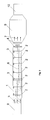
- FIG. 1 shows the construction of the device for disinfecting air using negative ions of oxygen installed in an air supply system such as a ventilation system of a building or the like.
- an ionization chamber 1 can be made as a part of an air inlet duct 19 in which dielectric plates 2 are mounted in parallel along the air inlet duct.
- Sources 3 of alpha particles are mounted in the depressions in the surfaces of dielectric plates 2.
- Sources 3 of alpha particles are made in the form of substrates onto which sealed sources of alpha - decay are embedded.
- a distance between the dielectric plates 2 across the air flow in the chamber 1 does not exceed 100 mm. This distance corresponds to double length of an average free path of alpha particles having energy of 5.1 MeV in the air, whereas a distance between the extreme dielectric plates and the walls of the ionization chamber does not exceed 50 mm.
- the electrodes 4 are mounted in the ionization chamber 1.
- the electrodes 4 are made as a conducting mesh mounted in the insulated frame and connected to a negative terminal of direct voltage source 5, the positive terminal of which is earthed.
- electrodes 8 are mounted in the air outlets 6 of an air duct 7 used to blow disinfected air into premises whereas electrodes 8 are made similar to electrodes 4, but the mesh of electrodes 8 is connected to a positive terminal of direct voltage source 9, a negative terminal of which is earthed.
- FIG.1 shows an embodiment of the device with an additional branch 10 of the air duct whereas the branch 10 is used to discharge a part of the air flow into atmosphere.
- An electrode 11 is made in a manner similar to electrodes 4 and electrodes 8 and is mounted at the entrance to the branch 10.
- a negative electric potential of up to 10 kV is maintained at the electrode 11 by the direct voltage source 12.
- the length L of an air disinfection chamber 20 that ends at the nearest electrode mounted in the air outlet made for distribution of disinfected air into premises is greater than L ⁇ TV, where V is the average linear flow rate of air in the disinfection chamber, and time T is in the range of 4.0 ⁇ T ⁇ 36.0 seconds.
- the cross section of the disinfection chamber is 0.7 x 0.7 m
- an air flow rate is 32 m 3 /hr
- the average linear flow rate of air in the air disinfection chamber will be 0,018 m/s
- the length of the disinfection chamber must be no less than L > 0.65 m for the air to be disinfected during 36 seconds.
- the embodiment of the device shown in FIG. operates the following way.
- the air 13 to be disinfected flows into the device through the air inlet duct 19 from which it gets into the ionization chamber 1, where the air goes through a stream of alpha particles emitted by sources 3.
- Air 14 enriched with negative ions of oxygen is processed during 4.0 ⁇ T ⁇ 36.0 seconds within the disinfection chamber 20 by negative ions of oxygen at the length L.
- disinfected air 15 while passing the outlet air duct 7 used for distribution of disinfected air into the premises, has a high concentration of negative ions of oxygen according to healthcare standards, a part of the negative ions of oxygen is reduced to neutral molecules at the electrodes 8. Disinfected air 16 with a concentration of negative ions of oxygen that meets the healthcare standards is fed into the premises.
- Fine-tuning of the device made in order to provide the most effective disinfection of air is achieved by selecting the following parameters: output voltage supplied to mesh electrodes, the size of the cells of mesh electrodes and by the depth of depression into which substrates with alpha particles are installed.
- the air duct is earthed by electrical grounding 17.
- Experimental and industrial device as shown in FIG.2 comprised an air feeding duct 8, through which the air 5 to be disinfected entered the ionization chamber 1.
- the dielectric plate was installed in the ionization chamber 1.
- sources of alpha particles 2 mounted linearly on the dielectric plate whereas each of the sources of alpha particles comprised a substrate containing Plutonium 239 manufactured according to GOST R51873-2002 (Sealed Sources of Ionizing Radiation. General Specifications).
- Maximum energy of alpha particles 3 emitted from the sources applied in tests was 5.1 MeV. It corresponded to the average free path of alpha particles in the air of 50 mm.
- the flow of alpha particles 3 was perpendicular to the air flow 6.
- Electrodes 4 were mounted at a distance of 20 mm from the source of alpha particles that is the last source along the air flow.
- the electrodes 4 were made of a metal mesh mounted in the non-conducting frame and connected to the negative terminal of direct voltage source, the positive terminal of which was earthed.
- the walls of the air duct were also earthed.
- the total length of the device was 2605 mm, whereas the length of the ionization chamber 1 with the sources of alpha particles and the electrodes mounted in it was 1505 mm, the cross section of disinfection chamber was 60 mm x 50 mm, the length of disinfection chamber 9 was 1100 mm, area of the cross section was 700 mm x 700 mm.
- Disinfection chamber 10 was connected to distribution ductwork 11.
- This embodiment of the method was tested in a series of experiments involving 3 tests with an airflow rate of 32.5 m 3 /h.
- the tests used an aerosol containing highly pathogenic avian flu virus (strain A/Chicken/Suzdalka/Nov-11/2005, extracted by the staff of SRC VB "Vector" on 27.07.05 during the epizootic avian flu in chickens in the Novosibirsk region, Russia) with the original activity of 8 , 0 - 6,0 1g TTsD50/ml.
- Virus containing suspension was used as dispersible liquid.
- Biological activity of the virus in samples was determined by cytopathogenic effect of the virus on sensitive cell culture MDCK. Mass concentration and parameters of FDS of aerosol were calculated basing on the results of fluorescent analysis. Final results are shown in the table below.
Landscapes
- Health & Medical Sciences (AREA)
- Epidemiology (AREA)
- Life Sciences & Earth Sciences (AREA)
- Animal Behavior & Ethology (AREA)
- General Health & Medical Sciences (AREA)
- Public Health (AREA)
- Veterinary Medicine (AREA)
- Disinfection, Sterilisation Or Deodorisation Of Air (AREA)
Applications Claiming Priority (2)
| Application Number | Priority Date | Filing Date | Title |
|---|---|---|---|
| RU2006139085/15A RU2314833C1 (ru) | 2006-11-07 | 2006-11-07 | Способ обеззараживания воздуха отрицательными ионами кислорода и устройство для его осуществления |
| PCT/RU2007/000600 WO2008057010A2 (fr) | 2006-11-07 | 2007-10-30 | Procédé de désinfection de l'air à l'aide d'ions négatifs d'oxygène et dispositif permettant sa mise en oeuvre |
Publications (2)
| Publication Number | Publication Date |
|---|---|
| EP2090325A2 true EP2090325A2 (fr) | 2009-08-19 |
| EP2090325A4 EP2090325A4 (fr) | 2010-01-20 |
Family
ID=39108527
Family Applications (1)
| Application Number | Title | Priority Date | Filing Date |
|---|---|---|---|
| EP07852039A Withdrawn EP2090325A4 (fr) | 2006-11-07 | 2007-10-30 | Procédé de désinfection de l'air à l'aide d'ions négatifs d'oxygène et dispositif permettant sa mise en oeuvre |
Country Status (3)
| Country | Link |
|---|---|
| EP (1) | EP2090325A4 (fr) |
| RU (1) | RU2314833C1 (fr) |
| WO (1) | WO2008057010A2 (fr) |
Cited By (3)
| Publication number | Priority date | Publication date | Assignee | Title |
|---|---|---|---|---|
| WO2010122280A1 (fr) * | 2009-04-24 | 2010-10-28 | Reckitt & Colman (Overseas) Limited | Dispositif de traitement d'air |
| US10499637B2 (en) | 2009-11-02 | 2019-12-10 | Meda Ab | Compositions comprising flavonoid-containing extracts from plants of the genus citrus and/or isolated citrus flavonoids and specific cationic surface active agents, and said composition for use as an agent for treating infestations with head lice |
| SE2000054A1 (sv) * | 2020-03-15 | 2021-09-16 | Martin Ivanov Denev | Användande av elektrisk negativa luftjoner för dödande av elektriskt positiva cancerceler ock viruser |
Families Citing this family (2)
| Publication number | Priority date | Publication date | Assignee | Title |
|---|---|---|---|---|
| GB2469684B (en) * | 2009-04-24 | 2012-08-08 | Reckitt & Colman Overseas | Air treatment device |
| RU2420321C2 (ru) * | 2009-08-11 | 2011-06-10 | Анищенко Сергей Викторович | Кислородная газожидкостная смесь (варианты) |
Family Cites Families (12)
| Publication number | Priority date | Publication date | Assignee | Title |
|---|---|---|---|---|
| US2594777A (en) * | 1950-07-14 | 1952-04-29 | Ionics | Ion controller |
| US2934648A (en) * | 1955-04-01 | 1960-04-26 | Messen Jaschin G A | Apparatus for the electric charging by means of radioactive preparations of matter suspended in a gas stream |
| US3154680A (en) * | 1956-10-18 | 1964-10-27 | Air Reduction | Gas analysis by measuring negative ions resulting from captured electrons |
| FR1185495A (fr) * | 1957-10-24 | 1959-07-31 | Dispositif de détection et de contrôle de variations de composition d'un gaz, utilisable notamment comme prédétecteur d'incendie | |
| SU1210839A1 (ru) * | 1984-05-11 | 1986-02-15 | Московский Ордена Трудового Красного Знамени Институт Инженеров Сельскохозяйственного Производства Им.В.П.Горячкина | Устройство дл обеззараживани воздуха помещений |
| JPH03221076A (ja) * | 1990-01-26 | 1991-09-30 | Yoshiyuki Sato | イオン発生法とその装置 |
| RU2021822C1 (ru) * | 1991-04-22 | 1994-10-30 | Научно-производственное объединение прикладной механики | Способ ионизации воздуха и устройство для его осуществления |
| RU2033272C1 (ru) * | 1992-04-03 | 1995-04-20 | Першин Александр Федорович | Устройство для очистки и обеззараживания воздуха |
| JP3221076B2 (ja) | 1992-07-17 | 2001-10-22 | ソニー株式会社 | ディジタルフィルタ設計法 |
| RU2061501C1 (ru) | 1993-12-10 | 1996-06-10 | Тихоокеанский научно-исследовательский институт рыбного хозяйства и океанографии | Ионизатор газа |
| JPH07322020A (ja) * | 1994-05-24 | 1995-12-08 | Ricoh Co Ltd | 画像読取装置 |
| RU2089073C1 (ru) * | 1995-05-12 | 1997-09-10 | Тихоокеанский научно-исследовательский рыбохозяйственный центр | Способ получения потоков аэроионов при атмосферном давлении и устройство для его осуществления |
-
2006
- 2006-11-07 RU RU2006139085/15A patent/RU2314833C1/ru not_active IP Right Cessation
-
2007
- 2007-10-30 WO PCT/RU2007/000600 patent/WO2008057010A2/fr not_active Ceased
- 2007-10-30 EP EP07852039A patent/EP2090325A4/fr not_active Withdrawn
Cited By (3)
| Publication number | Priority date | Publication date | Assignee | Title |
|---|---|---|---|---|
| WO2010122280A1 (fr) * | 2009-04-24 | 2010-10-28 | Reckitt & Colman (Overseas) Limited | Dispositif de traitement d'air |
| US10499637B2 (en) | 2009-11-02 | 2019-12-10 | Meda Ab | Compositions comprising flavonoid-containing extracts from plants of the genus citrus and/or isolated citrus flavonoids and specific cationic surface active agents, and said composition for use as an agent for treating infestations with head lice |
| SE2000054A1 (sv) * | 2020-03-15 | 2021-09-16 | Martin Ivanov Denev | Användande av elektrisk negativa luftjoner för dödande av elektriskt positiva cancerceler ock viruser |
Also Published As
| Publication number | Publication date |
|---|---|
| WO2008057010A3 (fr) | 2008-07-24 |
| EP2090325A4 (fr) | 2010-01-20 |
| RU2314833C1 (ru) | 2008-01-20 |
| WO2008057010A2 (fr) | 2008-05-15 |
Similar Documents
| Publication | Publication Date | Title |
|---|---|---|
| KR101433955B1 (ko) | 공기 정화 및 공기 살균을 위한 장치 | |
| CN107708749B (zh) | 用于化学空气污染物的电流体动力增强的破坏和生物剂的空气中灭活的方法 | |
| JP5707094B2 (ja) | 殺菌・不活化装置及びこれを用いた空気清浄装置 | |
| US9878064B2 (en) | Air disinfection method and a device for implementation thereof | |
| US12239769B2 (en) | Multi-function air purifying and sterilizing system | |
| KR101922560B1 (ko) | 광전 효과에 의한 항균 기능을 구비하는 공기 정화 장치 | |
| EP2090325A2 (fr) | Procédé de désinfection de l'air à l'aide d'ions négatifs d'oxygène et dispositif permettant sa mise en oeuvre | |
| US9381267B2 (en) | Apparatus for air purification and disinfection | |
| Qian | Air ionizers case study | |
| KR20220056216A (ko) | 코로나 방전 구역 내 성분의 오존 프리 분리하기 위한 디바이스 및 방법 | |
| Tao et al. | Advances in electrostatic plasma methods for purification of airborne pathogenic microbial aerosols: Mechanism, modeling and application | |
| RU2541004C1 (ru) | Способ обеззараживания воздуха и устройство для его осуществления | |
| US20070166207A1 (en) | Plasma-generating device and method of treating a gaseous medium | |
| CN111306663A (zh) | 基于细菌、病毒存在和传播状态的空气净化系统和空气净化方法 | |
| Schurk | A Bipolar Ionization Primer for HVAC Professionals. | |
| KR101198883B1 (ko) | 음이온 에어로졸을 이용한 공기청정 및 청량촉진 장치 | |
| CA2898030C (fr) | Procede de desinfection de l'air et un dispositif de mise en place dudit procede | |
| KR102222474B1 (ko) | 비말 내 부유 미생물 살균기 | |
| AU2012201738B2 (en) | Apparatus for air purification and disinfection | |
| US20230235900A1 (en) | Two stage air purification system for enclosed locations | |
| US20080193327A1 (en) | Device For The Treatment Of A Gaseous Medium With Plasma And Method Of Protecting Such A Device Against Inflammation And/Or Explosion | |
| JP2003210564A (ja) | 一重項酸素を利用した殺菌装置 | |
| CN85101380B (zh) | 空气负氧离子发生器 | |
| EA027302B1 (ru) | Способ обеззараживания воздуха и устройство для его осуществления | |
| CN113566367A (zh) | 空气消毒系统及空气净化方法 |
Legal Events
| Date | Code | Title | Description |
|---|---|---|---|
| PUAI | Public reference made under article 153(3) epc to a published international application that has entered the european phase |
Free format text: ORIGINAL CODE: 0009012 |
|
| 17P | Request for examination filed |
Effective date: 20090227 |
|
| AK | Designated contracting states |
Kind code of ref document: A2 Designated state(s): AT BE BG CH CY CZ DE DK EE ES FI FR GB GR HU IE IS IT LI LT LU LV MC MT NL PL PT RO SE SI SK TR |
|
| A4 | Supplementary search report drawn up and despatched |
Effective date: 20091221 |
|
| RIC1 | Information provided on ipc code assigned before grant |
Ipc: A61L 9/22 20060101AFI20090309BHEP Ipc: A61L 9/18 20060101ALI20091215BHEP |
|
| DAX | Request for extension of the european patent (deleted) | ||
| STAA | Information on the status of an ep patent application or granted ep patent |
Free format text: STATUS: THE APPLICATION IS DEEMED TO BE WITHDRAWN |
|
| 18D | Application deemed to be withdrawn |
Effective date: 20100317 |