EP2090592A1 - Hydrogels biodégradables obtenus par cycloaddition (chimie click) - Google Patents
Hydrogels biodégradables obtenus par cycloaddition (chimie click) Download PDFInfo
- Publication number
- EP2090592A1 EP2090592A1 EP07113559A EP07113559A EP2090592A1 EP 2090592 A1 EP2090592 A1 EP 2090592A1 EP 07113559 A EP07113559 A EP 07113559A EP 07113559 A EP07113559 A EP 07113559A EP 2090592 A1 EP2090592 A1 EP 2090592A1
- Authority
- EP
- European Patent Office
- Prior art keywords
- polymer
- hydrogel
- poly
- dextran
- moieties
- Prior art date
- Legal status (The legal status is an assumption and is not a legal conclusion. Google has not performed a legal analysis and makes no representation as to the accuracy of the status listed.)
- Withdrawn
Links
- 239000000017 hydrogel Substances 0.000 title claims abstract description 109
- 229920000642 polymer Polymers 0.000 claims abstract description 97
- 238000006352 cycloaddition reaction Methods 0.000 claims abstract description 57
- 150000001875 compounds Chemical class 0.000 claims abstract description 38
- 230000004962 physiological condition Effects 0.000 claims abstract description 33
- 238000000034 method Methods 0.000 claims abstract description 31
- -1 poly(acrylates) Polymers 0.000 claims description 54
- 239000011859 microparticle Substances 0.000 claims description 26
- 229920002307 Dextran Polymers 0.000 claims description 24
- XLYOFNOQVPJJNP-UHFFFAOYSA-N water Substances O XLYOFNOQVPJJNP-UHFFFAOYSA-N 0.000 claims description 18
- 229920001477 hydrophilic polymer Polymers 0.000 claims description 17
- 239000000839 emulsion Substances 0.000 claims description 12
- 229920001282 polysaccharide Polymers 0.000 claims description 12
- 239000005017 polysaccharide Substances 0.000 claims description 12
- 102000004196 processed proteins & peptides Human genes 0.000 claims description 11
- 108090000765 processed proteins & peptides Proteins 0.000 claims description 11
- 150000001540 azides Chemical class 0.000 claims description 10
- 229920001223 polyethylene glycol Polymers 0.000 claims description 9
- 150000001345 alkine derivatives Chemical group 0.000 claims description 8
- PFKFTWBEEFSNDU-UHFFFAOYSA-N carbonyldiimidazole Chemical compound C1=CN=CN1C(=O)N1C=CN=C1 PFKFTWBEEFSNDU-UHFFFAOYSA-N 0.000 claims description 8
- 102000004169 proteins and genes Human genes 0.000 claims description 8
- 108090000623 proteins and genes Proteins 0.000 claims description 8
- ARUVKPQLZAKDPS-UHFFFAOYSA-L copper(II) sulfate Chemical compound [Cu+2].[O-][S+2]([O-])([O-])[O-] ARUVKPQLZAKDPS-UHFFFAOYSA-L 0.000 claims description 7
- 239000003814 drug Substances 0.000 claims description 7
- 229940088679 drug related substance Drugs 0.000 claims description 7
- 239000003054 catalyst Substances 0.000 claims description 6
- 239000003153 chemical reaction reagent Substances 0.000 claims description 6
- 229920001184 polypeptide Polymers 0.000 claims description 6
- 150000004676 glycans Chemical class 0.000 claims description 5
- 238000004519 manufacturing process Methods 0.000 claims description 5
- JVTAAEKCZFNVCJ-UHFFFAOYSA-M Lactate Chemical compound CC(O)C([O-])=O JVTAAEKCZFNVCJ-UHFFFAOYSA-M 0.000 claims description 4
- 229940088597 hormone Drugs 0.000 claims description 4
- 239000005556 hormone Substances 0.000 claims description 4
- 239000008194 pharmaceutical composition Substances 0.000 claims description 4
- 108091032973 (ribonucleotides)n+m Proteins 0.000 claims description 3
- VMQMZMRVKUZKQL-UHFFFAOYSA-N Cu+ Chemical compound [Cu+] VMQMZMRVKUZKQL-UHFFFAOYSA-N 0.000 claims description 3
- JPVYNHNXODAKFH-UHFFFAOYSA-N Cu2+ Chemical compound [Cu+2] JPVYNHNXODAKFH-UHFFFAOYSA-N 0.000 claims description 3
- 108020004414 DNA Proteins 0.000 claims description 3
- 108091034117 Oligonucleotide Proteins 0.000 claims description 3
- 150000001408 amides Chemical class 0.000 claims description 3
- 229940088710 antibiotic agent Drugs 0.000 claims description 3
- 210000003169 central nervous system Anatomy 0.000 claims description 3
- 239000000824 cytostatic agent Substances 0.000 claims description 3
- 239000002254 cytotoxic agent Substances 0.000 claims description 3
- 231100000599 cytotoxic agent Toxicity 0.000 claims description 3
- 229940127089 cytotoxic agent Drugs 0.000 claims description 3
- 229920002338 polyhydroxyethylmethacrylate Polymers 0.000 claims description 3
- 108091033319 polynucleotide Proteins 0.000 claims description 3
- 102000040430 polynucleotide Human genes 0.000 claims description 3
- 239000002157 polynucleotide Substances 0.000 claims description 3
- BVKZGUZCCUSVTD-UHFFFAOYSA-L Carbonate Chemical compound [O-]C([O-])=O BVKZGUZCCUSVTD-UHFFFAOYSA-L 0.000 claims description 2
- AEMRFAOFKBGASW-UHFFFAOYSA-M Glycolate Chemical compound OCC([O-])=O AEMRFAOFKBGASW-UHFFFAOYSA-M 0.000 claims description 2
- 230000008878 coupling Effects 0.000 claims description 2
- 238000010168 coupling process Methods 0.000 claims description 2
- 238000005859 coupling reaction Methods 0.000 claims description 2
- 229920001603 poly (alkyl acrylates) Polymers 0.000 claims description 2
- 229920002627 poly(phosphazenes) Polymers 0.000 claims description 2
- 229920002401 polyacrylamide Polymers 0.000 claims description 2
- 229920000193 polymethacrylate Polymers 0.000 claims description 2
- 229920002451 polyvinyl alcohol Polymers 0.000 claims description 2
- KDYFGRWQOYBRFD-UHFFFAOYSA-L succinate(2-) Chemical compound [O-]C(=O)CCC([O-])=O KDYFGRWQOYBRFD-UHFFFAOYSA-L 0.000 claims description 2
- 239000003242 anti bacterial agent Substances 0.000 claims 2
- 230000003213 activating effect Effects 0.000 claims 1
- 150000002148 esters Chemical class 0.000 claims 1
- 239000000126 substance Substances 0.000 abstract description 26
- 238000006243 chemical reaction Methods 0.000 abstract description 21
- 239000012867 bioactive agent Substances 0.000 abstract 1
- 239000000203 mixture Substances 0.000 description 24
- FZWBNHMXJMCXLU-BLAUPYHCSA-N isomaltotriose Chemical group O[C@@H]1[C@@H](O)[C@H](O)[C@@H](CO)O[C@@H]1OC[C@@H]1[C@@H](O)[C@H](O)[C@@H](O)[C@@H](OC[C@@H](O)[C@@H](O)[C@H](O)[C@@H](O)C=O)O1 FZWBNHMXJMCXLU-BLAUPYHCSA-N 0.000 description 21
- 150000004804 polysaccharides Chemical class 0.000 description 11
- CSNNHWWHGAXBCP-UHFFFAOYSA-L Magnesium sulfate Chemical compound [Mg+2].[O-][S+2]([O-])([O-])[O-] CSNNHWWHGAXBCP-UHFFFAOYSA-L 0.000 description 10
- 238000004132 cross linking Methods 0.000 description 10
- 239000000499 gel Substances 0.000 description 10
- 229920002521 macromolecule Polymers 0.000 description 10
- 238000002360 preparation method Methods 0.000 description 10
- YMWUJEATGCHHMB-UHFFFAOYSA-N Dichloromethane Chemical compound ClCCl YMWUJEATGCHHMB-UHFFFAOYSA-N 0.000 description 9
- XEKOWRVHYACXOJ-UHFFFAOYSA-N Ethyl acetate Chemical compound CCOC(C)=O XEKOWRVHYACXOJ-UHFFFAOYSA-N 0.000 description 9
- 239000000047 product Substances 0.000 description 9
- IAZDPXIOMUYVGZ-UHFFFAOYSA-N Dimethylsulphoxide Chemical compound CS(C)=O IAZDPXIOMUYVGZ-UHFFFAOYSA-N 0.000 description 8
- 238000006731 degradation reaction Methods 0.000 description 8
- 230000007062 hydrolysis Effects 0.000 description 8
- 238000006460 hydrolysis reaction Methods 0.000 description 8
- 239000007788 liquid Substances 0.000 description 8
- 210000001519 tissue Anatomy 0.000 description 8
- 230000015572 biosynthetic process Effects 0.000 description 7
- 230000015556 catabolic process Effects 0.000 description 7
- 239000012071 phase Substances 0.000 description 7
- TVDSBUOJIPERQY-UHFFFAOYSA-N prop-2-yn-1-ol Chemical compound OCC#C TVDSBUOJIPERQY-UHFFFAOYSA-N 0.000 description 7
- 239000000243 solution Substances 0.000 description 7
- 238000006467 substitution reaction Methods 0.000 description 7
- 239000002202 Polyethylene glycol Substances 0.000 description 6
- 210000004027 cell Anatomy 0.000 description 6
- 239000003960 organic solvent Substances 0.000 description 6
- 235000018102 proteins Nutrition 0.000 description 6
- 229920001577 copolymer Polymers 0.000 description 5
- 230000003301 hydrolyzing effect Effects 0.000 description 5
- 229910052943 magnesium sulfate Inorganic materials 0.000 description 5
- 235000019341 magnesium sulphate Nutrition 0.000 description 5
- 239000000546 pharmaceutical excipient Substances 0.000 description 5
- 235000010378 sodium ascorbate Nutrition 0.000 description 5
- PPASLZSBLFJQEF-RKJRWTFHSA-M sodium ascorbate Substances [Na+].OC[C@@H](O)[C@H]1OC(=O)C(O)=C1[O-] PPASLZSBLFJQEF-RKJRWTFHSA-M 0.000 description 5
- 229960005055 sodium ascorbate Drugs 0.000 description 5
- PPASLZSBLFJQEF-RXSVEWSESA-M sodium-L-ascorbate Chemical compound [Na+].OC[C@H](O)[C@H]1OC(=O)C(O)=C1[O-] PPASLZSBLFJQEF-RXSVEWSESA-M 0.000 description 5
- 239000002904 solvent Substances 0.000 description 5
- 238000005160 1H NMR spectroscopy Methods 0.000 description 4
- HEDRZPFGACZZDS-MICDWDOJSA-N Trichloro(2H)methane Chemical compound [2H]C(Cl)(Cl)Cl HEDRZPFGACZZDS-MICDWDOJSA-N 0.000 description 4
- 239000008346 aqueous phase Substances 0.000 description 4
- 239000007864 aqueous solution Substances 0.000 description 4
- LOKCTEFSRHRXRJ-UHFFFAOYSA-I dipotassium trisodium dihydrogen phosphate hydrogen phosphate dichloride Chemical compound P(=O)(O)(O)[O-].[K+].P(=O)(O)([O-])[O-].[Na+].[Na+].[Cl-].[K+].[Cl-].[Na+] LOKCTEFSRHRXRJ-UHFFFAOYSA-I 0.000 description 4
- 229940079593 drug Drugs 0.000 description 4
- 238000012377 drug delivery Methods 0.000 description 4
- 238000009472 formulation Methods 0.000 description 4
- NOESYZHRGYRDHS-UHFFFAOYSA-N insulin Chemical compound N1C(=O)C(NC(=O)C(CCC(N)=O)NC(=O)C(CCC(O)=O)NC(=O)C(C(C)C)NC(=O)C(NC(=O)CN)C(C)CC)CSSCC(C(NC(CO)C(=O)NC(CC(C)C)C(=O)NC(CC=2C=CC(O)=CC=2)C(=O)NC(CCC(N)=O)C(=O)NC(CC(C)C)C(=O)NC(CCC(O)=O)C(=O)NC(CC(N)=O)C(=O)NC(CC=2C=CC(O)=CC=2)C(=O)NC(CSSCC(NC(=O)C(C(C)C)NC(=O)C(CC(C)C)NC(=O)C(CC=2C=CC(O)=CC=2)NC(=O)C(CC(C)C)NC(=O)C(C)NC(=O)C(CCC(O)=O)NC(=O)C(C(C)C)NC(=O)C(CC(C)C)NC(=O)C(CC=2NC=NC=2)NC(=O)C(CO)NC(=O)CNC2=O)C(=O)NCC(=O)NC(CCC(O)=O)C(=O)NC(CCCNC(N)=N)C(=O)NCC(=O)NC(CC=3C=CC=CC=3)C(=O)NC(CC=3C=CC=CC=3)C(=O)NC(CC=3C=CC(O)=CC=3)C(=O)NC(C(C)O)C(=O)N3C(CCC3)C(=O)NC(CCCCN)C(=O)NC(C)C(O)=O)C(=O)NC(CC(N)=O)C(O)=O)=O)NC(=O)C(C(C)CC)NC(=O)C(CO)NC(=O)C(C(C)O)NC(=O)C1CSSCC2NC(=O)C(CC(C)C)NC(=O)C(NC(=O)C(CCC(N)=O)NC(=O)C(CC(N)=O)NC(=O)C(NC(=O)C(N)CC=1C=CC=CC=1)C(C)C)CC1=CN=CN1 NOESYZHRGYRDHS-UHFFFAOYSA-N 0.000 description 4
- JVTAAEKCZFNVCJ-UHFFFAOYSA-N lactic acid Chemical compound CC(O)C(O)=O JVTAAEKCZFNVCJ-UHFFFAOYSA-N 0.000 description 4
- 239000000463 material Substances 0.000 description 4
- 239000002953 phosphate buffered saline Substances 0.000 description 4
- 239000000843 powder Substances 0.000 description 4
- 238000000425 proton nuclear magnetic resonance spectrum Methods 0.000 description 4
- XLSNRCSDLXPFKF-UHFFFAOYSA-N 1-(1h-imidazol-2-yl)but-3-yn-1-one Chemical compound C#CCC(=O)C1=NC=CN1 XLSNRCSDLXPFKF-UHFFFAOYSA-N 0.000 description 3
- WHVSIWLMCCGHFW-UHFFFAOYSA-N 3-azidopropan-1-ol Chemical compound OCCCN=[N+]=[N-] WHVSIWLMCCGHFW-UHFFFAOYSA-N 0.000 description 3
- LFQSCWFLJHTTHZ-UHFFFAOYSA-N Ethanol Chemical compound CCO LFQSCWFLJHTTHZ-UHFFFAOYSA-N 0.000 description 3
- PEDCQBHIVMGVHV-UHFFFAOYSA-N Glycerine Chemical compound OCC(O)CO PEDCQBHIVMGVHV-UHFFFAOYSA-N 0.000 description 3
- AEMRFAOFKBGASW-UHFFFAOYSA-N Glycolic acid Chemical group OCC(O)=O AEMRFAOFKBGASW-UHFFFAOYSA-N 0.000 description 3
- 102000004877 Insulin Human genes 0.000 description 3
- 108090001061 Insulin Proteins 0.000 description 3
- DYIMJNUBPZETOE-UHFFFAOYSA-N [2-(3-azidopropyl)imidazol-1-yl]-imidazol-1-ylmethanone Chemical compound N(=[N+]=[N-])CCCC=1N(C(=O)N2C=NC=C2)C=CN1 DYIMJNUBPZETOE-UHFFFAOYSA-N 0.000 description 3
- 239000008186 active pharmaceutical agent Substances 0.000 description 3
- 239000013543 active substance Substances 0.000 description 3
- 125000002355 alkine group Chemical group 0.000 description 3
- 239000000427 antigen Substances 0.000 description 3
- 102000036639 antigens Human genes 0.000 description 3
- 108091007433 antigens Proteins 0.000 description 3
- 239000012736 aqueous medium Substances 0.000 description 3
- IVRMZWNICZWHMI-UHFFFAOYSA-N azide group Chemical group [N-]=[N+]=[N-] IVRMZWNICZWHMI-UHFFFAOYSA-N 0.000 description 3
- 238000010461 azide-alkyne cycloaddition reaction Methods 0.000 description 3
- 230000008901 benefit Effects 0.000 description 3
- 230000000975 bioactive effect Effects 0.000 description 3
- 239000003795 chemical substances by application Substances 0.000 description 3
- 125000000524 functional group Chemical group 0.000 description 3
- 239000003102 growth factor Substances 0.000 description 3
- 239000004005 microsphere Substances 0.000 description 3
- VLKZOEOYAKHREP-UHFFFAOYSA-N n-Hexane Chemical compound CCCCCC VLKZOEOYAKHREP-UHFFFAOYSA-N 0.000 description 3
- 238000005191 phase separation Methods 0.000 description 3
- 239000000376 reactant Substances 0.000 description 3
- 239000011541 reaction mixture Substances 0.000 description 3
- 241000894007 species Species 0.000 description 3
- 239000003381 stabilizer Substances 0.000 description 3
- KDYFGRWQOYBRFD-UHFFFAOYSA-N succinic acid Chemical group OC(=O)CCC(O)=O KDYFGRWQOYBRFD-UHFFFAOYSA-N 0.000 description 3
- 229960005486 vaccine Drugs 0.000 description 3
- KIUKXJAPPMFGSW-DNGZLQJQSA-N (2S,3S,4S,5R,6R)-6-[(2S,3R,4R,5S,6R)-3-Acetamido-2-[(2S,3S,4R,5R,6R)-6-[(2R,3R,4R,5S,6R)-3-acetamido-2,5-dihydroxy-6-(hydroxymethyl)oxan-4-yl]oxy-2-carboxy-4,5-dihydroxyoxan-3-yl]oxy-5-hydroxy-6-(hydroxymethyl)oxan-4-yl]oxy-3,4,5-trihydroxyoxane-2-carboxylic acid Chemical compound CC(=O)N[C@H]1[C@H](O)O[C@H](CO)[C@@H](O)[C@@H]1O[C@H]1[C@H](O)[C@@H](O)[C@H](O[C@H]2[C@@H]([C@@H](O[C@H]3[C@@H]([C@@H](O)[C@H](O)[C@H](O3)C(O)=O)O)[C@H](O)[C@@H](CO)O2)NC(C)=O)[C@@H](C(O)=O)O1 KIUKXJAPPMFGSW-DNGZLQJQSA-N 0.000 description 2
- 239000004971 Cross linker Substances 0.000 description 2
- RTZKZFJDLAIYFH-UHFFFAOYSA-N Diethyl ether Chemical compound CCOCC RTZKZFJDLAIYFH-UHFFFAOYSA-N 0.000 description 2
- WQZGKKKJIJFFOK-GASJEMHNSA-N Glucose Chemical compound OC[C@H]1OC(O)[C@H](O)[C@@H](O)[C@@H]1O WQZGKKKJIJFFOK-GASJEMHNSA-N 0.000 description 2
- 238000006736 Huisgen cycloaddition reaction Methods 0.000 description 2
- 108010050904 Interferons Proteins 0.000 description 2
- 102000014150 Interferons Human genes 0.000 description 2
- JVTAAEKCZFNVCJ-REOHCLBHSA-N L-lactic acid Chemical compound C[C@H](O)C(O)=O JVTAAEKCZFNVCJ-REOHCLBHSA-N 0.000 description 2
- PXIPVTKHYLBLMZ-UHFFFAOYSA-N Sodium azide Chemical compound [Na+].[N-]=[N+]=[N-] PXIPVTKHYLBLMZ-UHFFFAOYSA-N 0.000 description 2
- FAPWRFPIFSIZLT-UHFFFAOYSA-M Sodium chloride Chemical compound [Na+].[Cl-] FAPWRFPIFSIZLT-UHFFFAOYSA-M 0.000 description 2
- 239000004480 active ingredient Substances 0.000 description 2
- 238000007259 addition reaction Methods 0.000 description 2
- 239000000969 carrier Substances 0.000 description 2
- 238000005119 centrifugation Methods 0.000 description 2
- 230000000295 complement effect Effects 0.000 description 2
- 238000013270 controlled release Methods 0.000 description 2
- 229910000366 copper(II) sulfate Inorganic materials 0.000 description 2
- 239000003431 cross linking reagent Substances 0.000 description 2
- 230000003247 decreasing effect Effects 0.000 description 2
- 239000000032 diagnostic agent Substances 0.000 description 2
- 229940039227 diagnostic agent Drugs 0.000 description 2
- 238000000502 dialysis Methods 0.000 description 2
- 201000010099 disease Diseases 0.000 description 2
- 208000037265 diseases, disorders, signs and symptoms Diseases 0.000 description 2
- 230000002255 enzymatic effect Effects 0.000 description 2
- 238000002474 experimental method Methods 0.000 description 2
- 238000001914 filtration Methods 0.000 description 2
- 238000004108 freeze drying Methods 0.000 description 2
- 230000014509 gene expression Effects 0.000 description 2
- 229920000578 graft copolymer Polymers 0.000 description 2
- LNEPOXFFQSENCJ-UHFFFAOYSA-N haloperidol Chemical compound C1CC(O)(C=2C=CC(Cl)=CC=2)CCN1CCCC(=O)C1=CC=C(F)C=C1 LNEPOXFFQSENCJ-UHFFFAOYSA-N 0.000 description 2
- 229920002674 hyaluronan Polymers 0.000 description 2
- 229960003160 hyaluronic acid Drugs 0.000 description 2
- SHFJWMWCIHQNCP-UHFFFAOYSA-M hydron;tetrabutylazanium;sulfate Chemical compound OS([O-])(=O)=O.CCCC[N+](CCCC)(CCCC)CCCC SHFJWMWCIHQNCP-UHFFFAOYSA-M 0.000 description 2
- 125000002887 hydroxy group Chemical group [H]O* 0.000 description 2
- 238000010348 incorporation Methods 0.000 description 2
- 229940125396 insulin Drugs 0.000 description 2
- 230000003993 interaction Effects 0.000 description 2
- 229940079322 interferon Drugs 0.000 description 2
- 239000003550 marker Substances 0.000 description 2
- 239000003094 microcapsule Substances 0.000 description 2
- 239000002088 nanocapsule Substances 0.000 description 2
- 239000012299 nitrogen atmosphere Substances 0.000 description 2
- 239000012044 organic layer Substances 0.000 description 2
- 239000002245 particle Substances 0.000 description 2
- 229920013730 reactive polymer Polymers 0.000 description 2
- 238000002390 rotary evaporation Methods 0.000 description 2
- 150000003839 salts Chemical class 0.000 description 2
- 238000001228 spectrum Methods 0.000 description 2
- 238000003756 stirring Methods 0.000 description 2
- 239000000725 suspension Substances 0.000 description 2
- 230000008961 swelling Effects 0.000 description 2
- 229920001059 synthetic polymer Polymers 0.000 description 2
- 125000001425 triazolyl group Chemical group 0.000 description 2
- 230000001960 triggered effect Effects 0.000 description 2
- VPVXHAANQNHFSF-UHFFFAOYSA-N 1,4-dioxan-2-one Chemical compound O=C1COCCO1 VPVXHAANQNHFSF-UHFFFAOYSA-N 0.000 description 1
- SEOVUYCETFJOGT-UHFFFAOYSA-N 1-azidopropan-1-ol Chemical class CCC(O)N=[N+]=[N-] SEOVUYCETFJOGT-UHFFFAOYSA-N 0.000 description 1
- BTMQLVDYPKNDHN-UHFFFAOYSA-N 3-azidopropyl hydrogen carbonate Chemical compound OC(=O)OCCCN=[N+]=[N-] BTMQLVDYPKNDHN-UHFFFAOYSA-N 0.000 description 1
- LAMUXTNQCICZQX-UHFFFAOYSA-N 3-chloropropan-1-ol Chemical compound OCCCCl LAMUXTNQCICZQX-UHFFFAOYSA-N 0.000 description 1
- BTPAOQMMQHKFGN-UHFFFAOYSA-N 4-azido-1-(1H-imidazol-2-yl)butan-1-one Chemical compound [N-]=[N+]=NCCCC(=O)C1=NC=CN1 BTPAOQMMQHKFGN-UHFFFAOYSA-N 0.000 description 1
- JJTUDXZGHPGLLC-IMJSIDKUSA-N 4511-42-6 Chemical compound C[C@@H]1OC(=O)[C@H](C)OC1=O JJTUDXZGHPGLLC-IMJSIDKUSA-N 0.000 description 1
- QOYHHIBFXOOADH-UHFFFAOYSA-N 8-[4,4-bis(4-fluorophenyl)butyl]-1-phenyl-1,3,8-triazaspiro[4.5]decan-4-one Chemical compound C1=CC(F)=CC=C1C(C=1C=CC(F)=CC=1)CCCN1CCC2(C(NCN2C=2C=CC=CC=2)=O)CC1 QOYHHIBFXOOADH-UHFFFAOYSA-N 0.000 description 1
- 229920001817 Agar Polymers 0.000 description 1
- 102000009027 Albumins Human genes 0.000 description 1
- 108010088751 Albumins Proteins 0.000 description 1
- 229920000945 Amylopectin Polymers 0.000 description 1
- 229920000856 Amylose Polymers 0.000 description 1
- 108010037003 Buserelin Proteins 0.000 description 1
- 102000011632 Caseins Human genes 0.000 description 1
- 108010076119 Caseins Proteins 0.000 description 1
- 229920001661 Chitosan Polymers 0.000 description 1
- 102100023804 Coagulation factor VII Human genes 0.000 description 1
- 102000008186 Collagen Human genes 0.000 description 1
- 108010035532 Collagen Proteins 0.000 description 1
- 108010071942 Colony-Stimulating Factors Proteins 0.000 description 1
- 102000007644 Colony-Stimulating Factors Human genes 0.000 description 1
- 229920001353 Dextrin Polymers 0.000 description 1
- 239000004375 Dextrin Substances 0.000 description 1
- YXHKONLOYHBTNS-UHFFFAOYSA-N Diazomethane Chemical compound C=[N+]=[N-] YXHKONLOYHBTNS-UHFFFAOYSA-N 0.000 description 1
- 239000004150 EU approved colour Substances 0.000 description 1
- 102000016942 Elastin Human genes 0.000 description 1
- 108010014258 Elastin Proteins 0.000 description 1
- 108010008165 Etanercept Proteins 0.000 description 1
- 108010023321 Factor VII Proteins 0.000 description 1
- 108010054218 Factor VIII Proteins 0.000 description 1
- 102000001690 Factor VIII Human genes 0.000 description 1
- 102000009123 Fibrin Human genes 0.000 description 1
- 108010073385 Fibrin Proteins 0.000 description 1
- BWGVNKXGVNDBDI-UHFFFAOYSA-N Fibrin monomer Chemical compound CNC(=O)CNC(=O)CN BWGVNKXGVNDBDI-UHFFFAOYSA-N 0.000 description 1
- 108090000385 Fibroblast growth factor 7 Proteins 0.000 description 1
- 102000003972 Fibroblast growth factor 7 Human genes 0.000 description 1
- 108010029961 Filgrastim Proteins 0.000 description 1
- PLDUPXSUYLZYBN-UHFFFAOYSA-N Fluphenazine Chemical compound C1CN(CCO)CCN1CCCN1C2=CC(C(F)(F)F)=CC=C2SC2=CC=CC=C21 PLDUPXSUYLZYBN-UHFFFAOYSA-N 0.000 description 1
- 108010010803 Gelatin Proteins 0.000 description 1
- 229920002148 Gellan gum Polymers 0.000 description 1
- 108010069236 Goserelin Proteins 0.000 description 1
- BLCLNMBMMGCOAS-URPVMXJPSA-N Goserelin Chemical compound C([C@@H](C(=O)N[C@H](COC(C)(C)C)C(=O)N[C@@H](CC(C)C)C(=O)N[C@@H](CCCN=C(N)N)C(=O)N1[C@@H](CCC1)C(=O)NNC(N)=O)NC(=O)[C@H](CO)NC(=O)[C@H](CC=1C2=CC=CC=C2NC=1)NC(=O)[C@H](CC=1NC=NC=1)NC(=O)[C@H]1NC(=O)CC1)C1=CC=C(O)C=C1 BLCLNMBMMGCOAS-URPVMXJPSA-N 0.000 description 1
- 102100039619 Granulocyte colony-stimulating factor Human genes 0.000 description 1
- 229920002907 Guar gum Polymers 0.000 description 1
- 239000000854 Human Growth Hormone Substances 0.000 description 1
- 102000002265 Human Growth Hormone Human genes 0.000 description 1
- 108010000521 Human Growth Hormone Proteins 0.000 description 1
- 238000004566 IR spectroscopy Methods 0.000 description 1
- 108010021625 Immunoglobulin Fragments Proteins 0.000 description 1
- 102000008394 Immunoglobulin Fragments Human genes 0.000 description 1
- 102100040018 Interferon alpha-2 Human genes 0.000 description 1
- 108010005716 Interferon beta-1a Proteins 0.000 description 1
- 108010047761 Interferon-alpha Proteins 0.000 description 1
- 102000006992 Interferon-alpha Human genes 0.000 description 1
- 108010079944 Interferon-alpha2b Proteins 0.000 description 1
- 102000003996 Interferon-beta Human genes 0.000 description 1
- 108090000467 Interferon-beta Proteins 0.000 description 1
- 102000008070 Interferon-gamma Human genes 0.000 description 1
- 108010074328 Interferon-gamma Proteins 0.000 description 1
- 102000013462 Interleukin-12 Human genes 0.000 description 1
- 108010065805 Interleukin-12 Proteins 0.000 description 1
- 102000000588 Interleukin-2 Human genes 0.000 description 1
- 108010002350 Interleukin-2 Proteins 0.000 description 1
- 102000015696 Interleukins Human genes 0.000 description 1
- 108010063738 Interleukins Proteins 0.000 description 1
- 229920001202 Inulin Polymers 0.000 description 1
- 102000004407 Lactalbumin Human genes 0.000 description 1
- 108090000942 Lactalbumin Proteins 0.000 description 1
- 102000008192 Lactoglobulins Human genes 0.000 description 1
- 108010060630 Lactoglobulins Proteins 0.000 description 1
- 108010000817 Leuprolide Proteins 0.000 description 1
- 102000004895 Lipoproteins Human genes 0.000 description 1
- 108090001030 Lipoproteins Proteins 0.000 description 1
- 229920000161 Locust bean gum Polymers 0.000 description 1
- 102100033342 Lysosomal acid glucosylceramidase Human genes 0.000 description 1
- 102100033468 Lysozyme C Human genes 0.000 description 1
- 108010014251 Muramidase Proteins 0.000 description 1
- 108010062010 N-Acetylmuramoyl-L-alanine Amidase Proteins 0.000 description 1
- 108010021717 Nafarelin Proteins 0.000 description 1
- RGCVKNLCSQQDEP-UHFFFAOYSA-N Perphenazine Chemical compound C1CN(CCO)CCN1CCCN1C2=CC(Cl)=CC=C2SC2=CC=CC=C21 RGCVKNLCSQQDEP-UHFFFAOYSA-N 0.000 description 1
- 229920000954 Polyglycolide Polymers 0.000 description 1
- 239000004373 Pullulan Substances 0.000 description 1
- 229920001218 Pullulan Polymers 0.000 description 1
- PMZURENOXWZQFD-UHFFFAOYSA-L Sodium Sulfate Chemical compound [Na+].[Na+].[O-]S([O-])(=O)=O PMZURENOXWZQFD-UHFFFAOYSA-L 0.000 description 1
- 108010073771 Soybean Proteins Proteins 0.000 description 1
- 229920002472 Starch Polymers 0.000 description 1
- 108010039185 Tenecteplase Proteins 0.000 description 1
- 108090000373 Tissue Plasminogen Activator Proteins 0.000 description 1
- 102000003978 Tissue Plasminogen Activator Human genes 0.000 description 1
- 108010050144 Triptorelin Pamoate Proteins 0.000 description 1
- 241000700605 Viruses Species 0.000 description 1
- 102000007544 Whey Proteins Human genes 0.000 description 1
- 108010046377 Whey Proteins Proteins 0.000 description 1
- 230000004913 activation Effects 0.000 description 1
- 239000012190 activator Substances 0.000 description 1
- 229960002964 adalimumab Drugs 0.000 description 1
- 239000002671 adjuvant Substances 0.000 description 1
- 239000008272 agar Substances 0.000 description 1
- 235000010419 agar Nutrition 0.000 description 1
- 235000010443 alginic acid Nutrition 0.000 description 1
- 239000000783 alginic acid Substances 0.000 description 1
- 229920000615 alginic acid Polymers 0.000 description 1
- 229960001126 alginic acid Drugs 0.000 description 1
- 150000004781 alginic acids Chemical class 0.000 description 1
- 229960003318 alteplase Drugs 0.000 description 1
- 235000001014 amino acid Nutrition 0.000 description 1
- 125000000539 amino acid group Chemical group 0.000 description 1
- 150000001413 amino acids Chemical class 0.000 description 1
- 239000000935 antidepressant agent Substances 0.000 description 1
- 229940005513 antidepressants Drugs 0.000 description 1
- 239000004599 antimicrobial Substances 0.000 description 1
- 239000003972 antineoplastic antibiotic Substances 0.000 description 1
- 239000003963 antioxidant agent Substances 0.000 description 1
- 235000006708 antioxidants Nutrition 0.000 description 1
- 239000000164 antipsychotic agent Substances 0.000 description 1
- 229940005529 antipsychotics Drugs 0.000 description 1
- 230000002238 attenuated effect Effects 0.000 description 1
- 238000006065 biodegradation reaction Methods 0.000 description 1
- 229960000182 blood factors Drugs 0.000 description 1
- 239000004067 bulking agent Substances 0.000 description 1
- CUWODFFVMXJOKD-UVLQAERKSA-N buserelin Chemical compound CCNC(=O)[C@@H]1CCCN1C(=O)[C@H](CCCN=C(N)N)NC(=O)[C@H](CC(C)C)NC(=O)[C@@H](COC(C)(C)C)NC(=O)[C@@H](NC(=O)[C@H](CO)NC(=O)[C@H](CC=1C2=CC=CC=C2NC=1)NC(=O)[C@H](CC=1NC=NC=1)NC(=O)[C@H]1NC(=O)CC1)CC1=CC=C(O)C=C1 CUWODFFVMXJOKD-UVLQAERKSA-N 0.000 description 1
- 229960002719 buserelin Drugs 0.000 description 1
- 150000001720 carbohydrates Chemical class 0.000 description 1
- 125000005587 carbonate group Chemical group 0.000 description 1
- 125000002843 carboxylic acid group Chemical group 0.000 description 1
- 229940125692 cardiovascular agent Drugs 0.000 description 1
- 239000002327 cardiovascular agent Substances 0.000 description 1
- 235000010418 carrageenan Nutrition 0.000 description 1
- 239000000679 carrageenan Substances 0.000 description 1
- 229920001525 carrageenan Polymers 0.000 description 1
- 229940113118 carrageenan Drugs 0.000 description 1
- 239000005018 casein Substances 0.000 description 1
- BECPQYXYKAMYBN-UHFFFAOYSA-N casein, tech. Chemical compound NCCCCC(C(O)=O)N=C(O)C(CC(O)=O)N=C(O)C(CCC(O)=N)N=C(O)C(CC(C)C)N=C(O)C(CCC(O)=O)N=C(O)C(CC(O)=O)N=C(O)C(CCC(O)=O)N=C(O)C(C(C)O)N=C(O)C(CCC(O)=N)N=C(O)C(CCC(O)=N)N=C(O)C(CCC(O)=N)N=C(O)C(CCC(O)=O)N=C(O)C(CCC(O)=O)N=C(O)C(COP(O)(O)=O)N=C(O)C(CCC(O)=N)N=C(O)C(N)CC1=CC=CC=C1 BECPQYXYKAMYBN-UHFFFAOYSA-N 0.000 description 1
- 235000021240 caseins Nutrition 0.000 description 1
- 238000006555 catalytic reaction Methods 0.000 description 1
- 239000001913 cellulose Substances 0.000 description 1
- 229920002678 cellulose Polymers 0.000 description 1
- 235000010980 cellulose Nutrition 0.000 description 1
- 229960005395 cetuximab Drugs 0.000 description 1
- 238000010382 chemical cross-linking Methods 0.000 description 1
- 150000005829 chemical entities Chemical class 0.000 description 1
- 125000003636 chemical group Chemical group 0.000 description 1
- 239000003638 chemical reducing agent Substances 0.000 description 1
- 229940045110 chitosan Drugs 0.000 description 1
- NJMYODHXAKYRHW-DVZOWYKESA-N cis-flupenthixol Chemical compound C1CN(CCO)CCN1CC\C=C\1C2=CC(C(F)(F)F)=CC=C2SC2=CC=CC=C2/1 NJMYODHXAKYRHW-DVZOWYKESA-N 0.000 description 1
- 238000012650 click reaction Methods 0.000 description 1
- 229960004170 clozapine Drugs 0.000 description 1
- QZUDBNBUXVUHMW-UHFFFAOYSA-N clozapine Chemical compound C1CN(C)CCN1C1=NC2=CC(Cl)=CC=C2NC2=CC=CC=C12 QZUDBNBUXVUHMW-UHFFFAOYSA-N 0.000 description 1
- 229920001436 collagen Polymers 0.000 description 1
- 229940047120 colony stimulating factors Drugs 0.000 description 1
- 238000010276 construction Methods 0.000 description 1
- 229910000365 copper sulfate Inorganic materials 0.000 description 1
- 239000013078 crystal Substances 0.000 description 1
- 125000004122 cyclic group Chemical group 0.000 description 1
- 238000013461 design Methods 0.000 description 1
- 238000005474 detonation Methods 0.000 description 1
- 230000001627 detrimental effect Effects 0.000 description 1
- 235000019425 dextrin Nutrition 0.000 description 1
- 206010012601 diabetes mellitus Diseases 0.000 description 1
- 238000003745 diagnosis Methods 0.000 description 1
- 229910003460 diamond Inorganic materials 0.000 description 1
- 239000010432 diamond Substances 0.000 description 1
- 238000004090 dissolution Methods 0.000 description 1
- 229960000284 efalizumab Drugs 0.000 description 1
- 230000000694 effects Effects 0.000 description 1
- 229920002549 elastin Polymers 0.000 description 1
- 230000008030 elimination Effects 0.000 description 1
- 238000003379 elimination reaction Methods 0.000 description 1
- 238000004945 emulsification Methods 0.000 description 1
- 238000005516 engineering process Methods 0.000 description 1
- 108010002601 epoetin beta Proteins 0.000 description 1
- 229960004579 epoetin beta Drugs 0.000 description 1
- 238000011067 equilibration Methods 0.000 description 1
- 229960000403 etanercept Drugs 0.000 description 1
- 230000001747 exhibiting effect Effects 0.000 description 1
- 229940012413 factor vii Drugs 0.000 description 1
- 229960000301 factor viii Drugs 0.000 description 1
- 229950003499 fibrin Drugs 0.000 description 1
- 229960004177 filgrastim Drugs 0.000 description 1
- 239000012467 final product Substances 0.000 description 1
- MHMNJMPURVTYEJ-UHFFFAOYSA-N fluorescein-5-isothiocyanate Chemical compound O1C(=O)C2=CC(N=C=S)=CC=C2C21C1=CC=C(O)C=C1OC1=CC(O)=CC=C21 MHMNJMPURVTYEJ-UHFFFAOYSA-N 0.000 description 1
- 229960002419 flupentixol Drugs 0.000 description 1
- 229960002690 fluphenazine Drugs 0.000 description 1
- 229960003532 fluspirilene Drugs 0.000 description 1
- 235000013305 food Nutrition 0.000 description 1
- 239000012634 fragment Substances 0.000 description 1
- 230000006870 function Effects 0.000 description 1
- 229920000159 gelatin Polymers 0.000 description 1
- 239000008273 gelatin Substances 0.000 description 1
- 235000019322 gelatine Nutrition 0.000 description 1
- 235000011852 gelatine desserts Nutrition 0.000 description 1
- 238000001879 gelation Methods 0.000 description 1
- 235000010492 gellan gum Nutrition 0.000 description 1
- 239000000216 gellan gum Substances 0.000 description 1
- XLXSAKCOAKORKW-UHFFFAOYSA-N gonadorelin Chemical class C1CCC(C(=O)NCC(N)=O)N1C(=O)C(CCCN=C(N)N)NC(=O)C(CC(C)C)NC(=O)CNC(=O)C(NC(=O)C(CO)NC(=O)C(CC=1C2=CC=CC=C2NC=1)NC(=O)C(CC=1NC=NC=1)NC(=O)C1NC(=O)CC1)CC1=CC=C(O)C=C1 XLXSAKCOAKORKW-UHFFFAOYSA-N 0.000 description 1
- 229960002913 goserelin Drugs 0.000 description 1
- 239000008187 granular material Substances 0.000 description 1
- 239000000122 growth hormone Substances 0.000 description 1
- 235000010417 guar gum Nutrition 0.000 description 1
- 239000000665 guar gum Substances 0.000 description 1
- 229960002154 guar gum Drugs 0.000 description 1
- 229960003878 haloperidol Drugs 0.000 description 1
- 238000000265 homogenisation Methods 0.000 description 1
- 239000003667 hormone antagonist Substances 0.000 description 1
- 239000003906 humectant Substances 0.000 description 1
- 229960002127 imiglucerase Drugs 0.000 description 1
- 108010039650 imiglucerase Proteins 0.000 description 1
- 210000001822 immobilized cell Anatomy 0.000 description 1
- 230000028993 immune response Effects 0.000 description 1
- 238000000338 in vitro Methods 0.000 description 1
- 238000011065 in-situ storage Methods 0.000 description 1
- 230000001939 inductive effect Effects 0.000 description 1
- 208000015181 infectious disease Diseases 0.000 description 1
- 230000036512 infertility Effects 0.000 description 1
- 229960000598 infliximab Drugs 0.000 description 1
- 238000002347 injection Methods 0.000 description 1
- 239000007924 injection Substances 0.000 description 1
- 239000004026 insulin derivative Substances 0.000 description 1
- 229960004461 interferon beta-1a Drugs 0.000 description 1
- 229960003130 interferon gamma Drugs 0.000 description 1
- 229960001388 interferon-beta Drugs 0.000 description 1
- 229940047124 interferons Drugs 0.000 description 1
- 229940117681 interleukin-12 Drugs 0.000 description 1
- 229940047122 interleukins Drugs 0.000 description 1
- 229940029339 inulin Drugs 0.000 description 1
- JYJIGFIDKWBXDU-MNNPPOADSA-N inulin Chemical compound O[C@H]1[C@H](O)[C@@H](CO)O[C@@]1(CO)OC[C@]1(OC[C@]2(OC[C@]3(OC[C@]4(OC[C@]5(OC[C@]6(OC[C@]7(OC[C@]8(OC[C@]9(OC[C@]%10(OC[C@]%11(OC[C@]%12(OC[C@]%13(OC[C@]%14(OC[C@]%15(OC[C@]%16(OC[C@]%17(OC[C@]%18(OC[C@]%19(OC[C@]%20(OC[C@]%21(OC[C@]%22(OC[C@]%23(OC[C@]%24(OC[C@]%25(OC[C@]%26(OC[C@]%27(OC[C@]%28(OC[C@]%29(OC[C@]%30(OC[C@]%31(OC[C@]%32(OC[C@]%33(OC[C@]%34(OC[C@]%35(OC[C@]%36(O[C@@H]%37[C@@H]([C@@H](O)[C@H](O)[C@@H](CO)O%37)O)[C@H]([C@H](O)[C@@H](CO)O%36)O)[C@H]([C@H](O)[C@@H](CO)O%35)O)[C@H]([C@H](O)[C@@H](CO)O%34)O)[C@H]([C@H](O)[C@@H](CO)O%33)O)[C@H]([C@H](O)[C@@H](CO)O%32)O)[C@H]([C@H](O)[C@@H](CO)O%31)O)[C@H]([C@H](O)[C@@H](CO)O%30)O)[C@H]([C@H](O)[C@@H](CO)O%29)O)[C@H]([C@H](O)[C@@H](CO)O%28)O)[C@H]([C@H](O)[C@@H](CO)O%27)O)[C@H]([C@H](O)[C@@H](CO)O%26)O)[C@H]([C@H](O)[C@@H](CO)O%25)O)[C@H]([C@H](O)[C@@H](CO)O%24)O)[C@H]([C@H](O)[C@@H](CO)O%23)O)[C@H]([C@H](O)[C@@H](CO)O%22)O)[C@H]([C@H](O)[C@@H](CO)O%21)O)[C@H]([C@H](O)[C@@H](CO)O%20)O)[C@H]([C@H](O)[C@@H](CO)O%19)O)[C@H]([C@H](O)[C@@H](CO)O%18)O)[C@H]([C@H](O)[C@@H](CO)O%17)O)[C@H]([C@H](O)[C@@H](CO)O%16)O)[C@H]([C@H](O)[C@@H](CO)O%15)O)[C@H]([C@H](O)[C@@H](CO)O%14)O)[C@H]([C@H](O)[C@@H](CO)O%13)O)[C@H]([C@H](O)[C@@H](CO)O%12)O)[C@H]([C@H](O)[C@@H](CO)O%11)O)[C@H]([C@H](O)[C@@H](CO)O%10)O)[C@H]([C@H](O)[C@@H](CO)O9)O)[C@H]([C@H](O)[C@@H](CO)O8)O)[C@H]([C@H](O)[C@@H](CO)O7)O)[C@H]([C@H](O)[C@@H](CO)O6)O)[C@H]([C@H](O)[C@@H](CO)O5)O)[C@H]([C@H](O)[C@@H](CO)O4)O)[C@H]([C@H](O)[C@@H](CO)O3)O)[C@H]([C@H](O)[C@@H](CO)O2)O)[C@@H](O)[C@H](O)[C@@H](CO)O1 JYJIGFIDKWBXDU-MNNPPOADSA-N 0.000 description 1
- 150000002500 ions Chemical class 0.000 description 1
- 235000014655 lactic acid Nutrition 0.000 description 1
- 239000004310 lactic acid Substances 0.000 description 1
- 210000001821 langerhans cell Anatomy 0.000 description 1
- GFIJNRVAKGFPGQ-LIJARHBVSA-N leuprolide Chemical compound CCNC(=O)[C@@H]1CCCN1C(=O)[C@H](CCCNC(N)=N)NC(=O)[C@H](CC(C)C)NC(=O)[C@@H](CC(C)C)NC(=O)[C@@H](NC(=O)[C@H](CO)NC(=O)[C@H](CC=1C2=CC=CC=C2NC=1)NC(=O)[C@H](CC=1N=CNC=1)NC(=O)[C@H]1NC(=O)CC1)CC1=CC=C(O)C=C1 GFIJNRVAKGFPGQ-LIJARHBVSA-N 0.000 description 1
- 229960004338 leuprorelin Drugs 0.000 description 1
- 150000002632 lipids Chemical class 0.000 description 1
- 239000002502 liposome Substances 0.000 description 1
- 235000010420 locust bean gum Nutrition 0.000 description 1
- 239000000711 locust bean gum Substances 0.000 description 1
- 238000011866 long-term treatment Methods 0.000 description 1
- 239000004325 lysozyme Substances 0.000 description 1
- 235000010335 lysozyme Nutrition 0.000 description 1
- 229960000274 lysozyme Drugs 0.000 description 1
- 244000005700 microbiome Species 0.000 description 1
- 239000000178 monomer Substances 0.000 description 1
- 229960002333 nafarelin Drugs 0.000 description 1
- RWHUEXWOYVBUCI-ITQXDASVSA-N nafarelin Chemical compound C([C@@H](C(=O)N[C@H](CC=1C=C2C=CC=CC2=CC=1)C(=O)N[C@@H](CC(C)C)C(=O)N[C@@H](CCCN=C(N)N)C(=O)N1[C@@H](CCC1)C(=O)NCC(N)=O)NC(=O)[C@H](CO)NC(=O)[C@H](CC=1C2=CC=CC=C2NC=1)NC(=O)[C@H](CC=1NC=NC=1)NC(=O)[C@H]1NC(=O)CC1)C1=CC=C(O)C=C1 RWHUEXWOYVBUCI-ITQXDASVSA-N 0.000 description 1
- 239000002105 nanoparticle Substances 0.000 description 1
- 239000002077 nanosphere Substances 0.000 description 1
- 229920005615 natural polymer Polymers 0.000 description 1
- 239000012454 non-polar solvent Substances 0.000 description 1
- 229960000470 omalizumab Drugs 0.000 description 1
- 229940006093 opthalmologic coloring agent diagnostic Drugs 0.000 description 1
- 239000008385 outer phase Substances 0.000 description 1
- 229920001277 pectin Polymers 0.000 description 1
- 239000001814 pectin Substances 0.000 description 1
- 235000010987 pectin Nutrition 0.000 description 1
- 229960000292 pectin Drugs 0.000 description 1
- HQQSBEDKMRHYME-UHFFFAOYSA-N pefloxacin mesylate Chemical compound [H+].CS([O-])(=O)=O.C1=C2N(CC)C=C(C(O)=O)C(=O)C2=CC(F)=C1N1CCN(C)CC1 HQQSBEDKMRHYME-UHFFFAOYSA-N 0.000 description 1
- 229960001373 pegfilgrastim Drugs 0.000 description 1
- 108010044644 pegfilgrastim Proteins 0.000 description 1
- 229960000762 perphenazine Drugs 0.000 description 1
- 229940124531 pharmaceutical excipient Drugs 0.000 description 1
- 230000035790 physiological processes and functions Effects 0.000 description 1
- 239000002798 polar solvent Substances 0.000 description 1
- 229920001308 poly(aminoacid) Polymers 0.000 description 1
- 229920000747 poly(lactic acid) Polymers 0.000 description 1
- 229920002643 polyglutamic acid Polymers 0.000 description 1
- 229920000656 polylysine Polymers 0.000 description 1
- 239000011148 porous material Substances 0.000 description 1
- OXCMYAYHXIHQOA-UHFFFAOYSA-N potassium;[2-butyl-5-chloro-3-[[4-[2-(1,2,4-triaza-3-azanidacyclopenta-1,4-dien-5-yl)phenyl]phenyl]methyl]imidazol-4-yl]methanol Chemical compound [K+].CCCCC1=NC(Cl)=C(CO)N1CC1=CC=C(C=2C(=CC=CC=2)C2=N[N-]N=N2)C=C1 OXCMYAYHXIHQOA-UHFFFAOYSA-N 0.000 description 1
- 230000002265 prevention Effects 0.000 description 1
- 238000012545 processing Methods 0.000 description 1
- KTZUEEIBRDOPPX-UHFFFAOYSA-N prop-2-ynyl hydrogen carbonate Chemical group OC(=O)OCC#C KTZUEEIBRDOPPX-UHFFFAOYSA-N 0.000 description 1
- 235000019423 pullulan Nutrition 0.000 description 1
- 230000002685 pulmonary effect Effects 0.000 description 1
- 229960004431 quetiapine Drugs 0.000 description 1
- URKOMYMAXPYINW-UHFFFAOYSA-N quetiapine Chemical compound C1CN(CCOCCO)CCN1C1=NC2=CC=CC=C2SC2=CC=CC=C12 URKOMYMAXPYINW-UHFFFAOYSA-N 0.000 description 1
- 230000004044 response Effects 0.000 description 1
- 230000000717 retained effect Effects 0.000 description 1
- RAPZEAPATHNIPO-UHFFFAOYSA-N risperidone Chemical compound FC1=CC=C2C(C3CCN(CC3)CCC=3C(=O)N4CCCCC4=NC=3C)=NOC2=C1 RAPZEAPATHNIPO-UHFFFAOYSA-N 0.000 description 1
- 229960001534 risperidone Drugs 0.000 description 1
- 229960004641 rituximab Drugs 0.000 description 1
- 150000003384 small molecules Chemical class 0.000 description 1
- 239000011780 sodium chloride Substances 0.000 description 1
- 229910052938 sodium sulfate Inorganic materials 0.000 description 1
- 235000011152 sodium sulphate Nutrition 0.000 description 1
- 239000007787 solid Substances 0.000 description 1
- 239000002047 solid lipid nanoparticle Substances 0.000 description 1
- 229960004532 somatropin Drugs 0.000 description 1
- 229940001941 soy protein Drugs 0.000 description 1
- 239000008107 starch Substances 0.000 description 1
- 235000019698 starch Nutrition 0.000 description 1
- 238000004659 sterilization and disinfection Methods 0.000 description 1
- 238000003860 storage Methods 0.000 description 1
- 239000000758 substrate Substances 0.000 description 1
- 239000001384 succinic acid Substances 0.000 description 1
- 229960004940 sulpiride Drugs 0.000 description 1
- BGRJTUBHPOOWDU-UHFFFAOYSA-N sulpiride Chemical compound CCN1CCCC1CNC(=O)C1=CC(S(N)(=O)=O)=CC=C1OC BGRJTUBHPOOWDU-UHFFFAOYSA-N 0.000 description 1
- 239000006228 supernatant Substances 0.000 description 1
- 239000004094 surface-active agent Substances 0.000 description 1
- 208000024891 symptom Diseases 0.000 description 1
- 229960000216 tenecteplase Drugs 0.000 description 1
- 230000001225 therapeutic effect Effects 0.000 description 1
- 229960005267 tositumomab Drugs 0.000 description 1
- 231100000167 toxic agent Toxicity 0.000 description 1
- 108010078749 trafermin Proteins 0.000 description 1
- 229950009227 trafermin Drugs 0.000 description 1
- 229960000575 trastuzumab Drugs 0.000 description 1
- 238000011282 treatment Methods 0.000 description 1
- VXKHXGOKWPXYNA-PGBVPBMZSA-N triptorelin Chemical compound C([C@@H](C(=O)N[C@H](CC=1C2=CC=CC=C2NC=1)C(=O)N[C@@H](CC(C)C)C(=O)N[C@@H](CCCNC(N)=N)C(=O)N1[C@@H](CCC1)C(=O)NCC(N)=O)NC(=O)[C@H](CO)NC(=O)[C@H](CC=1C2=CC=CC=C2NC=1)NC(=O)[C@H](CC=1N=CNC=1)NC(=O)[C@H]1NC(=O)CC1)C1=CC=C(O)C=C1 VXKHXGOKWPXYNA-PGBVPBMZSA-N 0.000 description 1
- 229960004824 triptorelin Drugs 0.000 description 1
- 239000000277 virosome Substances 0.000 description 1
- 238000003260 vortexing Methods 0.000 description 1
- 239000007762 w/o emulsion Substances 0.000 description 1
- 239000000080 wetting agent Substances 0.000 description 1
- 235000021119 whey protein Nutrition 0.000 description 1
- 229920001285 xanthan gum Polymers 0.000 description 1
- 235000010493 xanthan gum Nutrition 0.000 description 1
- 239000000230 xanthan gum Substances 0.000 description 1
- 229940082509 xanthan gum Drugs 0.000 description 1
- UHVMMEOXYDMDKI-JKYCWFKZSA-L zinc;1-(5-cyanopyridin-2-yl)-3-[(1s,2s)-2-(6-fluoro-2-hydroxy-3-propanoylphenyl)cyclopropyl]urea;diacetate Chemical compound [Zn+2].CC([O-])=O.CC([O-])=O.CCC(=O)C1=CC=C(F)C([C@H]2[C@H](C2)NC(=O)NC=2N=CC(=CC=2)C#N)=C1O UHVMMEOXYDMDKI-JKYCWFKZSA-L 0.000 description 1
- WFPIAZLQTJBIFN-DVZOWYKESA-N zuclopenthixol Chemical compound C1CN(CCO)CCN1CC\C=C\1C2=CC(Cl)=CC=C2SC2=CC=CC=C2/1 WFPIAZLQTJBIFN-DVZOWYKESA-N 0.000 description 1
- 229960004141 zuclopenthixol Drugs 0.000 description 1
Images



Classifications
-
- C—CHEMISTRY; METALLURGY
- C08—ORGANIC MACROMOLECULAR COMPOUNDS; THEIR PREPARATION OR CHEMICAL WORKING-UP; COMPOSITIONS BASED THEREON
- C08B—POLYSACCHARIDES; DERIVATIVES THEREOF
- C08B37/00—Preparation of polysaccharides not provided for in groups C08B1/00 - C08B35/00; Derivatives thereof
- C08B37/0006—Homoglycans, i.e. polysaccharides having a main chain consisting of one single sugar, e.g. colominic acid
- C08B37/0009—Homoglycans, i.e. polysaccharides having a main chain consisting of one single sugar, e.g. colominic acid alpha-D-Glucans, e.g. polydextrose, alternan, glycogen; (alpha-1,4)(alpha-1,6)-D-Glucans; (alpha-1,3)(alpha-1,4)-D-Glucans, e.g. isolichenan or nigeran; (alpha-1,4)-D-Glucans; (alpha-1,3)-D-Glucans, e.g. pseudonigeran; Derivatives thereof
- C08B37/0021—Dextran, i.e. (alpha-1,4)-D-glucan; Derivatives thereof, e.g. Sephadex, i.e. crosslinked dextran
-
- C—CHEMISTRY; METALLURGY
- C08—ORGANIC MACROMOLECULAR COMPOUNDS; THEIR PREPARATION OR CHEMICAL WORKING-UP; COMPOSITIONS BASED THEREON
- C08L—COMPOSITIONS OF MACROMOLECULAR COMPOUNDS
- C08L5/00—Compositions of polysaccharides or of their derivatives not provided for in groups C08L1/00 or C08L3/00
- C08L5/02—Dextran; Derivatives thereof
Definitions
- the present invention is in the field of biodegradable hydrogels, and includes related aspects such as polymers which are crosslinkable to obtain biodegradable hydrogels, the hydrogels obtained, and microparticles comprising such hydrogels. Further, the invention relates methods for preparing such hydrogels. Furthermore, the invention relates to the use of the hydrogels or microparticles especially in the controlled delivery of active compounds such as drug substances or diagnostic agents, and in tissue engineering. Also pharmaceutical compositions are encompassed.
- Biodegradable hydrogels are an important class of materials for tissue engineering and for the controlled release of pharmaceutically and nutracentically active compounds such as therapeutic proteins.
- Hydrogels are three-dimensional polymeric networks made by chemical or physical crosslinking of hydrophilic polymers ( Hennink WE and Van Nostrum CF. Novel crosslinking methods to design hydrogels. Adv. Drug Del. Rev. 54, 13-36, 2002 ).
- chemically crosslinked gels the polymers are connected primarily by covalent bonds.
- physically crosslinked gels the network is formed by physical or physicochemical interactions between different polymer chains.
- WO 00/48576 discloses stereocomplex hydrogels - which are a type of physical hydrogels - prepared from a mixture of polymers having complementary, i.e. opposite, chirality. The chiral regions are primarily composed of units derived from lactic acid. In particular, graft polymers are described in which oligo(lactate) grafts represent the chiral regions.
- De Jong et al. J. Controlled Release 72, 47-56, 2001
- biodegradable hydrogels based on stereocomplex formation between D- and L-lactic acid oligomers grafted to dextran backbones. Lim et al. (Macromol. Rapid Commun.
- hydrogels from two enantiomeric amphiphilic graft copolymers having backbones of poly(2-hydroxyethyl methacrylate) and side chains of oligo(D-lactide) or oligo(L-lactide), respectively. Also in these hydrogels, stereocomplex formation occurs between the side chains of opposite chirality. However, it is still difficult to provide physical hydrogels having the same stability as some of the known chemical hydrogels possess, which may limit their applications at present.
- hydrogels which are formed from hydrophilic polymers that are crosslinked with bi- or multifunctional linkers which are cycloaddition reactive.
- Malkoch et al., Chem. Commun. 2006, 2774-6 disclose hydrogels based on polyethylene glycol which are prepared by click chemistry using tetrafunctional azide crosslinkers.
- Potential disadvantages of these hydrogels include their reliance on small bi- or multifunctional, highly reactive, crosslinking agents of unknown biocompatibility, which would limit the use of these hydrogels e.g. for in-situ applications in which the hydrogel is prepared from reactants that are in, or in contact with, living tissue.
- hydrogels which do not exhibit one or more of the disadvantages of the presently known hydrogels, and especially not the above-mentioned disadvantages.
- Another object is to provide polymers which are useful for the preparation of such hydrogels, and methods for the preparation and uses of the hydrogels. Further objects will become obvious on the basis of the following description and claims.
- the invention provides a polymer comprising a hydrophilic backbone and at least one moiety capable of undergoing a cycloaddition reaction.
- the moiety is connected to the backbone of the polymer through a linker which comprises a bond or linkage which is hydrolysable under physiological conditions.
- linker which comprises a bond or linkage which is hydrolysable under physiological conditions.
- specific moieties capable of undergoing cycloaddition are azide and alkyne moieties which react with each other to form a triazole structure.
- bonds which are hydrolysable under physiological conditions or linkages include dioxanone, carbonate and anhydride bonds.
- the polymer comprises at least two cycloaddition reactive moieties of the same type.
- the invention provides a related method of making a hydrogel.
- the method comprises the step of (a) providing a first and a second polymer, each of the polymers comprising a hydrophilic polymeric backbone and one or more moieties capable of undergoing cycloaddition.
- the respective moieties of the first polymer are reactive with the respective moieties of the second polymer, said moiety of the first polymer being reactive with said moiety of the second polymer.
- the method further comprises the step (b) of allowing the first and the second polymer to react with each other to form a cycloaddition product.
- the reactive moiety of at least one of the polymers is connected to the backbone through a linker which comprises a bond which is hydrolysable under physiological conditions or linkage.
- at least one of the polymers comprises at least two cycloaddition reactive moieties of the same type.
- the invention provides a hydrogel which comprises a network of hydrophilic polymeric chains which are interconnected to each other through crosslinks. At least one of the crosslinks is a covalent crosslink which comprises at least one bond which is hydrolysable under physiological conditions and at least one moiety which is a cycloaddition product.
- the hydrogel may be prepared from one or more polymers as provided by the invention, or it may be prepared by the method described herein.
- the hydrogel may be in the form of a microparticle or a scaffold for tissue engineering.
- the invention provides the use of such hydrogel as a medicine or a component thereof, and pharmaceutical compositions comprising the hydrogel, optionally in the form of microparticles. More aspects of the invention are disclosed in the detailed description below, in the examples and the appending claims.
- a polymer is a substance composed of macromolecules. Macromolecules or polymer molecules, in turn, are individual molecules of high relative molecular mass, the structure of which essentially comprises the multiple repetition of units derived, actually or conceptually, from molecules of low relative molecular mass. In common technical language, however, the term polymer is often used for both the substance and the macromolecules of which a polymeric substance is composed. It is this broader definition which is used herein, i.e. the term can refer to the substance or to a polymeric molecule or macromolecule, as applicable and evident from the respective context. Furthermore, a polymer may refer to a copolymer, a mixture of (co)polymers, a crosslinked (co)polymer, or to polymeric networks.
- a backbone is the main chain of a macromolecule to which all other chains, if any, may be regarded as being pendant.
- Hydrophilic As used herein, a substance, molecule, or moiety is hydrophilic if it is capable of interaction with polar solvents, and in particular with water. Polymers are also considered hydrophilic if, for example, they are water-soluble, i.e. in their non-crosslinked form. In this respect, water-soluble means soluble in water or in an optionally buffered aqueous medium substantially free of organic solvents at room temperature, exhibiting a solubility of at least about 1 mg/ml. This definition should be understood so as to comprise polymers which cannot be dissolved in water at room temperature, but at a higher temperature, as long as they remain in solution when cooled to room temperature.
- hydrophilic polymers may be not be soluble in water, but exhibit a significant degree of swelling in water or in an optionally buffered aqueous medium at room temperature.
- a polymer which is not water-soluble is hydrophilic if it gains at least about 5 % in either volume or mass in such aqueous environment after equilibration.
- Another characteristic of many hydrophilic polymers is that they are better soluble in polar or even water-miscible organic solvents such as ethanol than in non-polar solvents such as hexane.
- Hydrolysable under physiological conditions a substance, molecule, moiety or chemical bond is hydrolysable under physiological conditions if it is susceptible of hydrolytic degradation in an aqueous environment at physiological conditions even in the absence of enzymatic activity.
- Physiological conditions primarily mean a pH which is close to a physiological pH and a temperature which is close to a physiological temperature. Under these conditions, hydrolysable compounds or bonds exhibit substantial hydrolytic degradation within time periods of interest for drug delivery or tissue engineering applications, such as over several hours, days, weeks, months, or a few years, without requiring enzymatic catalysis.
- Hydrogel As used herein, a hydrogel is a three-dimensional polymeric network made by chemical or physical crosslinking of one or more hydrophilic polymers. Physically crosslinked hydrogels are sometimes also termed physical hydrogels, whereas chemically crosslinked hydrogels are also called chemical hydrogels.
- Linker is an at least bivalent chemical structure (e.g. an atom, ion, molecule, or moiety) which connects two other chemical structures covalently or non-covalently.
- a linker may connect a pendant moiety to a backbone.
- a moiety is a part of a molecule comprising at least one atom. Typically, a moiety comprises a functional chemical group.
- an active compound is any chemical or biological substance or mixture of substances which is bioactive and useful for the diagnosis, prevention or treatment of diseases, symptoms, and other conditions of the body, or for influencing a body function.
- active and bioactive may be used interchangeably.
- Other terms which may be used are active agent, active ingredient, drug substance, and the like.
- a microparticle is a substantially solid or semisolid particle having a weight- or volume average diameter in the region of about 0.1 to about 1.000 ⁇ m, but usually of about 0.1 to about 500 ⁇ m, and often from about 1 to about 500 ⁇ m, regardless of its composition, geometrical shape, or internal structure.
- spherical microparticles which are often referred to as microspheres or nanospheres, are included in the term microparticles, just as capsular structures, such as micro- or nanocapsules.
- capsular structures such as micro- or nanocapsules.
- Cycloaddition is a chemical addition reaction which results in a cyclic structure.
- an addition reaction is a reaction in which at least two molecules react to form one larger molecule.
- a cycloaddition involves the loss of ⁇ -bonds and the gain of ⁇ -bonds.
- a chemical entity such as a molecule or moiety is capable of undergoing a cycloaddition reaction, or cycloaddition reactive, if it constitutes a potential reactant in a cycloaddition reaction.
- a further reactant must be provided which comprises a moiety that is reactive with the first cycloaddition reactive moiety.
- the polymer provided by the invention comprises a hydrophilic backbone and a functional group or moiety which is capable of undergoing a cycloaddition reaction.
- the cycloaddition reactive moiety is connected to the backbone through a linker which comprises a bond which is hydrolysable under physiological conditions.
- the polymer is particularly suitable for the preparation of hydrogels, in particular of hydrogels which are to be used in pharmaceutical or biomedical applications, e.g . as carriers of chemically sensitive active compounds.
- the hydrogels may be prepared from the polymer under mild conditions so that the bioactivity of active compounds which are to be incorporated may be easily retained.
- the presence of a bond or linkage which is hydrolysable under physiological conditions ensures that the hydrogels exhibit the desired degree of biodegradability, which is often much higher than the typical biodegradability of a natural or synthetic polymer from which the polymer of the invention may be derived.
- the polymer of the invention may be derived from various types of natural, semisynthetic or synthetic polymers having a hydrophilic backbone.
- the intended use should be taken into consideration.
- hydrophilic polymers which are suitable for carrying out the present invention are, for example, hydrophilic polysaccharides, including native and derivatised polysaccharides, linear or branched, such as dextran, starch, amylose, amylopectin, cellulose, alginic acid, pectin, chitosan, hyaluronic acid, xanthan gum, pullulan, gellan gum, agar, carrageenan, dextrin, guar gum, carob gum, and inulin.
- hydrophilic polysaccharides including native and derivatised polysaccharides, linear or branched, such as dextran, starch, amylose, amylopectin, cellulose, alginic acid, pectin, chitosan, hyaluronic acid, xanthan gum, pullulan, gellan gum, agar, carrageenan, dextrin, guar gum, carob gum, and inul
- polypeptides examples include albumin, lysozyme, synthetic poly(amino acids), gelatin, collagen, poly(lysine) and related copolymers, poly(glutamic acid) and related copolymers, elastin, fibrin, casein, whey protein, lactoglobulin, lactalbumin, and soy protein.
- polypeptides may be used as substrates for crosslinking in their native or derivatised forms.
- hydrophilic polymers include poly(acrylates), poly(acrylamides), poly(alkyl acrylates), poly(alkyl acrylamides), in particular poly(methacrylate), poly(hydroxyethyl methacrylate), poly(hydroxypropyl methacrylate), poly(hydroxyethyl methacrylamide), poly(hydroxypropyl methacrylamide); moreover poly(vinyl alcohol), poly(ethylene glycol), water soluble polyphosphazenes, and mixtures of any of the above.
- the molecular weight of the polymer is selected in the range from about 2,000 to about 500,000, and in particular from about 10,000 to about 150,000, or from about 20,000 to about 80,000, respectively.
- the polymer has a moiety or functional group which is capable of undergoing a cycloaddition reaction.
- the polymer may comprise two or more of such moieties per macromolecule. These moieties are to ensure that the polymer is easily crosslinkable to form a chemical hydrogel under very mild conditions.
- Types of cycloaddition reactions that are of particular interest are those that have recently received much attention in the context of the so-called "click chemistry", which aims at the highly selective construction of larger chemical structures in high yields under simple and mild reaction conditions.
- click chemistry One of the typical features of such chemical reactions is that they are distinctly exothermic with a relatively high thermodynamic driving force, such as more than 50 or even 80 kJ/mol. Often, a click reaction results in a single product.
- polar cycloaddition reactions such as the Huisgen cycloaddition, which is also known as a 1,3-dipolar cycloaddition or as azide-alkyne cycloaddition, are useful to carry out the invention.
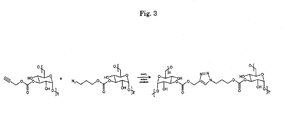
- This reaction between an azide and an alkyne leads to the formation of a cyclic 1,2,3-triazole structure.
- It is often used in combination with a copper-(I) or -(II) catalyst, preferably with copper sulphate in the presence of a reducing agent such as sodium ascorbate.
- the polymer may be modified such as to have at least two azide or alkyne groups per macromolecule.
- An azide group may be introduced to a macromolecule via small azides such as 3-azidopropanol.
- An example for a reagent which is useful for introducing an alkyne group is propargyl alcohol.
- the reagent by which the required functionalities are introduced will also determine the linker, i.e. the chemical structure linking the macromolecule and the functional group.
- At least one of the moieties capable of undergoing cycloaddition is connected to the hydrophilic backbone through a linker which comprises a bond which is hydrolysable under physiological conditions, such as a carbonate bond.
- a linker which comprises a bond which is hydrolysable under physiological conditions, such as a carbonate bond.
- bonds which are hydrolysable under physiological conditions include lactate, glycolate, succinate, and peptide bonds.
- ester bonds may be highly hydrolysable depending on the chemical nature of their neighbouring groups or moieties.
- a lactate or glycolate group or unit is the divalent unit derived from lactic or glycolic acid as it is e.g. present in poly(lactic acid) or poly(glycolic acid), respectively.
- a succinate group or unit is a divalent unit derived from succinic acid.
- Peptide bonds are the amide bonds between amino acids linked through their amino- and carboxylic acid groups, respectively. All these groups have been used in monomeric, oligomeric, or polymeric form in humans for a significant time, and therefore they can be considered safe.
- hydrolysability of a bond such as an amide or ester bond may also depend on the properties of the atoms or moieties in the neighbourhood of the bond.
- an amide or ester bond will not fulfil this condition unless the bond is relatively labile due to the effect of neighbouring atoms or groups.
- a carbonate ester bond will generally have the required degree of hydrolytic lability.
- bonds may be selected which exhibit at least 50% hydrolysis under physiological conditions within a period of not more than about a year, or which hydrolyse substantially completely within about a year or less.
- the time for at least 50% hydrolysis to occur may also range from about one day to about 6 months, and in particular from about 3 days to about 3 months, or from about one week to about 2 months, respectively.
- the hydrolysability of the bonds is selected to ensure that a crosslinked hydrogel which is prepared from two polymers as defined herein hydrolyses under physiological conditions within a period of less than about one year into hydrolysis products having a molecular weight of not more than about 150,000.
- the molecular weight of the hydrolysis products may be less than about 100,000, or less than about 80,000, or less than about 70,000, respectively, in order to facilitate the elimination from the body of a patient to whom the hydrogel is administered.
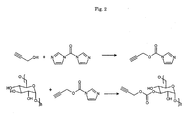
- the introduction of a highly hydrolysable group which readily hydrolyses under physiological conditions may be achieved, for example, by using carbonyl diimidazole (CDI) as activator of the hydroxyl group of certain useful reagents such as propargylalcohol or 3-azidopropanol.
- CDI carbonyl diimidazole
- the activated reagents can easily be coupled to free hydroxyl groups of many types of hydrophilic polymers, such as polysaccharides. In this way, hydrophilic polymers having pendant azidopropylcarbonate or propargylcarbonate moieties are formed.
- CDI carbonyl diimidazole
- substantially all linkers of a thus modified polymer that are cycloaddition reactive are connected via linkers which each include at least one highly hydrolysable group.
- some or all of the linkers may also comprise two or more of such highly hydrolysable groups as defined herein.
- both species of cycloaddition reactive moieties i.e. the cycloaddition reactive moieties of two polymers which are capable of forming a hydrogel with each other, are connected to their respective polymer backbones via linkers having at least one bond which is hydrolysable under physiological conditions each.
- An advantage of this particular embodiment is that a crosslinked hydrogel which is prepared from such polymers may be designed to hydrolyse into the native or unmodified polymers with high biocompatibility and only one species of a low molecular weight hydrolysis product which is likely to be eliminated easily from a physiological environment.
- polymer chains themselves are selected to be chemically identical except for the cycloaddition reactive moieties which have to be complementary (e,g . azide and alkyne), the additional advantage of obtaining only one higher molecular weight hydrolysis product is obtained.
- CDI-activated propargylalcohol and CDI-activated 3-azidopropanol are separately used for the introduction of linkers that each comprise a carbonate ester group which is highly hydrolysable and either an azide or an alkyne moiety, the hydrogel which results from crosslinking the two modified polymers would hydrolyse in a physiological environment into dextran and one low molecular weight triazole compound only, thus substantially reducing the risk of poor tolerability.
- the degree of substitution with respect to the cycloaddition reactive moieties typically has a large impact on the crosslinking density, swelling and degradation behaviour of a hydrogel prepared from the respective polymers.
- the degree of substitution the desired use, but also the nature and molecular weight of the monomeric units of the polymer backbone(s) should be taken into consideration.
- a normally useful degree of substitution for drug delivery and tissue engineering applications may be selected in the range from about 1 to about 50 cycloaddition reactive moieties per 100 saccharide monomers, i,e. representing a degree of substitution (DS) from about 1 to about 50.
- the degree of substitution may be selected in the range from about 2 to 30, such as about 5, 10, 15, or 20.
- the invention is directed to a method of making a hydrogel which relies on the use of one or more polymers as described above. More precisely, the method is characterised by the steps of (a) providing a first and a second polymer, each of the polymers comprising a hydrophilic polymeric backbone and a moiety capable of undergoing cycloaddition, the moiety of the first polymer being reactive with the moiety of the second polymer; and (b) allowing the first and the second polymer to react with each other to form a cycloaddition product. Furthermore, the reactive moiety of at least one of the polymers is connected to the backbone through a linker which comprises a bond or linkage which is hydrolysable under physiological conditions. In a particular embodiment, one or both of the polymers comprise at least two moieties which are capable of undergoing a cycloaddition reaction.
- the same teachings regarding the selection of the polymer backbone, the bond which is hydrolysable under physiological conditions and the cycloaddition reactive moieties may be applied in the same manner as has been put forth in the context of the polymer claimed and described herein.
- the method is conducted in such as way that both the first and the second polymer are selected to be polymers according to the present invention, which means amongst others that both polymers have at least one linker per main chain which comprises a bond which is hydrolysable under physiological conditions.
- only one of the polymers comprises one or more bonds which are hydrolysable under physiological conditions in its linkers through which the cycloaddition reactive moieties are connected to the backbone.
- the method is conducted by allowing two polymers based on substantially the same backbone to react with each other, leading to a chemically crosslinked hydrogel comprising a three-dimensional polymeric network based on a single macromolecular species.
- two polysaccharides or polypeptides of the same chemical type may be used of which one comprises a first cycloaddition reactive moiety and the other a second cycloaddition reactive moiety which is reactive with the first moiety.
- two modified dextrans which are cycloaddition reactive with each other are combined to carry out the method, such as dextran-azidopropylcarbonate and dextran-propargylcarbonate.
- the hydrogel which results from the method comprises an active compound, such as a drug substance or a diagnostic agent
- an active compound such as a drug substance or a diagnostic agent
- the cycloaddition reaction is carried out at a temperature of not more than about 40 °C, or not more than about 35 °C, or not more than about 30 °C, or not more than about room temperature, or at a temperature in the range from about 0 °C to about 25 °C, such as about 4 to 20 °C, or about 6 to 15 °C.
- the reaction is also conducted under normal pressure.
- the reaction may be carried out in the substantial absence of lipophilic organic solvents, which solvents would bring about the risk of detrimentally affecting the bioactivity of the active compound.
- the cycloaddition is a Huisgen-type dipolar cycloaddition, it may be triggered by the addition of a suitable catalyst, such as copper-(I) or copper-(II) ions and salts.
- a suitable catalyst such as copper-(I) or copper-(II) ions and salts.
- a combination of CuSO 4 and sodium ascorbate effectively triggers most azide-alkyne cycloadditions in an aqueous medium.
- the hydrogel prepared by the method is in the form of microparticles or microspheres, it is considered a useful option to carry out the reaction between the first and the second polymer in an emulsion, i.e. in the dispersed or discontinuous phase of an emulsion.
- the emulsion phase comprising the reacting polymers may be an aqueous phase, which means that the solvent of the phase is water, a hydrophilic liquid miscible with water such as glycerol or liquid polyethylene glycol, or a mixture of water and one or more of such water-miscible liquids.
- the dispersed aqueous phase may be comprised in a w/w-emulsion, a w/o-emulsion, or a double emulsion.
- the first and the second cycloaddition reactive polymer are dissolved in the dispersed aqueous phase of a w/w-emulsion whose continuous phase comprises a compound which is capable of aqueous phase separation when combined with the first and/or the second polymer.
- the outer phase of the w/w-emulsion may comprise polyethylene glycol which has a limited phase compatibility with dextrans in water.
- the crosslinking reaction may be conducted in an all aqueous system, preferably in the absence of an organic solvent that is not - in principle - water-miscible.
- the droplet size of the emulsion which may be decreased e.g. by mechanical means such as high-pressure homogenisation or ultra-turraxing, may be selected to determine the particle size of the crosslinked hydrogel microparticles.
- the first and the second polymer may be dissolved in water, subsequently combined with a continuous phase or, if applicable, a phase separation agent such as PEG, optionally homogenised to obtain the desired droplet size. Then, the cycloaddition reaction and thereby the crosslinking of the hydrogel may be started by the addition of the catalyst or catalyst mixture to the emulsion.
- a mixture of copper sulphate and sodium ascorbate may be added to start the crosslinking reaction.
- the selection of a dextran or dextran derivative as hydrophilic polymer on which the hydrogel is based is particularly useful as the w/w-emulsion method which works under particularly mild conditions as described above can be used.
- the selection of a dextran or dextran derivative is advantageous because dextrans are readily available at moderate cost and have a remarkable biocompatibility and safety record.
- the method can be carried out in the presence of an active compound, typically resulting in the incorporation of the active compound within the hydrogel prepared by the method.
- active compounds typically are those which are used in chronical or long-term treatment regimen and/or which have a low oral bioavailability, such as hormones, growth factors, hormone antagonists, antipsychotics, antidepressants, cardiovascular drugs, and the like.
- a preferred class of active compounds is that of peptides and proteins, in particular proteins, which can be delivered effectively with the gel compositions of the invention, providing drug release over extended time periods, thus eliminating the need for the frequent injection of these compounds.
- erythropoetins such as epoetin alpha, epoetin beta, darbepoetin, haemoglobin raffimer, and analogues or derivatives thereof; interferons, such as interferon alpha, interferon alpha-2b, PEG-interferon alpha-2b, interferon alpha-2a, interferon beta, interferon beta-1a and interferon gamma; insulins; antibodies, such as rituximab, infliximab, trastuzumab, adalimumab, omalizumab, tositumomab, efalizumab, and cetuximab; antibody fragments; blood factors such as alteplase, tenecteplase, factor VII(a), factor VIII; colony stimulating factors such as filgrastim, pegfilgrastim; growth hormones such as
- Antigens and vaccines whether these constitute peptides, proteins, lipoproteins, polysaccharides, live or inactivated microorganisms or viruses, or subunits thereof, including any adjuvants capable of increasing an immune response triggered by an antigen or vaccine, form another preferred group of active compounds for whose delivery the present invention is useful.
- preferred active compounds are polysaccharides and oligo- or polynucleotides, DNA, RNA, iRNA, hormones, cytostatic agents, cytotoxic agents, antibiotics, and living cells.
- Another class of preferred active compounds comprises drug substances acting on the central nervous system, even if they are small molecules and orally bioavailable, for example risperidone, zuclopenthixol, fluphenazine, perphenazine, flupentixol, haloperidol, fluspirilen, quetiapine, clozapine, amisulprid, sulpirid, ziprasidon, etc.
- the active compound may be a native living cell, a fragment of a living cell, a modified cell, or a plurality of cells.
- Encapsulated or immobilized cells can potentially be injected or implanted to replace physiological functions which are absent in a patient due to a specific disease or condition.
- diabetes patients could be treated with gel-encapsulated Langerhans cells which can produce and secrete insulin.
- both the living cells and the insulin could be considered as the active compound.
- the active compound may be incorporated in the form of drug-loaded colloidal carriers, such as nanoparticles, nanocapsules, liposomes, lipoplexes, lipid complexes, iscoms, polyplexes, solid lipid nanoparticles, virosomes, or drug conjugates.
- drug-loaded colloidal carriers such as nanoparticles, nanocapsules, liposomes, lipoplexes, lipid complexes, iscoms, polyplexes, solid lipid nanoparticles, virosomes, or drug conjugates.
- the invention is directed to the hydrogel itself which may be prepared according to the method described above.
- the hydrogel comprises a network of hydrophilic polymeric chains which are interconnected to each other through covalent crosslinks. At least some of the linkers comprise at least one bond which is hydrolysable under physiological conditions and at least one moiety which is a cycloaddition product.
- the hydrogel may be prepared from one or more polymers as provided by the invention and disclosed above. It may optionally be in the form of microparticles or microspheres.
- hydrogels predominantly comprising crosslinked polysaccharide chains are very suitable for the incorporation and the controlled delivery of active compounds.
- the hydrophilic polymeric chains are preferably crosslinked by low molecular weight linkers each comprising one or two bond which is hydrolysable under physiological conditions, such as carbonate ester bonds.
- the rate of biodegradation of the hydrogel may be adjusted to the particular purpose or intended use. It depends inter alia on the relative number of crosslinks and on the number and chemical nature of the bond which is hydrolysable under physiological conditions in the crosslinks. Depending on the choice of the backbones, these may also contribute to the overall degradation rate of the hydrogel. For example, if the hydrogel is based on polypeptide backbones, the backbones themselves may hydrolyse appreciably over periods of weeks or months, whereas in the case of many polysaccharide-based hydrogels the degradation will predominantly occur through the hydrolysis of the crosslinkers, i.e . of the bond which is hydrolysable under physiological conditions in the linkers.
- the hydrogels as well as the compositions may optionally comprise further excipients. These are preferably selected from those excipients which are commonly used in pharmaceutical or food technology. They are primarily used to influence the performance of the formulation, such as the release profile, the viscosity and injectability, or the tolerability. Also, excipients may be used in response to the specific requirements resulting from the nature of the active ingredient, such as stabilisers. Common pharmaceutical excipients which may be useful in hydrogel formulations are humectants, bulking agent, stabilisers, wetting agents, pore forming agents, antioxidants, colouring agents, substances for adjusting the pH and/or the tonicity and the like.
- the formulations must be sterile. Sterility can be achieved by the selection of appropriate manufacturing processes such as aseptical processing and/or sterilisation of the final product.
- hydrogels may also be dried, and provided in a rewettable form.
- a kit from which the hydrogel composition, or a formulation comprising such a composition can be prepared.
- the kit may comprise a first primary package containing a solid-state material, such as granules, a powder, or a lyophilisate, comprising a hydrogel-based composition in a dried state, also referred to as a xerogel; and a second primary package containing a liquid for reconstituting the xerogel to form the hydrogel composition.
- the liquid comprises water and, optionally, further excipients, such as salts, stabilisers, surfactants etc.
- the active compound may be present in the xerogel, or in the liquid for reconstitution, or within a third component of the kit.
- the xerogel may be in the form of microparticles.
- the hydrogel compositions of the invention may also be used for tissue engineering applications, or as wound dressings.
- the compositions may or may not comprise a pharmaceutically active compound as defined above.
- wound dressings in the form of hydrogel sheets may be useful to cover and protect a wound, which may be sufficient in some instances. In other cases, it may be more useful to incorporate an antimicrobial compound to prevent or treat local infections.
- Example 1 Preparation of dextran-azidopropylcarbonate (dex-N 3 ).
- Dextran-azidopropylcarbonate is a polymer comprising azide moieties that are capable of undergoing a cycloaddition reaction.
- the azide groups are connected to the dextran backbone via linkers that comprise a highly hydrolysable carbonate bond.
- 3-azidopropyl carbonylimidazole was synthesised.
- a dry round bottomed flask was charged with 18.24 g ( 112.5 mMol) carbonyldiimidazole (CDI) and 200 ml ethyl acetate yielding a turbid suspension.
- Ethyl acetate was used as solvent instead of dichloromethane to avoid the formation of diazomethane which is prone to detonation. 6.96 ml (75 mMol, 7.58 g) 3-azidopropanol was added dropwise under vigorous stirring while the reaction mixture turned into a clear solution.
- dextran-azidopropylcarbonate (dex-N 3 ) with a degree of substitution of approx. 20 was prepared by coupling 3-azidopropyl carbonyldiimidazole ("activated azidopropanol") to dextran.
- dextran corresponding to 6.167 mMol glucopyranose repeating units
- 20 ml anhydrous DMSO 20 ml anhydrous DMSO.
- Dextran-propargylcarbonate is a polymer comprising alkyne moieties that are capable of undergoing a cycloaddition reaction.
- the alkyne groups are connected to the dextran backbone via linkers that comprise a highly hydrolysable carbonate bond.
- propargyl carbonylimidazole was synthesised as follows. A dry round bottomed flask was charged with 29.19 g (180 mMol) CDI and 200 ml dichloromethane yielding a turbid suspension. 5.82 ml (100 mMol) propargyl alcohol was added under vigorous stirring yielding a clear solution upon dissolution of the propargyl alcohol. After 1 h reaction at room temperature the to mixture was extracted three times with 35 ml water. The organic layer was dried over magnesium sulfate.
- the activated propargyl alcohol i.e. propargyl carbonylimidazole
- dextran corresponding to 6.167 mMol glucopyranose repeating units
- 20 ml anhydrous DMSO 20 ml anhydrous DMSO.
- PA-CI 280 mg (1.86 mMol) PA-CI was added and the reaction was stirred overnight at 50°C under a nitrogen atmosphere. Subsequently the reaction mixture was put in dialysis bags (Mw cut off 3.5 kDa; Spectra Por) and dialysed against pure water for 5 days.
- Example 3 Preparation of hydrogel microparticles from dextran-propargylcarbonate and dextran-azidopropylcarbonate.
- Example 4 Degradation of hydrogel microparticles from dextran-propargylcarbonate and dextran-azidopropylcarbonate.
- Hydrogel microparticles incorporating FITC-dextran prepared according to example 3 were placed in a 15 ml conical centrifugation tube, dispersed in 10 ml PBS with sodium chloride (0.15 Mol) and adjusted to pH 7.4, and incubated at 37°C under continuous shaking. At regular time intervals the tubes were centrifuged (1000 g/ 10 min) and 1 ml of the supernatant is withdrawn and replaced by fresh PBS. The tubes were then vortexed to redisperse the microcapsules and the tubes are placed back at 37°C under continuous shaking.
- the release of the incorporated FITC-dextran marker is at least partially related to the hydrolytic degradation of the hydrogel, which is assumed to occur predominantly by the hydrolysis of carbonate ester bonds which are part of the crosslinks of the hydrogel, as shown in fig. 5 .
Landscapes
- Chemical & Material Sciences (AREA)
- Health & Medical Sciences (AREA)
- Chemical Kinetics & Catalysis (AREA)
- Life Sciences & Earth Sciences (AREA)
- Organic Chemistry (AREA)
- Polymers & Plastics (AREA)
- Medicinal Chemistry (AREA)
- Molecular Biology (AREA)
- Materials Engineering (AREA)
- Biochemistry (AREA)
- Engineering & Computer Science (AREA)
- General Health & Medical Sciences (AREA)
- Medicinal Preparation (AREA)
Priority Applications (1)
| Application Number | Priority Date | Filing Date | Title |
|---|---|---|---|
| EP07113559A EP2090592A1 (fr) | 2007-07-31 | 2007-07-31 | Hydrogels biodégradables obtenus par cycloaddition (chimie click) |
Applications Claiming Priority (1)
| Application Number | Priority Date | Filing Date | Title |
|---|---|---|---|
| EP07113559A EP2090592A1 (fr) | 2007-07-31 | 2007-07-31 | Hydrogels biodégradables obtenus par cycloaddition (chimie click) |
Publications (1)
| Publication Number | Publication Date |
|---|---|
| EP2090592A1 true EP2090592A1 (fr) | 2009-08-19 |
Family
ID=38777265
Family Applications (1)
| Application Number | Title | Priority Date | Filing Date |
|---|---|---|---|
| EP07113559A Withdrawn EP2090592A1 (fr) | 2007-07-31 | 2007-07-31 | Hydrogels biodégradables obtenus par cycloaddition (chimie click) |
Country Status (1)
| Country | Link |
|---|---|
| EP (1) | EP2090592A1 (fr) |
Cited By (35)
| Publication number | Priority date | Publication date | Assignee | Title |
|---|---|---|---|---|
| US8034396B2 (en) | 2008-04-01 | 2011-10-11 | Tyco Healthcare Group Lp | Bioadhesive composition formed using click chemistry |
| WO2012116250A1 (fr) | 2011-02-25 | 2012-08-30 | University Of Massachusetts Medical School | Monomères et polymères pour polycarbonates et poly(ester-carbonates) fonctionnels et hydrogels de peg-co-polycarbonate |
| WO2012146218A1 (fr) | 2011-04-24 | 2012-11-01 | Contipro Biotech S.R.O. | Matériaux amphotères à base d'acide hyaluronique réticulé, procédé de préparation associé, matériaux contenant des agents actifs, procédé de préparation associé, et utilisation desdits matériaux |
| US8512728B2 (en) | 2009-02-21 | 2013-08-20 | Sofradim Production | Method of forming a medical device on biological tissue |
| US8535477B2 (en) | 2009-02-21 | 2013-09-17 | Sofradim Production | Medical devices incorporating functional adhesives |
| CN103396554A (zh) * | 2013-07-02 | 2013-11-20 | 苏州大学 | 一种水凝胶、其制备方法及应用 |
| US8648144B2 (en) | 2009-02-21 | 2014-02-11 | Sofradim Production | Crosslinked fibers and method of making same by extrusion |
| US8663689B2 (en) | 2009-02-21 | 2014-03-04 | Sofradim Production | Functionalized adhesive medical gel |
| US8795331B2 (en) | 2010-03-25 | 2014-08-05 | Covidien Lp | Medical devices incorporating functional adhesives |
| US8865857B2 (en) | 2010-07-01 | 2014-10-21 | Sofradim Production | Medical device with predefined activated cellular integration |
| US8877170B2 (en) | 2009-02-21 | 2014-11-04 | Sofradim Production | Medical device with inflammatory response-reducing coating |
| EP2716662A4 (fr) * | 2011-05-31 | 2014-11-19 | Univ Tokyo | Hydrogel et son procédé de fabrication |
| US8956603B2 (en) | 2009-02-21 | 2015-02-17 | Sofradim Production | Amphiphilic compounds and self-assembling compositions made therefrom |
| US8968818B2 (en) | 2009-02-21 | 2015-03-03 | Covidien Lp | Medical devices having activated surfaces |
| US8969473B2 (en) | 2009-02-21 | 2015-03-03 | Sofradim Production | Compounds and medical devices activated with solvophobic linkers |
| US8968733B2 (en) | 2009-02-21 | 2015-03-03 | Sofradim Production | Functionalized surgical adhesives |
| WO2014152488A3 (fr) * | 2013-03-15 | 2015-03-05 | Dreher Matthew R | Microsphère embolique imageable |
| CN104403102A (zh) * | 2014-12-15 | 2015-03-11 | 东南大学 | 一种利用“一锅法”制备金属配位聚合物凝胶的方法 |
| US9039979B2 (en) | 2009-02-21 | 2015-05-26 | Sofradim Production | Apparatus and method of reacting polymers passing through metal ion chelated resin matrix to produce injectable medical devices |
| US9247931B2 (en) | 2010-06-29 | 2016-02-02 | Covidien Lp | Microwave-powered reactor and method for in situ forming implants |
| US9272074B2 (en) | 2010-03-25 | 2016-03-01 | Sofradim Production | Surgical fasteners and methods for sealing wounds |
| US9273191B2 (en) | 2009-02-21 | 2016-03-01 | Sofradim Production | Medical devices with an activated coating |
| US9375699B2 (en) | 2009-02-21 | 2016-06-28 | Sofradim Production | Apparatus and method of reacting polymers by exposure to UV radiation to produce injectable medical devices |
| US9523159B2 (en) | 2009-02-21 | 2016-12-20 | Covidien Lp | Crosslinked fibers and method of making same using UV radiation |
| US9555154B2 (en) | 2009-02-21 | 2017-01-31 | Covidien Lp | Medical devices having activated surfaces |
| US9775928B2 (en) | 2013-06-18 | 2017-10-03 | Covidien Lp | Adhesive barbed filament |
| US9895452B2 (en) | 2013-09-06 | 2018-02-20 | Biocompatibles Uk Limited | Imageable polymers |
| US9987297B2 (en) | 2010-07-27 | 2018-06-05 | Sofradim Production | Polymeric fibers having tissue reactive members |
| US10350295B2 (en) | 2013-09-06 | 2019-07-16 | Biocompatibles Uk Ltd. | Radiopaque polymers |
| KR102018979B1 (ko) * | 2018-03-27 | 2019-09-05 | 전북대학교산학협력단 | pH 감응형 말토덱스트린 공중합체 및 이를 포함하는 약물 전달체 |
| WO2020206174A1 (fr) * | 2019-04-03 | 2020-10-08 | 10X Genomics, Inc. | Compositions, procédés et systèmes pour la formation de perles à l'aide de polymères améliorés |
| US10837047B2 (en) | 2017-10-04 | 2020-11-17 | 10X Genomics, Inc. | Compositions, methods, and systems for bead formation using improved polymers |
| CN112074303A (zh) * | 2018-05-08 | 2020-12-11 | 亚州大学校产学协力团 | 通过点击化学反应的用作填充剂或药物载体的注射制剂组合物 |
| KR20220147435A (ko) * | 2021-04-27 | 2022-11-03 | 주식회사 켐얼라이언스 | 카르밤산염 화합물의 제조방법 |
| US11642415B2 (en) | 2017-03-22 | 2023-05-09 | Ascendis Pharma A/S | Hydrogel cross-linked hyaluronic acid prodrug compositions and methods |
Citations (4)
| Publication number | Priority date | Publication date | Assignee | Title |
|---|---|---|---|---|
| WO1998030575A1 (fr) * | 1997-01-08 | 1998-07-16 | Proligo Llc | Bioconjugaison de macromolecules |
| US20020051788A1 (en) * | 2000-08-09 | 2002-05-02 | Vince Pozsgay | Conjugation of biomolecules using Diels-Alder cycloaddition |
| WO2004055160A2 (fr) * | 2002-12-13 | 2004-07-01 | The Trustees Of Columbia University In The City Of New York | Methodes de couplage biomoleculaire par cycloaddition 1,3-dipolaire |
| WO2007003054A1 (fr) * | 2005-07-06 | 2007-01-11 | Shoichet Molly S | Procede d'immobilisation de biomolecule sur des polymeres faisant intervenir des reactions chimiques du type rapide |
-
2007
- 2007-07-31 EP EP07113559A patent/EP2090592A1/fr not_active Withdrawn
Patent Citations (4)
| Publication number | Priority date | Publication date | Assignee | Title |
|---|---|---|---|---|
| WO1998030575A1 (fr) * | 1997-01-08 | 1998-07-16 | Proligo Llc | Bioconjugaison de macromolecules |
| US20020051788A1 (en) * | 2000-08-09 | 2002-05-02 | Vince Pozsgay | Conjugation of biomolecules using Diels-Alder cycloaddition |
| WO2004055160A2 (fr) * | 2002-12-13 | 2004-07-01 | The Trustees Of Columbia University In The City Of New York | Methodes de couplage biomoleculaire par cycloaddition 1,3-dipolaire |
| WO2007003054A1 (fr) * | 2005-07-06 | 2007-01-11 | Shoichet Molly S | Procede d'immobilisation de biomolecule sur des polymeres faisant intervenir des reactions chimiques du type rapide |
Non-Patent Citations (2)
| Title |
|---|
| CRESCENZI VITTORIO ET AL: "Novel hydrogels via click chemistry: synthesis and potential biomedical applications.", BIOMACROMOLECULES JUN 2007, vol. 8, no. 6, June 2007 (2007-06-01), pages 1844 - 1850, XP002461327, ISSN: 1525-7797 * |
| MALKOCH MICHAEL ET AL: "Synthesis of well-defined hydrogel networks using click chemistry.", CHEMICAL COMMUNICATIONS (CAMBRIDGE, ENGLAND) 14 JUL 2006, no. 26, 14 July 2006 (2006-07-14), pages 2774 - 2776, XP002462132, ISSN: 1359-7345 * |
Cited By (60)
| Publication number | Priority date | Publication date | Assignee | Title |
|---|---|---|---|---|
| US8034396B2 (en) | 2008-04-01 | 2011-10-11 | Tyco Healthcare Group Lp | Bioadhesive composition formed using click chemistry |
| US9511175B2 (en) | 2009-02-21 | 2016-12-06 | Sofradim Production | Medical devices with an activated coating |
| US8956603B2 (en) | 2009-02-21 | 2015-02-17 | Sofradim Production | Amphiphilic compounds and self-assembling compositions made therefrom |
| US8512728B2 (en) | 2009-02-21 | 2013-08-20 | Sofradim Production | Method of forming a medical device on biological tissue |
| US8535477B2 (en) | 2009-02-21 | 2013-09-17 | Sofradim Production | Medical devices incorporating functional adhesives |
| US10632207B2 (en) | 2009-02-21 | 2020-04-28 | Sofradim Production | Compounds and medical devices activated with solvophobic linkers |
| US8648144B2 (en) | 2009-02-21 | 2014-02-11 | Sofradim Production | Crosslinked fibers and method of making same by extrusion |
| US8663689B2 (en) | 2009-02-21 | 2014-03-04 | Sofradim Production | Functionalized adhesive medical gel |
| US9375699B2 (en) | 2009-02-21 | 2016-06-28 | Sofradim Production | Apparatus and method of reacting polymers by exposure to UV radiation to produce injectable medical devices |
| US9517291B2 (en) | 2009-02-21 | 2016-12-13 | Covidien Lp | Medical devices having activated surfaces |
| US8877170B2 (en) | 2009-02-21 | 2014-11-04 | Sofradim Production | Medical device with inflammatory response-reducing coating |
| US9510810B2 (en) | 2009-02-21 | 2016-12-06 | Sofradim Production | Medical devices incorporating functional adhesives |
| US9523159B2 (en) | 2009-02-21 | 2016-12-20 | Covidien Lp | Crosslinked fibers and method of making same using UV radiation |
| US10167371B2 (en) | 2009-02-21 | 2019-01-01 | Covidien Lp | Medical devices having activated surfaces |
| US8968818B2 (en) | 2009-02-21 | 2015-03-03 | Covidien Lp | Medical devices having activated surfaces |
| US8969473B2 (en) | 2009-02-21 | 2015-03-03 | Sofradim Production | Compounds and medical devices activated with solvophobic linkers |
| US8968733B2 (en) | 2009-02-21 | 2015-03-03 | Sofradim Production | Functionalized surgical adhesives |
| US9550164B2 (en) | 2009-02-21 | 2017-01-24 | Sofradim Production | Apparatus and method of reacting polymers passing through metal ion chelated resin matrix to produce injectable medical devices |
| US9555154B2 (en) | 2009-02-21 | 2017-01-31 | Covidien Lp | Medical devices having activated surfaces |
| US9421296B2 (en) | 2009-02-21 | 2016-08-23 | Covidien Lp | Crosslinked fibers and method of making same by extrusion |
| US9273191B2 (en) | 2009-02-21 | 2016-03-01 | Sofradim Production | Medical devices with an activated coating |
| US9039979B2 (en) | 2009-02-21 | 2015-05-26 | Sofradim Production | Apparatus and method of reacting polymers passing through metal ion chelated resin matrix to produce injectable medical devices |
| US9216226B2 (en) | 2009-02-21 | 2015-12-22 | Sofradim Production | Compounds and medical devices activated with solvophobic linkers |
| US8795331B2 (en) | 2010-03-25 | 2014-08-05 | Covidien Lp | Medical devices incorporating functional adhesives |
| US9272074B2 (en) | 2010-03-25 | 2016-03-01 | Sofradim Production | Surgical fasteners and methods for sealing wounds |
| US9554782B2 (en) | 2010-03-25 | 2017-01-31 | Covidien Lp | Medical devices incorporating functional adhesives |
| US10143471B2 (en) | 2010-03-25 | 2018-12-04 | Sofradim Production | Surgical fasteners and methods for sealing wounds |
| US9247931B2 (en) | 2010-06-29 | 2016-02-02 | Covidien Lp | Microwave-powered reactor and method for in situ forming implants |
| US8865857B2 (en) | 2010-07-01 | 2014-10-21 | Sofradim Production | Medical device with predefined activated cellular integration |
| US9987297B2 (en) | 2010-07-27 | 2018-06-05 | Sofradim Production | Polymeric fibers having tissue reactive members |
| US9388276B2 (en) | 2011-02-25 | 2016-07-12 | University Of Massachusetts | Monomers and polymers for functional polycarbonates and poly(ester-carbonates) and PEG-co-polycarbonate hydrogels |
| WO2012116250A1 (fr) | 2011-02-25 | 2012-08-30 | University Of Massachusetts Medical School | Monomères et polymères pour polycarbonates et poly(ester-carbonates) fonctionnels et hydrogels de peg-co-polycarbonate |
| EP2678326A4 (fr) * | 2011-02-25 | 2015-03-04 | Univ Massachusetts Medical | Monomères et polymères pour polycarbonates et poly(ester-carbonates) fonctionnels et hydrogels de peg-co-polycarbonate |
| WO2012146218A1 (fr) | 2011-04-24 | 2012-11-01 | Contipro Biotech S.R.O. | Matériaux amphotères à base d'acide hyaluronique réticulé, procédé de préparation associé, matériaux contenant des agents actifs, procédé de préparation associé, et utilisation desdits matériaux |
| EP2716662A4 (fr) * | 2011-05-31 | 2014-11-19 | Univ Tokyo | Hydrogel et son procédé de fabrication |
| JPWO2012165462A1 (ja) * | 2011-05-31 | 2015-02-23 | 国立大学法人 東京大学 | ハイドロゲル及びその製造方法 |
| US10307493B2 (en) | 2013-03-15 | 2019-06-04 | Biocompatible UK Limited | Imageable embolic microsphere |
| CN105517580A (zh) * | 2013-03-15 | 2016-04-20 | 马修·R·德勒埃 | 可成像栓塞微球 |
| US11672876B2 (en) | 2013-03-15 | 2023-06-13 | Biocompatibles Uk Limited | Imageable embolic microsphere |
| WO2014152488A3 (fr) * | 2013-03-15 | 2015-03-05 | Dreher Matthew R | Microsphère embolique imageable |
| US9775928B2 (en) | 2013-06-18 | 2017-10-03 | Covidien Lp | Adhesive barbed filament |
| CN103396554B (zh) * | 2013-07-02 | 2015-04-29 | 苏州大学 | 一种水凝胶、其制备方法及应用 |
| CN103396554A (zh) * | 2013-07-02 | 2013-11-20 | 苏州大学 | 一种水凝胶、其制备方法及应用 |
| US10556022B2 (en) | 2013-09-06 | 2020-02-11 | Biocompatibles Uk Ltd. | Imageable polymers |
| US10098972B2 (en) | 2013-09-06 | 2018-10-16 | Biocompatibles Uk Ltd. | Imageable polymers |
| US9895452B2 (en) | 2013-09-06 | 2018-02-20 | Biocompatibles Uk Limited | Imageable polymers |
| US10350295B2 (en) | 2013-09-06 | 2019-07-16 | Biocompatibles Uk Ltd. | Radiopaque polymers |
| US10568967B2 (en) | 2013-09-06 | 2020-02-25 | Biocompatibles Uk Ltd. | Radiopaque polymers |
| CN104403102A (zh) * | 2014-12-15 | 2015-03-11 | 东南大学 | 一种利用“一锅法”制备金属配位聚合物凝胶的方法 |
| US11642415B2 (en) | 2017-03-22 | 2023-05-09 | Ascendis Pharma A/S | Hydrogel cross-linked hyaluronic acid prodrug compositions and methods |
| US12246070B2 (en) | 2017-03-22 | 2025-03-11 | Ascendis Pharma A/S | Hydrogel cross-linked hyaluronic acid prodrug compositions and methods |
| US10837047B2 (en) | 2017-10-04 | 2020-11-17 | 10X Genomics, Inc. | Compositions, methods, and systems for bead formation using improved polymers |
| US11441172B2 (en) | 2017-10-04 | 2022-09-13 | 10X Genomics, Inc. | Compositions, methods, and systems for bead formation using improved polymers |
| US11884964B2 (en) | 2017-10-04 | 2024-01-30 | 10X Genomics, Inc. | Compositions, methods, and systems for bead formation using improved polymers |
| US12624384B2 (en) | 2017-10-04 | 2026-05-12 | 10X Genomics, Inc. | Compositions, methods, and systems for bead formation using improved polymers |
| KR102018979B1 (ko) * | 2018-03-27 | 2019-09-05 | 전북대학교산학협력단 | pH 감응형 말토덱스트린 공중합체 및 이를 포함하는 약물 전달체 |
| CN112074303A (zh) * | 2018-05-08 | 2020-12-11 | 亚州大学校产学协力团 | 通过点击化学反应的用作填充剂或药物载体的注射制剂组合物 |
| WO2020206174A1 (fr) * | 2019-04-03 | 2020-10-08 | 10X Genomics, Inc. | Compositions, procédés et systèmes pour la formation de perles à l'aide de polymères améliorés |
| CN113874423A (zh) * | 2019-04-03 | 2021-12-31 | 10X基因组学有限公司 | 用于使用改进的聚合物形成珠粒的组合物、方法和系统 |
| KR20220147435A (ko) * | 2021-04-27 | 2022-11-03 | 주식회사 켐얼라이언스 | 카르밤산염 화합물의 제조방법 |
Similar Documents
| Publication | Publication Date | Title |
|---|---|---|
| Abasalizadeh et al. | Alginate-based hydrogels as drug delivery vehicles in cancer treatment and their applications in wound dressing and 3D bioprinting | |
| EP0910412B1 (fr) | Hydrogels hydrolysables pour liberation controlee | |
| US20100226985A1 (en) | Viscoelastic aqueous gels comprising microspheres | |
| Hudson et al. | Biopolymer nanoparticle production for controlled release of biopharmaceuticals | |
| US8703924B2 (en) | Chitosan composition | |
| Kumar et al. | Chitosan chemistry and pharmaceutical perspectives | |
| Watkins et al. | pH-responsive, lysine-based hydrogels for the oral delivery of a wide size range of molecules | |
| JPH11509256A (ja) | 多糖ゲル組成物 | |
| EP1183016B1 (fr) | Hydrogels stereocomplexes | |
| Bos et al. | Tissue reactions of in situ formed dextran hydrogels crosslinked by stereocomplex formation after subcutaneous implantation in rats | |
| US20070185008A1 (en) | Stereocomplex hydrogels with tunable degradation times | |
| US20080131512A1 (en) | Biodegradable hydrogels | |
| Kavitha et al. | Cellulose-derived materials for drug delivery applications | |
| EP3851130A1 (fr) | Formulation d'injection contenant un conjugué d'une charge d'acide poly-l-lactique et d'une charge d'acide hyaluronique, et son procédé de préparation | |
| CN119074638A (zh) | 一种基于氧化灵芝多糖的多肽水凝胶及应用 | |
| Majumdar | Cellulose-based hydrogels for drug delivery applications | |
| US9867787B2 (en) | Hypromellose-graft-chitosan and methods thereof for sustained drug delivery | |
| Gupta et al. | Biodegradable polymers—carriers for drug delivery | |
| WO2006075881A1 (fr) | Complexe acide cholanique-chitosane formant automatiquement des agregats et son procede de preparation | |
| Pandey et al. | Toward Eco‐friendly Nanotechnology‐based Polymers for Drug Delivery Applications | |
| Puri et al. | A prospective utilization of biodegradable polymers for controlled drug-delivery applications | |
| KR100752702B1 (ko) | 생분해성 고분자 나노입자 및 그 제조방법 | |
| Kaity et al. | Natural polymers for specialized formulations | |
| Naik et al. | Biodegradable and Biocompatible Natural Polymers in the Drug Delivery System–A New Trend toward the Enhancement of the Therapeutic Efficiencies | |
| LANKAPALLI et al. | APPLICATIONS OF BIODEGRADABLE NATURAL POLYMERS AS DRUG DELIVERY SYSTEMS: A REVIEW |
Legal Events
| Date | Code | Title | Description |
|---|---|---|---|
| PUAI | Public reference made under article 153(3) epc to a published international application that has entered the european phase |
Free format text: ORIGINAL CODE: 0009012 |
|
| AK | Designated contracting states |
Kind code of ref document: A1 Designated state(s): AT BE BG CH CY CZ DE DK EE ES FI FR GB GR HU IE IS IT LI LT LU LV MC MT NL PL PT RO SE SI SK TR |
|
| AX | Request for extension of the european patent |
Extension state: AL BA HR MK RS |
|
| AKX | Designation fees paid | ||
| REG | Reference to a national code |
Ref country code: DE Ref legal event code: 8566 |
|
| STAA | Information on the status of an ep patent application or granted ep patent |
Free format text: STATUS: THE APPLICATION IS DEEMED TO BE WITHDRAWN |
|
| 18D | Application deemed to be withdrawn |
Effective date: 20100220 |