EP2090931B1 - Positive Resistzusammensetzung und Strukturierungsverfahren - Google Patents
Positive Resistzusammensetzung und Strukturierungsverfahren Download PDFInfo
- Publication number
- EP2090931B1 EP2090931B1 EP09001923A EP09001923A EP2090931B1 EP 2090931 B1 EP2090931 B1 EP 2090931B1 EP 09001923 A EP09001923 A EP 09001923A EP 09001923 A EP09001923 A EP 09001923A EP 2090931 B1 EP2090931 B1 EP 2090931B1
- Authority
- EP
- European Patent Office
- Prior art keywords
- polymer
- group
- resist composition
- acid
- resist
- Prior art date
- Legal status (The legal status is an assumption and is not a legal conclusion. Google has not performed a legal analysis and makes no representation as to the accuracy of the status listed.)
- Active
Links
Images

Classifications
-
- G—PHYSICS
- G03—PHOTOGRAPHY; CINEMATOGRAPHY; ANALOGOUS TECHNIQUES USING WAVES OTHER THAN OPTICAL WAVES; ELECTROGRAPHY; HOLOGRAPHY
- G03F—PHOTOMECHANICAL PRODUCTION OF TEXTURED OR PATTERNED SURFACES, e.g. FOR PRINTING, FOR PROCESSING OF SEMICONDUCTOR DEVICES; MATERIALS THEREFOR; ORIGINALS THEREFOR; APPARATUS SPECIALLY ADAPTED THEREFOR
- G03F7/00—Photomechanical, e.g. photolithographic, production of textured or patterned surfaces, e.g. printing surfaces; Materials therefor, e.g. comprising photoresists; Apparatus specially adapted therefor
- G03F7/004—Photosensitive materials
- G03F7/039—Macromolecular compounds which are photodegradable, e.g. positive electron resists
-
- G—PHYSICS
- G03—PHOTOGRAPHY; CINEMATOGRAPHY; ANALOGOUS TECHNIQUES USING WAVES OTHER THAN OPTICAL WAVES; ELECTROGRAPHY; HOLOGRAPHY
- G03F—PHOTOMECHANICAL PRODUCTION OF TEXTURED OR PATTERNED SURFACES, e.g. FOR PRINTING, FOR PROCESSING OF SEMICONDUCTOR DEVICES; MATERIALS THEREFOR; ORIGINALS THEREFOR; APPARATUS SPECIALLY ADAPTED THEREFOR
- G03F7/00—Photomechanical, e.g. photolithographic, production of textured or patterned surfaces, e.g. printing surfaces; Materials therefor, e.g. comprising photoresists; Apparatus specially adapted therefor
- G03F7/004—Photosensitive materials
- G03F7/0045—Photosensitive materials with organic non-macromolecular light-sensitive compounds not otherwise provided for, e.g. dissolution inhibitors
-
- G—PHYSICS
- G03—PHOTOGRAPHY; CINEMATOGRAPHY; ANALOGOUS TECHNIQUES USING WAVES OTHER THAN OPTICAL WAVES; ELECTROGRAPHY; HOLOGRAPHY
- G03F—PHOTOMECHANICAL PRODUCTION OF TEXTURED OR PATTERNED SURFACES, e.g. FOR PRINTING, FOR PROCESSING OF SEMICONDUCTOR DEVICES; MATERIALS THEREFOR; ORIGINALS THEREFOR; APPARATUS SPECIALLY ADAPTED THEREFOR
- G03F7/00—Photomechanical, e.g. photolithographic, production of textured or patterned surfaces, e.g. printing surfaces; Materials therefor, e.g. comprising photoresists; Apparatus specially adapted therefor
- G03F7/004—Photosensitive materials
- G03F7/039—Macromolecular compounds which are photodegradable, e.g. positive electron resists
- G03F7/0392—Macromolecular compounds which are photodegradable, e.g. positive electron resists the macromolecular compound being present in a chemically amplified positive photoresist composition
-
- G—PHYSICS
- G03—PHOTOGRAPHY; CINEMATOGRAPHY; ANALOGOUS TECHNIQUES USING WAVES OTHER THAN OPTICAL WAVES; ELECTROGRAPHY; HOLOGRAPHY
- G03F—PHOTOMECHANICAL PRODUCTION OF TEXTURED OR PATTERNED SURFACES, e.g. FOR PRINTING, FOR PROCESSING OF SEMICONDUCTOR DEVICES; MATERIALS THEREFOR; ORIGINALS THEREFOR; APPARATUS SPECIALLY ADAPTED THEREFOR
- G03F7/00—Photomechanical, e.g. photolithographic, production of textured or patterned surfaces, e.g. printing surfaces; Materials therefor, e.g. comprising photoresists; Apparatus specially adapted therefor
- G03F7/004—Photosensitive materials
- G03F7/039—Macromolecular compounds which are photodegradable, e.g. positive electron resists
- G03F7/0392—Macromolecular compounds which are photodegradable, e.g. positive electron resists the macromolecular compound being present in a chemically amplified positive photoresist composition
- G03F7/0397—Macromolecular compounds which are photodegradable, e.g. positive electron resists the macromolecular compound being present in a chemically amplified positive photoresist composition the macromolecular compound having an alicyclic moiety in a side chain
-
- G—PHYSICS
- G03—PHOTOGRAPHY; CINEMATOGRAPHY; ANALOGOUS TECHNIQUES USING WAVES OTHER THAN OPTICAL WAVES; ELECTROGRAPHY; HOLOGRAPHY
- G03F—PHOTOMECHANICAL PRODUCTION OF TEXTURED OR PATTERNED SURFACES, e.g. FOR PRINTING, FOR PROCESSING OF SEMICONDUCTOR DEVICES; MATERIALS THEREFOR; ORIGINALS THEREFOR; APPARATUS SPECIALLY ADAPTED THEREFOR
- G03F7/00—Photomechanical, e.g. photolithographic, production of textured or patterned surfaces, e.g. printing surfaces; Materials therefor, e.g. comprising photoresists; Apparatus specially adapted therefor
- G03F7/20—Exposure; Apparatus therefor
- G03F7/2041—Exposure; Apparatus therefor in the presence of a fluid, e.g. immersion; using fluid cooling means
-
- G—PHYSICS
- G03—PHOTOGRAPHY; CINEMATOGRAPHY; ANALOGOUS TECHNIQUES USING WAVES OTHER THAN OPTICAL WAVES; ELECTROGRAPHY; HOLOGRAPHY
- G03F—PHOTOMECHANICAL PRODUCTION OF TEXTURED OR PATTERNED SURFACES, e.g. FOR PRINTING, FOR PROCESSING OF SEMICONDUCTOR DEVICES; MATERIALS THEREFOR; ORIGINALS THEREFOR; APPARATUS SPECIALLY ADAPTED THEREFOR
- G03F7/00—Photomechanical, e.g. photolithographic, production of textured or patterned surfaces, e.g. printing surfaces; Materials therefor, e.g. comprising photoresists; Apparatus specially adapted therefor
- G03F7/004—Photosensitive materials
- G03F7/0046—Photosensitive materials with perfluoro compounds, e.g. for dry lithography
-
- Y—GENERAL TAGGING OF NEW TECHNOLOGICAL DEVELOPMENTS; GENERAL TAGGING OF CROSS-SECTIONAL TECHNOLOGIES SPANNING OVER SEVERAL SECTIONS OF THE IPC; TECHNICAL SUBJECTS COVERED BY FORMER USPC CROSS-REFERENCE ART COLLECTIONS [XRACs] AND DIGESTS
- Y10—TECHNICAL SUBJECTS COVERED BY FORMER USPC
- Y10S—TECHNICAL SUBJECTS COVERED BY FORMER USPC CROSS-REFERENCE ART COLLECTIONS [XRACs] AND DIGESTS
- Y10S430/00—Radiation imagery chemistry: process, composition, or product thereof
- Y10S430/1053—Imaging affecting physical property or radiation sensitive material, or producing nonplanar or printing surface - process, composition, or product: radiation sensitive composition or product or process of making binder containing
- Y10S430/1055—Radiation sensitive composition or product or process of making
- Y10S430/106—Binder containing
- Y10S430/108—Polyolefin or halogen containing
-
- Y—GENERAL TAGGING OF NEW TECHNOLOGICAL DEVELOPMENTS; GENERAL TAGGING OF CROSS-SECTIONAL TECHNOLOGIES SPANNING OVER SEVERAL SECTIONS OF THE IPC; TECHNICAL SUBJECTS COVERED BY FORMER USPC CROSS-REFERENCE ART COLLECTIONS [XRACs] AND DIGESTS
- Y10—TECHNICAL SUBJECTS COVERED BY FORMER USPC
- Y10S—TECHNICAL SUBJECTS COVERED BY FORMER USPC CROSS-REFERENCE ART COLLECTIONS [XRACs] AND DIGESTS
- Y10S430/00—Radiation imagery chemistry: process, composition, or product thereof
- Y10S430/1053—Imaging affecting physical property or radiation sensitive material, or producing nonplanar or printing surface - process, composition, or product: radiation sensitive composition or product or process of making binder containing
- Y10S430/1055—Radiation sensitive composition or product or process of making
- Y10S430/106—Binder containing
- Y10S430/111—Polymer of unsaturated acid or ester
-
- Y—GENERAL TAGGING OF NEW TECHNOLOGICAL DEVELOPMENTS; GENERAL TAGGING OF CROSS-SECTIONAL TECHNOLOGIES SPANNING OVER SEVERAL SECTIONS OF THE IPC; TECHNICAL SUBJECTS COVERED BY FORMER USPC CROSS-REFERENCE ART COLLECTIONS [XRACs] AND DIGESTS
- Y10—TECHNICAL SUBJECTS COVERED BY FORMER USPC
- Y10S—TECHNICAL SUBJECTS COVERED BY FORMER USPC CROSS-REFERENCE ART COLLECTIONS [XRACs] AND DIGESTS
- Y10S430/00—Radiation imagery chemistry: process, composition, or product thereof
- Y10S430/143—Electron beam
Definitions
- This invention relates to (1) a positive resist composition comprising a polymer comprising recurring units containing a sulfonium salt, and (2) patterning processes using the resist composition.
- DUV and VUV lithography is thought to hold particular promise as the next generation in microfabrication technology.
- photolithography using an ArF excimer laser as the light source is thought requisite to the micropatterning technique capable of achieving a feature size of 0.13 ⁇ m or less.
- the ArF lithography started partial use from the fabrication of 130-nm node devices and became the main lithography since 90-nm node devices.
- lithography using F 2 laser (157 nm) was initially thought promising as the next lithography for 45-nm node devices, its development was retarded by several problems.
- a highlight was suddenly placed on the ArF immersion lithography that introduces a liquid having a higher refractive index than air (e.g., water, ethylene glycol, glycerol) between the projection lens and the wafer, allowing the projection lens to be designed to a numerical aperture (NA) of 1.0 or higher and achieving a higher resolution.
- NA numerical aperture
- a high sensitivity resist material capable of achieving a high resolution at a small dose of exposure is needed to prevent the degradation of precise and expensive optical system materials.
- the most common is to select each component which is highly transparent at the wavelength of 193 nm.
- polyacrylic acid and derivatives thereof, norbornene-maleic anhydride alternating copolymers, polynorbornene, ring-opening metathesis polymers, and hydrogenated ring-opening metathesis polymers have been proposed as the base resin. This choice is effective to some extent in that the transparency of a resin alone is increased.
- photoacid generators In prior art chemically amplified resist compositions for lithography using KrF excimer laser, photoacid generators capable of generating alkane- or arene-sulfonic acids are used. However, the use of these photoacid generators in chemically amplified resist compositions for ArF lithography results in an insufficient acid strength to scissor acid labile groups on the resin, a failure of resolution or a low sensitivity. Thus these photoacid generators are not suited for the fabrication of microelectronic devices.
- photoacid generators capable of generating perfluoroalkanesulfonic acids having a high acid strength are generally used in ArF chemically amplified resist compositions. These photoacid generators capable of generating perfluoroalkanesulfonic acids have already been developed for use in the KrF resist compositions.
- JP-A 2000-122296 and USP 6,048,672 (or JP-A 11-282168 ) describe photoacid generators capable of generating perfluorohexanesulfonic acid, perfluorooctanesulfonic acid, perfluoro-4-ethylcyclohexane-sulfonic acid, and perfluorobutanesulfonic acid.
- JP-A 2002-214774 US Patent Application Publication 2003-0113659 A1 ( JP-A 2003-140332 ), and US Patent Application Publication 2002-0197558 A1 describe novel photoacid generators capable of generating perfluoroalkyl ether sulfonic acids.
- PFOS perfluorooctanesulfonic acid derivatives
- JP-A 2004-531749 describes the development of ⁇ , ⁇ -difluoroalkanesulfonic acid salts from ⁇ , ⁇ -difluoroalkene and a sulfur compound and discloses a resist composition comprising a photoacid generator which generates such sulfonic acid upon exposure, specifically di(4-tert-butylphenyl)iodonium 1,1-difluoro-2-(1-naphthyl)-ethanesulfonate.
- JP-A 2004-2252 describes the development of ⁇ , ⁇ , ⁇ , ⁇ -tetrafluoroalkanesulfonic acid salts from ⁇ , ⁇ , ⁇ , ⁇ -tetrafluoro- ⁇ -iodoalkane and sulfur compound and discloses a photoacid generator capable of generating such a sulfonic acid and a resist composition comprising the same.
- JP-A 2002-214774 discloses such photoacid generators having difluorosulfoacetic acid alkyl esters and difluorosulfoacetic acid amides although their synthesis method is lacking.
- JP-A 2005-266766 discloses a photosensitive composition comprising a compound capable of generating a partially fluorinated alkane sulfonic acid having a sulfonylamide structure derived from perfluoroalkylene disulfonyl difluoride.
- sulfonium salts having an anion side incorporated into the polymer backbone such as polystyrenesulfonic acid are disclosed as effective in enhancing sensitivity or improving resist pattern profile ( Japanese Patent No. 3,613,491 ).
- the acids generated thereby are arenesulfonic and alkylsulfonic acid derivatives which have too low an acid strength to sever acid labile groups, especially acid labile groups in ArF chemically amplified resist compositions.
- JP-A 2006-178317 discloses a resist material comprising a polymer having a multiplicity of partially fluorinated sulfonic acid anions as polymerizable units.
- WO 2006-121096 A1 discloses a polymer having three partially fluorinated sulfonic acid anions in combination with a specific lactone compound.
- JP-A 2007-197718 discloses three anions.
- the polymers of WO 2006-121096 and JP-A 2007-197718 are still unsatisfactory because the former polymer exhibits a high acid diffusion due to a linker interposed, and the latter polymer in the form of difluoroacetate is susceptible to hydrolysis (storage instability).
- the lithography techniques which are considered promising next to the ArF lithography include electron beam (EB) lithography, F 2 lithography, extreme ultraviolet (EUV) lithography, and x-ray lithography.
- EB electron beam
- F 2 F 2
- EUV extreme ultraviolet
- x-ray lithography x-ray lithography
- An object of the present invention is to provide (1) a positive resist composition comprising as a base resin a polymer comprising recurring units having a sulfonium salt useful as a monomer, which composition exhibits a high resolution and improved line edge roughness (LER) when processed by the photolithography using high-energy radiation, typically ArF excimer laser radiation as the light source, and (2) patterning processes using the resist composition.
- LER line edge roughness
- a resist composition comprising as a base resin a polymer comprising recurring units having a sulfonium salt of the general formula (b) incorporated therein exhibits good characteristics including exposure dose dependency, pattern density dependency, and line edge roughness (LER); and that the polymer is very effective as a resist material in precise micropatterning.
- the invention provides a resist composition and a patterning process, as defined below.
- the invention provides a positive resist composition
- a base resin A
- a polymer comprising recurring units having the general formulae (a), (b), (c), and (d).
- R 1 is each independently hydrogen or methyl
- R 2 is an acid labile group
- Y is a lactone structure-containing substituent group
- Z is a hydroxyl-containing organic group
- R 5 , R 6 , and R 7 are each independently hydrogen or a straight, branched or cyclic monovalent hydrocarbon group of 1 to 20 carbon atoms which may contain a heteroatom.
- the lactone structure-containing substituent group represented by Y is one or multiple groups selected from the following formulae (c-1) through (c-6).
- the broken line denotes a valence bond
- X is O or CH 2 .
- R 3 is CO 2 R 4 when X is CH 2
- R 3 is hydrogen or CO 2 R 4 when X is O
- R 4 is a straight, branched or cyclic monovalent hydrocarbon group of 1 to 20 carbon atoms which may contain a heteroatom.
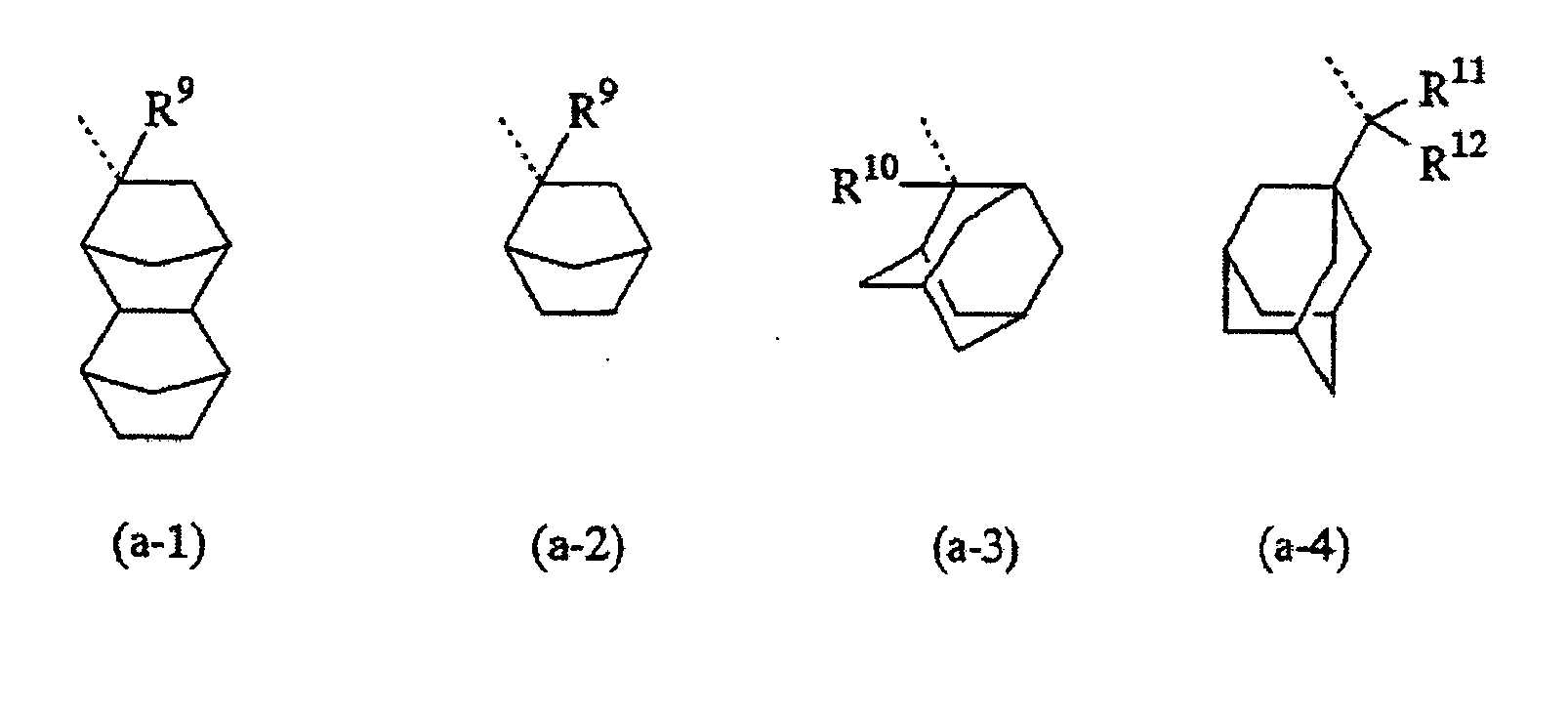
- the acid labile group represented by R 2 is one or multiple groups selected from the following formulae (a-1) through (a-8).
- the broken line denotes a valence bond
- R 9 , R 10 , R 11 , and R 12 are each independently a straight or branched C 1 -C 4 alkyl group
- R 13 is a straight or branched C 1 -C 4 alkyl, cyclopentyl or cyclohexyl, "o" is 1 or 2
- p is 1 or 2.
- the hydroxyl-containing organic group represented by Z is one or multiple groups selected from the following formulae (d-1) through (d-5).
- the broken line denotes a valence bond, and m is 1 or 2.
- the recurring units (d) having a group of formula (d-4) or (d-5) are derived by polymerizing a starting compound having a group of formula (M-d-4) or (M-d-5), followed by partial acid hydrolysis to form a hydroxyl-containing organic group of formula (d-4) or (d-5).
- R 2a is 1-alkoxyalkyl of total 2 to 8 carbon atoms, tetrahydropyranyl or tetrahydrofuranyl.
- the resist composition may further comprise as component (B) an acid generator having the general formula (1): wherein R 5 , R 6 , and R 7 are each independently hydrogen or a straight, branched or cyclic monovalent hydrocarbon group of 1 to 20 carbon atoms which may contain a heteroatom, and R 8 is a straight, branched or cyclic monovalent hydrocarbon group of 7 to 30 carbon atoms which may contain a heteroatom; and a surfactant which is insoluble in water and soluble in an alkaline developer.
- an acid generator having the general formula (1): wherein R 5 , R 6 , and R 7 are each independently hydrogen or a straight, branched or cyclic monovalent hydrocarbon group of 1 to 20 carbon atoms which may contain a heteroatom, and R 8 is a straight, branched or cyclic monovalent hydrocarbon group of 7 to 30 carbon atoms which may contain a heteroatom; and a surfactant which is insoluble in water and soluble in an alkaline developer.
- the invention provides a pattern forming process comprising the steps of applying the positive resist composition defined above onto a substrate to form a coating, heat treating the coating and exposing it to high-energy radiation through a photomask, and optionally heat treating the exposed coating and developing it with a developer; a pattern forming process comprising the steps of applying the positive resist composition defined above onto a substrate to form a resist coating, heat treating the resist coating, applying onto the resist coating a protective coating which is insoluble in water and soluble in an alkaline developer, exposing the coated substrate to high-energy radiation from a projection lens through a photomask while holding water between the substrate and the projection lens, optionally heat treating, and developing with a developer; and a pattern forming process comprising the steps of applying the positive resist composition defined above onto a substrate to form a coating, heat treating the coating, imagewise writing with an electron beam, optionally heat treating the coating, and developing it with a developer.
- the resist composition of the invention can be applied to the immersion lithography.
- the immersion lithography involves prebaking a resist film and exposing the resist film to light through a projection lens with a liquid medium interposed between the resist film and the projection lens.
- the ArF immersion lithography generally uses deionized water as the immersion medium. This technology, combined with a projection lens having a numerical aperture of at least 1.0, is important for the ArF lithography to survive to the 65 nm node and forth, with a further development thereof being accelerated.
- the resist composition of the invention allows the feature size of the pattern after development to be reduced by various shrinkage techniques.
- the hole size can be shrunk by such known techniques as thermal flow, RELACS, SAFIRE, and WASOOM. More effective shrinkage of hole size by thermal flow is possible particularly when the inventive polymer is blended with a hydrogenated cycloolefin ring-opening metathesis polymer (ROMP) having a low Tg.
- EMP hydrogenated cycloolefin ring-opening metathesis polymer
- the positive resist composition of the invention has many advantages. Since the base resin in the resist composition comprises recurring units having incorporated therein a sulfonium salt which has fluorine atoms at ⁇ -position relative to sulfonic acid, it generates a very strong sulfonic acid upon exposure to high-energy radiation so that it facilitates effective scission of acid labile groups in chemically amplified resist compositions.
- a radiation-sensitive resist composition comprising the polymer of the invention as a base resin exhibits a high resolution and is improved in pattern density dependency and exposure margin when processed by photolithography. The polymer is advantageously used to formulate a resist composition adapted for precise micropatterning.
- the polymer prevents leach-out in water and also minimizes the influence of water left on the wafer, restraining defect formation.
- (meth)acrylic ester moieties are hydrolyzable under basic conditions so that the polymers can be converted into less accumulative compounds of lower molecular weight.
- the polymers are more combustible because of a low degree of fluorine substitution.
- the notation (Cn-Cm) means a group containing from n to m carbon atoms per group.
- high-energy radiation is intended to encompass ultraviolet (UV) radiation, deep UV, electron beam (EB), EUV, x-ray, excimer laser, ⁇ -ray and synchrotron radiation.
- (A) a polymer or high molecular weight compound is used as a base resin.
- the polymer is characterized by comprising recurring units having the following general formulae (a), (b), (c), and (d).
- R 1 is each independently hydrogen or methyl.
- R 2 is an acid labile group
- Y is a lactone structure-containing substituent group
- Z is a hydroxyl-containing organic group, which will be illustrated below in detail.
- R 5 , R 6 , and R 7 are each independently hydrogen or a straight, branched or cyclic monovalent hydrocarbon group of 1 to 20 carbon atoms which may contain a heteroatom.
- Suitable hydrocarbon groups include methyl, ethyl, propyl, isopropyl, n-butyl, sec-butyl, tert-butyl, tert-amyl, n-pentyl, n-hexyl, cyclopentyl, cyclohexyl, ethylcyclopentyl, butylcyclopentyl, ethylcyclohexyl, butylcyclohexyl, adamantyl, ethyladamantyl, butyladamantyl, and modified forms of the foregoing in which any carbon-carbon bond is separated by a hetero atomic group such as -O-, -S-, -SO-, -SO 2 -, -NH-
- the acid labile group represented by R 2 is preferably one or multiple groups selected from the following formulae (a-1) through (a-8).
- the broken line denotes a valence bond.
- R 9 , R 10 , R 11 , and R 12 are each independently a straight or branched C 1 -C 4 alkyl group, such as methyl, ethyl, propyl, isopropyl, n-butyl, sec-butyl and tert-butyl.
- R 13 is a straight or branched C 1 -C 4 alkyl, cyclopentyl or cyclohexyl, such as methyl, ethyl, propyl, isopropyl, n-butyl, sec-butyl, tert-butyl, cyclopentyl or cyclohexyl.
- the subscript "o" is equal to 1 or 2
- p is equal to 1 or 2.
- Formula (a-1) there can exist enantiomers and diastereomers.
- Formula (a-1) collectively represents all such stereoisomers. Such stereoisomers may be used alone or in admixture.
- Examples of the acid labile group represented by R 2 are given below, but not limited thereto. Note that the broken line denotes a valence bond.
- the preferred acid labile groups are of the following formulae. Note that the broken line denotes a valence bond. Understandably, the left formula collectively represents enantiomers and diastereomers.
- reactants from which recurring units (b) capable of generating an acid in response to actinic light or radiation are derived can be synthesized by the following process, for example.
- One exemplary compound may be synthesized by reacting 2-bromo-2,2-difluoroethanol with pivalic chloride or anhydride to form 2-bromo-2,2-difluoroethyl pivalate, converting the bromo group into sodium sulfinate using a sulfur compound such as sodium dithionite, and converting sulfinic acid into sulfonic acid using an oxidizing agent such as hydrogen peroxide. This is followed by cation exchange with a triarylsulfonium halide or the like.
- the pivalic ester is then subjected to alkaline hydrolysis. Through reaction with (meth)acrylic anhydride, the alcohol resulting from hydrolysis is converted into a (meth)acrylic derivative, yielding the end compound.
- examples of the lactone structure-containing substituent group represented by Y include the following formulae (c-1) through (c-6), but are not limited thereto.
- the broken line denotes a valence bond.
- X is O or CH 2 - R 3 is CO 2 R 4 when X is CH 2
- R 3 is hydrogen or CO 2 R 4 when X is O.
- R 4 is a straight, branched or cyclic monovalent hydrocarbon group of 1 to 20 carbon atoms which may contain a heteroatom.
- Preferred lactone structure-containing substituent groups have the following formulae. Note that the broken line denotes a valence bond.
- examples of the hydroxyl-containing organic group represented by Z include the following formulae (d-1) through (d-5), but are not limited thereto.
- the broken line denotes a valence bond, and m is 1 or 2.
- Preferred hydroxyl-containing organic groups have the following formulae. Note that the broken line denotes a valence bond.
- a polymer having a group of formula (d-4) or (d-5) may be prepared by using a compound of the following formula (M-d-4) or (M-d-5) as one of starting monomers and effecting polymerization and partial hydrolysis.
- R 2a is a 1-alkoxyalkyl group having total 2 to 8 carbon atoms, tetrahydropyranyl or tetrahydrofuranyl.
- R 1 , R 2 , R 5 , R 6 , R 7 and Y are as defined above.
- polymer as resin component (A) contains recurring units (a), (b), (c), and (d) as essential units, it may further contain additional units (e), for example, recurring units of one or more type having acenaphthylene, indene, norbornadiene, norbornene, vinyl ether, maleic anhydride, maleimide, methacrylic acid, acrylic acid or the like.
- additional units are not limited to these examples.
- the proportion of recurring units (a), (b), (c) and (d) and optional recurring units (e) relative to the entire recurring units within the polymer as resin component (A) is desirably in the following range (molar ratio):
- the polymer defined herein is applicable to not only the ArF lithography, but also another lithography such as KrF, EB or EUV lithography.
- the polymer has a weight average molecular weight (Mw) of 1,000 to 500,000, and preferably 3,000 to 100,000. Outside the range, a polymer may suffer an extreme drop of etching resistance or a reduced resolution due to a failure to provide a difference in dissolution rate before and after exposure.
- Mw weight average molecular weight
- the measurement of molecular weight may be performed by gel permeation chromatography (GPC) versus polystyrene standards or a light scattering method.
- the polymer may be prepared through copolymerization reaction using the compound illustrated for resin component (A) as a first monomer and other compounds having a polymerizable double bond as second and subsequent monomers.
- Various modes of copolymerization reaction may be used for the preparation of the polymer. The preferred modes are radical polymerization, anionic polymerization and coordination polymerization.
- reaction conditions include (a) a solvent selected from among hydrocarbons such as benzene, ethers such as tetrahydrofuran, alcohols such as ethanol, and ketones such as methyl isobutyl ketone, (b) a polymerization initiator selected from azo compounds such as 2,2'-azobisisobutyronitrile and peroxides such as benzoyl peroxide and lauroyl peroxide, (c) a temperature of about 0°C to about 100°C, and (d) a time of about 1/2 hour to about 48 hours. Reaction conditions outside the described range may be employed if desired.
- a solvent selected from among hydrocarbons such as benzene, ethers such as tetrahydrofuran, alcohols such as ethanol, and ketones such as methyl isobutyl ketone
- a polymerization initiator selected from azo compounds such as 2,2'-azobisisobutyronitrile and peroxides such as benzoyl
- reaction conditions include (a) a solvent selected from among hydrocarbons such as benzene, ethers such as tetrahydrofuran, and liquid ammonia, (b) a polymerization initiator selected from metals such as sodium and potassium, alkyl metals such as n-butyllithium and sec-butyllithium, ketyl, and Grignard reagents, (c) a temperature of about -78°C to about 0°C, (d) a time of about 1/2 hour to about 48 hours, and (e) a stopper selected from among proton-donative compounds such as methanol, halides such as methyl iodide, and electrophilic compounds. Reaction conditions outside the described range may be employed if desired.
- a solvent selected from among hydrocarbons such as benzene, ethers such as tetrahydrofuran, and liquid ammonia
- a polymerization initiator selected from metals such as sodium and potassium, alkyl metals such as
- reaction conditions include (a) a solvent selected from among hydrocarbons such as n-heptane and toluene, (b) a catalyst selected from Ziegler-Natta catalysts comprising a transition metal (e.g., titanium) and alkylaluminum, Phillips catalysts of metal oxides having chromium or nickel compounds carried thereon, and olefin-metathesis mixed catalysts as typified by tungsten and rhenium mixed catalysts, (c) a temperature of about 0°C to about 100°C, and (d) a time of about 1/2 hour to about 48 hours. Reaction conditions outside the described range may be employed if desired.
- a solvent selected from among hydrocarbons such as n-heptane and toluene
- a catalyst selected from Ziegler-Natta catalysts comprising a transition metal (e.g., titanium) and alkylaluminum, Phillips catalysts of metal oxides having chromium or nickel compounds carried thereon, and ole
- a polymer is prepared by the above polymerization process, its solubility in alkaline developer may be controlled through deprotection of some or all acid labile groups on the polymer.
- the polymer may be converted into a copolymer with polyhydroxystyrene by eliminating ethoxyethoxy groups from the polymer using acetic acid, pyridinium tosylate or the like.
- the polymer defined above referred to as "inventive polymer,” is advantageously used as a base resin in a positive resist composition, and specifically a chemically amplified positive resist composition.
- the invention provides a positive resist composition, and especially a chemically amplified positive resist composition comprising the inventive polymer as a base resin.
- the positive resist composition preferably comprises:
- the base resin as component (A) may comprise another resin having a dissolution rate in an alkaline developer that increases under the action of an acid, if desired, as well as the inventive polymer.
- exemplary other resins include, but are not limited to, (i) poly(meth)acrylic acid derivatives, (ii) norbornene derivative/maleic anhydride copolymers, (iii) hydrogenated products of ring-opening metathesis polymers (ROMP), (iv) vinyl ether/maleic anhydride/(meth)acrylic acid derivative copolymers, and (v) polyhydroxystyrene derivatives.
- the poly(meth)acrylic acid derivatives (i) are polymers comprising units of formulae (a), (c) and (d) in combination.
- the polyhydroxystyrene derivatives (v) include polymers comprising units of the following formulae (e) to (h) in combination and polymers comprising units of formulae (a), (c) and (d) and units of formulae (e) to (h) in combination.
- a proportion of those units having acid labile groups for example, monomer units of one or more types selected from among formulae (a) and (e) and a combination thereof is from more than 0 mole% to 80 mole%, preferably 1 to 50 mole%, and more preferably 10 to 40 mole%.
- the hydrogenated products of ROMP (iii) are synthesized by the method illustrated in Examples of JP-A 2003-66612 .
- Illustrative examples of such hydrogenated polymers include those polymers having the recurring units shown below, but are not limited thereto.
- the inventive polymer and the other polymer are preferably blended in a weight ratio from 100:0 to 10:90, more preferably from 100:0 to 20:80. If the blend ratio of the inventive polymer is below this range, the resist composition would become poor in some of the desired properties.
- the properties of the resist composition can be adjusted by properly changing the blend ratio of the inventive polymer.
- the polymer is not limited to one type and a mixture of two or more polymers may be added. The use of plural polymers allows for easy adjustment of resist properties.
- an acid generator is optionally used as component (B).
- a photoacid generator may be any compound capable of generating an acid upon exposure to high-energy radiation.
- Suitable photoacid generators include sulfonium salts, iodonium salts, N-sulfonyloxyimide, and oxime-O-sulfonate acid generators. Exemplary acid generators are given below while they may be used alone or in admixture of two or more.
- Sulfonium salts are salts of sulfonium cations with sulfonates, bis(substituted alkylsulfonyl)imides and tris(substituted alkylsulfonyl)methides.
- Exemplary sulfonium cations include triphenylsulfonium, (4-tert-butoxyphenyl)diphenylsulfonium, bis(4-tert-butoxyphenyl)phenylsulfonium, tris(4-tert-butoxyphenyl)sulfonium, (3-tert-butoxyphenyl)diphenylsulfonium, bis(3-tert-butoxyphenyl)phenylsulfonium, tris(3-tert-butoxyphenyl)sulfonium, (3,4-di-tert-butoxyphenyl)diphenylsulfonium, bis(3,4-di-tert-butoxyphenyl)phenylsulfonium, tris(3,4-di-tert-butoxyphenyl)sulfonium, diphenyl(4-thiophenoxyphenyl)sulfonium, (4-tert-butoxycarbony
- Exemplary sulfonates include trifluoromethanesulfonate, pentafluoroethanesulfonate, heptafluoropropanesulfonate, nonafluorobutanesulfonate, tridecafluorohexanesulfonate, perfluoro(4-ethylcyclohexane)sulfonate, heptadecafluorooctanesulfonate, 2,2,2-trifluoroethanesulfonate, pentafluorobenzenesulfonate, 4-(trifluoromethyl)benzenesulfonate, 4-fluorobenzenesulfonate, mesitylenesulfonate, 2,4,6-triisopropylbenzenesulfonate, toluenesulfonate, benzenesulfonate, 4-(p-toluenesulfonyloxy)benzenes
- Exemplary bis(substituted alkylsulfonyl)imides include bis(trifluoromethylsulfonyl)imide, bis(pentafluoroethylsulfonyl)imide, bis(heptafluoropropylsulfonyl)imide, and perfluoro(1,3-propylenebissulfonyl)lmide.
- a typical tris(substituted alkylsulfonyl)methide is tris(trifluoromethylsulfonyl)methide.
- Sulfonium salts based on combination of the foregoing examples are included.
- Iodonium salts are salts of iodonium cations with sulfonates, bis(substituted alkylsulfonyl)imides and tris(substituted alkylsulfonyl)methides.
- Exemplary iodonium cations include diphenyliodinium, bis(4-tert-butylphenyl)iodonium, 4-tert-butoxyphenylphenyliodonium, and 4-methoxyphenylphenyliodonium.
- Exemplary sulfonates include trifluoromethanesulfonate, pentafluoroethanesulfonate, heptafluoropropanesulfonate, nonafluorobutanesulfonate, tridecafluorohexanesulfonate, perfluoro(4-ethylcyclohexane)sulfonate, heptadecafluorooctanesulfonate, 2,2,2-trifluoroethanesulfonate, pentafluorobenzenesulfonate, 4-(trifluoromethyl)benzenesulfonate, 4-fluorobenzenesulfonate, mesitylenesulfonate, 2,4,6-triisopropylbenzenesulfonate, toluenesulfonate, benzenesulfonate, 4-(p-toluenesulfonyloxy)benzenes
- Exemplary bis(substituted alkylsulfonyl)imides include bis(trifluoromethylsulfonyl)imide, bis(pentafluoroethylsulfonyl)imide, bis(heptafluoropropylsulfonyl)imide, and perfluoro(1,3-propylenebissulfonyl)imide.
- a typical tris(substituted alkylsulfonyl)methide is tris(trifluoromethylsulfonyl)methide.
- Iodonium salts based on combination of the foregoing examples are included.
- N-sulfonyloxydicarboxyimide photoacid generators include combinations of imide skeletons with sulfonates.
- Exemplary imide skeletons are succinimide, naphthalenedicarboxyimide, phthalimide, cyclohexyldicarboxyimide, 5-norbornene-2,3-dicarboxyimide, and 7-oxabicyclo[2.2.1]-5-heptene-2,3-dicarboxyimide.
- Exemplary sulfonates include trifluoromethanesulfonate, pentafluoroethanesulfonate, heptafluoropropanesulfonate, nonafluorobutanesulfonate, tridecafluorohexanesulfonate, perfluoro(4-ethylcyclohexane)sulfonate, heptadecafluorooctanesulfonate, 2,2,2-trifluoroethanesulfonate, pentafluorobenzenesulfonate, 4-(trifluoromethyl)benzenesulfonate, 4-fluorobenzenesulfonate, mesitylenesulfonate, 2,4,6-triisopropylbenzenesulfonate, toluenesulfonate, benzenesulfonate, 4-(p-toluenesulfonyloxy)benzenes
- O-arylsulfonyl oxime and O-alkylsulfonyl oxime (oxime sulfonate) photoacid generators include oxime sulfonate compounds having an electron-withdrawing group (e.g., trifluoromethyl) for increased stability, as represented by the formula (Ox-1): wherein R 401 is a substituted or unsubstituted C 1 -C 10 haloalkylsulfonyl or halobenzenesulfonyl group, R 402 is a C 1 -C 11 haloalkyl group, and Ar 401 is a substituted or unsubstituted aromatic or hetero-aromatic group.
- R 401 is a substituted or unsubstituted C 1 -C 10 haloalkylsulfonyl or halobenzenesulfonyl group
- R 402 is a C 1 -C 11 haloalkyl group
- Examples include 2-[2,2,3,3,4,4,5,5-octafluoro-1-(nonafluorobutylsulfonyloxy-imino)pentyl]fluorene, 2 -[ 2 ,2,3,3,4,4-pentafluoro-1-(nonafluorobutylsulfonyloxy-imino)butyl]fluorene, 2-[2,2,3,3,4,4,5,5,6,6-decafluoro-1-(nonafluorobutylsulfonyl-oxyimino)hexyl]fluorene, 2-[2,2,3,3,4,4,5,5-octafluoro-1-(nonafluorobutylsulfonyloxyimino)pentyl]-4-biphenyl, 2-[2,2,3,3,4,4-pentafluoro-1-(nonafluorobutylsulfonyloxyimino)butyl]
- modified forms of the foregoing compounds having substituted on their skeleton 2-benzoyloxy-1,1,3,3,3-pentafluoropropanesulfonate, 1,1,3,3.,3-pentafluoro-2-(4-phenylbenzoyloxy)propanesulfonate, 1,1,3,3,3-pentafluoro-2-pivaloyloxypropanesulfonate, 2-cyclohexanecarbonyloxy-1,1,3,3,3-pentafluoropropanesulfonate, 1,1,3,3,3-pentafluoro-2-furoyloxypropanesulfonate, 2-naphthoyloxy-1,1,3,3,3-pentafluoropropanesulfonate, 2-(4-tert-butylbenzoyloxy)-1,1,3,3,3-pentafluoropropanesulfonate, 2-(1-adamantanecarbonyloxy)-1,1,3,3,3
- R 5 , R 6 , and R 7 are each independently hydrogen or a straight, branched or cyclic, monovalent C 1 -C 20 hydrocarbon group which may contain a heteroatom.
- the photoacid generator (B) may be added in any desired amount as long as the objects of the invention are not compromised.
- An appropriate amount of the photoacid generator (B) is 0.1 to 10 parts, and more preferably 0.1 to 5 parts by weight per 100 parts by weight of the base resin in the composition. Too high a proportion of the photoacid generator (B) may give rise to problems of degraded resolution and foreign matter upon development and resist film peeling.
- the photoacid generators (B) may be used alone or in admixture of two or more.
- the transmittance of the resist film can be controlled by using a photoacid generator having a low transmittance at the exposure wavelength and adjusting the amount of the photoacid generator added.
- an acid diffusion controlling function may be provided when the photoacid generator is an onium salt capable of generating a weak acid.
- an onium salt capable of generating a weak acid e.g., non-fluorinated sulfonic acid or carboxylic acid
- a salt exchange occurs whereby the weak acid is released and an onium salt having a strong acid anion is formed.
- the strong acid is exchanged into the weak acid having a low catalysis, incurring apparent deactivation of the acid for enabling to control acid diffusion.
- an onium salt capable of generating a strong acid and an onium salt capable of generating a weak acid are used in admixture, an exchange from the strong acid to the weak acid as above can take place, but it never happens that the weak acid collides with the unreacted onium salt capable of generating a strong acid to induce a salt exchange. This is because of a likelihood of an onium cation forming an ion pair with a stronger acid anion.
- the resist composition of the invention there may be added a compound which is decomposed with an acid to generate another acid, that is, acid amplifier compound.
- acid amplifier compound for these compounds, reference should be made to J. Photopolym. Sci. and Tech., 8, 43-44, 45-46 (1995 ), and ibid., 9, 29-30 (1996 ).
- Examples of the acid amplifier compound include tert-butyl-2-methyl-2-tosyloxymethyl acetoacetate and 2-phenyl-2-(2-tosyloxyethyl)-1,3-dioxolane, but are not limited thereto.
- the photoacid generators many of those compounds having poor stability, especially poor thermal stability exhibit an acid amplifier-like behavior.
- an appropriate amount of the acid amplifier compound is up to 2 parts, and especially up to 1 part by weight per 100 parts by weight of the base resin. Excessive amounts of the acid amplifier compound make diffusion control difficult, leading to degradation of resolution and pattern profile.
- the organic solvent (C) used herein may be any organic solvent in which the base resin, acid generator, and other components are soluble.
- the organic solvent include ketones such as cyclohexanone and methyl amyl ketone; alcohols such as 3-methoxybutanol, 3-methyl-3-methoxybutanol, 1-methoxy-2-propanol, and 1-ethoxy-2-propanol; ethers such as propylene glycol monomethyl ether, ethylene glycol monomethyl ether, propylene glycol monoethyl ether, ethylene glycol monoethyl ether, propylene glycol dimethyl ether, and diethylene glycol dimethyl ether; esters such as propylene glycol monomethyl ether acetate (PGMEA), propylene glycol monoethyl ether acetate, ethyl lactate, ethyl pyruvate, butyl acetate, methyl 3-methoxypropionate
- PMEA propylene
- solvents may be used alone or in combinations of two or more thereof.
- organic solvents it is recommended to use diethylene glycol dimethyl ether, 1-ethoxy-2-propanol, propylene glycol monomethyl ether acetate, and mixtures thereof because the acid generator is most soluble therein.
- An appropriate amount of the organic solvent used is 200 to 1,000 parts, especially 400 to 800 parts by weight per 100 parts by weight of the base resin.
- a quencher (D) may be optionally used in the resist composition of the invention.
- quencher as used herein has a meaning generally known in the art and refers to a compound capable of suppressing the rate of diffusion when the acid generated by the acid generator diffuses within the resist film. The inclusion of quencher facilitates adjustment of resist sensitivity and holds down the rate of acid diffusion within the resist film, resulting in better resolution. In addition, it suppresses changes in sensitivity following exposure and reduces substrate and environment dependence, as well as improving the exposure latitude and the pattern profile.
- quenchers include primary, secondary, and tertiary aliphatic amines, mixed amines, aromatic amines, heterocyclic amines, nitrogen-containing compounds with carboxyl group, nitrogen-containing compounds with sulfonyl group, nitrogen-containing compounds with hydroxyl group, nitrogen-containing compounds with hydroxyphenyl group, alcoholic nitrogen-containing compounds, amide derivatives, imide derivatives, carbamate derivatives, and ammonium salts.
- Suitable primary aliphatic amines include ammonia, methylamine, ethylamine, n-propylamine, isopropylamine, n-butylamine, isobutylamine, sec-butylamine, tert-butylamine, pentylamine, tert-amylamine, cyclopentylamine, hexylamine, cyclohexylamine, heptylamine, octylamine, nonylamine, decylamine, dodecylamine, cetylamine, methylenediamine, ethylenediamine, and tetraethylenepentamine.
- Suitable secondary aliphatic amines include dimethylamine, diethylamine, di-n-propylamine, diisopropylamine, di-n-butylamine, diisobutylamine, di-sec-butylamine, dipentylamine, dicyclopentylamine, dihexylamine, dicyclohexylamine, diheptylamine, dioctylamine, dinonylamine, didecylamine, didodecylamine, dicetylamine, N,N-dimethylmethylenediamine, N,N-dimethylethylenediamine, and N,N-dimethyltetraethylenepentamine.
- Suitable tertiary aliphatic amines include trimethylamine, triethylamine, tri-n-propylamine, triisopropylamine, tri-n-butylamine, triisobutylamine, tri-sec-butylamine, tripentylamine, tricyclopentylamine, trihexylamine, tricyclohexylamine, triheptylamine, trioctylamine, trinonylamine, tridecylamine, tridodecylamine, tricetylamine, N,N,N',N'-tetramethylmethylenediamine, N,N,N',N'-tetramethylethylenediamine, and N,N,N',N'-tetramethyltetraethylenepentamine.
- suitable mixed amines include dimethylethylamine, methylethylpropylamine, benzylamine, phenethylamine, and benzyldimethylamine.
- suitable aromatic and heterocyclic amines include aniline derivatives (e.g., aniline, N-methylaniline, N-ethylaniline, N-propylaniline, N,N-dimethylaniline, N,N-bis(hydroxyethyl)aniline, 2-methylaniline, 3-methylaniline, 4-methylaniline, ethylaniline, propylaniline, dimethylaniline, 2,6-diisopropylaniline, trimethylaniline, 2-nitroaniline, 3-nitroaniline, 4-nitroaniline, 2,4-dinitroaniline, 2,6-dinitroaniline, 3,5-dinitroaniline, and N,N-dimethyltoluidine), diphenyl(p-tolyl)amine, methyldiphenylamine, triphenyl
- suitable nitrogen-containing compounds with carboxyl group include aminobenzoic acid, indolecarboxylic acid, and amino acid derivatives (e.g. nicotinic acid, alanine, alginine, aspartic acid, glutamic acid, glycine, histidine, isoleucine, glycylleucine, leucine, methionine, phenylalanine, threonine, lysine, 3-aminopyrazine-2-carboxylic acid, and methoxyalanine).
- a typical nitrogen-containing compound with sulfonyl group is 3-pyridinesulfonic acid.
- nitrogen-containing compounds with hydroxyl group nitrogen-containing compounds with hydroxyphenyl group, and alcoholic nitrogen-containing compounds
- 2-hydroxypyridine aminocresol, 2,4-quinolinediol, 3-indolemethanol hydrate, monoethanolamine, diethanolamine, triethanolamine, N-ethyldiethanolamine, N,N-diethylethanolamine, triisopropanolamine, 2,2'-iminodiethanol, 2-aminoethanol, 3-amino-1-propanol, 4-amino-1-butanol, 4-(2-hydroxyethyl)morpholine, 2-(2-hydroxyethyl)pyridine, 1-(2-hydroxyethyl)piperazine, 1-[2-(2-hydroxyethoxy)ethyl]piperazine, piperidine ethanol, 1-(2-hydroxyethyl)pyrrolidine, 1-(2-hydroxyethyl)-2-pyrrolidinone, 3-piperidino-1,2-propanediol, 3-pyr
- Suitable amide derivatives include formamide, N-methylformamide, N,N-dimethylformamide, acetamide, N-methylacetamide, N,N-dimethylacetamide, propionamide, benzamide, and 1-cyclohexylpyrrolidone.
- Suitable imide derivatives include phthalimide, succinimide, and maleimide.
- Suitable carbamate derivatives include N-tert-butoxycarbonyl-N,N-dicyclohexylamine, N-tert-butoxycarbonylbenzimidazole, and oxazolidinone.
- Suitable ammonium salts include pyridinium p-toluenesulfonate, triethylammonium p-toluenesulfonate, trioctylammonium p-toluenesulfonate, triethylammonium 2,4,6-triisopropylbenzenesulfonate, trioctylammonium 2,4,6-triisopropylbenzenesulfonate, triethylammonium camphorsulfonate, trioctylammonium camphorsulfonate, tetramethylammonium hydroxide, tetraethylammonium hydroxide, tetrabutylammonium hydroxide, benzyltrimethylammonium hydroxide, tetramethylammonium p-toluenesulfonate, tetrabutylammonium p-toluenesulf
- amine compounds of the following general formula (B)-1 may also be included alone or in admixture.
- N(X) n (Y) 3-n (B)-1 In the formula, n is equal to 1, 2 or 3.
- the side chain X is independently selected from groups of the following general formulas (X)-1 to (X)-3.
- the side chain Y is independently hydrogen or a straight, branched or cyclic C 1 -C 20 alkyl group in which some or all hydrogen atoms may be substituted by fluorine atoms and which may contain an ether or hydroxyl group. Two or three X may bond together to form a ring.
- R 300 , R 302 and R 305 are independently straight or branched C 1 -C 4 alkylene groups;
- R 301 and R 304 are independently hydrogen or straight, branched or cyclic C 1 -C 20 alkyl groups in which some or all hydrogen atoms may be substituted by fluorine atoms and which may contain at least one hydroxyl group, ether group, ester group or lactone ring;
- R 303 is a single bond or a straight or branched C 1 -C 4 alkylene group;
- R 306 is a straight, branched or cyclic C 1 -C 20 alkyl group in which some or all hydrogen atoms may be substituted by fluorine atoms and which may contain at least one hydroxyl group, ether group, ester group or lactone ring.
- Illustrative examples of the compounds of formula (H)-1 include, but are not limited to, tris(2-methoxymethoxyethyl)amine, tris ⁇ 2-(2-methoxyethoxy)ethyl ⁇ amine, tris ⁇ 2-(2-methoxyethoxymethoxy)ethyl ⁇ amine, tris ⁇ 2-(1-methoxyethoxy)ethyl ⁇ amine, tris ⁇ 2-(1-ethoxyethoxy)ethyl ⁇ amine, tris ⁇ 2-(1-ethoxypropoxy)ethyl ⁇ amine, tris[2- ⁇ 2-(2-hydroxyethoxy)ethoxy ⁇ ethyl]amine, 4,7,13,16,21,24-hexaoxa-1,10-diazabicyclo[8.8.8]hexacosane, 4,7,13,18-tetraoxa-1,10-diazabicyclo[8.5.5]eicosane, 1,4,10,13-tetrao
- cyclic structure-bearing amine compounds having the following general formula (B)-2.
- X is as defined above, and R 307 is a straight or branched C 2 -C 20 alkylene group in which some or all hydrogen atoms may be substituted by fluorine atoms and which may contain one or more carbonyl, ether, ester or sulfide groups.
- Illustrative examples of the cyclic structure-bearing amine compounds having formula (B)-2 include 1-[2-(methoxymethoxy)ethyl]pyrrolidine, 1-[2-(methoxymethoxy)ethyl]piperidine, 4-[2-(methoxymethoxy)ethyl]morpholine, 1-[2-[(2-methoxyethoxy)methoxy]ethyl]pyrrolidine, 1-[2-[(2-methoxyethoxy)methoxy]ethyl]piperidine, 4-[2-[(2-methoxyethoxy)methoxy]ethyl]morpholine, 2-[2-(2-methoxyethoxy)ethoxy]ethylmorpholine, 2-[2-(2-butoxyethoxy)ethoxy]ethylmorpholine, 2- ⁇ 2-[2-(2-methoxyethoxy)ethoxy]ethoxy ⁇ ethylmorpholine, 2- ⁇ 2-[2-(2-butoxyethoxy)e
- cyano-bearing amine compounds having the following general formulae (B)-3 to (B)-6 may be added.
- X, R 307 and n are as defined in formula (B)-1, and R 308 and R 309 each are independently a straight or branched C 1 -C 4 alkylene group.
- Illustrative examples of the cyano-bearing amine compounds having formulae (B)-3 to (B)-6 include 3-(diethylamino)propiononitrile, N,N-bis(2-hydroxyethyl)-3-aminopropiononitrile, N,N-bis(2-acetoxyethyl)-3-aminopropiononitrile, N,N-bis(2-formyloxyethyl)-3-aminopropiononitrile, N,N-bis(2-methoxyethyl)-3-aminopropiononitrile, N,N-bis[2-(methoxymethoxy)ethyl]-3-aminopropiononitrile, methyl N-(2-cyanoethyl)-N-(2-methoxyethyl)-3-aminopropionate, methyl N-(2-cyanoethyl)-N-(2-hydroxyethyl)-3-aminopropionate, methyl N-(2-ace
- R 310 is a straight, branched or cyclic C 2 -C 20 alkyl group in which some or all hydrogen atoms may be substituted by fluorine atoms and which has one or more polar functional groups.
- the polar functional group is selected from among hydroxyl, carbonyl, ester, ether, sulfide, carbonate, cyano and acetal groups and mixtures thereof.
- R 311 , R 312 and R 313 are each independently a hydrogen atom, a straight, branched or cyclic C 1 -C 10 alkyl group, aryl group or aralkyl group.
- R 314 is a hydrogen atom, a straight, branched or cyclic C 1 -C 10 alkyl group, aryl group or aralkyl group.
- R 315 is a straight, branched or cyclic C 1 -C 20 alkyl group in which some or all hydrogen atoms may be substituted by fluorine atoms and which has one or more polar functional groups.
- the alkyl group contains as the polar functional group at least one group selected from among ester, acetal and cyano groups, and may additionally contain at least one group selected from among hydroxyl, carbonyl, ether, sulfide and carbonate groups.
- heterocyclic nitrogen-containing compounds having a polar functional group represented by the general formulae (B)-9 and (B)-10.
- A is a nitrogen atom or ⁇ C-R 322 .
- B is a nitrogen atom or ⁇ C-R 323 .
- R 316 is a straight, branched or cyclic C 2 -C 20 alkyl group in which some or all hydrogen atoms may be substituted by fluorine atoms and which has one or more polar functional groups, the polar functional group being selected from among hydroxyl, carbonyl, ester, ether, sulfide, carbonate, cyano and acetal groups and mixtures thereof.
- R 317 , R 318 , R 319 and R 320 are each independently a hydrogen atom, a straight, branched or cyclic C 1 -C 10 alkyl group or aryl group, or a pair of R 317 and R 318 and a pair of R 319 and R 320 , taken together, may form a benzene, naphthalene or pyridine ring with the carbon atom to which they are attached.
- R 321 is a hydrogen atom, a straight, branched or cyclic C 1 -C 10 alkyl group or aryl group.
- R 322 and R 323 each are a hydrogen atom, a straight, branched or cyclic C 1 -C 10 alkyl group or aryl group, or a pair of R 321 and R 323 , taken together, may form a benzene or naphthalene ring with the carbon atom to which they are attached.
- R 324 is a C 6 -C 20 aryl group or C 4 -C 20 hetero-aromatic group, in which some or all hydrogen atoms may be replaced by halogen atoms, straight, branched or cyclic C 1 -C 20 alkyl groups, C 6 -C 20 aryl groups, C 7 -C 20 aralkyl groups, C 1 -C 10 alkoxy groups, C 1 -C 10 acyloxy groups or C 1 -C 10 alkylthio groups.
- R 325 is CO 2 R 326 , OR 327 or cyano group.
- R 326 is a C 1 -C 10 alkyl group, in which some methylene groups may be replaced by oxygen atoms.
- R 327 is a C 1 -C 10 alkyl or acyl group, in which some methylene groups may be replaced by oxygen atoms.
- R 328 is a single bond, methylene, ethylene, sulfur atom or -O(CH 2 CH 2 O) n -group wherein n is 0, 1, 2, 3 or 4.
- R 329 is hydrogen, methyl, ethyl or phenyl.
- X is a nitrogen atom or CR 330 .
- Y is a nitrogen atom or CR 331 .
- Z is a nitrogen atom or CR 332 .
- R 330 , R 331 and R 332 are each independently hydrogen, methyl or phenyl. Alternatively, a pair of R 330 and R 331 or a pair of R 331 and R 332 may bond together to form a C 6 -C 20 aromatic ring or C 2 -C 20 hetero-aromatic ring with the carbon atoms to which they are attached.
- R 333 is hydrogen or a straight, branched or cyclic C 1 -C 10 alkyl group.
- R 334 and R 335 are each independently a C 1 -C 20 alkyl group, C 6 -C 20 aryl group or C 7 -C 20 aralkyl group, which may contain one or more polar functional groups selected from among ether, carbonyl, ester, alcohol, sulfide, nitrile, amine, imine, and amide and in which some hydrogen atoms may be replaced by halogen atoms.
- R 334 and R 335 taken together, may form a C 2 -C 20 heterocyclic or hetero-aromatic ring with the nitrogen atom to which they are attached.
- the quencher is preferably formulated in an amount of 0.001 to 2 parts, and especially 0.01 to 1 part by weight, per 100 parts by weight of the base resin. Less than 0.001 phr of the quencher may achieve no addition effect whereas more than 2 phr may lead to too low a sensitivity.
- the resist composition of the invention may further comprise (E) a surfactant which is commonly used for improving the coating characteristics.
- the surfactant may be added in conventional amounts so long as this does not compromise the objects of the invention.
- Illustrative, non-limiting, examples of the surfactant include nonionic surfactants, for example, polyoxyethylene alkyl ethers such as polyoxyethylene lauryl ether, polyoxyethylene stearyl ether, polyoxyethylene cetyl ether, and polyoxyethylene oleyl ether, polyoxyethylene alkylaryl ethers such as polyoxyethylene octylphenol ether and polyoxyethylene nonylphenol ether, polyoxyethylene polyoxypropylene block copolymers, sorbitan fatty acid esters such as sorbitan monolaurate, sorbitan monopalmitate, and sorbitan monostearate, and polyoxyethylene sorbitan fatty acid esters such as polyoxyethylene sorbitan monolaurate, polyoxyethylene sorbitan monopalmitate, polyoxyethylene sorbitan monostearate, polyoxyethylene sorbitan trioleate, and polyoxyethylene sorbitan tristearate; fluorochemical surfactants such as EFTOP EF301,
- FC-4430 Surflon S-381, Surfynol E1004, KH-20 and KH-30 are preferred. These surfactants may be used alone or in admixture.
- the surfactant is preferably added in an amount of up to 2 parts, and especially up to 1 part by weight, per 100 parts by weight of the base resin.
- a surfactant may be added to the resist composition, the surfactant having a function to collect near the resist surface after spin coating to prevent or reduce water penetration or leaching.
- This surfactant is a polymeric surfactant which is insoluble-in water and soluble in an alkaline developer, and preferably is highly water repellent and improves water slippage.
- Exemplary polymeric surfactants are those comprising monomeric units represented by the following formula.
- R 14 is each independently hydrogen, fluorine, methyl or trifluoromethyl
- R 15 is each independently hydrogen or a straight, branched or cyclic C 1 -C 20 alkyl or fluoroalkyl group, or plural R 15 in a common monomer may bond together to form a ring with the carbon atom to which they are attached, and in this case, they collectively stand for a straight, branched or cyclic alkylene or fluoroalkylene group having 2 to 20 carbon atoms in total
- R 16 is fluorine or hydrogen, or R 16 may bond with R 17 to form a non-aromatic ring having 3 to 10 carbon atoms in total with the carbon atom to which they are attached
- R 17 is a straight, branched or cyclic C 1 -C 6 alkylene group in which one or more hydrogen atoms may be replaced by fluorine atoms
- R 18 is a straight or branched C 1 -C 10 alkyl group in which one or more hydrogen atom
- the polymeric surfactant is added in an amount of 0.001 to 20 parts, and preferably 0.01 to 10 parts by weight, per 100 parts by weight of the base resin.
- the polymeric surfactant reference should be made to JP-A 2007-297590 .
- the resist composition of the invention typically comprises the inventive polymer as a base resin, acid generator, organic solvent and quencher as described above, there may be added optional other ingredients such as dissolution inhibitors, acidic compounds, stabilizers, and dyes. Optional ingredients may be added in conventional amounts so long as this does not compromise the objects of the invention.
- any well-known lithography may be employed.
- the composition is applied onto a substrate for integrated circuitry fabrication (e.g., Si, SiO 2 , SiN, SiON, TiN, WSi, BPSG, SOG, organic antireflective coating, etc.) or a substrate for mask circuitry fabrication (e.g., Cr, CrO, CrON, MoSi, etc.) by a suitable coating technique such as spin coating.
- a suitable coating technique such as spin coating.
- the coating is prebaked on a hot plate at a temperature of 60 to 150°C for 1 to 10 minutes, preferably 80 to 140°C for 1 to 5 minutes, to form a resist film of 0.05 to 2.0 ⁇ m thick.
- a patterning mask having the desired pattern is then placed over the resist film, and the film exposed through the mask to an electron beam or to high-energy radiation such as deep-UV, excimer laser or x-ray in a dose of 1 to 200 mJ/cm 2 , and preferably 10 to 100 mJ/cm 2 .
- pattern formation may be performed by writing imagewise with an electron beam directly (not through a mask).
- Light exposure may be done by a conventional exposure process or in some cases, by an immersion process of providing liquid impregnation between the mask and the resist. In the case of immersion lithography, a protective coating which is insoluble in water may be used.
- the resist film is then post-exposure baked (PEB) on a hot plate at 60 to 150°C for 1 to 5 minutes, and preferably at 80 to 140°C for 1 to 3 minutes.
- PEB post-exposure baked
- development is carried out using as the developer an aqueous alkali solution, such as a 0.1 to 5 wt%, preferably 2 to 3 wt%, aqueous solution of tetramethylammonium hydroxide (TMAH), this being done by a conventional method such as dip, puddle, or spray development for a period of 0.1 to 3 minutes, and preferably 0.5 to 2 minutes.
- TMAH tetramethylammonium hydroxide
- the resist composition of the invention is best suited to fine pattern formation with, in particular, deep-UV having a wavelength of 250 to 190 nm, excimer laser, x-ray, or electron beam.
- the desired pattern may not be obtainable outside the upper and lower limits of the above range.
- the water-insoluble protective coating which is used in the immersion lithography is to prevent the resist coating from being leached and to improve water slippage at the coating surface and is generally divided into two types.
- the first type is an organic solvent-strippable protective coating which must be stripped, prior to alkaline development, with an organic solvent in which the resist coating is not dissolvable.
- the second type is an alkali-soluble protective coating which is soluble in an alkaline developer so that it can be removed simultaneously with the removal of solubilized areas of the resist coating.
- the protective coating of the second type is preferably of a material comprising a polymer having a 1,1,1,3,3,3-hexafluoro-2-propanol residue (which is insoluble in water and soluble in an alkaline developer) as a base in an alcohol solvent of at least 4 carbon atoms, an ether solvent of 8 to 12 carbon atoms or a mixture thereof.
- the aforementioned surfactant which is insoluble in water and soluble in an alkaline developer may be dissolved in an alcohol solvent of at least 4 carbon atoms, an ether solvent of 8 to 12 carbon atoms or a mixture thereof to form a material from which the protective coating of the second type is formed.
- any desired step may be added to the pattern forming process.
- a step of rinsing with pure water may be introduced to extract the acid generator or the like from the coating surface or wash away particles.
- a step of rinsing may be introduced to remove any water remaining on the coating after exposure.
- Triphenylsulfonium 2-(pivaloyloxy)-1,1-difluoroethane-sulfonate 243.5 g (0.48 mol) was dissolved in 760 g of methanol and ice cooled.
- a sodium hydroxide solution 40 g of sodium hydroxide in 120 g of water was added dropwise to the solution at a temperature below 5°C. It was aged at room temperature for 8 hours. At a temperature below 10°C, dilute hydrochloric acid (99.8 g of 12N hydrochloric acid in 200 g of water) was added to the mixture to quench the reaction.
- Methanol was distilled off in vacuum, after which 1,000 g of dichloromethane was added to the residue.
- the organic layer was washed three times with 30 g of saturated sodium chloride water.
- the organic layer was concentrated, after which 1 L of diisopropyl ether was added to the concentrate for crystallization.
- the crystals were filtered and dried, obtaining the target compound. 187 g (purity 78%, net yield 78%).
- Triphenylsulfonium 1,1-difluoro-2-hydroxyethanesulfonate (purity 63%) was dissolved in a 5-fold amount (by weight) of acetonitrile, to which 1 equivalent of triethylamine and 0.05 equivalent of 4-N,N-dimethylaminopyridine were added.
- the mixture was cooled in an ice bath. At a temperature below 5°C, 1.1 equivalents of methacrylic anhydride was added dropwise to the mixture, which was stirred at room temperature for 2 hours.
- Dilute hydrochloric acid was added to the reaction solution to turn it acidic, after which the solvent was distilled off in vacuum.
- Dichloromethane and water were added to the residue. The organic layer was separated and washed with water, and the solvent was distilled off in vacuum. Diethyl ether was added to the residue for re-precipitation.
- the target compound was thus purified and collected as an oily matter. Yield 70%.
- FIG. 1 is a 1 H-NMR diagram of triphenylsulfonium 1,1-difluoro-2-methacryloyloxyethanesulfonate MPAG-1.
- FIG. 2 is a 19 F-NMR diagram of MPAG-1.
- a monomer solution was prepared by combining 7.98 g of triphenylsulfonium 1,1-difluoro-2-methacryloyloxyethanesulfonate, 13.34 g of 4-ethyltetracyclo[6.2.1.1 3,6 .0 2,7 ]dodecanyl methacrylate, 11.03 g of tetrahydro-2-oxo-4-furanyl methacrylate, 7.66 g of 3-hydroxy-1-adamantyl methacrylate, 1.11 g of 2,2'-azobisisobutyronitrile, and 70.0 g of methyl ethyl ketone (MEK).
- triphenylsulfonium 1,1-difluoro-2-methacryloyloxyethanesulfonate 13.34 g of 4-ethyltetracyclo[6.2.1.1 3,6 .0 2,7 ]dodecanyl methacrylate, 11.03 g of
- a monomer solution was prepared by combining 7.78 g of triphenylsulfonium 1,1-difluoro-2-methacryloyloxyethanesulfonate, 13.00 g of 4-ethyltetracyclo[6.2.1.1 3,6 .0 2,7 ]dodecanyl methacrylate, 7.08 g of 4,8-dioxa-5-oxotricyclo[4.2.1.0 3,7 ]nonan-2-yl methacrylate, 12.14 g of 4-(1-(ethoxy)ethoxy)styrene, 1.11 g of 2,2'-azobisisobutyronitrile, and 70.0 g of MEK.
- the copolymer was dissolved in 170 g of a 1:1 (by volume) mixture of tetrahydrofuran and methanol. Then 0.8 g of oxalic acid dihydrate was added to the solution, which was heated at 40°C for 48 hours. The reaction solution, to which pyridine was added, was concentrated. The concentrate was dissolved in a mixture of tetrahydrofuran and ethyl acetate, and washed with water. The organic layer was concentrated again, dissolved in a small volume of tetrahydrofuran, and added dropwise to hexane. The precipitating copolymer was filtered out and dried in vacuum at 50°C for 20 hours.
- copolymer As white powder.
- the copolymer was analyzed by 13 C-NMR spectroscopy, finding a copolymer compositional ratio of 10/30/20/40 mol% in the described order of monomers.
- a series of resins shown in Table 1 were prepared by the same procedure as in Example 1-1 except that the type and blending ratio (molar ratio) of monomers were changed.
- the units shown in Table 1 have the structures shown in Tables 2 to 6. In Table 1, the ratio is on a molar basis.
- Polymers 34 to 39 and 50 prepared in accordance with the above formulation were subjected to deprotection reaction as in Example 1-2, yielding the target polymers.
- Polymers 40 and 51 were reacted with 1-chloro-1-methoxy-2-methylpropane under basic conditions, yielding the target polymers 46 and 52.
- Resist compositions were prepared by mixing and dissolving a polymer, acid generator, and quencher (or base) in a solvent according to the formulation shown in Table 7.
- the polymer used was selected from inventive resins: Polymers 1 to 33, 41 to 46 (P-01 to 33, P-41 to 46) and comparative resins: Polymers 47 to 49 and 52 (P-47 to 49 and 52). They were filtered through a Teflon® filter having a pore size of 0.2 ⁇ m, giving inventive resist compositions (R-01 to 40) and comparative resist compositions (R-60 to 63).
- the solvent contained 0.01 wt% of surfactant KH-20 (Asahi Glass Co., Ltd.).
- inventive resist compositions R-01 to 33 and comparative resist compositions R-60 to 62, prepared above, was spin coated on a silicon wafer having an antireflective coating (ARC-29A, by Nissan Chemical Co., Ltd.) of 78 nm thick and baked at 100°C for 60 seconds, forming a resist film of 120 nm thick.
- the resist film was exposed by means of an ArF excimer laser stepper 307E (Nikon Corp., NA 0.85, ⁇ 0.93/0.70, 3/4 annular illumination, 6% halftone mask), post-exposure baked (PEB) at 100°C for 60 seconds, and puddle developed with a 2.38 wt% aqueous solution of tetramethylammonium hydroxide (TMAH) for 30 seconds. In this way, a 1:1 line-and-space pattern was formed.
- ArF excimer laser stepper 307E Nekon Corp., NA 0.85, ⁇ 0.93/0.70, 3/4 annular illumination, 6% halftone mask
- PEB post-
- the pattern-bearing wafers were observed under a top-down scanning electron microscope (TDSEM).
- TDSEM top-down scanning electron microscope
- the optimum exposure was an exposure dose (mJ/cm 2 ) which provided a 1:1 resolution at the top and bottom of a 80-nm 1:1 line-and-space pattern.
- the maximum resolution of the resist was defined as the minimum line width (on-mask size, in increments of 5 nm) of a 1:1 line-and-space pattern that was found resolved and separated at the optimum exposure, with smaller values indicating better resolution.
- the line edge roughness (LER) of a 80-nm line-and-space pattern was measured using measurement SEM (S-9380 by Hitachi, Ltd.).
- Table 8 tabulates the test results (maximum resolution and LER) of the inventive and comparative resist compositions.
- Table 8 Resist composition Optimum exposure (mJ/cm 2 ) Maximum resolution (nm) LER (nm)
- Table 8 Resist composition Optimum exposure (mJ/cm 2 ) Maximum resolution (nm) LER (nm)
- Example 3-1 R-01 32 75 4.2 3-2 R-02 30 75 4.4 3-3 R-03 31 75 5.0 3-4 R-04 32 75 4.4 3-5 R-05 30 75 4.2 3-6 R-06 32 75 4.8 3-7 R-07 27 75 4.2 3-8 R-08 30 75 5.4 3-9 R-09 31 75 5.2 3-10 R-10 32 75 5.0 3-11 R-11 30 75 5.0 3-12 R-12 30 75 4.2 3-13 R-13 32 75 4.8 3-14 R-14 33 75 5.0 3-15 R-15 31 75 5.2 3-16 R-16 30 75 4.4 3-17 R-17 33 75 5.0 3-18 R-18 28 75 5.2 3-19 R-19 30 75
- a resist composition comprising as a base resin a polymer containing a sulfonium salt having a polymerizable anion in recurring units according to the invention develops excellent resist characteristics over those formulated in accordance with the prior art.
- each of the inventive resist compositions R-34 to 40 or a comparative resist composition R-63 was spin coated and heat treated at 100°C for 60 seconds to form a resist film of 150 nm thick.
- the resist film was post-exposure baked (PEB) at 100°C for 60 seconds and developed for 30 seconds with a 2.38 wt% TMAH aqueous solution, obtaining a positive pattern.
- the resist pattern was evaluated as follows.
- the optimum exposure (sensitivity, Eop) was defined as the exposure dose ( ⁇ C/cm 2 ) which provided a 1:1 resolution at the top and bottom of a 0.12- ⁇ m line-and-space pattern.
- the resolution of the resist was defined as the minimum line width of a line-and-space pattern that was ascertained separate at the optimum exposure.
- the profile of the resolved resist pattern was evaluated by observing a cross section of the resist under a SEM.
- the post-exposure delay (PED) in vacuum was evaluated by exposing the coated wafer on an EB lithography system, holding it in the vacuum system for 24 hours, thereafter effecting PEB and development.
- the size of lines of a 0.12- ⁇ m line-and-space pattern was measured and a percent change thereof was calculated. For example, when the line size increases by 0.012 ⁇ m, the change is reported as +10%. A smaller change indicates better stability.
- the test results are shown in Table 9.
- the resist composition of the invention is also improved in resolution and vacuum PED when processed by EB lithography.
- the resist composition is expected to perform equally when processed by the EUV or KrF lithography using polyhydroxystyrene derivatives.
- the photoresist films formed from the resist compositions of the invention are effective for preventing the generated acid from being leached out in water when processed by the immersion lithography using water. It is expected that the resist compositions of the invention undergo little change in pattern profile when processed by the immersion lithography and cause minimal damage to the exposure system.
Landscapes
- Physics & Mathematics (AREA)
- Spectroscopy & Molecular Physics (AREA)
- General Physics & Mathematics (AREA)
- Materials For Photolithography (AREA)
- Exposure And Positioning Against Photoresist Photosensitive Materials (AREA)
Claims (10)
- Positive Resistzusammensetzung, umfassend als ein Grundharz (A) ein Polymer, umfassend wiederkehrende Einheiten der folgenden Formeln (a), (b), (c) und (d)

- Resistzusammensetzung nach Anspruch 1, wobei in den Einheiten (c) in dem Polymer (A) die Lactonstruktur enthaltende Substituentengruppe, wiedergegeben durch Y, eine oder mehrere Gruppen sind, gewählt aus den folgenden Formeln (c-1) bis (c-6):

- Resistzusammensetzung nach Anspruch 1 oder 2, wobei in den Einheiten (a) in dem Polymer (A) die säurelabile Gruppe, wiedergegeben durch R2, eine oder mehrere Gruppen sind, gewählt aus den folgenden Formeln (a-1) bis (a-8):

- Resistzusammensetzung nach Anspruch 1, 2 oder 3, wobei in den Einheiten (d) in dem Polymer (A) die hydroxylhaltige organische Gruppe, wiedergegeben durch Z, eine oder mehrere Gruppen sind, gewählt aus den folgenden Formeln (d-1) bis (d-5)

- Resistzusammensetzung nach Anspruch 4, wobei die wiederkehrenden Einheiten (d), die eine Gruppe der Formel (d-4) oder (d-5) besitzen, erhalten werden durch Polymerisieren einer Ausgangsverbindung mit einer Gruppe der Formel (M-d-4) oder (M-d-5), gefolgt durch Teil-Säurehydrolyse zur Bildung einer hydroxylhaltigen organischen Gruppe der Formel (d-4) oder (d-5)

- Resistzusammensetzung nach mindestens einem der Ansprüche 1 bis 5, umfassend weiterhin als Komponente (B) einen Säuregenerator der allgemeinen Formel (1)

- Resistzusammensetzung nach mindestens einem der Ansprüche 1 bis 6, umfassend weiterhin ein Tensid, das in Wasser unlöslich und in einem alkalischen Entwickler löslich ist.
- Musterbildungsverfahren, umfassend die Schritte:Aufbringen einer positiven Resistzusammensetzung gemäß mindestens einem der Ansprüche 1 bis 7 auf ein Substrat zur Bildung einer Resistbeschichtung,Wärmebehandeln der Beschichtung und Aussetzen dieser einer Hochenergiestrahlung durch eine Fotomaske, undwahlweise Wärmebehandeln der belichteten Resistbeschichtung und Entwickeln dieser mit einem Entwickler.
- Musterbildungsverfahren, umfassend die Schritte:Aufbringen einer positiven Resistzusammensetzung gemäß mindestens einem der Ansprüche 1 bis 7 auf ein Substrat zur Bildung einer Resistbeschichtung,Wärmebehandeln der Resistbeschichtung,Aufbringen auf die Resistbeschichtung einer Schutzbeschichtung, welche in Wasser unlöslich und in einem alkalischen Entwickler löslich ist,Aussetzen des beschichteten Substrats gegenüber einer Hochenergiestrahlung von einer Projektionslinse durch eine Fotomaske, während zwischen dem Substrat und der Projektionslinse Wasser gehalten wird,wahlweise Wärmebehandeln des beschichteten Substrats, undEntwickeln dieses mit einem Entwickler.
- Musterbildungsverfahren, umfassend die Schritte:Aufbringen der positiven Resistzusammensetzung gemäß mindestens einem der Ansprüche 1 bis 7 auf ein Substrat zur Bildung einer Resistbeschichtung,Wärmebehandeln der Resistbeschichtung,bildmäßiges Beschreiben der Resistbeschichtung mit einem Elektronenstrahl,wahlweise Wärmebehandeln der Resistbeschichtung, undEntwickeln dieser mit einem Entwickler.
Applications Claiming Priority (1)
| Application Number | Priority Date | Filing Date | Title |
|---|---|---|---|
| JP2008031322 | 2008-02-13 |
Publications (2)
| Publication Number | Publication Date |
|---|---|
| EP2090931A1 EP2090931A1 (de) | 2009-08-19 |
| EP2090931B1 true EP2090931B1 (de) | 2010-09-22 |
Family
ID=40673154
Family Applications (1)
| Application Number | Title | Priority Date | Filing Date |
|---|---|---|---|
| EP09001923A Active EP2090931B1 (de) | 2008-02-13 | 2009-02-11 | Positive Resistzusammensetzung und Strukturierungsverfahren |
Country Status (6)
| Country | Link |
|---|---|
| US (1) | US8062828B2 (de) |
| EP (1) | EP2090931B1 (de) |
| JP (1) | JP5131482B2 (de) |
| KR (1) | KR101265383B1 (de) |
| DE (1) | DE602009000202D1 (de) |
| TW (1) | TWI439805B (de) |
Families Citing this family (62)
| Publication number | Priority date | Publication date | Assignee | Title |
|---|---|---|---|---|
| JP4475435B2 (ja) * | 2007-07-30 | 2010-06-09 | 信越化学工業株式会社 | 含フッ素単量体、含フッ素高分子化合物、レジスト材料及びパターン形成方法 |
| JP5150296B2 (ja) * | 2008-02-13 | 2013-02-20 | 富士フイルム株式会社 | 電子線、x線またはeuv用ポジ型レジスト組成物及びこれを用いたパターン形成方法 |
| JP5399639B2 (ja) * | 2008-02-18 | 2014-01-29 | 東京応化工業株式会社 | レジスト組成物並びにレジストパターン形成方法 |
| JP4998746B2 (ja) | 2008-04-24 | 2012-08-15 | 信越化学工業株式会社 | スルホニウム塩を含む高分子化合物、レジスト材料及びパターン形成方法 |
| JP5548406B2 (ja) | 2008-08-22 | 2014-07-16 | 東京応化工業株式会社 | ポジ型レジスト組成物、レジストパターン形成方法、高分子化合物 |
| JP5841707B2 (ja) | 2008-09-05 | 2016-01-13 | 富士フイルム株式会社 | ポジ型レジスト組成物、該組成物を用いたパターン形成方法及び該組成物に用いられる樹脂 |
| KR101054485B1 (ko) * | 2008-09-23 | 2011-08-04 | 금호석유화학 주식회사 | 오늄염 화합물, 이를 포함하는 고분자 화합물, 상기 고분자화합물을 포함하는 화학증폭형 레지스트 조성물 및 상기 조성물을 이용한 패턴 형성 방법 |
| JP5292127B2 (ja) * | 2009-02-24 | 2013-09-18 | 富士フイルム株式会社 | 感活性光線性または感放射線性樹脂組成物及びそれを用いたパターン形成方法 |
| TWI485511B (zh) * | 2009-03-27 | 2015-05-21 | Jsr Corp | 敏輻射線性樹脂組成物及聚合物 |
| JP5647793B2 (ja) * | 2009-03-30 | 2015-01-07 | 富士フイルム株式会社 | 感活性光線性又は感放射線性樹脂組成物、レジスト膜、及びそれを用いたパターン形成方法 |
| KR101766491B1 (ko) * | 2009-04-21 | 2017-08-08 | 제이에스알 가부시끼가이샤 | 감방사선성 수지 조성물, 중합체 및 레지스트 패턴 형성 방법 |
| KR20100121427A (ko) * | 2009-05-07 | 2010-11-17 | 제이에스알 가부시끼가이샤 | 감방사선성 수지 조성물 |
| JP5445320B2 (ja) * | 2009-05-29 | 2014-03-19 | 信越化学工業株式会社 | 化学増幅型レジスト材料及びパターン形成方法 |
| JP5287552B2 (ja) * | 2009-07-02 | 2013-09-11 | 信越化学工業株式会社 | 光酸発生剤並びにレジスト材料及びパターン形成方法 |
| US10377692B2 (en) * | 2009-09-09 | 2019-08-13 | Sumitomo Chemical Company, Limited | Photoresist composition |
| JP5573578B2 (ja) * | 2009-10-16 | 2014-08-20 | 信越化学工業株式会社 | パターン形成方法及びレジスト材料 |
| WO2011070947A1 (ja) * | 2009-12-08 | 2011-06-16 | Jsr株式会社 | 感放射線性樹脂組成物、重合体、単量体及び感放射線性樹脂組成物の製造方法 |
| JP5851688B2 (ja) | 2009-12-31 | 2016-02-03 | ローム アンド ハース エレクトロニック マテリアルズ エルエルシーRohm and Haas Electronic Materials LLC | 感光性組成物 |
| US9005870B2 (en) | 2010-01-27 | 2015-04-14 | Fujifilm Corporation | Actinic-ray- or radiation-sensitive resin composition and method of forming pattern using the composition |
| JP5598350B2 (ja) * | 2010-02-16 | 2014-10-01 | 信越化学工業株式会社 | 電子線用又はeuv用化学増幅ネガ型レジスト組成物及びパターン形成方法 |
| JP5561192B2 (ja) | 2010-02-26 | 2014-07-30 | 信越化学工業株式会社 | 高分子化合物及びこれを用いた化学増幅ポジ型レジスト組成物並びにパターン形成方法 |
| US9223204B2 (en) | 2010-03-29 | 2015-12-29 | Fujitsu Corporation | Actinic ray-sensitive or radiation-sensitive resin composition, resist film, and pattern-forming method using the same |
| JPWO2011125686A1 (ja) * | 2010-03-31 | 2013-07-08 | Jsr株式会社 | 感放射線性樹脂組成物及び重合体 |
| US9040221B2 (en) | 2010-05-20 | 2015-05-26 | Jsr Corporation | Radiation-sensitive resin composition, method for forming resist pattern, and polymer and compound |
| JP5505371B2 (ja) | 2010-06-01 | 2014-05-28 | 信越化学工業株式会社 | 高分子化合物、化学増幅ポジ型レジスト材料、及びパターン形成方法 |
| JP2012022261A (ja) * | 2010-06-15 | 2012-02-02 | Tokyo Ohka Kogyo Co Ltd | ポジ型レジスト組成物、レジストパターン形成方法 |
| JP5802369B2 (ja) | 2010-07-29 | 2015-10-28 | 富士フイルム株式会社 | 感活性光線性又は感放射線性樹脂組成物、並びに、それを用いたレジスト膜及びパターン形成方法 |
| JP5729114B2 (ja) | 2010-08-19 | 2015-06-03 | Jsr株式会社 | 感放射線性樹脂組成物、パターン形成方法、重合体及び化合物 |
| JP5621735B2 (ja) * | 2010-09-03 | 2014-11-12 | 信越化学工業株式会社 | パターン形成方法及び化学増幅ポジ型レジスト材料 |
| JP5292377B2 (ja) * | 2010-10-05 | 2013-09-18 | 富士フイルム株式会社 | 感活性光線性又は感放射線性樹脂組成物、並びに、それを用いた感活性光線性又は感放射線性膜及びパターン形成方法 |
| JP5278406B2 (ja) | 2010-11-02 | 2013-09-04 | 信越化学工業株式会社 | パターン形成方法 |
| JP5782797B2 (ja) * | 2010-11-12 | 2015-09-24 | 信越化学工業株式会社 | 近赤外光吸収色素化合物、近赤外光吸収膜形成材料、及びこれにより形成される近赤外光吸収膜 |
| JP5601309B2 (ja) | 2010-11-29 | 2014-10-08 | 信越化学工業株式会社 | ポジ型レジスト材料並びにこれを用いたパターン形成方法 |
| JP5453233B2 (ja) * | 2010-12-24 | 2014-03-26 | 信越化学工業株式会社 | ポジ型レジスト組成物、パターン形成方法 |
| EP2472322A2 (de) | 2010-12-31 | 2012-07-04 | Rohm and Haas Electronic Materials LLC | Fotosäureerzeugendes Monomer und Vorläufer davon |
| EP2472323A3 (de) * | 2010-12-31 | 2013-01-16 | Rohm and Haas Electronic Materials LLC | Polymerisierbare Fotosäuregeneratoren |
| EP2472321A1 (de) | 2010-12-31 | 2012-07-04 | Rohm and Haas Electronic Materials LLC | Verfahren zur Herstellung eines fotosäureerzeugenden Monomers |
| JP5365651B2 (ja) * | 2011-02-28 | 2013-12-11 | 信越化学工業株式会社 | 化学増幅ネガ型レジスト組成物及びパターン形成方法 |
| JP5601286B2 (ja) | 2011-07-25 | 2014-10-08 | 信越化学工業株式会社 | レジスト材料及びこれを用いたパターン形成方法 |
| US9057948B2 (en) | 2011-10-17 | 2015-06-16 | Tokyo Ohka Kogyo Co., Ltd. | Resist composition for EUV or EB, and method of forming resist pattern |
| JP5742661B2 (ja) * | 2011-10-25 | 2015-07-01 | 信越化学工業株式会社 | ポジ型レジスト組成物及びパターン形成方法 |
| JP5678864B2 (ja) | 2011-10-26 | 2015-03-04 | 信越化学工業株式会社 | ArF液浸露光用化学増幅ポジ型レジスト材料及びパターン形成方法 |
| JP2013097272A (ja) * | 2011-11-02 | 2013-05-20 | Tokyo Ohka Kogyo Co Ltd | レジスト組成物およびレジストパターン形成方法 |
| JP5793489B2 (ja) | 2011-11-30 | 2015-10-14 | 富士フイルム株式会社 | 感活性光線性又は感放射線性組成物、それを用いたレジスト膜、パターン形成方法、及び電子デバイスの製造方法 |
| JP5699943B2 (ja) | 2012-01-13 | 2015-04-15 | 信越化学工業株式会社 | パターン形成方法及びレジスト材料 |
| US8795948B2 (en) | 2012-03-22 | 2014-08-05 | Tokyo Ohka Kogyo Co., Ltd. | Resist composition, method of forming resist pattern and polymeric compound |
| US8795947B2 (en) | 2012-03-22 | 2014-08-05 | Tokyo Ohka Kogyo Co., Ltd. | Resist composition and method of forming resist pattern |
| JP2014074731A (ja) * | 2012-10-02 | 2014-04-24 | Tokyo Ohka Kogyo Co Ltd | Euv用又はeb用レジスト組成物、及びレジストパターン形成方法 |
| JP6181945B2 (ja) * | 2012-11-27 | 2017-08-16 | 東京応化工業株式会社 | レジスト組成物、レジストパターン形成方法 |
| JP6070203B2 (ja) * | 2013-01-16 | 2017-02-01 | Jsr株式会社 | 半導体素子及び表示素子 |
| JP6537118B2 (ja) * | 2013-08-07 | 2019-07-03 | 東洋合成工業株式会社 | 化学増幅フォトレジスト組成物及び装置の製造方法 |
| US9581901B2 (en) * | 2013-12-19 | 2017-02-28 | Rohm And Haas Electronic Materials Llc | Photoacid-generating copolymer and associated photoresist composition, coated substrate, and method of forming an electronic device |
| JP6319059B2 (ja) * | 2014-11-25 | 2018-05-09 | 信越化学工業株式会社 | フォトマスクブランク、レジストパターンの形成方法、及びフォトマスクの製造方法 |
| JP6325464B2 (ja) * | 2015-01-05 | 2018-05-16 | 信越化学工業株式会社 | 現像液及びこれを用いたパターン形成方法 |
| JP6735171B2 (ja) * | 2016-07-22 | 2020-08-05 | 東京応化工業株式会社 | 高分子化合物の製造方法 |
| US9921475B1 (en) | 2016-08-31 | 2018-03-20 | Rohm And Haas Electronic Materials Llc | Photoacid-generating compound, polymer derived therefrom, photoresist composition including the photoacid-generating compound or polymer, and method of forming a photoresist relief image |
| JP7061834B2 (ja) * | 2016-09-15 | 2022-05-16 | 東京応化工業株式会社 | レジスト組成物及びレジストパターン形成方法 |
| JP7010195B2 (ja) * | 2017-11-29 | 2022-01-26 | 信越化学工業株式会社 | パターン形成方法 |
| CN109851539A (zh) * | 2017-11-30 | 2019-06-07 | 罗门哈斯电子材料有限责任公司 | 盐和包含其的光致抗蚀剂 |
| JP7694422B2 (ja) * | 2021-03-17 | 2025-06-18 | 信越化学工業株式会社 | 化学増幅ポジ型レジスト組成物及びレジストパターン形成方法 |
| JP7729254B2 (ja) * | 2022-05-10 | 2025-08-26 | 信越化学工業株式会社 | 化学増幅ポジ型レジスト組成物及びレジストパターン形成方法 |
| WO2026014372A1 (ja) * | 2024-07-08 | 2026-01-15 | 丸善石油化学株式会社 | 重合体の製造方法 |
Family Cites Families (33)
| Publication number | Priority date | Publication date | Assignee | Title |
|---|---|---|---|---|
| EP0473547A1 (de) | 1990-08-27 | 1992-03-04 | Ciba-Geigy Ag | Olefinisch ungesättigte Oniumsalze |
| JP3613491B2 (ja) | 1996-06-04 | 2005-01-26 | 富士写真フイルム株式会社 | 感光性組成物 |
| US6048672A (en) | 1998-02-20 | 2000-04-11 | Shipley Company, L.L.C. | Photoresist compositions and methods and articles of manufacture comprising same |
| US7704668B1 (en) | 1998-08-04 | 2010-04-27 | Rohm And Haas Electronic Materials Llc | Photoresist compositions and methods and articles of manufacture comprising same |
| US6749987B2 (en) | 2000-10-20 | 2004-06-15 | Fuji Photo Film Co., Ltd. | Positive photosensitive composition |
| JP4150509B2 (ja) | 2000-11-20 | 2008-09-17 | 富士フイルム株式会社 | ポジ型感光性組成物 |
| WO2002042845A2 (en) | 2000-11-03 | 2002-05-30 | Shipley Company, L.L.C. | Photoacid generators and photoresists comprising same |
| KR20030029053A (ko) | 2001-04-05 | 2003-04-11 | 아치 스페셜티 케미칼즈, 인코포레이티드 | 포토레지스트용 퍼플루오로알킬설폰산 화합물 |
| US6830866B2 (en) | 2001-06-15 | 2004-12-14 | Shi-Etsu Chemical Co., Ltd. | Resist composition and patterning process |
| JP4013044B2 (ja) | 2001-06-15 | 2007-11-28 | 信越化学工業株式会社 | レジスト材料、及びパターン形成方法 |
| JP4110319B2 (ja) | 2001-06-29 | 2008-07-02 | Jsr株式会社 | 感放射線性酸発生剤および感放射線性樹脂組成物 |
| JP3826777B2 (ja) | 2001-12-05 | 2006-09-27 | Jsr株式会社 | 感放射線性樹脂組成物 |
| JP4054978B2 (ja) | 2001-08-24 | 2008-03-05 | 信越化学工業株式会社 | レジスト材料及びパターン形成方法 |
| US7105267B2 (en) | 2001-08-24 | 2006-09-12 | Shin-Etsu Chemical Co., Ltd. | Resist compositions and patterning process |
| US6977131B2 (en) * | 2002-05-30 | 2005-12-20 | Kodak Polychrome Graphics Llc | Selected polymeric sulfonate acid generators and their use in processes for imaging radiation-sensitive elements |
| JP4025162B2 (ja) | 2002-09-25 | 2007-12-19 | 信越化学工業株式会社 | 高分子化合物及びポジ型レジスト材料並びにこれを用いたパターン形成方法 |
| JP4088784B2 (ja) | 2003-06-19 | 2008-05-21 | 信越化学工業株式会社 | 高分子化合物の製造方法及びレジスト材料 |
| JP4244755B2 (ja) | 2003-09-09 | 2009-03-25 | Jsr株式会社 | 感放射線性樹脂組成物 |
| US7449573B2 (en) | 2004-02-16 | 2008-11-11 | Fujifilm Corporation | Photosensitive composition, compound for use in the photosensitive composition, and method of pattern formation with the photosensitive composition |
| JP4491335B2 (ja) | 2004-02-16 | 2010-06-30 | 富士フイルム株式会社 | 感光性組成物、該感光性組成物に用いる化合物及び該感光性組成物を用いたパターン形成方法 |
| JP4425776B2 (ja) | 2004-12-24 | 2010-03-03 | 信越化学工業株式会社 | レジスト材料及びこれを用いたパターン形成方法 |
| US7459261B2 (en) * | 2005-01-06 | 2008-12-02 | Shin-Etsu Chemical Co., Ltd. | Resist composition and patterning process using the same |
| TWI332122B (en) * | 2005-04-06 | 2010-10-21 | Shinetsu Chemical Co | Novel sulfonate salts and derivatives, photoacid generators, resist compositions and patterning process |
| EP1897869A4 (de) * | 2005-05-11 | 2010-05-05 | Jsr Corp | Neue verbindung, polymer und strahlungsempfindliche harzzusammensetzung |
| JP5061612B2 (ja) * | 2005-12-27 | 2012-10-31 | 住友化学株式会社 | 化学増幅型ポジ型レジスト組成物用酸発生樹脂 |
| US7932334B2 (en) | 2005-12-27 | 2011-04-26 | Sumitomo Chemical Company, Limited | Resin suitable for an acid generator |
| TWI440978B (zh) * | 2006-02-15 | 2014-06-11 | Sumitomo Chemical Co | 化學增幅正型阻劑組合物 |
| KR100994873B1 (ko) * | 2006-03-06 | 2010-11-16 | 신에쓰 가가꾸 고교 가부시끼가이샤 | 고분자 화합물 및 포지티브형 레지스트 재료 및 이를이용한 패턴 형성 방법 |
| JP4842844B2 (ja) | 2006-04-04 | 2011-12-21 | 信越化学工業株式会社 | レジスト材料及びこれを用いたパターン形成方法 |
| US7771913B2 (en) | 2006-04-04 | 2010-08-10 | Shin-Etsu Chemical Co., Ltd. | Resist composition and patterning process using the same |
| JP4725427B2 (ja) * | 2006-06-06 | 2011-07-13 | Jsr株式会社 | パターン形成方法並びにそれに用いられる感放射線性樹脂組成物及び感放射線性酸発生基含有樹脂 |
| JP5347349B2 (ja) * | 2007-09-18 | 2013-11-20 | セントラル硝子株式会社 | 2−ブロモ−2,2−ジフルオロエタノール及び2−(アルキルカルボニルオキシ)−1,1−ジフルオロエタンスルホン酸塩類の製造方法 |
| KR101054485B1 (ko) * | 2008-09-23 | 2011-08-04 | 금호석유화학 주식회사 | 오늄염 화합물, 이를 포함하는 고분자 화합물, 상기 고분자화합물을 포함하는 화학증폭형 레지스트 조성물 및 상기 조성물을 이용한 패턴 형성 방법 |
-
2009
- 2009-02-04 JP JP2009023340A patent/JP5131482B2/ja active Active
- 2009-02-11 EP EP09001923A patent/EP2090931B1/de active Active
- 2009-02-11 DE DE602009000202T patent/DE602009000202D1/de active Active
- 2009-02-12 KR KR1020090011411A patent/KR101265383B1/ko active Active
- 2009-02-12 TW TW098104507A patent/TWI439805B/zh active
- 2009-02-13 US US12/370,652 patent/US8062828B2/en active Active
Also Published As
| Publication number | Publication date |
|---|---|
| JP5131482B2 (ja) | 2013-01-30 |
| DE602009000202D1 (de) | 2010-11-04 |
| KR20090087829A (ko) | 2009-08-18 |
| EP2090931A1 (de) | 2009-08-19 |
| TW201001063A (en) | 2010-01-01 |
| JP2009217253A (ja) | 2009-09-24 |
| KR101265383B1 (ko) | 2013-05-20 |
| US20090202943A1 (en) | 2009-08-13 |
| US8062828B2 (en) | 2011-11-22 |
| TWI439805B (zh) | 2014-06-01 |
Similar Documents
| Publication | Publication Date | Title |
|---|---|---|
| EP2090931B1 (de) | Positive Resistzusammensetzung und Strukturierungsverfahren | |
| EP2112554B1 (de) | Sulfoniumsalz beinhaltendes Polymer, Resistzusammensetzung und Strukturierungsverfahren | |
| US8057985B2 (en) | Polymerizable anion-containing sulfonium salt and polymer, resist composition, and patterning process | |
| EP2033966B1 (de) | Neue Fotosäuregeneratoren, Harzzusammensetzungen und Strukturierungsverfahren | |
| EP2101217B1 (de) | Sulfoniumsalz enthaltendes Polymer, Resistzusammensetzung und Strukturierungsverfahren | |
| US8114571B2 (en) | Photoacid generator, resist composition, and patterning process | |
| EP2105794B1 (de) | Neuartiger Photosäuregenerator, Harzzusammensetzung und Strukturierungsverfahren | |
| EP2000851B1 (de) | Fotomaskenrohling, Verfahren zur Fotolackmusterformung und Verfahren zur Herstellung einer Fotomaske | |
| US7569326B2 (en) | Sulfonium salt having polymerizable anion, polymer, resist composition, and patterning process | |
| US8968979B2 (en) | Positive resist composition and patterning process | |
| EP2081083B1 (de) | Positive Resistzusammensetzungen und Strukturierungsverfahren | |
| EP2081084B1 (de) | Positive Resistzusammensetzungen und Strukturierungsverfahren | |
| EP2081085B1 (de) | Positive Resistzusammensetzungen und Strukturierungsverfahren | |
| EP1628160B1 (de) | Resistzusammensetzung und Verfahren zur Herstellung von Mustern | |
| EP1505443B1 (de) | Resistpolymer, Resistzusammensetzung und Mustererzeugungsverfahren |
Legal Events
| Date | Code | Title | Description |
|---|---|---|---|
| PUAI | Public reference made under article 153(3) epc to a published international application that has entered the european phase |
Free format text: ORIGINAL CODE: 0009012 |
|
| AK | Designated contracting states |
Kind code of ref document: A1 Designated state(s): AT BE BG CH CY CZ DE DK EE ES FI FR GB GR HR HU IE IS IT LI LT LU LV MC MK MT NL NO PL PT RO SE SI SK TR |
|
| AX | Request for extension of the european patent |
Extension state: AL BA RS |
|
| 17P | Request for examination filed |
Effective date: 20091216 |
|
| GRAP | Despatch of communication of intention to grant a patent |
Free format text: ORIGINAL CODE: EPIDOSNIGR1 |
|
| AKX | Designation fees paid |
Designated state(s): DE |
|
| GRAS | Grant fee paid |
Free format text: ORIGINAL CODE: EPIDOSNIGR3 |
|
| GRAA | (expected) grant |
Free format text: ORIGINAL CODE: 0009210 |
|
| AK | Designated contracting states |
Kind code of ref document: B1 Designated state(s): DE |
|
| REF | Corresponds to: |
Ref document number: 602009000202 Country of ref document: DE Date of ref document: 20101104 Kind code of ref document: P |
|
| PLBE | No opposition filed within time limit |
Free format text: ORIGINAL CODE: 0009261 |
|
| STAA | Information on the status of an ep patent application or granted ep patent |
Free format text: STATUS: NO OPPOSITION FILED WITHIN TIME LIMIT |
|
| 26N | No opposition filed |
Effective date: 20110623 |
|
| REG | Reference to a national code |
Ref country code: DE Ref legal event code: R097 Ref document number: 602009000202 Country of ref document: DE Effective date: 20110623 |
|
| PGFP | Annual fee paid to national office [announced via postgrant information from national office to epo] |
Ref country code: DE Payment date: 20251230 Year of fee payment: 18 |