EP2090989A1 - Bildanzeigesystem, anzeigeanordnung und anzeigeverfahren - Google Patents
Bildanzeigesystem, anzeigeanordnung und anzeigeverfahren Download PDFInfo
- Publication number
- EP2090989A1 EP2090989A1 EP07831223A EP07831223A EP2090989A1 EP 2090989 A1 EP2090989 A1 EP 2090989A1 EP 07831223 A EP07831223 A EP 07831223A EP 07831223 A EP07831223 A EP 07831223A EP 2090989 A1 EP2090989 A1 EP 2090989A1
- Authority
- EP
- European Patent Office
- Prior art keywords
- display
- image
- imaging
- image data
- location
- Prior art date
- Legal status (The legal status is an assumption and is not a legal conclusion. Google has not performed a legal analysis and makes no representation as to the accuracy of the status listed.)
- Granted
Links
Images






Classifications
-
- H—ELECTRICITY
- H04—ELECTRIC COMMUNICATION TECHNIQUE
- H04N—PICTORIAL COMMUNICATION, e.g. TELEVISION
- H04N5/00—Details of television systems
- H04N5/76—Television signal recording
- H04N5/765—Interface circuits between an apparatus for recording and another apparatus
-
- G—PHYSICS
- G02—OPTICS
- G02B—OPTICAL ELEMENTS, SYSTEMS OR APPARATUS
- G02B27/00—Optical systems or apparatus not provided for by any of the groups G02B1/00 - G02B26/00, G02B30/00
- G02B27/01—Head-up displays
- G02B27/017—Head mounted
-
- G—PHYSICS
- G09—EDUCATION; CRYPTOGRAPHY; DISPLAY; ADVERTISING; SEALS
- G09G—ARRANGEMENTS OR CIRCUITS FOR CONTROL OF INDICATING DEVICES USING STATIC MEANS TO PRESENT VARIABLE INFORMATION
- G09G5/00—Control arrangements or circuits for visual indicators common to cathode-ray tube indicators and other visual indicators
- G09G5/36—Control arrangements or circuits for visual indicators common to cathode-ray tube indicators and other visual indicators characterised by the display of a graphic pattern, e.g. using an all-points-addressable [APA] memory
-
- G—PHYSICS
- G06—COMPUTING OR CALCULATING; COUNTING
- G06F—ELECTRIC DIGITAL DATA PROCESSING
- G06F16/00—Information retrieval; Database structures therefor; File system structures therefor
- G06F16/20—Information retrieval; Database structures therefor; File system structures therefor of structured data, e.g. relational data
- G06F16/29—Geographical information databases
-
- G—PHYSICS
- G06—COMPUTING OR CALCULATING; COUNTING
- G06F—ELECTRIC DIGITAL DATA PROCESSING
- G06F16/00—Information retrieval; Database structures therefor; File system structures therefor
- G06F16/40—Information retrieval; Database structures therefor; File system structures therefor of multimedia data, e.g. slideshows comprising image and additional audio data
- G06F16/48—Retrieval characterised by using metadata, e.g. metadata not derived from the content or metadata generated manually
-
- G—PHYSICS
- G06—COMPUTING OR CALCULATING; COUNTING
- G06F—ELECTRIC DIGITAL DATA PROCESSING
- G06F16/00—Information retrieval; Database structures therefor; File system structures therefor
- G06F16/40—Information retrieval; Database structures therefor; File system structures therefor of multimedia data, e.g. slideshows comprising image and additional audio data
- G06F16/48—Retrieval characterised by using metadata, e.g. metadata not derived from the content or metadata generated manually
- G06F16/487—Retrieval characterised by using metadata, e.g. metadata not derived from the content or metadata generated manually using geographical or spatial information, e.g. location
-
- G—PHYSICS
- G06—COMPUTING OR CALCULATING; COUNTING
- G06F—ELECTRIC DIGITAL DATA PROCESSING
- G06F16/00—Information retrieval; Database structures therefor; File system structures therefor
- G06F16/50—Information retrieval; Database structures therefor; File system structures therefor of still image data
- G06F16/58—Retrieval characterised by using metadata, e.g. metadata not derived from the content or metadata generated manually
-
- G—PHYSICS
- G06—COMPUTING OR CALCULATING; COUNTING
- G06F—ELECTRIC DIGITAL DATA PROCESSING
- G06F16/00—Information retrieval; Database structures therefor; File system structures therefor
- G06F16/50—Information retrieval; Database structures therefor; File system structures therefor of still image data
- G06F16/58—Retrieval characterised by using metadata, e.g. metadata not derived from the content or metadata generated manually
- G06F16/587—Retrieval characterised by using metadata, e.g. metadata not derived from the content or metadata generated manually using geographical or spatial information, e.g. location
-
- G—PHYSICS
- G06—COMPUTING OR CALCULATING; COUNTING
- G06F—ELECTRIC DIGITAL DATA PROCESSING
- G06F3/00—Input arrangements for transferring data to be processed into a form capable of being handled by the computer; Output arrangements for transferring data from processing unit to output unit, e.g. interface arrangements
- G06F3/01—Input arrangements or combined input and output arrangements for interaction between user and computer
- G06F3/011—Arrangements for interaction with the human body, e.g. for user immersion in virtual reality
-
- G—PHYSICS
- G06—COMPUTING OR CALCULATING; COUNTING
- G06F—ELECTRIC DIGITAL DATA PROCESSING
- G06F3/00—Input arrangements for transferring data to be processed into a form capable of being handled by the computer; Output arrangements for transferring data from processing unit to output unit, e.g. interface arrangements
- G06F3/01—Input arrangements or combined input and output arrangements for interaction between user and computer
- G06F3/011—Arrangements for interaction with the human body, e.g. for user immersion in virtual reality
- G06F3/013—Eye tracking input arrangements
-
- H—ELECTRICITY
- H04—ELECTRIC COMMUNICATION TECHNIQUE
- H04N—PICTORIAL COMMUNICATION, e.g. TELEVISION
- H04N23/00—Cameras or camera modules comprising electronic image sensors; Control thereof
- H04N23/50—Constructional details
-
- H—ELECTRICITY
- H04—ELECTRIC COMMUNICATION TECHNIQUE
- H04N—PICTORIAL COMMUNICATION, e.g. TELEVISION
- H04N23/00—Cameras or camera modules comprising electronic image sensors; Control thereof
- H04N23/60—Control of cameras or camera modules
- H04N23/63—Control of cameras or camera modules by using electronic viewfinders
-
- H—ELECTRICITY
- H04—ELECTRIC COMMUNICATION TECHNIQUE
- H04N—PICTORIAL COMMUNICATION, e.g. TELEVISION
- H04N23/00—Cameras or camera modules comprising electronic image sensors; Control thereof
- H04N23/60—Control of cameras or camera modules
- H04N23/66—Remote control of cameras or camera parts, e.g. by remote control devices
- H04N23/661—Transmitting camera control signals through networks, e.g. control via the Internet
-
- H—ELECTRICITY
- H04—ELECTRIC COMMUNICATION TECHNIQUE
- H04N—PICTORIAL COMMUNICATION, e.g. TELEVISION
- H04N5/00—Details of television systems
- H04N5/64—Constructional details of receivers, e.g. cabinets or dust covers
-
- H—ELECTRICITY
- H04—ELECTRIC COMMUNICATION TECHNIQUE
- H04N—PICTORIAL COMMUNICATION, e.g. TELEVISION
- H04N5/00—Details of television systems
- H04N5/76—Television signal recording
-
- H—ELECTRICITY
- H04—ELECTRIC COMMUNICATION TECHNIQUE
- H04N—PICTORIAL COMMUNICATION, e.g. TELEVISION
- H04N9/00—Details of colour television systems
- H04N9/79—Processing of colour television signals in connection with recording
- H04N9/80—Transformation of the television signal for recording, e.g. modulation, frequency changing; Inverse transformation for playback
- H04N9/82—Transformation of the television signal for recording, e.g. modulation, frequency changing; Inverse transformation for playback the individual colour picture signal components being recorded simultaneously only
- H04N9/8205—Transformation of the television signal for recording, e.g. modulation, frequency changing; Inverse transformation for playback the individual colour picture signal components being recorded simultaneously only involving the multiplexing of an additional signal and the colour video signal
-
- G—PHYSICS
- G02—OPTICS
- G02B—OPTICAL ELEMENTS, SYSTEMS OR APPARATUS
- G02B27/00—Optical systems or apparatus not provided for by any of the groups G02B1/00 - G02B26/00, G02B30/00
- G02B27/01—Head-up displays
- G02B27/017—Head mounted
- G02B2027/0178—Eyeglass type
-
- H—ELECTRICITY
- H04—ELECTRIC COMMUNICATION TECHNIQUE
- H04N—PICTORIAL COMMUNICATION, e.g. TELEVISION
- H04N5/00—Details of television systems
- H04N5/76—Television signal recording
- H04N5/78—Television signal recording using magnetic recording
- H04N5/782—Television signal recording using magnetic recording on tape
Definitions
- the present invention relates to an image display system, a display apparatus, and a display method.
- the present invention relates to a technology for displaying an image shot by an external imaging apparatus, based on specification of a location on a map image at the part of display apparatus.
- JP-T-2004-538681 JP-T-2004-537193
- JP-T-2004-538679 JP-T-2004-538679
- the present invention seeks to allow the user to specify a location on the map image to see an image actually shot at that location.
- An image display system includes a display apparatus, an imaging apparatus to be placed on a movable body for photographing, and a server apparatus, and each of the display apparatus and the imaging apparatus is capable of communicating with the server apparatus.
- the imaging apparatus includes: imaging means for photographing; location detection means for detecting location information; and control means for performing a transmission control process of causing image data obtained by the photographing by the imaging means and additional data that includes at least the location information detected by the location detection means when the image data was obtained by the photographing to be transmitted to the server apparatus.
- the server apparatus includes: storage means for storing the image data and the additional data transmitted from the imaging apparatus; and control means for performing a search/transmission control process of searching through the image data stored in the storage means based on location specification information transmitted from the display apparatus, and causing image data found to be read and transmitted to the display apparatus.
- the display apparatus includes: display means for performing image display; and control means for performing a map display process of causing the display means to display a map image, a location specification process of setting the location specification information based on an input on the map image, an image request transmission process of transmitting the location specification information to the server apparatus to make a request for the image data, and a display process of receiving the image data transmitted from the server apparatus in response to the image request transmission process and causing the display means to perform a display operation based on the received image data.
- the movable body on which the imaging apparatus is placed may be one of a person, a non-human creature, a device that travels on the ground, a device that travels on a sea surface, a device that travels beneath the sea surface, a device that travels through the air, and a device that travels outside the atmosphere of the earth.
- the imaging apparatus may further include date/time detection means for detecting a current date and time, wherein: the control means of the imaging apparatus allows the additional data to include date/time information detected by the date/time detection means when the image data was obtained by photographing; the control means of the display apparatus performs a date/time specification process of setting date/time specification information for specifying a date and time, and, in the image request transmission process, transmits the date/time specification information, together with the location specification information, to the server apparatus; and in the search/transmission control process, the control means of the server apparatus searches through the image data stored in the storage means based on the location specification information and the date/time specification information transmitted from the display apparatus.
- the control means of the imaging apparatus allows the additional data to include date/time information detected by the date/time detection means when the image data was obtained by photographing
- the control means of the display apparatus performs a date/time specification process of setting date/time specification information for specifying a date and time, and, in the image request transmission process, transmits the date/time specification
- a display apparatus includes: display means for performing image display; communication means for performing data communication with an external server apparatus; and control means for performing a map display process of causing the display means to display a map image, a location specification process of setting location specification information based on an input on the map image, an image request transmission process of transmitting the location specification information to the server apparatus via the communication means to make a request for image data, and a display process of causing the communication means to receive the image data transmitted from the server apparatus in response to the image request transmission process and causing the display means to perform a display operation based on the received image data.
- control means may use, as the location specification information, information of a latitude and longitude of a point specified for the map image.
- control means may further perform a date/time specification process of setting date/time specification information for specifying a date and time, and, in the image request transmission process, perform a process of transmitting the date/time specification information, together with the location specification information, to the server apparatus.
- the display means may be configured to be arranged in front of an eye of a user to perform image display.
- the display apparatus may further include imaging means for photographing and location detection means for detecting location information, wherein the control means is additionally capable of performing a transmission control process of causing image data obtained by the photographing by the imaging means and additional data that includes at least the location information detected by the location detection means when the image data was obtained by the photographing to be transmitted to the server apparatus via the communication means.
- a display method includes: a map display process step of causing a map image to be displayed; a location specification process step of setting location specification information based on an input on the map image; an image request transmission process step of transmitting the location specification information to an external server apparatus to make a request for image data; and a display step of receiving the image data transmitted from the server apparatus in response to the image request transmission process, and performing a display operation based on the received image data.
- a user of the display apparatus is, by specifying a location on the map image, able to see an image actually shot by the imaging apparatus at that specified location.
- Examples of such external imaging apparatuses include: an imaging apparatus worn by another person; an imaging apparatus attached to an automobile, a train, or the like; and an imaging apparatus placed on an animal, a bird, or the like.
- Pieces of image data (video and still images) obtained by photographing by these imaging apparatuses are transmitted to the server apparatus together with the additional data including the location information about photographing points, and stored in the server apparatus. Accordingly, the pieces of image data obtained by photographing in various places by a great number of imaging apparatuses are accumulated in the server apparatus together with the location information.
- the server apparatus is able to search for the image data based on the location specification information.
- the server apparatus searches for the image data corresponding to the location specification information, and transmits it to the display apparatus.
- the display apparatus displays the received image data. As a result, the user of the display apparatus can see a scene photographed at the specified point, as an image displayed.
- examples of the map image in the present invention include not only images of "maps” showing roads, geographic features, buildings, natural objects, and so on on the ground but also images of a variety of figures that can be used when specifying a specific location, such as an ocean chart, an undersea topographic map, an aeronautical chart, and a space chart.
- the user of the display apparatus is, by specifying a location on the map image, able to see an image actually shot by the imaging apparatus at that specified location.
- the present invention provides a system and apparatus that satisfy a variety of needs of users, such as a desire to watch and enjoy a scene at a certain place that can be specified on the map, and a desire to know a situation of a certain place that can be specified on the map.
- the ability to specify a location on the map image and see an image shot at that location allows the user to know, as circumstances of the specified location, a geographic feature thereof, a view of a nearby building or natural object, the width of a road or the number of lanes, a state that varies depending on the date and time, or the like, for example.
- application to a so-called navigation system makes it possible to provide an expansive information providing service.
- An imaging/display apparatus 1 or a display apparatus 40 according to the preferred embodiments correspond to a display apparatus as recited in the appended claims, and in the preferred embodiments, a display method according to the present invention is performed as a procedure of the imaging/display apparatus 1 or the display apparatus 40.
- the imaging/display apparatus 1 or an imaging apparatus 30 according to the preferred embodiments correspond to an imaging apparatus as recited in the appended claims. Therefore, the imaging/display apparatus 1 according to the preferred embodiments is able to function as both the display apparatus and the imaging apparatus as recited in the appended claims.
- imaging/display apparatus imaging apparatus, display apparatus, and server apparatus
- Fig. 1 illustrates an exemplary appearance of the imaging/display apparatus 1.
- This imaging/display apparatus 1 can be worn by a user as a spectacle-shaped display camera.
- the imaging/display apparatus 1 has a wearing unit having a frame structure that extends halfway around a head from both temporal regions to an occipital region, for example, and is worn by the user with the wearing unit placed over ears as illustrated in this figure.
- the imaging/display apparatus 1 has a pair of display panel sections 2a and 2b designed for left and right eyes, and the display panel sections 2a and 2b are arranged in front of the eyes of the user (i.e., at positions where lenses of common spectacles would be located) when the imaging/display apparatus 1 is worn by the user in a manner as illustrated in Fig. 1 .
- Liquid crystal panels for example, are used for the display panel sections 2a and 2b, and the display panel sections 2a and 2b are capable of entering a see-through state, i.e., a transparent or translucent state, as illustrated in this figure by transmittance control.
- the capability of the display panel sections 2a and 2b to enter the see-through state allows the user to wear the imaging/display apparatus 1 at all times as he or she wears spectacles, with no interference occurring in his or her daily life.
- the imaging/display apparatus 1 has an image-pickup lens 3a arranged to face forward so as to image a scene that is in a direction in which the user sees while the imaging/display apparatus 1 is worn by the user.
- the imaging/display apparatus 1 has a lighting section 4a that provides illumination in a direction in which the image-pickup lens 3a takes an image.
- the lighting section 4a is formed by a light emitting diode (LED), for example.
- the imaging/display apparatus 1 has a pair of earphone speakers 5a that can be inserted into right and left earholes of the user when the imaging/display apparatus 1 is worn by the user. Note that only the left earphone speaker 5a is shown in the figure.
- the imaging/display apparatus 1 has microphones 6a and 6b for collecting external sounds.
- the microphones 6a and 6b are arranged to the right of the display panel section 2 for a right eye and to the left of the display panel section 2 for a left eye, respectively.
- Fig. 1 only shows one example, and that various structures are possible for the user to wear the imaging/display apparatus 1.
- a requirement for the wearing unit is that it be in the shape of spectacles or of a head-worn type so that the display panel sections 2a and 2b are arranged in front of and close to the eyes of the user, for example, and that the direction in which the image-pickup lens 3a takes an image is a direction in which the eyes of the user are directed, i.e., in a forward direction.
- the pair of display panel sections 2a and 2b may be provided for the both eyes as described above, only one display section may be provided for one of the eyes.
- the direction in which the image-pickup lens 3a takes an image need not coincide with the direction in which the eyes of the user are directed.
- the image-pickup lens 3a may image sideways or rearward.
- the imaging/display apparatus 1 need not have the left and right stereo speakers 5a, but may have only one of the earphone speakers 5a to be inserted into one of the earholes. Also note that the number of microphones may be one. That is, the imaging/display apparatus 1 may have only one of the microphones 6a and 6b. Also note that the imaging/display apparatus 1 need not have any microphone or earphone speaker.
- imaging/display apparatus 1 need not have any lighting section 4a.
- the wearing unit of the imaging/display apparatus 1 has been described as being in the shape of spectacles or of the head-mounted type, the wearing unit used for the user to wear the imaging/display apparatus may be of any type, such as a headphone type, a neckband type, a behind-the-ear type, or the like. Further, the imaging/display apparatus may be attached to common spectacles, visor, headphone, or the like via a fixing device, such as a clip, so that the imaging/display apparatus can be worn by the user. Also note that it is not necessary that the imaging/display apparatus be worn on the head of the user.
- the imaging/display apparatus 1 illustrated in Fig. 1 is a device that is to be worn by the user and in which a component for imaging and the display panel sections 2a and 2b for monitoring an image are integrated in one unit.
- a component for imaging and the display panel sections 2a and 2b for monitoring an image are integrated in one unit.
- devices to be worn by the user such as the imaging apparatus 30 illustrated in (a) of Fig. 2 and the display apparatus 40 illustrated in (b) of Fig. 2 .
- the imaging apparatus 30 illustrated in (a) of Fig. 2 is worn on one of the temporal regions of the user using a predetermined wearing frame.
- the imaging apparatus 30 has the image-pickup lens 3a and the lighting section 4a, which are arranged to face forward so as to image a scene that is in the direction in which the user sees while the imaging apparatus 30 is worn by the user.
- the imaging apparatus 30 has the microphone 6a for collecting the external sounds.
- the imaging apparatus 30 is a device that does not have a display capability but has a capability to image a scene within the user' s field of vision while it is worn by the user.
- the imaging apparatus 30 can have a variety of shapes, structures for wearing, and components.
- the display apparatus 40 illustrated in (b) of Fig. 2 is a display apparatus in the shape of a wristwatch.
- the display apparatus 40 has the display panel section 2a which the user can see while the display apparatus 40 is worn on a wrist of the user using a wristband.
- the display apparatus 40 illustrated in (b) of Fig. 2 assumes the shape of the wristwatch
- the display apparatus 40 to be worn or carried by the user can have a variety of shapes and structures for wearing or carrying.
- the display apparatus 40 may be a small portable device that can be carried by the user, for example.
- the display apparatus 40 may be a spectacle-shaped device to be worn by the user (i.e., a device that is similar to the imaging/display apparatus 1 illustrated in Fig. 1 except that this device does not have an imaging capability).
- the display apparatus 40 to be carried by the user may be a device dedicated to displaying for monitoring, other types of devices having the display capability, such as a mobile phone, a portable game machine, and a personal digital assistant (PDA), also can function as the display apparatus 40 according to the present embodiment.
- PDA personal digital assistant
- a stationary display apparatus besides such devices as can be worn or carried by the user, a stationary display apparatus, a computer apparatus, a television receiver, an in-vehicle display monitor, and so on can also be adopted as the display apparatus 40 according to the present embodiment.
- both of the imaging apparatus 30 and the display apparatus 40 illustrated in (a) and (b) of Fig. 2 may be used independently of each other, both of the imaging apparatus 30 and the display apparatus 40 may be worn by the user and used in combination as the imaging/display apparatus. In that case, the imaging apparatus 30 and the display apparatus 40 may perform data communication with each other so that the display apparatus 40 displays an image taken by the imaging apparatus 30 for monitoring or displays an image transmitted from an external device, for example.
- the imaging/display apparatus 1 and the display apparatus 40 are used by human users, and that the imaging apparatus 30 is placed on a variety of movable bodies including people and used thereat.
- the imaging apparatus 30 as illustrated in (a) of Fig. 2 is supposed to be worn by a person to image a scene within that person's field of vision, there are a variety of other imaging apparatuses 30 that are placed on movable bodies other than people.
- Examples of the movable bodies other than people include non-human creatures, devices that travel on the ground, devices that travel on a sea surface, devices that travel beneath the sea surface, devices that travel through the air, and devices that travel outside the atmosphere of the earth.
- non-human creatures examples include birds, mammals, reptiles, amphibians, fish, insects, and a variety of other creatures.
- Examples of the devices that travel on the ground include automotive vehicles, such as cars, trucks, buses, taxis, and motorcycles, and human-powered vehicles, such as bicycles, rickshaw, and toy vehicles.
- Other examples include railway vehicles such as trains and steam locomotives.
- Still other examples include rides at an amusement park or the like, and business-use vehicles used in a factory or other facilities.
- the devices that travel on the ground are not limited to movable bodies on which people ride.
- various types of robots designed for business or entertainment use and toys such as radio-controlled toys are also examples of the devices that travel on the ground.
- Examples of the devices that travel on the sea surface include a variety of watercrafts such as ships, boats, personal watercrafts, surfboards, rowboats, inflatable rings, and rafts.
- Examples of the devices that travel beneath the sea surface include submarines, autonomous underwater vehicles, and diving equipment such as aqualungs.
- Examples of the devices that travel through the air include a variety of aircrafts such as airplanes, helicopters, gliders, parachutes, balloons, and kites.
- Examples of the devices that travel outside the atmosphere of the earth include rockets, space probes, and satellites.
- the shape and structure for placing of the imaging apparatus 30 depends on the movable body on which the imaging apparatus 30 is placed.
- the user of the imaging/display apparatus 1 or the display apparatus 40 can specify a location on the map image being displayed to watch an image shot at that location by another imaging/display apparatus 1 or imaging apparatus 30.
- the user of the image/display apparatus 1 or the display apparatus 40 is, while seeing the map, able to watch an image of a scene at the location actually shown on the map with his or her imaging/display apparatus 1 or display apparatus 40.
- An exemplary system configuration for achieving this is illustrated in FIG. 3 .
- map images include not only ground maps as described above but also ocean charts, undersea maps, and aeronautical charts.
- Fig. 3 illustrates a configuration of a system in which the imaging/display apparatuses 1, the display apparatuses 40, the imaging apparatuses 30, and a server apparatus 70 communicate with one another via a network 60.
- Examples of the network 60 include wide-area networks, such as the Internet, and small-area networks, such as a local area network (LAN).
- wide-area networks such as the Internet
- small-area networks such as a local area network (LAN).
- LAN local area network
- users A, B, and C are wearing the imaging/display apparatus 1 as illustrated in Fig. 1 , for example. It is also assumed here that user D is wearing the display apparatus 40 as illustrated in (b) of Fig. 2 , for example, and that user E is wearing the imaging apparatus 30 as illustrated in (a) of Fig. 2 .
- the imaging apparatuses 30 mounted on movable bodies G and H are imaging apparatuses that are mounted on a movable body (a movable body other than a person), such as an automobile, a railway vehicle, or an aircraft, and have a suitable form to be placed thereon.
- each of the imaging apparatus 30 worn by user E and the imaging apparatuses 30 mounted on movable bodies G and H uploads, constantly, regularly, or at an arbitrary time, image data obtained by taking an image and additional data that includes at least the speed information indicative of the speed at the time of taking an image to the server apparatus 70 via the network 60.
- Each of the imaging/display apparatuses 1 worn by users A, B, and C is also capable of uploading, constantly, regularly, or at an arbitrary time, the image data obtained by taking an image and the additional data that includes at least the speed information indicative of the speed at the time of imaging to the server apparatus 70 via the network 60.
- the server apparatus 70 registers and stores the imaging/display apparatuses 1 and the imaging apparatuses 30 in a point image database, which will be described below.
- each of the imaging/display apparatuses 1 worn by users A, B, and C and the display apparatuses 40 used by users D and F accesses the server apparatus 70 via the network 60 and transmits the point specification information indicative of the specified speed to the server apparatus 70 to make a request for an image.
- the server apparatus 70 searches the point image database to extract image data of an image taken by an imaging apparatus or imaging/display apparatus that was moving at the specified speed indicated by the point specification information. Then, the server apparatus 70 transmits the extracted image data to the imaging/display apparatus 1 or the display apparatus 40.
- the imaging/display apparatus 1 or the display apparatus 40 receives the image data transmitted from the server apparatus 70, and displays the received image data.
- users A, B, C, D, and F are able to watch a scene that was actually taken at the location specified on the map.
- imaging/display apparatus imaging apparatus, display apparatus, and server apparatus
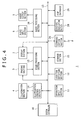
- imaging/display apparatus 1 Exemplary structures of the imaging/display apparatus 1, the imaging apparatus 30, the display apparatus 40, and the server apparatus 70 will now be described below with reference to Figs. 4 to 8 .
- a system controller 10 is formed by a microcomputer that includes a central processing unit (CPU), a read only memory (ROM), a random access memory (RAM), a nonvolatile memory section, and an interface section, for example, and controls an overall operation of the imaging/display apparatus 1. Based on a program held in the internal ROM or the like, the system controller 10 performs a variety of computational processes and exchanges a control signal and so on with each part of the imaging/display apparatus 1 via a bus 13 to cause each part of the imaging/display apparatus 1 to perform a necessary operation.
- CPU central processing unit
- ROM read only memory
- RAM random access memory
- nonvolatile memory section for example
- the imaging/display apparatus 1 includes an imaging section 3 as a component for imaging the scene that is in the direction in which the user sees.
- the imaging section 3 includes an imaging optical system, an imaging device section, and an imaging signal processing section.
- the imaging optical system in the imaging section 3 is provided with: a lens system formed by the image-pickup lens 3a illustrated in Fig. 1 , a diaphragm, a zoom lens, a focus lens, and the like; a driving system for allowing the lens system to perform a focusing operation, a zoom operation; and the like.
- the imaging device section in the imaging section 3 is provided with a solid-state imaging device array for detecting light for imaging obtained by the imaging optical system, and subjecting the detected light to optical-to-electrical conversion to generate an imaging signal.
- the solid-state imaging device array is, for example, a CCD (charge coupled device) sensor array or a CMOS (complementary metal oxide semiconductor) sensor array.
- the imaging signal processing section in the imaging section 3 includes a sample-hold/AGC (automatic gain control) circuit for subjecting the signal obtained by the solid-state imaging device to gain control and waveform shaping, and a video A/D converter, and obtains picked-up image data in digital form.
- the imaging signal processing section also performs white balancing processing, brightness processing, color signal processing, blur correction processing, and the like on the picked-up image data.
- Imaging is performed by the imaging section 3 that includes the imaging optical system, the imaging device section, and the imaging signal processing section described above, so that the image data is obtained by imaging.
- the system controller 10 performs control of turning on and off of an imaging operation in the imaging section 3, drive control of the zoom lens and the focus lens in the imaging optical system, control of sensitivity and a frame rate in the imaging device section, setting of a parameter for each process and setting for a process performed in the imaging signal processing section, and so on.
- the picked-up image data obtained by the imaging operation performed by the imaging section 3 can be supplied to a display section 2, a storage section 25, or a communication section 26 via an image processing section 15.
- the image processing section 15 performs a process of converting the picked-up image data into a predetermined image data format, and necessary signal processing for allowing the image data to be displayed on the display section 2 for monitoring.
- Examples of the signal processing for allowing the image data to be displayed on the display section 2 for monitoring include: brightness level control; color correction; contrast control; sharpness (edge enhancement) control; a split screen process; a process of synthesizing a character image; generation of a magnified or reduced image; and application of image effects, such as a mosaic image, a brightness-reversed image, soft focus, highlighting of a part of the image, and varying of an overall color atmosphere of the image.
- the image processing section 15 also performs a process of transferring the image data among the imaging section 3, the display section 2, the storage section 25, and the communication section 26. Specifically, the image processing section 15 performs a process of supplying the picked-up image data from the imaging section 3 to the display section 2, the storage section 25, or the communication section 26, a process of supplying image data read from the storage section 25 to the display section 2, and a process of supplying image data received by the communication section 26 to the display section 2.
- the imaging/display apparatus 1 includes the display section 2 as a component for presenting a display to the user.
- the display section 2 is provided with the above-described display panel sections 2a and 2b formed by the liquid crystal panels, and a display driving section for driving the display panel sections 2a and 2b to display.
- the display driving section is formed by a pixel driving circuit for allowing an image signal supplied from the image processing section 15 to be displayed on the display panel sections 2a and 2b, which are formed as liquid crystal displays, for example. That is, the display driving section applies driving signals based on a video signal to pixels arranged in a matrix in the display panel sections 2a and 2b with predetermined horizontal/vertical driving timing for displaying. As a result of this process, an image taken by the imaging section 3, an image of the image data read from the storage section 25, or an image of the image data received by the communication section 26 is displayed on the display panel sections 2a and 2b.
- the display driving section is capable of controlling transmittance of each of the pixels in the display panel sections 2a and 2b to allow the pixel to enter the see-through state (i.e., the transparent or translucent state).
- the system controller 10 performs on/off (see-through) control of a display operation in the display section 2, specification of a process parameter related to the image data to be displayed, screen area setting control, instruction for generation of a character, and so on.
- the imaging/display apparatus 1 further includes an audio input section 6, an audio processing section 16, and an audio output section 5.
- the audio input section 6 includes the microphones 6a and 6b illustrated in Fig. 1 , a microphone amplifier section for amplifying audio signals obtained by the microphones 6a and 6b, and an A/D converter, and outputs audio data.
- the audio data obtained at the audio input section 6 is supplied to the audio processing section 16.
- the audio processing section 16 controls transfer of the audio data. Specifically, the audio processing section 16 supplies the audio data obtained at the audio input section 6 to the audio output section 5, the storage section 25, or the communication section 26. The audio processing section 16 also supplies audio data read from the storage section 25 or audio data received by the communication section 26 to the audio output section 5.
- the audio processing section 16 Under control of the system controller 10, the audio processing section 16 also performs a process such as volume control, tone control, or application of a sound effect.
- the audio output section 5 includes the pair of earphone speakers 5a illustrated in Fig. 1 , an amplifier circuit for the earphone speakers 5a, and a D/A converter.
- the audio data supplied from the audio processing section 16 is converted by the D/A converter into an analog audio signal, and the analog audio signal is amplified by the amplifier circuit and outputted via the earphone speaker 5a as sound.
- the user is able to listen to the external sound, audio based on the audio data read from the storage section 25, or audio based on the audio data received by the communication section 26.
- the audio output section 5 may use a so-called bone conduction speaker.
- the storage section 25 is a unit for recording and reading the image data (and the audio data) onto or from a predetermined storage medium.
- the storage section 25 is formed by a hard disk drive (HDD).
- HDD hard disk drive
- various types of storage media are adoptable, such as a solid-state memory like a flash memory, a memory card containing the solid-state memory, an optical disk, a magneto-optical disk, and a hologram memory.
- a requirement for the storage section 25 is to be capable of recording and reading in accordance with the adopted storage medium.
- the storage section 25 records the image data (and the audio data) obtained by imaging on the storage medium, or records the image data (and the audio data) received by the communication section 26 on the storage medium. Specifically, the storage section 25 encodes the image data supplied via the image processing section 15 and the audio data supplied via the audio processing section 16, or the image data and the audio data received by the communication section 26, so that they can be recorded on the storage medium, and then records the encoded data on the storage medium.
- the storage section 25 is also capable of reading the recorded image data and audio data.
- the read image data is supplied to the display section 2 via the image processing section 15, whereas the read audio data is supplied to the audio output section 5 via the audio processing section 16. It is also possible to supply the read image/audio data to the communication section 26 as data to be transmitted to the external device.
- the communication section 26 transmits and receives data to or from the external device, particularly the server apparatus 70, via the network 60 illustrated in Fig. 3 .
- the communication section 26 may be configured to perform network communication via short-range wireless communication for a network access point, for example, in accordance with a system such as a wireless LAN, Bluetooth, or the like.
- the picked-up image data obtained by the imaging section 3 is supplied to the communication section 26 via the image processing section 15.
- the audio data obtained by the audio input section 6 is supplied to the communication section 26 via the audio processing section 16.
- the communication section 26 is capable of encoding the image data and the audio data for the purpose of communication, modulating the encoded data for radio transmission, and transmitting the modulated data to the external device. That is, the communication section 26 is capable of transmitting the image data and the audio data currently obtained in the imaging/display apparatus 1 by imaging and sound collecting to the external device (e.g., the server apparatus 70).
- the communication section 26 is also capable of encoding the image data and the audio data read from the storage section 25 for the purpose of communication, modulating the encoded data for radio transmission, and transmitting the modulated data to the external device.
- the system controller 10 At the time when the image/audio data currently obtained in the imaging/display apparatus 1 by imaging and sound collecting is transmitted to the server apparatus 70, for example, the system controller 10 generates the additional data, and causes the communication section 26 to encode and transmit the additional data together with the image/audio data.
- the additional data includes management information of the image data, the current location information detected by a location detection section 12 described below, and current date/time information obtained by calculation by a date/time calculation section 28.
- Another possible operation is an operation of once storing the image/audio data obtained by imaging and sound collecting in the storage section 25, then reading the stored image/audio data from the storage section 25 at a subsequent time, and transmitting the read image/audio data to the server apparatus 70 via the communication section 26.
- the system controller 10 when storing the image/audio data in the storage section 25, generates the additional data including the pieces of information mentioned above, and causes the storage section 25 to record the additional data together with the image/audio data.
- the additional data recorded together is also transmitted to the server apparatus 70.
- system controller 10 transmits the image/audio data to the server apparatus 70 by performing the above process
- location information indicative of a location at which the image data was obtained by taking an image and date/time information indicative of a date and time when the image/audio data was obtained are also transmitted to the server apparatus 70.
- the communication section 26 receives the image/audio data transmitted from the external device (the server apparatus 70), demodulates the received image/audio data, and supplies the demodulated image/audio data to the image processing section 15 and the audio processing section 16. In this case, the received image and audio are outputted via the display section 2 and the audio output section 5, respectively.
- the image/audio data received by the communication section 26 may be supplied to the storage section 25 and recorded on the storage medium.
- the imaging/display apparatus 1 further includes an illumination section 4 and an illumination control section 14.
- the illumination section 4 is formed by the lighting section 4a illustrated in Fig. 1 and Fig. 2 and a lighting circuit for causing the lighting section 4a (e.g., the LED) to emit light.
- the illumination control section 14 Based on an instruction issued from the system controller 10, the illumination control section 14 causes the illumination section 4 to perform a lighting operation.
- the illumination section 4 provides illumination in the direction in which the image-pickup lens 3a takes an image.
- the imaging/display apparatus 1 further includes an operation input section 11 for user operation.
- the operation input section 11 may include an operation unit(s) such as a key, a dial, or the like, and be configured to detect a user operation such as a key operation. Alternatively, the operation input section 11 may be configured to detect a deliberate behavior of the user.
- the operation unit(s) may include operation units for a power on/off operation, imaging-related operations (e.g., the zoom operation, an operation related to signal processing, etc.), display-related operations (e.g., selection of a display content, an operation for controlling the display, etc.), and an operation for specifying the external device described below.
- imaging-related operations e.g., the zoom operation, an operation related to signal processing, etc.
- display-related operations e.g., selection of a display content, an operation for controlling the display, etc.
- an operation for specifying the external device described below e.g., selection of a display content, an operation for controlling the display, etc.
- the operation input section 11 may be provided with an acceleration sensor, an angular velocity sensor, a vibration sensor, a pressure sensor, or the like.
- the user's act of tapping the imaging/display apparatus 1 from the side may be detected with the acceleration sensor, the vibration sensor, or the like.
- the system controller 10 may determine that a user operation has occurred when lateral acceleration has exceeded a predetermined value, for example.
- the acceleration sensor, the angular velocity sensor, or the like may be used to detect whether the user has tapped the side (which corresponds to a sidepiece of spectacles) of the imaging/display apparatus 1 from the right side or from the left side, and the system controller 10 may regard each of these acts of the user as a predetermined operation.
- the user's act of turning or shaking his or her head may be detected with the acceleration sensor, the angular velocity sensor, or the like.
- the system controller 10 may regard each of these acts of the user as a user operation.
- the pressure sensor may be provided on each of the left and right sides (which correspond to the sidepieces of the spectacles) of the imaging/display apparatus 1, for example. Then, the system controller 10 may determine that the user has performed an operation for telephoto zooming when the user has pushed the right side of the imaging/display apparatus 1 with a finger, and determine that the user has performed an operation for wide-angle zooming when the user has pushed the left side of the imaging/display apparatus 1 with a finger.
- the operation input section 11 may be provided with a biological sensor used to detect biological information concerning the user.
- the biological information detected may be recognized as an operation input.
- the biological information include a pulse rate, a heart rate, electrocardiogram information, electromyographic information, breathing information (e.g., a rate of breathing, a depth of breathing, the amount of ventilation, etc.), perspiration, GSR (galvanic skin response), blood pressure, a saturation oxygen concentration in the blood, a skin surface temperature, brain waves (e.g., information of alpha waves, beta waves, theta waves, and delta waves), a blood flow change, and the state of the eyes.
- a pulse rate e.g., a heart rate, electrocardiogram information, electromyographic information, breathing information (e.g., a rate of breathing, a depth of breathing, the amount of ventilation, etc.), perspiration, GSR (galvanic skin response), blood pressure, a saturation oxygen concentration in the blood, a skin surface temperature, brain waves (e.g.,
- the system controller 10 may recognize the information detected by the biological sensor as an operation input by the user.
- One example of deliberate behaviors of the user is a motion of the eyes (e.g., a change in the direction in which the eyes of the user are directed, winking, etc.).
- the system controller 10 may regard this act as a specific operation input.
- the system controller 10 may turn on or off power of the imaging/display apparatus 1 in response to detection of such an act, for example.
- the operation input section 11 supplies, to the system controller 10, information acquired by functioning as the operation unit(s), the acceleration sensor, the angular velocity sensor, the vibration sensor, the pressure sensor, the biological sensor, or the like as described above.
- the system controller 10 detects the user operation based on the supplied information.
- the imaging/display apparatus 1 further includes the location detection section 12.
- the location detection section 12 is, for example, a GPS receiver section.
- the GPS receiver section receives a radio wave from a global positioning system (GPS) satellite, and outputs information of a latitude and longitude of a current location to the system controller 10.
- GPS global positioning system
- location information at the time of imaging as detected by this location detection section 12 is included in the additional data.
- the location detection section 12 may employ Wi-Fi (Wireless Fidelity) or a location information service provided by a mobile phone company, or a combination of such a service and the GPS.
- Wi-Fi Wireless Fidelity
- a location information service provided by a mobile phone company
- a walking speed (or, in the case of a device installed on an automobile or the like, a vehicle speed or the like) may be detected to correct the location of the detection.
- the date/time calculation section 28 calculates a current date and time (year, month, day, hour, minute, second).
- the system controller 10 is capable of recognizing the current date and time based on a value calculated by the date/time calculation section 28.
- this additional data includes the date/time information (indicative of the date and time when the image data being transmitted was obtained by imaging) detected by the date/time calculation section 28.
- the imaging/display apparatus 1 is capable of displaying a map image on the display section 2.
- the imaging/display apparatus 1 further includes a map database 29.
- the map database 29 may be stored in a partial area of the HDD or the like.
- the map database 29 is a database containing, as information used for displaying a map as in a so-called navigation system, information for generating a map image corresponding to the location information, additional information such as names of points, search information, and so on.
- the system controller 10 is capable of performing a process of searching for and displaying an appropriate map using the map database 29.
- the structure of the imaging apparatus 30 will now be described below with reference to Fig. 5 .
- components that have their counterparts in Fig. 4 are assigned the same reference numerals as those of their counterparts in Fig. 4 , and descriptions thereof will be omitted.
- the imaging apparatus 30 illustrated in Fig. 5 is different from the imaging/display apparatus 1 illustrated in Fig. 4 in that the imaging apparatus 30 does not include the display section 2 for outputting the image, the audio output section 5 for outputting the audio, or the map database 29 used for displaying the map.
- the imaging apparatus 30 is capable of imaging by means of the imaging section 3, and transmitting the picked-up image data to the external device via the communication section 26 or recording the picked-up image data in the storage section 25.
- the system controller 10 controls the imaging operation, a communication operation, a recording operation, and so on.
- the exemplary structure of the display apparatus 40 will now be described below with reference to Fig. 6 .
- components that have their counterparts in Fig. 4 are assigned the same reference numerals as those of their counterparts in Fig. 4 , and descriptions thereof will be omitted.
- the display apparatus 40 illustrated in Fig. 6 is different from the imaging/display apparatus 1 illustrated in Fig. 4 in that the display apparatus 40 does not include the imaging section 3 for imaging or the audio input section 6 for audio input. Further, the display apparatus 40 is not provided with the illumination section 4 or the illumination control section 14, which are helpful for imaging.
- the display apparatus 40 is not designed to transmit the image/audio data to the server apparatus 70, the display apparatus 40 need not be provided with the location detection section 12 or the date/time calculation section 28 for generating the location information or the date/time information to be included in the additional data to when transmitting.
- the system controller 10 need not have a capability to perform a process of controlling the transmission of the image/audio data to the server apparatus 70.
- the display apparatus 40 is a device to be worn by the user in a manner as suggested by (b) of Fig. 2 , or carried by the user, or installed by the user in a house, the automobile, or the like.
- the display apparatus 40 receives, via the communication section 26, the image/audio data transmitted from the external device. Then, the display apparatus 40 outputs the received image/audio data via the display section 2 and the audio output section 5, or records the received image/audio data in the storage section 25.
- the system controller 10 controls the communication operation, the display operation, an audio output operation, the recording operation, and so on.
- the communication section 26 may be configured to perform network communication via wired connection.
- Both the imaging apparatus 30 and the display apparatus 40 as illustrated in (a) and (b) of Fig. 2 may be used by the same user, as user F illustrated in Fig. 3 does, so that the imaging apparatus 30 and the display apparatus 40 combine to fulfill functions similar to those of the imaging/display apparatus 1.
- the imaging apparatus 30 and the display apparatus 40 may have a configuration as illustrated in Fig. 7 .
- the imaging apparatus 30 has substantially the same structure as that of the imaging/display apparatus 1 illustrated in Fig. 4 , except that the imaging apparatus 30 is not provided with the display section 2 but is provided with a transmission section 27 instead.
- the transmission section 27 encodes image data supplied from the image processing section 15 as image data to be displayed for monitoring so that the image data can be transmitted to the display apparatus 40. Then, the transmission section 27 transmits the encoded image data to the display apparatus 40.
- the display apparatus 40 includes a reception section 41, a display control section 42, and the display section 2.
- the reception section 41 performs data communication with the transmission section 21 in the imaging apparatus 30.
- the reception section 41 receives the image data transmitted from the imaging apparatus 30, and decodes the received image data.
- the image data decoded by the reception section 41 is supplied to the display control section 42.
- the display control section 42 performs signal processing, screen splitting, character synthesis, or the like for presenting a display concerning the image data to generate an image signal used for the display, and supplies the generated image signal to the display section 2, which has the display panel section 2a such as the liquid crystal display.
- the display section 2 applies driving signals based on a video signal to the pixels arranged in a matrix in the display panel section 2a with predetermined horizontal/vertical driving timing for displaying.
- the imaging apparatus 30 and the display apparatus 40 have the above configuration, the user who is wearing the imaging apparatus 30 and the display apparatus 40 like user F in Fig. 3 is able to use the two apparatuses in a manner similar to the manner in which the imaging/display apparatus 1 is used.
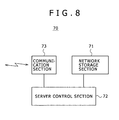
- the server apparatus 70 includes a server control section 72, a network storage section 71, and a communication section 73.
- the network storage section 71 is formed by an HDD or the like, and stores the point image database described below.
- the point image database is a database in which the image/audio data and the additional data received from the imaging apparatus 30 or the imaging/display apparatus 1 via the network 60 are accumulated.
- the communication section 73 performs data communication with the communication section 26 of each of the imaging/display apparatus 1, the imaging apparatus 30, and the display apparatus 40 via the network 60.
- the server control section 72 performs operation control necessary for the server apparatus 70. Specifically, the server control section 72 controls a communication operation performed between the imaging/display apparatus 1, the imaging apparatus 30, and the display apparatus 40, a process of storing the image/audio data in the network storage section 71, a searching process, and so on.
- imaging/display apparatus 1 While the structures of the imaging/display apparatus 1, the imaging apparatus 30, the display apparatus 40, and the server apparatus 70 have been described above, it will be appreciated that each of these structures is merely an example. Needless to say, addition or omission of a component(s) is possible in a variety of manners in accordance with an actual system operation or functionality as implemented. It will be appreciated that appropriate structures of the imaging apparatus 30, the imaging/display apparatus 1, and the display apparatus 40 depend upon the type of movable body on which the imaging apparatus 30 or the imaging/display apparatus 1 is mounted (placed) or upon the form (e.g., a watch shape, a portable type, a stationary type, etc.) of the display apparatus 30.
- Appatus A refers to the imaging/display apparatus 1 or the display apparatus 40 as illustrated in Fig. 3 .
- apparatus B refers to the imaging/display apparatus 1 or the imaging apparatus 30 as illustrated in Fig. 3 .
- apparatus A refers to devices that are used by a user and receive and display an image taken at another movable body from the server apparatus 70, and corresponds to the "display apparatus" as recited in the appended claims.
- apparatus B refers to devices that transmit images to the server apparatus 70 and are worn by or mounted on a person, a creature, a vehicle, or other movable bodies as mentioned previously, and corresponds to the "imaging apparatus" as recited in the appended claims.
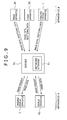
- Figs. 9 illustrates the imaging/display apparatus 1 and the display apparatus 40 which function as the apparatus A, the server apparatus 70, and the imaging/display apparatus 1 and the imaging apparatuses 30 which function as the apparatus B.
- the imaging apparatuses 30 and the imaging/display apparatus 1 which function as the apparatus B perform a process of transmitting the image data obtained by imaging (and the audio data) to the server apparatus 70.
- the imaging apparatuses 30 and the imaging/display apparatus 1 which function as the apparatus B may constantly image and transmit the taken image data (and the audio data) to the server apparatus 70.
- the imaging apparatuses 30 and the imaging/display apparatus 1 which function as the apparatus B may transmit the picked-up image data (and the audio data) to the server apparatus 70 every time imaging has been performed.
- imaging and transmission of the image data may be performed regularly.
- the server apparatus 70 may transmit to the apparatus B a request for imaging together with location information indicative of a specified location.
- the system controller 10 of the apparatus B may automatically take and transmit image data obtained by imaging to the server apparatus 70 when the system controller 10 has determined that the current location of the apparatus B corresponds to the specified location indicated by the location information.
- the imaging apparatus 30 and the imaging/display apparatus 1 which function as the apparatus B also transmit the additional data when transmitting the image/audio data to the server apparatus 70.
- the additional data includes image management information concerning the image/audio data transmitted, the location information indicative of the location at which the image data was obtained by imaging, and the date/time information indicative of the date and time when the image data was obtained by imaing.
- the server apparatus 70 stores the image data (and the audio data) and the additional data transmitted from each of the imaging/display apparatus 1 and the imaging apparatuses 30 in the point image database in the network storage section 71.
- the server control section 72 upon receipt of the image data (and the audio data) and the additional data from the apparatus B via the communication section 73, the server control section 72 performs a process of registering the received data in the point image database in the network storage section 71.
- Fig. 10 schematically illustrates contents recorded in the point image database.
- the image data transmitted from each of the imaging/display apparatuses 1 and the imaging apparatuses 30 which function as the apparatus B are segmented into and registered as entries #1, #2, and so on. Segmentation of the image data may be based on the size of the image data, a playback time, or the like. For example, a maximum data size, a maximum playback time, or the like may be determined.
- the image data is transmitted from the apparatus B as a continuous video
- the continuous video may be divided into different entries at a point where the location information indicative of the location where the image data was obtained by photographing changes.
- the manner in which the image data is segmented into different entries may be determined appropriately depending on the form of the transmission of the image data from the apparatus B, or duration of transmission, or according to convenience for management information of the point image database or convenience for an image providing service provided by the server apparatus 70, for example.
- image data (and audio data) VD1, VD2, VD3, and so on are recorded as entries, location information P1, P2, P3, and so on, date/time information Date1, Date2, Date3, and so on, and image management information C1, C2, C3, and so on are recorded so as to be associated with the image data VD1, VD2, VD3, and so on, respectively.
- the location information, the date/time information, and the image management information are the additional data transmitted from the apparatus B together with the image data.
- the location information P1 is location information indicative of a location where an image of the image data VD1 was taken, and is, for example, information of the latitude and longitude of that location.
- the date/time information Datel is information indicative of a date and time (year, month, day, hour, minute, second) when the image of the image data VD1 was taken.
- the image management information C1 is management information of the image data VD1, and includes, for example, an image type (video or still images, for example), a data size, a compression algorithm, the identification information of the apparatus B, and imaging location-related information such as information of a name of the location where the image of the image data VD1 was taken.
- the imaging location-related information may be retrieved from the map database 29 in the imaging/display apparatus 1 or imaging apparatus 30 that functions as the apparatus B based on the current location information at the time of imaging, and then the system controller 10 of the apparatus B may add the retrieved imaging location-related information to the additional data to be transmitted to the server apparatus 70.
- the server apparatus 70 may be provided with a map database and retrieve the imaging location-related information from the map database 75 based on the location information P1.
- each of the imaging/display apparatuses 1 and the imaging apparatuses 30 that function as the apparatus B transmits the image data and the additional data to the server apparatus 70 as illustrated in Fig. 9 .
- the image data of the images taken at a variety of places and at a variety of speeds is accumulated in the point image database as illustrated in Fig. 10 .
- the server apparatus 70 becomes able to provide the image providing service to the user of the apparatus A. That is, the server apparatus 70 is capable of reading the image data accumulated in the point image database and transmitting the read image data to the apparatus A in response to the image request from the apparatus A.
- this exemplary operation is an operation in which the user of the apparatus A enjoys the image providing service provided by the server apparatus 70.
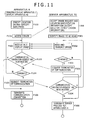
- a procedure of the apparatus A illustrated in Fig. 11 can be considered as a control procedure performed by the system controller 10 of the imaging/display apparatus 1 or the display apparatus 40, whereas a procedure of the server apparatus 70 can be considered as a control procedure performed by the server control section 72.
- a location specification process is performed using the map image.
- the system controller 10 of the apparatus A performs map display using data in the map database 29. It also performs a search for a specific area on the map, scrolling display, or the like in accordance with a user operation. This enables the user to see the map image of a specific region or area on the display section 2.
- the system controller 10 changes the area being displayed or the scale to cause a map image of a certain area to be displayed as illustrated in (a) of Fig. 12 , for example.
- the system controller 10 causes a pointer PT to be displayed on the map image as illustrated in (b) of Fig. 12 , for example, and allows the pointer PT to be moved on the map image in accordance with the user operation. That is, by moving the pointer PT to a desired location on the map image and performing a predetermined operation, the user is able to specify a specific location on the map image.
- pointer PT is not essential, needless to say.
- a touch panel operation feature may be added to the display section 2, so that the user can specify a desired location by touching that location on the map image with a finger.
- the system controller 10 In response to the user's performing the operation of specifying a certain point on the map image in such a manner, the system controller 10 generates the location specification information. In other words, it generates the location specification information including values of a latitude and longitude of the point specified by the user on the map.
- the system controller 10 of the apparatus A accesses the server apparatus 70 at step F101.
- the system controller 10 of the apparatus A establishes the communication connection with the server apparatus 70.
- the system controller 10 of the apparatus A transmits the information of the image request, and the location specification information to the server apparatus 70.
- the server control section 72 of the server apparatus 70 establishes the communication connection with the apparatus A, and accepts the image request, and the location specification information.
- the server control section 72 identifies image data to be read. Specifically, based on the received location specification information, the server control section 72 searches the point image database in the network storage section 71 to extract an entry whose location information matches the location specification information.
- an entry may be extracted that has location information within a predetermined range that can be considered as being close to the location in the latitude and longitude specified by the location specification information.
- the server control section 72 identifies the image data of the extracted entry as the image data to be read.
- the date/time information may be referred to so that image data of an entry whose date/time information indicates the most recent date and time is selected as the image data to be read.
- all of the entries found may be determined to be read sequentially.
- no entry that matches the location specification information may be found. That is, in the case where no image data of an image taken at (or near) the location indicated by the location specification information has been uploaded by the apparatus B.
- the server control section 72 notifies the apparatus A that no image data that matches the location specification information has been found and, therefore, providing of an image is impossible.
- the apparatus A informs the user of the impossibility of the providing of an image, and finishes its procedure.
- the server control section 72 After searching the point image database and identifying the entry (i.e., the image data) to be read, the server control section 72, at step F302, causes the image data identified as the image to be read to be read from the network storage section 71, and causes the read image data and audio data to be transmitted to the apparatus A via the communication section 73.
- the apparatus A receives and displays the image data transmitted from the server apparatus 70. That is, the system controller 10 of the apparatus A causes the image data (and the audio data) received and demodulated by the communication section 26 to be supplied to the image processing section 15 and the audio processing section 16, and causes the image data to be displayed on the display section 2 and the audio data to be outputted via the audio output section 5.
- the system controller 10 of the apparatus A monitors whether or not the communication termination request has been transmitted from the server apparatus 70.
- the system controller 10 of the apparatus A determines whether or not the displaying of the image should be terminated. For example, the system controller 10 of the apparatus A determines that the displaying of the image should be terminated when the user has performed the operation for terminating the displaying of the image using the operation input section 11. Also, the displaying of the image may be automatically terminated when the reception and displaying of the image data has continued for a predetermined period of time.
- the system controller 10 of the apparatus A continues to display the image data (and output the audio data) received at step F102 until it is determined at step F103 that the communication termination request has been received or it is determined at step F104 that the displaying of the image should be terminated.
- the server apparatus 70 monitors whether the reading of the image data of the entry to be read has been completed.
- the server apparatus 70 monitors whether the communication termination request has been received from the apparatus A. The server apparatus 70 continues to read and transmit the image data (and the audio data) until either of such cases are determined.
- the user of the apparatus A is able to watch an image of an actual scene that was taken in the past by the apparatus B that was located at or near the location specified by the user using the map image and was moving at the specified speed.
- step F104 If it is determined at step F104 that the displaying of the image should be terminated based on the user operation or another condition for termination, the system controller 10 of the apparatus A proceeds to step F105, and causes the communication termination request to be transmitted to the server apparatus 70 via the communication section 26, and then proceeds to step F106.
- the server apparatus 70 Upon receipt of the communication termination request, the server apparatus 70 proceeds from step F304 to F306.
- the server control section 72 proceeds from step F303 to F305, and causes the communication termination request to be transmitted to the apparatus A via the communication section 73.
- the system controller 10 of the apparatus A proceeds from step F103 to F106.
- step F106 the system controller 10 of the apparatus A performs a process of terminating the communication connection with the server apparatus 70.
- the server control section 72 of the server apparatus 70 terminates the communication with and the server process for the apparatus A. Thus, the system operation is finished.
- the user of the apparatus A is able to watch the scene photographed by the apparatus B at that location, with the apparatus A which the user is wearing or carrying.
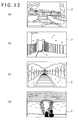
- Fig. 13 illustrates exemplary images that can be seen by the user of the apparatus A.
- Such images are, for example, images that had been shot at that specified point by the imaging apparatus 30 attached to, for example, the automobile, or the imaging apparatus 30 or the imaging/display apparatus 1 worn by a driver.
- the user of the apparatus A specifies a point on a certain railway track on the map, for example, the user can see an image shot by the apparatus B such as the imaging apparatus 30 attached to a railway vehicle at that point in the past, or the imaging apparatus 30 or imaging/display apparatus 1 that was worn by a train driver.
- the apparatus B such as the imaging apparatus 30 attached to a railway vehicle at that point in the past, or the imaging apparatus 30 or imaging/display apparatus 1 that was worn by a train driver.
- the user of the apparatus A specifies a point in a certain resort on the map, for example, the user can see an image shot by the apparatus B such as the imaging apparatus 30 or imaging/display apparatus 1 that was worn by a person who was present at that point in the past.
- the apparatus B such as the imaging apparatus 30 or imaging/display apparatus 1 that was worn by a person who was present at that point in the past.
- the user of the apparatus A can see an image that was actually shot at that point.
- the user of the apparatus A specifies only the location on the map image
- the user may be allowed to additionally specify a date and time as additionally described in step F100 in Fig. 11 .
- the system controller 10 generates the location specification information in accordance with the user's operation of specifying the location while the map image is being displayed.
- the system controller 10 may additionally ask the user to specify and enter the date and time either using a menu or by inputting a numerical value, for example.
- the user may be allowed to specify and enter a specific year, month, and day, a specific time, or the like, or to specify and enter a certain date range (e.g., from a certain day of a certain month to a certain day of a certain month) or a certain time range (e.g., from a certain hour to another hour).
- a search condition based on the entered date and time. Examples of such search conditions include "including the specified date/time,” "within the specified date/time range,” "before the specified date/time,” and "after the specified date/time.” Then, the system controller 10 sets the specified date/time or a combination of the specified date/time and the search condition as date/time specification information.
- the system controller 10 of the apparatus A transmits the date/time specification information as well as the location specification information.
- the server control section 72 accepts the date/time specification information as well as the location specification information.
- the server control section 72 searches the point image database using both the location specification information and the date/time specification information.
- the server control section 72 extracts entries whose location information in the point image database match (or are close to) the location specification information, and further extracts therefrom an entry whose date/time information in the point image database matches the date/time specification information.
- the server control section 72 extracts an entry that matches the location and imaging date/time specified by the user, and identifies image data of that entry as the image to be read.
- the user of the apparatus A is able to selectively watch an image taken at the specified date/time.
- the user of the apparatus A is able to arbitrarily select and watch a scene taken at a certain point in a certain period, a scene taken at a certain point in the recent past, a scene taken at a certain point before a certain time, a scene taken at a certain point on a specific day, a scene taken at a certain point at a specific time, a scene taken at a certain point at night, or the like.
- the user is able to watch a greater variety of scenes taken at an arbitrary place at an arbitrary moving speed.
- Embodiments have been described above.
- the user of the imaging/display apparatus 1 or display apparatus 40 corresponding to the apparatus A is able to see, by specifying a location on the map image, an image actually shot by the imaging apparatus 30 at the specified location.
- a system and apparatus that satisfy a variety of needs of users are achieved. Examples of such needs include a desire to watch and enjoy a scene at a certain place that can be specified on the map, and a desire to know a situation of a certain place that can be specified on the map.
- the ability to specify a location on the map image and see an image shot at that location allows the user to know, as circumstances of the specified location, a geographic feature thereof, a view of a nearby building or natural object, the width of a road or the number of lanes, a state that varies depending on the date and time, or the like, for example.
- application to a so-called navigation system makes it possible to provide an expansive information providing service.
- date/time specification information can be used to select image data to be provided. This allows the user to watch different images by specifying different date/time conditions.
- imaging/display apparatuses 1 or imaging apparatuses 30 that function as the apparatus B can be placed on the movable bodies including people, there is no need to provide fixed equipment such as a so-called fixed camera.
- the imaging/display apparatuses 1 or imaging apparatuses 30 placed on the movable bodies naturally take images while traveling over a variety of places. Therefore, it is easy to collect images actually taken at a variety of places and enrich the images registered in the point image database.
- imaging/display apparatus 1 and display apparatus 40 that function as the apparatus A, which corresponds to the display apparatus according to the present invention.
- imaging/display apparatus 1 and imaging apparatus 30 that function as the apparatus B, which corresponds to the imaging apparatus as recited in the appended claims.
- server apparatus 70 there are a variety of possible structures and procedures of the server apparatus 70.
- imaging operations may be performed to obtain images in the apparatus B so that the uploaded data is transmitted to the server apparatus 70.
- a request for a variety of imaging operations may be transmitted from the the server apparatus 70.
- imaging operations include: telephoto imaging; wide-angle imaging; imaging that involves zooming in or zooming out within a range between a telephoto extreme and a wide-angle extreme; imaging for a magnified image; imaging for a reduced image; imaging with a varied frame rate (e.g., imaging with a high frame rate, imaging with a low frame rate, etc.); imaging with increased brightness; imaging with reduced brightness; imaging with varied contrast; imaging with varied sharpness; imaging with increased imaging sensitivity; imaging with increased infrared imaging sensitivity; imaging with increased ultraviolet imaging sensitivity; imaging with a specific wavelength range cut off; imaging that involves application of an image effect, such as mosaicing for the picked-up image data, a brightness reversing process, a soft-focus process,
- the apparatus A when the apparatus A requests an image from the server apparatus 70, it may be so arranged that not only a normal playback image of an image registered in the point image database but also a special playback image thereof may be requested.
- a request for transmission of a still image, corresponding to only one frame, of a piece of image data that is stored as a video may be possible, and a request for image data played at a reduced speed or an increased speed may be possible.
- image data registered in the point image database since they are image data shot by the apparatus B as attached to a movable body, are often image data that were shot while the movable body was traveling at a certain speed. Accordingly, the server apparatus 70 may reproduce such image data at a varied speed to transmit it to the apparatus A, so that the user of the apparatus A can see an image of a scene that would be seen when traveling at a high speed, an image of a scene that would be seen when traveling at a slow speed, or the like, artificially.
- the image data transmitted from the server apparatus 70 may be stored in the storage section 25 with location information. That is, the system controller 10 stores the received image data in the storage section 25 so as to be associated the location information (e.g., the point specification information set at step F100 in Fig. 11 ).
- the user can replay the image data stored in the storage section 25 by specifying the same point on the map at any subsequent time.
- the user of the apparatus A may be allowed to specify a direction of movement from a certain point.
- the location detection section 12 detects the direction of movement as well, and the direction of movement is transmitted to the server apparatus 70 included in the additional data.
- the server apparatus 70 registers the received data in the point image database together with the movement direction information.
- the user of the apparatus A is able to request the server apparatus 70 to select image data of an image taken by an apparatus B moving in the specified direction of movement.
- scenes seen on a certain road that runs in a north-south direction will differ depending on whether the apparatus B imaging the scenes are moving northward or southward.
- the user of the apparatus A specifies the direction of movement as an additional search condition, image data that matches the user-specified direction of movement will be retrieved and provided to the apparatus A.
- a certain location may be specified via an ocean chart, an undersea topographic map, an aeronautical chart, a space chart, or the like.
- the server apparatus 70 may register image data of images shot at a watercraft, a submarine, an aircraft, a satellite, and so on in the point image database together with the location information thereof, and so on.
- the server apparatus 70 is able to search for an appropriate image based on the specification via the ocean chart or the like, and provide the image found to the apparatus A.
- location information concerning a location beneath the sea, in the air, in space, or the like may include not only information of the latitude and longitude but also information of an altitude or a depth.
- the user may specify a certain place on an orbit of the satellite using the space chart to watch an image shot at the satellite at that point or near that point.
- the apparatus A side is provided with the map database 29 to perform the map display.
- the server apparatus 70 may be provided with a map database, and the server apparatus 70 may transmit a map image based on the map database to allow it to be displayed at the apparatus A.
- the user of the apparatus A enters a specific place name, address, or the like, and transmits the place name, address, or the like to the server apparatus 70, as the location specification information. Then, the server apparatus 70 generates map image data that should be displayed based on the place name or the like, and transmits it to the apparatus A to be displayed.
- the image data and the audio data are uploaded to the server apparatus 70 from the apparatus B and provided to the apparatus A from the server apparatus 70. Note, however, that only the image data may be provided in another embodiment of the present invention.
- the present invention may be applied to a system that handles only the audio data.
Landscapes
- Engineering & Computer Science (AREA)
- Theoretical Computer Science (AREA)
- Multimedia (AREA)
- Signal Processing (AREA)
- Physics & Mathematics (AREA)
- General Physics & Mathematics (AREA)
- General Engineering & Computer Science (AREA)
- Databases & Information Systems (AREA)
- Data Mining & Analysis (AREA)
- Library & Information Science (AREA)
- Remote Sensing (AREA)
- Optics & Photonics (AREA)
- Human Computer Interaction (AREA)
- Computer Hardware Design (AREA)
- Controls And Circuits For Display Device (AREA)
- Studio Devices (AREA)
- Television Signal Processing For Recording (AREA)
Applications Claiming Priority (2)
| Application Number | Priority Date | Filing Date | Title |
|---|---|---|---|
| JP2006330832A JP5176311B2 (ja) | 2006-12-07 | 2006-12-07 | 画像表示システム、表示装置、表示方法 |
| PCT/JP2007/071491 WO2008068990A1 (ja) | 2006-12-07 | 2007-11-05 | 画像表示システム、表示装置、表示方法 |
Publications (3)
| Publication Number | Publication Date |
|---|---|
| EP2090989A1 true EP2090989A1 (de) | 2009-08-19 |
| EP2090989A4 EP2090989A4 (de) | 2011-11-02 |
| EP2090989B1 EP2090989B1 (de) | 2016-01-27 |
Family
ID=39491896
Family Applications (1)
| Application Number | Title | Priority Date | Filing Date |
|---|---|---|---|
| EP07831223.8A Not-in-force EP2090989B1 (de) | 2006-12-07 | 2007-11-05 | Bildanzeigesystem, anzeigeanordnung und anzeigeverfahren |
Country Status (10)
| Country | Link |
|---|---|
| US (3) | US8473544B2 (de) |
| EP (1) | EP2090989B1 (de) |
| JP (1) | JP5176311B2 (de) |
| KR (1) | KR101329419B1 (de) |
| CN (1) | CN101578602A (de) |
| BR (1) | BRPI0719940B1 (de) |
| CA (1) | CA2670744C (de) |
| MY (1) | MY151947A (de) |
| TW (1) | TW200837713A (de) |
| WO (1) | WO2008068990A1 (de) |
Cited By (2)
| Publication number | Priority date | Publication date | Assignee | Title |
|---|---|---|---|---|
| EP2136556A1 (de) * | 2008-06-17 | 2009-12-23 | Samsung Electronics Co., Ltd. | Verfahren und Vorrichtung zur Aufzeichnung und Wiedergabe eines Spielfilms mit Positionsinformationen |
| DE102014213058A1 (de) * | 2014-07-04 | 2016-01-07 | Siemens Aktiengesellschaft | Verfahren zur Ausgabe von Fahrzeuginformation |
Families Citing this family (46)
| Publication number | Priority date | Publication date | Assignee | Title |
|---|---|---|---|---|
| JP5017989B2 (ja) | 2006-09-27 | 2012-09-05 | ソニー株式会社 | 撮像装置、撮像方法 |
| JP2008096868A (ja) | 2006-10-16 | 2008-04-24 | Sony Corp | 撮像表示装置、撮像表示方法 |
| JP5023663B2 (ja) * | 2006-11-07 | 2012-09-12 | ソニー株式会社 | 撮像装置、撮像方法 |
| JP5092357B2 (ja) * | 2006-11-07 | 2012-12-05 | ソニー株式会社 | 撮像表示装置、撮像表示方法 |
| JP4367663B2 (ja) * | 2007-04-10 | 2009-11-18 | ソニー株式会社 | 画像処理装置、画像処理方法、プログラム |
| JP4506795B2 (ja) | 2007-08-06 | 2010-07-21 | ソニー株式会社 | 生体運動情報表示処理装置、生体運動情報処理システム |
| JP5369974B2 (ja) * | 2009-08-04 | 2013-12-18 | 株式会社リコー | 撮像装置及び画像共有システム |
| TWI423112B (zh) | 2009-12-09 | 2014-01-11 | Ind Tech Res Inst | 可攜式虛擬輸入操作裝置與其操作方法 |
| US9152650B1 (en) | 2010-03-31 | 2015-10-06 | Emc Corporation | Mobile device data recovery |
| US9514089B1 (en) | 2010-03-31 | 2016-12-06 | EMC IP Holding Company LLC | Mobile device network data synchronization |
| US8694597B1 (en) * | 2010-03-31 | 2014-04-08 | Emc Corporation | Mobile device group-based data sharing |
| US8638364B2 (en) | 2010-09-23 | 2014-01-28 | Sony Computer Entertainment Inc. | User interface system and method using thermal imaging |
| US8786698B2 (en) * | 2010-09-23 | 2014-07-22 | Sony Computer Entertainment Inc. | Blow tracking user interface system and method |
| JP5677002B2 (ja) * | 2010-09-28 | 2015-02-25 | キヤノン株式会社 | 映像制御装置、及び映像制御方法 |
| CN102033918B (zh) * | 2010-12-07 | 2012-11-21 | 武汉若鱼网络科技有限公司 | 基于时间位置信息搜索目标用户的方法及系统 |
| JP2012142825A (ja) * | 2011-01-05 | 2012-07-26 | Sony Corp | 情報処理装置、情報表示方法及びコンピュータプログラム |
| US8621000B2 (en) * | 2011-03-23 | 2013-12-31 | Verizon Patent And Licensing Inc. | Region of interest streaming |
| JP2012203128A (ja) * | 2011-03-24 | 2012-10-22 | Seiko Epson Corp | 頭部装着型表示装置および頭部装着型表示装置の制御方法 |
| US9217867B2 (en) | 2011-03-24 | 2015-12-22 | Seiko Epson Corporation | Head-mounted display device and control method for the head-mounted display device |
| US8818706B1 (en) | 2011-05-17 | 2014-08-26 | Google Inc. | Indoor localization and mapping |
| US8164599B1 (en) | 2011-06-01 | 2012-04-24 | Google Inc. | Systems and methods for collecting and providing map images |
| JP5860634B2 (ja) * | 2011-08-23 | 2016-02-16 | 任天堂株式会社 | 情報処理システム、情報処理方法、サーバプログラム、サーバ装置、および、サーバシステム |
| US8941560B2 (en) | 2011-09-21 | 2015-01-27 | Google Inc. | Wearable computer with superimposed controls and instructions for external device |
| TWI482108B (zh) * | 2011-12-29 | 2015-04-21 | Univ Nat Taiwan | To bring virtual social networks into real-life social systems and methods |
| KR20130080186A (ko) * | 2012-01-04 | 2013-07-12 | 삼성전자주식회사 | 위치 정보 태깅을 위한 방법 및 장치 |
| WO2013118535A1 (ja) * | 2012-02-06 | 2013-08-15 | ソニー株式会社 | 撮像制御装置、画像処理装置、撮像制御方法及び画像処理方法 |
| US9170113B2 (en) | 2012-02-24 | 2015-10-27 | Google Inc. | System and method for mapping an indoor environment |
| JP5891843B2 (ja) * | 2012-02-24 | 2016-03-23 | ソニー株式会社 | クライアント端末、サーバ、およびプログラム |
| JP2013183433A (ja) * | 2012-03-05 | 2013-09-12 | Sony Corp | クライアント端末、サーバ、およびプログラム |
| US9756138B2 (en) * | 2013-04-08 | 2017-09-05 | Here Global B.V. | Desktop application synchronization to process data captured on a mobile device |
| FR3006455A1 (fr) * | 2013-05-31 | 2014-12-05 | Optinvent | Systeme de vision oculaire avec guide optique positionnable dans deux positions |
| JP5836319B2 (ja) * | 2013-05-31 | 2015-12-24 | 京セラドキュメントソリューションズ株式会社 | 画像形成システム |
| JP6299234B2 (ja) * | 2014-01-23 | 2018-03-28 | 富士通株式会社 | 表示制御方法、情報処理装置、および表示制御プログラム |
| KR101580617B1 (ko) | 2014-06-05 | 2015-12-28 | 오병오 | 빛의 조사구간 선택이 용이한 실외용 엘이디등기구 |
| JP6070652B2 (ja) * | 2014-07-28 | 2017-02-01 | ヤマハ株式会社 | リファレンス表示装置およびプログラム |
| CN104767816A (zh) * | 2015-04-15 | 2015-07-08 | 百度在线网络技术(北京)有限公司 | 拍摄信息采集方法、装置和终端 |
| JP2015212828A (ja) * | 2015-06-17 | 2015-11-26 | セイコーエプソン株式会社 | 頭部装着型表示装置および頭部装着型表示装置の制御方法 |
| WO2017073775A1 (ja) * | 2015-10-30 | 2017-05-04 | 誠 大島 | 自動撮像装置、および装着型撮像装置 |
| MX2018007258A (es) | 2015-12-21 | 2018-11-29 | Amazon Tech Inc | Comparticion de secuencia de video de dispositivos de comunicación y grabacion de audio/video. |
| US10733456B2 (en) | 2015-12-21 | 2020-08-04 | A9.Com, Inc. | Sharing video footage from audio/video recording and communication devices |
| CN108924451A (zh) * | 2017-05-09 | 2018-11-30 | 高德信息技术有限公司 | 一种图像获取方法及装置 |
| CN110851643A (zh) * | 2019-10-28 | 2020-02-28 | 维沃移动通信有限公司 | 一种信息显示方法及电子设备 |
| US20210398322A1 (en) * | 2020-06-17 | 2021-12-23 | Palantir Technologies Inc. | Approaches for compressing and distributing image data |
| US12581142B2 (en) | 2020-06-17 | 2026-03-17 | Palantir Technologies Inc. | Approaches for compressing and distributing image data |
| WO2023084810A1 (ja) * | 2021-11-10 | 2023-05-19 | 日本電信電話株式会社 | 情報処理装置、情報処理方法、及び、情報処理プログラム |
| EP4535779A4 (de) | 2022-10-20 | 2025-12-31 | Samsung Electronics Co Ltd | Elektronische vorrichtung und verfahren zur steuerung einer kamera auf basis des standorts zur gewinnung von medien entsprechend dem standort und verfahren dafür |
Family Cites Families (43)
| Publication number | Priority date | Publication date | Assignee | Title |
|---|---|---|---|---|
| US6853293B2 (en) * | 1993-05-28 | 2005-02-08 | Symbol Technologies, Inc. | Wearable communication system |
| JP3793773B2 (ja) | 1994-06-20 | 2006-07-05 | 株式会社東芝 | 無線通信方法、無線通信基地局および無線端末 |
| US7084903B2 (en) * | 1998-05-18 | 2006-08-01 | International Business Machines Corporation | Image capturing system and method for automatically watermarking recorded parameters for providing digital image verification |
| US7107539B2 (en) | 1998-12-18 | 2006-09-12 | Tangis Corporation | Thematic response to a computer user's context, such as by a wearable personal computer |
| US6791580B1 (en) * | 1998-12-18 | 2004-09-14 | Tangis Corporation | Supplying notifications related to supply and consumption of user context data |
| JP2001034615A (ja) * | 1999-07-16 | 2001-02-09 | Nippon Telegr & Teleph Corp <Ntt> | 作業支援システム及び作業支援方法 |
| JP2001050759A (ja) * | 1999-08-06 | 2001-02-23 | Nissan Motor Co Ltd | ナビゲーション装置 |
| JP2001290820A (ja) * | 2000-01-31 | 2001-10-19 | Mitsubishi Electric Corp | 映像収集装置、映像検索装置および映像収集検索システム |
| US20020010734A1 (en) * | 2000-02-03 | 2002-01-24 | Ebersole John Franklin | Internetworked augmented reality system and method |
| GB0028804D0 (en) * | 2000-11-25 | 2001-01-10 | Hewlett Packard Co | Voice communication concerning a local entity |
| TWI256250B (en) | 2001-05-10 | 2006-06-01 | Ibm | System and method for enhancing recorded radio or television programs with information on the world wide web |
| TW540235B (en) | 2001-05-10 | 2003-07-01 | Ibm | System and method for enhancing broadcast programs with information on the world wide web |
| TWI220036B (en) | 2001-05-10 | 2004-08-01 | Ibm | System and method for enhancing broadcast or recorded radio or television programs with information on the world wide web |
| US20030014212A1 (en) * | 2001-07-12 | 2003-01-16 | Ralston Stuart E. | Augmented vision system using wireless communications |
| US6717737B1 (en) * | 2001-12-21 | 2004-04-06 | Kyle Haglund | Mobile imaging system |
| EP1324274A3 (de) | 2001-12-28 | 2005-11-02 | Matsushita Electric Industrial Co., Ltd. | Speicherungssystem für Fahrzeuginformationen |
| JP2003244691A (ja) | 2002-02-20 | 2003-08-29 | Matsushita Electric Ind Co Ltd | 記憶支援システム |
| JP3789842B2 (ja) | 2002-03-28 | 2006-06-28 | エヌ・ティ・ティ・コムウェア株式会社 | コンテンツのセキュリティ機能付き管理方法およびセキュリティ機能付きコンテンツ管理装置 |
| JP2003288357A (ja) | 2002-03-28 | 2003-10-10 | Toshiba Corp | 情報共有システムと情報共有方法 |
| JP4181372B2 (ja) * | 2002-09-27 | 2008-11-12 | 富士フイルム株式会社 | 表示装置、画像情報管理端末、画像情報管理システム、および画像表示方法 |
| JP4508596B2 (ja) * | 2002-11-06 | 2010-07-21 | キヤノン株式会社 | 通信装置、画像記憶装置およびそれらの制御方法 |
| TWI235588B (en) * | 2003-01-30 | 2005-07-01 | Casio Computer Co Ltd | Wrist-worn communications apparatus |
| US20040174443A1 (en) * | 2003-03-07 | 2004-09-09 | Simske Steven J. | System and method for storing of records in a database |
| WO2004107012A1 (ja) * | 2003-05-30 | 2004-12-09 | Vixen Co., Ltd. | 天体の自動導入装置 |
| JP4192731B2 (ja) * | 2003-09-09 | 2008-12-10 | ソニー株式会社 | 案内情報提供装置及びプログラム |
| US20050060299A1 (en) * | 2003-09-17 | 2005-03-17 | George Filley | Location-referenced photograph repository |
| JP3944160B2 (ja) * | 2003-12-25 | 2007-07-11 | キヤノン株式会社 | 撮像装置、情報処理装置、それらの制御方法及びプログラム |
| JP2005252732A (ja) * | 2004-03-04 | 2005-09-15 | Olympus Corp | 撮像装置 |
| JP4459717B2 (ja) | 2004-05-26 | 2010-04-28 | 富士フイルム株式会社 | 地図更新システム |
| US20060187317A1 (en) * | 2005-02-24 | 2006-08-24 | Memory Matrix, Inc. | Systems and methods for processing images with positional data |
| US20060197781A1 (en) * | 2005-03-03 | 2006-09-07 | Arutunian Ethan B | System and method utilizing enhanced imagery and associated overlays |
| US7848765B2 (en) * | 2005-05-27 | 2010-12-07 | Where, Inc. | Location-based services |
| CN101253788A (zh) * | 2005-07-07 | 2008-08-27 | 高通股份有限公司 | 用于提供位置信息的方法和设备 |
| US20070032945A1 (en) * | 2005-08-02 | 2007-02-08 | Jason Kaufman | System and method for providing location related information to a network user |
| US7920854B2 (en) * | 2005-09-19 | 2011-04-05 | Silverbrook Research Pty Ltd | Printing a map using a mobile device |
| US20070083329A1 (en) * | 2005-10-07 | 2007-04-12 | Wansoo Im | Location-based interactive web-based multi-user community site |
| JP4371127B2 (ja) | 2006-07-14 | 2009-11-25 | ソニー株式会社 | 再生装置、再生方法、プログラム |
| US20080082264A1 (en) * | 2006-09-11 | 2008-04-03 | Broadcom Corporation, A California Corporation | GPS route creation, photograph association, and data collection |
| JP5092357B2 (ja) * | 2006-11-07 | 2012-12-05 | ソニー株式会社 | 撮像表示装置、撮像表示方法 |
| JP5023663B2 (ja) * | 2006-11-07 | 2012-09-12 | ソニー株式会社 | 撮像装置、撮像方法 |
| US9665597B2 (en) * | 2006-12-05 | 2017-05-30 | Qualcomm Incorporated | Method and system for processing images using time and location filters |
| JP4961984B2 (ja) * | 2006-12-07 | 2012-06-27 | ソニー株式会社 | 画像表示システム、表示装置、表示方法 |
| JP4367663B2 (ja) * | 2007-04-10 | 2009-11-18 | ソニー株式会社 | 画像処理装置、画像処理方法、プログラム |
-
2006
- 2006-12-07 JP JP2006330832A patent/JP5176311B2/ja not_active Expired - Fee Related
-
2007
- 2007-11-05 TW TW096141749A patent/TW200837713A/zh not_active IP Right Cessation
- 2007-11-05 MY MYPI20091860 patent/MY151947A/en unknown
- 2007-11-05 EP EP07831223.8A patent/EP2090989B1/de not_active Not-in-force
- 2007-11-05 WO PCT/JP2007/071491 patent/WO2008068990A1/ja not_active Ceased
- 2007-11-05 US US12/312,615 patent/US8473544B2/en not_active Expired - Fee Related
- 2007-11-05 CA CA2670744A patent/CA2670744C/en not_active Expired - Fee Related
- 2007-11-05 BR BRPI0719940-6A patent/BRPI0719940B1/pt not_active IP Right Cessation
- 2007-11-05 KR KR1020097011531A patent/KR101329419B1/ko not_active Expired - Fee Related
- 2007-11-05 CN CNA2007800451131A patent/CN101578602A/zh active Pending
-
2013
- 2013-05-28 US US13/903,302 patent/US8949324B2/en not_active Expired - Fee Related
-
2014
- 2014-10-09 US US14/511,059 patent/US20150022427A1/en not_active Abandoned
Cited By (3)
| Publication number | Priority date | Publication date | Assignee | Title |
|---|---|---|---|---|
| EP2136556A1 (de) * | 2008-06-17 | 2009-12-23 | Samsung Electronics Co., Ltd. | Verfahren und Vorrichtung zur Aufzeichnung und Wiedergabe eines Spielfilms mit Positionsinformationen |
| US8463101B2 (en) | 2008-06-17 | 2013-06-11 | Samsung Electronics Co., Ltd. | Method and apparatus for recording and reproducing motion picture with location information |
| DE102014213058A1 (de) * | 2014-07-04 | 2016-01-07 | Siemens Aktiengesellschaft | Verfahren zur Ausgabe von Fahrzeuginformation |
Also Published As
| Publication number | Publication date |
|---|---|
| CA2670744C (en) | 2017-10-31 |
| US20130335352A1 (en) | 2013-12-19 |
| JP5176311B2 (ja) | 2013-04-03 |
| CA2670744A1 (en) | 2008-06-12 |
| US8473544B2 (en) | 2013-06-25 |
| US20150022427A1 (en) | 2015-01-22 |
| WO2008068990A1 (ja) | 2008-06-12 |
| KR20090086092A (ko) | 2009-08-10 |
| EP2090989A4 (de) | 2011-11-02 |
| TW200837713A (en) | 2008-09-16 |
| MY151947A (en) | 2014-07-31 |
| BRPI0719940A2 (pt) | 2014-03-11 |
| CN101578602A (zh) | 2009-11-11 |
| BRPI0719940B1 (pt) | 2018-11-27 |
| JP2008147864A (ja) | 2008-06-26 |
| EP2090989B1 (de) | 2016-01-27 |
| US20100063997A1 (en) | 2010-03-11 |
| KR101329419B1 (ko) | 2013-11-14 |
| US8949324B2 (en) | 2015-02-03 |
| TWI379284B (de) | 2012-12-11 |
Similar Documents
| Publication | Publication Date | Title |
|---|---|---|
| EP2090989B1 (de) | Bildanzeigesystem, anzeigeanordnung und anzeigeverfahren | |
| EP1956600B1 (de) | Bildanzeigesystem, Anzeigevorrichtung und Anzeigeverfahren | |
| US10187612B2 (en) | Display apparatus for displaying image data received from an image pickup apparatus attached to a moving body specified by specification information | |
| JP2008096868A (ja) | 撮像表示装置、撮像表示方法 | |
| JP5630513B2 (ja) | 表示装置、表示方法、画像表示システム | |
| JP5664677B2 (ja) | 撮像表示装置、撮像表示方法 |
Legal Events
| Date | Code | Title | Description |
|---|---|---|---|
| PUAI | Public reference made under article 153(3) epc to a published international application that has entered the european phase |
Free format text: ORIGINAL CODE: 0009012 |
|
| 17P | Request for examination filed |
Effective date: 20090604 |
|
| AK | Designated contracting states |
Kind code of ref document: A1 Designated state(s): AT BE BG CH CY CZ DE DK EE ES FI FR GB GR HU IE IS IT LI LT LU LV MC MT NL PL PT RO SE SI SK TR |
|
| DAX | Request for extension of the european patent (deleted) | ||
| A4 | Supplementary search report drawn up and despatched |
Effective date: 20111005 |
|
| RIC1 | Information provided on ipc code assigned before grant |
Ipc: G06F 17/30 20060101AFI20110928BHEP Ipc: H04N 5/64 20060101ALI20110928BHEP Ipc: H04N 5/93 20060101ALI20110928BHEP Ipc: H04N 5/225 20060101ALI20110928BHEP Ipc: H04N 5/232 20060101ALI20110928BHEP Ipc: H04N 5/91 20060101ALI20110928BHEP Ipc: G09G 5/00 20060101ALI20110928BHEP Ipc: H04N 5/765 20060101ALI20110928BHEP Ipc: H04N 5/76 20060101ALI20110928BHEP Ipc: G09G 5/36 20060101ALI20110928BHEP Ipc: H04N 9/82 20060101ALI20110928BHEP |
|
| 17Q | First examination report despatched |
Effective date: 20111017 |
|
| GRAP | Despatch of communication of intention to grant a patent |
Free format text: ORIGINAL CODE: EPIDOSNIGR1 |
|
| INTG | Intention to grant announced |
Effective date: 20150729 |
|
| GRAS | Grant fee paid |
Free format text: ORIGINAL CODE: EPIDOSNIGR3 |
|
| GRAA | (expected) grant |
Free format text: ORIGINAL CODE: 0009210 |
|
| AK | Designated contracting states |
Kind code of ref document: B1 Designated state(s): AT BE BG CH CY CZ DE DK EE ES FI FR GB GR HU IE IS IT LI LT LU LV MC MT NL PL PT RO SE SI SK TR |
|
| REG | Reference to a national code |
Ref country code: GB Ref legal event code: FG4D |
|
| REG | Reference to a national code |
Ref country code: CH Ref legal event code: EP |
|
| REG | Reference to a national code |
Ref country code: AT Ref legal event code: REF Ref document number: 772999 Country of ref document: AT Kind code of ref document: T Effective date: 20160215 |
|
| REG | Reference to a national code |
Ref country code: IE Ref legal event code: FG4D |
|
| REG | Reference to a national code |
Ref country code: DE Ref legal event code: R096 Ref document number: 602007044704 Country of ref document: DE |
|
| REG | Reference to a national code |
Ref country code: LT Ref legal event code: MG4D |
|
| REG | Reference to a national code |
Ref country code: NL Ref legal event code: MP Effective date: 20160127 |
|
| REG | Reference to a national code |
Ref country code: AT Ref legal event code: MK05 Ref document number: 772999 Country of ref document: AT Kind code of ref document: T Effective date: 20160127 |
|
| PG25 | Lapsed in a contracting state [announced via postgrant information from national office to epo] |
Ref country code: NL Free format text: LAPSE BECAUSE OF FAILURE TO SUBMIT A TRANSLATION OF THE DESCRIPTION OR TO PAY THE FEE WITHIN THE PRESCRIBED TIME-LIMIT Effective date: 20160127 |
|
| PG25 | Lapsed in a contracting state [announced via postgrant information from national office to epo] |
Ref country code: ES Free format text: LAPSE BECAUSE OF FAILURE TO SUBMIT A TRANSLATION OF THE DESCRIPTION OR TO PAY THE FEE WITHIN THE PRESCRIBED TIME-LIMIT Effective date: 20160127 Ref country code: GR Free format text: LAPSE BECAUSE OF FAILURE TO SUBMIT A TRANSLATION OF THE DESCRIPTION OR TO PAY THE FEE WITHIN THE PRESCRIBED TIME-LIMIT Effective date: 20160428 Ref country code: FI Free format text: LAPSE BECAUSE OF FAILURE TO SUBMIT A TRANSLATION OF THE DESCRIPTION OR TO PAY THE FEE WITHIN THE PRESCRIBED TIME-LIMIT Effective date: 20160127 |
|
| PG25 | Lapsed in a contracting state [announced via postgrant information from national office to epo] |
Ref country code: AT Free format text: LAPSE BECAUSE OF FAILURE TO SUBMIT A TRANSLATION OF THE DESCRIPTION OR TO PAY THE FEE WITHIN THE PRESCRIBED TIME-LIMIT Effective date: 20160127 Ref country code: SE Free format text: LAPSE BECAUSE OF FAILURE TO SUBMIT A TRANSLATION OF THE DESCRIPTION OR TO PAY THE FEE WITHIN THE PRESCRIBED TIME-LIMIT Effective date: 20160127 Ref country code: IS Free format text: LAPSE BECAUSE OF FAILURE TO SUBMIT A TRANSLATION OF THE DESCRIPTION OR TO PAY THE FEE WITHIN THE PRESCRIBED TIME-LIMIT Effective date: 20160527 Ref country code: LV Free format text: LAPSE BECAUSE OF FAILURE TO SUBMIT A TRANSLATION OF THE DESCRIPTION OR TO PAY THE FEE WITHIN THE PRESCRIBED TIME-LIMIT Effective date: 20160127 Ref country code: PT Free format text: LAPSE BECAUSE OF FAILURE TO SUBMIT A TRANSLATION OF THE DESCRIPTION OR TO PAY THE FEE WITHIN THE PRESCRIBED TIME-LIMIT Effective date: 20160527 Ref country code: PL Free format text: LAPSE BECAUSE OF FAILURE TO SUBMIT A TRANSLATION OF THE DESCRIPTION OR TO PAY THE FEE WITHIN THE PRESCRIBED TIME-LIMIT Effective date: 20160127 Ref country code: LT Free format text: LAPSE BECAUSE OF FAILURE TO SUBMIT A TRANSLATION OF THE DESCRIPTION OR TO PAY THE FEE WITHIN THE PRESCRIBED TIME-LIMIT Effective date: 20160127 |
|
| REG | Reference to a national code |
Ref country code: DE Ref legal event code: R097 Ref document number: 602007044704 Country of ref document: DE |
|
| PG25 | Lapsed in a contracting state [announced via postgrant information from national office to epo] |
Ref country code: DK Free format text: LAPSE BECAUSE OF FAILURE TO SUBMIT A TRANSLATION OF THE DESCRIPTION OR TO PAY THE FEE WITHIN THE PRESCRIBED TIME-LIMIT Effective date: 20160127 Ref country code: EE Free format text: LAPSE BECAUSE OF FAILURE TO SUBMIT A TRANSLATION OF THE DESCRIPTION OR TO PAY THE FEE WITHIN THE PRESCRIBED TIME-LIMIT Effective date: 20160127 |
|
| REG | Reference to a national code |
Ref country code: FR Ref legal event code: PLFP Year of fee payment: 10 |
|
| PG25 | Lapsed in a contracting state [announced via postgrant information from national office to epo] |
Ref country code: CZ Free format text: LAPSE BECAUSE OF FAILURE TO SUBMIT A TRANSLATION OF THE DESCRIPTION OR TO PAY THE FEE WITHIN THE PRESCRIBED TIME-LIMIT Effective date: 20160127 Ref country code: RO Free format text: LAPSE BECAUSE OF FAILURE TO SUBMIT A TRANSLATION OF THE DESCRIPTION OR TO PAY THE FEE WITHIN THE PRESCRIBED TIME-LIMIT Effective date: 20160127 Ref country code: SK Free format text: LAPSE BECAUSE OF FAILURE TO SUBMIT A TRANSLATION OF THE DESCRIPTION OR TO PAY THE FEE WITHIN THE PRESCRIBED TIME-LIMIT Effective date: 20160127 |
|
| PLBE | No opposition filed within time limit |
Free format text: ORIGINAL CODE: 0009261 |
|
| STAA | Information on the status of an ep patent application or granted ep patent |
Free format text: STATUS: NO OPPOSITION FILED WITHIN TIME LIMIT |
|
| PG25 | Lapsed in a contracting state [announced via postgrant information from national office to epo] |
Ref country code: BE Free format text: LAPSE BECAUSE OF FAILURE TO SUBMIT A TRANSLATION OF THE DESCRIPTION OR TO PAY THE FEE WITHIN THE PRESCRIBED TIME-LIMIT Effective date: 20160127 |
|
| 26N | No opposition filed |
Effective date: 20161028 |
|
| PG25 | Lapsed in a contracting state [announced via postgrant information from national office to epo] |
Ref country code: SI Free format text: LAPSE BECAUSE OF FAILURE TO SUBMIT A TRANSLATION OF THE DESCRIPTION OR TO PAY THE FEE WITHIN THE PRESCRIBED TIME-LIMIT Effective date: 20160127 Ref country code: BG Free format text: LAPSE BECAUSE OF FAILURE TO SUBMIT A TRANSLATION OF THE DESCRIPTION OR TO PAY THE FEE WITHIN THE PRESCRIBED TIME-LIMIT Effective date: 20160427 |
|
| REG | Reference to a national code |
Ref country code: CH Ref legal event code: PL |
|
| PG25 | Lapsed in a contracting state [announced via postgrant information from national office to epo] |
Ref country code: LI Free format text: LAPSE BECAUSE OF NON-PAYMENT OF DUE FEES Effective date: 20161130 Ref country code: CH Free format text: LAPSE BECAUSE OF NON-PAYMENT OF DUE FEES Effective date: 20161130 |
|
| REG | Reference to a national code |
Ref country code: IE Ref legal event code: MM4A |
|
| PG25 | Lapsed in a contracting state [announced via postgrant information from national office to epo] |
Ref country code: LU Free format text: LAPSE BECAUSE OF NON-PAYMENT OF DUE FEES Effective date: 20161130 |
|
| REG | Reference to a national code |
Ref country code: FR Ref legal event code: PLFP Year of fee payment: 11 |
|
| PG25 | Lapsed in a contracting state [announced via postgrant information from national office to epo] |
Ref country code: IE Free format text: LAPSE BECAUSE OF NON-PAYMENT OF DUE FEES Effective date: 20161105 |
|
| PG25 | Lapsed in a contracting state [announced via postgrant information from national office to epo] |
Ref country code: HU Free format text: LAPSE BECAUSE OF FAILURE TO SUBMIT A TRANSLATION OF THE DESCRIPTION OR TO PAY THE FEE WITHIN THE PRESCRIBED TIME-LIMIT; INVALID AB INITIO Effective date: 20071105 Ref country code: CY Free format text: LAPSE BECAUSE OF FAILURE TO SUBMIT A TRANSLATION OF THE DESCRIPTION OR TO PAY THE FEE WITHIN THE PRESCRIBED TIME-LIMIT Effective date: 20160127 |
|
| PG25 | Lapsed in a contracting state [announced via postgrant information from national office to epo] |
Ref country code: TR Free format text: LAPSE BECAUSE OF FAILURE TO SUBMIT A TRANSLATION OF THE DESCRIPTION OR TO PAY THE FEE WITHIN THE PRESCRIBED TIME-LIMIT Effective date: 20160127 Ref country code: MC Free format text: LAPSE BECAUSE OF FAILURE TO SUBMIT A TRANSLATION OF THE DESCRIPTION OR TO PAY THE FEE WITHIN THE PRESCRIBED TIME-LIMIT Effective date: 20160127 |
|
| PG25 | Lapsed in a contracting state [announced via postgrant information from national office to epo] |
Ref country code: MT Free format text: LAPSE BECAUSE OF NON-PAYMENT OF DUE FEES Effective date: 20161105 |
|
| REG | Reference to a national code |
Ref country code: DE Ref legal event code: R079 Ref document number: 602007044704 Country of ref document: DE Free format text: PREVIOUS MAIN CLASS: G06F0017300000 Ipc: G06F0016000000 |
|
| PGFP | Annual fee paid to national office [announced via postgrant information from national office to epo] |
Ref country code: DE Payment date: 20181120 Year of fee payment: 12 |
|
| PGFP | Annual fee paid to national office [announced via postgrant information from national office to epo] |
Ref country code: IT Payment date: 20181126 Year of fee payment: 12 Ref country code: GB Payment date: 20181120 Year of fee payment: 12 Ref country code: FR Payment date: 20181123 Year of fee payment: 12 |
|
| REG | Reference to a national code |
Ref country code: DE Ref legal event code: R119 Ref document number: 602007044704 Country of ref document: DE |
|
| GBPC | Gb: european patent ceased through non-payment of renewal fee |
Effective date: 20191105 |
|
| PG25 | Lapsed in a contracting state [announced via postgrant information from national office to epo] |
Ref country code: FR Free format text: LAPSE BECAUSE OF NON-PAYMENT OF DUE FEES Effective date: 20191130 Ref country code: GB Free format text: LAPSE BECAUSE OF NON-PAYMENT OF DUE FEES Effective date: 20191105 Ref country code: DE Free format text: LAPSE BECAUSE OF NON-PAYMENT OF DUE FEES Effective date: 20200603 Ref country code: IT Free format text: LAPSE BECAUSE OF NON-PAYMENT OF DUE FEES Effective date: 20191105 |