EP2091023B1 - Procédé de génération d'un signal d'information lors d'un souhait d'accès et dispositif d'exécution du procédé - Google Patents
Procédé de génération d'un signal d'information lors d'un souhait d'accès et dispositif d'exécution du procédé Download PDFInfo
- Publication number
- EP2091023B1 EP2091023B1 EP09001722A EP09001722A EP2091023B1 EP 2091023 B1 EP2091023 B1 EP 2091023B1 EP 09001722 A EP09001722 A EP 09001722A EP 09001722 A EP09001722 A EP 09001722A EP 2091023 B1 EP2091023 B1 EP 2091023B1
- Authority
- EP
- European Patent Office
- Prior art keywords
- feedback
- signal
- access
- ambient
- parameters
- Prior art date
- Legal status (The legal status is an assumption and is not a legal conclusion. Google has not performed a legal analysis and makes no representation as to the accuracy of the status listed.)
- Ceased
Links
Images
Classifications
-
- G—PHYSICS
- G07—CHECKING-DEVICES
- G07C—TIME OR ATTENDANCE REGISTERS; REGISTERING OR INDICATING THE WORKING OF MACHINES; GENERATING RANDOM NUMBERS; VOTING OR LOTTERY APPARATUS; ARRANGEMENTS, SYSTEMS OR APPARATUS FOR CHECKING NOT PROVIDED FOR ELSEWHERE
- G07C9/00—Individual registration on entry or exit
- G07C9/20—Individual registration on entry or exit involving the use of a pass
- G07C9/22—Individual registration on entry or exit involving the use of a pass in combination with an identity check of the pass holder
- G07C9/25—Individual registration on entry or exit involving the use of a pass in combination with an identity check of the pass holder using biometric data, e.g. fingerprints, iris scans or voice recognition
-
- G—PHYSICS
- G07—CHECKING-DEVICES
- G07C—TIME OR ATTENDANCE REGISTERS; REGISTERING OR INDICATING THE WORKING OF MACHINES; GENERATING RANDOM NUMBERS; VOTING OR LOTTERY APPARATUS; ARRANGEMENTS, SYSTEMS OR APPARATUS FOR CHECKING NOT PROVIDED FOR ELSEWHERE
- G07C9/00—Individual registration on entry or exit
- G07C9/20—Individual registration on entry or exit involving the use of a pass
- G07C9/28—Individual registration on entry or exit involving the use of a pass the pass enabling tracking or indicating presence
Definitions
- the invention relates to a method for generating an information signal in an access request according to the preamble of claim 1 and an apparatus for performing the method according to the preamble of claim 12.
- Access control devices are used by public authorities and commercial companies to protect protected areas or building areas from unauthorized access and to grant access only to authorized persons.
- an identification code entered by the person is evaluated or an identification code carried on a data carrier is read and, if the result of the examination is positive, access is granted by releasing the lock on a door or automatically opening the door.
- the access control device has a signal generator, which reports the evaluation result after evaluation of the access request, such as in the form that access is granted, access is denied or there is a fault, such as a read error when reading an identification data carrier.
- the DE 4308193A discloses an access control system with a signal device.
- the invention has for its object to provide a method for generating an information signal in an access request and a device for performing the method, which is a perception by a user also when impaired by the environment or personal characteristics.
- the basic idea of the invention is to adapt information signals individually to the needs, so that on the one hand the intended perception is guaranteed by the person requesting the access, but on the other hand the energy input for the transmission of the information signal is minimized.
- the latter has its reason once in the economical use of energy, on the other hand, but also in technical terms, as the most transmitted over data cable to the access control device electrical power is limited.
- the power and energy requirements of the access control device is limited to the level just necessary.
- a general disturbance in the vicinity of user communication terminals of the person holding the access control device is also avoided by the information signals.
- Information signals in the context of the invention are feedback signals which are generated after evaluation of an access request, as well as orientation signals that are generated before evaluation of an access request to facilitate a user finding an input device of the user communication terminal for issuing his access request or even allow.
- feedback signals from the set optical feedback signal, acoustic feedback signal, tactile feedback signal are selected individually or in combination depending on environmental parameters and personal parameters and adjusted in intensity to disturbing parameters with a reliable perception enabling signal to noise ratio with respect to the environmental parameters.
- the perception of the feedback signal is guaranteed, while only the necessary for the individual feedback case power is used and thus a disturbing influence in the vicinity of the user communication terminal Access control device of restrained persons is avoided.
- the type of feedback signals and the intensity of the intensity-controllable feedback signals can be permanently set.
- the type and intensity of the feedback signals can be set to the usual or expected for the installation site of the respective user communication terminal of the access control device but also manually adjust for changes.
- the nature of the feedback signals and the intensity of the controllable in intensity feedback signals automatically adjusted and adapted to the environmental parameters.
- the intensity-controllable feedback signals can be preset to a basic value and can only be increased in intensity when the signal-to-noise ratio resulting from the environmental parameters exceeds a predetermined limit value.
- the intensity of the feedback signals can be controlled by sensors that sense the environmental parameters.
- the type of feedback signals can be controlled by sensors that detect the environmental parameters.
- a tactile feedback signal z. B. to select a vibration signal and to generate the user communication terminal.
- the visual and audible feedback signal can be turned off.
- the nature of the feedback signals can be controlled by personal parameters stored in a memory of an evaluation and control controller of an access control device or read by the data carrier of a user.
- orientation signals can be generated which facilitate a user to find the user communication terminal of the access control device for entering or automatically reading an identification code.
- the orientation signals can not be switched on, adjusted, or changed until the approach of a person is detected by a proximity sensor.
- the nature and intensity of the orientation signals may be controlled by environmental sensors that sense the environmental parameters.
- the access control device is switched from a sleep mode to an operating mode as soon as the approach of a person is detected by a proximity sensor, and is switched back to the sleep mode after evaluating a request for access or after a waiting time.
- the feedback device in each case comprises at least one signal generator from the set of acoustic, optical, tactile signal generator, the signal generator by software or hardware logic of a terminal controller of a stationary user communication terminal or an evaluation and control controller of a door control device in response to parameters can be selected from the set of stored or read from a user's data personal parameters and environmental parameters and the signal intensity of at least one controllable in intensity signal generator is controlled or adjustable by means of environmental sensors detected environmental parameters.
- the volume of buzzers may include buzzer, beeper, speaker, the amount of optical beacon lamp, light emitting diode, running light, screen and include the set of tactile beacons Braille, braille display, vibrator, infrasonic, air flow generator, infrared flash.
- the amount of environmental sensors may include microphone, photosensor, proximity sensor.
- the stationary user terminal input device may comprise at least one of a set of buttons, a keyboard, a touch screen, a microphone, a passive RFID data carrier, an RFID active data reader, and a mobile user communications terminal communication device.
- the communication device can be assigned to the evaluation and control controller of the door control device or the terminal controller of the user communication terminal.
- a reader for an active RFID data carrier could be used if the person uses the input device of the stationary user communication terminal can not operate or reach due to a disability. In this case, the transmission of the identification code takes place automatically as soon as the active RFID data carrier has succeeded in the read area of the reading device.
- a mobile user communications terminal carried by a disabled user and having an input device with an input or reading device from the crowd, keyboard, microphone, passive RFID data carrier, and non-contact communication path with the stationary terminal controller may be used User communication terminals or the evaluation and control controller is connectable.
- the entry of an identification code or the handling of a data carrier with an identification code to be read can be substantially facilitated for a user with reduced mobility.
- the mobile user communication terminal may additionally comprise a feedback device with at least one signal generator from the set of acoustic, optical, tactile signal transmitters.
- one or more characteristics of a disability may be stored in the memory of the evaluation and control controller from the amount of movement impairment, visual impairment, color blindness, hearing impairment, or be readable as a control feature of the terminal controller from the data carrier of a user.
- these features can select as control commands and feedback signals by type and intensity.
- feedback signals are also selected according to type and intensity when a person requesting access carries a data carrier which is foreign to the access control device or whose identification code is not is stored in the memory of the evaluation and control controller of the door control unit and therefore not associated with the identification code features of a disability can be evaluated.
- a language such as German, English, French, Russian, Japanese can be stored in the memory of the evaluation and control controller of the door control unit or readable as a control feature of the terminal controller of the user communication terminal of a user's disk.
- the communication language can be automatically selected from the personal parameters, in which notes can be issued and transmitted in voice or text form for the person requesting access.
- the user communications terminal may include an orientation signal generator for facilitating locating the input device.
- the orientation signal transmitter can be formed by the feedback device and the signal generator of the feedback device can be switched on, adjustable or changed by the terminal controller of the user communication terminal.
- the signal transmitters of the feedback device can be controlled by the terminal controller and the environmental sensors on the basis of environmental parameters.
- the orientation signals are only generated when a person requesting access approaches the user communication terminal. Furthermore, the type and intensity of the orientation signals can be adapted to the environmental parameters in the same way as the feedback signals.
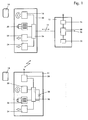
- the access control device shown comprises a stationary user communication terminal 10 connected to a door controller 12 via a bidirectional data line 14 and also a mobile user communication terminal 11.
- the user communication terminal 10 is located in a freely accessible area in front of an entrance door to a protected area while the door controller 12 is arranged in a protected area.
- the mobile user communication terminal 11 is intended to be used by a person with a physical disability, e.g. B. to be carried on a wheelchair and allows this, regardless of the stationary user communication terminal to express an access request.
- the door control unit 12 comprises an evaluation and control controller 68 with a memory 72 and a communication device 74 for connection to the mobile user communication terminal 11. To a control output 70 of the evaluation and control controller 68, a door opener not shown here is connected.
- Task of the evaluation and control controller 68 is primarily, by means of a software or hardware logic of the user communication terminal 10; Compare 11 received identification codes accessing people with stored in the memory 72 reference data and evaluate. The evaluation result is sent to the user communication terminal 10; 11 and returned there to the user. In the case of access authorization, the door opener is also actuated via the control output 70.
- the evaluation and control controller 68 can also control the type and intensity of feedback to a user from personal parameters associated with reference data and stored in the memory 72 if corresponding identification codes are received.
- the stationary user communication terminal 10 comprises a reader 16 for data carriers with identification codes, eg. B. passive RFID media 18, an input device 20, a feedback device 22, environment sensors 24 and a terminal controller 26.
- the terminal controller 26 controls the internal data processing of said components of the user communication terminal 10 and the bidirectional communication with the evaluation and control controller 68 of the door control unit 12th ,
- the mobile user communication terminal 11 also includes a reader 30 for data carriers with identification codes, eg. As passive RFID data carrier 18, an input device 32, a feedback device 34 and a terminal controller 36.
- the power is a battery 38.
- the terminal controller 36 also controls the internal data processing of said components of the user communication terminal 11 and the bidirectional communication with the evaluation and Control controller 68 of the door control unit 12, but by means of a communication device 28 via a non-contact communication path with the communication device 74 of the door control unit 12th
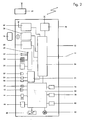
- Fig. 2 shows an expanded block diagram of the user communication terminal 10 with further details.
- the feedback device 22 comprises signal generators from the set of acoustic, optical, tactile signal transmitters, namely an output via screen 46, a braille display 76, an output via beeper or loudspeaker 42, an output via light emitting diodes 40, an output via running light 78, an output via Vibrator 44, an output via infrasound generator 80, an output via infrared flash 48 and an output via air flow generator 50.
- the input device comprises a reader device 58 for passive RFID data carriers 18, a reader 62 for active RFID data carriers 64, a magnetic or contact data carrier reader 60, an input device 20 with a keyboard 54, a pushbutton 52 and a touch-sensitive screen 56 is still a communication device 66, via which a mobile user communication terminal 11 with its communication device 28 (see Fig. 1 ) can communicate without contact, if the communication device 74 of the door control device 12 in an RF-shielded area or too far away.
- Environmental sensors 24 of the stationary user communication terminal 10 include a microphone 82 as an ambient noise sensor, a photosensor 84 as an ambient brightness sensor, and a proximity sensor 86.
- the terminal controller 26 has software or hardware logic to determine the type and, where appropriate, environmental parameters obtained from the environmental sensors also the intensity of the feedback signals are controlled. For this purpose, tailored to the particular case of need, single or a combination of several signal transmitters of the feedback device 22 is selected and activated.
- the software or hardware logic of the terminal controller 26 from the data carriers 18; 64 read data, which are transmitted in addition to identification codes, evaluated on personal parameters.
- personal parameters as the nature and degree of disability and / or preferred language, the nature and, where appropriate, the intensity of the feedback signals is also controlled. This is also done by selecting one or a combination of several signal transmitters of the feedback device 22 and to be activated. In this case, a selection of the signal generator can also be carried out with additional logical linkage of the environmental parameters obtained from the environmental sensors.
- the signal generator of the feedback device 22 are turned on as an orientation signal and used to facilitate the access to a person seeking to locate the user communication terminal 10.
- the terminal controller 26 selects for this the type and intensity of the orientation signals by one or a combination of the signal generator of the feedback device 22 is selected and activated.
- environmental parameters are also evaluated by the environmental sensors 24 analogously to the feedback signals.
- the orientation signals are only generated when the approach of a person requesting access is recognized.
Landscapes
- Physics & Mathematics (AREA)
- General Physics & Mathematics (AREA)
- Engineering & Computer Science (AREA)
- Human Computer Interaction (AREA)
- Selective Calling Equipment (AREA)
- User Interface Of Digital Computer (AREA)
- Telephonic Communication Services (AREA)
Claims (21)
- Procédé d'évaluation d'une demande d'accès depuis une zone non protégée, à travers une porte, à une zone protégée et d'envoi d'un signal de confirmation du résultat d'évaluation à une personne demandant l'accès, un code d'identification étant comparé, après avoir été entré ou lu automatiquement, à des données de référence mémorisées et, en fonction de la comparaison, un signal de confirmation étant généré sous les formes suivantes : «accès autorisé», «accès refusé» ou «données d'accès erronées» ou «non évaluables», la serrure de la porte étant libérée ou la porte étant ouverte automatiquement simultanément avec au moins un signal de confirmation « accès autorisé », caractérisé en ce qu'en fonction de paramètres parmi la quantité constituée non seulement de paramètres d'environnement, mais aussi de paramètres relatifs à la personne, l'au moins un signal de confirmation, qui est perceptible avec prise en considération de la luminosité ambiante, du bruit ambiant et des restrictions relatives à la personne, est généré suivant le type et l'intensité, le type des signaux de confirmation étant commandé par des paramètres relatifs à la personne qui sont mémorisés dans une mémoire (72) d'une unité d'évaluation et de commande (68) d'un dispositif de contrôle d'accès ou lus par le support de données (18) d'un utilisateur.
- Procédé suivant la revendication 1, caractérisé en ce que l'au moins un signal de confirmation parmi la quantité constituée d'un signal de confirmation optique, d'un signal de confirmation acoustique, d'un signal de confirmation tactile est choisi en fonction de paramètres parmi la quantité constituée de paramètres d'environnement et de paramètres relatifs à la personne et en ce que des signaux de confirmation, dont l'intensité peut être commandée par rapport à des paramètres d'environnement perturbants, sont réglés avec un écart de perturbation par rapport aux paramètres d'environnement, qui permet une perception fiable.
- Procédé suivant la revendication 1 ou 2, caractérisé en ce que le type des signaux de confirmation et l'intensité des signaux de confirmation, dont l'intensité peut être commandée, sont réglés de façon fixe.
- Procédé suivant la revendication 1 ou 2, caractérisé en ce que le type des signaux de confirmation et l'intensité des signaux de confirmation, dont l'intensité peut être commandée sont réglés automatiquement et adaptés aux paramètres d'environnement.
- Procédé suivant la revendication 4, caractérisé en ce que les signaux de confirmation, dont l'intensité peut être commandée, sont préréglés à une valeur de base et augmentés en intensité seulement lorsque l'écart de perturbation résultant des paramètres d'environnement soupasse une valeur limite prédéterminée.
- Procédé suivant une des revendications 1 à 5, caractérisé en ce que l'intensité des signaux de confirmation est commandée par des détecteurs (82, 84, 86) qui détectent les paramètres d'environnement.
- Procédé suivant une des revendications 1 à 6, caractérisé en ce que le type des signaux de confirmation est commandé par des détecteurs (82, 84, 86) qui détectent les paramètres d'environnement.
- Procédé suivant une des revendications 1 à 7, caractérisé en ce que des signaux d'orientation, qui facilitent à l'utilisateur la recherche d'un terminal de communication utilisateur (10) d'un dispositif de contrôle d'accès pour l'entrée ou la lecture automatique d'un code d'identification, sont générés dans le cadre de la demande d'accès.
- Procédé suivant la revendication 8, caractérisé en ce que les signaux d'orientation sont activés, réglés ou modifiés, dès que l'approche d'une personne est détectée par un détecteur de proximité (86).
- Procédé suivant la revendication 8 ou 9, caractérisé en ce que le type des signaux d'orientation est commandé par des détecteurs (82, 84, 86) qui détectent les paramètres d'environnement.
- Procédé suivant une des revendications 1 à 10, caractérisé en ce que le dispositif de contrôle d'accès est commuté d'un mode de repos à un mode de fonctionnement, dès que l'approche d'une personne est détectée par un détecteur de proximité (86) et à nouveau commuté en mode de repos après évaluation d'une demande d'accès ou après expiration d'un délai d'attente.
- Dispositif servant à l'exécution du procédé suivant une des revendications 1 à 11 avec un dispositif de contrôle d'accès constitué d'un terminal de communication utilisateur stationnaire (10) avec un dispositif d'entrée (20) et un dispositif de confirmation (22) pour générer un signal de confirmation sous les formes suivantes : « accès autorisé », « accès refusé » ou « données d'accès erronées ou non évaluables », ainsi que d'une unité d'évaluation et de commande (68) avec une mémoire (72), caractérisé en ce que des détecteurs d'environnement (24) pour la luminosité et le bruit ambiants sont raccordés à l'unité d'évaluation et de commande (68).
- Dispositif suivant la revendication 12, caractérisé en ce que la quantité constituée de générateurs de signaux acoustiques comprend un ronfleur, un téléavertisseur (42), un haut-parleur (42), que la quantité de générateurs de signaux optiques comprend une lampe, une diode lumineuse (40), une lumière défilante, un écran (46) et que la quantité de générateurs de signaux tactiles comprend l'écriture braille, un affichage en braille (76), un vibrateur (44), un générateur d'infrason (80), un générateur de courant d'air (50), un flash d'infrarouge (48).
- Dispositif suivant la revendication 12 ou 13, caractérisé en ce que la quantité constituée de détecteurs d'environnement comprend un microphone (82), un photodétecteur (84), un détecteur de proximité (86).
- Dispositif suivant une des revendications 12 à 14, caractérisé en ce que le dispositif d'entrée du terminal utilisateur stationnaire (10) comprend au moins une unité d'entrée (20) ou de lecture (16) parmi la quantité comprenant un palpeur (52), un clavier (54), un écran tactile (56), un microphone (82), un lecteur pour des supports de données RFID passifs (58), un lecteur pour des supports de données RFID actifs (62) ou un dispositif de communication pour un terminal de communication utilisateur mobile (10).
- Dispositif suivant la revendication 15, caractérisé en ce que le terminal de communication utilisateur mobile (10) comprend un dispositif d'entrée avec une unité d'entrée (12) ou de lecture (30) parmi la quantité comprenant un palpeur, un clavier (52), un microphone, un lecteur pour des supports de données RFID passifs et peut être relié, via une voie de communication sans contact, avec le contrôleur de terminal du terminal de communication utilisateur mobile (10) ou l'unité d'évaluation et de commande de l'appareil de commande de la porte (12).
- Dispositif suivant les revendications 15 ou 16, caractérisé en ce que le terminal de communication utilisateur mobile (11) comprend en plus un dispositif de confirmation avec au moins un générateur de signaux parmi la quantité constituée par des générateurs de signaux acoustiques, optiques, tactiles.
- Dispositif suivant une des revendications 12 à 17, caractérisé en ce que comme paramètre relatif à la personne, une langue, telle que l'allemand, l'anglais, le français, le russe, le japonais est mémorisée dans la mémoire de l'unité d'évaluation et de commande (68) ou peut être lue comme caractéristique de commande du contrôleur de terminal par le support de données (18) d'un utilisateur.
- Dispositif suivant une des revendications 11 à 19, caractérisé en ce que le terminal de communication utilisateur comprend un générateur de signaux d'orientation servant à faciliter la recherche du dispositif d'entrée.
- Dispositif suivant la revendication 19, caractérisé en ce que le générateur de signaux d'orientation est formé par le dispositif de confirmation (34) et les générateurs de signaux du dispositif de confirmation (39) peuvent être mis en service, réglés ou modifiés par le contrôleur de terminal du terminal de communication utilisateur (10).
- Dispositif suivant la revendication 19 ou 20, caractérisé en ce que les générateurs de signaux du dispositif de confirmation peuvent être commandés par le contrôleur de terminal et les détecteurs d'environnement à l'aide de paramètres d'environnement.
Applications Claiming Priority (1)
| Application Number | Priority Date | Filing Date | Title |
|---|---|---|---|
| DE102008008366A DE102008008366A1 (de) | 2008-02-09 | 2008-02-09 | Verfahren zum Generieren eines Informationssignals bei einem Zugangsbegehren und Vorrichtung zur Durchführung des Verfahrens |
Publications (2)
| Publication Number | Publication Date |
|---|---|
| EP2091023A1 EP2091023A1 (fr) | 2009-08-19 |
| EP2091023B1 true EP2091023B1 (fr) | 2012-06-20 |
Family
ID=40430805
Family Applications (1)
| Application Number | Title | Priority Date | Filing Date |
|---|---|---|---|
| EP09001722A Ceased EP2091023B1 (fr) | 2008-02-09 | 2009-02-06 | Procédé de génération d'un signal d'information lors d'un souhait d'accès et dispositif d'exécution du procédé |
Country Status (3)
| Country | Link |
|---|---|
| US (1) | US20090201122A1 (fr) |
| EP (1) | EP2091023B1 (fr) |
| DE (1) | DE102008008366A1 (fr) |
Families Citing this family (5)
| Publication number | Priority date | Publication date | Assignee | Title |
|---|---|---|---|---|
| US9065532B2 (en) * | 2010-02-03 | 2015-06-23 | Google Inc. | Bump button |
| US8598980B2 (en) * | 2010-07-19 | 2013-12-03 | Lockheed Martin Corporation | Biometrics with mental/physical state determination methods and systems |
| US10943585B2 (en) * | 2017-10-19 | 2021-03-09 | Daring Solutions, LLC | Cooking management system with wireless active voice engine server |
| CN111541441B (zh) * | 2020-04-24 | 2025-03-21 | 杭州尚朴投资有限公司 | 一种非接触按键装置及其工作方法 |
| KR20250086394A (ko) * | 2023-12-06 | 2025-06-13 | 현대자동차주식회사 | 차량의 주변영상 보정 장치 및 그 방법 |
Family Cites Families (16)
| Publication number | Priority date | Publication date | Assignee | Title |
|---|---|---|---|---|
| DE4308193C2 (de) * | 1993-03-15 | 1998-05-14 | Siemens Ag | Benutzungskontrollanlage für Lifte und Seilbahnen |
| US5616901A (en) * | 1995-12-19 | 1997-04-01 | Talking Signs, Inc. | Accessible automatic teller machines for sight-impaired persons and print-disabled persons |
| US6105866A (en) * | 1997-12-15 | 2000-08-22 | Ncr Corporation | Method and apparatus for reducing shrinkage during operation of a self-service checkout terminal |
| US6505774B1 (en) * | 1998-12-09 | 2003-01-14 | Miti Manufacturing Company | Automated fee collection and parking ticket dispensing machine |
| DE10227487B4 (de) * | 2002-06-19 | 2013-11-21 | Wilo Se | Beleuchtungsvorrichtung |
| US7026939B2 (en) * | 2003-02-10 | 2006-04-11 | Phase Iv Engineering, Inc. | Livestock data acquisition and collection |
| US20040249298A1 (en) * | 2003-06-03 | 2004-12-09 | Selevan James R. | Method and apparatus for determining heart rate |
| CN1820279B (zh) * | 2003-06-16 | 2012-01-25 | Uru科技公司 | 能通过生物测量创建和操作多用途凭证管理装置的方法和系统 |
| US7331522B2 (en) * | 2003-08-07 | 2008-02-19 | Cubic Corporation | Virtual gate system |
| WO2005041131A2 (fr) * | 2003-08-25 | 2005-05-06 | Digital Angel Corporation | Systemes et procedes de surveillance et de reperage |
| WO2005031633A1 (fr) * | 2003-09-30 | 2005-04-07 | Koninklijke Philips Electronics, N.V. | Systeme et methode pour etablir adaptativement des seuils de mesure biometrique |
| DE102004013965B3 (de) * | 2004-03-19 | 2005-12-01 | Skidata Ag | Zutrittskontrollvorrichtung |
| DE102004063594A1 (de) * | 2004-12-30 | 2006-07-13 | BSH Bosch und Siemens Hausgeräte GmbH | Verfahren zur Regelung der Hintergrundbeleuchtung eines Displays |
| DE102005020568A1 (de) * | 2005-04-30 | 2006-11-09 | Osram Opto Semiconductors Gmbh | Lichtquellenanordnung zur Hinterleuchtung von Anzeigevorrichtungen sowie Anzeigevorrichtung |
| DE102005051253A1 (de) * | 2005-10-26 | 2007-05-03 | Primion Technology Ag | Anzeige- und/oder Bedieneinheit für ein Überwachungssystem |
| ES2316246B1 (es) * | 2006-02-03 | 2010-01-08 | Luis Angel Ispizua Hernandez | Dispositivo inteligente de deteccion y orientacion de peatones discapacitados. |
-
2008
- 2008-02-09 DE DE102008008366A patent/DE102008008366A1/de not_active Withdrawn
-
2009
- 2009-02-06 US US12/322,802 patent/US20090201122A1/en not_active Abandoned
- 2009-02-06 EP EP09001722A patent/EP2091023B1/fr not_active Ceased
Also Published As
| Publication number | Publication date |
|---|---|
| DE102008008366A1 (de) | 2009-09-10 |
| EP2091023A1 (fr) | 2009-08-19 |
| US20090201122A1 (en) | 2009-08-13 |
Similar Documents
| Publication | Publication Date | Title |
|---|---|---|
| EP3295436B1 (fr) | Procédé d'utilisation d'un appareil de nettoyage à déplacement autonome | |
| EP2209729B1 (fr) | Procédé destiné à la fixation d'un appel cible en vue de l'utilisation d'une installation d'ascenseur et installation d'ascenseur | |
| EP3307666A1 (fr) | Système d'ascenseur avec génération d'appel prédictive | |
| DE102016103162A1 (de) | Verfahren und Vorrichtung zur Gestenerfassung in einem elektronischen Gerät | |
| EP3559845B1 (fr) | Procédé et système d'authentification d'un utilisateur basée sur le comportement | |
| EP3997023B1 (fr) | Dispositif de commande d'ascenseur tactile pour appel de direction de déplacement | |
| EP4021836B1 (fr) | Procédé de fonctionnement pour un dispositif de commande d'ascenseur doté d'un système d'écran tactile | |
| EP2091023A1 (fr) | Procédé de génération d'un signal d'information lors d'un souhait d'accès et dispositif d'exécution du procédé | |
| DE102013208506A1 (de) | Hierarchische Erkennung von Fahrzeugfahrer und Auswahlaktivierung von Fahrzeugeinstellungen auf der Grundlage der Erkennung | |
| DE112019003773T5 (de) | Informationsverarbeitungsvorrichtung, informationsverarbeitungssystem, informationsverarbeitungsverfahren und informationsverarbeitungsprogramm | |
| EP3559846B1 (fr) | Procédé et système pour l'authentification d'un utilisateur basée sur le comportement | |
| EP3602996A1 (fr) | Procédé et système pour l'authentification d'un utilisateur basée sur le comportement | |
| EP3477981B1 (fr) | Authentification à base du comportement en fonction des paramètres environnementaux | |
| DE202013101354U1 (de) | Vorrichtung zur Überwachung der momentanen Mobilität von Personen in privaten oder öffentlichen Räumen | |
| EP3477516B1 (fr) | Procédé vocal et système d'authentification | |
| EP3404570A1 (fr) | Procédé et système d'authentification comportementale | |
| EP3385875B1 (fr) | Procédé et système d'authentification | |
| WO2024121119A1 (fr) | Dispositif de réglage et procédé de commande d'une aide à l'embarquement en fonction du degré d'une limitation de mobilité | |
| EP4202871B1 (fr) | Terminal de détection de présence à interaction spécifique à l'utilisateur | |
| EP3220617B1 (fr) | Système de communication de porte, appareil externe pour un système de communication de porte et procédé de fonctionnement d'un système de communication de porte | |
| DE102006058758B4 (de) | Verfahren und Vorrichtung zum Steuern einer Telekommunikationsendeinrichtung | |
| EP4202735A1 (fr) | Terminal de détection de présence | |
| EP3471002A1 (fr) | Authentification à base de comportements en fonction des paramètres environnementaux | |
| WO2017153143A1 (fr) | Présentation d'informations d'orientation par un système d'éclairage | |
| EP4202872A1 (fr) | Terminal de détection de la présence à mode d'économie d'énergie |
Legal Events
| Date | Code | Title | Description |
|---|---|---|---|
| PUAI | Public reference made under article 153(3) epc to a published international application that has entered the european phase |
Free format text: ORIGINAL CODE: 0009012 |
|
| AK | Designated contracting states |
Kind code of ref document: A1 Designated state(s): AT BE BG CH CY CZ DE DK EE ES FI FR GB GR HR HU IE IS IT LI LT LU LV MC MK MT NL NO PL PT RO SE SI SK TR |
|
| AX | Request for extension of the european patent |
Extension state: AL BA RS |
|
| 17P | Request for examination filed |
Effective date: 20090917 |
|
| 17Q | First examination report despatched |
Effective date: 20091105 |
|
| AKX | Designation fees paid |
Designated state(s): DE FR GB |
|
| GRAP | Despatch of communication of intention to grant a patent |
Free format text: ORIGINAL CODE: EPIDOSNIGR1 |
|
| GRAS | Grant fee paid |
Free format text: ORIGINAL CODE: EPIDOSNIGR3 |
|
| GRAA | (expected) grant |
Free format text: ORIGINAL CODE: 0009210 |
|
| AK | Designated contracting states |
Kind code of ref document: B1 Designated state(s): DE FR GB |
|
| REG | Reference to a national code |
Ref country code: GB Ref legal event code: FG4D Free format text: NOT ENGLISH |
|
| REG | Reference to a national code |
Ref country code: DE Ref legal event code: R096 Ref document number: 502009003811 Country of ref document: DE Effective date: 20120816 |
|
| PLBE | No opposition filed within time limit |
Free format text: ORIGINAL CODE: 0009261 |
|
| STAA | Information on the status of an ep patent application or granted ep patent |
Free format text: STATUS: NO OPPOSITION FILED WITHIN TIME LIMIT |
|
| 26N | No opposition filed |
Effective date: 20130321 |
|
| REG | Reference to a national code |
Ref country code: DE Ref legal event code: R097 Ref document number: 502009003811 Country of ref document: DE Effective date: 20130321 |
|
| REG | Reference to a national code |
Ref country code: FR Ref legal event code: PLFP Year of fee payment: 8 |
|
| REG | Reference to a national code |
Ref country code: FR Ref legal event code: PLFP Year of fee payment: 9 |
|
| REG | Reference to a national code |
Ref country code: FR Ref legal event code: PLFP Year of fee payment: 10 |
|
| PGFP | Annual fee paid to national office [announced via postgrant information from national office to epo] |
Ref country code: GB Payment date: 20220221 Year of fee payment: 14 Ref country code: DE Payment date: 20220215 Year of fee payment: 14 |
|
| PGFP | Annual fee paid to national office [announced via postgrant information from national office to epo] |
Ref country code: FR Payment date: 20220221 Year of fee payment: 14 |
|
| REG | Reference to a national code |
Ref country code: DE Ref legal event code: R119 Ref document number: 502009003811 Country of ref document: DE |
|
| GBPC | Gb: european patent ceased through non-payment of renewal fee |
Effective date: 20230206 |
|
| PG25 | Lapsed in a contracting state [announced via postgrant information from national office to epo] |
Ref country code: GB Free format text: LAPSE BECAUSE OF NON-PAYMENT OF DUE FEES Effective date: 20230206 |
|
| PG25 | Lapsed in a contracting state [announced via postgrant information from national office to epo] |
Ref country code: GB Free format text: LAPSE BECAUSE OF NON-PAYMENT OF DUE FEES Effective date: 20230206 Ref country code: FR Free format text: LAPSE BECAUSE OF NON-PAYMENT OF DUE FEES Effective date: 20230228 Ref country code: DE Free format text: LAPSE BECAUSE OF NON-PAYMENT OF DUE FEES Effective date: 20230901 |