EP2091143A2 - Konversionsarchitektur zur Restspurvermeidung - Google Patents
Konversionsarchitektur zur Restspurvermeidung Download PDFInfo
- Publication number
- EP2091143A2 EP2091143A2 EP09152842A EP09152842A EP2091143A2 EP 2091143 A2 EP2091143 A2 EP 2091143A2 EP 09152842 A EP09152842 A EP 09152842A EP 09152842 A EP09152842 A EP 09152842A EP 2091143 A2 EP2091143 A2 EP 2091143A2
- Authority
- EP
- European Patent Office
- Prior art keywords
- signal
- frequency
- local oscillator
- offset
- local
- Prior art date
- Legal status (The legal status is an assumption and is not a legal conclusion. Google has not performed a legal analysis and makes no representation as to the accuracy of the status listed.)
- Withdrawn
Links
- 238000006243 chemical reaction Methods 0.000 title claims description 19
- 238000000034 method Methods 0.000 claims abstract description 17
- 238000001914 filtration Methods 0.000 claims abstract description 4
- 238000013459 approach Methods 0.000 description 4
- 238000002347 injection Methods 0.000 description 4
- 239000007924 injection Substances 0.000 description 4
- 238000010586 diagram Methods 0.000 description 3
- 239000000203 mixture Substances 0.000 description 2
- 238000001228 spectrum Methods 0.000 description 2
- 238000002955 isolation Methods 0.000 description 1
- 230000011664 signaling Effects 0.000 description 1
- 230000003595 spectral effect Effects 0.000 description 1
Images


Classifications
-
- H—ELECTRICITY
- H03—ELECTRONIC CIRCUITRY
- H03D—DEMODULATION OR TRANSFERENCE OF MODULATION FROM ONE CARRIER TO ANOTHER
- H03D7/00—Transference of modulation from one carrier to another, e.g. frequency-changing
- H03D7/16—Multiple-frequency-changing
- H03D7/161—Multiple-frequency-changing all the frequency changers being connected in cascade
Definitions
- the present invention relates to radio frequency receivers, and more particularly to a method of residual spur avoidance in a multi-conversion radio frequency receiver.
- a multi-conversion radio frequency receiver may use multiple local oscillators when up-converting and down-converting a signal of interest. These separate local oscillators create sum and difference harmonic mixing products between themselves using the various nonlinear elements, primarily mixers and amplifiers, in the receiver. The amplitude of these harmonic mixing products depends on the conversion efficiency of the various elements at the harmonic mixing product frequencies.
- LO local oscillator
- IF intermediate frequency
- the unintended harmonic mixing products of the first LO frequency with a second LO frequency may fall within an IF filter bandwidth.
- the energy from the unwanted LO harmonic mixing product, or residual spur appears as a real RF signal on a final spectral display.
- What is desired is a method of residual spur avoidance that avoids unwanted harmonic mixing products from multiple local oscillators in a multi-conversion radio frequency receiver.
- one embodiment comprises a superheterodyne receiver with a first tunable local oscillator, a mixer to mix the first local oscillator signal with an input RF signal to generate an IF signal, a band-pass filter to filter the IF signal at a band-pass frequency, a second set of two local oscillators having the same frequency offset above and below the IF signal, and a mixer to down convert the IF signal using one of the second local oscillators.
- the superheterodyne receiver can switch to the other of the second local oscillators to generate the same down converted IF frequency and to avoid the spurious response.
- Combinations of problem frequencies may be stored and accessed at run time to select the second local oscillator offset that provides better spurious response avoidance.
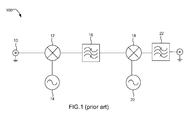
- Fig. 1 illustrates a prior art superheterodyne receiver 100 that provides multiple frequency conversions to down convert a high frequency signal to an IF signal, as further described in U.S. Pat. No. 6,785,527 .
- a superheterodyne receiver may generate a spurious response at the IF frequency.
- residual spurious response may be due to finite isolation of an IF filter that filters LO signals between conversion stages.
- Superheterodyne receiver 100 mixes an input RF signal 10 with a signal generated by a local oscillator 14 to generate a first IF signal.
- the first IF signal is band-pass filtered and then mixed with a signal from a second local oscillator to down convert to a second IF signal.
- a spurious response may be generated when the first LO 14 is tuned to 4.225 GHz and the second LO 20 is tuned to 4.15 GHz. At this frequency, the first LO 14 will generate a second harmonic at 8.45 GHz. If this harmonic passes through a first IF filter 16, the harmonic can mix with a second harmonic of the second LO 20 that is oscillating at 8.3 GHz to generate an unwanted 150 MHz signal at the same frequency as the output IF. Residual spurs may occur at numerous combinations of LO harmonic frequencies.
- Fig. 2 shows a block diagram view of an embodiment superheterodyne receiver 200 for residual spur avoidance according to the present disclosure.
- the embodiment superheterodyne receiver 200 provides a switchable second conversion that can mix an IF signal with a local oscillator that is either a frequency offset above or the same frequency offset below the IF signal. In this way, when a spurious response is generated at one combination of frequencies for a first and a second conversion, then the combination of frequencies can be changed by switching the second local oscillator to the opposite offset from the IF signal.
- Other embodiments are not so limited, for example, additional offsets may be used within the principles of this disclosure, some embodiments may use additional conversions, etc.
- superheterodyne receiver 200 mixes an input RF signal 50 with a signal generated by a local oscillator 54 to generate a first IF signal.
- the first IF signal is band-pass filtered 56 and then mixed 58 with a signal from a second local oscillator 62 to down convert to a second IF signal.
- the second IF signal is then band-pass filtered 66 to provide an output IF signal at a specific frequency.
- Superheterodyne receiver 200 further includes a switch 64 and another second local oscillator 60.
- second local oscillator 62 and second local oscillator 60 are offset from a first IF frequency the same amount, with one of the second local oscillators high-side injected to the first IF signal at mixer 58, and the other second local oscillator is low-side injected to the first IF signal at mixer 58. Therefore, a spurious response that would be generated at a combination of harmonics between the first and second local oscillators can be avoided by switching between the second local oscillators, thus generating IF output signals at the same frequency while moving the spurious response outside of the pass bands of filter 58.
- the second local oscillators 60 and 62 are set at 4.15 GHz and at 3.85 GHz.
- the second local oscillator may have a harmonic at 8.3 GHz with high-side injection or a harmonic at 7.7 GHz with low-side injection. Therefore, to avoid the spur that would be generated at 150 MHz between the 8.3 GHz harmonic of the high-side injected local oscillator, the second local oscillator and be switched to the 3.85 GHz signal, and thus the spurious response will be generated at 750MHz and outside of the range of the 150MHz IF.
- this 2nd LO may be switched at multiple frequencies at which a spurious response would occur. For example, combinations of problem frequencies may be stored in a table, and for frequency combinations that would generate a spurious response, the second local oscillator can be switched to the opposite side offset. In some combinations, a spurious response may be generated by both second local oscillators. In these situations, the second local oscillator that generates the smaller spurious response may be chosen. In some embodiments, this approach may be further applied to subsequent stages of conversion. In yet another embodiment, a superheterodyne receiver may switch between high and low-side injection to generate a second IF in combination with adjusting the effective filter shape of the second IF filter to provide more control for avoiding spurious responses.
- the center frequency of the second IF remains the same, but the pass-band is inverted.
- the second IF signal can again be inverted, for example using a digital signal processor (DSP).
- DSP digital signal processor
- program may connote a single program or multiple programs acting in concert, and may be used to denote applications, services, or any other type or class of program.
- computer and “computing device” as used herein include any device that electronically executes one or more programs, including, but not limited to a superheterodyne receiver such as a spectrum analyzer, or any other suitable RF signaling devices.
- a method 300 for residual spur avoidance is illustrated.
- a signal is generated using a tunable local oscillator.
- the local oscillator signal is then mixed with an input signal to generate an IF signal, as illustrated in block 320.
- the local oscillator may cover a corresponding frequency range in order to generate an IF signal of the same frequency for any input frequency.
- Other embodiments are not so limited.
- a multi-conversion radio frequency receiver may utilize separate circuitry to heterodyne input signals of different frequency ranges.
- method 300 comprises filtering the intermediate frequency signal at a band-pass frequency, as indicated at 330. Then, in some embodiments, the filtered intermediate frequency signal is mixed with a second local oscillator signal that may be switched between frequency offsets above and below the band-pass frequency (step 340). In this manner, when a spurious response is generated using one of the frequency offsets, the second local oscillator signal may be switched to the opposite offset to avoid the residual spurious response.
- this second local oscillator signal may be generated by a set of two local oscillators, and the signal may be generated by switching from one of the two local oscillators to the other of the two local oscillators.
Landscapes
- Engineering & Computer Science (AREA)
- Power Engineering (AREA)
- Superheterodyne Receivers (AREA)
- Noise Elimination (AREA)
- Transmitters (AREA)
Applications Claiming Priority (1)
| Application Number | Priority Date | Filing Date | Title |
|---|---|---|---|
| US12/032,537 US20090209222A1 (en) | 2008-02-15 | 2008-02-15 | Conversion Architecture For Residual Spur Avoidance |
Publications (2)
| Publication Number | Publication Date |
|---|---|
| EP2091143A2 true EP2091143A2 (de) | 2009-08-19 |
| EP2091143A3 EP2091143A3 (de) | 2010-05-26 |
Family
ID=40707668
Family Applications (1)
| Application Number | Title | Priority Date | Filing Date |
|---|---|---|---|
| EP09152842A Withdrawn EP2091143A3 (de) | 2008-02-15 | 2009-02-13 | Konversionsarchitektur zur Restspurvermeidung |
Country Status (4)
| Country | Link |
|---|---|
| US (1) | US20090209222A1 (de) |
| EP (1) | EP2091143A3 (de) |
| JP (1) | JP2009194907A (de) |
| CN (1) | CN101527580A (de) |
Families Citing this family (4)
| Publication number | Priority date | Publication date | Assignee | Title |
|---|---|---|---|---|
| US8400349B1 (en) * | 2010-06-09 | 2013-03-19 | Sandia Corporation | Radar echo processing with partitioned de-ramp |
| US8750411B2 (en) * | 2011-06-30 | 2014-06-10 | Motorola Mobility Llc | Method and apparatus for reducing transmitter interference |
| TW201401791A (zh) * | 2012-06-18 | 2014-01-01 | Wistron Neweb Corp | 無線通訊系統之射頻接收裝置 |
| JP7185673B2 (ja) * | 2020-09-30 | 2022-12-07 | アンリツ株式会社 | 信号解析装置及び信号解析方法 |
Citations (1)
| Publication number | Priority date | Publication date | Assignee | Title |
|---|---|---|---|---|
| US6785527B2 (en) | 2001-04-02 | 2004-08-31 | Tektronix, Inc. | Conversion spur avoidance in a multi-conversion radio frequency receiver |
Family Cites Families (8)
| Publication number | Priority date | Publication date | Assignee | Title |
|---|---|---|---|---|
| US4512035A (en) * | 1983-05-16 | 1985-04-16 | Motorola, Inc. | Method of programming a synthesizer ROM for elimination of receiver self-quieting |
| JPH0710051B2 (ja) * | 1987-07-16 | 1995-02-01 | 八重洲無線株式会社 | 無線受信機 |
| DE4306578C2 (de) * | 1993-03-03 | 1995-08-24 | Loewe Opta Gmbh | Verfahren und Schaltungsanordnung zum Empfang von HF-Signalen unter Verwendung eines Doppelüberlagerungsempfängers |
| US5493210A (en) * | 1993-06-10 | 1996-02-20 | Trilithic, Inc. | Combined signal level meter and leakage detector |
| JPH0746150A (ja) * | 1993-07-31 | 1995-02-14 | Nec Corp | 無線選択呼出受信機 |
| US6002924A (en) * | 1996-12-31 | 1999-12-14 | Aor, Ltd. | Full-spectrum all-mode radio receiver apparatus and method |
| GB0020528D0 (en) * | 2000-08-22 | 2000-10-11 | Mitel Semiconductor Ltd | Multiple conversion tuner |
| US7072633B2 (en) * | 2002-05-31 | 2006-07-04 | Broadcom Corporation | Double-conversion television tuner using a Delta-Sigma Fractional-N PLL |
-
2008
- 2008-02-15 US US12/032,537 patent/US20090209222A1/en not_active Abandoned
-
2009
- 2009-01-30 JP JP2009020871A patent/JP2009194907A/ja active Pending
- 2009-02-13 EP EP09152842A patent/EP2091143A3/de not_active Withdrawn
- 2009-02-16 CN CN200910004907A patent/CN101527580A/zh active Pending
Patent Citations (1)
| Publication number | Priority date | Publication date | Assignee | Title |
|---|---|---|---|---|
| US6785527B2 (en) | 2001-04-02 | 2004-08-31 | Tektronix, Inc. | Conversion spur avoidance in a multi-conversion radio frequency receiver |
Also Published As
| Publication number | Publication date |
|---|---|
| US20090209222A1 (en) | 2009-08-20 |
| EP2091143A3 (de) | 2010-05-26 |
| JP2009194907A (ja) | 2009-08-27 |
| CN101527580A (zh) | 2009-09-09 |
Similar Documents
| Publication | Publication Date | Title |
|---|---|---|
| US20070202815A1 (en) | Up/down conversion circuitry for radio transceiver | |
| US9264017B2 (en) | Electronically tunable filter | |
| EP1248360B1 (de) | Mehrstufiger Frequenzumsetzer mit Störsignalunterdrückung | |
| WO2009079615A4 (en) | Frequency synthesizer and related method for generating wideband signals | |
| EP2408118A1 (de) | Umwandlungssystem | |
| CN1261996A (zh) | 多模式直接变频接收机 | |
| US20120040628A1 (en) | Transceiver with Interferer Control | |
| EP2091143A2 (de) | Konversionsarchitektur zur Restspurvermeidung | |
| US20150222344A1 (en) | Modulation Circuit for a Radio Device and A Method Thereof | |
| US7928808B2 (en) | Selectable local oscillator | |
| US9252818B2 (en) | Transmitter and receiver circuits | |
| US8718590B2 (en) | Downconversion of comb spectrum | |
| US6995595B2 (en) | Direct conversion receiver having a DC offset eliminating function | |
| LU101013B1 (en) | A double frequency continuous wave doppler radar circuit structure for suppressing DC bias | |
| CN103532574B (zh) | 在接收变频系统中产生任意中频输出的装置 | |
| US8731122B1 (en) | Spurious component reduction | |
| US8185080B2 (en) | Harmonic rejection mixer | |
| KR101491106B1 (ko) | 광대역 주파수 변환장치 | |
| Liu | Bandpass sampling of multiple single sideband RF signals | |
| US9531324B1 (en) | Frequency synthesizer system and method | |
| JP2006525732A (ja) | 多段周波数変換 | |
| CN220964875U (zh) | 一种宽带dds扩频装置 | |
| US20240039549A1 (en) | Systems, methods, and apparatus for spur reduction including analog frequency shift | |
| Liu | Complex bandpass sampling and direct downconversion of multiband analytic signals | |
| US7613430B1 (en) | Dual synthesizer RF frequency plan optimized for interference avoidance |
Legal Events
| Date | Code | Title | Description |
|---|---|---|---|
| PUAI | Public reference made under article 153(3) epc to a published international application that has entered the european phase |
Free format text: ORIGINAL CODE: 0009012 |
|
| AK | Designated contracting states |
Kind code of ref document: A2 Designated state(s): AT BE BG CH CY CZ DE DK EE ES FI FR GB GR HR HU IE IS IT LI LT LU LV MC MK MT NL NO PL PT RO SE SI SK TR |
|
| AX | Request for extension of the european patent |
Extension state: AL BA RS |
|
| PUAL | Search report despatched |
Free format text: ORIGINAL CODE: 0009013 |
|
| AK | Designated contracting states |
Kind code of ref document: A3 Designated state(s): AT BE BG CH CY CZ DE DK EE ES FI FR GB GR HR HU IE IS IT LI LT LU LV MC MK MT NL NO PL PT RO SE SI SK TR |
|
| AX | Request for extension of the european patent |
Extension state: AL BA RS |
|
| RIC1 | Information provided on ipc code assigned before grant |
Ipc: H03D 7/18 20060101ALI20100420BHEP Ipc: H03D 7/16 20060101AFI20090612BHEP |
|
| AKY | No designation fees paid | ||
| STAA | Information on the status of an ep patent application or granted ep patent |
Free format text: STATUS: THE APPLICATION IS DEEMED TO BE WITHDRAWN |
|
| 18D | Application deemed to be withdrawn |
Effective date: 20101127 |