EP2091236A2 - Système de caméra de télévision - Google Patents
Système de caméra de télévision Download PDFInfo
- Publication number
- EP2091236A2 EP2091236A2 EP09000456A EP09000456A EP2091236A2 EP 2091236 A2 EP2091236 A2 EP 2091236A2 EP 09000456 A EP09000456 A EP 09000456A EP 09000456 A EP09000456 A EP 09000456A EP 2091236 A2 EP2091236 A2 EP 2091236A2
- Authority
- EP
- European Patent Office
- Prior art keywords
- lens device
- focus
- focus information
- monitor
- displayed
- Prior art date
- Legal status (The legal status is an assumption and is not a legal conclusion. Google has not performed a legal analysis and makes no representation as to the accuracy of the status listed.)
- Withdrawn
Links
- 238000003384 imaging method Methods 0.000 claims description 34
- 230000003287 optical effect Effects 0.000 claims description 28
- 238000012545 processing Methods 0.000 description 28
- 238000011156 evaluation Methods 0.000 description 8
- 238000000034 method Methods 0.000 description 5
- 239000000470 constituent Substances 0.000 description 3
- 238000010586 diagram Methods 0.000 description 2
- 230000009194 climbing Effects 0.000 description 1
Images

Classifications
-
- H—ELECTRICITY
- H04—ELECTRIC COMMUNICATION TECHNIQUE
- H04N—PICTORIAL COMMUNICATION, e.g. TELEVISION
- H04N23/00—Cameras or camera modules comprising electronic image sensors; Control thereof
- H04N23/60—Control of cameras or camera modules
- H04N23/66—Remote control of cameras or camera parts, e.g. by remote control devices
- H04N23/663—Remote control of cameras or camera parts, e.g. by remote control devices for controlling interchangeable camera parts based on electronic image sensor signals
-
- H—ELECTRICITY
- H04—ELECTRIC COMMUNICATION TECHNIQUE
- H04N—PICTORIAL COMMUNICATION, e.g. TELEVISION
- H04N23/00—Cameras or camera modules comprising electronic image sensors; Control thereof
- H04N23/60—Control of cameras or camera modules
- H04N23/63—Control of cameras or camera modules by using electronic viewfinders
- H04N23/633—Control of cameras or camera modules by using electronic viewfinders for displaying additional information relating to control or operation of the camera
- H04N23/635—Region indicators; Field of view indicators
-
- H—ELECTRICITY
- H04—ELECTRIC COMMUNICATION TECHNIQUE
- H04N—PICTORIAL COMMUNICATION, e.g. TELEVISION
- H04N23/00—Cameras or camera modules comprising electronic image sensors; Control thereof
- H04N23/60—Control of cameras or camera modules
- H04N23/67—Focus control based on electronic image sensor signals
- H04N23/673—Focus control based on electronic image sensor signals based on contrast or high frequency components of image signals, e.g. hill climbing method
Definitions
- the present invention relates to a television camera system and, in particular, relates to a television camera system which includes a television camera main body (camera device) and a television lens system (lens device) attached to the camera main body, wherein the lens device has an auto-focusing function and the television camera system has a function of displaying focus information obtained from the auto-focusing function on the view finder of the camera main body.
- a television camera system which includes a television camera main body (camera device) and a television lens system (lens device) attached to the camera main body, wherein the lens device has an auto-focusing function and the television camera system has a function of displaying focus information obtained from the auto-focusing function on the view finder of the camera main body.
- a television camera for business use or broadcasting use is configured in a manner that a lens device having an imaging optical system (imaging lens system) is mounted with respect to a camera main body so as to be detachable.
- a lens device which has an auto-focusing (AF) function for performing the automatic focusing.
- AF auto-focusing
- a lens device which receives a video signal obtained by imaging a subject from a camera main body and performs the auto-focusing processing of the well-known contrast method based on the video signal to thereby place the imaging optical system in a focused state.
- the camera main body is provided with a monitor (view finder) for displaying a real-time image being taken thereon.
- the lens device is arranged in a manner that the lens device outputs, to the camera main body in accordance with an instruction from a controller (focusing controller etc.) coupled to the lens device, information relating to the current focus state (front focus, rear focus or in-focus) obtained from the AF function and information relating to an AF area used in the AF function, whereby the camera main body processes these information to display these information on the view finder so as to be superimposed on an image of a subject (see JP-A-2002-365710 , for example).
- Information relating to the focusing such as the information relating to the focus state and the information relating to the AF area is called as focus information in this specification.
- the lens device determines in accordance with a setting state of the VF display instruction unit as to whether or not the focus information obtained by the AF function mounted on the lens device as described above is to be displayed on the view finder.
- a controller which does not include the VF display instruction unit.
- the lens device determines that the focus information is not to be displayed on the view finder.
- An object of an illustrative, non-limiting embodiment of the invention is to provide a television camera system which can display focus information obtained from the AF function of a lens device on a view finder (monitor) even in a case where a controller including VF display instruction unit is not coupled to the lens device.
- a television camera system including:
- the focus information can be displayed on the monitor even in a case where the controller including the display instruction unit for instructing whether or not the focus information is to be displayed on the monitor is not coupled to the lens device.
- a television camera system including:
- the controller including the display instruction unit for instructing whether or not the focus information is to be displayed on the monitor is not coupled to the lens device, a user can arbitrarily select as to whether or not the focus information is to be displayed on the monitor according to the other display instruction unit provided at the lens device or the television camera main body. Further, in the case where the controller including the display instruction unit is coupled to the lens device, the setting of the display instruction unit of the controller is given priority, and so it is determined whether or not the focus information is to be displayed on the monitor according to the setting of the display instruction unit of the controller.
- the television camera system may be configured in a manner that the focus information includes at least one of information representing focus information of the optical system and information of an AF (auto-focus) area representing an area of a subject on which the auto-focusing function is focused.
- the focus information includes at least one of information representing focus information of the optical system and information of an AF (auto-focus) area representing an area of a subject on which the auto-focusing function is focused.
- the concrete information contents of the focus information to be displayed on the monitor can be limited to focus information of the optical system or information on the AF area.
- the focus information obtained from the AF function of the lens device can be displayed on a view finder (monitor).
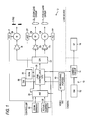
- Fig. 1 is a block diagram showing a configuration of a television camera system for broadcasting use or business use according to an exemplary embodiment of the invention.
- the television camera system shown in Fig. 1 mainly includes a television body 10 (hereinafter called the body 10), a lens device 12 and a view finder (monitor) 16.
- the lens device 12 is attached to the body 10 so as to be detachable.
- the body 10 mounts thereon an imaging device (not shown) that converts an image of a subject formed by the optical system of the lens device 12 into an electrical signal, a signal processing circuit (not shown) for subjecting the electrical signal of the image of the subject obtained from the imaging device to a predetermined processing to thereby convert the electrical signal into a video signal of a predetermined format, and a camera circuit 14 including a CPU etc. for generally controlling the entirety of the system.
- an imaging device (not shown) that converts an image of a subject formed by the optical system of the lens device 12 into an electrical signal
- a signal processing circuit for subjecting the electrical signal of the image of the subject obtained from the imaging device to a predetermined processing to thereby convert the electrical signal into a video signal of a predetermined format
- a camera circuit 14 including a CPU etc. for generally controlling the entirety of the system.
- the body 10 includes the view finder 16 (monitor) for displaying a real-time image of a subject being taken now by the imaging device of the body 10.
- the camera circuit 14 outputs the video signal generated from an image formed by the imaging device to the view finder 16. Focus information etc. described later is also displayed on the view finder 16 so as to be superimposed on the image of a subject, for example.
- a video signal of the superimposed images is generated by the camera circuit 14 of the body 10.
- the lens device 12 includes an optical system for imaging a subject image and a control system for controlling the optical system, for example.
- the optical system includes, as constituent elements disposed within a camera cone thereof as shown in Fig. 1 , for example, a movable focus lens group FL for adjusting a focal point (focal point adjustment), a movable zoom lens group ZL for zoom adjustment (focal distance adjustment), and a movable iris I for adjusting brightness. Further, the optical system includes a not-shown fixed lens group.
- the control system includes constituent elements for driving and controlling motors FM, ZM, IM respectively coupled to the focus lens group FL, the zoom lens group ZL, the iris I of the optical system.
- the control system includes a lens controlling CPU 20 for generally controlling the entirety of the lens device 12; a digital-to-analog (D/A) converter 22 for converting a control signal, which relates to positions or moving speeds of the focus lens group FL, the zoom lens group ZL, the iris I and is outputted from the lens controlling CPU 20, into an analog signal from a digital signal; amplifiers FA, ZA, IA for driving the respective motors in accordance with the control signal converted into the analog signal by the D/A converter 22; position sensors FP, LP, IP for detecting the current positions of the focus lens group FL, the zoom lens group ZL, the iris I; an analog-to-digital converter 24 for converting output signals from the position sensors FP, LP, IP into digital signals from analog signals; and a ROM
- These constituent elements of the control system drive and control the positions or the moving speeds of the focus lens group FL, the zoom lens group ZL, the iris I so as to be target positions or target moving speeds thereof set by the lens controlling CPU 20.
- the lens device 12 is coupled to controllers such as a focus demand 30 and a zoom demand 32 via cables etc., for example.
- the focus demand 30 includes a focus operating member for a manual focus operation.
- the focus demand 30 outputs a focus instruction signal representing the target position or the target moving speed of focusing (the focus lens group FL) in accordance with the operation of the focus operating member.
- the instruction signal is converted into a digital signal from an analog signal by the A/D converter 24 and applied to the lens controlling CPU 20.
- the zoom demand 32 is provided with a zoom operating member for a manual zoom operation.
- the zoom demand 32 outputs a zoom instruction signal representing the target position or the target moving speed of zooming (the zoom lens group ZL) in accordance with the operation of the zoom operating member.
- This instruction signal is converted into a digital signal from an analog signal by the A/D converter 24 and applied to the lens controlling CPU 20.
- the lens controlling CPU 20 sets the target positions or the target moving speeds of the focus lens group FL and the zoom lens group ZL in accordance with the instruction signals from the focus demand 30 and the zoom demand 32 to thereby control the focus lens group FL and the zoom lens group ZL so as to be the target positions or the target moving speeds thereof, respectively.
- the iris I is controlled in accordance with an iris instruction signal supplied from the body 10.
- the lens device 12 has an auto-focusing (AF) function for automatically driving the focusing system (the focus lens group FL) of the optical system so that the optical system is placed into a focused state.
- the lens device is provided with an AF processing portion 40.
- the AF processing portion 40 is supplied with a video signal (luminance signal) of an image taken by the imaging device of the body 10 or an image equivalent thereto.
- the AF processing portion 40 obtains a focal point evaluation value representing the contrast of an image within an AF area at every field image based on the video signal and outputs the focal point evaluation value to the lens controlling CPU 20.
- the AF area represents the range of a subject to be focused and is usually set as a square area at the center portion of a screen.
- the AF area (position or size etc. thereof) can be changed by the focus demand 30 or the predetermined operation member of other controller.
- the focal point evaluation value can be obtained in a manner that an image within the AF area is extracted from each of the field images, then the high-frequency component of a video signal within the AF area is extracted by a high-pass filter and the extracted components are added.
- the video signal applied to the AF processing portion 40 may be a video signal of a real-time image of a subject which is formed and generated by the imaging device of the body 10 and then taken from the body 10.
- an imaging device for AF AF imaging device
- the AF imaging device may form an image substantially same as that taken by the imaging device for video and may supply a video signal of the image obtained from the AF imaging device to the AF processing portion.
- the lens device is configured in the following manner, for example.
- a light splitting unit such as a half mirror is disposed at the rear stage (the rear stage of the focus lens group FL or the zoom lens group ZL) of the optical system of the lens device 12.
- the image forming plane of the AF imaging device is disposed at a position where a subject image formed on the image forming plane of the AF imaging device becomes substantially same (substantially same in a focus state and a view angle) as a subject image formed on the image forming plane of the imaging device for video.
- a video signal of an image substantially same as an image from the imaging device for video can be obtained from the AF imaging device.
- the lens controlling CPU 20 drives the focus lens group FL based on the focal point evaluation value applied from the AF processing portion 40 to move the focus lens group FL to an in-focus point where the focal point evaluation value becomes maximum.
- a so-called hill climbing method for example, is employed as the control method in this case. According to this method, the focus lens group FL is moved reciprocally (wobbling) by a small amount between an infinite point side and a close point side and a focal point evaluation value at each moved point of the focus lens group is obtained from the AF processing portion 40.
- a direction where the focal point evaluation value increases is detected based on the magnitude relation of the focal point evaluation values at the plural moved points thus obtained.
- the current position is an in-focus point. That is, it is detected as to which one of the front focus, the rear focus and the in-focus is the focus state of the current position.
- the focus lens group FL is moved to the in-focus direction, and also the wobbling operation is performed suitably to thereby detect the position where the focus state becomes the in-focus state. Then, the focus lens group FL is stopped at the position where the focus state becomes the in-focus state.
- the body 10 and the lens device 12 thus configured are electrically coupled in a manner that the connectors provided at the camera main body and the lens device are directly coupled or coupled via a cable to each other.
- various kinds of information can be transmitted between the camera circuit 14 of the body 10 and the lens controlling CPU 20 of the lens device 12.
- the camera circuit 14 of the body 10 When the information of the focus state and the information of the AF area (the information is referred as focus information) obtained by the AF function of the lens device 12 as describe above is transmitted to the camera circuit 14 of the body 10 from the lens controlling CPU 20 of the lens device 12, the camera circuit generates a video signal formed by superimposing an image for displaying these information on an image of a subject and outputs the video signal to the view finder 16 and display thereon.
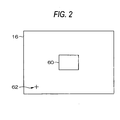
- an AF frame 60 having a position and a size corresponding to the AF area set by the AF processing portion 40 of the lens device 12 is displayed on the screen of the view finder 16 so as to be superimposed on an image of a subject (not shown). Further, in order to display the current focus state, "+" representing the front focus state, "-"representing the rear focus state or "0" representing the in-focus state is displayed at a focus state display position 62. These focus information may be displayed on the view finder 16 in a different manner from this example.
- the lens controlling CPU 20 of the lens device 12 determines whether or not such the focus information is to be displayed on the view finder 16.
- a controller having a view finder (VF) display instruction unit for instructing the on/off of the display of the focus information on the view finder 16 is coupled to the device, a user can determine by using the VF display instruction unit whether or not the focus information is to be displayed. That is, the lens controlling CPU 20 reads the setting state of the VF display instruction unit and perform the determination based on the setting state.
- VF view finder
- the VF display instruction unit may be provided at the focus demand 30 or the zoom demand 32.
- the VF display instruction unit may be provided at other arbitrary controller (including a dedicated controller) or may be other controller.
- the VF display instruction unit (VF display instruction switch) is provided at the lens device 12 or the body 10.
- the controller having the VF display instruction unit is not coupled to the lens device 12, the determination as to whether or not the lens controlling CPU 20 displays the focus information on the view finder 16 is made based on the designation of a user using the VF display instruction unit provided at the lens device 12 or the body 10. The detailed description of this processing will be made later.
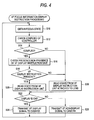
- the lens controlling CPU 20 obtains information (focus information) of the focus state and the AF area obtained from the AF function (step S10). Then, it is checked whether or not the controller is coupled to the lens device 12 (step S12) and determined whether or not the controller is coupled to the lens device (step S14). In the case where a plurality of the controllers are coupled to the lens device 12, it is determined to be Yes when at least one controller is coupled.
- step S 14 it is checked whether or not the controller has the VF display instruction unit (step S16) and determined whether or not the controller has the VF display instruction unit (step S 18). In the case where a plurality of the controllers are coupled to the lens device 12, it is determined to be Yes in step S 18 when at least one of the controllers has the VF display instruction unit. In contrast, when none of the controllers have the VF display instruction unit, it is determined to be No in step S 18.
- step S 18 the setting state of the VF display instruction unit (VF display instruction switch) of the controller is read (step S20) and it is determined whether or not the focus information is set to be displayed on the view finder (step S22).
- step S22 the focus information is transmitted to the camera circuit 14 of the body 10 and a command instructing the display of the focus information on the view finder 16 is transmitted (step S24).
- the focus information an image for displaying the focus information
- the superimposed image is displayed on the view finder 16.
- step S26 a command instructing not to display the focus information on the view finder 16 is transmitted (step S26).
- the focus information may not be transmitted to the camera circuit 14 of the body 10 so as not to display the focus information on the view finder 16.
- step S24 or S26 When the processing of step S24 or S26 is completed, the processing returns to step S10.
- step S24 when it is determined No in step S 14, that is, when it is determined that no controller is coupled or when it is determined No in step S 18, that is, when it is determined that the controller does not has the VF display instruction unit, the processing proceeds to step S24.
- the focus information is transmitted to the camera circuit 14 of the body 10 and also a command for instructing the display of the focus information on the view finder is transmitted (step S24).
- the focus information an image for displaying the focus information
- the focus information is superimposed on an image of a subject and the superimposed image is displayed on the view finder 16.
- the focus information is automatically displayed on the view finder 16.
- the lens device 12 is provide with the VF display instruction unit (a VF display instruction switch 50 in Fig. 1 ).
- the setting state of the VF display instruction unit (VF display instruction switch 50) provided at the lens device 12 is read (step S30).
- the processing proceeds to step S22, whereat it is determined whether or no the VF display instruction unit (VF display instruction switch 50) provided at the lens device 12 is in a setting state for turning on the display of the focus information on the view finder (step S22).
- step S22 the focus information is transmitted to the camera circuit 14 of the camera main body 10 and a command instructing the display of the focus information on the view finder 16 is transmitted (step S24).
- the focus information an image for displaying the focus information
- the superimposed image is displayed on the view finder 16.
- step S26 a command instructing not to display the focus information on the view finder is transmitted (step S26).
- the controller having the VF display instruction unit in the case where the controller having the VF display instruction unit is coupled to the lens device 12, it is determined whether or not the focus information is to be displayed on the view finder according to the VF display instruction unit of the controller.
- the controller having the VF display instruction unit in the case where the controller having the VF display instruction unit is not coupled to the lens device 12, that is, when the controller is not coupled to the lens device 12 or the controller coupled to the camera device does not have the VF display instruction unit, it is determined whether or not the focus information is to be displayed on the view finder 16 according to the VF display instruction unit provided at the lens device 12.
- the VF display instruction unit (a VF display instruction switch 52 in Fig. 1 ) at the camera main body 10 instead of providing the VF display instruction unit at the lens device 12.
- the setting state of the VF display instruction unit (VF display instruction switch 52) of the camera main body 10 may be read instead of reading the setting state of the VF display instruction unit of the lens device 12
- the invention can be applied to any type of the AF function mounted on the lens device 12.
- the invention can be applied to the AF function such as the optical path length difference AF system or the phase difference AF system.
- the optical path length difference AF system in the lens device 12, a light splitting unit is disposed at the optical system for imaging a subject on the imaging device of the camera main body 10 to thereby split a light from the subject for AF.
- a plurality of the AF imaging devices having an optical path length difference therebetween are disposed near a position where a subject image substantially same (substantially same in a focus state and a view angle) as a subject image formed on the image forming plane of the imaging device of the camera main body 10 is formed by the light from the subject for AF.
- the focus state is detected by comparing the contrasts of the subject images formed by the AF imaging devices, and the focus state of the optical system is controlled so as to be an in-focus state based on the detected focus state.
Landscapes
- Engineering & Computer Science (AREA)
- Multimedia (AREA)
- Signal Processing (AREA)
- Studio Devices (AREA)
- Automatic Focus Adjustment (AREA)
- Focusing (AREA)
- Indication In Cameras, And Counting Of Exposures (AREA)
Applications Claiming Priority (1)
| Application Number | Priority Date | Filing Date | Title |
|---|---|---|---|
| JP2008031735A JP4834009B2 (ja) | 2008-02-13 | 2008-02-13 | テレビカメラシステム |
Publications (2)
| Publication Number | Publication Date |
|---|---|
| EP2091236A2 true EP2091236A2 (fr) | 2009-08-19 |
| EP2091236A3 EP2091236A3 (fr) | 2012-12-19 |
Family
ID=40636842
Family Applications (1)
| Application Number | Title | Priority Date | Filing Date |
|---|---|---|---|
| EP09000456A Withdrawn EP2091236A3 (fr) | 2008-02-13 | 2009-01-14 | Système de caméra de télévision |
Country Status (3)
| Country | Link |
|---|---|
| US (1) | US20090201409A1 (fr) |
| EP (1) | EP2091236A3 (fr) |
| JP (1) | JP4834009B2 (fr) |
Families Citing this family (1)
| Publication number | Priority date | Publication date | Assignee | Title |
|---|---|---|---|---|
| JP5926492B2 (ja) | 2011-03-23 | 2016-05-25 | キヤノン株式会社 | レンズ装置及びそれを有する撮像装置 |
Citations (3)
| Publication number | Priority date | Publication date | Assignee | Title |
|---|---|---|---|---|
| JP2002365710A (ja) | 2001-06-04 | 2002-12-18 | Fuji Photo Optical Co Ltd | ピント表示装置 |
| EP1835732A2 (fr) * | 2006-03-13 | 2007-09-19 | Fujinon Corporation | Système d'affichage d'informations de mise au point |
| JP2008031735A (ja) | 2006-07-28 | 2008-02-14 | Tokyo Electric Power Co Inc:The | 塔状構造物の制振装置 |
Family Cites Families (8)
| Publication number | Priority date | Publication date | Assignee | Title |
|---|---|---|---|---|
| US5005040A (en) * | 1988-05-16 | 1991-04-02 | Minolta Camera Kabushiki Kaisha | Automatic focus adjusting apparatus of a camera |
| DE69225156T2 (de) * | 1991-02-01 | 1998-11-05 | Canon Kk | Konvertierer für Kamera mit auswechselbaren Linsen |
| DE602004006334T2 (de) * | 2003-03-25 | 2007-09-13 | Canon K.K. | Adapter für die Fernstreuerung einer Fokuslinse |
| JP2005140943A (ja) * | 2003-11-06 | 2005-06-02 | Canon Inc | フォーカスアシスト装置、ドライブユニット、撮影レンズおよび撮影システム |
| JP4196884B2 (ja) * | 2004-06-01 | 2008-12-17 | フジノン株式会社 | オートフォーカスシステム |
| JP2006145872A (ja) * | 2004-11-19 | 2006-06-08 | Fujinon Corp | Afエリア表示装置 |
| EP1659783A3 (fr) * | 2004-11-19 | 2006-05-31 | Fujinon Corporation | Appareil d'affichage de la zone AF et appareil de commande de la zone AF. |
| JP4639205B2 (ja) * | 2007-02-19 | 2011-02-23 | キヤノン株式会社 | 撮像装置及び制御方法、及びユーザーインタフェースの表示装置 |
-
2008
- 2008-02-13 JP JP2008031735A patent/JP4834009B2/ja not_active Expired - Fee Related
-
2009
- 2009-01-14 EP EP09000456A patent/EP2091236A3/fr not_active Withdrawn
- 2009-01-14 US US12/353,276 patent/US20090201409A1/en not_active Abandoned
Patent Citations (3)
| Publication number | Priority date | Publication date | Assignee | Title |
|---|---|---|---|---|
| JP2002365710A (ja) | 2001-06-04 | 2002-12-18 | Fuji Photo Optical Co Ltd | ピント表示装置 |
| EP1835732A2 (fr) * | 2006-03-13 | 2007-09-19 | Fujinon Corporation | Système d'affichage d'informations de mise au point |
| JP2008031735A (ja) | 2006-07-28 | 2008-02-14 | Tokyo Electric Power Co Inc:The | 塔状構造物の制振装置 |
Also Published As
| Publication number | Publication date |
|---|---|
| JP2009194523A (ja) | 2009-08-27 |
| EP2091236A3 (fr) | 2012-12-19 |
| JP4834009B2 (ja) | 2011-12-07 |
| US20090201409A1 (en) | 2009-08-13 |
Similar Documents
| Publication | Publication Date | Title |
|---|---|---|
| US8395670B2 (en) | Image capturing apparatus | |
| JP5474528B2 (ja) | オートフォーカスシステム | |
| EP2178292B1 (fr) | Système à mise au point automatique doté d'une fonction de suivi automatique de cadre | |
| US7978968B2 (en) | Auto focus device | |
| JP5705883B2 (ja) | レンズ装置 | |
| JP5794661B2 (ja) | 光学機器 | |
| US8773576B2 (en) | Image pickup system, including measuring unit | |
| JP5896763B2 (ja) | 光学機器および自動焦点調節を行う方法 | |
| EP2178291B1 (fr) | Système de mise au point automatique doté d'une fonction de suivi automatique de cadre | |
| EP1603328B1 (fr) | Système de focalisation automatique | |
| US10425573B2 (en) | Automatic focus adjustment device and automatic focus adjustment control device | |
| US11237458B2 (en) | Focus adjustment apparatus, image capturing apparatus, focus adjustment method, and storage medium | |
| JP6594053B2 (ja) | 撮像装置 | |
| JP2008145760A (ja) | オートフォーカスシステム | |
| EP2091236A2 (fr) | Système de caméra de télévision | |
| US20240098365A1 (en) | Lens apparatus and image pickup apparatus | |
| EP1835731A1 (fr) | Système autofocus | |
| JP2012173328A (ja) | レンズ装置、テレビカメラシステムおよびフォーカシングアシスト方法 | |
| JP5328616B2 (ja) | Af枠自動追尾システム | |
| JP2010096963A (ja) | Af枠自動追尾機能を備えたオートフォーカスシステム | |
| EP1596584B1 (fr) | Système de focalisation automatique | |
| US20230102114A1 (en) | Imaging apparatus | |
| JP2006084999A (ja) | Afエリア操作システム | |
| JP5457008B2 (ja) | Af枠自動追尾機能を備えたオートフォーカスシステム | |
| JP2006145872A (ja) | Afエリア表示装置 |
Legal Events
| Date | Code | Title | Description |
|---|---|---|---|
| PUAI | Public reference made under article 153(3) epc to a published international application that has entered the european phase |
Free format text: ORIGINAL CODE: 0009012 |
|
| 17P | Request for examination filed |
Effective date: 20090114 |
|
| AK | Designated contracting states |
Kind code of ref document: A2 Designated state(s): AT BE BG CH CY CZ DE DK EE ES FI FR GB GR HR HU IE IS IT LI LT LU LV MC MK MT NL NO PL PT RO SE SI SK TR |
|
| AX | Request for extension of the european patent |
Extension state: AL BA RS |
|
| RAP1 | Party data changed (applicant data changed or rights of an application transferred) |
Owner name: FUJIFILM CORPORATION |
|
| PUAL | Search report despatched |
Free format text: ORIGINAL CODE: 0009013 |
|
| AK | Designated contracting states |
Kind code of ref document: A3 Designated state(s): AT BE BG CH CY CZ DE DK EE ES FI FR GB GR HR HU IE IS IT LI LT LU LV MC MK MT NL NO PL PT RO SE SI SK TR |
|
| AX | Request for extension of the european patent |
Extension state: AL BA RS |
|
| RIC1 | Information provided on ipc code assigned before grant |
Ipc: H04N 5/232 20060101AFI20121115BHEP |
|
| AKX | Designation fees paid |
Designated state(s): AT BE BG CH CY CZ DE DK EE ES FI FR GB GR HR HU IE IS IT LI LT LU LV MC MK MT NL NO PL PT RO SE SI SK TR |
|
| 17Q | First examination report despatched |
Effective date: 20140926 |
|
| STAA | Information on the status of an ep patent application or granted ep patent |
Free format text: STATUS: THE APPLICATION IS DEEMED TO BE WITHDRAWN |
|
| 18D | Application deemed to be withdrawn |
Effective date: 20150207 |