EP2091276B1 - Verfahren und Vorrichtung zur Entscheidung, ob für ein Endgerät ein Handover durchgeführt werden muss - Google Patents
Verfahren und Vorrichtung zur Entscheidung, ob für ein Endgerät ein Handover durchgeführt werden muss Download PDFInfo
- Publication number
- EP2091276B1 EP2091276B1 EP08002822A EP08002822A EP2091276B1 EP 2091276 B1 EP2091276 B1 EP 2091276B1 EP 08002822 A EP08002822 A EP 08002822A EP 08002822 A EP08002822 A EP 08002822A EP 2091276 B1 EP2091276 B1 EP 2091276B1
- Authority
- EP
- European Patent Office
- Prior art keywords
- base station
- terminal
- duplex terminal
- duplex
- cell
- Prior art date
- Legal status (The legal status is an assumption and is not a legal conclusion. Google has not performed a legal analysis and makes no representation as to the accuracy of the status listed.)
- Not-in-force
Links
Images


Classifications
-
- H—ELECTRICITY
- H04—ELECTRIC COMMUNICATION TECHNIQUE
- H04W—WIRELESS COMMUNICATION NETWORKS
- H04W36/00—Hand-off or reselection arrangements
- H04W36/24—Reselection being triggered by specific parameters
- H04W36/26—Reselection being triggered by specific parameters by agreed or negotiated communication parameters
-
- H—ELECTRICITY
- H04—ELECTRIC COMMUNICATION TECHNIQUE
- H04W—WIRELESS COMMUNICATION NETWORKS
- H04W56/00—Synchronisation arrangements
- H04W56/004—Synchronisation arrangements compensating for timing error of reception due to propagation delay
- H04W56/0045—Synchronisation arrangements compensating for timing error of reception due to propagation delay compensating for timing error by altering transmission time
-
- H—ELECTRICITY
- H04—ELECTRIC COMMUNICATION TECHNIQUE
- H04W—WIRELESS COMMUNICATION NETWORKS
- H04W56/00—Synchronisation arrangements
-
- H—ELECTRICITY
- H04—ELECTRIC COMMUNICATION TECHNIQUE
- H04W—WIRELESS COMMUNICATION NETWORKS
- H04W76/00—Connection management
- H04W76/40—Connection management for selective distribution or broadcast
- H04W76/45—Connection management for selective distribution or broadcast for Push-to-Talk [PTT] or Push-to-Talk over cellular [PoC] services
Definitions
- the present invention relates generally to a method and a device for determining, in a wireless cellular telecommunication network, if a handover has to be executed for a terminal.
- each terminal is regularly assigned a candidate set of base stations, which could in theory handle the communication. These candidate base stations may be for instance base stations surrounding the base station which is currently handling the terminal.
- Each terminal regularly measures, or measures on demand, i.e. after a particular event, the quality of the signals in the candidate measurement channels of the different candidate base stations. These measurements are then reported by the terminal to the base station which is currently handling the terminal which may decide whether to start a handover procedure.
- a candidate set of base stations is not assigned to the terminals.
- Each terminal performs measurements with the base stations from which it receives signals of the measurement channel with enough quality. Then, the terminal reports the measurements to the base station which is currently handling the terminal which may decide whether to start a handover procedure or to validate a handover procedure requested by the terminal.
- a full-duplex terminal is a terminal which is able to transmit and receive radio signals simultaneously.
- a half-duplex terminal is a terminal which is not able to transmit and receive radio signals simultaneously.
- the terminal operates in Time Division Duplex (TDD) mode, with transmission and reception on the same frequency band but at different time periods.
- the terminal may also operate in Frequency Division Duplex (FDD) mode, with transmission and reception on different frequency bands and at different time periods.
- TDD Time Division Duplex
- FDD Frequency Division Duplex
- a base station transmits symbols at time te to a half-duplex terminal
- these symbols are received by the terminal located at a distance d from the base station at a time equal to te + RTD(d)/2, where RTD(d) is the Round Trip Delay for the terminal.
- RTD(d) is the Round Trip Delay for the terminal.
- These symbols are processed by the terminal which then may transmit also symbols over the uplink channel to the base station.
- the terminal TE Before transmitting symbols over the uplink channel, the terminal TE has to wait for a period of time, said Receive Transmit Switch time or simply switching time and referred to as RTS, in order to take into account the duration of hardware and software operations.
- this delay RTS is the maximum of the time needed by hardware equipments of the terminals to switch between reception and transmission modes and the time needed by hardware equipments of the base station to switch between transmission and reception modes.
- the symbols transmitted over the uplink channel cannot be received at the base station BTS before a time tr equal to te + RTD(d) + RTS + D DL , D DL being the total duration of the symbols the terminal can receive in the downlink channel.
- an idle period duration which corresponds to two symbols duration needs to be created, either at both the base station and the terminal sides or only at the terminal sides in order to make the base station able to handle terminals located at any position in the cell.
- An idle period duration which corresponds to two symbols duration allows half-duplex terminals located at a distance from the base station up to 19.6km to be handled by the base station.
- An idle period duration which corresponds to one symbol duration allows only half-duplex terminals located at a distance from the base station up to 8.3 km to be handled by the base station. With such idle period duration, even if the quality of the signals of the measurement channel is sufficiently high, a half duplex terminal located at a distance larger than 8.3 km from the base station can not be handled by the base station whereas a full-duplex terminal could.
- a handover procedure may be requested towards a base station whereas the half-duplex terminal can not be handled by the base station as the round trip delay between the base station and the terminal is not compatible with the idle period of the base station.
- the patent application US 2004/266474 discloses criteria for base station selection including providing handover in a wireless communication system.
- the patent application EP1746743 discloses a method for transmission in a TDD system with variable length guard period.
- the present invention aims at avoiding that a handover is executed for a half duplex terminal which can not cope with the idle period requirement of the target base station.
- the present invention concerns a method for determining in a wireless cellular telecommunication network in which a half duplex terminal is handled by a first base station, if a second base station is able to handle the half-duplex terminal, according to claim 1.
- the present invention concerns also a device for determining in a wireless cellular telecommunication network in which a half duplex terminal is handled by a first base station, if a second base station is able to handle the half-duplex terminal, according to claim 7.
- the quality of management of the handover procedure is increased by avoiding inefficient handover request for half-duplex terminals.
- the wireless cellular telecommunication network is cell synchronized.
- the wireless telecommunication network uses half duplex Frequency Division Duplexing scheme and only half-duplex terminals handled by the first or second base station do not transfer and do not receive signals during the idle period of the cell of the first or second base station or the half-duplex terminals handled by the first or second base station and the first or second base station do not transfer and do not receive signals during the idle period of the cell of the first or second base station.
- the wireless telecommunication network uses Time Division Duplexing scheme and the half-duplex terminals handled by the first or second base station and the first or second base station do not transfer and do not receive signals during the idle period.
- the half-duplex terminal the half-duplex terminal:
- the half-duplex terminal can check handover possibility towards each base station and transfers a measurement report which comprises only quality measurements on signals transferred by base station which can handle the terminal, the base station which handles the terminal can decide without any error which base station should handle the half-duplex terminal after handover.
- the half-duplex terminal the half-duplex terminal:
- the base station can take decision of handover with low computational complexity.
- the present invention concerns a computer program which can be directly loadable into a programmable device, comprising instructions or portions of code for implementing the steps of the method according to the invention, when said computer program is executed on a programmable device.
- Fig. 1 is a diagram representing the architecture of the wireless cellular telecommunication network in which the present invention is implemented.
- the wireless cellular telecommunication network may use Time Division Duplexing scheme (TDD) or half duplex Frequency Division Duplexing scheme.
- TDD Time Division Duplexing scheme
- half duplex Frequency Division Duplexing scheme may be used.
- the signals transferred in uplink and downlink channels are duplexed in different sub frames, named also time slots, in the same frequency band.
- the signals transferred in uplink and downlink channels are duplexed in same sub frames, named also time slots, in different frequency bands.
- half duplex FDD In half duplex FDD scheme, from the half-duplex terminal side, the signals transferred in uplink and downlink channels are duplexed in different sub frames, named also time slots, in different frequency bands. It should be noted that in such case, a base station may be able to use a full duplex Frequency Division Duplexing scheme whilst communicating with several half-duplex FDD terminals at the same time by appropriately ordering the time slots of each half-duplex FDD terminal.
- a base station BS When a base station BS transfers symbols to a terminal TE, the data, the signals or the messages are transferred through a downlink channel.
- the signals, the messages or data are transferred through uplink channel.
- a terminal TE located in the cell 15 2 of a base station BS2 is moving to the cell 15 1 of the base station BS1.
- the wireless cellular telecommunication network is composed of plural base stations BS.
- the cell 15 1 of the base station BS1 is the area in which the power strength of the signals transferred by the base station BS1, like the one transferred in the measurement channel of the base station BS1, are received by a terminal TE located in the cell 15 1 at a level which is upper than a predetermined value.
- the base station BS1 can handle the full-duplex terminal TE.
- the full-duplex terminal TE can establish or receive a communication with a remote telecommunication device through the base station BS1.
- the cell 15 1 has not a regular shape. This is mainly due to the particular locations which are in line of sight with the base station BS1 or obstructions.
- the area R1 of the base station BS1 is the area in which, for each terminal TE located in R1, the sum of the round trip delay between the base station BS1 and the terminal TE and the switch between receive and transmit modes and/or the switch between transmit and receive modes is lower than or equal to the idle period of the cell 15 1 .
- the terminal TE when a half-duplex or full-duplex terminal TE is located in the area R1 of the base station BS1, the terminal TE can be handled by the base station BS1 and can establish or receive a communication with a remote telecommunication device through the base station BS1.
- the half-duplex terminal TE When a half-duplex terminal TE is located in the cell 15 1 and is not located in area R1 of the base station BS1, the half-duplex terminal TE can not be handled by the base station BS1 as the terminal TE has a characteristic in the cell 15 1 which is not compatible with the idle period of the cell 15 1 .
- the area R1 is included in the cell 15 1 .
- the difference between R1 and 15 1 is defined by the idle period set for the cell 15 1 .
- a large idle period will enable any half-duplex terminal TE to be handled by the base station BS1 but will reduce the overall capacity in term of data transferred between the base station R1 and the half-duplex terminals TE.
- R1 is defined so as to provide to a majority of half duplex terminals TE located in the cell 15 1 , the possibility to be handled by the base station BS 1.
- R1 is defined so as to avoid that the idle period has to be lengthened only for a minority of half-duplex terminals TE which are far from the base station BS1.
- the cell 15 2 of the base station BS2 is the area in which the power strength of the signals, like the one transferred in the measurement channel of the base station BS2, is received by a terminal TE located in the cell 15 2 at a level which is upper than a predetermined value.
- a full-duplex terminal. TE is located in the cell 15 2 of the base station BS2, the base station BS2 can handle the full-duplex terminal TE.
- the full-duplex terminal TE can establish or receive a communication with a remote telecommunication device through the base station BS2.
- the area R2 of the base station BS2 is the area in which, for each terminal TE located in R2, the sum of the round trip delay between the base station BS2 and the terminal TE and the switch between receive and transmit modes and/or the switch between transmit and receive modes is lower than or equal to the idle period of the cell 15 2 .
- the terminal TE when a half-duplex or full-duplex terminal TE is located in the area R2 of the base station BS2, the terminal TE can be handled by the base station BS2 and can establish or receive a communication with a remote telecommunication device through the base station BS2.
- the half-duplex terminal TE When a half-duplex terminal TE is located in the cell 15 2 and is not located in area R2 of the base station BS2, the half-duplex terminal TE can not be handled by the base station BS2 as the terminal TE has a characteristic in the cell 15 2 which is not compatible with the idle period of the cell 15 2 .
- the area R2 is comprised in the cell 15 2 .
- the difference between R2 and 15 2 is defined by the idle period set for the cell 15 2 .
- the idle period set respectively for the cells 15 1 and 15 2 may be equal or different.
- the base stations BS comprise means for transferring downlink signals messages to the terminal TE and means for receiving messages according to the present invention.
- the base stations BS are also named nodes or nodes B or enhanced nodes B or access points.
- the terminal TE is a half-duplex terminal like a mobile phone, a personal digital assistant, or a personal computer.
- the terminal TE is also named a user equipment.
- the wireless telecommunication network is cell-synchronised.
- the signals originated from different cells 15 or base stations BS are simultaneously transmitted.
- the signals are structured in frames, which are themselves composed of symbols.
- Cell synchronisation may be ensured at the symbol level meaning that the transmission time of a symbol at a given cell 15 or base station BS matches the transmission time of a symbol at any other cell 15 or base station BS.
- Cell synchronisation may also be ensured at the frame level. In that case, the transmission time of a frame at a given cell 15 or base station BS matches the transmission time of a frame at any other cell 15 or base station BS.
- Cell synchronisation can be carried out by including a GNSS (Global Navigation Satellite System) in each base station BS.
- GNSS Global Navigation Satellite System
- Fig. 2a is a chronogram depicting the idle period when the uplink channel is synchronous and where the base station and the half-duplex terminal don't transfer and receive signal in the idle period of the cell.
- the uplink channel When the uplink channel is synchronous, the symbols transmitted in the uplink channel of a given cell 15 of a base station BS have to be received at the same time tr by the base station BS, regardless of the distance separating the base station BS and the terminal TE.
- the base station BS When no signal is received or transferred during the idle period by both the base station and the half-duplex terminal side, the base station BS has to wait for the reception of the symbols transmitted by the terminal TE in order to perform the processing thereof.
- the waiting time determined for the terminal TE which is located at the border of the area R1 or R2 or in other words, the largest waiting time that can be determined, is called the Guard Period or idle period IP of the cell 15 and must be equal at least to the round trip delay RTD(Ra) plus the Receive Transmit Switch times RTS, where Ra is the radius of the area R1 or R2 if the area R1 or R2 is considered as a circle.
- the base station BS1 transfers downlink symbols DL to the terminal TE. These downlink symbols DL are received by the terminal TE at a delay equal to half of the round trip delay RTD.
- the base station BS During the idle period IP, the base station BS doesn't transfer or receive any symbol. By not transferring or receiving any symbol, power consumption of the base station is reduced.
- the base station BS determines a timing delay TD(d) for each of the terminals TE.
- the terminal TE applies its Timing Advance TA(TE) value for the transmission of symbols over the uplink channel in such a manner that the transmitted symbols are received at the base station BS from the terminal TE at the beginning of the uplink timeslot tr.
- TA(TE) Timing Advance
- the idle period IP is discontinuous. It is composed for the terminal TE of the two time periods noted 1 ⁇ 2 RTD and the time period TD(TE).
- Fig. 2b is a chronogram depicting the idle period when the uplink channel is synchronous and where the half-duplex terminal does not transfer and receive signals in the idle period of the cell.
- the base station BS transfers symbols in the downlink channel DL T without any consideration of an idle period.
- the base station BS considers each terminal TE as being potentially a full-duplex terminal TE.
- the base station BS may transfer symbols even if they are not usable by the half-duplex terminals. Transferring non-usable symbols reduces development cost for manufacturing specific features of base stations BS which are able to handle full and half-duplex terminals TE.
- a half-duplex terminal TE receives the symbols in the downlink channel DL T
- the terminal TE executes some puncturing on the received symbols.
- the terminal TE receives only the downlink symbols in DL R which are compatible with the idle period of the cell 15, i.e. the downlink symbols which are comprised in the duration D DL of the symbols the terminal can receive in the downlink channel.
- the timing advance TA(TE) and the timing delay TD(TE) for the terminal TE are determined in a similar way as it has been disclosed in the Fig. 2a .
- the idle period IP is continuous at the base station BS whereas it is discontinuous at the half-duplex terminal TE. It is composed for the terminal TE of the two time periods noted 1 ⁇ 2 RTD and the time period TD(TE).
- Fig. 3 is a diagram representing the architecture of a terminal according to the present invention.
- the terminal TE has, for example, an architecture based on components connected together by a bus 301 and a processor 300 controlled by programs related to the algorithms as disclosed in the Fig. 5 or 6 .
- terminal TE is, in a variant, implemented under the form of one or several dedicated integrated circuits which execute the same operations as the one executed by the processor 300 as disclosed hereinafter.
- the bus 301 links the processor 300 to a read only memory ROM 302, a random access memory RAM 303 and a channel interface 305.
- the read only memory ROM 302 contains instructions of the programs related to the algorithms as disclosed in the Fig. 5 or 6 which are transferred, when the terminal TE is powered on to the random access memory RAM 303.
- the RAM memory 303 contains registers intended to receive variables, and the instructions of the programs related to the algorithms as disclosed in the Fig. 5 or 6 .
- the channel interface 305 comprises means for transferring and/or receiving messages to and/or from the base stations BS, means for transferring reports messages according to the present invention through the antenna TEAnt and means for measuring the quality of received signals.
- Fig. 4 depicts an example of a chronogram of signals and timings according to the present invention.
- the horizontal axis represents the distance separating the base stations BS and the terminal TE and the vertical axis represents the time.
- the base station BS2 transfers signals DL2 which are received by the terminal TE after a time duration of T 2 .
- the base station BS1 transfers signals DL1 which are received by the terminal TE after a time duration of T 1 .
- the difference of the time of reception of the signals DL1 and DL2 is noted ⁇ T.
- the terminal TE will use efficiently the difference ⁇ T in order to adapt the quality measurements report of the signals received by the terminal TE as it will be disclosed hereinafter.
- Fig. 5 is an example of algorithm executed by a terminal according to a first mode of realisation of the present invention.
- the present algorithm is executed by the processor 300 of each terminal TE each time downlink signals are received, e.g. in the measurement channel, from at least one base station BS.
- the terminal TE knows the idle period IP of the cell 15 of the base station BS which is currently handling the terminal TE, named also first base station BS, and the idle period IP of the cells 15 of other base stations BS, named also second base stations BS, which are, as example, neighbours of the base station BS which is currently handling the terminal TE.
- the idle period IP of each cell 15 of base station BS is broadcasted by the base station BS which is currently handling the terminal TE or is broadcasted by each base station BS or is identical for each cell 15 of base station BS.
- the processor 300 detects the reception by the channel interface 305 of a signal in the measurement channel of the base station BS which handles the terminal TE or first base station BS and at least a signal transferred by at least another or second base station BS in its measurement channel.
- the processor 300 for each other base station BS than the base station BS which is currently handling the terminal TE, memorises the difference of time ⁇ T between the time of reception of the signal transferred by the base station BS which handles the terminal TE and the time of reception of the signal transferred by the other base station BS.
- the processor 300 commands the channel interface 305 to execute some quality measurements on downlink signals.
- the channel interface 305 measures the signals transferred in each measurement channel of base station BS it can find and memorises the base stations BS and the measurements for which the quality measurements are higher than a predetermined value.
- the processor 300 determines, for each other base station BS, the Timing Advance it will have to apply if the terminal TE was handled by the other base station BS.
- TA(other BS) is the Timing Advance to be determined for the other base station BS
- TA(BS) is the Timing Advance for the base station BS which currently handles the terminal TE
- IP(BS) is the idle period of the cell 15 of the base station BS which currently handles the terminal TE.
- the processor 300 selects a first determined Timing Advance TA.
- the processor 300 checks if the selected Timing Advance TA is larger than IP(other BS).
- IP(other BS) is the idle period of the cell 15 of the other base station BS.
- Timing Advance When a determined Timing Advance is larger than IP(other BS) for another base station BS, it means that the round trip delay between the terminal TE and the other base station BS is upper than the idle period of the cell 15 of the other base station BS and that the terminal TE can not be handled by the other base station BS.
- step S506 If the selected Timing Advance is larger than IP(other BS), the processor 300 moves to step S506. If the selected Timing Advance is lower than or equal to IP(other BS), the processor 300 moves to step S507.
- the processor 300 marks the other base station BS for which the Timing Advance is selected as not compatible with the terminal TE and moves to step S508.
- the processor 300 marks the other base station BS for which the Timing Advance is selected as compatible with the terminal TE and moves to step S508.
- step S508 the processor 300 checks if a determined Timing Advance has not been selected. If a Timing Advance has not been selected, the processor 300 moves to step S509, selects another Timing Advance and returns to step S505.
- step S510 the processor 300 moves to step S510 and forms a measurement report.
- the processor 300 selects the base stations which transferred signals on which quality measurements are higher than a predetermined value and which are able to handle the half-duplex terminal.
- the processor 300 forms a measurement report which comprises the quality measurements on signals transferred by the selected base stations.
- the processor 300 commands the transfer of the measurement report to the base station BS which handles the terminal TE.
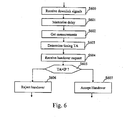
- Fig. 6 is an example of algorithm executed by a terminal according to a second mode of realisation of the present invention.
- the present algorithm is executed by the processor 300 of each terminal TE each time downlink signals are received in measurement channel of at least one base station BS.
- the terminal TE knows the idle period IP of the cell 15 of the base station BS which is currently handling the terminal TE, named also first base station BS, and the idle period IP of the cells 15 of the other base stations BS, named also second base stations BS, which are, as example, neighbours of the base station BS which is currently handling the terminal TE.
- the idle period IP of each cell of base station BS is broadcasted by the base station BS which is currently handling the terminal TE or broadcasted by each base station BS or is identical for each cell 15 of base station BS.
- the processor 300 detects the reception by the channel interface 305 of a signal in the measurement channel of the base station BS which handles the terminal TE and at least signal transferred by at least another base station BS in its measurement channel.
- the processor 300 for each other base station BS than the base station BS which is currently handling the terminal TE, memorises the difference of time ⁇ T between the time of reception of the signal transferred by the base station BS which handles the terminal TE and the time of reception of the signal transferred by the other base station BS.
- the processor 300 commands the channel interface 305 to execute some quality measurements on downlink signals.
- the channel interface 305 measures the signals transferred in each measurement channel of base station BS it can find and memorises the base stations BS and the measurements for which the quality measurements are higher than a predetermined value.
- the processor 300 determines, for each other base station BS, the Timing Advance it will have to apply if the terminal TE was handled by the other base station BS.
- TA(other BS) is the Timing Advance to be determined for the other base station BS
- TA(BS) is the Timing Advance for the base station BS which currently handles the terminal TE
- IP(BS) is the idle period of the cell 15 of the base station BS which currently handles the terminal TE.
- the processor 300 receives through the channel interface 305, a message transferred by the base station BS which handles the terminal TE and which is representative of a request to proceed to a handover, i.e. to be handled by another base station BS.
- the processor 300 checks if the Timing Advance determined for the other base station BS is larger than IP(other BS).
- IP(other BS) is the idle period of the cell 15 of the other base station BS.
- step S606 If the Timing Advance determined for the other base station BS is larger than IP(other BS), the processor 300 moves to step S606. Otherwise, the processor 300 moves to step S607.
- the processor 300 commands the transfer of a message to the base station BS which handles the terminal TE which is representative of a reject of the handover. After that, the processor 300 interrupts the present algorithm.
- the processor 300 commands the transfer of a message to the base station BS which handles the terminal TE which is representative of an agreement to proceed to the handover.
- the processor 300 starts a classical handover procedure with the other base station BS.
Landscapes
- Engineering & Computer Science (AREA)
- Computer Networks & Wireless Communication (AREA)
- Signal Processing (AREA)
- Mobile Radio Communication Systems (AREA)
Claims (8)
- Verfahren zum Bestimmen in einem drahtlosen zellularen Telekommunikationsnetz, in welchem ein Halbduplex-Endgerät (TE) durch eine erste Basisstation (BS1) bedient wird, ob eine zweite Basisstation (BS2) das Halbduplex-Endgerät bedienen kann, dadurch gekennzeichnet, dass das Verfahren die durch das Halbduplex-Endgerät ausgeführten folgenden Schritte aufweist:- Empfangen von Signalen (S500) von der ersten Basisstation und von der zweiten Basisstation,- Bestimmen (S501) der Zeitperiode zwischen dem Empfang des durch die erste Basisstation transferierten Signals und dem Empfang des durch die zweite Basisstation transferierten Signals,- Erhalten einer Ruhezeit der Zelle der ersten Basisstation und einer Ruhezeit der Zelle der zweiten Basisstation, wobei eine Ruhezeit einer Zelle einer Basisstation eine Zeitperiode ist, in welcher ein durch die Basisstation bedientes Halbduplex-Endgerät Signale nicht zu der Basisstation transferiert,- Bestimmen (S503) des zeitlichen Fortschreitens, welches das Halbduplex-Endgerät zu beantragen hat, wenn das Halbduplex-Endgerät durch die zweite Basisstation bedient wird, gemäß dem zeitlichen Fortschreiten, welches das Halbduplex-Endgerät zu beantragen hat, wenn das Halbduplex-Endgerät durch die erste Basisstation bedient wird, der Ruhezeit der Zelle der ersten Basisstation und der Zeitperiode zwischen dem Empfang der durch die erste Basisstation und die zweite Basisstation transferierten Signale,- Bestimmen (S505), ob die zweite Basisstation das Halbduplex-Endgerät bedienen kann, wenn das zeitliche Fortschreiten, welches das Halbduplex-Endgerät zu beantragen hat, wenn das Halbduplex-Endgerät durch die zweite Basisstation bedient wird, weniger lang als die Ruhezeit der zweiten Basisstation ist.
- Verfahren nach Anspruch 1, dadurch gekennzeichnet, dass das drahtlose zellulare Telekommunikationsnetz zellensynchronisiert ist.
- Verfahren nach Anspruch 1 oder 2, dadurch gekennzeichnet, dass das drahtlose zellulare Telekommunikationsnetz ein Halbduplex-Frequenzduplexschema verwendet und dass nur durch die erste oder zweite Basisstation bediente Halbduplex-Endgeräte während der Ruhezeit der Zelle der ersten oder zweiten Basisstation Signale nicht transferieren und nicht empfangen oder die durch die erste oder zweite Basisstation bedienten Halbduplex-Endgeräte und die erste oder zweite Basisstation während der Ruhezeit der Zelle der ersten oder zweiten Basisstation Signale nicht transferieren und nicht empfangen.
- Verfahren nach Anspruch 1 oder 2, dadurch gekennzeichnet, dass das drahtlose zellulare Telekommunikationsnetz ein Zeitduplexschema verwendet und dass die durch die erste oder zweite Basisstation bedienten Halbduplex-Endgeräte und die erste oder zweite Basisstation während der Ruhezeit Signale nicht transferieren und nicht empfangen.
- Verfahren nach einem der Ansprüche 1 bis 4, dadurch gekennzeichnet, dass das Verfahren folgende weitere Schritte aufweist:- Bestimmen (502) von Qualitätsmessungen für die Signale,- Auswählen der Basisstationen, welche Signale transferierten, für welche Qualitätsmessungen höher als ein vorbestimmter Wert sind, und welche das Halbduplex-Endgerät bedienen können,- Ausbilden (S510) eines Messungsberichts, der die Qualitätsmessungen an durch die ausgewählten Basisstationen transferierten Signalen umfasst,- Transferieren des Messungsberichts zu der ersten Basisstation, die das Halbduplex-Endgerät bedient.
- Verfahren nach einem der Ansprüche 1 bis 5, dadurch gekennzeichnet, dass das Verfahren folgende weitere Schritte aufweist:- Empfangen einer Nachricht, die eine Aufforderung zum Weitergehen zu einer Übergabe zu der zweiten Basisstation darstellt, von der ersten Basisstation,- Prüfen, ob die zweite Basisstation das Halbduplex-Endgerät bedienen kann,- Transferieren einer Nachricht zu der ersten Basisstation, die das Halbduplex-Endgerät bedient, gemäß dem Ergebnis der Prüfung.
- Vorrichtung zum Bestimmen in einem drahtlosen zellularen Telekommunikationsnetz, in welchem ein Halbduplex-Endgerät durch eine erste Basisstation bedient wird, ob eine zweite Basisstation das Halbduplex-Endgerät bedienen kann, dadurch gekennzeichnet, dass die Vorrichtung in dem Halbduplex-Endgerät enthalten ist und folgendes aufweist:- eine Einrichtung zum Empfangen von Signalen von der ersten Basisstation und von der zweiten Basisstation,- eine Einrichtung zum Bestimmen der Zeitperiode zwischen dem Empfang des durch die erste Basisstation transferierten Signals und dem Empfang des durch die zweite Basisstation transferierten Signals,- eine Einrichtung zum Erhalten einer Ruhezeit der Zelle der ersten Basisstation und einer Ruhezeit der Zelle der zweiten Basisstation, wobei eine Ruhezeit einer Zelle einer Basisstation eine Zeitperiode ist, in welcher ein durch die Basisstation bedientes Halbduplex-Endgerät Signale nicht zu der Basisstation transferiert,- eine Einrichtung zum Bestimmen des zeitlichen Fortschreitens, welches das Halbduplex-Endgerät zu beantragen hat, wenn das Halbduplex-Endgerät durch die zweite Basisstation bedient wird, gemäß dem zeitlichen Fortschreiten, welches das Halbduplex-Endgerät zu beantragen hat, wenn das Halbduplex-Endgerät durch die erste Basisstation bedient wird, der Ruhezeit der Zelle der ersten Basisstation und der Zeitperiode zwischen dem Empfang der durch die erste Basisstation und die zweite Basisstation transferierten Signale,- eine Einrichtung zum Bestimmen, ob die zweite Basisstation das Halbduplex-Endgerät bedienen kann, wenn das zeitliche Fortschreiten, welches das Halbduplex-Endgerät zu beantragen hat, wenn das Halbduplex-Endgerät durch die zweite Basisstation bedient wird, weniger lang als die Ruhezeit der zweiten Basisstation ist.
- Computerprogramm, das direkt ladbar in eine programmierbare Vorrichtung sein kann, mit Anweisungen oder Teilbereichen eines Codes zum Implementieren der Schritte des Verfahrens nach den Ansprüchen 1 bis 6, wenn das Computerprogramm auf einer programmierbaren Vorrichtung ausgeführt wird.
Priority Applications (5)
| Application Number | Priority Date | Filing Date | Title |
|---|---|---|---|
| EP08002822A EP2091276B1 (de) | 2008-02-15 | 2008-02-15 | Verfahren und Vorrichtung zur Entscheidung, ob für ein Endgerät ein Handover durchgeführt werden muss |
| AT08002822T ATE515909T1 (de) | 2008-02-15 | 2008-02-15 | Verfahren und vorrichtung zur entscheidung, ob für ein endgerät ein handover durchgeführt werden muss |
| US12/364,750 US8102816B2 (en) | 2008-02-15 | 2009-02-03 | Methods and devices for determining if a handover has to be executed for a terminal |
| JP2009031168A JP5351546B2 (ja) | 2008-02-15 | 2009-02-13 | 端末についてハンドオーバを実行しなければならないかを判断するための方法、デバイス、及びコンピュータプログラム |
| CNA2009101267837A CN101511114A (zh) | 2008-02-15 | 2009-02-13 | 用于确定为终端是否必须要执行切换的方法和设备 |
Applications Claiming Priority (1)
| Application Number | Priority Date | Filing Date | Title |
|---|---|---|---|
| EP08002822A EP2091276B1 (de) | 2008-02-15 | 2008-02-15 | Verfahren und Vorrichtung zur Entscheidung, ob für ein Endgerät ein Handover durchgeführt werden muss |
Publications (2)
| Publication Number | Publication Date |
|---|---|
| EP2091276A1 EP2091276A1 (de) | 2009-08-19 |
| EP2091276B1 true EP2091276B1 (de) | 2011-07-06 |
Family
ID=39731455
Family Applications (1)
| Application Number | Title | Priority Date | Filing Date |
|---|---|---|---|
| EP08002822A Not-in-force EP2091276B1 (de) | 2008-02-15 | 2008-02-15 | Verfahren und Vorrichtung zur Entscheidung, ob für ein Endgerät ein Handover durchgeführt werden muss |
Country Status (5)
| Country | Link |
|---|---|
| US (1) | US8102816B2 (de) |
| EP (1) | EP2091276B1 (de) |
| JP (1) | JP5351546B2 (de) |
| CN (1) | CN101511114A (de) |
| AT (1) | ATE515909T1 (de) |
Families Citing this family (2)
| Publication number | Priority date | Publication date | Assignee | Title |
|---|---|---|---|---|
| CN103109490B (zh) * | 2010-10-04 | 2018-02-02 | 诺基亚技术有限公司 | 用于避免在用户设备中的多个无线电之间的干扰的方法和装置 |
| CN112243260B (zh) * | 2019-07-18 | 2022-04-01 | 大唐移动通信设备有限公司 | 一种终端的切换方法、卫星基站、装置及介质 |
Family Cites Families (17)
| Publication number | Priority date | Publication date | Assignee | Title |
|---|---|---|---|---|
| FR2705514B1 (fr) * | 1993-05-14 | 1995-06-23 | Alcatel Mobile Comm France | Procédé de transfert intercellulaire, ou handover, entre deux cellules d'un réseau GSM. |
| US6026301A (en) * | 1996-12-17 | 2000-02-15 | Northern Telecom Limited | Method for hard handoff in a CDMA cellular environment |
| US5974318A (en) * | 1997-07-09 | 1999-10-26 | Northern Telecom Limited | Method and system for increasing capacity and improving performance of a cellular network |
| DE10039967B4 (de) * | 2000-08-16 | 2004-11-18 | Siemens Ag | Anpassung des Timing Advance beim synchronen Handover |
| US7251267B2 (en) * | 2002-12-13 | 2007-07-31 | Lucent Technologies Inc. | System and method for determining a best round trip delay indicator |
| US6954643B2 (en) * | 2003-06-25 | 2005-10-11 | Arraycomm Llc | Criteria for base station selection, including handover, in a wireless communication system |
| KR20050012491A (ko) * | 2003-07-25 | 2005-02-02 | 유티스타콤코리아 유한회사 | Cdma 통신 시스템에서의 핸드 오프시 역방향 트래픽채널 할당 방법 |
| WO2005029897A1 (en) * | 2003-09-19 | 2005-03-31 | Bell Mobility Inc. | Mobile user position locating system |
| EP1701564A4 (de) * | 2003-12-10 | 2012-11-07 | Nec Corp | Übertragungszeitdifferenz-messverfahren und system dafür |
| KR100827105B1 (ko) * | 2004-02-13 | 2008-05-02 | 삼성전자주식회사 | 광대역 무선 통신 시스템에서 고속 레인징을 통한 빠른핸드오버 수행 방법 및 장치 |
| US7583935B2 (en) * | 2005-07-08 | 2009-09-01 | Telcom Ventures, Llc | Method and system for mitigating co-channel interference |
| EP1746743B1 (de) * | 2005-07-21 | 2010-01-06 | Mitsubishi Electric R&D Centre Europe B.V. | Übertragungsverfahren in einem TDD-System mit einer Schutzzeit mit variabler Länge |
| JP4593396B2 (ja) * | 2005-08-02 | 2010-12-08 | 株式会社日立製作所 | 移動通信システム |
| US20070161374A1 (en) * | 2006-01-11 | 2007-07-12 | Airnet Communications Corporation | Co-channel handover in a cellular network |
| CN101578782B (zh) * | 2006-11-14 | 2013-02-27 | 韩国电子通信研究院 | 利用移动中继站的切换方法 |
| EP2160860A4 (de) * | 2007-06-25 | 2014-01-08 | Ericsson Telefon Ab L M | Zeitsynchronisation beim handover |
| WO2009081429A1 (en) * | 2007-12-21 | 2009-07-02 | Neonseven Spa | Method and device for the localization and mobility control of persons or things |
-
2008
- 2008-02-15 EP EP08002822A patent/EP2091276B1/de not_active Not-in-force
- 2008-02-15 AT AT08002822T patent/ATE515909T1/de not_active IP Right Cessation
-
2009
- 2009-02-03 US US12/364,750 patent/US8102816B2/en not_active Expired - Fee Related
- 2009-02-13 JP JP2009031168A patent/JP5351546B2/ja not_active Expired - Fee Related
- 2009-02-13 CN CNA2009101267837A patent/CN101511114A/zh active Pending
Also Published As
| Publication number | Publication date |
|---|---|
| JP2009201108A (ja) | 2009-09-03 |
| US20090209257A1 (en) | 2009-08-20 |
| CN101511114A (zh) | 2009-08-19 |
| EP2091276A1 (de) | 2009-08-19 |
| JP5351546B2 (ja) | 2013-11-27 |
| ATE515909T1 (de) | 2011-07-15 |
| US8102816B2 (en) | 2012-01-24 |
Similar Documents
| Publication | Publication Date | Title |
|---|---|---|
| EP3665790B1 (de) | Verfahren und vorrichtung zur auswahl eines antennenports unter verwendung von empfangenen antennenportspezifischen einstellungen | |
| CN102550092B (zh) | 用于减少定位测量期间干扰的方法和设备 | |
| TWI432047B (zh) | 無線電存取網路之方法、網路節點及在無線電存取網路中運算之方法 | |
| US8111665B2 (en) | Methods and devices for determining if a handover has to be executed for a terminal | |
| HK1257764A1 (zh) | 用於管理无线通信网络中的信令的无线设备、无线网络节点及在其中执行的方法 | |
| EP2091274B1 (de) | Verfahren und Vorrichtung zur Entscheidung, ob für ein Endgerät ein Handover durchgeführt werden muss | |
| TWI749055B (zh) | 用於管理鏈路的方法和裝置 | |
| US20200314853A1 (en) | Communication Method and Communication Apparatus | |
| EP3542571A1 (de) | Handhabung von benutzergerätekontext bei inaktivität | |
| WO2023147869A1 (en) | Measurements in a communication system | |
| US8085716B2 (en) | Methods and devices for determining if a base station can not handle a terminal | |
| EP3637856A1 (de) | Drahtloskommunikationsverfahren und drahtloskommunikationsvorrichtung | |
| US20190268814A1 (en) | Network Node and Methods Therein for User Plane Switching | |
| EP2091276B1 (de) | Verfahren und Vorrichtung zur Entscheidung, ob für ein Endgerät ein Handover durchgeführt werden muss | |
| EP2091275B1 (de) | Verfahren und Vorrichtung zur Auswahl einer Basisstation für ein Halbduplex-Endgerät | |
| CN114501558B (zh) | 一种信息传输、获取方法及装置 | |
| WO2026074334A1 (en) | Method and apparatus for beam management and layer 1/layer 2 triggered mobility (ltm) event based reporting inter-working | |
| CN120151968A (zh) | 切换方法、设备、装置及存储介质 | |
| CN119485529A (zh) | 信息处理方法及装置 | |
| WO2026073628A1 (en) | Method, apparatus and computer program | |
| CN119631332A (zh) | 一种无线通信方法及装置、设备、存储介质 |
Legal Events
| Date | Code | Title | Description |
|---|---|---|---|
| PUAI | Public reference made under article 153(3) epc to a published international application that has entered the european phase |
Free format text: ORIGINAL CODE: 0009012 |
|
| AK | Designated contracting states |
Kind code of ref document: A1 Designated state(s): AT BE BG CH CY CZ DE DK EE ES FI FR GB GR HR HU IE IS IT LI LT LU LV MC MT NL NO PL PT RO SE SI SK TR |
|
| AX | Request for extension of the european patent |
Extension state: AL BA MK RS |
|
| 17P | Request for examination filed |
Effective date: 20091222 |
|
| 17Q | First examination report despatched |
Effective date: 20100122 |
|
| AKX | Designation fees paid |
Designated state(s): AT BE BG CH CY CZ DE DK EE ES FI FR GB GR HR HU IE IS IT LI LT LU LV MC MT NL NO PL PT RO SE SI SK TR |
|
| RIC1 | Information provided on ipc code assigned before grant |
Ipc: H04W 36/26 20090101AFI20101001BHEP |
|
| RTI1 | Title (correction) |
Free format text: METHOD AND A DEVICE FOR DETERMINING IF A HANDOVER HAS TO BE EXCUTED FOR A TERMINAL |
|
| GRAP | Despatch of communication of intention to grant a patent |
Free format text: ORIGINAL CODE: EPIDOSNIGR1 |
|
| GRAS | Grant fee paid |
Free format text: ORIGINAL CODE: EPIDOSNIGR3 |
|
| GRAA | (expected) grant |
Free format text: ORIGINAL CODE: 0009210 |
|
| AK | Designated contracting states |
Kind code of ref document: B1 Designated state(s): AT BE BG CH CY CZ DE DK EE ES FI FR GB GR HR HU IE IS IT LI LT LU LV MC MT NL NO PL PT RO SE SI SK TR |
|
| REG | Reference to a national code |
Ref country code: GB Ref legal event code: FG4D |
|
| REG | Reference to a national code |
Ref country code: CH Ref legal event code: EP |
|
| REG | Reference to a national code |
Ref country code: IE Ref legal event code: FG4D |
|
| REG | Reference to a national code |
Ref country code: DE Ref legal event code: R096 Ref document number: 602008008023 Country of ref document: DE Effective date: 20110825 |
|
| REG | Reference to a national code |
Ref country code: NL Ref legal event code: VDEP Effective date: 20110706 |
|
| PG25 | Lapsed in a contracting state [announced via postgrant information from national office to epo] |
Ref country code: SI Free format text: LAPSE BECAUSE OF FAILURE TO SUBMIT A TRANSLATION OF THE DESCRIPTION OR TO PAY THE FEE WITHIN THE PRESCRIBED TIME-LIMIT Effective date: 20110706 |
|
| REG | Reference to a national code |
Ref country code: AT Ref legal event code: MK05 Ref document number: 515909 Country of ref document: AT Kind code of ref document: T Effective date: 20110706 |
|
| PG25 | Lapsed in a contracting state [announced via postgrant information from national office to epo] |
Ref country code: IS Free format text: LAPSE BECAUSE OF FAILURE TO SUBMIT A TRANSLATION OF THE DESCRIPTION OR TO PAY THE FEE WITHIN THE PRESCRIBED TIME-LIMIT Effective date: 20111106 Ref country code: BE Free format text: LAPSE BECAUSE OF FAILURE TO SUBMIT A TRANSLATION OF THE DESCRIPTION OR TO PAY THE FEE WITHIN THE PRESCRIBED TIME-LIMIT Effective date: 20110706 Ref country code: LT Free format text: LAPSE BECAUSE OF FAILURE TO SUBMIT A TRANSLATION OF THE DESCRIPTION OR TO PAY THE FEE WITHIN THE PRESCRIBED TIME-LIMIT Effective date: 20110706 Ref country code: NL Free format text: LAPSE BECAUSE OF FAILURE TO SUBMIT A TRANSLATION OF THE DESCRIPTION OR TO PAY THE FEE WITHIN THE PRESCRIBED TIME-LIMIT Effective date: 20110706 Ref country code: SE Free format text: LAPSE BECAUSE OF FAILURE TO SUBMIT A TRANSLATION OF THE DESCRIPTION OR TO PAY THE FEE WITHIN THE PRESCRIBED TIME-LIMIT Effective date: 20110706 Ref country code: PT Free format text: LAPSE BECAUSE OF FAILURE TO SUBMIT A TRANSLATION OF THE DESCRIPTION OR TO PAY THE FEE WITHIN THE PRESCRIBED TIME-LIMIT Effective date: 20111107 Ref country code: FI Free format text: LAPSE BECAUSE OF FAILURE TO SUBMIT A TRANSLATION OF THE DESCRIPTION OR TO PAY THE FEE WITHIN THE PRESCRIBED TIME-LIMIT Effective date: 20110706 Ref country code: NO Free format text: LAPSE BECAUSE OF FAILURE TO SUBMIT A TRANSLATION OF THE DESCRIPTION OR TO PAY THE FEE WITHIN THE PRESCRIBED TIME-LIMIT Effective date: 20111006 Ref country code: HR Free format text: LAPSE BECAUSE OF FAILURE TO SUBMIT A TRANSLATION OF THE DESCRIPTION OR TO PAY THE FEE WITHIN THE PRESCRIBED TIME-LIMIT Effective date: 20110706 |
|
| PG25 | Lapsed in a contracting state [announced via postgrant information from national office to epo] |
Ref country code: LV Free format text: LAPSE BECAUSE OF FAILURE TO SUBMIT A TRANSLATION OF THE DESCRIPTION OR TO PAY THE FEE WITHIN THE PRESCRIBED TIME-LIMIT Effective date: 20110706 Ref country code: CY Free format text: LAPSE BECAUSE OF FAILURE TO SUBMIT A TRANSLATION OF THE DESCRIPTION OR TO PAY THE FEE WITHIN THE PRESCRIBED TIME-LIMIT Effective date: 20110706 Ref country code: AT Free format text: LAPSE BECAUSE OF FAILURE TO SUBMIT A TRANSLATION OF THE DESCRIPTION OR TO PAY THE FEE WITHIN THE PRESCRIBED TIME-LIMIT Effective date: 20110706 Ref country code: PL Free format text: LAPSE BECAUSE OF FAILURE TO SUBMIT A TRANSLATION OF THE DESCRIPTION OR TO PAY THE FEE WITHIN THE PRESCRIBED TIME-LIMIT Effective date: 20110706 Ref country code: GR Free format text: LAPSE BECAUSE OF FAILURE TO SUBMIT A TRANSLATION OF THE DESCRIPTION OR TO PAY THE FEE WITHIN THE PRESCRIBED TIME-LIMIT Effective date: 20111007 |
|
| PG25 | Lapsed in a contracting state [announced via postgrant information from national office to epo] |
Ref country code: CZ Free format text: LAPSE BECAUSE OF FAILURE TO SUBMIT A TRANSLATION OF THE DESCRIPTION OR TO PAY THE FEE WITHIN THE PRESCRIBED TIME-LIMIT Effective date: 20110706 Ref country code: SK Free format text: LAPSE BECAUSE OF FAILURE TO SUBMIT A TRANSLATION OF THE DESCRIPTION OR TO PAY THE FEE WITHIN THE PRESCRIBED TIME-LIMIT Effective date: 20110706 |
|
| PLBE | No opposition filed within time limit |
Free format text: ORIGINAL CODE: 0009261 |
|
| STAA | Information on the status of an ep patent application or granted ep patent |
Free format text: STATUS: NO OPPOSITION FILED WITHIN TIME LIMIT |
|
| PG25 | Lapsed in a contracting state [announced via postgrant information from national office to epo] |
Ref country code: IT Free format text: LAPSE BECAUSE OF FAILURE TO SUBMIT A TRANSLATION OF THE DESCRIPTION OR TO PAY THE FEE WITHIN THE PRESCRIBED TIME-LIMIT Effective date: 20110706 Ref country code: EE Free format text: LAPSE BECAUSE OF FAILURE TO SUBMIT A TRANSLATION OF THE DESCRIPTION OR TO PAY THE FEE WITHIN THE PRESCRIBED TIME-LIMIT Effective date: 20110706 Ref country code: RO Free format text: LAPSE BECAUSE OF FAILURE TO SUBMIT A TRANSLATION OF THE DESCRIPTION OR TO PAY THE FEE WITHIN THE PRESCRIBED TIME-LIMIT Effective date: 20110706 |
|
| 26N | No opposition filed |
Effective date: 20120411 |
|
| PG25 | Lapsed in a contracting state [announced via postgrant information from national office to epo] |
Ref country code: DK Free format text: LAPSE BECAUSE OF FAILURE TO SUBMIT A TRANSLATION OF THE DESCRIPTION OR TO PAY THE FEE WITHIN THE PRESCRIBED TIME-LIMIT Effective date: 20110706 |
|
| REG | Reference to a national code |
Ref country code: DE Ref legal event code: R097 Ref document number: 602008008023 Country of ref document: DE Effective date: 20120411 |
|
| PG25 | Lapsed in a contracting state [announced via postgrant information from national office to epo] |
Ref country code: MC Free format text: LAPSE BECAUSE OF NON-PAYMENT OF DUE FEES Effective date: 20120229 |
|
| REG | Reference to a national code |
Ref country code: CH Ref legal event code: PL |
|
| PG25 | Lapsed in a contracting state [announced via postgrant information from national office to epo] |
Ref country code: CH Free format text: LAPSE BECAUSE OF NON-PAYMENT OF DUE FEES Effective date: 20120229 Ref country code: LI Free format text: LAPSE BECAUSE OF NON-PAYMENT OF DUE FEES Effective date: 20120229 |
|
| REG | Reference to a national code |
Ref country code: IE Ref legal event code: MM4A |
|
| PG25 | Lapsed in a contracting state [announced via postgrant information from national office to epo] |
Ref country code: IE Free format text: LAPSE BECAUSE OF NON-PAYMENT OF DUE FEES Effective date: 20120215 |
|
| PG25 | Lapsed in a contracting state [announced via postgrant information from national office to epo] |
Ref country code: ES Free format text: LAPSE BECAUSE OF FAILURE TO SUBMIT A TRANSLATION OF THE DESCRIPTION OR TO PAY THE FEE WITHIN THE PRESCRIBED TIME-LIMIT Effective date: 20111017 |
|
| PG25 | Lapsed in a contracting state [announced via postgrant information from national office to epo] |
Ref country code: BG Free format text: LAPSE BECAUSE OF FAILURE TO SUBMIT A TRANSLATION OF THE DESCRIPTION OR TO PAY THE FEE WITHIN THE PRESCRIBED TIME-LIMIT Effective date: 20111006 |
|
| PG25 | Lapsed in a contracting state [announced via postgrant information from national office to epo] |
Ref country code: MT Free format text: LAPSE BECAUSE OF FAILURE TO SUBMIT A TRANSLATION OF THE DESCRIPTION OR TO PAY THE FEE WITHIN THE PRESCRIBED TIME-LIMIT Effective date: 20110706 |
|
| PG25 | Lapsed in a contracting state [announced via postgrant information from national office to epo] |
Ref country code: TR Free format text: LAPSE BECAUSE OF FAILURE TO SUBMIT A TRANSLATION OF THE DESCRIPTION OR TO PAY THE FEE WITHIN THE PRESCRIBED TIME-LIMIT Effective date: 20110706 |
|
| PGFP | Annual fee paid to national office [announced via postgrant information from national office to epo] |
Ref country code: DE Payment date: 20140219 Year of fee payment: 7 |
|
| PG25 | Lapsed in a contracting state [announced via postgrant information from national office to epo] |
Ref country code: LU Free format text: LAPSE BECAUSE OF NON-PAYMENT OF DUE FEES Effective date: 20120215 |
|
| PGFP | Annual fee paid to national office [announced via postgrant information from national office to epo] |
Ref country code: FR Payment date: 20140226 Year of fee payment: 7 |
|
| PGFP | Annual fee paid to national office [announced via postgrant information from national office to epo] |
Ref country code: GB Payment date: 20140218 Year of fee payment: 7 |
|
| PG25 | Lapsed in a contracting state [announced via postgrant information from national office to epo] |
Ref country code: HU Free format text: LAPSE BECAUSE OF FAILURE TO SUBMIT A TRANSLATION OF THE DESCRIPTION OR TO PAY THE FEE WITHIN THE PRESCRIBED TIME-LIMIT Effective date: 20080215 |
|
| REG | Reference to a national code |
Ref country code: DE Ref legal event code: R119 Ref document number: 602008008023 Country of ref document: DE |
|
| GBPC | Gb: european patent ceased through non-payment of renewal fee |
Effective date: 20150215 |
|
| REG | Reference to a national code |
Ref country code: FR Ref legal event code: ST Effective date: 20151030 |
|
| PG25 | Lapsed in a contracting state [announced via postgrant information from national office to epo] |
Ref country code: DE Free format text: LAPSE BECAUSE OF NON-PAYMENT OF DUE FEES Effective date: 20150901 Ref country code: GB Free format text: LAPSE BECAUSE OF NON-PAYMENT OF DUE FEES Effective date: 20150215 |
|
| PG25 | Lapsed in a contracting state [announced via postgrant information from national office to epo] |
Ref country code: FR Free format text: LAPSE BECAUSE OF NON-PAYMENT OF DUE FEES Effective date: 20150302 |