EP2091288A2 - Vorwärts- und Rückwärtsverbindungsleistungssteuerung durch Positions- und Mobilitätsinformation - Google Patents
Vorwärts- und Rückwärtsverbindungsleistungssteuerung durch Positions- und Mobilitätsinformation Download PDFInfo
- Publication number
- EP2091288A2 EP2091288A2 EP09006031A EP09006031A EP2091288A2 EP 2091288 A2 EP2091288 A2 EP 2091288A2 EP 09006031 A EP09006031 A EP 09006031A EP 09006031 A EP09006031 A EP 09006031A EP 2091288 A2 EP2091288 A2 EP 2091288A2
- Authority
- EP
- European Patent Office
- Prior art keywords
- power control
- mobile station
- control loop
- velocity
- current position
- Prior art date
- Legal status (The legal status is an assumption and is not a legal conclusion. Google has not performed a legal analysis and makes no representation as to the accuracy of the status listed.)
- Withdrawn
Links
- 238000000034 method Methods 0.000 claims abstract description 56
- 238000004891 communication Methods 0.000 claims description 22
- 238000005259 measurement Methods 0.000 claims description 7
- 238000001914 filtration Methods 0.000 claims description 5
- 230000007423 decrease Effects 0.000 abstract description 7
- 238000010586 diagram Methods 0.000 description 6
- 230000005540 biological transmission Effects 0.000 description 3
- 230000001413 cellular effect Effects 0.000 description 2
- 238000013461 design Methods 0.000 description 2
- 238000005562 fading Methods 0.000 description 2
- 238000012986 modification Methods 0.000 description 1
- 230000004048 modification Effects 0.000 description 1
- 238000012544 monitoring process Methods 0.000 description 1
- 238000012545 processing Methods 0.000 description 1
- 238000012384 transportation and delivery Methods 0.000 description 1
Images



Classifications
-
- H—ELECTRICITY
- H04—ELECTRIC COMMUNICATION TECHNIQUE
- H04W—WIRELESS COMMUNICATION NETWORKS
- H04W52/00—Power management, e.g. Transmission Power Control [TPC] or power classes
- H04W52/04—Transmission power control [TPC]
- H04W52/06—TPC algorithms
-
- H—ELECTRICITY
- H04—ELECTRIC COMMUNICATION TECHNIQUE
- H04W—WIRELESS COMMUNICATION NETWORKS
- H04W52/00—Power management, e.g. Transmission Power Control [TPC] or power classes
- H04W52/04—Transmission power control [TPC]
- H04W52/06—TPC algorithms
- H04W52/12—Outer and inner loops
-
- H—ELECTRICITY
- H04—ELECTRIC COMMUNICATION TECHNIQUE
- H04W—WIRELESS COMMUNICATION NETWORKS
- H04W52/00—Power management, e.g. Transmission Power Control [TPC] or power classes
- H04W52/04—Transmission power control [TPC]
- H04W52/18—TPC being performed according to specific parameters
- H04W52/28—TPC being performed according to specific parameters using user profile, e.g. mobile speed, priority or network state, e.g. standby, idle or non-transmission
-
- H—ELECTRICITY
- H04—ELECTRIC COMMUNICATION TECHNIQUE
- H04W—WIRELESS COMMUNICATION NETWORKS
- H04W52/00—Power management, e.g. Transmission Power Control [TPC] or power classes
- H04W52/04—Transmission power control [TPC]
- H04W52/30—Transmission power control [TPC] using constraints in the total amount of available transmission power
- H04W52/36—Transmission power control [TPC] using constraints in the total amount of available transmission power with a discrete range or set of values, e.g. step size, ramping or offsets
-
- H—ELECTRICITY
- H04—ELECTRIC COMMUNICATION TECHNIQUE
- H04W—WIRELESS COMMUNICATION NETWORKS
- H04W52/00—Power management, e.g. Transmission Power Control [TPC] or power classes
- H04W52/04—Transmission power control [TPC]
- H04W52/18—TPC being performed according to specific parameters
- H04W52/22—TPC being performed according to specific parameters taking into account previous information or commands
- H04W52/226—TPC being performed according to specific parameters taking into account previous information or commands using past references to control power, e.g. look-up-table
-
- H—ELECTRICITY
- H04—ELECTRIC COMMUNICATION TECHNIQUE
- H04W—WIRELESS COMMUNICATION NETWORKS
- H04W52/00—Power management, e.g. Transmission Power Control [TPC] or power classes
- H04W52/04—Transmission power control [TPC]
- H04W52/18—TPC being performed according to specific parameters
- H04W52/24—TPC being performed according to specific parameters using SIR [Signal to Interference Ratio] or other wireless path parameters
-
- H—ELECTRICITY
- H04—ELECTRIC COMMUNICATION TECHNIQUE
- H04W—WIRELESS COMMUNICATION NETWORKS
- H04W52/00—Power management, e.g. Transmission Power Control [TPC] or power classes
- H04W52/04—Transmission power control [TPC]
- H04W52/18—TPC being performed according to specific parameters
- H04W52/28—TPC being performed according to specific parameters using user profile, e.g. mobile speed, priority or network state, e.g. standby, idle or non-transmission
- H04W52/282—TPC being performed according to specific parameters using user profile, e.g. mobile speed, priority or network state, e.g. standby, idle or non-transmission taking into account the speed of the mobile
-
- H—ELECTRICITY
- H04—ELECTRIC COMMUNICATION TECHNIQUE
- H04W—WIRELESS COMMUNICATION NETWORKS
- H04W52/00—Power management, e.g. Transmission Power Control [TPC] or power classes
- H04W52/04—Transmission power control [TPC]
- H04W52/18—TPC being performed according to specific parameters
- H04W52/28—TPC being performed according to specific parameters using user profile, e.g. mobile speed, priority or network state, e.g. standby, idle or non-transmission
- H04W52/283—Power depending on the position of the mobile
Definitions
- the present invention relates generally to mobile radio communication systems. More particularly, the present invention relates to power control systems for controlling the power level of signals sent on the forward links of a mobile radio communication system, and for controlling the signal to noise ratios of signals sent on the reverse links of a mobile radio communication system. Even more particularly, the present invention relates to a novel system and method that dynamically adjusts the parameters of forward and reverse link power control loops based upon the position and velocity of a mobile station.
- the transmit power levels of signals sent between a base station and a mobile station are carefully controlled using power control loops.
- one power control loop is used to maintain the power level of signals on the forward link (i.e., signals sent from the base station to a mobile station) between a minimum and a maximum level.
- a different power control loop is similarly used to maintain the received signal to noise ratio of signals sent on the reverse link (i.e., the SNR measured at the base station of signals sent from a mobile station to the base station) between a minimum desired level and a maximum desired level.
- These power control loops typically adjust the transmit power of a signal upward or downward in fixed step wise increments (e.g., plus or minus 1 dB) in order to maintain either the power level or the signal to noise ratio of the signal between the minimum and maximum desired levels.
- forward link power control was typically accomplished using an open power control loop, whereas the reverse link power control system used a closed power control loop.
- Current CDMA systems use a closed power control loop for forward link power control and it is expected that future CDMA systems will continue to use a closed power control loop for forward link power control.
- Each geographic cell in a mobile radio communication system is typically serviced by a base station associated with the cell.
- the parameters of the forward link power control loop i.e., the minimum power level, maximum power level, and step size associated with the forward link power control loop
- the limits of the reverse link power control loop i.e., the minimum desired signal to noise ratio, maximum desired signal to noise ration, and step size associated with the reverse link power control loop
- the transmit power requirements of signals sent between a base station and a mobile station vary as the mobile station moves within a cell. For example, as the mobile station moves closer to the base station, less transmit power is often required on the reverse link to achieve the same signal-to-noise ratio of the received signal at the base station. Thus, as the mobile station moves closer to the base station, the transmit power on the reverse link can often be reduced while maintaining the same signal-to-noise ratio of the received signal at the base station. In addition, less transmit power is also often required when the mobile station is stationary or moving slowly (as opposed to moving quickly) to achieve the same signal-to-noise ratio of the received signal at the base station. Thus, as the mobile station slows down, the transmit power on the reverse link can often be reduced while maintaining the same signal-to-noise ratio of the received signal at the base station.
- the capacity of a given mobile radio communication system is limited by the transmit power available to the base station and the signal to noise ratio requirement on the reverse link.
- the capacity of the system could be increased if the base station transmit power and/or the signal to noise ratio on the reverse link in the system are reduced.
- the present invention maximizes the capacity of a given cell by adjusting one or both limits of a power control loop based on the position of a mobile station within the cell.
- the present invention dynamically adjusts the parameters of a power control loop that attempts to maintain the transmit power of a signal sent from a base station to a mobile station above a minimum threshold.
- location information that is representative of the distance and the morphology between the mobile station and the base station is determined.
- the minimum threshold of the power control loop is then adjusted in accordance with the location information such that the minimum threshold varies as the distance and the morphology between the mobile station and the base station change.
- a transmitter then transmits the signal at a power level that is controlled by the power control loop with the adjusted minimum threshold.
- This aspect of the invention can be used for controlling the minimum power level associated with the forward link power control loop.
- the present invention dynamically adjusts the parameters of a power control loop that attempts to maintain the signal to noise ratio of a signal sent from the mobile station to the base station above a minimum threshold.
- location information that is representative of the distance and the morphology between the mobile station and the base station is determined.
- the minimum threshold of the power control loop is then adjusted in accordance with the location and the morphology information such that the minimum threshold varies as the distance and the morphology between the mobile station and the base station change.
- a transmitter then transmits the signal at a power level that is controlled by the power control loop with the adjusted minimum threshold.
- This aspect of the invention can be used for controlling the minimum desired signal to noise ratio (i.e., the minimum desired signal to noise ratio of a reverse link signal received at the base station) in a reverse link power control loop.
- the present invention also determines velocity information that is representative of the velocity of the mobile station.
- the minimum threshold of a power control loop is adjusted based on the velocity information alone or, alternatively, the minimum threshold of the power control loop is adjusted based on both the velocity information and the current position of the mobile station.
- This aspect of the invention can also be used for controlling the minimum thresholds associated with both the forward and reverse link power control loops, and is especially useful in mixed wireless networks where there are both fixed position wireless users (also referred to as wireless local loop users) and mobile wireless users (i.e., wireless users that change position.)
- fixed position wireless users also referred to as wireless local loop users
- mobile wireless users i.e., wireless users that change position.
- adjustment of the minimum thresholds associated with both the forward and reverse link power control loops based on the velocity of wireless user ensures efficient allocation of system resources.
- the maximum threshold of a forward link power control loop (i.e., the power level below which the power control loop attempts to maintain the transmit power of the signal sent from the base station) is also adjusted in accordance with the location information (and optionally the velocity information) such that the maximum threshold varies as the distance and the morphology between the mobile station and the base station (and optionally the velocity of the mobile station) vary.
- the maximum threshold of a reverse link power control loop i.e., the maximum desired signal to noise ratio below which the power control loop attempts to maintain the signal to noise ratio of a reverse link signal received at a base station
- the maximum threshold is also adjusted in accordance with the location information (and optionally the velocity information) such that the maximum threshold varies as the distance and the morphology between the mobile station and the base station (and optionally the velocity of the mobile station) vary.
- the step size of a power control loop (i.e., the step wise power increment used in the power control loop to adjust the transmit power of the signal upward or downward) is also adjusted in accordance with the velocity information such that the step size varies as the velocity of the mobile station varies.
- the step size used by the power control loop is preferably reduced for stationary or slow moving mobile stations, and the step size is increased when a mobile station begins moving more quickly. This aspect of the invention can be used for controlling the step size of either a forward link or reverse link power control loop.
- a position P(x, y) of the mobile station is determined using, for example, measurements from both the Global Positioning Satellite (GPS) system and the system infrastructure.
- GPS Global Positioning Satellite
- the position of the mobile station is preferably determined in this step using differential GPS and in accordance with the method disclosed in U.S. Patent Appl. No.
- the position of the mobile station can be determined using at least three (and preferably more) terrestrial base stations in the system infrastructure.
- step 120 the motion of the mobile station is modeled (preferably using past positional measurements) in order to estimate the current velocity (or a range of potential velocities) of the mobile station.
- Map information which places the mobile station on a street or highway, which is oriented in a known direction, may also be used to model the current velocity of the mobile station. Filtering methods can further enhance this trajectory estimation technique.
- a good example is to use a Kalman filter to adaptively track the mobile trajectory and hence predict its dynamic state in terms of speed and position.
- step 130 the position of the mobile station is applied to a look up table associated with a cell (such as Table I below) in order to determine the upper and lower limits of the forward and reverse link power control loops.
- a look up table associated with a cell (such as Table I below) in order to determine the upper and lower limits of the forward and reverse link power control loops.
- the power control loop values stored in the table are determined empirically by collecting data reflecting the power requirements of a mobile user as the user moves to different locations within a cell.
- the data can be collected by giving a mobile station with position location capability to a postman and monitoring the power requirements of the mobile station as the post man moves about the cell making postal deliveries.
- the forward link power levels and the reverse link signal to noise ratio are monitored and stored at different locations in the cell as the mobile station moves about the cell.
- the SNR_MAX RL and SNR_MIN RL values -- which represent the minimum and maximum desired signal to noise ratios associated with the reverse link power control loop to be applied at the location or region -- are selected by, for example; adding and subtracting predetermined margins from the reverse link signal to noise ratio of the reverse link signal that was measured at the base station when the mobile station was in the location or region.
- the SNR_MAX RL value for the region will be set by adding a predetermined margin of dB to the reverse link signal to noise ratio that was measured at the base station when the mobile station was in the location or region, and the SNR_MIN RL value for the region will be set by subtracting a predetermined margin of dB from the reverse link signal to noise ratio that was measured at the base station when the mobile station was in the location or region.
- the PMAX FL and PMIN FL values -- which represent the power ceiling and floor of the forward link power control loop to be applied at the location or region -- are selected by, for example, adding and subtracting predetermined power margins from the measured forward link power level in the location or region.
- the PMAX FL value for the region will be set by adding a predetermined margin of dB to the forward link power level that was measured when the mobile station was in the location or region, and the PMIN FL value for the region will be set by subtracting a predetermined margin of dB from the forward link power level that was measured when the mobile station unit was in the location or region.
- step 130 after the PMAX FL , PMIN FL , SNR_MAX RL and SNR_MIN RL values are selected from the look up table, the values are adjusted based on the velocity of the mobile station.
- This aspect of the invention recognizes that low mobility users (e.g., mobile stations moving at less than 5 mph or pedestrian speed) will experience less fading than higher mobility users and that, as a result, the forward and reverse links associated with lower mobility users can operate within tighter power control limits.
- a predetermined amount e.g., 2 dB
- a predetermined amount e.g., 2 dB
- a predetermined amount e.g., 2 dB
- This aspect of the invention similarly recognizes that high mobility users (e.g., mobile stations moving at more than 35 mph) will experience more fading than lower mobility users and that, as a result, the forward and reverse links associated with such higher mobility users should operate within wider power control limits.
- high mobility users e.g., mobile stations moving at more than 35 mph
- the forward and reverse links associated with such higher mobility users should operate within wider power control limits.
- a predetermined amount e.g., 2 dB
- a predetermined amount e.g., 2 dB
- a predetermined amount e.g., 2 dB
- Adjustment of the PMAX FL , PMIN FL , SNR_MAX RL and SNR_MIN RL based on the velocity of the mobile station as is done in step 130 is especially important in mixed wireless networks where there are both fixed position wireless users (also referred to as wireless local loop users) and mobile wireless users (i.e., wireless users that change position.)
- fixed position wireless users also referred to as wireless local loop users
- mobile wireless users i.e., wireless users that change position.
- adjustment of the minimum thresholds associated with both the forward and reverse link power control loops based on the velocity of the wireless users ensures efficient allocation of system resources.
- the term "mobile station” shall refer to a mobile station such as mobile station 300 shown in Figure 3 , regardless of whether the user of such station is a fixed position wireless user or a mobile wireless user.
- step 130 the velocity of the mobile station is also applied to a second look up table (such as Table II below) in order to determine the power adjustments step sizes to be used in the forward and reverse link power control loops: TABLE II Velocity Information Forward Link PC Loop Step Size Reverse Link PC Loop Step size 0 ⁇ Velocity ⁇ v 1 STEP1 FL STEP1 RL v 1 ⁇ Velocity ⁇ v 2 STEP2 FL STEP2 RL v 2 ⁇ Velocity STEP3 FL STEP3 RL
- the values stored in Table II preferably reflect that a smaller step size will be required to adequately maintain the power or signal to noise ratio of a signal within predetermined limits in cases where the mobile station is moving more slowly.
- v 1 and v 2 are equal to 5 mph and 35 mph, respectively
- exemplary values for STEP1 RL , STEP2 RL and STEP3 RL are 0.25 dB, 0.5 dB and 1.0 dB
- exemplary values of for STEP1 FL , STEP2 FL and STEP3 FL are _, _ and 1 times the normal power increment step size on the forward link power control loop.
- the power control loop parameters were adjusted in step 130 by predetermined amounts based on the velocity of the mobile station, it will be understood by those skilled in the art that the particular amounts used to adjust the power control loop parameters represent a matter of design choice and that optimal values may be determined using empirical data for a given cell.
- the PMAX RL , PMIN FL , SNR_MAX RL and SNR_MIN RL values from the first look up table are applied to the forward and reverse link power control loops and used as the upper and lower power limits of these control loops.
- the STEP RL and STEP FL values from the second look up table are applied to the forward and reverse link power control loops and used as the step size used for power adjustment by these control loops.
- the process shown in Figure 1 is preferably repeated at regular intervals so that the power control loops are regularly updated as a mobile station moves about a cell and/or its mobility varies.
- the PMAX FL , PMIN FL , SNR_MAX RL and SNR_MIN RL values from the look up table are adjusted based on the mobility (or velocity) of the mobile station before being applied to the forward and reverse link power control loops
- the PMAX FL , PMIN FL , SNR_MAX RL and SNR_MIN RL values from the look up table may be applied to the forward and reverse link power control loops without any adjustment based on the mobility (or velocity) of the mobile station.
- the PMAX FL , PMIN FL , SNR_MAX RL and SNR_MIN RL values may be adjusted based only on the mobility or velocity of the mobile station (and not the location of the mobile station within the cell) before being applied to the forward and reverse link power control loops by making the PMAX FL , PMIN FL , SNR_MAX RL and SNR_MIN RL values in the look up table location independent (i.e., in these embodiments the values in the table are set so that they do not vary based on position of the mobile station within the cell).
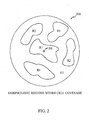
- FIG. 2 there is shown a map of a cell 200 with several geographical regions (R0, R1, R2 and R3) each of which has different minimum and maximum thresholds associated therewith for controlling the transmit power of forward and reverse link signals transmitted from such regions to a base station.
- the limits of the forward and reverse link power control loops vary in a stepwise manner based on regions within the cell.
- one set of PMAX FL , PMIN FL , SNR_MAX RL and SNR_MIN RL values will be extracted from the look up table in step 130 whenever the mobile station is operating in region R0
- a second set of PMAX FL , PMIN FL , SNR_MAX RL and SNR_MIN RL values will be extracted from the look up table whenever the mobile station is operating in region R1, and so on.
- the PMAX FL , PMIN FL , PSN_MAX RL and SNR_MIN RL values could alternatively vary in a more continuous or less regular manner as a function of the distance of the mobile station from the center of the cell.
- FIG. 3 there is a block diagram showing the components of an exemplary code division multiple access (CDMA) mobile station 300 used for implementing the power control systems of the present invention.
- the mobile station includes an antenna system 330, which is coupled through diplexer 332 to analog receiver 334 and transmit power amplifier 336.
- Antenna system 330 and diplexer 332 are of standard design and permit simultaneous reception and transmission through one or more antennae.
- Antenna system 330 optionally includes one antenna for voice traffic, and a separate antenna for receiving GPS signals.
- Antenna system 330 collects signals transmitted to the mobile station from one or more base stations and the GPS system, and provides the signals though diplexer 332 to analog receiver 334.
- Receiver 334 is also provided with an analog to digital converter (not shown).
- Receiver 334 receives RF signals from diplexer 332, amplifies and frequency downconverts the signals, and provides a digitized output signal to digital data receivers 340, 342 and to search receiver 344. It will be understood that, although in the embodiment in Figure 3 only two digital data receivers are shown, a low performance mobile station might have only a single digital data receiver while higher performance units will have two or more digital data receivers to permit diversity reception.
- the outputs of receivers 340 and 342 are provided to diversity and combiner circuitry 348 which time adjusts the two streams of data received from the receivers 340 and 342, adds the streams together and decodes the result.
- An output signal is provided from the decoder 348 to control processor 346.
- the output signal from the decoder will include, for example, any pilot signals from the base stations that will be used for making positional measurements, timing signals received from the GPS system, and other information such as modeling information and base station position information sent from a base station to the mobile unit.
- the control processor 346 determines the forward and/or reverse link power control parameters in accordance with the method shown in Figure 1 and the reverse link power control parameters are used with the power control unit in the mobile station to control the power level of the reverse link signals from the mobile station. All the steps shown in Figure 1 are preferably implemented in software on control processor 346; however, it will be understood by those skilled in the art that many of these steps could alternatively be implemented in the system infrastructure.
- FIG. 4 there is shown a block diagram of the components of an exemplary CDMA base station 400 used for implementing the forward and reverse link power control systems of the present invention.
- two receiver systems are utilized with each having a separate antenna and analog receiver for diversity reception.
- the signals are processed identically until the signals undergo a diversity combination process.
- the elements within the dashed lines correspond to elements corresponding to the communications between the base station and one mobile station.
- the first receiver system is comprised of antenna 460, analog receiver 462, searcher receiver 464 and digital data receivers 466 and 468.
- the second receiver system includes antenna 470, analog receiver 472, searcher receiver 474 and digital data receiver 476.
- Cell-site control processor 478 is used for signal processing and control. Among other things, cell site processor 478 monitors the signals sent to and received from a mobile station in order to determine the position information used in the present invention, and this processor is also preferably used for performing the modeling of the mobile velocity in step 120. Cell site processor 478 optionally determines the forward and/or reverse link power control parameters in accordance with the method shown in Figure 1 , and the forward link power control parameters are used with the power control unit in the base station to control the power level of the forward link signals from the base station.
- a digital link 482 is used to communicate signals from and to a base station controller or data router under the control of control processor 478. Signals received on antenna 460 are provided to analog receiver 462, where the signals are amplified, frequency translated and digitized in a process identical to that described in connection with the mobile station analog receiver. The output from the analog receiver 462 is provided to digital data receivers 466 and 468 and searcher receiver 464.
- the second receiver system i.e., analog receiver 472, searcher receiver 474 and digital data receiver 476) processes the received signals in a manner similar to the first receiver system.
- the outputs of the digital data receivers 466, 476 are provided to diversity combiner and decoder circuitry 480, which processes the signals in accordance with a decoding algorithm. Details concerning the operation of the first and second receiver systems and the diversity combiner and decoder 980 are described in U.S. Patent No. 5,101,501 entitled “Method and Apparatus for Providing A Soft Handoff In Communications In A CDMA Cellular Telephone System", incorporated above. Signals for transmission to mobile units are provided to a transmit modulator 484 under the control of processor 478. Transmit modulator 484 modulates the data for transmission to the intended recipient mobile station.
Landscapes
- Engineering & Computer Science (AREA)
- Computer Networks & Wireless Communication (AREA)
- Signal Processing (AREA)
- Mobile Radio Communication Systems (AREA)
- Transmitters (AREA)
- Vehicle Body Suspensions (AREA)
- Control Of Motors That Do Not Use Commutators (AREA)
- Radar Systems Or Details Thereof (AREA)
Applications Claiming Priority (2)
| Application Number | Priority Date | Filing Date | Title |
|---|---|---|---|
| US09/204,026 US6490460B1 (en) | 1998-12-01 | 1998-12-01 | Forward and reverse link power control using position and mobility information |
| EP99965074A EP1135870B1 (de) | 1998-12-01 | 1999-11-30 | Vorwärts- und rückwärtsverbindungsleistungssteuerung durch positions- und mobilitätsinformation |
Related Parent Applications (1)
| Application Number | Title | Priority Date | Filing Date |
|---|---|---|---|
| EP99965074A Division EP1135870B1 (de) | 1998-12-01 | 1999-11-30 | Vorwärts- und rückwärtsverbindungsleistungssteuerung durch positions- und mobilitätsinformation |
Publications (1)
| Publication Number | Publication Date |
|---|---|
| EP2091288A2 true EP2091288A2 (de) | 2009-08-19 |
Family
ID=22756306
Family Applications (2)
| Application Number | Title | Priority Date | Filing Date |
|---|---|---|---|
| EP09006031A Withdrawn EP2091288A2 (de) | 1998-12-01 | 1999-11-30 | Vorwärts- und Rückwärtsverbindungsleistungssteuerung durch Positions- und Mobilitätsinformation |
| EP99965074A Expired - Lifetime EP1135870B1 (de) | 1998-12-01 | 1999-11-30 | Vorwärts- und rückwärtsverbindungsleistungssteuerung durch positions- und mobilitätsinformation |
Family Applications After (1)
| Application Number | Title | Priority Date | Filing Date |
|---|---|---|---|
| EP99965074A Expired - Lifetime EP1135870B1 (de) | 1998-12-01 | 1999-11-30 | Vorwärts- und rückwärtsverbindungsleistungssteuerung durch positions- und mobilitätsinformation |
Country Status (15)
| Country | Link |
|---|---|
| US (1) | US6490460B1 (de) |
| EP (2) | EP2091288A2 (de) |
| JP (1) | JP4447785B2 (de) |
| KR (1) | KR100622328B1 (de) |
| CN (1) | CN1224183C (de) |
| AT (1) | ATE444605T1 (de) |
| AU (1) | AU758586B2 (de) |
| BR (1) | BR9915863A (de) |
| CA (1) | CA2352775C (de) |
| DE (1) | DE69941490D1 (de) |
| EA (1) | EA002893B1 (de) |
| ES (1) | ES2331268T3 (de) |
| IL (2) | IL143457A0 (de) |
| MX (1) | MXPA01005501A (de) |
| WO (1) | WO2000033478A1 (de) |
Cited By (1)
| Publication number | Priority date | Publication date | Assignee | Title |
|---|---|---|---|---|
| EP4422310A4 (de) * | 2021-10-22 | 2024-12-25 | Beijing Xiaomi Mobile Software Co., Ltd. | Verfahren und vorrichtung zur steuerung der leistung eines erfassungssignals sowie vorrichtung und speichermedium |
Families Citing this family (113)
| Publication number | Priority date | Publication date | Assignee | Title |
|---|---|---|---|---|
| US6977967B1 (en) | 1995-03-31 | 2005-12-20 | Qualcomm Incorporated | Method and apparatus for performing fast power control in a mobile communication system |
| TW347616B (en) * | 1995-03-31 | 1998-12-11 | Qualcomm Inc | Method and apparatus for performing fast power control in a mobile communication system a method and apparatus for controlling transmission power in a mobile communication system is disclosed. |
| US6119010A (en) * | 1998-10-13 | 2000-09-12 | Motorola, Inc. | Method and apparatus for adjusting channel powers in a wireless communication system based on a predicted mobile location |
| JP3607512B2 (ja) * | 1998-11-26 | 2005-01-05 | 松下電器産業株式会社 | 基地局装置及び送信電力制御方法 |
| US6914889B1 (en) * | 1998-12-08 | 2005-07-05 | Lucent Technologies Inc. | Variable rate forward power control for multichannel applications |
| GB2348572A (en) * | 1999-03-31 | 2000-10-04 | Adaptive Broadband Ltd | Controlling transmit power of nodes |
| GB2355366B (en) * | 1999-10-11 | 2003-08-20 | Ericsson Telefon Ab L M | Radio transceiver |
| KR20010038528A (ko) * | 1999-10-26 | 2001-05-15 | 조정남 | 부호분할 다중접속 시스템에서의 역방향 링크의 전력 제어 장치 및 방법 |
| US6748233B1 (en) * | 1999-10-28 | 2004-06-08 | Telcordia Technologies, Inc. | System and method for energy-efficient transmission power control, routing and transmission scheduling in wireless communication networks |
| KR100350476B1 (ko) * | 1999-12-30 | 2002-08-28 | 삼성전자 주식회사 | 이동통신시스템의 핸드오프 수행장치 및 방법 |
| JP2001218253A (ja) * | 2000-02-02 | 2001-08-10 | Nec Saitama Ltd | 無線通信システム |
| US6970708B1 (en) * | 2000-02-05 | 2005-11-29 | Ericsson Inc. | System and method for improving channel monitoring in a cellular system |
| US7502340B1 (en) | 2000-05-12 | 2009-03-10 | At&T Corp. | Method and system for integrated link adaptation and power control to improve error and throughput performance in wireless packet networks |
| US6845246B1 (en) * | 2000-06-15 | 2005-01-18 | Nortel Networks Limited | Location based power control for mobile communications systems |
| US8265637B2 (en) * | 2000-08-02 | 2012-09-11 | Atc Technologies, Llc | Systems and methods for modifying antenna radiation patterns of peripheral base stations of a terrestrial network to allow reduced interference |
| EP1182798B1 (de) * | 2000-08-18 | 2003-06-18 | Lucent Technologies Inc. | Kanalgestützte Leistungsregelungsverfahren |
| EP1180854A1 (de) * | 2000-08-18 | 2002-02-20 | Lucent Technologies Inc. | Leistungsregelung mit auf Messungen von Kanalparametern basierender intelligenter Schrittweite |
| JP3848068B2 (ja) | 2000-09-12 | 2006-11-22 | 株式会社エヌ・ティ・ティ・ドコモ | Cdma無線送信装置、cdma無線送受信システムおよびcdma無線送信装置の送信電力制御方法ならびにcdma無線送受信システムにおける無線送信装置の送信電力制御方法 |
| US7006841B2 (en) * | 2000-12-20 | 2006-02-28 | Lucent Technologies Inc | Method to control base station transmit power drift during soft handoffs |
| KR100393108B1 (ko) * | 2000-12-22 | 2003-07-31 | 엘지전자 주식회사 | 고속 데이터 채널 수신기 및 고속 데이터 채널의 전력제어 방법 |
| JP3543959B2 (ja) * | 2001-02-16 | 2004-07-21 | 日本電気株式会社 | 基地局 |
| US20020115459A1 (en) * | 2001-02-22 | 2002-08-22 | Chuang Justin Che-L | Power control for wireless packet packet with application to EDGE system |
| US8199696B2 (en) | 2001-03-29 | 2012-06-12 | Qualcomm Incorporated | Method and apparatus for power control in a wireless communication system |
| US7260415B1 (en) * | 2001-05-31 | 2007-08-21 | Sprint Spectrum L.P. | Method and system for location-based power control in wireless communications |
| US7574230B1 (en) * | 2001-05-31 | 2009-08-11 | Sprint Spectrum L.P. | Remote base station with transmit power control |
| US7139304B2 (en) * | 2001-08-10 | 2006-11-21 | Qualcomm Incorporated | Method and apparatus for controlling gain level of a communication channel in a CDMA communication system |
| KR100645743B1 (ko) * | 2001-12-28 | 2006-11-13 | 엘지노텔 주식회사 | 아이엠티-2000 시스템에서의 파워 관리 방법 |
| CN1615600A (zh) * | 2002-01-16 | 2005-05-11 | 三菱电机株式会社 | 基站、移动站、通信系统、基站通信方法、基站通信程序、移动站通信方法、移动站通信程序 |
| EP1331690B1 (de) * | 2002-01-23 | 2006-04-19 | Siemens Schweiz AG | Mobilfunkantennenanlage mit einstellbarem Richtverhalten |
| EP1365612B1 (de) * | 2002-05-22 | 2006-08-23 | Siemens Aktiengesellschaft | Verfahren und Vorrichtung zur Mobilitätssteuerung in einem Kommunikationssystem |
| DE10222583A1 (de) * | 2002-05-22 | 2003-12-24 | Siemens Ag | Verfahren und Vorrichtung zur Mobilitätssteuerung in einem Kommunikationssystem |
| EP1326349A1 (de) * | 2002-06-25 | 2003-07-09 | Siemens Aktiengesellschaft | Verfahren zur Einstellung der Sendeleistung einer mobilen Station, sowie zugehöriges Funksystem und mobile Station |
| DE10228342A1 (de) * | 2002-06-25 | 2003-09-04 | Siemens Ag | Verfahren, Funksystem und mobile Station zur Einstellung der Sendeleistung der mobilen Station |
| US7835762B2 (en) * | 2002-06-27 | 2010-11-16 | Qualcomm Incorporated | Adjusting transmit power in a wireless communication system |
| US7751496B2 (en) * | 2003-06-25 | 2010-07-06 | Pine Valley Investments, Inc. | Electromagnetic wave transmitter, receiver and transceiver systems, methods and articles of manufacture |
| US7254195B2 (en) * | 2003-08-25 | 2007-08-07 | M/A-Com, Inc. | Apparatus, methods and articles of manufacture for dynamic differential delay correction |
| US7221915B2 (en) * | 2003-06-25 | 2007-05-22 | M/A-Com, Inc. | Electromagnetic wave transmitter, receiver and transceiver systems, methods and articles of manufacture |
| US7151913B2 (en) * | 2003-06-30 | 2006-12-19 | M/A-Com, Inc. | Electromagnetic wave transmitter, receiver and transceiver systems, methods and articles of manufacture |
| US6859098B2 (en) | 2003-01-17 | 2005-02-22 | M/A-Com, Inc. | Apparatus, methods and articles of manufacture for control in an electromagnetic processor |
| FR2850233B1 (fr) * | 2003-01-22 | 2005-05-06 | Nec Technologies Uk Ltd | Procede d'optimisation des performances d'un terminal mobile |
| JP4059088B2 (ja) * | 2003-01-28 | 2008-03-12 | 日本電気株式会社 | 移動体無線通信システム、及びその無線パラメータ制御方法 |
| US8254358B2 (en) * | 2003-03-06 | 2012-08-28 | Ericsson Ab | Communicating a broadcast message to change data rates of mobile stations |
| US7599394B2 (en) * | 2003-06-16 | 2009-10-06 | Telefonaktiebolaget Lm Ericsson (Publ) | Common rate control method for reverse link channels in CDMA networks |
| AU2004301428A1 (en) | 2003-07-11 | 2005-01-27 | Qualcomm, Incorporated | Dynamic shared forward link channel for a wireless communication system |
| KR100556871B1 (ko) * | 2003-07-12 | 2006-03-03 | 엘지전자 주식회사 | 역방향 전력 제어 방법 |
| US7480511B2 (en) * | 2003-09-19 | 2009-01-20 | Trimble Navigation Limited | Method and system for delivering virtual reference station data |
| US7091778B2 (en) | 2003-09-19 | 2006-08-15 | M/A-Com, Inc. | Adaptive wideband digital amplifier for linearly modulated signal amplification and transmission |
| US7616660B2 (en) * | 2003-11-21 | 2009-11-10 | Telefonaktiebolaget Lm Ericsson (Publ) | Common rate control method for reverse link channels in CDMA networks |
| BRPI0400115B1 (pt) * | 2004-01-23 | 2018-10-30 | Coppe/Ufrj Coordenacao Dos Programas De Pos Graduacao De Engenharia Da Univ Federal Do Rio De Janeir | método de ajuste de potência de equipamentos de transmissão sem fio segundo o perfil de obstáculos e ocupação do terreno e seu uso |
| US7865132B2 (en) * | 2004-07-20 | 2011-01-04 | Rockwell Collins, Inc. | Method and apparatus for interacting with a communications system using radiated power adjusted according to an estimation of link-loss |
| KR100725773B1 (ko) | 2004-08-20 | 2007-06-08 | 삼성전자주식회사 | 시분할 듀플렉스 방식의 이동통신 시스템에서 단말기의상태에 따라 상향링크 전력제어방식을 적응적으로변경하기 위한 장치 및 방법 |
| JP4665469B2 (ja) * | 2004-09-15 | 2011-04-06 | 日本電気株式会社 | 携帯通信端末装置及び送信電力制御方法 |
| US9154339B2 (en) * | 2004-12-22 | 2015-10-06 | Qualcomm Incorporated | Methods and apparatus for decoder selection in communication systems |
| CN104244394A (zh) * | 2005-02-02 | 2014-12-24 | 日本电气株式会社 | 传输功率目标值可变控制设备和方法以及移动通信终端 |
| US7899482B2 (en) | 2005-02-02 | 2011-03-01 | Nec Corporation | Transmission power target value variable control apparatus and method and mobile communication terminal |
| US7747258B2 (en) * | 2005-02-04 | 2010-06-29 | Qualcomm Incorporated | Method and apparatus for performing position determination with pre-session action |
| US7764641B2 (en) * | 2005-02-05 | 2010-07-27 | Cisco Technology, Inc. | Techniques for determining communication state using accelerometer data |
| US8315636B2 (en) * | 2005-02-24 | 2012-11-20 | Cisco Technology, Inc. | Techniques for distributing data among nodes based on dynamic spatial/organizational state of a mobile node |
| US7636322B1 (en) | 2005-03-07 | 2009-12-22 | Sprint Spectrum L.P. | Method and system for management of RF access probes based on RF conditions |
| EP1878127A4 (de) * | 2005-04-26 | 2015-04-15 | Texas Instruments Inc | Verfahren und vorrichtung zur steuerung der übertragungsleistung in drahtlosen datenkommunikationssystemen |
| JP2006311417A (ja) * | 2005-05-02 | 2006-11-09 | Nec Corp | 移動端末送信スケジューリング方法及び基地局 |
| US8712422B1 (en) | 2005-05-18 | 2014-04-29 | Sprint Spectrum L.P. | Dynamic allocation of access channels based on access channel occupancy in a cellular wireless communication system |
| US7345534B2 (en) * | 2005-05-31 | 2008-03-18 | M/A-Com Eurotec Bv | Efficient power amplification system |
| JP2007020074A (ja) * | 2005-07-11 | 2007-01-25 | Ntt Docomo Inc | 移動無線局及びその通信パラメータ制御方法 |
| US7392021B2 (en) * | 2005-08-03 | 2008-06-24 | M/A-Com, Inc. | Apparatus, system, and method for measuring power delivered to a load |
| US8099106B2 (en) * | 2005-08-24 | 2012-01-17 | Qualcomm Incorporated | Method and apparatus for classifying user morphology for efficient use of cell phone system resources |
| US20070087770A1 (en) * | 2005-10-14 | 2007-04-19 | Hong Gan | Methods and apparatuses for transmission power control in a wireless communication system |
| KR100869922B1 (ko) * | 2006-05-12 | 2008-11-21 | 삼성전자주식회사 | 광대역 무선 통신시스템에서 상향링크 전력 제어 장치 및방법 |
| CN101079663B (zh) * | 2006-05-24 | 2012-12-05 | 方正通信技术有限公司 | 降低无线蜂窝系统邻小区干扰的方法、基站及系统 |
| US8072902B2 (en) * | 2006-08-07 | 2011-12-06 | Cisco Technology, Inc. | Techniques for distributing data among mobile nodes based on dynamically generated data objects in a distributed object-oriented database |
| JP2008042547A (ja) * | 2006-08-07 | 2008-02-21 | Fujitsu Ltd | 移動通信システム,基地局,端末装置及び送信制御方法 |
| US9173163B2 (en) * | 2006-09-05 | 2015-10-27 | Broadcom Corporation | Altering communication interface parameters based upon mobility |
| US7885342B2 (en) * | 2007-03-05 | 2011-02-08 | Cisco Technology, Inc. | Managing bit error rates on point-to-point wireless links in a network |
| US20090027112A1 (en) * | 2007-07-26 | 2009-01-29 | Chin Li | Controllable precision transconductance |
| US7671699B2 (en) * | 2007-08-14 | 2010-03-02 | Pine Valley Investments, Inc. | Coupler |
| US7979039B2 (en) | 2007-09-24 | 2011-07-12 | Intel Corporation | Pre-distorting a transmitted signal for offset cancellation |
| KR100953711B1 (ko) * | 2007-10-31 | 2010-04-19 | 고려대학교 산학협력단 | 이동통신시스템 및 그 액세스 프로브 전송전력 제어방법 |
| US8140107B1 (en) | 2008-01-04 | 2012-03-20 | Sprint Spectrum L.P. | Method and system for selective power control of wireless coverage areas |
| JP5075019B2 (ja) * | 2008-06-04 | 2012-11-14 | 株式会社エヌ・ティ・ティ・ドコモ | 移動通信端末装置及び送信電力設定方法 |
| US8385483B2 (en) | 2008-11-11 | 2013-02-26 | Isco International, Llc | Self-adaptive digital RF bandpass and bandstop filter architecture |
| US8849190B2 (en) | 2009-04-21 | 2014-09-30 | Andrew Llc | Radio communication systems with integrated location-based measurements for diagnostics and performance optimization |
| US9793982B2 (en) | 2009-04-21 | 2017-10-17 | Commscope Technologies Llc | System for automatic configuration of a mobile communication system |
| US8509699B1 (en) | 2009-09-22 | 2013-08-13 | Sprint Spectrum L.P. | Method and system for adjusting access parameters in response to surges in paging buffer occupancy |
| US9140559B2 (en) * | 2009-10-01 | 2015-09-22 | Qualcomm Incorporated | Routing graphs for buildings using schematics |
| US8812015B2 (en) | 2009-10-01 | 2014-08-19 | Qualcomm Incorporated | Mobile device locating in conjunction with localized environments |
| US8880103B2 (en) | 2009-10-12 | 2014-11-04 | Qualcomm Incorporated | Method and apparatus for transmitting indoor context information |
| KR101273082B1 (ko) * | 2009-12-15 | 2013-06-10 | 한국전자통신연구원 | 상향 링크 전송 전력 제어를 위한 피드백 생성 방법 및 시스템 |
| US20110172916A1 (en) * | 2010-01-14 | 2011-07-14 | Qualcomm Incorporated | Mobile Device Positioning In A Constrained Environment |
| US20110178705A1 (en) * | 2010-01-15 | 2011-07-21 | Qualcomm Incorporated | Using Filtering With Mobile Device Positioning In A Constrained Environment |
| US9389085B2 (en) | 2010-01-22 | 2016-07-12 | Qualcomm Incorporated | Map handling for location based services in conjunction with localized environments |
| CN102754494B (zh) * | 2010-02-16 | 2016-07-06 | 瑞典爱立信有限公司 | 适配家庭基站所服务的用户设备的最大输出功率的方法、家庭基站及用户设备 |
| CN102208967B (zh) * | 2010-03-31 | 2014-04-09 | 中兴通讯股份有限公司 | 一种lte终端非自适应重传功率控制的方法及装置 |
| JP2012105228A (ja) * | 2010-11-12 | 2012-05-31 | Ntt Docomo Inc | 移動通信方法、移動局及び無線基地局 |
| EP2528371B1 (de) | 2011-05-25 | 2014-01-15 | Alcatel Lucent | Zellpartitionierung für Hochgeschwindigkeitsnutzer |
| US8699943B2 (en) | 2011-06-03 | 2014-04-15 | Andrew Llc | Mobile repeater system and method having geophysical location awareness without use of GPS |
| CN102307378A (zh) * | 2011-08-26 | 2012-01-04 | 中兴通讯股份有限公司 | 一种移动终端发射功率调整的方法和装置 |
| US8655304B2 (en) | 2011-12-29 | 2014-02-18 | Motorola Solutions, Inc. | Methods and apparatus for detecting and mitigating radio interference among user equipment and base stations of geographically co-located and spectrally distinct wireless systems |
| US8768402B1 (en) * | 2012-03-15 | 2014-07-01 | Sprint Spectrum L.P. | Method and system for controlling transmit power levels |
| US9319916B2 (en) | 2013-03-15 | 2016-04-19 | Isco International, Llc | Method and appartus for signal interference processing |
| US9276827B2 (en) * | 2013-03-15 | 2016-03-01 | Cisco Technology, Inc. | Allocating computing resources based upon geographic movement |
| US9474000B2 (en) | 2013-07-31 | 2016-10-18 | Qualcomm Incorporated | Handover and reselection searching using predictive mobility |
| US20150038140A1 (en) | 2013-07-31 | 2015-02-05 | Qualcomm Incorporated | Predictive mobility in cellular networks |
| US9775116B2 (en) | 2014-05-05 | 2017-09-26 | Isco International, Llc | Method and apparatus for increasing performance of communication links of cooperative communication nodes |
| US9942412B1 (en) | 2014-09-08 | 2018-04-10 | Sprint Spectrum L.P. | Use of contention-free random-access preamble in paging process |
| FI3651386T3 (fi) | 2015-05-04 | 2023-11-15 | Isco Int Llc | Menetelmä ja laitteisto viestintäpolkujen suorituskyvyn lisäämiseksi viestintäsolmuille |
| CN106341838B (zh) * | 2015-10-26 | 2020-03-03 | 北京智谷睿拓技术服务有限公司 | 发射功率确定方法、装置及车载设备 |
| MX2018014697A (es) | 2016-06-01 | 2019-09-13 | Isco Int Llc | Metodo y aparato para realizar acondicionamiento de señales para mitigar la interferencia detectada en un sistema de comunicacion. |
| US10298279B2 (en) | 2017-04-05 | 2019-05-21 | Isco International, Llc | Method and apparatus for increasing performance of communication paths for communication nodes |
| US10812121B2 (en) | 2017-08-09 | 2020-10-20 | Isco International, Llc | Method and apparatus for detecting and analyzing passive intermodulation interference in a communication system |
| US10284313B2 (en) | 2017-08-09 | 2019-05-07 | Isco International, Llc | Method and apparatus for monitoring, detecting, testing, diagnosing and/or mitigating interference in a communication system |
| EP4040862B1 (de) * | 2017-11-17 | 2026-01-07 | Telefonaktiebolaget LM Ericsson (publ) | Begrenzung der akkumulation der sendeleistungsregelung in einer strahlspezifischen leistungsregelung |
| JP2021513761A (ja) | 2017-12-26 | 2021-05-27 | オッポ広東移動通信有限公司Guangdong Oppo Mobile Telecommunications Corp., Ltd. | Ueのランダムアクセス電力の制御方法、ue及びコンピュータ記憶媒体 |
| CN115915371A (zh) * | 2021-09-30 | 2023-04-04 | 南宁富联富桂精密工业有限公司 | 功率控制方法及系统 |
Citations (2)
| Publication number | Priority date | Publication date | Assignee | Title |
|---|---|---|---|---|
| US4050198A (en) | 1975-04-01 | 1977-09-27 | General Electric Company | Method for shaping the edge of a blade element |
| US5101501A (en) | 1989-11-07 | 1992-03-31 | Qualcomm Incorporated | Method and system for providing a soft handoff in communications in a cdma cellular telephone system |
Family Cites Families (20)
| Publication number | Priority date | Publication date | Assignee | Title |
|---|---|---|---|---|
| JP2636236B2 (ja) * | 1987-03-31 | 1997-07-30 | 三菱電機株式会社 | 通話中チヤンネル切替方式 |
| US5239667A (en) * | 1990-01-31 | 1993-08-24 | Nec Corporation | Method of controlling handoff in cellular mobile radio communications system |
| US5305468A (en) * | 1992-03-18 | 1994-04-19 | Motorola, Inc. | Power control method for use in a communication system |
| US5465399A (en) | 1992-08-19 | 1995-11-07 | The Boeing Company | Apparatus and method for controlling transmitted power in a radio network |
| US5404376A (en) * | 1993-09-09 | 1995-04-04 | Ericsson-Ge Mobile Communications Inc. | Navigation assistance for call handling in mobile telephone systems |
| US5603096A (en) * | 1994-07-11 | 1997-02-11 | Qualcomm Incorporated | Reverse link, closed loop power control in a code division multiple access system |
| US5604730A (en) | 1994-07-25 | 1997-02-18 | Qualcomm Incorporated | Remote transmitter power control in a contention based multiple access system |
| US5594946A (en) * | 1995-02-28 | 1997-01-14 | Motorola, Inc. | Method and apparatus for mitigating interference produced by a communication unit in a communication system |
| TW347616B (en) * | 1995-03-31 | 1998-12-11 | Qualcomm Inc | Method and apparatus for performing fast power control in a mobile communication system a method and apparatus for controlling transmission power in a mobile communication system is disclosed. |
| US5710981A (en) * | 1995-05-23 | 1998-01-20 | Ericsson Inc. | Portable radio power control device and method using incrementally degraded received signals |
| US5634206A (en) * | 1995-05-25 | 1997-05-27 | Motorola, Inc. | Method and apparatus for estimating a signal fading characteristic |
| US5778030A (en) | 1996-03-15 | 1998-07-07 | Motorola, Inc. | Method and apparatus for power control in a communication system |
| US5857155A (en) * | 1996-07-10 | 1999-01-05 | Motorola, Inc. | Method and apparatus for geographic based control in a communication system |
| FI104025B1 (fi) * | 1996-08-28 | 1999-10-29 | Nokia Telecommunications Oy | Tehonsäätömenetelmä ja solukkoradiojärjestelmä |
| US5924040A (en) * | 1996-11-20 | 1999-07-13 | Telxon Corporation | Wireless communication system having base station with adjustable power transceiver for locating mobile devices |
| US5896411A (en) * | 1997-05-05 | 1999-04-20 | Northern Telecom Limited | Enhanced reverse link power control in a wireless communication system |
| KR100245989B1 (ko) * | 1997-07-03 | 2000-04-01 | 서평원 | 코드분할다중접속시스템기지국의송수신전력조절방법 |
| US6181738B1 (en) * | 1998-02-13 | 2001-01-30 | Northern Telecom Limited | Reverse link power control using a frame quality metric |
| US6144841A (en) * | 1998-03-10 | 2000-11-07 | Nortel Networks Corporation | Method and system for managing forward link power control within a code-division multiple access mobile telephone communication network |
| US6115580A (en) * | 1998-09-08 | 2000-09-05 | Motorola, Inc. | Communications network having adaptive network link optimization using wireless terrain awareness and method for use therein |
-
1998
- 1998-12-01 US US09/204,026 patent/US6490460B1/en not_active Expired - Lifetime
-
1999
- 1999-11-30 ES ES99965074T patent/ES2331268T3/es not_active Expired - Lifetime
- 1999-11-30 KR KR1020017006861A patent/KR100622328B1/ko not_active Expired - Fee Related
- 1999-11-30 EP EP09006031A patent/EP2091288A2/de not_active Withdrawn
- 1999-11-30 IL IL14345799A patent/IL143457A0/xx active IP Right Grant
- 1999-11-30 DE DE69941490T patent/DE69941490D1/de not_active Expired - Lifetime
- 1999-11-30 JP JP2000586012A patent/JP4447785B2/ja not_active Expired - Fee Related
- 1999-11-30 EA EA200100606A patent/EA002893B1/ru not_active IP Right Cessation
- 1999-11-30 BR BR9915863-9A patent/BR9915863A/pt not_active IP Right Cessation
- 1999-11-30 CN CNB998159514A patent/CN1224183C/zh not_active Expired - Fee Related
- 1999-11-30 MX MXPA01005501A patent/MXPA01005501A/es not_active IP Right Cessation
- 1999-11-30 AU AU31069/00A patent/AU758586B2/en not_active Ceased
- 1999-11-30 WO PCT/US1999/028394 patent/WO2000033478A1/en not_active Ceased
- 1999-11-30 AT AT99965074T patent/ATE444605T1/de not_active IP Right Cessation
- 1999-11-30 CA CA002352775A patent/CA2352775C/en not_active Expired - Fee Related
- 1999-11-30 EP EP99965074A patent/EP1135870B1/de not_active Expired - Lifetime
-
2001
- 2001-05-30 IL IL143457A patent/IL143457A/en not_active IP Right Cessation
Patent Citations (2)
| Publication number | Priority date | Publication date | Assignee | Title |
|---|---|---|---|---|
| US4050198A (en) | 1975-04-01 | 1977-09-27 | General Electric Company | Method for shaping the edge of a blade element |
| US5101501A (en) | 1989-11-07 | 1992-03-31 | Qualcomm Incorporated | Method and system for providing a soft handoff in communications in a cdma cellular telephone system |
Cited By (1)
| Publication number | Priority date | Publication date | Assignee | Title |
|---|---|---|---|---|
| EP4422310A4 (de) * | 2021-10-22 | 2024-12-25 | Beijing Xiaomi Mobile Software Co., Ltd. | Verfahren und vorrichtung zur steuerung der leistung eines erfassungssignals sowie vorrichtung und speichermedium |
Also Published As
| Publication number | Publication date |
|---|---|
| KR20010080657A (ko) | 2001-08-22 |
| CN1338159A (zh) | 2002-02-27 |
| JP4447785B2 (ja) | 2010-04-07 |
| JP2002531991A (ja) | 2002-09-24 |
| MXPA01005501A (es) | 2002-06-04 |
| BR9915863A (pt) | 2002-01-08 |
| US6490460B1 (en) | 2002-12-03 |
| IL143457A (en) | 2006-10-31 |
| AU3106900A (en) | 2000-06-19 |
| EA002893B1 (ru) | 2002-10-31 |
| IL143457A0 (en) | 2002-04-21 |
| ES2331268T3 (es) | 2009-12-28 |
| EA200100606A1 (ru) | 2001-12-24 |
| ATE444605T1 (de) | 2009-10-15 |
| CA2352775A1 (en) | 2000-06-08 |
| WO2000033478A1 (en) | 2000-06-08 |
| AU758586B2 (en) | 2003-03-27 |
| KR100622328B1 (ko) | 2006-09-13 |
| DE69941490D1 (de) | 2009-11-12 |
| CN1224183C (zh) | 2005-10-19 |
| CA2352775C (en) | 2006-06-06 |
| EP1135870A1 (de) | 2001-09-26 |
| EP1135870B1 (de) | 2009-09-30 |
Similar Documents
| Publication | Publication Date | Title |
|---|---|---|
| EP2091288A2 (de) | Vorwärts- und Rückwärtsverbindungsleistungssteuerung durch Positions- und Mobilitätsinformation | |
| EP0986868B1 (de) | Verbesserte rückwärtsleistungssteuerung eines drahtlosen kommunikationssystems | |
| AU664751B2 (en) | Duplex power control | |
| US6594500B2 (en) | Method and apparatus for controlling transmit power thresholds based on classification of wireless communication subscribers | |
| US6577875B1 (en) | Cellular communications system/method with uplink interference ceiling | |
| JP2823034B2 (ja) | 移動通信システムの送信電力制御方式 | |
| EP1502376B1 (de) | Verfahren und vorrichtung für aufwärtsübertragungstakt in einem mobilkommunikationssystem | |
| US6553016B1 (en) | Downlink power control at soft handover | |
| WO2002054604B1 (en) | System and method for improved mobile communication admission and congestion control | |
| JP2001520475A (ja) | 最適化電力制御用の装置および方法 | |
| CN1355964A (zh) | 移动无线通信系统中的自适应功率控制 | |
| JP2001520478A (ja) | 電力制御モードの選択装置及び方法 | |
| JP2000232329A (ja) | 受信機のための自動利得制御およびその方法 | |
| CA2285403A1 (en) | System specified adaptive mobile station behavior within a mobile telecommunications system | |
| US6445684B1 (en) | Method and system for dynamic adjustment of CDMA wireless device power levels | |
| KR100330415B1 (ko) | 코드분할다중접속 무선통신시스템에서 전력제어 장치 및방법 | |
| EP1161112A1 (de) | Adaptive Zuweisung der Vorwärtsverbindung durch interzellulare gegenseitige Überwachung |
Legal Events
| Date | Code | Title | Description |
|---|---|---|---|
| PUAI | Public reference made under article 153(3) epc to a published international application that has entered the european phase |
Free format text: ORIGINAL CODE: 0009012 |
|
| 17P | Request for examination filed |
Effective date: 20090430 |
|
| AC | Divisional application: reference to earlier application |
Ref document number: 1135870 Country of ref document: EP Kind code of ref document: P |
|
| AK | Designated contracting states |
Kind code of ref document: A2 Designated state(s): AT BE CH CY DE DK ES FI FR GB GR IE IT LI LU MC NL PT SE |
|
| STAA | Information on the status of an ep patent application or granted ep patent |
Free format text: STATUS: THE APPLICATION IS DEEMED TO BE WITHDRAWN |
|
| 18D | Application deemed to be withdrawn |
Effective date: 20120601 |