EP2091537B1 - Pharmazeutische zusammensetzungen zur behandlung von kapillarer arteriopathie - Google Patents
Pharmazeutische zusammensetzungen zur behandlung von kapillarer arteriopathie Download PDFInfo
- Publication number
- EP2091537B1 EP2091537B1 EP07846885.7A EP07846885A EP2091537B1 EP 2091537 B1 EP2091537 B1 EP 2091537B1 EP 07846885 A EP07846885 A EP 07846885A EP 2091537 B1 EP2091537 B1 EP 2091537B1
- Authority
- EP
- European Patent Office
- Prior art keywords
- acid
- terguride
- lisuride
- mixtures
- enantiomers
- Prior art date
- Legal status (The legal status is an assumption and is not a legal conclusion. Google has not performed a legal analysis and makes no representation as to the accuracy of the status listed.)
- Active
Links
Images
Classifications
-
- C—CHEMISTRY; METALLURGY
- C07—ORGANIC CHEMISTRY
- C07D—HETEROCYCLIC COMPOUNDS
- C07D471/00—Heterocyclic compounds containing nitrogen atoms as the only ring hetero atoms in the condensed system, at least one ring being a six-membered ring with one nitrogen atom, not provided for by groups C07D451/00 - C07D463/00
- C07D471/02—Heterocyclic compounds containing nitrogen atoms as the only ring hetero atoms in the condensed system, at least one ring being a six-membered ring with one nitrogen atom, not provided for by groups C07D451/00 - C07D463/00 in which the condensed system contains two hetero rings
- C07D471/06—Peri-condensed systems
-
- A—HUMAN NECESSITIES
- A61—MEDICAL OR VETERINARY SCIENCE; HYGIENE
- A61K—PREPARATIONS FOR MEDICAL, DENTAL OR TOILETRY PURPOSES
- A61K31/00—Medicinal preparations containing organic active ingredients
-
- A—HUMAN NECESSITIES
- A61—MEDICAL OR VETERINARY SCIENCE; HYGIENE
- A61K—PREPARATIONS FOR MEDICAL, DENTAL OR TOILETRY PURPOSES
- A61K31/00—Medicinal preparations containing organic active ingredients
- A61K31/33—Heterocyclic compounds
- A61K31/395—Heterocyclic compounds having nitrogen as a ring hetero atom, e.g. guanethidine or rifamycins
- A61K31/435—Heterocyclic compounds having nitrogen as a ring hetero atom, e.g. guanethidine or rifamycins having six-membered rings with one nitrogen as the only ring hetero atom
- A61K31/47—Quinolines; Isoquinolines
- A61K31/48—Ergoline derivatives, e.g. lysergic acid, ergotamine
-
- A—HUMAN NECESSITIES
- A61—MEDICAL OR VETERINARY SCIENCE; HYGIENE
- A61P—SPECIFIC THERAPEUTIC ACTIVITY OF CHEMICAL COMPOUNDS OR MEDICINAL PREPARATIONS
- A61P13/00—Drugs for disorders of the urinary system
- A61P13/12—Drugs for disorders of the urinary system of the kidneys
-
- A—HUMAN NECESSITIES
- A61—MEDICAL OR VETERINARY SCIENCE; HYGIENE
- A61P—SPECIFIC THERAPEUTIC ACTIVITY OF CHEMICAL COMPOUNDS OR MEDICINAL PREPARATIONS
- A61P9/00—Drugs for disorders of the cardiovascular system
-
- A—HUMAN NECESSITIES
- A61—MEDICAL OR VETERINARY SCIENCE; HYGIENE
- A61P—SPECIFIC THERAPEUTIC ACTIVITY OF CHEMICAL COMPOUNDS OR MEDICINAL PREPARATIONS
- A61P9/00—Drugs for disorders of the cardiovascular system
- A61P9/08—Vasodilators for multiple indications
-
- A—HUMAN NECESSITIES
- A61—MEDICAL OR VETERINARY SCIENCE; HYGIENE
- A61P—SPECIFIC THERAPEUTIC ACTIVITY OF CHEMICAL COMPOUNDS OR MEDICINAL PREPARATIONS
- A61P9/00—Drugs for disorders of the cardiovascular system
- A61P9/10—Drugs for disorders of the cardiovascular system for treating ischaemic or atherosclerotic diseases, e.g. antianginal drugs, coronary vasodilators, drugs for myocardial infarction, retinopathy, cerebrovascula insufficiency, renal arteriosclerosis
-
- A—HUMAN NECESSITIES
- A61—MEDICAL OR VETERINARY SCIENCE; HYGIENE
- A61P—SPECIFIC THERAPEUTIC ACTIVITY OF CHEMICAL COMPOUNDS OR MEDICINAL PREPARATIONS
- A61P9/00—Drugs for disorders of the cardiovascular system
- A61P9/12—Antihypertensives
-
- A—HUMAN NECESSITIES
- A61—MEDICAL OR VETERINARY SCIENCE; HYGIENE
- A61P—SPECIFIC THERAPEUTIC ACTIVITY OF CHEMICAL COMPOUNDS OR MEDICINAL PREPARATIONS
- A61P9/00—Drugs for disorders of the cardiovascular system
- A61P9/14—Vasoprotectives; Antihaemorrhoidals; Drugs for varicose therapy; Capillary stabilisers
Definitions
- the present invention relates to the use of specific ergot derivatives or ergotins.
- Constrictive capillary arteriopathy refers to the conditions of pulmonary arterial hypertension, endogenously induced or exogenously induced glomerulosclerosis, and secondary Raynaud's syndrome or phenomenon.
- Constrictive capillary arteriopathy is a pathological hallmark in human medicine for diffuse constrictive arterial lesions involving reshaping of the vessel wall, leading to irreversible narrowing to occlusions of arterioles. As functional consequences an increase of the vascular pressure and an increased vascular resistance can be observed.
- Constrictive capillary arteriopathy of various etiologies manifests in the vascular bed of many tissues.
- the present invention focuses on organ-specific changes which increase the long-term pressure of arterioles and are characterized by an increase in vascular resistance, aggrevative vasospasm and precipitating structural closure.
- the term "capillary arteriopathy” and in particular "constrictive capillary arteriopathy” as used herein is for the indications of arterial pulmonary hypertension, glomerulosclerosis and secondary Raynaud's phenomenon and / or syndrome.
- the object of the present invention is to provide further uses of lisuride and terguride.
- the present invention thus relates to the use of lisuride and terguride
- constrictive capillary arteriopathy i. of pulmonary arterial hypertension, endogenously induced or exogenously induced glomerulosclerosis and secondary Raynaud syndrome.
- Lisuride and Terguride are basic and acid addition salts can be obtained by adding organic or inorganic acids.
- acids forming an acid addition with lisuride or terguride the following may be mentioned: sulfuric acid, sulfonic acid, phosphoric acid, nitric acid, nitrous acid, perchloric acid, hydrobromic acid, hydrochloric acid, formic acid, acetic acid, propionic acid, succinic acid, oxalic acid, gluconic acid (Glycons.
- Dextronic acid lactic acid, malic acid, tartaric acid, tartronic acid (hydroxymalonic acid, hydroxypropanedioic acid), fumaric acid, citric acid, ascorbic acid, maleic acid, malonic acid, hydroxymaleic acid, pyruvic acid, phenylacetic acid, (o-, m-, p-) toluic acid, benzoic acid, p-aminobenzoic acid, p-hydroxybenzoic acid, salicylic acid, p-aminosalicylic acid, methanesulfonic acid, ethanesulfonic acid, hydroxyethanesulfonic acid, ethylene sulfonic acid, p-toluenesulfonic acid, naphthylsulfonic acid, naphthylamine sulfonic acid, sulfanilic acid, camphorsulfonic acid, quinic acid (quinic acid), o-methyl-mandelic acid, hydrogenbenzenesul
- base addition salts can also be formed, e.g. Alkali metal salts and salts with amines.
- alkali metal salts such as the sodium salt, the potassium salt, the lithium salt or the magnesium salt, the calcium salt, alkyl amino salts or amino acid salts, e.g. be formed with basic amino acids such as lysine.
- the claimed ergot derivatives also include stereoisomers, enantiomers, enantiomeric mixtures, diastereomers and diastereomeric mixtures, with, for example, chiral compounds being preferred
- lisuride (CAS No .: 18016-80-3, 3- (9,10-didehydro-6-methylergoline-8alpha-yl) -1,1-diethylurea), and terguride ((+) - 1, 1-diethyl-3- (6-methyl-8a-ergolinyl) urea).
- terguride trans-dihydrolisuride
- lisuride CAS No .: 18016-80-3, 3- (9,10-didehydro-6-methylergoline-8alpha-yl) -1,1-diethylurea
- terguride ((+) - 1, 1-diethyl-3- (6-methyl-8a-ergolinyl) urea).
- terguride trans-dihydrolisuride
- lisuride CAS No .: 18016-80-3, 3- (9,10-didehydro-6-methylergoline-8alpha-yl) -1,1-diethylurea
- the abovementioned substances are particularly suitable for the prophylaxis and treatment of pulmonary arterial hypertension, endogenously induced or exogenously induced glomerulosclerosis as well as secondary Raynaud's phenomenon or Raynaud's syndrome.
- Explicit side effects include Raynaud's phenomenon, vasospasm, diplopia, retroperitoneal fibrosis, pleural effusions and heart valve fibrosis.
- Postural hypertension is known to be a side effect of dopaminergic ergot derivatives including lisuride and terguride. Since the administration of ergolines and ergot derivatives is associated with more severe gastrointestinal side effects such as nausea and vomiting, a therapeutic benefit was sometimes denied in principle.
- Blood pressure refers to the pressure that results when blood circulates along the inner vessel wall of the arteries. Blood pressure is typically given by two values, arterial pressure, when the heart contracts and relaxes between each heartbeat (i.e., the systolic and diastolic pressures).
- Blood pressure usually changes throughout the day and usually increases with age. In addition, physical activity affects blood pressure. Blood pressure increases in response to exercise and stress. Patients with hypertension have elevated blood pressure (usually over 140/90 mm Hg) even when at rest. Untreated hypertension causes increased stress on the heart and also the arteries, which can damage the tissue. This, in turn, is a risk factor and can lead to heart failure, heart attack (myocardial infarction) and stroke.
- pulmonary hypertension or glomerulosclerosis results in a local change in vasoreactivity, resulting in a local increase in blood pressure without causing a detectable increase in systemic blood pressure.
- Pulmonary hypertension is usually the result of a disease of the heart and / or lungs. Pulmonary hypertension occurs when the blood pressure in the pulmonary arteries exceeds normal systemic blood pressure, due to local changes in vasoreactivity and the development of small arteries called arterioles. This leads to a load on the right side of the heart. Pulmonary hypertension is a serious problem. It manifests itself in signs such as shortness of breath after little effort, tiredness, fainting and chest pain. These symptoms usually limit physical stress and activities.
- ACE inhibitors such as e.g. Captopril
- diuretics such as. Furosemide
- angiotensin 2 receptor blockers such as e.g. Losartan
- alpha and beta blockers such as e.g. Prazosin and propranolol
- direct vasodilators e.g. Minoxidil
- centrally acting agents such as e.g. Clonidine used for the treatment of hypertension
- a positive effect in hypertension can not be simultaneously derived or vice versa.
- the present invention relates to pharmaceutical compositions prepared using at least one claimed compound or a salt thereof, and more particularly, using lisuride or terguride.
- compositions contain at least one compound according to claim 1 and in particular lisuride or terguride in an active ingredient concentration of 0.1-10 mg per single dose together with at least one pharmacologically acceptable carrier, excipient or solvent.
- compositions are preferably used in the form of tablets, coated tablets, pills, capsules, microcapsules, sustained oralia, transdermal systems, suppositories, microformulations, nanoformulations, liposomal formulations, drops, nose drops, nasal sprays, aerosols, ampoules, solutions, emulsions, dispersions, Powders, inhalation powders, microcrystalline formulations or inhalation sprays provided and are particularly suitable for oral, sublingual, parenteral, cutaneous, buccal, percutaneous, inhalative or nasal administration.
- lactose starch, sorbitol, sucrose, cellulose, magnesium stearate, dicalcium phosphate, calcium sulfate, talc, mannitol, ethyl alcohol and the like can be used as pharmacologically acceptable carriers.
- Powders as well as tablets may consist of 5 to 95% of such a carrier.
- Starch gelatin, natural sugars, both natural and synthetic gums such as acacia or guar gum, sodium alginate, carboxymethyl cellulose, polyethylene glycol and waxes may also be used as binders.
- lubricant boric acid, sodium benzoate, sodium acetate, sodium chloride, and the like can be used.
- disintegrating agents, dyes, flavorings and / or binders may be added to the pharmaceutical compositions.
- Liquid formulations include solutions, suspensions, sprays and emulsions.
- solutions for example, water-based or water-propylene glycol-based injection solutions for parenteral injections.
- fatty acid esters and glycerides are preferably used.
- Capsules are made, for example, from methylcellulose, polyvinyl alcohols or denatured gelatin or starch.
- Starch sodium carboxymethyl starch, natural and synthetic gums such as locust bean gum, karaya, guar, tragacanth and agar, and cellulose derivatives such as methyl cellulose, sodium carboxymethyl cellulose, microcrystalline cellulose and alginates, clays and bentonites can be used as disintegrants. These ingredients can be used in amounts of 2 to 30 wt .-%.
- binders sugar, starch from grain, rice or potatoes, natural gums such as acacia, gelatin, tragacanth, alginic acid, sodium alginate, ammonium calcium alginate, methylcellulose, sodium carboxymethylcellulose, hydroxypropyl methylcellulose, polyvinylpyrrolidone and inorganic compounds such as magnesium-aluminum -Silicates are added.
- the binders can be added in amounts of 1 to 30 wt .-%.
- stearates such as magnesium stearate, calcium stearate, potassium stearate, stearic acid, refractory waxes, as well as water-soluble lubricants such as sodium chloride, sodium benzoate, sodium acetate, sodium oleate, polyethylene glycol and amino acids such as leucine can be used.
- water-soluble lubricants such as sodium chloride, sodium benzoate, sodium acetate, sodium oleate, polyethylene glycol and amino acids such as leucine can be used.
- Such lubricants can be used in amounts of 0.05 to 15 wt .-%.
- Such subcutaneous formulations and transdermal systems preferably consist of a matrix, in particular a biodegradable polymeric matrix, in which the at least one compound according to formula (I) is preferably incorporated into lisuride or terguride.
- biodegradable polymers are preferably used.
- biodegradable polymers include: polyvalerolactones, poly- ⁇ -decalactones, polylactides, polyglycolides, copolymers of polylactides and polyglycolides, poly- ⁇ -caprolactone, polyhydroxybutyric acid, polyhydroxybutyrates, polyhydroxyvalerates, polyhydroxybutyrate-co-valerates, poly (1,4 dioxane-2,3-diones), poly (1,3-dioxan-2-ones), poly-para-dioxanones, polyanhydrides such as polymaleic anhydrides, polyhydroxymethacrylates, fibrin, polycyanoacrylates, polycaprolactone dimethyl acrylates, poly-b-maleic acid, polycaprolactone butyl acrylates, Multiblock polymers such as from oligocaprolactone diols and oligodioxanonediols, polyetherester multiblock polymers such as e.g.
- biological polymers such as starch and denatured starch, cellulose, glycosaminoglycans and collagen, as well as semi-synthetic and synthetic polymers such as silicones, silicone elastomers, polydimethylsiloxane, polydimethylsiloxane containing silica, Polydimethylsiloxane containing polyalkylene oxide (Gelest ®), polytetrafluoroethylene (Teflon ®), polylactides, polyglycolides, polyethylene glycol, polylactide-polyglycolide copolymers, polyanhydrides, ethylene vinyl acetate polymers, poly (methyl methacrylate), cellulose ethyl ether, poly (ethyl acrylate), poly (trimethylammonium ethyl-methacrylate) , Polydimethylsiloxanes, hydroxyethyl polymethacrylates, polyurethanes and polystyrene-butad
- transdermal systems may also consist of microspherical particles or nanoparticles or microcrystals containing at least one compound according to general formula (I). Such particles can also be introduced into a gel and applied in this form.
- microparticles of biocompatible ceramics such as hydroxyapatite is possible to and / or in which the compounds of the formula (I) are attached and / or stored.
- Human pulmonary smooth muscle cells were cultured in PromoCell culture medium to confluency in six-well plates according to the manufacturer's instructions. The pulmonary smooth muscle cells were then seeded in PromoCell culture medium in 24-well plates at a cell density of 5 * 10 4 cells per well. After adhesion of the cells, the culture medium was exchanged and induced by culture in a medium with 0.2% fetal calf serum for 48 hours, a growth arrest.
- the cells were first preincubated with 10 .mu.mol / l drugs. Thereafter, the growth behavior of the cells was stimulated with serotonin (10 -8 mol / l).
- serotonin 10 -8 mol / l.
- [3H] -thymidine (Amersham) was added to the cultures and incubated for 24 hours. Thereafter, the cells were first incubated twice in ice-cold phosphate-buffered saline and then in ice-cold 10% trichloroacetic acid for 30 minutes at 4 ° C. The cells were then dissolved in 0.1 M sodium hydroxide solution (0.5 ml / well). After neutralization with acetic acid, incorporation of [3H] -thymidine was determined by liquid scintillation measurements. The determinations were carried out as triplicates. In FIG. 1 the mean value is shown in each case.
- Example 2 Preparation of a formulation for oral administration with terguride.
- Example 3 Preparation of Formulation for Oral Application of Lisuride with Delayed Release.
- Example 4 Preparation of a sterile lyophilisate with lisuride hydrogen maleate for injection after dissolution.
- lisuric hydrogen maleate 2.0 g of lisuric hydrogen maleate are dissolved together with 20.0 g of lactose monohydrate, 0.4 g of citric acid monohydrate and 1.0 g of sodium citrate dihydrate in 976.6 g of water for injection.
- the resulting colorless to pale yellowish solution has a pH between 4.5 and 5.4.
- This solution is prefiltered through a membrane filter and then sterile filtered through a further membrane filter (0.2 microns) under aseptic conditions.
- 1.0 g of the sterile solution thus obtained is filled into sterilized vials with a filling volume of 6 ml and provided with a rubber stopper suitable for the subsequent freeze-drying and frozen in a lyophilizer at -40 to -50 ° C.
- the vials are closed and crimped under aseptic conditions. There are 1000 vials (theoretical yield) in this way with 2 mg lyophilized lisuride Hydogenmaleat.
- the lyophilizate is reconstituted by exposure to sterile saline solution and provides a ready to use sterile solution for injection or infusion for immediate use.
- Example 5 Preparation of a matrix plaster with terguride for transdermal application
- the coating solution thus obtained is continuously coated under suitable process conditions in a coater onto a polymer film of polyethylene and subsequently dried to a weight per unit area of 50 mg / 10 cm 2 ( ⁇ 5%) of coated surface.
- the adhesive matrix obtained in this way is laminated with a one-side siliconized polymer film and, in a further step, punched into patches of a size suitable for therapeutic use (for example 20 cm 2 ) and packed in aluminum bags.
- the terguride patch produced in this way continuously delivers the active substance to the systemic circulation after application to the intact, hairless skin for several days at a rate of between 0.1 to 0.5 ⁇ g / cm 2 / h.
- Example 6 Preparation of a membrane plaster with lisuride for transdermal application.
- a membrane of microporous polyethylene (Solupor® 10P05A) as a control membrane (or alternatively of ethylene vinyl acetate copolymer (EVA, Cotran® 3M 9728)) with a skin-compatible silicone adhesive (BioPSA®7- 4202) (alternatively, polyisobutylene, Oppanol ®), coated and dried with a basis weight of about 10 to 25 mg / cm 2 and then laminated with a unilaterally siliconized release liner (polyethylene).
- the resulting laminate is sealed in a suitable sealing machine with heat-sealable polyethylene ring except for a small opening and punched.
- a suitable sealing machine with heat-sealable polyethylene ring except for a small opening and punched.
- hydroxypropyl cellulose is input and then completely sealed over the remaining opening by means of a suitable injection device (Klucel ® LF) and tocopherol.
- the membrane patch After equilibration and withdrawal of the release liner, the membrane patch can be adhered to the intact, hairless skin and releases Lisurid continuously and at a constant rate.
- the dosage can be adjusted by the different plaster sizes.
- 50 g Tergurid are micronized homogeneously mixed with 50 g of polydimethylsiloxanes and shaped by standard methods, preferably by extrusion to form a rope-shaped core matrix. The strand is cut into pieces of 30 mm. A drug-free core extrudate with identical dimensions is produced by the same process.
- silica-containing polydimethylsiloxane or z For example, Pt-catalyzed crosslinked polyalkylene oxide (Gelest®) containing polydimethylsiloxane are in a second step by extrusion tubular membranes with a wall thickness of z. Eg 0.2 mm wall thickness produced.
- the membranes are cut to a length of 60 mm and allowed to swell in cyclohexane.
- the active ingredient-containing core matrix is introduced and introduced from both sides of the tube membrane drug-free extrudate, z.
- an air-filled gap of about 1-3 mm between the active ingredient-containing core and the drug-free core is formed on both sides.
- cyclohexane is removed by evaporation, the formulation cut to a total length of 50 mm, so that on both sides of the formulation, a closure by drug-free core material is formed.
- the formulation is gas sterilized by standard methods (ethylene oxide, H 2 O 2 ). Due to the air inclusions, the position of the formulation at the application site can be detected at any time by ultrasonic detection.
- Rats were given 1 monocrotaline (60 mg / kg, Sigma) on the day of the study.
- the substance was dissolved in 0.5 molar hydrochloric acid for this purpose, and then the pH was adjusted to 7.4 with 0.5 molar sodium hydroxide solution.
- the solution was administered as a single subcutaneous injection at a dose of 60 mg / kg to male Sprague Dawley rats.
- Control animals were given the same volume of isotonic saline.
- the substances were used as hydrogen maleate salt or free base. They were taken in the presence of traces of ascorbic acid in distilled water and administered in a volume of 2 mL by gavage morning and evening. Control animals were given the same amount of water.
- the rats were perfused with physiological saline.
- the right lung was harvested, frozen and processed to determine collagen content.
- the tissue was first homogenized and based on the method of Berg (Meths Enzymol., 82, 372 (1982 )) certainly.
- hydrolysis of the sample in 6 molar hydrochloric acid was carried out at 116 ° C for 16 hours.
- oxidation of hydroxyproline to pyrrole followed by complex formation with p-dimethylaminobenzaldehyde.
- the resulting color complex was measured photometrically at 560 nm and the hydroxyproline content of the samples was determined by means of a calibration curve. The results are given as ⁇ g / g protein in lung tissue.
- Lisurid and Terguride have efficacies in this established animal model that make successful therapeutic use in patients with pulmonary hypertension.
- the experimental example described demonstrates the successful use of ergolines on the example of lisuride and terguride for the treatment of pulmonary hypertension.
- Rats were given 1 monocrotaline (60 mg / kg, Sigma) on the day of the study.
- the substance was dissolved in 0.5 molar hydrochloric acid for this purpose, and then the pH was adjusted to 7.4 with 0.5 molar sodium hydroxide solution.
- the solution was administered as a single subcutaneous injection at a dose of 60 mg / kg to male Sprague Dawley rats.
- Control animals were given the same volume of isotonic saline.
- Groups of 4 animals treated with monocrotaline on day 1 were given intraperitoneally 1.2 mg / kg terguride twice daily on days 1-28.
- Terguride was taken in the presence of traces of ascorbic acid in distilled water and administered in a volume of 2 mL by gavage morning and evening. Control animals were given the same amount of physiological saline.
- RVSP Right Ventricular Systolic Pressure
- SAP Systolic Arterial Pressure
- the rats were perfused with physiological saline.
- the heart was harvested and dissected to prepare the right ventricle, septum and left ventricle of each heart.
- the tissue preparations were freeze dried and then the dry weights were determined by weighing. From these animals, the quotient of: right ventricular weight / left ventricular weight and septum weight (RV / LV + S) was determined for each individual animal as a measure of right heart hypertrophy.
- vascular smooth muscle cells were stained with an antibody to actin and the endothelium using antibodies against von Willebrand factor.
- ⁇ 80 intra-acinar arteries with a diameter> 50 ⁇ m were used.
- the vessels were divided into 3 categories: non-muscularized vessels ⁇ 20%, partially muscularized vessels> 20% but ⁇ 70%, and fully muscularized vessels with> 70% vascular cross-section of smooth muscle cells.
- RVSP right ventricle
- SAP systemic arterial pressure
- terguride has efficacy in all relevant functional and structural parameters that make successful therapeutic use in patients with pulmonary hypertension.
- Example 10 Inhibition of expression of Col IA2 in pulmonary smooth muscle cells
- the cells were cultured for an additional 2 days in 5% FCS. For the experiment, a medium with addition of 0.5% FCS was used. After addition of serotonin (100 nmol / L) and / or Terguride (100 nmol / L), the cells were further cultured for 48 hours. The incubations were carried out in triplicates.
- gene expression was quantified by SYBR Green real-time PCR on an ABI Prism 7700 Sequence Detection System (Applied Biosystems, Foster City, CA) according to standard protocols.
- the forward primer 5'-GGTCAGCACCA-CCGATGTC-3 'and the reverse primer: 5'-CACGCCTG-CCCTTCCTT-3' were used in the PCR analysis.
- Col1 A2 was normalized to the expression of the enzyme glyceraldehyde-3-phosphate dehydrogenase (GAPDH), which is constitutively expressed in the cells.
- GPDH glyceraldehyde-3-phosphate dehydrogenase
- the following primers were used: Forward primer: 5'-CAATGC-CTCCTGCACCACCAAC-3 'and reverse primer: 5'-AGGGGCCATCCACAGTCTTCT-3'.
Landscapes
- Health & Medical Sciences (AREA)
- Chemical & Material Sciences (AREA)
- Organic Chemistry (AREA)
- Life Sciences & Earth Sciences (AREA)
- Veterinary Medicine (AREA)
- Public Health (AREA)
- General Health & Medical Sciences (AREA)
- Medicinal Chemistry (AREA)
- Animal Behavior & Ethology (AREA)
- Pharmacology & Pharmacy (AREA)
- Engineering & Computer Science (AREA)
- Bioinformatics & Cheminformatics (AREA)
- Chemical Kinetics & Catalysis (AREA)
- Nuclear Medicine, Radiotherapy & Molecular Imaging (AREA)
- General Chemical & Material Sciences (AREA)
- Heart & Thoracic Surgery (AREA)
- Cardiology (AREA)
- Epidemiology (AREA)
- Urology & Nephrology (AREA)
- Vascular Medicine (AREA)
- Pharmaceuticals Containing Other Organic And Inorganic Compounds (AREA)
- Nitrogen Condensed Heterocyclic Rings (AREA)
- Medicinal Preparation (AREA)
- Acyclic And Carbocyclic Compounds In Medicinal Compositions (AREA)
Description
- Die vorliegende Erfindung betrifft die Verwendung von spezifischen Ergot-Derivaten bzw. Ergotinen. Insbesondere von Lisurid und Tergurid zur Prophylaxe und Behandlung von konstriktiver kapillärer Arteriophatie. Mit konstriktiver kapillärer Arteriophatie werden die Erkrankungen pulmonaler arterieller Hochdruck:, endogen-induzierte oder exogen-induzierte Glomerulosklerosen sowie sekundäres Raynaud Syndrom bzw. Phänomen bezeichnet.
- Konstriktive kapilläre Arteriophatie ist ein pathologisches Kennzeichen in der Humanmedizin für diffuse konstriktive arterielle Läsionen umfassend eine Umgestaltung der Gefäßwand, welche zu irreversiblen Verengungen bis hinzu Verschlüssen von Arteriolen führt. Als funktionale Konsequenzen ist ein Anstieg des Gefäßdrucks und ein erhöhter vaskulärer Wiederstand zu beobachten.
- Die konstriktive kapillare Arteriopathie verschiedener Ätiologie manifestiert sich in dem Gefäßbett vieler Gewebearten. Die vorliegende Erfindung fokussiert sich im Rahmen der kapillaren Arteriopathie auf organspezifische Veränderungen, welche zum Anstieg des Langzeitdrucks von Arteriolen führen und sich durch die Erhöhung des vaskularen Widerstandes, aggrevativer Vasospasmus und prezipitierendem strukturellem Verschluss auszeichnen. Somit steht der Begriff "kapillare Arteriopathie" und insbesondere "konstriktive kapillare Arteriopathie" wie hierin verwendet für die Indikationen arterieller Lungenhochdruck, Glomerulosklerosen und sekundäres Raynaud Phänomen und/oder Syndrom.
- Aufgabe der vorliegenden Erfindung ist es, weitere Verwendungen von von Lisurid und Tergurid bereitzustellen.
- Die Aufgabe wird durch die in Patentanspruch 1 beschriebenen Indikationen gelöst. Weitere vorteilhafte Ausgestaltungen ergeben sich aus den abhängigen Ansprüchen, den Beispielen und der Beschreibung.
- Überraschenderweise wurde festgestellt, dass die beanspruchten Ergot-Derivate und Ergoline und insbesondere Lisurid und Tergurid für die Prophylaxe als auch die Behandlung von (konstriktiver) kapillärer Arteriophatie geeignet sind.
- Die vorliegende Erfindung betrifft somit die Verwendung von Lisurid und Tergurid
- Salze, Enantiomere, Enantiomerengemische, Diastereomere, Diastereomerengemische, Hydrate, Solvate und Racemate der vorgenannten Verbindungen zur Herstellung einer pharmazeutischen Zusammensetzung zur Behandlung und Prophylaxe von konstriktiver kapillärer Arteriophatie, d.h. von pulmonaler arterieller Hypertension, endogen-induzierter oder exogen-induzierter Glomerulosklerosen sowie von sekundärem Raynaud Syndrom.
- Lisurid und Tergurid sind basisch und durch Zugabe von organischen oder anorganischen Säuren können Säureadditionssalze erhalten werden. Als Säuren, welche ein Säureadditionssatz mit Lisurid oder Tergurid bilden, können die folgenden genannt werden: Schwefelsäure, Sulfonsäure, Phosphorsäure, Salpetersäure, salpetrige Säure, Perchlorsäure, Bromwasserstoffsäure, Chlorwasserstoffsäure, Ameisensäure, Essigsäure, Propionsäure, Bernsteinsäure, Oxalsäure, Gluconsäure (Glycons., Dextronsäure), Milchsäure, Apfelsäure, Weinsäure, Tartronsäure (Hydroxymalonsäure, Hydroxypropandisäure), Fumarsäure, Zitronensäure, Ascorbinsäure, Maleinsäure, Malonsäure, Hydroxymaleinsäure, Brenztraubensäure, Phenylessigsäure, (o-, m-, p-) Toluylsäure, Benzoesäure, p-Aminobenzoesäure, p-Hydroxybenzoesäure, Salicylsäure, p-Aminosalicylsäure, Methansulfonsäure, Ethansulfonsäure, Hydroxyethansulfonsäure, Ethylensulfonsäure, p-Toluolsulfonsäure, Naphthylsulfonsäure, Naphthylaminsulfonsäure, Sulfanilsäure, Camphersulfonsäure, Chinasäure (Chininsäure), o-Methyl-Mandelsäure, Hydrogenbenzolsulfonsäure, Pikrinsäure (2,4,6-Trinitrophenol), Adipinsäure, d-o-Tolylweinsäure, Aminosäuren wie Methionin, Tryptophan, Arginin und insbesondere saure Aminosäuren wie Glutaminsäure oder Asparaginsäure.
- Bei dem Vorhandensein von sauren Gruppen lassen sich auch Basenadditionssalze bilden, z.B. Alkalimetallsalze sowie Salze mit Aminen. So können Alkalimetallsalze wie das Natriumsalz, das Kaliumsalz, das Lithiumsalz oder das Magnesiumsalz, das Calciumsalz, Alkylaminosalze oder Aminosäurensalze, z.B. mit basischen Aminosäuren wie Lysin gebildet werden.
- Die beanspruchten Ergot-Derivate umfassen auch Stereoisomere, Enantiomere, Enantiomerengemische, Diastereomere und Diastereomerengemische, wobei beispielsweise chirale Verbindungen bevorzugt
- Insbesondere bevorzugt sind Lisurid (CAS-Nr.: 18016-80-3, 3-(9,10-Didehydro-6-methylergolin-8alpha-yl)-1,1-diethylharnstoff), und Tergurid ((+)-1,1-Diethyl-3-(6-methyl-8a-ergolinyl)-harnstoff). Im speziellen bevorzugt ist die Verwendung von Tergurid (trans-Dihydrolisurid) und Lisurid.
- Die vorgenannten Substanzen eignen sich insbesondere zur Prophylaxe und Behandlung von pulmonalem arteriellem Hochdruck, endogen-induzierten oder exogen-induzierten Glomerulosklerosen sowie sekundäres Raynaud Phänomen bzw. Raynaud Syndrom.
- Dass sich die beanspruchten Verbindungen zur Prophylaxe und Behandlung von konstriktiver kapillärer Arteriophatie eignen, war überraschend, da ein Fachmann aufgrund des Standes der Technik derartige Verbindungen nicht in Betracht gezogen hätte, da gerade diese Indikation als Nebenwirkungen bei bei 8-α-Ergolinen genannt werden. So beschreibt die Firma Schering AG in ihrem Beipackzettel zum Arzneimittel Teluron®, welches als 8-α-Ergolin Tergurid enthält, dass beispielsweise Raynaud Phänomen bzw. Raynaud Syndrom auftreten kann. Ferner ist literaturbekannt, dass Mutterkornalkaloide, welche auch die 8-α-Ergoline umfassen, fibrotische Veränderungen zur Folge haben können. Explizit als Nebenwirkungen sind Raynaud Phänomen, Vasospasmus, Diplopie, retroperitoneale Fibrose, Pleuraergüsse und Herzklappenfibrosen dem Fachmann bekannt. Diese Negativbefunde haben einen Fachmann davon abgehalten, die Verbindungen der Formel (I) zur Prophylaxe und Behandlung der vorgenannten Indikationen einzusetzen.
- Somit würde ein Fachmann die beanspruchten Verbindungen insbesondere Lisurid und Tergurid nicht zur Prophylaxe und Behandlung von konstriktiver kapillarer Arteriophatie gekennzeichnet durch die Erkrankungen pulmonalem arteriellem Hochdruck, endogen-induzierten oder exogen-induzierten Glomerulosklerosen sowie sekundäres Raynaud Syndrom einsetzen. Insbesondere kommen für einen Fachmann die Indikationen Raynaud Phänomen bzw. Raynaud Syndrom und pulmonale Hypertension nicht in Betracht, da diese explizit als Nebenwirkungen für 8-α-Ergolin-Wirkstoffen genannt werden. Gerade die Erwähnung derartiger Nebenwirkungen in einem Beipackzettel für ein Pharmazeutikum aus der Wirkstoffklasse der 8-α-Ergoline weist einen Fachmann konkret darauf hin, dass eine intensive klinische Untersuchung des Wirkstoffs stattgefunden hat. Somit besteht kein Anlaß für einen Fachmann an den Angaben und Aussagen in einem Beipackzettel eines Pharmazeutikums zu zweifeln.
- Posturale Hypertension ist als eine Nebenwirkung von dopaminergen Ergotderivaten einschließlich Lisurid und Tergurid bekannt. Da die Verabreichung von Ergolinen und Ergotderivaten mit stärkeren gastrointestinalen Nebenwirkungen wie beispielsweise Brechreiz und Übelkeit verbunden ist, wurde ihnen ein therapeutischer Nutzen teilweise grundsätzlich abgesprochen.
- Um so überraschender war es als festgestellt wurde, dass Tergurid und Lisurid gerade bei den Erkrankungen pulmonale arterielle Hypertension (PAH), endogen-induzierte oder exogen-induzierte Glomerulosklerosen sowie sekundäres Raynaud Phänomen bzw. Syndrom, welche hier zusammen als konstriktive kapilläre Arteriophatie bezeichnet werden, eine therapeutische Wirkung zeigen und eben nicht wie zu erwarten war, kontraindikativ sind.
- Hypertension ist der medizinische Fachausdruck für hohen Blutdruck. Der Begriff "Blutdruck" bezeichnet den Druck, der entsteht, wenn Blut entlang der inneren Gefäßwand der Arterien zirkuliert. Der Blutdruck wird in der Regel durch zwei Werte angegeben, nämlich den arteriellen Druck, wenn das Herz sich zwischen den einzelnen Herzsschlägen kontrahiert und wieder relaxiert (d.h. den systolischen und den diastolischen Druck).
- Der Blutdruck verändert sich normalerweise über den Tag hinweg und nimmt normalerweise mit steigendem Alter zu. Zusätzlich beeinflussen körperliche Aktivitäten den Blutdruck. Der Blutdruck steigt als Reaktion auf körperliche Belastung und Stress. Patienten mit Hypertension haben einen erhöhten Blutdruck (meist über 140/90 mm Hg) auch im Ruhezustand. Unbehandelte Hypertension führt dazu, dass das Herz und auch die Arterien einer stärkeren Belastung ausgesetzt sind, was zu einer Schädigung des Gewebes führen kann. Dies ist wiederum ein Risikofaktor und kann zu Herzfehlern, Herzinfarkt (Myokardinfarkt) und Schlaganfall führen.
- Im Gegensatz dazu führen beispielsweise die pulmonale Hypertension oder die Glomerulosklerosen zu einer lokalen Veränderung der Vasoreaktivität, was zu einem lokalen Anstieg des Blutdrucks führt, ohne einen detektierbaren Anstieg des systemischen Blutdrucks hervorzurufen.
- Beispielsweise äußert sich bei pulmonaler Hypertension der hohe Blutdruck nur in der pulmonalen Zirkulation. Hingegen ist der Blutdruck in beispielsweise den Armen oder im Rest des Körpers normal und niedriger. Daher ist pulmonale Hypertension deutlich verschieden von (allgemeiner) Hypertension. Pulmonale Hypertension ist in der Regel die Folge einer Erkrankung des Herzens und/oder der Lungen. Pulmonale Hypertension liegt vor, wenn der Blutdruck in den pulmonalen Arterien den normalen systemischen Blutdruck übersteigt, was auf lokale Veränderungen der Vasoreaktivität und Aufbau der kleinen Arterien, den sogenannten Arteriolen zurückzuführen ist. Dies führt zu einer Belastung der rechten Herzseite. Pulmonale Hypertension ist ein ernsthaftes Problem. Sie äußert sich in Anzeichen wie Kurzatmigkeit nach geringer Anstrengung, Müdigkeitsgefühl, Ohnmacht und Brustschmerzen. Diese Symptome beschränken gewöhnlich körperliche Belastungen und Aktivitäten.
- Der Unterschied in der Ätiologie sowie unterschiedliche Behandlungsansätze für Hypertension (auch bezeichnet als essentielle oder allgemeine Hypertension) und pulmonale Hypertension lassen den deutlichen Unterschied zwischen diesen beiden Krankheiten erkennen. Während ACE-Inhibitoren wie z.B. Captopril, Diuretika wie z.B. Furosemid, Angiotensin-2-Rezeptorblocker wie Z.B. Losartan, alpha- und beta-Blocker wie z.B. Prazosin und Propranolol, direkte Vasodilatoren wie z.B. Minoxidil oder zentral wirkende Agentien wie z.B. Clonidin zur Behandlung von Hypertension eingesetzt werden, eignet sich keiner dieser Wirkstoff für die spezifische Behandlung von pulmonaler Hypertension und wird auch nicht dafür verwendet.
- Somit kann aus einer positiven Wirkung von insbesondere Tergurid und Lisurid bei pulmonalem arteriellem Hochdruck nicht auch gleichzeitig eine positive Wirkung bei Hypertension abgeleitet werden oder umgekehrt.
- Ferner betrifft die vorliegende Erfindung pharmazeutische Zusammensetzungen, welche unter Verwendung mindestens einer beanspruchten Verbindung oder eines Salzes davon und insbesondere unter Verwendung von Lisurid oder Tergurid hergestellt wurden.
- Diese pharmazeutischen Zusammensetzungen enthalten mindestens eine Verbindung gemäß Anspruch 1 und insbesondere Lisurid oder Tergurid in einer aktiven Wirkstoffkonzentration von 0,1 - 10 mg pro Einzeldosis zusammen mit mindestens einem pharmakologisch verträglichen Träger, Hilfsstoff oder Lösungsmittel.
- Die pharmazeutischen Zusammensetzung werden bevorzugt in Form von Tabletten, Schichttabletten, Pillen, Kapseln, Mikrokapseln, Retard-Oralia, transdermalen Systemen, Suppositorien, Mikroformulierungen, Nanoformulierungen, liposomalen Formulierungen, Tropfen, Nasentropfen, Nasensprays, Aerosolen, Ampullen, Lösungen, Emulsionen, Dispersionen, Pulvern, Inhalationspulvern, mikrokristallinen Formulierungen oder Inhalationssprays bereit gestellt und sind insbesondere zur oralen, sublingualen, parenteralen, kutanen, bukkalen, perkutanen, inhalativen oder nasalen Verabreichung geeignet.
- Als pharmakologisch verträgliche Träger können beispielsweise Lactose, Stärke, Sorbitol, Sucrose, Cellulose, Magnesiumstearat, Dicalciumphosphat, Calciumsulfat, Talk, Mannitol, Ethylalkohol und dergleichen eingesetzt werden. Puder als auch Tabletten können zu 5 bis 95% aus einem derartigen Träger bestehen.
- Als Bindemittel können zudem Stärke, Gelatine, natürliche Zucker, sowohl natürliche als auch synthetische Gummis wie beispielsweise Akaziengummi oder Guar-Gummi, Natriumalginat, Carboxymethyl-Cellulose, Polyethylenglycol und Wachse eingesetzt werden. Als Gleitmittel können Borsäure, Natriumbenzoat, Natriumacetat, Natriumchlorid, und dergleichen dienen.
- Ferner können den pharmazeutischen Zusammensetzungen noch Sprengmittel, Farbstoffe, Geschmacksstoffe und/oder Bindemittel zugesetzt werden.
- Flüssige Formulierungen umfassen Lösungen, Suspensionen, Sprays und Emulsionen. Beispielsweise Injektionslösungen auf Wasserbasis oder Wasser-Propylenglycol-Basis für parenterale Injektionen.
- Für die Zubereitung von Suppositorien werden bevorzugt niedrigschmelzende Wachse, Fettsäureester und Glyceride eingesetzt.
- Kapseln werden beispielsweise aus Methylcellulose, Polyvinylalkohole oder denaturierte Gelatine oder Stärke hergestellt.
- Als Sprengmittel können Stärke, Natrium-Carboxymethylstärke, natürliche und synthetische Gummis wie beispielsweise Johannisbrotkernmehl, Karaya, Guar, Tragacanth und Agar sowie Cellulosederivate wie Methylcellulose, Natrium-Carboxymethylcellulose, microkristalline Cellulose sowie Alginate, Tonerden und Bentonite verwendet werden. Diese Bestandteile können in Mengen von 2 bis 30 Gew.-% eingesetzt werden.
- Als Bindemittel können Zucker, Stärke aus Korn, Reis oder Kartoffeln, natürliche Gummis wie Akaziengummi, Gelatine, Tragacanth, Alginsäure, Natriumalginat, Ammonium-Calcium-Alginat, Methylcellulose, Natrium-Carboxymethylcellulose, Hydroxypropyl-methylcellulose, Polyvinylpyrrolidon sowie anorganische Verbindungen wie Magnesium-Aluminum-Silicate zugesetzt werden. Die Bindemittel könne in Mengen von 1 bis 30 Gew.-% zugesetzt werden.
- Als Gleitmittel können Stearate wie Magnesiumstearat, Calciumstearat, Kaliumstearat, Stearinsäure, hochschmelzende Wachse als auch wasserlösliche Gleitmittel wie Natriumchlorid, Natriumbenzoat, Natriumacetat, Natriumoleat, Polyethylenglycol und Aminosäuren wie Leucin eingesetzt werden. Derartige Gleitmittel können in Mengen von 0,05 bis 15 Gew.-% verwendet werden.
- Als weitere bevorzugte Formulierungen sind subkutane Formulierungen und transdermale Systeme zu nennen. Solche subkutanen Formulierungen und Transdermalsysteme bestehen vorzugsweise aus einer Matrix insbesondere eine bioabbaubare polymere Matrix, worin die mindestens eine Verbindung gemäß Formel (I) bevorzugt Lisurid oder Tergurid eingelagert ist. Zur Erzeugung dieser Matrix werden vorzugsweise biologisch abbaubare Polymere verwendet.
- Als Beispiele für bioabbaubare Polymere können genannt werden: Polyvalerolactone, Poly-ε-Decalactone, Polylactide, Polyglycolide, Copolymere der Polylactide und Polyglycolide, Poly-ε-caprolacton, Polyhydroxybuttersäure, Polyhydroxybutyrate, Polyhydroxyvalerate, Polyhydroxybutyrate-co-valerate, Poly(1,4-dioxan-2,3-dione), Poly(1,3-dioxan-2-one), Poly-para-dioxanone, Polyanhydride wie Polymaleinsäureanhydride, Polyhydroxymethacrylate, Fibrin, Polycyanoacrylate, Polycaprolactondimethylacrylate, Poly-b-Maleinsäure Polycaprolactonbutyl-acrylate, Multiblockpolymere wie z.B. aus Oligocaprolactondiole und Oligodioxanondiole, Polyetherester-multiblockpolymere wie z.B. PEG und Poly(butylenterephtalat. Polypivotolactone, Polyglycolsäuretrimethyl-carbonate Polycaprolacton-glycolide, Poly(g-ethylglutamat), Poly(DTH-Iminocarbonat), Poly(DTE-co-DT-carbonat), Poly(Bisphenol A-iminocarbonat), Polyorthoester, Polyglycol-säuretrimethyl-carbonate, Polytrimethylcarbonate, Polyiminocarbonate, Poly(N-vinyl)-Pyrolidon, Polyvinylalkohole, Polyesteramide, glycolierte Polyester, Polyphosphoester, Polyphosphazene, Poly[p-carboxyphenoxy)propan] Polyhydroxypentan-säure, Polyanhydride, Polyethylenoxid-propylenoxid, weiche Polyurethane, Polyurethane mit Aminosäurereste im Backbone, Polyetherester wie das Polyethylenoxid, Polyalkenoxalate, Polyorthoester sowie deren Copolymere, Carrageenane, Fibrinogen, Stärke, Kollagen, protein-basierende Polymere, Polyaminosäuren, synthetische Polyaminosäuren, Zein, modifiziertes Zein, Polyhydroxyalkanoate, Pectinsäure, Actinsäure, modifiziertes und unmodifiziertes Fibrin und Casein, Carboxymethylsulfat, Albumin, desweiteren Hyaluronsäure, Heparansulfat, Heparin, Chondroitinsulfat, Dextran, b-Cyclodextrine, und Copolymere mit PEG und Polypropylenglycol, Gummi arabicum, Guar, Gelatine, Collagen Collagen-N-Hydroxysuccinimid, Modifikationen und Copolymere und/oder Mischungen der vorgenannten Substanzen.
- Bevorzugt sind biologische Polymere wie beispielsweise Stärke und denaturierte Stärke, Cellulose, Glykosaminoglykane und Collagen als auch semisynthetische und synthetische Polymere wie beispielsweise Silicone, Siliconelastomere, Polydimethylsiloxan, Polydimethylsiloxan enthaltend Siliciumdioxid, Polydimethylsiloxan enthaltend Polyalkylenoxid (Gelest®), Polytetrafluorethylen (Teflon®), Polylactide, Polyglykolide, Polyethylenglykol, Polylactid-Polyglykolid-Copolymere, Polyanhydride, Ethylenvinylacetat-Polymere, Poly(methylmethacrylat), Celluloseethylether, Poly(ethylacrylat), Poly(trimethylammoniumethyl-methacrylate), Polydimethylsiloxane, Hydroxyethyl-Polymethacrylate, Polyurethane und Polystyrol-Butadien-Copolymere.
- Ferner können derartige transdermale Systeme auch aus mikrosphärischen Partikeln oder Nanopartikeln oder Mikrokristallen bestehen, welche mindestens eine Verbindung gemäß allgemeiner Formel (I) enthalten. Solche Partikel können zudem in ein Gel eingebracht und in dieser Form appliziert werden.
- Ferner ist auch die Verwendung von Mikropartikeln aus biokompatiblen Keramiken wie beispielsweise Hydroxyapatit möglich, an und/oder in welche die Verbindungen gemäß Formel (I) angelagert und/oder eingelagert werden.
-
- Figur 1
- zeigt, dass in Gegenwart von erhöhten Serotonin-Konzentrationen, Serotonin als Wachstumsfaktor zu einer Proliferation von glatten Muskelzellen führt. In Anwesenheit einer Verbindung gemäss allgemeiner Formel (I) wie beispielsweise Lisurid oder Tergurid wird diese Zellproliferation durch die antagonistische Wirkung der Substanzen (an Serotonin 5-HT2 Rezeptoren) deutlich vermindert. Aus diesem in vitro Modell kann abgeleitet werden, dass unter Bedingungen, die lokal oder systemisch zu einer erhöhten Serotoninfreisetzung führen, die genannten Stoffe eine überschiessende Proliferation von glatten Muskelzellen in Blutgefäßen während des Heilungsprozesses hemmen können.
- Figur 2
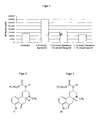
- zeigt die chemische Struktur von Lisurid,
- Figur 3
- zeigt die chemische Struktur von Tergurid.
- Figur 4
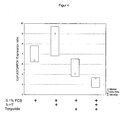
- zeigt den Einfluß von Serotonin und Tergurid auf die Expression von Col1 A2 in glatten Muskelzellen aus Lungenarterien.
- Humane pulmonale glatte Muskelzellen (PromoCell) wurden in PromoCell-Kulturmedium nach Angaben des Herstellers bis zur Konfluenz in Sechs-LochPlatten kultiviert. Die pulmonalen glatten Muskelzellen wurden danach in PromoCell-Kulturmedium in 24-Loch-Plattenin einer Zelldichte von 5 * 104 Zellen pro Loch (Well) ausgesät. Nach erfolgter Adhäsion der Zellen wurde das Kulturmedium ausgetauscht und durch Kultur in einem Medium mit 0,2% fötalem Kälberserum über 48 Stunden ein Wachstumsarrest herbeigeführt.
- Zur Prüfung der antiproliferativen Substanzwirkung wurden die Zellen zunächst mit 10 µmol/l Wirkstoffe vorinkubiert. Daraufhin wurde das Wachstumsverhalten der Zellen mit Serotonin (10-8 mol/l) stimuliert. Zur Messung der Zellproliferation wurden [3H]-Thymidin (Amersham) zu den Kulturen zugesetzt und für 24 Stunden inkubiert. Danach wurden die Zellen zunächst zweimal in eiskalter Phosphat-gepufferter Kochsalzlösung und anschließend in eiskalter 10%iger Trichloressigsäure für 30 Minuten bei 4°C inkubiert. Die Zellen wurden dann in 0,1 molarer Natronlauge (0,5 ml/Loch) aufgelöst. Nach Neutralisation mit Essigsäure wurde der Einbau von [3H]-Thymidin durch Flüssigkeitsszintillationsmessungen bestimmt. Die Bestimmungen wurden als Triplikate ausgeführt. In
Figur 1 ist jeweils der Mittelwert dargestellt. - 25,0 g Tergurid, mikronisiert werden mit 4035,0 g Laktose, 1800,0 g mikrokristalliner Cellulose und 120,0 g Croscarmellose Na nach vorherigem Sieben der Hilfsstoffe für 5 min. in einem Freifallmischer bei z. Bsp. 162 rpm gemischt. Anschliessend wird diese Vormischung über ein Sieb mit 0,8 mm Maschenweite gegeben. Es wird 20,0 g Magnesiumstearat zugegeben und erneut für 1 min. gemischt. Die so erhaltene Pressmasse wird auf einer geeigneten Tablettenpresse (z. Bsp. Rundläuferpresse) zu 50.000 Tabletten (theoretische Ausbeute) mit 7mm Durchmesser und einem Tablettengewicht von 120 mg entsprechend einer Dosierung von 0,5 mg Tergurid /Tablette verpresst. Die so hergestellten Tabletten geben den Wirkstoff nach Einbringen in Wasser schnell und nach max. 60 min. nahezu vollständig frei.
- 2,0 g Lisurid Hydrogenmaleat, mikronisiert werden mit 750,0 g Hydroxyethylcellulose (Tylose H) und 243,0 g mikrokristalliner Cellulose nach vorherigem Sieben der Hilfsstoffe für 5 min. in einem Freifallmischer bei z. Bsp. 180 rpm gemischt. Anschliessend wird diese Vormischung über ein Sieb mit 0,8 mm Maschenweite gegeben. Es wird 5,0 g Magnesiumstearat zugegeben und erneut für 1 min. gemischt. Die so erhaltene Pressmasse wird auf einer geeigneten Tablettenpresse (z. Bsp. Rundläuferpresse) zu 10.000 Tabletten (theoretische Ausbeute) mit 6 mm Durchmesser und einem Tablettengewicht von 100 mg entsprechend einer Dosierung von 0,2 mg Lisurid Hydrogenmaleat / Tablette verpresst. Die so hergestellten Tabletten geben den Wirkstoff nach Einbringen in Wasser verzögert frei, sodass nach ca. 2 h etwa 60 - 70% der Dosis aus der Formulierung abgegeben werden.
- 2,0 g Lisurid Hydrogenmaleat werden zusammen mit 20,0 g Laktose-Monohydrat, 0,4 g Citronensäure-Monohydrat und 1,0 g Natriumcitrat-Dihydrat in 976,6 g Wasser für Injektionszwecke gelöst. Die erhaltene farblos bis schwach gelbliche Lösung weist einen pH Wert zwischen 4,5 und 5,4 auf. Diese Lösung über ein Membranfilter vorfiltriert und danach über einen weiteren Membranfilter (0,2 µm) unter aseptischen Bedingungen sterilfiltriert. Je 1,0 g der so erhaltenen sterilen Lösung wird in sterilisierte Vials mit einem Füllvolumen von 6 ml verfüllt mit einem für die anschliessende Gefriertrocknung geeigneten Gummistopfen versehen und in einem Lyophilisator auf -40 bis -50°C eingefroren. Anschliessend wird unter Vakuum getrocknet bzw. nachgetrocknet unter Erhalt eines trockenen Substanzkuchens. Die Vials werden unter aseptischen Bedingungen verschlossen und gebördelt. Es werden auf diesem Wege 1000 Vials (theoretische Ausbeute) mit je 2 mg lyophilisiertem Lisurid Hydogenmaleat. Das Lyophilisat wird durch auslösen mit steriler, physiologischer Kochsalz Lösung rekonstituiert und ergibt eine gebrauchsfertige sterile Lösung zur Injektion bzw. Infusion zur sofortigen Anwendung.
- 2,5 g Tergurid werden mit 2,13 g Aceton und 51,54 g einer Lösung von basischem Butylmethacrylate Copolymer (Eudragit 100 Lösung) zusammengegeben. Der Lösung werden 5,0 g Polyvinylpyrrolidone (Povidone 25), 2,5 g Propylenglycol, 5,0 g Dodecyl-N,N-dimethylaminoacetat (alternativ 5,0 g 1-Dodecanol), 1,0 g Foral E 105 und 0,65 g eines Antioxidants (z. Bsp. Butylhydroxyanisol) zugegeben. Die so erhaltene Beschichtungslösung wird unter geeigneten Prozessbedingungen in einem Coater auf eine Polymerfolie aus Polyethylen kontinuierlich ausgestrichen und anschliessend getrocknet zu einem Flächengewicht von 50 mg/10cm2 (± 5%) beschichteter Fläche. Die so erhaltene klebende Matrix wird mit einer einseitig silikonisierten Polymerfolie laminiert und in einem weiteren Schritt zu Pflastern in einer für die therapeutische Anwendung geeigneten Größe (z. Bsp. 20 cm2) gestanzt und in Alubeuteln verpackt. Das so hergestellte Tergurid Pflaster gibt den Wirkstoff nach Applikation auf die intakte unbehaarte Haut kontinuierlich über mehrere Tage mit einer Geschwindigkeit zwischen 0,1 bis 0,5 µg/cm2/h an die systemische Zirkulation ab.
- Mittels eines Laborcoaters wird eine Membran aus mikroporösem Polyethylen (Solupor® 10P05A) als Kontrollmembran (oder alternativ aus Ethylenvinylacetat Copolymer (EVA, Cotran® 3M 9728)) mit einem hautverträglichen Siliconkleber (BioPSA®7- 4202) (alternativ Polyisobutylenkleber, Oppanol®), beschichtet und getrocknet mit einem Flächengewicht von ca. 10 bis 25 mg/cm2 und anschliessend mit einem einseitig silikonisierten Releaseliner (Polyethylen) laminiert.
- Das so erhaltene Laminat wird in einer geeigneten Siegelmaschine mit heisssiegelfähigem Polyethylen ringförmig bis auf eine kleine Öffnung gesiegelt und gestanzt. In den entstandenen Hohlraum wird über die verbleibende Öffnung mittel einer geeigneten Injektionsvorrichtung ca. 0,5 ml einer 1%igen Lösung von Lisurid in 2-Propanol, Hydroxypropylcellulose (Klucel® LF) und Tocopherol eingegeben und danach vollständig versiegelt.
- Nach Äquilibierung und Abzug des Releaseliners kann das Membranpflaster auf die intakte, unbehaarte Haut aufgeklebt werden und gibt kontinuierlich und mit konstanter Geschwindigkeit Lisurid frei. Die Dosierung kann durch die unterschiedliche Pflastergrößen eingestellt werden.
- 50 g Tergurid mikronisiert werden mit 50 g Polydimethylsiloxane homogen vermischt und mit Standardverfahren vorzugsweise durch Extrusion zu einer strangförmigen Core-Matrix geformt. Der Strang wird in Teile zu 30 mm geschnitten. Nach dem gleichen Verfahren wird ein wirkstofffreies Core-Extrudat mit identischen Dimensionen hergestellt. Aus käuflich erhältlichem Siliciumdioxid enthaltendem Polydimethylsiloxan oder aus z. Bsp. Pt katalysiertem vernetztem Polyalkylenoxid (Gelest®) enthaltendem Polydimethylsiloxan werden in einem zweiten Schritt durch Extrusion schlauchförmige Membranen mit einer Wandstärke von z. Bsp. 0,2 mm Wandstärke hergestellt. Die Membranen werden zu einer Länge von 60 mm geschnitten und in Cyclohexan schwellen lassen. Anschliessend wird die wirkstoffhaltige Core Matrix eingeführt und von beiden Seiten der Schlauchmembran das wirkstofffreie Extrudat eingeführt, z. Bsp. in einer Weise, dass auf beiden Seiten ein luftgefüllter Zwischenraum von ca. 1-3 mm zwischen dem wirkstoffhaltigen Core und dem wirkstofffreien Core entsteht. Anschliessend wird Cyclohexan durch Verdunsten entfernt, die Formulierung auf eine Gesamtlänge von 50 mm geschnitten, sodass an beiden Seiten der Formulierung ein Verschluss durch wirkstofffreies Corematerial entsteht. Die Formulierung wird durch Standardverfahren (Ethylenoxid, H2O2) gassterilisiert. Durch die Lufteinschlüsse kann die Lage der Formulierung am Applikationsort durch Ultraschalldetektion jederzeit detektiert werden.
- Ratten wurden am Versuchstag 1 Monocrotalin (60 mg/kg; Sigma) verabreicht. Die Substanz wurde hierzu in 0.5 molarer Salzsäure gelöst und anschliessend der pH mit 0.5 molarer Natronlauge auf 7.4 adjustiert. Die Lösung wurde als einmalige subkutane Injektion in einer Dosis von 60 mg/kg an männliche Sprague Dawley Ratten verabreicht. Kontrolltieren wurde das gleiche Volumen isotonischer Kochsalzlösung verabreicht.
- Gruppen von jeweils 6 Tieren, die am Tag 1 mit Monocrotalin behandelt wurden, wurden an den Versuchtagen 14-28 täglich entweder 0.25 mg/kg Lisurid oder 2.5 mg/kg Tergurid per Schlundsonde verabreicht. Die Dosisangaben beziehen sich hierbei auf die freie Base der Substanzen. Die Substanzen wurden als Hydrogenmaleat-Salz bzw. freie Base eingesetzt. Sie wurden in Gegenwart von Spuren von Ascorbinsäure in destilliertem Wasser aufgenommen und in einem Volumen von 2 mL per Schlundsonde Morgens und Abends verabreicht. Kontrolltieren wurde die gleiche Menge Wasser verabreicht.
- Am Versuchstag 28 wurden 2 Stunden nach der letzten Substanzgabe die Tiere mit Pentobarbital in Narkose versetzt. Anschließend wurden an den Tiere eine Tracheostomie ausgeführt und die Tiere mit 10 ml/kg und einer Frequenz von 60s-1 beatmet (SAR830A/P; IITC). Die Narkose wurde durch Inhalation von Isofluran aufrechterhalten.
- Der mittlere arterielle Druck sowie der rechte ventrikuläre systolische Blutdruck wurden bestimmt. Der systemische arterielle Druck wurde durch einen Millarkatheter in der linken Karotis Arterie gemessen. Durch die rechte Jugularvene wurde ein Millar Katheter mit einem Drucksensor (Millar Instruments, Modell. SPR-534) eingeführt und bis in den rechten Ventrikel des Herzens geschoben und zur Messungen des rechten Ventrikeldrucks (RVSP) eingesetzt. Das Signal wurde mittels eines HSE Couplers Series 500 verstärkt und einer Registriereinheit zur Auswertung zugeführt.
- Nach Durchführung der Druckmessungen wurden die Ratten mit physiologischer Kochsalzlösung perfundiert. Der rechte Lungenflügel wurde entnommen, tiefgefroren und zur Bestimmung des Collagengehalts aufgearbeitet. Hierzu wurde das Gewebe zunächst homogenisiert und in Anlehnung an die Methode von Berg (Meths Enzymol. 82, 372 (1982)) bestimmt. Zunächst wurde eine Hydrolyse der Probe in 6 molarer Salzsäure für 16 Stunden bei 116°C durchgeführt. Nachgeschaltet erfolgte eine Oxidation von Hydroxyprolin zu Pyrrol, gefolgt von einer Komplexbildung mit p-Dimethylaminobenzaldehyd. Der entstandene Farbkomplex wurde bei 560 nm photometrisch vermessen und mittels einer Eichkurve wurde der Hydroxyprolin-Gehalt der Proben ermittelt. Die Ergebnisse sind als µg/g Protein im Lungengewebe angegeben.
-
a) Einfluß der Behandlung mit Lisurid oder Tergurid an den Versuchstagen 15-28 auf den systolischen Druck im rechten Herzventrikel (RVPsys) und den systemischen arteriellen Druck (SAP)RVPsys [mm Hg] SAP [mm Hg] Kontrolle 23± 4 118±5 Monocrotalin 55± 5 114±7 Monocrotalin + 0,25mg/kg Lisurid bid 43±7 109±9 Monocrotalin +2,5 mg/kg Terqurid bid 39±3 111±7
b) Einfluß der Behandlung mit Lisurid oder Tergurid an den Versuchstagen 15-28 auf den Hydroxyprolin-Gehalt der LungeHydroxyprolin [ug/g Protein] Kontrolle 1,2 ± 0,2 Monocrotalin 4,2 ± 1,1 Monocrotalin + 0.25mg/kg Lisurid bid 3,3 ± 0.8 Monocrotalin +2,5 mg/kg Tergurid bid 2,7 ± 1.2 - Nach Verabreichung von Monocrotalin kommt es in Ratten zu einer Endothelschädigung der Lunge, die mit einer überschießenden Produktion von Bindegewebe und der Entwicklung von Lungenhochdruck verbunden sind. Die Akkumulation von Collagen, gemessen als Hydroxyprolin-Gehalt im Lungengewebe sowie der systolische Druckanstieg in der rechten Herzkammer reflektieren diese strukturellen und funktionellen Veränderungen. In diesem Modell für Lungenhochdruck wurden mögliche therapeutische Wirkungen einer Behandlung mit Lisurid oder Tergurid geprüft. Die Therapie setzte unter den experimentellen Bedingungen nicht zum Zeitpunkt der Monocrotalin Behandlung, d.h. nicht zum Zeitpunkt der Schädigung, sondern erst nach 14 Tagen ein. Zu diesem Zeitpunkt haben sich nach Literaturangaben umfangreiche Gefäßveränderungen und ein Druckanstieg manifestiert. Die Therapie mit Lisurid oder Tergurid vermindert den Druckanstieg in der rechten Herzkammer als ein indirektes Maß für den Lungenhochdruck im Sinne eines therapeutisch gewünschten Effektes.
- Als strukturelles Korrelat wurde unter Therapie mit beiden Substanzen eine Verminderung des durch Monocrotalin erhöhten Hydroxyprolin-Gehaltes im Sinne eines "reversen Remodellings" beobachtet. Lisurid und Tergurid weisen in diesem etablierten Tiermodell Wirkqualitäten auf, die einen therapeutischen Einsatz an Patienten mit Lungenhochdruck erfolgreich machen.
- Das beschriebene Versuchsbeispiel belegt die erfolgreiche Verwendung der Ergoline am Beispiel von Lisurid und Tergurid zur Behandlung von Lungenhochdruck.
- Ratten wurden am Versuchstag 1 Monocrotalin (60 mg/kg; Sigma) verabreicht. Die Substanz wurde hierzu in 0.5 molarer Salzsäure gelöst und anschliessend der pH mit 0.5 molarer Natronlauge auf 7.4 adjustiert. Die Lösung wurde als einmalige subkutane Injektion in einer Dosis von 60 mg/kg an männliche Sprague Dawley Ratten verabreicht. Kontrolltieren wurde das gleiche Volumen isotonischer Kochsalzlösung verabreicht.
- Gruppen von jeweils 4 Tieren, die am Tag 1 mit Monocrotalin behandelt wurden, wurden an den Versuchtagen 1-28 zweimal täglich 1.2 mg/kg Tergurid intraperitoneal verabreicht. Tergurid wurde in Gegenwart von Spuren von Ascorbinsäure in destilliertem Wasser aufgenommen und in einem Volumen von 2 mL per Schlundsonde Morgens und Abends verabreicht. Kontrolltieren wurde die gleiche Menge physiologischer Kochsalzlösung verabreicht.
- Am Versuchstag 28 wurden 2 Stunden nach der letzten Substanzgabe die Tiere mit Pentobarbital in Narkose versetzt. Anschließend wurden an den Tieren eine Tracheostomie ausgeführt und die Tiere mit 10 ml/kg und einer Frequenz von 60s-1 beatmet (SAR830A/P; IITC). Die Narkose wurde durch Inhalation von Isofluran aufrechterhalten.
- Der mittlere arterielle Druck sowie der rechte ventrikuläre systolische Blutdruck wurden bestimmt. Der systemische arterielle Druck wurde durch einen Millarkatheter in der linken Karotis Arterie gemessen. Durch die rechte Jugularvene wurde ein Millar Katheter mit einem Drucksensor (Millar Instruments, Modell. SPR-534) eingeführt und bis in den rechten Ventrikel des Herzens geschoben und zur Messungen des rechten Ventrikeldrucks (RVSP) eingesetzt. Das Signal wurde mittels eines HSE Couplers Series 500 verstärkt und einer Registriereinheit zur Auswertung zugeführt.
- Nach Durchführung der Druckmessungen wurden die Ratten mit physiologischer Kochsalzlösung perfundiert. Das Herz wurde entnommen sowie durch Dissektion der rechte Ventrikel, das Septum sowie der linke Ventrikel jedes Herzens präpariert. Die Gewebepräparationen wurden gefriergetrocknet und anschließend die Trockengewichte durch Auswiegen bestimmt. Aus diesen Tieren wurde für jedes individuelle Tier der Quotient: Gewicht des rechten Ventrikels/ Gewicht von linken Ventrikel und Septum (RV/LV+S) als ein Maß der Rechtsherzhypertrophie bestimmt.
- Die Lungen wurden entnommen, in Formalin fixiert und in Paraffin eingebettet. 3 um Paraffin Schnitte wurden gewonnen und eine immunhistochemische Doppelfärbung nach Standardprotokollen durchgeführt. Glatte Muskelzellen der Gefäße wurden mit einem Antikörper gegen Aktin und das Endothel mittel Antikörper gegen von Willebrand Faktor angefärbt. Für die Auswertung wurden ≥ 80 intraazinäre Arterien mit einem Durchmesser > 50 µm herangezogen. Die Gefäße wurden in 3 Kategorien unterteilt: nicht-muskularisierte Gefäße mit < 20 %, teilweise muskularisierte Gefässe mit >20 %, aber < 70%, und voll muskularisierte Gefäße mit >70 % Umkleidung des Gefäßquerschnitts mit glatten Muskelzellen.
-
a) Einfluß der Behandlung mit Tergurid an den Versuchstagen 1-28 auf den systolischen Druck im rechten Herzventrikel (RVSP) und den systemischen arteriellen Druck (SAP)RVSP [mm Hg] SAP [mm Hg] Kontrolle 31,0 ± 3,6 104,0 ± 13,3 Monocrotalin 64,4 ± 14,5 93,7 ± 19,4 Monocrotalin + 0,4mg/kg Terguride bid 36,4 ± 3,6 97,5 ± 15,2
b) Einfluß der Behandlung mit Tergurid an den Versuchstagen 1-28 auf die Rechtsherzhypertrophie, gemessen als Verhältnis: Gewicht von rechtem Herzventrikel vs. Gewicht von linkem Herzventrikel und Septum.RV/LV+S Kontrolle 0,31 ± 0,06 Monocrotalin 0,74 ± 0,14 Monocrotalin + 0,4mg/kg Terguride bid 0,33 ± 0,08
c) Einfluß der Behandlung mit Tergurid an den Versuchstagen 1-28 auf die Muskularisierung von arteriellen Kapillargefäßen (20-50 µm Durchmesser) in der LungeAnteil nichtmuskularisierter Gefäße [%] Anteil teilmuskularisierter Gefäße [%] Anteil voll muskularisierter Gefäße [%] Kontrolle 57,8 ± 14,6 3,2 ± 2,3 14,8 ± 6,2 Monocrotalin 40,4 ± 16,0 42,3 ± 4,4 64,0 ± 7,7 Monocrotalin + 0,4mg/kq Terquride bid 1,9 ± 1,6 57,8 ± 14,6 21,3 ± 12,6 - Nach Verabreichung von Monocrotalin kommt es in Ratten zu einer Endothelschädigung der Lunge, die mit einer überschießenden Proliferation von glatten Muskelzellen in arteriellen Kapillargefäßen der Lunge und der Entwicklung von Lungenhochdruck verbunden sind. Der systolische Druckanstieg in der rechten Herzkammer bei konstantem systemischem Blutdruck sowie die Rechtsherzhypertrophie reflektieren diese strukturellen und funktionellen Veränderungen.
- In diesem Modell für Lungenhochdruck wurden mögliche therapeutische Wirkungen einer Behandlung mit Tergurid geprüft. Die Therapie setzte unter den experimentellen Bedingungen unmittelbar nach dem Zeitpunkt der Monocrotalin Gabe ein. Unter Therapie mit Tergurid wird der Druckanstieg in der rechten Herzkammer als ein indirektes Maß für den Lungenhochdruck nachzuständig unterdrückt. Der systemische Blutdruck ist unter den Versuchsbedingungen nicht nachweisbar verändert.
- Ebenso kommt es unter Therapie zu einer vollständigen Unterdrückung der Monocrotalin induzierten Rechtsherzhypertrophie. In der Lunge wurde unter Therapie als therapeutische Wirkung eine Verminderung der Monocrotalininduzierten Muskularisierung von arteriellen Kapillargefäßen beobachtet. Tergurid weist in diesem etablierten Tiermodell für pulmonalen Hochdruck Wirkqualitäten in allen relevanten funktionellen und strukturellen Parametern auf, die einen therapeutischen Einsatz an Patienten mit Lungenhochdruck erfolgreich machen.
- In dem Experiment wurde ein möglicher stimulierender Einfluss von Serotonin auf die Expression von Col1 A2 sowie die Hemmwirkung von Tergurid untersucht. Die Untersuchungen wurden an humane pulmonale glatte Muskelzellen (Cambrex) durchgeführt.. Die Zellen wurden nach Herstellerangaben in CC-3182 Medium (Cambrex) kultiviert. 5% eines mit Aktivkohle vorbehandelten Serotonin depletierten fötalen Kälberserums (FCS) (HyClone) wurden zugesetzt.
- Nach Erreichen eines konfluenten Zellrasens wurden die Zellen für weitere 2 Tage in 5% FCS kultiviert. Für das Experiment wurde ein Medium mit Zusatz von 0.5% FCS eingesetzt. Nach Zugabe von Serotonin (100 nmol/L) und/oder Terguride (100 nmol/L) wurden die Zellen für 48 Stunden weiterkultiviert. Die Inkubationen wurden in Triplikaten durchgeführt.
- Gesamt RNS wurde mit dem RNeas Kit (Qiagen) gemäß Herstellerangaben gewonnen. Die reverser Transcription in cDNA erfolgte mittel oligo-dT Primer (Roche).
- Anschließend wurde die Genexpression mittels SYBR Green real-time PCR an einem ABI Prism 7700 Sequence Detection System (Applied Biosystems, Foster City, CA, USA) nach Standardprotokollen quantifiziert. Als spezifisches Primer-Paar für humanes Col1 A2 wurden in die PCR-Analyse der Vorwärts Primer: 5'-GGTCAGCACCA-CCGATGTC-3', und der reverse Primer: 5'-CACGCCTG-CCCTTCCTT-3' eingesetzt.
- Zur Standardisierung von Unterschieden in der Gesamtmenge an RNA in einzelnen Proben, wurde die Expression von Col1 A2 normiert auf die Expression des Enzyms Glycerinaldehyd-3-Phosphat Dehydrogenase (GAPDH), welches in den Zellen konstitutiv exprimiert wird. Hierzu wurden folgende Primer benutzt: Vorwärts Primer: 5'-CAATGC-CTCCTGCACCACCAAC-3'und reverser Primer: 5'-AGGGGCCATCCACAGTCTTCT-3'.
- Die Expressionsleistung von Col1 A2 und GAPDH in individuellen Proben wurde mit Standardauswertungsmethoden bestimmt und als Col1A2/GAPDH Verhältnisse quantifiziert.
- Die Darstellung der Ergebnisse erfolgte als "box-and whisker" Plots.
- Wie aus der Abbildung zu ersehen ist, wird in human glatten Musklezellen aus Pulmonalarterien die Expression von Col1 A2 in Gegenwart von 100 nmol/L Serotonin im Vergleich zu einem Kontrollansatz deutlich stimuliert. Dies deutet auf eine trophischen Wirkung von Serotonin hin. Eine überschiessende Deposition von Collagen leistet zusammen mit der Proliferation von glatten Muskelzellen einen Beitrag zur Pathophysiologie von pulmonalem arteriellem Hochdruck.
- In Gegenwart von Terguride wird die Expression von Col1 A2 gehemmt, wobei die Hemmwirkung in Gegenwart von Serotonin stärker ausgeprägt ist. Aus der hier beschriebenen Wirkqualität lässt sich deshalb ein möglicher therapeutischer Nutzen von Tergurid für die Anwendung bei Patienten mit pulmonalem Hochdruck ableiten.
Claims (5)
- Lisurid oder Tergurid sowie Salze, Enantiomere, Enantiomerengemische, Diastereomere, Diastereomerengemische, Hydrate, Solvate und Racemate davon zur Verwendung bei der Behandlung und Prophylaxe von pulmonalem arteriellem Hochdruck, endogen-induzierter oder exogen-induzierter Glomerulosklerosen und sekundärem Raynaud Syndrom.
- Verwendung von Lisurid oder Tergurid sowie Salzen, Enantiomeren, Enantiomerengemischen, Diastereomeren, Diastereomerengemischen, Hydraten, Solvaten und Racematen davon zur Herstellung einer pharmazeutischen Zusammensetzung zur Behandlung und Prophylaxe von pulmonalem arteriellem Hochdruck, endogen-induzierter oder exogen-induzierter Glomerulosklerosen und sekundärem Raynaud-Syndrom.
- Pharmazeutische Zusammensetzung enthaltend mindestens eine der Verbindungen Lisurid oder Tergurid sowie Salze, Enantiomere, Enantiomerengemische, Diastereomere, Diastereomerengemische, Hydrate, Solvate und Racemate davon in einer aktiven Wirkstoffkonzentration von 0,1 - 10 mg pro Einzeldosis zusammen mit pharmakologisch verträglichen Trägern, Hilfsstoffen und/oder Lösungsmitteln zur Verwendung bei der Behandlung und Prophylaxe von pulmonalem arteriellem Hochdruck, endogen-induzierter oder exogen-induzierter Glomerulosklerosen und sekundärem Raynaud Syndrom.
- Pharmazeutische Zusammensetzung zur Verwendung gemäß Anspruch 3, wobei die pharmazeutische Zusammensetzung zur oralen, sublingualen, parenteralen, kutanen, bukkalen, perkutanen, subcutanen, inhalativen oder nasalen Verabreichung geeignet ist.
- Pharmazeutische Zusammensetzung zur Verwendung gemäß Anspruch 3 oder 4 in Form von Tabletten, Schichttabletten, Kapseln, Retard-Oralia, Suppositorien, Mikroformulierungen, Nanoformulierungen, liposomalen Formulierungen, Tropfen, Nasentropfen, Nasensprays, Aerosolen, Ampullen, Lösungen, Emulsionen, Dispersionen, Pulvern, Inhalationspulvern, mikrokristallinen Formulierungen, Inhalationssprays, transdermalen Systemen oder subcutanen Formulierungen.
Priority Applications (4)
| Application Number | Priority Date | Filing Date | Title |
|---|---|---|---|
| EP07846885.7A EP2091537B1 (de) | 2006-11-23 | 2007-11-23 | Pharmazeutische zusammensetzungen zur behandlung von kapillarer arteriopathie |
| SI200731292T SI2091537T1 (sl) | 2006-11-23 | 2007-11-23 | Farmacevtski sestavki za zdravljenje kapilarne arteriopatije |
| PL07846885T PL2091537T3 (pl) | 2006-11-23 | 2007-11-23 | Kompozycja farmaceutyczna do leczenia arteriopatii włośniczkowej |
| CY20131100707T CY1114364T1 (el) | 2006-11-23 | 2013-08-20 | Φαρμακευτικες συνθεσεις για την θεραπεια της αρτηριοπαθειας των τριχοειδων αγγειων |
Applications Claiming Priority (4)
| Application Number | Priority Date | Filing Date | Title |
|---|---|---|---|
| EP06024308 | 2006-11-23 | ||
| EP06025263 | 2006-12-06 | ||
| EP07846885.7A EP2091537B1 (de) | 2006-11-23 | 2007-11-23 | Pharmazeutische zusammensetzungen zur behandlung von kapillarer arteriopathie |
| PCT/EP2007/010360 WO2008061805A1 (de) | 2006-11-23 | 2007-11-23 | Pharmazeutische zusammensetzungen zur behandlung von kapillarer arteriopathie |
Publications (2)
| Publication Number | Publication Date |
|---|---|
| EP2091537A1 EP2091537A1 (de) | 2009-08-26 |
| EP2091537B1 true EP2091537B1 (de) | 2013-05-22 |
Family
ID=38982525
Family Applications (1)
| Application Number | Title | Priority Date | Filing Date |
|---|---|---|---|
| EP07846885.7A Active EP2091537B1 (de) | 2006-11-23 | 2007-11-23 | Pharmazeutische zusammensetzungen zur behandlung von kapillarer arteriopathie |
Country Status (14)
| Country | Link |
|---|---|
| US (2) | US20090325997A1 (de) |
| EP (1) | EP2091537B1 (de) |
| JP (1) | JP5407865B2 (de) |
| AU (1) | AU2007324706B2 (de) |
| CA (1) | CA2670846C (de) |
| CY (1) | CY1114364T1 (de) |
| DK (1) | DK2091537T3 (de) |
| ES (1) | ES2425581T3 (de) |
| HR (1) | HRP20130791T1 (de) |
| PL (1) | PL2091537T3 (de) |
| PT (1) | PT2091537E (de) |
| RU (1) | RU2463048C2 (de) |
| SI (1) | SI2091537T1 (de) |
| WO (1) | WO2008061805A1 (de) |
Families Citing this family (8)
| Publication number | Priority date | Publication date | Assignee | Title |
|---|---|---|---|---|
| EP2550959A1 (de) | 2011-07-27 | 2013-01-30 | Sinoxa Pharma | Lisurid, Tergurid und Derivate davon zur Verwendung in der Prophylaxe und/oder Therapie fibrotischer Veränderungen |
| EP2637644A1 (de) | 2010-11-11 | 2013-09-18 | Sinoxa Pharma UG | Lisurid, tergurid und derivate davon zur verwendung in der prophylaxe und/oder therapie fibrotischer veränderungen |
| DE102010051391A1 (de) | 2010-11-11 | 2012-10-11 | Sinoxa Pharma Ug | Multivalente Arzneistoffe mit kombinierter antioxidativer Wirkung und antagonistischen Effekten an 5-HT2-Rezeptor-Subtypen zur Behandlung von fibrotischem Organumbau. |
| RU2516921C1 (ru) * | 2013-04-08 | 2014-05-20 | Общество с ограниченной ответственностью "Научно-производственная компания ВИТАФОРМ" | Композиция для костной пластики (варианты) |
| CN113149982A (zh) | 2015-01-20 | 2021-07-23 | Xoc制药股份有限公司 | 麦角灵化合物及其用途 |
| EP3528812B1 (de) * | 2016-10-20 | 2020-12-30 | Pfizer Inc | Palbociclib zur behandlung von pah |
| JP2020522504A (ja) | 2017-06-01 | 2020-07-30 | エックスオーシー ファーマシューティカルズ インコーポレイテッドXoc Pharmaceuticals, Inc | 多環式化合物およびそれらの用途 |
| WO2023107931A1 (en) * | 2021-12-06 | 2023-06-15 | Terran Biosciences, Inc. | Salt and solid forms of indole analogs and methods of use thereof |
Citations (3)
| Publication number | Priority date | Publication date | Assignee | Title |
|---|---|---|---|---|
| US4593032A (en) * | 1984-03-16 | 1986-06-03 | Schering Aktiengesellschaft | Terguride as antihypertensive |
| DE4240798A1 (en) * | 1991-12-03 | 1993-06-09 | Poli Industria Chimica S.P.A., Mailand/Milano, It | Neuro-protective agents preventing nerve damage - contain ergot derivs. e.g. clavine lysergic acid amide or 8-alpha-amino:ergoline derivs. |
| WO2002094238A1 (en) * | 2001-05-24 | 2002-11-28 | Alexza Molecular Delivery Corporation | Delivery of anti-migraine compounds through an inhalation route |
Family Cites Families (8)
| Publication number | Priority date | Publication date | Assignee | Title |
|---|---|---|---|---|
| DE3722383A1 (de) * | 1986-07-14 | 1988-01-28 | Sandoz Ag | Neue verwendung von bromocriptin |
| US20070243240A9 (en) * | 2000-08-24 | 2007-10-18 | Fred Windt-Hanke | Transdermal therapeutic system |
| US20020122773A1 (en) * | 2000-12-20 | 2002-09-05 | Michel Pairet | Pharmaceutical compositions based on anticholinergics and dopamine agonists |
| JP2005508220A (ja) * | 2001-10-24 | 2005-03-31 | パーリ・ゲーエムベーハー | 薬用組成物調製用具 |
| US20070149451A1 (en) * | 2003-11-17 | 2007-06-28 | Holmes David G | Combination of a dpp IV inhibitor and an antiobesity or appetite regulating agent |
| EP1900737A1 (de) * | 2006-08-31 | 2008-03-19 | Novartis AG | Polymorph von (R)-3-(2-hydroxy-2,2-diphenyl-acetoxy)-1-(isoxazol-3-ylcarbamoyl-methyl)-1-azonia-bicyclo-[2.2.2]octane bromid |
| US8580801B2 (en) * | 2008-07-23 | 2013-11-12 | Robert I. Henkin | Phosphodiesterase inhibitor treatment |
| EP2637644A1 (de) * | 2010-11-11 | 2013-09-18 | Sinoxa Pharma UG | Lisurid, tergurid und derivate davon zur verwendung in der prophylaxe und/oder therapie fibrotischer veränderungen |
-
2007
- 2007-11-23 DK DK07846885.7T patent/DK2091537T3/da active
- 2007-11-23 ES ES07846885T patent/ES2425581T3/es active Active
- 2007-11-23 PT PT78468857T patent/PT2091537E/pt unknown
- 2007-11-23 CA CA2670846A patent/CA2670846C/en not_active Expired - Fee Related
- 2007-11-23 EP EP07846885.7A patent/EP2091537B1/de active Active
- 2007-11-23 SI SI200731292T patent/SI2091537T1/sl unknown
- 2007-11-23 RU RU2009123401/15A patent/RU2463048C2/ru not_active IP Right Cessation
- 2007-11-23 JP JP2009537565A patent/JP5407865B2/ja not_active Expired - Fee Related
- 2007-11-23 PL PL07846885T patent/PL2091537T3/pl unknown
- 2007-11-23 US US12/515,966 patent/US20090325997A1/en not_active Abandoned
- 2007-11-23 WO PCT/EP2007/010360 patent/WO2008061805A1/de not_active Ceased
- 2007-11-23 HR HRP20130791TT patent/HRP20130791T1/hr unknown
- 2007-11-23 AU AU2007324706A patent/AU2007324706B2/en not_active Ceased
-
2012
- 2012-01-20 US US13/354,832 patent/US9695173B2/en not_active Expired - Fee Related
-
2013
- 2013-08-20 CY CY20131100707T patent/CY1114364T1/el unknown
Patent Citations (3)
| Publication number | Priority date | Publication date | Assignee | Title |
|---|---|---|---|---|
| US4593032A (en) * | 1984-03-16 | 1986-06-03 | Schering Aktiengesellschaft | Terguride as antihypertensive |
| DE4240798A1 (en) * | 1991-12-03 | 1993-06-09 | Poli Industria Chimica S.P.A., Mailand/Milano, It | Neuro-protective agents preventing nerve damage - contain ergot derivs. e.g. clavine lysergic acid amide or 8-alpha-amino:ergoline derivs. |
| WO2002094238A1 (en) * | 2001-05-24 | 2002-11-28 | Alexza Molecular Delivery Corporation | Delivery of anti-migraine compounds through an inhalation route |
Non-Patent Citations (3)
| Title |
|---|
| LUQUIN M R ET AL: "Parenteral administration of lisuride in Parkinson's disease.", ADVANCES IN NEUROLOGY 1987 LNKD- PUBMED:3825733, vol. 45, 1987, pages 561 - 568, XP001525514, ISSN: 0091-3952 * |
| OBESO J A ET AL: "Intravenous lisuride corrects oscillations of motor performance in Parkinson's disease", 1986, ANNALS OF NEUROLOGY 1986 US, VOL. 19, NR. 1, PAGE(S) 31 - 35, ISSN: 0364-5134 * |
| OBESO J A ET AL: "Intravenous lisuride corrects oscillations of motor performance in Parkinson's disease", ANNALS OF NEUROLOGY 1986 US, vol. 19, no. 1, 1986, pages 31 - 35, ISSN: 0364-5134 * |
Also Published As
| Publication number | Publication date |
|---|---|
| PT2091537E (pt) | 2013-08-29 |
| WO2008061805A1 (de) | 2008-05-29 |
| CA2670846C (en) | 2014-12-23 |
| AU2007324706A2 (en) | 2009-06-25 |
| RU2009123401A (ru) | 2010-12-27 |
| AU2007324706B2 (en) | 2013-09-05 |
| AU2007324706A1 (en) | 2008-05-29 |
| PL2091537T3 (pl) | 2013-10-31 |
| ES2425581T3 (es) | 2013-10-16 |
| SI2091537T1 (sl) | 2013-10-30 |
| CA2670846A1 (en) | 2008-05-29 |
| CY1114364T1 (el) | 2016-08-31 |
| JP5407865B2 (ja) | 2014-02-05 |
| JP2010510273A (ja) | 2010-04-02 |
| US20140045879A1 (en) | 2014-02-13 |
| US20090325997A1 (en) | 2009-12-31 |
| RU2463048C2 (ru) | 2012-10-10 |
| EP2091537A1 (de) | 2009-08-26 |
| DK2091537T3 (da) | 2013-08-26 |
| US9695173B2 (en) | 2017-07-04 |
| HRP20130791T1 (en) | 2013-09-30 |
Similar Documents
| Publication | Publication Date | Title |
|---|---|---|
| JP6929479B2 (ja) | 激越の治療のための舌下デクスメデトミジンの使用 | |
| EP2091537A1 (de) | Pharmazeutische zusammensetzungen zur behandlung von kapillarer arteriopathie | |
| EP3626234B1 (de) | Perkutanes mikronadelpflaster mit donepezil | |
| EP2982367A1 (de) | Pharmazeutische zusammensetzung zur parenteralen verabreichung mit donepezil | |
| DE69814378T2 (de) | Salz von naphthylidincarbonsäure-derivaten | |
| AU2020323532A1 (en) | Dosing regimens for oral complement Factor D inhibitors | |
| JP2021091712A (ja) | 心臓肥大および肺高血圧の治療用医薬の製造におけるカウラン化合物の使用 | |
| EP2637644A1 (de) | Lisurid, tergurid und derivate davon zur verwendung in der prophylaxe und/oder therapie fibrotischer veränderungen | |
| JP2002538102A (ja) | 光学的に純粋なr(+)オンダンセトロンを使用する無呼吸および無呼吸障害の治療方法 | |
| EP0306846A2 (de) | Neue synergistische Kombination bestehend aus einem Phosphodiesterase-Hemmer und einem Thromboxan-A2-Antagonisten und deren Verwendung bzw. Herstellung | |
| WO2011107283A2 (de) | Formulierungen von taurolidin und verfahren zu seiner herstellung | |
| US20060194829A1 (en) | Therapeutic materials and methods | |
| KR102560150B1 (ko) | 트러블 개선 및 피부 재생을 위한 용해성 미세바늘 패치 | |
| EP0471388B1 (de) | Mittel zur Behandlung der Herzinsuffizienz | |
| WO2024220974A1 (en) | Rimegepant fast-dissolving films for oral administration | |
| DE102010063127A1 (de) | Flüssige, oral applizierbare pharmazeutische Zusammensetzungen enthaltend 5-Chlor-N-({(5S)-2-oxo-3-[4-(3-oxo-4-morpholinyl)-phenyl]-1,3-oxazolidin-5-yl}-methyl)-2-thiophencarboxamid | |
| KR20180005618A (ko) | 에피디티오디옥소피페라진 화합물 또는 이의 유도체, 또는 이들의 약학적으로 허용가능한 염을 포함하는 폐동맥고혈압 예방 또는 치료용 약학적 조성물 | |
| EP1150680B1 (de) | Verwendung von moxonidin zur behandlung nach herzinfarkt | |
| CN110693882A (zh) | 一种舌下用药物组合物 | |
| EP0273253A2 (de) | Verwendung von 6-Allyl-2-amino-5,6,7,8-tetrahydro-4H-thiazolo-[5,4-d]azepin zur Freisetzung von Wachstumshormon | |
| RU2314103C1 (ru) | Раствор моксифлоксацина для инъекций и способ его получения | |
| DE102010051391A1 (de) | Multivalente Arzneistoffe mit kombinierter antioxidativer Wirkung und antagonistischen Effekten an 5-HT2-Rezeptor-Subtypen zur Behandlung von fibrotischem Organumbau. | |
| EP2550959A1 (de) | Lisurid, Tergurid und Derivate davon zur Verwendung in der Prophylaxe und/oder Therapie fibrotischer Veränderungen | |
| OA20576A (en) | Dosing regimens for oral complement factor D inhibitors. | |
| EP3138559A1 (de) | Arzneimittel zur behandlung von tinnitus-patienten |
Legal Events
| Date | Code | Title | Description |
|---|---|---|---|
| PUAI | Public reference made under article 153(3) epc to a published international application that has entered the european phase |
Free format text: ORIGINAL CODE: 0009012 |
|
| 17P | Request for examination filed |
Effective date: 20090520 |
|
| AK | Designated contracting states |
Kind code of ref document: A1 Designated state(s): AT BE BG CH CY CZ DE DK EE ES FI FR GB GR HU IE IS IT LI LT LU LV MC MT NL PL PT RO SE SI SK TR |
|
| AX | Request for extension of the european patent |
Extension state: AL BA HR MK RS |
|
| 17Q | First examination report despatched |
Effective date: 20100707 |
|
| RAP1 | Party data changed (applicant data changed or rights of an application transferred) |
Owner name: PFIZER INC. |
|
| GRAP | Despatch of communication of intention to grant a patent |
Free format text: ORIGINAL CODE: EPIDOSNIGR1 |
|
| RAP1 | Party data changed (applicant data changed or rights of an application transferred) |
Owner name: SINOXA PHARMA GMBH |
|
| GRAS | Grant fee paid |
Free format text: ORIGINAL CODE: EPIDOSNIGR3 |
|
| GRAA | (expected) grant |
Free format text: ORIGINAL CODE: 0009210 |
|
| AK | Designated contracting states |
Kind code of ref document: B1 Designated state(s): AT BE BG CH CY CZ DE DK EE ES FI FR GB GR HU IE IS IT LI LT LU LV MC MT NL PL PT RO SE SI SK TR |
|
| AX | Request for extension of the european patent |
Extension state: AL BA HR MK RS |
|
| REG | Reference to a national code |
Ref country code: GB Ref legal event code: FG4D Free format text: NOT ENGLISH |
|
| REG | Reference to a national code |
Ref country code: CH Ref legal event code: EP |
|
| REG | Reference to a national code |
Ref country code: AT Ref legal event code: REF Ref document number: 612819 Country of ref document: AT Kind code of ref document: T Effective date: 20130615 |
|
| REG | Reference to a national code |
Ref country code: IE Ref legal event code: FG4D Free format text: LANGUAGE OF EP DOCUMENT: GERMAN |
|
| REG | Reference to a national code |
Ref country code: DE Ref legal event code: R096 Ref document number: 502007011818 Country of ref document: DE Effective date: 20130718 |
|
| REG | Reference to a national code |
Ref country code: HR Ref legal event code: TUEP Ref document number: P20130791 Country of ref document: HR Ref country code: RO Ref legal event code: EPE |
|
| REG | Reference to a national code |
Ref country code: DK Ref legal event code: T3 |
|
| REG | Reference to a national code |
Ref country code: PT Ref legal event code: SC4A Free format text: AVAILABILITY OF NATIONAL TRANSLATION Effective date: 20130822 |
|
| REG | Reference to a national code |
Ref country code: DE Ref legal event code: R082 Ref document number: 502007011818 Country of ref document: DE Representative=s name: 24IP LAW GROUP SONNENBERG FORTMANN, DE Ref country code: DE Ref legal event code: R082 Ref document number: 502007011818 Country of ref document: DE Representative=s name: BOEHMERT & BOEHMERT ANWALTSPARTNERSCHAFT MBB -, DE Ref country code: DE Ref legal event code: R082 Ref document number: 502007011818 Country of ref document: DE Representative=s name: BOEHMERT & BOEHMERT, DE |
|
| REG | Reference to a national code |
Ref country code: SE Ref legal event code: TRGR |
|
| REG | Reference to a national code |
Ref country code: HR Ref legal event code: T1PR Ref document number: P20130791 Country of ref document: HR Ref country code: CH Ref legal event code: NV Representative=s name: ISLER AND PEDRAZZINI AG, CH |
|
| REG | Reference to a national code |
Ref country code: NL Ref legal event code: T3 |
|
| REG | Reference to a national code |
Ref country code: ES Ref legal event code: FG2A Ref document number: 2425581 Country of ref document: ES Kind code of ref document: T3 Effective date: 20131016 |
|
| REG | Reference to a national code |
Ref country code: GR Ref legal event code: EP Ref document number: 20130401705 Country of ref document: GR Effective date: 20130920 |
|
| PG25 | Lapsed in a contracting state [announced via postgrant information from national office to epo] |
Ref country code: IS Free format text: LAPSE BECAUSE OF FAILURE TO SUBMIT A TRANSLATION OF THE DESCRIPTION OR TO PAY THE FEE WITHIN THE PRESCRIBED TIME-LIMIT Effective date: 20130922 |
|
| REG | Reference to a national code |
Ref country code: PL Ref legal event code: T3 |
|
| REG | Reference to a national code |
Ref country code: SK Ref legal event code: T3 Ref document number: E 14849 Country of ref document: SK |
|
| REG | Reference to a national code |
Ref country code: EE Ref legal event code: FG4A Ref document number: E008397 Country of ref document: EE Effective date: 20130821 |
|
| PLBE | No opposition filed within time limit |
Free format text: ORIGINAL CODE: 0009261 |
|
| REG | Reference to a national code |
Ref country code: HU Ref legal event code: AG4A Ref document number: E018459 Country of ref document: HU |
|
| STAA | Information on the status of an ep patent application or granted ep patent |
Free format text: STATUS: NO OPPOSITION FILED WITHIN TIME LIMIT |
|
| 26N | No opposition filed |
Effective date: 20140225 |
|
| REG | Reference to a national code |
Ref country code: DE Ref legal event code: R097 Ref document number: 502007011818 Country of ref document: DE Effective date: 20140225 |
|
| PG25 | Lapsed in a contracting state [announced via postgrant information from national office to epo] |
Ref country code: MC Free format text: LAPSE BECAUSE OF FAILURE TO SUBMIT A TRANSLATION OF THE DESCRIPTION OR TO PAY THE FEE WITHIN THE PRESCRIBED TIME-LIMIT Effective date: 20130522 |
|
| REG | Reference to a national code |
Ref country code: FR Ref legal event code: PLFP Year of fee payment: 9 |
|
| REG | Reference to a national code |
Ref country code: DE Ref legal event code: R082 Ref document number: 502007011818 Country of ref document: DE Representative=s name: FORTMANN TEGETHOFF PATENT- UND RECHTSANWAELTE, DE Representative=s name: 24IP LAW GROUP SONNENBERG FORTMANN, DE Ref country code: DE Ref legal event code: R082 Ref document number: 502007011818 Country of ref document: DE |
|
| REG | Reference to a national code |
Ref country code: DE Ref legal event code: R082 Ref document number: 502007011818 Country of ref document: DE Representative=s name: FORTMANN TEGETHOFF PATENT- UND RECHTSANWAELTE, DE |
|
| REG | Reference to a national code |
Ref country code: FR Ref legal event code: PLFP Year of fee payment: 10 |
|
| REG | Reference to a national code |
Ref country code: HR Ref legal event code: ODRP Ref document number: P20130791 Country of ref document: HR Payment date: 20161117 Year of fee payment: 10 |
|
| PGFP | Annual fee paid to national office [announced via postgrant information from national office to epo] |
Ref country code: LT Payment date: 20161116 Year of fee payment: 10 Ref country code: SK Payment date: 20161115 Year of fee payment: 10 Ref country code: HU Payment date: 20161111 Year of fee payment: 10 Ref country code: CZ Payment date: 20161114 Year of fee payment: 10 Ref country code: CY Payment date: 20161102 Year of fee payment: 10 |
|
| PG25 | Lapsed in a contracting state [announced via postgrant information from national office to epo] |
Ref country code: BE Free format text: LAPSE BECAUSE OF NON-PAYMENT OF DUE FEES Effective date: 20161130 |
|
| PGFP | Annual fee paid to national office [announced via postgrant information from national office to epo] |
Ref country code: PT Payment date: 20161118 Year of fee payment: 10 Ref country code: PL Payment date: 20161011 Year of fee payment: 10 Ref country code: RO Payment date: 20161115 Year of fee payment: 10 Ref country code: SI Payment date: 20161115 Year of fee payment: 10 |
|
| PGFP | Annual fee paid to national office [announced via postgrant information from national office to epo] |
Ref country code: FI Payment date: 20170130 Year of fee payment: 10 Ref country code: GR Payment date: 20170131 Year of fee payment: 10 Ref country code: EE Payment date: 20170131 Year of fee payment: 10 Ref country code: TR Payment date: 20161120 Year of fee payment: 10 Ref country code: SE Payment date: 20170130 Year of fee payment: 10 |
|
| PG25 | Lapsed in a contracting state [announced via postgrant information from national office to epo] |
Ref country code: BE Free format text: LAPSE BECAUSE OF NON-PAYMENT OF DUE FEES Effective date: 20161130 |
|
| PGFP | Annual fee paid to national office [announced via postgrant information from national office to epo] |
Ref country code: IE Payment date: 20170130 Year of fee payment: 10 Ref country code: LU Payment date: 20170130 Year of fee payment: 10 Ref country code: AT Payment date: 20170130 Year of fee payment: 10 Ref country code: BE Payment date: 20170130 Year of fee payment: 10 Ref country code: LV Payment date: 20170131 Year of fee payment: 10 Ref country code: BG Payment date: 20170131 Year of fee payment: 10 |
|
| PGRI | Patent reinstated in contracting state [announced from national office to epo] |
Ref country code: BE Effective date: 20170201 |
|
| REG | Reference to a national code |
Ref country code: FR Ref legal event code: PLFP Year of fee payment: 11 |
|
| PGFP | Annual fee paid to national office [announced via postgrant information from national office to epo] |
Ref country code: DK Payment date: 20171124 Year of fee payment: 11 |
|
| PGFP | Annual fee paid to national office [announced via postgrant information from national office to epo] |
Ref country code: ES Payment date: 20171201 Year of fee payment: 11 |
|
| REG | Reference to a national code |
Ref country code: HR Ref legal event code: PBON Ref document number: P20130791 Country of ref document: HR Effective date: 20171123 |
|
| REG | Reference to a national code |
Ref country code: LT Ref legal event code: MM4D Effective date: 20171123 |
|
| REG | Reference to a national code |
Ref country code: EE Ref legal event code: MM4A Ref document number: E008397 Country of ref document: EE Effective date: 20171130 |
|
| REG | Reference to a national code |
Ref country code: SE Ref legal event code: EUG |
|
| REG | Reference to a national code |
Ref country code: AT Ref legal event code: MM01 Ref document number: 612819 Country of ref document: AT Kind code of ref document: T Effective date: 20171123 |
|
| PG25 | Lapsed in a contracting state [announced via postgrant information from national office to epo] |
Ref country code: FI Free format text: LAPSE BECAUSE OF NON-PAYMENT OF DUE FEES Effective date: 20171123 Ref country code: PT Free format text: LAPSE BECAUSE OF NON-PAYMENT OF DUE FEES Effective date: 20180523 Ref country code: CY Free format text: LAPSE BECAUSE OF NON-PAYMENT OF DUE FEES Effective date: 20171123 Ref country code: SK Free format text: LAPSE BECAUSE OF NON-PAYMENT OF DUE FEES Effective date: 20171123 Ref country code: EE Free format text: LAPSE BECAUSE OF NON-PAYMENT OF DUE FEES Effective date: 20171130 Ref country code: CZ Free format text: LAPSE BECAUSE OF NON-PAYMENT OF DUE FEES Effective date: 20171123 Ref country code: LT Free format text: LAPSE BECAUSE OF NON-PAYMENT OF DUE FEES Effective date: 20171123 |
|
| REG | Reference to a national code |
Ref country code: SK Ref legal event code: MM4A Ref document number: E 14849 Country of ref document: SK Effective date: 20171123 |
|
| PG25 | Lapsed in a contracting state [announced via postgrant information from national office to epo] |
Ref country code: AT Free format text: LAPSE BECAUSE OF NON-PAYMENT OF DUE FEES Effective date: 20171123 Ref country code: SE Free format text: LAPSE BECAUSE OF NON-PAYMENT OF DUE FEES Effective date: 20171124 Ref country code: LV Free format text: LAPSE BECAUSE OF NON-PAYMENT OF DUE FEES Effective date: 20171123 Ref country code: GR Free format text: LAPSE BECAUSE OF NON-PAYMENT OF DUE FEES Effective date: 20180604 Ref country code: SI Free format text: LAPSE BECAUSE OF NON-PAYMENT OF DUE FEES Effective date: 20171124 Ref country code: RO Free format text: LAPSE BECAUSE OF NON-PAYMENT OF DUE FEES Effective date: 20171123 Ref country code: LU Free format text: LAPSE BECAUSE OF NON-PAYMENT OF DUE FEES Effective date: 20171123 Ref country code: HU Free format text: LAPSE BECAUSE OF NON-PAYMENT OF DUE FEES Effective date: 20171124 |
|
| REG | Reference to a national code |
Ref country code: SI Ref legal event code: KO00 Effective date: 20180709 Ref country code: BE Ref legal event code: MM Effective date: 20171130 |
|
| REG | Reference to a national code |
Ref country code: IE Ref legal event code: MM4A |
|
| PG25 | Lapsed in a contracting state [announced via postgrant information from national office to epo] |
Ref country code: MT Free format text: LAPSE BECAUSE OF NON-PAYMENT OF DUE FEES Effective date: 20171123 |
|
| PGFP | Annual fee paid to national office [announced via postgrant information from national office to epo] |
Ref country code: MT Payment date: 20161123 Year of fee payment: 10 |
|
| PG25 | Lapsed in a contracting state [announced via postgrant information from national office to epo] |
Ref country code: IE Free format text: LAPSE BECAUSE OF NON-PAYMENT OF DUE FEES Effective date: 20171123 |
|
| PG25 | Lapsed in a contracting state [announced via postgrant information from national office to epo] |
Ref country code: BE Free format text: LAPSE BECAUSE OF NON-PAYMENT OF DUE FEES Effective date: 20171130 |
|
| PGFP | Annual fee paid to national office [announced via postgrant information from national office to epo] |
Ref country code: NL Payment date: 20181122 Year of fee payment: 12 |
|
| PG25 | Lapsed in a contracting state [announced via postgrant information from national office to epo] |
Ref country code: BG Free format text: LAPSE BECAUSE OF NON-PAYMENT OF DUE FEES Effective date: 20180605 |
|
| PGFP | Annual fee paid to national office [announced via postgrant information from national office to epo] |
Ref country code: GB Payment date: 20181218 Year of fee payment: 13 |
|
| PG25 | Lapsed in a contracting state [announced via postgrant information from national office to epo] |
Ref country code: PL Free format text: LAPSE BECAUSE OF NON-PAYMENT OF DUE FEES Effective date: 20171123 |
|
| REG | Reference to a national code |
Ref country code: DK Ref legal event code: EBP Effective date: 20181130 |
|
| GBPC | Gb: european patent ceased through non-payment of renewal fee |
Effective date: 20181123 |
|
| PG25 | Lapsed in a contracting state [announced via postgrant information from national office to epo] |
Ref country code: DK Free format text: LAPSE BECAUSE OF NON-PAYMENT OF DUE FEES Effective date: 20181130 |
|
| PG25 | Lapsed in a contracting state [announced via postgrant information from national office to epo] |
Ref country code: GB Free format text: LAPSE BECAUSE OF NON-PAYMENT OF DUE FEES Effective date: 20181123 |
|
| REG | Reference to a national code |
Ref country code: ES Ref legal event code: FD2A Effective date: 20200108 |
|
| PGFP | Annual fee paid to national office [announced via postgrant information from national office to epo] |
Ref country code: DE Payment date: 20191118 Year of fee payment: 13 |
|
| PG25 | Lapsed in a contracting state [announced via postgrant information from national office to epo] |
Ref country code: ES Free format text: LAPSE BECAUSE OF NON-PAYMENT OF DUE FEES Effective date: 20181124 |
|
| PGFP | Annual fee paid to national office [announced via postgrant information from national office to epo] |
Ref country code: FR Payment date: 20191121 Year of fee payment: 13 Ref country code: IT Payment date: 20191120 Year of fee payment: 13 |
|
| REG | Reference to a national code |
Ref country code: CH Ref legal event code: PL |
|
| REG | Reference to a national code |
Ref country code: NL Ref legal event code: MM Effective date: 20191201 |
|
| PG25 | Lapsed in a contracting state [announced via postgrant information from national office to epo] |
Ref country code: LI Free format text: LAPSE BECAUSE OF NON-PAYMENT OF DUE FEES Effective date: 20191130 Ref country code: CH Free format text: LAPSE BECAUSE OF NON-PAYMENT OF DUE FEES Effective date: 20191130 |
|
| PG25 | Lapsed in a contracting state [announced via postgrant information from national office to epo] |
Ref country code: NL Free format text: LAPSE BECAUSE OF NON-PAYMENT OF DUE FEES Effective date: 20191201 |
|
| REG | Reference to a national code |
Ref country code: DE Ref legal event code: R082 Ref document number: 502007011818 Country of ref document: DE Representative=s name: FORTMANN TEGETHOFF PATENT- UND RECHTSANWAELTE, DE |
|
| REG | Reference to a national code |
Ref country code: DE Ref legal event code: R119 Ref document number: 502007011818 Country of ref document: DE |
|
| PG25 | Lapsed in a contracting state [announced via postgrant information from national office to epo] |
Ref country code: FR Free format text: LAPSE BECAUSE OF NON-PAYMENT OF DUE FEES Effective date: 20201130 Ref country code: IT Free format text: LAPSE BECAUSE OF NON-PAYMENT OF DUE FEES Effective date: 20201123 |
|
| PG25 | Lapsed in a contracting state [announced via postgrant information from national office to epo] |
Ref country code: DE Free format text: LAPSE BECAUSE OF NON-PAYMENT OF DUE FEES Effective date: 20210601 |
|
| PG25 | Lapsed in a contracting state [announced via postgrant information from national office to epo] |
Ref country code: TR Free format text: LAPSE BECAUSE OF NON-PAYMENT OF DUE FEES Effective date: 20171123 |