EP2091703B1 - Säge, griff und schneide - Google Patents
Säge, griff und schneide Download PDFInfo
- Publication number
- EP2091703B1 EP2091703B1 EP07852245.5A EP07852245A EP2091703B1 EP 2091703 B1 EP2091703 B1 EP 2091703B1 EP 07852245 A EP07852245 A EP 07852245A EP 2091703 B1 EP2091703 B1 EP 2091703B1
- Authority
- EP
- European Patent Office
- Prior art keywords
- blade
- handle
- insert
- fastening device
- rotational body
- Prior art date
- Legal status (The legal status is an assumption and is not a legal conclusion. Google has not performed a legal analysis and makes no representation as to the accuracy of the status listed.)
- Active
Links
Images






Classifications
-
- B—PERFORMING OPERATIONS; TRANSPORTING
- B27—WORKING OR PRESERVING WOOD OR SIMILAR MATERIAL; NAILING OR STAPLING MACHINES IN GENERAL
- B27B—SAWS FOR WOOD OR SIMILAR MATERIAL; COMPONENTS OR ACCESSORIES THEREFOR
- B27B21/00—Hand saws without power drive; Equipment for hand sawing, e.g. saw horses
- B27B21/04—Cross-cut saws; Pad saws
-
- B—PERFORMING OPERATIONS; TRANSPORTING
- B27—WORKING OR PRESERVING WOOD OR SIMILAR MATERIAL; NAILING OR STAPLING MACHINES IN GENERAL
- B27B—SAWS FOR WOOD OR SIMILAR MATERIAL; COMPONENTS OR ACCESSORIES THEREFOR
- B27B21/00—Hand saws without power drive; Equipment for hand sawing, e.g. saw horses
-
- B—PERFORMING OPERATIONS; TRANSPORTING
- B23—MACHINE TOOLS; METAL-WORKING NOT OTHERWISE PROVIDED FOR
- B23D—PLANING; SLOTTING; SHEARING; BROACHING; SAWING; FILING; SCRAPING; LIKE OPERATIONS FOR WORKING METAL BY REMOVING MATERIAL, NOT OTHERWISE PROVIDED FOR
- B23D51/00—Sawing machines or sawing devices working with straight blades, characterised only by constructional features of particular parts; Carrying or attaching means for tools, covered by this subclass, which are connected to a carrier at both ends
- B23D51/08—Sawing machines or sawing devices working with straight blades, characterised only by constructional features of particular parts; Carrying or attaching means for tools, covered by this subclass, which are connected to a carrier at both ends of devices for mounting straight saw blades or other tools
- B23D51/10—Sawing machines or sawing devices working with straight blades, characterised only by constructional features of particular parts; Carrying or attaching means for tools, covered by this subclass, which are connected to a carrier at both ends of devices for mounting straight saw blades or other tools for hand-held or hand-operated devices
-
- B—PERFORMING OPERATIONS; TRANSPORTING
- B27—WORKING OR PRESERVING WOOD OR SIMILAR MATERIAL; NAILING OR STAPLING MACHINES IN GENERAL
- B27B—SAWS FOR WOOD OR SIMILAR MATERIAL; COMPONENTS OR ACCESSORIES THEREFOR
- B27B33/00—Sawing tools for saw mills, sawing machines, or sawing devices
- B27B33/02—Structural design of saw blades or saw teeth
- B27B33/10—Hand saw blades
Definitions
- the present invention relates to a saw according to the preamble of claim 1 and comprising at least one handle and at least one blade, the handle having at least one fastening device having at least one first part in the form of a rotational body, which rotational body can be turned around a first turning axis, the blade being detachable from the handle and having at least one through cut out extending from an edge of the blade.
- the present invention also relates to a handle according to the preamble of claim 6 for use in a saw and a blade according to the preamble of claim 11 for use in a saw.
- Such a saw according to the preamble of claim 1 and such a handle according to the preamble of claim 6 are known from US2140496A1 .
- US, A, 1 405 925 shows a saw handle having a detachable blade.
- the combination allows the use of a number of blades for the same handle, including blades of different types for different kinds of work.
- blades of different thickness cannot be used and the stability upon sawing is not at optimum.
- U1 also discloses a saw handle according to the preamble of claim 11 and having a detachable blade.
- This saw handle discloses a spring locking lever mechanism for releasing the detachable blade.
- a first object of the present invention is to provide a saw that, in spite of the blade being detachable, holds the blade more firmly and is more stable upon sawing than hitherto known saws of the corresponding type.
- a second object of the present invention is to provide a handle for use in such a saw.
- a third object of the present invention is to provide a blade for use in such a saw.
- a fourth object of the present invention is to provide a saw that, by the blade being detachable, allows the fitting of blades of different thicknesses.
- a fifth object of the present invention is to provide a handle for use in such a saw.
- a sixth object of the present invention is to provide a blade for use in such a saw.
- a seventh object of the present invention is to provide a saw that, by the blade being detachable, allows the fitting of blades upside down in the handle.
- An eighth object of the present invention is to provide a handle for use in such a saw.
- a ninth object of the present invention is to provide a blade for use in such a saw.
- a tenth object of the present invention is to provide a saw that, by the handle being ergonomically and/or asymmetrically shaped and the blade being detachable, allows sawing with highest comfort and/or with best control and/or with best sawing performance using different types of blades.
- An eleventh object of the present invention is to provide a handle for use in such a saw.
- a twelfth object of the present invention is to provide a blade for use in such a saw.
- the invention embraces a saw as defined by the features of claim 1.
- the invention also embraces a handle as defined by the features of claim 6.
- the invention also embraces a blade as defined by the features of claim 11.
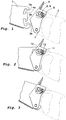
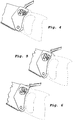
- FIG. 1-9 it is seen in sequence how a blade 1 according to the invention is being fitted in a handle 2 according to the invention, consequently a saw according to the invention being obtained.
- the blade 1 is equipped with a cut out 3 in the end thereof facing the handle, see Figure 1 .
- the cut out 3 is symmetrically shaped, i.e., an upper half 3a of the cut out 3, such as it is seen in the figure, is a mirror image of a lower half 3b.
- the blade 1 is equipped with two side spring tongues 4a, 4b, which are characterized in that they, each one, have an ability to spring somewhat laterally out from the blade 1, i.e., spring substantially perpendicular to the substantial plane of extension of the blade 1.
- the handle 2 is equipped with a fastening device that, in a first embodiment according to the Figures 1-9 , comprises two plates 5 situated at a distance from each other, a rotational body 6 and a second shaft 7.
- the plates 5 are together somewhat movable in relation to the rest of the handle 2 and also in relation to the rest of the fastening device.
- the rotational body 6 consists of a plurality of co-rotating parts and is operated by an actuation device 8, which via a first shaft 9 is connected to the rest of the rotational body 6.
- the shafts 7, 9 extend substantially perpendicular to the substantial plane of extension of the fastening device, i.e., the substantial plane of extension of the plates 5.
- the shafts 7, 9 also extend through the plates 5, the first shaft 9 being mounted with a play in the form of a circumferential opening in a first end of the respective plate 5 (the upper end of the respective plate 5 such as they are shown in the Figures 1-9 ) and the second shaft 7 is mounted with a play in the form of an elongate recess in a second end of the respective plate 5 (the lower end of the respective plate 5 such as they are shown in the Figures 1-9 ).
- the second shaft 7 present on the handle 2 is placed in the lower half 3b of the cut out 3 in the blade 1, see Figure 2 , and then the blade 1 is turned in the substantial plane of extension thereof until the rotational body 6 reaches the bottom in the upper half 3a of the cut out 3, see Figure 3 .
- a locking phase follows, the rotational body 6 being operated by the actuation device 8 in such a way that the free end of the actuation device 8 is pressed in a continuous motion against the handle 2, see the Figures 4-9 .
- the blade will also be pulled further closer to the handle since a finger-like formation 10 of the rotational body 6 co-operates with the correspondingly shaped upper part 3a of the cut out 3 in the blade 1.
- a bulge 11 and a first stop lip 12 On the rotational body 6, there are also, in the present first embodiment, a bulge 11 and a first stop lip 12.
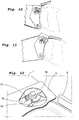
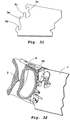
- the bulge 11 reaches the side spring tongue 4a in the position of the rotational body 6 that corresponds to Figure 5 , presses the side spring tongue 4a out/up and passes under the same in the position of the rotational body 6 that corresponds to the Figures 6-8 , and leaves the side spring tongue 4a in the position of the rotational body 6 that corresponds to Figure 9 , in which position the bulge 11 and the stop lip 12 together lock the side spring tongue 4a and thereby the blade in position in the handle. This locked position is seen more clearly in partial enlargement in Figure 12 .
- the bulge 11 has a length in the peripheral direction (i.e., a direction that is substantially perpendicular to a radius through the first shaft 9, which radius is substantially perpendicular to the substantial direction of extension of the first shaft 9) that approximately corresponds to a distance between the side spring tongue 4a and the rest of the blade 1, i.e., the bulge 11 is accommodated with precision in the space between the side spring tongue 4a and the rest of the blade 1.
- the edges of the bulge 11 against the side spring tongue 4a and the rest of the blade 1 are chamfered.
- the edge of the stop lip 12 facing the side spring tongue 4a is, however, not chamfered in order to give the most stable possible locking.
- One of the plates 5 is equipped with a particular driver 13, which makes that the blade in the locked position presses the plates 5 as close to the handle as possible.
- a disassembly of the blade 2 takes place in an analogous way. Additional force is initially required to overcome the resilient force of the side spring tongue 4a when the bulge 11, by the actuation device 8 being spaced apart from the handle 2, is brought to lift the side spring tongue 4a and pass under the same.
- Figure 10 it is seen how the bulge 11 is positioned precisely under the side spring tongue 4a when the actuation device 8 has been spaced apart from the handle 2 into a position that for the fitting phase corresponds to the position according to Figure 7 .
- Blades 1 may be manufactured with different angles between the substantial direction of extension of the cut out 3 in the plane of the blade and the toothed edge of the blade, which blades become suitable for different fields of application. Also the level/position of the cut out 3 on the blade end may be varied, i.e., the cut out 3 may be placed differently far from the toothed edge of the blade.
- the bulge 11 has been replaced by a second stop lip 12b, the blade 1 in the locked position being entirely locked between the stop lips 12, 12b, see Figure 13 .
- a release bulge 11b is present, radially outside the stop lips 12, 12b, that only is used to first lift the side spring tongue 4a so that after that, a stop lip 12b can pass the side spring tongue 4a when disassembling a blade 1.
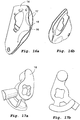
- the release bulge 11b is brought in under the side spring tongue 4a and lifts the same, see Figure 14 , after which further lifting of the actuation device 8 also turns the stop lips 12, 12b and the blade 1 is released, see Figure 15 .
- an insert 14 is seen manufactured from one and the same piece of plate, which insert may be used, i.e., originally be fitted by the manufacturer of the tool, in the space between the plates 5 to allow the use of saw blades of different thicknesses in one and the same handle, as well as to further improve the stability in the retention of the blade locked in the handle.
- the insert 14 is manufactured with an inherent initial stress resulting in a first branch 15 always aiming to keep a certain distance to a second branch 16.
- the insert 14 In the branches 15, 16, there are pressed protuberances 17 that, when the insert 14 is placed in the space between the plates 5, contribute to provide a larger pressure than otherwise from other parts of the insert 14 against a blade 1 that is being fitted and/or is fitted between the branches 15, 16.
- the insert 14 is also somewhat movable in relation to the rest of the handle 2 and also in relation to the rest of the fastening device, i.e., also in relation to the plates 5.
- the motion of the insert 14 between the plates 5 takes place around and/or in relation to said first turning axis 6 in said first end of the fastening device and around and/or in relation to said second turning axis 7 in said second end of the fastening device.
- the insert 14 may be present in constructions according to each one of the described first and second embodiments and is, if so, a part of the fastening device.
- the insert 14 may also be present in a construction where the plates 5 are lacking and the insert 14 accordingly is fitted in a groove directly in the handle 2, walls in this groove exerting the pressure on the insert 14 that otherwise is exerted by the plates 5 at assembly and/or disassembly of blades 1 in the handle 2.
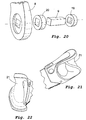
- FIG. 17a and 17b a first part 18 of the rotational body 6 according to said first embodiment of the invention is seen.
- a corresponding first part 19 of the rotational body 6 according to said second embodiment of the invention is seen, also a second part 20 of the rotational body 6 being required, see each one of Figures 19a and 19b .
- the way the parts 19, 20 in principle are placed on the first shaft 9 is seen in the exploded view according to Figure 20 , a part of the actuation device 8 also being seen.
- each one of the parts 19 and 20 is represented by a body having, in comparison with the real bodies, a very simplified design.
- Figure 20 relates to said second embodiment - in said first embodiment, the part 20 is accordingly spared and the part 19 is replaced by the part 18 according to the above stated.
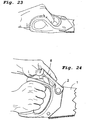
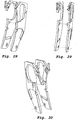
- the handle 2 is ergonomically and asymmetrically shaped and has a first gripping part 21 having a substantial direction of extension that forms an angle ("tilt") of 5-20°, preferably 10-15° and most preferably 12,5° in relation to a substantial plane of extension of the blade 1, see Figures 21-24 .
- Said first gripping part 21 is the one that rests in the palm of the hand when the saw/the handle is gripped. Also all possible angles between a substantial plane of extension of the handle 2 and a substantial plane of extension of the blade 1 may be varied in the production of the handle 2 in order to make sawing as efficient and comfortable as possible.
- the handle 2 shown in Figures 21-24 is made for right-handed persons, but the shape may naturally be mirror-inverted in the manufacture to fit left-handed persons. The size in general may also be varied, such as height, width and so on to fit differently large hands.
- the handle 2 in Figures 21-24 has no plates 5 and neither no insert 14, but the blade 1 here has been fitted detachably directly in the handle 2, here it should be pointed out that the handle, where appropriate after modification regarding the attachment of the blade in accordance with what has been described above, can be used in combination with any one of the embodiments mentioned in this description.
- the handle 2 may also be used in combination with fixedly fitted saw blades, by which it is understood permanently fitted saw blades that cannot be dismounted unless the saw is destroyed and/or seriously damaged, wherein design details that intend to facilitate the exchange of blades naturally can be spared and traditional fastening elements of the type screws, bolts, rivets and/or the like be used instead. Glue or the like may also be used.
- a saw comprising at least one handle 2 and at least one blade 1, the blade 1 being permanently fitted in the handle 2, wherein said handle 2 is ergonomically and asymmetrically shaped and has at least one first gripping part 21 having a substantial direction of extension that forms an angle of 5-20°, preferably 10-15° and most preferably 12,5° in relation to a substantial plane of extension of said blade 1.
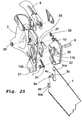
- the handle 2 has a fastening device for the blade 1, which fastening device comprises a rotational body 6, an actuation device 8, a first insert 31, a second insert 32, a second shaft 7, a positioning pin 33 and a first spring 34.
- the rotational body 6, in turn, comprises an eccentric 35, a washer 36, a shaft 9, a second spring 37 and two bearings 38.
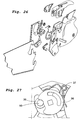
- the blade 1 has three through cut outs 3c, 3d, 3e extending from an edge of the blade, the first cut out having a first recess 3cs having substantially parallel sides, the second cut out having a second recess 3ds having substantially parallel sides, while the third cut out 3e constitutes a third recess 3es.
- the fitting takes place in an analogous way in comparison with the first embodiment of the invention.
- the second shaft 7 of the handle 2 is placed in the second (the lower one in Figure 25 ) cut out 3d in the blade 1, after which the blade 1 is turned in the substantial plane of extension thereof until the eccentric 35 reaches the bottom in the first (the upper one in Figure 25 ) cut out 3c, see also Figure 27 .
- the positioning pin 33 fitted directly to the handle 2 or to the inserts 31, 32 is introduced into the third cut out 3e of the blade 1, and the blade is placed between the two branches of the spring 34.
- a locking phase follows, the rotational body 6 being operated by the actuation device 8 in such a way that the free end of the actuation device 8 is pressed in a continuous motion against the handle 2, involving a turning of the rotational body 6 of at least approx. 90°.
- the blade will also be pulled further closer to the handle since a finger-like formation 10 of the eccentric 35 co-operates with the correspondingly shaped first cut out 3c in the blade 1.
- the finger-like formation 10 rests on the eccentric 35 in the first recess 3cs, the second shaft 7 in the second recess 3ds, and the positioning pin 33 in the third recess 3es.
- the blade 1 also has a side spring tongue 4c.
- a first stop lip 12 and a second stop lip 12b on the eccentric 35 there are, also in the present embodiment, a first stop lip 12 and a second stop lip 12b on the eccentric 35, the side spring tongue 4c in the locked position being entirely locked between the stop lips 12, 12b.
- a release bulge 11b is present on the washer 36, radially outside the stop lips 12, 12b, which release bulge 11b only is used to first lift the side spring tongue 4c so that after that, a stop lip 12b can pass the side spring tongue 4c when disassembling a blade 1.
- the release bulge 11b is brought in under the side spring tongue 4c and lifts the same, after which further lifting of the actuation device 8 also turns the stop lips 12, 12b and the blade 1 is released.
- the second spring 37 may, by the co-operation with a particular rib on the eccentric 35 in the open position of the actuation device 8, contribute to a parking position of the actuation device 8, involving that the blade 1 has to be pulled out of the handle 2 by hand the last bit upon disassembly. In this way, the risk is minimized that the blade 1 in an undesired moment falls freely out of the handle 2.
- the first spring 34 has the general function of exerting a distancing force on the inserts 31, 32 when the same are placed in the handle 2. In this way, the force action from the spring 34 replaces the inherent initial stress that previously has been described in connection with the double-sided insert 14 found in a previously described embodiment of the invention.
- the fastening device When the fastening device is maximally open, i.e., the actuation device 8 entirely open, and no blade 1 is fitted in the handle 2, the distance between the inserts 31, 32 is maximal.
- a blade 1 is being fitted and the actuation device 8 is being closed, i.e., the rotational body 6 is turned in the locking direction, the inserts 31, 32 move further inwards in the handle, their modifiedly conical shape making that the pressure generated by the handle 2 on the inserts 31, 32 increases successively and that thereby the pressure generated by the inserts 31, 32 on the blade 1 increases successively.
- the actuation device 8 has been entirely closed, i.e., the rotational body 6 has been turned maximally, the blade 1 is retained maximally stably and entirely free of play in the handle 2.
- the motion of the inserts 31, 32 in the handle 2 takes place around and/or in relation to said first turning axis 6 in said first end of the fastening device and around and/or in relation to said second turning axis 7 in said second end of the fastening device.
- the thickness of the blade varies between approx. 0,73 mm and approx. 1,15 mm, but is usually approx. 1,0 mm (applies to all embodiments).
- the side spring tongue 4c has a length of approx. 5 mm - approx. 90 mm, preferably approx. 5 mm - approx. 30 mm, and most preferably approx. 21 mm. It has a width of approx. 7 mm - approx. 12 mm, preferably approx. 9 mm - approx. 10 mm, and most preferably approx. 9,7 mm.
- a spring 39 has another design and partly function than the second spring 37 according to preceding embodiment.
- An upper/outer end of the spring 39 affords the actuation device 8, when this is in the closed position, i.e., closest to the handle 2, a snap locking.
- An inner end of the spring 39 affords, like the second spring 37 according to preceding embodiment, the actuation device 8 a parking position by the co-operation with a particular rib on the eccentric 35 in the open position of the actuation device 8, involving that the blade 1 has to be pulled out of the handle 2 by hand the last bit upon disassembly. In this way, the risk is minimized, as mentioned above, that the blade 1 in an undesired moment falls freely out of the handle 2.
- the cut out configuration of the blade 1 is also somewhat altered and is most clearly seen in Figure 39 .
- the blade 1 has three through cut outs 3c, 3d, 3e extending from an edge of the blade, the first cut out 3c having a first recess 3cs having substantially parallel sides, the second cut out 3d having a second recess 3ds having substantially parallel sides, while the third cut out 3e constituting a third recess 3es.
- the placement of the third recess 3es and the area above the same in Figure 39 are, however, somewhat altered in comparison with the preceding embodiment, and therefore, in this case, the third cut out 3e can be regarded as a part of the second cut out 3d.
- a further embodiment of the saw according to the invention is seen.
- a spring 40 has another design and partly function than the spring 39 of preceding embodiment.
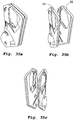
- an insert 32, an eccentric 35, a washer 36 and the spring 40 are seen in exploded view, the shown parts being placed in a position in relation to each other that corresponds to the open position of the actuation device 8.
- the parts assembled together with a blade 1 are seen in Figure 40b .
- the cut out configuration of the blade 1 is also somewhat altered.
- the blade 1 has three through cut outs 3c, 3d, 3e extending from an edge of the blade, the first cut out having a first recess 3cs having substantially parallel sides, the second cut out having a second recess 3ds having substantially parallel sides, while the third cut out 3e constituting a third recess 3es.
- the placement of the third recess 3es and the area above the same are, however, somewhat altered in comparison with the preceding embodiment.
- the third cut out 3e can be regarded as a part of the second cut out 3d.
- Figure 41 a modification of the blade according to Figures 40b and 40d is seen, the active part 41 being more convex in the substantial plane of extension of the blade 1 and accordingly affecting the spring 40 more.
- first turning axis 6 extends substantially perpendicular to the substantial plane of extension of the blade 1.
- the blades are of metal and the inserts most often of plastic, but any other expedient known materials are feasible.
- insert inlaysgg
- insert insats
Landscapes
- Life Sciences & Earth Sciences (AREA)
- Engineering & Computer Science (AREA)
- Mechanical Engineering (AREA)
- Wood Science & Technology (AREA)
- Forests & Forestry (AREA)
- Sawing (AREA)
- Knives (AREA)
- Walking Sticks, Umbrellas, And Fans (AREA)
Claims (18)
- Säge, umfassend mindestens einen Griff (2) und mindestens ein Blatt (1), wobei der Griff (2) mindestens eine Befestigungseinrichtung mit mindestens einem ersten Teil in Form eines Rotationskörpers (6) aufweist, wobei der Rotationskörper (6) um eine erste Drehachse (6) gedreht werden kann, wobei das Blatt (1) vom Griff (2) abnehmbar ist und mindestens eine durchgehende Ausstanzung (3, 3a, 3b, 3c, 3d, 3e) aufweist, die sich von einer Kante des Blatts (1) erstreckt, wobei sich die erste Drehachse (6) durch die mindestens eine Ausstanzung (3, 3a, 3b, 3c, 3d, 3e) erstreckt, wobei ein zweiter Teil der Befestigungseinrichtung in Form eines Einsatzes (14) in Bezug auf den Griff (2) beim Anmontieren und/oder Abmontieren des Blatts (1) an den /von dem Griff (2) bewegbar ist, wobei der Einsatz (14) um und in Bezug auf die erste Drehachse (6) an einem ersten Ende des Einsatzes (14) bewegbar ist und um und in Bezug auf eine zweite Drehachse (7) an einem zweiten Ende des Einsatzes (14) bewegbar ist, dadurch gekennzeichnet, dass der mindestens eine Drehkörper (6) mit mindestens einer Betätigungseinrichtung (8) der Befestigungseinrichtung verbunden ist und durch diese betätigt wird, wobei der Einsatz (14) der Befestigungseinrichtung mindestens eine erste Anlagefläche umfasst, die an einer ersten Seite des Blatts (1) anliegt, und ein dritter Teil der Befestigungseinrichtung in Form eines zweiten Einsatzes mindestens eine zweite Anlagefläche umfasst, die an einer zweiten Seite des Blatts (1) anliegt, wobei die erste und die zweite Anlagefläche das Blatt (1) in dem Griff (2) halten und stabilisieren, wobei der zweite und dritte Teil der Befestigungseinrichtung beim Anmontieren und/oder Abmontieren des Blatts (1) an den /von dem Griff (2) in Bezug auf den Griff (2) bewegbar sind, um das Anmontieren und/oder Abmontieren zu erleichtern, wobei der zweite und dritte Teil um und/oder in Bezug auf die erste Drehachse (6) an einem ersten Ende der jeweiligen Teile und um und/oder in Bezug auf eine zweite Drehachse (7) an einem zweiten Ende der jeweiligen Teile bewegbar sind, wobei die erste und zweite Drehachse im Wesentlichen senkrecht zu einer Hauptausdehnungsebene des Blatts ausgerichtet sind, wobei die erste Drehachse (6) durch den mindestens einen Rotationskörper (6) gebildet wird, und wobei der mindestens eine Rotationskörper (6) mindestens eine fingerartige Ausformung (10) umfasst, die beim Schließen der mindestens einen Betätigungseinrichtung (8) in Verbindung mit dem Einsetzen des Blatts (1) in den Griff (2) mit der mindestens einen Ausstanzung (3, 3a, 3b, 3c, 3d, 3e) in dem Blatt (1) zusammenwirkt und das Blatt (1) in Richtung des Griffs (2) nach innen zwischen zwei druckerzeugende Platten (5) zieht, die den Druck auf den Einsatz (14) allmählich erhöhen und dabei einen Teil des Blatts (1) zwischen der ersten und zweiten Anlagefläche der Befestigungseinrichtung einzieht, während andererseits die fingerähnliche Ausformung (10) beim Öffnen der mindestens einen Betätigungseinrichtung (8) in Verbindung mit dem Abmontieren des Blatts (1) an den /von dem Griff (2) mit der mindestens einen Ausstanzung (3, 3a, 3b, 3c, 3d, 3e) in dem Blatt (1) zusammenwirkt und das Blatt (1) in eine Richtung weg von dem Griff (2) nach außen zwischen die Platten (5) drückt, die allmählich den erzeugten Druck auf den Einsatz (14) verringern und dabei einen Teil des Blatts (1) aus der Position zwischen der ersten und zweiten Anlagefläche der Befestigungseinrichtung drückt.
- Säge nach Anspruch 1, wobei das Blatt (1) mindestens eine seitliche Federzunge (4a, 4b, 4c) aufweist, die zum Federn in eine Richtung gebracht werden kann, die im Wesentlichen senkrecht zur Hauptausdehnungsebene des Blatts (1) ist.
- Säge nach einem der vorhergehenden Ansprüche, wobei der Einsatz (14) der Befestigungseinrichtung allein mindestens eine erste Anlagefläche, die an einer ersten Seite des Blatts (1) anliegt, mindestens eine zweite Anlagefläche, die an einer zweiten Seite des Blatts (1) anliegt, und mindestens eine dritte Anlagefläche umfasst, die an mindestens einer Nut anliegt, die dafür in mindestens einem zusätzlichen Teil (5) der Befestigungseinrichtung oder in dem Griff (2) eingerichtet ist, wobei die erste und zweite Anlagefläche das Blatt (1) in dem Griff (2) halten und stabilisieren.
- Säge nach Anspruch 3, wobei der Einsatz (14) der Befestigungseinrichtung in Bezug auf den Griff (2) beim Anmontieren und/oder Abmontieren des Blatts (1) an den /von dem Griff (2) bewegbar ist, um das Anmontieren und/oder Abmontieren zu erleichtern.
- Säge nach einem der Ansprüche 2-4, wobei die Befestigungseinrichtung mindestens eine Feder aufweist, die beim Öffnen der mindestens einen Betätigungseinrichtung (8) in Verbindung mit dem Abmontieren des Blatts (1) von dem Griff (2) das Blatt (1) in eine Richtung weg von dem Griff (2) drückt.
- Griff (2), der mindestens eine Befestigungseinrichtung mit mindestens einem ersten Teil in Form eines Rotationskörpers (6) ausweist, wobei der Rotationskörper (6) um eine erste Drehachse (6) gedreht werden kann, wobei der Griff mit einem Blatt (1) verbunden werden kann, das mindestens eine durchgehende Ausstanzung (3, 3a, 3b, 3c, 3d, 3e) aufweist, die sich von einer Kante des Blatts (1) erstreckt, und wobei der Rotationskörper (6) dazu bestimmt ist, mit der Ausstanzung (3, 3a, 3b, 3c, 3d, 3e) zusammenzuwirken, wobei der Rotationskörper (6) um mindestens ungefähr 90° um die erste Drehachse (6) gedreht werden kann, wobei ein zweiter Teil der Befestigungseinrichtung in Form eines Einsatzes (14) in Bezug auf den Griff (2) beim Anmontieren und/oder Abmontieren des Blatts (1) an den /von dem Griff (2) bewegbar ist, wobei der Einsatz (14) um und in Bezug auf die erste Drehachse (6) an einem ersten Ende des Einsatzes (14) bewegbar ist und um und in Bezug auf eine zweite Drehachse (7) an einem zweiten Ende des Einsatzes (14) bewegbar ist, dadurch gekennzeichnet, dass der mindestens eine Drehkörper (6) mit mindestens einer Betätigungseinrichtung (8) der Befestigungseinrichtung verbunden ist und durch diese betätigt wird, wobei der Einsatz der Befestigungseinrichtung mindestens eine erste Anlagefläche umfasst, die an einer ersten Seite des Blatts (1) anliegt, und ein dritter Teil der Befestigungseinrichtung in Form eines zweiten Einsatzes mindestens eine zweite Anlagefläche umfasst, die an einer zweiten Seite des Blatts (1) anliegt, wobei die erste und zweite Anlagefläche dazu bestimmt sind, das Blatt (1) in dem Griff (2) zu halten und zu stabilisieren, wobei der erste und zweite Einsatz in Bezug auf den Griff (2) beim Anmontieren und/oder Abmontieren des Blatts (1) an den /von dem Griff bewegbar sind, um das Anmontieren und/oder Abmontieren zu erleichtern, wobei der zweite und dritte Teil um und/oder in Bezug auf die erste Drehachse (6) in einem ersten Ende der jeweiligen Teile und um und/oder in Bezug auf eine zweite Drehachse (7) in einem zweiten Ende der jeweiligen Teile bewegbar sind, wobei die erste und zweite Drehachse im Wesentlichen senkrecht zu einer Hauptausdehnungsebene des Blatts ausgerichtet sind, wobei die erste Drehachse (6) durch den mindestens einen Rotationskörper (6) gebildet wird, und wobei der mindestens eine Rotationskörper (6) mindestens eine fingerartige Ausformung (10) umfasst, die beim Schließen der mindestens einen Betätigungseinrichtung (8) in Verbindung mit dem Einsetzen des Blatts (1) in den Griff (2) dazu bestimmt ist, mit der mindestens einen Ausstanzung (3, 3a, 3b, 3c, 3d, 3e) in dem Blatt (1) zusammenzuwirken und das Blatt (1) in Richtung des Griffs (2) nach innen zwischen zwei druckerzeugende Platten (5) zu ziehen, die den Druck auf den Einsatz (14) allmählich erhöhen und dabei einen Teil des Blatts (1) zwischen der ersten und zweiten Anlagefläche der Befestigungseinrichtung einzuziehen, während andererseits die fingerähnliche Ausformung (10) beim Öffnen der mindestens einen Betätigungseinrichtung (8) in Verbindung mit dem Abmontieren des Blatts (1) von dem Griff (2) dazu bestimmt ist, mit der mindestens einen Ausstanzung (3, 3a, 3b) in dem Blatt (1) zusammenzuwirken und das Blatt (1) in eine Richtung weg von dem Griff (2) nach außen zwischen die Platten (5) zu drücken, die allmählich den erzeugten Druck auf den Einsatz (14) verringern und dabei einen Teil des Blatts (1) aus der Position zwischen der ersten und zweiten Anlagefläche der Befestigungseinrichtung zu drücken.
- Griff (2) nach Anspruch 6, wobei die Betätigungseinrichtung (8) die Form eines länglichen Arms (8) aufweist, der mit dem Rotationskörper (6) an einem Ende des länglichen Arms (8) verbunden ist.
- Griff (2) nach einem der Ansprüche 6-7, wobei der Einsatz (14) der Befestigungseinrichtung allein mindestens eine erste Anlagefläche zur Anlage an einer ersten Seite des Blatts (1), mindestens eine zweite Anlagefläche zur Anlage an einer zweiten Seite des Blatts (1) und mindestens eine dritte Anlagefläche umfasst, die an mindestens einer Nut anliegt, die dafür in mindestens einem zusätzlichen Teil (5) der Befestigungseinrichtung oder in dem Griff (2) eingerichtet ist, wobei die erste und zweite Anlagefläche dazu bestimmt sind, das Blatt (1) in dem Griff (2) zu halten und zu stabilisieren.
- Griff (2) nach Anspruch 8, wobei der Einsatz (14) in Bezug auf den Griff (2) beim Anmontieren und/oder Abmontieren des Blatts (1) an den/von dem Griff bewegbar ist, um das Anmontieren und/oder Abmontieren zu erleichtern.
- Griff (2) nach einem der Ansprüche 6-9, wobei die Befestigungseinrichtung mindestens eine Feder aufweist, die beim Öffnen der mindestens einen Betätigungseinrichtung (8) in Verbindung mit dem Abmontieren des Blatts (1) von dem Griff (2) das Blatt (1) in eine Richtung weg von dem Griff (2) drückt.
- Blatt (1), das mit einem Griff (2) verbindbar ist, wobei der Griff (2) mindestens eine Befestigungseinrichtung mit mindestens einem ersten Teil in Form eines Rotationskörpers (6) aufweist, wobei der Rotationskörper (6) um eine erste Drehachse (6) gedreht werden kann, wobei das Blatt (1) mindestens eine durchgehende Ausstanzung (3, 3a, 3b, 3c, 3d, 3e) aufweist, die sich von einer Kante des Blatts (1) erstreckt, und wobei die Ausstanzung (3, 3a, 3b, 3c, 3d, 3e) dazu bestimmt ist, mit dem Rotationskörper (6) zusammenzuwirken und dass die mindestens eine Ausstanzung (3, 3a, 3b, 3c, 3d, 3e) mindestens eine erste Ausnehmung (3cs, 3ds, 3es) aufweist, die im Wesentlichen parallele Seiten aufweist, und die dazu bestimmt ist, mit einer fingerähnlichen Ausformung (10) des Rotationskörpers (6) zusammenzuwirken, um das Blatt näher an den Griff zu ziehen, wenn das Blatt in dem Griff arretiert wird, und dass die mindestens eine Ausstanzung (3, 3a, 3b, 3c, 3d, 3e) mindestens eine zweite Ausnehmung aufweist, die im Wesentlichen parallele Seiten aufweist, und dass die mindestens eine Ausstanzung (3, 3a, 3b, 3c, 3d, 3e) mindestens eine dritte Ausnehmung aufweist, die im Wesentlichen parallele Seiten aufweist, dadurch gekennzeichnet, dass mindestens eine seitliche Federzunge (4a, 4b, 4c), die zum Federn in eine Richtung gebracht werden kann, die im Wesentlichen senkrecht zur Hauptausdehnungsebene des Blatts (1) ist, in der Kante des Blatts (1) bereitgestellt wird.
- Blatt (1) nach Anspruch 11, wobei die seitliche Federzunge (4a, 4b, 4c) eine Hauptausdehnungsrichtung in einer Hauptausdehnungsebene des Blatts (1) aufweist, die sich von einer Hauptausdehnungsrichtung der ersten Ausnehmung um ungefähr 0-45°, bevorzugt um ungefähr 0-22,5° und am meisten bevorzugt um ungefähr 10° unterscheidet.
- Blatt (1) nach einem der Ansprüche 11-12, wobei die mindestens eine Ausstanzung (3, 3a, 3b, 3c, 3d, 3e) in einer Hauptausdehnungsebene des Blatts (1) symmetrisch ist und an einem ersten Ende des Blatts (1) liegt, wobei das Blatt (1) auf zwei Arten eingesetzt werden kann und entsprechend im Griff (2) umdrehbar ist.
- Blatt (1) nach Anspruch 13, wobei die mindestens eine Ausstanzung (3, 3a, 3b) in Bezug auf eine gerade Linie symmetrisch ist, die parallel zur Zahnkante des Blatts (1) ist, wobei das Blatt (1) einen ersten Winkel mit dem Griff (2) in der Hauptausdehnungsebene der Säge bildet, wenn das Blatt (1) auf eine erste Art in den Griff (2) eingesetzt ist, um im Wesentlichen nach unten zu sägen, und einen zweiten Winkel mit dem Griff (2) in der Hauptausdehnungsebene der Säge bildet, wenn das Blatt (1) auf eine zweite Art in den Griff (2) eingesetzt ist, um im Wesentlichen nach oben zu sägen, wobei der erste und zweite Winkel gleich groß sind.
- Blatt (1) nach Anspruch 13, wobei die mindestens eine Ausstanzung (3, 3a, 3b, 3c, 3d, 3e) in Bezug auf eine gerade Linie symmetrisch ist, die zur Zahnkante des Blatts (1) nicht parallel ist, wobei das Blatt (1) einen ersten Winkel mit dem Griff (2) in der Hauptausdehnungsebene der Säge bildet, wenn das Blatt (1) auf eine erste Art in den Griff (2) eingesetzt ist, um im Wesentlichen nach unten zu sägen, und einen zweiten Winkel mit dem Griff (2) in der Hauptausdehnungsebene der Säge bildet, wenn das Blatt (1) auf eine zweite Art in den Griff (2) eingesetzt ist, um im Wesentlichen nach oben zu sägen, wobei der erste und zweite Winkel unterschiedlich groß sind.
- Blatt (1) nach Anspruch 13, wobei die mindestens eine Ausstanzung (3, 3a, 3b, 3c, 3d, 3e) in einer Hauptausdehnungsebene des Blatts (1) unsymmetrisch ist und an einem ersten Ende des Blatts (1) liegt.
- Blatt (1) nach einem der Ansprüche 11-12, wobei die erste Ausnehmung am nächsten an einer ersten langen Seite des Blatts angeordnet ist, wobei die zweite Ausnehmung am nächsten an einer zweiten langen Seite des Blatts angeordnet ist, und wobei die dritte Ausnehmung zwischen der ersten Ausnehmung und der zweiten Ausnehmung angeordnet ist.
- Blatt (1) nach Anspruch 11, wobei die seitliche Federzunge (4a, 4b, 4c) zwischen der ersten Ausnehmung und der dritten Ausnehmung des Blatts (1) angeordnet ist.
Applications Claiming Priority (3)
| Application Number | Priority Date | Filing Date | Title |
|---|---|---|---|
| SE0602684A SE0602684A0 (sv) | 2006-12-11 | 2006-12-11 | Såg, handtag och blad |
| US87425806P | 2006-12-12 | 2006-12-12 | |
| PCT/SE2007/050973 WO2008082348A1 (en) | 2006-12-11 | 2007-12-11 | Saw, handle and blade |
Publications (3)
| Publication Number | Publication Date |
|---|---|
| EP2091703A1 EP2091703A1 (de) | 2009-08-26 |
| EP2091703A4 EP2091703A4 (de) | 2014-04-09 |
| EP2091703B1 true EP2091703B1 (de) | 2018-03-21 |
Family
ID=39588870
Family Applications (1)
| Application Number | Title | Priority Date | Filing Date |
|---|---|---|---|
| EP07852245.5A Active EP2091703B1 (de) | 2006-12-11 | 2007-12-11 | Säge, griff und schneide |
Country Status (11)
| Country | Link |
|---|---|
| US (1) | US20100018065A1 (de) |
| EP (1) | EP2091703B1 (de) |
| CN (2) | CN102259354B (de) |
| AR (1) | AR064224A1 (de) |
| AU (1) | AU2007339473B2 (de) |
| DK (1) | DK2091703T3 (de) |
| NO (1) | NO343408B1 (de) |
| RU (1) | RU2449886C2 (de) |
| SE (1) | SE0602684A0 (de) |
| TW (1) | TWI520800B (de) |
| WO (1) | WO2008082348A1 (de) |
Families Citing this family (8)
| Publication number | Priority date | Publication date | Assignee | Title |
|---|---|---|---|---|
| US8312632B2 (en) * | 2008-08-05 | 2012-11-20 | Stanley Black & Decker, Inc. | Saw blade handle with replaceable blades |
| EP2266742B1 (de) * | 2009-06-23 | 2015-04-29 | Milwaukee Electric Tool Corporation | Handsäge |
| US8613146B2 (en) * | 2009-09-16 | 2013-12-24 | Milwaukee Electric Tool Corporation | Compact hacksaw |
| WO2015195615A1 (en) * | 2014-06-16 | 2015-12-23 | Robert Bosch Gmbh | Blade and blade attachment system for an oscillating tool |
| US9925605B2 (en) * | 2015-09-24 | 2018-03-27 | Kuang Pin Wang | Assembly of saw handle and saw member |
| JP6543655B2 (ja) * | 2017-05-24 | 2019-07-10 | 株式会社高儀 | 替刃式鋸 |
| US11529693B2 (en) | 2020-03-17 | 2022-12-20 | Blims AS | Segmented saw |
| GB2619364B (en) * | 2022-09-09 | 2024-05-29 | Apache Ltd | A handle for a saw and a saw comprising the same |
Family Cites Families (23)
| Publication number | Priority date | Publication date | Assignee | Title |
|---|---|---|---|---|
| US238758A (en) * | 1881-03-15 | William e | ||
| US601480A (en) * | 1898-03-29 | Handsaw | ||
| US785459A (en) * | 1904-09-19 | 1905-03-21 | John Weiler | Detachable handle for handsaws. |
| US1301522A (en) * | 1918-04-29 | 1919-04-22 | William B Sullivan | Removable saw-handle. |
| US1362676A (en) * | 1919-08-28 | 1920-12-21 | William T Conway | Saw |
| US1405925A (en) | 1921-02-28 | 1922-02-07 | Larson Charles | Saw handle and blade connection |
| US1543512A (en) * | 1924-10-28 | 1925-06-23 | Henry O Noyes | Hack saw |
| US2140496A (en) * | 1936-05-11 | 1938-12-20 | John S Coleman | Saw construction |
| US2321223A (en) * | 1942-05-02 | 1943-06-08 | Loughlin Alphonse | Saw handle |
| US2319176A (en) * | 1942-12-18 | 1943-05-11 | John B Wright | Saw |
| JPS55151501U (de) * | 1979-04-17 | 1980-10-31 | ||
| US4425709A (en) * | 1981-12-21 | 1984-01-17 | Phil Quenzi | Pocket tool |
| SU1569237A1 (ru) * | 1986-10-21 | 1990-06-07 | А. X. Гении и А. М. Пинхасик | Ручна пила по дереву |
| CN2138019Y (zh) * | 1992-10-04 | 1993-07-14 | 郭湘泗 | 折叠锯 |
| US5979065A (en) * | 1998-06-11 | 1999-11-09 | Hsu; An-Sun | Handle assembly for a foldable saw |
| JP2000326303A (ja) * | 1999-05-20 | 2000-11-28 | Takagi:Kk | 刃板着脱構造 |
| JP2002067002A (ja) * | 2000-09-01 | 2002-03-05 | Koji Takeuchi | 押挽き鋸 |
| US6516525B2 (en) * | 2001-07-02 | 2003-02-11 | Chin-Pao Liu | Handsaw |
| JP2005119253A (ja) * | 2003-10-16 | 2005-05-12 | Yuum Kogyo:Kk | 鋸身の強度を保持した研磨加工による胴付用鋸刃 |
| US7065885B1 (en) * | 2004-11-29 | 2006-06-27 | King Jaws Metal Co., Ltd. | Handsaw having replaceable blade |
| US7325314B1 (en) * | 2005-03-15 | 2008-02-05 | King Jaws Metal Co., Ltd. | Handsaw having replaceable blade |
| DE202005008995U1 (de) | 2005-06-08 | 2005-08-25 | King Jaws Metal Co., Ltd., Hua Tan | Handsäge mit austauschbarem Blatt |
| RU2279344C1 (ru) * | 2005-06-24 | 2006-07-10 | Закрытое акционерное общество "Корпорация "МАСТЕРНЭТ" | Ручная пила |
-
2006
- 2006-12-11 SE SE0602684A patent/SE0602684A0/sv unknown
-
2007
- 2007-12-11 RU RU2009119920/02A patent/RU2449886C2/ru not_active IP Right Cessation
- 2007-12-11 AR ARP070105528A patent/AR064224A1/es unknown
- 2007-12-11 TW TW096147161A patent/TWI520800B/zh not_active IP Right Cessation
- 2007-12-11 CN CN201110227480.1A patent/CN102259354B/zh not_active Expired - Fee Related
- 2007-12-11 AU AU2007339473A patent/AU2007339473B2/en not_active Ceased
- 2007-12-11 US US12/518,657 patent/US20100018065A1/en not_active Abandoned
- 2007-12-11 WO PCT/SE2007/050973 patent/WO2008082348A1/en not_active Ceased
- 2007-12-11 EP EP07852245.5A patent/EP2091703B1/de active Active
- 2007-12-11 DK DK07852245.5T patent/DK2091703T3/en active
- 2007-12-11 CN CN200780045886XA patent/CN101557912B/zh not_active Expired - Fee Related
-
2009
- 2009-05-19 NO NO20091937A patent/NO343408B1/no unknown
Non-Patent Citations (1)
| Title |
|---|
| None * |
Also Published As
| Publication number | Publication date |
|---|---|
| SE0602684A0 (sv) | 2009-02-25 |
| CN102259354A (zh) | 2011-11-30 |
| RU2449886C2 (ru) | 2012-05-10 |
| WO2008082348A1 (en) | 2008-07-10 |
| AU2007339473A1 (en) | 2008-07-10 |
| US20100018065A1 (en) | 2010-01-28 |
| NO20091937L (no) | 2009-09-04 |
| CN101557912B (zh) | 2013-05-01 |
| SE0602684L (de) | 2009-02-25 |
| TWI520800B (zh) | 2016-02-11 |
| AR064224A1 (es) | 2009-03-18 |
| TW200840670A (en) | 2008-10-16 |
| CN102259354B (zh) | 2015-07-01 |
| RU2009119920A (ru) | 2011-01-20 |
| EP2091703A1 (de) | 2009-08-26 |
| DK2091703T3 (en) | 2018-05-28 |
| AU2007339473B2 (en) | 2014-01-09 |
| CN101557912A (zh) | 2009-10-14 |
| EP2091703A4 (de) | 2014-04-09 |
| NO343408B1 (no) | 2019-02-25 |
Similar Documents
| Publication | Publication Date | Title |
|---|---|---|
| EP2091703B1 (de) | Säge, griff und schneide | |
| CN112292240B (zh) | 折叠刀 | |
| US7712399B2 (en) | Tool and associated bit driver | |
| EP2266742B1 (de) | Handsäge | |
| US7305768B2 (en) | Locking mechanism for folding tool | |
| US11904450B2 (en) | Multi-function pliers | |
| US20250050518A1 (en) | Bolt Cutter | |
| CN109152334B (zh) | 齿轮传动的手动工具 | |
| US10265841B2 (en) | Multi-function tool | |
| CN121290325A (zh) | 折叠工具 | |
| CN105500407A (zh) | 具有锁定机构的折叠刀 | |
| US20160184999A1 (en) | Utility knife with pivoting head assembly | |
| CN111315547B (zh) | 多功能刀刀片保持机构 | |
| EP4101607B1 (de) | Schwenkbare rampenförmige klingenverriegelung | |
| US20250222626A1 (en) | Adjustable tile nipper | |
| HK40010232B (zh) | 具有锁定机构的折叠刀 | |
| JP6486203B2 (ja) | 手動利器 | |
| HK1223592B (zh) | 具有锁定机构的折叠刀 | |
| HK1123255A1 (zh) | 折疊工具 |
Legal Events
| Date | Code | Title | Description |
|---|---|---|---|
| PUAI | Public reference made under article 153(3) epc to a published international application that has entered the european phase |
Free format text: ORIGINAL CODE: 0009012 |
|
| 17P | Request for examination filed |
Effective date: 20090605 |
|
| AK | Designated contracting states |
Kind code of ref document: A1 Designated state(s): AT BE BG CH CY CZ DE DK EE ES FI FR GB GR HU IE IS IT LI LT LU LV MC MT NL PL PT RO SE SI SK TR |
|
| DAX | Request for extension of the european patent (deleted) | ||
| A4 | Supplementary search report drawn up and despatched |
Effective date: 20140312 |
|
| RIC1 | Information provided on ipc code assigned before grant |
Ipc: B27B 21/00 20060101AFI20140306BHEP Ipc: B27B 33/10 20060101ALI20140306BHEP Ipc: B23D 61/12 20060101ALI20140306BHEP |
|
| 17Q | First examination report despatched |
Effective date: 20160817 |
|
| GRAP | Despatch of communication of intention to grant a patent |
Free format text: ORIGINAL CODE: EPIDOSNIGR1 |
|
| GRAJ | Information related to disapproval of communication of intention to grant by the applicant or resumption of examination proceedings by the epo deleted |
Free format text: ORIGINAL CODE: EPIDOSDIGR1 |
|
| GRAP | Despatch of communication of intention to grant a patent |
Free format text: ORIGINAL CODE: EPIDOSNIGR1 |
|
| INTG | Intention to grant announced |
Effective date: 20171106 |
|
| INTG | Intention to grant announced |
Effective date: 20171114 |
|
| GRAS | Grant fee paid |
Free format text: ORIGINAL CODE: EPIDOSNIGR3 |
|
| GRAA | (expected) grant |
Free format text: ORIGINAL CODE: 0009210 |
|
| AK | Designated contracting states |
Kind code of ref document: B1 Designated state(s): AT BE BG CH CY CZ DE DK EE ES FI FR GB GR HU IE IS IT LI LT LU LV MC MT NL PL PT RO SE SI SK TR |
|
| REG | Reference to a national code |
Ref country code: GB Ref legal event code: FG4D |
|
| REG | Reference to a national code |
Ref country code: CH Ref legal event code: EP |
|
| REG | Reference to a national code |
Ref country code: AT Ref legal event code: REF Ref document number: 980604 Country of ref document: AT Kind code of ref document: T Effective date: 20180415 |
|
| REG | Reference to a national code |
Ref country code: IE Ref legal event code: FG4D |
|
| REG | Reference to a national code |
Ref country code: DE Ref legal event code: R096 Ref document number: 602007054323 Country of ref document: DE |
|
| REG | Reference to a national code |
Ref country code: SE Ref legal event code: TRGR |
|
| REG | Reference to a national code |
Ref country code: DK Ref legal event code: T3 Effective date: 20180522 |
|
| REG | Reference to a national code |
Ref country code: NL Ref legal event code: FP |
|
| PG25 | Lapsed in a contracting state [announced via postgrant information from national office to epo] |
Ref country code: LT Free format text: LAPSE BECAUSE OF FAILURE TO SUBMIT A TRANSLATION OF THE DESCRIPTION OR TO PAY THE FEE WITHIN THE PRESCRIBED TIME-LIMIT Effective date: 20180321 Ref country code: CY Free format text: LAPSE BECAUSE OF FAILURE TO SUBMIT A TRANSLATION OF THE DESCRIPTION OR TO PAY THE FEE WITHIN THE PRESCRIBED TIME-LIMIT Effective date: 20180321 Ref country code: FI Free format text: LAPSE BECAUSE OF FAILURE TO SUBMIT A TRANSLATION OF THE DESCRIPTION OR TO PAY THE FEE WITHIN THE PRESCRIBED TIME-LIMIT Effective date: 20180321 |
|
| REG | Reference to a national code |
Ref country code: LT Ref legal event code: MG4D |
|
| REG | Reference to a national code |
Ref country code: AT Ref legal event code: MK05 Ref document number: 980604 Country of ref document: AT Kind code of ref document: T Effective date: 20180321 |
|
| PG25 | Lapsed in a contracting state [announced via postgrant information from national office to epo] |
Ref country code: BG Free format text: LAPSE BECAUSE OF FAILURE TO SUBMIT A TRANSLATION OF THE DESCRIPTION OR TO PAY THE FEE WITHIN THE PRESCRIBED TIME-LIMIT Effective date: 20180621 Ref country code: GR Free format text: LAPSE BECAUSE OF FAILURE TO SUBMIT A TRANSLATION OF THE DESCRIPTION OR TO PAY THE FEE WITHIN THE PRESCRIBED TIME-LIMIT Effective date: 20180622 Ref country code: LV Free format text: LAPSE BECAUSE OF FAILURE TO SUBMIT A TRANSLATION OF THE DESCRIPTION OR TO PAY THE FEE WITHIN THE PRESCRIBED TIME-LIMIT Effective date: 20180321 |
|
| PG25 | Lapsed in a contracting state [announced via postgrant information from national office to epo] |
Ref country code: PL Free format text: LAPSE BECAUSE OF FAILURE TO SUBMIT A TRANSLATION OF THE DESCRIPTION OR TO PAY THE FEE WITHIN THE PRESCRIBED TIME-LIMIT Effective date: 20180321 Ref country code: EE Free format text: LAPSE BECAUSE OF FAILURE TO SUBMIT A TRANSLATION OF THE DESCRIPTION OR TO PAY THE FEE WITHIN THE PRESCRIBED TIME-LIMIT Effective date: 20180321 Ref country code: IT Free format text: LAPSE BECAUSE OF FAILURE TO SUBMIT A TRANSLATION OF THE DESCRIPTION OR TO PAY THE FEE WITHIN THE PRESCRIBED TIME-LIMIT Effective date: 20180321 Ref country code: RO Free format text: LAPSE BECAUSE OF FAILURE TO SUBMIT A TRANSLATION OF THE DESCRIPTION OR TO PAY THE FEE WITHIN THE PRESCRIBED TIME-LIMIT Effective date: 20180321 Ref country code: ES Free format text: LAPSE BECAUSE OF FAILURE TO SUBMIT A TRANSLATION OF THE DESCRIPTION OR TO PAY THE FEE WITHIN THE PRESCRIBED TIME-LIMIT Effective date: 20180321 |
|
| PG25 | Lapsed in a contracting state [announced via postgrant information from national office to epo] |
Ref country code: AT Free format text: LAPSE BECAUSE OF FAILURE TO SUBMIT A TRANSLATION OF THE DESCRIPTION OR TO PAY THE FEE WITHIN THE PRESCRIBED TIME-LIMIT Effective date: 20180321 Ref country code: CZ Free format text: LAPSE BECAUSE OF FAILURE TO SUBMIT A TRANSLATION OF THE DESCRIPTION OR TO PAY THE FEE WITHIN THE PRESCRIBED TIME-LIMIT Effective date: 20180321 Ref country code: SK Free format text: LAPSE BECAUSE OF FAILURE TO SUBMIT A TRANSLATION OF THE DESCRIPTION OR TO PAY THE FEE WITHIN THE PRESCRIBED TIME-LIMIT Effective date: 20180321 |
|
| PG25 | Lapsed in a contracting state [announced via postgrant information from national office to epo] |
Ref country code: PT Free format text: LAPSE BECAUSE OF FAILURE TO SUBMIT A TRANSLATION OF THE DESCRIPTION OR TO PAY THE FEE WITHIN THE PRESCRIBED TIME-LIMIT Effective date: 20180723 |
|
| REG | Reference to a national code |
Ref country code: DE Ref legal event code: R097 Ref document number: 602007054323 Country of ref document: DE |
|
| PLBE | No opposition filed within time limit |
Free format text: ORIGINAL CODE: 0009261 |
|
| STAA | Information on the status of an ep patent application or granted ep patent |
Free format text: STATUS: NO OPPOSITION FILED WITHIN TIME LIMIT |
|
| 26N | No opposition filed |
Effective date: 20190102 |
|
| PG25 | Lapsed in a contracting state [announced via postgrant information from national office to epo] |
Ref country code: SI Free format text: LAPSE BECAUSE OF FAILURE TO SUBMIT A TRANSLATION OF THE DESCRIPTION OR TO PAY THE FEE WITHIN THE PRESCRIBED TIME-LIMIT Effective date: 20180321 |
|
| REG | Reference to a national code |
Ref country code: CH Ref legal event code: PL |
|
| PG25 | Lapsed in a contracting state [announced via postgrant information from national office to epo] |
Ref country code: MC Free format text: LAPSE BECAUSE OF FAILURE TO SUBMIT A TRANSLATION OF THE DESCRIPTION OR TO PAY THE FEE WITHIN THE PRESCRIBED TIME-LIMIT Effective date: 20180321 Ref country code: LU Free format text: LAPSE BECAUSE OF NON-PAYMENT OF DUE FEES Effective date: 20181211 |
|
| REG | Reference to a national code |
Ref country code: IE Ref legal event code: MM4A |
|
| REG | Reference to a national code |
Ref country code: BE Ref legal event code: MM Effective date: 20181231 |
|
| PG25 | Lapsed in a contracting state [announced via postgrant information from national office to epo] |
Ref country code: IE Free format text: LAPSE BECAUSE OF NON-PAYMENT OF DUE FEES Effective date: 20181211 |
|
| PG25 | Lapsed in a contracting state [announced via postgrant information from national office to epo] |
Ref country code: BE Free format text: LAPSE BECAUSE OF NON-PAYMENT OF DUE FEES Effective date: 20181231 |
|
| PG25 | Lapsed in a contracting state [announced via postgrant information from national office to epo] |
Ref country code: CH Free format text: LAPSE BECAUSE OF NON-PAYMENT OF DUE FEES Effective date: 20181231 Ref country code: LI Free format text: LAPSE BECAUSE OF NON-PAYMENT OF DUE FEES Effective date: 20181231 |
|
| PG25 | Lapsed in a contracting state [announced via postgrant information from national office to epo] |
Ref country code: MT Free format text: LAPSE BECAUSE OF NON-PAYMENT OF DUE FEES Effective date: 20181211 |
|
| PG25 | Lapsed in a contracting state [announced via postgrant information from national office to epo] |
Ref country code: TR Free format text: LAPSE BECAUSE OF FAILURE TO SUBMIT A TRANSLATION OF THE DESCRIPTION OR TO PAY THE FEE WITHIN THE PRESCRIBED TIME-LIMIT Effective date: 20180321 |
|
| PG25 | Lapsed in a contracting state [announced via postgrant information from national office to epo] |
Ref country code: HU Free format text: LAPSE BECAUSE OF FAILURE TO SUBMIT A TRANSLATION OF THE DESCRIPTION OR TO PAY THE FEE WITHIN THE PRESCRIBED TIME-LIMIT; INVALID AB INITIO Effective date: 20071211 |
|
| PG25 | Lapsed in a contracting state [announced via postgrant information from national office to epo] |
Ref country code: IS Free format text: LAPSE BECAUSE OF FAILURE TO SUBMIT A TRANSLATION OF THE DESCRIPTION OR TO PAY THE FEE WITHIN THE PRESCRIBED TIME-LIMIT Effective date: 20180721 |
|
| PGFP | Annual fee paid to national office [announced via postgrant information from national office to epo] |
Ref country code: NL Payment date: 20221214 Year of fee payment: 16 Ref country code: GB Payment date: 20221216 Year of fee payment: 16 Ref country code: FR Payment date: 20221214 Year of fee payment: 16 Ref country code: DK Payment date: 20221215 Year of fee payment: 16 Ref country code: DE Payment date: 20221219 Year of fee payment: 16 |
|
| P01 | Opt-out of the competence of the unified patent court (upc) registered |
Effective date: 20230321 |
|
| REG | Reference to a national code |
Ref country code: DE Ref legal event code: R119 Ref document number: 602007054323 Country of ref document: DE |
|
| REG | Reference to a national code |
Ref country code: DK Ref legal event code: EBP Effective date: 20231231 |
|
| REG | Reference to a national code |
Ref country code: NL Ref legal event code: MM Effective date: 20240101 |
|
| GBPC | Gb: european patent ceased through non-payment of renewal fee |
Effective date: 20231211 |
|
| PG25 | Lapsed in a contracting state [announced via postgrant information from national office to epo] |
Ref country code: NL Free format text: LAPSE BECAUSE OF NON-PAYMENT OF DUE FEES Effective date: 20240101 |
|
| PG25 | Lapsed in a contracting state [announced via postgrant information from national office to epo] |
Ref country code: NL Free format text: LAPSE BECAUSE OF NON-PAYMENT OF DUE FEES Effective date: 20240101 |
|
| PG25 | Lapsed in a contracting state [announced via postgrant information from national office to epo] |
Ref country code: DE Free format text: LAPSE BECAUSE OF NON-PAYMENT OF DUE FEES Effective date: 20240702 |
|
| PG25 | Lapsed in a contracting state [announced via postgrant information from national office to epo] |
Ref country code: GB Free format text: LAPSE BECAUSE OF NON-PAYMENT OF DUE FEES Effective date: 20231211 |
|
| PG25 | Lapsed in a contracting state [announced via postgrant information from national office to epo] |
Ref country code: FR Free format text: LAPSE BECAUSE OF NON-PAYMENT OF DUE FEES Effective date: 20231231 |
|
| PG25 | Lapsed in a contracting state [announced via postgrant information from national office to epo] |
Ref country code: GB Free format text: LAPSE BECAUSE OF NON-PAYMENT OF DUE FEES Effective date: 20231211 Ref country code: FR Free format text: LAPSE BECAUSE OF NON-PAYMENT OF DUE FEES Effective date: 20231231 Ref country code: DE Free format text: LAPSE BECAUSE OF NON-PAYMENT OF DUE FEES Effective date: 20240702 |
|
| PG25 | Lapsed in a contracting state [announced via postgrant information from national office to epo] |
Ref country code: DK Free format text: LAPSE BECAUSE OF NON-PAYMENT OF DUE FEES Effective date: 20231231 |
|
| PG25 | Lapsed in a contracting state [announced via postgrant information from national office to epo] |
Ref country code: DK Free format text: LAPSE BECAUSE OF NON-PAYMENT OF DUE FEES Effective date: 20231231 |
|
| PGFP | Annual fee paid to national office [announced via postgrant information from national office to epo] |
Ref country code: SE Payment date: 20251219 Year of fee payment: 19 |