EP2092424B1 - Finden von sicherheitsanfälligkeiten in quellcode - Google Patents
Finden von sicherheitsanfälligkeiten in quellcode Download PDFInfo
- Publication number
- EP2092424B1 EP2092424B1 EP07827207.7A EP07827207A EP2092424B1 EP 2092424 B1 EP2092424 B1 EP 2092424B1 EP 07827207 A EP07827207 A EP 07827207A EP 2092424 B1 EP2092424 B1 EP 2092424B1
- Authority
- EP
- European Patent Office
- Prior art keywords
- node
- source code
- data flow
- graph
- flow graph
- Prior art date
- Legal status (The legal status is an assumption and is not a legal conclusion. Google has not performed a legal analysis and makes no representation as to the accuracy of the status listed.)
- Active
Links
Images




Classifications
-
- G—PHYSICS
- G06—COMPUTING OR CALCULATING; COUNTING
- G06F—ELECTRIC DIGITAL DATA PROCESSING
- G06F8/00—Arrangements for software engineering
- G06F8/40—Transformation of program code
- G06F8/41—Compilation
- G06F8/43—Checking; Contextual analysis
- G06F8/433—Dependency analysis; Data or control flow analysis
-
- G—PHYSICS
- G06—COMPUTING OR CALCULATING; COUNTING
- G06F—ELECTRIC DIGITAL DATA PROCESSING
- G06F16/00—Information retrieval; Database structures therefor; File system structures therefor
- G06F16/20—Information retrieval; Database structures therefor; File system structures therefor of structured data, e.g. relational data
- G06F16/24—Querying
- G06F16/245—Query processing
-
- G—PHYSICS
- G06—COMPUTING OR CALCULATING; COUNTING
- G06F—ELECTRIC DIGITAL DATA PROCESSING
- G06F16/00—Information retrieval; Database structures therefor; File system structures therefor
- G06F16/20—Information retrieval; Database structures therefor; File system structures therefor of structured data, e.g. relational data
- G06F16/28—Databases characterised by their database models, e.g. relational or object models
- G06F16/284—Relational databases
- G06F16/285—Clustering or classification
-
- G—PHYSICS
- G06—COMPUTING OR CALCULATING; COUNTING
- G06F—ELECTRIC DIGITAL DATA PROCESSING
- G06F16/00—Information retrieval; Database structures therefor; File system structures therefor
- G06F16/90—Details of database functions independent of the retrieved data types
- G06F16/901—Indexing; Data structures therefor; Storage structures
- G06F16/9024—Graphs; Linked lists
-
- G—PHYSICS
- G06—COMPUTING OR CALCULATING; COUNTING
- G06F—ELECTRIC DIGITAL DATA PROCESSING
- G06F21/00—Security arrangements for protecting computers, components thereof, programs or data against unauthorised activity
- G06F21/50—Monitoring users, programs or devices to maintain the integrity of platforms, e.g. of processors, firmware or operating systems
- G06F21/57—Certifying or maintaining trusted computer platforms, e.g. secure boots or power-downs, version controls, system software checks, secure updates or assessing vulnerabilities
- G06F21/577—Assessing vulnerabilities and evaluating computer system security
-
- G—PHYSICS
- G06—COMPUTING OR CALCULATING; COUNTING
- G06F—ELECTRIC DIGITAL DATA PROCESSING
- G06F2221/00—Indexing scheme relating to security arrangements for protecting computers, components thereof, programs or data against unauthorised activity
- G06F2221/03—Indexing scheme relating to G06F21/50, monitoring users, programs or devices to maintain the integrity of platforms
- G06F2221/033—Test or assess software
Definitions
- This invention relates to vulnerability assessment of computer software. More particularly, this invention relates to scanning application source code automatically to detect application level vulnerabilities.
- Source code is parsed into an intermediate representation. Models are derived for the code and then analyzed in conjunction with pre-specified rules about the routines to determine if the routines possess one or more of pre-selected vulnerabilities.
- U.S. Patent Application Publication No. 2003/0056192 entitled “Source Code Analysis System and Method” proposes building a database associated with a software application. A viewer provides access to the contents of the database. Relevant information may then be displayed, including module-to-module communication, calls made to databases or external files, and variable usage through-out the application. Presumably, the operator would be able to identify vulnerabilities from the display.
- an automatic tool analyzes application source code for application level vulnerabilities.
- the tool integrates seamlessly into the soft-ware development process, so vulnerabilities are found early in the software development life cycle, when removing the defects is far cheaper than in the post-production phase. Operation of the tool is based on static analysis, but makes use of a variety of techniques, for example, methods for dealing with obfuscated code.
- An embodiment of the invention provides a data processing system for detecting security vulnerabilities in a computer program, including a memory having computer program instructions stored therein, an I/O facility, and a processor accessing the memory to read the instructions, wherein the instructions cause the processor to receive source code to be analyzed via the I/O facility, the source code including code elements and statements, at least a portion of the statements referencing variables, and the variables including data structures having member variables.
- the processor is operative to construct an object-oriented model of the source code by assigning respective identifiers to the member variables.
- the processor is operative, using the model, to construct a control flow graph including nodes, derive a data flow graph from the control flow graph, derive a control dependence graph from the control flow graph, analyze the control flow graph, the data flow graph and the control dependence graph to identify a portion of the source code having a security vulnerability by identifying references to a predetermined member variable using the respective identifiers thereof, wherein the member name of the predetermined member variable is identical to the member name of another member variable, and to report the security vulnerability.
- the processor is operative to modify the source code to remove the security vulnerability.
- the processor is operative to code-slice the control dependence graph to define blocks of the control dependence graph that represent atomic elements of the source code, wherein no more than a single action is performed.
- the processor is operative to identify data flow nodes in the data flow graph wherein input data is validated, and verify that the input data is validated in the identifed data flow nodes in accordance with a predetermined specification.
- the processor is operative to apply software fault tree analysis to the source code.
- the processor is operative to generate test cases for a data validation function to identify scenarios wherein the data validation function fails.
- An embodiment of the invention provides a data processing system for detecting security vulnerabilities in a computer program, including a memory having computer program instructions stored therein, an I/O facility, and a processor accessing the memory to read the instructions, wherein the instructions cause the processor to receive source code to be analyzed via the I/O facility, the source code including code elements and statements, at least a portion of the statements referencing variables.
- the processor is operative to construct an object-oriented model of the source code, wherein the code elements are represented by respective objects, using the model, construct a control flow graph including nodes, derive a data flow graph from the control flow graph, derive a control dependence graph from the control flow graph, analyze the control flow graph, the data flow graph and the control dependence graph to identify a portion of the source code having a security vulnerability, by traversing a first portion of the control dependence graph a first time, and marking a traversed segment of the control dependence graph, and thereafter traversing a second time a second portion of the control dependence graph that includes the marked segment by skipping the marked segment, and report the security vulnerability.
- An embodiment of the invention provides a data processing system for detecting security vulnerabilities in a computer program, including a memory having computer program instructions stored therein, an I/O facility, and a processor accessing the memory to read the instructions, wherein the instructions cause the processor to receive source code to be analyzed via the I/O facility, the source code including code elements and statements.
- the processor is operative to construct an object-oriented model of the source code, wherein the code elements are represented by respective objects, using the model, construct a control flow graph including nodes, derive a data flow graph from the control flow graph, derive a control dependence graph from the control flow graph, analyze the control flow graph, the data flow graph and the control dependence graph to identify a portion of the source code having a security vulnerability by identifying in the data flow graph first data flow nodes wherein input is accepted, second data flow nodes wherein data is validated, and third data flow nodes wherein data is consumed, removing the second data flow nodes from the data flow graph, thereafter determining that one of the third data flow nodes is connected to one of the first data flow nodes by one of the data flow edges, and to report the one third data flow node as having an unvalidated input vulnerability.
- An embodiment of the invention provides a data processing system for detecting security vulnerabilities in a computer program, including a memory having computer program instructions stored therein, an I/O facility, and a processor accessing the memory to read the instructions, wherein the instructions cause the processor to receive source code to be analyzed via the I/O facility, wherein the code elements are represented by respective objects.
- the processor is operative, using the model, to construct a control flow graph including nodes, wherein the control flow graph describes a plurality of functions in the source code, the variables further comprise global variables, and the global variables are passed to the functions as a super-global variable having the global variables as data members thereof, derive a data flow graph from the control flow graph, derive a control dependence graph from the control flow graph, analyze the control flow graph, the data flow graph and the control dependence graph to identify a portion of the source code having a security vulnerability, and report the security vulnerability.
- An embodiment of the invention provides a data processing system for detecting security vulnerabilities in a computer program, including a memory having computer program instructions stored therein, an I/O facility, and a processor accessing the memory to read the instructions, wherein the instructions cause the processor to receive source code to be analyzed via the I/O facility, the source code including code elements and statements, at least a portion of the statements referencing variables.
- the processor is operative to construct an object-oriented model of the source code, wherein the code elements are represented by respective objects, using the model, construct a control flow graph, derive a data flow graph from the control flow graph, the data flow graph including data flow nodes and data flow edges connecting the data flow nodes.
- the processor is operative to derive the data flow graph by associating a first array and a second array with each of the data flow nodes, wherein the first array holds static information regarding ones of the variables on which its respective associated data flow node depends, and the second array holds information that identifies other variables that influence the associated data flow node, the other variables being associated with others of the data flow nodes.
- the processor is operative to perform a traversal of the control flow graph, and at each of the nodes thereof establish the information in the second array of a corresponding data flow node in the data flow graph, and responsively to the information, to construct data flow edges to connect data flow nodes with the others of the data flow nodes, respectively, derive a control dependence graph from the control flow graph, analyze the control flow graph, the data flow graph and the control dependence graph to identify a portion of the source code has a security vulnerability and report the security vulnerability.
- An embodiment of the invention provides a data processing system for detecting security vulnerabilities in a computer program, including a memory having computer program instructions stored therein, an I/O facility, and a processor accessing the memory to read the instructions, wherein the instructions cause the processor to receive source code to be analyzed via the I/O facility, the source code including code elements and statements, at least a portion of the statements referencing variables, the variables including member variables, the member variables has member names, construct an object-oriented model of the source code, wherein the code elements are represented by respective objects.
- the processor is operative to construct a control flow graph including nodes, each of the nodes has a topological order in the control flow graph, and a portion of the nodes has at least one child node, derive a data flow graph from the control flow graph, the data flow graph including data flow nodes and data flow edges connecting the data flow nodes, derive a control dependence graph from the control flow graph has control dependence nodes.
- the processor is operative to derive the control dependence graph by assigning each of the nodes of the control flow graph an innate property that is inherited by the at least one child node thereof in equal proportions as inherited properties therein, in each of the nodes canceling ones of the inherited properties that sum to the innate property thereof, maintaining respective inheritance records of the inherited properties of the nodes, the inheritance records including identifications of the nodes that are sources of origin of respective the inherited properties, identifying an entry node in the control flow graph, identifying a first set of the nodes whose members lack inherited properties, establishing respective first edges between members of the first set and the entry node, identifying a second set of the nodes, wherein members of the second set have inherited properties, identify-ing in members of the second set a respective closest topological order of the sources of origin in the inheritance records thereof, respectively, and constructing second edges between the members of the second set and the sources of origin having the closest topological order, respectively.
- the processor is operative to analyze, the control flow graph, the data
- Software programming code which embodies aspects of the present invention, is typically maintained in permanent storage, such as a computer readable medium.
- software programming code may be stored on a client or a server.
- the software programming code may be embodied on any of a variety of known media for use with a data processing system, such as a diskette, or hard drive, or CD-ROM.
- the code may be distributed on such media, or may be distributed to users from the memory or storage of one computer system over a network of some type to other computer systems for use by users of such other systems.
- vulnerability refers to a section of program source code, which when executed, has the potential to allow external inputs to cause improper or undesired behavior. Examples of vulnerabilities include buffer overflow, race conditions, and privilege escalation.
- Control flow refers to a logical execution sequence of program instructions beginning, logically, at the beginning, traversing various loops and control transferring statements (branches), and concluding with the end or termination point of the program.
- a "control flow graph” is a graphical representation of paths that might be traversed through a program during its execution. Each node in the graph represents a basic block, i.e., a straight-line piece of code without any jumps or jump targets; jump targets start a block, and jumps end a block. Directed edges are used to represent jumps in the control flow.
- Data flow refers to the process within the program whereby variables and data elements, i.e., data that is stored in program memory either dynamically or statically on some external memory unit, are read from or written to memory. Data flow includes the process whereby variables or data inputs or outputs are defined by name and content and used and/or modified program execution. Data flow may be graphically represented as a "data flow graph”.
- FIG. 1 is a block diagram of a system 10 for processing computer program code, in accordance with a disclosed embodiment of the invention.
- the system 10 typically comprises a general purpose or embedded computer 12, which is provided with conventional memory and I/O facilities, and programmed with suitable software for carrying out the functions described hereinbelow.
- portions of the system 10 are shown as comprising a number of separate functional blocks, these blocks are not necessarily separate physical entities, but rather represent different computing tasks or data objects stored in a memory that is accessible to the processor. These tasks may be carried out in software running on a single processor, or on multiple processors.
- the software may be provided to the processor or processors on tangible media, such as CD-ROM or non-volatile memory or may be retrieved from storage over data networks.
- the system 10 may comprise a digital signal processor or hard-wired logic.
- the system 10 may include a display 14, enabling an operator to interact with the system, typically via a graphical user interface.
- the system 10 receives application source code 16, which is intended to be transformed into executable code.
- the transformation is accomplished by compilation to generate object code, and linking of the object code with library code, as is known in the art.
- the principles of the invention are equally applicable to software development systems in which intermediate representations are employed, or development environments employing source code interpreters.
- the system 10 includes a source code analyzer 18 (SCA).
- SCA source code analyzer 18
- the source code analyzer 18 comprises a plurality of distinct layers, which can be independently modified. Each of the layers is coupled only to adjacent layers, which provides a considerable degree of isolation. Modifications to one of the layers generally affect only the succeeding layer that receives input from the modified layer.
- One layer is a security-related layer 20, which holds a set of queries that detect various types of security vulnerabilities, which are discussed in further detail below.
- the other layers in aggregate form a SCA engine 22 that is harnessed by the security-related layer 20.
- the modular architecture provides a high degree of flexibility.
- the layers forming the SCA engine 22 perform a variety of functions relating to the application being analyzed, e.g., evaluation of reliability, performance, and compliance with specifications and standards.
- FIG. 2 is a block diagram of the SCA engine 22 ( Fig. 1 ), in accordance with a disclosed embodiment of the invention.
- the SCA engine 22 has the following layers and components, which are described in further detail hereinbelow:
- Source code 16 constitutes the principle input to the SCA engine 22.
- the source code 16 is passed to classification module 26.
- Current versions of the SCA engine 22 are capable of scanning source code written in Java, C#, .NET, and server-side scripting languages JSP (Java Server Page) language, and ASPX (Active Server Page Framework). It should be noted, however, that the principles of the invention disclosed herein are not limited to these particular languages. Converters may be constructed by those skilled in the art that enable the SCA engine 22 to process other computer languages.
- the classification module 26 determines which language is applicable to the source code 16. If the source code 16 is malformed or is presented in a language to which the SCA engine 22 has not been adapted, then the classification module 26 reports an error.
- the SCA engine 22 can scan programs developed in environments that transform source code into intermediate representations, using known decompilation techniques. For example both the .NETTM framework and Java platform work by transforming source code into an intermediate language, rather than machine code, Recognition by the SCA engine 22 that the source code 16 is received in an intermediate representation invokes the decompiler 28, which transforms the intermediate code into a higher level representation that is capable of being analyzed in the SCA engine 22.
- the decompiler 28 and elements of the classification module 26 can be constructed using known techniques, as taught in U.S. Patent Nos. 5,881,290 , 5,586,330 , 5,586,328 , and 7,210,133 .
- a suitable decompiler, "Reflector for .NET" is available from Lutz Roeder via the Internet.
- Modern programming languages such as .NET support event driven programs.
- the call graph of such programs is often poorly defined, as the order of function calls is deferred until runtime.
- the SCA engine 22 makes no assumptions about the order of raising various events, including Web events that occur in ASPX and JSP code. Such events are converted to C# and Java code, respectively, with introduction of appropriate meta-loops and select-case switches.
- the classification module 26 and decompiler 28 form first layer 24.
- the classified and optionally decompiled source code is processed in the parser 32, where it is decomposed into individual tokens.
- the tokens are then passed into layer 34, and arranged, according to the grammar of the particular language, into an abstract syntax tree (AST) in AST module 36.
- AST abstract syntax tree
- This step is conventional.
- the tool ANTLR available from antlr.org on the Internet, is suitable for use as the AST module 36.
- the DOM builder 40 in layer 38 produces a document object model (DOM), which represents each code element of the abstract syntax tree by a matching object.
- the DOM builder 40 comprises two principle modules.
- the shallow DOM solver 42 (AST2DOM) receives a language-dependent abstract syntax tree, and returns an almost language-independent document object model.
- the output of the shallow DOM solver 42 is a "shallow" representation, in which logical connections between distant objects have yet to be established.
- the deep DOM solver 44 creates these connections based on relevant specifications of the language, which produces a document object model that is fully language-independent.
- the implication is that subsequent layers that make use of the document object model need not be language-aware. Thus, in order to support a new language, at most only the layers 24, 30, 34, 38 may need to be changed. Layers succeeding the layer 38 are unaware of the source code language.
- the shallow DOM solver 42 assigns each referenced variable a different value for the member InstanceID, even if they reference the same variable.
- the two references to "i” receive different values of the member InstanceID, even if the both refer to the same variable.
- all references to the same variable are assigned the same value to its member InstanceID.
- Methods have a similar mechanism, but instead of the member InstanceID, method declarations and invocations are assigned a member known as "DefinitionID", which serves the same purpose.
- FIG. 3 is a composite illustration illustrating aspects of source code analysis using the SCA engine 22 ( Fig. 2 ), in accordance with a disclosed embodiment of the invention.
- Exemplary source code 76 has been processed to form an abstract syntax tree 78.
- a node 80 "NAMESPACENODE” in the second row of the abstract syntax tree 78 has a child node 82 "QUALIDENT” (QUALified IDENTifier).
- the node 82 has the value of "CheckmarxNamespace", corresponding to an identifier 84 in the first line of the source code 76. This is the name of the namespace, but as far as the abstract syntax tree 78 is concerned, it is merely a string of characters representing an identifier.
- a DOM fragment 86 a document object model, a portion of which is shown as a DOM fragment 86.
- a DOM object 88 "NamespaceDecl" is created, and its data member "Name” is initialized with the value "CheckmarxNamespace”.
- Member variables are fields within a data structure, e.g., a C++ class. Normally, member variables are used in different functions or methods, but defined outside the functions or methods. In the DOM builder 40, each member variable receives a unique ID number. Thus, different member variables having like member names and having parents of like data types (e.g., member name ".x" in member variables a.x, b.x) are distinguished from one another, and considered as different variables.
- Some conventional integrated development environments e.g., Visual Studio ® , have a feature that finds all references to a designated variable.
- Control flow graphs are constructed in layer 46 ( Fig. 2 ), using CFG module 48.
- Each node of a control flow graph produced by the SCA engine 22 represents a single statement. Furthermore, in most cases, when a single statement contains several expressions, each expression is represented by its own node.
- Fig. 4 is a control flow graph 90 that represents a single source code statement, a "for" statement, in accordance with a disclosed embodiment of the invention.
- the control flow graph 90 illustrates how the components of the statement are elaborated into a plurality of nodes.
- the CFG module 48 initially computes modular control flow graphs for single methods. Invocations of other methods are left intact, and complex expressions are divided into several atomic expressions, while preserving the logic of the expressions. The efficiency of this stage is O(n), where n is the number of sub expressions in the code. For example, in the control flow graph 90, the invocation Write() is not further analyzed.
- the next phase in the operation of the CFG module 48 is transformation of the control flow graph 90 into an invocation-aware single method control flow graph.
- a placeholder for the invoked method has to be prepared.
- a stub is prepared. If source code is available, it eventually replaces the stub.
- a calling method has makes preparations before the call, and performs "cleanup" after return. Similarly, the called method must make some preparation at the beginning and cleanup at the end of the call.
- Fig. 5 is a flow chart of a method of constructing an invocation-aware single method control flow graph, in accordance with a disclosed embodiment of the invention.
- a single method control flow graph is prepared, as described in Fig. 4 .
- the calling method which is the method described by the control flow graph prepared in step 92, initializes the parameters to be sent to a called method.
- the parameters include the "this" object, which may be manipulated during the call, and include global variables as well. It is desirable to create a container for the global variables to facilitate their transport.
- step 96 the called method copies its parameters into temporary variables. These are placed in a section termed a "prolog”.
- step 98 A temporary stub is created as a placeholder in the control flow graph.
- the source code of the called method is not available, it is necessary to make assumptions about the use of the sent parameters by the called method.
- Step 100 is performed following step 98.
- the called method copies the parameters that it modifies ("out parameters"), which are typically “by reference” parameters, into temporary variables, termed an "epilog".
- the calling method updates the "out" parameters with new data in the temporary variables.
- the result of is a control flow graph of a single method, embellished with prologs and epilogs, and provided with a stub for each invoked method.
- Fig. 6 is an exemplary invocation-aware single method control flow graph 104, in accordance with a disclosed embodiment of the invention.
- the control flow graph 104 has nodes 106, 108 representing a prolog, and an epilog, respectively.
- a stub 110 for the called function, func2(), is included, because in this example source code is unavailable for the called function func2().
- FIG. 7 is a data flow graph 112 that is constructed in accordance with a disclosed embodiment of the invention.
- a data flow graph describes data flow within a single method. Each time a value is assigned to a variable, the influencing object and the location of the assignment is recorded. As result, a graph can be constructed, in which the data flow nodes are variables in a specific location, and connections represent dependency. The graph is transitive. Thus, a backward transitive closure computed at a specific location retrieves all influencing variables. It will be noted that each node is directed to a node that affects or influences it. For example in node 114, the assigned value of the variable "c" is influenced by an assignment to a variable "a" in node 116.
- Fig. 8 is a flow chart of a method for constructing a data flow graph, in accordance with a disclosed embodiment of the invention.
- the process steps are shown in a particular linear sequence in Fig. 8 for clarity of presentation. However, it will be evident that many of them can be performed in parallel, asynchronously, or in different orders.
- a method is selected, and a control flow graph for the method constructed as described above with reference to Fig. 5 .
- the data flow graph is based on the control flow graph.
- a unique identifier is assigned to each node of at least the duplicate control flow graph.
- the nodes of the control flow graph prepared in initial step 118 are duplicated.
- the duplicated nodes are to be used for constructing the data flow graph by establishing appropriate edges.
- the original control flow graph is normally used for other purposes by the SCA engine 22 ( Fig. 2 ).
- duplication may be omitted, and the original version used.
- Duplication of the nodes is typically implemented as a computer processing task in which the nodes are data objects, which are only optionally displayed to assist an operator.
- a node is selected from the duplicated nodes. At this step, any nodes that do not relate to data are ignored, and may be discarded.
- step 124 two arrays are created and associated with the currently selected duplicated node. These arrays are termed "VariablesThisBlockDependsOn” and “VariablesChangingLocations”, which respectively contain static information regarding variables on which the current node depends, and dynamic information regarding variables that are currently known to influence the current duplicated node. As will be seen from the description below, the dynamic information is developed during a traversal of the data flow graph.
- the arrays are initialized.
- the array VariablesChangingLocations is initialized.
- a node-by-node traversal begins.
- the traversal order corresponds approximately to a breadth-first traversal of the original control flow graph.
- a breadth-first search applies to a hierarchical tree structure.
- the search initially solves parent nodes first and then proceeds from the parents in a breadth-first manner.
- Control proceeds to step 130.
- a duplicated node is selected.
- step 132 an attempt is made to update the array VariablesChangingLocations for the current duplicated node by include all relevant variable information that could influence the current duplicated node. This is done by passing the array "by reference”, rather than "by value” to the updating function. Passing the array by reference rather than a copy spares computational resources.
- the efficiency of this step is O(1). In some cases, there may not presently be sufficient information to do this, and the duplicated node may need to be revisited after first having completed step 132 recursively for the node's descendants. Nodes requiring revisits are marked. The marked nodes are then revisited in a depth-first manner.
- step 134 determines whether the determination at decision step 134 is affirmative. If the determination at decision step 134 is affirmative, then control proceeds to step 138.
- the node is classified as having been evaluated. Relevant edges will be established between the current node and other duplicated nodes upon which it depends after all nodes have been evaluated.
- control proceeds to decision step 136, where it is determined if more duplicated nodes need to be visited or revisited. If the determination at decision step 136 is affirmative, then control returns to step 130.
- step 140 Relevant edges are now constructed between the nodes, as noted above in the discussion of step 138. This is done by first consulting the array VariablesThisBlockDependsOn, and then adding edges based on the array VariablesChangingLocations. The data flow graph is then complete, and the procedure ends.
- Fig. 9 is a diagram illustrating construction of a data flow graph according to the method described with reference to Fig. 8 , in accordance with a disclosed embodiment of the invention. As shown in the upper portion of Fig. 9 , a data flow graph is constructed from a fragment of source code 142.
- a control flow graph 144 and a duplicate control flow graph 146 are prepared, and the nodes of the latter assigned unique identifiers (1, 2, 3, 4).
- each of its nodes is associated with respective tables of variables - a column 148 of tables containing respective arrays "VariablesThisBlockDependsOn", and a set of tables 150, each being offset according to the rank of its associated node in the duplicate control flow graph 146.
- node 152 has been assigned unique identifier "1', and has been associated with tables 154, 156. It will be recalled that each node represents a single source code statement.
- the purpose of table 154 is to identify those variables upon which the statement of source code 142, represented by the node 152, depends.
- node 158 is associated with tables 160, 162, node 159 with tables 164, 166, and node 168 with tables 170, 172.
- each relevant variable is associated with a pointer to the node to which it relates.
- Node 158 has an identifier "2". This identifier is found in table 162, together with the variable B, which is modified in the node 158.
- Variables A and B are both relevant to node 158.
- the node 158 depends only on the variable A, as indicated by table 160.
- Variable A has been entered in the upper row of table 162, and encoded "1", corresponding to node 152, where it was last modified.
- variable B has been encoded "2”, as it was last modified in node 158.
- Variable C has no entry in the tables 160, 162.
- Fig. 10 is a diagram that illustrates a process of building a data flow graph in accordance with a disclosed embodiment of the invention. The process is disclosed with continued reference to Fig. 9 . Progressing downward in the duplicate control flow graph 146.
- Variable A is changed in node 152, as indicated in partial data flow graph 176.
- Variable B is changed in node 158.
- Node 158 depends on variable A, which was changed in node 152. This is illustrated by construction of a partial data flow graph 178 and the entries of tables 160, 162.
- Variable A is again changed in node 159.
- Node 159 also depends on the variable A, last accessed in node 158, as indicated by table 164.
- a new partial data flow graph 182 is constructed to reflect this situation.
- Variable C is changed in node 168.
- Node 168 depends on variable B that was previously changed in node 158, as shown in table 172.
- a complete data flow graph 184 can now be constructed.
- each node is evaluated once by default. Furthermore, by virtue of the fact that the set of tables 150 are built incrementally, it is only necessary to evaluate each node only once for each variable on which it depends in each nesting level of the source code in which the variable appears. For example, if a statement is nested inside a "for" statement, which in turn is occurs inside an "if" statement, then at most the node corresponding to the statement will be solved three times. The efficiency is O(n*m) where n is the number of nodes and m is the deepest source code nesting level.
- object oriented languages e.g., C++
- Newer versions e.g., .NET do allow early initialization of data members, i.e., at declaration time. Consequently, when employing the older languages, in order to construct a data flow graph, it is helpful to create a metaconstructor that performs all relevant assignment operations and initializations.
- the class constructor is written to invoke the metaconstructor before performing any of its routine functions.
- Listing 3 exemplary source code is presented, which illustrates the point. Variables "i” and “j” are initialized at the time of their declaration and not in the constructors. Adding a metaconstructor avoids any issues of uninitialized variables, and enables the data flow graph to be constructed more accurately. Addition of a metaconstructor to the code of Listing 3 is shown in Listing 4.
- Control dependence graphs directed graphs that are known in the software engineering art, and are exploited by the SCA engine 22 ( Fig. 2 ).
- a control dependence graph (CDG) shows the dependency of one statement on another, but the nature of the dependency is control rather than data.
- Each statement A is linked to a previous statement B, which controls whether statement A will be executed.
- nodes or vertices represent executable statements, and edges represent direct control dependencies. Construction of control dependence graphs, however, is a known computational bottleneck, which is mitigated by aspects of the present invention.
- control dependence graphs are constructed in layer 54, using CDG module 56, in which control dependence graphs are derived from control flow graphs produced by the CFG module 48 described above.
- Construction of a control dependence graph is derived from a consideration of the shape, i.e., topology, of the corresponding control flow graph, rather than its content. It is assumed that each node of the control flow graph corresponds to one line of the source code. However, it is the structure of the control flow graph that is now of primary interest.
- Each node is given an attribute, referred to herein as a "potential", which has a numerical value, and which is propagated to its descendents.
- Potential is a quantity, which is a reflection of a control influence of one node upon another.
- the graph is traversed. However, any node that cannot be immediately solved is ignored and visited later. Once a computation for the node is undertaken, that node is not revisited. To the extent possible, recognizing that nodes may have multiple parents, the traversal is conducted in a depth-first manner.
- FIG. 11 is a flow chart of a method of establishing potentials in the nodes of a control flow graph as a first phase of constructing a control dependence graph, in accordance with a disclosed embodiment of the invention.
- source code is selected and a control flow graph prepared as described above.
- a node is selected.
- the current node is initialized.
- An innate potential is assigned to the current node. In the current embodiment, this has a value of 1.0. However, other values may be chosen, so long as it is possible to determine whether inherited potentials sum to the value of the innate potential.
- step 194 If the determination at decision step 194 is negative, then initialization of the nodes has been completed, and evaluation of their potentials begins. Control proceeds to step 196. An unevaluated node of the control flow graph is selected.
- step 198 determines whether the determination at decision step 198 is affirmative. If the determination at decision step 198 is affirmative, then control proceeds to step 200, which is described below.
- step 198 If the determination at decision step 198 is negative, then evaluation of the current node is deferred until all the parents have been evaluated. Control proceeds to step 202. The current node is marked for revisit. Then, at step 204 an unevaluated parent of the current node is selected, and control returns to decision step 198
- Step 200 is performed if the determination at decision step 198 is affirmative.
- the magnitude and the node of origin of all inherited potentials are recorded. It is desirable to record the topological order of the nodes of origin, as this information may be required later.
- control proceeds to step 208.
- the particular set of inherited potentials is deleted from the record that was prepared in decision step 198. Control returns to decision step 206 to repeat the test using the remaining inherited potentials.
- step 206 If the determination at decision step 206 is negative, then control proceeds to step 210. All the potentials of the current node are divided for propagation to the child nodes in subsequent iterations in accordance with Rule 2.
- step 212 the current node is marked has having been evaluated, so that will not be revisited.
- control proceeds to final step 216.
- nodal potentials of the control flow graph are employed to construct a control dependence graph. The details are given below.
- control dependence graph 218 can be constructed. The following rules apply to construction of control dependence graphs:
- Rule 7 If a node has only innate potential, value 1.0, it depends on the entry node (e.g., node "Enter” in control dependence graph 218).
- Rule 8 If a node has multiple inherited potentials from different source nodes, then it depends on the source node of the corresponding control flow graph that is closest in topological order to the current node.
- Rule 9 If a node has a single inherited potential, then it depends from the source node of the inherited potential. Rule 9 is actually a trivial case of Rule 8.
- Fig. 12 is a flow chart illustrating further details of method of Fig. 11 for constructing a control dependence graph in accordance with a disclosed embodiment of the invention. It is assumed that the method described with reference to Fig. 11 has been performed. The steps described below are an expansion of final step 216 ( Fig. 11 ).
- a node of the control flow graph is selected.
- a depth first traversal with respect to solved parent nodes traversal is suitable for traversing the control flow graph.
- step 224 If the determination at decision step 224 is negative, then it is concluded that the current node only has innate potential and Rule 7 applies. The current node depends directly on the entry node. Control proceeds to step 226. An edge is established between the entry node and the current node. Control then proceeds to decision step 228, which is described below.
- step 230 If the determination at decision step 224 is affirmative, then control proceeds to step 230. It will be recalled that in step 200 ( Fig. 11 ), the source node of origin of each inherited potential was recorded. In step 221, the topological orders of the sources are compared and the source node or nodes having the topological order closest to that of the current node are selected.
- Rule 9 applies. The source node from which the single inherited potential derives is selected. Otherwise, Rule 8 applies. It a plurality of source nodes share the closest topological order, then all such source nodes are selected.
- edges are established between the source node or nodes that were selected in step 230 and the current node.
- control proceeds to final step 234.
- the control dependence graph is now complete and the procedure ends.
- Fig. 13 is a composite diagram illustrating construction of a control dependence graph in accordance with the methods disclosed with reference to Fig. 11 and Fig. 12 , in accordance with a disclosed embodiment of the invention.
- Exemplary source code 236 maps to control flow graph 186.
- dependence graph 218 nodes are distinguished from their corresponding equivalents in the control flow graph 186 by a suffix "d".
- Node 1 is visited first (step 1). It has no ancestors, and is assigned a potential value of 1.0 (Table 1, Row 1). Table 1 Row Node Status Remarks Source Potential 1 1 1 1 1 2 1 0.5 3 2 2 1 4 1 0.5 5 4 4 1 6 1 0.5 7 5 5 1 8 1 0.25 9 7 5 0.5 10 7 1 11 1 0.25 12 11 5 0.5 13 11 1 14 1 0.5 15 13 13 1 16 7 0.5 + 0.5 (canceled) 17 1 0.5 (canceled) Rcvd directly from Node 1 18 15 1 0.5 (canceled) Rcvd via Node 13 19 15 1
- node 1 Since node 1 has two children (node 2 and node 15), it divides its potential among them. Thus, in step 2, node 2 and node 15 each inherit a potential value of 0.5 from node 1. Node 15 is discussed below. Node 2 has inherited potential of 0.5 (Table 1, Row 2) and innate potential of 1.0 (Table 1, Row 3). Node 2 has one child node, node 4.
- node 4 is considered.
- the two potentials derived from node 2 are treated separately. It will be recalled from the discussion of Rule 5 that node 4 inherits the innate potential of node 2, but since it equals one, it is canceled. This transaction is omitted from Table 1.
- Node 4 has received from node 2 an inherited potential of 0.5 derived its remote ancestor, node 1, (Table 1, row 4). Additionally, its has innate potential 1.0 (Table 1, row 5).
- Node 4 propagates 100% of its inherited potential to node 5, its only child node (Table 1, row 6). Node 4 also has innate potential 1.0 (Table 1, row 7).
- Node 5 has two children, nodes 7, 11, and distributes its potentials among them in accordance with Rule 2. Node 7 is described first. In a first transaction 50% of the inherited potential of node 5 (Table 1, Row 6), value 0.25 is propagated to node 7 (Table 1, Row 8). In a second transaction, 50% of the innate potential of node 5 (Table 1, Row 7), value 0.5 and deriving from node 1, is propagated to node 7 (Table 1, Row 9). Node 7 has an innate potential, value 1.0 (Table 1, Row 10).
- Node 13 is now visited.
- the order of visitation of the nodes in the control flow graph 186 is not critical, and the particular order detailed herein is exemplary. However, it is apparent that the requisite information required from one of its parents, node 11, has not yet been determined. Node 13 cannot presently be evaluated, and is deferred.
- Node 11 is now visited and evaluated. The details are identical to node 7 and are not repeated in the interest of brevity.
- Node 13 is reconsidered. It receives identical distributions of first inherited potentials from node 7 (Table 1, Row 8) and node 11 (Table 1, Row 11), each value 0.25. Both of these are originally derived from node 1. They are combined for convenience in one row (Table 1, Row 14). Node 13 has innate potential, value 1.0 (Table 1, Row 15). In another transaction, node 13 also receives identical second inherited potentials from node 7 (Table 1, Row 9) and node 11 (Table 1, Row 12), each having value 0.5. The second inherited potentials are derived from their common parent, node 5. They total 1.0, and are therefore canceled in accordance with Rule 5 (Table 1, Row 16).
- node 15 The last node to be considered is node 15.
- 50% of the innate potential of one of its parents 50% of the innate potential of one of its parents, node 1, value 0.5 (Table 1, Row 17).
- node 13 In a second transaction, inherited potential held in the other parent, node 13 (Table 1, Row 14), which also originated from node 1, is propagated to node 15 (Table 1, Row 18).
- Node 15 is left with innate potential, value 1.0 (Table 1, Row 19).
- each node is evaluated only once.
- a system dependence graph can be regarded as a larger, application-encompassing control flow graph.
- the system dependence graph has the same properties as the control flow graph, except that instead of creating stubs as in the case of the CFG module 48, the CDG + DFG module 60 adds edges to the single method control flow graph of the called method.
- codes are associated with invocations and returns, e.g., color properties. These are expedient to direct invocations and returns in the graph in a desired order.
- color used herein is arbitrary to indicate an index to a particular invocation or return. Such codes may be implemented in many ways. Indeed, the graphs are generally not actually displayed, except for purposes of explication. In cases of polymorphism, all possible paths are constructed.
- parameters may contain several datamembers, each of which may itself recursively incorporate other data members.
- each data member and component In order to trace data flow it is necessary to treat with each data member and component individually.
- a simple function that receives a single parameter may require an expansion of the data structure, so that many parameters may be processed in the data flow graphs.
- THIS a "THIS" object exists, which refers to the object that is currently active. Information concerning the "this” object has to flow between method invocations to correctly describe data flow. The issue is resolved by treating the "this" object as the first parameter to each called method.
- Listing 5 illustrates handling of all three issues. At first, it seems that only one parameter is passed to the function func(): Public void func(myClass ins).
- the data members of each parameter are expanded.
- the THIS object contains one data-member (var3)
- the Super-Global variable contains one data-member (Session["Hello”]) and "ins” has two data members (varl, var2).
- the function appears as follows: Public void func(THIS,THIS.VAR3, SuperGlobal, SuperGlobal.Session-Hello, myClass ins, ins.var1, ins.var2).
- Fig. 14 diagrammatically illustrates stub replacement in a control flow graph, in accordance with a disclosed embodiment of the invention, based on source code 239.
- relevant nodes of one single method control flow graph are linked to the prolog of another single method control flow graph.
- a similar link is established from the epilog to return values.
- the calling function, func1() is shown as a column of nodes 238 on the left, and the invoked function, func2() as a column of nodes 240 on the right.
- Edges 242, 244 link the functions at the points of invocation and return, respectively.
- colors of such links are assigned by the CDG + DFG module 60 ( Fig. 2 ) for convenience of the operator.
- the linking process may be iterated to create large, application-encompassing graphs, such as a system dependence graph.
- Suitable databases for this purpose include the model db4o, available from db4objects, Inc. 1900 South Norfolk Street, Suite 350, San Mateo, CA, 94403 and the VersantTM Object Database, available from Versant Corporation, 255 Shoreline Drive, Suite 450, Redwood City, CA 94065.
- Database storage enables querying the source code for static characteristics, e.g., using query languages such as OQL. Furthermore, automatic updating of code can sometimes be accomplished with the aid of an object database.
- layer 62 includes the object oriented database 64.
- Listing 6 illustrates the process of storage and retrieval using the database 64.
- Listing 7 is an example of manipulating the document object model, in which public data members are changed to private data members.
- the first method is to use hard-coded customized functions. Once developed, such functions are easy to use, but they are inflexible, and difficult to adapt to particular applications or local user requirements.
- query language This language is flexible enough to retrieve any static and dynamic knowledge from the data that might be needed. However, to be used effectively scripting skills are required on the part of the user.
- the SCA engine 22 employs a query language that has been extended by specialized built-in functions. This has all the advantages of both methods - it is easy to use on one hand, and highly configurable on the other. An expert user can tailor the queries to his specific needs, or even write queries from scratch, whereas a novice has only to "point and click".
- Program slicing is a technique for aiding debugging and program comprehension by reducing complexity.
- the essence of program slicing is to remove statements from a program that do not affect the values of variables at a point of interest.
- Program slicing is a technique well known in the art.
- This example displays code slicing using the following code fragment of Listing 8. It is desired to learn what influences the Write statement in line 4.
- the code is analyzed or "backward sliced", preserving syntax.
- the "slice” is computed by working backwards from the point of interest finding all statements that can affect the specified variables at the point of interest and discarding the other statements.
- syntax preserving the syntax of the original program is largely untouched. Irrelevant statements are simply removed to create a program slice.
- a solution is to use a known technique known as "semantic preserving slicing", in which only semantics-preserving transformations are allowed. This is achieved by splitting blocks in the control flow graph into atomic elements, which represent a single action. Applying this technique results in the code fragment of Listing 10.
- the query language of the current embodiment contains the commands shown in Table 2, in which X and Y are arrays of objects.
- Table 2 X.DatalnfluencedBy(Y) All object of X that are data influenced by objects from Y. Y.DataInfluencingOn(X) All object of Y that are data influencing on objects from X.
- X.InfluencedBy(Y) All objects of X that are influenced by objects from Y (either data or control).
- Y.InfluencingOn(X) All objects of Y that are influencing on objects from X (either data or control).
- X.ExecutesBefore(Y) All object of X that are executed before any of the objects in Y.
- Y.ExecutesAfter(X) All object of Y that are executed after any of the objects of X.
- X.FindByID(n) All objects of X that their id is n (id is a unique identifier each object in the system has. This implies that the returned array may contain one object at most).
- X.FindByName(s) All objects of X that are their name is/contains s (supports wildcards).
- X.FindByLocation(loc) All objects of X that are located in the specifed location (line, row).
- X.FindByType(typeof(t)) All objects of X that their DOM object is of type t (For example, find all field declarations).
- X.FindByType(t) All objects of X that are of type t (For example, find all int variables).
- X.FindByQuery(q) All objects of X that match specific query (see section 10 above).
- X - Y All objects of X that are not in Y.
- X / Y All objects of X that are not in Y together with all objects of Y that are not in X.
- X.DataInfluencedByAnd NotSanitized(Y, Z) All objects of X that are data influenced by Y, and there is a path between Y and X that doesn't go through Z (see section 15 below).
- All.DirectlyDataInfluencingOn(X) The objects that directly affect the value of any of the objects in X.
- All.DirectlyDataInfluencedBy(X) The objects that are directly affected by the value of the object in X.
- Result All.InfluencingOn(All.FindByID(3)).InfluencedBy (All.FindByID(5)).
- Much of the computational effort in servicing queries involves searching for specific objects in large graphs.
- Various methods are employed to service the query, particularly those listed in Table 2. These methods generally involve searches for different types of objects.
- a common search method returns the forward/backward closure from a specified location.
- Each method involved in a particular query then parses the closure results. In order to avoid infinite loops visiting the same node more than once, unless distinguished by a different color property, as explained above.
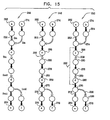
- FIG. 15 are exemplary control dependence graphs 246, 248, 250, illustrating use of a "leapfrog" closure computation” algorithm, in accordance with a disclosed embodiment of the invention.
- Edges 258, 260 are given color properties for the same reason.
- the traversals are marked or "painted” according to the following rules:
- a first traversal during a search operation or closure computation follows a path from node 262 (a) to node 264 (e). Most of the graph is shown unmarked. However, during a first traversal node 262 has been reached. Node 262 is an entry point to some function in the source code. Edge 252 has been painted "red” in accordance with Rule 11. In preparation for marking a matched section when a return from the function occurs, a property "red" is pushed onto a stack.
- the traversal passes through a section bounded by node 266 and node 268. These nodes indicate invocation and return from another function. At node 266, a property "blue” is pushed onto the stack.
- edge 272 is painted red.
- the property "red” is popped from the stack. The traversal of path leading from node 262 to node 264 (e) is then completed uneventfully.
- edge 254 which is initially unmarked in accordance with Rule 10, the first function is invoked again, from a different location, and the property "green” is pushed onto the stack. The property green is pushed onto the stack.
- the treatment is the same as for edge 252, discussed above, but the properties of edge 254 and edge 252 are distinguishable.
- Such "contractions” of the graph enable a subsequent traversal of a path to skip or leapfrog previously marked sections of the graph, possibly representing large sections of code.
- a contraction between nodes 266, 268 is established, including nodes 280, 278 and their incoming and outgoing edges.
- the section delineated by edges having the property "blue" is skipped, and is not seen. As this section already appears in the closure, no information is missed. Rather, the computation is accelerated by avoiding sections of code in the leapfrog operation.
- the second traversal follows broken line 282.
- layers of the SCA engine 22 described above provide an infrastructure for code querying.
- the following sections describe application of these layers for detection of code vulnerabilities.
- GUI graphical user interface
- Unvalidated input points provide attackers with entry points to an application. Application without entry points, that does not receive any input from users, is not likely to be attacked. Input validation is used to verify that input entered from the user complies with predetermined rules, an issue that software developers sometimes ignore or fail to implement properly.
- the SCA engine 22 uses data flow graphs to locate input sites lacking validation. For this purpose, nodes of the data flow graph are assigned to one of three categories, denoted as [1], [2], [3]. Entry points in the application are assigned to category [1]. Such points potentially contain unsafe input.
- Category [2] corresponds to input validation functions, which typically sanitize input data.
- Category [3] applies to places where the data is consumed. It is at the places classified as category [3] that the SCA engine 22 verifies that only acceptable data is processed.
- Fig. 16 is a flow chart of a method for identifying a possibility of unvalidated input in a computer program, in accordance with a disclosed embodiment of the invention.
- the method shown below involves closure of a flow graph follow removal of some nodes. Applying closure in this manner increases the efficiency of graph traversals, in that conditional statements need not be evaluated.
- a data flow graph is prepared, for example as described above with reference to Fig. 8 . A traversal of the graph is now begun, applying the "leapfrog" method described above.
- a node is selected and categorized as described above.
- control proceeds to step 294.
- the current node and its incoming and outgoing edges are removed from the data flow graph.
- control proceeds to decision step 296, where it is determined if there are more nodes to be processed in the data flow graph. If the determination at decision step 296 is negative, then control returns to step 290.
- step 300 an edge leading away from the current node is chosen.
- control proceeds to decision step 306, where it is determined if there are more edges leading from the current node.
- step 306 If the determination at decision step 306 is affirmative, then control returns to step 300.
- control proceeds to decision step 308, where it is determined if there are more category [1] nodes in the data flow graph. If the determination at decision step 308 is affirmative, then control returns to step 298, where a new node is chosen.
- nodes of category [3] may be selected at step 298 and connections between category [1] nodes and category [3] nodes determined by evaluating edges leading into the category [3] nodes.
- FIG. 17 illustrate processing of data flow graphs to determine unvalidated input vulnerabilities in accordance with a disclosed embodiment of the invention.
- Data flow graphs 312, 314 correspond to code 316. Nodes of categories [1], [2], [3] are shown.
- edge 320 connects category [1] node 322 to node 318.
- edge 320 ends blindly.
- edges 324, 326 are found to connect category [1] node 328 with category [3] nodes, and are therefore reported as unsafe. Edge 320 is not reported as being unsafe. It is concluded that category [1] node 328 constitutes a security vulnerability.
- Table 3 illustrates categorization of node types relating to respective forms of injection.
- HTMLEncode Web screen output Command Injection Interactive inputs Sanitization function (e.g., removing meta-characters) Operating system direct access commands LDAP Injection Interactive inputs Sanitization function (e.g., removing LDAP meta-characters) LDAP access command Reflection injection Interactive inputs Sanitization function (e.g., global variables removal) Reflection commands Path manipulation Interactive inputs Sanitization function (e.g., path meta-characters removal) File access commands
- Persistent attacks occur in two stages. In the first stage stores a dangerous payload on the server. The second stage, typically deferred, causes the payload to execute. Deferral of the effect makes it very difficult to locate the vulnerability manually.
- the method described with respect to Fig. 16 and Fig. 17 is capable of finding such vulnerabilities when modified by categorizing storage functions (instead of entry points) as category [1].
- the method is capable of detecting the following vulnerabilities: Second order SQL Injection; persistent SQL Injection; intersystem attacks; and persistent cross-site scripting attacks (XSS attacks).
- Least privilege is a well-known term in IT security. The idea behind it is that an entity, whether a user, an application or a service, should have only the privileges needed to make it work correctly, and nothing more. Although the idea is simple, its implementation is labor intensive. This difficulty is alleviated by using the query language described above with reference to Table 2 to identify privileges and automatically create a configuration file that specifies such privileges.
- the above query creates a .SQL configuration file, containing the content exec sp_dropextendedproc 'xp_cmdshell'.
- NTFS NT File System
- SCA engine 22 presents a dialog box that allows an operator to manually configure permissions. The same approach can be applied to file systems other than NTFS.
- Logical flaws are unique to a specific application. These are coding errors that do not comply with the application's specification. Such flaws can be detected using the above-described query language combined with the SCA engine 22 ( Fig. 2 ).
- This technique exposes many types of vulnerabilities that stem from logical flaws, for example flaws that violate the business logic as specified for the application.
- logical flaws for example flaws that violate the business logic as specified for the application.
- One obvious example is the display of confidential information, such as passwords, credit card numbers, and social security numbers.
- Other examples include forgotten debugging code, orders with negative quantity, and backdoors.
- Pages that are accessible from the Internet, but can not be accessed from the UI usually mean there was use of the "security by obscurity" technique, that is secrecy of design or, implementation to provide security.
- This approach admits that an application may have security vulnerabilities, but relies on the belief that the flaws are not known, and that attackers are therefore unlikely to find them. Identification of this disfavored approach alerts the operator that the application may indeed have latent security vulnerabilities and indicates the need for particular scrutiny
- the following query detects a vulnerability of the above-described type: FindAllPages - FindUIPageAccessCommand.AccessedPage.
- I/O operations applied to a virtual directory may expose data, since a virtual directory, unless configured otherwise, is likely to enable read operations by all users.
- the SCA engine 22 ( Fig. 2 ) employs the software fault tree analysis (SFTA), a known technique.
- SFTA is discussed, for example, in the document A Software Fault Tree Approach to Requirements Analysis of an Intrusion Detection System, Guy Helmer et al. (2001 ), which was published on the Internet.
- SFTA engine 68 in layer 66 verifies the competence of data validation functions that may be found in the code.
- Fig. 18 is a diagrammatically illustrates processing of an exemplary proprietary data validation function in accordance with a disclosed embodiment of the invention. This occurs in the layer 66 ( Fig. 2 ).
- the function, shown as source code 330 is intended to replace occurrences of the character ""' in a string s.
- Source code 330 contains a "for" loop, an "if” block, and an assignment statement.
- the string s contains an apostrophe in its Nth position. It is desired to determine if the apostrophe remains after completion of the for loop in the source code 330. We start by observing that there are three possible paths through the code:
- the second possible path is represented by block 338.
- a data validation function for example the function shown in Fig. 17
- the unit testing engine 72 in layer 70 by inserting a data validation function, for example the function shown in Fig. 17 , into the unit testing engine 72 in layer 70 and testing it automatically, scenarios may be identified in which the data validation functions fails.
- a data validation function for example the function shown in Fig. 17
- test cases generate.
- the outputs are presented to a validation engine, and the results can indicate a security vulnerability.
- queries can be designed, using the above-described query language, to locate pages that are called only when compliance with certain criteria are required, e.g., user authorization, but which are not checked during user interactions with such pages.
- DAL data access layer
- the SCA engine 22 ( Fig. 2 ) assists the vulnerability discovery process using a source-sensitive wizard to develop queries.
- each built-in query of the SCA engine 22 has conditions that determine whether the query should be executed.
- This wizard is source-code sensitive wizard, in that it asks relevant questions based to determine whether such conditions are satisfied for the particular source code. For example, if the application does not access the database, all relevant database questions can be omitted.
Landscapes
- Engineering & Computer Science (AREA)
- Theoretical Computer Science (AREA)
- General Engineering & Computer Science (AREA)
- Databases & Information Systems (AREA)
- Physics & Mathematics (AREA)
- General Physics & Mathematics (AREA)
- Software Systems (AREA)
- Computer Hardware Design (AREA)
- Computer Security & Cryptography (AREA)
- Data Mining & Analysis (AREA)
- Computing Systems (AREA)
- Computational Linguistics (AREA)
- Stored Programmes (AREA)
Claims (11)
- Von einem Computer umgesetztes Verfahren zum Erfassen von Sicherheitsschwachstellen in einem Computerprogramm, das folgende Schritte aufweist:Empfangen eines Quellcodes (16) des Computerprogramms zur Analyse in einem Arbeitsspeicher, wobei der Quellcode Code-Elemente und Anweisungen aufweist, wobei mindestens ein Abschnitt der Anweisungen auf Variablen verweist, wobei die Variablen Datenstrukturen aufweisen, die Elementvariablen haben, wobei die Elementvariablen Elementnamen haben;Erstellen, unter Verwendung eines Quellcode-Analyseprogramms (22), das auf einem Prozessor (12) ausgeführt wird, eines objektorientierten Modells des Quellcodes, wobei die Code-Elemente durch jeweilige Objekte dargestellt werden, wobei das Erstellen eines objektorientierten Modells Zuweisen von eindeutigen Instanzkennungen zu jeder der Elementvariablen aufweist; undunter Verwendung des Modells Erstellen von mindestens einem Steuerungsablaufdiagramm (144), das einen Ablauf des Computerprogramms darstellt,dadurch gekennzeichnet, dass das Verfahren enthält:Speichern des objektorientierten Modells in einer objektorientierten Datenbank;Empfangen einer Quellcode-Datenbankabfrage in einer vordefinierten Code-Diagrammabfragesprache in Bezug auf eine Sicherheitsschwachstelle, in der ein Elementname einer vorbestimmten Elementvariablen identisch mit dem Elementnamen einer anderen Elementvariablen ist;Analysieren des mindestens einen Steuerungsablaufdiagramms in Reaktion auf die Quellcode-Datenbankabfrage, um einen Abschnitt des Quellcodes mit der Sicherheitsschwachstelle durch Identifizieren von Verweisen auf die vorbestimmte Elementvariable unter Verwendung von deren eindeutigen Instanzkennungen zu identifizieren; undMelden der Sicherheitsschwachstelle.
- Verfahren nach Anspruch 1, wobei Erstellen des mindestens einen Steuerungsablaufdiagramms aufweist:Ableiten eines Datenflussdiagramms aus dem Steuerungsablaufdiagramm, wobei das Datenflussdiagramm Datenflussknoten und Datenflusskanten aufweist, die die Datenflussknoten verbinden; und Ableiten eines Steuerungsabhängigkeitsdiagramms von dem Steuerungsablaufdiagramm, das Steuerungsabhängigkeitsknoten hat,wobei Analysieren des mindestens einen Steuerungsablaufdiagramms Analysieren von einem oder mehreren des Steuerungsablaufdiagramms, des Datenflussdiagramms und des Steuerungsabhängigkeitsdiagramms aufweist.
- Verfahren nach Anspruch 2, wobei der Quellcode in einer objektorientierten Sprache geschrieben ist, wobei die objektorientierte Sprache ein gegenwärtig aktives Objekt aufweist, und das Datenflussdiagramm aufgerufene Methoden aufweist, und wobei der Schritt des Ableitens eines Datenflussdiagramms Verwenden des gegenwärtig aktiven Objekts als einen Parameter für die aufgerufenen Methoden aufweist.
- Verfahren nach Anspruch 2, wobei der Schritt des Analysierens ein Erstellen von Code-Sektoren für das Steuerungsabhängigkeitsdiagramm aufweist, um Blöcke des Steuerungsabhängigkeitsdiagramms zu definieren, die atomare Elemente des Quellcodes darstellen, wobei nicht mehr als eine einzige Aktion ausgeführt wird.
- Verfahren nach Anspruch 2, wobei der Schritt des Analysierens ferner die folgenden Schritte aufweist:Identifizieren von Datenflussknoten in dem Datenflussdiagramm, wobei eingegebene Daten validiert werden; undÜberprüfen, ob die eingegebenen Daten in den identifizierten Datenflussknoten gemäß einer vorbestimmten Spezifikation validiert sind.
- Verfahren nach einem der Ansprüche 1 bis 5, wobei die Sicherheitsschwachstelle aus einer Gruppe von Sicherheitsschwachstellen ausgewählt wird, bestehend aus:einem logischen Fehler, wobei ein Abschnitt des Quellcodes nicht mit einer Spezifikation davon konform ist;einer nicht erzwungenen Einschränkung des Benutzerzugriffs;einer Fähigkeit eines Benutzers, ein ausgeblendetes Feld einer Webseite anzuzeigen; undeiner Aktivierung von E/A-Operationen in einem virtuellen Verzeichnis.
- Verfahren nach einem der Ansprüche 1 bis 5, wobei der Schritt des Analysierens mindestens eines von einer Enthüllung einer Datenzugriffsschicht-Methodologie und Anwenden einer Software-Fehlerstrukturanalyse auf den Quellcode aufweist.
- Verfahren nach Anspruch 1, das ferner die folgenden Schritte aufweist:automatisches Vorbereiten einer Konfigurationsdatei, die Zugriffsberechtigungen auf Objekte des Computerprogramms angibt;Abfragen der Konfigurationsdatei zum Bestimmen, ob die Zugriffsberechtigungen für vorbestimmte der Objekte vorhanden sind; undAbbrechen der Zugriffsberechtigungen für die vorbestimmten der Objekte.
- Verfahren nach Anspruch 1, wobei Erstellen des mindestens einen Steuerungsablaufdiagramms Ableiten eines Datenflussdiagramms aus dem Steuerungsablaufdiagramm aufweist, wobei das Datenflussdiagramm Datenflussknoten und Datenflusskanten aufweist, die die Datenflussknoten verbinden, wobei das Analysieren ferner die folgenden Schritte aufweist:in dem Datenflussdiagramm Identifizieren von ersten Datenflussknoten, wobei Eingabe akzeptiert wird, von zweiten Datenflussknoten, wobei Daten validiert werden, und von dritten Datenflussknoten, wobei Daten verarbeitet werden;Entfernen der zweiten Datenflussknoten aus dem Datenflussdiagramm;anschließend Bestimmen, ob einer der dritten Datenflussknoten mit einem der ersten Datenflussknoten über eine der Datenflusskanten verbunden ist; undMelden des einen dritten Datenflussknotens, dass er eine nicht validierte Eingabeschwachstelle hat.
- Datenverarbeitungssystem zum Erfassen von Sicherheitsschwachstellen in einem Computerprogramm, das aufweist:einen Arbeitsspeicher, in dem Computerprogrammanweisungenespeichert sind;eine E/A-Einrichtung; undeinen Prozessor (12), der auf den Arbeitsspeicher zugreift, um die Anweisungen zu lesen, wobei die Anweisungen den Prozessor veranlassen zum:Empfangen des Quellcodes (16) des Computerprogramms zur Analyse über die E/A-Einrichtung, wobei der Quellcode Code-Elemente und Anweisungen aufweist, wobei mindestens ein Abschnitt der Anweisungen auf Variablen verweist, wobei die Variablen Datenstrukturen aufweisen, die Elementvariablen haben, wobei die Elementvariablen Elementnamen haben;Erstellen eines objektorientierten Modells des Quellcodes, wobei die Code-Elemente durch jeweilige Objekte dargestellt werden, wobei eindeutige Instanzkennungen jeder der Elementvariablen zugewiesen sind; undErstellen, unter Verwendung des Modells, von mindestens einem Steuerungsablaufdiagramm (144), das einen Ablauf des Computerprogramms darstellt;dadurch gekennzeichnet, dass der Prozessor konfiguriert ist zum:Speichern des objektorientierten Modells in einer objektorientierten Datenbank;Empfangen einer Quellcode-Datenbankabfrage in einer vordefinierten Code-Diagrammabfragesprache in Bezug auf eine Sicherheitsschwachstelle, in der ein Elementname einer vorbestimmten Elementvariablen identisch mit dem Elementnamen einer anderen Elementvariablen ist;Analysieren des mindestens einen Steuerungsablaufdiagramms in Reaktion auf die Quellcode-Datenbankabfrage, um einen Abschnitt des Quellcodes mit der Sicherheitsschwachstelle durch Identifizieren von Verweisen auf die vorbestimmte Elementvariable unter Verwendung von deren eindeutigen Instanzkennungen zu identifizieren; undMelden der Sicherheitsschwachstelle.
- Computer-Softwareprodukt zum Erfassen von Sicherheitsschwachstellen in einem Computerprogramm, einschließlich eines konkreten computerlesbaren Mediums, in dem Computerprogrammanweisungen gespeichert sind, wobei Anweisungen, wenn sie von einem Computer (12) gelesen werden, den Computer veranlassen zum:Empfangen eines Quellcodes (16) des Computerprogramms zur Analyse, wobei der Quellcode Code-Elemente und Anweisungen aufweist, wobei mindestens ein Abschnitt der Anweisungen auf Variablen verweist, wobei die Variablen Datenstrukturen aufweisen, die Elementvariablen haben, wobei die Elementvariablen Elementnamen haben;Erstellen eines objektorientierten Modells des Quellcodes durch Zuweisen von eindeutigen Instanzkennungen zu jeder der Elementvariablen, wobei die Code-Elemente durch jeweilige Objekte dargestellt werden; undErstellen, unter Verwendung des Modells, von mindestens einem Steuerungsablaufdiagramm (144), das einen Ablauf des Computerprogramms darstellt,dadurch gekennzeichnet, dass die Anweisungen den Computer veranlassen zum:Speichern des objektorientierten Modells in einer objektorientierten Datenbank;Empfangen einer Quellcode-Datenbankabfrage in einer vordefinierten Code-Diagrammabfragesprache in Bezug auf eine Sicherheitsschwachstelle, in der ein Elementname einer vorbestimmten Elementvariablen identisch mit dem Elementnamen einer anderen Elementvariablen ist;Analysieren des mindestens einen Steuerungsablaufdiagramms in Reaktion auf die Quellcode-Datenbankabfrage, um einen Abschnitt des Quellcodes mit der Sicherheitsschwachstelle durch Identifizieren von Verweisen auf die vorbestimmte Elementvariable unter Verwendung von deren eindeutigen Instanzkennungen zu identifizieren; undMelden der Sicherheitsschwachstelle.
Applications Claiming Priority (2)
| Application Number | Priority Date | Filing Date | Title |
|---|---|---|---|
| US85334906P | 2006-10-19 | 2006-10-19 | |
| PCT/IL2007/001233 WO2008047351A2 (en) | 2006-10-19 | 2007-10-15 | Locating security vulnerabilities in source code |
Publications (3)
| Publication Number | Publication Date |
|---|---|
| EP2092424A2 EP2092424A2 (de) | 2009-08-26 |
| EP2092424A4 EP2092424A4 (de) | 2011-11-02 |
| EP2092424B1 true EP2092424B1 (de) | 2015-12-30 |
Family
ID=39314446
Family Applications (1)
| Application Number | Title | Priority Date | Filing Date |
|---|---|---|---|
| EP07827207.7A Active EP2092424B1 (de) | 2006-10-19 | 2007-10-15 | Finden von sicherheitsanfälligkeiten in quellcode |
Country Status (4)
| Country | Link |
|---|---|
| US (3) | US20100083240A1 (de) |
| EP (1) | EP2092424B1 (de) |
| JP (1) | JP5042315B2 (de) |
| WO (1) | WO2008047351A2 (de) |
Cited By (1)
| Publication number | Priority date | Publication date | Assignee | Title |
|---|---|---|---|---|
| US11714615B2 (en) | 2020-09-18 | 2023-08-01 | International Business Machines Corporation | Application migration using cost-aware code dependency graph |
Families Citing this family (209)
| Publication number | Priority date | Publication date | Assignee | Title |
|---|---|---|---|---|
| US7051322B2 (en) * | 2002-12-06 | 2006-05-23 | @Stake, Inc. | Software analysis framework |
| US8108826B2 (en) * | 2004-09-29 | 2012-01-31 | Avaya Inc. | Code-coverage guided prioritized test generation |
| EP2092424B1 (de) | 2006-10-19 | 2015-12-30 | Checkmarx Ltd. | Finden von sicherheitsanfälligkeiten in quellcode |
| US8429637B2 (en) * | 2008-09-02 | 2013-04-23 | Apple Inc. | System and method for conditional expansion obfuscation |
| US8869111B2 (en) * | 2009-01-15 | 2014-10-21 | Infosys Limited | Method and system for generating test cases for a software application |
| US8589884B2 (en) * | 2009-01-15 | 2013-11-19 | Infosys Limited | Method and system for identifying regression test cases for a software |
| JP5228943B2 (ja) * | 2009-01-27 | 2013-07-03 | 富士通株式会社 | 最小権限違反検出プログラム |
| CN102317911B (zh) | 2009-02-13 | 2016-04-06 | 起元技术有限责任公司 | 管理任务执行 |
| JP5186443B2 (ja) | 2009-06-30 | 2013-04-17 | インターナショナル・ビジネス・マシーンズ・コーポレーション | 文字列の妥当性を判定するシステム、方法及びプログラム |
| CN101964025B (zh) * | 2009-07-23 | 2016-02-03 | 北京神州绿盟信息安全科技股份有限公司 | Xss检测方法和设备 |
| US8612954B2 (en) * | 2009-08-17 | 2013-12-17 | International Business Machines Corporation | Fine slicing: generating an executable bounded slice for program |
| US8397300B2 (en) | 2009-09-22 | 2013-03-12 | International Business Machines Corporation | Detecting security vulnerabilities relating to cryptographically-sensitive information carriers when testing computer software |
| US8448139B2 (en) * | 2009-10-05 | 2013-05-21 | International Business Machines Corporation | Automatic correction of application based on runtime behavior |
| US8584246B2 (en) | 2009-10-13 | 2013-11-12 | International Business Machines Corporation | Eliminating false reports of security vulnerabilities when testing computer software |
| US8468512B2 (en) * | 2009-10-30 | 2013-06-18 | International Business Machines Corporation | Abstracting benefit rules from computer code |
| JP5381649B2 (ja) * | 2009-11-26 | 2014-01-08 | 富士通株式会社 | 検証対象抽出プログラム、検証対象抽出装置、および検証対象抽出方法 |
| US8468605B2 (en) | 2009-11-30 | 2013-06-18 | International Business Machines Corporation | Identifying security vulnerability in computer software |
| US8359584B2 (en) * | 2009-12-18 | 2013-01-22 | Microsoft Corporation | Debugging from a call graph |
| US9210184B2 (en) | 2009-12-29 | 2015-12-08 | International Business Machines Corporation | Determining the vulnerability of computer software applications to attacks |
| US8843902B2 (en) * | 2010-03-12 | 2014-09-23 | XMOS Ltd. | Program flow route constructor |
| US10025688B2 (en) * | 2010-03-14 | 2018-07-17 | Virtual Forge GmbH | System and method for detecting data extrusion in software applications |
| US8584108B2 (en) * | 2010-03-29 | 2013-11-12 | GM Global Technology Operations LLC | Method and apparatus for analyzing software |
| US8589898B2 (en) * | 2010-03-29 | 2013-11-19 | GM Global Technology Operations LLC | Method and apparatus for analyzing software including a calibrated value |
| US8910133B2 (en) * | 2010-06-07 | 2014-12-09 | Microsoft Corporation | Library conformity checker |
| CN107066241B (zh) | 2010-06-15 | 2021-03-09 | 起元技术有限责任公司 | 用于动态加载基于图的计算的系统和方法 |
| US8528095B2 (en) | 2010-06-28 | 2013-09-03 | International Business Machines Corporation | Injection context based static analysis of computer software applications |
| US9141806B2 (en) | 2010-08-24 | 2015-09-22 | Checkmarx Ltd. | Mining source code for violations of programming rules |
| US20120102474A1 (en) * | 2010-10-26 | 2012-04-26 | International Business Machines Corporation | Static analysis of client-server applications using framework independent specifications |
| US8572747B2 (en) * | 2010-11-19 | 2013-10-29 | International Business Machines Corporation | Policy-driven detection and verification of methods such as sanitizers and validators |
| US8667584B2 (en) | 2010-12-15 | 2014-03-04 | International Business Machines Corporation | Formal analysis of the quality and conformance of information flow downgraders |
| US8407242B2 (en) * | 2010-12-16 | 2013-03-26 | Microsoft Corporation | Temporal binding for semantic queries |
| IL210169A0 (en) | 2010-12-22 | 2011-03-31 | Yehuda Binder | System and method for routing-based internet security |
| KR101097105B1 (ko) * | 2010-12-23 | 2011-12-22 | 한국저작권위원회 | Sw 소스코드 난독화와 버전 관리시스템과의 연동 방법 및 시스템 |
| US20120192280A1 (en) * | 2011-01-20 | 2012-07-26 | Board Of Trustees Of The University Of Illinois | Apparatus for enhancing web application security and method therefor |
| US8914890B2 (en) * | 2011-01-31 | 2014-12-16 | International Business Machines Corporation | Determining the vulnerability of computer software applications to privilege-escalation attacks |
| US8606866B2 (en) | 2011-02-10 | 2013-12-10 | Kaspersky Lab Zao | Systems and methods of probing data transmissions for detecting spam bots |
| JP5654944B2 (ja) * | 2011-05-02 | 2015-01-14 | Kddi株式会社 | アプリケーション解析装置およびプログラム |
| US8539466B2 (en) | 2011-05-23 | 2013-09-17 | International Business Machines Corporation | Determining suitable insertion points for string sanitizers in a computer code |
| US8516443B2 (en) * | 2011-05-26 | 2013-08-20 | Oracle International Corporation | Context-sensitive analysis framework using value flows |
| US8949992B2 (en) * | 2011-05-31 | 2015-02-03 | International Business Machines Corporation | Detecting persistent vulnerabilities in web applications |
| US8666999B2 (en) * | 2011-08-02 | 2014-03-04 | Rockwell Automation Technologies, Inc. | Search utility program for software developers |
| US8793665B2 (en) * | 2011-08-26 | 2014-07-29 | Fujitsu Limited | Performing taint analysis for javascript software using a control flow graph |
| US8875109B2 (en) * | 2011-08-26 | 2014-10-28 | Fujitsu Limited | Tracking variables in javascript software using a control flow graph |
| JP2013061843A (ja) * | 2011-09-14 | 2013-04-04 | Fujifilm Corp | コンピュータ・ソフトウエア解析システムならびにクライアント・コンピュータ,その動作制御方法およびその動作プログラム |
| US8769696B2 (en) | 2011-09-29 | 2014-07-01 | International Business Machines Corporation | Automated detection of flaws and incompatibility problems in information flow downgraders |
| US9098624B1 (en) | 2011-12-22 | 2015-08-04 | Dell Software Inc. | Deep type parsing |
| US8856935B2 (en) | 2012-02-07 | 2014-10-07 | International Business Machines Corporation | Automatic synthesis of unit tests for security testing |
| US8806464B2 (en) * | 2012-04-26 | 2014-08-12 | Hewlett-Packard Development Company, L.P. | Process flow optimized directed graph traversal |
| CA2777434C (en) | 2012-05-18 | 2019-09-10 | Ibm Canada Limited - Ibm Canada Limitee | Verifying application security vulnerabilities |
| CN102693396B (zh) * | 2012-06-11 | 2014-09-17 | 中南大学 | 一种基于虚拟执行模式的Flash漏洞检测方法 |
| WO2014018042A1 (en) * | 2012-07-26 | 2014-01-30 | Hewlett-Packard Development Company, L. P. | Application security testing |
| JP6382196B2 (ja) | 2012-08-18 | 2018-08-29 | フーガ インコーポレイテッド | セキュアな計算環境を提供するシステム及び方法 |
| WO2014049504A1 (en) * | 2012-09-25 | 2014-04-03 | Checkmarx Ltd. | Detecting malicious advertisements using source code analysis |
| US9501646B2 (en) | 2012-09-26 | 2016-11-22 | Mitsubishi Electric Corporation | Program verification apparatus, program verification method, and computer readable medium |
| US9032530B2 (en) | 2012-09-28 | 2015-05-12 | International Business Machines Corporation | Correcting workflow security vulnerabilities via static analysis and virtual patching |
| US9141807B2 (en) * | 2012-09-28 | 2015-09-22 | Synopsys, Inc. | Security remediation |
| US9292693B2 (en) * | 2012-10-09 | 2016-03-22 | International Business Machines Corporation | Remediation of security vulnerabilities in computer software |
| US8966636B2 (en) * | 2012-10-16 | 2015-02-24 | International Business Machines Corporation | Transforming unit tests for security testing |
| US10521288B2 (en) * | 2012-11-07 | 2019-12-31 | International Business Machines Corporation | Collaborative application testing |
| WO2014076773A1 (ja) | 2012-11-13 | 2014-05-22 | 富士通株式会社 | ネットワークのフィルタリング装置、及びフィルタリング方法 |
| US10108521B2 (en) | 2012-11-16 | 2018-10-23 | Ab Initio Technology Llc | Dynamic component performance monitoring |
| US9507682B2 (en) | 2012-11-16 | 2016-11-29 | Ab Initio Technology Llc | Dynamic graph performance monitoring |
| CN103108044B (zh) * | 2013-02-04 | 2015-08-19 | 南京大学 | 一种基于依赖图约减和QoS保持的Web服务组合方法 |
| US9384354B2 (en) | 2013-02-20 | 2016-07-05 | International Business Machines Corporation | Rule matching in the presence of languages with no types or as an adjunct to current analyses for security vulnerability analysis |
| JP5941859B2 (ja) * | 2013-03-05 | 2016-06-29 | 株式会社エヌ・ティ・ティ・データ | 検証装置、検証方法、及びプログラム |
| US9372785B2 (en) * | 2013-03-07 | 2016-06-21 | Microsoft Technology Licensing, Llc | Identifying implicit assumptions associated with a software product |
| US9569334B2 (en) | 2013-03-14 | 2017-02-14 | Whitehat Security, Inc. | Techniques for traversing representations of source code |
| CN105210075A (zh) | 2013-04-19 | 2015-12-30 | 惠普发展公司,有限责任合伙企业 | 被测应用程序的未使用参数 |
| US9158922B2 (en) | 2013-05-29 | 2015-10-13 | Lucent Sky Corporation | Method, system, and computer-readable medium for automatically mitigating vulnerabilities in source code |
| US9471286B2 (en) * | 2013-06-04 | 2016-10-18 | Microsoft Technology Licensing, Llc | System and method for providing code completion features for code modules |
| US9426177B2 (en) * | 2013-07-15 | 2016-08-23 | Tencent Technology (Shenzhen) Company Limited | Method and apparatus for detecting security vulnerability for animation source file |
| JP6233414B2 (ja) * | 2013-07-26 | 2017-11-22 | 富士通株式会社 | 情報処理装置、フィルタリングシステム、フィルタリング方法、及びフィルタリングプログラム |
| EP3028203A4 (de) * | 2013-07-31 | 2017-03-29 | Hewlett-Packard Enterprise Development LP | Signaltoken zur anzeige von schadprogrammen |
| US9459986B2 (en) | 2013-08-28 | 2016-10-04 | International Business Machines Corporation | Automatic generation of analysis-equivalent application constructs |
| US12124586B2 (en) * | 2013-09-13 | 2024-10-22 | Omnissa, Llc | Risk assessment for managed client devices |
| US20150095894A1 (en) * | 2013-09-30 | 2015-04-02 | International Business Machines Corporation | Detecting race condition vulnerabilities in computer software applications |
| CN106170762B (zh) | 2013-12-05 | 2020-01-14 | 起元技术有限责任公司 | 管理包括子图的数据流图所用的接口 |
| US11057416B2 (en) * | 2013-12-19 | 2021-07-06 | Micro Focus Llc | Analyze code that uses web framework using local parameter model |
| US10019567B1 (en) * | 2014-03-24 | 2018-07-10 | Amazon Technologies, Inc. | Encoding of security codes |
| US20150278526A1 (en) * | 2014-03-25 | 2015-10-01 | Wipro Limited | Computerized systems and methods for presenting security defects |
| WO2015155028A1 (en) * | 2014-04-11 | 2015-10-15 | Arima Software Design S.L.L. | Detection of manipulation of applications |
| US10423793B2 (en) * | 2014-06-19 | 2019-09-24 | Entit Software Llc | Install runtime agent for security test |
| US9852294B1 (en) * | 2014-06-24 | 2017-12-26 | Symantec Corporation | Systems and methods for detecting suspicious applications based on how entry-point functions are triggered |
| US10599852B2 (en) | 2014-08-15 | 2020-03-24 | Securisea, Inc. | High performance software vulnerabilities detection system and methods |
| US9824214B2 (en) | 2014-08-15 | 2017-11-21 | Securisea, Inc. | High performance software vulnerabilities detection system and methods |
| US9454659B1 (en) | 2014-08-15 | 2016-09-27 | Securisea, Inc. | Software vulnerabilities detection system and methods |
| CN105487966B (zh) * | 2014-09-17 | 2023-07-25 | 深圳市雅阅科技有限公司 | 程序测试方法、装置及系统 |
| US10657262B1 (en) * | 2014-09-28 | 2020-05-19 | Red Balloon Security, Inc. | Method and apparatus for securing embedded device firmware |
| US10120997B2 (en) | 2015-01-01 | 2018-11-06 | Checkmarx Ltd. | Code instrumentation for runtime application self-protection |
| US10282550B1 (en) | 2015-03-12 | 2019-05-07 | Whitehat Security, Inc. | Auto-remediation workflow for computer security testing |
| US9792443B1 (en) * | 2015-03-12 | 2017-10-17 | Whitehat Security, Inc. | Position analysis of source code vulnerabilities |
| CN106295346B (zh) * | 2015-05-20 | 2022-08-30 | 深圳市腾讯计算机系统有限公司 | 一种应用漏洞检测方法、装置及计算设备 |
| US10095734B2 (en) | 2015-06-10 | 2018-10-09 | International Business Machines Corporation | Source code search engine |
| KR102414250B1 (ko) * | 2015-07-30 | 2022-06-29 | 삼성전자주식회사 | 전자 장치, 컴파일링 방법 및 컴퓨터 판독가능 기록매체 |
| US10657134B2 (en) | 2015-08-05 | 2020-05-19 | Ab Initio Technology Llc | Selecting queries for execution on a stream of real-time data |
| KR101696694B1 (ko) * | 2015-08-17 | 2017-01-18 | (주)트리니티소프트 | 역추적을 이용한 소스 코드 취약점 분석 방법 및 장치 |
| KR101640479B1 (ko) * | 2015-08-28 | 2016-07-18 | (주)엔키소프트 | 소스코드기반 소프트웨어 취약점 공격행위 분석시스템 |
| US10341194B2 (en) | 2015-10-05 | 2019-07-02 | Fugue, Inc. | System and method for building, optimizing, and enforcing infrastructure on a cloud based computing environment |
| US10229612B2 (en) * | 2015-10-07 | 2019-03-12 | Coursera Inc. | Secure computer-implemented execution and evaluation of programming assignments for on demand courses |
| CN105389194B (zh) * | 2015-10-19 | 2019-02-01 | 华为技术有限公司 | 一种确定应用程序计算逻辑的方法及装置 |
| US11218510B2 (en) * | 2015-10-28 | 2022-01-04 | Qomplx, Inc. | Advanced cybersecurity threat mitigation using software supply chain analysis |
| US20220014555A1 (en) | 2015-10-28 | 2022-01-13 | Qomplx, Inc. | Distributed automated planning and execution platform for designing and running complex processes |
| US11570209B2 (en) | 2015-10-28 | 2023-01-31 | Qomplx, Inc. | Detecting and mitigating attacks using forged authentication objects within a domain |
| SG11201803929YA (en) | 2015-12-21 | 2018-06-28 | Ab Initio Technology Llc | Sub-graph interface generation |
| US11593249B2 (en) * | 2015-12-23 | 2023-02-28 | Oracle International Corporation | Scalable points-to analysis via multiple slicing |
| KR101645019B1 (ko) | 2016-01-15 | 2016-08-02 | 지티원 주식회사 | 소프트웨어 보안취약점 검출을 위한 규칙명세언어 |
| US10366213B2 (en) * | 2016-02-09 | 2019-07-30 | International Business Machines Corporation | Protecting an application via an intra-application firewall |
| US9959097B2 (en) * | 2016-03-09 | 2018-05-01 | Bank Of America Corporation | SVN interface system for heterogeneous development environments |
| WO2017163141A1 (en) | 2016-03-21 | 2017-09-28 | Checkmarx Ltd. | Integrated interactive application security testing |
| US10210336B2 (en) * | 2016-03-29 | 2019-02-19 | International Business Machines Corporation | Precision-tuned runtime monitoring |
| WO2017196381A1 (en) * | 2016-05-12 | 2017-11-16 | Synopsys, Inc. | Systems and methods for model-based analysis of software |
| US10210077B2 (en) | 2016-05-18 | 2019-02-19 | International Business Machines Corporation | Using multiple sequence alignment to identify security vulnerability code paths |
| CN105959335B (zh) * | 2016-07-19 | 2019-11-19 | 腾讯科技(深圳)有限公司 | 一种网络攻击行为检测方法及相关装置 |
| US10325097B2 (en) * | 2016-07-19 | 2019-06-18 | Oracle International Corporation | Static detection of context-sensitive cross-site scripting vulnerabilities |
| KR20180010053A (ko) * | 2016-07-20 | 2018-01-30 | 주식회사 이븐스타 | 보안 취약점 점검을 위한 위험성 코드 검출 시스템 및 그 방법 |
| US10176074B2 (en) * | 2016-09-21 | 2019-01-08 | Lenvio Inc. | Computed call/jump target resolution via behavior computation |
| US10628140B2 (en) | 2016-11-17 | 2020-04-21 | Mitsubishi Electric Corporation | Program code generation apparatus |
| US10339320B2 (en) | 2016-11-18 | 2019-07-02 | International Business Machines Corporation | Applying machine learning techniques to discover security impacts of application programming interfaces |
| CN108614695A (zh) * | 2016-12-06 | 2018-10-02 | 北京奇虎科技有限公司 | 快速定位安卓应用代码文件中的指定内容的方法和装置 |
| US10581879B1 (en) * | 2016-12-22 | 2020-03-03 | Fireeye, Inc. | Enhanced malware detection for generated objects |
| EP3566166B1 (de) * | 2017-01-04 | 2022-03-02 | Checkmarx Ltd. | Verwaltung von sicherheitsschwachstellen |
| DE102017200161A1 (de) * | 2017-01-09 | 2018-07-12 | Robert Bosch Gmbh | Verfahren zum Erfassen von Signalen |
| US10437714B2 (en) * | 2017-01-25 | 2019-10-08 | Wipro Limited | System and method for performing script-less unit testing |
| EP3401827A1 (de) | 2017-05-10 | 2018-11-14 | Checkmarx Ltd. | Computerimplementiertes verfahren und datenverarbeitungssystem |
| US10318259B2 (en) * | 2017-05-31 | 2019-06-11 | Intel Corporation | Technology to use control dependency graphs to convert control flow programs into data flow programs |
| US10740470B2 (en) | 2017-05-31 | 2020-08-11 | Shiftleft Inc. | System and method for application security profiling |
| CN109214188B (zh) * | 2017-06-30 | 2022-05-27 | 阿里巴巴集团控股有限公司 | 一种漏洞分析方法和装置及数据处理方法和装置 |
| US10796240B2 (en) * | 2017-07-22 | 2020-10-06 | QC Ware Corp. | Performing fault tree analysis on quantum computers |
| US10872156B2 (en) * | 2017-08-11 | 2020-12-22 | Jpmorgan Chase Bank, N.A. | Typescript security scanner |
| US20190052602A1 (en) * | 2017-08-14 | 2019-02-14 | Onapsis, lnc. | Generating rules to detect security vulnerabilities based on vulnerability primitives with entry point finder |
| US10275235B2 (en) | 2017-09-18 | 2019-04-30 | International Business Machines Corporation | Adaptable management of web application state in a micro-service architecture |
| US10956574B2 (en) | 2017-10-07 | 2021-03-23 | Shiftleft Inc. | System and method for securing applications through an application-aware runtime agent |
| US10365905B1 (en) * | 2017-10-26 | 2019-07-30 | Facebook, Inc. | Systems and methods for evaluating application performance changes via comparative call graphs |
| US10540255B2 (en) * | 2017-10-31 | 2020-01-21 | Oracle International Corporation | Staged refinement for static analysis |
| KR102392642B1 (ko) * | 2017-11-08 | 2022-04-29 | 한국전력공사 | Cfg를 이용한 패턴 기반의 소프트웨어 절차변경 동작 감시 장치 및 그 방법 |
| US10572367B2 (en) | 2017-11-21 | 2020-02-25 | Accenture Global Solutions Limited | Intelligent code quality monitoring |
| US11074362B2 (en) | 2017-12-04 | 2021-07-27 | ShiftLeft, Inc. | System and method for code-based protection of sensitive data |
| US10133871B1 (en) * | 2017-12-13 | 2018-11-20 | Booz Allen Hamilton Inc. | Method and system for identifying functional attributes that change the intended operation of a compiled binary extracted from a target system |
| US10740469B2 (en) | 2017-12-28 | 2020-08-11 | Fmr Llc | Automated secure software development management, risk assessment, and risk remediation |
| US10198250B1 (en) * | 2018-01-04 | 2019-02-05 | Accenture Global Solutions Limited | Partitioning based migration of systems to container and microservice based platforms |
| KR102092192B1 (ko) * | 2018-01-08 | 2020-03-23 | 국방과학연구소 | 함수 정보 요약 장치 및 방법 |
| WO2019142335A1 (ja) * | 2018-01-19 | 2019-07-25 | 三菱電機株式会社 | セキュリティ設計装置、セキュリティ設計方法およびセキュリティ設計プログラム |
| US10606570B2 (en) * | 2018-03-08 | 2020-03-31 | Fujitsu Limited | Representing software with an abstract code graph |
| US10678916B2 (en) * | 2018-03-20 | 2020-06-09 | Didi Research America, Llc | Malicious program detection |
| US11087001B2 (en) | 2018-04-04 | 2021-08-10 | Red Hat, Inc. | Determining location of speculation denial instructions for memory access vulnerabilities |
| US10261784B1 (en) * | 2018-06-20 | 2019-04-16 | Terbium Labs, Inc. | Detecting copied computer code using cryptographically hashed overlapping shingles |
| US11144840B2 (en) * | 2018-07-26 | 2021-10-12 | International Business Machines Corporation | Completing decision logic to avoid a side effect |
| US20200042712A1 (en) * | 2018-07-31 | 2020-02-06 | Veracode, Inc. | Open-source software vulnerability analysis |
| US11036866B2 (en) | 2018-10-18 | 2021-06-15 | Denso Corporation | Systems and methods for optimizing control flow graphs for functional safety using fault tree analysis |
| US12229255B2 (en) | 2018-10-31 | 2025-02-18 | Capital One Services, Llc | Methods and systems for multi-tool orchestration |
| US10534912B1 (en) * | 2018-10-31 | 2020-01-14 | Capital One Services, Llc | Methods and systems for multi-tool orchestration |
| US10754628B2 (en) * | 2018-11-02 | 2020-08-25 | Microsoft Technology Licensing, Llc | Extracting web API endpoint data from source code to identify potential security threats |
| US11741196B2 (en) | 2018-11-15 | 2023-08-29 | The Research Foundation For The State University Of New York | Detecting and preventing exploits of software vulnerability using instruction tags |
| US11514172B2 (en) | 2018-11-15 | 2022-11-29 | Grabango Co. | System and method for information flow analysis of application code |
| US11265292B1 (en) * | 2019-01-28 | 2022-03-01 | Amazon Technologies, Inc. | Graph based management of virtualized infrastructures |
| US11163888B2 (en) * | 2019-02-15 | 2021-11-02 | Oracle International Corporation | Detecting second-order security vulnerabilities via modelling information flow through persistent storage |
| CN111611149B (zh) * | 2019-02-22 | 2023-03-31 | 上海信息安全工程技术研究中心 | 基于代码行为单位的程序变量有效定义检测方法及装置 |
| US11599644B2 (en) * | 2019-05-17 | 2023-03-07 | Walmart Apollo, Llc | Blocking insecure code with locking |
| CN110221973B (zh) * | 2019-05-22 | 2022-12-16 | 湖南泛联新安信息科技有限公司 | 面向c程序缺陷检测的靶向式并行符号执行方法 |
| US11636211B2 (en) | 2019-06-27 | 2023-04-25 | Blackberry Limited | Binary static analysis of application structure to identify vulnerabilities |
| US11650905B2 (en) | 2019-09-05 | 2023-05-16 | International Business Machines Corporation | Testing source code changes |
| CN111027073B (zh) * | 2019-11-28 | 2022-03-22 | 深信服科技股份有限公司 | 漏洞检测方法、装置、设备及存储介质 |
| CN110825650B (zh) * | 2019-11-29 | 2023-04-11 | 北京网聘咨询有限公司 | 单元测试覆盖精度检测方法及装置 |
| US11440190B1 (en) * | 2020-02-26 | 2022-09-13 | Trend Micro Incorporated | Detecting unsecure data flow in automation task programs |
| CN111460450B (zh) * | 2020-03-11 | 2023-02-10 | 西北大学 | 一种基于图卷积网络的源代码漏洞检测方法 |
| EP3882782A1 (de) * | 2020-03-20 | 2021-09-22 | Tata Consultancy Services Limited | System und verfahren zur sql-abfrage-extraktion in einer anwendung |
| CN111488582B (zh) * | 2020-04-01 | 2023-09-29 | 杭州云象网络技术有限公司 | 一种基于图神经网络的智能合约重入性漏洞检测的方法 |
| CN113741861B (zh) * | 2020-05-29 | 2025-05-27 | 中科寒武纪科技股份有限公司 | 计算程序中数据依赖关系的方法及计算机可读存储介质 |
| US11836258B2 (en) | 2020-07-28 | 2023-12-05 | Checkmarx Ltd. | Detecting exploitable paths in application software that uses third-party libraries |
| US12164646B2 (en) | 2020-08-27 | 2024-12-10 | Checkmarx Ltd. | Automatic identification of flaws in software systems |
| US11610000B2 (en) | 2020-10-07 | 2023-03-21 | Bank Of America Corporation | System and method for identifying unpermitted data in source code |
| US11366901B2 (en) * | 2020-10-07 | 2022-06-21 | Bank Of America Corporation | System and method for identifying insider threats in source code |
| US11568060B2 (en) * | 2020-12-08 | 2023-01-31 | Oracle International Corporation | Modular taint analysis with access paths |
| US12050668B1 (en) * | 2021-01-08 | 2024-07-30 | Take-Two Interactive Software, Inc. | Method and system for obfuscating and protecting game logic and variables during video game compilation |
| EP4044057B1 (de) * | 2021-02-12 | 2023-09-27 | Tata Consultancy Services Limited | Verfahren und system zur identifizierung von sicherheitslücken |
| US11968224B2 (en) | 2021-03-22 | 2024-04-23 | International Business Machines Corporation | Shift-left security risk analysis |
| US11550569B2 (en) * | 2021-05-14 | 2023-01-10 | Cyberark Software Ltd. | Discovering and remediating hidden secrets in code files |
| US20240281539A1 (en) * | 2021-06-02 | 2024-08-22 | The Johns Hopkins University | System and method for detecting vulnerabilities in object-oriented program code using an object property graph |
| CN113467983A (zh) * | 2021-07-16 | 2021-10-01 | 中国银行股份有限公司 | 故障的处理方法、装置、设备及可读存储介质 |
| US12475119B2 (en) * | 2021-08-11 | 2025-11-18 | Sap Se | Operator movement optimization technique for procedures |
| CN113836532B (zh) * | 2021-09-27 | 2025-06-13 | 中邮科通信技术股份有限公司 | 一种基于污点分析的php静态代码分析方法 |
| US12204651B2 (en) | 2022-03-29 | 2025-01-21 | Dazz, Inc. | Cyber attribution of software containers |
| US20230130649A1 (en) * | 2021-10-21 | 2023-04-27 | Dazz, Inc. | Techniques for semantic analysis of cybersecurity event data and remediation of cybersecurity event root causes |
| US12314387B2 (en) | 2022-03-29 | 2025-05-27 | Dazz, Inc. | Systems and methods for cybersecurity alert deduplication, grouping, and prioritization |
| US12488097B2 (en) | 2022-07-27 | 2025-12-02 | Wiz, Inc. | Techniques for securing deployment of infrastructure as code |
| CN113722721B (zh) * | 2021-11-03 | 2022-03-11 | 北京鸿渐科技有限公司 | 一种基于值依赖图的源库模式Java安全漏洞检测方法 |
| KR102427767B1 (ko) * | 2021-11-25 | 2022-08-02 | 숭실대학교 산학협력단 | 구현 특징에 기반한 모바일 악성 애플리케이션 탐지 방법, 이를 수행하기 위한 기록 매체 및 장치 |
| US12430104B2 (en) * | 2021-12-23 | 2025-09-30 | OutSystems-Software em Rede, S.A. | Declarative visual programming language code search |
| US20230237161A1 (en) * | 2022-01-26 | 2023-07-27 | Microsoft Technology Licensing, Llc | Detection of and protection against cross-site scripting vulnerabilities in web application code |
| CN114707152B (zh) * | 2022-02-23 | 2025-02-11 | 北京邮电大学 | 联盟链智能合约的安全漏洞检测方法及装置 |
| CN114595148B (zh) * | 2022-03-02 | 2024-04-16 | 北京大学 | 一种基于数据流传播分析的Java空指针引用检测方法及系统 |
| CN114611074B (zh) * | 2022-03-09 | 2025-12-30 | 河海大学 | Solidity语言源代码混淆方法、系统、设备及存储介质 |
| US12086266B2 (en) * | 2022-05-20 | 2024-09-10 | Dazz, Inc. | Techniques for identifying and validating security control steps in software development pipelines |
| CN114996149B (zh) * | 2022-06-16 | 2024-05-28 | 南京邮电大学 | 一种基于程序切片度量的代码缺陷预测方法 |
| CN115146279A (zh) * | 2022-06-28 | 2022-10-04 | 湖南大学 | 程序漏洞检测方法、终端设备及存储介质 |
| CN115935367A (zh) * | 2022-11-01 | 2023-04-07 | 电子科技大学 | 一种基于图神经网络的源代码漏洞静态检测及定位方法 |
| CN115525905B (zh) * | 2022-11-08 | 2026-03-31 | 广东启链科技有限公司 | 基于图神经网络的智能合约用户权限异常漏洞检测方法 |
| US12341812B2 (en) | 2022-12-01 | 2025-06-24 | International Business Machines Corporation | Method of correlating distinct phishing campaigns by identifying shared modus operandi |
| CN115906101B (zh) * | 2022-12-06 | 2025-10-21 | 武汉市教云慧智信息技术有限公司 | 基于深度学习的跨文件调用漏洞挖掘方法 |
| US12461844B2 (en) | 2023-03-27 | 2025-11-04 | Saudi Arabian Oil Company | Method, apparatus, and system for determining relative importance of computer code analysis alerts |
| FR3147642A1 (fr) | 2023-04-07 | 2024-10-11 | Nicolas DE POMEREU | Procédé de génération d’un code informatique résistant aux attaques par injection SQL |
| WO2024232777A1 (ru) * | 2023-05-11 | 2024-11-14 | Публичное Акционерное Общество "Сбербанк России" | Способ и система устранения уязвимостей в программном коде |
| CN117171029B (zh) * | 2023-09-04 | 2024-09-17 | 四川大学 | 一种基于上下文边关系的改进源码切片方法 |
| CN117725576A (zh) * | 2023-11-27 | 2024-03-19 | 国网山西省电力公司电力科学研究院 | 一种基于静态分析的自动化代码审计方法及系统 |
| US20250278254A1 (en) * | 2024-03-01 | 2025-09-04 | Dazz, Inc. | Techniques for code fingerprinting |
| CN118260771A (zh) * | 2024-04-26 | 2024-06-28 | 兰州交通大学 | 一种基于CodeBERT的源代码漏洞定位方法 |
| CN119248347B (zh) * | 2024-12-04 | 2025-04-01 | 杭州电子科技大学 | 基于数据流切片与大语言模型驱动的代码重构方法及系统 |
| CN119783119A (zh) * | 2025-03-07 | 2025-04-08 | 中国电子信息产业集团有限公司第六研究所 | 一种代码漏洞的检测方法、检测装置、设备及介质 |
| CN120670323B (zh) * | 2025-08-20 | 2025-10-31 | 中安质信(南京)科技有限公司 | 基于加权有向图的fpga代码相似度检测方法和装置 |
Family Cites Families (59)
| Publication number | Priority date | Publication date | Assignee | Title |
|---|---|---|---|---|
| WO1991003791A1 (en) * | 1989-09-01 | 1991-03-21 | Amdahl Corporation | Operating system and data base |
| US5107418A (en) * | 1990-06-11 | 1992-04-21 | Supercomputer Systems Limited Partnership | Method for representing scalar data dependences for an optimizing compiler |
| US5485616A (en) * | 1993-10-12 | 1996-01-16 | International Business Machines Corporation | Using program call graphs to determine the maximum fixed point solution of interprocedural bidirectional data flow problems in a compiler |
| US5790858A (en) * | 1994-06-30 | 1998-08-04 | Microsoft Corporation | Method and system for selecting instrumentation points in a computer program |
| US5586328A (en) * | 1994-10-21 | 1996-12-17 | Microsoft Corporation | Module dependency based incremental compiler and method |
| JPH08190475A (ja) * | 1995-01-05 | 1996-07-23 | Fujitsu Ltd | プログラム解析装置 |
| US5701489A (en) * | 1995-06-06 | 1997-12-23 | International Business Machines Corporation | System for partial in-line expansion of procedure calls during program compilation |
| US5742811A (en) | 1995-10-10 | 1998-04-21 | International Business Machines Corporation | Method and system for mining generalized sequential patterns in a large database |
| US5875334A (en) * | 1995-10-27 | 1999-02-23 | International Business Machines Corporation | System, method, and program for extending a SQL compiler for handling control statements packaged with SQL query statements |
| US5778233A (en) * | 1996-10-11 | 1998-07-07 | International Business Machines Corporation | Method and apparatus for enabling global compiler optimizations in the presence of exception handlers within a computer program |
| US5881290A (en) * | 1996-12-09 | 1999-03-09 | Allen-Bradley Company, Llc | Industrial controller decompiler accommodating an expandable instruction set |
| CA2200812A1 (en) * | 1997-03-24 | 1998-09-24 | Archambault, Roch George | Optimizing compilation of pointer variables |
| US5978588A (en) * | 1997-06-30 | 1999-11-02 | Sun Microsystems, Inc. | Method and apparatus for profile-based code placement using a minimum cut set of the control flow graph |
| DE69924857T2 (de) * | 1998-10-10 | 2006-03-02 | Transitive Ltd., Hanging Ditch | Programm-kode-umwandlung |
| US6442748B1 (en) * | 1999-08-31 | 2002-08-27 | Accenture Llp | System, method and article of manufacture for a persistent state and persistent object separator in an information services patterns environment |
| US9525696B2 (en) | 2000-09-25 | 2016-12-20 | Blue Coat Systems, Inc. | Systems and methods for processing data flows |
| US7284274B1 (en) * | 2001-01-18 | 2007-10-16 | Cigital, Inc. | System and method for identifying and eliminating vulnerabilities in computer software applications |
| US7137103B2 (en) * | 2001-03-08 | 2006-11-14 | International Business Machines Corporation | Coverage analysis of message flows |
| US20030056192A1 (en) * | 2001-05-24 | 2003-03-20 | Burgess Allen G. | Source code analysis system and method |
| JP2003050722A (ja) * | 2001-08-03 | 2003-02-21 | Sony Corp | プログラム解析システムとプログラム解析方法 |
| US7392545B1 (en) | 2002-01-18 | 2008-06-24 | Cigital, Inc. | Systems and methods for detecting software security vulnerabilities |
| US7299458B2 (en) * | 2002-10-31 | 2007-11-20 | Src Computers, Inc. | System and method for converting control flow graph representations to control-dataflow graph representations |
| US7051322B2 (en) * | 2002-12-06 | 2006-05-23 | @Stake, Inc. | Software analysis framework |
| US7418734B2 (en) * | 2003-04-18 | 2008-08-26 | Ounce Labs, Inc. | Method and system for detecting privilege escalation vulnerabilities in source code |
| US20050015752A1 (en) * | 2003-07-15 | 2005-01-20 | International Business Machines Corporation | Static analysis based error reduction for software applications |
| CA2453714A1 (en) * | 2003-12-19 | 2005-06-19 | Ibm Canada Limited - Ibm Canada Limitee | Method, system and product for indentifying and executing locked read regions and locked write regions in programming languages that offer synchronization without explicit means to distinguish between such regions |
| JP3966518B2 (ja) * | 2004-03-12 | 2007-08-29 | インターナショナル・ビジネス・マシーンズ・コーポレーション | プログラム解析装置、その解析方法及びプログラム |
| US7447666B2 (en) | 2004-04-09 | 2008-11-04 | The Boeing Company | System and method for analyzing a pattern in a time-stamped event sequence |
| US7975306B2 (en) * | 2004-06-04 | 2011-07-05 | Hewlett-Packard Development Company, L.P. | Apparatus and method for monitoring secure software |
| JP4789933B2 (ja) * | 2004-06-04 | 2011-10-12 | フォーティファイ ソフトウェア, エルエルシー | セキュアーソフトウェアを開発し、テストし、監視するための装置および方法 |
| US7565631B1 (en) * | 2004-07-02 | 2009-07-21 | Northwestern University | Method and system for translating software binaries and assembly code onto hardware |
| US7363616B2 (en) | 2004-09-15 | 2008-04-22 | Microsoft Corporation | Systems and methods for prioritized data-driven software testing |
| US8108826B2 (en) * | 2004-09-29 | 2012-01-31 | Avaya Inc. | Code-coverage guided prioritized test generation |
| US20060085156A1 (en) * | 2004-10-18 | 2006-04-20 | Kolawa Adam K | Method and system for predicting memory leaks from unit testing |
| US7555778B2 (en) * | 2004-10-19 | 2009-06-30 | George Mason Intellectual Properties, Inc. | Minimum-cost network hardening |
| JP4183192B2 (ja) * | 2004-12-28 | 2008-11-19 | インターナショナル・ビジネス・マシーンズ・コーポレーション | アプリケーション・プログラムの開発支援方法、プログラム、情報処理装置 |
| EP1684151A1 (de) | 2005-01-20 | 2006-07-26 | Grant Rothwell William | Computerschutz gegen böswillige Änderungen |
| US7860842B2 (en) * | 2005-03-16 | 2010-12-28 | Oracle International Corporation | Mechanism to detect and analyze SQL injection threats |
| US7698694B2 (en) * | 2005-06-08 | 2010-04-13 | Cisco Technology, Inc. | Methods and systems for transforming an AND/OR command tree into a command data model |
| US7526758B2 (en) * | 2005-06-30 | 2009-04-28 | Microsoft Corporation | Execution failure investigation using static analysis |
| US8239939B2 (en) * | 2005-07-15 | 2012-08-07 | Microsoft Corporation | Browser protection module |
| US7849509B2 (en) * | 2005-10-07 | 2010-12-07 | Microsoft Corporation | Detection of security vulnerabilities in computer programs |
| US20070143759A1 (en) | 2005-12-15 | 2007-06-21 | Aysel Ozgur | Scheduling and partitioning tasks via architecture-aware feedback information |
| US7861226B1 (en) * | 2006-03-16 | 2010-12-28 | Avaya Inc. | Constraint solver to code based test data generation for improving software reliability and security |
| US7720835B2 (en) | 2006-05-05 | 2010-05-18 | Visible Technologies Llc | Systems and methods for consumer-generated media reputation management |
| US8365286B2 (en) * | 2006-06-30 | 2013-01-29 | Sophos Plc | Method and system for classification of software using characteristics and combinations of such characteristics |
| US7971193B2 (en) * | 2006-07-14 | 2011-06-28 | Hewlett-Packard Development Company, L.P. | Methods for performining cross module context-sensitive security analysis |
| EP2092424B1 (de) | 2006-10-19 | 2015-12-30 | Checkmarx Ltd. | Finden von sicherheitsanfälligkeiten in quellcode |
| US8468244B2 (en) * | 2007-01-05 | 2013-06-18 | Digital Doors, Inc. | Digital information infrastructure and method for security designated data and with granular data stores |
| US20100011441A1 (en) | 2007-05-01 | 2010-01-14 | Mihai Christodorescu | System for malware normalization and detection |
| JP2009205269A (ja) | 2008-02-26 | 2009-09-10 | Osaka Univ | 頻出変化パターン抽出装置 |
| JP5011234B2 (ja) | 2008-08-25 | 2012-08-29 | 株式会社日立情報システムズ | 攻撃ノード群判定装置およびその方法、ならびに情報処理装置および攻撃対処方法、およびプログラム |
| US20100088770A1 (en) | 2008-10-08 | 2010-04-08 | Raz Yerushalmi | Device and method for disjointed computing |
| IL197477A0 (en) | 2009-03-08 | 2009-12-24 | Univ Ben Gurion | System and method for detecting new malicious executables, based on discovering and monitoring of characteristic system call sequences |
| US8689172B2 (en) | 2009-03-24 | 2014-04-01 | International Business Machines Corporation | Mining sequential patterns in weighted directed graphs |
| WO2010126412A1 (en) | 2009-04-28 | 2010-11-04 | Telefonaktiebolaget Lm Ericsson (Publ) | Predicting presence of a mobile user equipment |
| US9141806B2 (en) | 2010-08-24 | 2015-09-22 | Checkmarx Ltd. | Mining source code for violations of programming rules |
| US8510237B2 (en) | 2011-03-15 | 2013-08-13 | Qualcomm Incorporated | Machine learning method to identify independent tasks for parallel layout in web browsers |
| US8949271B2 (en) | 2012-10-23 | 2015-02-03 | Liebherr-Werk Nenzing Gmbh | Method for monitoring a number of machines and monitoring system |
-
2007
- 2007-10-15 EP EP07827207.7A patent/EP2092424B1/de active Active
- 2007-10-15 JP JP2009532956A patent/JP5042315B2/ja active Active
- 2007-10-15 WO PCT/IL2007/001233 patent/WO2008047351A2/en not_active Ceased
- 2007-10-15 US US12/443,824 patent/US20100083240A1/en not_active Abandoned
-
2013
- 2013-02-21 US US13/772,377 patent/US9128728B2/en active Active
-
2015
- 2015-07-28 US US14/810,495 patent/US20150332055A1/en not_active Abandoned
Cited By (1)
| Publication number | Priority date | Publication date | Assignee | Title |
|---|---|---|---|---|
| US11714615B2 (en) | 2020-09-18 | 2023-08-01 | International Business Machines Corporation | Application migration using cost-aware code dependency graph |
Also Published As
| Publication number | Publication date |
|---|---|
| US20100083240A1 (en) | 2010-04-01 |
| WO2008047351A3 (en) | 2009-05-07 |
| US20130167241A1 (en) | 2013-06-27 |
| EP2092424A2 (de) | 2009-08-26 |
| JP5042315B2 (ja) | 2012-10-03 |
| US20150332055A1 (en) | 2015-11-19 |
| JP2010507165A (ja) | 2010-03-04 |
| EP2092424A4 (de) | 2011-11-02 |
| US9128728B2 (en) | 2015-09-08 |
| WO2008047351A2 (en) | 2008-04-24 |
Similar Documents
| Publication | Publication Date | Title |
|---|---|---|
| EP2092424B1 (de) | Finden von sicherheitsanfälligkeiten in quellcode | |
| Luo et al. | Tchecker: Precise static inter-procedural analysis for detecting taint-style vulnerabilities in php applications | |
| Tsankov et al. | Securify: Practical security analysis of smart contracts | |
| US9298924B2 (en) | Fixing security vulnerability in a source code | |
| Alhuzali et al. | Chainsaw: Chained automated workflow-based exploit generation | |
| Balakrishnan et al. | Wysinwyx: What you see is not what you execute | |
| Sridharan et al. | F4F: taint analysis of framework-based web applications | |
| Doupe et al. | deDacota: toward preventing server-side XSS via automatic code and data separation | |
| Kim et al. | DAPP: automatic detection and analysis of prototype pollution vulnerability in Node. js modules | |
| Wesley et al. | Verifying Solidity smart contracts via communication abstraction in SmartACE | |
| US20050055565A1 (en) | Reviewing the security of trusted software components | |
| AU2004232058A1 (en) | Method and system for detecting vulnerabilities in source code | |
| US7155703B2 (en) | Virtual method protection | |
| Ernst et al. | Boolean formulas for the static identification of injection attacks in Java | |
| Møller et al. | Automated detection of client-state manipulation vulnerabilities | |
| Hauzar et al. | Framework for static analysis of PHP applications | |
| Yang et al. | Lolisa: Formal syntax and semantics for a subset of the Solidity programming language in mathematical tool Coq | |
| Legoupil et al. | Iris-MSWasm: Elucidating and mechanising the security invariants of memory-safe WebAssembly | |
| Zhang et al. | Rumono: Fuzz driver synthesis for rust generic apis | |
| Sarkar et al. | Flow-insensitive static analysis for detecting integer anomalies in programs | |
| Keil et al. | Type-based dependency analysis for javascript | |
| Letarte et al. | Security model evolution of PHP web applications | |
| Xiao et al. | Performing high efficiency source code static analysis with intelligent extensions | |
| Akhundov et al. | Verification by gambling on program slices | |
| Tystahl et al. | COSSETER: GitHub Actions Permission Reduction Using Demand-Driven Static Analysis |
Legal Events
| Date | Code | Title | Description |
|---|---|---|---|
| PUAI | Public reference made under article 153(3) epc to a published international application that has entered the european phase |
Free format text: ORIGINAL CODE: 0009012 |
|
| 17P | Request for examination filed |
Effective date: 20090507 |
|
| AK | Designated contracting states |
Kind code of ref document: A2 Designated state(s): AT BE BG CH CY CZ DE DK EE ES FI FR GB GR HU IE IS IT LI LT LU LV MC MT NL PL PT RO SE SI SK TR |
|
| DAX | Request for extension of the european patent (deleted) | ||
| A4 | Supplementary search report drawn up and despatched |
Effective date: 20110929 |
|
| RIC1 | Information provided on ipc code assigned before grant |
Ipc: G06F 9/45 20060101AFI20110923BHEP Ipc: G06F 21/00 20060101ALI20110923BHEP |
|
| 17Q | First examination report despatched |
Effective date: 20120615 |
|
| REG | Reference to a national code |
Ref country code: DE Ref legal event code: R079 Ref document number: 602007044414 Country of ref document: DE Free format text: PREVIOUS MAIN CLASS: G06F0009450000 Ipc: G06F0021570000 |
|
| GRAP | Despatch of communication of intention to grant a patent |
Free format text: ORIGINAL CODE: EPIDOSNIGR1 |
|
| RIC1 | Information provided on ipc code assigned before grant |
Ipc: G06F 9/45 20060101ALI20150811BHEP Ipc: G06F 21/57 20130101AFI20150811BHEP |
|
| INTG | Intention to grant announced |
Effective date: 20150907 |
|
| GRAS | Grant fee paid |
Free format text: ORIGINAL CODE: EPIDOSNIGR3 |
|
| GRAA | (expected) grant |
Free format text: ORIGINAL CODE: 0009210 |
|
| AK | Designated contracting states |
Kind code of ref document: B1 Designated state(s): AT BE BG CH CY CZ DE DK EE ES FI FR GB GR HU IE IS IT LI LT LU LV MC MT NL PL PT RO SE SI SK TR |
|
| REG | Reference to a national code |
Ref country code: GB Ref legal event code: FG4D Ref country code: NL Ref legal event code: FP |
|
| REG | Reference to a national code |
Ref country code: CH Ref legal event code: EP |
|
| REG | Reference to a national code |
Ref country code: AT Ref legal event code: REF Ref document number: 767771 Country of ref document: AT Kind code of ref document: T Effective date: 20160115 |
|
| REG | Reference to a national code |
Ref country code: IE Ref legal event code: FG4D |
|
| REG | Reference to a national code |
Ref country code: DE Ref legal event code: R096 Ref document number: 602007044414 Country of ref document: DE |
|
| RAP2 | Party data changed (patent owner data changed or rights of a patent transferred) |
Owner name: CHECKMARX LTD. |
|
| REG | Reference to a national code |
Ref country code: DE Ref legal event code: R081 Ref document number: 602007044414 Country of ref document: DE Owner name: CHECKMARX LTD, IL Free format text: FORMER OWNER: CHECKMARX LTD., YOKNEAM, IL |
|
| REG | Reference to a national code |
Ref country code: LT Ref legal event code: MG4D |
|
| PG25 | Lapsed in a contracting state [announced via postgrant information from national office to epo] |
Ref country code: LT Free format text: LAPSE BECAUSE OF FAILURE TO SUBMIT A TRANSLATION OF THE DESCRIPTION OR TO PAY THE FEE WITHIN THE PRESCRIBED TIME-LIMIT Effective date: 20151230 |
|
| REG | Reference to a national code |
Ref country code: AT Ref legal event code: MK05 Ref document number: 767771 Country of ref document: AT Kind code of ref document: T Effective date: 20151230 |
|
| PG25 | Lapsed in a contracting state [announced via postgrant information from national office to epo] |
Ref country code: FI Free format text: LAPSE BECAUSE OF FAILURE TO SUBMIT A TRANSLATION OF THE DESCRIPTION OR TO PAY THE FEE WITHIN THE PRESCRIBED TIME-LIMIT Effective date: 20151230 Ref country code: LV Free format text: LAPSE BECAUSE OF FAILURE TO SUBMIT A TRANSLATION OF THE DESCRIPTION OR TO PAY THE FEE WITHIN THE PRESCRIBED TIME-LIMIT Effective date: 20151230 Ref country code: SE Free format text: LAPSE BECAUSE OF FAILURE TO SUBMIT A TRANSLATION OF THE DESCRIPTION OR TO PAY THE FEE WITHIN THE PRESCRIBED TIME-LIMIT Effective date: 20151230 Ref country code: GR Free format text: LAPSE BECAUSE OF FAILURE TO SUBMIT A TRANSLATION OF THE DESCRIPTION OR TO PAY THE FEE WITHIN THE PRESCRIBED TIME-LIMIT Effective date: 20160331 |
|
| PG25 | Lapsed in a contracting state [announced via postgrant information from national office to epo] |
Ref country code: CZ Free format text: LAPSE BECAUSE OF FAILURE TO SUBMIT A TRANSLATION OF THE DESCRIPTION OR TO PAY THE FEE WITHIN THE PRESCRIBED TIME-LIMIT Effective date: 20151230 Ref country code: IT Free format text: LAPSE BECAUSE OF FAILURE TO SUBMIT A TRANSLATION OF THE DESCRIPTION OR TO PAY THE FEE WITHIN THE PRESCRIBED TIME-LIMIT Effective date: 20151230 Ref country code: ES Free format text: LAPSE BECAUSE OF FAILURE TO SUBMIT A TRANSLATION OF THE DESCRIPTION OR TO PAY THE FEE WITHIN THE PRESCRIBED TIME-LIMIT Effective date: 20151230 |
|
| PG25 | Lapsed in a contracting state [announced via postgrant information from national office to epo] |
Ref country code: SK Free format text: LAPSE BECAUSE OF FAILURE TO SUBMIT A TRANSLATION OF THE DESCRIPTION OR TO PAY THE FEE WITHIN THE PRESCRIBED TIME-LIMIT Effective date: 20151230 Ref country code: PL Free format text: LAPSE BECAUSE OF FAILURE TO SUBMIT A TRANSLATION OF THE DESCRIPTION OR TO PAY THE FEE WITHIN THE PRESCRIBED TIME-LIMIT Effective date: 20151230 Ref country code: IS Free format text: LAPSE BECAUSE OF FAILURE TO SUBMIT A TRANSLATION OF THE DESCRIPTION OR TO PAY THE FEE WITHIN THE PRESCRIBED TIME-LIMIT Effective date: 20160430 Ref country code: EE Free format text: LAPSE BECAUSE OF FAILURE TO SUBMIT A TRANSLATION OF THE DESCRIPTION OR TO PAY THE FEE WITHIN THE PRESCRIBED TIME-LIMIT Effective date: 20151230 Ref country code: RO Free format text: LAPSE BECAUSE OF FAILURE TO SUBMIT A TRANSLATION OF THE DESCRIPTION OR TO PAY THE FEE WITHIN THE PRESCRIBED TIME-LIMIT Effective date: 20151230 Ref country code: AT Free format text: LAPSE BECAUSE OF FAILURE TO SUBMIT A TRANSLATION OF THE DESCRIPTION OR TO PAY THE FEE WITHIN THE PRESCRIBED TIME-LIMIT Effective date: 20151230 |
|
| REG | Reference to a national code |
Ref country code: DE Ref legal event code: R097 Ref document number: 602007044414 Country of ref document: DE |
|
| REG | Reference to a national code |
Ref country code: FR Ref legal event code: PLFP Year of fee payment: 10 |
|
| PG25 | Lapsed in a contracting state [announced via postgrant information from national office to epo] |
Ref country code: DK Free format text: LAPSE BECAUSE OF FAILURE TO SUBMIT A TRANSLATION OF THE DESCRIPTION OR TO PAY THE FEE WITHIN THE PRESCRIBED TIME-LIMIT Effective date: 20151230 |
|
| PLBE | No opposition filed within time limit |
Free format text: ORIGINAL CODE: 0009261 |
|
| STAA | Information on the status of an ep patent application or granted ep patent |
Free format text: STATUS: NO OPPOSITION FILED WITHIN TIME LIMIT |
|
| 26N | No opposition filed |
Effective date: 20161003 |
|
| PG25 | Lapsed in a contracting state [announced via postgrant information from national office to epo] |
Ref country code: BE Free format text: LAPSE BECAUSE OF FAILURE TO SUBMIT A TRANSLATION OF THE DESCRIPTION OR TO PAY THE FEE WITHIN THE PRESCRIBED TIME-LIMIT Effective date: 20151230 |
|
| PG25 | Lapsed in a contracting state [announced via postgrant information from national office to epo] |
Ref country code: SI Free format text: LAPSE BECAUSE OF FAILURE TO SUBMIT A TRANSLATION OF THE DESCRIPTION OR TO PAY THE FEE WITHIN THE PRESCRIBED TIME-LIMIT Effective date: 20151230 |
|
| REG | Reference to a national code |
Ref country code: IE Ref legal event code: MM4A |
|
| PG25 | Lapsed in a contracting state [announced via postgrant information from national office to epo] |
Ref country code: LU Free format text: LAPSE BECAUSE OF NON-PAYMENT OF DUE FEES Effective date: 20161015 |
|
| REG | Reference to a national code |
Ref country code: FR Ref legal event code: PLFP Year of fee payment: 11 |
|
| PG25 | Lapsed in a contracting state [announced via postgrant information from national office to epo] |
Ref country code: IE Free format text: LAPSE BECAUSE OF NON-PAYMENT OF DUE FEES Effective date: 20161015 |
|
| PG25 | Lapsed in a contracting state [announced via postgrant information from national office to epo] |
Ref country code: CY Free format text: LAPSE BECAUSE OF FAILURE TO SUBMIT A TRANSLATION OF THE DESCRIPTION OR TO PAY THE FEE WITHIN THE PRESCRIBED TIME-LIMIT Effective date: 20151230 Ref country code: HU Free format text: LAPSE BECAUSE OF FAILURE TO SUBMIT A TRANSLATION OF THE DESCRIPTION OR TO PAY THE FEE WITHIN THE PRESCRIBED TIME-LIMIT; INVALID AB INITIO Effective date: 20071015 |
|
| PG25 | Lapsed in a contracting state [announced via postgrant information from national office to epo] |
Ref country code: MC Free format text: LAPSE BECAUSE OF FAILURE TO SUBMIT A TRANSLATION OF THE DESCRIPTION OR TO PAY THE FEE WITHIN THE PRESCRIBED TIME-LIMIT Effective date: 20151230 Ref country code: PT Free format text: LAPSE BECAUSE OF FAILURE TO SUBMIT A TRANSLATION OF THE DESCRIPTION OR TO PAY THE FEE WITHIN THE PRESCRIBED TIME-LIMIT Effective date: 20151230 Ref country code: TR Free format text: LAPSE BECAUSE OF FAILURE TO SUBMIT A TRANSLATION OF THE DESCRIPTION OR TO PAY THE FEE WITHIN THE PRESCRIBED TIME-LIMIT Effective date: 20151230 Ref country code: MT Free format text: LAPSE BECAUSE OF NON-PAYMENT OF DUE FEES Effective date: 20161031 |
|
| PG25 | Lapsed in a contracting state [announced via postgrant information from national office to epo] |
Ref country code: BG Free format text: LAPSE BECAUSE OF FAILURE TO SUBMIT A TRANSLATION OF THE DESCRIPTION OR TO PAY THE FEE WITHIN THE PRESCRIBED TIME-LIMIT Effective date: 20151230 |
|
| REG | Reference to a national code |
Ref country code: FR Ref legal event code: PLFP Year of fee payment: 12 |
|
| P01 | Opt-out of the competence of the unified patent court (upc) registered |
Effective date: 20230524 |
|
| REG | Reference to a national code |
Ref country code: CH Ref legal event code: U11 Free format text: ST27 STATUS EVENT CODE: U-0-0-U10-U11 (AS PROVIDED BY THE NATIONAL OFFICE) Effective date: 20251101 |
|
| PGFP | Annual fee paid to national office [announced via postgrant information from national office to epo] |
Ref country code: NL Payment date: 20251021 Year of fee payment: 19 |
|
| PGFP | Annual fee paid to national office [announced via postgrant information from national office to epo] |
Ref country code: DE Payment date: 20251021 Year of fee payment: 19 |
|
| PGFP | Annual fee paid to national office [announced via postgrant information from national office to epo] |
Ref country code: GB Payment date: 20251022 Year of fee payment: 19 |
|
| PGFP | Annual fee paid to national office [announced via postgrant information from national office to epo] |
Ref country code: FR Payment date: 20251029 Year of fee payment: 19 |
|
| PGFP | Annual fee paid to national office [announced via postgrant information from national office to epo] |
Ref country code: CH Payment date: 20251101 Year of fee payment: 19 |