EP2092820A1 - Dispositif et procédé destinés à la protection de vignes contre la gelée - Google Patents
Dispositif et procédé destinés à la protection de vignes contre la gelée Download PDFInfo
- Publication number
- EP2092820A1 EP2092820A1 EP08003182A EP08003182A EP2092820A1 EP 2092820 A1 EP2092820 A1 EP 2092820A1 EP 08003182 A EP08003182 A EP 08003182A EP 08003182 A EP08003182 A EP 08003182A EP 2092820 A1 EP2092820 A1 EP 2092820A1
- Authority
- EP
- European Patent Office
- Prior art keywords
- compression
- gas
- vines
- distribution system
- temperature
- Prior art date
- Legal status (The legal status is an assumption and is not a legal conclusion. Google has not performed a legal analysis and makes no representation as to the accuracy of the status listed.)
- Withdrawn
Links
- 238000000034 method Methods 0.000 title claims abstract description 38
- 230000006835 compression Effects 0.000 claims abstract description 48
- 238000007906 compression Methods 0.000 claims abstract description 48
- 235000014787 Vitis vinifera Nutrition 0.000 claims abstract description 35
- 240000006365 Vitis vinifera Species 0.000 claims abstract description 18
- 241000219095 Vitis Species 0.000 claims description 17
- 235000009754 Vitis X bourquina Nutrition 0.000 claims description 17
- 235000012333 Vitis X labruscana Nutrition 0.000 claims description 17
- 230000001419 dependent effect Effects 0.000 claims description 6
- 230000033228 biological regulation Effects 0.000 claims description 5
- 230000005855 radiation Effects 0.000 claims description 5
- 230000001105 regulatory effect Effects 0.000 claims description 5
- 238000006073 displacement reaction Methods 0.000 claims description 3
- 230000007257 malfunction Effects 0.000 claims description 2
- 230000001276 controlling effect Effects 0.000 claims 1
- 238000010438 heat treatment Methods 0.000 abstract description 13
- 241000196324 Embryophyta Species 0.000 description 7
- 239000004744 fabric Substances 0.000 description 4
- 230000035945 sensitivity Effects 0.000 description 4
- 210000004243 sweat Anatomy 0.000 description 4
- 238000013459 approach Methods 0.000 description 3
- 238000013461 design Methods 0.000 description 3
- 238000011156 evaluation Methods 0.000 description 3
- 239000002184 metal Substances 0.000 description 3
- 230000001932 seasonal effect Effects 0.000 description 3
- 230000012010 growth Effects 0.000 description 2
- 238000012423 maintenance Methods 0.000 description 2
- 238000012360 testing method Methods 0.000 description 2
- 240000001140 Mimosa pudica Species 0.000 description 1
- 235000016462 Mimosa pudica Nutrition 0.000 description 1
- 241000219094 Vitaceae Species 0.000 description 1
- 230000002528 anti-freeze Effects 0.000 description 1
- TZCXTZWJZNENPQ-UHFFFAOYSA-L barium sulfate Chemical compound [Ba+2].[O-]S([O-])(=O)=O TZCXTZWJZNENPQ-UHFFFAOYSA-L 0.000 description 1
- 230000015572 biosynthetic process Effects 0.000 description 1
- 238000009529 body temperature measurement Methods 0.000 description 1
- 239000000969 carrier Substances 0.000 description 1
- 230000002950 deficient Effects 0.000 description 1
- 238000011161 development Methods 0.000 description 1
- 230000018109 developmental process Effects 0.000 description 1
- 235000013399 edible fruits Nutrition 0.000 description 1
- 235000021021 grapes Nutrition 0.000 description 1
- 230000020169 heat generation Effects 0.000 description 1
- 230000002262 irrigation Effects 0.000 description 1
- 238000003973 irrigation Methods 0.000 description 1
- 238000005259 measurement Methods 0.000 description 1
- 230000008635 plant growth Effects 0.000 description 1
- 238000012545 processing Methods 0.000 description 1
Images


Classifications
-
- A—HUMAN NECESSITIES
- A01—AGRICULTURE; FORESTRY; ANIMAL HUSBANDRY; HUNTING; TRAPPING; FISHING
- A01G—HORTICULTURE; CULTIVATION OF VEGETABLES, FLOWERS, RICE, FRUIT, VINES, HOPS OR SEAWEED; FORESTRY; WATERING
- A01G13/00—Protection of plants
- A01G13/06—Devices for generating heat, smoke or fog in gardens, orchards or forests, e.g. to prevent damage by frost
Definitions
- the invention relates to a device and a method for frost protection of grapevines.
- the object of the present invention is to provide an equally effective, low-maintenance and energy-efficient method for frost protection of grapevines.
- the invention provides a method for frost protection of vines, in which a gas, in particular air, heated at least one station, passed through a distribution system to the vines and output through outlet openings of the distribution system, so that it flows around the vines at least partially.
- the method is suitable for both flat and inclined vine fields of almost every cut and size.
- the heating and distribution by compression in particular by means of a rotary blower, has a number of particular advantages.
- the air heated by compression can be directed precisely to the particularly frost-sensitive plant parts and distributed evenly there.
- the heat is directed to where it is actually needed, and little heat is lost unused.
- the structure of the invention is extremely robust, reliable and long life. This is particularly important because the device for frost protection must be used only in exceptional cases, namely during temporary cold spells, while most of the time is not needed and out of service. But if the heater is needed, it has to work with great reliability, even if it has been out of service for a long time.
- heat generation via compression is virtually instantaneous, so that sudden cold peaks can be compensated quickly.
- the compression means is preferably adapted to generate a pressure of at least 150 kPa, preferably at least 250 kPa in addition to the atmospheric pressure.
- the compression device is preferably suitable for heating the gas by compression by at least 5 K, preferably by at least 10 K.
- Such a minimum capacity of the compression device is sufficient to prevent frost damage.
- the described minimum pressure increase is also advantageous for the distribution of the gas, in particular because it enables the use of capillary tubes or fabric tubes, which are described below.
- the distribution system connected to the compression device which directs the heated air from the compression device to the grapevines, is oriented in structure and design to the location and spatial arrangement of the grapevines. Depending on the size and cut of the vine field, it may be appropriate or necessary to connect several (possibly spatially separated) compression devices with a common distribution system.
- the distribution system may include both fixed piping and flexible hoses.
- the connection of the components of the distribution system with each other and with the compression or the devices is preferably carried out by commercially available valves.
- Such a distribution system consists for example of one or more associated with the compression means main lines, of which branch several branches to individual groups or rows of vines.
- the main lines can be completely or predominantly consist of fixed pipes, which can be laid in particular underground. As a result, the work paths for field management are kept free in the vine field.
- the secondary pipes which direct the heated air from the main pipes to the grapevines via outlet openings, may consist mainly or completely of flexible gas-permeable hoses.
- the hoses can adapt to the spatial arrangement of the vines and extend at least partially raised relative to the ground, for example along a wire mesh supporting the vines. This ensures, on the one hand, that the heated air primarily reaches the particularly frost-sensitive parts of the plant and, on the other hand, prevents the hose system from hindering the growth or processing of the plants.
- the gas-permeable tubes are preferably guided at a distance of at least 70 cm, preferably 85 cm to 120 cm from the ground.
- air-permeable hoses may advantageously be used in the manner of a sweat hose or drip hose.
- capillary openings They release the heated air evenly over almost the entire hose surface. This can ensure that all endangered plant parts are surrounded by a uniform flow of heated air, without a careful and time-consuming alignment of the outlet openings is necessary.
- the capillary openings require a certain minimum pressure to let air through. However, such a minimum pressure can easily be generated by the compression devices described above, in particular by a positive displacement blower.
- hoses made of a fabric, such as a plastic fabric can be used.
- the sweat, drip or fabric tubes are preferably UV light resistant.
- the inventive method also provides that the intensity and duration of the compression and / or the distribution of the gas depending on the season, the grape variety, the ambient temperature, the humidity and / or the global radiation is controlled or regulated. Therefore, a control device is connected to the compression device and / or the distribution system, which controls or regulates the compression and optionally the distribution of the gas to the vines. This control device is preferably connected to one or more sensors for determining the ambient temperature, air humidity and / or global radiation.
- a plurality of temperature sensors is provided, which are arranged at different locations.
- the temperature relevant to the control is then determined from the plurality of obtained temperature measurements, for example, the lowest measured temperature value is used for the control.
- the number of temperature sensors is furthermore preferably of such a size that a sufficient redundancy of the measured values results, by means of which errors in individual measurements, for example by a defective temperature sensor, can be detected and taken into account.
- the one or more temperature sensors are preferably arranged in a region around which the heated gas flows when the device is in operation.
- the relevant for the frost-sensitive parts of the vines ambient temperature can be determined as the actual value and hold this temperature by a known loop above a certain setpoint to avoid frost damage. This way you can be sure ensure that the vines are effectively protected from frost, without producing appreciable amounts of excess heat that is not needed for the purposes of frost protection.
- control of the compression for example, depending on the difference in ambient temperature to a dependent on the season and / or grape variety threshold temperature take place.
- control device may also include an input unit for selecting a grape variety and / or inputting a threshold temperature curve.
- the control or regulation of the compression can be carried out in particular via the control or regulation of the rotational speed of a rotary blower.
- the method and apparatus of the invention are intended for the protection of grapevines from frost damage.
- the device is typically used only on a few days of the year when there is actually a risk of frost damage, and may not be needed in years of mild climates.
- the temperatures actually drop to the extent that frost damage is likely the device must operate safely and reliably. In other words, one can not rely on detecting functional failures in operation, since the device is in operation anyway only when it is actually needed, and then, in turn, a disturbance would have disastrous consequences. Therefore, the control device is preferably suitable for detecting faults in the device itself, even if it is not in heating mode.
- the device preferably comprises a notification device, for example a mobile telephone, which is suitable for sending a fault message in the event of a detected fault.
- a notification device for example a mobile telephone, which is suitable for sending a fault message in the event of a detected fault.
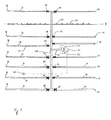
- Fig. 1 schematically shows a grape vine field with a field heating according to the invention in supervision.
- the shown vine field consists of a plurality of vines, which are arranged in mutually parallel, equidistant rows along a direction X.
- wooden or metal posts 20 are attached at regular intervals, along which a plurality of metal wires 22 are braced for attachment and support of the vines.
- Post 20 and tension wires 22 are shown for simplicity only for one row of vines.
- Fig. 1 further shows a compression device 24 with a compressor 26.
- the compressor 26 may be, for example, a rotary piston blower.
- the compressor 26 heats air by compression and directs it under pressure from the compression device 24 into a distribution system that is in Fig. 1 is shown as a system of interconnected main lines 28 and secondary lines 30.
- the main line 28 extends in the embodiment shown perpendicular to the rows of vines over the entire length of the vine field and is connected via a short extension piece 32 to the compressor 26. From the main line 28 branches via valves 34 connected secondary lines 30 from.
- Fig. 1 further shows a compression device 24 with a compressor 26.
- the compressor 26 may be, for example, a rotary piston blower.
- the compressor 26 heats air by compression and directs it under pressure from the compression device 24 into a distribution system that is in Fig. 1 is shown as a system of interconnected main lines 28 and secondary lines 30.
- the main line 28 extends in the embodiment shown perpendicular to the rows
- the main line 28 may for example consist of a metal pipe or plastic pipe and run at least partially underground, while the secondary lines 30 preferably consist of flexible tubes and are stretched along the tension wires 22 between the post 20. In this way, the work paths for field orders are kept free in the vine field and at the same time it is ensured that the system of the secondary lines 30 does not impair plant growth.
- the secondary lines 30 are closed airtight at their end facing away from the main line 28 in each case by closing flaps 36.
- the system of secondary conduits in the line section extending along the vines consists of porous tubes whose surface has a plurality of capillary outlet openings.
- similar hoses are known as “sweat hose” or “drip hose”.
- sweat or drip hoses are preferably carried out UV-resistant in the context of the invention.
- the heated by the compressor 26 of the compression device 24 air flows under pressure through the extension piece 32 into the main line 28 and from there via the secondary lines 30 through the capillary outlet openings, so that it flows around the vines, at least partially.
- the arrangement of the hoses is below based on Fig. 2a and Fig. 2b described in more detail.
- the compression device 24 is connected to a control device 38, which controls the speed of the rotary piston blower 26 by means of a frequency converter in dependence on the ambient temperature.
- the control device 38 is wirelessly connected for this purpose to at least one temperature sensor 40 positioned at a suitable location of the vine field.
- the temperature sensor 40 is disposed in the vicinity of frost-sensitive portions of the vines and, in particular, arranged to be flowed around by the compression-heated air exiting the secondary pipes 30 in a similar manner as the frost-sensitive portions of the vines. Then, the measured value of the temperature sensor 40 provides information about the ambient temperature actually present at the vines, so that the intensity of the compression and the distribution of the air heated by compression can be optimally regulated.
- hygrometers for measuring atmospheric humidity
- pyranometers for measuring global radiation
- Fig. 1 shows the structure of a field heating according to the invention only by way of example.
- multiple compression devices 24 may be connected to a common distribution system.
- the subdivision of the distribution system into main lines 28 and secondary lines 30 is also illustrative only.
- a plurality of spatially separated temperature sensors 40 may be connected to the controller 38.
- the design of the field heating, in particular of the distribution system, will always be based on the local circumstances.
- Fig. 2a shows a section of the distribution system of Fig. 1 in the field of vines in side view.
- a capillary tube is suspended as part of the secondary line 30 of the distribution system.
- Fig. 2b shows the same section in cross section.
- the distance between the posts can also be less and be, for example, only 100 cm.
- the air flowing out of the capillary tube during operation of the plant rises due to its lower density in comparison to the surrounding air through the vines.
- the capillary tubes 30 are arranged at such a height that in particular the frost-sensitive buds of the vines are surrounded by warm air.
- the volume in which the frost-sensitive buds of the grapevines are arranged is in Fig. 2a and 2b indicated by the contour 42. This area can be heated efficiently by the compressed air exiting the capillary tube 30.
- Fig. 3 shows the seasonal course of two threshold curves for the grape varieties GeBruztraminer 80 and Merlot 82 for a location in the northern hemisphere.
- the calendar date is plotted, whereby the time in the representation of Fig. 3 running from right to left.
- the minimum of the threshold curves and thus the lowest frost sensitivity is available in the months of January and February. If the ambient temperature falls below the threshold temperature, frost damage to the vines is likely.
- temperature curves which represent the seasonal course of the daily minimum temperatures 84 and the maximum daily temperatures 86 are also shown. As in Fig. 3 can be seen, the falls below Daytime low 84 only on a few days in the year the threshold 80 or 82. Only on these days, the field heating of the invention is ever needed and used.
- Fig. 4 shows a flowchart illustrating the function of the controller 38 in a simplified manner.
- Fig. 4 shows a loop 43 of program steps, which the controller 38 continuously executes when it is in the standby mode.
- temperatures detected by a plurality of temperature sensors 40 are displayed on an LCD display connected to the controller 38.
- a bit evaluation of a data word takes place, which represents both a "collective error message" (SSM) and the selection of a grape variety, in this case Merlot or GeBruztraminer.
- SSM collector error message
- the collective trouble message indicates whether any malfunctions have been detected in a plurality of self-tests that the controller 38 continuously performs.
- step 46 If the bit evaluation in step 46 indicates that there is a fault, the process flow proceeds to step 48, where a trouble message is generated.
- the fault message can be sent, for example via a notification device, such as a mobile phone, directly to a previously determined person, such as the winemaker.
- a "Run LED” is turned on, indicating that the controller 38 is operating even if there is a fault in that case.
- the system is turned off in step 48 for safety reasons.
- step 50 a telephone number is output on an LCD display to which a technical support person can turn. After that, the process returns to the beginning.
- step 46 determines which vine variety is present.
- two varieties of grapes are available, Merlot and GeBruztraminer. Which type of grape is present is input manually to an input device for the control device 38 (not shown in the figures), for example by actuating a selector switch.
- the threshold temperature curve for the relevant grape variety can be entered manually.
- the process branches into two branches 52 (in the Merlot case) and 54 (in the case GeBruztraminer).
- the branches 52, 54 are identical per se except that the respective threshold value curves are used in the process. Therefore, only branch 52 will be described in detail below.
- step 56 of branch 52 the "Run LED” is turned on, indicating that the controller 38 is in operation.
- step 58 the grape variety, in this case Merlot, is displayed on the LCD.
- step 60 the smallest of the measured outside temperatures is selected. On the basis of this smallest outside temperature is decided in the following step 62, whether a heating is necessary. If the minimum outside temperature determined in step 60 is less than a predetermined differential temperature value above the threshold temperature corresponding to the calendar date and the grape variety (here Merlot), it is decided that the vines are to be heated, and the process proceeds to step 64. Otherwise, the process returns to its beginning.
- step 64 the control device 38 generates a control signal which predefines the rotational speed of the rotary blower 26.
- the value of the control signal depends on how close the minimum outside temperature determined in step 60 has already reached the threshold temperature. The more the outside temperature approaches the threshold temperature, the more the control signal approaches the maximum speed.
- the actuating signal is generated in step 66 as a pulse width modulated signal and sent to a frequency converter (not shown) which controls the rotational speed of the rotary blower 26 (see FIG Fig. 1 ) controls accordingly. After that, the process returns to its beginning.
- branch 52 forms part of a control loop in which the ambient temperature effectively effective for the vines can be controlled. This represents the preferred embodiment of the invention.
- the outside temperature may be measured in a range not reached by the heated air, and thus correspond to the actual outside temperature.
- the rotational speed of the rotary blower 26 is not regulated, but controlled in dependence on the actual outside temperature. Also through This simple control provides effective antifreeze protection without excess heat being generated to an unacceptable extent.
- the positive displacement blower is operated at 50% of maximum power, and this power is increased by increasing the speed as the temperature approaches the threshold temperature.
Landscapes
- Life Sciences & Earth Sciences (AREA)
- Forests & Forestry (AREA)
- Health & Medical Sciences (AREA)
- General Health & Medical Sciences (AREA)
- Toxicology (AREA)
- Environmental Sciences (AREA)
- Cultivation Of Plants (AREA)
- Suspension Of Electric Lines Or Cables (AREA)
Priority Applications (2)
| Application Number | Priority Date | Filing Date | Title |
|---|---|---|---|
| EP08003182A EP2092820A1 (fr) | 2008-02-21 | 2008-02-21 | Dispositif et procédé destinés à la protection de vignes contre la gelée |
| PCT/EP2009/001110 WO2009103488A1 (fr) | 2008-02-21 | 2009-02-17 | Dispositif et procédé pour protéger des vignes contre le gel |
Applications Claiming Priority (1)
| Application Number | Priority Date | Filing Date | Title |
|---|---|---|---|
| EP08003182A EP2092820A1 (fr) | 2008-02-21 | 2008-02-21 | Dispositif et procédé destinés à la protection de vignes contre la gelée |
Publications (1)
| Publication Number | Publication Date |
|---|---|
| EP2092820A1 true EP2092820A1 (fr) | 2009-08-26 |
Family
ID=39591723
Family Applications (1)
| Application Number | Title | Priority Date | Filing Date |
|---|---|---|---|
| EP08003182A Withdrawn EP2092820A1 (fr) | 2008-02-21 | 2008-02-21 | Dispositif et procédé destinés à la protection de vignes contre la gelée |
Country Status (2)
| Country | Link |
|---|---|
| EP (1) | EP2092820A1 (fr) |
| WO (1) | WO2009103488A1 (fr) |
Cited By (2)
| Publication number | Priority date | Publication date | Assignee | Title |
|---|---|---|---|---|
| DE102014110351B3 (de) * | 2014-07-23 | 2015-10-29 | Uli Eymann | Verfahren und Vorrichtung zum Frostschutz bei Weinreben |
| RU2621079C2 (ru) * | 2015-04-30 | 2017-05-31 | Анатолий Андреевич Шевцов | Комплексный способ создания микроклимата для выращивания и защиты виноградников и стационарная технологическая система транспортирующих воздушных трубопроводов для создания микроклимата на виноградниках |
Families Citing this family (2)
| Publication number | Priority date | Publication date | Assignee | Title |
|---|---|---|---|---|
| MD643Z (ro) * | 2011-10-26 | 2014-01-31 | Inst Publica Inst Stiintifico Practic Horticultura Tehnologii Alimentare | Procedeu de protecţie a viţei de vie împotriva condiţiilor meteo nefavorabile |
| CN107249303B (zh) * | 2014-11-19 | 2020-09-25 | 诺曼德·拉穆勒 | 用于增加在不利的气候区域中种植的特殊的结果实的藤的度日的方法和系统 |
Citations (1)
| Publication number | Priority date | Publication date | Assignee | Title |
|---|---|---|---|---|
| DE2628884A1 (de) | 1976-06-26 | 1978-01-05 | Rudolf Weigmann | Frostschutzvorrichtung fuer rebstoecke |
-
2008
- 2008-02-21 EP EP08003182A patent/EP2092820A1/fr not_active Withdrawn
-
2009
- 2009-02-17 WO PCT/EP2009/001110 patent/WO2009103488A1/fr not_active Ceased
Patent Citations (1)
| Publication number | Priority date | Publication date | Assignee | Title |
|---|---|---|---|---|
| DE2628884A1 (de) | 1976-06-26 | 1978-01-05 | Rudolf Weigmann | Frostschutzvorrichtung fuer rebstoecke |
Cited By (3)
| Publication number | Priority date | Publication date | Assignee | Title |
|---|---|---|---|---|
| DE102014110351B3 (de) * | 2014-07-23 | 2015-10-29 | Uli Eymann | Verfahren und Vorrichtung zum Frostschutz bei Weinreben |
| WO2016012525A1 (fr) | 2014-07-23 | 2016-01-28 | Uli Eymann | Procédé et dispositif de protection contre la gelée dans les vignes |
| RU2621079C2 (ru) * | 2015-04-30 | 2017-05-31 | Анатолий Андреевич Шевцов | Комплексный способ создания микроклимата для выращивания и защиты виноградников и стационарная технологическая система транспортирующих воздушных трубопроводов для создания микроклимата на виноградниках |
Also Published As
| Publication number | Publication date |
|---|---|
| WO2009103488A1 (fr) | 2009-08-27 |
Similar Documents
| Publication | Publication Date | Title |
|---|---|---|
| EP2268125B1 (fr) | Dispositif et procédé permettant d'accélérer la croissance et de régénérer des surfaces de pelouse | |
| DE2223158C2 (de) | Bedachung für ein Gewächshaus | |
| EP3107370B1 (fr) | Système mobile stimulant la croissance d'une pelouse | |
| WO2009015911A2 (fr) | Tapis d'irrigation pour répartir l'eau sur une surface étendue | |
| EP3017688A1 (fr) | Double film plastique pour recouvrir des cultures agricoles | |
| EP2100500B1 (fr) | Procédé et dispositif de protection des plantes contre le gel | |
| EP2092820A1 (fr) | Dispositif et procédé destinés à la protection de vignes contre la gelée | |
| DE102014110351B3 (de) | Verfahren und Vorrichtung zum Frostschutz bei Weinreben | |
| DE3238073A1 (de) | Verfahren zum steuern der wasserzufuhr zu einer bewaesserungs- oder beregnungsanlage und schaltungsanordnung zum durchfuehren dieses verfahrens | |
| JP2017079631A (ja) | 溶液殺菌装置 | |
| EP3399264A1 (fr) | Système de champ de pulvérisation pour une tour de refroidissement, tour de refroidissement, utilisation et procédé | |
| DE29702238U1 (de) | Vorrichtung zum Beseitigen von Wildkraut | |
| DE2915260C2 (de) | Einrichtung zum Be- und Entlüften von Viehställen | |
| DE2214977A1 (de) | Anordnung und Verfahren zur hydroponischen Pflanzenaufzucht | |
| DE102016000392A1 (de) | Vorrichtung und Verfahren zur Wachstumsbeschleunigung und Regeneration von Rasenflächer | |
| EP0605824B1 (fr) | Canon à neige | |
| DE102016109747A1 (de) | Impulsdosiersystem | |
| DE2525114A1 (de) | Bewaesserungsanlage | |
| AT526188B1 (de) | Heizsystem für Pflanzenkulturen | |
| Heisey et al. | Automation of an intermittent overhead irrigation frost protection system for an apple orchard | |
| DE102019009019A1 (de) | Vorhängevorrichtung für eine Gebäudefassade und Verfahren zum Versehen einer Gebäudefassade mit Vorhängevorrichtungen, ein Gebäude, sowie ein Verfahren zum Betreiben einer Gesamtheit aus einer Mehrzahl von an einer Gebäudefasade angeordneten und paarweise miteinander gekoppelten Vorhängevorrichtungen | |
| DE3806973A1 (de) | Pflanzenversorgungssystem | |
| DE202019104177U1 (de) | Vorrichtung zum Kühlen und Befeuchten von Pflanzungen | |
| WO2018049540A1 (fr) | Toit protecteur rétractable destiné à la protection des vignobles | |
| DE102009040920A1 (de) | Verfahren und Vorrichtung zur automatischen Löschung von Bränden an oder im Umfeld einer Windenergieanlage |
Legal Events
| Date | Code | Title | Description |
|---|---|---|---|
| PUAI | Public reference made under article 153(3) epc to a published international application that has entered the european phase |
Free format text: ORIGINAL CODE: 0009012 |
|
| AK | Designated contracting states |
Kind code of ref document: A1 Designated state(s): AT BE BG CH CY CZ DE DK EE ES FI FR GB GR HR HU IE IS IT LI LT LU LV MC MT NL NO PL PT RO SE SI SK TR |
|
| AX | Request for extension of the european patent |
Extension state: AL BA MK RS |
|
| AKX | Designation fees paid | ||
| STAA | Information on the status of an ep patent application or granted ep patent |
Free format text: STATUS: THE APPLICATION IS DEEMED TO BE WITHDRAWN |
|
| 18D | Application deemed to be withdrawn |
Effective date: 20090227 |
|
| REG | Reference to a national code |
Ref country code: DE Ref legal event code: 8566 |