EP2093151A1 - Stapel-, Säge- und Transportbehälter - Google Patents
Stapel-, Säge- und Transportbehälter Download PDFInfo
- Publication number
- EP2093151A1 EP2093151A1 EP09002174A EP09002174A EP2093151A1 EP 2093151 A1 EP2093151 A1 EP 2093151A1 EP 09002174 A EP09002174 A EP 09002174A EP 09002174 A EP09002174 A EP 09002174A EP 2093151 A1 EP2093151 A1 EP 2093151A1
- Authority
- EP
- European Patent Office
- Prior art keywords
- container
- long goods
- stanchions
- processing station
- bottom part
- Prior art date
- Legal status (The legal status is an assumption and is not a legal conclusion. Google has not performed a legal analysis and makes no representation as to the accuracy of the status listed.)
- Granted
Links
- 238000000034 method Methods 0.000 claims abstract description 11
- 238000005520 cutting process Methods 0.000 claims description 13
- 238000009434 installation Methods 0.000 claims description 2
- 230000001681 protective effect Effects 0.000 abstract description 3
- 230000003014 reinforcing effect Effects 0.000 abstract 1
- 239000002023 wood Substances 0.000 description 18
- 238000000926 separation method Methods 0.000 description 11
- 238000004519 manufacturing process Methods 0.000 description 4
- 239000003351 stiffener Substances 0.000 description 3
- 238000003860 storage Methods 0.000 description 3
- 238000001035 drying Methods 0.000 description 2
- 239000000463 material Substances 0.000 description 2
- 125000006850 spacer group Chemical group 0.000 description 2
- 239000000443 aerosol Substances 0.000 description 1
- 239000013590 bulk material Substances 0.000 description 1
- 238000006243 chemical reaction Methods 0.000 description 1
- 238000010276 construction Methods 0.000 description 1
- 238000009826 distribution Methods 0.000 description 1
- 230000007613 environmental effect Effects 0.000 description 1
- 238000003754 machining Methods 0.000 description 1
- 239000002184 metal Substances 0.000 description 1
- 238000012856 packing Methods 0.000 description 1
- 239000008188 pellet Substances 0.000 description 1
- 239000010876 untreated wood Substances 0.000 description 1
- 238000009423 ventilation Methods 0.000 description 1
Images



Classifications
-
- B—PERFORMING OPERATIONS; TRANSPORTING
- B65—CONVEYING; PACKING; STORING; HANDLING THIN OR FILAMENTARY MATERIAL
- B65D—CONTAINERS FOR STORAGE OR TRANSPORT OF ARTICLES OR MATERIALS, e.g. BAGS, BARRELS, BOTTLES, BOXES, CANS, CARTONS, CRATES, DRUMS, JARS, TANKS, HOPPERS, FORWARDING CONTAINERS; ACCESSORIES, CLOSURES, OR FITTINGS THEREFOR; PACKAGING ELEMENTS; PACKAGES
- B65D19/00—Pallets or like platforms, with or without side walls, for supporting loads to be lifted or lowered
- B65D19/02—Rigid pallets with side walls, e.g. box pallets
- B65D19/06—Rigid pallets with side walls, e.g. box pallets with bodies formed by uniting or interconnecting two or more components
- B65D19/14—Rigid pallets with side walls, e.g. box pallets with bodies formed by uniting or interconnecting two or more components made wholly or mainly of wood
-
- B—PERFORMING OPERATIONS; TRANSPORTING
- B27—WORKING OR PRESERVING WOOD OR SIMILAR MATERIAL; NAILING OR STAPLING MACHINES IN GENERAL
- B27B—SAWS FOR WOOD OR SIMILAR MATERIAL; COMPONENTS OR ACCESSORIES THEREFOR
- B27B21/00—Hand saws without power drive; Equipment for hand sawing, e.g. saw horses
-
- B—PERFORMING OPERATIONS; TRANSPORTING
- B65—CONVEYING; PACKING; STORING; HANDLING THIN OR FILAMENTARY MATERIAL
- B65D—CONTAINERS FOR STORAGE OR TRANSPORT OF ARTICLES OR MATERIALS, e.g. BAGS, BARRELS, BOTTLES, BOXES, CANS, CARTONS, CRATES, DRUMS, JARS, TANKS, HOPPERS, FORWARDING CONTAINERS; ACCESSORIES, CLOSURES, OR FITTINGS THEREFOR; PACKAGING ELEMENTS; PACKAGES
- B65D2519/00—Pallets or like platforms, with or without side walls, for supporting loads to be lifted or lowered
- B65D2519/00004—Details relating to pallets
- B65D2519/00009—Materials
- B65D2519/00014—Materials for the load supporting surface
- B65D2519/00029—Wood
-
- B—PERFORMING OPERATIONS; TRANSPORTING
- B65—CONVEYING; PACKING; STORING; HANDLING THIN OR FILAMENTARY MATERIAL
- B65D—CONTAINERS FOR STORAGE OR TRANSPORT OF ARTICLES OR MATERIALS, e.g. BAGS, BARRELS, BOTTLES, BOXES, CANS, CARTONS, CRATES, DRUMS, JARS, TANKS, HOPPERS, FORWARDING CONTAINERS; ACCESSORIES, CLOSURES, OR FITTINGS THEREFOR; PACKAGING ELEMENTS; PACKAGES
- B65D2519/00—Pallets or like platforms, with or without side walls, for supporting loads to be lifted or lowered
- B65D2519/00004—Details relating to pallets
- B65D2519/00009—Materials
- B65D2519/00049—Materials for the base surface
- B65D2519/00064—Wood
-
- B—PERFORMING OPERATIONS; TRANSPORTING
- B65—CONVEYING; PACKING; STORING; HANDLING THIN OR FILAMENTARY MATERIAL
- B65D—CONTAINERS FOR STORAGE OR TRANSPORT OF ARTICLES OR MATERIALS, e.g. BAGS, BARRELS, BOTTLES, BOXES, CANS, CARTONS, CRATES, DRUMS, JARS, TANKS, HOPPERS, FORWARDING CONTAINERS; ACCESSORIES, CLOSURES, OR FITTINGS THEREFOR; PACKAGING ELEMENTS; PACKAGES
- B65D2519/00—Pallets or like platforms, with or without side walls, for supporting loads to be lifted or lowered
- B65D2519/00004—Details relating to pallets
- B65D2519/00009—Materials
- B65D2519/00084—Materials for the non-integral separating spacer
- B65D2519/00099—Wood
-
- B—PERFORMING OPERATIONS; TRANSPORTING
- B65—CONVEYING; PACKING; STORING; HANDLING THIN OR FILAMENTARY MATERIAL
- B65D—CONTAINERS FOR STORAGE OR TRANSPORT OF ARTICLES OR MATERIALS, e.g. BAGS, BARRELS, BOTTLES, BOXES, CANS, CARTONS, CRATES, DRUMS, JARS, TANKS, HOPPERS, FORWARDING CONTAINERS; ACCESSORIES, CLOSURES, OR FITTINGS THEREFOR; PACKAGING ELEMENTS; PACKAGES
- B65D2519/00—Pallets or like platforms, with or without side walls, for supporting loads to be lifted or lowered
- B65D2519/00004—Details relating to pallets
- B65D2519/00009—Materials
- B65D2519/00154—Materials for the side walls
- B65D2519/00169—Wood
-
- B—PERFORMING OPERATIONS; TRANSPORTING
- B65—CONVEYING; PACKING; STORING; HANDLING THIN OR FILAMENTARY MATERIAL
- B65D—CONTAINERS FOR STORAGE OR TRANSPORT OF ARTICLES OR MATERIALS, e.g. BAGS, BARRELS, BOTTLES, BOXES, CANS, CARTONS, CRATES, DRUMS, JARS, TANKS, HOPPERS, FORWARDING CONTAINERS; ACCESSORIES, CLOSURES, OR FITTINGS THEREFOR; PACKAGING ELEMENTS; PACKAGES
- B65D2519/00—Pallets or like platforms, with or without side walls, for supporting loads to be lifted or lowered
- B65D2519/00004—Details relating to pallets
- B65D2519/00009—Materials
- B65D2519/00189—Materials for the lid or cover
- B65D2519/00203—Wood
-
- B—PERFORMING OPERATIONS; TRANSPORTING
- B65—CONVEYING; PACKING; STORING; HANDLING THIN OR FILAMENTARY MATERIAL
- B65D—CONTAINERS FOR STORAGE OR TRANSPORT OF ARTICLES OR MATERIALS, e.g. BAGS, BARRELS, BOTTLES, BOXES, CANS, CARTONS, CRATES, DRUMS, JARS, TANKS, HOPPERS, FORWARDING CONTAINERS; ACCESSORIES, CLOSURES, OR FITTINGS THEREFOR; PACKAGING ELEMENTS; PACKAGES
- B65D2519/00—Pallets or like platforms, with or without side walls, for supporting loads to be lifted or lowered
- B65D2519/00004—Details relating to pallets
- B65D2519/00009—Materials
- B65D2519/00223—Materials for the corner elements or corner frames
- B65D2519/00238—Wood
-
- B—PERFORMING OPERATIONS; TRANSPORTING
- B65—CONVEYING; PACKING; STORING; HANDLING THIN OR FILAMENTARY MATERIAL
- B65D—CONTAINERS FOR STORAGE OR TRANSPORT OF ARTICLES OR MATERIALS, e.g. BAGS, BARRELS, BOTTLES, BOXES, CANS, CARTONS, CRATES, DRUMS, JARS, TANKS, HOPPERS, FORWARDING CONTAINERS; ACCESSORIES, CLOSURES, OR FITTINGS THEREFOR; PACKAGING ELEMENTS; PACKAGES
- B65D2519/00—Pallets or like platforms, with or without side walls, for supporting loads to be lifted or lowered
- B65D2519/00004—Details relating to pallets
- B65D2519/00258—Overall construction
- B65D2519/00283—Overall construction of the load supporting surface
- B65D2519/00293—Overall construction of the load supporting surface made of more than one piece
-
- B—PERFORMING OPERATIONS; TRANSPORTING
- B65—CONVEYING; PACKING; STORING; HANDLING THIN OR FILAMENTARY MATERIAL
- B65D—CONTAINERS FOR STORAGE OR TRANSPORT OF ARTICLES OR MATERIALS, e.g. BAGS, BARRELS, BOTTLES, BOXES, CANS, CARTONS, CRATES, DRUMS, JARS, TANKS, HOPPERS, FORWARDING CONTAINERS; ACCESSORIES, CLOSURES, OR FITTINGS THEREFOR; PACKAGING ELEMENTS; PACKAGES
- B65D2519/00—Pallets or like platforms, with or without side walls, for supporting loads to be lifted or lowered
- B65D2519/00004—Details relating to pallets
- B65D2519/00258—Overall construction
- B65D2519/00313—Overall construction of the base surface
- B65D2519/00328—Overall construction of the base surface shape of the contact surface of the base
- B65D2519/00333—Overall construction of the base surface shape of the contact surface of the base contact surface having a stringer-like shape
-
- B—PERFORMING OPERATIONS; TRANSPORTING
- B65—CONVEYING; PACKING; STORING; HANDLING THIN OR FILAMENTARY MATERIAL
- B65D—CONTAINERS FOR STORAGE OR TRANSPORT OF ARTICLES OR MATERIALS, e.g. BAGS, BARRELS, BOTTLES, BOXES, CANS, CARTONS, CRATES, DRUMS, JARS, TANKS, HOPPERS, FORWARDING CONTAINERS; ACCESSORIES, CLOSURES, OR FITTINGS THEREFOR; PACKAGING ELEMENTS; PACKAGES
- B65D2519/00—Pallets or like platforms, with or without side walls, for supporting loads to be lifted or lowered
- B65D2519/00004—Details relating to pallets
- B65D2519/00258—Overall construction
- B65D2519/00368—Overall construction of the non-integral separating spacer
- B65D2519/00373—Overall construction of the non-integral separating spacer whereby at least one spacer is made of one piece
-
- B—PERFORMING OPERATIONS; TRANSPORTING
- B65—CONVEYING; PACKING; STORING; HANDLING THIN OR FILAMENTARY MATERIAL
- B65D—CONTAINERS FOR STORAGE OR TRANSPORT OF ARTICLES OR MATERIALS, e.g. BAGS, BARRELS, BOTTLES, BOXES, CANS, CARTONS, CRATES, DRUMS, JARS, TANKS, HOPPERS, FORWARDING CONTAINERS; ACCESSORIES, CLOSURES, OR FITTINGS THEREFOR; PACKAGING ELEMENTS; PACKAGES
- B65D2519/00—Pallets or like platforms, with or without side walls, for supporting loads to be lifted or lowered
- B65D2519/00004—Details relating to pallets
- B65D2519/00258—Overall construction
- B65D2519/00398—Overall construction reinforcements
- B65D2519/00462—Applied in mold, e.g. bi-injection molded reinforcement
- B65D2519/00482—Applied in mold, e.g. bi-injection molded reinforcement on or in the walls
-
- B—PERFORMING OPERATIONS; TRANSPORTING
- B65—CONVEYING; PACKING; STORING; HANDLING THIN OR FILAMENTARY MATERIAL
- B65D—CONTAINERS FOR STORAGE OR TRANSPORT OF ARTICLES OR MATERIALS, e.g. BAGS, BARRELS, BOTTLES, BOXES, CANS, CARTONS, CRATES, DRUMS, JARS, TANKS, HOPPERS, FORWARDING CONTAINERS; ACCESSORIES, CLOSURES, OR FITTINGS THEREFOR; PACKAGING ELEMENTS; PACKAGES
- B65D2519/00—Pallets or like platforms, with or without side walls, for supporting loads to be lifted or lowered
- B65D2519/00004—Details relating to pallets
- B65D2519/00258—Overall construction
- B65D2519/00492—Overall construction of the side walls
- B65D2519/00502—Overall construction of the side walls whereby at least one side wall is made of two or more pieces
-
- B—PERFORMING OPERATIONS; TRANSPORTING
- B65—CONVEYING; PACKING; STORING; HANDLING THIN OR FILAMENTARY MATERIAL
- B65D—CONTAINERS FOR STORAGE OR TRANSPORT OF ARTICLES OR MATERIALS, e.g. BAGS, BARRELS, BOTTLES, BOXES, CANS, CARTONS, CRATES, DRUMS, JARS, TANKS, HOPPERS, FORWARDING CONTAINERS; ACCESSORIES, CLOSURES, OR FITTINGS THEREFOR; PACKAGING ELEMENTS; PACKAGES
- B65D2519/00—Pallets or like platforms, with or without side walls, for supporting loads to be lifted or lowered
- B65D2519/00004—Details relating to pallets
- B65D2519/00258—Overall construction
- B65D2519/00492—Overall construction of the side walls
- B65D2519/00532—Frame structures
-
- B—PERFORMING OPERATIONS; TRANSPORTING
- B65—CONVEYING; PACKING; STORING; HANDLING THIN OR FILAMENTARY MATERIAL
- B65D—CONTAINERS FOR STORAGE OR TRANSPORT OF ARTICLES OR MATERIALS, e.g. BAGS, BARRELS, BOTTLES, BOXES, CANS, CARTONS, CRATES, DRUMS, JARS, TANKS, HOPPERS, FORWARDING CONTAINERS; ACCESSORIES, CLOSURES, OR FITTINGS THEREFOR; PACKAGING ELEMENTS; PACKAGES
- B65D2519/00—Pallets or like platforms, with or without side walls, for supporting loads to be lifted or lowered
- B65D2519/00004—Details relating to pallets
- B65D2519/00547—Connections
- B65D2519/00577—Connections structures connecting side walls, including corner posts, to each other
- B65D2519/00582—Connections structures connecting side walls, including corner posts, to each other structures intended to be disassembled, i.e. collapsible or dismountable
- B65D2519/00587—Connections structures connecting side walls, including corner posts, to each other structures intended to be disassembled, i.e. collapsible or dismountable side walls directly connected to each other
-
- B—PERFORMING OPERATIONS; TRANSPORTING
- B65—CONVEYING; PACKING; STORING; HANDLING THIN OR FILAMENTARY MATERIAL
- B65D—CONTAINERS FOR STORAGE OR TRANSPORT OF ARTICLES OR MATERIALS, e.g. BAGS, BARRELS, BOTTLES, BOXES, CANS, CARTONS, CRATES, DRUMS, JARS, TANKS, HOPPERS, FORWARDING CONTAINERS; ACCESSORIES, CLOSURES, OR FITTINGS THEREFOR; PACKAGING ELEMENTS; PACKAGES
- B65D2519/00—Pallets or like platforms, with or without side walls, for supporting loads to be lifted or lowered
- B65D2519/00004—Details relating to pallets
- B65D2519/00547—Connections
- B65D2519/00636—Connections structures connecting side walls to the pallet
- B65D2519/00641—Structures intended to be disassembled
Definitions
- the invention relates to a container and a method for handling, in particular for storing, transporting and separating long goods having the features in the preamble of the method and device main claim.
- Firewood in particular is usually cut to a basic length as fresh, wet trunk wood, optionally split and stacked, stored and transported on the pallet.
- the reason for this is not only the space-saving arrangement, but also that the usual unit of measure when trading firewood is a star.
- a ster indicates the packing volume of one cubic meter or room meter.
- the wood stack is unloaded and sawed individually into smaller pieces. These shorter pieces are then transported as loose bulk material to the customer and unloaded there as a pile. Due to the disorderly pile of wood, it is no longer possible for the customer to directly check whether the full amount of wood was delivered.
- the firewood is weighed before delivery and converted into ster. Decisive for the accuracy of the conversion here is the residual moisture content and thus the weight of the wood. The amount of wood actually delivered can be noticeably heavier when wet.
- the invention solves this problem with the features in the method and device main claim.
- the container according to the invention has the advantage that long goods and especially woods are stacked in it and secured in the longitudinal and transverse direction against slipping or falling out.
- the woods may be of the same or different wood species and be cut to length and / or split before being stacked. Through openings in the wall of the container, the long goods can be cut as a whole pile into shorter pieces. A clearance in the support surface of the bottom part allows a severing of the entire stack in one operation, without damaging the bottom part, the structure or the cutting tool.
- the wood can be stacked wet and dried in the air-permeable container.
- the container can be manufactured in different sizes and moved with all commercial means of transport, especially with pallet trucks, stackers or sack trucks.
- the long goods can be separated from its basic length into shorter pieces of different formats as needed.
- so-called "meter wood” can be cut one or more times, oven-ready formats of, for example, 25 cm, 33 cm, 50 cm or 100 cm being commercially available.
- oven-ready formats for example, 25 cm, 33 cm, 50 cm or 100 cm being commercially available.
- any length and combination of formats is possible.
- the severing can be done on customer request or already directly after the storage. In the container, even large-diameter warehouses can be severed.
- the long goods can be stored in the container, aerated or moistened if necessary.
- the containers are stackable and thus space-saving on a small area storable.
- the wall is preferably formed by side parts and stanchions. These side parts and stanchions are individually attachable to the bottom part and can also be removed individually. This allows the wall open at any point to facilitate the introduction and removal of the long goods.
- the stakes can be designed as Eckrungen and side stanchions, which are stiffened for transport and storage by cross connections. During the separation of the long goods, these transverse stiffeners can be removed. Stiffeners or guard edges may be attached to the stanchions. These can also serve as guide elements for a cutting tool.
- the stanchions are preferably connected by braces, upper struts or bearing cradles.
- the side walls, stakes, bow and the bottom part are preferably positively connected to each other.
- it is particularly plug connections, which can be additionally secured if necessary, for example, with cable ties, wires, fittings or nails.
- Bottom part, side panels, stanchions and top struts are preferably made of untreated wood, making the container is inexpensive to manufacture and can be fired by the customer after removing the fasteners without environmental concerns.
- the container can also be wholly or partly made of plastic, metal or any combination of materials.
- the container is preferably used in agriculture and forestry and in the firewood trade. It is suitable for manufacturing, transport and distribution.
- the invention relates to a container (1) and a method for handling long goods (17), in particular for storing, transporting and separating long goods (17) in a container (1).
- the invention further relates to a processing station (14) for handling long goods (17).
- the container (1) can be provided for any types and materials of long goods (17). In the embodiment shown, it is a container (1) for round logs or logs.
- the container (1) consists of a bottom part (2), a lateral, optionally circumferential wall (3) and optionally a lid.
- the lateral wall is in the form of side members (5) and stanchions (6, 6 ') and provides one or more openings (4) for the passage of a separating tool (16), such as a chain saw.
- the openings (4) are preferably aligned transversely to the bottom part (2) and emerge recordable in that narrow stanchions (6, 6 ') are mutually spaced apart.
- the bottom part (2) in the embodiment shown is a pallet consisting of blocks with longitudinal and transverse slats or boards applied thereto.
- support strips (8) are applied as spacers.
- the long goods (17) are stacked on these support strips, with cavities remaining free between the support strips (8) and preferably in the region of the openings (4) of the wall (3).
- These cavities are used in the separation process as a clearance (9) for the cutting tool, so that the bottom part (2) is not damaged during the separation process and the whole stack can be cut in one operation.
- the support strips (8) preferably extend transversely to the axis of the long goods (17) and parallel to the parting plane.
- the freewheels (9) can also be formed by recesses in the bottom part (2). It is also possible that the bottom part (2) is formed with a thick bearing surface and the cutting tool penetrates into the upper part of the support surface.
- the side parts (5) can be positively and detachably connected to the bottom part (2).
- connectors (10) are shown in the form of U-profiles.
- the stanchions (6, 6 ') are designed as corner stanchions (6) and central stanchions (6'), between which, for example, three or four openings (4) remain free.
- opposite stanchions (6,6 ') can in the upper part by brackets (7), Auflageriegel or upper struts with possibly the same width as the Rungen (6,6 ') in pairs be connected.
- the brackets (7) also form openings (4) for the passage of a separating tool (16), which connect to the vertical openings (4).
- the bearing bolts (7) are detachable and form-fitting, e.g. by plug connections (10), in particular U-profiles, connected to the stanchions (6,6 ').
- the bearing bolts (7) are used to stiffen the container (1), as well as a support of the forces acting on the stanchions (6,6 '), in particular during the separation process. They continue to carry the long goods (16) in the severed as undivided state transversely to the axis and secure them from slipping or falling out.
- the bearing bolts (7) preferably form a loadable surface of the container (1).
- the containers (1) are stackable in two or more layers.
- stiffening elements (12) can be attached, which increase the rigidity and stability of the wall and the entire container. Depending on the embodiment, these elements can also be designed as guide elements (12) for a cutting tool or as protective edges. In the drawing, U-profiles on the edges of the Mittelrept (6 ') are shown. However, the stiffeners (12) can also be mounted on the inner or outer surface, as well as on the Eckritch (6).
- the Eckrungen (6) and Mittelrept (6 ') and optionally the side parts (5) are interconnected by cross braces (13). These cross braces (13) are detachably connected to the corner stanchions (6), the middle stanchions (6 ') and optionally to the side panels (5) and can be removed for the separation process to release the apertures (4).
- cross braces (13) shown in the upper and lower portions of the stanchions (6,6 '), for example, with the stanchions (6,6') positively, for example by screws, bolt connectors, etc., are connected.
- the side parts (5) are preferably frontally attached to the long goods on the bottom part (2), provide a guide and possibly support the long goods (17) transverse to the axis and are individually disassembled.
- the side parts (5) are preferably in the upper and / or central region via corner joints (11) with the Eckrungen (6) positively and releasably connected.
- the side parts (5) are shown as a frame construction with a grid element.
- the container (1) can be arranged in a processing station (14) and on a lifting installation (15).
- the processing station (14) prepares the long goods (17) optionally by cutting to a basic length or splitting.
- the processing station (14) includes at least one container (1), and optionally a separating tool (16), a splitting tool (18) and a cutting tool (19), which in FIG. 7 schematically illustrated by a saw blade and a wedge.
- the wall (3) may be completely or partially removed. In particular, a side wall (5) may be removed.
- the optionally axial introduction and stacking of the long goods (17) in the container (1) can be simplified by a conveyor (20) or automated by means of a handling device.
- the separating tool (16) is preferably designed as a mobile chain saw with a long, pivotable chain sword, which can be guided from above through the horizontal and vertical openings (4) and through the stack.
- the cutting tool can also be designed differently, eg as a band saw.
- the stored in the containers long goods (17) can be cut at any time and in variable section lengths in the region of the openings (4).
- the cross braces (13) are removed and a separating tool (16) guided wholly or partially through the stack. After the separation process, the cross braces (13) are attached again.
- the wall (3) is preferably designed so that the long goods (17) can be aerated in the container, moistened or treated in a similar manner.
- the wall can consist on all sides of stanchions (6, 6 ') with openings (4) located therebetween.
- the upper struts (7) may be formed as a plate or lid.
- the number of stanchions (6,6 ') and the openings (4) is variable.
- the container may also be designed as a box with slots or as a bottom part (2) with a box-like wall (3) and / or optionally flap-like lid.
- the processing station may have a lifting device (15), a handling device for stacking the long goods and a moistening, drying system.
- the treatment station can also have systems for thermal or aerosol treatment and a transport system for the containers (1).
Landscapes
- Life Sciences & Earth Sciences (AREA)
- Engineering & Computer Science (AREA)
- Mechanical Engineering (AREA)
- Wood Science & Technology (AREA)
- Forests & Forestry (AREA)
- Solid Fuels And Fuel-Associated Substances (AREA)
- Packages (AREA)
- Pallets (AREA)
Abstract
Description
- Die Erfindung betrifft einen Behälter und ein Verfahren zum Handhaben, insbesondere zum Lagern, Transportieren und Trennen von Langgütern mit den Merkmalen im Oberbegriff des Verfahrens- und Vorrichtungshauptanspruchs.
- Aus der Praxis ist es bekannt und üblich, Langgüter wie Rundhölzer oder Holzscheite auf dafür vorgesehenen Paletten zu lagern und zu transportieren. Die Langgüter werden in einer bestimmten Grundlänge auf die Paletten gestapelt. An den Paletten werden aufrechte Stangen angebracht, die das Langgut quer zu seiner Achse führen. Während des Transports wird gegebenenfalls eine Plane um den Stapel gebunden, um ein Herausfallen oder Abrutschen zu vermeiden. Die für den Transportschutz angebrachte Plane wird zum Lagern des Holzes abgenommen, um eine ausreichende Durchlüftung und ein Abtrocknen des Holzes zu ermöglichen.
- Insbesondere Brennholz wird als frisches, nasses Stammholz üblicherweise auf eine Grundlänge abgelängt, gegebenenfalls gespalten und auf der Palette gestapelt, gelagert und transportiert. Grund hierfür ist nicht nur die platzsparende Anordnung, sondern auch, dass die gebräuchliche Maßeinheit beim Handel mit Brennholz ein Ster ist. Ein Ster bezeichnet das Packvolumen von einem Kubik- oder Raummeter.
- Wünscht ein Kunde eine kürzere Länge des Brennholzes, so wird der Holzstapel abgeladen und einzeln in kleinere Stücke zersägt. Diese kürzeren Stücke werden dann als loses Schüttgut zum Kunden transportiert und dort als Haufen abgeladen. Aufgrund der ungeordneten Aufschüttung des Holzes ist es für den Kunden nun nicht mehr möglich, direkt zu überprüfen, ob die vollständige Holzmenge angeliefert wurde. Das Brennholz wird vor der Auslieferung gewogen und in Ster umgerechnet. Ausschlaggebend für die Exaktheit der Umrechnung ist hierbei der Restfeuchtegehalt und damit das Gewicht des Holzes. Die tatsächlich gelieferte Menge Holz kann im nassen Zustand merklich schwerer wirken.
- Im Allgemeinen ist es dem Kunden überlassen, die einzelnen Holzstücke erneut aufzustapeln und gegebenenfalls wieder auf Paletten und / oder an einem trockenen Ort zu lagern. Das Abladen des Holzes zum Zersägen in kleinere Stücke und das erneute Aufstapeln erfordern viel Kraft und Zeit und stellen mühevolle Arbeiten dar.
- Es ist Aufgabe der Erfindung einen verbesserten Behälter und ein verbessertes Verfahren zum Handhaben von Langgütern aufzuzeigen. Weiterhin ist es Aufgabe der Erfindung eine Bearbeitungsstation zur vorteilhaften Handhabung von Langgut aufzuzeigen.
- Die Erfindung löst diese Aufgabe mit den Merkmalen im Verfahrens- und Vorrichtungshauptanspruch.
- Der erfindungsgemäße Behälter hat den Vorteil, dass Langgüter und insbesondere Hölzer in ihm aufgestapelt und in Längs- und Querrichtung gegen Verrutschen oder Herausfallen gesichert werden. Die Hölzer können von gleicher oder verschiedener Holzart sein und vor dem Aufstapeln auf eine Grundlänge abgelängt und / oder gespalten werden. Durch Öffnungen in der Wandung des Behälters können die Langgüter als ganzer Stapel in kürzere Stücke zertrennt werden. Ein Freigang in der Auflagefläche des Bodenteils ermöglicht ein Durchtrennen des gesamten Stapels in einem Arbeitsgang, ohne dass das Bodenteil, der Aufbau oder das Trennwerkzeug beschädigt werden. Das Holz kann nass aufgestapelt werden und im luftdurchlässigen Behälter trocknen.
- Da das Holz im Behälter zertrennt werden kann, entfallen die Prozesse des Abladens und erneuten Aufstapelns der Langgüter. Hierdurch wird der Bearbeitungsvorgang erheblich verkürzt und erleichtert. Im Fall von Brennholz kann ein kompletter Holzstapel direkt im Behälter zersägt und sehr schnell zum Kunden geliefert werden. Somit wird eine geschlossene Kette der Brennholzerzeugung vom Stammholz bis zum ofenfertigen Brennholz beim Kunden gewährleistet, ohne dass das Brennholz lose transportiert, abgekippt oder neu gestapelt werden muss. Der Behälter wird als komplette Einheit bis zum Kunden transportiert. Die Holzmenge im Behälter ist zu jedem Zeitpunkt genau definiert, also sichtbar und berechenbar. Der Kunde kann auch selbst das Zertrennen des Holzes durchführen.
- Der Behälter kann in unterschiedlichen Größen gefertigt und mit allen handelsüblichen Transportmitteln bewegt werden, insbesondere mit Hubwagen, Staplern oder Sackkarren.
- Das Langgut kann je nach Bedarf von seiner Grundlänge ausgehend in kürzere Stücke verschiedener Formate zertrennt werden. Beispielsweise kann sog. "Meterholz" ein- oder mehrmals zertrennt werden, wobei ofenfertige Formate von beispielsweise 25cm, 33cm, 50cm oder 100cm handelsüblich sind. Es ist jedoch jede beliebige Länge und Kombination von Formaten möglich. Das Zertrennen kann auf Kundenanfrage oder bereits direkt nach der Einlagerung erfolgen. Im Behälter können auch Laggüter mit großem Durchmesser zertrennt werden.
- Durch die Querführung des Holzes wird dieses auch während des Trennprozesses von der Umwandung abgestützt. Die zertrennten Stücke sowie die ganzen Hölzer sind im Behälter sicher transportierbar und vor Verrutschen und Herausfallen geschützt. Der Platzbedarf bei der Herstellung wird wesentlich verringert und das Langgut kann auch im zertrennten Zustand auf minimaler Fläche gelagert werden. Das beim Trennen anfallende Sägemehl kann aufgefangen, getrocknet und wiederum zu Presslingen verarbeitet oder in sonstiger Weise verwertet werden.
- Die Langgüter können im Behälter gelagert, durchlüftet oder gegebenenfalls befeuchtet werden. Die Behälter sind stapelbar und somit platzsparend auf geringer Fläche lagerbar.
- Die Wandung wird bevorzugt durch Seitenteile und Rungen gebildet. Diese Seitenteile und Rungen sind einzeln am Bodenteil anbringbar und können auch einzeln wieder abgenommen werden. Hierdurch lässt sich die Wandung an beliebiger Stelle öffnen, um das Einbringen und Herausnehmen des Langgutes zu vereinfachen.
- Die Rungen können als Eckrungen und Seitenrungen ausgeführt sein, welche zum Transport und zur Lagerung durch Querverbindungen versteift werden. Während des Zertrennens der Langgüter können diese Querversteifungen abgenommen werden. An den Rungen können Versteifungselemente oder Schutzkanten angebracht sein. Diese können auch als Führungselemente für ein Trennwerkzeug dienen.
- Im oberen Bereich sind die Rungen bevorzugt durch Spriegel, Oberverstrebungen oder Auflageriegel verbunden. Die Spriegel nehmen während des Trennprozesses zusammen mit den Rungen die Trennkräfte auf und versteifen den Behälter. Sie bieten weiterhin eine belastbare Oberfläche für das Stapeln der Behälter.
- Die Seitenwände, Rungen, Spriegel und das Bodenteil werden bevorzugt formschlüssig miteinander verbunden. Es eignen sich hierbei besonders Steckverbindungen, die bei Bedarf zusätzlich beispielsweise mit Kabelbindern, Drähten, Verschraubungen oder Nägeln gesichert werden können.
- Hierdurch werden eine einfache, schnelle und kostengünstige Montage sowie Demontage des Behälters ermöglicht. Die demontierten Teile sind wiederverwendbar und können mit geringem Stauraum gelagert und transportiert werden.
- Bodenteil, Seitenteile, Rungen und Oberverstrebungen werden bevorzugt aus unbehandeltem Holz gefertigt, wodurch der Behälter günstig herzustellen ist und vom Kunden nach Entfernen der Verbindungselemente ohne Umweltbedenken mit verfeuert werden kann. Der Behälter kann aber auch ganz oder teilweise aus Kunststoff, Metall oder einer beliebigen Materialkombination gefertigt sein.
- Der Behälter wird bevorzugt in Land- und Forstwirtschaft und im Brennholzhandel verwendet. Er eignet sich für Herstellung, Transport und Vertrieb.
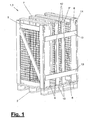
- Die Erfindung ist in den Zeichnungen beispielsweise und schematisch dargestellt. Im einzelnen zeigen:
- Figur 1:
- Einen leeren Behälter in perspektivischer Ansicht,
- Figur 2:
- einen leeren Behälter in Seitenansicht,
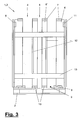
- Figur 3:
- einen leeren Behälter in Frontansicht,
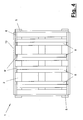
- Figur 4:
- eine Draufsicht auf Bodenteil und Wandung des Behälters,
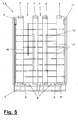
- Figur 5:
- einen Behälter mit eingestapeltem Langgut und ein Trennwerkzeug während des Trennprozesses in Frontansicht,
- Figur 6:
- einen Behälter mit eingestapeltem Langgut und ein Trennwerkzeug während des Trennprozesses in Seitenansicht und
- Figur 7:
- einen Behälter auf einer Hebebühne beim Einbringen des Langgutes in einer Bearbeitungsstation.
- Die Erfindung betrifft einen Behälter (1) und ein Verfahren zum Handhaben von Langgut (17), insbesondere zum Lagern, Transportieren und Trennen von Langgut (17) in einem Behälter (1). Die Erfindung betrifft weiterhin eine Bearbeitungsstation (14) für die Handhabung von Langgut (17).
- Der Behälter (1) kann für beliebige Arten und Materialien von Langgütern (17) vorgesehen sein. In der gezeigten Ausführungsform handelt es sich um einen Behälter (1) für Rundhölzer oder Holzscheite. Der Behälter (1) besteht aus einem Bodenteil (2), einer seitlichen, gegebenenfalls umlaufenden Wandung (3) und gegebenenfalls einem Deckel. Die seitliche Wandung ist in Form von Seitenteilen (5) und Rungen (6,6') ausgeführt und bietet ein oder mehrere Öffnungen (4) für den Durchtritt eines Trennwerkzeugs (16), wie beispielsweise einer Kettensäge. Die Öffnungen (4) sind bevorzugt quer zum Bodenteil (2) ausgerichtet und entstehen bespielsweise dadurch, dass schmale Rungen (6,6') gegenseitig auf Abstand gesetzt werden.
- Das Bodenteil (2) ist in der gezeigten Ausführung eine Palette, bestehend aus Klötzen mit darauf aufgebrachten Längs- und Querlatten oder -brettern. Auf die Querlatten sind Auflageleisten (8) als Abstandsbildner aufgebracht. Auf diese Auflageleisten werden die Langgüter (17) aufgestapelt, wobei zwischen den Auflageleisten (8) und bevorzugt im Bereich der Öffnungen (4) der Wandung (3) Hohlräume freibleiben. Diese Hohlräume dienen im Trennprozess als Freigang (9) für das Trennwerkzeug, sodass das Bodenteil (2) beim Trennprozess nicht beschädigt wird und der ganze Stapel in einem Arbeitsgang durchtrennt werden kann. Die Auflageleisten (8) verlaufen bevorzugt quer zur Achse des Langgutes (17) und parallel zur Trennebene. Die Freigänge (9) können auch durch Ausnehmungen im Bodenteil (2) gebildet werden. Es ist weiterhin möglich, dass das Bodenteil (2) mit einer dicken Auflagefläche ausgeformt ist und das Trennwerkzeug in den oberen Teil der Auflagefläche eindringt.
- Die Seitenteile (5) können mit dem Bodenteil (2) formschlüssig und lösbar verbunden sein. In den Zeichnungen sind Steckverbindungen (10) in Form von U-Profilen dargestellt. Die Rungen (6,6') sind als Eckrungen (6) und Mittelrungen (6') ausgeführt, zwischen denen beispielsweise drei oder vier Öffnungen (4) frei bleiben. Beidseits am Bodenteil (2) gegenüberliegende Rungen (6,6') können im oberen Bereich durch Spriegel (7), Auflageriegel oder Oberverstrebungen mit ggf. gleicher Breite wie die Rungen (6,6') paarweise verbunden sein. Die Spriegel (7) bilden ebenfalls Öffnungen (4) für den Durchtritt eines Trennwerkzeugs (16), die an die vertikalen Öffnungen (4) anschließen.
- Die Auflageriegel (7) sind lösbar und formschlüssig, z.B. durch Steckverbindungen (10), insbesondere U-Profile, mit den Rungen (6,6') verbunden. Die Auflageriegel (7) dienen der Versteifung des Behälters (1), sowie einer Abstützung der auf die Rungen (6,6') wirkenden Kräfte, insbesondere während des Trennprozesses. Sie führen weiterhin die Langgüter (16) im zertrennten wie unzertrennten Zustand quer zu deren Achse und sichern diese vor Verrutschen oder Herausfallen.
- Die Auflageriegel (7) bilden bevorzugt eine belastbare Oberfläche des Behälters (1). Die Behälter (1) sind in zwei oder mehr Lagen übereinander stapelbar.
- An den Rungen (6,6') können Versteifungselemente (12) angebracht werden, die die Steifigkeit und Stabilität der Wandung und des gesamten Behälters erhöhen. Je nach Ausführungsform können diese Elemente auch als Führungselemente (12) für ein Trennwerkzeug oder als Schutzkanten ausgebildet sein. In der Zeichnung sind U-Profile auf den Rändern der Mittelrungen (6') dargestellt. Die Versteifungen (12) können jedoch auch auf der Innen-oder Außenfläche, sowie an den Eckrungen (6) angebracht werden.
- Die Eckrungen (6) und Mittelrungen (6') sowie gegebenenfalls die Seitenteile (5) sind durch Querverstrebungen (13) untereinander verbunden. Diese Querverstrebungen (13) sind lösbar mit den Eckrungen (6), den Mittelrungen (6') und gegebenenfalls mit den Seitenteilen (5) verbunden und können für den Trennprozess abgenommen werden, um die Öffnungen (4) freizugeben. In den Zeichnungen sind jeweils zwei Querverstrebungen (13) im oberen und unteren Bereich der Rungen (6,6') dargestellt, die beispielsweise mit den Rungen (6,6') formschlüssig, z.B. durch Schrauben, Riegelverbinder etc., verbunden sind.
- Die Seitenteile (5) sind bevorzugt stirnseitig zum Langgut am Bodenteil (2) befestigt, bieten eine Führung und ggf. Abstützung der Langgüter (17) quer zu deren Achse und sind einzeln demontierbar. Die Seitenteile (5) sind bevorzugt im oberen und / oder mittleren Bereich über Eckverbindungen (11) mit den Eckrungen (6) formschlüssig und lösbar verbunden. In den Zeichnungen sind die Seitenteile (5) als Rahmenkonstruktion mit einem Gitterelement dargestellt.
- Zum Einbringen und Aufstapeln kann der Behälter (1) in einer Bearbeitungsstation (14) und auf einer Hebeanlage (15) angeordnet sein. Die Bearbeitungsstation (14) bereitet das Langgut (17) gegebenenfalls durch Ablängung auf eine Grundlänge oder Spaltung auf. Die Bearbeitungsstation (14) beinhaltet mindestens einen Behälter (1), sowie gegebenenfalls ein Trennwerkzeug (16), ein Spaltwerkzeug (18) und ein Ablängwerkzeug (19), was in
Figur 7 schematisch durch ein Sägeblatt und einen Keil illustriert ist. Für die Einbringung oder Entnahme der Langgüter (17) in den Behälter (1) kann die Wandung (3) ganz oder teilweise entfernt sein. Insbesondere kann eine Seitenwand (5) entfernt sein. Das ggf. axiale Einbringen und Aufstapeln der Langgüter (17) im Behälter (1) kann durch eine Fördereinrichtung (20) vereinfacht oder mittels einer Handhabungseinrichtung automatisiert sein. Das Trennwerkzeug (16) ist vorzugsweise als fahrbare Kettensäge mit einem langen, schwenkbaren Kettenschwert ausgebildet, das von oben durch die horizontalen und vertikalen Öffnungen (4) und durch den Stapel geführt werden kann. Das Trennwerkzeug kann auch anders, z.B. als Bandsäge ausgeführt sein. - Die in den Behältern gelagerten Langgüter (17) können zu einem beliebigen Zeitpunkt und in variablen Abschnittslängen im Bereich der Öffnungen (4) zertrennt werden. Hierzu werden die Querverstrebungen (13) entfernt und ein Trennwerkzeug (16) ganz oder teilweise durch den Stapel hindurch geführt. Nach dem Trennprozess werden die Querverstrebungen (13) wieder angebracht.
- Die Wandung (3) ist bevorzugt so ausgeführt, dass die Langgüter (17) im Behälter durchlüftet, befeuchtet oder auf ähnliche Weise behandelt werden können.
- In einer weiteren Ausführungsform kann die Wandung zu allen Seiten aus Rungen (6,6') mit dazwischen befindlichen Öffnungen (4) bestehen. Die Oberverstrebungen (7) können als Platte oder Deckel ausgeformt sein. Die Zahl der Rungen (6,6') und der Öffnungen (4) ist variabel. Der Behälter kann ferner als Kiste mit Schlitzen oder als Bodenteil (2) mit kistenartiger Wandung (3) und / oder gegebenenfalls klappenartigem Deckel ausgeführt sein.
- Die Bearbeitungsstation kann eine Hubeinrichtung (15), eine Handhabungseinrichtung für das Aufstapeln der Langgüter sowie eine Befeuchtungs-, Trocknungsanlage aufweisen. Die Behandlungsstation kann ferner Anlagen zur thermischen oder aerosolischen Behandlung sowie ein Transportsystem für die Behälter (1) aufweisen.
-
- 1
- Behälter
- 2
- Bodenteil
- 3
- Umwandung
- 4
- Öffnung
- 5
- Seitenteil
- 6
- Runge, Eckrunge
- 6'
- Runge, Mittelrunge
- 7
- Spriegel / Oberverstrebung / Auflageriegel
- 8
- Auflageleiste / Abstandsbildner
- 9
- Freigang / Hohlraum
- 10
- Steckverbinder
- 11
- Eckverbindung
- 12
- Führungs- oder Versteifungselement / Schutzkante
- 13
- Querverstrebung
- 14
- Bearbeitungsstation
- 15
- Hubanlage
- 16
- Trennwerkzeug
- 17
- Langgut
- 18
- Spaltwerkzeug
- 19
- Ablängwerkzeug
- 20
- Fördereinrichtung
Claims (14)
- Behälter (1) zur Aufnahme von stapelbarem Langgut (17), wobei der Behälter ein Bodenteil (2) und eine Umwandung (3) aufweist, dadurch gekennzeichnet, dass die Umwandung (3) ein oder mehrere Öffnungen (4) für den Durchtritt eines Trennwerkzeugs (16) aufweist und das Langgut (17) in Längs- und Querrichtung führt.
- Behälter (1) nach Anspruch 1, dadurch gekennzeichnet, dass das Bodenteil (2) eine Auflagefläche mit Freigang (9) für das Trennwerkzeug (16) aufweist.
- Behälter (1) nach Anspruch 1 oder 2, dadurch gekennzeichnet, dass die Wandung (3) aus Seitenteilen (5) und Rungen (6,6') besteht, die mit dem Bodenteil (2) lösbar verbunden sind.
- Behälter (1) nach Anspruch 1, 2, oder 3, dadurch gekennzeichnet, dass die Rungen (6,6') auf Abstand gesetzt sind und ein oder mehrere Öffnungen (4) bilden.
- Behälter (1) nach einem der vorhergehenden Ansprüche, dadurch gekennzeichnet, dass gegenüberliegende Rungen (6,6') im oberen Bereich durch Spriegel (7) verbunden sind.
- Behälter nach einem der vorhergehenden Ansprüche, dadurch gekennzeichnet, dass die Rungen (6,6') ein oder mehrere Führungs- oder Versteifungselemente (12) aufweisen.
- Behälter (1) nach einem der vorhergehenden Ansprüche, dadurch gekennzeichnet, dass die Seitenteile (5) und Rungen (6,6') durch abnehmbare Querverstrebungen (13) untereinander versteift sind.
- Verfahren zum Handhaben, insbesondere zum Lagern, Transportieren und Zertrennen von stapelbarem Langgut (17) in einem Behälter (1), dadurch gekennzeichnet, dass das Langgut (17) in den Behälter (1) gestapelt wird, und dass das Langgut (17) als Stapel im Behälter (1) zertrennt wird.
- Verfahren nach Anspruch 8, dadurch gekennzeichnet, dass das Langgut (17) vor dem Einbringen in einer Bearbeitungsanlage (14) aufbereitet wird.
- Verfahren nach Anspruch 8 oder 9, dadurch gekennzeichnet, dass das Langgut (17) in Teile gewünschten Formats zertrennt und anschließend im Behälter (1) transportiert oder gelagert werden kann.
- Verfahren nach einem der Ansprüche 8, 9 oder 10, dadurch gekennzeichnet, dass das Langgut (17) oder dessen Abschnitte einzeln aus dem Behälter (1) entnommen werden.
- Bearbeitungsstation (14) für Langgut (17), dadurch gekennzeichnet, dass die Bearbeitungsstation (14) mindestens einen Behälter (1) nach Ansprüchen 1 bis 8 und ein Trennwerkzeug (16) aufweist.
- Bearbeitungsstation (14) nach Anspruch 12, dadurch gekennzeichnet, dass die Bearbeitungsstation (14) ein Spaltwerkzeug (18) und /oder ein Ablängwerkzeug (19) für das Langgut (17) aufweist.
- Bearbeitungsstation (14) nach Anspruch 12 oder 13, dadurch gekennzeichnet, dass die Bearbeitungsstation (14) eine Handhabungseinrichtung zum Einstapeln des Langgutes (17) und / oder eine Hebeanlage (15) aufweist.
Applications Claiming Priority (1)
| Application Number | Priority Date | Filing Date | Title |
|---|---|---|---|
| DE200810010072 DE102008010072A1 (de) | 2008-02-20 | 2008-02-20 | Stapel-, Säge- und Transportpalette für Brennholz |
Publications (2)
| Publication Number | Publication Date |
|---|---|
| EP2093151A1 true EP2093151A1 (de) | 2009-08-26 |
| EP2093151B1 EP2093151B1 (de) | 2014-04-23 |
Family
ID=40680706
Family Applications (1)
| Application Number | Title | Priority Date | Filing Date |
|---|---|---|---|
| EP20090002174 Not-in-force EP2093151B1 (de) | 2008-02-20 | 2009-02-17 | Stapel-, Säge- und Transportbehälter |
Country Status (2)
| Country | Link |
|---|---|
| EP (1) | EP2093151B1 (de) |
| DE (1) | DE102008010072A1 (de) |
Cited By (3)
| Publication number | Priority date | Publication date | Assignee | Title |
|---|---|---|---|---|
| FR2959439A1 (fr) * | 2010-04-29 | 2011-11-04 | Transports Negoces Services | Support de decoupe de buches de bois |
| AT519795A3 (de) * | 2017-04-14 | 2018-12-15 | Hofstetter Reinhard | Hilfsgerät zum Ablängen und Verladen von Brennholz |
| CN112830069A (zh) * | 2020-12-31 | 2021-05-25 | 沈林芳 | 一种可稳定堆垛的货物多式联运用转运装置 |
Citations (6)
| Publication number | Priority date | Publication date | Assignee | Title |
|---|---|---|---|---|
| DE8024996U1 (de) * | 1980-12-18 | Ebert, Anton, 7592 Renchen | Abläng-Kreissäge | |
| DE3046655A1 (de) | 1980-12-11 | 1982-07-22 | Peter 7943 Ertingen Rauch | Haltevorrichtung zum halten laengerer holzteile fuer die querunterteilung mit einem schneidwerkzeug wie einer motorsaege |
| CH660568A5 (en) | 1983-09-16 | 1987-05-15 | Konrad Lacher | Method of sawing firewood into shorter pieces, and saw trestle for carrying out the method |
| WO1995016622A1 (de) | 1993-12-14 | 1995-06-22 | 3 H-Forst-Dickel Gmbh & Co. Kg | Transportverfahren bzw. transportcontainer für holz |
| US20030030239A1 (en) * | 2001-07-31 | 2003-02-13 | Woerner Axel G. | Industrial transportation and storage cart |
| DE202007010637U1 (de) | 2007-07-31 | 2007-11-15 | Torbau-Schwaben Gmbh | Rahmen-Vorrichtung für Holzscheite |
Family Cites Families (3)
| Publication number | Priority date | Publication date | Assignee | Title |
|---|---|---|---|---|
| CA2227905A1 (fr) * | 1998-02-20 | 1999-08-20 | Yvon Gaudreault | Methode et dispositif pour transporter du bois de chauffage |
| DE20218106U1 (de) * | 2002-11-22 | 2003-03-27 | Böttcher, Monika, 92318 Neumarkt | Brennholz Lager- und Transportpalette |
| DE102004002773A1 (de) * | 2004-01-20 | 2005-08-11 | Wilfried Brunck | Lager- und Transportsystem für Brennholz |
-
2008
- 2008-02-20 DE DE200810010072 patent/DE102008010072A1/de not_active Withdrawn
-
2009
- 2009-02-17 EP EP20090002174 patent/EP2093151B1/de not_active Not-in-force
Patent Citations (6)
| Publication number | Priority date | Publication date | Assignee | Title |
|---|---|---|---|---|
| DE8024996U1 (de) * | 1980-12-18 | Ebert, Anton, 7592 Renchen | Abläng-Kreissäge | |
| DE3046655A1 (de) | 1980-12-11 | 1982-07-22 | Peter 7943 Ertingen Rauch | Haltevorrichtung zum halten laengerer holzteile fuer die querunterteilung mit einem schneidwerkzeug wie einer motorsaege |
| CH660568A5 (en) | 1983-09-16 | 1987-05-15 | Konrad Lacher | Method of sawing firewood into shorter pieces, and saw trestle for carrying out the method |
| WO1995016622A1 (de) | 1993-12-14 | 1995-06-22 | 3 H-Forst-Dickel Gmbh & Co. Kg | Transportverfahren bzw. transportcontainer für holz |
| US20030030239A1 (en) * | 2001-07-31 | 2003-02-13 | Woerner Axel G. | Industrial transportation and storage cart |
| DE202007010637U1 (de) | 2007-07-31 | 2007-11-15 | Torbau-Schwaben Gmbh | Rahmen-Vorrichtung für Holzscheite |
Cited By (5)
| Publication number | Priority date | Publication date | Assignee | Title |
|---|---|---|---|---|
| FR2959439A1 (fr) * | 2010-04-29 | 2011-11-04 | Transports Negoces Services | Support de decoupe de buches de bois |
| AT519795A3 (de) * | 2017-04-14 | 2018-12-15 | Hofstetter Reinhard | Hilfsgerät zum Ablängen und Verladen von Brennholz |
| AT519795B1 (de) * | 2017-04-14 | 2019-11-15 | Hofstetter Reinhard | Hilfsgerät zum Ablängen und Verladen von Brennholz |
| CN112830069A (zh) * | 2020-12-31 | 2021-05-25 | 沈林芳 | 一种可稳定堆垛的货物多式联运用转运装置 |
| CN112830069B (zh) * | 2020-12-31 | 2023-01-13 | 陶泓羽 | 一种可稳定堆垛的货物多式联运用转运装置 |
Also Published As
| Publication number | Publication date |
|---|---|
| DE102008010072A1 (de) | 2009-09-03 |
| EP2093151B1 (de) | 2014-04-23 |
Similar Documents
| Publication | Publication Date | Title |
|---|---|---|
| DE60206372T2 (de) | Verfahren zur beförderung eines satzes grosser länglicher gegenstände, durch das verfahren zu verwendendes verpackungssystem und verwendung eines solchen verpackungssystems | |
| DE1937205C3 (de) | Stapelplatte für den Transport von Kabelrollen | |
| EP2905231B1 (de) | Vorrichtung, system und verfahren zum herstellen und handhaben von bunden aus stapelgut, z. b. von holzscheitbunden | |
| DE1761869A1 (de) | Vorrichtung fuer die Einlagerung,die Handhabung und den Transport von zerbrechlichen Platten | |
| EP2562094A1 (de) | Aufsatzrahmen für Transportbehälter | |
| EP2093151B1 (de) | Stapel-, Säge- und Transportbehälter | |
| EP2981486B1 (de) | Containerstausystem | |
| DE102019213872A1 (de) | Zelle sowie verfahren zum betreiben einer zelle aus mindestens zwei verketteten horizontal-bearbeitungszentren | |
| DE4342536C1 (de) | Transportverfahren bzw. Transportcontainer für Holz | |
| EP1354807B1 (de) | Kufe für einen transportkasten, eine palette oder dergleichen | |
| DE2229243A1 (de) | Palette zum transport von stueckguetern | |
| DE102013104883A1 (de) | Ständer zum Aufbewahren von plattenförmigen Gegenständen | |
| DE1175156B (de) | Zerleg- und verpackbare Stapelplatte | |
| DE20307504U1 (de) | Halte- und Sägevorrichtung in Rahmenbauweise zum Sägen von Brennholzstapeln mit angebauter und abnehmbarer Prallwand | |
| DE9005181U1 (de) | Zusammenlegbarer Behälter | |
| EP2596924A1 (de) | Sägen von Holzlamellen | |
| DE102008063511B3 (de) | Vorrichtung zum Zerlegen von Baumstämmen | |
| DE1802903A1 (de) | Verfahren zur Herstellung,ausgehend von bearbeitetem Papier,einer Trag- und Lagerpalette fuer den Transport von Guetern auf dem Seeweg | |
| EP1608562B1 (de) | Ladeeinheit mit palettiertablar | |
| DE2501318C3 (de) | Teilbehälter für die Verbindung mit einer Bodenplatte | |
| EP3866588B1 (de) | Ladungshilfe für gestapelte und mit lebenden geflügeltieren zu befüllende transportbehälter | |
| EP1796975B1 (de) | Grossladungsträger | |
| DE102016104262B3 (de) | Mehrweg-Transportbox | |
| WO1999061351A1 (de) | Vorrichtung zum lagern von transportbehältnissen | |
| DE202004002235U1 (de) | Lager- und Transportvorrichtung für Holzhäksel |
Legal Events
| Date | Code | Title | Description |
|---|---|---|---|
| PUAI | Public reference made under article 153(3) epc to a published international application that has entered the european phase |
Free format text: ORIGINAL CODE: 0009012 |
|
| AK | Designated contracting states |
Kind code of ref document: A1 Designated state(s): AT BE BG CH CY CZ DE DK EE ES FI FR GB GR HR HU IE IS IT LI LT LU LV MC MK MT NL NO PL PT RO SE SI SK TR |
|
| AX | Request for extension of the european patent |
Extension state: AL BA RS |
|
| 17P | Request for examination filed |
Effective date: 20100218 |
|
| 17Q | First examination report despatched |
Effective date: 20100325 |
|
| AKX | Designation fees paid |
Designated state(s): AT BE BG CH CY CZ DE DK EE ES FI FR GB GR HR HU IE IS IT LI LT LU LV MC MK MT NL NO PL PT RO SE SI SK TR |
|
| GRAP | Despatch of communication of intention to grant a patent |
Free format text: ORIGINAL CODE: EPIDOSNIGR1 |
|
| INTG | Intention to grant announced |
Effective date: 20131218 |
|
| GRAS | Grant fee paid |
Free format text: ORIGINAL CODE: EPIDOSNIGR3 |
|
| GRAA | (expected) grant |
Free format text: ORIGINAL CODE: 0009210 |
|
| AK | Designated contracting states |
Kind code of ref document: B1 Designated state(s): AT BE BG CH CY CZ DE DK EE ES FI FR GB GR HR HU IE IS IT LI LT LU LV MC MK MT NL NO PL PT RO SE SI SK TR |
|
| REG | Reference to a national code |
Ref country code: GB Ref legal event code: FG4D Free format text: NOT ENGLISH |
|
| REG | Reference to a national code |
Ref country code: CH Ref legal event code: EP |
|
| REG | Reference to a national code |
Ref country code: AT Ref legal event code: REF Ref document number: 663674 Country of ref document: AT Kind code of ref document: T Effective date: 20140515 |
|
| REG | Reference to a national code |
Ref country code: IE Ref legal event code: FG4D Free format text: LANGUAGE OF EP DOCUMENT: GERMAN |
|
| REG | Reference to a national code |
Ref country code: DE Ref legal event code: R096 Ref document number: 502009009220 Country of ref document: DE Effective date: 20140605 |
|
| REG | Reference to a national code |
Ref country code: CH Ref legal event code: NV Representative=s name: E. BLUM AND CO. AG PATENT- UND MARKENANWAELTE , CH |
|
| REG | Reference to a national code |
Ref country code: NL Ref legal event code: VDEP Effective date: 20140423 |
|
| REG | Reference to a national code |
Ref country code: LT Ref legal event code: MG4D |
|
| PG25 | Lapsed in a contracting state [announced via postgrant information from national office to epo] |
Ref country code: BG Free format text: LAPSE BECAUSE OF FAILURE TO SUBMIT A TRANSLATION OF THE DESCRIPTION OR TO PAY THE FEE WITHIN THE PRESCRIBED TIME-LIMIT Effective date: 20140723 Ref country code: IS Free format text: LAPSE BECAUSE OF FAILURE TO SUBMIT A TRANSLATION OF THE DESCRIPTION OR TO PAY THE FEE WITHIN THE PRESCRIBED TIME-LIMIT Effective date: 20140823 Ref country code: FI Free format text: LAPSE BECAUSE OF FAILURE TO SUBMIT A TRANSLATION OF THE DESCRIPTION OR TO PAY THE FEE WITHIN THE PRESCRIBED TIME-LIMIT Effective date: 20140423 Ref country code: CY Free format text: LAPSE BECAUSE OF FAILURE TO SUBMIT A TRANSLATION OF THE DESCRIPTION OR TO PAY THE FEE WITHIN THE PRESCRIBED TIME-LIMIT Effective date: 20140423 Ref country code: GR Free format text: LAPSE BECAUSE OF FAILURE TO SUBMIT A TRANSLATION OF THE DESCRIPTION OR TO PAY THE FEE WITHIN THE PRESCRIBED TIME-LIMIT Effective date: 20140724 Ref country code: LT Free format text: LAPSE BECAUSE OF FAILURE TO SUBMIT A TRANSLATION OF THE DESCRIPTION OR TO PAY THE FEE WITHIN THE PRESCRIBED TIME-LIMIT Effective date: 20140423 Ref country code: NL Free format text: LAPSE BECAUSE OF FAILURE TO SUBMIT A TRANSLATION OF THE DESCRIPTION OR TO PAY THE FEE WITHIN THE PRESCRIBED TIME-LIMIT Effective date: 20140423 Ref country code: NO Free format text: LAPSE BECAUSE OF FAILURE TO SUBMIT A TRANSLATION OF THE DESCRIPTION OR TO PAY THE FEE WITHIN THE PRESCRIBED TIME-LIMIT Effective date: 20140723 |
|
| PG25 | Lapsed in a contracting state [announced via postgrant information from national office to epo] |
Ref country code: HR Free format text: LAPSE BECAUSE OF FAILURE TO SUBMIT A TRANSLATION OF THE DESCRIPTION OR TO PAY THE FEE WITHIN THE PRESCRIBED TIME-LIMIT Effective date: 20140423 Ref country code: PL Free format text: LAPSE BECAUSE OF FAILURE TO SUBMIT A TRANSLATION OF THE DESCRIPTION OR TO PAY THE FEE WITHIN THE PRESCRIBED TIME-LIMIT Effective date: 20140423 Ref country code: ES Free format text: LAPSE BECAUSE OF FAILURE TO SUBMIT A TRANSLATION OF THE DESCRIPTION OR TO PAY THE FEE WITHIN THE PRESCRIBED TIME-LIMIT Effective date: 20140423 Ref country code: LV Free format text: LAPSE BECAUSE OF FAILURE TO SUBMIT A TRANSLATION OF THE DESCRIPTION OR TO PAY THE FEE WITHIN THE PRESCRIBED TIME-LIMIT Effective date: 20140423 Ref country code: SE Free format text: LAPSE BECAUSE OF FAILURE TO SUBMIT A TRANSLATION OF THE DESCRIPTION OR TO PAY THE FEE WITHIN THE PRESCRIBED TIME-LIMIT Effective date: 20140423 |
|
| PG25 | Lapsed in a contracting state [announced via postgrant information from national office to epo] |
Ref country code: PT Free format text: LAPSE BECAUSE OF FAILURE TO SUBMIT A TRANSLATION OF THE DESCRIPTION OR TO PAY THE FEE WITHIN THE PRESCRIBED TIME-LIMIT Effective date: 20140825 |
|
| REG | Reference to a national code |
Ref country code: DE Ref legal event code: R097 Ref document number: 502009009220 Country of ref document: DE |
|
| PG25 | Lapsed in a contracting state [announced via postgrant information from national office to epo] |
Ref country code: DK Free format text: LAPSE BECAUSE OF FAILURE TO SUBMIT A TRANSLATION OF THE DESCRIPTION OR TO PAY THE FEE WITHIN THE PRESCRIBED TIME-LIMIT Effective date: 20140423 Ref country code: RO Free format text: LAPSE BECAUSE OF FAILURE TO SUBMIT A TRANSLATION OF THE DESCRIPTION OR TO PAY THE FEE WITHIN THE PRESCRIBED TIME-LIMIT Effective date: 20140423 Ref country code: CZ Free format text: LAPSE BECAUSE OF FAILURE TO SUBMIT A TRANSLATION OF THE DESCRIPTION OR TO PAY THE FEE WITHIN THE PRESCRIBED TIME-LIMIT Effective date: 20140423 Ref country code: EE Free format text: LAPSE BECAUSE OF FAILURE TO SUBMIT A TRANSLATION OF THE DESCRIPTION OR TO PAY THE FEE WITHIN THE PRESCRIBED TIME-LIMIT Effective date: 20140423 Ref country code: SK Free format text: LAPSE BECAUSE OF FAILURE TO SUBMIT A TRANSLATION OF THE DESCRIPTION OR TO PAY THE FEE WITHIN THE PRESCRIBED TIME-LIMIT Effective date: 20140423 |
|
| PLBE | No opposition filed within time limit |
Free format text: ORIGINAL CODE: 0009261 |
|
| STAA | Information on the status of an ep patent application or granted ep patent |
Free format text: STATUS: NO OPPOSITION FILED WITHIN TIME LIMIT |
|
| PG25 | Lapsed in a contracting state [announced via postgrant information from national office to epo] |
Ref country code: IT Free format text: LAPSE BECAUSE OF FAILURE TO SUBMIT A TRANSLATION OF THE DESCRIPTION OR TO PAY THE FEE WITHIN THE PRESCRIBED TIME-LIMIT Effective date: 20140423 |
|
| 26N | No opposition filed |
Effective date: 20150126 |
|
| REG | Reference to a national code |
Ref country code: DE Ref legal event code: R097 Ref document number: 502009009220 Country of ref document: DE Effective date: 20150126 |
|
| PG25 | Lapsed in a contracting state [announced via postgrant information from national office to epo] |
Ref country code: BE Free format text: LAPSE BECAUSE OF NON-PAYMENT OF DUE FEES Effective date: 20150228 |
|
| PG25 | Lapsed in a contracting state [announced via postgrant information from national office to epo] |
Ref country code: SI Free format text: LAPSE BECAUSE OF FAILURE TO SUBMIT A TRANSLATION OF THE DESCRIPTION OR TO PAY THE FEE WITHIN THE PRESCRIBED TIME-LIMIT Effective date: 20140423 |
|
| PG25 | Lapsed in a contracting state [announced via postgrant information from national office to epo] |
Ref country code: LU Free format text: LAPSE BECAUSE OF FAILURE TO SUBMIT A TRANSLATION OF THE DESCRIPTION OR TO PAY THE FEE WITHIN THE PRESCRIBED TIME-LIMIT Effective date: 20150217 |
|
| GBPC | Gb: european patent ceased through non-payment of renewal fee |
Effective date: 20150217 |
|
| PG25 | Lapsed in a contracting state [announced via postgrant information from national office to epo] |
Ref country code: MC Free format text: LAPSE BECAUSE OF FAILURE TO SUBMIT A TRANSLATION OF THE DESCRIPTION OR TO PAY THE FEE WITHIN THE PRESCRIBED TIME-LIMIT Effective date: 20140423 |
|
| REG | Reference to a national code |
Ref country code: IE Ref legal event code: MM4A |
|
| PG25 | Lapsed in a contracting state [announced via postgrant information from national office to epo] |
Ref country code: IE Free format text: LAPSE BECAUSE OF NON-PAYMENT OF DUE FEES Effective date: 20150217 Ref country code: GB Free format text: LAPSE BECAUSE OF NON-PAYMENT OF DUE FEES Effective date: 20150217 |
|
| REG | Reference to a national code |
Ref country code: FR Ref legal event code: PLFP Year of fee payment: 8 |
|
| PGFP | Annual fee paid to national office [announced via postgrant information from national office to epo] |
Ref country code: CH Payment date: 20160222 Year of fee payment: 8 |
|
| PGFP | Annual fee paid to national office [announced via postgrant information from national office to epo] |
Ref country code: AT Payment date: 20160218 Year of fee payment: 8 Ref country code: FR Payment date: 20160222 Year of fee payment: 8 |
|
| PG25 | Lapsed in a contracting state [announced via postgrant information from national office to epo] |
Ref country code: MT Free format text: LAPSE BECAUSE OF FAILURE TO SUBMIT A TRANSLATION OF THE DESCRIPTION OR TO PAY THE FEE WITHIN THE PRESCRIBED TIME-LIMIT Effective date: 20140423 |
|
| PG25 | Lapsed in a contracting state [announced via postgrant information from national office to epo] |
Ref country code: HU Free format text: LAPSE BECAUSE OF FAILURE TO SUBMIT A TRANSLATION OF THE DESCRIPTION OR TO PAY THE FEE WITHIN THE PRESCRIBED TIME-LIMIT; INVALID AB INITIO Effective date: 20090217 |
|
| PG25 | Lapsed in a contracting state [announced via postgrant information from national office to epo] |
Ref country code: TR Free format text: LAPSE BECAUSE OF FAILURE TO SUBMIT A TRANSLATION OF THE DESCRIPTION OR TO PAY THE FEE WITHIN THE PRESCRIBED TIME-LIMIT Effective date: 20140423 |
|
| REG | Reference to a national code |
Ref country code: CH Ref legal event code: PL |
|
| REG | Reference to a national code |
Ref country code: AT Ref legal event code: MM01 Ref document number: 663674 Country of ref document: AT Kind code of ref document: T Effective date: 20170217 |
|
| PG25 | Lapsed in a contracting state [announced via postgrant information from national office to epo] |
Ref country code: CH Free format text: LAPSE BECAUSE OF NON-PAYMENT OF DUE FEES Effective date: 20170228 Ref country code: LI Free format text: LAPSE BECAUSE OF NON-PAYMENT OF DUE FEES Effective date: 20170228 Ref country code: AT Free format text: LAPSE BECAUSE OF NON-PAYMENT OF DUE FEES Effective date: 20170217 |
|
| REG | Reference to a national code |
Ref country code: FR Ref legal event code: ST Effective date: 20171031 |
|
| PG25 | Lapsed in a contracting state [announced via postgrant information from national office to epo] |
Ref country code: FR Free format text: LAPSE BECAUSE OF NON-PAYMENT OF DUE FEES Effective date: 20170228 |
|
| PG25 | Lapsed in a contracting state [announced via postgrant information from national office to epo] |
Ref country code: MK Free format text: LAPSE BECAUSE OF FAILURE TO SUBMIT A TRANSLATION OF THE DESCRIPTION OR TO PAY THE FEE WITHIN THE PRESCRIBED TIME-LIMIT Effective date: 20140423 |
|
| PGFP | Annual fee paid to national office [announced via postgrant information from national office to epo] |
Ref country code: DE Payment date: 20190223 Year of fee payment: 11 |
|
| REG | Reference to a national code |
Ref country code: DE Ref legal event code: R119 Ref document number: 502009009220 Country of ref document: DE |
|
| PG25 | Lapsed in a contracting state [announced via postgrant information from national office to epo] |
Ref country code: DE Free format text: LAPSE BECAUSE OF NON-PAYMENT OF DUE FEES Effective date: 20200901 |