EP2093209A1 - Procédé de production d'acide acétique - Google Patents
Procédé de production d'acide acétique Download PDFInfo
- Publication number
- EP2093209A1 EP2093209A1 EP08250564A EP08250564A EP2093209A1 EP 2093209 A1 EP2093209 A1 EP 2093209A1 EP 08250564 A EP08250564 A EP 08250564A EP 08250564 A EP08250564 A EP 08250564A EP 2093209 A1 EP2093209 A1 EP 2093209A1
- Authority
- EP
- European Patent Office
- Prior art keywords
- reaction zone
- zone
- reaction
- liquid
- liquid reaction
- Prior art date
- Legal status (The legal status is an assumption and is not a legal conclusion. Google has not performed a legal analysis and makes no representation as to the accuracy of the status listed.)
- Ceased
Links
- QTBSBXVTEAMEQO-UHFFFAOYSA-N Acetic acid Chemical compound CC(O)=O QTBSBXVTEAMEQO-UHFFFAOYSA-N 0.000 title claims abstract description 150
- 238000000034 method Methods 0.000 title claims abstract description 79
- 238000004519 manufacturing process Methods 0.000 title claims abstract description 12
- 238000006243 chemical reaction Methods 0.000 claims abstract description 308
- 239000007788 liquid Substances 0.000 claims abstract description 154
- 239000000203 mixture Substances 0.000 claims abstract description 140
- UGFAIRIUMAVXCW-UHFFFAOYSA-N Carbon monoxide Chemical compound [O+]#[C-] UGFAIRIUMAVXCW-UHFFFAOYSA-N 0.000 claims abstract description 64
- 229910002091 carbon monoxide Inorganic materials 0.000 claims abstract description 64
- OKKJLVBELUTLKV-UHFFFAOYSA-N Methanol Chemical compound OC OKKJLVBELUTLKV-UHFFFAOYSA-N 0.000 claims abstract description 61
- 238000005810 carbonylation reaction Methods 0.000 claims abstract description 60
- 238000000926 separation method Methods 0.000 claims abstract description 59
- 230000006315 carbonylation Effects 0.000 claims abstract description 58
- 239000003054 catalyst Substances 0.000 claims abstract description 56
- XLYOFNOQVPJJNP-UHFFFAOYSA-N water Substances O XLYOFNOQVPJJNP-UHFFFAOYSA-N 0.000 claims abstract description 32
- KXKVLQRXCPHEJC-UHFFFAOYSA-N acetic acid trimethyl ester Natural products COC(C)=O KXKVLQRXCPHEJC-UHFFFAOYSA-N 0.000 claims abstract description 31
- XBDQKXXYIPTUBI-UHFFFAOYSA-M Propionate Chemical compound CCC([O-])=O XBDQKXXYIPTUBI-UHFFFAOYSA-M 0.000 claims abstract description 30
- INQOMBQAUSQDDS-UHFFFAOYSA-N iodomethane Chemical compound IC INQOMBQAUSQDDS-UHFFFAOYSA-N 0.000 claims abstract description 16
- 229910052741 iridium Inorganic materials 0.000 claims description 24
- GKOZUEZYRPOHIO-UHFFFAOYSA-N iridium atom Chemical group [Ir] GKOZUEZYRPOHIO-UHFFFAOYSA-N 0.000 claims description 24
- KJTLSVCANCCWHF-UHFFFAOYSA-N Ruthenium Chemical group [Ru] KJTLSVCANCCWHF-UHFFFAOYSA-N 0.000 claims description 23
- 239000007789 gas Substances 0.000 claims description 23
- 229910052707 ruthenium Inorganic materials 0.000 claims description 23
- 238000004821 distillation Methods 0.000 claims description 13
- 229910052703 rhodium Inorganic materials 0.000 claims description 13
- 239000010948 rhodium Substances 0.000 claims description 13
- MHOVAHRLVXNVSD-UHFFFAOYSA-N rhodium atom Chemical group [Rh] MHOVAHRLVXNVSD-UHFFFAOYSA-N 0.000 claims description 13
- 230000036961 partial effect Effects 0.000 claims description 7
- HSZCZNFXUDYRKD-UHFFFAOYSA-M lithium iodide Chemical compound [Li+].[I-] HSZCZNFXUDYRKD-UHFFFAOYSA-M 0.000 claims description 6
- 229910001516 alkali metal iodide Inorganic materials 0.000 claims description 4
- 238000010924 continuous production Methods 0.000 claims description 3
- 150000004694 iodide salts Chemical class 0.000 claims description 3
- 229910001619 alkaline earth metal iodide Inorganic materials 0.000 claims description 2
- AZDRQVAHHNSJOQ-UHFFFAOYSA-N alumane Chemical group [AlH3] AZDRQVAHHNSJOQ-UHFFFAOYSA-N 0.000 claims description 2
- 229910001511 metal iodide Inorganic materials 0.000 claims description 2
- 229910052762 osmium Inorganic materials 0.000 claims description 2
- SYQBFIAQOQZEGI-UHFFFAOYSA-N osmium atom Chemical compound [Os] SYQBFIAQOQZEGI-UHFFFAOYSA-N 0.000 claims description 2
- 229910052702 rhenium Inorganic materials 0.000 claims description 2
- WUAPFZMCVAUBPE-UHFFFAOYSA-N rhenium atom Chemical compound [Re] WUAPFZMCVAUBPE-UHFFFAOYSA-N 0.000 claims description 2
- 239000000047 product Substances 0.000 description 14
- 230000002829 reductive effect Effects 0.000 description 10
- 150000001875 compounds Chemical class 0.000 description 8
- 230000003247 decreasing effect Effects 0.000 description 4
- 239000012535 impurity Substances 0.000 description 4
- UHOVQNZJYSORNB-UHFFFAOYSA-N Benzene Chemical compound C1=CC=CC=C1 UHOVQNZJYSORNB-UHFFFAOYSA-N 0.000 description 3
- CURLTUGMZLYLDI-UHFFFAOYSA-N Carbon dioxide Chemical compound O=C=O CURLTUGMZLYLDI-UHFFFAOYSA-N 0.000 description 3
- 150000001242 acetic acid derivatives Chemical class 0.000 description 3
- 239000006227 byproduct Substances 0.000 description 3
- 238000001035 drying Methods 0.000 description 3
- 238000002474 experimental method Methods 0.000 description 3
- 238000011065 in-situ storage Methods 0.000 description 3
- 238000000746 purification Methods 0.000 description 3
- 239000000376 reactant Substances 0.000 description 3
- IJGRMHOSHXDMSA-UHFFFAOYSA-N Atomic nitrogen Chemical compound N#N IJGRMHOSHXDMSA-UHFFFAOYSA-N 0.000 description 2
- LCGLNKUTAGEVQW-UHFFFAOYSA-N Dimethyl ether Chemical compound COC LCGLNKUTAGEVQW-UHFFFAOYSA-N 0.000 description 2
- XEEYBQQBJWHFJM-UHFFFAOYSA-N Iron Chemical compound [Fe] XEEYBQQBJWHFJM-UHFFFAOYSA-N 0.000 description 2
- 229910052784 alkaline earth metal Inorganic materials 0.000 description 2
- 229910002092 carbon dioxide Inorganic materials 0.000 description 2
- 150000001732 carboxylic acid derivatives Chemical class 0.000 description 2
- 238000001816 cooling Methods 0.000 description 2
- 238000005260 corrosion Methods 0.000 description 2
- 230000007797 corrosion Effects 0.000 description 2
- 238000000354 decomposition reaction Methods 0.000 description 2
- 239000012530 fluid Substances 0.000 description 2
- 239000007791 liquid phase Substances 0.000 description 2
- 229910052751 metal Inorganic materials 0.000 description 2
- 239000002184 metal Substances 0.000 description 2
- 238000002156 mixing Methods 0.000 description 2
- HFPZCAJZSCWRBC-UHFFFAOYSA-N p-cymene Chemical compound CC(C)C1=CC=C(C)C=C1 HFPZCAJZSCWRBC-UHFFFAOYSA-N 0.000 description 2
- 238000001556 precipitation Methods 0.000 description 2
- 239000000243 solution Substances 0.000 description 2
- DMRVBCXRFYZCPR-PGUQZTAYSA-L (5Z)-cycloocta-1,5-diene dichlororuthenium Chemical compound Cl[Ru]Cl.C1C\C=C/CCC=C1 DMRVBCXRFYZCPR-PGUQZTAYSA-L 0.000 description 1
- POILWHVDKZOXJZ-ARJAWSKDSA-M (z)-4-oxopent-2-en-2-olate Chemical compound C\C([O-])=C\C(C)=O POILWHVDKZOXJZ-ARJAWSKDSA-M 0.000 description 1
- 229940101798 4-cymene Drugs 0.000 description 1
- OKTJSMMVPCPJKN-UHFFFAOYSA-N Carbon Chemical compound [C] OKTJSMMVPCPJKN-UHFFFAOYSA-N 0.000 description 1
- VEXZGXHMUGYJMC-UHFFFAOYSA-M Chloride anion Chemical compound [Cl-] VEXZGXHMUGYJMC-UHFFFAOYSA-M 0.000 description 1
- UFHFLCQGNIYNRP-UHFFFAOYSA-N Hydrogen Chemical compound [H][H] UFHFLCQGNIYNRP-UHFFFAOYSA-N 0.000 description 1
- -1 Ir2O3 Inorganic materials 0.000 description 1
- 229910021638 Iridium(III) chloride Inorganic materials 0.000 description 1
- 238000004497 NIR spectroscopy Methods 0.000 description 1
- 229910021603 Ruthenium iodide Inorganic materials 0.000 description 1
- 239000007983 Tris buffer Substances 0.000 description 1
- ROZSPJBPUVWBHW-UHFFFAOYSA-N [Ru]=O Chemical class [Ru]=O ROZSPJBPUVWBHW-UHFFFAOYSA-N 0.000 description 1
- 150000004729 acetoacetic acid derivatives Chemical class 0.000 description 1
- CUJRVFIICFDLGR-UHFFFAOYSA-N acetylacetonate Chemical compound CC(=O)[CH-]C(C)=O CUJRVFIICFDLGR-UHFFFAOYSA-N 0.000 description 1
- 239000002253 acid Substances 0.000 description 1
- 230000002411 adverse Effects 0.000 description 1
- 239000003513 alkali Substances 0.000 description 1
- 150000001342 alkaline earth metals Chemical class 0.000 description 1
- 125000005233 alkylalcohol group Chemical group 0.000 description 1
- 239000002585 base Substances 0.000 description 1
- 230000009286 beneficial effect Effects 0.000 description 1
- 230000015572 biosynthetic process Effects 0.000 description 1
- 238000009835 boiling Methods 0.000 description 1
- VNBCLZZFHLADIG-UHFFFAOYSA-K butanoate ruthenium(3+) Chemical compound [Ru+3].CCCC([O-])=O.CCCC([O-])=O.CCCC([O-])=O VNBCLZZFHLADIG-UHFFFAOYSA-K 0.000 description 1
- 229910052799 carbon Inorganic materials 0.000 description 1
- 239000001569 carbon dioxide Substances 0.000 description 1
- JYHHJVKGDCZCCL-UHFFFAOYSA-J carbon monoxide;dichlororuthenium Chemical compound [O+]#[C-].[O+]#[C-].[O+]#[C-].[O+]#[C-].[O+]#[C-].[O+]#[C-].Cl[Ru]Cl.Cl[Ru]Cl JYHHJVKGDCZCCL-UHFFFAOYSA-J 0.000 description 1
- NQZFAUXPNWSLBI-UHFFFAOYSA-N carbon monoxide;ruthenium Chemical group [Ru].[Ru].[Ru].[O+]#[C-].[O+]#[C-].[O+]#[C-].[O+]#[C-].[O+]#[C-].[O+]#[C-].[O+]#[C-].[O+]#[C-].[O+]#[C-].[O+]#[C-].[O+]#[C-].[O+]#[C-] NQZFAUXPNWSLBI-UHFFFAOYSA-N 0.000 description 1
- 230000003197 catalytic effect Effects 0.000 description 1
- 238000006555 catalytic reaction Methods 0.000 description 1
- JIXOCHSERUXVMW-UHFFFAOYSA-M chlororuthenium Chemical compound [Ru]Cl JIXOCHSERUXVMW-UHFFFAOYSA-M 0.000 description 1
- 239000000539 dimer Substances 0.000 description 1
- 238000010980 drying distillation Methods 0.000 description 1
- 238000005886 esterification reaction Methods 0.000 description 1
- 238000004817 gas chromatography Methods 0.000 description 1
- 238000010438 heat treatment Methods 0.000 description 1
- 239000001257 hydrogen Substances 0.000 description 1
- 229910052739 hydrogen Inorganic materials 0.000 description 1
- HLYTZTFNIRBLNA-LNTINUHCSA-K iridium(3+);(z)-4-oxopent-2-en-2-olate Chemical compound [Ir+3].C\C([O-])=C\C(C)=O.C\C([O-])=C\C(C)=O.C\C([O-])=C\C(C)=O HLYTZTFNIRBLNA-LNTINUHCSA-K 0.000 description 1
- KZLHPYLCKHJIMM-UHFFFAOYSA-K iridium(3+);triacetate Chemical compound [Ir+3].CC([O-])=O.CC([O-])=O.CC([O-])=O KZLHPYLCKHJIMM-UHFFFAOYSA-K 0.000 description 1
- HTXDPTMKBJXEOW-UHFFFAOYSA-N iridium(IV) oxide Inorganic materials O=[Ir]=O HTXDPTMKBJXEOW-UHFFFAOYSA-N 0.000 description 1
- 229910052742 iron Inorganic materials 0.000 description 1
- 239000000463 material Substances 0.000 description 1
- 229910052757 nitrogen Inorganic materials 0.000 description 1
- 229910000510 noble metal Inorganic materials 0.000 description 1
- 150000003891 oxalate salts Chemical class 0.000 description 1
- 239000012071 phase Substances 0.000 description 1
- 229920000642 polymer Polymers 0.000 description 1
- 238000002360 preparation method Methods 0.000 description 1
- LEIZJJNFNQIIKH-UHFFFAOYSA-K propanoate;ruthenium(3+) Chemical compound [Ru+3].CCC([O-])=O.CCC([O-])=O.CCC([O-])=O LEIZJJNFNQIIKH-UHFFFAOYSA-K 0.000 description 1
- 238000011084 recovery Methods 0.000 description 1
- 230000000717 retained effect Effects 0.000 description 1
- 229910001925 ruthenium oxide Inorganic materials 0.000 description 1
- BNBKCTCLPAQLAH-UHFFFAOYSA-K ruthenium(3+) triformate Chemical compound [Ru+3].[O-]C=O.[O-]C=O.[O-]C=O BNBKCTCLPAQLAH-UHFFFAOYSA-K 0.000 description 1
- OJLCQGGSMYKWEK-UHFFFAOYSA-K ruthenium(3+);triacetate Chemical compound [Ru+3].CC([O-])=O.CC([O-])=O.CC([O-])=O OJLCQGGSMYKWEK-UHFFFAOYSA-K 0.000 description 1
- WYRXRHOISWEUST-UHFFFAOYSA-K ruthenium(3+);tribromide Chemical compound [Br-].[Br-].[Br-].[Ru+3] WYRXRHOISWEUST-UHFFFAOYSA-K 0.000 description 1
- LJZVDOUZSMHXJH-UHFFFAOYSA-K ruthenium(3+);triiodide Chemical compound [Ru+3].[I-].[I-].[I-] LJZVDOUZSMHXJH-UHFFFAOYSA-K 0.000 description 1
- IREVRWRNACELSM-UHFFFAOYSA-J ruthenium(4+);tetrachloride Chemical compound Cl[Ru](Cl)(Cl)Cl IREVRWRNACELSM-UHFFFAOYSA-J 0.000 description 1
- YBCAZPLXEGKKFM-UHFFFAOYSA-K ruthenium(iii) chloride Chemical compound [Cl-].[Cl-].[Cl-].[Ru+3] YBCAZPLXEGKKFM-UHFFFAOYSA-K 0.000 description 1
- 150000003839 salts Chemical class 0.000 description 1
- 239000002904 solvent Substances 0.000 description 1
- DANYXEHCMQHDNX-UHFFFAOYSA-K trichloroiridium Chemical compound Cl[Ir](Cl)Cl DANYXEHCMQHDNX-UHFFFAOYSA-K 0.000 description 1
- ZTWIEIFKPFJRLV-UHFFFAOYSA-K trichlororuthenium;trihydrate Chemical compound O.O.O.Cl[Ru](Cl)Cl ZTWIEIFKPFJRLV-UHFFFAOYSA-K 0.000 description 1
- 238000011179 visual inspection Methods 0.000 description 1
- 239000002918 waste heat Substances 0.000 description 1
Images
Classifications
-
- C—CHEMISTRY; METALLURGY
- C07—ORGANIC CHEMISTRY
- C07C—ACYCLIC OR CARBOCYCLIC COMPOUNDS
- C07C51/00—Preparation of carboxylic acids or their salts, halides or anhydrides
- C07C51/10—Preparation of carboxylic acids or their salts, halides or anhydrides by reaction with carbon monoxide
- C07C51/12—Preparation of carboxylic acids or their salts, halides or anhydrides by reaction with carbon monoxide on an oxygen-containing group in organic compounds, e.g. alcohols
-
- C—CHEMISTRY; METALLURGY
- C07—ORGANIC CHEMISTRY
- C07C—ACYCLIC OR CARBOCYCLIC COMPOUNDS
- C07C51/00—Preparation of carboxylic acids or their salts, halides or anhydrides
- C07C51/42—Separation; Purification; Stabilisation; Use of additives
- C07C51/43—Separation; Purification; Stabilisation; Use of additives by change of the physical state, e.g. crystallisation
- C07C51/44—Separation; Purification; Stabilisation; Use of additives by change of the physical state, e.g. crystallisation by distillation
-
- C—CHEMISTRY; METALLURGY
- C07—ORGANIC CHEMISTRY
- C07C—ACYCLIC OR CARBOCYCLIC COMPOUNDS
- C07C53/00—Saturated compounds having only one carboxyl group bound to an acyclic carbon atom or hydrogen
- C07C53/08—Acetic acid
Definitions
- the present invention relates to a process for the production of acetic acid by carbonylation of methanol and/or reactive derivative thereof.
- acetic acid by carbonylation of methanol and/or a reactive derivative thereof in the presence of a rhodium catalyst is described in, for example, GB-A-1,233,121 , EP 0384652 , and EP 0391680 .
- the process in the presence of an iridium catalyst is described in, for example, GB-A-1234641 , US-A-3772380 , EP 0616997 , EP 0618184 , EP 0786447 , EP 0643034 , EP 0752406 .
- the continuous catalysed, homogeneous methanol carbonylation process is said to consist of three basic sections; reaction, purification and off-gas treatment.
- the reaction section comprises a stirred tank reactor, operated at elevated temperature, and a flash vessel. Liquid reaction composition is withdrawn from the reactor and is passed through a flashing valve to the flash vessel, in which a vapour fraction, comprising condensable components (including product acetic acid) and low-pressure off-gas is separated from a liquid fraction. The vapour fraction is then passed to the purification section whilst the liquid fraction is recycled to the reactor.
- the purification section is said to comprise a series of distillation columns wherein impurities are removed from the acetic acid product.
- EP 0685446 relates to a process for the preparation of acetic acid which comprises carbonylating methanol with carbon monoxide in a first reactor in the presence of a rhodium catalyst.
- the reaction fluid containing dissolved carbon monoxide is passed from the first reactor to a second reactor where the dissolved carbon monoxide, without the feeding of additional carbon monoxide, is further reacted before the reaction fluid is introduced into a flash zone.
- EP 0846674 describes a liquid phase process for the production of carboxylic acid which comprises carbonylating an alkyl alcohol with carbon monoxide in a first reaction zone in the presence of an iridium catalyst wherein at least a portion of the liquid reaction composition together with dissolved and/or entrained carbon monoxide is withdrawn from the first reaction zone and is passed into a second reaction zone, and wherein at least a portion of the dissolved and/or entrained carbon monoxide in the withdrawn reaction composition is reacted by further carbonylation in the second reaction zone to produce further carboxylic acid product, prior to the reaction composition being passed into a flash zone.
- the present invention provides a process for the production of acetic acid which process comprises the steps of:
- the temperature of the liquid reaction composition passed from the second reaction zone to the flash separation zone is at least 8°C greater than the temperature of liquid reaction composition withdrawn from the first reaction zone.
- This increase in temperature allows improved separation of acetic acid and other condensable components from the carbonylation catalyst and optional carbonylation catalyst promoter in the flash separation zone.
- the vapour fraction from the flash separation zone will be richer in acetic acid, thereby allowing a higher yield of acetic acid to be achieved. Further, the volume and flow rate of the liquid fraction will be reduced.
- Increasing the temperature of liquid reaction composition after its withdrawal from the first reaction zone and prior to its passage into the flash separation zone allows the first reaction zone to be operated at a lower temperature than might otherwise be employed. Operation of the first reaction zone at a reduced temperature will result in an increased partial pressure of carbon monoxide. This may be advantageous as an increased carbon monoxide partial pressure will result in an increased rate of carbonylation.
- the carbon monoxide partial pressure can be maintained, for example, by reducing the rate at which high pressure off-gas is vented from the first reaction zone. This is advantageous since loss of carbon monoxide to the atmosphere is reduced.
- the present invention provides an improved process for the production of acetic acid by carbonylation of methanol and/or reactive derivative thereof.
- yield of acetic acid product is improved, thereby providing a more economical process.
- suitable reactive derivatives of methanol include methyl acetate, dimethyl ether and methyl iodide.
- a mixture of methanol and or reactive derivatives thereof may be used as reactants in the process of the present invention.
- methanol and/or methyl acetate are used as reactants.
- Methyl acetate may be formed in situ in the liquid reaction composition by the reaction of methanol and/or reactive derivative thereof with the acetic acid product or solvent.
- concentration of methyl acetate in the liquid reaction composition in the first reaction zone is in the range 2 to 50 wt%, more preferably 3 to 35 wt%.
- the concentration of methyl iodide in the liquid reaction composition in the first reaction zone is independently in the range of 1 to 20wt%, preferably 2 to 16wt%.
- the process of the present invention may employ a group VIII noble metal carbonylation catalyst.
- the carbonylation catalyst comprises rhodium, iridium or mixtures thereof.
- the optional carbonylation catalyst promoter may be selected from the group consisting of alkali metal iodides, for example lithium iodide, alkaline earth metal iodides, aluminium group metal iodides and/or organic iodide salts.
- the optional carbonylation catalyst promoter may be selected from the group consisting of ruthenium, osmium, rhenium, and mixtures thereof.
- the iridium catalyst may comprise any iridium-containing compound which is soluble in the liquid reaction composition.
- the iridium catalyst may be added to the liquid reaction composition in any suitable form which dissolves in the liquid reaction composition or is convertible to a soluble form.
- the iridium may be used as a chloride free compound such as acetates which are soluble in one or more of the liquid reaction composition components, for example water and/or acetic acid and so may be added to the reaction as solutions therein.
- the concentration of the iridium catalyst in the liquid reaction composition in the first and second reaction zones is independently in the range 100 to 6000 ppm by weight of iridium.
- the carbonylation catalyst promoter is preferably ruthenium.
- the promoter may comprise any ruthenium-containing compound which is soluble in the liquid reaction composition.
- the ruthenium promoter may be added to the liquid reaction composition in any suitable form which dissolves in the liquid reaction composition or is convertible to soluble form.
- the ruthenium promoter compound may be used as chloride-free compounds such as acetates which are soluble in one or more of the liquid reaction composition components, for example water and/or acetic acid and so may be added to the reaction as solutions therein.
- ruthenium-containing compounds examples include ruthenium (III) chloride, ruthenium (III) chloride trihydrate, ruthenium (IV) chloride, ruthenium (III) bromide, ruthenium (III) iodide, ruthenium metal, ruthenium oxides, ruthenium (III) formate, [Ru(CO) 3 I 3 ] - H + , tetra(aceto)chlororuthenium (II, III), ruthenium (III) acetate, ruthenium (III) propionate, ruthenium(III) butyrate, ruthenium pentacarbonyl, trirutheniumdodecacarbonyl and mixed ruthenium halocarbonyls such as dichlorotricarbonylruthenium (II) dimer, dibromotricarbonylruthenium (II) dimer, and other organoruthenium complexes such as tetrachlorobis
- the ruthenium-containing compounds are free of impurities which provide or generate in-situ ionic iodides which may inhibit the reaction, for example, alkali or alkaline earth metal or other metal salts.
- the ruthenium promoter is present in an effective amount up to the limit of its solubility in the liquid reaction composition, the liquid fraction and/or any liquid process streams recycled to the carbonylation reaction zones from the one or more distillation zones.
- the ruthenium promoter is suitably present in the liquid reaction composition at a molar ratio of each ruthenium promoter: iridium in the range [0.1 to 100]:1, preferably [greater than 0.5]:1, more preferably [greater than1]:1 and preferably [up to 20]:1 more preferably [up to 15]:1 and yet more preferably [up to 10]:1.
- the concentration of ruthenium promoter in the liquid reaction composition in each of the first and second reaction zones is, independently, less than 6000 ppm.
- a suitable promoter concentration is 400 to 5000 ppm, such as 2000 to 4000 ppm.
- Suitable rhodium carbonylation catalysts are described, for example, in EP-A-0 161 874 , US 6,211,405 and EP-A-0728727 .
- the rhodium catalyst concentration in the liquid reaction composition is preferably in the range 50 to 5000 ppm, preferably 100 to 1500 ppm by weight of rhodium.
- an alkali metal iodide such as lithium iodide is preferably used as the promoter, as described, for example, in EP-A-0 161 874 , US 6,211,405 and EP-A-0728727 .
- Carbon monoxide is suitably present in the first reaction zone at a partial pressure of 1 x 10 5 to 7 x 10 6 Nm -2 , preferably 1 x 10 5 to 3.5 x 10 6 Nm -2 .
- Water may be formed in situ in the liquid reaction composition, for example, by the esterification reaction of methanol and acetic acid product. Additionally or alternatively, water may be introduced independently to the first reaction zone together with or separately from other components of the liquid reaction composition.
- iridium used as the carbonylation catalyst the amount of water in the liquid reaction composition in the first reaction zone is suitably at least 0.5wt% up to maximum of 15wt%, such as up to 10wt%, preferably up to 8wt%.
- rhodium is used as the carbonylation catalyst the amount of water in the first reaction zone is preferably in the range 0.1 to 15 wt%, preferably 1 to 15 wt%, more preferably 1 to 8 wt%.
- the first reaction zone may comprise a conventional liquid-phase carbonylation reaction zone.
- the first reaction zone may be operated at a reaction pressure in the range of 1 x 10 6 to 2 x 10 7 Nm -2 , preferably 1.5 x 10 6 to 1 x 10 7 Nm -2 , more preferably 1.5 x 10 6 to 5 x 10 6 Nm -2 .
- step b) of the process of the present invention at least a portion of the liquid reaction composition together with dissolved and/or entrained carbon monoxide is withdrawn from the first reaction zone, and in step c) at least a portion of the withdrawn liquid and dissolved and/or entrained carbon monoxide is passed to a second reaction zone, wherein the dissolved and/or entrained carbon monoxide is consumed by further carbonylation to produce additional acetic acid.
- substantially all of the liquid reaction composition together with dissolved and/or entrained carbon monoxide withdrawn from the first reaction zone is passed to the second reaction zone.
- the temperature of the liquid reaction composition withdrawn from the first reaction zone is in the range 185 to 195°C.
- the second reaction zone may be operated at a reaction pressure which is substantially the same as that of the first reaction zone.
- the second reaction zone has a volume in the range of 5 to 20%, more preferably 10 to 20% of the volume of the first reaction zone.
- Increasing the temperature of liquid reaction composition after its withdrawal from the first reaction zone and prior to its passage into the flash separation zone can be achieved by the introduction of carbon monoxide into the second reaction zone, in addition to the carbon monoxide which is dissolved and/or entrained in the liquid reaction composition withdrawn from the first reaction zone.
- the temperature increase could be achieved by applying heat to the second reaction zone.
- the introduction of additional carbon monoxide into the second reaction zone results in an increased amount of carbonylation taking place therein.
- the increased carbonylation results in the consumption of methyl acetate and water present in the liquid reaction composition to form acetic acid.
- one mole of methyl acetate, one mole of water and one mole of carbon monoxide will produce two moles of acetic acid.
- Such carbonylation of methyl acetate is exothermic; hence, this carbonylation delivers a temperature increase in the second reaction zone.
- An appropriate amount of additional carbon monoxide which can be introduced into the second reaction zone is between 0.5 to 20%, preferably 1 to 15%, more preferably 1 to 10%, of the total amount of carbon monoxide introduced into the first reaction zone.
- Carbon monoxide is suitably present in the second reaction zone at a partial pressure in the range of 1 x 10 5 to 3.5 x 10 6 Nm -2 , preferably 1 x 10 5 to 1.5 x 10 6 Nm -2 .
- Increased carbonylation in the second reaction zone itself has a number of advantages.
- acetic acid since acetic acid is produced the vapour fraction in the flash separation zone will be even further enriched with acetic acid.
- methyl acetate and water are consumed, separation of product acetic acid from light components (which include methyl acetate and water) will require less energy than would otherwise be required.
- the first reaction zone may be operated at higher concentrations of methyl acetate and water without adversely affecting the composition of the liquid reaction composition passed into the flash separation zone; and since the formation of by-products in methanol carbonylation processes tends to decrease with increasing concentrations of methyl acetate and water, operating the first reaction zone at higher concentrations of methyl acetate and water can lead to an overall reduction in by-products.
- the total residence time of liquid reaction composition in the second reaction zone is suitably in the range 10 seconds to 5 minutes, preferably 30 seconds to 3 minutes.
- additional carbon monoxide may be fed separately to one or more locations within the second reaction zone.
- additional carbon monoxide may contain impurities, such as H 2 , N 2 , CO 2 and CH 4 .
- the additional carbon monoxide may be comprised of high pressure off-gas from the first reaction zone which could advantageously allow the first reaction zone to be operated at a higher CO pressure with the resulting higher flow of carbon monoxide being fed to the second reaction zone. Additionally it could eliminate the requirement for a high pressure off-gas treatment.
- the additional carbon monoxide may also be comprised of another carbon monoxide-containing gas stream such as for example a carbon monoxide-rich stream from another plant.
- ruthenium promoted carbonylation processes it is preferred that the total amount of carbon monoxide introduced into the first and second reaction zones is sufficient to minimise precipitation of the iridium catalyst and/or ruthenium promoter.
- concentration of carbon monoxide in the low-pressure off-gas which can be separated from the vapour fraction formed in the flash separation zone in the one or more distillation zones, according to the formula: Y > mX + C, wherein Y is the molar concentration of carbon monoxide in the low pressure off-gas, X is the concentration in ppm by weight of ruthenium in the liquid reaction composition, m is about 0.012 and C is about -8.7, minimises precipitation of the catalyst system (that is the iridium catalyst and the ruthenium promoter).
- the concentration of carbon monoxide in the low-pressure off-gas is about 15mol% greater than the value of mX + C for every 10°C rise in the temperature of the liquid reaction composition passed into the flash separation zone compared to the temperature of the liquid reaction composition withdrawn from the first reaction zone.
- the first and second reaction zones are maintained in separate reaction vessels with means for withdrawing from the first reaction vessel and passing to the second reaction vessel liquid reaction composition with dissolved and/or entrained carbon monoxide.
- a suitable separate second reaction vessel may comprise a vessel which is capable of acting as a plug-flow reactor.
- the second reaction vessel may, for example, be a section of pipe between the first reaction vessel and the flash separation zone.
- the second reaction vessel may comprise an integrated part of the first reaction vessel, for example, a seal pan.
- the second reaction zone may comprise both an integrated part of the first reaction vessel and a separate second reaction vessel. The design of the second reaction zone is suitably such as to minimise or substantially eliminate back-mixing in the second reaction zone.
- the concentration of methyl acetate in the liquid reaction composition in the second reaction zone is in the range 2 to 40 wt%, more preferably 2 to 25 wt%.
- the increase in temperature of liquid reaction composition after its withdrawal from the first reaction zone and prior to its passage into the flash separation zone is achieved by the introduction of additional carbon monoxide into the second reaction zone, preferably, the concentration of methyl acetate in the liquid reaction composition passed into the flash separation zone is at least 1.5wt% less than the concentration of methyl acetate in the liquid reaction composition withdrawn from the first reaction zone.
- the amount of water in the liquid reaction composition in the second reaction zone is suitably at least 0.5wt% up to maximum of 15wt%, such as up to 10wt%, preferably up to 8wt%.
- the amount of water in the second reaction zone is preferably in the range 0.1 to 15 wt%, preferably 1 to 15 wt%, more preferably 1 to 8 wt%.
- the increase in temperature of liquid reaction composition after its withdrawal from the first reaction zone and prior to its passage into the flash separation zone is achieved by the introduction of additional carbon monoxide into the second reaction zone, preferably, the concentration of water in the liquid reaction composition passed to the flash separation zone is at least 0.4wt% less than the concentration of water in the liquid reaction composition withdrawn from the first reaction zone.
- the concentration of methyl iodide in the liquid reaction composition in the second reaction zone is in the range of 1 to 20wt%, preferably 2 to 16wt%.
- step d) of the process of the present invention at least a portion of the liquid reaction composition from step c) is passed to the flash separation zone.
- substantially all of the liquid reaction composition from step c) is passed to the flash separation zone.
- one or more portions of the liquid reaction composition from step c) may be withdrawn from the second reaction zone and, for example, passed to a waste heat boiler loop.
- the temperature of the liquid reaction composition passed to the flash separation zone is less than or equal to 215°C. Maintaining the temperature of the liquid reaction composition passed to the flash separation zone at less than or equal to 215°C may avoid certain disadvantages, such as, decomposition of the carbonylation catalyst and/or carbonylation catalyst promoter.
- the temperature of the liquid reaction composition passed into the flash separation zone is in the range 195 to 215°C, more preferably 200 to 215°C.
- the liquid reaction composition passed into the flash separation zone is at a temperature which is 10 to 20°C greater than the temperature of the liquid reaction composition withdrawn from the first reaction zone.
- Liquid reaction composition may be passed into the flash separation zone by means of a flashing valve.
- the flash separation zone may comprise an adiabatic flash vessel.
- the flash separation zone may comprise heating means.
- the flash separation zone may be operated at a pressure in the range of 0 to 10 barg, preferably 0 to 3 barg.
- At least a portion of the liquid fraction from the flash separation zone is recycled to the first reaction zone and/or the second reaction zone.
- improved separation in the flash separation zone results in reduced volume and flow rate of the liquid fraction.
- the reduced flow rate of the liquid fraction will result in decreased cooling in the first reaction zone. Decreased cooling in the first reaction zone may allow heat, which might otherwise be wasted, to be usefully exploited; thereby reducing the energy requirements of the process.
- the flow rate of the liquid fraction is reduced the flow rates of the liquid reaction composition passing from the first reaction zone to the second reaction zone and the liquid reaction composition passing from the second reaction zone to the flash separation zone will also be reduced.
- the amount of carbonylation catalyst and optional carbonylation catalyst promoter passed to the flash separation zone per unit of time will be reduced; and, as the vapour fraction is enriched in acetic acid, the amount of catalyst and optional promoter passed to the flash separation zone per unit of acetic acid produced will also be reduced.
- acetic acid product is recovered from the vapour fraction from the flash separation zone by distillation.
- the distillation zone can be any conventional distillation apparatus used in the production of acetic acid.
- the distillation zone may comprise a first distillation column in which acetic acid product is separated from light components, such as methyl iodide and methyl acetate.
- the light components are removed overhead and may be recycled to the first or second reaction zones.
- a low pressure off-gas comprising the non-condensable gases such as nitrogen, carbon monoxide, hydrogen and carbon dioxide.
- Such a low-pressure off-gas stream may be passed through an off-gas treatment section to remove any condensable materials such as methyl iodide, prior to being vented to atmosphere, for example, via a flare.
- the distillation zone may comprise further distillation columns to remove further impurities, such as water and higher-boiling by-products, from the product acetic acid.
- the temperature of the liquid reaction composition withdrawn from the primary reaction zone may be measured at the outlet of the first reaction zone through which liquid reaction composition is withdrawn.
- the temperature of the liquid reaction composition passed from the second reaction zone to the flash separation zone may be measured at the inlet of the flash separation zone through which liquid reaction composition is passed. Where liquid reaction composition is passed into the flash separation zone by means of a flashing valve, the temperature of the liquid reaction composition passed from the second reaction zone may be measured at the flashing valve.
- the process of the present invention may be performed as a batch or a continuous process, preferably as a continuous process.
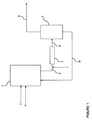
- Figure 1 represents in schematic form, apparatus suitable for carrying out the process of the present invention.
- the apparatus comprises a first reaction zone (1) a second reaction zone (2), a flash separation zone (3) and a combined light ends and drying distillation column (not shown).
- methanol and carbon monoxide are fed to the first reaction zone (1) via lines (4) and (5) respectively.
- carbon monoxide is contacted with a liquid reaction composition which comprises the carbonylation catalyst, optional carbonylation catalyst promoter, methanol, methyl acetate, water, methyl iodide and acetic acid.
- Liquid reaction composition is withdrawn from the first reaction zone (1) via line (6), and is passed to the second reaction zone (2), into which an additional supply of carbon monoxide is fed via line (7).
- the liquid reaction composition from the second reaction zone (2) is passed to flash separation zone (3), via a flashing valve (8) wherein it is separated into two phases: a vapour fraction and a liquid fraction.
- the vapour fraction comprising acetic acid, methyl iodide, water, methanol and methyl acetate, is fed via line (9) to a distillation zone, comprising a combined light ends and drying column (not shown), from which low pressure off-gas is removed, for recovery of purified acetic acid.
- the liquid fraction, comprising catalytic species and acetic acid is returned to the first reaction zone (1) via line (10).
- acetic acid was produced by carbonylating methanol with carbon monoxide in the presence of an iridium catalyst and ruthenium promoter, using the apparatus of Figure 1 .
- the first reaction zone (1) comprised a 6 litre primary carbonylation stirred tank reactor
- the second reaction zone (2) comprised a secondary plug-flow reactor equipped with heaters, having a volume of approximately 12% of the volume of the primary reactor
- the flash separation zone (3) comprised an adiabatic flash vessel.
- the operating pressure of the primary reactor was 27.6 barg (2.76 x 10 6 Nm -2 ), and the temperature of the primary reactor was maintained at approximately 190°C.
- the primary reactor was fitted with a stirrer/propeller and a baffle cage to ensure intimate mixing of the liquid and gaseous reactants.
- Carbon monoxide was supplied from pressure bottles to the primary reactor via a sparge fitted beneath the stirrer.
- a jacket (not shown), through which hot oil is circulated, enabled the liquid reaction composition in the primary reactor (1) to be maintained at a constant reaction temperature.
- the adiabatic flash vessel was operated at a pressure of 1.48 barg (1.48 x 10 5 Nm -2 ).
- the carbon monoxide concentration in the low-pressure off-gas removed from the combined light-ends and drying column, was maintained at 50-55 mol%.
- the liquid reaction composition was analysed, at the flash valve, by near infra-red spectroscopy every 4 minutes, and by gas chromatography up to 3 times a day. A high pressure off-gas was purged from the head of the primary reactor.
- Example A Using the above-described apparatus, method and operating conditions, but excluding the use of the secondary reactor, a baseline experiment (Experiment A) was performed in which the liquid reaction composition in the primary reactor was maintained at 5wt% water, 7wt% methyl iodide and 12 wt% methyl acetate.
- the temperature of the liquid reaction composition in the primary reactor and at the flash valve, liquid reaction composition data, and the flow rates of various process streams are given in Table 1.
Landscapes
- Chemical & Material Sciences (AREA)
- Organic Chemistry (AREA)
- Engineering & Computer Science (AREA)
- Oil, Petroleum & Natural Gas (AREA)
- Chemical Kinetics & Catalysis (AREA)
- Crystallography & Structural Chemistry (AREA)
- Organic Low-Molecular-Weight Compounds And Preparation Thereof (AREA)
- Low-Molecular Organic Synthesis Reactions Using Catalysts (AREA)
- Catalysts (AREA)
Priority Applications (19)
| Application Number | Priority Date | Filing Date | Title |
|---|---|---|---|
| EP08250564A EP2093209A1 (fr) | 2008-02-19 | 2008-02-19 | Procédé de production d'acide acétique |
| KR1020107018238A KR20100125249A (ko) | 2008-02-19 | 2009-02-11 | 아세트산의 제조 방법 |
| BRPI0908218A BRPI0908218A2 (pt) | 2008-02-19 | 2009-02-11 | processo para a produção de ácido acético |
| TW098104309A TWI465425B (zh) | 2008-02-19 | 2009-02-11 | 用於製造乙酸之方法 |
| ES09711918T ES2377918T3 (es) | 2008-02-19 | 2009-02-11 | Procedimiento para la producción de ácido acético |
| AT09711918T ATE540015T1 (de) | 2008-02-19 | 2009-02-11 | Verfahren zur herstellung von essigsäure |
| CN201610089884.1A CN105693497A (zh) | 2008-02-19 | 2009-02-11 | 用于制备乙酸的方法 |
| MYPI20103866 MY153063A (en) | 2008-02-19 | 2009-02-11 | Process for the production of acetic acid |
| US12/735,796 US8283493B2 (en) | 2008-02-19 | 2009-02-11 | Process for the production of acetic acid |
| CN2009801056798A CN101945846A (zh) | 2008-02-19 | 2009-02-11 | 用于制备乙酸的方法 |
| RU2010138283/04A RU2505523C2 (ru) | 2008-02-19 | 2009-02-11 | Способы получения уксусной кислоты |
| JP2010547240A JP2011512391A (ja) | 2008-02-19 | 2009-02-11 | 酢酸の製造方法 |
| EP09711918A EP2244995B1 (fr) | 2008-02-19 | 2009-02-11 | Procede de production d'acide acetique |
| CA2714508A CA2714508C (fr) | 2008-02-19 | 2009-02-11 | Procede de production d'acide acetique |
| KR1020167014114A KR20160066001A (ko) | 2008-02-19 | 2009-02-11 | 아세트산의 제조 방법 |
| RS20120123A RS52314B (sr) | 2008-02-19 | 2009-02-11 | Postupak za dobijanje sirćetne kiseline |
| PCT/GB2009/000381 WO2009103948A1 (fr) | 2008-02-19 | 2009-02-11 | Procédé de production d'acide acétique |
| UAA201011095A UA105359C2 (uk) | 2008-02-19 | 2009-11-02 | Спосіб одержання оцтової кислоти |
| JP2015129057A JP2015164971A (ja) | 2008-02-19 | 2015-06-26 | 酢酸の製造方法 |
Applications Claiming Priority (1)
| Application Number | Priority Date | Filing Date | Title |
|---|---|---|---|
| EP08250564A EP2093209A1 (fr) | 2008-02-19 | 2008-02-19 | Procédé de production d'acide acétique |
Publications (1)
| Publication Number | Publication Date |
|---|---|
| EP2093209A1 true EP2093209A1 (fr) | 2009-08-26 |
Family
ID=39661374
Family Applications (2)
| Application Number | Title | Priority Date | Filing Date |
|---|---|---|---|
| EP08250564A Ceased EP2093209A1 (fr) | 2008-02-19 | 2008-02-19 | Procédé de production d'acide acétique |
| EP09711918A Revoked EP2244995B1 (fr) | 2008-02-19 | 2009-02-11 | Procede de production d'acide acetique |
Family Applications After (1)
| Application Number | Title | Priority Date | Filing Date |
|---|---|---|---|
| EP09711918A Revoked EP2244995B1 (fr) | 2008-02-19 | 2009-02-11 | Procede de production d'acide acetique |
Country Status (15)
| Country | Link |
|---|---|
| US (1) | US8283493B2 (fr) |
| EP (2) | EP2093209A1 (fr) |
| JP (2) | JP2011512391A (fr) |
| KR (2) | KR20100125249A (fr) |
| CN (2) | CN105693497A (fr) |
| AT (1) | ATE540015T1 (fr) |
| BR (1) | BRPI0908218A2 (fr) |
| CA (1) | CA2714508C (fr) |
| ES (1) | ES2377918T3 (fr) |
| MY (1) | MY153063A (fr) |
| RS (1) | RS52314B (fr) |
| RU (1) | RU2505523C2 (fr) |
| TW (1) | TWI465425B (fr) |
| UA (1) | UA105359C2 (fr) |
| WO (1) | WO2009103948A1 (fr) |
Cited By (3)
| Publication number | Priority date | Publication date | Assignee | Title |
|---|---|---|---|---|
| US9567282B2 (en) | 2010-09-28 | 2017-02-14 | Celanese International Corporation | Production of acetic acid with high conversion rate |
| US9663437B2 (en) | 2011-09-13 | 2017-05-30 | Celanese International Corporation | Production of acetic acid with high conversion rate |
| WO2021204585A1 (fr) * | 2020-04-06 | 2021-10-14 | Ineos Acetyls Uk Limited | Procédé de production d'acide acétique |
Families Citing this family (11)
| Publication number | Priority date | Publication date | Assignee | Title |
|---|---|---|---|---|
| US7820855B2 (en) * | 2008-04-29 | 2010-10-26 | Celanese International Corporation | Method and apparatus for carbonylating methanol with acetic acid enriched flash stream |
| US8932372B2 (en) | 2010-02-02 | 2015-01-13 | Celanese International Corporation | Integrated process for producing alcohols from a mixed acid feed |
| US9272970B2 (en) | 2010-07-09 | 2016-03-01 | Celanese International Corporation | Hydrogenolysis of ethyl acetate in alcohol separation processes |
| US8530696B2 (en) | 2010-09-24 | 2013-09-10 | Celanese International Corporation | Pump around reactor for production of acetic acid |
| WO2012149137A1 (fr) | 2011-04-26 | 2012-11-01 | Celanese International Corporation | Procédé de production d'éthanol à partir d'une charge d'acide acétique et d'une charge d'acétate d'éthyle recyclé |
| US9073816B2 (en) | 2011-04-26 | 2015-07-07 | Celanese International Corporation | Reducing ethyl acetate concentration in recycle streams for ethanol production processes |
| US8895786B2 (en) | 2011-08-03 | 2014-11-25 | Celanese International Corporation | Processes for increasing alcohol production |
| AR087712A1 (es) * | 2012-02-08 | 2014-04-09 | Celanese Int Corp | Produccion de acido acetico con una alta proporcion de conversion |
| US8729317B2 (en) | 2012-02-15 | 2014-05-20 | Celanese International Corporation | Ethanol manufacturing process over catalyst with cesium and support comprising tungsten or oxides thereof |
| US8975452B2 (en) | 2012-03-28 | 2015-03-10 | Celanese International Corporation | Process for producing ethanol by hydrocarbon oxidation and hydrogenation or hydration |
| GB201610338D0 (en) * | 2016-06-14 | 2016-07-27 | Bp Chem Int Ltd | Process |
Citations (18)
| Publication number | Priority date | Publication date | Assignee | Title |
|---|---|---|---|---|
| GB1233121A (fr) | 1967-04-05 | 1971-05-26 | ||
| GB1234641A (fr) | 1967-04-05 | 1971-06-09 | ||
| US3772380A (en) | 1970-03-12 | 1973-11-13 | Monsanto Co | Production of carboxylic acids and esters |
| EP0161874A1 (fr) | 1984-05-03 | 1985-11-21 | Celanese Corporation | Procédé de carbonylation du méthanol |
| EP0384652A1 (fr) | 1989-02-23 | 1990-08-29 | The British Petroleum Company P.L.C. | Procédé de préparation d'acides carboxyliques |
| EP0391680A1 (fr) | 1989-04-06 | 1990-10-10 | BP Chemicals Limited | Procédé de préparation d'acides carboxyliques |
| EP0616997A1 (fr) | 1993-03-26 | 1994-09-28 | BP Chemicals Limited | Procédé de récupération du produit de carbolylisation |
| EP0618184A1 (fr) | 1993-03-31 | 1994-10-05 | Pardies Acetiques | Procédé de préparation d'acides carboxyliques ou des esters correspondants en présence d'un catalyseur à base d'irridium |
| EP0643034A1 (fr) | 1993-09-10 | 1995-03-15 | BP Chemicals Limited | Procédé de production d'acide acétique |
| EP0685446A1 (fr) | 1994-06-02 | 1995-12-06 | Daicel Chemical Industries, Ltd. | Procédé de préparation d'acide acétique |
| EP0728727A1 (fr) | 1995-02-21 | 1996-08-28 | BP Chemicals Limited | Procédé de carboxylation d'un alcool |
| EP0752406A1 (fr) | 1995-06-21 | 1997-01-08 | BP Chemicals Limited | Procédé de préparation d'acide acétique par carbonylation |
| EP0759419A1 (fr) * | 1995-08-22 | 1997-02-26 | BP Chemicals Limited | Procédé de carboxylation d'alcool et/ou son dérivé réactif |
| EP0846674A1 (fr) | 1996-12-05 | 1998-06-10 | BP Chemicals Limited | Procédé de carbonylation pour la production d'un acide carboxylique catalysé par l'iridium |
| US6211405B1 (en) | 1998-10-23 | 2001-04-03 | Celanese International Corporation | Addition of iridium to the rhodium/inorganic iodide catalyst system |
| US6617472B1 (en) * | 1999-06-22 | 2003-09-09 | Acetex Chimie | Process for improving the stability and/or preventing the deactivation of the catalyst during the manufacture of acetic acid and/or of methyl acetate |
| WO2003097567A1 (fr) * | 2002-05-20 | 2003-11-27 | Bp Chemicals Limited | Procede de production de l'acide acetique |
| WO2003106396A1 (fr) * | 2002-06-12 | 2003-12-24 | Bp Chemicals Limited | Procede de production d'acide acetique |
Family Cites Families (3)
| Publication number | Priority date | Publication date | Assignee | Title |
|---|---|---|---|---|
| US5831120A (en) * | 1996-11-19 | 1998-11-03 | Watson; Derrick John | Process for the production of acetic acid |
| GB0601863D0 (en) * | 2006-01-30 | 2006-03-08 | Bp Chem Int Ltd | Process |
| TWI465424B (zh) * | 2006-03-21 | 2014-12-21 | Bp Chem Int Ltd | 製造醋酸的方法 |
-
2008
- 2008-02-19 EP EP08250564A patent/EP2093209A1/fr not_active Ceased
-
2009
- 2009-02-11 MY MYPI20103866 patent/MY153063A/en unknown
- 2009-02-11 BR BRPI0908218A patent/BRPI0908218A2/pt active Search and Examination
- 2009-02-11 CN CN201610089884.1A patent/CN105693497A/zh active Pending
- 2009-02-11 US US12/735,796 patent/US8283493B2/en active Active
- 2009-02-11 JP JP2010547240A patent/JP2011512391A/ja active Pending
- 2009-02-11 KR KR1020107018238A patent/KR20100125249A/ko not_active Ceased
- 2009-02-11 AT AT09711918T patent/ATE540015T1/de active
- 2009-02-11 RS RS20120123A patent/RS52314B/sr unknown
- 2009-02-11 KR KR1020167014114A patent/KR20160066001A/ko not_active Ceased
- 2009-02-11 WO PCT/GB2009/000381 patent/WO2009103948A1/fr not_active Ceased
- 2009-02-11 CN CN2009801056798A patent/CN101945846A/zh active Pending
- 2009-02-11 EP EP09711918A patent/EP2244995B1/fr not_active Revoked
- 2009-02-11 ES ES09711918T patent/ES2377918T3/es active Active
- 2009-02-11 CA CA2714508A patent/CA2714508C/fr not_active Expired - Fee Related
- 2009-02-11 TW TW098104309A patent/TWI465425B/zh active
- 2009-02-11 RU RU2010138283/04A patent/RU2505523C2/ru active
- 2009-11-02 UA UAA201011095A patent/UA105359C2/uk unknown
-
2015
- 2015-06-26 JP JP2015129057A patent/JP2015164971A/ja active Pending
Patent Citations (20)
| Publication number | Priority date | Publication date | Assignee | Title |
|---|---|---|---|---|
| GB1234641A (fr) | 1967-04-05 | 1971-06-09 | ||
| GB1233121A (fr) | 1967-04-05 | 1971-05-26 | ||
| US3772380A (en) | 1970-03-12 | 1973-11-13 | Monsanto Co | Production of carboxylic acids and esters |
| EP0161874A1 (fr) | 1984-05-03 | 1985-11-21 | Celanese Corporation | Procédé de carbonylation du méthanol |
| EP0384652A1 (fr) | 1989-02-23 | 1990-08-29 | The British Petroleum Company P.L.C. | Procédé de préparation d'acides carboxyliques |
| EP0391680A1 (fr) | 1989-04-06 | 1990-10-10 | BP Chemicals Limited | Procédé de préparation d'acides carboxyliques |
| EP0786447A1 (fr) | 1993-03-26 | 1997-07-30 | BP Chemicals Limited | Procédé pour réagir d'anhydride carbonique avec un réactif carbonylatable et/ou son dérivé d'ester |
| EP0616997A1 (fr) | 1993-03-26 | 1994-09-28 | BP Chemicals Limited | Procédé de récupération du produit de carbolylisation |
| EP0618184A1 (fr) | 1993-03-31 | 1994-10-05 | Pardies Acetiques | Procédé de préparation d'acides carboxyliques ou des esters correspondants en présence d'un catalyseur à base d'irridium |
| EP0643034A1 (fr) | 1993-09-10 | 1995-03-15 | BP Chemicals Limited | Procédé de production d'acide acétique |
| EP0685446A1 (fr) | 1994-06-02 | 1995-12-06 | Daicel Chemical Industries, Ltd. | Procédé de préparation d'acide acétique |
| EP0728727A1 (fr) | 1995-02-21 | 1996-08-28 | BP Chemicals Limited | Procédé de carboxylation d'un alcool |
| EP0752406A1 (fr) | 1995-06-21 | 1997-01-08 | BP Chemicals Limited | Procédé de préparation d'acide acétique par carbonylation |
| EP0759419A1 (fr) * | 1995-08-22 | 1997-02-26 | BP Chemicals Limited | Procédé de carboxylation d'alcool et/ou son dérivé réactif |
| EP0846674A1 (fr) | 1996-12-05 | 1998-06-10 | BP Chemicals Limited | Procédé de carbonylation pour la production d'un acide carboxylique catalysé par l'iridium |
| US6211405B1 (en) | 1998-10-23 | 2001-04-03 | Celanese International Corporation | Addition of iridium to the rhodium/inorganic iodide catalyst system |
| US6617472B1 (en) * | 1999-06-22 | 2003-09-09 | Acetex Chimie | Process for improving the stability and/or preventing the deactivation of the catalyst during the manufacture of acetic acid and/or of methyl acetate |
| WO2003097567A1 (fr) * | 2002-05-20 | 2003-11-27 | Bp Chemicals Limited | Procede de production de l'acide acetique |
| EP1506151A1 (fr) | 2002-05-20 | 2005-02-16 | BP Chemicals Limited | Procede de production de l'acide acetique |
| WO2003106396A1 (fr) * | 2002-06-12 | 2003-12-24 | Bp Chemicals Limited | Procede de production d'acide acetique |
Non-Patent Citations (1)
| Title |
|---|
| HOWARD ET AL., CATALYSIS TODAY, vol. 18, 1993, pages 325 - 354 |
Cited By (6)
| Publication number | Priority date | Publication date | Assignee | Title |
|---|---|---|---|---|
| US9567282B2 (en) | 2010-09-28 | 2017-02-14 | Celanese International Corporation | Production of acetic acid with high conversion rate |
| US9663437B2 (en) | 2011-09-13 | 2017-05-30 | Celanese International Corporation | Production of acetic acid with high conversion rate |
| WO2021204585A1 (fr) * | 2020-04-06 | 2021-10-14 | Ineos Acetyls Uk Limited | Procédé de production d'acide acétique |
| CN115298156A (zh) * | 2020-04-06 | 2022-11-04 | 英力士乙酰英国有限公司 | 用于生产乙酸的方法 |
| CN115298156B (zh) * | 2020-04-06 | 2025-07-11 | 英力士乙酰英国有限公司 | 用于生产乙酸的方法 |
| US12552734B2 (en) | 2020-04-06 | 2026-02-17 | Ineos Acetyls Uk Limited | Process for producing acetic acid |
Also Published As
| Publication number | Publication date |
|---|---|
| CA2714508A1 (fr) | 2009-08-27 |
| TWI465425B (zh) | 2014-12-21 |
| EP2244995A1 (fr) | 2010-11-03 |
| RU2010138283A (ru) | 2012-03-27 |
| US8283493B2 (en) | 2012-10-09 |
| JP2011512391A (ja) | 2011-04-21 |
| US20100324333A1 (en) | 2010-12-23 |
| BRPI0908218A2 (pt) | 2015-10-27 |
| UA105359C2 (uk) | 2014-05-12 |
| WO2009103948A1 (fr) | 2009-08-27 |
| CN101945846A (zh) | 2011-01-12 |
| RU2505523C2 (ru) | 2014-01-27 |
| CN105693497A (zh) | 2016-06-22 |
| TW200938524A (en) | 2009-09-16 |
| RS52314B (sr) | 2012-12-31 |
| MY153063A (en) | 2014-12-31 |
| JP2015164971A (ja) | 2015-09-17 |
| KR20100125249A (ko) | 2010-11-30 |
| ATE540015T1 (de) | 2012-01-15 |
| KR20160066001A (ko) | 2016-06-09 |
| CA2714508C (fr) | 2016-10-11 |
| ES2377918T3 (es) | 2012-04-03 |
| EP2244995B1 (fr) | 2012-01-04 |
Similar Documents
| Publication | Publication Date | Title |
|---|---|---|
| EP2244995B1 (fr) | Procede de production d'acide acetique | |
| JP4195103B2 (ja) | 酢酸の製造方法 | |
| EP1511711B1 (fr) | Procede de production d'acide acetique | |
| JP2010265275A (ja) | 酢酸の製造方法 | |
| US10550059B2 (en) | Process for the production of acetic acid | |
| CA2637465C (fr) | Procede de production d'acide acetique | |
| JP4578236B2 (ja) | 酢酸の製造方法 |
Legal Events
| Date | Code | Title | Description |
|---|---|---|---|
| PUAI | Public reference made under article 153(3) epc to a published international application that has entered the european phase |
Free format text: ORIGINAL CODE: 0009012 |
|
| AK | Designated contracting states |
Kind code of ref document: A1 Designated state(s): AT BE BG CH CY CZ DE DK EE ES FI FR GB GR HR HU IE IS IT LI LT LU LV MC MT NL NO PL PT RO SE SI SK TR |
|
| AX | Request for extension of the european patent |
Extension state: AL BA MK RS |
|
| STAA | Information on the status of an ep patent application or granted ep patent |
Free format text: STATUS: THE APPLICATION HAS BEEN REFUSED |
|
| 18R | Application refused |
Effective date: 20090912 |