EP2093543A2 - Photoelektrischer Codierer und Skala - Google Patents
Photoelektrischer Codierer und Skala Download PDFInfo
- Publication number
- EP2093543A2 EP2093543A2 EP20090153333 EP09153333A EP2093543A2 EP 2093543 A2 EP2093543 A2 EP 2093543A2 EP 20090153333 EP20090153333 EP 20090153333 EP 09153333 A EP09153333 A EP 09153333A EP 2093543 A2 EP2093543 A2 EP 2093543A2
- Authority
- EP
- European Patent Office
- Prior art keywords
- modulation
- scale
- pattern
- incremental
- photoelectric encoder
- Prior art date
- Legal status (The legal status is an assumption and is not a legal conclusion. Google has not performed a legal analysis and makes no representation as to the accuracy of the status listed.)
- Withdrawn
Links
- 238000012545 processing Methods 0.000 claims abstract description 23
- 238000005259 measurement Methods 0.000 claims abstract description 9
- 230000001678 irradiating effect Effects 0.000 claims abstract description 3
- 238000001514 detection method Methods 0.000 description 45
- 230000003321 amplification Effects 0.000 description 20
- 238000003199 nucleic acid amplification method Methods 0.000 description 20
- 230000008901 benefit Effects 0.000 description 15
- 239000000470 constituent Substances 0.000 description 14
- 238000010586 diagram Methods 0.000 description 13
- 238000000926 separation method Methods 0.000 description 10
- 238000000034 method Methods 0.000 description 6
- 238000003491 array Methods 0.000 description 5
- 238000010408 sweeping Methods 0.000 description 4
- 239000011521 glass Substances 0.000 description 3
- 239000000758 substrate Substances 0.000 description 3
- 238000001914 filtration Methods 0.000 description 2
- 238000012986 modification Methods 0.000 description 2
- 230000004048 modification Effects 0.000 description 2
- 230000000737 periodic effect Effects 0.000 description 2
- 238000012935 Averaging Methods 0.000 description 1
- 238000007792 addition Methods 0.000 description 1
- 230000005540 biological transmission Effects 0.000 description 1
- 238000004519 manufacturing process Methods 0.000 description 1
- 239000000203 mixture Substances 0.000 description 1
- 230000003287 optical effect Effects 0.000 description 1
Images







Classifications
-
- G—PHYSICS
- G01—MEASURING; TESTING
- G01D—MEASURING NOT SPECIALLY ADAPTED FOR A SPECIFIC VARIABLE; ARRANGEMENTS FOR MEASURING TWO OR MORE VARIABLES NOT COVERED IN A SINGLE OTHER SUBCLASS; TARIFF METERING APPARATUS; MEASURING OR TESTING NOT OTHERWISE PROVIDED FOR
- G01D5/00—Mechanical means for transferring the output of a sensing member; Means for converting the output of a sensing member to another variable where the form or nature of the sensing member does not constrain the means for converting; Transducers not specially adapted for a specific variable
- G01D5/26—Mechanical means for transferring the output of a sensing member; Means for converting the output of a sensing member to another variable where the form or nature of the sensing member does not constrain the means for converting; Transducers not specially adapted for a specific variable characterised by optical transfer means, i.e. using infrared, visible, or ultraviolet light
- G01D5/32—Mechanical means for transferring the output of a sensing member; Means for converting the output of a sensing member to another variable where the form or nature of the sensing member does not constrain the means for converting; Transducers not specially adapted for a specific variable characterised by optical transfer means, i.e. using infrared, visible, or ultraviolet light with attenuation or whole or partial obturation of beams of light
- G01D5/34—Mechanical means for transferring the output of a sensing member; Means for converting the output of a sensing member to another variable where the form or nature of the sensing member does not constrain the means for converting; Transducers not specially adapted for a specific variable characterised by optical transfer means, i.e. using infrared, visible, or ultraviolet light with attenuation or whole or partial obturation of beams of light the beams of light being detected by photocells
- G01D5/347—Mechanical means for transferring the output of a sensing member; Means for converting the output of a sensing member to another variable where the form or nature of the sensing member does not constrain the means for converting; Transducers not specially adapted for a specific variable characterised by optical transfer means, i.e. using infrared, visible, or ultraviolet light with attenuation or whole or partial obturation of beams of light the beams of light being detected by photocells using displacement encoding scales
- G01D5/34746—Linear encoders
-
- G—PHYSICS
- G01—MEASURING; TESTING
- G01D—MEASURING NOT SPECIALLY ADAPTED FOR A SPECIFIC VARIABLE; ARRANGEMENTS FOR MEASURING TWO OR MORE VARIABLES NOT COVERED IN A SINGLE OTHER SUBCLASS; TARIFF METERING APPARATUS; MEASURING OR TESTING NOT OTHERWISE PROVIDED FOR
- G01D5/00—Mechanical means for transferring the output of a sensing member; Means for converting the output of a sensing member to another variable where the form or nature of the sensing member does not constrain the means for converting; Transducers not specially adapted for a specific variable
- G01D5/26—Mechanical means for transferring the output of a sensing member; Means for converting the output of a sensing member to another variable where the form or nature of the sensing member does not constrain the means for converting; Transducers not specially adapted for a specific variable characterised by optical transfer means, i.e. using infrared, visible, or ultraviolet light
- G01D5/32—Mechanical means for transferring the output of a sensing member; Means for converting the output of a sensing member to another variable where the form or nature of the sensing member does not constrain the means for converting; Transducers not specially adapted for a specific variable characterised by optical transfer means, i.e. using infrared, visible, or ultraviolet light with attenuation or whole or partial obturation of beams of light
- G01D5/34—Mechanical means for transferring the output of a sensing member; Means for converting the output of a sensing member to another variable where the form or nature of the sensing member does not constrain the means for converting; Transducers not specially adapted for a specific variable characterised by optical transfer means, i.e. using infrared, visible, or ultraviolet light with attenuation or whole or partial obturation of beams of light the beams of light being detected by photocells
- G01D5/347—Mechanical means for transferring the output of a sensing member; Means for converting the output of a sensing member to another variable where the form or nature of the sensing member does not constrain the means for converting; Transducers not specially adapted for a specific variable characterised by optical transfer means, i.e. using infrared, visible, or ultraviolet light with attenuation or whole or partial obturation of beams of light the beams of light being detected by photocells using displacement encoding scales
- G01D5/34776—Absolute encoders with analogue or digital scales
Definitions
- the present invention relates to a photoelectric encoder and a scale.
- an absolute encoder that can measure an absolute position as well as an incremental encoder measuring a relative moving distance.
- the incremental encoder is a photoelectric encoder
- the incremental encoder includes an incremental track constituted by an equidistant light-dark incremental pattern. By counting light-dark signals based on this pattern, the incremental encoder detects a relative moving distance of an object.
- the incremental encoder includes an origin detection pattern provided separately from the equidistant light-dark incremental pattern and detects a relative moving distance of the object from an origin, thereby making it possible to detect an absolute moving distance of the object.
- a photoelectric origin detection method is disclosed in, for example, Japanese Patent Application Laid-Open No. 2005-83808 .
- it is disadvantageously required to move a scale horizontally before measurement so as to read the origin detection pattern.
- the absolute encoder includes an absolute track constituted by an absolute pattern that expresses pseudo random codes such as M-sequence codes.
- the absolute encoder detects an absolute position of an object by reading this pattern. Differently from the incremental encoder, the absolute encoder does not need to detect an origin using the origin detection pattern but can start measuring at a position at which the encoder is turned on. Nevertheless, the absolute encoder is inferior to the incremental encoder in detection accuracy.
- a photoelectric encoder having an incremental track constituted by an equidistant incremental pattern and an absolute track constituted by an absolute pattern expressing pseudo random codes arranged on one scale side by side as disclosed in, for example, Japanese Patent Application Laid-Open No. 7-286861 .
- the encoder detects, first, an absolute position of an object by reading the absolute pattern on the absolute track after the encoder is turned on, and interpolates the absolute position by a highly accurate relative position obtained by reading the incremental pattern on the incremental track.
- the technique can provide a photoelectric encoder capable of covering shortcomings of both the incremental encoder and the absolute encoder while enjoying merits of the both encoders.
- the photoelectric encoder has the following problems. Since it is necessary to provide the absolute pattern and the incremental pattern side by side, a pattern width is increased. Furthermore, demand for a configuration that makes it possible to acquire more information from one track rises for a photoelectric encoder that tends to be made smaller in size.
- a photoelectric encoder including: a scale; a light source irradiating a measurement light onto the scale; a light receiving unit receiving the measurement light reflected or transmitted by the scale; and a signal processing circuit processing a light receiving signal of the light receiving unit and detecting an absolute position of the scale, the scale being configured to be relatively movable to the light source and the light receiving unit in a measuring direction, and includes a modulation incremental track that includes a modulation incremental pattern having a plurality of modulation scale patterns arranged thereon, and the modulation incremental pattern is formed so that a shape or a pitch of the modulation scale patterns changes periodically in the measuring direction within a first period.
- a scale used in a photoelectric encoder and reflecting or transmitting a measurement light including: a modulation incremental track including a modulation incremental pattern having a plurality of modulation scale patterns arranged thereon, the modulation incremental pattern being formed so that a shape or a pitch of the modulation scale patterns changes periodically in a measuring direction within a first period.
- Fig. 1 is a schematic diagram showing an overall configuration of a photoelectric encoder according to a first embodiment of the present invention.
- the photoelectric encoder according to the first embodiment is configured to include a light emitting element 11, a scale 12, a lens 13, a light receiving element 14 and a signal processing circuit 20.
- the light emitting element 11 is, for example, an LED.
- the first modulation incremental pattern 31 is formed so that a center distance L0 in a measuring direction between one first modulation scale pattern 3A (k) and a first modulation scale pattern 3A(k+1) adjacent to the pattern 3A (k) in the measuring direction is equal among all the first modulation scale patterns 3A(k).
- each first modulation scale pattern 3A(k) is similar in configuration to an ordinary incremental pattern.
- the first modulation incremental pattern 31 is formed so that a width W of each first modulation scale pattern 3A(k) in the measuring direction has a periodic change within a predetermined period Pr (such as about 0.2 mm to 0.6 mm).
- a modulation scale pattern 3A(i) formed at a central position X1 within the predetermined period Pr has a maximum width W1 in the measuring direction within the predetermined period Pr. Furthermore, each of modulation scale patterns 3A(i+j) and 3A(i-j) formed at end positions X2, respectively within the predetermined period Pr has a minimum width W2 in the measuring direction within the predetermined period Pr. Widths W of the modulation scale patterns 3A (k) in the measuring direction are set to be smaller from the central position X1 toward each end position X2 within the predetermined period Pr. By so setting, a signal intensity has a periodic change within the predetermined period Pr.
- the light emitting element 11 irradiates a light onto this scale 12 and an irradiated light transmitted by the scale 12 is projected onto the light receiving element 14 via the lens 13.
- the light receiving element 14 is configured to include a photodiode array for incremental signal detection (hereinafter, "INC array”) 41 and a photodiode array for modulation signal detection (hereinafter, “modulation array”) 42.
- IOC array photodiode array for incremental signal detection
- modulation array photodiode array for modulation signal detection
- the INC array 41 is formed so that a length of the INC array 41 in the measuring direction is a length P that is an integer multiple of the predetermined period Pr. Namely, the INC array 41 is configured to obtain light-dark signals from each of which a modulation component is removed by setting the length of the INC array 41 in the measuring direction to the length P.
- the INC array 41 includes four photodiode arrays different in phase each by 90 degrees. Because of the presence of the four photodiode arrays, the INC array 41 can detect a light-dark signal based on the first modulation incremental pattern 31 and output four-phase sinusoidal signals different in phase each by 90 degrees.
- the modulation array 42 is configured to arrange photodiodes each having a magnitude equal to or smaller than half the predetermined period (modulation period) Pr.
- the modulation array 42 outputs a light-dark signal by sweeping the respective photodiodes based on the first modulation incremental pattern 31.
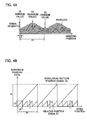
- Fig. 4A is a chart showing a light-dark signal 411 output from the modulation array 42.
- an intensity of the light-dark signal 411 changes in a sinusoidal wave fashion in accordance with a scale position and the center distance L0.
- an envelope (see Fig. 4A ) connecting maximum amplitudes of a sinusoidal wave changes in a sinusoidal wave fashion so as to have a maximum value and a minimum value within the predetermined period Pr. That is, the maximum value of the envelope occurs at the central position X1 and the minimum value thereof occurs at each of the end positions X2.
- the signal processing circuit 20 is configured to include, for example, a noise filter/amplification circuit 21, an A/D converter circuit 22, a relative position detection circuit 23, a noise filter/amplification circuit 24, an A/D converter circuit 25 and a modulation pattern position detection circuit 26.
- the noise filter/amplification circuit 21 differentially amplifies an analog output signal (each of four-phase sinusoidal signals different in phase each by 90 degrees) 410 from the INC array 41, removes noise from the differentially-amplified analog output signal and outputs the resultant analog output signal.
- the A/D converter circuit 22 converts the analog output signal output from the noise filter/amplification circuit 21 into a digital signal.
- the relative position detection circuit 23 performs an arctan operation on an amplitude of the obtained digital signal (90-degree phase difference signal), thereby outputting a relative position signal D1 indicating a relative moving amount and a relative moving direction of the scale 10.
- the noise filter/amplification circuit 24 removes noise from the analog signal 411 from the modulation array 42 of the light receiving element 14, amplifies the noise-removed analog signal and outputs the amplified analog signal.
- the A/D converter circuit 25 converts the analog signal output from the noise filter/amplification circuit 24 into a digital signal.
- the modulation pattern position detection circuit 26 detects an envelope of the digitized light-dark signal from the A/D converter circuit 25, thereby calculating a modulation pattern position and outputting a modulation pattern position signal D2.
- Fig. 4B is a chart showing the relative position signal D1 and the modulation pattern position signal D2 output from the relative position detection circuit 23 and the modulation pattern position detection circuit 26, respectively. As shown in Fig. 4B , the relative position detection signal D1 with the center distance L0 set as a period thereof and the modulation pattern position signal D2 with the predetermined period Pr set as a period thereof are obtained to correspond to movement of the scale 12.
- the photoelectric encoder according to the first embodiment can detect in which period the scale 12 is located seen from a measuring start position, with the center distance L0 assumed as one period, by counting changes in the relative position signal D1. Furthermore, the photoelectric encoder can detect in which period the scale 12 is located seen from a measuring start position, with the predetermined period Pr assumed as one period, by counting changes in the modulation pattern position signal D2.
- the photoelectric encoder according to the first embodiment can acquire information other than a relative position using one track.
- the modulation pattern position signal D2 can be assumed as an origin signal. Besides, in that case, an origin position can be arbitrarily set within the modulation period Pr.
- FIG. 5 is a plan view for explaining a configuration of a scale 12a of the photoelectric encoder according to the second embodiment.
- the photoelectric encoder according to the second embodiment differs from that according to the first embodiment only in the configuration of the scale 12a, and is similar to that according to the first embodiment in remaining configurations.
- Similar constituent elements of the photoelectric encoder according to the first embodiment are not described.
- the second modulation incremental pattern 31a is formed so that a center distance L between one second modulation scale pattern 3B (k) and the second modulation scale pattern 3B(k+1) adjacent to the pattern 3B(k) changes periodically within a predetermined period Pr. Further, the second modulation incremental pattern 31a is formed so that a width W0 of each second modulation scale pattern 3B (k) in the measuring direction is equal. Namely, the center distance L between second modulation scale patterns 3B (i) and 3B (i+1) formed on both sides of a central position X3, respectively within the predetermined period Pr is a shortest distance L1 within the predetermined period Pr.
- a center distance between second modulation scale patterns 3B(i-j) and 3B(i-j-1) (or a center distance between second modulation patterns 3B(i+j) and 3B(i+j+1)) formed on both sides of an end position X4, respectively within the predetermined period Pr is a longest distance L2 within the predetermined period Pr. Center distances each between the two second modulation scale patterns 3B(k) are set to be longer from the central position X3 toward each end position X4.
- Fig. 6 is a chart showing a light-dark signal 411 based on the scale 12a and output from the modulation array 42.
- an intensity of the light-dark signal 411 changes in a sinusoidal wave fashion to correspond to a scale position and the center distance L.
- a period in which the intensity of the light-dark signal 411 changes in a sinusoidal wave fashion changes at intervals of the predetermined period Pr. The period is the longest in an interval near the central position X4 and the shortest in an interval near each end position X3. It is to be noted that a signal similar to the modulation pattern position signal D2 shown in Fig. 4B is obtained by processing the light-dark signal 411 by means of a modulation pattern detection circuit 26.
- the photoelectric encoder according to the second embodiment stated above can exhibit similar advantages to those of the photoelectric encoder according to the first embodiment.
- FIG. 7 is a plan view for explaining a configuration of a scale 12b of the photoelectric encoder according to the third embodiment.
- the photoelectric encoder according to the third embodiment differs from that according to the first embodiment only in the configuration of the scale 12b, and is similar to that according to the first embodiment in remaining configurations. Similar constituent elements of the photoelectric encoder according to the first embodiment are not described in the third embodiment.
- a predetermined period such as about 0.2 mm to 0.6 mm
- the third modulation incremental pattern 31b is formed so that a center distance L0 between one third modulation scale pattern 3C(k) and a third modulation scale pattern 3C(k+1) adjacent to the pattern 3C(k) is equal among all the third modulation scale patterns 3C(k).
- the third modulation scale pattern 3C (k) is formed so that a width W0 of each third modulation scale pattern 3C(k) in the measuring direction is equal.
- the third modulation incremental pattern 31b is formed so that a fracture part area of the third modulation scale pattern 3C (k) changes periodically within a predetermined period Pr.
- the fracture part area means herein an area of a part in which the third modulation scale pattern 3C (k) is fractured.
- a third modulation scale pattern 3C(i) at a central position X5 within the predetermined period Pr does not have a fracture shape but a linear shape.
- each of third modulation scale patterns 3C(i+j) and 3C(i-j) at end positions X6, respectively within the predetermined period Pr has a shape (fracture shape) having a largest fracture part area within the predetermined period Pr.
- Third modulation scale patterns 3C (k) are formed so that the fracture part area is larger from the central position X5 toward each end position X6.
- a light-dark signal 411 based on the scale 12b and output from the modulation array 42 is similar in waveform to the signal shown in Fig. 4A according to the first embodiment.
- the photoelectric encoder according to the third embodiment stated above can exhibit similar advantages to those of the photoelectric encoder according to the first embodiment.
- FIG. 8 is a schematic diagram showing an overall configuration of the photoelectric encoder according to the fourth embodiment.
- the photoelectric encoder according to the fourth embodiment differs from those according to the first to third embodiments in configurations of a scale 12d, a light receiving element 14a and a signal processing circuit 20a. Similar constituent elements of the photoelectric encoder according to the first embodiment are not described in the fourth embodiment.
- Fig. 9 is a plan view for explaining the configuration of the scale 12d.
- the scale 12d includes a first modulation incremental track 301 similarly to the first embodiment.
- the scale 12d also includes an absolute track 302 constituted by an ordinary absolute pattern 32 that expresses an absolute position by a pseudo random pattern (M-sequence code in this embodiment).
- Fig. 10 is a plan view for explaining the configuration of the light receiving element 14a.
- the light receiving element 14a includes an INC array 41 and a modulation array 42 similarly to the first embodiment.
- the light receiving element 14a also includes an ABS detection photodiode array (hereinafter, "ABS array") 43 corresponding to the absolute track 302.
- ABS array ABS detection photodiode array
- the ABS array 43 is configured to arrange photodiodes at an arrangement pitch corresponding to a minimum line width of the absolute pattern 32.
- the ABS array 43 outputs a signal obtained by sweeping light-dark signals based on the absolute pattern 32 in a measuring direction.
- the signal processing circuit 20a includes noise filter/amplification circuits 21 and 24, A/D converter circuits 22 and 25, a relative position detection circuit 23 and a modulation pattern position detection circuit 26 similarly to the first embodiment.
- the signal processing circuit 20a also includes a noise filter/amplification circuit 27, an A/D converter circuit 28, an absolute position detection circuit 29 and an absolute position combining circuit 30.
- the noise filter/amplification circuit 27 removes noise from an analog output signal (absolute position signal) 420 from the ABS array 43, amplifies the analog output signal 420 and outputs the amplified analog output signal.
- the A/D converter circuit 28 converts the analog signal output from the noise filter/amplification circuit 27 into a digital signal.
- the converted digital signal includes M-sequence code data expressed on the absolute pattern 32 in this case.
- the absolute position detection circuit 29 includes a table (not shown) that shows a relationship between a M-sequence code and an absolute position expressed by the M-sequence code.
- the absolute position detection circuit 29 outputs an absolute position signal D3 indicating an absolute position of the scale 12d while referring to this table.
- the absolute position combining circuit 30 calculates a fine absolute position of the scale 12d based on a relative position signal D1, a modulation pattern position signal D2 and the absolute position signal D3. This operation performed by the absolute position combining circuit 30 will be described with reference to Fig. 11.
- Fig. 11 is a chart for explaining operation performed by the photoelectric encoder according to the fourth embodiment.
- the absolute position signal D3 includes information on the absolute position of the scale 12d. Namely, absolute position information can be acquired from the absolute position signal D3. Further, a rough position can be identified based on the absolute position signal D3 and finer position information can be acquired using the modulation pattern position signal D2 and the relative position signal D1 as well as the absolute position signal D3.
- the photoelectric encoder according to the fourth embodiment stated above can exhibit similar advantages to those of the photoelectric encoder according to the first embodiment.
- the absolute pattern 32 is not required to have position accuracy corresponding to the center distance L0 in the modulation incremental pattern 31 that is formed finely but it suffices to form the absolute pattern 32 with a predetermined position accuracy with respect to a predetermined period Pr larger than the center distance L0. Therefore, according to the fourth embodiment, it is possible to make a pitch of the modulation incremental pattern 31 smaller and to thereby improve accuracy of the photoelectric encoder.
- FIG. 12 is a plan view showing a configuration of a scale 12e of the photoelectric encoder according to the fifth embodiment.
- the photoelectric encoder according to the fifth embodiment differs from that according to the fourth embodiment only in the configuration of the scale 12e. Similar constituent elements of the photoelectric encoder according to the first to fourth embodiment are not described in the fifth embodiment.
- the scale 12e includes a second modulation incremental track 301a similarly to the second embodiment.
- the scale 12e also includes an absolute track 302 similarly to the fourth embodiment.
- the photoelectric encoder according to the fifth embodiment stated above can exhibit similar advantages to those of the photoelectric encoder according to the fourth embodiment.
- FIG. 13 is a plan view showing a configuration of a scale 12f of the photoelectric encoder according to the sixth embodiment.
- the photoelectric encoder according to the sixth embodiment differs from that according to the fourth embodiment only in the configuration of the scale 12f. Similar constituent elements of the photoelectric encoder according to the first to fourth embodiment are not described in the sixth embodiment.
- the scale 12f includes a third modulation incremental track 301b similarly to the third embodiment.
- the scale 12f also includes an absolute track 302 similarly to the fourth embodiment.
- the photoelectric encoder according to the sixth embodiment stated above can exhibit similar advantages to those of the photoelectric encoder according to the fourth embodiment.
- FIG. 14 is a schematic diagram showing an overall configuration of the photoelectric encoder according to the seventh embodiment.
- the photoelectric encoder according to the seventh embodiment differs from those according to the first to sixth embodiments in configurations of a scale 12g, a light receiving element 14b and a signal processing circuit 20b. Similar constituent elements of the photoelectric encoder according to the first to sixth embodiments are denoted by the same reference symbols and not described in the seventh embodiment.
- Fig. 15 is a plan view for explaining the configuration of the scale 12g.
- the scale 12g includes a first modulation incremental track 301 and an absolute track 302 constituted by an absolute pattern 32 similarly to the fourth embodiment.
- the scale 12g also includes an.incremental track 303 constituted by an incremental pattern 33 formed at an equidistant light-dark arrangement pitch Pi (such as 40 micrometers ( ⁇ m)).
- Fig. 16 is a plan view for explaining the configuration of the light receiving element 14b.
- the light receiving element 14b includes an INC array 41 and a modulation array 42 similarly to the fourth embodiment.
- the light receiving element 14b also includes an INC detection photodiode array (hereinafter, "INC array") 44 to correspond to the incremental track 303.
- INC array INC detection photodiode array
- the INC array 44 is configured to arrange photodiodes at an arrangement pitch to correspond to a pitch of the incremental pattern 33. Similarly to the INC array 41, the INC array 44 includes four photodiode arrays different in phase each by 90 degrees, detects light-dark signals based on the incremental pattern 31 and outputs four-phase sinusoidal wave signals different in phase each by 90 degrees.
- the signal processing circuit 20b includes noise filter/amplification circuits 21, 24 and 27, A/D converter circuits 22, 25 and 28, a relative position detection circuit 23, a modulation pattern position detection circuit 26, an absolute position detection circuit 29 and an absolute position combining circuit 30 similarlyto the fourth embodiment.
- the signal processing circuit 20b also includes a noise filter/amplification circuit 21a, an A/D converter circuit 22a and an absolute position detection circuit 23a.
- the noise filter/amplification circuit 21a differentially amplifies an analog output signal (each of four-phase sinusoidal signals different in phase each by 90 degrees) 430 from the INC array 44, removes noise from the differentially-amplified analog output signal and outputs the resultant analog output signal.
- the A/D converter circuit 22a converts the analog output signal output from the noise filter/amplification circuit 21a into a digital signal.
- the absolute position detection circuit 23a performs an arctan operation on an amplitude of the obtained digital signal (90-degree phase difference signal), thereby outputting a relative position signal D4 indicating a relative moving amount and a relative moving direction of the scale 12g.
- the absolute position combining circuit 30 calculates a fine absolute position of the scale 12g based on a relative position signal D1, a modulation pattern position signal D2, an absolute position signal D3 and the relative position signal D4. This operation performed by the absolute position combining circuit 30 will be described with reference to Fig. 17.
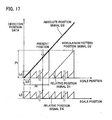
- Fig. 17 is a chart for explaining operation performed by the photoelectric encoder according to the seventh embodiment.
- the absolute position signal D3 includes information on an absolute position of the scale 12g. Since the absolute pattern 32 is formed with a predetermined accuracy,' absolute position information can be acquired from the absolute position signal D3. Further, a rough position can be identified based on the absolute position signal D3 and finer position information can be acquired using themodulationpattern position signal D2 and the relative position signals D1 and D4 as well as the absolute position signal D3.
- the photoelectric encoder according to the seventh embodiment stated above can exhibit similar advantages to those of the photoelectric encoder according to the fourth embodiment.
- the position of the scale 12g can be identified by the other relative position signal.
- FIG. 18 a photoelectric encoder according to an eighth embodiment of the present invention will be described.
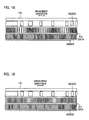
- Fig. 18 is a plan view showing a configuration of a scale 12h of the photoelectric encoder according to the eighth embodiment.
- the photoelectric encoder according to the eighth embodiment differs from that according to the seventh embodiment only in the configuration of the scale 12h. Similar constituent elements of the photoelectric encoder according to the first to seventh embodiments are not described in the eighth embodiment.
- the scale 12h includes a second modulation incremental track 301a and an absolute track 302 similarly to the fifth embodiment.
- the scale 12h also includes an incremental track 303 similarly to the seventh embodiment.
- the photoelectric encoder according to the eighth embodiment stated above can exhibit similar advantages to those of the photoelectric encoder according to the seventh embodiment.
- FIG. 19 is a plan view showing a configuration of a scale 12i of the photoelectric encoder according to the ninth embodiment.
- the photoelectric encoder according to the ninth embodiment differs from that according to the seventh embodiment only in the configuration of the scale 12i. Similar constituent elements of the photoelectric encoder according to the first to eighth embodiments are not described in the ninth embodiment.
- the scale 12i includes a third modulation incremental track 301b and an absolute track 302 similarly to the sixth embodiment.
- the scale 12i also includes an incremental track 303 similarly to the seventh embodiment.
- the photoelectric encoder according to the ninth embodiment stated above can exhibit similar advantages to those of the photoelectric encoder according to the seventh embodiment.
- a photoelectric encoder according to a tenth embodiment of the present invention will be described. Similar constituent elements of the photoelectric encoder according to the first to ninth embodiments are denoted by the same reference symbols and are not described in the tenth embodiment.
- Fig. 20 is a schematic diagram showing an overall configuration of the photoelectric encoder according to the tenth embodiment.
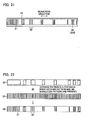
- Fig. 21 shows a plane configuration of a scale 12i.
- the tenth embodiment differs from the first to ninth embodiment in that the scale 12i includes an ABS/first modulation INC integrated track 304 constituted by an ABS/first modulation INC integrated pattern 34 that is obtained by integrating a first modulation incremental pattern 31 with an absolute pattern 32 and arranging the integrated pattern on one track in place of the first modulation incremental pattern 31 and the absolute pattern 32.
- the ABS/first modulation INC integrated pattern 34 is formed by integrating the absolute pattern 32 with the first modulation incremental pattern 31 and arranging the integrated pattern on one track.
- the ABS/first modulation INC integrated pattern 34 is configured to form patterns only in portions in which both the absolute pattern 32 and the first modulation incremental pattern 31 are present and to include an absolute pattern part 32' corresponding to the absolute pattern 32 and a first modulation incremental pattern part 31' corresponding to the first modulation incremental pattern 31.
- the scale 12i includes only one track as stated above. Therefore, an occupation area can be reduced as compared with the fourth embodiment in which the scale 12d includes two tracks.
- a light receiving element 14 is configured similarly to that according to the first embodiment ( Fig. 3 ) so as to correspond to the configuration of the scale 12i as stated above.
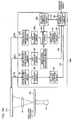
- a signal processing circuit 20c according to the tenth embodiment differs from the signal processing circuit 20 according to the first embodiment in that an analog signal 440 from an INC array 41 of a light receiving element 14 based on the ABS/first modulation INC integrated pattern 34 is input to a separation circuit 201 via a noise filter/amplification circuit 21 and an A/D converter circuit 22.
- an analog signal 441 from a modulation array 42 based on the ABS/first modulation INC integrated pattern 34 is input to a modulation pattern position detection circuit 26 via a noise filter/amplification circuit 24 and an A/D converter circuit 25.
- the modulation pattern position detection circuit 2 6 outputs amodulation pattern position signal D2' to an absolute position combining circuit 30.
- the separation circuit 201 functions to separate a signal based on the absolute pattern part 32' and a signal based on modulation incremental pattern part 31' from the ABS/first modulation INC integrated pattern 34.
- the separation circuit 201 includes a lowpass filter, a subtraction circuit and the like that are not shown.
- the lowpass filter removes a signal based on the modulation incremental pattern part 31' from a light-dark signal based on the ABS/first modulation INC integrated pattern 34, thereby obtaining an absolute light-dark signal.
- the subtraction circuit subtracts the obtained absolute light-dark signal from the light-dark signal based on the ABS/first modulation INC integrated pattern 34, thereby making it possible to obtain a modulation incremental light-dark signal.
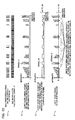
- a method of processing a signal based on the ABS/first modulation INC integrated pattern 34 will be described in detail.
- symbol “A” denotes the relationship between the INC array 41 and the ABS/first modulation INC integrated pattern 34.
- symbol “B” denotes the light-dark signal 440 based on the ABS/first modulation INC integrated pattern 34 and obtained from the INC array 41 by sweeping in the measuring axial direction.
- symbol “B” a vertical axis indicates signal intensity and a horizontal axis indicates sweeping direction.
- a signal A includes a mixture of an absolute light-dark signal and an incremental light-dark signal.
- Fig. 23 symbol “A” denotes the relationship between the INC array 41 and the ABS/first modulation INC integrated pattern 34.
- symbol “B” denotes the light-dark signal 440 based on the ABS/first modulation INC integrated pattern 34 and obtained from the INC array 41 by sweeping in the measuring axial direction.
- a vertical axis indicates signal intensity and a horizontal axis indicates
- symbol "C” denotes a light-dark signal after lowpass filtering.
- the lowpass filtering removes the incremental light-dark signal and only an absolute light-dark signal B remains. As a result, the absolute light-dark signal B can be separated.
- This absolute light-dark signal B is transmitted to the absolute position signal detection circuit 29.
- the absolute position signal detection circuit 29 outputs an absolute position signal D3' based on the signal B.
- symbol “D” denotes a signal C obtained by subtracting the absolute light-dark signal B shown in symbol “C” from the light-dark signal Abased on the ABS/first modulation INC integrated pattern 34 shown in symbol “B".
- this signal C a portions in which the absolute pattern part 32' is not present have a signal intensity of zero and do not, therefore, contribute to incremental position detection. Therefore, only the incremental light-dark signal C can be separated.
- the signal C that is the incremental light-dark signal obtained by this separation is transmitted to the relative position detection circuit 23.
- the signal C from a separated first modulation incremental pattern part 31' is input to the relative position detection circuit 23.
- the relative position detection circuit 23 outputs a relative position signal D1'.
- the relative position signal D1', a modulation pattern position signal D2'and an absolute position signal D3' thus obtained are input to the absolute position combining circuit 30.
- the absolute position combining circuit 30 operates similarly to that according to the fourth embodiment.
- the photoelectric encoder according to the tenth embodiment stated above can exhibit similar advantages to those of the photoelectric encoder according to the fourth embodiment. Furthermore, the photoelectric encoder according to the tenth embodiment can not only reduce the track width but also detect the absolute position using fewer types of photodiode arrays than types of patterns. As a result, it is possible to improve measuring accuracy, downsize the photoelectric encoder, and reduce cost.
- FIG. 24 is a plan view showing a configuration of a scale 12j of the photoelectric encoder according to the eleventh embodiment.
- the photoelectric encoder according to the eleventh embodiment differs from that according to the tenth embodiment only in the configuration of the scale 12j. Similar constituent elements of the photoelectric encoder according to the first to tenth embodiments are not described in the eleventh embodiment.
- the scale 12j includes an ABS/second modulation INC integrated track 304a that includes anABS/second modulation INC integrated pattern 34a formed by a similar method to the method according to the tenth embodiment ( Fig. 22 ).
- the ABS/second modulation INC integrated pattern 34a is formed by integrating an absolute pattern 32 with a second modulation incremental pattern 31a and arranging the integrated pattern on one track.
- the photoelectric encoder according to the eleventh embodiment stated above can exhibit similar advantages to those of the photoelectric encoder according to the tenth embodiment.
- FIG. 25 is a plan view showing a configuration of a scale 12k of the photoelectric encoder according to the twelfth embodiment.
- the photoelectric encoder according to the twelfth embodiment differs from that according to the tenth embodiment only in the configuration of the scale 12k. Similar constituent elements of the photoelectric encoder according to the first to eleventh embodiments are not described in the twelfth embodiment.
- the scale 12k includes an ABS/third modulation INC integrated track 304b that includes an ABS/third modulation INC integrated pattern 34b formed by a similar method to the method according to the tenth embodiment ( Fig. 22 ).
- the ABS/third modulation INC integrated pattern 34b is formed by integrating an absolute pattern 32 with a third modulation incremental pattern 31b and arranging the integrated pattern on one track.
- the photoelectric encoder according to the twelfth embodiment stated above can exhibit similar advantages to those of the photoelectric encoder according to the tenth embodiment.
- Fig. 26 is a schematic diagram showing an overall configuration of the photoelectric encoder according to the thirteenth embodiment.
- Fig. 27 shows a plane configuration of a light receiving element 14c.
- Fig. 28 shows a plane configuration of a scale 121.
- the photoelectric encoder according to the thirteenth embodiment differs from the first to twelfth embodiments in configurations of the scale 121, the light receiving element 14c and a signal processing circuit 20d.
- the light receiving element 14c includes INC arrays 41 and 44 and a modulation array 42 similarly to the seventh embodiment.
- the scale 121 includes a first modulation incremental track 301 similarly to the first embodiment.
- the scale 121 also includes an ABS/INC integrated track 305 constituted by an ABS/INC integrated pattern 35 obtained by integrating a modulation incremental pattern 31 with an absolute pattern 32 and arranging the integrated pattern on one track in place of the modulation incremental pattern 31 and the absolute pattern 32.
- the scale 121 according to the thirteenth embodiment differs from the scales 12 to 12k according to the first to twelfth embodiments in this respect.
- the ABS/INC integrated pattern 35 is formed by integrating the absolute pattern 32 with the incremental pattern 33 and arranging the integrated pattern on one track.
- the signal processing circuit 20d includes noise filter/amplification circuits 21 and 24, A/D converter circuits 22 and 25, a relative position detection circuit 23, a modulation pattern position detection circuit 26, a separation circuit 201, an absolute position detection circuit 29 and an absolute position combining circuit 30 similarly to the tenth embodiment.
- the signal processing circuit 20d also includes a noise filter/amplification circuit 21b, an A/D converter circuit 22b and a relative position detection circuit 23a.
- a relative position signal D1 and a modulation pattern position signal D2 are input to the absolute position combining circuit 30 by similar configurations and operations of the noise filter/amplification circuits 21 and 24, the A/D converter circuit 22 and 25, the separation circuit 201, the relative position detection circuit 23 and the modulation pattern position detection circuit 26 to those according to the seventh embodiment.
- the noise filter/amplification circuit 21b receives an analog signal 450 from an INC array 44 of the light receiving element 14c based on the ABS/INC integrated pattern 35.
- the A/D converter circuit 22b converts the analog signal 450 into a digital signal and inputs the digital signal to the separation circuit 201.
- the absolute position detection circuit 29 receives a signal based on the ABS/INC integrated pattern 35 and separated by the separation circuit 201 and outputs an absolute position signal D3''. Further, the relative position detection circuit 23a receives a signal based on the ABS/INC integrated pattern 35 and separated by the separation circuit 201 and outputs a relative position signal D4'.
- the photoelectric encoder according to the thirteenth embodiment stated above can exhibit similar advantages to those of the tenth embodiment.
- FIG. 29 is a plan view showing a configuration of a scale 12m of the photoelectric encoder according to the fourteenth embodiment.
- the photoelectric encoder according to the fourteenth embodiment differs from that according to the thirteenth embodiment only in the configuration of the scale 12m. Similar constituent elements of the photoelectric encoder according to the first to thirteenth embodiments are not described in the fourteenth embodiment.
- the scale 12m includes an ABS/INC integrated pattern 35 similarly to the thirteenth embodiment.
- the scale 12m also includes a second modulation incremental track 301a similarly to the second embodiment.
- the photoelectric encoder according to the fourteenth embodiment stated above can exhibit similar advantages to those of the photoelectric encoder according to the thirteenth embodiment.
- FIG. 30 is a plan view showing a configuration of a scale 12n of the photoelectric encoder according to the fifteenth embodiment.
- the photoelectric encoder according to the fifteenth embodiment differs from that according to the thirteenth embodiment only in the configuration of the scale 12n. Similar constituent elements of the photoelectric encoder according to the fifteenth embodiment to those according to the first to fourteenth embodiments are not described in the fifteenth embodiment.
- the scale 12n includes an ABS/INC integrated pattern 35 similarly to the thirteenth embodiment.
- the scale 12n also includes a third modulation incremental track 301b similarly to the third embodiment.
- the photoelectric encoder according to the fifteenth embodiment stated above can exhibit similar advantages to those of the photoelectric encoder according to the thirteenth embodiment.
- the present invention has been described so far while taking a transmission photoelectric encoder as an example.
- the present invention may be applied to a reflection photoelectric encoder in which a light emitting element 11 is arranged on the same side as that on which a lens 13 and a light receiving element 14 are arranged as a reflection optical system for reflecting a light by the light emitting element 11.
Landscapes
- Physics & Mathematics (AREA)
- General Physics & Mathematics (AREA)
- Optical Transform (AREA)
- Transmission And Conversion Of Sensor Element Output (AREA)
Applications Claiming Priority (1)
| Application Number | Priority Date | Filing Date | Title |
|---|---|---|---|
| JP2008040360A JP2009198318A (ja) | 2008-02-21 | 2008-02-21 | 光電式エンコーダ |
Publications (1)
| Publication Number | Publication Date |
|---|---|
| EP2093543A2 true EP2093543A2 (de) | 2009-08-26 |
Family
ID=40783123
Family Applications (1)
| Application Number | Title | Priority Date | Filing Date |
|---|---|---|---|
| EP20090153333 Withdrawn EP2093543A2 (de) | 2008-02-21 | 2009-02-20 | Photoelektrischer Codierer und Skala |
Country Status (2)
| Country | Link |
|---|---|
| EP (1) | EP2093543A2 (de) |
| JP (1) | JP2009198318A (de) |
Cited By (10)
| Publication number | Priority date | Publication date | Assignee | Title |
|---|---|---|---|---|
| CN102650536A (zh) * | 2011-02-28 | 2012-08-29 | 佳能株式会社 | 光学编码器 |
| EP2492647A2 (de) | 2011-02-28 | 2012-08-29 | Canon Kabushiki Kaisha | Skala, optischer Codierer und optische Vorrichtung |
| EP2565590A1 (de) * | 2011-09-01 | 2013-03-06 | Mitutoyo Corporation | Codierer zum Messen der Absolutposition |
| US9024251B2 (en) | 2011-04-13 | 2015-05-05 | Canon Kabushiki Kaisha | Encoder having a scale that includes block patterns |
| US9121731B2 (en) | 2011-04-14 | 2015-09-01 | Canon Kabushiki Kaisha | Encoder having a scale with two areas in which an increasing direction of the amplitude of the energy distribution is opposite between the two areas for precisely obtaining a position of the scale |
| US9127967B2 (en) | 2011-04-14 | 2015-09-08 | Canon Kabushiki Kaisha | Encoder having plural phase acquirers and a positional information acquirer for precisely obtaining a position of a scale |
| US9354089B2 (en) | 2011-04-14 | 2016-05-31 | Canon Kabushiki Kaisha | Encoder |
| CN105659057A (zh) * | 2013-10-23 | 2016-06-08 | 施内贝格尔控股公司 | 增量编码器的刻度及其制造方法 |
| US9436166B2 (en) | 2013-11-05 | 2016-09-06 | Kabushiki Kaisha Yaskawa Denki | Encoder, motor with encoder, and servo system |
| CN110617770A (zh) * | 2019-09-23 | 2019-12-27 | 吉林大学 | 基于位置编码的位移检测系统及检测方法 |
Families Citing this family (9)
| Publication number | Priority date | Publication date | Assignee | Title |
|---|---|---|---|---|
| JP5887064B2 (ja) | 2010-04-28 | 2016-03-16 | 株式会社ミツトヨ | 光学式エンコーダ |
| US8309906B2 (en) * | 2010-06-10 | 2012-11-13 | Mitutoyo Corporation | Absolute optical encoder with long range intensity modulation on scale |
| JP5595148B2 (ja) * | 2010-07-05 | 2014-09-24 | キヤノン株式会社 | アブソリュートエンコーダ |
| JP5479255B2 (ja) | 2010-07-20 | 2014-04-23 | キヤノン株式会社 | 光学式エンコーダ |
| JP6253320B2 (ja) | 2013-09-13 | 2017-12-27 | キヤノン株式会社 | エンコーダおよびこれを用いた装置 |
| JP6251126B2 (ja) * | 2014-06-11 | 2017-12-20 | Dmg森精機株式会社 | 変位検出装置 |
| US9958294B2 (en) * | 2016-06-30 | 2018-05-01 | Mitutoyo Corporation | Absolute position encoder including scale with varying spatial characteristic and utilizing Fourier transform or other signal processing |
| US10422666B2 (en) * | 2016-12-23 | 2019-09-24 | Mitutoyo Corporation | Electronic position encoder and method for reducing short range errors |
| JP7391527B2 (ja) * | 2019-04-03 | 2023-12-05 | 株式会社ミツトヨ | 光電式エンコーダ |
Citations (3)
| Publication number | Priority date | Publication date | Assignee | Title |
|---|---|---|---|---|
| JPH07286861A (ja) | 1994-02-25 | 1995-10-31 | Baumer Electric Ag | 光学変換器および方法 |
| JP2005083808A (ja) | 2003-09-05 | 2005-03-31 | Olympus Corp | 光学式原点検出センサ及びその原点検出方法並びに光学式エンコーダ |
| JP2008040360A (ja) | 2006-08-09 | 2008-02-21 | Ricoh Co Ltd | 画像形成装置 |
-
2008
- 2008-02-21 JP JP2008040360A patent/JP2009198318A/ja active Pending
-
2009
- 2009-02-20 EP EP20090153333 patent/EP2093543A2/de not_active Withdrawn
Patent Citations (3)
| Publication number | Priority date | Publication date | Assignee | Title |
|---|---|---|---|---|
| JPH07286861A (ja) | 1994-02-25 | 1995-10-31 | Baumer Electric Ag | 光学変換器および方法 |
| JP2005083808A (ja) | 2003-09-05 | 2005-03-31 | Olympus Corp | 光学式原点検出センサ及びその原点検出方法並びに光学式エンコーダ |
| JP2008040360A (ja) | 2006-08-09 | 2008-02-21 | Ricoh Co Ltd | 画像形成装置 |
Cited By (18)
| Publication number | Priority date | Publication date | Assignee | Title |
|---|---|---|---|---|
| EP2492648A2 (de) | 2011-02-28 | 2012-08-29 | Canon Kabushiki Kaisha | Optischer Kodierer |
| EP2492647A2 (de) | 2011-02-28 | 2012-08-29 | Canon Kabushiki Kaisha | Skala, optischer Codierer und optische Vorrichtung |
| US9417101B2 (en) | 2011-02-28 | 2016-08-16 | Canon Kabushiki Kaisha | Optical encoder with a scale that has fine and coarse pitch patterns |
| CN102650536A (zh) * | 2011-02-28 | 2012-08-29 | 佳能株式会社 | 光学编码器 |
| EP2492647A3 (de) * | 2011-02-28 | 2014-12-03 | Canon Kabushiki Kaisha | Skala, optischer Codierer und optische Vorrichtung |
| US8993954B2 (en) | 2011-02-28 | 2015-03-31 | Canon Kabushiki Kaisha | Optical encoder having a high resolution detection mode to detect a fine pitch pattern and a low resolution detection mode to detect a coarse pitch pattern |
| CN102650536B (zh) * | 2011-02-28 | 2015-08-19 | 佳能株式会社 | 光学编码器 |
| US9024251B2 (en) | 2011-04-13 | 2015-05-05 | Canon Kabushiki Kaisha | Encoder having a scale that includes block patterns |
| US9127967B2 (en) | 2011-04-14 | 2015-09-08 | Canon Kabushiki Kaisha | Encoder having plural phase acquirers and a positional information acquirer for precisely obtaining a position of a scale |
| US9354089B2 (en) | 2011-04-14 | 2016-05-31 | Canon Kabushiki Kaisha | Encoder |
| US9121731B2 (en) | 2011-04-14 | 2015-09-01 | Canon Kabushiki Kaisha | Encoder having a scale with two areas in which an increasing direction of the amplitude of the energy distribution is opposite between the two areas for precisely obtaining a position of the scale |
| CN102967321A (zh) * | 2011-09-01 | 2013-03-13 | 株式会社三丰 | 绝对位置测量型编码器 |
| CN102967321B (zh) * | 2011-09-01 | 2016-02-24 | 株式会社三丰 | 绝对位置测量型编码器 |
| US8809764B2 (en) | 2011-09-01 | 2014-08-19 | Mitutoyo Corporation | Absolute position measuring encoder |
| EP2565590A1 (de) * | 2011-09-01 | 2013-03-06 | Mitutoyo Corporation | Codierer zum Messen der Absolutposition |
| CN105659057A (zh) * | 2013-10-23 | 2016-06-08 | 施内贝格尔控股公司 | 增量编码器的刻度及其制造方法 |
| US9436166B2 (en) | 2013-11-05 | 2016-09-06 | Kabushiki Kaisha Yaskawa Denki | Encoder, motor with encoder, and servo system |
| CN110617770A (zh) * | 2019-09-23 | 2019-12-27 | 吉林大学 | 基于位置编码的位移检测系统及检测方法 |
Also Published As
| Publication number | Publication date |
|---|---|
| JP2009198318A (ja) | 2009-09-03 |
Similar Documents
| Publication | Publication Date | Title |
|---|---|---|
| JP2009198318A (ja) | 光電式エンコーダ | |
| EP1980824B1 (de) | Kodierer mit absoluter Positionslängenmessung | |
| US7663093B2 (en) | Absolute position encoder having a second incremental track integrated with the absolute track | |
| EP2565590B1 (de) | Codierer zum Messen der Absolutposition | |
| US7994470B2 (en) | Photoelectric encoder | |
| EP2607858A2 (de) | Optische Kodierer mit anpassbarer Auflösung | |
| JP5641746B2 (ja) | 光電式エンコーダ | |
| US8729458B2 (en) | Encoder | |
| JP2012037392A (ja) | アブソリュートエンコーダ | |
| US9933284B2 (en) | Multi-track absolute encoder | |
| JP5553667B2 (ja) | 光学式基準位置検出型エンコーダ | |
| US9395214B2 (en) | Optical position-measuring device | |
| US7348545B2 (en) | System and method for optical encoding on two opposed surfaces of a pattern medium | |
| EP2743651A2 (de) | Beleuchtungsabschnitt für einen optischen Codierer mit anpassbarer Auflösung | |
| JP2006071535A (ja) | 変位検出装置 | |
| US20040168333A1 (en) | Scanning unit for scanning a measuring standard | |
| EP2653838B1 (de) | Konfiguration mit mehreren Wellenlänge für einen optischen Codierlesekopf | |
| JP5553669B2 (ja) | 光学式絶対位置測長型エンコーダ | |
| JP6694722B2 (ja) | 光学式エンコーダ及びその原点決定方法 | |
| US7301140B2 (en) | Scanning device for scanning a scale graduation, and position measuring system utilizing the same | |
| EP2743650A2 (de) | Beleuchtungsabschnitt für einen optischen Codierer mit anpassbarer Auflösung | |
| JP2014106210A (ja) | アブソリュートエンコーダ及び絶対位置を求める方法 |
Legal Events
| Date | Code | Title | Description |
|---|---|---|---|
| PUAI | Public reference made under article 153(3) epc to a published international application that has entered the european phase |
Free format text: ORIGINAL CODE: 0009012 |
|
| AK | Designated contracting states |
Kind code of ref document: A2 Designated state(s): AT BE BG CH CY CZ DE DK EE ES FI FR GB GR HR HU IE IS IT LI LT LU LV MC MK MT NL NO PL PT RO SE SI SK TR |
|
| AX | Request for extension of the european patent |
Extension state: AL BA RS |
|
| STAA | Information on the status of an ep patent application or granted ep patent |
Free format text: STATUS: THE APPLICATION HAS BEEN WITHDRAWN |
|
| 18W | Application withdrawn |
Effective date: 20101210 |