EP2093552A1 - Verfahren und Vorrichtung zur Bestimmung der Propellereffizienz an Bord eines Schiffs - Google Patents
Verfahren und Vorrichtung zur Bestimmung der Propellereffizienz an Bord eines Schiffs Download PDFInfo
- Publication number
- EP2093552A1 EP2093552A1 EP08151821A EP08151821A EP2093552A1 EP 2093552 A1 EP2093552 A1 EP 2093552A1 EP 08151821 A EP08151821 A EP 08151821A EP 08151821 A EP08151821 A EP 08151821A EP 2093552 A1 EP2093552 A1 EP 2093552A1
- Authority
- EP
- European Patent Office
- Prior art keywords
- ship
- propeller
- velocity
- efficiency
- angular velocity
- Prior art date
- Legal status (The legal status is an assumption and is not a legal conclusion. Google has not performed a legal analysis and makes no representation as to the accuracy of the status listed.)
- Pending
Links
- 238000000034 method Methods 0.000 title claims abstract description 29
- 230000005284 excitation Effects 0.000 claims abstract description 31
- XLYOFNOQVPJJNP-UHFFFAOYSA-N water Substances O XLYOFNOQVPJJNP-UHFFFAOYSA-N 0.000 claims abstract description 23
- 238000005259 measurement Methods 0.000 claims abstract description 18
- 230000001939 inductive effect Effects 0.000 claims abstract description 9
- 238000012423 maintenance Methods 0.000 claims abstract description 5
- 230000010355 oscillation Effects 0.000 claims description 10
- 239000000446 fuel Substances 0.000 description 10
- 238000004088 simulation Methods 0.000 description 10
- FFBHFFJDDLITSX-UHFFFAOYSA-N benzyl N-[2-hydroxy-4-(3-oxomorpholin-4-yl)phenyl]carbamate Chemical compound OC1=C(NC(=O)OCC2=CC=CC=C2)C=CC(=C1)N1CCOCC1=O FFBHFFJDDLITSX-UHFFFAOYSA-N 0.000 description 7
- 238000004364 calculation method Methods 0.000 description 4
- 230000007423 decrease Effects 0.000 description 4
- 238000013461 design Methods 0.000 description 3
- 238000004599 local-density approximation Methods 0.000 description 3
- 230000033001 locomotion Effects 0.000 description 3
- 238000000917 particle-image velocimetry Methods 0.000 description 3
- 238000012360 testing method Methods 0.000 description 3
- 239000013598 vector Substances 0.000 description 3
- 238000002474 experimental method Methods 0.000 description 2
- 230000003068 static effect Effects 0.000 description 2
- 201000009482 yaws Diseases 0.000 description 2
- 230000005540 biological transmission Effects 0.000 description 1
- 238000004422 calculation algorithm Methods 0.000 description 1
- 230000015556 catabolic process Effects 0.000 description 1
- 230000003247 decreasing effect Effects 0.000 description 1
- 238000006731 degradation reaction Methods 0.000 description 1
- 230000000694 effects Effects 0.000 description 1
- 230000005288 electromagnetic effect Effects 0.000 description 1
- 239000012530 fluid Substances 0.000 description 1
- 238000013178 mathematical model Methods 0.000 description 1
- 238000011160 research Methods 0.000 description 1
- 230000035945 sensitivity Effects 0.000 description 1
- 239000007787 solid Substances 0.000 description 1
- 238000009966 trimming Methods 0.000 description 1
Images

Classifications
-
- G—PHYSICS
- G01—MEASURING; TESTING
- G01L—MEASURING FORCE, STRESS, TORQUE, WORK, MECHANICAL POWER, MECHANICAL EFFICIENCY, OR FLUID PRESSURE
- G01L3/00—Measuring torque, work, mechanical power, or mechanical efficiency, in general
- G01L3/24—Devices for determining the value of power, e.g. by measuring and simultaneously multiplying the values of torque and revolutions per unit of time, by multiplying the values of tractive or propulsive force and velocity
- G01L3/247—Devices for determining the value of power, e.g. by measuring and simultaneously multiplying the values of torque and revolutions per unit of time, by multiplying the values of tractive or propulsive force and velocity by measuring and simultaneously multiplying tractive or propulsive force and velocity
-
- B—PERFORMING OPERATIONS; TRANSPORTING
- B63—SHIPS OR OTHER WATERBORNE VESSELS; RELATED EQUIPMENT
- B63B—SHIPS OR OTHER WATERBORNE VESSELS; EQUIPMENT FOR SHIPPING
- B63B79/00—Monitoring properties or operating parameters of vessels in operation
- B63B79/20—Monitoring properties or operating parameters of vessels in operation using models or simulation, e.g. statistical models or stochastic models
-
- B—PERFORMING OPERATIONS; TRANSPORTING
- B63—SHIPS OR OTHER WATERBORNE VESSELS; RELATED EQUIPMENT
- B63B—SHIPS OR OTHER WATERBORNE VESSELS; EQUIPMENT FOR SHIPPING
- B63B79/00—Monitoring properties or operating parameters of vessels in operation
- B63B79/40—Monitoring properties or operating parameters of vessels in operation for controlling the operation of vessels, e.g. monitoring their speed, routing or maintenance schedules
-
- B—PERFORMING OPERATIONS; TRANSPORTING
- B63—SHIPS OR OTHER WATERBORNE VESSELS; RELATED EQUIPMENT
- B63J—AUXILIARIES ON VESSELS
- B63J99/00—Subject matter not provided for in other groups of this subclass
-
- G—PHYSICS
- G01—MEASURING; TESTING
- G01L—MEASURING FORCE, STRESS, TORQUE, WORK, MECHANICAL POWER, MECHANICAL EFFICIENCY, OR FLUID PRESSURE
- G01L3/00—Measuring torque, work, mechanical power, or mechanical efficiency, in general
- G01L3/26—Devices for measuring efficiency, i.e. the ratio of power output to power input
-
- G—PHYSICS
- G01—MEASURING; TESTING
- G01L—MEASURING FORCE, STRESS, TORQUE, WORK, MECHANICAL POWER, MECHANICAL EFFICIENCY, OR FLUID PRESSURE
- G01L5/00—Apparatus for, or methods of, measuring force, work, mechanical power, or torque, specially adapted for specific purposes
- G01L5/13—Apparatus for, or methods of, measuring force, work, mechanical power, or torque, specially adapted for specific purposes for measuring the tractive or propulsive power of vehicles
- G01L5/133—Apparatus for, or methods of, measuring force, work, mechanical power, or torque, specially adapted for specific purposes for measuring the tractive or propulsive power of vehicles for measuring thrust of propulsive devices, e.g. of propellers
-
- B—PERFORMING OPERATIONS; TRANSPORTING
- B63—SHIPS OR OTHER WATERBORNE VESSELS; RELATED EQUIPMENT
- B63B—SHIPS OR OTHER WATERBORNE VESSELS; EQUIPMENT FOR SHIPPING
- B63B79/00—Monitoring properties or operating parameters of vessels in operation
- B63B79/10—Monitoring properties or operating parameters of vessels in operation using sensors, e.g. pressure sensors, strain gauges or accelerometers
-
- Y—GENERAL TAGGING OF NEW TECHNOLOGICAL DEVELOPMENTS; GENERAL TAGGING OF CROSS-SECTIONAL TECHNOLOGIES SPANNING OVER SEVERAL SECTIONS OF THE IPC; TECHNICAL SUBJECTS COVERED BY FORMER USPC CROSS-REFERENCE ART COLLECTIONS [XRACs] AND DIGESTS
- Y02—TECHNOLOGIES OR APPLICATIONS FOR MITIGATION OR ADAPTATION AGAINST CLIMATE CHANGE
- Y02T—CLIMATE CHANGE MITIGATION TECHNOLOGIES RELATED TO TRANSPORTATION
- Y02T70/00—Maritime or waterways transport
- Y02T70/10—Measures concerning design or construction of watercraft hulls
Definitions
- US patent publication no. 4,459,671 discloses a method of minimizing the costs of a ship during a trip comprising the steps of:
- US patent publication no. 4,334,425 discloses a system for indicating the presence of fuel penalties brought on by inefficient power plant components or degradation in performance of components.
- the primary inputs to the system are angular velocity and torque of the ship propeller shaft, fuel flow and velocity of the ship.
- One of the primary outputs from the system is total fuel consumption. Total fuel consumption is used as a factor for pinpointing external causes of fuel penalties such as hull fouling or propeller damage.
- US 6,227,918 B1 discloses a device for determining propeller apparent slip on board of a ship as a measure of the theoretical propeller advance lost in water.
- the inputs to the system are velocity of the ship, engine speed, gear ratio, and propeller blade pitch.
- the data relating to propeller apparent slip is recorded to allow comparison of apparent slip for different propellers and under different conditions.
- a general object of the present invention is to reduce operating costs of a ship.
- a more specific object of the present invention is to determine propeller efficiency with high accuracy on board of a ship.
- the angular velocity n represents the number of rotations of the propeller per second.
- the unit of the angular velocity n is [1/s].
- the angular velocity is easy to measure with an inaccuracy of not more than 0.2%.
- the thrust T represents the force that is produced by the propeller and is transmitted to the hull via the propeller shaft.
- the unit of the thrust T is [N]. It is possible to measure thrust T with strain gauges with an inaccuracy of 5 to 10%. The inaccuracy arises from electric noises due to thermal and electromagnetic effects on the strain gauge bridges. At present, there is ongoing research to decrease the inaccuracy below 1%.
- the advance velocity u a is the velocity of the water entering the propeller plane.
- the advance velocity u a can be regarded as the velocity of the propeller with respect to the surrounding water. Because of this, the advance velocity u a is also named ambient water velocity.
- the unit of the advance velocity u a is [m/s].
- a method of determining propeller efficiency ⁇ on board of a ship comprising the steps of:
- the source of harmonic excitation is either natural or artificial.
- a natural source of harmonic excitation are waves and wind which act on the ship hull and make the ship pitch, roll and yaw.
- An artificial source of harmonic excitation is a sinusoidal change in the control input for controlling the ship propulsion system.
- the steps of obtaining angular velocity n, thrust T and torque Q may include measuring and/or simulating n, T and Q.
- the harmonic excitation is induced by artificially introducing controlled oscillations in the ship propulsion system.
- Introducing artificial oscillations has the advantage that the propeller efficiency ⁇ can be determined at a time when natural sources of harmonic excitation like waves and wind do not introduce oscillations in the ship propulsion system which allow for determining the advance velocity u a .
- a device for determining propeller efficiency ⁇ on board of a ship comprising:
- the angular velocity obtaining means, the thrust obtaining means and the torque obtaining means may be embodied as a computer that simulates or calculates angular velocity n, thrust T or torque Q based on certain input data such as ship velocity u, fuel consumption and the like.
- the method of or the device for determining propeller efficiency on board of a ship is used for scheduling ship maintenance.
- the method of or the device for determining propeller efficiency on board of a ship is used at the design stage of a propeller.
- Propeller design is done currently using Computational Fluid Dynamics (CFD) software.
- Numerical modelling of water flow around the propeller is one of the most complex applications for a CFD tool.
- the propeller efficiency determined on board of the ship may be used as a feedback for future propeller designs.
- the semi-dynamic state means small oscillations around the steady state. Several frequencies for harmonic excitation are used. This process is repeated until the frequency for which the advance velocity u a is estimated with the lowest possible error is found. Then, depending on the value of the frequency, an interval around that value is considered. The decision upon the right frequency has to be made considering the capabilities of the propulsion system, i.e. engine, gear box, transmission, and propeller. Also, one has to look for the frequency that gives the best estimate of the advance velocity.
- process 2 the frequency obtained from the Process 1 is used to determine the propeller efficiency ⁇ on board of the ship.
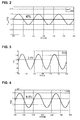
- Fig. 2 shows the target angular velocity n set , which oscillated harmonically with an amplitude of ⁇ 0.05 s -1 around a constant part n const of the target angular velocity n set of 2.45 s -1 with an oscillation period of 20 s.
- the relative angular velocity variation was 4% with respect to the stationary target angular velocity n set .
- the navigation system is fed with the propeller efficiency taking into account the theoretical or actual advance velocity under different flow conditions (e.g., velocity of the ship, loading condition of the ship, propeller rotation speed, the depth of the water etc.) for adjusting the propeller rotation speed and in case of controlled pitch propellers also the pitch of propeller blade.
- This data can be based on theoretical propeller efficiency calculations, simulation of propeller function or test trials with model or actual ship.
- a simulation model of the flow conditions in the area of the propeller in the ship navigation system which is used to optimise the propeller efficiency taking into account the hull geometry of the ship, the loading condition of the ship and the depth of the water below the ship or on the estimated route of the ship.
- the calculation of advance velocity can be combined with speed-through-water measurements to increase accuracy of calculation.
- the propeller, ship hull and propulsion system efficiency are monitored by comparing the optimal efficiency parameters ship water velocity, propeller rotation speed and fuel efficiency of the propulsion system of the ship with the actual parameters and using the information in scheduling ship maintenance.
Landscapes
- Chemical & Material Sciences (AREA)
- Engineering & Computer Science (AREA)
- Combustion & Propulsion (AREA)
- Physics & Mathematics (AREA)
- Ocean & Marine Engineering (AREA)
- Mechanical Engineering (AREA)
- General Physics & Mathematics (AREA)
- Probability & Statistics with Applications (AREA)
- Aerodynamic Tests, Hydrodynamic Tests, Wind Tunnels, And Water Tanks (AREA)
Priority Applications (1)
| Application Number | Priority Date | Filing Date | Title |
|---|---|---|---|
| EP08151821A EP2093552A1 (de) | 2008-02-22 | 2008-02-22 | Verfahren und Vorrichtung zur Bestimmung der Propellereffizienz an Bord eines Schiffs |
Applications Claiming Priority (1)
| Application Number | Priority Date | Filing Date | Title |
|---|---|---|---|
| EP08151821A EP2093552A1 (de) | 2008-02-22 | 2008-02-22 | Verfahren und Vorrichtung zur Bestimmung der Propellereffizienz an Bord eines Schiffs |
Publications (1)
| Publication Number | Publication Date |
|---|---|
| EP2093552A1 true EP2093552A1 (de) | 2009-08-26 |
Family
ID=39590967
Family Applications (1)
| Application Number | Title | Priority Date | Filing Date |
|---|---|---|---|
| EP08151821A Pending EP2093552A1 (de) | 2008-02-22 | 2008-02-22 | Verfahren und Vorrichtung zur Bestimmung der Propellereffizienz an Bord eines Schiffs |
Country Status (1)
| Country | Link |
|---|---|
| EP (1) | EP2093552A1 (de) |
Cited By (6)
| Publication number | Priority date | Publication date | Assignee | Title |
|---|---|---|---|---|
| CN104089773A (zh) * | 2014-07-23 | 2014-10-08 | 江苏大学 | 卷盘式喷灌机传动系统效率试验装置与方法 |
| CN106052925A (zh) * | 2016-06-03 | 2016-10-26 | 中国矿业大学 | 一种卷盘式喷灌机运行过程性能测试装置及方法 |
| GR20180100158A (el) * | 2018-04-13 | 2019-11-28 | Νικολαος Παναγιωτη Κυρτατος | Εκ του μακροθεν αξιολογηση της ρυπανσης ελικας πλοιου |
| WO2019243932A1 (en) | 2018-06-21 | 2019-12-26 | Kyrtatos Nikolaos | Remote assessment of ship propeller fouling |
| CN111114856A (zh) * | 2019-09-24 | 2020-05-08 | 哈尔滨工业大学 | 火星飞行器上下旋翼间距自动可调的气动特性测量装置 |
| CN111964735A (zh) * | 2020-09-30 | 2020-11-20 | 中国船舶科学研究中心 | 船舶推进轴系动态特性测试系统 |
Citations (5)
| Publication number | Priority date | Publication date | Assignee | Title |
|---|---|---|---|---|
| US4334425A (en) | 1980-04-18 | 1982-06-15 | Crane Harold E | Ship efficiency analyzer |
| US4459671A (en) | 1981-10-30 | 1984-07-10 | Teass Garnette S | Fuel management control system |
| EP0215500A2 (de) * | 1985-09-06 | 1987-03-25 | Shell Internationale Researchmaatschappij B.V. | Verfahren und Gerät zur Schiffleistungsüberwachung |
| US4843575A (en) * | 1982-10-21 | 1989-06-27 | Crane Harold E | Interactive dynamic real-time management system |
| US6227918B1 (en) | 2000-01-05 | 2001-05-08 | Mark E. Wharton | System for determining apparent slip and angle of attack |
-
2008
- 2008-02-22 EP EP08151821A patent/EP2093552A1/de active Pending
Patent Citations (5)
| Publication number | Priority date | Publication date | Assignee | Title |
|---|---|---|---|---|
| US4334425A (en) | 1980-04-18 | 1982-06-15 | Crane Harold E | Ship efficiency analyzer |
| US4459671A (en) | 1981-10-30 | 1984-07-10 | Teass Garnette S | Fuel management control system |
| US4843575A (en) * | 1982-10-21 | 1989-06-27 | Crane Harold E | Interactive dynamic real-time management system |
| EP0215500A2 (de) * | 1985-09-06 | 1987-03-25 | Shell Internationale Researchmaatschappij B.V. | Verfahren und Gerät zur Schiffleistungsüberwachung |
| US6227918B1 (en) | 2000-01-05 | 2001-05-08 | Mark E. Wharton | System for determining apparent slip and angle of attack |
Cited By (8)
| Publication number | Priority date | Publication date | Assignee | Title |
|---|---|---|---|---|
| CN104089773A (zh) * | 2014-07-23 | 2014-10-08 | 江苏大学 | 卷盘式喷灌机传动系统效率试验装置与方法 |
| CN104089773B (zh) * | 2014-07-23 | 2016-07-13 | 江苏大学 | 卷盘式喷灌机传动系统效率试验装置与方法 |
| CN106052925A (zh) * | 2016-06-03 | 2016-10-26 | 中国矿业大学 | 一种卷盘式喷灌机运行过程性能测试装置及方法 |
| CN106052925B (zh) * | 2016-06-03 | 2019-01-25 | 中国矿业大学 | 一种卷盘式喷灌机运行过程性能测试装置及方法 |
| GR20180100158A (el) * | 2018-04-13 | 2019-11-28 | Νικολαος Παναγιωτη Κυρτατος | Εκ του μακροθεν αξιολογηση της ρυπανσης ελικας πλοιου |
| WO2019243932A1 (en) | 2018-06-21 | 2019-12-26 | Kyrtatos Nikolaos | Remote assessment of ship propeller fouling |
| CN111114856A (zh) * | 2019-09-24 | 2020-05-08 | 哈尔滨工业大学 | 火星飞行器上下旋翼间距自动可调的气动特性测量装置 |
| CN111964735A (zh) * | 2020-09-30 | 2020-11-20 | 中国船舶科学研究中心 | 船舶推进轴系动态特性测试系统 |
Similar Documents
| Publication | Publication Date | Title |
|---|---|---|
| EP2178745B1 (de) | Wirkungsgradoptimierende propellergeschwindigkeitssteuerung für schiffe | |
| EP3330171B1 (de) | Vorrichtung zur vorhersage des stromverbrauchs eines seeschiffes | |
| Ueno et al. | Estimation and prediction of effective inflow velocity to propeller in waves | |
| JP2015526778A (ja) | シップの性能を予測する方法およびシステム | |
| Kraus | Wave glider dynamic modeling, parameter identification and simulation | |
| Scott et al. | The effect of ship size on airwake aerodynamics and maritime helicopter operations | |
| Donnarumma et al. | Numerical models for ship dynamic positioning | |
| Sumislawski et al. | Advances on numerical and experimental investigation of ship roll damping | |
| Zinchenko et al. | Application of the conditional optimization method in the problem of vessel stormy sailing. | |
| Park et al. | A study on the key performance indicator of the dynamic positioning system | |
| Batrak et al. | Propeller hydrodynamic loads in relation to propulsion shaft alignment and vibration calculations | |
| Oettle et al. | A 4 degree of freedom velocity/power prediction program for wind (assisted) vessels | |
| Huu et al. | A 3D dynamic model applied for cargo ships to study ship motion control | |
| Lee et al. | Prediction of velocity and attitude of a yacht sailing upwind by computational fluid dynamics | |
| Зінченко et al. | Influence of hull and cargo contours on lateral force and yaw torque in real-time vessel control systems | |
| Alagili et al. | Performance assessment of DP control systems for different sea states | |
| Dash et al. | Roll-induced bifurcation in ship maneuvering under model uncertainty | |
| Göksu et al. | Evaluation of the canopy curvature for a kite assisted ship propulsion system | |
| Hamzah | Analysis of wave height to ship motion with displacement of 7,597 tons by finite element method | |
| Fasse et al. | Development of an experimental blade-controlled cycloidal propeller | |
| Spagnolo | A cycloidal propeller simulation model and its application to low and high speed ship manoeuvres | |
| TIWARI | HYDRODYNAMIC CHARACTERISATION AND CONTROL ANALYSIS FOR DYNAMIC POSITIONING OF AN OCEANOGRAPHIC RESEARCH VESSEL | |
| Alonso-Reig et al. | A novel tool for floating offshore wind substructures design: Validation and definition of design guidelines | |
| Nguyen et al. | Experimental study on hydrodynamic forces acting on ship hull and rudder behind the propeller in regular waves | |
| Dubois | Magnitude and phase shift of the side-force generated by a collective and cyclic pitch propeller |
Legal Events
| Date | Code | Title | Description |
|---|---|---|---|
| PUAI | Public reference made under article 153(3) epc to a published international application that has entered the european phase |
Free format text: ORIGINAL CODE: 0009012 |
|
| AK | Designated contracting states |
Kind code of ref document: A1 Designated state(s): AT BE BG CH CY CZ DE DK EE ES FI FR GB GR HR HU IE IS IT LI LT LU LV MC MT NL NO PL PT RO SE SI SK TR |
|
| AX | Request for extension of the european patent |
Extension state: AL BA MK RS |
|
| 17P | Request for examination filed |
Effective date: 20091014 |
|
| AKX | Designation fees paid |
Designated state(s): AT BE BG CH CY CZ DE DK EE ES FI FR GB GR HR HU IE IS IT LI LT LU LV MC MT NL NO PL PT RO SE SI SK TR |
|
| STAA | Information on the status of an ep patent application or granted ep patent |
Free format text: STATUS: THE APPLICATION IS DEEMED TO BE WITHDRAWN |
|
| D18D | Application deemed to be withdrawn (deleted) | ||
| 18D | Application deemed to be withdrawn |
Effective date: 20100901 |