EP2093628A2 - Development roller, development device, and image forming apparatus - Google Patents
Development roller, development device, and image forming apparatus Download PDFInfo
- Publication number
- EP2093628A2 EP2093628A2 EP09002261A EP09002261A EP2093628A2 EP 2093628 A2 EP2093628 A2 EP 2093628A2 EP 09002261 A EP09002261 A EP 09002261A EP 09002261 A EP09002261 A EP 09002261A EP 2093628 A2 EP2093628 A2 EP 2093628A2
- Authority
- EP
- European Patent Office
- Prior art keywords
- toner
- base
- development roller
- development
- projection
- Prior art date
- Legal status (The legal status is an assumption and is not a legal conclusion. Google has not performed a legal analysis and makes no representation as to the accuracy of the status listed.)
- Withdrawn
Links
Images





Classifications
-
- G—PHYSICS
- G03—PHOTOGRAPHY; CINEMATOGRAPHY; ANALOGOUS TECHNIQUES USING WAVES OTHER THAN OPTICAL WAVES; ELECTROGRAPHY; HOLOGRAPHY
- G03G—ELECTROGRAPHY; ELECTROPHOTOGRAPHY; MAGNETOGRAPHY
- G03G15/00—Apparatus for electrographic processes using a charge pattern
- G03G15/06—Apparatus for electrographic processes using a charge pattern for developing
- G03G15/08—Apparatus for electrographic processes using a charge pattern for developing using a solid developer, e.g. powder developer
- G03G15/0806—Apparatus for electrographic processes using a charge pattern for developing using a solid developer, e.g. powder developer on a donor element, e.g. belt, roller
- G03G15/0818—Apparatus for electrographic processes using a charge pattern for developing using a solid developer, e.g. powder developer on a donor element, e.g. belt, roller characterised by the structure of the donor member, e.g. surface properties
Definitions
- the present invention relates to a development roller having a roughness on the circumference thereof for transporting toner to a latent image bearing unit, a development device containing the development roller, and an image forming apparatus containing the development device.
- Development devices developing a toner image from a latent image with one-component non-magnetic toner triboelectrically charge the toner on a development roller.
- the development roller has a surface roughness on the circumference thereof, the roughness having a substantially flat top surface.
- the development roller includes a base unit having a roughness portion of grooves on the circumference thereof formed through component rolling, and a surface layer having a uniform thickness formed through plating on the surface of the base unit (as disclosed in Japanese Unexamined Patent Application Publication No. JP-A-2007-121948 ).
- a development roller a includes a base unit b and a surface layer c plated on the base unit a as a coverage.
- a toner feed roller and a toner regulator unit typically remain in contact with the development roller.
- Silica having a high hardness is used as an external additive plating toner mother particles.
- the surface layer on the development roller is thus designed to control wear of the circumference of the development roller.
- a small portion e is swollen in a radially external direction of the development roller a (in an upward direction in Fig. 8A ) from a main surface d serving as a regular surface of a base projection c at the side edges of the base projection c of a main unit b of the development roller a. If the roughness depth is large, the material amount of the recess is large, and the swollen portion e is pronounced.
- a small base recess f can be caused on the base surface d of the base projection c through centerless machining performed prior to component rolling.
- a plating process is performed with no consideration given to the base swollen portion e and the base recess f in the related art.
- a swollen portion i of the surface layer g is caused at the base swollen portion e having a height h from the base surface d larger than a thickness t of the surface layer g (t ⁇ h).
- the wear of the surface layer g of the development roller a is controlled as previously described, the degree of wear of the surface layer increases in a long service life of the development roller a.
- the surface layer g is worn, the swollen portion i of the surface layer g is rapidly worn as illustrated in Fig. 8B , and the base swollen portion e is exposed at an early stage of service.
- the durability of the development roller a is increased with the surface layer g, the level of durability of the development roller a is not sufficient. There is still room for improvement in the durability of the development roller a.
- a base portion k may be swollen in a direction toward the base recess j at the side edge of the base projection c of the base unit b of the development roller a as illustrated in Fig. 8C .
- a swollen portion n of the surface layer g is caused at the base swollen portion k having an expansion h' from a base side surface m as the regular surface larger than the thickness t of the surface layer g (t ⁇ h').
- the durability of the development roller a is not sufficient, and there is room for improvement.
- An amount of toner e transported by the development roller a is regulated by a toner regulator blade f.
- a predetermined area f 2 of the toner regulator blade f including a front edge portion f 1 illustrated in Fig. 11A or a front edge portion f 2 illustrated in Fig. 11B , is slid on a flat portion h of a projection g so that the flat portion h has partially no toner e with most of the toner e held in a recess i.
- a surface k of the base projection j of the base unit b has a large number of small dents m (only one dent m shown for convenience of explanation) through centerless machining performed prior to the machining of the roughness portion of the base unit b. For this reason, the surface of the base projection j has some degree of surface roughness.
- a surface layer c at the projection g covering the base projection j also has a large number of small dents n (only one dent n shown for convenience of explanation). The surface layer c has some degree of surface roughness.
- a toner feed roller (not shown) is forced to be in contact with the development roller a.
- One of silica and titania having a high hardness, is used as an external additive covering toner mother particles of the toner e.
- the surface of the surface layer c at the flat portion h is worn because the toner feed roller and the toner regulator blade f press silica and titania against the development roller a.
- the surface of the surface layer c is smoothed (to a mirror state free from small roughness). A contact area of the toner regulator blade f to the projection g thus increases.
- the contact level between the development roller a and the toner regulator blade f is thus raised.
- the contact level tends to be even larger if part of the flat portion h of the projection g is not covered with the toner e, or if the toner regulator blade f is made of rubber.
- the toner regulator blade f suffers from uneven sliding.
- the toner regulator blade f may be even broken at the front end thereof.
- a rasping sound may be caused when the toner regulating blade f is pressed against the development roller a. In view of a long service life, there is room for improvement in the durability of the development roller a and the contact level.
- An advantage of some aspects of the invention is that a development roller having a roughness portion formed through component rolling provides a long service life thereof for image development with an increased durability thereof.
- a development device and an image forming apparatus, each containing the development roller, also provide can perform development operation for a long period of time.
- a development roller maintains durability by controlling contact level with an engagement member even when the surface layer is worn after a long period of usage in image forming, and provides a long service life thereof in image development.
- a development device and an image forming apparatus, each containing the development roller, also can perform development operation for a long period of time.
- a base roughness is formed on a base unit in pressure machining of the development roller.
- a small swollen portion is formed at a side edge of a base projection, swollen from a regular surface of the base projection.
- a surface layer is formed on the circumference of the base unit. A thickness of the surface layer is set to be larger than a maximum height of the base swollen portion from the regular surface of the base projection.
- the swollen portion of the surface layer corresponding to the swollen portion of the base unit is first worn in a long service of image development. Even if the swollen portion of the surface layer is worn out, the base unit is prevented from being exposed because a thickness of the surface layer is set as previously discussed.
- a projection of the surface layer becomes flat corresponding to the regular surface of the base projection of the base unit.
- the area of the flat surface of the surface layer at the projection is increased.
- An area under the weight of a toner regulator unit and a toner feed unit is expanded, and the pressure is thus distributed. The wear rate of the flat surface of the surface layer at the projection is thus controlled.
- the durability of the development roller is substantially increased, and the toner charging property of the development roller is maintained at an excellent level.
- the base unit is prevented from being exposed for a long period of time. Even if a corrosive iron-based material is used for the base unit, the base unit is prevented from being corroded for a long period of time.
- the development roller of one embodiment of the invention develops a toner image on a latent image bearing unit in response to an electrostatic latent image. If an average diameter of toner particles smaller than the depth of the recess of the development roller is used, the surface of the surface layer at the projection is worn generally flatly. The wear of the surface layer is controlled for a long period of time.
- the toner particles are coated with silica having a relatively high hardness as an external additive with the silica coverage ratio to the toner mother particles being 100% or more.
- Silica is abundant in the surface of the toner mother particles and separated silica is also abundant in the toner. This causes a relatively high wear rate in the surface layer of the projection.
- Such toner is typically used when toner fluidity is needed in one-component non-magnetic non-contact development. Even if the development roller is used in the development device that uses the toner having a silica coverage rate of 100% or more, the durability of the development roller is still effectively increased.
- the image forming apparatus containing the development device of one embodiment of the invention thus provides excellent images for a long period of time.
- the surface roughness of the surface layer at the flat portion of the projection is set to be larger than the thickness of the surface layer.
- the flat portion of the projection of the development roller is thus maintained to a constant surface roughness until the flat portion of the base unit is exposed at the end of the service life of the development roller. Since the surface layer is manufactured through electroless plating, a small recess is more accurately formed in accordance with a base recess of the base unit. An increase in the contact level between the toner regulator blade and the flat portion of the projection is thus controlled for a long period of time.
- Uneven sliding of the toner regulator blade on the development roller and a sound of the toner regulator blade are effectively controlled.
- the breaking of the toner regulator blade may also be avoided.
- the durability of the development roller and the toner regulator blade are increased.
- the charging property of the development roller is maintained at an excellent level for a long period of time.
- the development device including the development roller can thus develop toner images on the latent image bearing unit in accordance with latent images for a long period of time.
- the front edge portion of the toner regulator blade is kept in contact with the flat portion of the projection so that the flat portion of the projection is partially covered with the toner.
- an increase in the contact level between the toner regulator blade and the flat portion of the projection is effectively controlled for a long period of time.
- the image forming apparatus containing the development device can provide excellent images for a long period of time.
- Fig. 1 illustrates an image forming apparatus in accordance with one embodiment of the invention.
- Fig. 2 is a sectional view diagrammatically illustrating a development device illustrated in Fig. 1 .
- Fig. 3A diagrammatically illustrates a development roller, a toner feed roller, and a toner regulator unit
- Fig. 3B is a partial sectional view illustrating part of the development roller and taken along line IIIB-IIIB in Fig. 3A
- Fig. 3C is a partial sectional view illustrating a base unit of the development roller.
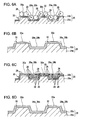
- Figs. 4A-4C illustrate a development roller in accordance with a first embodiment of the invention, wherein Fig. 4A is a partial sectional view diagrammatically illustrating one projection of the development roller, Fig. 4B is a partial sectional view diagrammatically illustrating a wear process on the development roller, and Fig. 4C is a partial sectional view diagrammatically illustrating a further wear process on the development roller.
- Figs. 5A-5C illustrate the development roller in accordance with the first embodiment of the invention, wherein Fig. 5A illustrates a size of a roughness of the development roller, Fig. 5B illustrates a wear process of the development roller when a toner particle diameter is larger than a depth of the roughness of the development roller, and Fig. 5C illustrates a wear process of the development roller when the toner particle diameter is smaller than the depth of the roughness of the development roller.
- Figs. 6A-6D illustrate the development roller of the first embodiment of the invention wherein Fig. 6A illustrates the behavior of toner particles when the toner particle diameter is larger than the depth of the roughness of the development roller, Fig. 6B illustrates the wear state of the development roller of Fig. 6A, Fig. 6C illustrates the behavior of toner particles when the toner particle diameter is smaller than the depth of the roughness of the development roller, Fig. 6D illustrates the wear state of the development roller of Fig. 6C .
- Fig. 7A partially illustrates a development roller in accordance with another embodiment of the invention
- Fig. 7B illustrates the wear state of the development roller in Fig. 7A .
- Fig. 8A is a partial sectional view illustrating a portion of the projection swollen in a radial direction of the development roller in the related art
- Fig. 8B is a partial sectional view illustrating the wear of the projection of the development roller in Fig. 8A
- Fig. 8C is a partial sectional view illustrating a portion swollen in a direction looking toward the recess of the development roller in the related art
- Fig. 8D is a partial sectional view illustrating the wear of the projection in Fig. 8C .
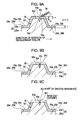
- Figs. 9A-9C illustrate a development roller in accordance with a second embodiment of the invention, wherein Fig. 9A is a partial sectional view diagrammatically illustrating one projection of the development roller, Fig. 9B is a partial sectional view diagrammatically illustrating a wear process of the development roller, and Fig. 9C is a partial sectional view diagrammatically illustrating a further wear process of the development roller.
- Figs. 10A and 10B illustrate the development roller in accordance with the second embodiment of the invention wherein Fig. 10A illustrates a size of a roughness of the development roller, and Fig. 10B illustrates a wear process of the development roller when a toner particle diameter is smaller than a depth of the roughness of the development roller.
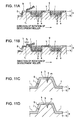
- Figs. 11A illustrates a toner regulating method that is performed with a front edge of a toner regulator blade in contact with a flat portion of the projection
- Fig. 11B illustrates a toner regulating method that is performed with a predetermined area containing the front edge of the toner regulator blade in contact with the flat portion of the projection
- Fig. 11C is a partial sectional view diagrammatically illustrating the projection of the development roller in the related art
- Fig. 11D is a partial sectional view diagrammatically illustrating the wear of the surface layer at the projection.
- Fig. 1 diagrammatically illustrates an image forming apparatus 1 in accordance with one embodiment of the invention.
- a photoconductor unit 3 as an image bearing unit is supported in an apparatus body 2 in a manner such that the photoconductor unit 3 is clockwise rotated in a direction of rotation ⁇ .
- a charging device 4 is arranged in the vicinity of the circumference of the photoconductor unit 3.
- a rotary development unit 5 as a development device, a primary transfer device 6, and a cleaning device 7.
- the rotary development unit 5 includes a development device 5Y for yellow color, a development device 5M for magenta color, a rotary development unit 5C for cyan color, and a development device 5K for black.
- development devices 5Y, 5M, 5C and 5K are detachably supported in a rotary 5a that is rotatable about a center axis in a direction of rotation ⁇ (counterclockwise rotation in Fig. 1 ).
- An exposure device 8 is arranged below the charging device 4 and the cleaning device 7.
- the image forming apparatus 1 further includes an intermediate transfer belt 9 having an endless structure as an intermediate transfer medium.
- the intermediate transfer belt 9 is entrained about a belt driving roller 10 and a driven roller 11.
- a driving force of a motor (not shown) is conveyed to the belt driving roller 10.
- the belt driving roller 10 causes the intermediate transfer belt 9 to rotate in a rotational direction ⁇ (counterclockwise rotation in Fig. 1 ) while the intermediate transfer belt 9 is pressed by the primary transfer device 6 against the photoconductor unit 3.
- a secondary transfer device 12 is arranged next to the belt driving roller 10 of the intermediate transfer belt 9.
- a transfer material cassette 13 is arranged below the exposure device 8.
- the transfer material cassette 13 holds a sheet-like transfer material such as a transfer paper sheet (corresponding to a transfer medium in accordance with one embodiment of the invention).
- a pickup roller 15 and a gate roller pair 16 are arranged close to the secondary transfer device 12 in a transfer material transport path 14 extending from the transfer material cassette 13 to the secondary transfer device 12.
- a fixing device 17 is arranged above the secondary transfer device 12.
- the fixing device 17 includes a heater roller 18 and a pressure roller 19 pressed against the heater roller 18.
- a transfer material discharge tray 20 is arranged on the top portion of the apparatus body 2.
- a pair of transfer material discharge rollers 21 are arranged between the fixing device 17 and the transfer material discharge tray 20.
- a yellow electrostatic latent image for example, is formed on the photoconductor unit 3 uniformly charged by the charging device 4 in response to laser light L from the exposure device 8.
- the yellow electrostatic latent image is developed on the photoconductor unit 3 by yellow toner of the yellow development device 5Y at a development position (not shown) determined when the rotary 5a rotates.
- a yellow toner image is thus developed on the photoconductor unit 3.
- the yellow toner image is then transferred to the intermediate transfer belt 9 by the primary transfer device 6. Toner remaining on the photoconductor unit 3 subsequent to the transfer operation is scraped off by a cleaning blade or the like of the cleaning device 7 and then recycled.
- a magenta image is formed by the exposure device 8 on the photoconductor unit 3 that is uniformly charged by the charging device 4.
- the magenta electrostatic latent image is developed by magenta toner of the magenta development device 5M at the development position.
- the magenta image on the photoconductor unit 3 is transferred to the intermediate transfer belt 9 by the primary transfer device 6 in a manner such that the magenta image is superimposed on the yellow image.
- Toner remaining on the photoconductor unit 3 subsequent the transfer operation is recycled by the cleaning device 7.
- a similar operation is repeated for cyan and black toners.
- the toner images are successively formed on the photoconductor unit 3, and then superimposed on the preceding toner images on the intermediate transfer belt 9. A full-color toner image is then formed on the intermediate transfer belt 9.
- toner remaining on the photoconductor unit 3 subsequent to each transfer operation is recycled by the cleaning device 7.
- the full-color toner image transferred onto the intermediate transfer belt 9 is then transferred by the secondary transfer device 12 to the transfer material transported from the transfer material cassette 13 via the transfer material transport path 14.
- the transfer material is then transported to the secondary transfer device 12 at a timing with the full-color toner image of the intermediate transfer belt 9 by the gate roller 16.
- the toner image pre-fixed to the transfer material is heated and pressure-fixed by the heater roller 18 and the pressure roller 19 in the fixing device 17.
- the transfer material having the image thereon is transported via the transfer material transport path 14, discharged to the transfer material discharge tray 20 via the transfer material discharge roller pair 21 and then held there.
- a characteristic structure of the image forming apparatus 1 is described below.
- the development devices 5Y, 5M, 5C, and 5K in the image forming apparatus 1 are identical in structure.
- the rotary development unit 5 is representatively discussed without individually referring to the development devices 5Y, 5M, 5C, and 5K.
- reference number 5' is used to discriminate the development device from the rotary development unit 5.
- Fig. 2 is a sectional view of the development device 5' taken in a direction perpendicular to the longitudinal direction of the development device 5' in accordance with one embodiment of the invention.
- the development device 5' has a form of an elongated container. With reference to Fig. 2 , the development device 5' has the same structure as the development device disclosed in Japanese Unexamined Patent Application Publication No. JP-A-2007-121948 . More specifically, the development device 5' includes in an elongated housing 22 a toner container 23, a toner feed roller 24, a development roller 25, and a toner regulator member 26. The toner container 23, the toner feed roller 24, the development roller 25, and the toner regulator member 26 extend in the longitudinal direction of the development device 5' (i.e., in a direction perpendicular to the plane of the page of Fig. 2 ).
- the toner container 23 is partitioned into two toner compartments 23a and 23b by a partitioning wall 27.
- the toner container 23 includes a common section 23c through which the first and second toner compartments 23a and 23b are open to each other in Fig. 2 .
- the partitioning wall 27 limits the movement of toner 28 between the first and second toner compartments 23a and 23b.
- the toner 28 then moves back to each of the first and second toner compartments 23a and 23b. In this way, part of the toner 28 previously held in the first toner compartment 23a is moved to the second toner compartment 23b and part of the toner 28 previously held in the second toner compartment 23b is moved to the first toner compartment 23a.
- the toner 28 is thus agitated within the toner container 23.
- the toner 28 is one-component, non-magnetic toner with toner mother particles thereof coated with an external additive.
- the external additive contains at least silica.
- the toner feed roller 24 is arranged in the lower portion of the first toner compartment 23a in a manner such that the toner feed roller 24 is clockwise rotatable.
- the development roller 25 is counterclockwise rotatably supported on the outside of the housing 22 as illustrated in Fig. 2 .
- the development roller 25 is arranged close to the photoconductor unit 3 (in a non-contact fashion).
- the development roller 25 is pressed against the toner feed roller 24 at a predetermined pressure through an opening 22a of the housing 22.
- the toner regulator member 26 is also arranged on the housing 22. The toner regulator member 26 remains in contact with the development roller 25 downstream of a nip (contact point) between the development roller 25 and the toner feed roller 24.
- the toner regulator member 26 regulates a thickness of the toner 28 fed to the development roller 25 from the toner feed roller 24.
- the toner 28 regulated by the toner regulator member 26 is transported to the photoconductor unit 3 by the development roller 25.
- the electrostatic latent image is thus developed into the toner image on the photoconductor unit 3 by the toner 28 transported by the development roller 25.
- the toner image of each color thus results on the photoconductor unit 3.
- Fig. 3A illustrates the circumference surface of the development roller 25 that has the same mesh roughness pattern as the one on the development roller discussed with reference to Japanese Unexamined Patent Application Publication No. JP-A-2007-121948 .
- the grooves 29 are formed in a roughness pattern in predetermined positions in the axial direction thereof on the whole circumference surface.
- the grooves 29 include first grooves 29a of a predetermined number continuously spiraling at a predetermined angle with respect to the axial direction of the development roller 25 (the predetermined slant angle is 45° in Fig. 3A , but not limited to 45°), and second grooves 29b of a predetermined number continuously spiraling at an angle opposite to the slant angle of the first grooves 29a.
- the first and second grooves 29a and 29b are formed at the respective slant angles at a predetermined pitch p with regular interval of W along the axial direction of the development roller 25.
- the first and second grooves 29a and 29b may be different from each other in slant angle and pitch.
- the development roller 25 includes a base unit 25a, and a surface layer 25b formed on the circumference surface of the base unit 25a.
- the base unit 25a is a metal sleeve made of an aluminum based metal such as 5056 aluminum alloy or 6063 aluminum alloy, or an iron based metal such as STKM steel.
- the surface layer 25b is a nickel-based or chromium-based layer plated on the base unit 25a.
- the use of the surface layer 25b thus improves electrical characteristics and surface hardness of the development roller 25.
- the durability and toner charging property of the development roller 25 are thus increased.
- first and second grooves 29a' and 29b' serving as a base for the first and second grooves 29a and 29b are formed on the circumference surface of the base unit 25a of the development roller 25 through component rolling.
- the machining method of forming the first and second grooves 29a' and 29b' may be any known method. The discussion of the machining method is thus omitted here.
- the base unit 25a has island projections 30' of a predetermined number surrounded by the first and second grooves 29a' and 29b'.
- the projections 30 refer to a projection protruded from the bottom of each of the first and second grooves 29a' and 29b'.
- the base projection 30' is square if the first and second base grooves 29a' and 29b' have a slant angle of 45° and the same pitches, and is diamond if the first and second slant base grooves 29a' and 29b' have a slant angle of other than 45° and the same pitches.
- the base projection 30' is rectangular if the first and second base grooves 29a' and 29b' have a slant angle of 45° and different pitches, and is parallelogrammic if the first and second base grooves 29a' and 29b' have a slant angle of other than 45° and different pitches.
- the circumference surface of the base unit 25a having the first and second base grooves 29a' and 29b' and the base projections 30' is electroless nickel plated.
- the surface layer 25b is thus formed on the surface of the base unit 25a.
- the first and second grooves 29a and 29b and the projection 30 are formed on the surface layer 25b in a curved surface similar to the first and second base grooves 29a' and 29b' and the base projection 30'. It is noted that the first and second grooves 29a and 29b are respectively smaller than the first and second base grooves 29a' and 29b' and that the projection 30 is larger than the base projection 30'.
- the first and second grooves 29a and 29b and the projections 30 form a roughness portion (recesses and projections) on the circumference of the development roller 25.
- the left and right side walls of the projection 30 are inclined so that the projection 30 is tapered with a width of the projection 30 (a length of the projection 30 extending from the left side wall thereof to the right side wall thereof in Fig. 3B ) gradually narrowed as the projection 30 extends from the bottom to the top thereof.
- Fig. 3B is a sectional view of the development roller 25 taken along an axial line thereof.
- the projections 30 are also tapered with the two side walls inclined. More specifically, the projection 30 is tapered with four side walls inclined, and thus forms a quadrangular pyramid frustum.
- Swollen portions 30b' of a predetermined number raised from a base flat surface 30a' of the base projection 30' are formed at the upper side edge of the base projection 30' of the base unit 25a manufactured through component rolling as previously discussed with reference to Fig. 4A .
- Base recesses 30c' of a predetermined number dented downward from the base flat surface 30a' may be formed within the upper side edges of the base flat surface 30a' of the base projection 30'.
- the height of the swollen portions 30b' from the base flat surface 30a' and the depth of the base recesses 30c' are respectively negligibly smaller than the height of the base projection 30' and the depth of the first and second base grooves 29a' and 29b'.
- the swollen portion 30b' of the base projection 30' causes a swollen portion 30b raised from the flat surface 30a to be formed at the upper side edge of the projection 30 on the surface layer 25b plated on the circumference of the base unit 25a.
- the base recess 30c' causes a recess 30c dented from the flat surface 30a within the upper side edges of the flat surface 30a on top of the projection 30 on the surface (plated) layer 25b.
- the thickness t of the surface layer 25b is set to be larger than a maximum height h 1 of the highest one of the base swollen portions 30b' from the base flat surface 30a'.
- the thickness t of the surface layer 25b is also set so that the height h 2 of the deepest one of the recesses 30c of the surface layer 25b in the projection 30 from the base flat surface 30a' is larger than the height h 1 of the base swollen portion 30b'. In other words, h 1 ⁇ h 2 ⁇ t.
- Figs. 8A and 8D illustrate the surface layer 25b of the development roller 25 is worn in different wear traces as illustrated in Figs. 8A and 8D.
- Fig. 8A illustrates that the flat surface 30a of the projection 30 of the development roller 25 is worn in a substantially flat configuration.
- Fig. 8D illustrates that the flat surface 30a of the projection 30 of the development roller 25 is worn in a curved configuration.
- the wear traces were measured using Keyence VK-9500 as a three-dimensional measuring laser microscope.
- the image forming apparatus used in the tests was printer model LP9000C manufactured by Seiko Epson.
- a development roller 25 to be discussed below was used instead of the original development roller in the printer model LP9000C.
- Printer model LP9000C was modified to employ the development roller 25.
- Image forming conditions in the durability tests were the standard image forming conditions of the printer model LP9000C.
- the development roller 25 was machined to form a base roughness portion as below.
- the base roughness depth (height from the bottom of the base groove to the top surface of the projection) was 3 ⁇ m, the base roughness pitch was 100 ⁇ m, the width of the base projection along a line extending at half the base roughness depth was 54 ⁇ m, and the width of the base recess along the half line was 46 ⁇ m.
- the maximum height h1 of the swollen portion of the base projection from the regular surface of the base projection was 3 ⁇ m.
- a nickel-phosphorus (Ni-P) layer was electroless plated to a thickness of 3 ⁇ m as the surface layer 25b on the base unit 25a.
- the development roller 25 had a base roughness depth (height from the bottom of the base grooves 29a and 29b to the top surface of the projection 30) of 6 ⁇ m, a base roughness pitch of 100 ⁇ m, a width of the base projection at the half line of the base roughness depth of 60 ⁇ m, and a width of the base recess (first and second grooves 29a and 29b) along the half line of 40 ⁇ m.
- a plurality of recesses 30c were formed on the surface layer 25b at the flat surface 30a of the projection 30.
- the height h 2 of the deepest recess 30c of the surface layer 25b from the base flat surface 30a' was 4.5 ⁇ m (i.e., the maximum height h1 of the base swollen portion 30b' ⁇ the height h 2 of the deepest recess 30c of the surface layer 25b ⁇ the thickness t of the surface layer 25b).
- the base roughness portion (the grooves 29a' and 29b', and the projection 30') and a surface roughness portion (the grooves 29a and 29b, and the projection 30) were measured using Keyence VK-9500 as a three-dimensional measuring laser microscope.
- the toner regulator member 26 is constructed of a blade made of urethane rubber, and installed to be pressed against the development roller 25 under a pressure of 40 g/cm.
- a first type of toner was produced by manufacturing polyester particles through a pulverizing process, and by internally dispersing proper amounts of a charge control agent (CCA), a wax, and a pigment with the polyester particles into toner mother particles. Then externally added to the toner mother particles were small silica particles having a size of 20 nm, median silica particles having a size of 40 nm, and titania particles having a size of 30 nm. The process resulted in large size toner having an average diameter D50 of 8.5 ⁇ m.
- CCA charge control agent
- a second type of toner was produced by manufacturing polyester particles through a pulverizing process, and by internally dispersing proper amounts of a CCA, a wax, and a pigment with the polyester particles into toner mother particles. Then externally added to the toner mother particles were small silica particles having a size of 20 nm, median silica particles having a size of 40 nm, large silica particles having a size of 100 nm, and titania particles having a size of 30 nm. The process resulted in large size toner having an average diameter D50 of 6.5 ⁇ m.
- a third type of toner was produced by manufacturing polyester particles through a pulverizing process, and by internally dispersing proper amounts of a CCA, a wax, and a pigment with the polyester particles into toner mother particles. Then externally added to the toner mother particles were small silica particles having a size of 20 nm, median silica particles having a size of 40 nm, large silica particles having a size of 100 nm, and titania particles having a size of 30 nm. The process resulted in small size toner having an average diameter D50 of 4.5 ⁇ m.
- a fourth type of toner was produced by manufacturing styrene acrylate particles through a polymerization process, and by internally dispersing proper amounts of a wax, and a pigment with the styrene acrylate particles into toner mother particles. Then externally added to the toner mother particles were small silica particles having a size of 20 nm, median silica particles having a size of 40 nm, large silica particles having a size of 100 nm, and titania particles having a size of 30 nm. The process resulted in small size toner having an average diameter D50 of 4.5 ⁇ m.
- Durability image forming tests were conducted on A4 size standard sheets using a text pattern having a monochrome image occupancy rate of 5% under the standard image forming condition of the printer model LP9000C.
- the top four side edges of the surface layer 25b at the projection 30 having an initial profile denoted by a solid line in Fig. 5B were worn into a curved profile denoted by a broken line as the number of image forming cycles increased.
- the original profile was worn into a profile having a curved flat surface 30a of the surface layer 25b of the projection 30 as denoted by a dot-and-dash chain line.
- the projections 30 tended to be worn into the curved profile similar to that when the first type toner was used.
- the top four side edges of the surface layer 25b at the projection 30 having an initial profile denoted by a solid line in Fig. 5C were worn into a flat profile denoted by a dot-and-dash chain line as the number of image forming cycles increased.
- the projections 30 tended to be worn into the flat profile similar to that when the third type small toner was used.
- the wear profile is analyzed more in detail.
- the curved wear profile illustrated in Fig. 5B tends to occur if the toner particle diameter (D50 diameter, namely, average particle diameter of 50% volume) is larger than the roughness depth of the development roller 25 (i.e., the toner particle diameter > the roughness depth of the development roller 25).
- the substantially flat wear profile illustrated in Fig. 5C tends to occur if the toner particle diameter (D50 diameter, namely, average particle diameter of 50% volume) is smaller than the roughness depth of the development roller 25 (i.e., the toner particle diameter ⁇ the roughness depth of the development roller 25).
- Figs. 6A and 6D are sectional views of the first and second grooves 29a and 29b taken in a line perpendicular to the running direction of the grooves.
- the partial sectional views of the development roller 25 are not aligned with the direction of rotation of the development roller 25.
- Toner particles on the first grooves 29a thus move on the flat surfaces 30a of the projections 30, and then move to any of the first and second grooves 29a and 29b adjacent to the projections 30.
- toner particles on the second grooves 29b move on the flat surfaces 30a of the projections 30, and then move to any of the first and second grooves 29a and 29b adjacent to the projections 30.
- the toner movement is identical to the other examples of the development roller 25.
- the toner particle diameter (D50 particle diameter) is smaller than the depth of the roughness portion as illustrated in Fig. 6C , the surface of the surface layer 25b at the projection 30 is worn in a substantially flat configuration as illustrated in Fig. 6D .
- the reason for this is described below.
- toner particles present on the flat surfaces 30a of the projections 30 move into the first and second grooves 29a and 29b. Since the average diameter of the toner particles is smaller than the roughness depth, almost all the toner particles of the toner 28 having moved into the first and second grooves 29a and 29b are aligned in a plurality of layers.
- toner particles present in the first and second grooves 29a and 29b move onto the flat surfaces 30a of the projections 30. Since the top layer of toner particles is then about at the same level as the flat surface 30a of the projection 30, mainly the toner particles at the top layer out of the toner particles in the first and second grooves 29a and 29b horizontally move, and most of the remaining toner particles remain stationary. In the course of the movement of the top layer toner particles, the external additive having a relatively high hardness coating the toner mother particles gradually wears the surface of the surface layer 25b into a substantially flat state.
- the flat surface 30a of the surface layer 25b at the projection 30 is worn in a substantially flat configuration. All the swollen portions 30b are then worn out as illustrated in Fig. 4B , and the four side walls of the projection 30 are inclined as previously discussed. An area of the top portion 30a receiving a force applied by the toner feed roller 24, the tone regulator blade 26, etc. increases. A pressure acting on the top portion 30a is thus reduced. The wearing of the surface layer 25b at the projection 30 is thus controlled. Since the thickness t of the surface layer 25b is larger than the maximum height h 1 of the base swollen portion 30b', the base swollen portion 30b' is not exposed at an early stage of service.
- the flat surface 30a of the surface layer 25b at the projection 30 is gradually worn.
- the deepest recess 30c on the flat surface 30a at the projection 30 is then eliminated (i.e., all the recesses 30c are eliminated) as illustrated in Fig. 4C .
- the elimination of the recesses 30c and the presence of the inclined side walls of the projection 30 increases a pressure receiving area of the flat surface 30a as the top of the worn projection 30.
- the pressure applied on the top of the flat surface 30a is reduced more.
- the wear rate of the surface layer 25b at the projection 30 is thus further reduced.
- the height h 2 of the bottom of the deepest recess 30c on the surface layer 25b from the base flat surface 30a' is larger than the maximum height h 1 of the base swollen portion 30b', the base swollen portion 30b' is not exposed even if the deepest recess 30c is eliminated.
- the flat surface 30a at the top of the projection 30 is relatively smooth, a toner regulating method that causes the flat surface 30a at the top to be substantially fully covered with toner particles (preferably with a 100% coverage) is preferred when the toner regulator member 26 regulates the toner.
- the thickness t of the development (plated) roller 25 is set to be larger than the maximum height h 1 of the base swollen portion 30b' from the base flat surface 30a' of the highest base swollen portion 30b'.
- the surface layer 25b at the projection 30 With the swollen portion 30b of the surface layer 25b eliminated, the surface layer 25b at the projection 30 becomes the flat surface 30a as the top surface corresponding to the regular surface of the base projection 30'.
- the flat area of the surface layer 25b at the projection 30 thus increases.
- the wear rate of the flat surface 30a of the surface layer 25b at the top of the projection 30 is controlled.
- the wearing of the surface layer 25b is effectively controlled for a long period of time.
- the development roller has an increased durability and maintains the toner charging property at an excellent level for a long period of time.
- the thickness t is set so that the height h 2 of the deepest one of the recesses 30c of the surface layer 25b in the projection 30 from the base flat surface 30a' is larger than the height h 1 of the base swollen portion 30b'.
- the durability of the development roller 25 is increased further.
- the base unit 25a is not exposed for a long period of time. Even if an iron-based material is used for the base unit 25a, the base unit 25a is prevented from being corroded for a long period of time.
- the development device 5' including the development roller 25 maintains the toner charging property of the photoconductor unit 3 for a long period of time.
- the use of the toner 28 having the average particle diameter (D50 average diameter) smaller than the depth of the roughness portion of the development roller 25 allows the flat surface 30a of the surface layer 25b at the projection 30 to worn in a substantially flat configuration. The wearing of the surface layer 25b is thus controlled for a long period of time.
- the height h 2 of the bottom of the deepest recess 30c is not necessarily set to be larger than the height h 1 of the base swollen portion 30b'.
- the height h 2 is preferably set to be larger than the height h 1 .
- the number and pitch of the second grooves 29b may or may not be identical to the number and pitch of the first grooves 29a.
- the number of first grooves 29a may be 1 or more, and the number of second grooves 29b may be 1 or more.
- the toner 28 having the average particle diameter (D50 average diameter) larger than the depth of the roughness portion of the development roller 25 may be used. In such a case, the flat surface 30a of the surface layer 25b at the projection 30 is worn in a curved configuration. The durability of the development roller 25 is thus increased. However, the development roller 25 does not have so high a durability as the development roller 25 when the toner 28 having the average particle diameter (D50 average diameter) smaller than the depth of the roughness portion of the development roller 25 is used. In view of achieving a high durability of the development roller 25, the use of the toner 28 having the average particle diameter (D50 average diameter) smaller than the depth of the roughness portion of the development roller 25 is preferable.
- the toner particles are coated with silica having a relatively high hardness as an external additive with the silica coverage ratio to the toner mother particles being 100% or more.
- Silica is abundant in the surface of the toner mother particles and separated silica is also abundant in the toner. This causes a relatively high wear rate in the surface layer 25b of the projection 30.
- Such toner is typically used when toner fluidity is needed in one-component non-magnetic non-contact development. Even if the development roller 25 is used in the development device 5' that uses the toner having a silica coverage rate of 100% or more, the durability of the development roller 25 is effectively increased.
- the image forming apparatus 1 including the development device 5' can thus provide excellent images for a long period of time.
- Figs. 7A and 7B are partial sectional views illustrating part of a development roller in accordance with one embodiment of the invention. Elements identical to those illustrated in Figs. 4A and 4B are designated with the same reference numerals and the discussion thereof is omitted here.
- the development roller 25 includes a swollen portion 30d expanding in a direction toward the first groove 29a.
- the swollen portion 30d is created when the first and second grooves 29a and 29b are created through component rolling.
- the thickness t of the surface layer 25b is set to be larger than an extension (height) h' of a swollen portion 30d' of the base unit 25a from a base side surface 29e' (regular surface of the base unit 25a) of a side wall 30e.
- the development device 5' including the development roller 25 uses the toner 28 (not shown in Figs. 7A and 7B ) having the average particle diameter (D50 average diameter) larger than the depth of the roughness portion of the development roller 25.
- the flat surface 30a of the surface layer 25b at the top of the projection 30 illustrated in Fig. 7B is worn in a curved configuration. Since the thickness t of the surface layer 25b is set to be larger than the height h' of the base swollen portion 30d', the base swollen portion 30d' of the base unit 25a is not exposed rapidly.
- each of the development roller 25, the development device 5', and the image forming apparatus 1 remain substantially identical to those previously described.
- the development device 5' including the development roller 25 may use the toner 28 (not shown in Figs. 7A and 7B ) having the average particle diameter (D50 average diameter) smaller than the depth of the roughness portion of the development roller 25.
- the surface layer 25b at the flat surface 30a of the projection 30 is worn in a substantially flat configuration. If the surface layer 25b at the flat surface 30a of the projection 30 is gradually worn, a pressure receiving area of the surface 30a receiving a force from the toner feed roller 24, the toner regulator member 26, etc. expands. The pressure acting on the surface 30a at the top is thus decreased. The wearing of the surface layer 25b at the projection 30 is controlled.
- a plurality of small recesses 30c' dented downward from the base flat surface 30a' are formed in the base flat surface 30a' of the base projection 30' of the base unit 25a as previously discussed.
- These base recesses 30c' are created by making streak scratches with any appropriate means in a surface finish process prior to the roughening process of the base unit 25a.
- the base recesses 30c' may be formed using micro blasting.
- the base flat surface 30a' of the base projection 30' with a plurality of micro base recesses 30c' has a predetermined surface roughness r'.
- the surface layer 25b of the flat surface 30a at the projection 30 covering the base flat surface 30a' of the base projection 30' also has a plurality micro recesses 30c dented downward from the flat surface 30a in accordance with the base recesses 30c'.
- the surface layer 25b is produced through electroless plating, and micro recesses 30c precisely reflects the configuration of the base recesses 30c'.
- a surface roughness r of the flat surface 30a of the projection 30 of the surface layer 25b is set to be larger than the thickness t of the surface layer 25b (t ⁇ r).
- the surface roughness r may be a ten point average height Rz.
- the ten point average height Rz of the flat surface 30a of the projection 30 of the surface layer 25b is set to be larger than the thickness t of the surface layer 25b (t ⁇ Rz).
- the ten point average height Rz of the flat surface 30a can be measured using SURFTEST (surface roughness measuring instrument) manufactured by Mitutoyo.
- the center line average height (Ra) or the maximum height (Rmax) may be used as the surface roughness r.
- the measurement of these surface roughnesses is known and the discussion thereof is omitted here.
- a surface roughness r' of the base flat surface 30a' of the base projection 30' can be measured in a similar fashion.
- Durability tests were conducted on the development roller 25.
- the image forming apparatus used in the tests was printer model LP9000C manufactured by Seiko Epson.
- a development roller 25 to be discussed below was used instead of the original development roller in the printer model LP9000C.
- Printer model LP9000C was modified to employ the development roller 25.
- Image forming conditions in the durability tests were the standard image forming conditions of the printer model LP9000C.
- the ten point average height Rz of the base flat surface 30a' of one base projection 30' of the base unit 25a was 2 ⁇ m.
- the development roller 25 was machined to form a base roughness portion as below.
- the base roughness depth (height from the bottom of the base groove to the top surface of the projection) was 4.5 ⁇ m, the base roughness pitch was 100 ⁇ m, the width of the base projection along a line extending at half the base roughness depth was 57 ⁇ m, and the width of the base recess along the half line was 43 ⁇ m.
- a nickel-phosphorus (Ni-P) layer was electroless plated to a thickness of 1.5 ⁇ m as the surface layer 25b on the base unit 25a.
- the development roller 25 had a base roughness depth (height from the bottom of the base grooves 29a and 29b to the top surface of the projection 30) of 6 ⁇ m, a base roughness pitch of 100 ⁇ m, a width of the base projection at the half line of the base roughness depth of 60 ⁇ m, and a width of the base recess (grooves 29a and 29b) along the half line of 40 ⁇ m.
- the base roughness portion (the grooves 29a' and 29b', and the projection 30') and a surface roughness portion (the grooves 29a and 29b, and the projection 30) were measured using Keyence VK-9500 as a three-dimensional measuring laser microscope. Subsequent to the production of the surface layer 25b, a plurality of streak recesses 30c are formed on the surface layer 25b of the flat surface 30a of the projection 30.
- the ten point average height Rz of the flat surface 30a of the projection 30 was 1.8 ⁇ m.
- the ten point average height Rz of the flat surface 30a was larger than the thickness t of the surface layer 25b, which was 1.5 ⁇ m (the ten point average height Rz of the flat surface 30a > than the thickness t of the surface layer 25b).
- the toner regulator blade 26 was constructed of a blade made of urethane rubber. As illustrated in Fig. 9A , a front edge 26a of the toner regulator blade 26 was pressed into contact with the flat surfaces 30a of the projections 30 under a pressure of 40 g/cm.
- a first type of toner was produced by manufacturing polyester particles through a pulverizing process, and by internally dispersing proper amounts of a charge control agent (CCA), a wax, and a pigment with the polyester particles into toner mother particles. Then externally added to the toner mother particles were small silica particles having a size of 20 nm, median silica particles having a size of 40 nm, large silica particles having a size of 100 nm, and titania particles having a size of 30 nm. The process resulted in small size toner having an average diameter D50 of 4.5 ⁇ m, and smaller than the roughness depth of 6 ⁇ m.
- CCA charge control agent
- a second type of toner was produced by manufacturing styrene acrylate particles through a polymerization process, and by internally dispersing proper amounts of a wax, and a pigment with the styrene acrylate particles into toner mother particles. Then externally added to the toner mother particles were small silica particles having a size of 20 nm, median silica particles having a size of 40 nm, large silica particles having a size of 100 nm, and titania particles having a size of 30 nm. The process resulted in small size toner having an average diameter D50 of 4.5 ⁇ m.
- Durability image forming tests were conducted on A4 size standard sheets using a 25% halftone monochrome image under the standard image forming condition of the printer model LP9000C.
- the flat surface 30a of the projection 30 of the surface layer 25b at the projection 30 having an initial profile denoted by a solid line in Fig. 10B tended to be worn into a flat profile denoted by a dot-and-dash chain line.
- the projections 30 tended to be worn into the flat profile similar to that when the first type toner was used.
- the flat surface 30a is worn in a flat configuration as illustrated in Fig. 9B .
- recesses 30c of the surface layer 25b at the flat surface 30a are eliminated, some of the recesses 30c still remain.
- the surface layer 25b of the flat surface 30a at the projection 30 maintains a predetermined surface roughness.
- An increase in the contact area between the toner regulator blade 26 and the flat surface 30a of the projection 30 is controlled and the separated external additive of the toner 28 is inserted into the remaining recesses 30c.
- An increase in the contact level between the toner regulator blade 26 and the flat surface 30a of the projection 30 is controlled. The uneven sliding and the sound causing of the toner regulator blade 26 sliding on the flat surface 30a are thus controlled.
- the flat surface 30a of the projection 30 is further worn and the base flat surface 30a' of the base projection 30' of the base unit 25a is exposed as illustrated in Fig. 9C .
- the development roller 25 then ends the service life thereof. Although further recesses 30c of the surface layer 25b at the flat surface 30a are eliminated, some of the recesses 30c still remain. In other words, the surface layer 25b of the flat surface 30a at the projection 30 maintains a predetermined surface roughness.
- the predetermined surface roughness of the flat surface 30a of the projection 30 on the development roller 25 controls an increase in the contact level between the toner regulator blade 26 and the flat surface 30a of the projection 30 until the base flat surface 30a' is exposed at the end of the service life. The durability of the development roller 25 is thus increased.
- the flat surface 30a of the projection 30 is set to be larger than the thickness t of the surface layer 25b (the ten point average height Rz of the flat surface 30a > the thickness t of the surface layer 25b), the flat surface 30a of the projection 30 of the development roller 25 is maintained at a constant surface roughness until the end of the service life of the development roller 25. Since the surface layer 25b is electroless plated, micro recesses 30c are formed in good similarity with the base recesses 30c'. An increase in the contact level between the toner regulator blade 26 and the flat surface 30a of the projection 30 is controlled for a long period of time.
- the uneven sliding of the toner regulator blade 26 on the development roller 25 and the sound causing of the toner regulator blade 26 are thus controlled.
- the durability of the development roller 25 and the toner regulator blade 26 is substantially increased.
- the toner charging property of the development roller 25 is maintained for a long period of time.
- the development device 5' containing the development roller 25 can operate for a long period of time, developing toner images on the photoconductor unit 3 in accordance with electrostatic latent images for a long period of time.
- the image forming apparatus 1 containing the development device 5' can also operate for a long period of time, providing high-quality images.
- At least a predetermined area including at least the front edge 26a of the toner regulator blade 26 is put into contact with the flat surface 30a of the projection 30.
- an increase in the contact level between the toner regulator blade 26 and the flat surface 30a of the projection 30 is effectively controlled for a long period of time.
- the roughness portion is formed of regular grooves, the sound causing of the toner regulator blade 26 is effectively controlled.
- the invention is applied to the image forming apparatus 1 containing the rotary development unit 5.
- the invention is not limited to the image forming apparatus 1.
- the invention is applicable to image forming apparatuses including a development device with the development roller having a roughness portion.
- image forming apparatuses include an image forming apparatus having an image forming units arranged in tandem, a four-cycle image forming apparatus, a monochrome image forming apparatus, and an image forming apparatus that directly transfers a toner image to a transfer material (transfer medium of one embodiment of the invention) from an image bearing unit (i.e., an image forming apparatus having no intermediate transfer medium).
- transfer material transfer medium of one embodiment of the invention
- an image bearing unit i.e., an image forming apparatus having no intermediate transfer medium.
- the invention is applicable to any image forming apparatus falling within the scope defined by the claims.
- the roughness portion of the development roller 25 includes regular grooves produced through component rolling. Alternatively, the roughness portion may be machined in another process such as a cutting process.
- the invention is applicable to any image forming apparatus falling within the scope of the invention defined in the claims.
Landscapes
- Physics & Mathematics (AREA)
- General Physics & Mathematics (AREA)
- Dry Development In Electrophotography (AREA)
Abstract
A development roller (25) includes a base unit (25a) having a base recess (29a',29b') and a base projection (30') that are formed in a predetermined area of a circumference surface of the base unit (25a) by pressing a regular pattern in pressure machining, and a surface layer (25b) formed on the circumference surface of the base unit (25a) and having a recess (29a,29b) and a projection (30) formed respectively in accordance with the base recess (29a',29b') and the base projection (30') of the base unit (25a). A thickness of the surface layer (25b) is larger than a maximum height of a base swollen portion (30b') close to the side edge of the base projection (30') from a regular surface of the base projection (30').
Description
- The present invention relates to a development roller having a roughness on the circumference thereof for transporting toner to a latent image bearing unit, a development device containing the development roller, and an image forming apparatus containing the development device.
- Development devices developing a toner image from a latent image with one-component non-magnetic toner triboelectrically charge the toner on a development roller. The development roller has a surface roughness on the circumference thereof, the roughness having a substantially flat top surface. The development roller includes a base unit having a roughness portion of grooves on the circumference thereof formed through component rolling, and a surface layer having a uniform thickness formed through plating on the surface of the base unit (as disclosed in Japanese Unexamined Patent Application Publication No.
JP-A-2007-121948 - As illustrated in
Fig. 11A , a development roller a includes a base unit b and a surface layer c plated on the base unit a as a coverage. - A toner feed roller and a toner regulator unit typically remain in contact with the development roller. Silica having a high hardness is used as an external additive plating toner mother particles. As image forming operations are repeated by many times, the outer circumference of the development roller is worn. The surface layer on the development roller is thus designed to control wear of the circumference of the development roller.
- When a roughness pattern is pressed against the base unit of a development roller a to form a roughness portion, the material of the base unit corresponding to the recess is swollen around the recess. Referring to
Fig. 8A , a small portion e is swollen in a radially external direction of the development roller a (in an upward direction inFig. 8A ) from a main surface d serving as a regular surface of a base projection c at the side edges of the base projection c of a main unit b of the development roller a. If the roughness depth is large, the material amount of the recess is large, and the swollen portion e is pronounced. A small base recess f can be caused on the base surface d of the base projection c through centerless machining performed prior to component rolling. - When the surface layer g is formed on the base unit b, a plating process is performed with no consideration given to the base swollen portion e and the base recess f in the related art. A swollen portion i of the surface layer g is caused at the base swollen portion e having a height h from the base surface d larger than a thickness t of the surface layer g (t<h).
- Although the wear of the surface layer g of the development roller a is controlled as previously described, the degree of wear of the surface layer increases in a long service life of the development roller a. As the surface layer g is worn, the swollen portion i of the surface layer g is rapidly worn as illustrated in
Fig. 8B , and the base swollen portion e is exposed at an early stage of service. Even if the durability of the development roller a is increased with the surface layer g, the level of durability of the development roller a is not sufficient. There is still room for improvement in the durability of the development roller a. - Similarly, a base portion k may be swollen in a direction toward the base recess j at the side edge of the base projection c of the base unit b of the development roller a as illustrated in
Fig. 8C . A swollen portion n of the surface layer g is caused at the base swollen portion k having an expansion h' from a base side surface m as the regular surface larger than the thickness t of the surface layer g (t<h'). The durability of the development roller a is not sufficient, and there is room for improvement. - An amount of toner e transported by the development roller a is regulated by a toner regulator blade f. In one toner regulating method, a predetermined area f2 of the toner regulator blade f, including a front edge portion f1 illustrated in
Fig. 11A or a front edge portion f2 illustrated inFig. 11B , is slid on a flat portion h of a projection g so that the flat portion h has partially no toner e with most of the toner e held in a recess i. - Referring to
Fig. 11C , a surface k of the base projection j of the base unit b has a large number of small dents m (only one dent m shown for convenience of explanation) through centerless machining performed prior to the machining of the roughness portion of the base unit b. For this reason, the surface of the base projection j has some degree of surface roughness. A surface layer c at the projection g covering the base projection j also has a large number of small dents n (only one dent n shown for convenience of explanation). The surface layer c has some degree of surface roughness. - In addition to the toner regulator blade f, a toner feed roller (not shown) is forced to be in contact with the development roller a. One of silica and titania, having a high hardness, is used as an external additive covering toner mother particles of the toner e. As the image forming operations are repeated by many times, the surface of the surface layer c at the flat portion h is worn because the toner feed roller and the toner regulator blade f press silica and titania against the development roller a. As illustrated in
Fig. 11D , the surface of the surface layer c is smoothed (to a mirror state free from small roughness). A contact area of the toner regulator blade f to the projection g thus increases. As a result, the contact level between the development roller a and the toner regulator blade f is thus raised. The contact level tends to be even larger if part of the flat portion h of the projection g is not covered with the toner e, or if the toner regulator blade f is made of rubber. - If the contact level between the development roller a and the toner regulator blade f is high, the toner regulator blade f suffers from uneven sliding. The toner regulator blade f may be even broken at the front end thereof. A rasping sound may be caused when the toner regulating blade f is pressed against the development roller a. In view of a long service life, there is room for improvement in the durability of the development roller a and the contact level.
- An advantage of some aspects of the invention is that a development roller having a roughness portion formed through component rolling provides a long service life thereof for image development with an increased durability thereof. A development device and an image forming apparatus, each containing the development roller, also provide can perform development operation for a long period of time.
- Another advantage of an aspect of the invention is that a development roller maintains durability by controlling contact level with an engagement member even when the surface layer is worn after a long period of usage in image forming, and provides a long service life thereof in image development. A development device and an image forming apparatus, each containing the development roller, also can perform development operation for a long period of time.
- In accordance with one aspect of the invention, a base roughness is formed on a base unit in pressure machining of the development roller. In the pressure machining, a small swollen portion is formed at a side edge of a base projection, swollen from a regular surface of the base projection. A surface layer is formed on the circumference of the base unit. A thickness of the surface layer is set to be larger than a maximum height of the base swollen portion from the regular surface of the base projection.
- The swollen portion of the surface layer corresponding to the swollen portion of the base unit is first worn in a long service of image development. Even if the swollen portion of the surface layer is worn out, the base unit is prevented from being exposed because a thickness of the surface layer is set as previously discussed. When the swollen portion of the surface layer is worn out, a projection of the surface layer becomes flat corresponding to the regular surface of the base projection of the base unit. The area of the flat surface of the surface layer at the projection is increased. An area under the weight of a toner regulator unit and a toner feed unit is expanded, and the pressure is thus distributed. The wear rate of the flat surface of the surface layer at the projection is thus controlled. In this way, the durability of the development roller is substantially increased, and the toner charging property of the development roller is maintained at an excellent level. The base unit is prevented from being exposed for a long period of time.
Even if a corrosive iron-based material is used for the base unit, the base unit is prevented from being corroded for a long period of time. - The development roller of one embodiment of the invention develops a toner image on a latent image bearing unit in response to an electrostatic latent image. If an average diameter of toner particles smaller than the depth of the recess of the development roller is used, the surface of the surface layer at the projection is worn generally flatly. The wear of the surface layer is controlled for a long period of time.
- The toner particles are coated with silica having a relatively high hardness as an external additive with the silica coverage ratio to the toner mother particles being 100% or more. Silica is abundant in the surface of the toner mother particles and separated silica is also abundant in the toner. This causes a relatively high wear rate in the surface layer of the projection. Such toner is typically used when toner fluidity is needed in one-component non-magnetic non-contact development. Even if the development roller is used in the development device that uses the toner having a silica coverage rate of 100% or more, the durability of the development roller is still effectively increased.
- The image forming apparatus containing the development device of one embodiment of the invention thus provides excellent images for a long period of time.
- The surface roughness of the surface layer at the flat portion of the projection is set to be larger than the thickness of the surface layer. The flat portion of the projection of the development roller is thus maintained to a constant surface roughness until the flat portion of the base unit is exposed at the end of the service life of the development roller. Since the surface layer is manufactured through electroless plating, a small recess is more accurately formed in accordance with a base recess of the base unit. An increase in the contact level between the toner regulator blade and the flat portion of the projection is thus controlled for a long period of time.
- Uneven sliding of the toner regulator blade on the development roller and a sound of the toner regulator blade are effectively controlled. The breaking of the toner regulator blade may also be avoided. The durability of the development roller and the toner regulator blade are increased. The charging property of the development roller is maintained at an excellent level for a long period of time.
- Since an increase in the contact level between the toner regulator blade and the flat portion of the projection is controlled, an increase in the drive torque of the development roller is also restricted for a long period of time.
- The development device including the development roller can thus develop toner images on the latent image bearing unit in accordance with latent images for a long period of time.
- The front edge portion of the toner regulator blade is kept in contact with the flat portion of the projection so that the flat portion of the projection is partially covered with the toner. In such a toner regulating method, an increase in the contact level between the toner regulator blade and the flat portion of the projection is effectively controlled for a long period of time.
- With the roughness portion constructed of regular grooves, the uneven sliding of the toner regulator blade is effectively controlled.
- The image forming apparatus containing the development device can provide excellent images for a long period of time.
- The invention will be described with reference to the accompanying drawings, wherein like numbers reference like elements.
-
Fig. 1 illustrates an image forming apparatus in accordance with one embodiment of the invention. -
Fig. 2 is a sectional view diagrammatically illustrating a development device illustrated inFig. 1 . -
Fig. 3A diagrammatically illustrates a development roller, a toner feed roller, and a toner regulator unit,Fig. 3B is a partial sectional view illustrating part of the development roller and taken along line IIIB-IIIB inFig. 3A, and Fig. 3C is a partial sectional view illustrating a base unit of the development roller. -
Figs. 4A-4C illustrate a development roller in accordance with a first embodiment of the invention, whereinFig. 4A is a partial sectional view diagrammatically illustrating one projection of the development roller,Fig. 4B is a partial sectional view diagrammatically illustrating a wear process on the development roller, andFig. 4C is a partial sectional view diagrammatically illustrating a further wear process on the development roller. -
Figs. 5A-5C illustrate the development roller in accordance with the first embodiment of the invention, whereinFig. 5A illustrates a size of a roughness of the development roller,Fig. 5B illustrates a wear process of the development roller when a toner particle diameter is larger than a depth of the roughness of the development roller, andFig. 5C illustrates a wear process of the development roller when the toner particle diameter is smaller than the depth of the roughness of the development roller. -
Figs. 6A-6D illustrate the development roller of the first embodiment of the invention whereinFig. 6A illustrates the behavior of toner particles when the toner particle diameter is larger than the depth of the roughness of the development roller,Fig. 6B illustrates the wear state of the development roller ofFig. 6A, Fig. 6C illustrates the behavior of toner particles when the toner particle diameter is smaller than the depth of the roughness of the development roller,Fig. 6D illustrates the wear state of the development roller ofFig. 6C . -
Fig. 7A partially illustrates a development roller in accordance with another embodiment of the invention, andFig. 7B illustrates the wear state of the development roller inFig. 7A . -
Fig. 8A is a partial sectional view illustrating a portion of the projection swollen in a radial direction of the development roller in the related art,Fig. 8B is a partial sectional view illustrating the wear of the projection of the development roller inFig. 8A, Fig. 8C is a partial sectional view illustrating a portion swollen in a direction looking toward the recess of the development roller in the related art, andFig. 8D is a partial sectional view illustrating the wear of the projection inFig. 8C . -
Figs. 9A-9C illustrate a development roller in accordance with a second embodiment of the invention, whereinFig. 9A is a partial sectional view diagrammatically illustrating one projection of the development roller,Fig. 9B is a partial sectional view diagrammatically illustrating a wear process of the development roller, andFig. 9C is a partial sectional view diagrammatically illustrating a further wear process of the development roller. -
Figs. 10A and 10B illustrate the development roller in accordance with the second embodiment of the invention whereinFig. 10A illustrates a size of a roughness of the development roller, andFig. 10B illustrates a wear process of the development roller when a toner particle diameter is smaller than a depth of the roughness of the development roller. -
Figs. 11A illustrates a toner regulating method that is performed with a front edge of a toner regulator blade in contact with a flat portion of the projection,Fig. 11B illustrates a toner regulating method that is performed with a predetermined area containing the front edge of the toner regulator blade in contact with the flat portion of the projection,Fig. 11C is a partial sectional view diagrammatically illustrating the projection of the development roller in the related art, andFig. 11D is a partial sectional view diagrammatically illustrating the wear of the surface layer at the projection. - The embodiments of the invention are described below with reference to the drawings.
-
Fig. 1 diagrammatically illustrates animage forming apparatus 1 in accordance with one embodiment of the invention. - With reference to
Fig. 1 , aphotoconductor unit 3 as an image bearing unit is supported in anapparatus body 2 in a manner such that thephotoconductor unit 3 is clockwise rotated in a direction of rotation α. A charging device 4 is arranged in the vicinity of the circumference of thephotoconductor unit 3. Also arranged in the direction of rotation α of from the charging device 4 to thephotoconductor unit 3 around thephotoconductor unit 3 are arotary development unit 5 as a development device, aprimary transfer device 6, and a cleaning device 7. Therotary development unit 5 includes adevelopment device 5Y for yellow color, adevelopment device 5M for magenta color, arotary development unit 5C for cyan color, and adevelopment device 5K for black. Thesedevelopment devices Fig. 1 ). Anexposure device 8 is arranged below the charging device 4 and the cleaning device 7. - The
image forming apparatus 1 further includes anintermediate transfer belt 9 having an endless structure as an intermediate transfer medium. Theintermediate transfer belt 9 is entrained about abelt driving roller 10 and a drivenroller 11. A driving force of a motor (not shown) is conveyed to thebelt driving roller 10. Thebelt driving roller 10 causes theintermediate transfer belt 9 to rotate in a rotational direction γ (counterclockwise rotation inFig. 1 ) while theintermediate transfer belt 9 is pressed by theprimary transfer device 6 against thephotoconductor unit 3. - A
secondary transfer device 12 is arranged next to thebelt driving roller 10 of theintermediate transfer belt 9. Atransfer material cassette 13 is arranged below theexposure device 8. Thetransfer material cassette 13 holds a sheet-like transfer material such as a transfer paper sheet (corresponding to a transfer medium in accordance with one embodiment of the invention). Apickup roller 15 and agate roller pair 16 are arranged close to thesecondary transfer device 12 in a transfermaterial transport path 14 extending from thetransfer material cassette 13 to thesecondary transfer device 12. - A fixing
device 17 is arranged above thesecondary transfer device 12. The fixingdevice 17 includes aheater roller 18 and apressure roller 19 pressed against theheater roller 18. A transfermaterial discharge tray 20 is arranged on the top portion of theapparatus body 2. A pair of transfermaterial discharge rollers 21 are arranged between the fixingdevice 17 and the transfermaterial discharge tray 20. - In the
image forming apparatus 1 thus constructed, a yellow electrostatic latent image, for example, is formed on thephotoconductor unit 3 uniformly charged by the charging device 4 in response to laser light L from theexposure device 8. The yellow electrostatic latent image is developed on thephotoconductor unit 3 by yellow toner of theyellow development device 5Y at a development position (not shown) determined when the rotary 5a rotates. A yellow toner image is thus developed on thephotoconductor unit 3. The yellow toner image is then transferred to theintermediate transfer belt 9 by theprimary transfer device 6. Toner remaining on thephotoconductor unit 3 subsequent to the transfer operation is scraped off by a cleaning blade or the like of the cleaning device 7 and then recycled. - Similarly, a magenta image is formed by the
exposure device 8 on thephotoconductor unit 3 that is uniformly charged by the charging device 4. The magenta electrostatic latent image is developed by magenta toner of themagenta development device 5M at the development position. The magenta image on thephotoconductor unit 3 is transferred to theintermediate transfer belt 9 by theprimary transfer device 6 in a manner such that the magenta image is superimposed on the yellow image. Toner remaining on thephotoconductor unit 3 subsequent the transfer operation is recycled by the cleaning device 7. A similar operation is repeated for cyan and black toners. The toner images are successively formed on thephotoconductor unit 3, and then superimposed on the preceding toner images on theintermediate transfer belt 9. A full-color toner image is then formed on theintermediate transfer belt 9. Similarly, toner remaining on thephotoconductor unit 3 subsequent to each transfer operation is recycled by the cleaning device 7. - The full-color toner image transferred onto the
intermediate transfer belt 9 is then transferred by thesecondary transfer device 12 to the transfer material transported from thetransfer material cassette 13 via the transfermaterial transport path 14. The transfer material is then transported to thesecondary transfer device 12 at a timing with the full-color toner image of theintermediate transfer belt 9 by thegate roller 16. - The toner image pre-fixed to the transfer material is heated and pressure-fixed by the
heater roller 18 and thepressure roller 19 in the fixingdevice 17. The transfer material having the image thereon is transported via the transfermaterial transport path 14, discharged to the transfermaterial discharge tray 20 via the transfer materialdischarge roller pair 21 and then held there. - A characteristic structure of the
image forming apparatus 1 is described below. - The
development devices image forming apparatus 1 are identical in structure. In the discussion that follows, therotary development unit 5 is representatively discussed without individually referring to thedevelopment devices rotary development unit 5. -
Fig. 2 is a sectional view of the development device 5' taken in a direction perpendicular to the longitudinal direction of the development device 5' in accordance with one embodiment of the invention. - The development device 5' has a form of an elongated container. With reference to
Fig. 2 , the development device 5' has the same structure as the development device disclosed in Japanese Unexamined Patent Application Publication No.JP-A-2007-121948 toner container 23, atoner feed roller 24, adevelopment roller 25, and atoner regulator member 26. Thetoner container 23, thetoner feed roller 24, thedevelopment roller 25, and thetoner regulator member 26 extend in the longitudinal direction of the development device 5' (i.e., in a direction perpendicular to the plane of the page ofFig. 2 ). - The
toner container 23 is partitioned into twotoner compartments toner container 23 includes acommon section 23c through which the first andsecond toner compartments Fig. 2 . The partitioning wall 27 limits the movement oftoner 28 between the first andsecond toner compartments Fig. 2 with the rotary 5a of therotary development unit 5 rotated, thetoner 28 stored in each of the first andsecond toner compartments common section 23c. The rotary 5a further rotates, causing the development device 5' to be positioned to the state illustrated inFig. 2 . Thetoner 28 then moves back to each of the first andsecond toner compartments toner 28 previously held in thefirst toner compartment 23a is moved to thesecond toner compartment 23b and part of thetoner 28 previously held in thesecond toner compartment 23b is moved to thefirst toner compartment 23a. Thetoner 28 is thus agitated within thetoner container 23. Thetoner 28 is one-component, non-magnetic toner with toner mother particles thereof coated with an external additive. In accordance with one embodiment of the invention, the external additive contains at least silica. - Referring to
Fig. 2 , thetoner feed roller 24 is arranged in the lower portion of thefirst toner compartment 23a in a manner such that thetoner feed roller 24 is clockwise rotatable. Thedevelopment roller 25 is counterclockwise rotatably supported on the outside of thehousing 22 as illustrated inFig. 2 . Thedevelopment roller 25 is arranged close to the photoconductor unit 3 (in a non-contact fashion). Thedevelopment roller 25 is pressed against thetoner feed roller 24 at a predetermined pressure through an opening 22a of thehousing 22. Thetoner regulator member 26 is also arranged on thehousing 22. Thetoner regulator member 26 remains in contact with thedevelopment roller 25 downstream of a nip (contact point) between thedevelopment roller 25 and thetoner feed roller 24. Thetoner regulator member 26 regulates a thickness of thetoner 28 fed to thedevelopment roller 25 from thetoner feed roller 24. Thetoner 28 regulated by thetoner regulator member 26 is transported to thephotoconductor unit 3 by thedevelopment roller 25. The electrostatic latent image is thus developed into the toner image on thephotoconductor unit 3 by thetoner 28 transported by thedevelopment roller 25. The toner image of each color thus results on thephotoconductor unit 3. -
Fig. 3A illustrates the circumference surface of thedevelopment roller 25 that has the same mesh roughness pattern as the one on the development roller discussed with reference to Japanese Unexamined Patent Application Publication No.JP-A-2007-121948 development roller 25,grooves 29 are formed in a roughness pattern in predetermined positions in the axial direction thereof on the whole circumference surface. Thegrooves 29 includefirst grooves 29a of a predetermined number continuously spiraling at a predetermined angle with respect to the axial direction of the development roller 25 (the predetermined slant angle is 45° inFig. 3A , but not limited to 45°), andsecond grooves 29b of a predetermined number continuously spiraling at an angle opposite to the slant angle of thefirst grooves 29a. The first andsecond grooves development roller 25. The first andsecond grooves - With reference to
Fig. 3B , thedevelopment roller 25 includes abase unit 25a, and asurface layer 25b formed on the circumference surface of thebase unit 25a. Thebase unit 25a is a metal sleeve made of an aluminum based metal such as 5056 aluminum alloy or 6063 aluminum alloy, or an iron based metal such as STKM steel. Thesurface layer 25b is a nickel-based or chromium-based layer plated on thebase unit 25a. - The use of the
surface layer 25b thus improves electrical characteristics and surface hardness of thedevelopment roller 25. The durability and toner charging property of thedevelopment roller 25 are thus increased. - Referring to
Fig. 3C , first andsecond grooves 29a' and 29b' serving as a base for the first andsecond grooves base unit 25a of thedevelopment roller 25 through component rolling. The machining method of forming the first andsecond grooves 29a' and 29b' may be any known method. The discussion of the machining method is thus omitted here. Thebase unit 25a has island projections 30' of a predetermined number surrounded by the first andsecond grooves 29a' and 29b'. In the specification, theprojections 30 refer to a projection protruded from the bottom of each of the first andsecond grooves 29a' and 29b'. - The base projection 30' is square if the first and
second base grooves 29a' and 29b' have a slant angle of 45° and the same pitches, and is diamond if the first and secondslant base grooves 29a' and 29b' have a slant angle of other than 45° and the same pitches. The base projection 30' is rectangular if the first andsecond base grooves 29a' and 29b' have a slant angle of 45° and different pitches, and is parallelogrammic if the first andsecond base grooves 29a' and 29b' have a slant angle of other than 45° and different pitches. - The circumference surface of the
base unit 25a having the first andsecond base grooves 29a' and 29b' and the base projections 30' is electroless nickel plated. Thesurface layer 25b is thus formed on the surface of thebase unit 25a. The first andsecond grooves projection 30 are formed on thesurface layer 25b in a curved surface similar to the first andsecond base grooves 29a' and 29b' and the base projection 30'. It is noted that the first andsecond grooves second base grooves 29a' and 29b' and that theprojection 30 is larger than the base projection 30'. - The first and
second grooves projections 30 form a roughness portion (recesses and projections) on the circumference of thedevelopment roller 25. The left and right side walls of the projection 30 (borders between the recesses and projections) are inclined so that theprojection 30 is tapered with a width of the projection 30 (a length of theprojection 30 extending from the left side wall thereof to the right side wall thereof inFig. 3B ) gradually narrowed as theprojection 30 extends from the bottom to the top thereof.Fig. 3B is a sectional view of thedevelopment roller 25 taken along an axial line thereof. If viewed in a cross section taken in a circumferential line of the development roller 25 (in the direction of rotation of the development roller 25), theprojections 30 are also tapered with the two side walls inclined. More specifically, theprojection 30 is tapered with four side walls inclined, and thus forms a quadrangular pyramid frustum. -
Swollen portions 30b' of a predetermined number raised from a baseflat surface 30a' of the base projection 30' (regular surface of thebase unit 25a, i.e., the circumference surface of thebase unit 25a) are formed at the upper side edge of the base projection 30' of thebase unit 25a manufactured through component rolling as previously discussed with reference toFig. 4A . Base recesses 30c' of a predetermined number dented downward from the baseflat surface 30a' may be formed within the upper side edges of the baseflat surface 30a' of the base projection 30'. The height of theswollen portions 30b' from the baseflat surface 30a' and the depth of the base recesses 30c' are respectively negligibly smaller than the height of the base projection 30' and the depth of the first andsecond base grooves 29a' and 29b'. Theswollen portion 30b' of the base projection 30' causes aswollen portion 30b raised from theflat surface 30a to be formed at the upper side edge of theprojection 30 on thesurface layer 25b plated on the circumference of thebase unit 25a. Thebase recess 30c' causes arecess 30c dented from theflat surface 30a within the upper side edges of theflat surface 30a on top of theprojection 30 on the surface (plated)layer 25b. - In the
development roller 25, the thickness t of thesurface layer 25b is set to be larger than a maximum height h1 of the highest one of the baseswollen portions 30b' from the baseflat surface 30a'. The thickness t of thesurface layer 25b is also set so that the height h2 of the deepest one of therecesses 30c of thesurface layer 25b in theprojection 30 from the baseflat surface 30a' is larger than the height h1 of the baseswollen portion 30b'. In other words, h1<h2<t. - The inventor of the invention has paid attention to the fact that the
surface layer 25b of thedevelopment roller 25 is worn in different wear traces as illustrated inFigs. 8A and 8D. Fig. 8A illustrates that theflat surface 30a of theprojection 30 of thedevelopment roller 25 is worn in a substantially flat configuration.Fig. 8D illustrates that theflat surface 30a of theprojection 30 of thedevelopment roller 25 is worn in a curved configuration. The wear traces were measured using Keyence VK-9500 as a three-dimensional measuring laser microscope. - The inventor conducted durability tests to study the substantially flat wear trace and the curved wear trace of the
flat surface 30a at the top of theprojection 30. The image forming apparatus used in the tests was printer model LP9000C manufactured by Seiko Epson. Adevelopment roller 25 to be discussed below was used instead of the original development roller in the printer model LP9000C. Printer model LP9000C was modified to employ thedevelopment roller 25. Image forming conditions in the durability tests were the standard image forming conditions of the printer model LP9000C. - Before forming the roughness portion on the
base unit 25a, thebase unit 25a of thedevelopment roller 25, made of STKM steel, was centerless machined in surface finishing. A plurality of base recesses 30c' were then formed as illustrated inFig. 4A . The deepest one of the base recesses 30c' had a depth of 1 µm. - With reference to
Fig. 4A , thedevelopment roller 25 was machined to form a base roughness portion as below. The base roughness depth (height from the bottom of the base groove to the top surface of the projection) was 3 µm, the base roughness pitch was 100 µm, the width of the base projection along a line extending at half the base roughness depth was 54 µm, and the width of the base recess along the half line was 46 µm. The maximum height h1 of the swollen portion of the base projection from the regular surface of the base projection was 3 µm. - A nickel-phosphorus (Ni-P) layer was electroless plated to a thickness of 3 µm as the
surface layer 25b on thebase unit 25a. As illustrated inFig. 5A , thedevelopment roller 25 had a base roughness depth (height from the bottom of thebase grooves second grooves recesses 30c were formed on thesurface layer 25b at theflat surface 30a of theprojection 30. The height h2 of thedeepest recess 30c of thesurface layer 25b from the baseflat surface 30a' was 4.5 µm (i.e., the maximum height h1 of the baseswollen portion 30b' < the height h2 of thedeepest recess 30c of thesurface layer 25b < the thickness t of thesurface layer 25b). The base roughness portion (thegrooves 29a' and 29b', and the projection 30') and a surface roughness portion (thegrooves - The
toner feed roller 24, made of urethane foam, was installed to press against thedevelopment roller 25 by an amount of sink of 1.5 mm. Thetoner regulator member 26 is constructed of a blade made of urethane rubber, and installed to be pressed against thedevelopment roller 25 under a pressure of 40 g/cm. - Four types of toner were used. A first type of toner was produced by manufacturing polyester particles through a pulverizing process, and by internally dispersing proper amounts of a charge control agent (CCA), a wax, and a pigment with the polyester particles into toner mother particles. Then externally added to the toner mother particles were small silica particles having a size of 20 nm, median silica particles having a size of 40 nm, and titania particles having a size of 30 nm. The process resulted in large size toner having an average diameter D50 of 8.5 µm. A second type of toner was produced by manufacturing polyester particles through a pulverizing process, and by internally dispersing proper amounts of a CCA, a wax, and a pigment with the polyester particles into toner mother particles. Then externally added to the toner mother particles were small silica particles having a size of 20 nm, median silica particles having a size of 40 nm, large silica particles having a size of 100 nm, and titania particles having a size of 30 nm. The process resulted in large size toner having an average diameter D50 of 6.5 µm. A third type of toner was produced by manufacturing polyester particles through a pulverizing process, and by internally dispersing proper amounts of a CCA, a wax, and a pigment with the polyester particles into toner mother particles. Then externally added to the toner mother particles were small silica particles having a size of 20 nm, median silica particles having a size of 40 nm, large silica particles having a size of 100 nm, and titania particles having a size of 30 nm. The process resulted in small size toner having an average diameter D50 of 4.5 µm. A fourth type of toner was produced by manufacturing styrene acrylate particles through a polymerization process, and by internally dispersing proper amounts of a wax, and a pigment with the styrene acrylate particles into toner mother particles. Then externally added to the toner mother particles were small silica particles having a size of 20 nm, median silica particles having a size of 40 nm, large silica particles having a size of 100 nm, and titania particles having a size of 30 nm. The process resulted in small size toner having an average diameter D50 of 4.5 µm.
- Durability image forming tests were conducted on A4 size standard sheets using a text pattern having a monochrome image occupancy rate of 5% under the standard image forming condition of the printer model LP9000C. When the first type large size toner was used, the top four side edges of the
surface layer 25b at theprojection 30 having an initial profile denoted by a solid line inFig. 5B were worn into a curved profile denoted by a broken line as the number of image forming cycles increased. As the number of image forming cycles further increased, the original profile was worn into a profile having a curvedflat surface 30a of thesurface layer 25b of theprojection 30 as denoted by a dot-and-dash chain line. When the second type large size toner was tested, theprojections 30 tended to be worn into the curved profile similar to that when the first type toner was used. - When the third type small size toner was used, the top four side edges of the
surface layer 25b at theprojection 30 having an initial profile denoted by a solid line inFig. 5C were worn into a flat profile denoted by a dot-and-dash chain line as the number of image forming cycles increased. When the fourth type small size toner was tested, theprojections 30 tended to be worn into the flat profile similar to that when the third type small toner was used. - The wear profile is analyzed more in detail. The curved wear profile illustrated in
Fig. 5B tends to occur if the toner particle diameter (D50 diameter, namely, average particle diameter of 50% volume) is larger than the roughness depth of the development roller 25 (i.e., the toner particle diameter > the roughness depth of the development roller 25). The substantially flat wear profile illustrated inFig. 5C tends to occur if the toner particle diameter (D50 diameter, namely, average particle diameter of 50% volume) is smaller than the roughness depth of the development roller 25 (i.e., the toner particle diameter < the roughness depth of the development roller 25). - The possible reason why such a wear profile occurred is described below. As the
development roller 25 rotates inFig. 6A , thetoner feed roller 24 and thetoner regulator member 26 are respectively pressed against thedevelopment roller 25. Toner particles present on theflat surfaces 30a of theprojections 30 move into the first andsecond grooves toner 28 having moved into the first andsecond grooves development roller 25 further rotates, toner particles present in the first andsecond grooves flat surfaces 30a of theprojections 30. As illustrated inFig. 6B , the relatively hard external additive on the surface of each toner particle gradually wears the surface of thesurface layer 25b and the upper edges thereof in the long service life. - As
Fig. 3B ,Figs. 6A and 6D are sectional views of the first andsecond grooves development roller 25 are not aligned with the direction of rotation of thedevelopment roller 25. Toner particles on thefirst grooves 29a thus move on theflat surfaces 30a of theprojections 30, and then move to any of the first andsecond grooves projections 30. Furthermore, toner particles on thesecond grooves 29b move on theflat surfaces 30a of theprojections 30, and then move to any of the first andsecond grooves projections 30. The toner movement is identical to the other examples of thedevelopment roller 25. - If the toner particle diameter (D50 particle diameter) is smaller than the depth of the roughness portion as illustrated in
Fig. 6C , the surface of thesurface layer 25b at theprojection 30 is worn in a substantially flat configuration as illustrated inFig. 6D . The reason for this is described below. As thedevelopment roller 25 rotates inFig. 6C , toner particles present on theflat surfaces 30a of theprojections 30 move into the first andsecond grooves toner 28 having moved into the first andsecond grooves development roller 25 further rotates, toner particles present in the first andsecond grooves flat surfaces 30a of theprojections 30. Since the top layer of toner particles is then about at the same level as theflat surface 30a of theprojection 30, mainly the toner particles at the top layer out of the toner particles in the first andsecond grooves surface layer 25b into a substantially flat state. - If the development device 5' including the
development roller 25 illustrated inFig. 4A has been used for a long period of time with thetoner 28 having the average diameter (D50 average diameter) smaller than the depth of the roughness portion of thedevelopment roller 25, theflat surface 30a of thesurface layer 25b at theprojection 30 is worn in a substantially flat configuration. All theswollen portions 30b are then worn out as illustrated inFig. 4B , and the four side walls of theprojection 30 are inclined as previously discussed. An area of thetop portion 30a receiving a force applied by thetoner feed roller 24, thetone regulator blade 26, etc. increases. A pressure acting on thetop portion 30a is thus reduced. The wearing of thesurface layer 25b at theprojection 30 is thus controlled. Since the thickness t of thesurface layer 25b is larger than the maximum height h1 of the baseswollen portion 30b', the baseswollen portion 30b' is not exposed at an early stage of service. - As the image forming operation is repeated, the
flat surface 30a of thesurface layer 25b at theprojection 30 is gradually worn. Thedeepest recess 30c on theflat surface 30a at theprojection 30 is then eliminated (i.e., all therecesses 30c are eliminated) as illustrated inFig. 4C . The elimination of therecesses 30c and the presence of the inclined side walls of theprojection 30 increases a pressure receiving area of theflat surface 30a as the top of theworn projection 30. The pressure applied on the top of theflat surface 30a is reduced more. The wear rate of thesurface layer 25b at theprojection 30 is thus further reduced. Since the height h2 of the bottom of thedeepest recess 30c on thesurface layer 25b from the baseflat surface 30a' is larger than the maximum height h1 of the baseswollen portion 30b', the baseswollen portion 30b' is not exposed even if thedeepest recess 30c is eliminated. Since theflat surface 30a at the top of theprojection 30 is relatively smooth, a toner regulating method that causes theflat surface 30a at the top to be substantially fully covered with toner particles (preferably with a 100% coverage) is preferred when thetoner regulator member 26 regulates the toner. - In the
development roller 25, the thickness t of the development (plated)roller 25 is set to be larger than the maximum height h1 of the baseswollen portion 30b' from the baseflat surface 30a' of the highest baseswollen portion 30b'. After a long service life of image forming, theswollen portion 30b of thesurface layer 25b corresponding to the baseswollen portion 30b' is expected to first worn out. Even after the elimination of theswollen portion 30b of thesurface layer 25b, the baseswollen portion 30b' of thebase unit 25a remains unexposed. With theswollen portion 30b of thesurface layer 25b eliminated, thesurface layer 25b at theprojection 30 becomes theflat surface 30a as the top surface corresponding to the regular surface of the base projection 30'. The flat area of thesurface layer 25b at theprojection 30 thus increases. In this condition, the wear rate of theflat surface 30a of thesurface layer 25b at the top of theprojection 30 is controlled. The wearing of thesurface layer 25b is effectively controlled for a long period of time. - In comparison with the development roller of the related art, the development roller has an increased durability and maintains the toner charging property at an excellent level for a long period of time. The thickness t is set so that the height h2 of the deepest one of the
recesses 30c of thesurface layer 25b in theprojection 30 from the baseflat surface 30a' is larger than the height h1 of the baseswollen portion 30b'. The durability of thedevelopment roller 25 is increased further. Thebase unit 25a is not exposed for a long period of time. Even if an iron-based material is used for thebase unit 25a, thebase unit 25a is prevented from being corroded for a long period of time. - The development device 5' including the
development roller 25 maintains the toner charging property of thephotoconductor unit 3 for a long period of time. The use of thetoner 28 having the average particle diameter (D50 average diameter) smaller than the depth of the roughness portion of thedevelopment roller 25 allows theflat surface 30a of thesurface layer 25b at theprojection 30 to worn in a substantially flat configuration. The wearing of thesurface layer 25b is thus controlled for a long period of time. - In accordance with one embodiment of the invention, the height h2 of the bottom of the
deepest recess 30c is not necessarily set to be larger than the height h1 of the baseswollen portion 30b'. However, to increase effectively the durability of thedevelopment roller 25, the height h2 is preferably set to be larger than the height h1. - The number and pitch of the
second grooves 29b may or may not be identical to the number and pitch of thefirst grooves 29a. The number offirst grooves 29a may be 1 or more, and the number ofsecond grooves 29b may be 1 or more. - The
toner 28 having the average particle diameter (D50 average diameter) larger than the depth of the roughness portion of thedevelopment roller 25 may be used. In such a case, theflat surface 30a of thesurface layer 25b at theprojection 30 is worn in a curved configuration. The durability of thedevelopment roller 25 is thus increased. However, thedevelopment roller 25 does not have so high a durability as thedevelopment roller 25 when thetoner 28 having the average particle diameter (D50 average diameter) smaller than the depth of the roughness portion of thedevelopment roller 25 is used. In view of achieving a high durability of thedevelopment roller 25, the use of thetoner 28 having the average particle diameter (D50 average diameter) smaller than the depth of the roughness portion of thedevelopment roller 25 is preferable. - The toner particles are coated with silica having a relatively high hardness as an external additive with the silica coverage ratio to the toner mother particles being 100% or more. Silica is abundant in the surface of the toner mother particles and separated silica is also abundant in the toner. This causes a relatively high wear rate in the
surface layer 25b of theprojection 30. Such toner is typically used when toner fluidity is needed in one-component non-magnetic non-contact development. Even if thedevelopment roller 25 is used in the development device 5' that uses the toner having a silica coverage rate of 100% or more, the durability of thedevelopment roller 25 is effectively increased. - The
image forming apparatus 1 including the development device 5' can thus provide excellent images for a long period of time. - As
Figs. 4A and 4B ,Figs. 7A and 7B are partial sectional views illustrating part of a development roller in accordance with one embodiment of the invention. Elements identical to those illustrated inFigs. 4A and 4B are designated with the same reference numerals and the discussion thereof is omitted here. - Referring to
Fig. 7A , thedevelopment roller 25 includes aswollen portion 30d expanding in a direction toward thefirst groove 29a. Theswollen portion 30d is created when the first andsecond grooves development roller 25 as well, the thickness t of thesurface layer 25b is set to be larger than an extension (height) h' of aswollen portion 30d' of thebase unit 25a from abase side surface 29e' (regular surface of thebase unit 25a) of a side wall 30e. - The development device 5' including the
development roller 25 uses the toner 28 (not shown inFigs. 7A and 7B ) having the average particle diameter (D50 average diameter) larger than the depth of the roughness portion of thedevelopment roller 25. - If the
image forming apparatus 1 including the development device 5' has been used for a long service life, theflat surface 30a of thesurface layer 25b at the top of theprojection 30 illustrated inFig. 7B is worn in a curved configuration. Since the thickness t of thesurface layer 25b is set to be larger than the height h' of the baseswollen portion 30d', the baseswollen portion 30d' of thebase unit 25a is not exposed rapidly. - The structure and operation of each of the
development roller 25, the development device 5', and theimage forming apparatus 1 remain substantially identical to those previously described. - The development device 5' including the
development roller 25 may use the toner 28 (not shown inFigs. 7A and 7B ) having the average particle diameter (D50 average diameter) smaller than the depth of the roughness portion of thedevelopment roller 25. In this case, thesurface layer 25b at theflat surface 30a of theprojection 30 is worn in a substantially flat configuration. If thesurface layer 25b at theflat surface 30a of theprojection 30 is gradually worn, a pressure receiving area of thesurface 30a receiving a force from thetoner feed roller 24, thetoner regulator member 26, etc. expands. The pressure acting on thesurface 30a at the top is thus decreased. The wearing of thesurface layer 25b at theprojection 30 is controlled. Second Embodiment - Referring to
Fig. 9A , a plurality ofsmall recesses 30c' dented downward from the baseflat surface 30a' (only onebase dent 30c' is illustrated inFig. 9A ) are formed in the baseflat surface 30a' of the base projection 30' of thebase unit 25a as previously discussed. These base recesses 30c' are created by making streak scratches with any appropriate means in a surface finish process prior to the roughening process of thebase unit 25a. Instead of streak base recesses 30c', the base recesses 30c' may be formed using micro blasting. - The base
flat surface 30a' of the base projection 30' with a plurality of micro base recesses 30c' has a predetermined surface roughness r'. Thesurface layer 25b of theflat surface 30a at theprojection 30 covering the baseflat surface 30a' of the base projection 30' also has a pluralitymicro recesses 30c dented downward from theflat surface 30a in accordance with the base recesses 30c'. In such a case, thesurface layer 25b is produced through electroless plating, andmicro recesses 30c precisely reflects the configuration of the base recesses 30c'. - A surface roughness r of the
flat surface 30a of theprojection 30 of thesurface layer 25b is set to be larger than the thickness t of thesurface layer 25b (t<r). The surface roughness r may be a ten point average height Rz. In other words, the ten point average height Rz of theflat surface 30a of theprojection 30 of thesurface layer 25b is set to be larger than the thickness t of thesurface layer 25b (t<Rz). The ten point average height Rz of theflat surface 30a can be measured using SURFTEST (surface roughness measuring instrument) manufactured by Mitutoyo. - The center line average height (Ra) or the maximum height (Rmax) may be used as the surface roughness r. The measurement of these surface roughnesses is known and the discussion thereof is omitted here. A surface roughness r' of the base
flat surface 30a' of the base projection 30' can be measured in a similar fashion. - Durability tests were conducted on the
development roller 25. The image forming apparatus used in the tests was printer model LP9000C manufactured by Seiko Epson. Adevelopment roller 25 to be discussed below was used instead of the original development roller in the printer model LP9000C. Printer model LP9000C was modified to employ thedevelopment roller 25. Image forming conditions in the durability tests were the standard image forming conditions of the printer model LP9000C. - Before forming the roughness portion on the
base unit 25a, thebase unit 25a of thedevelopment roller 25, made of STKM steel, was centerless machined in surface finishing. A plurality of steak recesses 30c' were then formed as illustrated inFig. 9A . The ten point average height Rz of the baseflat surface 30a' of one base projection 30' of thebase unit 25a was 2 µm. - With reference to
Fig. 9A , thedevelopment roller 25 was machined to form a base roughness portion as below. The base roughness depth (height from the bottom of the base groove to the top surface of the projection) was 4.5 µm, the base roughness pitch was 100 µm, the width of the base projection along a line extending at half the base roughness depth was 57 µm, and the width of the base recess along the half line was 43 µm. - A nickel-phosphorus (Ni-P) layer was electroless plated to a thickness of 1.5 µm as the
surface layer 25b on thebase unit 25a. As illustrated inFig. 10A , thedevelopment roller 25 had a base roughness depth (height from the bottom of thebase grooves grooves grooves 29a' and 29b', and the projection 30') and a surface roughness portion (thegrooves surface layer 25b, a plurality ofstreak recesses 30c are formed on thesurface layer 25b of theflat surface 30a of theprojection 30. The ten point average height Rz of theflat surface 30a of theprojection 30 was 1.8 µm. In other words, the ten point average height Rz of theflat surface 30a was larger than the thickness t of thesurface layer 25b, which was 1.5 µm (the ten point average height Rz of theflat surface 30a > than the thickness t of thesurface layer 25b). - The
toner feed roller 24, made of urethane foam, was installed to press against thedevelopment roller 25 by an amount of sink of 1.5 mm. Thetoner regulator blade 26 was constructed of a blade made of urethane rubber. As illustrated inFig. 9A , afront edge 26a of thetoner regulator blade 26 was pressed into contact with theflat surfaces 30a of theprojections 30 under a pressure of 40 g/cm. - Two types of toner were used. A first type of toner was produced by manufacturing polyester particles through a pulverizing process, and by internally dispersing proper amounts of a charge control agent (CCA), a wax, and a pigment with the polyester particles into toner mother particles. Then externally added to the toner mother particles were small silica particles having a size of 20 nm, median silica particles having a size of 40 nm, large silica particles having a size of 100 nm, and titania particles having a size of 30 nm. The process resulted in small size toner having an average diameter D50 of 4.5 µm, and smaller than the roughness depth of 6 µm. A second type of toner was produced by manufacturing styrene acrylate particles through a polymerization process, and by internally dispersing proper amounts of a wax, and a pigment with the styrene acrylate particles into toner mother particles. Then externally added to the toner mother particles were small silica particles having a size of 20 nm, median silica particles having a size of 40 nm, large silica particles having a size of 100 nm, and titania particles having a size of 30 nm. The process resulted in small size toner having an average diameter D50 of 4.5 µm.
- Durability image forming tests were conducted on A4 size standard sheets using a 25% halftone monochrome image under the standard image forming condition of the printer model LP9000C. When the first type small size toner was used, the
flat surface 30a of theprojection 30 of thesurface layer 25b at theprojection 30 having an initial profile denoted by a solid line inFig. 10B tended to be worn into a flat profile denoted by a dot-and-dash chain line. When the second type small size toner was tested, theprojections 30 tended to be worn into the flat profile similar to that when the first type toner was used. - As the image forming operations are repeated by many times, the
flat surface 30a is worn in a flat configuration as illustrated inFig. 9B . Althoughrecesses 30c of thesurface layer 25b at theflat surface 30a are eliminated, some of therecesses 30c still remain. In other words, thesurface layer 25b of theflat surface 30a at theprojection 30 maintains a predetermined surface roughness. An increase in the contact area between thetoner regulator blade 26 and theflat surface 30a of theprojection 30 is controlled and the separated external additive of thetoner 28 is inserted into the remainingrecesses 30c. An increase in the contact level between thetoner regulator blade 26 and theflat surface 30a of theprojection 30 is controlled. The uneven sliding and the sound causing of thetoner regulator blade 26 sliding on theflat surface 30a are thus controlled. - As the image forming operations are repeated further, the
flat surface 30a of theprojection 30 is further worn and the baseflat surface 30a' of the base projection 30' of thebase unit 25a is exposed as illustrated inFig. 9C . Thedevelopment roller 25 then ends the service life thereof. Althoughfurther recesses 30c of thesurface layer 25b at theflat surface 30a are eliminated, some of therecesses 30c still remain. In other words, thesurface layer 25b of theflat surface 30a at theprojection 30 maintains a predetermined surface roughness. The predetermined surface roughness of theflat surface 30a of theprojection 30 on thedevelopment roller 25 controls an increase in the contact level between thetoner regulator blade 26 and theflat surface 30a of theprojection 30 until the baseflat surface 30a' is exposed at the end of the service life. The durability of thedevelopment roller 25 is thus increased. - Since the ten point average height Rz of the
flat surface 30a of theprojection 30 is set to be larger than the thickness t of thesurface layer 25b (the ten point average height Rz of theflat surface 30a > the thickness t of thesurface layer 25b), theflat surface 30a of theprojection 30 of thedevelopment roller 25 is maintained at a constant surface roughness until the end of the service life of thedevelopment roller 25. Since thesurface layer 25b is electroless plated,micro recesses 30c are formed in good similarity with the base recesses 30c'. An increase in the contact level between thetoner regulator blade 26 and theflat surface 30a of theprojection 30 is controlled for a long period of time. - The uneven sliding of the
toner regulator blade 26 on thedevelopment roller 25 and the sound causing of thetoner regulator blade 26 are thus controlled. The durability of thedevelopment roller 25 and thetoner regulator blade 26 is substantially increased. The toner charging property of thedevelopment roller 25 is maintained for a long period of time. - Since an increase in the contact level between the
toner regulator blade 26 and theflat surface 30a of theprojection 30 is controlled, an increase in the drive torque of thedevelopment roller 25 is also controlled for a long period of time. - The development device 5' containing the
development roller 25 can operate for a long period of time, developing toner images on thephotoconductor unit 3 in accordance with electrostatic latent images for a long period of time. Theimage forming apparatus 1 containing the development device 5' can also operate for a long period of time, providing high-quality images. - At least a predetermined area including at least the
front edge 26a of thetoner regulator blade 26 is put into contact with theflat surface 30a of theprojection 30. In the toner regulating method in which theflat surface 30a of theprojection 30 is partially covered with the toner, an increase in the contact level between thetoner regulator blade 26 and theflat surface 30a of theprojection 30 is effectively controlled for a long period of time. - If the roughness portion is formed of regular grooves, the sound causing of the
toner regulator blade 26 is effectively controlled. - In the above-described embodiments, the invention is applied to the
image forming apparatus 1 containing therotary development unit 5. The invention is not limited to theimage forming apparatus 1. The invention is applicable to image forming apparatuses including a development device with the development roller having a roughness portion. Such image forming apparatuses include an image forming apparatus having an image forming units arranged in tandem, a four-cycle image forming apparatus, a monochrome image forming apparatus, and an image forming apparatus that directly transfers a toner image to a transfer material (transfer medium of one embodiment of the invention) from an image bearing unit (i.e., an image forming apparatus having no intermediate transfer medium). The invention is applicable to any image forming apparatus falling within the scope defined by the claims. - The roughness portion of the
development roller 25 includes regular grooves produced through component rolling. Alternatively, the roughness portion may be machined in another process such as a cutting process. The invention is applicable to any image forming apparatus falling within the scope of the invention defined in the claims.
Claims (15)
- A development roller, comprising a base unit having a base recess and a base projection that are formed in a predetermined area of a circumference surface of the base unit by pressing a regular pattern in pressure machining, and a surface layer formed on the circumference surface of the base unit and having a recess and a projection formed respectively in accordance with the base recess and the base projection of the base unit,
wherein a thickness of the surface layer is larger than a maximum height of a base swollen portion close to the side edge of the base projection from a regular surface of the base projection. - The development roller according to claim 1,
wherein the surface layer is manufactured through electroless plating. - The development roller according to claim 1 or 2,
wherein the base recess is a continuously spiraling groove. - The development roller according to claim 1, 2 or 3,
wherein the pressure machining comprises component rolling. - The development roller according to any one of the preceding claims, wherein the base swollen portion is swollen in one of a radially external direction and a direction toward the base recess.
- A development device, comprising a development roller that transports toner to a latent image bearing unit, a toner feed roller that remains in contact with the development roller to feed the toner, and a toner regulator unit that remains in contact with the development roller and regulates an amount of toner to be fed to the latent image bearing unit,
wherein the development roller is the development roller according to any one of the preceding claims 1 to 5, and wherein an average diameter of particles of the toner is smaller than a depth of the recess of the development roller. - The development device according to claim 6,
wherein the toner comprises one-component non-magnetic toner made of toner mother particles coated with an external additive and wherein the external additive contains at least silica, and wherein a coverage ratio of silica to the toner mother particles is 100% or more. - An image forming apparatus, comprising a latent image bearing unit on which at least an electrostatic latent image is formed, a development device that develops on the latent image bearing unit a toner image with toner in a non-contact development fashion in accordance with the electrostatic latent image, and a transfer device that transfers the toner image from the latent image bearing unit to a transfer medium,
wherein the development device is the development device according to claim 6 or 7. - A development roller, comprising a base unit having a base recess and a base projection that are formed in a predetermined area of a circumference surface of the base unit, and a surface layer formed on the circumference surface of the base unit and having a recess and a projection formed respectively in accordance with the base recess and the base projection of the base unit,
wherein the base projection includes a flat portion, and
wherein a surface roughness of the surface layer on the flat portion is larger than a thickness of the surface layer. - The development roller according to claim 9,
wherein the surface layer is manufactured through electroless plating. - The development roller according to claim 9 or 10,
wherein the surface roughness of the flat portion is a ten point average height. - The development roller according to claim 9, 10 or 11, wherein the base recess is a continuously spiraling groove.
- A development device, comprising a development roller that transports toner to a latent image bearing unit, a toner feed roller that remains in contact with the development roller to feed the toner, and a toner regulator unit that remains in contact with the development roller and regulates an amount of toner to be fed to the latent image bearing unit,
wherein the development roller is the development roller according to any one of the preceding claims 1 to 5 and 9 to 12, and wherein the toner regulator unit is a toner regulator blade. - The development device according to claim 13,
wherein at least a front edge of the toner regulator unit remains in contact with the flat portion. - An image forming apparatus, comprising a latent image bearing unit on which at least an electrostatic latent image is formed, a development device that develops on the latent image bearing unit a toner image with toner in a non-contact development fashion in accordance with the electrostatic latent image, and a transfer device that transfers the toner image from the latent image bearing unit to a transfer medium,
wherein the development device is the development device according to claim 13 or 14.
Applications Claiming Priority (2)
| Application Number | Priority Date | Filing Date | Title |
|---|---|---|---|
| JP2008038703A JP4502145B2 (en) | 2008-02-20 | 2008-02-20 | Developing roller, developing device, and image forming apparatus |
| JP2008038702A JP2009198671A (en) | 2008-02-20 | 2008-02-20 | Development roller, developing apparatus, and image forming apparatus |
Publications (1)
| Publication Number | Publication Date |
|---|---|
| EP2093628A2 true EP2093628A2 (en) | 2009-08-26 |
Family
ID=40671272
Family Applications (1)
| Application Number | Title | Priority Date | Filing Date |
|---|---|---|---|
| EP09002261A Withdrawn EP2093628A2 (en) | 2008-02-20 | 2009-02-18 | Development roller, development device, and image forming apparatus |
Country Status (2)
| Country | Link |
|---|---|
| US (1) | US8023868B2 (en) |
| EP (1) | EP2093628A2 (en) |
Families Citing this family (3)
| Publication number | Priority date | Publication date | Assignee | Title |
|---|---|---|---|---|
| US7925192B2 (en) * | 2007-09-04 | 2011-04-12 | Ricoh Company, Ltd. | Developing roller, developing device, process cartridge, and image forming apparatus |
| EP2093629A3 (en) * | 2008-02-20 | 2010-03-10 | Seiko Epson Corporation | Development roller, development device, and image forming apparatus |
| US10935901B1 (en) * | 2019-11-25 | 2021-03-02 | Xerox Corporation | Metallic toner particles |
Citations (1)
| Publication number | Priority date | Publication date | Assignee | Title |
|---|---|---|---|---|
| JP2007121948A (en) | 2005-10-31 | 2007-05-17 | Seiko Epson Corp | Developing device, toner particle carrying roller, image forming apparatus, image forming system, and toner particle supply roller manufacturing method |
Family Cites Families (44)
| Publication number | Priority date | Publication date | Assignee | Title |
|---|---|---|---|---|
| JPS5764764A (en) * | 1980-10-09 | 1982-04-20 | Canon Inc | Dry type development device |
| GB2120960B (en) * | 1982-05-31 | 1986-10-01 | Ricoh Kk | Developer device |
| JPH0646331B2 (en) * | 1985-03-27 | 1994-06-15 | 株式会社東芝 | Developing device manufacturing method |
| US4737216A (en) * | 1985-11-07 | 1988-04-12 | Sonoco Products Company | Method of fabricating disposable roller for use in xerographic copier machines |
| JPS645738A (en) | 1987-06-30 | 1989-01-10 | Nec Corp | Manufacture of metal dice |
| JPH01170969A (en) | 1987-12-25 | 1989-07-06 | Matsushita Electric Ind Co Ltd | Developing device |
| JPH01253776A (en) | 1988-04-03 | 1989-10-11 | Canon Inc | Developing device |
| JP2652561B2 (en) | 1988-10-28 | 1997-09-10 | 株式会社音戸工作所 | Method of manufacturing synchronous tooth for speed change |
| JP3014052B2 (en) * | 1989-05-11 | 2000-02-28 | 富士通株式会社 | One-component developing device |
| US5387966A (en) * | 1992-05-22 | 1995-02-07 | Ricoh Company, Ltd. | Developing apparatus and method including grooved developer carrying roller |
| JPH08227219A (en) | 1994-12-20 | 1996-09-03 | Ricoh Co Ltd | One-component developing device |
| US6149564A (en) * | 1997-07-17 | 2000-11-21 | Tokai Rubber Industries, Ltd. | Toner supply roll including porous cylindrical polyurethane sponge structure having skin layer having openings and alternate protrusions and recesses, and method of producing the same |
| JP3902843B2 (en) | 1997-10-08 | 2007-04-11 | キヤノン株式会社 | Image forming apparatus |
| US6104903A (en) * | 1997-10-08 | 2000-08-15 | Canon Kabushiki Kaisha | Developing device |
| JP3588563B2 (en) * | 1999-03-31 | 2004-11-10 | キヤノン株式会社 | Developer carrying member, developing device and image forming apparatus using the same |
| US6205313B1 (en) | 1999-11-23 | 2001-03-20 | Xerox Corporation | Toner charging system for atom imaging process |
| US6512910B2 (en) * | 2001-03-27 | 2003-01-28 | Toshiba Tec Kabushiki Kaisha | Developing apparatus |
| JP3997065B2 (en) * | 2001-08-20 | 2007-10-24 | キヤノン株式会社 | Process cartridge and image forming apparatus |
| US6725007B2 (en) * | 2001-10-01 | 2004-04-20 | Canon Kabushiki Kaisha | Developing assembly and image-forming apparatus |
| JP2003295599A (en) * | 2002-02-04 | 2003-10-15 | Ricoh Co Ltd | Developer carrier, developing device, image forming device, and process cartridge |
| JP2004037951A (en) | 2002-07-04 | 2004-02-05 | Canon Inc | Image forming apparatus, developing apparatus, and image forming method |
| US20060062599A1 (en) | 2004-09-21 | 2006-03-23 | Kabushiki Kaisha Toshiba | Image forming apparatus and color image forming apparatus |
| JP2006201505A (en) | 2005-01-20 | 2006-08-03 | Canon Chemicals Inc | Developing roller and manufacturing method therefor |
| JP2006259384A (en) | 2005-03-17 | 2006-09-28 | Seiko Epson Corp | Developing device and image forming apparatus |
| JP2006267805A (en) * | 2005-03-25 | 2006-10-05 | Brother Ind Ltd | Developing device and image forming apparatus |
| US7565099B2 (en) * | 2005-10-31 | 2009-07-21 | Seiko Epson Corporation | Developing device and image forming apparatus having a toner-particle bearing roller with a helical groove portion |
| CN102004417A (en) * | 2005-11-02 | 2011-04-06 | 精工爱普生株式会社 | Toner-particle bearing roller and developing device |
| JP2007183312A (en) | 2006-01-04 | 2007-07-19 | Seiko Epson Corp | Developing device, image forming apparatus, image forming system, method for manufacturing charging member, and method for manufacturing sealing member |
| US7555252B2 (en) * | 2006-01-17 | 2009-06-30 | Seiko Epson Corporation | Image forming apparatus that prevents conspicuous unevenness in image density |
| JP4730111B2 (en) | 2006-01-24 | 2011-07-20 | 富士ゼロックス株式会社 | Non-magnetic one-component developer, developing method and cartridge |
| JP2007218993A (en) | 2006-02-14 | 2007-08-30 | Tokai Rubber Ind Ltd | Roughening roll for electrophotographic equipment and method for producing the same |
| US7751760B2 (en) * | 2006-03-02 | 2010-07-06 | Seiko Epson Corporation | Image forming apparatus, image forming method, and image forming system |
| JP4155304B2 (en) | 2006-03-02 | 2008-09-24 | セイコーエプソン株式会社 | Image forming apparatus and image forming system |
| US7729647B2 (en) * | 2006-03-02 | 2010-06-01 | Seiko Epson Corporation | Image forming apparatus, image forming method, and image forming system |
| JP4952019B2 (en) | 2006-03-30 | 2012-06-13 | 富士ゼロックス株式会社 | Developer carrying member, method for producing the same, and developing device using the developer carrying member |
| JP2007279251A (en) | 2006-04-04 | 2007-10-25 | Seiko Epson Corp | Developer carrying body, developer carrying body manufacturing method, developing device, and image forming apparatus |
| JP2008009059A (en) | 2006-06-28 | 2008-01-17 | Fuji Electric Device Technology Co Ltd | Developer carrier |
| JP2008020862A (en) | 2006-07-14 | 2008-01-31 | Seiko Epson Corp | Developing roller, developing device, and image forming apparatus |
| JP4921879B2 (en) | 2006-07-28 | 2012-04-25 | 株式会社興和工業所 | Hot-dip galvanizing method and zinc-based plating coating |
| JP2008083474A (en) * | 2006-09-28 | 2008-04-10 | Fuji Xerox Co Ltd | Image forming apparatus |
| JP4715728B2 (en) | 2006-11-08 | 2011-07-06 | セイコーエプソン株式会社 | Developing roller manufacturing method, developing roller, developing device, and image forming apparatus |
| JP4770707B2 (en) | 2006-11-13 | 2011-09-14 | セイコーエプソン株式会社 | Developing roller manufacturing method, developing roller, developing device, and image forming apparatus |
| US8086152B2 (en) * | 2007-05-30 | 2011-12-27 | Seiko Epson Corporation | Developing device, image forming apparatus, image forming system, developing method, and toner bearing member |
| US7907879B2 (en) * | 2008-02-21 | 2011-03-15 | Seiko Epson Corporation | Development roller, development device, image forming apparatus, and method of manufacturing development roller |
-
2009
- 2009-02-18 EP EP09002261A patent/EP2093628A2/en not_active Withdrawn
- 2009-02-19 US US12/388,880 patent/US8023868B2/en not_active Expired - Fee Related
Patent Citations (1)
| Publication number | Priority date | Publication date | Assignee | Title |
|---|---|---|---|---|
| JP2007121948A (en) | 2005-10-31 | 2007-05-17 | Seiko Epson Corp | Developing device, toner particle carrying roller, image forming apparatus, image forming system, and toner particle supply roller manufacturing method |
Also Published As
| Publication number | Publication date |
|---|---|
| US20090208256A1 (en) | 2009-08-20 |
| US8023868B2 (en) | 2011-09-20 |
Similar Documents
| Publication | Publication Date | Title |
|---|---|---|
| KR100380588B1 (en) | Apparatus for image developing capable of effectively forming an even development agent layer | |
| US8086152B2 (en) | Developing device, image forming apparatus, image forming system, developing method, and toner bearing member | |
| US8192339B2 (en) | Developing roller, manufacturing method thereof, developing apparatus and image forming apparatus | |
| US7907879B2 (en) | Development roller, development device, image forming apparatus, and method of manufacturing development roller | |
| US8023868B2 (en) | Development roller, development device, and image forming apparatus | |
| US8081911B2 (en) | Development roller, development device, and image forming apparatus | |
| GB2487662A (en) | Developing device | |
| JP2009198671A (en) | Development roller, developing apparatus, and image forming apparatus | |
| US5621505A (en) | Developing apparatus having rotatable developer supply member for developer carrying member | |
| EP2741143A2 (en) | Developing Device, Process Cartridge Including Developing Device, and Image Forming Device Including Developing Device | |
| JP4502146B2 (en) | Developing roller, developing device, image forming apparatus, and developing roller manufacturing method | |
| JP4577530B2 (en) | Developing roller, developing device, image forming apparatus, and developing roller manufacturing method | |
| JP2010139717A (en) | Developing roller, developing device, image forming apparatus and method for manufacturing the developing roller | |
| JP4502145B2 (en) | Developing roller, developing device, and image forming apparatus | |
| JP5017033B2 (en) | Developing device and image forming apparatus | |
| JP3464068B2 (en) | Developing device and image forming device | |
| JP4573058B2 (en) | Developing roller, developing device, and image forming apparatus | |
| JP2009198673A (en) | Development roller, developing device, and image forming apparatus | |
| JP2011100003A (en) | Developing roller, developing device, process cartridge, and image forming apparatus | |
| JP2008292594A (en) | Developing roller, developing device, and image forming apparatus | |
| US20040165914A1 (en) | Developing apparatus | |
| GB2568789A (en) | Image forming apparatus | |
| JP2009058864A (en) | Electrophotographic developing roller | |
| JP2008040400A (en) | Development device, image forming apparatus using the same, developer carrier, and method for producing the same | |
| JP2009020210A (en) | Developing device, process cartridge, and image forming apparatus |
Legal Events
| Date | Code | Title | Description |
|---|---|---|---|
| PUAI | Public reference made under article 153(3) epc to a published international application that has entered the european phase |
Free format text: ORIGINAL CODE: 0009012 |
|
| STAA | Information on the status of an ep patent application or granted ep patent |
Free format text: STATUS: THE APPLICATION HAS BEEN WITHDRAWN |
|
| AK | Designated contracting states |
Kind code of ref document: A2 Designated state(s): AT BE BG CH CY CZ DE DK EE ES FI FR GB GR HR HU IE IS IT LI LT LU LV MC MK MT NL NO PL PT RO SE SI SK TR |
|
| AX | Request for extension of the european patent |
Extension state: AL BA RS |
|
| 18W | Application withdrawn |
Effective date: 20090811 |