EP2093690A1 - Appareil et procédé de contrôle d'authentification - Google Patents
Appareil et procédé de contrôle d'authentification Download PDFInfo
- Publication number
- EP2093690A1 EP2093690A1 EP09152034A EP09152034A EP2093690A1 EP 2093690 A1 EP2093690 A1 EP 2093690A1 EP 09152034 A EP09152034 A EP 09152034A EP 09152034 A EP09152034 A EP 09152034A EP 2093690 A1 EP2093690 A1 EP 2093690A1
- Authority
- EP
- European Patent Office
- Prior art keywords
- authentication
- unit
- operator
- corresponding information
- request
- Prior art date
- Legal status (The legal status is an assumption and is not a legal conclusion. Google has not performed a legal analysis and makes no representation as to the accuracy of the status listed.)
- Ceased
Links
Images






Classifications
-
- G—PHYSICS
- G06—COMPUTING OR CALCULATING; COUNTING
- G06F—ELECTRIC DIGITAL DATA PROCESSING
- G06F21/00—Security arrangements for protecting computers, components thereof, programs or data against unauthorised activity
- G06F21/30—Authentication, i.e. establishing the identity or authorisation of security principals
- G06F21/31—User authentication
Definitions
- the present invention generally relates to authentication control apparatuses, authentication control methods, and programs and, in particular, to an authentication control apparatus, an authentication control method, and a program that perform authentication for users.
- the conventional authentication function uses the authentication methods in a fixed manner.
- the authentication methods can be selected at system construction.
- the authentication method selected at the system construction is applied to users or authentication situations in a fixed and unified manner.
- the present invention has been made in view of the above drawbacks and may provide an authentication control apparatus, an authentication control method, and a program capable of improving the flexibility of an authentication function.
- an authentication control apparatus including plural authentication units that perform authentication for an operator with different authentication methods; a corresponding information management unit that manages corresponding information between the mode of an authentication request and the authentication unit to be used; and an authentication control unit that determines the authentication unit corresponding to the mode of the authentication request based on the corresponding information in response to the authentication request from the operator and causes the determined authentication unit to execute the authentication for the operator.
- an authentication control apparatus an authentication control method, and a program capable of improving the flexibility of an authentication function.
- a multi-function machine 1 is an image forming apparatus that performs the functions of a printer, a copier, a scanner, a facsimile machine, etc., in a single housing.
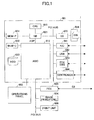
- FIG. 1 is a diagram showing an example of the hardware configuration of the multi-function machine according to the embodiments of the present invention.
- the hardware of the multi-function machine 1 includes a controller 601, an operations panel 602, a facsimile control unit (FCU) 603, an image pickup unit 604, and a print unit 605.
- FCU facsimile control unit
- the controller 601 is composed of a CPU 611, an ASIC 612, a NB 621, a SB 622, a MEM-P 631, a MEM-C 632, a HDD (Hard Disk Drive) 633, a memory card slot 634, a NIC (Network Interface Controller) 641, a USB device 642, an IEEE1394 device 643, and a Centronics device 644.
- the CPU 611 is an IC that processes various information items.
- the ASIC 612 is an IC that processes various images.
- the NB 621 stands for the north bridge of the controller 601.
- the SB 622 stands for the south bridge of the controller 601.
- the MEM-P631 is the system memory of the multi-function machine 1.
- the MEM-C632 is the local memory of the multi-function machine 1.
- the HDD 633 is the storage device of the multi-function machine 1.
- the memory card slot 634 is a slot that receives and holds the memory card 635.
- the NIC 641 is a controller for network communications using a MAC address.
- the USB device 642 is a device that provides the USB-compatible connection terminal.
- the IEEE1394 device 643 is a device that provides the IEEE1394-compatible connection terminal.
- the Centronics device 644 is a device that provides the Centronics-compatible connection terminal.
- the operations panel 602 serves not only as hardware (operating device) through which an operator inputs data to the multi-function machine 1 but also as hardware (display device) through which the operator receives data output from the multi-function machine 1.
- FIG. 2 is a diagram showing an example of the system requirements of the software of the multi-function machine according to the embodiments of the present invention.
- the software of the multi-function machine 1 is composed of an OS (Operating System) 101, a JVM (Java (registered trademark) Virtual Machine) 102, an OSGi (Open Services Gateway Initiative) framework 103, a bundle 104, a JAR (Java (registered trademark) Archive) file 105, etc.
- OS Operating System
- JVM Java (registered trademark) Virtual Machine
- OSGi Open Services Gateway Initiative
- bundle 104 a bundle 104
- JAR Java (registered trademark) Archive) file 105
- the OS 101 is a so-called OS (Operating System).
- the JVM 102 converts Java (registered trademark) bytecode contained in the JAR file 105, the bundle 104, etc., into native code so as to be operable on the OS 101 and executes it.
- the OSGi framework 103 is standardization technology using the OSGi alliance and a software platform that provides an execution environment for software components generated based on open software component technology using the Java (registered trademark) language. On the OSGi framework 103, software in the Java (registered trademark) language is implemented in the form of a software component called a "bundle."
- One bundle is composed of one JAR (Java (registered trademark) Archive) file and may be separately dynamically installed without requiring the restart of the apparatus.
- the bundle 104 represents such a bundle. Note that plural of the bundles 4 may exist.
- the JAR file 105 represents the JAR file other than the bundle. In other words, the JAR file 105 directly operates on the JVM 102 without the intervention of the OSGi framework 103.
- the multi-function machine 1 may operate a Java (registered trademark) program.
- the embodiments of the present invention describe an example in which an authentication function is realized using the JAAS (Java Authentication and Authorizing Service) as the authentication structure of the Java (registered trademark) standard.
- authentication in the embodiments of the present invention refers to authentication for an operator (i.e., user authentication) before the multi-function machine 1 is operated.
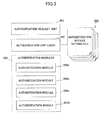
- FIG. 3 is a diagram for illustrating the overview of the JAAS.
- an authentication request unit 501 an authentication unit 502, authentication modules 503, and an authentication module setting file 504 are shown.
- the authentication unit 502 corresponds to the JAAS.
- the JAAS authentication unit 502 provides a framework (interface) related to the authentication function of the Java (registered trademark) standard and a part of the implementation of the framework. Actual authentication processing is implemented in the authentication module 503.
- the authentication module 503 is an individually implemented interface according to the JAAS and may be arbitrarily added as a plug-in. In other words, the authentication module 503 may expand an authentication function by implementing unique authentication processing.
- FIG. 3 exemplifies a case in which the four authentication modules 503 of authentication modules 503a, 503b, 503c, and 504d are incorporated.
- the authentication request unit 501 requests authentication from the authentication unit 502 by invoking an interface provided by the authentication unit 502.
- the authentication module setting file 504 is a file generated in advance for each authentication module 13 and has information (information, etc., required for invoking the interface) related to the authentication module 503 described in a predetermined format.
- FIG. 4 is a sequence diagram for illustrating general authentication processing using the JAAS.
- the authentication request unit 501 selects the authentication module setting file 504 corresponding to the authentication module 503 used for the authentication (S102). Next, the authentication request unit 501 requests the authentication from the authentication unit 502 (S103). In this case, authentication information input by the user, the file name of the authentication module setting file 504 selected by the authentication request unit 501, etc., are informed to the authentication unit 502.
- the authentication unit 502 refers to the authentication module setting file 504 related to the informed file name (S104). Next, the authentication unit 502 requests the authentication from the authentication module 503 specified by the information described in the authentication module setting file 504 (S105). Accordingly, the authentication module 503 corresponding to the authentication module setting file 504 selected in step S102 is invoked. Note that in this case the authentication information input by the user is also informed to the authentication module 503.
- the authentication module 503 performs the authentication based on the authentication information and returns its results to the authentication unit 502 (S106). Note that authentication methods are different depending on the implementation of the authentication modules 503. The authentication results are informed to the user via the authentication request unit 501, etc.
- FIG. 5 is a diagram showing a configuration example of the authentication function of the multi-function machine according to a first embodiment.
- the authentication function of the multi-function machine 1 is composed of an authentication request unit 11, an authentication control unit 12, an authentication unit 13, an authentication module 14, a plug-in management unit 15, a security policy unit 16, module status information 21, policy data 22, etc.
- Each of the units other than the module status information 21 and the policy data 22 is implemented as the JAR file 105 or the bundle 104.
- the authentication module 14 When the authentication module 14 is dynamically installed, it may be implemented as the bundle 104.
- the authentication unit 13 corresponds to the JAAS. Accordingly, the authentication module 14 represents the implementation of authentication processing capable of being plugged in.
- the four authentication modules 14 of authentication modules A, B, C, and D, which perform the authentication processing with different authentication methods, are exemplified.
- the authentication request unit 11 receives an authentication request and requests processing corresponding to the authentication request from the authentication control unit 12.
- the authentication control unit 12 selects the authentication modules 14 used for the authentication processing in accordance with information constituting the mode (including conditions at the time of authentication) of the authentication request, and then requests the authentication with the authentication modules from the authentication unit 13.
- the plug-in management unit 15 controls the installation and uninstallation processing of the authentication modules 14.
- the security policy unit 16 determines the authentication modules 14 to be used based on the policy data 22.
- the policy data 22 are data storing information for identifying the authentication modules 14 to be selected (used) in accordance with the information constituting the mode of the authentication request (i.e., corresponding information between the information constituting the mode of the authentication request and the authentication modules 14 to be used), and are stored, for example, in the HDD 633.
- the module status information 21 indicates the statuses of the authentication modules and is stored, for example, in the HDD 633.
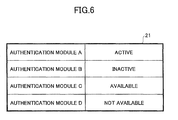
- FIG. 6 is a diagram showing a configuration example of module status information.
- the module status information 21 is composed of information indicating statuses (such as "active,” “inactive,” “available,” and “not available") of the respective authentication modules 14.
- the status represented as “active” is a status in which the authentication module A has been installed in the multi-function machine 1 and may be used normally.
- the status represented as “inactive” is a status in which the authentication module B has been installed in the multi-function machine 1 but cannot be temporarily used for any reason such as failures in the authentication module 14.
- the status represented as “available” is a status in which the authentication module C has not been installed in the multi-function machine 1 but is capable of being installed.
- the status represented as “not available” is a status in which the authentication module D has not been installed in the multi-function machine 1 and is not permitted to be installed.
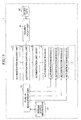
- FIG. 7 is a sequence diagram for illustrating the processing procedures for updating the module status information according to the first embodiment.
- the plug-in management unit 15 informs the authentication control unit 12 of the addition of the new authentication module 14 (S202).
- the authentication control unit 12 updates the module status information 21 with the status of the added authentication module 14 set as "active" (S203).
- the authentication control unit 12 regards the status of the authentication module 14 as a designated status and updates the module status information 21 (S212).
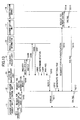
- FIG. 8 is a sequence diagram for illustrating the processing procedures of the authentication processing according to the first embodiment.
- the authentication request unit 11 receives the input of information such as a user name, a user ID, a group name, and a group ID (hereinafter referred to as "user identification information") for identifying an operator through a screen, etc., displayed on the operations panel 602 (S301).
- information such as a password and biometric information for identifying the operator is not necessarily input. This is because each authentication module 14 receives the input of such information.
- the authentication request unit 12 requests the authentication from the authentication control unit 12 (S302).
- the authentication control unit 12 inquires of the security policy unit 16 about the authentication module 14 to be used (inquiry about policy) (S303).
- the security policy unit 16 determines the authentication module 14 to be used based on the policy data 22 and returns determination results (identification information of the authentication module 14 to be used) to the authentication control unit 12 (S304).
- FIG. 9 is a diagram showing a first example of the policy data.
- the authentication modules 14 to be used are defined for respective user identification information.
- the policy data 22a it is determined that the user (user 001) whose identification information is "001" is required to be authenticated by the authentication modules A and B.
- the user 002 is required to be authenticated by the authentication modules A, B, and C.
- the user 003 is required to be authenticated by the authentication modules A, B, and D.
- the authentication module D is an authentication method that assures a higher level of security than the authentication module C does, the level of security increases in this order of the users 001, 002, and 003.
- Such policy data 22a are effective if the user 001 is a director or a section chief, the user 002 is a regular employee, and the user 003 is a part-time worker.
- FIG. 10 is a diagram showing a second example of the policy data.
- the authentication modules 14 to be used are defined for respective time zones. According to the policy data 22b, it is determined that during the daytime on weekdays the user is required to be authenticated by the authentication modules A and B. Furthermore, it is determined that during the nighttime on weekdays the user is required to be authenticated by the authentication module C in addition to the authentication modules 14 (authentication modules A and B) which are required for performing the authentication during the daytime on weekdays.
- the time zones may be determined based on time of the timer provided in the multi-function machine 1 and corresponding information between the time and time zones registered in advance in the HDD 633, etc.
- the user identification information is not required for determining the authentication modules 14 to be used. Accordingly, in this case, the user identification information is not required to be input in step S101. For example, it is only necessary to inform that the operator starts performing an operation.
- the policy data 22a and the policy data 22b may be combined together. In this case, for example, it may be determined that the authentication modules 14 related to AND or OR of the plural policy data 22 should be used.
- the authentication control unit 12 acquires from the module status information 21 the status information of the respective authentication modules 14 determined to be used (S305 and S306), and determines whether the statuses of the respective authentication modules 14 are either "active” or “available” (S307). Here, if any of the statuses of the respective authentication modules 14 is either "inactive” or “not available,” the authentication control unit 12 returns an error to the authentication request unit 11 (S308). In this case, the authentication is not performed, and the multi-function machine 1 cannot receive an operating request from the operator.
- the authentication control unit 12 requests the installation of the authentication module 14 from the plug-in management unit 15 (S309).
- the plug-in management unit 15 installs the bundle of the authentication module 14 in the OSGi framework 103 (S310) and returns the success and failure of the installation to the authentication control unit 12 (S311).
- the operator may specify the acquisition source (such as a URL (Uniform Resource Locator) on networks and a SD card inserted into the multi-function machine 1) of the authentication module 14.
- the plug-in management unit 15 may perform the installation based on information input on an installation screen after causing the installation screen to be displayed on the operations panel 602.
- the acquisition source is capable of being specified in advance for each of the authentication modules 14, information indicating the acquisition source may be registered in the HDD 633.
- the plug-in management unit 15 may automatically acquire the authentication module 14 based on the information. Note that if the installation fails, the authentication control unit 12 returns an error to the authentication request unit 11. As a result, the authentication processing is stopped. On the other hand, if the installation is successful, the status of the authentication module 14 is set as "active.”
- each of the authentication modules 14 to be used is subjected to processing, and the processing is repeatedly carried out (loop interaction).
- the authentication control unit 12 automatically generates an authentication module setting file (used synonymously with the authentication module setting file 504 shown in FIG. 3 ) related to the authentication module 14 to be subjected to the processing in accordance with a predetermined format (S312).
- the authentication control unit 12 requests the authentication from the authentication unit 13 (S313). At this time, the file name of the automatically generated authentication module setting file, etc., are informed to the authentication unit 13.
- the authentication unit 13 refers to the authentication module setting file related to the informed file name and requests the authentication from the authentication module 14 specified by the information described in the authentication module setting file (S314).
- the authentication module 14 performs the authentication based on authentication information and returns its results to the authentication unit 13 (S315).
- the authentication module 14 displays a message prompting the user to input authentication information on the operations panel 602 in accordance with its implementation or receives authentication information from specified devices (such as the operations panel 602 for inputting a password, an IC-card reader for reading data with an IC card, and a device for reading biometric information).
- the authentication unit 13 returns the authentication results by the authentication module 14 to the authentication control unit 12 (S316).
- the authentication control unit 12 returns the authentication results to the authentication request unit 11 (S317).
- the authentication may be determined to be successful when the authentication is determined to be successful by all the authentication modules 14 to be used (AND authentication), or it may be determined to be successful when the authentication is determined to be successful by at least one of the authentication modules 14 (OR authentication).
- the authentication control unit 12 may stop the loop processing when an authentication failure is returned from one of the authentication modules 14 and inform the authentication request unit 11 of the authentication failure.
- the module status information 21 is managed by the authentication control unit 12. However, it may be managed by the plug-in management unit 15. Next, such a mode is described as a second embodiment.
- FIG. 11 is a diagram showing a configuration example of the authentication function of a multi-function machine according to the second embodiment.
- components the same as those shown in FIG. 5 are denoted by the same reference numerals.
- FIG. 11 is different from FIG. 5 in that the module status information 21 is managed by the plug-in management unit 15. Due to a difference in the configuration, respective processing procedures are different from those of the first embodiment.
- FIG. 12 is a sequence diagram for illustrating the processing procedures for updating module status information according to the second embodiment.
- the plug-in management unit 15 updates the module status information 21 with the status set as "active" (S402).
- the plug-in management unit 15 regards the status of the authentication module 14 as a designated status and updates the module status information 21 (S412).
- FIG. 13 is a sequence diagram for illustrating the processing procedures of the authentication processing according to the second embodiment.
- Steps S501 and S502 are the same as steps S301 and S302 shown in FIG. 8 .
- the authentication control unit 12 requests the setting of the authentication module 14 (setting the status of the authentication module 14 to be used as "active") from the plug-in management unit 15 (S503).
- steps S504 through S508 shown in FIG. 13 are the same as steps S303 through S307 shown in FIG. 8 .
- the processing executed by the authentication control unit 12 in steps S303 through S307 in the first embodiment is executed by the plug-in management unit 15 in the second embodiment ( FIG. 13 ).
- the plug-in management unit 15 installs the bundle of the authentication module 14 in "available" state in the OSGi framework 103 (S509) and informs the authentication control unit 12 of the results of setting the authentication module 14 (S510). If the informed results indicate that any one of the statuses of the authentication modules 14 to be used is "inactive" or “not available” or the installation of the authentication module 14 has failed, the authentication control unit 12 returns an error to the authentication request unit 11 (S511).
- the plug-in management unit 15 When the setting of the authentication module 14 is normally completed, the plug-in management unit 15 returns a list of the authentication modules 14 to be used to the authentication control unit 12 in step S510. After this, the processing of steps S512 through S517 the same as those of steps S312 through S317 shown in FIG. 8 is applied to the authentication modules 14 related to the list.
- the authentication module 14 to be used can be dynamically changed depending on the mode of the authentication request. Accordingly, the authentication with the different authentication methods can be performed depending on the user identification information, the time zones, etc. Furthermore, when it is necessary to perform the authentication with the authentication module 14 that is not prepared at the time of the authentication request, the authentication module 14 is dynamically installed to continue the authentication processing. Accordingly, it is possible to reduce the likelihood of interrupting the authentication processing due to the absence of the authentication module 14.
- the information constituting the mode of the authentication request is not limited to the user identification information and the time zones.
- it may be replaced by programs and functions required to be used according to the operator.
- the above embodiments describe the case using the authentication module setting file.
- the authentication module 14 is not necessarily designated by the authentication module setting file. Instead, the information stored in the authentication module setting file may be transmitted to (set in) the JAAS using a predetermined class of an instance. Accordingly, the embodiments of the present invention may be realized according to this structure.
Landscapes
- Engineering & Computer Science (AREA)
- Computer Security & Cryptography (AREA)
- Theoretical Computer Science (AREA)
- Computer Hardware Design (AREA)
- Software Systems (AREA)
- Physics & Mathematics (AREA)
- General Engineering & Computer Science (AREA)
- General Physics & Mathematics (AREA)
- Facsimiles In General (AREA)
- User Interface Of Digital Computer (AREA)
Applications Claiming Priority (1)
| Application Number | Priority Date | Filing Date | Title |
|---|---|---|---|
| JP2008038827A JP5078660B2 (ja) | 2008-02-20 | 2008-02-20 | 認証制御装置、認証制御方法及びプログラム |
Publications (1)
| Publication Number | Publication Date |
|---|---|
| EP2093690A1 true EP2093690A1 (fr) | 2009-08-26 |
Family
ID=40491077
Family Applications (1)
| Application Number | Title | Priority Date | Filing Date |
|---|---|---|---|
| EP09152034A Ceased EP2093690A1 (fr) | 2008-02-20 | 2009-02-04 | Appareil et procédé de contrôle d'authentification |
Country Status (3)
| Country | Link |
|---|---|
| US (1) | US8429727B2 (fr) |
| EP (1) | EP2093690A1 (fr) |
| JP (1) | JP5078660B2 (fr) |
Cited By (1)
| Publication number | Priority date | Publication date | Assignee | Title |
|---|---|---|---|---|
| EP2348436A1 (fr) * | 2009-12-24 | 2011-07-27 | Samsung Electronics Co., Ltd. | Appareil de formation d'images et procédé associé de réglage de politique de sécurité |
Families Citing this family (10)
| Publication number | Priority date | Publication date | Assignee | Title |
|---|---|---|---|---|
| JP2011081768A (ja) * | 2009-09-14 | 2011-04-21 | Ricoh Co Ltd | 画像処理装置、情報処理方法、及びプログラム |
| US8732811B2 (en) | 2011-03-28 | 2014-05-20 | Canon Kabushiki Kaisha | Systems and methods for implementing security services |
| US8631480B2 (en) | 2011-03-28 | 2014-01-14 | Canon Kabushiki Kaisha | Systems and methods for implementing security services |
| US20130125226A1 (en) * | 2011-04-28 | 2013-05-16 | Interdigital Patent Holdings, Inc. | Sso framework for multiple sso technologies |
| JP5575071B2 (ja) * | 2011-08-26 | 2014-08-20 | 株式会社東芝 | 情報処理装置、情報処理方法、およびプログラム |
| JP6330475B2 (ja) * | 2014-05-19 | 2018-05-30 | 富士通株式会社 | ログイン制御プログラム、ログイン制御方法、およびログイン制御システム |
| US9961059B2 (en) | 2014-07-10 | 2018-05-01 | Red Hat Israel, Ltd. | Authenticator plugin interface |
| JP7037615B2 (ja) * | 2020-10-30 | 2022-03-16 | キヤノン株式会社 | 画像形成装置及びその制御方法とプログラム |
| US11729167B2 (en) * | 2021-02-12 | 2023-08-15 | Target Brands, Inc. | Authorization proxy |
| JP7635642B2 (ja) * | 2021-06-07 | 2025-02-26 | 富士フイルムビジネスイノベーション株式会社 | 情報処理装置、情報処理システム、及び情報処理プログラム |
Citations (4)
| Publication number | Priority date | Publication date | Assignee | Title |
|---|---|---|---|---|
| EP1043648A2 (fr) * | 1999-04-09 | 2000-10-11 | Sun Microsystems, Inc. | Méthode et appareil pour la gestion à distance des services d'authentification et de contrôle d'accès |
| US20030158815A1 (en) | 2001-12-28 | 2003-08-21 | Sony Corporation | Information processing apparatus and information processing method |
| US20050024674A1 (en) | 2003-07-30 | 2005-02-03 | Takezo Fujishige | Multifunction image forming apparatus and document information searching method |
| US20060041507A1 (en) | 2004-08-13 | 2006-02-23 | Sbc Knowledge Ventures L.P. | Pluggable authentication for transaction tool management services |
Family Cites Families (8)
| Publication number | Priority date | Publication date | Assignee | Title |
|---|---|---|---|---|
| JP4213411B2 (ja) * | 2002-06-24 | 2009-01-21 | 株式会社リコー | 本人認証システム、本人認証方法及びその方法をコンピュータに実行させるプログラム |
| JP4703964B2 (ja) | 2004-03-19 | 2011-06-15 | 株式会社リコー | 情報処理装置、端末装置、情報処理方法、情報処理プログラム、及び記録媒体 |
| US20060021003A1 (en) * | 2004-06-23 | 2006-01-26 | Janus Software, Inc | Biometric authentication system |
| JP4868724B2 (ja) * | 2004-08-31 | 2012-02-01 | キヤノン株式会社 | 情報処理装置、情報処理方法及びそのプログラム |
| JP4574335B2 (ja) * | 2004-11-19 | 2010-11-04 | 株式会社日立製作所 | セキュリティシステム、認証サーバ、認証方法、およびプログラム |
| JP2007048079A (ja) * | 2005-08-10 | 2007-02-22 | Ricoh Co Ltd | サービス提供装置,サービス提供方法及びサービス提供プログラム |
| JP5025193B2 (ja) | 2005-09-16 | 2012-09-12 | 株式会社リコー | 機器、情報処理方法、情報処理プログラム、及び記録媒体 |
| JP2007164661A (ja) * | 2005-12-16 | 2007-06-28 | Fuji Xerox Co Ltd | ユーザ認証プログラム、ユーザ認証装置、ユーザ認証方法 |
-
2008
- 2008-02-20 JP JP2008038827A patent/JP5078660B2/ja not_active Expired - Fee Related
-
2009
- 2009-02-04 EP EP09152034A patent/EP2093690A1/fr not_active Ceased
- 2009-02-09 US US12/320,921 patent/US8429727B2/en not_active Expired - Fee Related
Patent Citations (4)
| Publication number | Priority date | Publication date | Assignee | Title |
|---|---|---|---|---|
| EP1043648A2 (fr) * | 1999-04-09 | 2000-10-11 | Sun Microsystems, Inc. | Méthode et appareil pour la gestion à distance des services d'authentification et de contrôle d'accès |
| US20030158815A1 (en) | 2001-12-28 | 2003-08-21 | Sony Corporation | Information processing apparatus and information processing method |
| US20050024674A1 (en) | 2003-07-30 | 2005-02-03 | Takezo Fujishige | Multifunction image forming apparatus and document information searching method |
| US20060041507A1 (en) | 2004-08-13 | 2006-02-23 | Sbc Knowledge Ventures L.P. | Pluggable authentication for transaction tool management services |
Non-Patent Citations (2)
| Title |
|---|
| SAMAR V ED - ASSOCIATION FOR COMPUTING MACHINERY: "UNIFIED LOGIN WITH PLUGGABLE AUTHENTICATION MODULES (PAM)", 14 March 1996, 3RD. ACM CONFERENCE ON COMPUTER AND COMMUNICATIONS SECURITY. NEW DELHI, MAR. 14 - 16, 1996; [ACM CONFERENCE ON COMPUTER AND COMMUNICATIONS SECURITY], NEW YORK, ACM, US, PAGE(S) 1 - 10, ISBN: 978-0-89791-829-9, XP000620972 * |
| XEROX CORPORATION: "Xerox Secure Access Unified ID System", 1 January 2006 (2006-01-01), XP002530662, Retrieved from the Internet <URL:http://www.office.xerox.com/latest/SOLBR-26.PDF> [retrieved on 20090604] * |
Cited By (2)
| Publication number | Priority date | Publication date | Assignee | Title |
|---|---|---|---|---|
| EP2348436A1 (fr) * | 2009-12-24 | 2011-07-27 | Samsung Electronics Co., Ltd. | Appareil de formation d'images et procédé associé de réglage de politique de sécurité |
| US8650611B2 (en) | 2009-12-24 | 2014-02-11 | Samsung Electronics Co., Ltd. | Image forming apparatus and method of setting security policy thereof |
Also Published As
| Publication number | Publication date |
|---|---|
| JP5078660B2 (ja) | 2012-11-21 |
| JP2009199234A (ja) | 2009-09-03 |
| US8429727B2 (en) | 2013-04-23 |
| US20090210925A1 (en) | 2009-08-20 |
Similar Documents
| Publication | Publication Date | Title |
|---|---|---|
| US8429727B2 (en) | Authentication control apparatus and authentication control method | |
| US8665466B2 (en) | Image forming apparatus, program updating method and computer-readable storage medium | |
| US7280238B2 (en) | Image forming apparatus, user restriction method and use history generation method | |
| US8051158B2 (en) | Program management apparatus and method | |
| US9286141B2 (en) | Image forming apparatus, program management system, program management method, and computer-readable storage medium | |
| EP2919113B1 (fr) | Système et procédé de traitement d'informations | |
| US9218224B2 (en) | Electronic apparatus, information processing method, and recording medium storing information processing program | |
| US8726090B2 (en) | Information processing system, management apparatus, information processing apparatus, and computer program product | |
| US20070255428A1 (en) | Multifunction device, method of controlling multifunction device, control device, method of controlling control device, multifunction device control system, control program, and computer-readable storage medium | |
| US20050028173A1 (en) | Information processing apparatus, information processing method, and control program | |
| EP2615545B1 (fr) | Appareil, procédé de contrôle et support de stockage | |
| US10057233B2 (en) | Image processing apparatus, method for controlling the same, and storage medium for carrying out login processing | |
| EP2099209B1 (fr) | Appareil de formation d'images, procédé de traitement d'informations, et support d'enregistrement lisible sur un ordinateur stockant le programme de traitement d'informations | |
| US20110283087A1 (en) | Image forming apparatus, image forming method, and computer readable medium storing control program therefor | |
| JP5293462B2 (ja) | 電子機器、情報処理方法、及び情報処理プログラム | |
| US20090249346A1 (en) | Image forming apparatus, information processing apparatus and information processing method | |
| CN110708435A (zh) | 图像处理设备及其控制方法和存储介质 | |
| JP5793872B2 (ja) | 画像形成装置、プログラム管理方法、プログラム管理プログラム、及び記録媒体 | |
| EP3206120B1 (fr) | Système de traitement d'informations, appareil de gestion d'informations et procédé de traitement d'informations | |
| JP2009205262A (ja) | アプリケーションプログラムインストール装置、アプリケーションプログラムインストール方法、プログラム、および記録媒体 | |
| US20080256614A1 (en) | Network terminal management apparatus, method and program | |
| JP5333035B2 (ja) | リモート管理システム、管理装置、機器、プログラム更新方法、プログラム、及び記録媒体 | |
| US8239857B2 (en) | Information processing apparatus and method of installing application program | |
| JP6089794B2 (ja) | 機器、情報処理システム、情報処理方法、及びプログラム | |
| CN102256041B (zh) | 图像形成设备和获取识别信息的方法 |
Legal Events
| Date | Code | Title | Description |
|---|---|---|---|
| PUAI | Public reference made under article 153(3) epc to a published international application that has entered the european phase |
Free format text: ORIGINAL CODE: 0009012 |
|
| 17P | Request for examination filed |
Effective date: 20090204 |
|
| AK | Designated contracting states |
Kind code of ref document: A1 Designated state(s): AT BE BG CH CY CZ DE DK EE ES FI FR GB GR HR HU IE IS IT LI LT LU LV MC MK MT NL NO PL PT RO SE SI SK TR |
|
| AX | Request for extension of the european patent |
Extension state: AL BA RS |
|
| AKX | Designation fees paid |
Designated state(s): DE FR GB |
|
| 17Q | First examination report despatched |
Effective date: 20100720 |
|
| STAA | Information on the status of an ep patent application or granted ep patent |
Free format text: STATUS: THE APPLICATION HAS BEEN REFUSED |
|
| 18R | Application refused |
Effective date: 20120628 |