EP2093741A1 - Procédé, dispositif et programme de prédiction de parcours d'obstacles - Google Patents
Procédé, dispositif et programme de prédiction de parcours d'obstacles Download PDFInfo
- Publication number
- EP2093741A1 EP2093741A1 EP07831653A EP07831653A EP2093741A1 EP 2093741 A1 EP2093741 A1 EP 2093741A1 EP 07831653 A EP07831653 A EP 07831653A EP 07831653 A EP07831653 A EP 07831653A EP 2093741 A1 EP2093741 A1 EP 2093741A1
- Authority
- EP
- European Patent Office
- Prior art keywords
- course
- obstacle
- probability
- prediction
- take
- Prior art date
- Legal status (The legal status is an assumption and is not a legal conclusion. Google has not performed a legal analysis and makes no representation as to the accuracy of the status listed.)
- Granted
Links
Images









Classifications
-
- B—PERFORMING OPERATIONS; TRANSPORTING
- B60—VEHICLES IN GENERAL
- B60W—CONJOINT CONTROL OF VEHICLE SUB-UNITS OF DIFFERENT TYPE OR DIFFERENT FUNCTION; CONTROL SYSTEMS SPECIALLY ADAPTED FOR HYBRID VEHICLES; ROAD VEHICLE DRIVE CONTROL SYSTEMS FOR PURPOSES NOT RELATED TO THE CONTROL OF A PARTICULAR SUB-UNIT
- B60W40/00—Estimation or calculation of non-directly measurable driving parameters for road vehicle drive control systems not related to the control of a particular sub unit, e.g. by using mathematical models
- B60W40/02—Estimation or calculation of non-directly measurable driving parameters for road vehicle drive control systems not related to the control of a particular sub unit, e.g. by using mathematical models related to ambient conditions
- B60W40/06—Road conditions
- B60W40/072—Curvature of the road
-
- B—PERFORMING OPERATIONS; TRANSPORTING
- B60—VEHICLES IN GENERAL
- B60W—CONJOINT CONTROL OF VEHICLE SUB-UNITS OF DIFFERENT TYPE OR DIFFERENT FUNCTION; CONTROL SYSTEMS SPECIALLY ADAPTED FOR HYBRID VEHICLES; ROAD VEHICLE DRIVE CONTROL SYSTEMS FOR PURPOSES NOT RELATED TO THE CONTROL OF A PARTICULAR SUB-UNIT
- B60W40/00—Estimation or calculation of non-directly measurable driving parameters for road vehicle drive control systems not related to the control of a particular sub unit, e.g. by using mathematical models
- B60W40/02—Estimation or calculation of non-directly measurable driving parameters for road vehicle drive control systems not related to the control of a particular sub unit, e.g. by using mathematical models related to ambient conditions
- B60W40/06—Road conditions
- B60W40/076—Slope angle of the road
-
- G—PHYSICS
- G05—CONTROLLING; REGULATING
- G05D—SYSTEMS FOR CONTROLLING OR REGULATING NON-ELECTRIC VARIABLES
- G05D1/00—Control of position, course, altitude or attitude of land, water, air or space vehicles, e.g. using automatic pilots
- G05D1/02—Control of position or course in two dimensions
- G05D1/021—Control of position or course in two dimensions specially adapted to land vehicles
- G05D1/0212—Control of position or course in two dimensions specially adapted to land vehicles with means for defining a desired trajectory
- G05D1/0214—Control of position or course in two dimensions specially adapted to land vehicles with means for defining a desired trajectory in accordance with safety or protection criteria, e.g. avoiding hazardous areas
-
- G—PHYSICS
- G08—SIGNALLING
- G08G—TRAFFIC CONTROL SYSTEMS
- G08G1/00—Traffic control systems for road vehicles
- G08G1/16—Anti-collision systems
- G08G1/165—Anti-collision systems for passive traffic, e.g. including static obstacles, trees
-
- G—PHYSICS
- G08—SIGNALLING
- G08G—TRAFFIC CONTROL SYSTEMS
- G08G1/00—Traffic control systems for road vehicles
- G08G1/16—Anti-collision systems
- G08G1/166—Anti-collision systems for active traffic, e.g. moving vehicles, pedestrians, bikes
-
- B—PERFORMING OPERATIONS; TRANSPORTING
- B60—VEHICLES IN GENERAL
- B60W—CONJOINT CONTROL OF VEHICLE SUB-UNITS OF DIFFERENT TYPE OR DIFFERENT FUNCTION; CONTROL SYSTEMS SPECIALLY ADAPTED FOR HYBRID VEHICLES; ROAD VEHICLE DRIVE CONTROL SYSTEMS FOR PURPOSES NOT RELATED TO THE CONTROL OF A PARTICULAR SUB-UNIT
- B60W30/00—Purposes of road vehicle drive control systems not related to the control of a particular sub-unit, e.g. of systems using conjoint control of vehicle sub-units
- B60W30/08—Active safety systems predicting or avoiding probable or impending collision or attempting to minimise its consequences
- B60W30/095—Predicting travel path or likelihood of collision
- B60W30/0956—Predicting travel path or likelihood of collision the prediction being responsive to traffic or environmental parameters
-
- G—PHYSICS
- G05—CONTROLLING; REGULATING
- G05D—SYSTEMS FOR CONTROLLING OR REGULATING NON-ELECTRIC VARIABLES
- G05D1/00—Control of position, course, altitude or attitude of land, water, air or space vehicles, e.g. using automatic pilots
- G05D1/02—Control of position or course in two dimensions
- G05D1/021—Control of position or course in two dimensions specially adapted to land vehicles
- G05D1/0231—Control of position or course in two dimensions specially adapted to land vehicles using optical position detecting means
- G05D1/0238—Control of position or course in two dimensions specially adapted to land vehicles using optical position detecting means using obstacle or wall sensors
- G05D1/024—Control of position or course in two dimensions specially adapted to land vehicles using optical position detecting means using obstacle or wall sensors in combination with a laser
-
- G—PHYSICS
- G05—CONTROLLING; REGULATING
- G05D—SYSTEMS FOR CONTROLLING OR REGULATING NON-ELECTRIC VARIABLES
- G05D1/00—Control of position, course, altitude or attitude of land, water, air or space vehicles, e.g. using automatic pilots
- G05D1/02—Control of position or course in two dimensions
- G05D1/021—Control of position or course in two dimensions specially adapted to land vehicles
- G05D1/0231—Control of position or course in two dimensions specially adapted to land vehicles using optical position detecting means
- G05D1/0246—Control of position or course in two dimensions specially adapted to land vehicles using optical position detecting means using a video camera in combination with image processing means
-
- G—PHYSICS
- G05—CONTROLLING; REGULATING
- G05D—SYSTEMS FOR CONTROLLING OR REGULATING NON-ELECTRIC VARIABLES
- G05D1/00—Control of position, course, altitude or attitude of land, water, air or space vehicles, e.g. using automatic pilots
- G05D1/02—Control of position or course in two dimensions
- G05D1/021—Control of position or course in two dimensions specially adapted to land vehicles
- G05D1/0257—Control of position or course in two dimensions specially adapted to land vehicles using a radar
-
- G—PHYSICS
- G05—CONTROLLING; REGULATING
- G05D—SYSTEMS FOR CONTROLLING OR REGULATING NON-ELECTRIC VARIABLES
- G05D1/00—Control of position, course, altitude or attitude of land, water, air or space vehicles, e.g. using automatic pilots
- G05D1/02—Control of position or course in two dimensions
- G05D1/021—Control of position or course in two dimensions specially adapted to land vehicles
- G05D1/0268—Control of position or course in two dimensions specially adapted to land vehicles using internal positioning means
- G05D1/027—Control of position or course in two dimensions specially adapted to land vehicles using internal positioning means comprising intertial navigation means, e.g. azimuth detector
-
- G—PHYSICS
- G05—CONTROLLING; REGULATING
- G05D—SYSTEMS FOR CONTROLLING OR REGULATING NON-ELECTRIC VARIABLES
- G05D1/00—Control of position, course, altitude or attitude of land, water, air or space vehicles, e.g. using automatic pilots
- G05D1/02—Control of position or course in two dimensions
- G05D1/021—Control of position or course in two dimensions specially adapted to land vehicles
- G05D1/0276—Control of position or course in two dimensions specially adapted to land vehicles using signals provided by a source external to the vehicle
- G05D1/0278—Control of position or course in two dimensions specially adapted to land vehicles using signals provided by a source external to the vehicle using satellite positioning signals, e.g. GPS
Definitions
- the present invention relates to a method, an apparatus, and a program of predicting an obstacle course, for predicting a course, which an obstacle present within a predetermined area may take.
- the following patent document 1 discloses the technique relating to a collision avoidance apparatus provided with a yaw rate sensor for detecting yaw rate of a subject vehicle, a velocity detection device for detecting a velocity of the subject vehicle, and a radar device for detecting a position and a velocity of a surrounding obstacle.
- a predicted travel trajectory of the subject vehicle is obtained by the yaw rate sensor and the velocity sensor and a predetermined area on both sides of the predicted travel trajectory is obtained as a predicted travel area of the subject vehicle, and on the other hand, a predicted travel trajectory and a predicted travel area of the obstacle are obtained based on a position and a velocity of the obstacle detected by the radar device. After that, a collision point or an adjacent point of the both is calculated from each predicted travel area of the subject vehicle and the obstacle. Also, collision risk is determined by calculating target deceleration and acceleration and target deceleration, and when the risk of collision arises as a result of the determination, a velocity control of the subject vehicle is performed according to the target deceleration and acceleration and the target deceleration.
- Patent Document 1 Japanese Patent No. 2799375
- the present invention is achieved in view of the above-described circumstances, and an object of the present invention is to provide the method, the apparatus, and the program of predicting the obstacle course for appropriately predicting the course of the obstacle even under the complicated traffic environment.
- an obstacle course prediction method which a computer predicts a course of the obstacle, the computer providing memory means that memorizes at least a position and an internal state of an obstacle present within a predetermined area from a mobile object, the method includes a course predicting step performing prediction of a course, which the obstacle may take, based on the position and the internal state of the obstacle read from the memory means, and performing probabilistic prediction of a plurality of courses, which the obstacle may take, for at least one of the obstacles at the time of the prediction; a course interference assessing step obtaining a course in which the obstacles interfere with each other within the courses, which a plurality of the obstacles predicted at the course predicting step may take, and lowering predicted probability of the course for which the probabilistic prediction is performed within the interfering courses, when there are a plurality of the obstacles; and a probability calculating step calculating probability of realizing each of the plurality of courses including the course in which the predicted probability is lowered at the course interference
- the obstacle course prediction method further includes a specific obstacle selecting step selecting one of the obstacles satisfying a predetermined condition as a specific obstacle, wherein the course predicting step includes a specific obstacle course predicting step performing probabilistic prediction of a plurality of courses, which the specific obstacle may take, and a general obstacle course predicting step performing prediction of the course, which the obstacle other than the specific obstacle may take, the course interference assessing step lowers predicted probability of a course of which distance at the same time from a course, which the general obstacle may take, is smaller than a predetermined value, within a plurality of courses, which the specific obstacle may take, when there are a plurality of the obstacles, and the probability calculating step calculates probability of realizing each of a plurality of courses of the specific obstacle including the course the predicted probability of which is lowered at the course interference assessing step.
- the course predicting step includes a specific obstacle course predicting step performing probabilistic prediction of a plurality of courses, which the specific obstacle may take, and a general obstacle course predicting step performing prediction of the course, which the
- the specific obstacle course predicting step includes a trajectory generating step generating variation in position, which the specific obstacle may take with time, as a trajectory in space-time composed of time and space, based on the position and the internal state of the obstacle, and a prediction calculating step performing probabilistic prediction calculation of a course, which the specific obstacle may take, using the trajectory generated at the trajectory generating step.
- the general obstacle course predicting step predicts the course of the general obstacle assuming that the internal state of the general obstacle is maintained.
- the obstacle course prediction method further includes a course generating step generating a course of the mobile object based on a position and an internal state of the mobile object; a collision probability calculating step calculating collision probability between the course of the mobile object generated at the course generating step and each of a plurality of courses, which the specific obstacle may take, of which probability is calculated for each course at the probability calculating step.
- the course predicting step performs probabilistic prediction of a plurality of courses, which the obstacle may take
- the course interference assessing step lowers probability of taking the course of which distance at the same time from the course of another of the obstacles is smaller than a predetermined value within the courses, which a plurality of the obstacles may take, when there are a plurality of the obstacles
- the probability calculating step calculates the probability of realizing each of all the courses of a plurality of the obstacles including the course the predicted probability of which is lowered at the course interference assessing step.
- the course predicting step includes a trajectory generating step generating variation in position, which the obstacle may take with time, as a trajectory in a space-time composed of time and space, based on the position and the internal state of the obstacle, and a prediction calculating step performing probabilistic prediction calculation of the course of the obstacle by using the trajectory generated at the trajectory generating step.
- the obstacle course prediction method further includes a course generating step generating a course of the mobile object based on the position and the internal state of the mobile object; and a collision probability calculating step calculating collision probability between the course of the mobile object generated at the course generating step and each of all courses, which the obstacle may take, probability of which is calculate for each course at the probability calculating step.
- An obstacle course prediction apparatus for predicting a course of an obstacle exiting around a mobile object according to the present invention, includes memory means that memorizes at least a position and an internal state of the obstacle present within a predetermined area from the mobile object; course predicting means that performs prediction of a course, which the obstacle may take, based on the position and the internal state of the obstacle read from the memory means, and performs probabilistic prediction of a plurality of courses, which the obstacle may take, for at least one of the obstacles at the time of the prediction; course interference assessing means that obtains a course in which the obstacles interfere with each other within the courses, which a plurality of the obstacles predicted at the course predicting means may take, and lowers predicted probability of the course for which the probabilistic prediction is performed within the interfering courses, when there are a plurality of the obstacles; and probability calculating means that calculates probability of realizing each of the plurality of courses including the course in which the predicted probability is lowered at the course interference assessing means.
- the obstacle course prediction apparatus further includes specific obstacle selecting means that selects one of the obstacles satisfying a predetermined condition as a specific obstacle, wherein the course predicting means has a specific obstacle course predicting means that performs probabilistic prediction of a plurality of courses, which the specific obstacle may take, and a general obstacle course predicting means that performs prediction of the course, which the obstacle other than the specific obstacle may take, the course interference assessing means lowers predicted probability of a course of which distance at the same time from a course, which the general obstacle may take, is smaller than a determined value, within a plurality of courses, which the specific obstacle may take, when there are a plurality of the obstacles, and the probability calculating means calculates probability of realizing each of a plurality of courses of the specific obstacle including the course the predicted probability of which is lowered at the course interference assessing means.
- the specific obstacle course predicting means includes a trajectory generating means that generates variation in position, which the specific obstacle may take with time, as a trajectory in space-time composed of time and space, based on the position and the internal state of the obstacle, and a prediction calculating means that performs probabilistic prediction calculation of a course, which the specific obstacle may take, using the trajectory generated at the trajectory generating means.
- the general obstacle course predicting means predicts the course of the general obstacle assuming that the internal state of the general obstacle is maintained.
- the obstacle course prediction apparatus further includes a course generating means that generates a course of the mobile object based on a position and an internal state of the mobile object; and a collision probability calculating means that calculates collision probability between the course of the mobile object generated at the course generating means and each of a plurality of courses, which the specific obstacle may take, of which probability is calculated for each course at the probability calculating means.
- the course predicting means performs probabilistic prediction of a plurality of courses, which the obstacle may take
- the course interference assessing means lowers probability of taking the course of which distance at the same time from the course of another of the obstacles is smaller than a predetermined value within the courses, which a plurality of the obstacles may take, when there are a plurality of the obstacles
- the probability calculating means calculates the probability of realizing each of all the courses of a plurality of the obstacles including the course the predicted probability of which is lowered at the course interference assessing means.
- the course prediction means includes a trajectory generating means that generates variation in position, which the obstacle may take with time, as a trajectory in a space-time composed of time and space, based on the position and the internal state of the obstacle, and a prediction calculating means that performs probabilistic prediction calculation of the course of the obstacle by using the trajectory generated at the trajectory generating means.
- the obstacle course prediction apparatus further includes a course generating means that generates a course of the mobile object based on the position and the internal state of the mobile object; and a collision probability calculating means that calculates collision probability between the course of the mobile object generated at the course generating means and each of all courses, which the obstacle may take, probability of which is calculate for each course at the probability calculating means.
- An obstacle course prediction program allows the computer to execute the obstacle course prediction method.
- the prediction may be performed by taking an effect thereof into consideration, by predicting the course, which the obstacle may take, based on the position and the internal state of the obstacle, and at the time of the prediction, probabilistically predicting a plurality of courses of at least one obstacle, and when there are a plurality of obstacles, obtaining the course in which different obstacles interfere with each other out of the predicted courses, which a plurality of obstacles may take, and lowering the predictive probability of the course for which the probabilistic prediction is performed out of the courses in which they interfere with each other, and calculating probability that each of a plurality of courses including the course of which predicted probability is lowered, is realized. Therefore, it becomes possible to appropriately predict the course of the obstacle even under the complicated traffic environment.
- Fig. 1 is a block diagram showing a functional configuration of an obstacle course prediction apparatus according to a first embodiment of the present invention.
- An obstacle course prediction apparatus 1 shown in the drawing is installed in a vehicle such as a four-wheeled vehicle, which is a mobile object, for predicting a course, which an obstacle present around a subject vehicle may take.
- the obstacle course prediction apparatus 1 is provided with a sensor unit 2 for detecting a position and an internal state of an object present within a predetermined area, an obstacle extracting unit 3 for extracting the obstacle included in the predetermined area based on a result detected by the sensor unit 2, a specific obstacle selecting unit 4 for selecting one obstacle (specific obstacle) satisfying a predetermine condition from the obstacles extracted by the obstacle extracting unit 3, a specific obstacle-course predicting unit 5 for probabilistically predicting a course of the specific obstacle selected by the obstacle selecting unit 4, a general obstacle-course predicting unit 6 for predicting a course of a general obstacle other than the specific obstacle, a course interference assessing unit 7 for assessing an interference between a predicted course of the specific obstacle and a predicted course of the general obstacle, a normalizing unit 8, which is probability calculating means for calculating probability that the course, which the specific obstacle may take, is realized, using an assessment result by the course interference assessing unit 7, an output unit 9 for outputting information regarding the course of the specific obstacle calculated by the normalizing unit 8, and a memory
- the sensor unit 2 is realized by using millimeter wave radar, laser radar, an image sensor, or the like.
- the sensor unit 2 is provided with various sensors such as a velocity sensor, a yaw rate sensor, an accelerated velocity sensor, and a rudder angle sensor.
- the internal state of the object to be detected by the sensor unit 2 is a beneficial state, which may be used to predict the course of the object, and is preferably a physical amount such as a velocity (having a velocity and a direction) and a yaw rate (having a volume and a direction) of the object, and also includes a case in which values of the physical amounts are 0 (a state in which the object is stopped).
- the output unit 9 has an image generating unit 91 for generating an image based on information corresponding to a result of the process performed by the course interference assessing unit 7, and a display unit 92, which is realized by using a liquid crystal display, a plasma display, or an organic electroluminescence (EL) display, for displaying and outputting information including the image generated by the image generating unit 91. Also, as the display unit 92, a projector is located on an upper posterior portion of a driver seat to make a superimposed display on a front glass of the vehicle.
- the memory unit 10 memorizes predicted results by the specific obstacle-course predicting unit 5 and the general obstacle-course predicting unit 6, and a result of the interference assessment by the course interference assessing unit 7, in addition to the detected result by the sensor unit 2.
- the memory unit 10 is realized by using a ROM in which a program to activate a predetermined operation system (OS), an obstacle course prediction program according to the first embodiment, or the like are memorized in advance, and a random access memory (RAM) in which a calculation parameter, data, or the like of each process are memorized.
- the memory unit 10 may be realized by providing an interface on which a computer-readable recording medium may be mounted on the obstacle course prediction apparatus 1 and mounting the recording medium corresponding to the interface.
- the obstacle course prediction apparatus 1 having the above-described functional configuration is an electronic device (computer) provided with a central processing unit (CPU) having a calculation function and a control function.
- the CPU provided on the obstacle course prediction apparatus 1 executes a calculation process regarding an obstacle course prediction method according to the first embodiment, by reading the information memorized and stored in the memory unit 10 and the various programs including the above-described obstacle course prediction program from the memory 10.
- the obstacle course prediction program according to the first embodiment may be recorded in the computer-readable recording medium such as a hard disk, a flexible disk, a CD-ROM, a DVD-ROM, a flash memory, and a MO disk, and widely distributed.
- the computer-readable recording medium such as a hard disk, a flexible disk, a CD-ROM, a DVD-ROM, a flash memory, and a MO disk, and widely distributed.
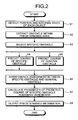
- FIG. 2 is a flowchart showing an overview of a process of the obstacle course prediction method according to the first embodiment.
- the obstacle course prediction method according to the first embodiment is applicable to the object traveling in a three-dimensional space. Also, this is applicable to a case in which one object has a plurality of degrees of freedom (an object such as a robot arm having six degrees of freedom, for example).
- the sensor unit 2 detects the position of the object within the predetermined area with respect to the subject vehicle and the internal state thereof, and stores the detected information in the memory unit 10 (step S1).
- the position of the object shall be represented by a value of a central portion of the object, and the internal state of the object shall be specified by the velocity (velocity v, direction ⁇ ).
- the obstacle extracting unit 3 extracts the obstacle within the predetermined area based on the result detected by the sensor unit 2 (step S2).
- the object which may be considered as the obstacle interrupting travel of the subject vehicle, is extracted from the objects detected at the step S1 and other objects are excluded.
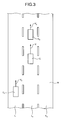
- Fig. 3 is a view showing a condition around an subject vehicle C 0 when two vehicles C 1 and C 2 are extracted as the obstacles with respect to the subject vehicle C 0 , which travels straight with a velocity v 0 .
- This drawing shows a case in which the subject vehicle C 0 travels on a left lane L 1 of a road R having three lanes, and two preceding vehicles C 1 and C 2 travel on a center lane L 2 on a right side thereof.
- a velocity v 1 of a posterior vehicle C 1 shall be larger than a velocity V 2 of an anterior vehicle C 2 .
- the specific obstacle selecting unit 4 selects one specific obstacle therefrom (step S3).
- a selection criterion when selecting the specific obstacle is set in advance, and the selection criterion may be selected from conditions of an object, which is the closest to the subject vehicle C 0 , an object, which is the fastest, or an object, which is the slowest, around the subject vehicle C 0 .
- the vehicle C 1 is the specific obstacle.
- the specific obstacle-course predicting unit 5 probabilistically predicts a plurality of courses, which the specific obstacle selected at the step S3 may take (step S4).
- the course may be predicted by providing a predetermined probability distribution to a plurality of courses, which the specific obstacle may take, according to present status.
- a model corresponding to a type of the specific obstacle may be memorized in the memory unit 10 in advance. When using the model, a corresponding model is read from the memory unit 10, and the course is probabilistically predicted by using the read model.
- Fig. 4 is a view showing an example of the probability distribution to be provided to the course of the specific obstacle at the step S4. Specifically, a case in which a probability distribution curve ⁇ 1 having the largest value in a straight through direction is provided to the specific obstacle is shown.
- an x coordinate in Fig. 4 is a coordinate in a width direction of the road R, and an origin thereof represents a present position of the specific obstacle.
- the probability distribution to be provided to the specific obstacle is preferably unimodal as represented by a normal distribution; however, a distribution function thereof is not limited.
- the general obstacle-course predicting unit 6 predicts the course of the general obstacle from the present position (step S5).
- the general obstacle shall move while holding the internal state detected by the sensor unit 2 and memorized in the memory unit 10, and one course is predicted for one general obstacle.
- the step S5 is performed in parallel with the above-described specific obstacle course prediction process at the step S4.
- the course interference assessing unit 7 assesses the interference between a plurality of courses of the specific obstacle, which are probabilistically predicted at the step S4, and the course of the general obstacle predicted by the general obstacle-course predicting unit 6 at the step S5 (step S6). More specifically, the probability (predicted probability) that the specific obstacle takes the course to collide with the course of the general obstacle out of a plurality of courses is set to 0 and this is removed.
- the collision at that time is an amount defined according to the type of the obstacle, and in a case in which both of the specific obstacle and the general obstacle are vehicles, it is determined that they collide with each other when a distance therebetween becomes smaller than a predetermined distance (for example, standard width and length of the vehicle) at the same time.
- Fig. 5 is a view showing a curve, which may be obtained by removing a line representing that the vehicle C 1 collides with the vehicle C 2 , which is the general obstacle, in a predetermined time period, in a case in which the course probability distribution of the vehicle C 1 , which is the specific obstacle, is given as the probability distribution curve ⁇ 1 shown in Fig. 4 .
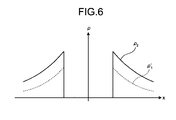
- the normalizing unit 8 obtains a course predicted probability of the vehicle C 1 , which remains unremoved by the course interference assessing unit 7 at the step S6 (step S7). That is to say, the normalizing unit 8 normalizes such that the total sum of the probability of the course of the specific obstacle, which remains unremoved at the step S6, becomes 1, and provides correctly defined probability to all the predicted courses.
- Fig. 6 is a view showing a probability distribution curve ⁇ 2 obtained by normalizing the distribution ⁇ 1 ' at the step S7.
- a probability distribution curve ⁇ 2 obtained by normalizing the distribution ⁇ 1 ' at the step S7.
- the course may be predicted under a complicated traffic environment more appropriately than in the conventional technique.
- the output unit 9 outputs predetermined information based on the predicted course probability of the specific obstacle obtained at the step S7 (step S8). For example, it is preferable to display an area in which the specific obstacle may take the course with probability larger than a predetermined value.
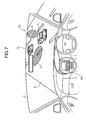
- Fig. 7 is a view showing a display output example of a predicted result in the display unit 92, and schematically showing the display output example of the course predicted result for the vehicle C 1 as the specific obstacle in the road environment shown in Fig. 3 .
- Fig. 7 shows a case in which an area D indicating a course of which probability is not smaller than the predetermined value out of the predicted courses of the vehicle C 1 is translucently superimposingly displayed on a front glass F of the subject vehicle C 0 .
- the above-described superimposed display is realized by projecting the image generated by the image generating unit 91 on the front glass F from the projector (not shown) installed on the upper posterior portion of the driver seat of the subject vehicle C 0 .
- a driver of the subject vehicle C 0 may immediately recognize an area in which the risk might arise in the near future while driving. Therefore, the driver may appropriately avoid the risk by reflecting a recognition result to driving.
- the output unit 9 may output the predicted result by the specific obstacle-course predicting unit 5.
- the obstacle course prediction method according to the first embodiment is repeated at predetermined time intervals, and information always based on the newest road environment is output. Therefore, according to the obstacle course prediction method according to the first embodiment, it becomes possible to aid the driver of the subject vehicle to perform the appropriate operation in response to the road environment changing every second.
- the prediction may be performed by taking an effect thereof into consideration, by predicting the course, which the obstacle may take, based on the position and the internal state of the obstacle, and at the time of the prediction, probabilistically predicting a plurality of courses of the specific obstacles selected by a predetermined condition and predicting the course of the general obstacle other than those, and when there are a plurality of obstacles, lowering the predicted probability of the course of which distance at the same time from the course, which the general obstacle may take, is smaller than a predetermined value out of a plurality of courses, which the specific obstacle may take, and calculating the probability that each of a plurality of courses of the specific obstacle including the course of which predicted probability is lowered, is realized. Therefore, it becomes possible to appropriately predict the course of the obstacle even under the complicated traffic environment.
- the obstacle which is most likely to be the obstacle for the vehicle, is selected as the specific obstacle, and the probabilistic prediction is performed for a plurality of courses of the specific obstacle, and on the other hand, the course maintaining the present status is taken as the course of other general obstacles, so that practical course prediction process of the obstacle may be realized without a heavy load on the device while controlling a calculation amount required for the process.
- the driver of the subject vehicle who receives the information, may drive while rapidly and appropriately avoiding the risk, which might arise in the near future while driving.
- Fig. 8 is a view showing an example of the probability distribution to be provided to the general obstacle when the probability distribution of the specific obstacle is ⁇ 1 shown in Fig. 4 .
- the probability distribution curve ⁇ G shown in Fig. 8 shows a distribution of which dispersion is smaller than that of the probability distribution curve ⁇ 1 of the specific obstacle and possibility of selecting the course in the straight through direction or in the vicinity thereof is significantly high.
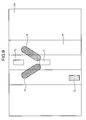
- the course predicted result of the specific obstacle may be displayed by allowing a display screen CN (refer to Fig. 7 ) of a car navigation system installed in the subject vehicle C 0 to have a function of the display unit 92.
- Fig. 9 is a screen showing the area D in which it is predicted that the vehicle C 1 , which is the specific obstacle, travels with the probability not smaller than the predetermined value in this case.
- the preceding vehicle traveling in the same direction as the subject vehicle is described as the obstacle in the above-described description, it is also possible to consider the following vehicle traveling in the same direction as the subject vehicle as the obstacle. Also, it is possible that an opposing vehicle traveling in a direction opposed to the subject vehicle is considered as the obstacle. Further, it is possible that a stationary object is considered as the obstacle.
- a second embodiment of the present invention is characterized in that a variation in position, which the specific obstacle specified as in the above-described first embodiment may take with time, is generated as a trajectory in space-time composed of time and space to perform the course prediction using the generated trajectory.
- Fig. 10 is a block diagram showing a functional configuration of an obstacle course prediction apparatus according to the second embodiment.
- the configuration is the same as that of the obstacle course prediction apparatus 1 according to the above-described first embodiment, except for a specific obstacle-course predicting unit 12. Therefore, the same reference numerals are given to portions having the same functions as those of the obstacle course prediction apparatus 1.
- the specific obstacle-course predicting unit 12 has a trajectory generating unit 13 for generating the variation in position, which the specific obstacle selected by the specific obstacle selecting unit 4 may take with time, as the trajectory in the space-time composed of time and space, and a predictive calculating unit 14 for performing the probabilistic prediction calculation of the course of the specific obstacle by using the trajectory of the specific obstacle output from the trajectory generating unit 13.
- the trajectory generating unit 13 is for predictively generating the trajectory, which the specific obstacle may take until a predetermined time period has passed, and has an operation selecting unit 131 for selecting an operation to allow the specific obstacle to virtually move on simulations from a plurality of operations, an object operating unit 132 for performing the operation selected by the operation selecting unit 131 for a predetermined time period, and a determining unit 133 for determining whether the position and the internal state of the specific obstacle after being operated by the object operating unit 132 satisfy predetermined conditions or not.
- the obstacle course prediction method according to the second embodiment is the same as the obstacle course prediction method according to the above-described first embodiment, except for the prediction process of the course of the specific obstacle (refer to the flowchart in Fig. 2 ). Therefore, in the following description, the course prediction process of the specific obstacle (corresponding to the step S4 in Fig. 2 ) is described in detail.
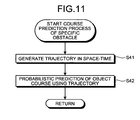
- Fig. 11 is a flowchart showing an overview of the course prediction process of the specific obstacle.
- the trajectory generating unit 13 generates a plurality of trajectories of the specific obstacle (step S41).
- Fig. 12 is a flowchart showing a detail of the trajectory generation process by the trajectory generating unit 13.
- N is a natural number
- time to generate the trajectory is set to T(>0).
- the trajectory generating unit 13 first performs initialization in which a value of a counter n indicating the number of trajectory generation for the specific obstacle O S (step S401)
- the trajectory generating unit 13 reads the result detected by the sensor unit 2 from the memory unit 10, and makes the read detected result an initial state (step S402). Specifically, a time t is set to 0, and an initial position (x(0),y(0)) and an initial internal state (v(0), ⁇ (0)) of the specific obstacle O S are made input information (x 0 ,y 0 ) and (v 0 , ⁇ 0 ) from the sensor unit 2, respectively.
- the operation selecting unit 131 selects one operation from a plurality of selectable operations according to an operation selection probability provided to each operation in advance, as an operation u(t) to be performed within a time period ⁇ t thereafter (step S403).
- An operation selection probability p(u c ) of selecting an operation u c is defined, for example, by associating an element of operation set ⁇ u c ⁇ selectable as u(t) with a predetermined random number. In this sense, the operation selection probability p(u c ) different from each operation u c may be provided, or equivalent probability may be provided for all the elements of the operation set ⁇ u c ⁇ .
- the operation u c is composed of a plurality of elements, and the contents of the selectable operation vary according to the type of the specific obstacle O S .
- the specific obstacle O S is the four-wheeled vehicle
- an accelerated velocity and an angular velocity of the four-wheeled vehicle are defined by a steering control and a degree of pressure on an accelerator pedal.
- the operation u c performed for the specific obstacle O S which is the four-wheeled vehicle, is defined by the element including the accelerated velocity and the angular velocity.
- the operation u c may be specified by the velocity.
- a more specific setting example of the operation u c is as follows.
- the acceleration is in a range from -10 to +30(km/h/sec) and a steering angel is in a range from -7 to +7(deg/sec) (directions thereof are specified by a sign)
- the velocity is in a range from 0 to 36(km/h) and a direction is in a range from 0 to 360(deg).
- the amounts described herein are continuous volumes. In such a case, the number of elements of each operation is made finite by performing an appropriate discretization to compose the operation set ⁇ u c ⁇ .
- the object operating unit 132 allows the operation u c selected at the step S403 to be performed for the time period ⁇ t (step S404).
- the time period ⁇ t is preferably smaller in terms of accuracy, this may be practically set to a value about 0.1 to 0.5(sec).
- a trajectory generating time T shall be integral multiplication of ⁇ t; however, a value of T may be made variable according to the velocity of the specific obstacle O S and is not necessarily the integral multiplication of ⁇ t.
- the determining unit 133 determines whether the internal state of the specific obstacle O S after the operation u c is performed at the step S404 satisfies a predetermined control condition or not (step S405).
- the control condition to be determined at the step S405 is defined according to the type of the specific obstacle O S , and when the specific obstacle O S is the four-wheeled vehicle, for example, this is defined by the area of the velocity after the operation at the step S404 and the maximum vehicle G of the acceleration velocity after the operation at the step S404.
- the determining unit 133 determines whether the position of the specific obstacle O S after the operation u c is performed is within a movable area or not (step S406).
- the movable area to be determined at the step S406 indicates the area such as the road (including a roadway and a pathway).
- a case in which the object is located within the movable area is represented as "to satisfy mobile condition”.
- the trajectory generating unit 13 increments the time by ⁇ t (t ⁇ t+ ⁇ t) to make the position and the internal state after the operation at the step S404 to (x(t),y(t)) and (v(t), ⁇ (t)), respectively (step S407).
- a trajectory P S (m) (1 ⁇ m ⁇ N, m is the natural number) shown in this drawing passes through a three-dimensional space-time (x,y,t) of two space dimension (x,y) and one time dimension (t).
- the predicted course of the specific obstacle O S in the two-dimensional space (x,y) may be obtained by projecting the trajectory P S (m) on an x-y plane.
- step S409 when the value of the counter n does not reach N (No at the step S410), the trajectory generating unit 13 increments the value of the counter n by 1 (step S411), and the procedure returns back to the step S402 to repeat the above-described processes at the steps S402 to S408 until reaching the trajectory generating time T.
- Fig. 14 is a view schematically showing the trajectory set ⁇ P S (n) ⁇ composed of N trajectories P S (1), P S (2), ..., P S (N) generated for the specific obstacle O S in the three-dimensional space-time.
- a starting point that is to say, an initial position (x 0 ,y 0 ,0) of each trajectory, which are elements of the trajectory set ⁇ P S (n) ⁇ , are the same (refer to the step S402).
- Fig. 14 is absolutely the schematic view, and the value of N may be the value of several hundreds to several tens of thousands, for example.
- space-time probability density density of presence probability of the specific obstacle O S in each area of the space-time
- density per unit volume of the trajectory set ⁇ P S (n) ⁇ in each area of the space-time is provided as density per unit volume of the trajectory set ⁇ P S (n) ⁇ in each area of the space-time. Therefore, it becomes possible to obtain the probability that the specific obstacle O S passes through the predetermined area in the three-dimensional space-time, by using the trajectory set ⁇ P S (n) ⁇ composed of the trajectory generation process at the step S41.
- the space-time probability density is absolutely a probability concept in the space-time, so that the total sum of a value of one object in the space-time is not necessarily 1.
- a specific value of the trajectory generation time T is preferably a value such that when the trajectory is generated to a point larger than the value T, the probability density distribution in space-time becomes uniform and there is no meaning in calculating.
- the operation time period ⁇ t at the step S404 is set to about 0.1 to 0.5 (sec)
- a set of processes from the step S403 to the step S407 are repeated 10 times to 50 times for generating one trajectory P S (m).
- the trajectory generation times T different from one type of the road to the next such as an express highway, a general road, and a two-track road, and to switch by a method to read the type of the road now traveling from map data using positional data and a method to read the type of the road by a road recognition device applying image recognition or the like.
- the specific obstacle-course predicting unit 12 probabilistically predicts the course, which the specific obstacle may take (step S42).
- the prediction calculation is merely one example.
- probability p(P S (m)) that one trajectory P S (m) out of them becomes an actual trajectory is calculated as follows.
- an operation sequence ⁇ u m (t) ⁇ to realize the trajectory P S (m) of the specific obstacle is ⁇ u m (0), u m ( ⁇ t), u m (2 ⁇ t), ..., u m (T) ⁇
- the prediction calculating unit 14 obtains the presence probability of the specific obstacle O s per unit volume in each area of the three-dimensional space-time based on the calculated probability p(P s (m)).
- the presence probability corresponds to the space-time probability density in the three-dimensional space-time of the trajectory set ⁇ P s (n) ⁇ , and this is generally large in the area in which density of the passing trajectories is high.
- the calculation result in the prediction calculating unit 14 is output to the course interference assessing unit 7.
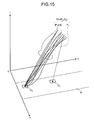
- Fig. 15 is a view schematically showing a configuration example of the space-time environment formed by adding the trajectory set ⁇ P S (n) ⁇ of the specific obstacle O S and the predicted course of the general obstacle.
- the space-time environment Env(P S ,P G ) shown in this drawing is composed of the trajectory set ⁇ P S (n) ⁇ of the specific obstacle O S (represented by a solid line) and one trajectory P G of the general obstacle O G (represented by a broken line).
- the space-time environment Env shows the space-time environment in a case in which the general obstacle O G in addition to the specific obstacle O S travels on a flat and linear road R such as the express highway in a +y axis direction (the subject vehicle C 0 in which the obstacle course prediction apparatus 11 is installed is not included in the space-time environment).
- the trajectory is independently generated for each obstacle without considering relationship between the obstacles, so that the trajectories of different objects might intersect in the space-time.
- the process thereafter is performed as in the above-described first embodiment. That is to say, the trajectory, which intersects with the trajectory P G of the general obstacle O G , that is to say, the trajectory on which the specific obstacle O S and the general obstacle O G collide with each other is removed from the trajectory set ⁇ P S (n) ⁇ of the specific obstacle O S , as the interference assessment process between the specific obstacle O S and the general obstacle O G (step S6).
- the collision at that time is defined as in the above-described first embodiment, and includes a case in which the two trajectories get closer to each other with a distance smaller than a predetermined distance according to the type of the obstacle, in addition to a case in which the two trajectories merely have intersection.
- the normalizing unit 8 normalizes such that the total sum of the probability of each element of the trajectory set remaining unremoved (non-interference trajectory set) ⁇ P S '(n) ⁇ becomes 1 to calculate the probability (step S7).
- the output unit 9 outputs the information based on the probability distribution obtained at the step S7 (step S8).
- the prediction may be performed by taking an effect thereof into consideration, by predicting the course, which the obstacle may take, based on the position and the internal state of the obstacle, and at the time of the prediction, probabilistically predicting a plurality of courses of the specific obstacles selected by a predetermined condition and predicting the course of the general obstacle other than those, and when there are a plurality of obstacles, lowering the predicted probability of the course of which distance at the same time from the course, which the general obstacle may take, is smaller than a predetermined value out of a plurality of courses, which the specific obstacle may take, and calculating the probability that each of a plurality of courses of the specific obstacle including the course of which predicted probability is lowered, is realized. Therefore, as in the above-described first embodiment, it becomes possible to appropriately predict the course of the obstacle even under the complicated traffic environment.
- the course of a dynamic object may be predicted with high accuracy.
- the trajectory when performing the trajectory generation process of the specific obstacle in the space-time, the trajectory may be generated by allowing all the selectable operations to be performed.
- An algorithm realizing such trajectory generation process may be realized by applying a recursive call by depth-first search or breadth-first search, for example.
- the number of elements that is to say, the number of trajectories of the trajectory set ⁇ P S (n) ⁇ of the specific obstacle O S , is not known until the trajectory generation process for the specific obstacle O S is finished.
- the search method having the optimal calculation amount may be selected according to the number of elements of the operation u c (t) at the operation time period ⁇ t (degree of discretization when the operation u c (t) is a continuous amount).
- the second embodiment is applicable to a four-dimensional space-time (three space dimensions and one time dimension) as in a case of applying to the vehicle traveling on the road with vertical interval.
- a third embodiment of the present invention is different from the above-described two embodiments, and is characterized in equally treating all the obstacles, generating the variation in position, which each obstacle may take with time, as the trajectory in the space-time, and predicting the course of the obstacle using the generated trajectory.
- FIG. 16 is a block diagram showing a functional configuration of an obstacle course prediction apparatus according to the third embodiment of the present invention.
- An obstacle course prediction apparatus 21 shown in this drawing has the sensor unit 2, the obstacle extracting unit 3, an obstacle course predicting unit 22 for performing probability prediction of the course of the obstacle extracted by the obstacle extracting unit 3, the course interference assessing unit 7, which assesses interference of the predicted course between the obstacles predicted by the obstacle course predicting unit 22, the normalizing unit 8, the output unit 9, and the memory unit 10.
- the output unit 9 has the image generating unit 91 and the display unit 92.
- the obstacle course predicting unit 22 has a trajectory generating unit 23 for generating the variation in position, which the obstacle extracted by the obstacle extracting unit 3 may take with time, as the trajectory in space-time, and a prediction calculating unit 24 for probabilistically performing a prediction calculation of the course of each obstacle by using the trajectories of a plurality of obstacles output from the trajectory generating unit 23.
- the trajectory generating unit 23 is for predictably generating the trajectory, which the object may take before a predetermined time period has passed, and has an operation selecting unit 231, an object operating unit 232, and a determining unit 233, just as the trajectory generating unit 13 described in the above-described second embodiment.
- the obstacle course predicting unit 22 predicts the courses of all the obstacles by equally treating a plurality of obstacles. Also, the course interference assessing unit 7 performs the interference assessment by removing all the courses, which interfere with each other, that is to say, the trajectories, which get closer to each other with a distance smaller than a predetermined distance at the same time, from the predicted courses.
- the sensor unit 2 detects a position of an object within a predetermined area with respect to the subject vehicle and an internal state thereof, and stores the detected information in the memory unit 10 (step S11).
- the position of the object is represented by the value of the central portion of the object, and the internal state of the object is specified by the velocity (velocity v and direction ⁇ ).
- the obstacle extracting unit 3 extracts the obstacle within the predetermined area, based on the result detected by the sensor unit 2 (step S12).
- the obstacle course predicting unit 22 probabilistically predicts the courses, which a plurality of obstacles extracted by the obstacle extracting unit 3, may take (step S13).
- a specific course prediction process to be performed for each obstacle at the step S13 is similar to the course prediction process of the specific obstacle in the above-described second embodiment (refer to Figs. 11 and 12 ).
- a total number of the obstacles detected by the sensor unit 2 is set to I, and the calculation to generate the trajectory shall be performed N i times for one obstacle O i (1 ⁇ i ⁇ I, i is a natural number) (I and N i are natural numbers).
- the trajectory generating unit 23 reads the result detected by the sensor unit 2 from the memory unit 10, and sets the read detected result as an initial state. Thereafter, the operation selecting unit 231 selects an operation u i (t) to be performed within the time period ⁇ t after the initial state. At that time, the operation selecting unit 231 selects one operation out of a plurality of selectable operations according to the operation selection probability provided to each operation in advance. Meanwhile, a specific operation u ic is set just as the operation u c in the above-described second embodiment. Also, an operation selection probability p(u ic ) to select the operation u ic also is defined as the above-described operation selection probability p(u c ).
- the object operating unit 232 allows the operation u ic selected by the operation selecting unit 231 to be performed for the time period ⁇ t, and the determining unit 233 determines whether the internal state of the object O i after the operation u ic is performed satisfies a predetermined control condition or not and determines whether the position of the object O i after the operation u ic is performed is within the movable area or not.
- the trajectory generating unit 23 increments the time by ⁇ t (t ⁇ t+ ⁇ t) only when the position and the internal state of the object O i after the operation u ic is finished satisfy all the conditions, as a result of determination at the determining unit 233, to set the position and the internal state after the operation to (x i (t), y i (t)) and (v i (t), ⁇ i (t)), respectively.
- N i times the process for one obstacle O i is finished. After that, the similar process is performed for another obstacle O i .
- the trajectory generating unit 23 performs the trajectory generation process for all the obstacles, thereby the space-time environment composed of trajectory set, which a plurality of objects present within the predetermined area in the three-dimensional space-time may take, is formed.
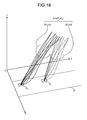
- Fig. 18 is a view schematically showing a configuration example of the space-time environment.
- the space-time environment Env (P 1 , P 2 ) shown in the drawing is formed of the trajectory set ⁇ P 1 (n) ⁇ of the obstacle O 1 (indicated by a solid line in Fig. 18 ) and the trajectory set ⁇ P 2 (n) ⁇ of the obstacle O 2 (indicated by a broken line in Fig. 18 ).
- the space-time environment Env (P 1 , P 2 ) shows the space-time environment when two obstacles O 1 and O 2 travel on the flat and linear road R such as the express highway in the +y axis direction.
- the trajectory is generated for each object without considering the correlation between the objects, so that the trajectories of different objects might intersect with each other in space-time.
- the prediction calculating unit 24 probabilistically predicts the course, which each obstacle may take.
- the presence probability corresponds to the space-time probability density of the trajectory set ⁇ P i (n) ⁇ in three-dimensional space-time, and the presence probability is generally high in the area in which density of passing trajectories is high.
- the course interference assessing unit 7 performs the interference assessment between the obstacles (step S14).
- the trajectories intersecting with each other are removed from the trajectory set ⁇ P 1 (n) ⁇ , ⁇ P 2 (n) ⁇ , ..., ⁇ P I (n) ⁇ for all the obstacles.
- the definition of the intersection of the trajectories is the same as that of the above-described second embodiment.
- the courses of all the obstacles remaining unremoved are calculated as the course predicted probability of all the obstacles under the space-time environment (step S15).
- the normalizing unit 8 normalizes such that the total sum of the probabilities of all the courses remaining unremoved becomes 1.
- the output unit 9 outputs predetermined information based on the predicted course probabilities of all the obstacles calculated at the step 15 (step 16). For example, it is preferable that the area in which the course is taken with probability larger than the predetermine value is displayed.
- the display method on the display unit 92 in this case may be the superimposed display on the front glass, or may be the display on the display screen CN of the car navigation system, described in the above-described first embodiment.
- the obstacle course prediction method according to the third embodiment is applicable to the four-dimensional space-time (three space dimensions and one time dimension) as in the above-described second embodiment.
- the prediction may be performed by taking an effect thereof into consideration, by predicting the course, which the obstacle may take, based on the position and the internal state of the obstacle, and at the time of the prediction, probabilistically predicting a plurality of courses of the obstacles, and when there are a plurality of obstacles, lowering the probability of taking the course of which distance from the course of the different obstacle at the same time is smaller than a predetermined value out of the courses, which a plurality of obstacles may take, and calculating the probability that each of all the courses of a plurality of obstacle including the course of which predicted probability is lowered, is realized. Therefore, it becomes possible to appropriately predict the course of the obstacle even under the complicated traffic environment.
- the course of the dynamic object may be predicted with high accuracy by generating the variation in position, which the obstacle may take with time, as a plurality of trajectories in space-time composed of time and space and probabilistically predicting the course, which all the obstacles may take, by using a plurality of generated trajectories.
- any of conventionally known probabilistic method may be applied.
- a fourth embodiment of the present invention is characterized in generating a course of the subject vehicle in addition to predicting the course of the specific obstacle as in the above-described first embodiment, and calculating collision probability of the specific obstacle and the subject vehicle.
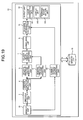
- FIG. 19 is a block diagram showing a functional configuration of the obstacle course prediction apparatus according to the fourth embodiment.
- An obstacle course prediction apparatus 31 shown in this drawing detects the position and the internal state of the object present within the predetermined area, and has a sensor unit 32 for detecting the position and the internal state of the subject vehicle, a subject vehicle-course generating unit 33 for generating the course of the subject vehicle from the present position, a collision probability calculating unit 34 for calculating the collision probability of the subject vehicle and the specific obstacle, and an output unit 35 for outputting information regarding the collision probability of the subject vehicle and the specific obstacle calculated by the collision probability calculating unit 34.
- the output unit 35 has an image generating unit 351 for generating an image based on the collision probability calculated by the collision probability calculating unit 34, a display unit 352 for display outputting information including the image generated by the image generating unit 351, and a warning sound emitting unit 353 for emitting a warning sound (including voice) when the collision probability of the subject vehicle course generated by the own course generating unit 33 and the specific obstacle is larger than a predetermined threshold value.
- a configuration of the obstacle course prediction apparatus 31 other than that described herein is the same as the configuration of the obstacle course prediction apparatus 1 according to the above-described first embodiment (refer to Fig. 1 ).
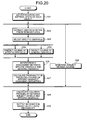
- Fig. 20 is a flowchart showing an overview of the process of the obstacle course prediction method according to the fourth embodiment.
- the position of the object within the predetermined area with respect to the subject vehicle C 0 and the internal state thereof and the position and the internal state of the subject vehicle are detected, and the detected information is stored in the memory unit 10 (step S21).
- the obstacle extracting unit 3 extracts the obstacle within the predetermined area, based on the result detected by the sensor unit 32 (step S22).
- the specific obstacle selecting unit 4 selects one specific obstacle out of the obstacles extracted by the obstacle extracting unit 3 (step S23).
- the sensor unit 32 may also detect the internal state of the subject vehicle C 0 , the obstacle of which time to collision (TTC), which is the time until the subject vehicle C 0 collides with the obstacle when traveling under the present circumstances, is the shortest may be selected as the specific obstacle.
- TTC time to collision
- the subject vehicle-course generating unit 38 generates the course of the subject vehicle using the subject vehicle information detected by the sensor unit 2 (step S28). Specifically, the subject vehicle-course generating unit 33 generates the trajectory in a case in which the subject vehicle travels under the present circumstances. Meanwhile, if it is possible that the sensor unit 32 detects a road surface environment such as a white line, the trajectory according to the number of travelable lanes may be generated.
- the step S28 is performed in parallel with the processes from the step S22 to the step S27.
- the collision probability calculating unit 34 calculates the probability that the course of the subject vehicle generated by the subject vehicle-course generating unit 33 and the course of the specific obstacle obtained by the course interference assessing unit 7 collide with each other (step S29).
- the collision probability calculating unit 34 calculates the probability that the course of the subject vehicle generated by the subject vehicle-course generating unit 33 and the course of the specific obstacle obtained by the course interference assessing unit 7 collide with each other (step S29).
- a distance between the course of the subject vehicle and the course of the specific obstacle becomes smaller than a predetermined distance at the same time, they are considered to collide with each other to calculate the collision probability is calculated.
- the distance with which they are considered to collide with each other is defined according to the type of the specific obstacle.
- the output unit 35 outputs predetermined information based on the collision probability obtained at the step S29 (step S30). For example, this displays with the display unit 352 when the collision probability is larger than the predetermined threshold value, and emits the warning sound from the warning sound emitting unit 35 when the collision probability is larger than the predetermined threshold value. Meanwhile, when the subject vehicle-course generating unit 33 generates a plurality of courses, the course (or lane) of which collision probability is the lowest may be displayed or informed by voice as suggested course (or a suggested lane).
- the prediction may be performed by taking an effect thereof into consideration, by predicting the course, which the obstacle may take, based on the position and the internal state of the obstacle, and at the time of the prediction, probabilistically predicting a plurality of courses of the specific obstacles selected by a predetermined condition and predicting the course of the general obstacle other than those, and when there are a plurality of obstacles, lowering the predicted probability of the course of which distance at the same time from the course, which the general obstacle may take, is smaller than a predetermined value out of a plurality of courses, which the specific obstacle may take, and calculating the probability that each of a plurality of courses of the specific obstacle including the course of which predicted probability is lowered, is realized. Therefore, it becomes possible to appropriately predict the course of the obstacle even under the complicated traffic environment.
- the fourth embodiment it becomes possible to appropriately determine safety of the subject vehicle course under the complicated traffic environment within the practical time period, by calculating the collision probability between the subject vehicle course and the predicted course of the specific obstacle.
- the fourth embodiment it is also possible to further provide an subject vehicle-course generating unit and a collision probability calculating unit to the obstacle course prediction apparatus according to the third embodiment.
- the probabilities for the courses of all the obstacles are calculated and the collision probability with the subject vehicle course is calculated.
- a fifth embodiment of the present invention is characterized in generating the course of the subject vehicle in addition to predicting the course of the specific obstacle by using the trajectory generated in the three-dimensional space-time as in the above-described second embodiment, thereby obtaining the collision probability between the specific obstacle and the subject vehicle.
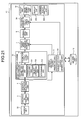
- FIG. 21 is a block diagram showing a functional configuration of an obstacle course prediction apparatus according to the fifth embodiment of the present invention.
- An obstacle course prediction apparatus 41 shown in this drawing detects the position and the internal state of the object present within the predetermined area, and is provided with the sensor unit 32 for detecting the position and the internal state of the subject vehicle, the subject vehicle-course generating unit 33 for generating the course of the subject vehicle from the present position, the collision probability calculating unit 34 for calculating the collision probability between the subject vehicle and the specific obstacle, and the output unit 35 for outputting the information regarding the collision probability between the subject vehicle and the specific obstacle calculated by the collision probability calculating unit 34.
- the output unit 35 has the image generating unit 351 for generating the image based on the collision probability calculated at the collision probability calculating unit 34, the display unit 352 for display outputting the information including the image generated by the image generating unit 351, and the warning sound emitting unit 353 for emitting the warning sound (including voice) when the collision probability between the subject vehicle course generated by the subject vehicle-course generating unit 33 and the specific obstacle is larger than the predetermined threshold value.
- the configuration of the obstacle course prediction apparatus 41 other than those described herein is the same as the configuration of the obstacle course prediction apparatus 11 according to the above-described second embodiment (refer to Fig. 10 ).
- the obstacle course prediction method according to the fifth embodiment is the same as the obstacle course prediction method according to the above-described fourth embodiment, except for the details of the course prediction process of the specific obstacle and the collision probability calculation process (refer to the flowchart in Fig. 20 ). Also, the course prediction process of the specific obstacle is the same as the obstacle course prediction method according to the above-described second embodiment (refer to Figs. 11 and 12 ). Then, in the following description, the collision probability calculation process (corresponding to the step S29 in Fig. 20 ) is described in detail. Meanwhile, in the following description, the same step number is used for the same process as the obstacle course prediction method according to the above-described fourth embodiment.
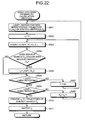
- Fig. 22 is a flowchart showing a detail of the collision probability calculation process.
- the collision probability calculation process shown in the drawing is composed of two loop processes and calculates the collision probability between the trajectory P 0 of the subject vehicle C 0 generated at the step S28 and a non-interference trajectory set ⁇ P S '(n) ⁇ remaining unremoved at the step S26.
- the collision probability calculating unit 34 calculates the collision probability using the trajectory P 0 of the subject vehicle C 0 , the non-interference trajectory set ⁇ P S '(n) ⁇ of the specific obstacle O S , and an assessment function, which assesses the collision probability between the subject vehicle C 0 and the specific obstacle O S .
- the assessment function may be input from outside by providing an input unit to the obstacle course prediction apparatus 41. Also, the assessment function may be adoptively changed depending on the type of the road and the velocity of the subject vehicle C 0 .
- an interference degree r S is introduced as an amount to quantitatively provide a degree of interference between the subject vehicle C 0 and the specific obstacle O S , and an initial value of the interference degree r S is set to 0 (step S502).
- the collision probability calculating unit 34 starts the repetitive process (Loop2) to assess the interference between the trajectory P 0 of the subject vehicle C 0 and one non-interference trajectory P S '(n S ) at the specific obstacle O S (step S503).
- a spatial distance between the two trajectories at the same time becomes smaller than a predetermined value (for example, normal width and length of the vehicle)
- a predetermined value for example, normal width and length of the vehicle
- Fig. 23 is a view schematically showing a relationship in the space-time between the trajectory P 0 of the subject vehicle C 0 and the non-interference trajectory P S '(n S ) of the specific obstacle O S .
- the trajectory P 0 and the non-interference trajectory P S '(n S ) intersect with each other at two points a 1 and a 2 . Therefore, areas A 1 and A 2 in which a distance between the two trajectories at the same time is smaller than the interference distance are present in the vicinity of the two points a 1 and a 2 , respectively.
- the collision probability calculating unit 34 obtains the distance between the subject vehicle C 0 and the specific obstacle O S and when this determines that the subject vehicle C 0 and the specific obstacle O S collide with each other in the above-described sense as a result thereof (Yes at the step S504), this defines a value of the interference degree r S as Equation 8 r S ⁇ r S + p P S ⁇ ⁇ n S (step S505).
- a second term p(P S '(n S )) is the probability that the trajectory P S '(n S ) is selected (herein, the probability distribution function already provided to each trajectory is normalized by the normalizing unit 8).
- the collision probability calculating unit 34 does not finish the repetition when the time t does not reach T after the step S505 (No at the step S506), and increments the value of t by ⁇ t (step S507), and returns to the step S503 to repeat the Loop2. On the other hand, the collision probability calculating unit 34 finishes the Loop2 when the time t reaches T after the step S505 (Yes at the step S506).
- the collision probability calculating unit 34 performs determination process whether to repeat the Loop1 or not. That is to say, when there is the trajectory of which interference assessment with the trajectory P 0 of the subject vehicle C 0 is not performed out of the trajectories generated for the specific obstacle O S , this does not finish the Loop1 (No at the step S508) and makes n S to n S +1 (step S509), and returns back to the step S501 to repeat the Loop1.
- the collision probability calculating unit 34 provides the final interference degree r S to assess the interference between the trajectory P 0 of the subject vehicle C 0 and all the non-interference trajectory set ⁇ P S '(n) ⁇ of the specific obstacle O S (step S510), and outputs the provided interference degree r S to store in the memory unit 10 (step S511).
- a sum of a right side of the equation (9) is no more than the collision probability that the trajectory P 0 of the subject vehicle C 0 collide with the trajectory, which the specific obstacle O s may take. That is to say, the collision probability that the subject vehicle C 0 and the specific obstacle O s collide with each other may be obtained by the equation (9).
- the output unit 35 displays information with the display unit 352 and emits the warning sound from the warning sound emitting unit 353 when the interference degree r s , which is the collision probability between the subject vehicle C 0 and the specific obstacle O s , is larger than a predetermined threshold value (step S30).
- the prediction may be performed by taking an effect thereof into consideration, by predicting the course, which the obstacle may take, based on the position and the internal state of the obstacle, and at the time of the prediction, probabilistically predicting a plurality of courses of the specific obstacles selected by a predetermined condition and predicting the course of the general obstacle other than those, and when there are a plurality of obstacles, lowering the predicted probability of the course of which distance from the course, which the general obstacle may take, at the same time is smaller than a predetermined value out of a plurality of courses, which the specific obstacle may take, and calculating the probability that each of a plurality of courses of the specific obstacle including the course of which predicted probability is lowered, is realized. Therefore, it is possible to appropriately predict the course of the obstacle even under the complicated traffic environment.
- the course of the dynamic object may be predicted with high accuracy, by generating the variation in position, which the specific obstacle may take with time, as the trajectory in space-time composed of time and space, and probabilistically predicting the course of the specific obstacle by using the generated trajectory.
- the fifth embodiment it becomes possible to appropriately determine safety of the subject vehicle course under realistically possible circumstance within the practical time period, by calculating the interference degree quantitatively indicating the degree of interference between the trajectory, which the specific obstacle may take, and the trajectory, which the subject vehicle may take in the space-time, and obtaining the calculated interference degree as the collision probability.
- the subject vehicle-course generating unit and the collision probability calculating unit to the obstacle course prediction apparatus according to the above-described third embodiment, as a modification of the fifth embodiment.
- the collision probability between the subject vehicle C 0 and all the obstacles in the space-time environment by repeatedly performing the above-described processes from the step S501 to the step S511 for a plurality of obstacles.
- the present invention is not limited to the five embodiments.
- it may be configured such that the predicted probability of the courses, which interfere with each other, is lowered in place of setting the predicted probability of taking the courses interfering with each other to 0 and removing the same.
- the specific obstacle selecting unit sequentially selects the obstacle extracted by the obstacle extracting unit based on an optional rule (for example, in an order of distance with the subject vehicle from the closest to the farthest) and repeat performing the course prediction process for each specific obstacle by a loop.
- an operation signal to operate the subject vehicle is generated in response to the output of the obstacle course prediction apparatus (the course predicted result and the collision probability with the subject vehicle) and the operation signal is transmitted to a predetermined actuator device provided on the subject vehicle.
- a virtual obstacle in addition to the real obstacle detected by the sensor unit and predicts the course for the virtual obstacle. More specifically, it is possible to form a virtual model, which behaves undesirably for the subject vehicle, and predicts the course thereof by arranging the model to a predetermined position. By arranging such a virtual model to a position, which is not detected from the subject vehicle traveling near a blind cross point due to presence of a screen or the like, it becomes possible to predict the risk of collision or the like with the obstacle, which may jump from the cross point. Meanwhile, information of the virtual model may be stored in the memory unit in advance and arranged on a desired position according to condition setting from a separately provided input unit.
- the obstacle course prediction apparatus When applying the obstacle course prediction apparatus according to the present invention to a region such as the express highway at which travel of only vehicles is supposed, it may be configured that traveling circumstances of the vehicles, which travels close to each other, are exchanged by vehicle-to-vehicle communication, by providing communication means for the vehicle-to-vehicle communication to each vehicle.
- each vehicle stores the operation history in its memory unit, provides the operation selection probability for each operation based on the operation history, and transmits this with the information regarding the operation selection probability to another vehicle.
- the accuracy of the course prediction becomes high, and the risk while traveling may be further surely avoided.
- GPS global positioning system
- the positional information and the move information of the object detected by the sensor unit may be corrected by referring to the three-dimensional map information stored in the GPS.
- the obstacle course prediction apparatus may be mounted on the mobile object such as the vehicle other than the four-wheeled vehicle, the person, and a robot.
- the obstacle course prediction apparatus is not necessarily mounted on the mobile object.
- the obstacle course prediction apparatus may be formed of the course interference assessing system including the subject vehicle, another vehicle around the subject vehicle, and infrastructure.
- it is also possible to perform the course prediction calculation of the obstacle on an infrastructure side and to specify the subject vehicle as the prediction calculation requesting vehicle, which requires the infrastructure side the prediction calculation result and receives the same, and performs the process base on the received prediction calculation result.
- the obstacle course prediction method, the apparatus, and the program according to the present invention is preferable as the technique to avoid the risk when driving the mobile object such as the four-wheel vehicle and assuring the safety.
Landscapes
- Engineering & Computer Science (AREA)
- Physics & Mathematics (AREA)
- Automation & Control Theory (AREA)
- General Physics & Mathematics (AREA)
- Mathematical Physics (AREA)
- Transportation (AREA)
- Mechanical Engineering (AREA)
- Aviation & Aerospace Engineering (AREA)
- Radar, Positioning & Navigation (AREA)
- Remote Sensing (AREA)
- Traffic Control Systems (AREA)
- Management, Administration, Business Operations System, And Electronic Commerce (AREA)
Applications Claiming Priority (2)
| Application Number | Priority Date | Filing Date | Title |
|---|---|---|---|
| JP2006305744A JP4062353B1 (ja) | 2006-11-10 | 2006-11-10 | 障害物進路予測方法、装置、およびプログラム |
| PCT/JP2007/071923 WO2008056806A1 (fr) | 2006-11-10 | 2007-11-12 | Procédé, dispositif et programme de prédiction de parcours d'obstacles |
Publications (3)
| Publication Number | Publication Date |
|---|---|
| EP2093741A1 true EP2093741A1 (fr) | 2009-08-26 |
| EP2093741A4 EP2093741A4 (fr) | 2011-01-12 |
| EP2093741B1 EP2093741B1 (fr) | 2012-12-26 |
Family
ID=39293988
Family Applications (1)
| Application Number | Title | Priority Date | Filing Date |
|---|---|---|---|
| EP07831653A Active EP2093741B1 (fr) | 2006-11-10 | 2007-11-12 | Procédé, dispositif et programme de prédiction de parcours d'obstacles |
Country Status (5)
| Country | Link |
|---|---|
| US (2) | US10065650B2 (fr) |
| EP (1) | EP2093741B1 (fr) |
| JP (1) | JP4062353B1 (fr) |
| CN (1) | CN101536058B (fr) |
| WO (1) | WO2008056806A1 (fr) |
Cited By (9)
| Publication number | Priority date | Publication date | Assignee | Title |
|---|---|---|---|---|
| EP2306433A1 (fr) * | 2009-10-05 | 2011-04-06 | Nederlandse Organisatie voor toegepast -natuurwetenschappelijk onderzoek TNO | Système et procédé d'évitement des collisions pour véhicule routier et programme d'ordinateur correspondant |
| WO2015024620A1 (fr) * | 2013-08-20 | 2015-02-26 | Audi Ag | Procédé permettant de faire fonctionner un véhicule automobile pourvu d'un système de sécurité et d'un système d'assistance au conducteur entièrement automatique et véhicule automobile |
| EP2825435A4 (fr) * | 2012-03-15 | 2016-09-07 | Google Inc | Modification de comportement de véhicule autonome en fonction d'un comportement prédit d'autres véhicules |
| CN107710304A (zh) * | 2015-07-02 | 2018-02-16 | 三菱电机株式会社 | 路径预测装置 |
| CN108352116A (zh) * | 2015-07-31 | 2018-07-31 | 日立汽车系统株式会社 | 自身车辆周边信息管理装置 |
| EP3361466A1 (fr) * | 2017-02-14 | 2018-08-15 | Honda Research Institute Europe GmbH | Assistance au conducteur axée sur les risques pour l'approche des intersections à visibilité réduite |
| EP3333819A4 (fr) * | 2015-07-21 | 2018-10-17 | Nissan Motor Co., Ltd. | Dispositif d'évaluation de scènes, dispositif d'aide à la circulation et procédé d'évaluation de scènes |
| WO2018220418A1 (fr) * | 2017-06-02 | 2018-12-06 | Toyota Motor Europe | Procédé et système d'aide à la conduite |
| EP3761137A1 (fr) * | 2019-07-01 | 2021-01-06 | Fujitsu Limited | Commande d'objets autonomes |
Families Citing this family (61)
| Publication number | Priority date | Publication date | Assignee | Title |
|---|---|---|---|---|
| JP2009271405A (ja) | 2008-05-09 | 2009-11-19 | Mitsumi Electric Co Ltd | カメラモジュール |
| JP4623145B2 (ja) | 2008-06-16 | 2011-02-02 | トヨタ自動車株式会社 | 運転支援装置 |
| JP5094658B2 (ja) * | 2008-09-19 | 2012-12-12 | 日立オートモティブシステムズ株式会社 | 走行環境認識装置 |
| JP5077182B2 (ja) * | 2008-10-14 | 2012-11-21 | トヨタ自動車株式会社 | 車両進路予測装置 |
| JP4614005B2 (ja) * | 2009-02-27 | 2011-01-19 | トヨタ自動車株式会社 | 移動軌跡生成装置 |
| JP4939564B2 (ja) * | 2009-03-23 | 2012-05-30 | 本田技研工業株式会社 | 車両用情報提供装置 |
| JP4957747B2 (ja) | 2009-05-18 | 2012-06-20 | トヨタ自動車株式会社 | 車両環境推定装置 |
| JP4957752B2 (ja) | 2009-06-12 | 2012-06-20 | トヨタ自動車株式会社 | 進路評価装置 |
| JP2011014037A (ja) * | 2009-07-03 | 2011-01-20 | Fuji Heavy Ind Ltd | リスク予測システム |
| JP5407764B2 (ja) * | 2009-10-30 | 2014-02-05 | トヨタ自動車株式会社 | 運転支援装置 |
| WO2011125168A1 (fr) * | 2010-04-05 | 2011-10-13 | トヨタ自動車株式会社 | Dispositif de jugement de collision de véhicule |
| JP5607409B2 (ja) * | 2010-04-06 | 2014-10-15 | トヨタ自動車株式会社 | 対象物リスク予測装置 |
| US9601020B2 (en) * | 2010-10-05 | 2017-03-21 | Toyota Jidosha Kabushiki Kaisha | Collision determination device |
| JP5648420B2 (ja) * | 2010-10-26 | 2015-01-07 | トヨタ自動車株式会社 | 危険度予測装置 |
| US8466807B2 (en) * | 2011-06-01 | 2013-06-18 | GM Global Technology Operations LLC | Fast collision detection technique for connected autonomous and manual vehicles |
| EP3040685A1 (fr) * | 2011-12-29 | 2016-07-06 | INTEL Corporation | Systèmes de navigation qui améliorent la conscience de conducteur |
| US10023230B2 (en) * | 2012-11-29 | 2018-07-17 | Toyota Jidosha Kabushiki Kaisha | Drive assist device, and drive assist method |
| US10740703B2 (en) * | 2013-04-29 | 2020-08-11 | Verge Technologies Inc. | Method and system for determining optimized travel path for agricultural implement on land with obstacle |
| CA2814599A1 (fr) * | 2013-04-29 | 2014-10-29 | Fieldstone Land Management Inc. | Procede et appareil pour calcul et compensation d'effet tangible |
| US9250324B2 (en) * | 2013-05-23 | 2016-02-02 | GM Global Technology Operations LLC | Probabilistic target selection and threat assessment method and application to intersection collision alert system |
| CN107851392B (zh) * | 2015-07-22 | 2021-04-09 | 本田技研工业株式会社 | 路径生成装置、路径生成方法及存储路径生成程序的介质 |
| US9691151B1 (en) * | 2015-08-25 | 2017-06-27 | X Development Llc | Using observations from one or more robots to generate a spatio-temporal model that defines pose values for a plurality of objects in an environment |
| CN108140316B (zh) * | 2015-09-30 | 2020-08-18 | 日产自动车株式会社 | 行驶控制方法及行驶控制装置 |
| JP6508114B2 (ja) | 2016-04-20 | 2019-05-08 | トヨタ自動車株式会社 | 移動体の自動運転制御システム |
| DE102016009760A1 (de) * | 2016-08-11 | 2018-02-15 | Trw Automotive Gmbh | Steuerungssystem und Steuerungsverfahren zum Führen eines Kraftfahrzeugs entlang eines Pfades |
| US20180052470A1 (en) * | 2016-08-18 | 2018-02-22 | GM Global Technology Operations LLC | Obstacle Avoidance Co-Pilot For Autonomous Vehicles |
| JPWO2018096644A1 (ja) * | 2016-11-25 | 2019-10-17 | 本田技研工業株式会社 | 車両用表示制御装置、車両用表示制御方法、および車両用表示制御プログラム |
| CN106740475A (zh) * | 2016-12-26 | 2017-05-31 | 深圳市元征科技股份有限公司 | 车辆起步安全预警方法及装置 |
| CN110366744A (zh) * | 2017-03-31 | 2019-10-22 | 爱信艾达株式会社 | 驾驶支援系统 |
| CN108657176A (zh) * | 2017-04-01 | 2018-10-16 | 华为技术有限公司 | 车辆控制方法、装置及相关计算机程序产品 |
| CN108732588B (zh) * | 2017-04-21 | 2020-12-18 | 百度在线网络技术(北京)有限公司 | 一种雷达扫描装置、方法以及设备 |
| US20180362047A1 (en) | 2017-06-19 | 2018-12-20 | Panasonic Intellectual Property Corporation Of America | Information processing device and recording medium |
| US10754341B2 (en) * | 2018-02-07 | 2020-08-25 | Baidu Usa Llc | Systems and methods for accelerated curve projection |
| US11378961B2 (en) * | 2018-04-17 | 2022-07-05 | Baidu Usa Llc | Method for generating prediction trajectories of obstacles for autonomous driving vehicles |
| CN108592932A (zh) * | 2018-04-27 | 2018-09-28 | 平安科技(深圳)有限公司 | 一种无人车调度方法、系统、设备及存储介质 |
| CN110487288B (zh) * | 2018-05-14 | 2024-03-01 | 华为技术有限公司 | 一种行车道路的估计方法以及行车道路估计系统 |
| US11260855B2 (en) * | 2018-07-17 | 2022-03-01 | Baidu Usa Llc | Methods and systems to predict object movement for autonomous driving vehicles |
| JP2020024561A (ja) * | 2018-08-07 | 2020-02-13 | 本田技研工業株式会社 | 表示装置、表示制御方法、およびプログラム |
| US11126185B2 (en) | 2018-09-15 | 2021-09-21 | Toyota Research Institute, Inc. | Systems and methods for predicting vehicle trajectory |
| JP7115184B2 (ja) | 2018-09-26 | 2022-08-09 | トヨタ自動車株式会社 | 自動運転システム |
| US11169531B2 (en) * | 2018-10-04 | 2021-11-09 | Zoox, Inc. | Trajectory prediction on top-down scenes |
| US11195418B1 (en) | 2018-10-04 | 2021-12-07 | Zoox, Inc. | Trajectory prediction on top-down scenes and associated model |
| JP7205154B2 (ja) | 2018-10-16 | 2023-01-17 | トヨタ自動車株式会社 | 表示装置 |
| US11194331B2 (en) * | 2018-10-30 | 2021-12-07 | The Regents Of The University Of Michigan | Unsupervised classification of encountering scenarios using connected vehicle datasets |
| CN109709961B (zh) * | 2018-12-28 | 2021-12-07 | 百度在线网络技术(北京)有限公司 | 道路障碍物检测方法、装置及自动驾驶汽车 |
| CN109544993A (zh) * | 2019-01-08 | 2019-03-29 | 吉林大学 | 一种智能车辆右转弯防碰撞三级预警系统及预警方法 |
| CN109885943B (zh) * | 2019-02-26 | 2023-05-16 | 百度在线网络技术(北京)有限公司 | 行车决策的预测方法、装置、存储介质和终端设备 |
| US11447130B2 (en) * | 2019-03-28 | 2022-09-20 | Nissan Motor Co., Ltd. | Behavior prediction method, behavior prediction apparatus and vehicle control apparatus |
| JP7459224B2 (ja) * | 2019-07-03 | 2024-04-01 | ウェイモ エルエルシー | アンカー軌道を使用したエージェント軌道予測 |
| JP7205444B2 (ja) | 2019-11-13 | 2023-01-17 | トヨタ自動車株式会社 | 運転支援装置 |
| CN111488419B (zh) * | 2020-03-30 | 2023-11-03 | 中移(杭州)信息技术有限公司 | 室内机器人地图的创建方法、装置、电子设备和存储介质 |
| JP7264103B2 (ja) | 2020-04-21 | 2023-04-25 | トヨタ自動車株式会社 | 車両制御システム及び車両制御方法 |
| CN111595352B (zh) * | 2020-05-14 | 2021-09-28 | 陕西重型汽车有限公司 | 一种基于环境感知和车辆行驶意图的轨迹预测方法 |
| CN111951552B (zh) * | 2020-08-11 | 2021-10-15 | 腾讯科技(深圳)有限公司 | 一种自动驾驶中风险管理的方法以及相关装置 |
| TWI796846B (zh) * | 2021-11-23 | 2023-03-21 | 財團法人工業技術研究院 | 基於物件互動關係之路徑預測方法及電子裝置 |
| KR102490011B1 (ko) * | 2022-07-19 | 2023-01-19 | 주식회사 라이드플럭스 | 로드 유저 예측 기반 자율주행 차량의 주행 계획 결정방법, 장치 및 컴퓨터프로그램 |
| WO2024232244A1 (fr) * | 2023-05-10 | 2024-11-14 | ソニーグループ株式会社 | Dispositif de traitement d'informations, procédé de traitement d'informations et programme |
| CN116691689B (zh) * | 2023-08-07 | 2024-01-12 | 山东海量信息技术研究院 | 一种车辆控制方法、系统、设备及计算机可读存储介质 |
| CN118457570B (zh) * | 2024-02-23 | 2025-03-21 | 东风商用车有限公司 | 障碍物轨迹预测方法、系统、自动驾驶车辆以及存储介质 |
| CN119038337B (zh) * | 2024-09-12 | 2025-05-09 | 福克斯电梯有限公司 | 一种基于物联网分析的用户乘梯控制方法及系统 |
| CN121254856B (zh) * | 2025-12-03 | 2026-02-27 | 宁波博海深衡科技有限公司 | 基于环扫声呐的水下避障方法及系统 |
Family Cites Families (18)
| Publication number | Priority date | Publication date | Assignee | Title |
|---|---|---|---|---|
| US5111401A (en) * | 1990-05-19 | 1992-05-05 | The United States Of America As Represented By The Secretary Of The Navy | Navigational control system for an autonomous vehicle |
| JP2799375B2 (ja) | 1993-09-30 | 1998-09-17 | 本田技研工業株式会社 | 衝突防止装置 |
| US7202776B2 (en) * | 1997-10-22 | 2007-04-10 | Intelligent Technologies International, Inc. | Method and system for detecting objects external to a vehicle |
| KR100208806B1 (ko) * | 1996-12-12 | 1999-07-15 | 윤종용 | 차량의 진행을 예측하여 안내하는 방법 |
| JP4066573B2 (ja) * | 1999-09-22 | 2008-03-26 | 株式会社デンソー | 先行車選択装置、車間制御装置及び記録媒体 |
| JP2001148098A (ja) | 1999-11-24 | 2001-05-29 | Oki Electric Ind Co Ltd | 車両の走行支援装置 |
| JP2003081037A (ja) | 2001-09-14 | 2003-03-19 | Toshiba Corp | 交通事故防止装置 |
| JP3896852B2 (ja) * | 2002-01-16 | 2007-03-22 | 株式会社デンソー | 車両用衝突被害軽減装置 |
| DE10257842A1 (de) * | 2002-05-07 | 2003-11-27 | Bosch Gmbh Robert | Verfahren zur Bestimmung einer Unfallgefahr eines ersten Objekts mit wenigstens einem zweiten Objekt |
| US6820006B2 (en) * | 2002-07-30 | 2004-11-16 | The Aerospace Corporation | Vehicular trajectory collision conflict prediction method |
| JP4055656B2 (ja) * | 2003-05-30 | 2008-03-05 | トヨタ自動車株式会社 | 衝突予測装置 |
| JP4052650B2 (ja) * | 2004-01-23 | 2008-02-27 | 株式会社東芝 | 障害物検出装置、方法及びプログラム |
| US7447593B2 (en) * | 2004-03-26 | 2008-11-04 | Raytheon Company | System and method for adaptive path planning |
| DE102004038734A1 (de) * | 2004-08-10 | 2006-02-23 | Robert Bosch Gmbh | Verfahren und Vorrichtung zur Auslösung einer Notbremsung |
| JP2006085285A (ja) * | 2004-09-14 | 2006-03-30 | Matsushita Electric Ind Co Ltd | 危険車両予測装置 |
| JP2006248361A (ja) * | 2005-03-10 | 2006-09-21 | Advics:Kk | 車両用走行支援装置 |
| JP4517972B2 (ja) * | 2005-08-02 | 2010-08-04 | 日産自動車株式会社 | 障害物判断装置及び方法 |
| FR2889882B1 (fr) * | 2005-08-19 | 2009-09-25 | Renault Sas | Procede et systeme de prediction de choc entre un vehicule et un pieton. |
-
2006
- 2006-11-10 JP JP2006305744A patent/JP4062353B1/ja active Active
-
2007
- 2007-11-12 WO PCT/JP2007/071923 patent/WO2008056806A1/fr not_active Ceased
- 2007-11-12 US US12/312,195 patent/US10065650B2/en active Active
- 2007-11-12 CN CN2007800412692A patent/CN101536058B/zh active Active
- 2007-11-12 EP EP07831653A patent/EP2093741B1/fr active Active
-
2018
- 2018-07-31 US US16/050,716 patent/US10960891B2/en active Active
Non-Patent Citations (2)
| Title |
|---|
| No further relevant documents disclosed * |
| See also references of WO2008056806A1 * |
Cited By (22)
| Publication number | Priority date | Publication date | Assignee | Title |
|---|---|---|---|---|
| WO2011043658A1 (fr) * | 2009-10-05 | 2011-04-14 | Nederlandse Organisatie Voor Toegepast-Natuurwetenschappelijk Onderzoek Tno | Système et procédé anti-collision pour véhicule routier et produit-programme d'ordinateur associé |
| CN102576494A (zh) * | 2009-10-05 | 2012-07-11 | 荷兰应用自然科学研究组织Tno | 公路车辆的防撞系统与方法及相关计算机程序产品 |
| US20120271518A1 (en) * | 2009-10-05 | 2012-10-25 | Nederlandse Organisatie Voor Toegepast- Natuurwetenschappelijk Onderzoek Tno | Collision avoidance system and method for a road vehicle and respective computer program product |
| JP2013506931A (ja) * | 2009-10-05 | 2013-02-28 | ネーデルランドセ・オルガニサティ・フォール・トゥーヘパスト−ナトゥールウェテンスハッペライク・オンデルズーク・テーエヌオー | 道路車両用の衝突回避システムおよび方法ならびに各コンピュータプログラム製品 |
| US8626398B2 (en) * | 2009-10-05 | 2014-01-07 | Nederlandse Organisatie Voor Toegepast-Natuurwetenschappelijk Onderzoek Tno | Collision avoidance system and method for a road vehicle and respective computer program product |
| EP2306433A1 (fr) * | 2009-10-05 | 2011-04-06 | Nederlandse Organisatie voor toegepast -natuurwetenschappelijk onderzoek TNO | Système et procédé d'évitement des collisions pour véhicule routier et programme d'ordinateur correspondant |
| CN102576494B (zh) * | 2009-10-05 | 2016-08-03 | 荷兰应用自然科学研究组织Tno | 公路车辆的防撞系统与方法及相关计算机程序产品 |
| EP2825435A4 (fr) * | 2012-03-15 | 2016-09-07 | Google Inc | Modification de comportement de véhicule autonome en fonction d'un comportement prédit d'autres véhicules |
| WO2015024620A1 (fr) * | 2013-08-20 | 2015-02-26 | Audi Ag | Procédé permettant de faire fonctionner un véhicule automobile pourvu d'un système de sécurité et d'un système d'assistance au conducteur entièrement automatique et véhicule automobile |
| CN107710304A (zh) * | 2015-07-02 | 2018-02-16 | 三菱电机株式会社 | 路径预测装置 |
| EP3319065A4 (fr) * | 2015-07-02 | 2019-02-27 | Mitsubishi Electric Corporation | Dispositif de prédiction de trajectoires |
| US10741079B2 (en) | 2015-07-02 | 2020-08-11 | Mitsubishi Electric Corporation | Route prediction system |
| EP3333819A4 (fr) * | 2015-07-21 | 2018-10-17 | Nissan Motor Co., Ltd. | Dispositif d'évaluation de scènes, dispositif d'aide à la circulation et procédé d'évaluation de scènes |
| CN108352116A (zh) * | 2015-07-31 | 2018-07-31 | 日立汽车系统株式会社 | 自身车辆周边信息管理装置 |
| EP3330946A4 (fr) * | 2015-07-31 | 2019-07-03 | Hitachi Automotive Systems, Ltd. | Dispositif de gestion d'informations de périphérie de véhicule |
| US10493907B2 (en) | 2015-07-31 | 2019-12-03 | Hitachi Automotive Systems, Ltd. | Vehicle periphery information management device |
| US10759336B2 (en) | 2015-07-31 | 2020-09-01 | Hitachi Automotive Systems, Ltd. | Vehicle periphery information management device |
| CN108352116B (zh) * | 2015-07-31 | 2022-04-05 | 日立安斯泰莫株式会社 | 自身车辆周边信息管理装置 |
| EP3361466A1 (fr) * | 2017-02-14 | 2018-08-15 | Honda Research Institute Europe GmbH | Assistance au conducteur axée sur les risques pour l'approche des intersections à visibilité réduite |
| WO2018220418A1 (fr) * | 2017-06-02 | 2018-12-06 | Toyota Motor Europe | Procédé et système d'aide à la conduite |
| US11364899B2 (en) | 2017-06-02 | 2022-06-21 | Toyota Motor Europe | Driving assistance method and system |
| EP3761137A1 (fr) * | 2019-07-01 | 2021-01-06 | Fujitsu Limited | Commande d'objets autonomes |
Also Published As
| Publication number | Publication date |
|---|---|
| US10960891B2 (en) | 2021-03-30 |
| CN101536058A (zh) | 2009-09-16 |
| EP2093741A4 (fr) | 2011-01-12 |
| US20100063735A1 (en) | 2010-03-11 |
| US10065650B2 (en) | 2018-09-04 |
| WO2008056806A1 (fr) | 2008-05-15 |
| JP4062353B1 (ja) | 2008-03-19 |
| JP2008123217A (ja) | 2008-05-29 |
| US20180334172A1 (en) | 2018-11-22 |
| EP2093741B1 (fr) | 2012-12-26 |
| CN101536058B (zh) | 2011-02-02 |
Similar Documents
| Publication | Publication Date | Title |
|---|---|---|
| US10960891B2 (en) | Method, apparatus and program of predicting obstacle course | |
| US8805601B2 (en) | Object path prediction method, apparatus, and program, and automatic operation system | |
| JP4353192B2 (ja) | 進路設定方法、装置、プログラム、および自動運転システム | |
| JP4946739B2 (ja) | 移動体進路取得方法、および、移動体進路取得装置 | |
| JP4211794B2 (ja) | 干渉評価方法、装置、およびプログラム | |
| EP2172919B1 (fr) | Dispositif d'estimation de trajectoire de déplacement de véhicule | |
| US10994729B2 (en) | System and method for controlling lateral motion of vehicle | |
| JP7064303B2 (ja) | オートノマスシステムの検証法 | |
| US8457892B2 (en) | Own-vehicle-path determining method and own-vehicle-path determining apparatus | |
| US20150149088A1 (en) | In-vehicle path verification | |
| JP4807385B2 (ja) | 干渉評価方法、装置、およびプログラム | |
| JP5691237B2 (ja) | 運転支援装置 | |
| JP5082433B2 (ja) | 移動体周囲危険度判定方法、装置、およびプログラム | |
| US20240157979A1 (en) | Trajectory prediction using diffusion models | |
| JP4396653B2 (ja) | 物体進路予測方法、装置、およびプログラム | |
| JP4730137B2 (ja) | 移動体安全性評価方法および移動体安全性評価装置 | |
| JP2010224788A (ja) | 車線逸脱予測装置 | |
| EP3965017B1 (fr) | Distillation de connaissances pour véhicules autonomes | |
| JP6330868B2 (ja) | 車両制御装置 | |
| US20260109375A1 (en) | Modeling agent driving behavior | |
| Taylor | Development of a Bayesian decision theory framework to enhance the design of rear-end collision warning systems |
Legal Events
| Date | Code | Title | Description |
|---|---|---|---|
| PUAI | Public reference made under article 153(3) epc to a published international application that has entered the european phase |
Free format text: ORIGINAL CODE: 0009012 |
|
| 17P | Request for examination filed |
Effective date: 20090508 |
|
| AK | Designated contracting states |
Kind code of ref document: A1 Designated state(s): AT BE BG CH CY CZ DE DK EE ES FI FR GB GR HU IE IS IT LI LT LU LV MC MT NL PL PT RO SE SI SK TR |
|
| DAX | Request for extension of the european patent (deleted) | ||
| A4 | Supplementary search report drawn up and despatched |
Effective date: 20101210 |
|
| GRAP | Despatch of communication of intention to grant a patent |
Free format text: ORIGINAL CODE: EPIDOSNIGR1 |
|
| GRAS | Grant fee paid |
Free format text: ORIGINAL CODE: EPIDOSNIGR3 |
|
| GRAA | (expected) grant |
Free format text: ORIGINAL CODE: 0009210 |
|
| AK | Designated contracting states |
Kind code of ref document: B1 Designated state(s): AT BE BG CH CY CZ DE DK EE ES FI FR GB GR HU IE IS IT LI LT LU LV MC MT NL PL PT RO SE SI SK TR |
|
| REG | Reference to a national code |
Ref country code: GB Ref legal event code: FG4D |
|
| REG | Reference to a national code |
Ref country code: CH Ref legal event code: EP |
|
| REG | Reference to a national code |
Ref country code: AT Ref legal event code: REF Ref document number: 590824 Country of ref document: AT Kind code of ref document: T Effective date: 20130115 |
|
| RAP2 | Party data changed (patent owner data changed or rights of a patent transferred) |
Owner name: TOYOTA JIDOSHA KABUSHIKI KAISHA |
|
| REG | Reference to a national code |
Ref country code: DE Ref legal event code: R096 Ref document number: 602007027693 Country of ref document: DE Effective date: 20130307 |
|
| PG25 | Lapsed in a contracting state [announced via postgrant information from national office to epo] |
Ref country code: SE Free format text: LAPSE BECAUSE OF FAILURE TO SUBMIT A TRANSLATION OF THE DESCRIPTION OR TO PAY THE FEE WITHIN THE PRESCRIBED TIME-LIMIT Effective date: 20121226 Ref country code: LT Free format text: LAPSE BECAUSE OF FAILURE TO SUBMIT A TRANSLATION OF THE DESCRIPTION OR TO PAY THE FEE WITHIN THE PRESCRIBED TIME-LIMIT Effective date: 20121226 Ref country code: FI Free format text: LAPSE BECAUSE OF FAILURE TO SUBMIT A TRANSLATION OF THE DESCRIPTION OR TO PAY THE FEE WITHIN THE PRESCRIBED TIME-LIMIT Effective date: 20121226 |
|
| REG | Reference to a national code |
Ref country code: AT Ref legal event code: MK05 Ref document number: 590824 Country of ref document: AT Kind code of ref document: T Effective date: 20121226 |
|
| REG | Reference to a national code |
Ref country code: LT Ref legal event code: MG4D |
|
| REG | Reference to a national code |
Ref country code: NL Ref legal event code: VDEP Effective date: 20121226 |
|
| PG25 | Lapsed in a contracting state [announced via postgrant information from national office to epo] |
Ref country code: LV Free format text: LAPSE BECAUSE OF FAILURE TO SUBMIT A TRANSLATION OF THE DESCRIPTION OR TO PAY THE FEE WITHIN THE PRESCRIBED TIME-LIMIT Effective date: 20121226 Ref country code: SI Free format text: LAPSE BECAUSE OF FAILURE TO SUBMIT A TRANSLATION OF THE DESCRIPTION OR TO PAY THE FEE WITHIN THE PRESCRIBED TIME-LIMIT Effective date: 20121226 Ref country code: GR Free format text: LAPSE BECAUSE OF FAILURE TO SUBMIT A TRANSLATION OF THE DESCRIPTION OR TO PAY THE FEE WITHIN THE PRESCRIBED TIME-LIMIT Effective date: 20130327 |
|
| PG25 | Lapsed in a contracting state [announced via postgrant information from national office to epo] |
Ref country code: IS Free format text: LAPSE BECAUSE OF FAILURE TO SUBMIT A TRANSLATION OF THE DESCRIPTION OR TO PAY THE FEE WITHIN THE PRESCRIBED TIME-LIMIT Effective date: 20130426 Ref country code: ES Free format text: LAPSE BECAUSE OF FAILURE TO SUBMIT A TRANSLATION OF THE DESCRIPTION OR TO PAY THE FEE WITHIN THE PRESCRIBED TIME-LIMIT Effective date: 20130406 Ref country code: AT Free format text: LAPSE BECAUSE OF FAILURE TO SUBMIT A TRANSLATION OF THE DESCRIPTION OR TO PAY THE FEE WITHIN THE PRESCRIBED TIME-LIMIT Effective date: 20121226 Ref country code: EE Free format text: LAPSE BECAUSE OF FAILURE TO SUBMIT A TRANSLATION OF THE DESCRIPTION OR TO PAY THE FEE WITHIN THE PRESCRIBED TIME-LIMIT Effective date: 20121226 Ref country code: BE Free format text: LAPSE BECAUSE OF FAILURE TO SUBMIT A TRANSLATION OF THE DESCRIPTION OR TO PAY THE FEE WITHIN THE PRESCRIBED TIME-LIMIT Effective date: 20121226 Ref country code: BG Free format text: LAPSE BECAUSE OF FAILURE TO SUBMIT A TRANSLATION OF THE DESCRIPTION OR TO PAY THE FEE WITHIN THE PRESCRIBED TIME-LIMIT Effective date: 20130326 Ref country code: CZ Free format text: LAPSE BECAUSE OF FAILURE TO SUBMIT A TRANSLATION OF THE DESCRIPTION OR TO PAY THE FEE WITHIN THE PRESCRIBED TIME-LIMIT Effective date: 20121226 Ref country code: SK Free format text: LAPSE BECAUSE OF FAILURE TO SUBMIT A TRANSLATION OF THE DESCRIPTION OR TO PAY THE FEE WITHIN THE PRESCRIBED TIME-LIMIT Effective date: 20121226 |
|
| PG25 | Lapsed in a contracting state [announced via postgrant information from national office to epo] |
Ref country code: RO Free format text: LAPSE BECAUSE OF FAILURE TO SUBMIT A TRANSLATION OF THE DESCRIPTION OR TO PAY THE FEE WITHIN THE PRESCRIBED TIME-LIMIT Effective date: 20121226 Ref country code: PL Free format text: LAPSE BECAUSE OF FAILURE TO SUBMIT A TRANSLATION OF THE DESCRIPTION OR TO PAY THE FEE WITHIN THE PRESCRIBED TIME-LIMIT Effective date: 20121226 Ref country code: PT Free format text: LAPSE BECAUSE OF FAILURE TO SUBMIT A TRANSLATION OF THE DESCRIPTION OR TO PAY THE FEE WITHIN THE PRESCRIBED TIME-LIMIT Effective date: 20130426 Ref country code: NL Free format text: LAPSE BECAUSE OF FAILURE TO SUBMIT A TRANSLATION OF THE DESCRIPTION OR TO PAY THE FEE WITHIN THE PRESCRIBED TIME-LIMIT Effective date: 20121226 |
|
| PG25 | Lapsed in a contracting state [announced via postgrant information from national office to epo] |
Ref country code: DK Free format text: LAPSE BECAUSE OF FAILURE TO SUBMIT A TRANSLATION OF THE DESCRIPTION OR TO PAY THE FEE WITHIN THE PRESCRIBED TIME-LIMIT Effective date: 20121226 |
|
| PLBE | No opposition filed within time limit |
Free format text: ORIGINAL CODE: 0009261 |
|
| STAA | Information on the status of an ep patent application or granted ep patent |
Free format text: STATUS: NO OPPOSITION FILED WITHIN TIME LIMIT |
|
| PG25 | Lapsed in a contracting state [announced via postgrant information from national office to epo] |
Ref country code: CY Free format text: LAPSE BECAUSE OF FAILURE TO SUBMIT A TRANSLATION OF THE DESCRIPTION OR TO PAY THE FEE WITHIN THE PRESCRIBED TIME-LIMIT Effective date: 20121226 |
|
| 26N | No opposition filed |
Effective date: 20130927 |
|
| PG25 | Lapsed in a contracting state [announced via postgrant information from national office to epo] |
Ref country code: IT Free format text: LAPSE BECAUSE OF FAILURE TO SUBMIT A TRANSLATION OF THE DESCRIPTION OR TO PAY THE FEE WITHIN THE PRESCRIBED TIME-LIMIT Effective date: 20121226 |
|
| REG | Reference to a national code |
Ref country code: DE Ref legal event code: R097 Ref document number: 602007027693 Country of ref document: DE Effective date: 20130927 |
|
| REG | Reference to a national code |
Ref country code: CH Ref legal event code: PL |
|
| PG25 | Lapsed in a contracting state [announced via postgrant information from national office to epo] |
Ref country code: MC Free format text: LAPSE BECAUSE OF FAILURE TO SUBMIT A TRANSLATION OF THE DESCRIPTION OR TO PAY THE FEE WITHIN THE PRESCRIBED TIME-LIMIT Effective date: 20121226 Ref country code: LI Free format text: LAPSE BECAUSE OF NON-PAYMENT OF DUE FEES Effective date: 20131130 Ref country code: CH Free format text: LAPSE BECAUSE OF NON-PAYMENT OF DUE FEES Effective date: 20131130 |
|
| REG | Reference to a national code |
Ref country code: IE Ref legal event code: MM4A |
|
| REG | Reference to a national code |
Ref country code: DE Ref legal event code: R084 Ref document number: 602007027693 Country of ref document: DE |
|
| REG | Reference to a national code |
Ref country code: GB Ref legal event code: 746 Effective date: 20140917 |
|
| REG | Reference to a national code |
Ref country code: DE Ref legal event code: R084 Ref document number: 602007027693 Country of ref document: DE Effective date: 20140910 |
|
| PG25 | Lapsed in a contracting state [announced via postgrant information from national office to epo] |
Ref country code: IE Free format text: LAPSE BECAUSE OF NON-PAYMENT OF DUE FEES Effective date: 20131112 |
|
| PG25 | Lapsed in a contracting state [announced via postgrant information from national office to epo] |
Ref country code: TR Free format text: LAPSE BECAUSE OF FAILURE TO SUBMIT A TRANSLATION OF THE DESCRIPTION OR TO PAY THE FEE WITHIN THE PRESCRIBED TIME-LIMIT Effective date: 20121226 |
|
| PG25 | Lapsed in a contracting state [announced via postgrant information from national office to epo] |
Ref country code: LU Free format text: LAPSE BECAUSE OF NON-PAYMENT OF DUE FEES Effective date: 20131112 Ref country code: HU Free format text: LAPSE BECAUSE OF FAILURE TO SUBMIT A TRANSLATION OF THE DESCRIPTION OR TO PAY THE FEE WITHIN THE PRESCRIBED TIME-LIMIT; INVALID AB INITIO Effective date: 20071112 |
|
| PG25 | Lapsed in a contracting state [announced via postgrant information from national office to epo] |
Ref country code: MT Free format text: LAPSE BECAUSE OF FAILURE TO SUBMIT A TRANSLATION OF THE DESCRIPTION OR TO PAY THE FEE WITHIN THE PRESCRIBED TIME-LIMIT Effective date: 20121226 |
|
| REG | Reference to a national code |
Ref country code: FR Ref legal event code: PLFP Year of fee payment: 9 |
|
| REG | Reference to a national code |
Ref country code: FR Ref legal event code: PLFP Year of fee payment: 10 |
|
| REG | Reference to a national code |
Ref country code: FR Ref legal event code: PLFP Year of fee payment: 11 |
|
| REG | Reference to a national code |
Ref country code: FR Ref legal event code: PLFP Year of fee payment: 12 |
|
| PGFP | Annual fee paid to national office [announced via postgrant information from national office to epo] |
Ref country code: FR Payment date: 20191015 Year of fee payment: 13 |
|
| PGFP | Annual fee paid to national office [announced via postgrant information from national office to epo] |
Ref country code: GB Payment date: 20191107 Year of fee payment: 13 |
|
| GBPC | Gb: european patent ceased through non-payment of renewal fee |
Effective date: 20201112 |
|
| PG25 | Lapsed in a contracting state [announced via postgrant information from national office to epo] |
Ref country code: FR Free format text: LAPSE BECAUSE OF NON-PAYMENT OF DUE FEES Effective date: 20201130 |
|
| PG25 | Lapsed in a contracting state [announced via postgrant information from national office to epo] |
Ref country code: GB Free format text: LAPSE BECAUSE OF NON-PAYMENT OF DUE FEES Effective date: 20201112 |
|
| P01 | Opt-out of the competence of the unified patent court (upc) registered |
Effective date: 20230517 |
|
| PGFP | Annual fee paid to national office [announced via postgrant information from national office to epo] |
Ref country code: DE Payment date: 20250930 Year of fee payment: 19 |