EP2093947A1 - Réseau de télécommunication, dispositif de n ud de réseau et procédé de routage - Google Patents
Réseau de télécommunication, dispositif de n ud de réseau et procédé de routage Download PDFInfo
- Publication number
- EP2093947A1 EP2093947A1 EP07859785A EP07859785A EP2093947A1 EP 2093947 A1 EP2093947 A1 EP 2093947A1 EP 07859785 A EP07859785 A EP 07859785A EP 07859785 A EP07859785 A EP 07859785A EP 2093947 A1 EP2093947 A1 EP 2093947A1
- Authority
- EP
- European Patent Office
- Prior art keywords
- character code
- routing
- network node
- terminal reception
- code
- Prior art date
- Legal status (The legal status is an assumption and is not a legal conclusion. Google has not performed a legal analysis and makes no representation as to the accuracy of the status listed.)
- Withdrawn
Links
Images



Classifications
-
- H—ELECTRICITY
- H04—ELECTRIC COMMUNICATION TECHNIQUE
- H04L—TRANSMISSION OF DIGITAL INFORMATION, e.g. TELEGRAPHIC COMMUNICATION
- H04L45/00—Routing or path finding of packets in data switching networks
-
- H—ELECTRICITY
- H04—ELECTRIC COMMUNICATION TECHNIQUE
- H04L—TRANSMISSION OF DIGITAL INFORMATION, e.g. TELEGRAPHIC COMMUNICATION
- H04L45/00—Routing or path finding of packets in data switching networks
- H04L45/54—Organization of routing tables
-
- H—ELECTRICITY
- H04—ELECTRIC COMMUNICATION TECHNIQUE
- H04L—TRANSMISSION OF DIGITAL INFORMATION, e.g. TELEGRAPHIC COMMUNICATION
- H04L2101/00—Indexing scheme associated with group H04L61/00
- H04L2101/30—Types of network names
- H04L2101/365—Application layer names, e.g. buddy names, unstructured names chosen by a user or home appliance name
Definitions
- the present invention relates to a telecommunication network configured by connecting a plurality of network node devices to each other, and more particularly, a technique of selecting a route in a network node device.
- connection control is conducted using a telephone number which is a decimal.
- a network node device employs a telephone number as a destination identifier to perform a routing process of selecting a route.
- IP internet protocol
- a node device performs a routing process by using a binary numeral IP address as a destination identifier.
- routing information address information of a network layer which includes route information such as an interface number or address of a destination node device and which corresponds to the destination identifier.
- a user designates a character code (alphanumeric, etc.) indicating a domain name as a destination.
- a character code alphanumeric, etc.
- an IP address corresponding to the character code (domain name) is acquired and the acquired IP address is used as a destination identifier.
- the character code is a destination identifier of 'indirect' routing information.
- a function of converting a domain name into an IP address is called a domain name service (DNS).
- DNS domain name service
- a far-end identifier designated by a user is a domain name address
- the DNS is used to convert a domain name address represented by character into an IP address.
- a routing system for exclusive use which searches a conversion database (DB) so as to convert a far-end uniform resource locator (URL) address into an IP address before routing is preformed.
- DB conversion database
- a character string such as a domain name has its own meaning. Therefore, in a case where a destination is designated by the domain name, convenience of a user can be improved in dealing with information of the destination. For example, the user can easily record and remember the information of the destination.
- a character code address indicating a domain name is converted into an IP address (numeric code address) by means of the DNS, and a routing process is carried out on the basis of the IP address. Accordingly, a system which converts the character code address into the numeric code address or a system which manages routing information using the two kinds of codes is required. Building such systems on a telecommunication network results in a large-scale complicated communication system.
- An exemplary object of the present invention is to provide a telecommunication network, a network node device and a routing method capable of solving the foregoing problem and selecting a route without requiring a large-scale complicated communication system.
- a telecommunication network which includes a plurality of network nodes, wherein each of the plurality of network nodes comprises route selection means for directly using a character code that designates a terminal reception point to select a route from its own network node to the terminal reception point.
- a network node device constituting a telecommunication network with another network node, the network node device comprising route selection means for directly using a character code that designates a terminal reception point to select a route from its own network node to the final reception point.
- a routing method of a network node device constituting a telecommunication network with another network node comprising directly using a character code that designates the terminal reception point to select a route from its own network node to a terminal reception point.
- a data communication method which includes: receiving electronic data that includes a character code that designates a terminal reception point from another communication device; using, as a search identifier, the character code of the received electronic data whose format is not converted to search a routing table where identification information of a plurality of output lines is stored corresponding to character codes that indicate terminal reception points of the respective output lines; and transmitting the received electronic data through the output line determined on the basis of the search result.
- each node is provided with a table in which searches can be performed based on the character code.
- a routing (a route selection) can be directly performed based on character code information without performing numeric conversion of the character code by the DNS.
- FIG. 1 is a block view illustrating the configuration of a telecommunication network according to a first exemplary embodiment of the present invention.
- telecommunication network 100 includes plurality of network nodes 1-1 to 1-7 connected to each other. The number and connection form of the network nodes can be appropriately changed.
- Network nodes 1-1 to 1-7 are identical in construction.
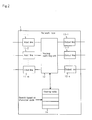
- FIG. 2 shows the construction of a network node used as network nodes 1-1 to 1-7.
- network node 1 includes input lines 11-1 to 11-m, routing switching unit 12, output lines 13-1 to 13-n, and routing table 14.
- Each of input lines 11-1 to 11-m receives a data packet from a network node which is a connection destination of the input line, and transfers the received data packet to routing switching unit 12.
- a character code address which is information regarding designating a terminal reception point, is stored in a header portion of the data packet as a destination identifier.
- the character code is represented by an American standard code for information interchange (ASCII) that is one of the coding schemes.
- Designation of the terminal reception point includes designation of a point, designation of equipment and designation of a person in addition to the designation of a domain name.
- the character code address may have a fixed or variable code length. However, a maximum code length is restricted by the header size of the data packet. For example, the maximum code length is 100 bytes.
- a code indicating the end of the character code address (a code below ASCII) is inserted after the character code address. For instance, in a case where the character code address is 80 bytes, the code indicating the end of the character code address is inserted after 81 bytes. Detecting this code makes it possible to identify the character code address in the header information of the data packet.
- routing switching unit 12 When routing switching unit 12 receives a data packet from any one of input lines 11-1 to 11-m, routing switching unit 12 searches routing table 14 by using a character code address stored in the header portion of the received data packet as a search identifier. Routing table 14 stores information showing the association between the search identifiers (character code addresses) and output lines 13-1 to 13-n. Routing switching unit 12 determines an output line from among output lines 13-1 to 13-n on the basis of the search result, and outputs the received data packet to the determined output line.
- FIG. 3 is a view illustrating a construction example of routing table 14 of FIG. 2 .
- routing table 14 accumulates matching information of character code addresses #1 to #N and output lines 5 to 16 corresponding thereto.
- Exemplary searching methods using routing table 14 include the following first to third searching methods.
- the first searching method compares the character code addresses of routing table 14 entry by entry, starting from the first one, until the matched one is found.
- the second searching method uses a hash function. Concretely, when a search character code is applied to the hash function, 'a position' of a character code address in routing table 14 is expressed as the return value of the hash function. The routing table is read using the return value, to determine an output line.
- the third searching method positions routing table 14 in a content addressable memory (CAM), and supplies a search character code address to the CAM, so that the CAM can output an output line.
- CAM content addressable memory
- Each of network nodes 1-1 to 1-7 is provided with routing table 14 that stores the matching information of the search identifiers and the output lines as shown in FIG. 3 .
- Routing tables 14 are provided in respective network nodes 1-1 to 1-7, corresponding to the input lines.
- FIG. 4 is a flowchart showing the order of the routing process.
- routing switching unit 12 receives a data packet from any one of input lines 11-1 to 11-m (step S10).
- routing switching unit 12 extracts a character code address from the header portion of the received data packet (step S11).
- routing switching unit 12 acquires output line information by searching routing table 14 by using the character code address as a search identifier, and determines an output line from among output lines 13-1 to 13-n (step S12) to transmit the received data packet. Then, routing switching unit 12 transmits the received data packet through the determined output line (step S13).
- the foregoing routing process is performed in all the nodes on the route including a terminal destination node.
- a character code address (character code information) designating a terminal reception point as a destination is directly used as routing information, a process of converting character code information into numeric code information such as the DNS is not necessary. Therefore, since only the character code information is managed as routing information and since the numeric code information does not need not to be managed, a communication system can be reduced in scale and the system configuration can be simplified.
- each of network nodes 1-1 to 1-7 exchanges information necessary for the routing using the character codes between its own node and the other node, to update and manage routing tables 14.
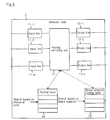
- FIG. 5 is a block view illustrating the construction of a network node that constitutes a telecommunication network according to a second exemplary embodiment of the present invention.
- Network node 2 shown in FIG. 5 is identical in construction to network node 1 shown in FIG. 2 except that routing switching unit 21 can search routing table 14 and binary numeral routing table 22.
- routing switching unit 21 can search routing table 14 and binary numeral routing table 22.
- the same reference numerals are used for the same components in FIGS. 2 and 5 .
- network node 2 includes input lines 11-1 to 11-m, routing table 14, binary numeral routing table 22, routing switching unit 21, and output lines 13-1 to 13-n.
- routing switching unit 21 receives a data packet through any one of input lines 11-1 to 11-m, routing switching unit 21 performs a search process in which routing table 14 is searched based on a character code or a search process in which binary numeral routing table 22 is searched based on a numeric code, and determines an output line from among output lines 13-1 to 13-n.
- FIG. 6 is a view illustrating a construction example of binary numeral routing table 22 of FIG. 5 .
- routing table 22 accumulates matching information of binary numeral addresses #1 to #N and output lines 5 to 16 corresponding thereto.
- the telecommunication network of this exemplary embodiment includes plurality of network nodes 1-1 to 1-7 connected to each other like telecommunication network 100 of FIG. 1 .
- Network nodes 1-1 to 1-7 are identical in construction to network node 2 of FIG. 5 .
- the number and connection form of the network nodes can be appropriately changed.
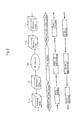
- FIG. 7 is a flowchart showing the order of the routing process.
- routing switching unit 21 receives a data packet from any one of input lines 11-1 to 11-m (step S20).
- routing switching unit 21 extracts a code address from the header portion of the received data packet (step S21), and examines whether the code address is a routing based on a character code or a routing based on a numeric code (step S22).
- routing switching unit 21 searches routing table 14 by using the character code address as a search identifier to acquire output line information, and determines an output line from among output lines 13-1 to 13-n to transmit the received data packet (step S23). Then, routing switching unit 21 transmits the received data packet through the determined output line (step S24).
- routing switching unit 21 searches routing table 22 by using the numeric code address as a search identifier to acquire output line information, and determines an output line from among output lines 13-1 to 13-n to transmit the received data packet (step S25). Then, routing switching unit 21 transmits the received data packet through the determined output line (step S26).
- the foregoing routing process is performed in all the nodes on the route including a terminal destination node.
- the telecommunication network of this exemplary embodiment it is possible to handle general routing based on a numeric code in addition to a routing based on a character code. Therefore, in addition to the effects explained in the first exemplary embodiment, the telecommunication network of this exemplary embodiment is easily applicable to a general telecommunication network where only the routing based on the numeric code is carried out. Moreover, the general telecommunication network can be easily changed into the telecommunication network of this exemplary embodiment.
- FIG. 8 is a block view illustrating the configuration of a telecommunication network according to a third exemplary embodiment of the present invention.
- the telecommunication network of this exemplary embodiment includes a first telecommunication network composed of nodes 1-o and 1-p connected to each other, and a second telecommunication network composed of nodes 1-q and 1-r connected to each other.
- the first and second telecommunication networks are connected to each other through IP network 100 which is a relay section. Meanwhile, in the first and second telecommunication networks, the number and connection form of the network nodes can be appropriately changed.
- Nodes 1-o to 1-r are capable of performing a routing process based on a character code address.
- Nodes 1-o and 1-r are identical in construction to network node 1 of FIG. 2 or network node 2 of FIG. 5 .
- Nodes 1-p and 1-q are basically identical in construction to nodes 1-o and 1-r, but part of the routing process of Nodes 1-p and 1-q is different from that of nodes 1-o and 1-r.
- the routing tables provided in nodes 1-p and 1-q are tables in which information of an IP address given to a header is added to output line information in the routing tables as shown in FIG.3 .
- nodes 1-p and 1-q include a routing table that stores information showing the association between the character code addresses, output lines and IP addresses.
- the routing process explained in the first or second exemplary embodiment is carried out between nodes 1-o and 1-p and between nodes 1-q and 1-r in the first and second telecommunication networks.
- IP network 100 is interposed in a section between nodes 1-p and 1-q.
- a routing switching unit performs the following routing process in nodes 1-p and 1-q.
- the routing switching unit In a case where the routing switching unit receives data packet P1 from another node, the routing switching unit acquires output line information and an IP address by searching the routing table by using a character code address of the header portion of received data packet P1 as a search identifier. Thereafter, the routing switching unit determines an output line on the basis of the acquired output line information, creates new data packet P2 containing the contents of received data packet P1, and records the acquired IP address in a header portion thereof. And, the routing switching unit transmits newly-created data packet P2 to IP network side 100 through the determined output line.
- the routing switching unit receives data packet P2 from IP network 100, the routing switching unit extracts a character code address of the header portion of data packet P1 stored in a data portion of received data packet P2. Thereafter, the routing switching unit acquires output line information by searching the routing table by using the character code address as a search identifier. And, the routing switching unit determines an output line on the basis of the acquired output line information, and transmits data packet P1 through the determined output line.
- a routing based on a character code is applicable to the telecommunication network where the IP network is interposed.
- the routing process in the first to third exemplary embodiments described above is applicable to a data communication method for a communication system in which electronic data such as character data, voice data and image data are transmitted from a source communication device to a destination communication device.
- the process in which electronic data containing a character code designating a terminal reception point is received from another communication device, the character code of the received electronic data is used as a search identifier without converting a format to search a routing table where identification information regarding a plurality of output lines is stored corresponding to character codes indicating terminal reception points of the respective output lines, and the received electronic data is transmitted through the output line determined on the basis of the search result, is carried out.
- the received electronic data to be transmitted may contain the character code whose format is not converted.
- a telephone number may be used to designate a person.
- the telephone number is used as a character code designating a final receiver (call receiver).
- a routing to select a route directly based upon character code information, without converting a character code into a numeric code (IP address) by the DNS.
- IP address a numeric code
- the telecommunication network of the present invention where, both routing based on a character code and routing based on a numeric code can be carried out, is easily applicable to a general telecommunication network where only routing basend on a numeric code is carried out. Further, the general telecommunication network can be easily changed into the telecommunication network of this exemplary embodiment.
- the present invention is applicable to a next-generation integrated telecommunication network (telephone network, mobile network, internet, etc.).
Landscapes
- Engineering & Computer Science (AREA)
- Computer Networks & Wireless Communication (AREA)
- Signal Processing (AREA)
- Data Exchanges In Wide-Area Networks (AREA)
- Telephonic Communication Services (AREA)
Applications Claiming Priority (2)
| Application Number | Priority Date | Filing Date | Title |
|---|---|---|---|
| JP2006335204 | 2006-12-13 | ||
| PCT/JP2007/073962 WO2008072667A1 (fr) | 2006-12-13 | 2007-12-12 | Réseau de télécommunication, dispositif de nœud de réseau et procédé de routage |
Publications (2)
| Publication Number | Publication Date |
|---|---|
| EP2093947A1 true EP2093947A1 (fr) | 2009-08-26 |
| EP2093947A4 EP2093947A4 (fr) | 2012-08-01 |
Family
ID=39511684
Family Applications (1)
| Application Number | Title | Priority Date | Filing Date |
|---|---|---|---|
| EP07859785A Withdrawn EP2093947A4 (fr) | 2006-12-13 | 2007-12-12 | Réseau de télécommunication, dispositif de n ud de réseau et procédé de routage |
Country Status (5)
| Country | Link |
|---|---|
| US (1) | US20100054238A1 (fr) |
| EP (1) | EP2093947A4 (fr) |
| JP (1) | JPWO2008072667A1 (fr) |
| CN (1) | CN101578819A (fr) |
| WO (1) | WO2008072667A1 (fr) |
Families Citing this family (3)
| Publication number | Priority date | Publication date | Assignee | Title |
|---|---|---|---|---|
| US20100124220A1 (en) * | 2008-11-18 | 2010-05-20 | Morris Robert P | Method And Systems For Incrementally Resolving A Host Name To A Network Address |
| JP6053692B2 (ja) * | 2011-12-20 | 2016-12-27 | キヤノン株式会社 | データ転送装置、データ転送方法およびチップ間通信システム |
| CN107231341B (zh) * | 2016-12-27 | 2020-09-15 | 深圳市万网博通科技有限公司 | 报文处理方法和装置 |
Family Cites Families (7)
| Publication number | Priority date | Publication date | Assignee | Title |
|---|---|---|---|---|
| JPH1188427A (ja) | 1997-09-05 | 1999-03-30 | Nippon Telegr & Teleph Corp <Ntt> | ルーティングテーブル検索装置 |
| US6981023B1 (en) * | 1999-03-09 | 2005-12-27 | Michael Hamilton | Message routing |
| US6385615B1 (en) * | 1999-05-21 | 2002-05-07 | Cisco Technology, Inc. | Communicating network information using universal resource locators |
| US6850980B1 (en) * | 2000-06-16 | 2005-02-01 | Cisco Technology, Inc. | Content routing service protocol |
| US7698433B2 (en) * | 2001-03-20 | 2010-04-13 | Verizon Business Global Llc | User aliases in communication system |
| JP2004140776A (ja) * | 2002-07-12 | 2004-05-13 | Nec Corp | ネットワークにおけるフレーム転送方法及びノード、フレーム転送プログラム |
| JP4733432B2 (ja) | 2005-06-01 | 2011-07-27 | 朝日電装株式会社 | ハンドルスイッチ装置 |
-
2007
- 2007-12-12 WO PCT/JP2007/073962 patent/WO2008072667A1/fr not_active Ceased
- 2007-12-12 US US12/515,904 patent/US20100054238A1/en not_active Abandoned
- 2007-12-12 EP EP07859785A patent/EP2093947A4/fr not_active Withdrawn
- 2007-12-12 JP JP2008549339A patent/JPWO2008072667A1/ja active Pending
- 2007-12-12 CN CNA2007800438866A patent/CN101578819A/zh active Pending
Also Published As
| Publication number | Publication date |
|---|---|
| US20100054238A1 (en) | 2010-03-04 |
| EP2093947A4 (fr) | 2012-08-01 |
| WO2008072667A1 (fr) | 2008-06-19 |
| CN101578819A (zh) | 2009-11-11 |
| JPWO2008072667A1 (ja) | 2010-04-02 |
Similar Documents
| Publication | Publication Date | Title |
|---|---|---|
| US7852997B2 (en) | Internet telephony communications adapter for web browsers | |
| BRPI0613848A2 (pt) | método para estabelecer comunicação entre um primeiro dispositivo e um segundo dispositivo, sistema para estabelecer comunicação entre um primeiro dispositivo e um segundo dispositivo, sistema de sinalização e aparelho para comunicação através de uma rede | |
| WO2003041379B1 (fr) | Procede et reseau de communication destines a acheminer un message de communication en temps reel a partir d'un profil d'abonne | |
| EP2093947A1 (fr) | Réseau de télécommunication, dispositif de n ud de réseau et procédé de routage | |
| JP4452282B2 (ja) | ウエブ情報の要求を発信するための電話サービスの使用 | |
| JP2004157991A (ja) | 無線インターネット接続装置及び無線インターネット接続方法 | |
| EP1320269B1 (fr) | Dispositif, méthode et poste téléphonique pour compléter un appel à un réseau de paquets | |
| HK1130975A (en) | Telecommunication network, network node device, and routing method | |
| US7570971B2 (en) | Arrangement for the wireless connection of terminals to a communication system | |
| JP2004260430A (ja) | Ipネット翻訳方式および方法 | |
| EP1892907B1 (fr) | Passerelle de signalisation | |
| US7558860B2 (en) | Updating of software stored in a computer of a data communication system | |
| CN114422420A (zh) | 路由信息处理方法及网络数据管理系统 | |
| JP4633612B2 (ja) | 電話番号管理装置及び電話番号変換方法 | |
| KR100461881B1 (ko) | 문자 전화번호 안내 서비스 시스템 및 방법 | |
| US20030074470A1 (en) | Server communications system, and internet protocol packet transferring method | |
| CN101197755B (zh) | 一种传输sua信令网管消息的方法及装置 | |
| KR100619896B1 (ko) | 이동통신 단말기와 개인정보서버의 데이터 동기화 방법 | |
| JP4669701B2 (ja) | Ip電話交換機およびその着信制御方法 | |
| JP2009302817A (ja) | パケット伝送システム、情報端末、ルータ、パケット伝送方法及びプログラム | |
| JP2005252367A (ja) | サービス提供プラットフォーム装置およびサービス提供方法 | |
| JP6013991B2 (ja) | 呼制御装置及び外線番号を特定する方法 | |
| JP2005167728A (ja) | 通信システム及び通信方法 | |
| JP2003333178A (ja) | 一般電話機によるインターネット電話システム | |
| KR950016097A (ko) | 종합정보통신망과 랜망이 연결된 통신망에서의 신규 랜가입자 추가 접속 방법 |
Legal Events
| Date | Code | Title | Description |
|---|---|---|---|
| PUAI | Public reference made under article 153(3) epc to a published international application that has entered the european phase |
Free format text: ORIGINAL CODE: 0009012 |
|
| 17P | Request for examination filed |
Effective date: 20090527 |
|
| AK | Designated contracting states |
Kind code of ref document: A1 Designated state(s): AT BE BG CH CY CZ DE DK EE ES FI FR GB GR HU IE IS IT LI LT LU LV MC MT NL PL PT RO SE SI SK TR |
|
| REG | Reference to a national code |
Ref country code: HK Ref legal event code: DE Ref document number: 1130975 Country of ref document: HK |
|
| DAX | Request for extension of the european patent (deleted) | ||
| A4 | Supplementary search report drawn up and despatched |
Effective date: 20120703 |
|
| RIC1 | Information provided on ipc code assigned before grant |
Ipc: H04L 12/56 20060101AFI20120627BHEP Ipc: H04L 29/12 20060101ALI20120627BHEP |
|
| STAA | Information on the status of an ep patent application or granted ep patent |
Free format text: STATUS: THE APPLICATION HAS BEEN WITHDRAWN |
|
| 18W | Application withdrawn |
Effective date: 20121102 |
|
| REG | Reference to a national code |
Ref country code: HK Ref legal event code: WD Ref document number: 1130975 Country of ref document: HK |