EP2094023A1 - Procédé et dispositif pour poussser des informations - Google Patents
Procédé et dispositif pour poussser des informations Download PDFInfo
- Publication number
- EP2094023A1 EP2094023A1 EP08715219A EP08715219A EP2094023A1 EP 2094023 A1 EP2094023 A1 EP 2094023A1 EP 08715219 A EP08715219 A EP 08715219A EP 08715219 A EP08715219 A EP 08715219A EP 2094023 A1 EP2094023 A1 EP 2094023A1
- Authority
- EP
- European Patent Office
- Prior art keywords
- category
- information
- communication terminal
- short message
- message
- Prior art date
- Legal status (The legal status is an assumption and is not a legal conclusion. Google has not performed a legal analysis and makes no representation as to the accuracy of the status listed.)
- Withdrawn
Links
Images



Classifications
-
- G—PHYSICS
- G06—COMPUTING OR CALCULATING; COUNTING
- G06Q—INFORMATION AND COMMUNICATION TECHNOLOGY [ICT] SPECIALLY ADAPTED FOR ADMINISTRATIVE, COMMERCIAL, FINANCIAL, MANAGERIAL OR SUPERVISORY PURPOSES; SYSTEMS OR METHODS SPECIALLY ADAPTED FOR ADMINISTRATIVE, COMMERCIAL, FINANCIAL, MANAGERIAL OR SUPERVISORY PURPOSES, NOT OTHERWISE PROVIDED FOR
- G06Q30/00—Commerce
- G06Q30/02—Marketing; Price estimation or determination; Fundraising
-
- H—ELECTRICITY
- H04—ELECTRIC COMMUNICATION TECHNIQUE
- H04L—TRANSMISSION OF DIGITAL INFORMATION, e.g. TELEGRAPHIC COMMUNICATION
- H04L12/00—Data switching networks
- H04L12/02—Details
- H04L12/16—Arrangements for providing special services to substations
- H04L12/18—Arrangements for providing special services to substations for broadcast or conference, e.g. multicast
- H04L12/1859—Arrangements for providing special services to substations for broadcast or conference, e.g. multicast adapted to provide push services, e.g. data channels
-
- H—ELECTRICITY
- H04—ELECTRIC COMMUNICATION TECHNIQUE
- H04L—TRANSMISSION OF DIGITAL INFORMATION, e.g. TELEGRAPHIC COMMUNICATION
- H04L51/00—User-to-user messaging in packet-switching networks, transmitted according to store-and-forward or real-time protocols, e.g. e-mail
- H04L51/58—Message adaptation for wireless communication
-
- H—ELECTRICITY
- H04—ELECTRIC COMMUNICATION TECHNIQUE
- H04L—TRANSMISSION OF DIGITAL INFORMATION, e.g. TELEGRAPHIC COMMUNICATION
- H04L67/00—Network arrangements or protocols for supporting network services or applications
- H04L67/50—Network services
- H04L67/55—Push-based network services
-
- H—ELECTRICITY
- H04—ELECTRIC COMMUNICATION TECHNIQUE
- H04W—WIRELESS COMMUNICATION NETWORKS
- H04W4/00—Services specially adapted for wireless communication networks; Facilities therefor
- H04W4/12—Messaging; Mailboxes; Announcements
- H04W4/14—Short messaging services, e.g. short message services [SMS] or unstructured supplementary service data [USSD]
Definitions
- the present invention relates to the communication field, and in particular, to a method and apparatus for pushing messages to communication terminals.
- SMS Short Message Service
- MS Mobile Station
- SMS-based advertisements in the traditional art are sent in groups, without differentiating the recipients. That is, the SMS-based advertisements are sent in groups to all MSs without differentiating the MSs according to their user's hobbies.
- This mode that the SMS-based advertisements are sent in groups has the following defects: (1) In the group transmission mode, the specific requirements of users can not be met; (2) The group transmission mode leads to plenty of junk short messages, and wastes public communication resources.
- SMS-based advertisements it is necessary to discover the interests and hobbies of users, understand the instant and potential requirements of the users, and provide individualized SMS-based advertisement services for the users.
- Embodiments of the present invention provide a method and apparatus for pushing messages, so as to sort out real target MSs and push messages to them by analyzing the correlation between the messages sent by MSs and the messages to be pushed to MSs.
- a method for pushing messages includes:
- categorizing a first message according to a first category set creating a first mapping relation between the first message and the category in the first category set; categorizing a second information sent by a message source according to a second category set, and creating a second mapping relation between the message source that sends the second information and the category in the second category set;
- An apparatus for pushing messages includes:
- a first message processing module adapted to categorize a first message according to a first category set, and create a first mapping relation between the first message and the category in the first category set;
- a second information processing module adapted to obtain a second information sent by a message source, categorize the second information according to a second category set, and create a second mapping relation between the message source that sends the second information and the category in the second category set according to the categorization result;
- a message matching module adapted to sort out each category in the second category set that matches the corresponding category in the first category set which is in the first mapping relation with the first message according to the relation between the category in the first category set and the category in the second category set, and determine the corresponding message source according to the second mapping relation;
- a message pushing module adapted to push the first message to the determined corresponding message source.
- the user requirements are analyzed according to the messages sent by MSs, and the messages to be pushed are matched with reqirements, and the specific MS group for receiving the messages to be pushed is determined, thus meeting the specific requirements of the users, overcoming the blindness of pushing messages, and avoiding waste of public communication resources.
- Figure 1A and Figure 1B are flowcharts of pushing advertisements to a specific MS according to the short messages sent by the MS of the user in an embodiment of the present invention
- Figure 2 is a flowchart of preprocessing and integrating short messages in an embodiment of the present invention
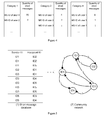
- Figure 3 shows categorization of short messages in an embodiment of the present invention
- Figure 4 is a user interest measure list provided in an embodiment of the present invention.
- Figure 5 shows a process of obtaining a user community network according to the short message database in an embodiment of the present invention
- Figure 6 is a flowchart of entering an advertisement and categorizing the advertisement in an embodiment of the present invention.
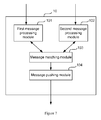
- Figure 7 shows a structure of an apparatus for pushing messages in an embodiment of the present invention.
- a first message is an advertisement message (including but not limited to product advertisement, service broadcast, or service advertisement);
- a message source is a communication apparatus that can send messages, for example, an MS;
- a second information is short messages sent by the MS through the Short Message Service Center (SMSC).
- SMSC Short Message Service Center
- the short messages sent by the MS need to be categorized, and the advertisements with different contents need to be categorized.
- the MSs suitable for receiving different advertisements to be pushed may be determined.
- each short message category uniquely corresponds to an advertisement category.
- Figure 1A and Figure 1B are flowcharts of pushing advertisements to a specific MS according to short messages sent by an MS of a user in an embodiment of the present invention.
- Figure 1A includes the following steps:
- Step S 11 Collecting short messages sent by an MS of a user, and storing the short messages into a database.
- Step S12 Preprocessing and integrating short message data of the user.
- Step S 13 Categorizing integrated short message text.
- Step S 14 Creating a mapping relation between identifier of the MS that sends the short messages and each short message category, and creating a user interest measure list for each short message category.
- Step S 15 Creating a community network for exchanging short messages between MSs according to the short messages stored in the short message database.
- Step S16 Determining a dominant user list according to the created community network.
- steps S12, S 13, and S 14 may be performed before or after S15 and S16, or may be performed concurrently with S15 and S16.
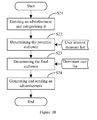
- An embodiment showed in figure 1B includes the following steps:
- Step S21 Entering advertisements and categorizing the advertisements.
- Step S22 Determining a user interest measure list specific to the advertisement among the created user interest measure lists according to the category of the current advertisement, namely, determining the potential audience.
- Step S23 Determining the final audience, namely, the MSs to which the advertisement is finally pushed, according to the determined user interest measure list (potential audience) and the dominant user list.
- Step S24 Generating advertisements of different styles according to different categories of MSs, and sending the advertisements to the corresponding MSs.
- Step S11 is detailed below:
- the short message database may be created by a database management system based on the conventional art, for example, an Oracle system.
- the table structure of the short message database includes at least: a sender terminal identifier (ID), a recipient terminal identifier (ID), short message sending time, and short message content, as shown in Table 1: Table 1 Sender ID Recipient ID Date and Time of Sending Short Message Content
- the sender and recipient of a short message may be an ordinary user or an entity connected to the SMSC, namely, a Short Message Entity (SME).
- SME Short Message Entity
- the short message of an SME does not reflect the personal interest of the user. Therefore, the embodiment of the present invention mainly relates to the point-to-point short messages of ordinary users.
- the short messages sent by ordinary users are collected.
- the short messages sent by the user may be in diversified forms, for example, plain text message, and multimedia message that carries sound, image and video. This embodiment supposes that the collected short messages are text messages of ordinary users.
- the short messages may be collected in different ways, for example:
- Collection mode 1 Receiving the short messages sent by the communication terminal and forwarded by the SMSC in real time.
- Collection mode 2 Obtaining the short messages from the original bill files of the communication terminal, namely, using the original bill files on the accounting server as data sources, and reading each short message from the original bill files;
- Collection mode 3 Monitoring and obtaining the short messages sent by the MS to the SMSC.
- a time period of collecting short messages may be set.
- the short messages are collected daily, weekly or monthly.
- the collected short message data is available for subsequent analyzing and processing.
- Step S12 is detailed below:
- a specific removing method is: A threshold value k is set according to the data collection time. If the quantity of short messages sent by a mobile phone number exceeds that threshold value, the mobile phone number is determined as a group transmitting number, and all short message data sent by the mobile phone number needs to be deleted from the short message database.
- the quantity of short messages sent by a specific mobile phone number may be determined by using the statistic function of the database management system.
- the short message carries a small number of characters; sometimes a content is sent through several short messages.
- the topics of message communication with different recipients are not necessarily the same. Therefore, the short messages are clustered according to the short message content with reference to the time dependencies and object dependencies of the short message text.
- the time dependencies and object dependencies may be obtained through sorting of the short message database, where primary keyword is the MS number of the short message sender and secondary keyword is the MS number of the short message recipient.
- an embodiment of the present invention provides a text integration method based on sliding windows.
- the specific method is: A proper window size "w" (w is a natural number) is predetermined.
- w is a natural number
- the similarity is calculated between the new short message text and the latest w integrated short message texts, and the most similar short message texts with similarity higher than the threshold are integrated.
- FIG. 2 is a flowchart of preprocessing and integrating short messages in an embodiment of the present invention. The process includes:
- Step S30 Setting a group transmitting threshold k, a sliding window size w (that is, the quantity of the short message in the sliding window is w), and a similarity threshold d.
- Step S31 Sorting the short message database by using the sender number as a primary keyword and using the recipient number as a secondary keyword.
- Step S32 Deleting all the records with the quantity of sent short messages exceeding the threshold k in the database, namely, deleting the records of short messages sent in groups.
- Step S33 Judging whether the short message database contains any unprocessed short message; if any unprocessed short message is contained, proceeding to the following steps; if no unprocessed short message is contained, ending the process.
- Step S34 Reading a next short message.
- Step S35 Retrieving the vector of the read short message.
- Step S36 Calculating the similarity between the vector of the current short message and that of the w previous short messages.
- Step S37 Judging whether the similarity is greater than the similarity threshold d; if it is greater, proceeding to step S38; otherwise, proceeding to step S39.
- Step S38 Integrating the short message with the text of the short message which has the greatest similarity, and going back to step S33.
- Step S39 The short message is showed in the sliding window as a new text, and the sliding window slides one pane down; and going back to step S33.
- a group transmitting threshold, a similarity threshold and a sliding window size need to be specified beforehand. Such parameters are adjustable as required.
- step S36 the text similarity can be calculated in the following way:
- V ⁇ X 1 , X 2 , X 3 , ..., X n ⁇ , where X;is a feature word.
- V 1 ( ⁇ 1 , ⁇ 2 , ⁇ , ⁇ n )
- ⁇ i the frequency of the feature word X i in the text S1
- V 2 ( ⁇ 1 , ⁇ 2 , ⁇ , ⁇ n )
- ⁇ i the frequency of the feature word X i in the text S2.
- step S38 the texts are integrated by adding the frequency of the corresponding feature words and normalizing them. Specifically, supposing that the vector of the text S1 and text S2 are represented by the above formulas, the vectors corresponding to feature items are added up and then the integrated texts are standardized.
- Step S39 the time of sending the new text is the time of sending the newly integrated text.
- the quantity of original short messages corresponding to the new text is recorded at the time of integrating the vector of the text. In practice, it can be realized by adding 1 to the quantity of the short messages included in the new text at each time of integrating.
- Table 2 shows a format of the preprocessed and integrated short message text: Table 2 Sender ID Date and Time of Sending Short Message Text Vector Quantity of Original Short Messages
- the integrated short message texts may be stored into a database, or saved as a file or other formats.
- the time dependencies, object dependencies and content dependencies specific to short messages are applied. Therefore, the integrated short message texts have relatively centralized topics, the quantity of short messages is slashed, and the integrated short message texts are easier to categorize subsequently.
- Step S 13 is detailed below:
- the short message text categorization is to arrange the short message text sent by the MS into a predefined short message category.
- the technologies for categorizing Chinese texts include one of the following: Multi-classifier integration method, Support Vector Machine (SVM), K-Nearest Neighbor (KNN) method, Naive Bayes method, decision tree, neural network, and maximum entropy model, which are all applicable to the categorization process herein.
- SVM Support Vector Machine
- KNN K-Nearest Neighbor
- Naive Bayes method Naive Bayes method
- decision tree decision tree
- neural network neural network
- maximum entropy model which are all applicable to the categorization process herein.
- the separation plane model of the SVM overcomes the impact of sample distribution, redundancy features, and over-fitting, and is highly capable of generalization and superior to other methods in terms of effect and stability. Therefore, the SVM method is preferred herein as a categorization algorithm.
- the present invention is not limited to the SVM algorithm
- LIBSVM Library for Support Vector Machines
- the training set is categorized manually.
- the selection of the training texts needs to cause little difference between the quantity of one category of texts and the quantity of another.
- VSM Vector Space Model
- the training set may be expressed as:
- T T i
- T i W i c i , c i ⁇ C
- W i is the vector of training text i in the training set
- C is the manually sorted category set (namely, the second category set) of the vector.
- n is the dimension of the vector.
- the text model training is performed through an LIBSVM tool.
- the training steps are as follows:
- the system parameters may be set through the svm_parameter method provided by the LIBSVM software package.
- the default value of the parameter y of the RBF kernel function is 0.5;
- the svm_type attribute has five optional values: C_SVC, NU_SVC, ONE_CLASS, EPSILON_SVR, and NU_SVR, and C_SVC is used in this embodiment;
- the C attribute indicates the quantity of categories, and is set to the number of elements in the category set, namely, "m";
- the "kernel_type” attribute has five optional values: LINEAR, POLY, RBF, SIGMOID, and PRECOMPUTE, and RBF is used in this embodiment;
- the "shrinking" attribute is set to 1 in this embodiment.
- the buffer size is set to 40 MB and the operation precision is set to 0.001 in this embodiment.
- Such parameters correspond to "cache_size”, “eps”, and “shrinking" attributes of svm_parameter respectively.
- the parameters selected in this embodiment are:
- the training set serves as the input of the SVM.
- a categorization model of the categorizer of the SVM is generated.
- svm_problem is used to describe the current categorization.
- the l attribute of svm_problem is set to describe the quantity of elements in the training set T;
- the x attribute is set to describe the training text vector set of the training set T, and
- the y attribute is set to describe the category set of the corresponding training text.
- the x attribute of svm_problem is a 2-dimensional svm_node array.
- the first dimension is set to the quantity of elements in the training set T
- the second dimension is set to the dimension of the training text vector in the training set T.
- Each element in the training set T corresponds to a line in x.
- its "index" attribute is set to "j+1”
- its "value” attribute is set to the value of dimension j of the vector of training text i in the training set.
- the y attribute of svm_problem is a 1-dimensional array, and the value of y is the quantity of elements in the training set T. For dimension i of y, its value is set to category c i of training text i in the training set T.
- the static svm_train method of the SVM may be invoked to implement the training of the SVM categorizer.
- This method uses svm_problem and svm_parameter as parameters, both having been set in the steps described above.
- the returned value of the svm_train method is the object of the svm_model type, and this object is the SVM categorizer model.
- the LIBSVM software package provides the function of predicting the category of an unknown text by using the SVM categorizer model.
- the vector w d of an unknown text is entered in the same way of entering the training data in the training set except that the "value" attribute of the corresponding svm_node does not need to be set.
- the predication is implemented by invoking the static svm_predict method of the SVM.
- This method uses svm_model and svm_node arrays as parameters.
- the svm_model array is the SVM categorizer model in step 3, and the svm_node array corresponds to the data entered for the text of the category to be predicted.
- the svm_predict method returns the text category predicted through the svm_model.
- each short message text is included into a specific category.
- a category file is created beforehand. If the category of a short message is determined, the MS number that sends the short message text is recorded into the category. That is, a mapping relation is created between the ID of the MS that sends the short message and the corresponding category.
- Each category includes several IDs of MSs that send the corresponding category of short messages, for example, MS ID of user 1, MS ID of user 2, MS ID of user 3, and MS ID of user 4.
- An MS may be included into multiple categories. For example, in Figure 3 , the MS of user 1 is included into category 1, category 2 and category m.
- a category may include a same MS ID repeatedly.
- category 1 includes "MS ID of user 1" twice.
- MSs included in a category are disorderly. For example, "MS ID of user 1" and “MS ID of user 2" in category 1 are not sequential.
- the categorization result includes a large amount of data; for each integrated text that needs to be categorized, a result corresponding to it exists in the result set; that is, the categorization result includes the MS ID corresponding to the integrated short message text, and the quantity of short messages included in an integrated short message text.
- category 1 includes two MS IDs of user 1, which correspond to 8 short messages and 12 short messages respectively.
- the categorization result includes a large amount of data, and the MS IDs in each category are disorderly. Such data cannot express the interest of different MS users toward a specific category directly, thus affecting the correctness of pushing the SMS-based advertisements.
- Step S14 is detailed below:
- a user interest measure list shown in Figure 4 is generated according to the categorization result of the foregoing SVM categorizer.
- the same MS ID does not appear in the same category repeatedly.
- the MS that appears at a higher frequency in a specific category is more interested in this category.
- a category includes the same MS usually more than once. Therefore, the result requires less storage space than the data result set after SVM categorization.
- a weight may be assigned to each categorization result that appears at different time to calculate the extent of the user interest.
- the short message texts are chronological, and the short message that arrives earlier appears in the categorization result earlier.
- a lower weight value is assigned to the earlier categorization result, and a higher weight value is assigned to the later categorization result.
- the calculated interest extent better reflects the latest interest and requirements of the user. If the short messages are rather old, the weighted interest calculation method is preferred.
- step S15 the method for creating a community network according to the short message database in step S15 is described below:
- the community network is discovered from the perspective of the short message receiving/sending of the MS.
- the frequently communicating users are generally closely related, and the seldom communicating users are little related. Therefore, the short message interaction between users and the frequency of interaction decide the user's influence extent and influence range in the community.
- Figure 5 shows an instance of a user community obtained from the short message database.
- ID1, ID2, ID3, ID4 and ID5 represent different MS IDs respectively.
- the sender MS ID (such as a mobile number) and the recipient MS ID (such as a mobile number) of short message i are read from the short message database.
- the communication network obtained through the foregoing method may be very huge.
- the most complex situation is: The MSs of all users are directly or indirectly related so that all MS users are in the same community network. Besides, the user may enter incorrect numbers occasionally. The mistakenly sent short messages do not indicate close relationships between users. Consequently, the obtained network does not reflect the relationships between users exactly.
- Method 1 A strongly connected component is found in the community network.
- a strongly connected component means that all nodes are mutually reachable, and "reachable” means that a directional simple path exists between nodes.
- Method 2 Only the relationships between frequently contacted users are considered, and the relationships between seldom contacted users are ignored. In practice, the edges whose weight is less than a threshold are deleted from the network.
- the threshold may be selected according to the actual conditions of the system, and generally ranges from 2 to 5.
- the directional network includes several connected components. Connected components may be obtained from the directional network through many methods such as the depth-first traversal algorithm.
- the network uses an adjacency matrix or adjacency table as a storage structure.
- the adjacency table is preferred as a storage structure.
- the table head node stores a vector.
- the head node includes at least a field for storing the MS number of the user and a pointer that points to the first adjacent edge; the table node indicates an edge and includes at least two data fields: the pointer to the next adjacent node and the weight of this edge.
- step S16 the detailed process of determining dominant users according to the community network includes:
- this embodiment defines the user's dominant coefficient to ensure enough coverage of the short message.
- the quantity of dominant users is controlled within a proper value range.
- the calculation of the dominant coefficient depends on the user's dominance extent and dominance range.
- a i,j is a weight on arc ⁇ vi,vj>, namely, the quantity of short messages sent by MS i to MS j;
- a j,i is a weight on arc ⁇ vj,vi>, namely, the quantity of short messages received by MS i from MS j;
- r i represents the dominance range of communication terminal i
- d i,out represents the total quantity of short messages sent by communication terminal i
- d i,in represents the total quantity of short messages received by communication terminal i
- L i ⁇ 1 ⁇ p i avg p + ⁇ 2 ⁇ r i avg r
- p i is the dominance extent of MS i; avg ( p ) is the average dominance extent of all MSs; r i is the dominance range of MS I; avg ( r ) is the average dominance range of all MSs.
- the weight between the dominance extent and the dominance range is adjustable according to the actual conditions.
- Table 3 reveals that the final dominant coefficients of the five users are ranked as ID3, ID1, ID5, ID2, and ID4 sequentially.
- a typical result of the sequence list is shown in Table 4: Table 4 MS ID Dominant Coefficient ID3 1.739 ID1 1.259 ID5 1.186 ID2 0.593 ID4 0.223
- the user interest measure list is created for a specific short message category (corresponding to the advertisement category) according to the short message interaction between MSs; and a dominant user list is determined according to the created community network.
- Step S21 is detailed below:
- Figure 6 is a flowchart of inputting an advertisement and categorizing the advertisement.
- the advertisement information needs to be inputted, and the information is in the form of text information.
- the advertisement information needs to be further categorized, and the category information of the advertisement information may also be inputted as required.
- the category information is consistent with the short message category information, both being predefined. If the category of the advertisement is specified, the advertisement form may be text or any other form such as video, image or audio.
- the advertisements may be inputted one by one, or the advertisement information is pre-stored into a file or database file and then inputted in batches.
- the advertisement needs to be categorized.
- the advertisement texts may be categorized in many ways. One advertisement may belong to multiple product categories. Therefore, the one-category categorization algorithms such as SVM are not applicable.
- the categorization algorithm shown in Figure 6 is used to include a single advertisement text into multiple categories. The categorization process is as follows:
- Step S40 Reading an advertisement.
- Step S41 Determining whether to perform automatic categorization or manual categorization; for automatic categorization, proceeding to step S42; for manual categorization, proceeding to step S43.
- Step S42 According to the predefined advertisement category, if the category of the current advertisement is inputted, finishing the categorization of the current advertisement.
- the method is detailed below:
- Tij represents dimension j of text vector i in the training set T of category i and k is the quantity of elements in T.
- Barycenter Center ij of dimension j is calculated through:
- Step S45 Calculating the equivalent radius through:
- R ij Equal ⁇ ij ⁇ R ij - + 1 - ⁇ ij ⁇ R ij +
- n ij + is the quantity of texts to the left of Center ij and is the quantity of texts to the right of Center ij .
- Step S46 Calculating the distance ( S i ) from the advertisement to each category:
- 1/ ⁇ 2 is a distance coefficient.
- the categorizer function is not sensitive to this variable, and ⁇ is 10 in this embodiment.
- the value of S i ( W d' ) is calculated to obtain the distance value of the advertisement vector to category i. Smaller values of S i ( W d' ) indicate that the advertisement is closer to the corresponding category.
- Step S47 Finally, determining the category of the advertisement.
- Step S22 of determining the user interest measure list is detailed below:
- the list of users who are interested in the advertisement needs to be determined.
- the users in the list are MS users who are interested in the given advertisement, and are arranged from high interest to low interest.
- a i For an advertisement A i to be pushed, through advertisement categorization, A i is included into category set R i ⁇ C.
- a i For the category c j ⁇ R i included in R i , according to the user interest measure list determined in step S 14, all the MS users who are interested in the advertisement may be obtained with reference to the category of the advertisement. The method is detailed below:
- the MS ID in a mapping relation with the category in R i is the MS which is interested in advertisement A i .
- I ji is arranged in descending order to obtain a list of users who are interested in the advertisement, namely, a user interest measure list (with the MS ID representing the user).
- Step S23 of determining the final audience is detailed below:
- the user interest measure list obtained in step S22 is a list of potential audience. To achieve a better advertisement effect and save advertisement costs, the audience needs to be sifted:
- the sifting of audience is based on the following reasons:
- the user interest measure list includes multitudinous results and the users who are little interested in the advertisement. If the advertisement is pushed to such users, the advertisement does not arouse the interests of the users and is regarded as a junk message, and is even blacklisted, which makes more advertisement messages unable to be sent in the future. On the other hand, sending of numerous short messages occupies massive network resources, and even leads to network congestion and affects normal sending of short messages.
- the interest and dominant coefficient serve as an inner product, and a new interest-dominant user list is generated according to the obtained interest dominance extent.
- ILi is the interest dominance extent of user i
- Iii is the interest of the user corresponding to MS i toward category i advertisements determined through the foregoing method
- Li is the dominant coefficient of MS i determined through the foregoing method.
- the sequence of the MS IDs decided by this inner product is the sequence of the theoretic effects achievable by sending the advertisement to the corresponding users.
- Table 5 MS ID Interest Dominance Extent ID1 1.658 ID2 1.012 ⁇ IDU 0.125
- the operator specifies the size (N) of the audience specific to the advertisement to be sent.
- the final audience is obtained from three aspects: user interest measure list, dominant user list, and interest-dominant user list.
- N*40% users that show higher interest may be selected as the first part of the final audience from the user interest measure list (N*40% is adjustable; in this embodiment, the upper threshold quantity of users interested in the commodities is 40%).
- Dominant users are users who are representative of the community, and are interested in the sent short messages. Therefore, in practice, the users not interested in the category of the current advertisement are removed from the dominant user list first; and then N*10% users with a greater dominant coefficient are selected as the second part of the final audience from the remaining dominant user list (N*10% is adjustable; in this embodiment, the upper threshold quantity of dominant users is 10%).
- the selected first part and the second part are removed from the interest-dominant user list, and N*50% users are selected from the remaining list as the third part of the final audience.
- An advertisement is sent in either of the following two ways:
- the advertisement is sent to all selected users, with the content and form of the advertisement being the same;
- the advertisement may be pushed through the SMS group transmission platform in the prior art. Therefore, the SMS-based advertisements in the foregoing two forms are transmitted to the SMS transmission platform in the prior art for being sent directly.
- the MS may have different features and functions.
- the screens of different MSs may have different sizes and support different quantities of colors.
- some MSs support only text messages, and some support voice messages, image messages and even video messages. Therefore, an optional implementation method is to push advertisements of different forms to the MSs according to different features of the MSs, with a view to maximizing the concern of the MS users about the advertisements.
- the features of the MSs vary sharply. If an advertisement is prepared with reference to all such features, a huge overhead is involved. Such overhead includes not only the overhead for preparing different short message forms, but also a high time overhead caused by selecting an advertisement form for each different MS. Therefore, only two basic implementation modes are considered, namely, the forms of the SMS-based advertisements are limited to: plain text short message, and Multimedia Message Service (MMS) message.
- MMS Multimedia Message Service
- MSs may be obtained through many methods.
- MS identification technology in the Wireless Access Protocol (WAP) application is mature, and may be used directly.
- WAP Wireless Access Protocol
- the foregoing embodiments of the present invention provide a method for pushing a corresponding category of advertisements to the MS according to the short messages sent by the MS. Accordingly, an apparatus 10 for pushing messages is provided, as shown in Figure 7 .
- the apparatus 10 includes:
- a first message processing module 101 adapted to: categorize a first message according to a first category set, and create a first mapping relation between the first message and the category in the first category set;
- a second information processing module 102 adapted to: obtain a second information sent by a message source, categorize the second information according to the second category set, and create a second mapping relation between the message source that sends the second information and the category in the second category set according to the categorization result;
- a message matching module 103 adapted to: sort out each category in the second category set that matches the corresponding category in the first category set which is in the first mapping relation with the first message according to the relation between the category in the first category set and the category in the second category set, and determine the corresponding message source according to the second mapping relation;
- a message pushing module 104 adapted to push the first message to the determined corresponding message source.
- the second information processing module 102 is adapted to:
- the second information processing module 102 is further adapted to: create a directional network according to the short messages stored in the local short message database by using the communication terminal ID as a network node, using the short message receiving and sending between communication terminals as a directional arc, and using the quantity of exchanged short messages as an arc weight;
- the foregoing message matching module 103 is adapted to: obtain the category in a mapping relation with the first message in the first message processing module, and determine the user interest measure list correlated with the first message; and select several communication terminals from the determined user interest measure list in order of higher interest to lower interest according to the size of audience of the first message.
- the message pushing module 104 pushes the first message to the selected communication terminals.
- the foregoing message matching module 103 is further adapted to: determine the interest of each communication terminal toward the first message according to the quantity of short messages corresponding to each communication terminal ID in the user interest measure list correlated with the first message and according to the similarity between the first message and the category in a mapping relation with the first message; generate a user interest measure list specific to the first message; and select several communication terminals from the determined user interest measure list in order of higher interest to lower interest according to the size of audience of the first message.
- the message pushing module pushes the first message to the communication terminals selected from the user interest measure list.
- the foregoing message matching module 103 is further adapted to select several communication terminals from the dominant user list generated by the second information processing module 102 in order of higher dominant coefficient to lower dominant coefficient according to the size of audience of the first message.
- the message pushing module 104 pushes the first message to the communication terminals selected from the dominant user list.
- the user requirements are analyzed according to the message (the second information, exemplified by the short message sent by the MS in the foregoing embodiments) sent by the user; the user requirements are correlated and matched with the message to be pushed (the first message, exemplified by the advertisement pushed to the user in the foregoing embodiments) to determine the specific user groups; and the first message is pushed to the determined user groups, thus meeting the specific requirements of the user, overcoming the blindness of pushing the first message (fore example, advertisement) and avoiding waste of public communication resources.
Landscapes
- Engineering & Computer Science (AREA)
- Computer Networks & Wireless Communication (AREA)
- Signal Processing (AREA)
- Business, Economics & Management (AREA)
- Accounting & Taxation (AREA)
- Development Economics (AREA)
- Strategic Management (AREA)
- Finance (AREA)
- Game Theory and Decision Science (AREA)
- Entrepreneurship & Innovation (AREA)
- Economics (AREA)
- Marketing (AREA)
- Physics & Mathematics (AREA)
- General Business, Economics & Management (AREA)
- General Physics & Mathematics (AREA)
- Theoretical Computer Science (AREA)
- Information Transfer Between Computers (AREA)
- Information Retrieval, Db Structures And Fs Structures Therefor (AREA)
Applications Claiming Priority (2)
| Application Number | Priority Date | Filing Date | Title |
|---|---|---|---|
| CN200710087413A CN101026802B (zh) | 2007-03-16 | 2007-03-16 | 一种信息推送方法与装置 |
| PCT/CN2008/070483 WO2008113290A1 (fr) | 2007-03-16 | 2008-03-12 | Procédé et dispositif pour poussser des informations |
Publications (2)
| Publication Number | Publication Date |
|---|---|
| EP2094023A1 true EP2094023A1 (fr) | 2009-08-26 |
| EP2094023A4 EP2094023A4 (fr) | 2010-05-19 |
Family
ID=38744622
Family Applications (1)
| Application Number | Title | Priority Date | Filing Date |
|---|---|---|---|
| EP08715219A Withdrawn EP2094023A4 (fr) | 2007-03-16 | 2008-03-12 | Procédé et dispositif pour poussser des informations |
Country Status (4)
| Country | Link |
|---|---|
| US (1) | US20100075701A1 (fr) |
| EP (1) | EP2094023A4 (fr) |
| CN (1) | CN101026802B (fr) |
| WO (1) | WO2008113290A1 (fr) |
Cited By (2)
| Publication number | Priority date | Publication date | Assignee | Title |
|---|---|---|---|---|
| CN102957746A (zh) * | 2012-10-29 | 2013-03-06 | 百度在线网络技术(北京)有限公司 | 一种向移动终端推送广告信息的方法及系统 |
| EP3144824A4 (fr) * | 2014-05-15 | 2017-05-10 | ZTE Corporation | Procédé et dispositif d'acquisition d'informations de système de boîte vocale |
Families Citing this family (46)
| Publication number | Priority date | Publication date | Assignee | Title |
|---|---|---|---|---|
| US20090012841A1 (en) * | 2007-01-05 | 2009-01-08 | Yahoo! Inc. | Event communication platform for mobile device users |
| CN101026802B (zh) * | 2007-03-16 | 2012-10-17 | 华为技术有限公司 | 一种信息推送方法与装置 |
| CN101516071B (zh) * | 2008-02-18 | 2013-01-23 | 中国移动通信集团重庆有限公司 | 垃圾短消息的分类方法 |
| CN101959156B (zh) * | 2009-07-20 | 2014-07-23 | 中国移动通信集团公司 | 信息推送方法、装置及推送对象识别装置 |
| CN101620717A (zh) * | 2009-07-22 | 2010-01-06 | 中兴通讯股份有限公司 | 一种用户需求的分析方法及系统 |
| CN102457822A (zh) * | 2010-10-21 | 2012-05-16 | 中国移动通信集团福建有限公司 | 一种移动通信系统中的网络社区数据库生成方法和设备 |
| CN102045391A (zh) * | 2010-12-09 | 2011-05-04 | 向心力信息技术股份有限公司 | 一种信息推送方法 |
| US8566156B2 (en) * | 2011-07-05 | 2013-10-22 | Yahoo! Inc. | Combining segments of users into vertically indexed super-segments |
| CN103209398B (zh) * | 2012-01-17 | 2015-12-09 | 阿里巴巴集团控股有限公司 | 灰名单建立的方法和系统以及短信发送的方法和系统 |
| CN102572108A (zh) * | 2012-01-31 | 2012-07-11 | 盘丝无限(北京)科技有限公司 | 一种优化手机消息服务的方法和系统 |
| CN102663001A (zh) * | 2012-03-15 | 2012-09-12 | 华南理工大学 | 基于支持向量机的博客作者兴趣与性格自动识别方法 |
| US8897424B2 (en) * | 2012-07-11 | 2014-11-25 | Oracle International Corporation | Automatic clustering and visualization of data trends |
| CN102801817B (zh) * | 2012-09-07 | 2015-07-15 | 深圳市学之泉集团有限公司 | 基于用户上下文的推送方法及装置 |
| CN103716223A (zh) * | 2012-09-28 | 2014-04-09 | 北京网秦天下科技有限公司 | 一种信息推送的方法和系统 |
| CN103714474A (zh) * | 2012-10-08 | 2014-04-09 | 阿里巴巴集团控股有限公司 | 推广信息投放方法及信息服务器 |
| EP2770788B1 (fr) | 2013-01-18 | 2020-02-26 | Huawei Technologies Co., Ltd. | Procédé, dispositif et système de notification poussée |
| CN104065677B (zh) * | 2013-03-20 | 2018-05-25 | 腾讯科技(深圳)有限公司 | 一种业务数据推荐方法及设备 |
| CN104112210B (zh) * | 2013-04-17 | 2018-01-23 | 华为技术有限公司 | 一种推送广告的方法及设备 |
| CN103517227A (zh) * | 2013-07-24 | 2014-01-15 | 北京宽连十方数字技术有限公司 | 一种短信Adsense服务系统及其实现方法 |
| US9836517B2 (en) * | 2013-10-07 | 2017-12-05 | Facebook, Inc. | Systems and methods for mapping and routing based on clustering |
| CN105787072B (zh) * | 2013-11-04 | 2019-06-28 | 中国航空工业集团公司沈阳飞机设计研究所 | 一种面向流程的领域知识抽取与推送方法 |
| CN103593195A (zh) * | 2013-11-22 | 2014-02-19 | 安一恒通(北京)科技有限公司 | 一种个性化软件的定制方法和装置 |
| CN103685502B (zh) | 2013-12-09 | 2017-07-25 | 腾讯科技(深圳)有限公司 | 一种消息推送方法、装置及系统 |
| CN103744929B (zh) * | 2013-12-30 | 2017-10-17 | 传神联合(北京)信息技术有限公司 | 目标用户对象的确定方法 |
| JP2015154292A (ja) * | 2014-02-14 | 2015-08-24 | アプリックスIpホールディングス株式会社 | ビーコン信号受信システム、記憶装置、端末装置及びビーコン信号受信方法 |
| CN103944987A (zh) * | 2014-04-18 | 2014-07-23 | 北京搜狗科技发展有限公司 | 为用户整合个性化资源的方法及装置 |
| CN105227429B (zh) * | 2014-06-25 | 2019-10-18 | 腾讯科技(深圳)有限公司 | 一种信息推送方法和装置 |
| WO2016119184A1 (fr) * | 2015-01-29 | 2016-08-04 | 刘一佳 | Procédé de mise en correspondance de publicité en fonction du contenu de livre électronique et terminal mobile |
| CN114827914B (zh) | 2015-06-10 | 2023-04-14 | 荣耀终端有限公司 | 短信息处理方法、装置及电子设备 |
| CN105472400B (zh) * | 2015-12-24 | 2019-06-11 | Tcl集团股份有限公司 | 一种消息推送方法及系统 |
| CN107229622B (zh) * | 2016-03-23 | 2021-02-05 | 腾讯科技(北京)有限公司 | 一种信息处理方法及服务器 |
| CN105868317B (zh) * | 2016-03-25 | 2017-04-12 | 华中师范大学 | 一种数字教育资源推荐方法及系统 |
| US10176609B2 (en) * | 2016-05-11 | 2019-01-08 | Runtime Collective Limited | Analysis and visualization of interaction and influence in a network |
| CN107786952A (zh) * | 2016-08-30 | 2018-03-09 | 南京中兴软件有限责任公司 | 信息处理方法及装置 |
| CN108073671A (zh) * | 2017-04-12 | 2018-05-25 | 北京市商汤科技开发有限公司 | 业务对象推荐方法、装置和电子设备 |
| CN107786736A (zh) * | 2017-10-16 | 2018-03-09 | 微梦创科网络科技(中国)有限公司 | 一种垃圾短信提醒方式的智能控制方法及控制系统 |
| CN107748739B (zh) * | 2017-10-19 | 2024-08-27 | 上海大汉三通通信股份有限公司 | 一种短信文本模版的提取方法及相关装置 |
| CN108615177B (zh) * | 2018-04-09 | 2021-09-03 | 武汉理工大学 | 基于加权提取兴趣度的电子终端个性化推荐方法 |
| CN109039931B (zh) * | 2018-07-17 | 2021-12-24 | 杭州迪普科技股份有限公司 | 一种虚拟化设备性能优化的方法与装置 |
| CN109474542B (zh) * | 2018-10-24 | 2022-05-13 | 平安科技(深圳)有限公司 | 基于业务规则的消息推送请求流量控制方法、装置及介质 |
| CN110209855B (zh) * | 2019-06-04 | 2021-05-14 | 成都终身成长科技有限公司 | 图片展示方法、装置、电子设备及计算机可读存储介质 |
| CN110418171B (zh) * | 2019-07-23 | 2022-07-29 | 腾讯科技(深圳)有限公司 | 媒体资源的推送方法和装置、存储介质及电子装置 |
| CN113191896A (zh) * | 2021-04-27 | 2021-07-30 | 华世界数字科技(深圳)有限公司 | 一种招标信息的推荐方法、装置及计算机设备 |
| KR102772461B1 (ko) * | 2021-09-29 | 2025-02-26 | 라인플러스 주식회사 | 미디어 파일로부터 추출한 키워드를 통한 미디어 메시지 검색 방법 및 시스템 |
| CN114401494B (zh) * | 2022-01-14 | 2023-05-26 | 平安壹钱包电子商务有限公司 | 短消息下发异常检测方法、装置、计算机设备及存储介质 |
| CN116228278B (zh) * | 2023-03-10 | 2023-11-14 | 读书郎教育科技有限公司 | 基于大数据的用户画像建立方法和用户画像管理系统 |
Family Cites Families (9)
| Publication number | Priority date | Publication date | Assignee | Title |
|---|---|---|---|---|
| US6778834B2 (en) * | 2001-02-27 | 2004-08-17 | Nokia Corporation | Push content filtering |
| US20050130685A1 (en) * | 2003-12-12 | 2005-06-16 | Mark Jenkin | Method and apparatus for inserting information into an unused portion of a text message |
| JP2006163996A (ja) * | 2004-12-09 | 2006-06-22 | Evolium Sas | 行動履歴に基づくプッシュ型の情報提供システム |
| CN100556046C (zh) * | 2005-04-06 | 2009-10-28 | 中兴通讯股份有限公司 | 一种wap终端用户push消息的接收方法及其系统 |
| GB0508468D0 (en) * | 2005-04-26 | 2005-06-01 | Ramakrishna Madhusudana | Method and system providing data in dependence on keywords in electronic messages |
| CN1870601A (zh) * | 2005-05-27 | 2006-11-29 | 佛山市顺德区顺达电脑厂有限公司 | 推播信息接收方法与具有信息过滤功能的携带式电子装置 |
| CN101047723A (zh) * | 2006-03-30 | 2007-10-03 | 腾讯科技(深圳)有限公司 | 分类信息推送系统及方法 |
| CN101075253A (zh) * | 2007-02-15 | 2007-11-21 | 腾讯科技(深圳)有限公司 | 一种广告信息推送系统和方法 |
| CN101026802B (zh) * | 2007-03-16 | 2012-10-17 | 华为技术有限公司 | 一种信息推送方法与装置 |
-
2007
- 2007-03-16 CN CN200710087413A patent/CN101026802B/zh active Active
-
2008
- 2008-03-12 WO PCT/CN2008/070483 patent/WO2008113290A1/fr not_active Ceased
- 2008-03-12 EP EP08715219A patent/EP2094023A4/fr not_active Withdrawn
-
2009
- 2009-09-16 US US12/560,793 patent/US20100075701A1/en not_active Abandoned
Cited By (3)
| Publication number | Priority date | Publication date | Assignee | Title |
|---|---|---|---|---|
| CN102957746A (zh) * | 2012-10-29 | 2013-03-06 | 百度在线网络技术(北京)有限公司 | 一种向移动终端推送广告信息的方法及系统 |
| CN102957746B (zh) * | 2012-10-29 | 2016-01-20 | 百度在线网络技术(北京)有限公司 | 一种向移动终端推送广告信息的方法及系统 |
| EP3144824A4 (fr) * | 2014-05-15 | 2017-05-10 | ZTE Corporation | Procédé et dispositif d'acquisition d'informations de système de boîte vocale |
Also Published As
| Publication number | Publication date |
|---|---|
| US20100075701A1 (en) | 2010-03-25 |
| EP2094023A4 (fr) | 2010-05-19 |
| WO2008113290A1 (fr) | 2008-09-25 |
| CN101026802B (zh) | 2012-10-17 |
| CN101026802A (zh) | 2007-08-29 |
Similar Documents
| Publication | Publication Date | Title |
|---|---|---|
| EP2094023A1 (fr) | Procédé et dispositif pour poussser des informations | |
| US11593894B2 (en) | Interest recommendation method, computer device, and storage medium | |
| CN111026971B (zh) | 内容的推送方法及装置、计算机存储介质 | |
| US6108645A (en) | Method and apparatus for efficient profile matching in a large scale webcasting system | |
| US6151584A (en) | Computer architecture and method for validating and collecting and metadata and data about the internet and electronic commerce environments (data discoverer) | |
| US7054876B2 (en) | Program, apparatus, and method of conducting questionnaire | |
| US6934687B1 (en) | Computer architecture and method for supporting and analyzing electronic commerce over the world wide web for commerce service providers and/or internet service providers | |
| US7421429B2 (en) | Generate blog context ranking using track-back weight, context weight and, cumulative comment weight | |
| CN100596135C (zh) | 一种确定内容提供商优先级的系统和方法 | |
| US20130262966A1 (en) | Digital content reordering method and digital content aggregator | |
| US11341510B2 (en) | Determining client system attributes | |
| US20100169250A1 (en) | Methods and systems for transductive data classification | |
| US20110145178A1 (en) | Data classification using machine learning techniques | |
| US20110196870A1 (en) | Data classification using machine learning techniques | |
| CN102387207A (zh) | 基于用户反馈信息的推送方法和推送系统 | |
| CN111125528B (zh) | 信息推荐方法及装置 | |
| WO2013033559A1 (fr) | Fusion de données à l'aide de facteurs comportementaux | |
| CN116862592A (zh) | 一种基于用户行为的sop私域营销信息自动推送方法 | |
| CN107896153A (zh) | 一种基于移动用户上网行为的流量套餐推荐方法及装置 | |
| CN114330752A (zh) | 排序模型训练方法和排序方法 | |
| US8140539B1 (en) | Systems, devices, and/or methods for determining dataset estimators | |
| CN113609409B (zh) | 一种推荐浏览信息的方法及其系统、电子设备、存储介质 | |
| KR100781399B1 (ko) | 사용자의 상황에 따라 추천 엔진별 가중치를 부여하는장치, 방법 및 이를 구현할 수 있는 컴퓨터로 읽을 수 있는기록 매체 | |
| US8301503B2 (en) | System and method for providing requested information to thin clients | |
| CN120562398A (zh) | 一种基于用户画像的ai智能短信内容生成优化方法及系统 |
Legal Events
| Date | Code | Title | Description |
|---|---|---|---|
| PUAI | Public reference made under article 153(3) epc to a published international application that has entered the european phase |
Free format text: ORIGINAL CODE: 0009012 |
|
| 17P | Request for examination filed |
Effective date: 20090706 |
|
| AK | Designated contracting states |
Kind code of ref document: A1 Designated state(s): AT BE BG CH CY CZ DE DK EE ES FI FR GB GR HR HU IE IS IT LI LT LU LV MC MT NL NO PL PT RO SE SI SK TR |
|
| RIC1 | Information provided on ipc code assigned before grant |
Ipc: H04W 4/00 20090101AFI20090812BHEP |
|
| RIC1 | Information provided on ipc code assigned before grant |
Ipc: H04L 29/00 20060101ALI20100324BHEP Ipc: G06Q 30/00 20060101AFI20100324BHEP |
|
| A4 | Supplementary search report drawn up and despatched |
Effective date: 20100415 |
|
| DAX | Request for extension of the european patent (deleted) | ||
| 17Q | First examination report despatched |
Effective date: 20110224 |
|
| STAA | Information on the status of an ep patent application or granted ep patent |
Free format text: STATUS: THE APPLICATION IS DEEMED TO BE WITHDRAWN |
|
| 18D | Application deemed to be withdrawn |
Effective date: 20130220 |