EP2094217B2 - Tampon - Google Patents
Tampon Download PDFInfo
- Publication number
- EP2094217B2 EP2094217B2 EP07866620.3A EP07866620A EP2094217B2 EP 2094217 B2 EP2094217 B2 EP 2094217B2 EP 07866620 A EP07866620 A EP 07866620A EP 2094217 B2 EP2094217 B2 EP 2094217B2
- Authority
- EP
- European Patent Office
- Prior art keywords
- tampon
- zone
- hydrophobic substance
- restriction member
- absorbent material
- Prior art date
- Legal status (The legal status is an assumption and is not a legal conclusion. Google has not performed a legal analysis and makes no representation as to the accuracy of the status listed.)
- Not-in-force
Links
- 239000000126 substance Substances 0.000 claims description 53
- 230000002209 hydrophobic effect Effects 0.000 claims description 50
- 238000010521 absorption reaction Methods 0.000 claims description 49
- 230000002745 absorbent Effects 0.000 claims description 39
- 239000002250 absorbent Substances 0.000 claims description 39
- 239000000463 material Substances 0.000 claims description 36
- 238000002844 melting Methods 0.000 claims description 23
- 230000008018 melting Effects 0.000 claims description 23
- 239000007787 solid Substances 0.000 claims description 23
- 239000012530 fluid Substances 0.000 claims description 21
- 238000000034 method Methods 0.000 claims description 13
- 238000005470 impregnation Methods 0.000 claims description 11
- 230000004888 barrier function Effects 0.000 claims description 9
- 210000001215 vagina Anatomy 0.000 claims description 9
- 238000004519 manufacturing process Methods 0.000 claims description 6
- 238000010438 heat treatment Methods 0.000 claims description 3
- VBICKXHEKHSIBG-UHFFFAOYSA-N 1-monostearoylglycerol Chemical compound CCCCCCCCCCCCCCCCCC(=O)OCC(O)CO VBICKXHEKHSIBG-UHFFFAOYSA-N 0.000 claims description 2
- DCXXMTOCNZCJGO-UHFFFAOYSA-N Glycerol trioctadecanoate Natural products CCCCCCCCCCCCCCCCCC(=O)OCC(OC(=O)CCCCCCCCCCCCCCCCC)COC(=O)CCCCCCCCCCCCCCCCC DCXXMTOCNZCJGO-UHFFFAOYSA-N 0.000 claims description 2
- 239000004264 Petrolatum Substances 0.000 claims 1
- 235000013871 bee wax Nutrition 0.000 claims 1
- 239000012166 beeswax Substances 0.000 claims 1
- 235000013869 carnauba wax Nutrition 0.000 claims 1
- 239000004203 carnauba wax Substances 0.000 claims 1
- 235000014593 oils and fats Nutrition 0.000 claims 1
- 229940066842 petrolatum Drugs 0.000 claims 1
- 235000019271 petrolatum Nutrition 0.000 claims 1
- 239000001993 wax Substances 0.000 claims 1
- 230000000694 effects Effects 0.000 description 11
- 230000001012 protector Effects 0.000 description 8
- 230000015572 biosynthetic process Effects 0.000 description 4
- 238000005096 rolling process Methods 0.000 description 4
- 230000006835 compression Effects 0.000 description 3
- 238000007906 compression Methods 0.000 description 3
- 230000001419 dependent effect Effects 0.000 description 3
- 238000001035 drying Methods 0.000 description 3
- 238000003780 insertion Methods 0.000 description 3
- 230000037431 insertion Effects 0.000 description 3
- 239000000203 mixture Substances 0.000 description 3
- 238000012986 modification Methods 0.000 description 3
- 230000004048 modification Effects 0.000 description 3
- 229920006395 saturated elastomer Polymers 0.000 description 3
- 208000005392 Spasm Diseases 0.000 description 2
- 208000027418 Wounds and injury Diseases 0.000 description 2
- 230000002421 anti-septic effect Effects 0.000 description 2
- 239000008280 blood Substances 0.000 description 2
- 210000004369 blood Anatomy 0.000 description 2
- 230000006378 damage Effects 0.000 description 2
- 238000007731 hot pressing Methods 0.000 description 2
- 208000014674 injury Diseases 0.000 description 2
- 238000004806 packaging method and process Methods 0.000 description 2
- 238000009958 sewing Methods 0.000 description 2
- 208000007101 Muscle Cramp Diseases 0.000 description 1
- 238000009825 accumulation Methods 0.000 description 1
- 230000006978 adaptation Effects 0.000 description 1
- 210000001124 body fluid Anatomy 0.000 description 1
- 230000008859 change Effects 0.000 description 1
- 230000002153 concerted effect Effects 0.000 description 1
- 230000007423 decrease Effects 0.000 description 1
- 238000011161 development Methods 0.000 description 1
- 238000001914 filtration Methods 0.000 description 1
- 239000012634 fragment Substances 0.000 description 1
- 208000015181 infectious disease Diseases 0.000 description 1
- 238000002347 injection Methods 0.000 description 1
- 239000007924 injection Substances 0.000 description 1
- 230000002175 menstrual effect Effects 0.000 description 1
- 210000003205 muscle Anatomy 0.000 description 1
- 230000003387 muscular Effects 0.000 description 1
- 239000002985 plastic film Substances 0.000 description 1
- 229920006255 plastic film Polymers 0.000 description 1
- 230000002787 reinforcement Effects 0.000 description 1
- 238000007493 shaping process Methods 0.000 description 1
- 239000002689 soil Substances 0.000 description 1
- 238000003860 storage Methods 0.000 description 1
- 210000001519 tissue Anatomy 0.000 description 1
- 238000013519 translation Methods 0.000 description 1
- 239000002699 waste material Substances 0.000 description 1
Images








Classifications
-
- A—HUMAN NECESSITIES
- A61—MEDICAL OR VETERINARY SCIENCE; HYGIENE
- A61F—FILTERS IMPLANTABLE INTO BLOOD VESSELS; PROSTHESES; DEVICES PROVIDING PATENCY TO, OR PREVENTING COLLAPSING OF, TUBULAR STRUCTURES OF THE BODY, e.g. STENTS; ORTHOPAEDIC, NURSING OR CONTRACEPTIVE DEVICES; FOMENTATION; TREATMENT OR PROTECTION OF EYES OR EARS; BANDAGES, DRESSINGS OR ABSORBENT PADS; FIRST-AID KITS
- A61F13/00—Bandages or dressings; Absorbent pads
- A61F13/15—Absorbent pads, e.g. sanitary towels, swabs or tampons for external or internal application to the body; Supporting or fastening means therefor; Tampon applicators
- A61F13/20—Tampons, e.g. catamenial tampons; Accessories therefor
- A61F13/2051—Tampons, e.g. catamenial tampons; Accessories therefor characterised by the material or the structure of the inner absorbing core
-
- A—HUMAN NECESSITIES
- A61—MEDICAL OR VETERINARY SCIENCE; HYGIENE
- A61F—FILTERS IMPLANTABLE INTO BLOOD VESSELS; PROSTHESES; DEVICES PROVIDING PATENCY TO, OR PREVENTING COLLAPSING OF, TUBULAR STRUCTURES OF THE BODY, e.g. STENTS; ORTHOPAEDIC, NURSING OR CONTRACEPTIVE DEVICES; FOMENTATION; TREATMENT OR PROTECTION OF EYES OR EARS; BANDAGES, DRESSINGS OR ABSORBENT PADS; FIRST-AID KITS
- A61F13/00—Bandages or dressings; Absorbent pads
- A61F13/15—Absorbent pads, e.g. sanitary towels, swabs or tampons for external or internal application to the body; Supporting or fastening means therefor; Tampon applicators
- A61F13/20—Tampons, e.g. catamenial tampons; Accessories therefor
- A61F13/2002—Tampons, e.g. catamenial tampons; Accessories therefor characterised by the use
- A61F13/202—Catamenial tampons
-
- A—HUMAN NECESSITIES
- A61—MEDICAL OR VETERINARY SCIENCE; HYGIENE
- A61F—FILTERS IMPLANTABLE INTO BLOOD VESSELS; PROSTHESES; DEVICES PROVIDING PATENCY TO, OR PREVENTING COLLAPSING OF, TUBULAR STRUCTURES OF THE BODY, e.g. STENTS; ORTHOPAEDIC, NURSING OR CONTRACEPTIVE DEVICES; FOMENTATION; TREATMENT OR PROTECTION OF EYES OR EARS; BANDAGES, DRESSINGS OR ABSORBENT PADS; FIRST-AID KITS
- A61F13/00—Bandages or dressings; Absorbent pads
- A61F13/15—Absorbent pads, e.g. sanitary towels, swabs or tampons for external or internal application to the body; Supporting or fastening means therefor; Tampon applicators
- A61F13/20—Tampons, e.g. catamenial tampons; Accessories therefor
- A61F13/2051—Tampons, e.g. catamenial tampons; Accessories therefor characterised by the material or the structure of the inner absorbing core
- A61F13/2065—Tampons folded from sheets of material
-
- A—HUMAN NECESSITIES
- A61—MEDICAL OR VETERINARY SCIENCE; HYGIENE
- A61F—FILTERS IMPLANTABLE INTO BLOOD VESSELS; PROSTHESES; DEVICES PROVIDING PATENCY TO, OR PREVENTING COLLAPSING OF, TUBULAR STRUCTURES OF THE BODY, e.g. STENTS; ORTHOPAEDIC, NURSING OR CONTRACEPTIVE DEVICES; FOMENTATION; TREATMENT OR PROTECTION OF EYES OR EARS; BANDAGES, DRESSINGS OR ABSORBENT PADS; FIRST-AID KITS
- A61F13/00—Bandages or dressings; Absorbent pads
- A61F13/15—Absorbent pads, e.g. sanitary towels, swabs or tampons for external or internal application to the body; Supporting or fastening means therefor; Tampon applicators
- A61F13/20—Tampons, e.g. catamenial tampons; Accessories therefor
- A61F13/2074—Tampons, e.g. catamenial tampons; Accessories therefor impregnated with hydrophobic, hydrophilic, skin enhancers, medicinal etc. substances
-
- A—HUMAN NECESSITIES
- A61—MEDICAL OR VETERINARY SCIENCE; HYGIENE
- A61F—FILTERS IMPLANTABLE INTO BLOOD VESSELS; PROSTHESES; DEVICES PROVIDING PATENCY TO, OR PREVENTING COLLAPSING OF, TUBULAR STRUCTURES OF THE BODY, e.g. STENTS; ORTHOPAEDIC, NURSING OR CONTRACEPTIVE DEVICES; FOMENTATION; TREATMENT OR PROTECTION OF EYES OR EARS; BANDAGES, DRESSINGS OR ABSORBENT PADS; FIRST-AID KITS
- A61F13/00—Bandages or dressings; Absorbent pads
- A61F13/15—Absorbent pads, e.g. sanitary towels, swabs or tampons for external or internal application to the body; Supporting or fastening means therefor; Tampon applicators
- A61F13/20—Tampons, e.g. catamenial tampons; Accessories therefor
- A61F13/2082—Apparatus or processes of manufacturing
- A61F13/2085—Catamenial tampons
-
- A—HUMAN NECESSITIES
- A61—MEDICAL OR VETERINARY SCIENCE; HYGIENE
- A61F—FILTERS IMPLANTABLE INTO BLOOD VESSELS; PROSTHESES; DEVICES PROVIDING PATENCY TO, OR PREVENTING COLLAPSING OF, TUBULAR STRUCTURES OF THE BODY, e.g. STENTS; ORTHOPAEDIC, NURSING OR CONTRACEPTIVE DEVICES; FOMENTATION; TREATMENT OR PROTECTION OF EYES OR EARS; BANDAGES, DRESSINGS OR ABSORBENT PADS; FIRST-AID KITS
- A61F13/00—Bandages or dressings; Absorbent pads
- A61F13/15—Absorbent pads, e.g. sanitary towels, swabs or tampons for external or internal application to the body; Supporting or fastening means therefor; Tampon applicators
- A61F13/20—Tampons, e.g. catamenial tampons; Accessories therefor
- A61F13/26—Means for inserting tampons, i.e. applicators
- A61F13/28—Means for inserting tampons, i.e. applicators with lubricating means
-
- A—HUMAN NECESSITIES
- A61—MEDICAL OR VETERINARY SCIENCE; HYGIENE
- A61F—FILTERS IMPLANTABLE INTO BLOOD VESSELS; PROSTHESES; DEVICES PROVIDING PATENCY TO, OR PREVENTING COLLAPSING OF, TUBULAR STRUCTURES OF THE BODY, e.g. STENTS; ORTHOPAEDIC, NURSING OR CONTRACEPTIVE DEVICES; FOMENTATION; TREATMENT OR PROTECTION OF EYES OR EARS; BANDAGES, DRESSINGS OR ABSORBENT PADS; FIRST-AID KITS
- A61F13/00—Bandages or dressings; Absorbent pads
- A61F13/15—Absorbent pads, e.g. sanitary towels, swabs or tampons for external or internal application to the body; Supporting or fastening means therefor; Tampon applicators
- A61F13/20—Tampons, e.g. catamenial tampons; Accessories therefor
- A61F13/34—Means for withdrawing tampons, e.g. withdrawal strings
-
- A—HUMAN NECESSITIES
- A61—MEDICAL OR VETERINARY SCIENCE; HYGIENE
- A61F—FILTERS IMPLANTABLE INTO BLOOD VESSELS; PROSTHESES; DEVICES PROVIDING PATENCY TO, OR PREVENTING COLLAPSING OF, TUBULAR STRUCTURES OF THE BODY, e.g. STENTS; ORTHOPAEDIC, NURSING OR CONTRACEPTIVE DEVICES; FOMENTATION; TREATMENT OR PROTECTION OF EYES OR EARS; BANDAGES, DRESSINGS OR ABSORBENT PADS; FIRST-AID KITS
- A61F13/00—Bandages or dressings; Absorbent pads
- A61F13/15—Absorbent pads, e.g. sanitary towels, swabs or tampons for external or internal application to the body; Supporting or fastening means therefor; Tampon applicators
- A61F13/42—Absorbent pads, e.g. sanitary towels, swabs or tampons for external or internal application to the body; Supporting or fastening means therefor; Tampon applicators with wetness indicator or alarm
-
- A—HUMAN NECESSITIES
- A61—MEDICAL OR VETERINARY SCIENCE; HYGIENE
- A61F—FILTERS IMPLANTABLE INTO BLOOD VESSELS; PROSTHESES; DEVICES PROVIDING PATENCY TO, OR PREVENTING COLLAPSING OF, TUBULAR STRUCTURES OF THE BODY, e.g. STENTS; ORTHOPAEDIC, NURSING OR CONTRACEPTIVE DEVICES; FOMENTATION; TREATMENT OR PROTECTION OF EYES OR EARS; BANDAGES, DRESSINGS OR ABSORBENT PADS; FIRST-AID KITS
- A61F13/00—Bandages or dressings; Absorbent pads
- A61F13/15—Absorbent pads, e.g. sanitary towels, swabs or tampons for external or internal application to the body; Supporting or fastening means therefor; Tampon applicators
- A61F13/551—Packaging before or after use
- A61F13/55175—Packaging before or after use packaging of tampons
Definitions
- This disclosure is generally related to the field of sanitary tampons and to devices permitting absorption of the body's natural waste fluids.
- the present invention relates to a sanitary tampon with the features of the introductory part of claim 1, to a sanitary tampon with the features according to the introductory part of claims 10, 12 or 20, as well as to a method for manufacturing a sanitary tampon according to claim 28.
- sanitary articles exist, especially for absorbing menstrual fluids, in particular catamenial and/or sanitary tampons made of absorbent material in the form of sheets and/or bands that are folded and/or rolled up, using techniques well known to persons skilled in the art, in order to form tampons that are inserted, with or without applicators, into the vaginas of the users.
- the lower part of the tampon also called the proximal part
- this part has a tendency to cause discomfort or injuries by rubbing on the vaginal wall, especially in the area of muscular narrowing of the vaginal wall.
- Patent application WO 2006/094753 A1 discloses a tampon with an impermeable zone formed by a plastic film and zones of variable absorption in order to avoid drying of the vaginal walls.
- US 3,693,622 A discloses tampons and other sanitary articles which, at their ends, comprise zones impregnated with fluid-repelling compositions.
- the devices described in these documents nevertheless have numerous disadvantages, such as the possibility of the fluid-repelling compositions migrating into the whole of the tampon and/or the sanitary article after production, the possibility of the fluid-repelling compositions being transferred to the user's finger at the moment of insertion of the tampon, and especially the impossibility of limiting the drying effect during withdrawal.
- the disclosed devices do not solve the problem of the shaping and adaptation of a tampon such that it better matches the shape of the vaginal walls.
- US 7,060,057 A discloses tampons comprising nonabsorbent zones arranged on the outer surface of the tampon that permit increased comfort at the interface between the tampon and the vaginal walls.
- US 7,097,638 A discloses tampons comprising zones that form reinforcements on the outer walls of the tampon in order to improve comfort while at the same time maintaining the absorption capacities of the tampons.
- US 3,965,905 A discloses tampons formed of a plurality of absorbent product parts connected by a withdrawal cord.
- US 2003/0097108 A describes a tampon comprising an absorbent compressed body whose outer face is largely covered by an absorbent shroud that forms a skirt beyond the proximal end of the body of the tampon.
- US 2005/0096620 A describes a tampon obtained by rolling up a layer of absorbent material, the layer having an edge intended to constitute the proximal end after rolling, and being covered by an absorbent shroud before rolling.
- US 4,211,225 A describes a tampon permitting improved comfort during its withdrawal.
- a first shroud and then a second shroud are attached to the body of the tampon and are fixed in the area of the distal end of the tampon.
- the first shroud is designed such that the frictional forces generated during withdrawal between the body of the tampon and the first shroud are less than the frictional forces between the second shroud and the surrounding tissues.
- the sanitary tampon that forms the starting point of the invention ( FR 2 803 208 A ; US 2002/0173760 A1 ) comprises a body of absorbent material and a withdrawal thread fixed to the absorbent material of this body.
- the body of the tampon as usual for every tampon, has a distal end, the front end when inserting the tampon into the vagina of a user, and an opposite proximal end, the rear end on application, where the withdrawal thread extends from the proximal end of the body so that the user may grab the withdrawal thread if necessary to pull and remove the tampon.
- the sanitary tampon of this prior art has its distal end covered with a solid covering of a hydrophobic and antiseptic substance that has a melting point slightly greater than 37 degrees centigrade
- the object of the present invention is to improve on a sanitary tampon as far as the characteristics when the body contacts an absorbable fluid is concerted.
- the tampon combines both variants of the invention according to claim 26.
- the invention also relates to a method for manufacturing a sanitary tampon as described in claim 28. This method is improved by further embodiments and modifications according to the dependent claims 29 to 23.
- the sanitary tampon according to the invention comprises means for limiting the expansion and/or the absorption of at least one zone of the body of the tampon when the tampon comes into contact with a fluid that is to be absorbed.
- the sanitary tampon according to the invention is configured so that the part in which the expansion and/or the absorption is limited is situated at or near to the proximal end of the body.
- the control of the expansion and/or of the absorption of the body of the tampon in this zone permits formation, at this location, of a fluidic barrier that is more or less impervious with respect to the absorbed fluid.
- the body of the tampon may comprise a plurality of zones formed by fluidic barriers.
- the expansion and/or absorption are limited by a solid hydrophobic substance whose melting point is greater than 37 degrees centigrade, which partially or totally impregnates the absorbent material from which the tampon is made.
- the disclosure is also directed to tampons having a withdrawal thread that is also at least partially impregnated with a solid hydrophobic substance whose melting point is greater than 37 degrees centigrade
- the zones in which the expansion and/or the absorption are limited are permanent, that is to say, the zones are nondeformable or are only minimally deformable, even when the tampon is saturated.
- the hydrophobic substance is stearin.
- the part in which the expansion and/or the absorption are limited is situated at a distance of more than 0.5 mm from the proximal end of the tampon.
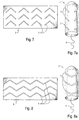
- the zone in which the expansion and/or the absorption is limited forms a spiral inside and outside the tampon.
- the tampon additianally comprises another zone in which the expansion and/or the absorption are limited, situated halfway between the two ends of the tampon.
- the tampon additionally comprises another part in which the expansion and/or the absorption are limited, forming a spiral outside the tampon.
- the spiral shape obtained may be nondeformable or only minimally deformable, even after saturation of the tampon with a hydrophilic substance, and this spiral shape makes it possible to channel the flow and thus avoid flow of fluid along the vaginal walls, and also to increase the time of contact between the absorbent material and the flow, thus permitting improved absorption and a greater capacity of the tampon.
- the tampons may be impregnated with the solid hydrophobic substance whose melting point is greater than 37 degrees centigrade in the melted state and before and/or after formation of the tampon.
- the substance is applied before formation of the tampon, it is applied to the band before folding and/or compression and/or rolling of the band.
- a zone formed by a line measuring several tenths of a millimeter to several millimeters is applied continuously or discontinuously to the front face and/or rear face of the band, optionally in several zones, and optionally nonsymmetrically.
- the zones of impregnation may be arranged on what will become the lower part, middle part, and/or the upper part of the tampon in order to create one or more reservoirs with these successive barriers.
- the zones may be arranged in such a way that, after folding and/or compression of the band, a spiral shape is obtained that is nondeformable or only minimally deformable, even after saturation of the tampon with a hydrophilic substance.
- This spiral shape makes it possible to channel the flow, and thus avoid flow of fluid along the vaginal walls, and also to increase the time of contact between the absorbent material and the flow, thus improving absorption and capacity of the tampon.
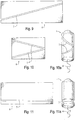
- the tampon comprises an impregnation zone in the form of an up-turned funnel which, by diverting the flow from the center of the tampon, makes it possible to avoid accumulation of fluid at the site of fixation of a withdrawal thread and to avoid leaks due to the presence of this withdrawal thread.
- the zone in which expansion and/or absorption is limited is defined by at least one restriction member encircling a portion of the body of the tampon.
- the restriction member is configured to permanently restrict a diameter of the body of the tampon at said zone from expanding upon absorption of a fluid by the tampon. This zone is maintained in its initial shape when the other parts of the body of the tampon inflate under the effect of absorption of a fiuid.
- the restriction member of the sanitary tampon according to the invention comprises at least one ring, washer, collar, or foldable restrictor band.
- the restriction member comprises, on its outer face, at least one smooth zone that makes it possible to limit the friction during removal of the tampon, so as to avoid any injury.
- the ring is formed with the protector of the tampon.
- each restrictor band comprises at least one orifice near each of its two ends, the orifice having a diameter that is substantially equal to that of the compressed tampon.
- the restrictor band may comprise at least a third orifice in the central part for passage of the withdrawal thread.
- the tampon comprises at least two superposed restrictor bands arranged perpendicular to each other before folding.
- the restrictor band is designed to have a length that ensures the restrictor band does not disturb the natural development of the geometry of the tampon body when the tampon is placed in contact with a fluid that is to be absorbed.
- the two variants of the invention can be combined in one sanitary tampon.
- the zone defined by the solid hydrophobic substance and the zone defined by the at least one restriction member are located in a proximal area of the body of the tampon.
- the disclosure is also directed to a method for producing a tampon, wherein the method finally comprises, after a step of folding and/or of compression and/or of impregnation of an absorbent material such as an absorbent strip including a hydrophobic substance, a step of heating to a temperature above the melting point of the hydrophobic substance, making it possible to bind the impregnated zones.
- an absorbent material such as an absorbent strip including a hydrophobic substance
- the disclosure is also directed to a tampon comprising a saturation indicator at its proximal end.
- the indicator is formed by the proximal zone situated at the proximal end of the tampon comprising at least one zone in which the expansion and/or the absorption are limited, the zone being formed by partial or total impregnation of the absorbent material of the tampon with a solid hydrophobic substance whose melting point is greater than 37 degrees centigrade
- the indicator is formed by the proximal zone situated at the proximal end of the tampon comprising at least one zone in which the expansion and/or the absorption are limited, the zone being formed by placement of a restriction member, for example in the form of a ring, string, collar or restrictor band(s) encircling the tampon and allowing it to be maintained in its initial shape in the zone in question, when the tampon comes to inflate under the effect of the absorption.
- the various embodiments may be separate or in combination with
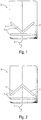
- a strip of absorbent material 6 of absorbent material may comprise zones in which the absorbent material is partially or totally impregnated with a solid hydrophobic substance 7 whose melting point is greater than 37 degrees centigrade
- the hydrophobic substances described herein may have a melting point equal to or greater than 38 degrees centigrade, 39 degrees centigrade, 40 degrees centigrade, 41 degrees centigrade, 42 degrees centigrade, 43 degrees centigrade, 44 degrees centigrade, 45 degrees centigrade, or 46 degrees centigrade
- the hydrophobic substance has a melting point equal to or greater than 47 degrees centigrade, 49 degrees centigrade, 51 degrees centigrade, 53 degrees centigrade, 55 degrees centigrade, 57 degrees centigrade, 59 degrees centigrade, 61 degrees centigrade, or 63 degrees centigrade
- the hydrophobic substance has a melting point equal to or greater than 68 degrees centigrade, 69 degrees centigrade, 70 degrees centigrade, 71 degrees centigrade, 72 degrees centigrade,
- the hydrophobic substances preferably do not dissolve in bodily fluids and preferably have a melting point that is higher than the internal temperature of the human body (37 degrees C) so that the hydrophobic substance remains solid while the tampon is in a vagina.
- the hydrophobic substance has a melting point that is 45 degrees centigrade or higher so that the hydrophobic substance remains solid during shipping and/or storage of the tampons where the tampons may be exposed to temperatures greater or significantly greater than 37 degrees centigrade
- the melting point of the hydrophobic substance does not exceed 120 degrees centigrade, and more preferably does not exceed 100 degrees centigrade, thus making it more economical to manufacture the tampons in terms of costs and time.
- the lower the melting temperature of the hydrophobic substance the less energy and time required to melt the hydrophobic substance for impregnation of the absorbent material and to allow or cause the impregnated hydrophobic substance to solidify.
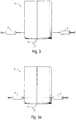
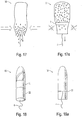
- the mode of functioning of the absorption of the tampon 1 is illustrated in Figures 16, 16a and 17a .
- the absorption is improved by the barrier effect provided by the impregnation with the hydrophobic substance 7. This therefore makes it possible to reduce the first leaks.
- the zones that are impregnated are nondeformable or are minimally deformable, and they are not expanded, or are only minimally expanded, by the absorption of the flow of fluid.
- such a tampon 1 may be designed to have an improved fluid absorption capacity of up to about 60 percent.
- a traditional tampon 30 will tend to allow an untimely quantity of blood to escape via the proximal end and the withdrawal thread, on account of pressure exerted on the tampon by the muscles near the vaginal opening during removal of the tampon 30.
- This pressure is represented schematically by the white arrows in Figure 17 .
- a tampon 1 configured with a fluidic barrier formed by a hydrophobic substance 7 as disclosed herein and as shown in Figure 17a , counteracts this phenomenon by reducing the amount of blood that flows into the proximal area of the tampon during withdrawal of the tampon.
- the barrier formed simply has a filtering effect and makes it possible to increase the absorption by increasing the contact time between the flow and the absorbent material from which the tampon 1 is made.
- the means for limiting the expansion and/or the absorption are formed by at least one restriction member 11 encircling the corresponding zone of the body and allowing the zone to be maintained in its initial shape when the body comes to inflate under the effect of the absorption.
- This restriction member 11 may, for example, be in the form of a ring, a string or a collar encircling the body of the tampon 10, as is illustrated in Figure 18 .
- the zone that is compressed or whose expansion and/or absorption are limited functions as a means of reducing the passage of the fluid.
- the restriction member 11 may be formed with a string, where at least a portion of the string is wrapped, tied, fastened, or otherwise affixed around the body of the tampon.
- a withdrawal thread 4 may also be connected to and/or function as the restriction member 11.
- the ring forming the restriction member 11 is be formed with the protector 12 or packaging of the tampon 10, in the form of a wrapper, which is cut or pre-slit or breakable so that the ring is separable from the protector 12 or packaging of the tampon 10, as is illustrated in Figures 19 and 19a .
- This protector 12 has a tab 12' for guaranteeing the protection of the ring 11 intended to remain in place after the insertion. During use of the tampon 10, the user takes hold of this tab 12' in order to fragment the protector 12 at the area of two weld points or bonding points 12". The ring 11 will then be formed by the remaining part of the protector 12 around the tampon 10.
- the tab 12' may be reattached to the protector 12 via weld points or bonding points 12"'.
- This variant is particularly advantageous from the point of view of hygiene, because the ring 11 is free of any prior contact with the exterior before detachment of the protector 12.
- the position of the ring 11 may be centered with respect to the distal and/or proximal ends and/or offset toward one of the ends.
- the ring may be formed by a single washer 14 or by a plurality of stacked washers 14, such as 2, 3, 4, 5, 6, 7, 8, 9, or 10 or more washers.
- the orifice of each washer 14 has a diameter substantially equal to that of the compressed body of the tampon 10.
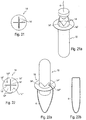
- Figures 20a and 20b show a ring having four stacked washers 14.
- each washer 14 is preferably formed by making two slits 14' perpendicular to each other, the effect of which is to delimit four substantially triangular flaps 14" which are oriented upward or downward depending on whether the washer 14 is introduced via the top or bottom of the tampon 10.
- the orifice may be formed by two slits that are not perpendicular to each other, or by more than two slits.
- the washer 14 has been slid on from the bottom of the tampon 10.
- the washers 14 may be secured to the tampon by affixing one or more of the triangular flaps 14" to the tampon by hot pressing, hot melting, sewing, or any other method, as schematically depicted by the dashed lines in Figure 21a .
- two opposite flaps 14" may each comprise a hole 14"' in such a way as to allow the passage of the withdrawal thread 4 shown in Figure 22b .
- the washer 14 thus formed has been slid on from the top of the tampon 10.
- each restriction member may be made of a permeable material in the form of a restrictor band 16 or in the form of a cross 17 prior to folding.
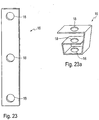
- a restrictor band 16 for the upper part of the tampon 10 has at least one nondeformable or minimally deformable orifice 18 near each of its two ends, and the diameter of this orifice 18 is chosen such as to be equal to that of the body of the compressed tampon 10.
- the body of the tampon will inflate under the effect of the absorption, while the zone of the body of the tampon encircled by the edge of the orifices 18 will remain compressed.
- These orifices 18 may therefore actually play the role of a restriction member, prohibiting the tampon 10 from changing diameter in the desired zones.
- the restrictor band 16 has a supplementary central orifice 18 when it is a restrictor band intended for the lower part of the tampon 10 and requiring passage of the withdrawal thread 4.
- the same restrictor band 16 may be used for the lower part and the upper part of the tampon 10, as is shown in Figures 24 and 24a .
- the restrictor band 16 in this case comprise four orifices 18, 18a, 18b, and 18c.
- the tampon 10 shown in Figure 25b comprises a restrictor band 16, illustrated in Figure 25 , that has been folded and then inserted exclusively via the upper part of the tampon 10.
- Figure 25c shows the tampon 10 after use.
- Another restrictor band 16 differs from the one described above in that it comprises, on the one hand, an inner absorbent layer 16a and, on the other hand, an outer impermeable layer 16b connected to the inner layer 16a.
- the restrictor band 16 may be formed by folding in an accordion configuration.
- the restrictor band 16 is folded in such a way as to align the orifices 18, with a view to then being positioned around the tampon 10, either via the top or via the bottom of the tampon 10, by inserting the body of the tampon 10 through the orifices 18.
- this restrictor band 16 is thus introduced via the bottom of the tampon 10.
- the restrictor band 16 is preferably long enough to leave enough "slack" such that the tampon 10 can dilate. After use, and as is shown in Figure 27b , the restrictor band 16 will enclose the tampon 10 at the bottom part. In this embodiment, reduced or no friction occurs in the area of the vaginal wall during spasms. Indeed, the slight movement of translation of the tampon due to each spasm does not cause any movement of the restrictor band 16 itself because of the "slack," which allows the restrictor band 16 to remain motionless in relation to the vaginal wall.
- the "slack" in the restrictor band 16 allows some freedom of movement of the body of the tampon with respect to the restrictor band 16.
- the body of the tampon will move first until it has been moved a sufficient distance that the "slack" in the restrictor band 16 is taken up, whereby the movement of the body of the tampon exerts enough tension on the restrictor band 16 that the body of the tampon and the restrictor band 16 move relative to the walls of the vagina at an equal rate.
- the pulling force on the body of the tampon elongates the tampon in the axial direction, which decreases the radial diameter of the body of the tampon.
- the body of the tampon exerts less radial force on the restrictor band 16, which reduces the frictional force between the walls of the vagina and the restrictor band 16. Accordingly, the longitudinal forces that must be applied to the tampon to withdraw the device are lower than those required with a traditional tampon.
- the limitation of the expansion and/or of the absorption of one or more zones of a tampon 20 according to the invention is able to be obtained by simultaneous use, as shown in Figure 28 , of a fluidic barrier 7', formed with the aid of a hydrophobic substance 7, and also of a restriction member, such as a restrictor band 16.
- the fluidic barrier 7' and the zone formed by a restriction member may be located in a proximate area of the tampon, and may be located at substantially the same distance from the proximal end of the tampon.
- each orifice 18 of the restrictor band 16 may be formed by making two slits 18' perpendicular to each other, the effect of which is to delimit four substantially triangular flaps 18" which is oriented upward or downward depending on whether the orifice 18 is introduced via the top or via the bottom of the tampon 10.
- the orifice may be formed by two slits that are not perpendicular to each other, or by more than two slits.
- a restrictor band 16 may be secured to the tampon by affixing one or more of the triangular flaps 18" to the tampon by hot pressing, hot melting, sewing, or any other method.
- the material used to form the restrictor band 16 is chosen to be able to resist the pressure of the tampon 10, 20 in the area of the orifices 18.
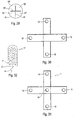
- each of the four ends comprises an orifice 18, as is illustrated in Figure 30 . If it is a restriction member for the lower part of the tampon 10, a supplementary central orifice 18 is formed for passage of the withdrawal thread 4, as shown in Figure 31 .
- this cross 17 may alternatively be produced with the aid of two separate restrictor bands 16 that are superposed in the area of their central parts and are arranged perpendicular to each other.
- this cross 17 is arranged in the lower part of the tampon, the central orifices 18 of the two restrictor bands 16 are superposed in such a way as to permit passage of the withdrawal thread 4.
- the restriction member whether in the form of a restrictor band 16 or a cross 17, is designed to provide some "slack,” such that it is able to adapt to the geometry of the body once it has developed in shape under the effect of the inflation associated with the absorption of the fluid, as is illustrated in particular in Figures 24 and 24a . For this reason, the tampon 10 is able to deploy fully in the upper part without being impeded by the restrictor band 16 or cross 17 arranged around it.
- the tampon comprises a saturation indicator at its proximal end.
- a saturation indicator is understood as a means allowing the user to verify the state of saturation or nonsaturation of the tampon by simple contact.
- the proximal zone 21 situated at the proximal end of the tampon 1 comprises at least one zone in which the expansion and/or the absorption are limited, this zone being formed by partial or total impregnation of the absorbent material of the tampon 1 with a solid hydrophobic substance 7 whose melting point is greater than 37 degrees centigrade This proximal zone 21 may then serve as a saturation indicator zone.
- the proximal zone 21 is soaked only when the tampon 1 is saturated. This proximal zone 21 may thus be used as a saturation indicator. If the proximal zone 21 is neither soaked nor inflated then this indicates to the user that the tampon 1 is not saturated.
- the tampon 10 illustrated in Figure 17 is notable in that the saturation indicator is formed by the proximal zone 22 situated at the proximal end of the tampon 10 comprising at least one zone in which the expansion and/or the absorption are limited by placement of at least one restriction member 11, for example in the form of a ring, string, collar or one or more restrictor bands encircling the zone of the body of the tampon and allowing it to be maintained at this location in its initial shape when the body of the tampon inflates under the effect of the absorption.
- the saturation indicator is formed by the proximal zone 22 situated at the proximal end of the tampon 10 comprising at least one zone in which the expansion and/or the absorption are limited by placement of at least one restriction member 11, for example in the form of a ring, string, collar or one or more restrictor bands encircling the zone of the body of the tampon and allowing it to be maintained at this location in its initial shape when the body of the t
Landscapes
- Health & Medical Sciences (AREA)
- Engineering & Computer Science (AREA)
- Vascular Medicine (AREA)
- Epidemiology (AREA)
- Biomedical Technology (AREA)
- Heart & Thoracic Surgery (AREA)
- Life Sciences & Earth Sciences (AREA)
- Animal Behavior & Ethology (AREA)
- General Health & Medical Sciences (AREA)
- Public Health (AREA)
- Veterinary Medicine (AREA)
- Dermatology (AREA)
- Manufacturing & Machinery (AREA)
- Absorbent Articles And Supports Therefor (AREA)
Claims (33)
- Sanitärtampon, umfassend einen Körper (1) aus saugfähigem Material (6), einen Rückholfaden (4), der an dem saugfähigen Material (6) befestigt ist, und einen Bereich aus einer festen hydrophoben Substanz (7) mit einem Schmelzpunkt über 37 °C, wobei der Körper (1) ein distales Ende und ein gegenüberliegendes proximales Ende aufweist, wobei sich der Rückholfaden (4) von dem proximalen Ende des Körpers (1) aus erstreckt, dadurch gekennzeichnet, dass die feste hydrophobe Substanz (7) in mindestens einer Zone des saugfähigen Materials (6) bereitgestellt ist und das saugfähige Material (6) des Körpers (1) mindestens teilweise imprägniert, wobei die mindestens eine Zone, welche die feste hydrophobe Substanz (7) enthält, an dem proximalen Ende des Körpers (1) angeordnet ist, so dass die feste hydrophobe Substanz (7) in der mindestens einen Zone eine Fluidbarriere bildet, die Absorption und Expansion durch die Zone mit der festen hydrophoben Substanz (7) bei Kontakt des Körpers (1) mit einem absorbierbaren Fluid begrenzt, wobei die hydrophobe Substanz (7) Stearin ist.
- Tampon nach Anspruch 1, dadurch gekennzeichnet, dass der Rückholfaden (4) mindestens teilweise mit einer festen hydrophoben Substanz mit einem Schmelzpunkt über 37 °C imprägniert ist.
- Tampon nach Anspruch 1 oder 2, dadurch gekennzeichnet, dass sich die hydrophobe Substanz (7) quer im Wesentlichen über den gesamten Querschnitt des Tampons erstreckt.
- Tampon nach einem der vorhergehenden Ansprüche, dadurch gekennzeichnet, dass die mindestens eine Zone, die die feste hydrophobe Substanz (7) enthält, in einem Abstand von mehr als 0,5 mm von dem proximalen Ende des Körpers (1) angeordnet ist.
- Tampon nach einem der vorhergehenden Ansprüche, dadurch gekennzeichnet, dass die mindestens eine Zone, die die feste hydrophobe Substanz (7) enthält, eine Spirale auf der Innenseite und Außenseite des Tampons bildet.
- Tampon nach einem der vorhergehenden Ansprüche, dadurch gekennzeichnet dass der Körper (1) eine andere Zone umfasst, die eine gleitende hydrophobe Substanz (7) enthält, die ungefähr in der Mitte zwischen den beiden Enden des Körpers (1) angeordnet ist.
- Tampon nach einem der vorhergehenden Ansprüche, dadurch gekennzeichnet, dass der Körper (1) eine Imprägnierungszone (7) in Form eines Trichters umfasst, der darauf ausgelegt ist, Fluss zum proximalen Ende des Körpers (1) zu leiten.
- Tampon nach einem der Ansprüche 1 bis 7, dadurch gekennzeichnet, dass der Körper (1) ferner eine Imprägnierungszone in Form eines nach oben gedrehten Trichters umfasst, der darauf ausgelegt ist, Fluss von einer Mitte des Körpers (1) umzuleiten.
- Tampon nach einem der vorhergehenden Ansprüche, dadurch gekennzeichnet, dass die feste hydrophobe Substanz (7) einen Schmelzpunkt aufweist, der in einem Bereich von 45 °C bis 120 °C liegt, vorzugsweise in einem Bereich von 68 °C bis 10 °C.
- Sanitärtampon, umfassend einen Körper (1) aus saugfähigem Material (6) und einen Rückholfaden (4), der an dem saugfähigen Material (6) befestigt ist, wobei der Körper (1) ein distales und ein gegenüberliegendes proximales Ende aufweist, wobei sich der Rückholfaden (4) von dem proximalen Ende des Körpers (1) aus erstreckt, und wobei es eine Zone des Körpers (1) gibt, in der Expansion und/oder Absorption begrenzt sind, dadurch gekennzeichnet, dass die Zone, in der Expansion und/oder Absorption begrenzt sind, von mindestens einem Begrenzungselement (11) definiert wird, das einen Abschnitt des Körpers (1) des Tampons umgibt, wobei das Begrenzungselement (11) darauf ausgelegt ist, dauerhaft einen Durchmesser des Körpers (1) des Tampons in der Zone in Bezug auf eine Expansion bei Absorption eines Fluids durch den Tampon zu begrenzen, wobei das Begrenzungselement (11) mindestens einen Ring, eine Unterlegscheibe, einen Kragen oder ein faltbares Begrenzungsband umfasst, und wobei das Begrenzungselement (11) einen Ring umfasst, der einen trennbaren Abschnitt einer Umhüllung (12) auf dem Körper (1) umfasst.
- Tampon nach Anspruch 10, dadurch gekennzeichnet, dass eine Außenfläche des Begrenzungselements (11) mindestens eine glatte Zone umfasst, die darauf ausgelegt ist, die Reibung zwischen dem Tampon und einer Vagina während des Entfernens des Tampons zu reduzieren.
- Sanitärtampon, umfassend einen Körper (1) aus saugfähigem Material (6) und einen Rückholfaden (4), der an dem saugfähigem Material (6) befestigt ist, wobei der Körper (1) ein distales und ein gegenüberliegendes proximales Ende aufweist, wobei sich der Rückholfaden (4) von dem proximalen Ende des Körpers (1) aus erstreckt, und wobei es eine Zone des Körpers (1) gibt, in der Expansion und/oder Absorption begrenzt sind, dadurch gekennzeichnet, dass die Zone, in der Expansion und/oder Absorption begrenzt sind, von mindestens einem Begrenzungselement (11) definiert wird, das einen Abschnitt des Körpers (1) des Tampons umgibt, wobei das Begrenzungselement (11) darauf ausgelegt ist, dauerhaft einen Durchmesser des Körpers (1) des Tampons in der Zone in Bezug auf eine Expansion bei Absorption eines Fluids durch den Tampon zu begrenzen, wobei das Begrenzungselement (11) mindestens einen Ring, eine Unterlegscheibe, einen Kragen oder ein faltbares Begrenzungsband umfasst, und wobei das Begrenzungselement (11) mindestens ein Begrenzungsband (16) mit zwei Enden umfasst, und das Begrenzungsband (16) mindestens eine Öffnung (18) neben jedem der beiden Enden des Begrenzungsbands (16) umfasst, wobei die mindestens eine Öffnung (18) einen Durchmesser aufweist, der einem Durchmesser des Tampons im Wesentlichen gleicht, wenn der Tampon zusammengepresst wird.
- Tampon nach Anspruch 12, dadurch gekennzeichnet, dass eine Außenfläche des Begrenzungselements (11) mindestens eine glatte Zone umfasst, die darauf ausgelegt ist, die Reibung zwischen dem Tampon und einer Vagina während des Entfernens des Tampons zu verringern.
- Tampon nach Anspruch 12 oder 13, dadurch gekennzeichnet, dass das Begrenzungsband (16) ferner mindestens eine dritte Öffnung (18) in einem mittleren Teil des Begrenzungsbands (16) zur Durchführung eines Rückholfadens (4) umfasst.
- Tampon nach Anspruch 12 oder 13, dadurch gekennzeichnet, dass mindestens eine der Öffnungen (18) in dem Begrenzungsband (16) von einer Vielzahl von Schlitzen definiert wird.
- Tampon nach Anspruch 15, dadurch gekennzeichnet, dass mindestens eine der Öffnungen (18) in dem Begrenzungsband (16) durch zwei Schlitze senkrecht zueinander definiert wird, so dass vier Lappen begrenzt werden.
- Tampon nach Anspruch 15, dadurch gekennzeichnet, dass mindestens einer der vier Lappen an dem Körper (1) des Tampons befestigt ist.
- Tampon nach einem der Ansprüche 10 bis 12, dadurch gekennzeichnet, dass der Tampon mindestens zwei übereinander angeordnete Begrenzungsbänder (16) umfasst, die senkrecht zueinander an einer Stelle angeordnet sind, an der die Begrenzungsbänder (16) übereinander angeordnet sind.
- Tampon nach einem der Ansprüche 10 bis 12, dadurch gekennzeichnet, dass das Begrenzungselement (11) mindestens ein Begrenzungsband (16) umfasst, und das Begrenzungsband (16) so ausgelegt ist, dass es eine Länge aufweist, die eine Ausdehnung des Körpers (1) außerhalb der Zone ermöglicht, wenn der Körper (1) mit einem zu absorbierenden Fluid in Kontakt gebracht wird.
- Sanitärtampon, umfassend einen Körper (1) aus saugfähigem Material (6) und einen Rückholfaden (4), der an dem saugfähigem Material (6) befestigt ist, wobei der Körper (1) ein distales und ein gegenüberliegendes proximales Ende aufweist, wobei sich der Rückholfaden (4) von dem proximalen Ende des Körpers (1) aus erstreckt, und wobei es eine Zone des Körpers (1) gibt, in der Expansion und/oder Absorption begrenzt sind, dadurch gekennzeichnet, dass die Zone, in der Expansion und/oder Absorption begrenzt sind, von mindestens einem Begrenzungselement (11) definiert wird, das einen Abschnitt des Körpers (1) des Tampons umgibt, wobei das Begrenzungselement (11) darauf ausgelegt ist, dauerhaft einen Durchmesser des Körpers (1) des Tampons in der Zone in Bezug auf eine Expansion bei Absorption eines Fluids durch den Tampon zu begrenzen, wobei das Begrenzungselement (11) mindestens einen Ring, eine Unterlegscheibe, einen Kragen oder ein faltbares Begrenzungsband umfasst, und wobei das Begrenzungselement (11) mindestens eine Unterlegscheibe mit einer Öffnung umfasst, die von einer Vielzahl von Schlitzen definiert wird.
- Tampon nach Anspruch 20, dadurch gekennzeichnet, dass eine Außenfläche des Begrenzungselements (11) mindestens eine glatte Zone umfasst, die ausgelegt ist, die Reibung zwischen dem Tampon und einer Vagina während des Entfernens des Tampons zu verringern.
- Tampon nach Anspruch 20, dadurch gekennzeichnet, dass das Begrenzungselement (11) mindestens eine Unterlegscheibe mit einer Öffnung umfasst, die durch zwei Schlitze senkrecht zueinander definiert wird, so dass vier Lappen begrenzt werden.
- Tampon nach Anspruch 22, dadurch gekennzeichnet, dass mindestens einer der vier Lappen an dem Körper (1) des Tampons befestigt ist.
- Tampon nach Anspruch 22 oder 23, dadurch gekennzeichnet, dass zwei gegenüberliegende Lappen jeweils ein Loch umfassen, das Durchführung eines Rückholfadens gestattet.
- Tampon nach einem der Ansprüche 10 bis 24, dadurch gekennzeichnet, dass das Begrenzungselement (11) den Rückholfaden (4) umfasst, der an dem Begrenzungselement (11) befestigt ist.
- Tampon nach einem der Ansprüche 1 bis 9 sowie nach einem der Ansprüche 10 bis 25, dadurch gekennzeichnet, dass die Zone, die durch die feste hydrophobe Substanz (7) definiert wird, und die Zone, die durch das mindestens eine Begrenzungselement (11) definiert wird, in einem proximalen Bereich des Körpers (1) des Tampons angeordnet sind.
- Tampon nach Anspruch 26, dadurch gekennzeichnet, dass die Zone, die durch die feste hydrophobe Substanz (7) definiert wird, und die Zone, die durch das mindestens eine Begrenzungselement (11) definiert wird, im Wesentlichen im selben Abstand von einem proximalen Ende des Körpers (1) des Tampons angeordnet sind.
- Verfahren zum Herstellen eines Sanitärtampons, umfassend: Einspritzen einer festen hydrophoben Substanz mit einem Schmelzpunkt über 37 °C in eine Dicke eines Streifens aus saugfähigem Material, und Formen des Streifens aus saugfähigem Material in einen Körper eines Tampons.
- Verfahren nach Anspruch 28, dadurch gekennzeichnet, dass die hydrophobe Substanz diskontinuierlich eingespritzt wird.
- Verfahren nach Anspruch 28 bis 29, dadurch gekennzeichnet, dass es ferner einen Schritt des Faltens und optional des Zusammenpressens des Streifens aus saugfähigem Material, gefolgt von einem Schritt des Erwärmens des Streifens aus saugfähigem Material auf eine Temperatur oberhalb des Schmelzpunkts der hydrophoben Substanz umfasst, wodurch zwei oder mehr Abschnitte des Streifens, der die hydrophobe Substanz enthält, miteinander verbunden werden.
- Verfahren nach einem der Ansprüche 28 bis 30, dadurch gekennzeichnet, dass die hydrophobe Substanz ausgewählt ist aus der Gruppe, bestehend aus gehärteten und nicht-gehärteten Ölen und Fetten.
- Verfahren nach einem der Ansprüche 28 bis 30, dadurch gekennzeichnet, dass die hydrophobe Substanz ausgewählt ist aus der Gruppe, bestehend aus natürlichen und synthetischen Wachsen, wobei die hydrophobe Substanz vorzugsweise Bienenwachs oder Carnaubawachs ist.
- Verfahren nach einem der Ansprüche 28 bis 30, dadurch gekennzeichnet, dass die hydrophobe Substanz gehärtetes Petrolatum ist.
Priority Applications (1)
| Application Number | Priority Date | Filing Date | Title |
|---|---|---|---|
| EP11183229.1A EP2450013B1 (de) | 2006-11-24 | 2007-11-23 | Hygienetampon |
Applications Claiming Priority (7)
| Application Number | Priority Date | Filing Date | Title |
|---|---|---|---|
| US86079806P | 2006-11-24 | 2006-11-24 | |
| US88002307P | 2007-01-12 | 2007-01-12 | |
| US89871007P | 2007-02-01 | 2007-02-01 | |
| US92077607P | 2007-03-30 | 2007-03-30 | |
| US90741107P | 2007-04-02 | 2007-04-02 | |
| US92949007P | 2007-06-29 | 2007-06-29 | |
| PCT/IB2007/004343 WO2008062322A2 (en) | 2006-11-24 | 2007-11-23 | Catamenial and sanitary tampons |
Related Child Applications (2)
| Application Number | Title | Priority Date | Filing Date |
|---|---|---|---|
| EP11183229.1A Division-Into EP2450013B1 (de) | 2006-11-24 | 2007-11-23 | Hygienetampon |
| EP11183229.1A Division EP2450013B1 (de) | 2006-11-24 | 2007-11-23 | Hygienetampon |
Publications (3)
| Publication Number | Publication Date |
|---|---|
| EP2094217A2 EP2094217A2 (de) | 2009-09-02 |
| EP2094217B1 EP2094217B1 (de) | 2016-03-30 |
| EP2094217B2 true EP2094217B2 (de) | 2018-10-10 |
Family
ID=39430122
Family Applications (2)
| Application Number | Title | Priority Date | Filing Date |
|---|---|---|---|
| EP07866620.3A Not-in-force EP2094217B2 (de) | 2006-11-24 | 2007-11-23 | Tampon |
| EP11183229.1A Not-in-force EP2450013B1 (de) | 2006-11-24 | 2007-11-23 | Hygienetampon |
Family Applications After (1)
| Application Number | Title | Priority Date | Filing Date |
|---|---|---|---|
| EP11183229.1A Not-in-force EP2450013B1 (de) | 2006-11-24 | 2007-11-23 | Hygienetampon |
Country Status (10)
| Country | Link |
|---|---|
| US (1) | US20080154222A1 (de) |
| EP (2) | EP2094217B2 (de) |
| JP (1) | JP2010510820A (de) |
| CA (1) | CA2670520A1 (de) |
| IL (1) | IL198928A0 (de) |
| MA (1) | MA31018B1 (de) |
| MX (1) | MX2009005519A (de) |
| PL (1) | PL2094217T3 (de) |
| TN (1) | TN2009000207A1 (de) |
| WO (1) | WO2008062322A2 (de) |
Families Citing this family (24)
| Publication number | Priority date | Publication date | Assignee | Title |
|---|---|---|---|---|
| JP4134052B2 (ja) * | 2005-01-19 | 2008-08-13 | 株式会社 ハリーズ | 生理用タンポンの製造方法及び製造装置 |
| US8597267B2 (en) * | 2007-04-18 | 2013-12-03 | The Procter & Gamble Company | Tampon having at least one physical discontinuity |
| AU2009224715A1 (en) * | 2008-03-12 | 2009-09-17 | Btampon Ip | Web for retention of internal bodily secretions |
| EP2184044A1 (de) * | 2008-11-06 | 2010-05-12 | Ontex Hygieneartikel Deutschland GmbH | Tampon mit Antiauslaufelement, Verfahren und Vorrichtung zu dessen Herstellung |
| AT508454B1 (de) * | 2009-06-29 | 2015-06-15 | Ruggli Projects Ag | Verfahren für eine abschliessende formgebung eines tampons |
| CN102802579B (zh) * | 2009-06-29 | 2016-06-01 | Sca卫生用品公司 | 具有波浪形压缩线的月经卫生棉条 |
| WO2012004315A1 (en) * | 2010-07-09 | 2012-01-12 | Ontex Hygieneartikel Deutschland Gmbh | Press and method for producing absorbent article |
| US8938866B2 (en) * | 2011-05-03 | 2015-01-27 | Kimberly-Clark Worldwide, Inc. | Integrated tampon and method for making |
| US9610201B2 (en) | 2011-05-05 | 2017-04-04 | Kimberly-Clark Worldwide, Inc. | Tampon having multiple absorbent regions |
| JP5997885B2 (ja) * | 2011-08-30 | 2016-09-28 | ユニ・チャーム株式会社 | タンポンの製造方法 |
| US8916015B2 (en) | 2011-12-21 | 2014-12-23 | Kimberly-Clark Worldwide, Inc. | Tampon method of manufacture |
| US9393160B2 (en) | 2012-06-29 | 2016-07-19 | Kimberly-Clark Worldwide, Inc. | Tampon with contact elements |
| US9211216B2 (en) | 2012-06-29 | 2015-12-15 | Kimberly-Clark Worldwide, Inc. | Tampon method of manufacture |
| US9211217B2 (en) | 2012-10-31 | 2015-12-15 | Kimberly-Clark Worldwide, Inc. | Method of manufacturing tampons by forming a softwind with contact elements |
| US9308134B2 (en) * | 2012-10-31 | 2016-04-12 | Kimberly-Clark Worldwide, Inc. | Tampon method of manufacture |
| US9522087B2 (en) | 2012-10-31 | 2016-12-20 | Kimberly-Clark Worldwide, Inc. | Method of manufacturing tampons with contact elements |
| SI24253B (sl) | 2012-12-29 | 2017-06-30 | Tosama Tovarna Sanitetnega Materiala D.O.O. | Higienski tampon z izboljšano sposobnostjo zadrževanja tekočine in postopek izdelave tovrstnega tampona |
| BE1021217B1 (nl) * | 2014-04-10 | 2015-08-11 | Ontex Bvba | Tampon met anti-lekkage element, methode en apparaat om hetzelfde te produceren |
| DE102017004322A1 (de) * | 2017-05-04 | 2018-11-08 | Rauscher Consumer Products Gmbh | Tampon und Verfahren zum Herstellen eines Tampons |
| US20210220184A1 (en) * | 2018-08-03 | 2021-07-22 | Anne's Day Ltd | Absorbent tampon for treatment of menstrual symptoms |
| IL285936B2 (en) * | 2019-03-01 | 2024-10-01 | Tampro Inc | Reduced-leakage tampon |
| USD1039690S1 (en) | 2020-09-01 | 2024-08-20 | Tampro Inc. | Tampon |
| WO2022051228A1 (en) | 2020-09-01 | 2022-03-10 | Tampro Inc. | Reduced-leakage tampon |
| USD1046123S1 (en) | 2023-04-28 | 2024-10-08 | Tampro Inc. | Tampon |
Citations (2)
| Publication number | Priority date | Publication date | Assignee | Title |
|---|---|---|---|---|
| US4335721A (en) † | 1981-02-17 | 1982-06-22 | Kimberly-Clark Corporation | Tampon containing fusible portions |
| US4787895A (en) † | 1987-05-29 | 1988-11-29 | Kimberly-Clark Corporation | Adhesively held spiral wound tampon and method of its formation |
Family Cites Families (37)
| Publication number | Priority date | Publication date | Assignee | Title |
|---|---|---|---|---|
| DE7314654U (de) | 1973-12-20 | Simm R | Vaginalschutzvornchtung | |
| US2330257A (en) | 1939-01-14 | 1943-09-28 | John F Wallace | Process for making tampons |
| JPS426393Y1 (de) * | 1965-02-05 | 1967-03-27 | ||
| US3693622A (en) * | 1970-08-14 | 1972-09-26 | Jones Sr John L | Waste fluid flow control element |
| US3965905A (en) | 1972-07-13 | 1976-06-29 | Warner-Lambert Company | Catamenial tampon |
| US4185631A (en) * | 1978-03-17 | 1980-01-29 | Johnson & Johnson | Readily removable expanding catamenial tampon |
| US4211225A (en) | 1978-07-19 | 1980-07-08 | Dan Sibalis | Tampon with a collapsible and invertible shroud |
| JPS599622Y2 (ja) * | 1979-12-31 | 1984-03-27 | ユニ・チヤ−ム株式会社 | 生理用タンポン |
| DE3204124A1 (de) | 1982-02-06 | 1983-08-18 | Bayer Ag, 5090 Leverkusen | Antimykotische tampons mit hoher wirkstoff-freisetzung |
| DE3740208A1 (de) | 1987-11-27 | 1989-06-08 | Ver Papierwerke Ag | Gepresster staebchenfoermiger tampon |
| US4952211A (en) | 1988-09-12 | 1990-08-28 | Dale Snider | Feminine tampon coated with beeswax |
| JPH0354635U (de) * | 1990-06-29 | 1991-05-27 | ||
| DE9410595U1 (de) * | 1994-06-30 | 1994-08-11 | VP-Schickedanz AG, 90489 Nürnberg | Tampon, insbesondere für die Frauenhygiene |
| US7341737B2 (en) * | 1997-06-11 | 2008-03-11 | Kimberly-Clark Worldwide, Inc. | Medicated tampon |
| FI981932A0 (fi) | 1998-09-09 | 1998-09-09 | Erja Anita Helena Tojkander | Kehon ulkopuoliselta kosteudelta suojattu läpivuodon estävä sisäisestikäytettävä tamponi |
| DE19843963A1 (de) * | 1998-09-24 | 2000-03-30 | Rauscher & Co | Tampon und Tampon-Packung |
| ATE250944T1 (de) | 1998-12-21 | 2003-10-15 | Ivf Hartmann Ag | Infektionsschutz-tampon |
| JP3725370B2 (ja) * | 1999-07-02 | 2005-12-07 | ユニ・チャーム株式会社 | 生理用タンポン |
| FR2803208A1 (fr) * | 1999-12-29 | 2001-07-06 | Jean Bastien Pasquini | Tampon periodique antiseptique et son procede de preparation |
| CA2357516A1 (en) | 2000-09-28 | 2002-03-28 | Uni-Charm Corporation | Absorbent article and barrier agent for absorbent article |
| DE20105031U1 (de) | 2000-12-20 | 2001-10-31 | Mörlein, Dieter, Dipl.-Ing., 31628 Landesbergen | Tampon-Binden und Einlagen |
| US6506958B2 (en) * | 2001-01-26 | 2003-01-14 | Playtex Products, Inc. | Signal tampon |
| DE20121759U1 (de) | 2001-03-26 | 2003-05-22 | Johnson & Johnson GmbH, 40474 Düsseldorf | Tampon für die Frauenhygiene sowie Vorrichtung zur Herstellung desselben |
| US20020142693A1 (en) | 2001-03-30 | 2002-10-03 | Herve Buzot | Absorbent device for insertion into a vaginal cavity |
| US7214848B2 (en) * | 2001-06-29 | 2007-05-08 | Mcneil-Ppc, Inc. | Catamenial device change indicator |
| US6899700B2 (en) | 2001-08-29 | 2005-05-31 | Kimberly-Clark Worldwide, Inc. | Therapeutic agent delivery tampon |
| US20030153864A1 (en) * | 2001-10-16 | 2003-08-14 | Bernard Chaffringeon | Disposable device and method for transferring an active liquid into a body cavity |
| US6840927B2 (en) | 2001-11-16 | 2005-01-11 | The Proctor & Gamble Company | Tampon with fluid wicking overwrap with skirt portion |
| US7977532B2 (en) * | 2002-09-05 | 2011-07-12 | The Procter & Gamble Company | Tampon with clean appearance post use |
| JP2004097304A (ja) | 2002-09-05 | 2004-04-02 | Kao Corp | 生理用タンポン |
| US7060057B2 (en) | 2003-02-24 | 2006-06-13 | Nini Policappelli | Comfortable tampon |
| US20050090794A1 (en) * | 2003-10-27 | 2005-04-28 | The Procter & Gamble Company | Tampon with enhanced leakage protection |
| US20050096620A1 (en) | 2003-10-31 | 2005-05-05 | Bernhard Awolin | Tampon having liquid-resistant base |
| US7097638B2 (en) | 2003-11-21 | 2006-08-29 | The Procter & Gamble Company | Tampon having recessed portions |
| BRPI0512838A (pt) * | 2004-06-30 | 2008-04-08 | Mcneil Ppc Inc | dispositivo intravaginal com expansão controlada |
| EP1700588A1 (de) | 2005-03-09 | 2006-09-13 | Björn Andersch | Tampon |
| US8293968B2 (en) | 2005-04-29 | 2012-10-23 | Kimberly-Clark Worldwide, Inc. | Dual mode absorbent tampon |
-
2007
- 2007-11-23 EP EP07866620.3A patent/EP2094217B2/de not_active Not-in-force
- 2007-11-23 JP JP2009537718A patent/JP2010510820A/ja active Pending
- 2007-11-23 CA CA002670520A patent/CA2670520A1/en not_active Abandoned
- 2007-11-23 EP EP11183229.1A patent/EP2450013B1/de not_active Not-in-force
- 2007-11-23 US US11/984,880 patent/US20080154222A1/en not_active Abandoned
- 2007-11-23 PL PL07866620.3T patent/PL2094217T3/pl unknown
- 2007-11-23 WO PCT/IB2007/004343 patent/WO2008062322A2/en not_active Ceased
- 2007-11-23 MX MX2009005519A patent/MX2009005519A/es unknown
-
2009
- 2009-05-25 TN TNP2009000207A patent/TN2009000207A1/fr unknown
- 2009-05-25 IL IL198928A patent/IL198928A0/en unknown
- 2009-06-24 MA MA32028A patent/MA31018B1/fr unknown
Patent Citations (2)
| Publication number | Priority date | Publication date | Assignee | Title |
|---|---|---|---|---|
| US4335721A (en) † | 1981-02-17 | 1982-06-22 | Kimberly-Clark Corporation | Tampon containing fusible portions |
| US4787895A (en) † | 1987-05-29 | 1988-11-29 | Kimberly-Clark Corporation | Adhesively held spiral wound tampon and method of its formation |
Also Published As
| Publication number | Publication date |
|---|---|
| IL198928A0 (en) | 2011-08-01 |
| WO2008062322A3 (en) | 2008-10-30 |
| EP2450013B1 (de) | 2017-07-12 |
| JP2010510820A (ja) | 2010-04-08 |
| CA2670520A1 (en) | 2008-05-29 |
| EP2094217A2 (de) | 2009-09-02 |
| WO2008062322A2 (en) | 2008-05-29 |
| MX2009005519A (es) | 2009-08-20 |
| EP2094217B1 (de) | 2016-03-30 |
| US20080154222A1 (en) | 2008-06-26 |
| MA31018B1 (fr) | 2009-12-01 |
| TN2009000207A1 (fr) | 2010-10-18 |
| EP2450013A1 (de) | 2012-05-09 |
| PL2094217T3 (pl) | 2016-10-31 |
Similar Documents
| Publication | Publication Date | Title |
|---|---|---|
| EP2094217B1 (de) | Menstruations- und sanitärtampons | |
| RU2239402C2 (ru) | Абсорбирующее интерлабиальное изделие | |
| EP1101475B1 (de) | Wegwerfartikel zum Aufnehmen von Urin für den Mann | |
| RU2242205C2 (ru) | Прикрепляемые к телу межгубные изделия и способы их изготовления | |
| US6186995B1 (en) | Vaginal tampon and method for fabrication thereof | |
| KR100940223B1 (ko) | 의료용 및 생리용 흡수체. | |
| KR101729358B1 (ko) | 당김-활성화 탐폰 어플리케이터 | |
| EP1481656A1 (de) | Tampon mit unterschiedlicher Ausdehnungskapazität | |
| JP2022008564A (ja) | タンポンを製造するための方法 | |
| EP0727976A1 (de) | Hygienischer tampon | |
| JP2008534034A (ja) | タンポンアプリケータ組立品 | |
| JP2018518309A5 (de) | ||
| MX2015000058A (es) | Tampon para dias entre las menstruaciones. | |
| EP3513774A1 (de) | Morpho-anatomische flexible materialbahn | |
| EP2155133A2 (de) | Tampon | |
| AU2019202388A1 (en) | Vaginal insertion assembly | |
| EP2276441A1 (de) | Bahn zum zurückhalten von inneren körpersekreten | |
| EP0676943A1 (de) | Menstruationstampon sowie verfahren zu seiner herstellung | |
| RU2433810C2 (ru) | Менструальные и гигиенические тампоны | |
| WO2003051257A1 (en) | Tampon, in particular for feminine hygiene or medical purposes | |
| CN101573095A (zh) | 月经和卫生棉塞 | |
| JP4969270B2 (ja) | 生理用タンポン | |
| JP2004298452A (ja) | 生理用タンポン | |
| KR20130134155A (ko) | 면부직포를 이용한 원주형 흡수체 삽입형 생리대 | |
| WO1995013040A1 (en) | A safety tampon |
Legal Events
| Date | Code | Title | Description |
|---|---|---|---|
| PUAI | Public reference made under article 153(3) epc to a published international application that has entered the european phase |
Free format text: ORIGINAL CODE: 0009012 |
|
| 17P | Request for examination filed |
Effective date: 20090622 |
|
| AK | Designated contracting states |
Kind code of ref document: A2 Designated state(s): AT BE BG CH CY CZ DE DK EE ES FI FR GB GR HU IE IS IT LI LT LU LV MC MT NL PL PT RO SE SI SK TR |
|
| 17Q | First examination report despatched |
Effective date: 20090930 |
|
| DAX | Request for extension of the european patent (deleted) | ||
| RAP1 | Party data changed (applicant data changed or rights of an application transferred) |
Owner name: INTIGENA AG |
|
| RIN1 | Information on inventor provided before grant (corrected) |
Inventor name: CHAFFRINGEON, BERNARD |
|
| RAP1 | Party data changed (applicant data changed or rights of an application transferred) |
Owner name: INTIGENA (SCHWEIZ)AG |
|
| GRAP | Despatch of communication of intention to grant a patent |
Free format text: ORIGINAL CODE: EPIDOSNIGR1 |
|
| INTG | Intention to grant announced |
Effective date: 20151104 |
|
| GRAS | Grant fee paid |
Free format text: ORIGINAL CODE: EPIDOSNIGR3 |
|
| GRAA | (expected) grant |
Free format text: ORIGINAL CODE: 0009210 |
|
| AK | Designated contracting states |
Kind code of ref document: B1 Designated state(s): AT BE BG CH CY CZ DE DK EE ES FI FR GB GR HU IE IS IT LI LT LU LV MC MT NL PL PT RO SE SI SK TR |
|
| REG | Reference to a national code |
Ref country code: GB Ref legal event code: FG4D |
|
| REG | Reference to a national code |
Ref country code: CH Ref legal event code: EP |
|
| REG | Reference to a national code |
Ref country code: AT Ref legal event code: REF Ref document number: 784522 Country of ref document: AT Kind code of ref document: T Effective date: 20160415 |
|
| REG | Reference to a national code |
Ref country code: IE Ref legal event code: FG4D |
|
| REG | Reference to a national code |
Ref country code: DE Ref legal event code: R096 Ref document number: 602007045592 Country of ref document: DE |
|
| REG | Reference to a national code |
Ref country code: NL Ref legal event code: FP |
|
| REG | Reference to a national code |
Ref country code: SE Ref legal event code: TRGR |
|
| REG | Reference to a national code |
Ref country code: LT Ref legal event code: MG4D |
|
| PG25 | Lapsed in a contracting state [announced via postgrant information from national office to epo] |
Ref country code: GR Free format text: LAPSE BECAUSE OF FAILURE TO SUBMIT A TRANSLATION OF THE DESCRIPTION OR TO PAY THE FEE WITHIN THE PRESCRIBED TIME-LIMIT Effective date: 20160701 Ref country code: FI Free format text: LAPSE BECAUSE OF FAILURE TO SUBMIT A TRANSLATION OF THE DESCRIPTION OR TO PAY THE FEE WITHIN THE PRESCRIBED TIME-LIMIT Effective date: 20160330 |
|
| PG25 | Lapsed in a contracting state [announced via postgrant information from national office to epo] |
Ref country code: LT Free format text: LAPSE BECAUSE OF FAILURE TO SUBMIT A TRANSLATION OF THE DESCRIPTION OR TO PAY THE FEE WITHIN THE PRESCRIBED TIME-LIMIT Effective date: 20160330 Ref country code: LV Free format text: LAPSE BECAUSE OF FAILURE TO SUBMIT A TRANSLATION OF THE DESCRIPTION OR TO PAY THE FEE WITHIN THE PRESCRIBED TIME-LIMIT Effective date: 20160330 |
|
| PG25 | Lapsed in a contracting state [announced via postgrant information from national office to epo] |
Ref country code: EE Free format text: LAPSE BECAUSE OF FAILURE TO SUBMIT A TRANSLATION OF THE DESCRIPTION OR TO PAY THE FEE WITHIN THE PRESCRIBED TIME-LIMIT Effective date: 20160330 Ref country code: IS Free format text: LAPSE BECAUSE OF FAILURE TO SUBMIT A TRANSLATION OF THE DESCRIPTION OR TO PAY THE FEE WITHIN THE PRESCRIBED TIME-LIMIT Effective date: 20160730 |
|
| REG | Reference to a national code |
Ref country code: FR Ref legal event code: PLFP Year of fee payment: 10 |
|
| PG25 | Lapsed in a contracting state [announced via postgrant information from national office to epo] |
Ref country code: CZ Free format text: LAPSE BECAUSE OF FAILURE TO SUBMIT A TRANSLATION OF THE DESCRIPTION OR TO PAY THE FEE WITHIN THE PRESCRIBED TIME-LIMIT Effective date: 20160330 Ref country code: RO Free format text: LAPSE BECAUSE OF FAILURE TO SUBMIT A TRANSLATION OF THE DESCRIPTION OR TO PAY THE FEE WITHIN THE PRESCRIBED TIME-LIMIT Effective date: 20160330 Ref country code: PT Free format text: LAPSE BECAUSE OF FAILURE TO SUBMIT A TRANSLATION OF THE DESCRIPTION OR TO PAY THE FEE WITHIN THE PRESCRIBED TIME-LIMIT Effective date: 20160801 Ref country code: ES Free format text: LAPSE BECAUSE OF FAILURE TO SUBMIT A TRANSLATION OF THE DESCRIPTION OR TO PAY THE FEE WITHIN THE PRESCRIBED TIME-LIMIT Effective date: 20160330 Ref country code: SK Free format text: LAPSE BECAUSE OF FAILURE TO SUBMIT A TRANSLATION OF THE DESCRIPTION OR TO PAY THE FEE WITHIN THE PRESCRIBED TIME-LIMIT Effective date: 20160330 |
|
| REG | Reference to a national code |
Ref country code: DE Ref legal event code: R026 Ref document number: 602007045592 Country of ref document: DE |
|
| PLBI | Opposition filed |
Free format text: ORIGINAL CODE: 0009260 |
|
| PG25 | Lapsed in a contracting state [announced via postgrant information from national office to epo] |
Ref country code: IT Free format text: LAPSE BECAUSE OF FAILURE TO SUBMIT A TRANSLATION OF THE DESCRIPTION OR TO PAY THE FEE WITHIN THE PRESCRIBED TIME-LIMIT Effective date: 20160330 |
|
| 26 | Opposition filed |
Opponent name: SCA HYGIENE PRODUCTS AB Effective date: 20161219 |
|
| PG25 | Lapsed in a contracting state [announced via postgrant information from national office to epo] |
Ref country code: DK Free format text: LAPSE BECAUSE OF FAILURE TO SUBMIT A TRANSLATION OF THE DESCRIPTION OR TO PAY THE FEE WITHIN THE PRESCRIBED TIME-LIMIT Effective date: 20160330 |
|
| PGFP | Annual fee paid to national office [announced via postgrant information from national office to epo] |
Ref country code: CH Payment date: 20161121 Year of fee payment: 10 Ref country code: NL Payment date: 20161118 Year of fee payment: 10 Ref country code: LU Payment date: 20161121 Year of fee payment: 10 Ref country code: IE Payment date: 20161122 Year of fee payment: 10 |
|
| PLAX | Notice of opposition and request to file observation + time limit sent |
Free format text: ORIGINAL CODE: EPIDOSNOBS2 |
|
| PGFP | Annual fee paid to national office [announced via postgrant information from national office to epo] |
Ref country code: SE Payment date: 20161118 Year of fee payment: 10 Ref country code: AT Payment date: 20161121 Year of fee payment: 10 Ref country code: BE Payment date: 20161118 Year of fee payment: 10 Ref country code: PL Payment date: 20161116 Year of fee payment: 10 |
|
| PG25 | Lapsed in a contracting state [announced via postgrant information from national office to epo] |
Ref country code: SI Free format text: LAPSE BECAUSE OF FAILURE TO SUBMIT A TRANSLATION OF THE DESCRIPTION OR TO PAY THE FEE WITHIN THE PRESCRIBED TIME-LIMIT Effective date: 20160330 |
|
| PLBP | Opposition withdrawn |
Free format text: ORIGINAL CODE: 0009264 |
|
| REG | Reference to a national code |
Ref country code: FR Ref legal event code: PLFP Year of fee payment: 11 |
|
| REG | Reference to a national code |
Ref country code: DE Ref legal event code: R082 Ref document number: 602007045592 Representative=s name: HOFFMANN - EITLE PATENT- UND RECHTSANWAELTE PA, DE Country of ref document: DE Ref country code: DE Ref legal event code: R082 Ref document number: 602007045592 Country of ref document: DE Representative=s name: ZACCO PATENTANWALTS- UND RECHTSANWALTSGESELLSC, DE Ref country code: DE Ref legal event code: R082 Ref document number: 602007045592 Country of ref document: DE Representative=s name: ZACCO DR. PETERS UND PARTNER, DE Ref country code: DE Ref legal event code: R081 Ref document number: 602007045592 Country of ref document: DE Owner name: SCA HYGIENE PRODUCTS AB, SE Free format text: FORMER OWNER: INTIGENA (SCHWEIZ)AG, ZUG, CH Ref country code: DE Ref legal event code: R081 Ref document number: 602007045592 Country of ref document: DE Owner name: ESSITY HYGIENE AND HEALTH AB, SE Free format text: FORMER OWNER: INTIGENA (SCHWEIZ)AG, ZUG, CH Ref country code: DE Ref legal event code: R081 Ref document number: 602007045592 Country of ref document: DE Owner name: ESSITY HYGIENE AND HEALTH AKTIEBOLAG, SE Free format text: FORMER OWNER: INTIGENA (SCHWEIZ)AG, ZUG, CH |
|
| RAP2 | Party data changed (patent owner data changed or rights of a patent transferred) |
Owner name: SCA HYGIENE PRODUCTS AB |
|
| REG | Reference to a national code |
Ref country code: GB Ref legal event code: 732E Free format text: REGISTERED BETWEEN 20171109 AND 20171115 |
|
| PLAY | Examination report in opposition despatched + time limit |
Free format text: ORIGINAL CODE: EPIDOSNORE2 |
|
| PLBC | Reply to examination report in opposition received |
Free format text: ORIGINAL CODE: EPIDOSNORE3 |
|
| REG | Reference to a national code |
Ref country code: AT Ref legal event code: UEP Ref document number: 784522 Country of ref document: AT Kind code of ref document: T Effective date: 20160330 |
|
| REG | Reference to a national code |
Ref country code: FR Ref legal event code: TP Owner name: SCA HYGIENE PRODUCTS, SE Effective date: 20180219 |
|
| PG25 | Lapsed in a contracting state [announced via postgrant information from national office to epo] |
Ref country code: CY Free format text: LAPSE BECAUSE OF FAILURE TO SUBMIT A TRANSLATION OF THE DESCRIPTION OR TO PAY THE FEE WITHIN THE PRESCRIBED TIME-LIMIT Effective date: 20160330 Ref country code: HU Free format text: LAPSE BECAUSE OF FAILURE TO SUBMIT A TRANSLATION OF THE DESCRIPTION OR TO PAY THE FEE WITHIN THE PRESCRIBED TIME-LIMIT; INVALID AB INITIO Effective date: 20071123 |
|
| PG25 | Lapsed in a contracting state [announced via postgrant information from national office to epo] |
Ref country code: MC Free format text: LAPSE BECAUSE OF FAILURE TO SUBMIT A TRANSLATION OF THE DESCRIPTION OR TO PAY THE FEE WITHIN THE PRESCRIBED TIME-LIMIT Effective date: 20160330 Ref country code: TR Free format text: LAPSE BECAUSE OF FAILURE TO SUBMIT A TRANSLATION OF THE DESCRIPTION OR TO PAY THE FEE WITHIN THE PRESCRIBED TIME-LIMIT Effective date: 20160330 |
|
| REG | Reference to a national code |
Ref country code: SE Ref legal event code: EUG |
|
| REG | Reference to a national code |
Ref country code: NL Ref legal event code: MM Effective date: 20171201 |
|
| REG | Reference to a national code |
Ref country code: AT Ref legal event code: MM01 Ref document number: 784522 Country of ref document: AT Kind code of ref document: T Effective date: 20171123 |
|
| PG25 | Lapsed in a contracting state [announced via postgrant information from national office to epo] |
Ref country code: LI Free format text: LAPSE BECAUSE OF NON-PAYMENT OF DUE FEES Effective date: 20171130 Ref country code: BG Free format text: LAPSE BECAUSE OF FAILURE TO SUBMIT A TRANSLATION OF THE DESCRIPTION OR TO PAY THE FEE WITHIN THE PRESCRIBED TIME-LIMIT Effective date: 20160330 Ref country code: CH Free format text: LAPSE BECAUSE OF NON-PAYMENT OF DUE FEES Effective date: 20171130 |
|
| PG25 | Lapsed in a contracting state [announced via postgrant information from national office to epo] |
Ref country code: LU Free format text: LAPSE BECAUSE OF NON-PAYMENT OF DUE FEES Effective date: 20171123 Ref country code: SE Free format text: LAPSE BECAUSE OF NON-PAYMENT OF DUE FEES Effective date: 20171124 Ref country code: AT Free format text: LAPSE BECAUSE OF NON-PAYMENT OF DUE FEES Effective date: 20171123 |
|
| REG | Reference to a national code |
Ref country code: BE Ref legal event code: FP Effective date: 20160622 Ref country code: BE Ref legal event code: MM Effective date: 20171130 |
|
| REG | Reference to a national code |
Ref country code: IE Ref legal event code: MM4A |
|
| PUAH | Patent maintained in amended form |
Free format text: ORIGINAL CODE: 0009272 |
|
| STAA | Information on the status of an ep patent application or granted ep patent |
Free format text: STATUS: PATENT MAINTAINED AS AMENDED |
|
| RAP2 | Party data changed (patent owner data changed or rights of a patent transferred) |
Owner name: ESSITY HYGIENE AND HEALTH AKTIEBOLAG |
|
| PG25 | Lapsed in a contracting state [announced via postgrant information from national office to epo] |
Ref country code: MT Free format text: LAPSE BECAUSE OF NON-PAYMENT OF DUE FEES Effective date: 20161123 |
|
| REG | Reference to a national code |
Ref country code: DE Ref legal event code: R082 Ref document number: 602007045592 Country of ref document: DE Representative=s name: HOFFMANN - EITLE PATENT- UND RECHTSANWAELTE PA, DE Ref country code: DE Ref legal event code: R082 Ref document number: 602007045592 Country of ref document: DE Representative=s name: ZACCO PATENTANWALTS- UND RECHTSANWALTSGESELLSC, DE Ref country code: DE Ref legal event code: R081 Ref document number: 602007045592 Country of ref document: DE Owner name: ESSITY HYGIENE AND HEALTH AB, SE Free format text: FORMER OWNER: SCA HYGIENE PRODUCTS AB, GOETEBORG, SE Ref country code: DE Ref legal event code: R081 Ref document number: 602007045592 Country of ref document: DE Owner name: ESSITY HYGIENE AND HEALTH AKTIEBOLAG, SE Free format text: FORMER OWNER: SCA HYGIENE PRODUCTS AB, GOETEBORG, SE |
|
| 27A | Patent maintained in amended form |
Effective date: 20181010 |
|
| AK | Designated contracting states |
Kind code of ref document: B2 Designated state(s): AT BE BG CH CY CZ DE DK EE ES FI FR GB GR HU IE IS IT LI LT LU LV MC MT NL PL PT RO SE SI SK TR |
|
| REG | Reference to a national code |
Ref country code: DE Ref legal event code: R102 Ref document number: 602007045592 Country of ref document: DE |
|
| REG | Reference to a national code |
Ref country code: FR Ref legal event code: PLFP Year of fee payment: 12 |
|
| PG25 | Lapsed in a contracting state [announced via postgrant information from national office to epo] |
Ref country code: IE Free format text: LAPSE BECAUSE OF NON-PAYMENT OF DUE FEES Effective date: 20171123 Ref country code: NL Free format text: LAPSE BECAUSE OF NON-PAYMENT OF DUE FEES Effective date: 20171201 |
|
| REG | Reference to a national code |
Ref country code: DE Ref legal event code: R082 Ref document number: 602007045592 Country of ref document: DE Representative=s name: HOFFMANN - EITLE PATENT- UND RECHTSANWAELTE PA, DE Ref country code: DE Ref document number: 602007045592 Country of ref document: DE Ref legal event code: R082 Representative=s name: ZACCO PATENTANWALTS- UND RECHTSANWALTSGESELLSC, DE Ref country code: DE Ref legal event code: R081 Ref document number: 602007045592 Country of ref document: DE Owner name: ESSITY HYGIENE AND HEALTH AKTIEBOLAG, SE Free format text: FORMER OWNER: ESSITY HYGIENE AND HEALTH AB, GOETEBORG, SE |
|
| PG25 | Lapsed in a contracting state [announced via postgrant information from national office to epo] |
Ref country code: BE Free format text: LAPSE BECAUSE OF NON-PAYMENT OF DUE FEES Effective date: 20171130 |
|
| PG25 | Lapsed in a contracting state [announced via postgrant information from national office to epo] |
Ref country code: PL Free format text: LAPSE BECAUSE OF NON-PAYMENT OF DUE FEES Effective date: 20171123 |
|
| REG | Reference to a national code |
Ref country code: DE Ref legal event code: R082 Ref document number: 602007045592 Country of ref document: DE Ref country code: DE Ref legal event code: R082 Ref document number: 602007045592 Country of ref document: DE Representative=s name: HOFFMANN - EITLE PATENT- UND RECHTSANWAELTE PA, DE |
|
| REG | Reference to a national code |
Ref country code: DE Ref legal event code: R082 Ref document number: 602007045592 Country of ref document: DE Representative=s name: HOFFMANN - EITLE PATENT- UND RECHTSANWAELTE PA, DE |
|
| PGFP | Annual fee paid to national office [announced via postgrant information from national office to epo] |
Ref country code: DE Payment date: 20191112 Year of fee payment: 13 |
|
| PGFP | Annual fee paid to national office [announced via postgrant information from national office to epo] |
Ref country code: FR Payment date: 20191014 Year of fee payment: 13 |
|
| PGFP | Annual fee paid to national office [announced via postgrant information from national office to epo] |
Ref country code: GB Payment date: 20191122 Year of fee payment: 13 |
|
| REG | Reference to a national code |
Ref country code: DE Ref legal event code: R119 Ref document number: 602007045592 Country of ref document: DE |
|
| GBPC | Gb: european patent ceased through non-payment of renewal fee |
Effective date: 20201123 |
|
| PG25 | Lapsed in a contracting state [announced via postgrant information from national office to epo] |
Ref country code: FR Free format text: LAPSE BECAUSE OF NON-PAYMENT OF DUE FEES Effective date: 20201130 |
|
| PG25 | Lapsed in a contracting state [announced via postgrant information from national office to epo] |
Ref country code: DE Free format text: LAPSE BECAUSE OF NON-PAYMENT OF DUE FEES Effective date: 20210601 Ref country code: GB Free format text: LAPSE BECAUSE OF NON-PAYMENT OF DUE FEES Effective date: 20201123 |