EP2094891B1 - Elastisches spinnvlies und elastische vliesfaser damit - Google Patents
Elastisches spinnvlies und elastische vliesfaser damit Download PDFInfo
- Publication number
- EP2094891B1 EP2094891B1 EP08785501.1A EP08785501A EP2094891B1 EP 2094891 B1 EP2094891 B1 EP 2094891B1 EP 08785501 A EP08785501 A EP 08785501A EP 2094891 B1 EP2094891 B1 EP 2094891B1
- Authority
- EP
- European Patent Office
- Prior art keywords
- elastic
- nonwoven
- polymeric component
- layer
- spunbonded
- Prior art date
- Legal status (The legal status is an assumption and is not a legal conclusion. Google has not performed a legal analysis and makes no representation as to the accuracy of the status listed.)
- Not-in-force
Links
Images


Classifications
-
- D—TEXTILES; PAPER
- D01—NATURAL OR MAN-MADE THREADS OR FIBRES; SPINNING
- D01F—CHEMICAL FEATURES IN THE MANUFACTURE OF ARTIFICIAL FILAMENTS, THREADS, FIBRES, BRISTLES OR RIBBONS; APPARATUS SPECIALLY ADAPTED FOR THE MANUFACTURE OF CARBON FILAMENTS
- D01F8/00—Conjugated, i.e. bi- or multicomponent, artificial filaments or the like; Manufacture thereof
- D01F8/04—Conjugated, i.e. bi- or multicomponent, artificial filaments or the like; Manufacture thereof from synthetic polymers
- D01F8/06—Conjugated, i.e. bi- or multicomponent, artificial filaments or the like; Manufacture thereof from synthetic polymers with at least one polyolefin as constituent
-
- D—TEXTILES; PAPER
- D01—NATURAL OR MAN-MADE THREADS OR FIBRES; SPINNING
- D01D—MECHANICAL METHODS OR APPARATUS IN THE MANUFACTURE OF ARTIFICIAL FILAMENTS, THREADS, FIBRES, BRISTLES OR RIBBONS
- D01D5/00—Formation of filaments, threads, or the like
- D01D5/08—Melt spinning methods
- D01D5/098—Melt spinning methods with simultaneous stretching
- D01D5/0985—Melt spinning methods with simultaneous stretching by means of a flowing gas (e.g. melt-blowing)
-
- D—TEXTILES; PAPER
- D04—BRAIDING; LACE-MAKING; KNITTING; TRIMMINGS; NON-WOVEN FABRICS
- D04H—MAKING TEXTILE FABRICS, e.g. FROM FIBRES OR FILAMENTARY MATERIAL; FABRICS MADE BY SUCH PROCESSES OR APPARATUS, e.g. FELTS, NON-WOVEN FABRICS; COTTON-WOOL; WADDING ; NON-WOVEN FABRICS FROM STAPLE FIBRES, FILAMENTS OR YARNS, BONDED WITH AT LEAST ONE WEB-LIKE MATERIAL DURING THEIR CONSOLIDATION
- D04H13/00—Other non-woven fabrics
-
- D—TEXTILES; PAPER
- D04—BRAIDING; LACE-MAKING; KNITTING; TRIMMINGS; NON-WOVEN FABRICS
- D04H—MAKING TEXTILE FABRICS, e.g. FROM FIBRES OR FILAMENTARY MATERIAL; FABRICS MADE BY SUCH PROCESSES OR APPARATUS, e.g. FELTS, NON-WOVEN FABRICS; COTTON-WOOL; WADDING ; NON-WOVEN FABRICS FROM STAPLE FIBRES, FILAMENTS OR YARNS, BONDED WITH AT LEAST ONE WEB-LIKE MATERIAL DURING THEIR CONSOLIDATION
- D04H3/00—Non-woven fabrics formed wholly or mainly of yarns or like filamentary material of substantial length
- D04H3/02—Non-woven fabrics formed wholly or mainly of yarns or like filamentary material of substantial length characterised by the method of forming fleeces or layers, e.g. reorientation of yarns or filaments
-
- D—TEXTILES; PAPER
- D04—BRAIDING; LACE-MAKING; KNITTING; TRIMMINGS; NON-WOVEN FABRICS
- D04H—MAKING TEXTILE FABRICS, e.g. FROM FIBRES OR FILAMENTARY MATERIAL; FABRICS MADE BY SUCH PROCESSES OR APPARATUS, e.g. FELTS, NON-WOVEN FABRICS; COTTON-WOOL; WADDING ; NON-WOVEN FABRICS FROM STAPLE FIBRES, FILAMENTS OR YARNS, BONDED WITH AT LEAST ONE WEB-LIKE MATERIAL DURING THEIR CONSOLIDATION
- D04H3/00—Non-woven fabrics formed wholly or mainly of yarns or like filamentary material of substantial length
- D04H3/08—Non-woven fabrics formed wholly or mainly of yarns or like filamentary material of substantial length characterised by the method of strengthening or consolidating
- D04H3/14—Non-woven fabrics formed wholly or mainly of yarns or like filamentary material of substantial length characterised by the method of strengthening or consolidating with bonds between thermoplastic yarns or filaments produced by welding
- D04H3/147—Composite yarns or filaments
-
- Y—GENERAL TAGGING OF NEW TECHNOLOGICAL DEVELOPMENTS; GENERAL TAGGING OF CROSS-SECTIONAL TECHNOLOGIES SPANNING OVER SEVERAL SECTIONS OF THE IPC; TECHNICAL SUBJECTS COVERED BY FORMER USPC CROSS-REFERENCE ART COLLECTIONS [XRACs] AND DIGESTS
- Y10—TECHNICAL SUBJECTS COVERED BY FORMER USPC
- Y10T—TECHNICAL SUBJECTS COVERED BY FORMER US CLASSIFICATION
- Y10T442/00—Fabric [woven, knitted, or nonwoven textile or cloth, etc.]
- Y10T442/60—Nonwoven fabric [i.e., nonwoven strand or fiber material]
- Y10T442/601—Nonwoven fabric has an elastic quality
- Y10T442/602—Nonwoven fabric comprises an elastic strand or fiber material
Definitions
- the present invention relates to a novel elastic spunbonded nonwoven made from multi-component filaments, and having a remarkable elastic recovery, and to an elastic nonwoven fabric comprising at least two superposed layers, one of which being constituted by the said novel elastic spunbonded nonwoven.
- Elastic nonwoven fabrics advantageously offer the ability to conform to irregular shapes, and thus enable to increase fit and to allow more freedom and comfort, for example to body movements, than other textile fabrics with more limited extensibility.
- Elastic nonwoven fabrics are thus widely used in many industrial applications.
- Elastic nonwoven fabrics are used in the hygienic and personal care industry for making, for example, disposable diapers, child swim pants, child training pants, adult incontinent garments, sanitary napkins, wipes and other personal care products.
- Elastic nonwoven fabrics are also used in the manufacture of medical products, such as, for example, gowns, linens, bandages, masks, heads wraps and drapes. Others additional applications of elastic nonwoven fabrics include consumer products, like seat covers and car covers.
- TPU thermoplastic polyurethane
- a further drawback of the use of elastomeric polymers such as TPU for making spunbonded nonwoven is their poor bonding ability, especially thermal-bonding ability, with the most used polyolefin materials.
- the first elastic polymeric component preferably comprises at least one elastomer that includes an elastic polypropylene ; the second polymeric component preferably comprises at least one polyolefin that is a linear low density polyethylene (LLDPE) having a density greater than 0.90 g/cc.
- LLDPE linear low density polyethylene
- the extensible conjugate fiber has a total heat of melting of less than 80 Joules per gram, and comprises:
- Japanese patent application JP 11 323716 discloses an extensible spunbonded nonwoven fabric made of filaments of the eccentric sheath-core type. This spunbonded nonwoven fabric is extensible, but does not exhibit very high elastic properties, in particular high recovery.
- the present invention proposes a novel elastic spunbonded nonwoven that overcomes the aforesaid problems inherent to the use of elastomeric polymers such as TPU, and that enables to achieve very high elastic properties.
- the first polymeric component (P) can advantageously exhibit very high elastic properties, and in particular one can use an elastic polymeric component with a low melt flow rate that would be practically not spinnable alone.
- melt flow rates (MFR1, MFR2) of the first and second polymeric components For measuring the melt flow rates (MFR1, MFR2) of the first and second polymeric components, standard method ASTM D-1238 can be used.
- elastic propylene-based olefin copolymer means polypropylene polymers, selected from the group of thermoplastic olefin-based elastomers, that incorporate a low level of a comonomer, such as ethylene or a higher alpha-olefin in the backbone to form an elastomeric copolymer.
- copolymers means any polymer comprising two or more monomers, where the monomer present in the polymer is the polymerized form of the monomer.
- catalyst components are described as comprising neutral stable forms of the components, it is well understood that the active form of the component is the form that reacts with the monomers to produce polymers.
- polypropylene As used herein, the term "polypropylene”, “propylene polymer,” or “PP” refers to homopolymers, copolymers, terpolymers, and interpolymers, comprising from 50 to 100 weight % of propylene.
- “elastic propylene-based olefin copolymer” can be a single semi-amorphous copolymer or a blend of several semi-amorphous polymers, each semi-amorphous polymer comprising propylene and from 10 to 25 weight % of one or more C2 and/or C4 to C10 alpha-olefin co-monomers, preferably ethylene, wherein the copolymer comprises isotactically crystallizable alpha-olefin sequences.
- crystallizable describes those polymers or sequences which are mainly amorphous in the undeformed state, but upon stretching or annealing, crystallization occurs.
- the copolymer is an ethylene propylene copolymer, e. g., ethylene propylene thermoplastic elastomer.
- the copolymer has a substantially uniform composition distribution preferably as a result of polymerization with a metallocene catalyst. Composition distribution is a property of copolymers indicating a statistically significant intermolecular or intramolecular difference in the composition of the polymer.
- each semi-amorphous polymers has : a) heat of fusion of 4 to 70 J/g, as determined by Differential Scanning Calorimetry (DSC); b) a Melt Flow Rate of 0.1 to 2000 dg/min, most preferably greater than 2 dg/min and less than 100 dg/min, as measured by ASTM D-1238 at 230°C, and 2.16 kg.
- a semi-amorphous copolymer may be produced in a continuous solution process using a metallocene catalyst.
- copolymers having a narrow molecular weight distribution are used.
- a single sited metallocene catalyst is advantageously used, which allows only a single statistical mode of addition of the first and second monomer sequences, and the copolymer is advantageously well-mixed in a continuous flow stirred tank polymerization reactor, which allows only a single polymerization environment for substantially all of the polymer chains of the copolymer.
- Preferred semi-amorphous polymers useful in this invention preferably have a molecular weight distribution (Mw/Mn) of less than 5, preferably between 1 and 4.
- molecular weight (Mn and Mw) and molecular weight distribution (MWD or Mw/Mn) are determined by gel permeation chromatography using polystyrene standards.
- a slip agent selected for example from the group consisting of: erucamide, oleylamide, oleamide, and stearamide and used in a concentration from 50 ppm to 10 weight % can be successful added.
- erucamide, oleylamide, oleamide, and stearamide used in a concentration from 50 ppm to 10 weight %.
- Preferred elastic propylene-based olefin copolymers suitable for the invention include thermoplastic elastic propylene-ethylene copolymers formed by using metallocene polymerization catalysis.
- Such polymers include those commercially available from ExxonMobil Chemical Co, Huston, TX under the trademark of VISTAMAXX®, e.g. Vistamaxx 2120 or Vistamaxx 2125 for second polymeric component in the sheath and a blend of Vistamaxx 2125 and Vistamaxx 6100 (or Vistamaxx 6102) for first polymeric component in the core.
- the elastic spunbonded nonwoven of the invention is further characterized by the following optional features that can be combined or taken alone :
- Another object of the invention is to propose an elastic nonwoven fabric comprising at least one first elastic spunbonded nonwoven layer as defined above, and at least one additional nonwoven layer.
- the composite nonwoven is characterized by the following optional features that can be taken alone or combined together:
- polyolefin-based nonwoven layer means any nonwoven layer that is essentially made from a polymer or copolymer that is exclusively or predominantly made up of polyolefin units.
- At least one polyolefin-based nonwoven layer is a polypropylene-based nonwoven layer.
- polypropylene -based nonwoven layer means any nonwoven layer that is essentially made from a polymer or copolymer that is exclusively or predominantly made up of polypropylene units.
- a further object of the invention is a hydroentangled elastic nonwoven fabric comprising at least one first elastic spunbonded nonwoven layer (W) and at least one second nonwoven layer, and wherein the said first elastic spunbonded nonwoven layer (W) comprises a plurality of multi-component filaments, each multi-component filament comprising a first polymeric component (P) and a second polymeric component (P'), and wherein the first polymeric component (P) comprises an elastic propylene-based olefin copolymer, and the second polymeric component (P') comprises an elastic propylene-based olefin and has a melt flow rate MFR2 that is higher than the melt flow rate MFR1 of the first polymeric component.
- the layers of the hydroentangled elastic nonwoven fabric are perforated, more especially by means of hydro jets.
- the elastic nonwoven of the invention is obtained by a spunbonding process and is made of multi-component filaments F of the sheath/core type wherein the core is made of a first polymeric components P and the sheath is made of second polymeric P', said first and second polymeric components being specific of the invention.
- both the first (P) and the second (P') polymeric components comprise an elastic propylene-based olefin copolymer, but have two different melt flow rates (MFR1; MFR2), the melt flow rate MFR2 of the second polymeric component being higher than the melt flow rate MFR1 of the first polymeric component.
- the elastic propylene-based olefin copolymers that are suitable for the first and second polymeric components are copolymers comprising propylene and from 10 to 25 weight % of one or more C2 and/or C4 to C10 alpha-olefin co-monomers, like for example the ones commercially available from ExxonMobil Chemical Co, Huston, TX under the trademark of VISTAMAXX®.
- the elastic propylene-based olefin copolymers that are suitable for the first polymeric components are for example a blend of at least two different propylene-ethylene copolymers commercially available from ExxonMobil Chemical Co, Huston, TX under the trademark of VISTAMAXX® and having two different melt flow rate (MFR1 a and MFR1 b).
- the first and second polymeric components can also include others materials, like pigments or colorants, or opacizers (like TiO 2 ) antioxidants, stabilizers, fillers, surfactants, waxes, flow promoters or special additives to enhance processability of the composition, like for example slip agents. It is particularly recommended to add slip agents in the second polymeric component.
- filaments F Various shapes in cross section for the filaments F can be envisaged (round shape, oval shape, bilobal shape, trilobal shape, etc).
- the multi-component filaments are bi-component filaments of the core/sheath type.
- Some non-limiting examples of different cross sections for bicomponent filaments of the core/sheath type that are suitable for the invention are illustrated on figures 1A, 1B, 1C, 1D, 1E .
- At least 50% of the whole surface of the filament F is constituted by the second polymeric component P', and even more preferably 100% of the whole surface of the filament F is constituted by the second polymeric component P'( figures 1B, 1C, 1D, 1E ).
- Bicomponent filament of the sheath/core type like the ones illustrated in figures 1A, 1B, 1C, 1D , and wherein the core is made of the first polymeric component P and the sheath is made of the second polymeric component P are preferably used for a better thermal-bondability of the elastic spunbonded web with other polyolefin layers, as described hereafter.
- sheath/core configuration is preferred, the invention is however not limited to that particular configuration.
- the filaments can however comprise more than two polymeric components.
- the method applied to produce the elastic nonwoven web according to the present invention is the spunbonding process.
- spunbonding processes are described in US patent 3,338,992 to Kenney , US patent 3,692,613 to Dorschner , US patent 3,802, 817 to Matsuki , US patent 4,405,297 to Appel , US patent 4,812,112 to Balk and US patent 5,665,300 to Brignola et al.
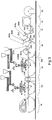
- FIG. 2 One example of a suitable process line for producing an elastic nonwoven fabric of the invention is illustrated in Figure 2 .
- the process line comprises:
- the spunbonding unit (SU) comprises two hoppers 1 and 2, containing respectively the first polymeric component (P) and the second (P') polymeric components. These two hoppers 1 and 2 feed in parallel two extruders 3 and 4, for separately melting the two polymeric components.
- the outputs of the two extruders 3 and 4 are connected to two melt polymer pumps 5, 6 respectively. Said pumps 5, 6 feed a dosed amount of polymers to the bi-component spinning pack 7.
- the bi-component spinning pack 7 usually contains a certain number of plates stacked one on top of the other to distribute the polymers to the lower plate which is the spinnerets plate, having one or more rows of capillary holes and where the bi-component filaments are extruded.
- Typical spinnerets die systems well known designed for polypropylene can be used, for example with a die hole density of 2000-6000 holes per meter, and a die capillary hole diameter of 0.3 to 0.8 mm.
- the barrel temperatures of the two extruders are, for example, ranging from a minimum of 170°C to a maximum 260°C, depending on screws speed and design.
- the filament curtain After having been cooled the filament curtain enters in a draw unit 9, which in the most preferred case is constituted by a slot through which the filaments are drawn by means of air flow entering from the sides of the slot and flowing downward through the passage.
- the filaments are laid onto a foraminous transport belt (for example a wire belt) forming a transport surface T.
- a vacuum box 12 is positioned below the transport surface T, and delimitates a web forming area on the transport surface T.
- the spunbonding unit (SU) further comprises a compression roller 10 which stabilizes, by means of a low compression, the web W just after it is formed and a pair of thermal point calander rolls 13 (one heated engraved roll and one heated smooth roll), that can be used to bond the layers (L1, W and L2) together.
- a compression roller 10 which stabilizes, by means of a low compression, the web W just after it is formed and a pair of thermal point calander rolls 13 (one heated engraved roll and one heated smooth roll), that can be used to bond the layers (L1, W and L2) together.
- the first delivering mean 11 is used for laying directly onto the transport surface T, and upstream the web formation area of the spunbonding unit (SU), a bottom pre-consolidated nonwoven layer L1 (for example a spun layer, a meltblown layer or a carder layer).
- a bottom pre-consolidated nonwoven layer L1 for example a spun layer, a meltblown layer or a carder layer.
- the elastic spunbonded layer W of the invention is formed on top of this bottom layer L1.
- the second delivering mean 15 is used for laying directly onto the spunbonded web W a top pre-consolidated nonwoven layer L2 (for example a spun layer, a meltblown layer or a carder layer).
- the nonwoven layer W is thus sandwiched between the two outer nonwoven layers L1 and L2.
- the elastic spunbonded layer W of the invention can be manufactured off line and wound up in the form of a roll, and the final elastic nonwoven fabric (L1/W/L2) can be manufactured from a roll of said elastic nonwoven W.
- the three layers (L1, W and L2) can be thermo-bonded together by means of calander rolls 13, and the elastic nonwoven fabric (L1/W/L2) is wound up in the form of rolls on a winding machine 14.
- This winding machine 14 has to be suitable for elastic material, and preferably enables a strict control of tension variations during winding, said tension variations being caused by the elastic properties of the final composite nonwoven.
- the invention is not limited to an elastic composite nonwoven fabric that is consolidated by thermal bonding, but within the scope of the invention the elastic fabric can be consolidated by using any bonding technology known in the field of nonwoven, and including notably: water needling (also called hydroentanglement) by means of hydro jets (on one side or on both sides of the composite nonwoven), mechanical needling, ultrasonic bonding, air trough bonding and chemical bonding.
- any bonding technology known in the field of nonwoven, and including notably: water needling (also called hydroentanglement) by means of hydro jets (on one side or on both sides of the composite nonwoven), mechanical needling, ultrasonic bonding, air trough bonding and chemical bonding.
- the elastic composite nonwoven fabric of the invention can be also perforated by using any perforation technology that is known in the field of nonwoven, including notably mechanical perforation and perforation by means of hydro jets.
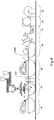
- FIG. 3 One example of a suitable process line for producing a hydroentangled elastic nonwoven fabric of the invention is illustrated in Figure 3 .
- the process line comprises a carding unit 18, a first spunbonding unit SU, second spunbonding unit 19, a hydraulic needling unit 20, a dewatering unit 21, a drying unit 22, and a winding unit 23.
- the carded nonwoven layer C is compressed by compaction rolls (not shown on figure 3 ) and/or by means of calander rolls like the calander rolls 13 previously described in reference to figure 2 .
- This compression and/or the calandering is performed in order to pre-consolidate the layer C, before the spunbonded layer W is formed.
- the same considerations apply for the production lines of figures 4 and 5 .
- the spunbonding unit SU is similar to the one of figure 2 and is used for producing in line the elastic spunbonded nonwoven layer W of the fabric.
- the spunbonding unit 19 is similar to spunbonding unit (SU), but in contrast with spunbonding unit SU, spunbonding unit 19 does not comprise any calender rolls. This spunbonding unit 19 is used for laying a top spunbonded layer S onto the elastic spunbonded layer W.
- the composite nonwoven (C/W/S) is transported, downstream the spunbonding unit 19, by means of a conveyor belt 200 through the hydraulic needling unit 20.
- This hydraulic needling unit 20 is used for bonding together the layers of the nonwoven composite (C/W/S), by means of high pressure water jets (hydroentanglement process) that are directed at least towards the surface of the top layer S, and that penetrate through the structure of the composite and are partially reflected back to the structure.
- the water needling process is performed on both sides of the composite nonwoven (C/W/S).
- the hydraulic needling unit 20 comprises four successive perforated drums.
- First perforated drum 201 is associated with two successive hydro-jet beams 201a and 201b.
- Second perforated drum 202 is associated with two successive hydro-jet beams 202a and 202b.
- Third perforated drum 203 is associated with two successive hydro-jet beams 203a and 203b.
- Fourth perforated drum 204 is associated with two successive hydro-jet beams 204a and 204b.
- the water pressure of the upstream hydro-jet beam 201a is lower than the water pressure of all the other downstream hydro-jet beams 201b, 202a, 202b, 203a, 203b, 204a, 204b, in order to obtain a pre-hydroentanglement of the layers.
- the fourth drum 204 can be equipped with a perforation screen, in order to create apertures in the multilayer elastic fabric C/W/S.
- This perforation step can be also performed by replacing the fourth drum 204 by a suitable drum for perforation, having the surface constituted by one net or several nets superposed one on the other.
- the hydroentangled elastic composite C/W/S is transported downstream the hydraulic needling unit 20 by the conveyor belt 210 of a dewatering unit 21, and over a vacuum box 211, that enables to remove by suction from the fabric most of the water that has been absorbed during the water needling process (conventional dewatering process).
- the hydroentanglement unit 20 and the dewatering unit 21 can be integrated in the same industrial equipment.
- the dewatered hydroentangled elastic fabric (C/W/S) issued from the dewatering unit 21 is continuously fed through the oven of the drying unit 22, wherein heat is applied to the fabric (for example by means of hot air), in order to remove the remaining water still contained within the fabric.
- the dried fabric (C/W/S) is wound in the form of a roll, by means of the winding unit 23.
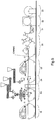
- FIG. 4 Another example of a suitable process line for producing a hydroentangled elastic nonwoven fabric of the invention is illustrated in Figure 4 .
- the process line of figure 4 differs from the process line of figure 3 by the use of a second carding unit 18' (similar to first carding unit 18), that is substituted to the spunbonding unit 19.
- FIG. 5 Another example of a suitable process line for producing a hydroentangled elastic nonwoven fabric of the invention is illustrated in Figure 5 .
- the process line of figure 5 differs from the process line of figure 4 by the use of an additional meltblown unit 24, that is positioned between the first spunbonding unit SU and the second carding unit 18'.
- This meltblown unit 24 is used for producing a meltblown layer M , sandwiched between the elastic spunbonded layer W issued from the first spunbonding unit SU and the carded layer C issued from the second carding unit 18'.
- meltblown layer means any layer essentially made of “meltblown fibers”.
- meltblown fibers are well known in the prior art and a meltblown process for making meltblown fibers is disclosed, for example, in U.S. Pat. No. 3,849,241 to Butin .
- Meltblown fibers are generally formed by extruding a molten thermoplastic material through a plurality of fine, usually circular, die capillaries. The molten threads or filaments issued from the die capillaries are fed into converging high velocity air streams which attenuate the filaments of molten thermoplastic material and reduce their diameter. Said diameter is generally reduced in order to obtain microfibers. Meltblown fibers are thus microfibers that may be continuous or discontinuous, and are generally smaller than 10 microns in diameter. Thereafter, the meltblown fibers are carried by the high velocity air stream and are deposited onto a collecting surface (i.e. the elastic spunbonded nonwoven of the invention) to form a layer of randomly distributed meltblown fibers.
- a collecting surface i.e. the elastic spunbonded nonwoven of the invention
- an additional meltblown layer M is advantageously used when opacity for the elastic nonwoven fabric is required.
- a meltblown layer is preferably laid on top of the elastic spunbonded layer W of the invention ; for example, the weight of the meltblown layer M is at least 5 gsm, preferably 8 gsm and more preferably 10 gsm. This meltblown layer gives a more uniform white colour to the elastic nonwoven fabric , and thus improves the aesthetic thereof.
- the spunbonded nonwoven (W) was made from bi-component filaments having a sheath/core arrangement and having the round cross section of figure 1D ,.
- the polymeric materials that have been used for producing these spunbonded nonwovens (W) were the following.
- a dry blend of VM2125 (polymer P a ) and VM6100 (polymer P b ) was used as first polymeric component (P).
- VM 2125 is a specialty polyolefin elastomer commercially available from ExxonMobil Chemical Co, Huston, TX under the trademark of VISTAMAXX®.
- This specialty polyolefin elastomer is a semi-crystalline elastic propylene-based olefin copolymer comprising at least 85wt% of propylene units and made in the presence of a metallocene catalyst during the polymerization process.
- This copolymer has a melt flow rate (MFR1 a) of 80 g/10min (measured at 230°C and 2.16Kg - ASTM D-1238), a broad melting temperature range and a highest melting peak of 160°C.
- This copolymer has a slower crystallization rate than polypropylene homopolymers.
- VM6100 (VMX6102)
- VM 6100 is a specialty polyolefin elastomer commercially available from ExxonMobil Chemical Co, Huston, TX under the trademark of VISTAMAXX®.
- This specialty polyolefin elastomer is a semi-crystalline elastic propylene-based olefin copolymer comprising at least 80wt% of propylene units and made in the presence of a metallocene catalyst during the polymerization process.
- This copolymer has a low melt flow rate (MFR1 b) of 3 g/10min (measured at 230°C and 2.16Kg - ASTM D-1238), a broad melting temperature range and a highest melting peak of 160°C.
- This copolymer has a slower crystallization rate than polypropylene homopolymers.
- VMX 6100 can be replaced by the equivalent grade VM 6102, having same chemical properties as VM 6100 and giving the same elastic properties to the nonwovens produced.
- the weight ratio (Wa) of VM2125 was 0.8 and the weight ratio (Wb) of VM6100 (or VM6102) was 0.2.
- the melt flow rate MFR1 of the blend (first polymeric component P) calculated by means of above formula (1) was thus around 41 g/10min.
- the second polymeric component was made of aforesaid elastic propylene-based olefin copolymer VM2115
- compositions of the filaments of the different samples of spunbonded nonwoven W are summarized in table 2.
- TABLE 2 Filaments composition Sample Core _ wt % (P) Sheath_wt% (P') Core material /P a Wa Core Material / P b Wb Sheath Material (P') (P') Weight %in the Sheath Additive in the Sheath (Additive) Weight % in the Sheath E-7-6 85 15 VM2125 0.8 VM6100 0.2 VM2125 97% (a) 3% E-7-8 85 15 VM2125 0.8 VM6100 0.2 VM2125 97% (a) 3% E-7-10 85 15 VM2125 0.8 VM6100 0.2 VM2125 97% (a) 3% (a) the additive in the sheath is a slip agent masterbatch containing lubricant and used for facilitating spinning.
- the main spunbonding process parameters are summarized in the following table 3 for each sample of spunbonded nonwoven W..
- Web samples of a predetermined length Lo in the relaxed state were cut in each web W.
- the web samples were elongated at 50% elongation, held in the stretched state for 30 seconds and then relaxed to zero tensile force.
- the web samples were elongated a second time at 50% elongation, held in the stretched state for 30 seconds and then relaxed to zero tensile force. At the end the recovery (R) was measured.
- the resulting nonwoven of the invention has a root mean square (RMS) average recovery of at least 85%, said RMS average recovery being based on machine direction (R MD ) and cross direction (R CD ) recovery values after 50% elongation and one pull.
- the fabrics have at least about a RMS recovery of 80% after two successive 50% pulls.
- Table 5 relates to recovery results obtained with comparative spunbonded webs W not covered by the invention.
- the main characteristics of the TPU materials used in the comparative examples of table 5 are also summarized in table 6.
- TABLE 4 Elastic spunbonded nonwoven (W) of the invention Root Mean Square Example N° Arrangement Spunbonded Filament bi-component Spunbonded Filament composition Total Web (W) - weight Recovery Recovery gsm 1st pull 50% 2nd pull 50% E-7-6 core 85wt% VM2125(80wt%) +VM6100 (20wt%) 60 92.3 90.2 sheath 15wt% VM 2125 (97wt%) + slip agent(3wt%) E-7-8 core 85wt% VM2125(80wt%) +VM6100 (20wt%) 30 89.5 87.3 sheath 15wt% VM 2125 (97wt%) + slip agent (3wt%) E-7-10 core 85wt% VM2125(80wt%) +VM6100 (20wt%) 80 94.1 92.6 sheath 15
- the spunbonded layer (W) of the invention exhibits very high recovery values. These recovery values are higher than recovery values that are obtained for example with spunbonded web made of Sheath/Core bi-component filaments (LLDPE /TPU) as the ones described in examples No 10 of US patent 6,225,243 .
- LLDPE /TPU Sheath/Core bi-component filaments
- the comparative examples n°19, 20 and 21 were based on pure TPU, same in core and in sheath arrangement. Even though elasticity was good, the elastic TPU layer exhibits a high stickiness. Furthermore, the elastic TPU layer was not thermo-bondable to other polypropylene-based layers. In addition, because of the degradation of the TPU during melting, TPU materials can not be processed in standard polypropylene extruders.
- the elastic spunbonded layer of the invention (samples E-7-6; E-7-8; E-7-10) is advantageously less sticky, and thus easier to be wound and unwound.
- the chemical composition of the sheath is similar to polyolefin materials that are mostly used in the field of nonwoven.
- the polymeric materials used for practicing the invention can thus be advantageously processed in standard polypropylene extruders.
- thermal bondability of the spunbonded layers (W) of the invention with other polyolefin-based nonwoven layers (L1, L2) is improved.
- the comparative examples N° 22 and N°23 were based on pure VM2125 or VM 2120.
- the spunbonded layers (W) of the invention (E-7-6; E-7-8; E-7-10) have advantageously a higher elasticity and elastic recovery.
- the spunbonded nonwoven layer W of the invention does not necessarily require any activation step for obtaining its elastic properties.
- the outer carded layers (C) with low basis weight give textile appearance and soft touch to the final nonwoven fabric. This property is particularly useful in all applications wherein the composite nonwoven has to come into contact with the skin, for example in diapers, feminine/adult care or the like.
- the outer polypropylene carded layers (C) also give advantageously a dimensional stabilization to the nonwoven fabric in the machine direction.
- a non perforated composite nonwoven fabric (C/W/M/C) of basis weight 92gsm has been also produced in a pilot plant according to the manufacturing process of figure 5 (example referred "E-105/HET").
- the two external layers were carded layers (C) made of PP (polypropylene fibers).
- the basis weight of each carded layer (at the output of the carded unit) was 14gsm.
- the elastic spunbonded layer W was made of bicomponent sheath/core filaments having the round cross-section of figure 1D .
- the core of the filaments was made (first polymeric component P) of a blend VM2125 (70wt%) and VM6100 (30wt%).
- the melt flow rate MFR1 of this blend (first polymeric component P) calculated by means of formula (1) was thus around 29.87g/10min.
- the outer sheath of the filaments was made of VM 2125 (second polymeric component P').
- the weight of the core was 90% of the total basis weight, and the weight of the sheath was 10% of the total basis weight.
- the basis weight of the elastic spunbonded layer (W) was 54gsm.
- the material used for the elastic meltblown layer (M) was VM 2320.
- the basis weight of the meltblown layer (M) was 10gsm.
- VM 2320 is a specialty polyolefin elastomer suitable for melt blown process commercially available from ExxonMobil Chemical Co, Huston, TX under the trademark of VISTAMAXX®.
- This specialty polyolefin elastomer is a semi-crystalline elastic propylene-based olefin copolymer comprising at least 80wt% of propylene units and made in the presence of a metallocene catalyst during the polymerization process.
- This copolymer has a MFR (Melt Flow Rate) of 200 (measured at 230°C and 2.16Kg - ASTM D-1238), a broad melting temperature range and a highest melting peak of 160°C.
- This copolymer has a slower crystallization rate than polypropylene homopolymers.
- thermoplastic materials used for making the meltblown fibers will be knowingly selected by one skilled in the art, in respect of the properties required for the elastic nonwoven fabric.
- Specialty elastomeric polyolefin VM2320 is given only by way of example.
- This specialty elastomeric polyolefin can be replaced by any other known thermoplastic material, in particular by any thermoplastic material that are used in the field of hygienic product (diapers, training pants, ..) for making meltblown layers.
- Elastic properties of these elastic nonwoven fabrics of the invention were measured at 23°C ⁇ 2, using an Instron Testing apparatus equipped with Grips type line contact or similar.
- the grip defines the gauge for the specimen, therefore those skilled in the art know that the grip must hold the specimen to avoid slipping or damage.
- the above mentioned apparatus has to be set at 1 inch gauge length and a stretching rate of 10 inches per minute.
- the specimens will have the following dimensions: width 1 inch and length 3 inches.
- the forces were measured in Newton/inch.
- Tensile tests, load at peak and elongation at peak and hysteresis cycles have been performed on the above mentioned specimens specifically in cross direction (CD).
- the Instron Testing apparatus is equipped with a software which plots the load-elongation curve and the data are stored in the buffer memory.
- a new specimen has been pulled (1 st cycle) at a stretching rate of 10 inches per minute till the designated 150% elongation value: the sample is then held in the stretched state for 30 seconds and allowed to fully relax at zero force for 60 seconds.
- a second pull is applied (2 nd cycle) at a stretching rate of 10 inches per minute till the designated 150% elongation value, held in the stretched state for 30 seconds and then allowed to fully relax at zero force.
- ELASTIC layer % represent the weight percentage of the elastic material [i.e. elastic spunbonded layer (W) and elastic meltblown layer for example E-105/HET and elastic spunbonded layer (W) for examples E-150-FP, E-151-FP, E-152-FP, E-153-FP, E-155-FP] on the total weight of the elastic nonwoven fabric.
- the elastic spunbonded layer W was made of bicomponent sheath/core filaments having the round cross-section of figure 1D .
- the core of the filaments was made (first polymeric component P) of a blend VM2125 (70wt%) and VM6100 (30wt%).
- the outer sheath of the filaments was made of VM 2125 (second polymeric component P').
- the weight of the core was 90% of the total basis weight, and the weight of the sheath was 10% of the total basis weight.
- the basis weight of the elastic spunbonded layer (W) was 54gsm.
- the material used for the elastic meltblown layer (M) was VM 2320.
- the basis weight of the meltblown layer (M) was 10gsm.
- the elastic properties of the elastic spunbonded nonwoven (W/M) were measured and are given in table 10. TABLE 10 : Examples CD PERMANENT SET AFTER 2 CYCLES@150%Elongation (%) CD ELONGATION @ PEAK (%) CD LOAD@150% Elongation (N/inch) CD LOAD @ PEAK (N/inch) E-105 21 398 1.4 3.5
- the elastic nonwoven fabric of the invention is not limited to the particular multilayered structures of the examples previously described.
- the invention actually encompasses any elastic nonwoven fabric wherein at least one of the layer is an elastic spunbonded nonwoven W as the one defined in the claims.
Landscapes
- Engineering & Computer Science (AREA)
- Textile Engineering (AREA)
- Mechanical Engineering (AREA)
- Chemical & Material Sciences (AREA)
- Chemical Kinetics & Catalysis (AREA)
- General Chemical & Material Sciences (AREA)
- Nonwoven Fabrics (AREA)
Claims (15)
- Elastisches gesponnenes Faservlies (W), umfassend eine Vielzahl von Kern/Hülle-Filamenten, wobei der Kern jedes Kern/Hülle-Filaments aus einer ersten polymeren Komponente (P) hergestellt ist und die Hülle jedes Kern/Hülle-Filaments aus einer zweiten polymeren Komponente (P') hergestellt ist, wobei die erste polymere Komponente (P) ein Gemisch aus mindestens zwei elastischen Olefincopolymeren auf Propylenbasis (Pa; Pb) mit unterschiedlichen Schmelzfließraten (MFR1a und MFR1b) umfasst, und die zweite polymere Komponente (P') ein elastisches Olefincopolymer auf Propylenbasis umfasst und eine höhere Schmelzfließrate MFR2 als die Schmelzfließrate MFR1 der ersten Komponente aufweist, wobei die Schmelzfließraten MFR1 und MFR2 der ersten und zweiten polymeren Komponenten (P, P') größer als 2g/10 min und geringer als 100g/10 min sind, gemessen nach ASTM D-1238 bei 230°C und 2,16 kg, wobei das Verhältnis MFR2/MFR1 größer als 1,5 ist und wobei die elastischen Olefincopolymere auf Propylenbasis der ersten polymeren Komponente und der zweiten polymeren Komponente Propylen und von 10 bis 25 Gew.-% eines oder mehrerer C2- und/oder C4- bis C10-Alphaolefincopolymere umfassen.
- Elastisches gesponnenes Faservlies nach Anspruch 1, wobei das elastische Olefincopolymer auf Propylenbasis für die erste polymere Komponente und für die zweite polymere Komponente ein Ethylen-Propylen-Copolymer ist.
- Elastisches gesponnenes Faservlies nach einem der Ansprüche 1 oder 2, wobei das elastische Olefincopolymer auf Propylenbasis für die erste polymere Komponente und für die zweite polymere Komponente mindestens 80 Gew.-% Propyleneinheiten umfasst.
- Elastisches gesponnenes Faservlies nach einem der Ansprüche 1 bis 3, wobei das elastische Olefincopolymer auf Propylenbasis für die erste polymere Komponente und für die zweite polymere Komponente ein Metallocenkatalysiertes Polymer ist.
- Elastisches gesponnenes Faservlies nach einem der Ansprüche 1 bis 4, welches einen quadratischen Mittelwert (RMS) der mittleren Rückformung von mindestens 85% aufweist, wobei die mittlere RMS-Rückformung aus der Formel:


- Elastisches gesponnenes Faservlies nach Anspruch 5, welches weiterhin nach zwei aufeinanderfolgenden 50%-Ziehvorgängen eine RMS-Rückformung von mindestens 80% aufweist.
- Elastisches gesponnenes Faservlies nach einem der Ansprüche 1 bis 6, wobei die Menge der ersten polymeren Komponente mindestens 50 Gew.-% des Gesamtgewichts des Filaments ist und die Menge der zweiten polymeren Komponente weniger als 50 Gew.-% des Gesamtgewichts des Filaments ist.
- Elastischer Faservliesstoff, umfassend mindestens eine Schicht eines elastischen gesponnenen Faservlieses (W) nach einem der Ansprüche 1 bis 7 und mindestens eine weitere Faservliesschicht.
- Elastischer Faservliesstoff nach Anspruch 8, wobei mindestens eine weitere Faservliesschicht aus der Gruppe ausgewählt ist: kardierte Faservliesschicht (C), Schmelzblasschicht (M), gesponnene Schicht (S), Faservlies auf Polyolefinbasis und Faservlies auf Polypropylenbasis.
- Elastischer Faservliesstoff nach einem der Ansprüche 8 bis 9, umfassend mindestens zwei weitere kardierte Faservliesschichten (C), wobei sich die elastische gesponnene Faservliesschicht (W) zwischen den zwei kardierten Schichten befindet.
- Elastischer Faservliesstoff nach Anspruch 10, umfassend eine weitere Schmelzblasschicht (M) zwischen der elastischen gesponnenen Faservliesschicht (W) und einer kardierten Faservliesschicht (C).
- Elastischer Faservliesstoff nach einem der Ansprüche 8 bis 11, wobei die Schichten durch eine der folgenden Verbindungstechnologien miteinander verbunden sind: Thermobonding, Wasserstrahl-Vernadelung, mechanische Vernadelung, Ultraschall-Bonding, Air-Through-Bonding und chemisches Verbinden.
- Elastischer Faservliesstoff nach einem der Ansprüche 8 bis 12, wobei die Schichten perforiert sind.
- Elastischer Faservliesstoff nach einem der Ansprüche 8 bis 13, welcher eine bleibende Verformumg in Querrichtung (CD) nach zwei Zyklen bei 150% Dehnung von 50% oder weniger hat, bevorzugt 40% oder weniger.
- Elastischer Faservliesstoff nach einem der Ansprüche 8 bis 14, welcher eine Dehnung bei Spitzenlast in Querrichtung (CD) von mindestens 150 % aufweist, bevorzugt mindestens 200 %.
Priority Applications (1)
| Application Number | Priority Date | Filing Date | Title |
|---|---|---|---|
| EP08785501.1A EP2094891B1 (de) | 2007-09-10 | 2008-08-12 | Elastisches spinnvlies und elastische vliesfaser damit |
Applications Claiming Priority (3)
| Application Number | Priority Date | Filing Date | Title |
|---|---|---|---|
| EP20070017656 EP2034057A1 (de) | 2007-09-10 | 2007-09-10 | Elastisches Spinnvlies und elastische Vliesfaser damit |
| EP08785501.1A EP2094891B1 (de) | 2007-09-10 | 2008-08-12 | Elastisches spinnvlies und elastische vliesfaser damit |
| PCT/EP2008/006622 WO2009033540A2 (en) | 2007-09-10 | 2008-08-12 | Elastic spunbonded nonwoven and elastic nonwoven fabric comprising the same |
Publications (2)
| Publication Number | Publication Date |
|---|---|
| EP2094891A2 EP2094891A2 (de) | 2009-09-02 |
| EP2094891B1 true EP2094891B1 (de) | 2018-03-07 |
Family
ID=38969558
Family Applications (2)
| Application Number | Title | Priority Date | Filing Date |
|---|---|---|---|
| EP20070017656 Withdrawn EP2034057A1 (de) | 2007-09-10 | 2007-09-10 | Elastisches Spinnvlies und elastische Vliesfaser damit |
| EP08785501.1A Not-in-force EP2094891B1 (de) | 2007-09-10 | 2008-08-12 | Elastisches spinnvlies und elastische vliesfaser damit |
Family Applications Before (1)
| Application Number | Title | Priority Date | Filing Date |
|---|---|---|---|
| EP20070017656 Withdrawn EP2034057A1 (de) | 2007-09-10 | 2007-09-10 | Elastisches Spinnvlies und elastische Vliesfaser damit |
Country Status (4)
| Country | Link |
|---|---|
| US (1) | US20090068912A1 (de) |
| EP (2) | EP2034057A1 (de) |
| CA (1) | CA2697552C (de) |
| WO (1) | WO2009033540A2 (de) |
Families Citing this family (22)
| Publication number | Priority date | Publication date | Assignee | Title |
|---|---|---|---|---|
| US20100029164A1 (en) | 2008-08-04 | 2010-02-04 | Sudhin Datta | Soft Polypropylene-Based Nonwovens |
| US9018112B2 (en) | 2003-11-18 | 2015-04-28 | Exxonmobil Chemicals Patents Inc. | Extensible polypropylene-based nonwovens |
| US8007699B2 (en) * | 2008-08-20 | 2011-08-30 | Fina Technology, Inc. | Process of making bicomponent fiber |
| CN102762782A (zh) * | 2009-12-23 | 2012-10-31 | 英威达技术有限公司 | 包含抗粘添加剂的弹性纤维 |
| TWI649468B (zh) * | 2010-05-26 | 2019-02-01 | 伊唯斯科技公司 | 具降低摩擦力之雙成份彈性纖維 |
| JP2015535698A (ja) | 2012-09-21 | 2015-12-17 | ザ プロクター アンド ギャンブルカンパニー | 柔らかい不織布層を有する物品 |
| US20140127461A1 (en) * | 2012-11-06 | 2014-05-08 | The Procter & Gamble Company | Article(s) with soft nonwoven web |
| US20140127459A1 (en) * | 2012-11-06 | 2014-05-08 | The Procter & Gamble Company | Article(s) with soft nonwoven web |
| US20140127460A1 (en) * | 2012-11-06 | 2014-05-08 | The Procter & Gamble Company | Article(s) with soft nonwoven web |
| JP6188306B2 (ja) | 2012-11-08 | 2017-08-30 | スリーエム イノベイティブ プロパティズ カンパニー | 不織布及び伸縮性積層体 |
| US9322114B2 (en) * | 2012-12-03 | 2016-04-26 | Exxonmobil Chemical Patents Inc. | Polypropylene fibers and fabrics |
| CA2954606A1 (en) | 2014-07-04 | 2016-01-07 | Panefri Industrial Co., Ltd. | Steric net-like fiber aggregation |
| ES2676305T5 (es) * | 2015-02-04 | 2023-03-16 | Reifenhaeuser Masch | Procedimiento para la fabricación de un laminado y laminado |
| DK3269861T3 (da) * | 2015-03-09 | 2020-02-03 | Mitsui Chemicals Inc | Ikke-vævet stoflaminat, strækbart ikke-vævet stoflaminat, fiberartikel, absorberende artikel og hygiejnemaske |
| JP6367500B2 (ja) | 2016-05-04 | 2018-08-01 | アヴェント インコーポレイテッド | 使い捨て式手術衣 |
| DE102016109115A1 (de) * | 2016-05-18 | 2017-11-23 | Reifenhäuser GmbH & Co. KG Maschinenfabrik | Spinnvlies aus Endlosfilamenten |
| US11583013B2 (en) | 2016-07-29 | 2023-02-21 | O&M Halyard, Inc. | Collar for a disposable surgical gown |
| CN111771021B (zh) * | 2018-02-28 | 2022-11-22 | 东丽株式会社 | 层叠无纺布 |
| AU2019323823B2 (en) | 2018-08-24 | 2024-09-26 | O&M Halyard, Inc. | Personal protection and ventilation system |
| US11528947B2 (en) | 2018-08-24 | 2022-12-20 | O&M Halyard, Inc. | Personal protection and ventilation system |
| DK3771761T3 (da) * | 2019-07-30 | 2021-07-26 | Reifenhaeuser Masch | Spunbond-vliesstof af endeløse filamenter og indretning til produktion af spunbond-vliesstoffet |
| JP7750552B2 (ja) * | 2020-10-30 | 2025-10-07 | ナイキ イノベイト シーブイ | 非対称面複合不織テキスタイル及びその製造方法 |
Citations (3)
| Publication number | Priority date | Publication date | Assignee | Title |
|---|---|---|---|---|
| US5997989A (en) * | 1992-02-03 | 1999-12-07 | Bba Nonwovens Simpsonville, Inc. | Elastic nonwoven webs and method of making same |
| WO2005090655A1 (en) * | 2004-03-19 | 2005-09-29 | Dow Global Technologies Inc. | Propylene-based copolymers, a method of making the fibers and articles made from the fibers |
| WO2005090659A1 (en) * | 2004-03-19 | 2005-09-29 | Dow Global Technologies, Inc. | Extensible and elastic conjugate fibers and webs having a nontacky feel |
Family Cites Families (13)
| Publication number | Priority date | Publication date | Assignee | Title |
|---|---|---|---|---|
| US3338992A (en) * | 1959-12-15 | 1967-08-29 | Du Pont | Process for forming non-woven filamentary structures from fiber-forming synthetic organic polymers |
| US3849241A (en) * | 1968-12-23 | 1974-11-19 | Exxon Research Engineering Co | Non-woven mats by melt blowing |
| DE2048006B2 (de) * | 1969-10-01 | 1980-10-30 | Asahi Kasei Kogyo K.K., Osaka (Japan) | Verfahren und Vorrichtung zur Herstellung einer breiten Vliesbahn |
| DE1950669C3 (de) * | 1969-10-08 | 1982-05-13 | Metallgesellschaft Ag, 6000 Frankfurt | Verfahren zur Vliesherstellung |
| US4405297A (en) * | 1980-05-05 | 1983-09-20 | Kimberly-Clark Corporation | Apparatus for forming nonwoven webs |
| DE3713861A1 (de) * | 1987-04-25 | 1988-11-10 | Reifenhaeuser Masch | Verfahren und spinnvliesanlage zur herstellung eines spinnvlieses aus synthetischem endlosfilament |
| US5665300A (en) * | 1996-03-27 | 1997-09-09 | Reemay Inc. | Production of spun-bonded web |
| US6235664B1 (en) * | 1997-03-04 | 2001-05-22 | Exxon Chemical Patents, Inc. | Polypropylene copolymer alloys for soft nonwoven fabrics |
| JP3946867B2 (ja) * | 1998-05-15 | 2007-07-18 | 三井化学株式会社 | 高伸長性不織布の製造方法 |
| US6225243B1 (en) * | 1998-08-03 | 2001-05-01 | Bba Nonwovens Simpsonville, Inc. | Elastic nonwoven fabric prepared from bi-component filaments |
| US7091140B1 (en) * | 1999-04-07 | 2006-08-15 | Polymer Group, Inc. | Hydroentanglement of continuous polymer filaments |
| US20040121690A1 (en) * | 2002-12-23 | 2004-06-24 | Mleziva Mark Michael | Elastomeric laminates having random copolymer facings |
| US8198200B2 (en) * | 2004-03-29 | 2012-06-12 | The Procter & Gamble Company | Web materials having both plastic and elastic properties |
-
2007
- 2007-09-10 EP EP20070017656 patent/EP2034057A1/de not_active Withdrawn
-
2008
- 2008-08-12 CA CA2697552A patent/CA2697552C/en not_active Expired - Fee Related
- 2008-08-12 EP EP08785501.1A patent/EP2094891B1/de not_active Not-in-force
- 2008-08-12 WO PCT/EP2008/006622 patent/WO2009033540A2/en not_active Ceased
- 2008-09-09 US US12/206,828 patent/US20090068912A1/en not_active Abandoned
Patent Citations (3)
| Publication number | Priority date | Publication date | Assignee | Title |
|---|---|---|---|---|
| US5997989A (en) * | 1992-02-03 | 1999-12-07 | Bba Nonwovens Simpsonville, Inc. | Elastic nonwoven webs and method of making same |
| WO2005090655A1 (en) * | 2004-03-19 | 2005-09-29 | Dow Global Technologies Inc. | Propylene-based copolymers, a method of making the fibers and articles made from the fibers |
| WO2005090659A1 (en) * | 2004-03-19 | 2005-09-29 | Dow Global Technologies, Inc. | Extensible and elastic conjugate fibers and webs having a nontacky feel |
Also Published As
| Publication number | Publication date |
|---|---|
| CA2697552A1 (en) | 2009-03-19 |
| EP2094891A2 (de) | 2009-09-02 |
| WO2009033540A2 (en) | 2009-03-19 |
| CA2697552C (en) | 2015-10-06 |
| US20090068912A1 (en) | 2009-03-12 |
| WO2009033540A3 (en) | 2009-05-28 |
| EP2034057A1 (de) | 2009-03-11 |
Similar Documents
| Publication | Publication Date | Title |
|---|---|---|
| CA2697552C (en) | Elastic spunbonded nonwoven and elastic nonwoven fabric comprising the same | |
| CA2659274C (en) | Elastic spunbonded nonwoven and composite nonwoven comprising the same | |
| KR101348060B1 (ko) | 다층 부직 동일-공정계 라미네이트 및 이의 제조 방법 | |
| JP5847989B2 (ja) | 非粘着性感触を有する延伸性および弾性コンジュゲート繊維およびウエブ | |
| CN101842526B (zh) | 具有改善的机械性质的茂金属聚丙烯纤维和无纺物 | |
| KR101313465B1 (ko) | 탄성 다층 패브릭용 신장성 부직 표면층 | |
| JP5635653B2 (ja) | 弾性不織布及びこれを用いた繊維製品 | |
| JP6508654B2 (ja) | 捲縮した2成分又は多成分繊維から成るバット | |
| EP2925920A1 (de) | Polypropylenfasern und gewebe damit | |
| JP2015004158A6 (ja) | 多層不織in situラミネートおよびその製造方法 | |
| JP2012519242A6 (ja) | 多層不織in situラミネートおよびその製造方法 | |
| CN102300883B (zh) | 聚丙烯非织造纤维和织物及其制造方法 | |
| MX2008002376A (es) | Capas no tejidas, sopladas en fusion, a base de propileno, y estructuras mixtas. | |
| US20110183568A1 (en) | Fibers and nonwovens with increased surface roughness | |
| CN118103560A (zh) | 高蓬松非织造织物 |
Legal Events
| Date | Code | Title | Description |
|---|---|---|---|
| PUAI | Public reference made under article 153(3) epc to a published international application that has entered the european phase |
Free format text: ORIGINAL CODE: 0009012 |
|
| 17P | Request for examination filed |
Effective date: 20090622 |
|
| AK | Designated contracting states |
Kind code of ref document: A2 Designated state(s): AT BE BG CH CY CZ DE DK EE ES FI FR GB GR HR HU IE IS IT LI LT LU LV MC MT NL NO PL PT RO SE SI SK TR |
|
| 17Q | First examination report despatched |
Effective date: 20100406 |
|
| RAP1 | Party data changed (applicant data changed or rights of an application transferred) |
Owner name: ALBIS INTERNATIONAL S.R.L. |
|
| DAX | Request for extension of the european patent (deleted) | ||
| REG | Reference to a national code |
Ref country code: DE Ref legal event code: R079 Ref document number: 602008054362 Country of ref document: DE Free format text: PREVIOUS MAIN CLASS: D01F0008060000 Ipc: D01D0005098000 |
|
| GRAP | Despatch of communication of intention to grant a patent |
Free format text: ORIGINAL CODE: EPIDOSNIGR1 |
|
| RIC1 | Information provided on ipc code assigned before grant |
Ipc: D04H 13/00 20060101ALI20170828BHEP Ipc: D01F 8/06 20060101ALI20170828BHEP Ipc: D04H 3/147 20120101ALI20170828BHEP Ipc: D04H 3/02 20060101ALI20170828BHEP Ipc: D01D 5/098 20060101AFI20170828BHEP |
|
| INTG | Intention to grant announced |
Effective date: 20170928 |
|
| GRAS | Grant fee paid |
Free format text: ORIGINAL CODE: EPIDOSNIGR3 |
|
| GRAA | (expected) grant |
Free format text: ORIGINAL CODE: 0009210 |
|
| AK | Designated contracting states |
Kind code of ref document: B1 Designated state(s): AT BE BG CH CY CZ DE DK EE ES FI FR GB GR HR HU IE IS IT LI LT LU LV MC MT NL NO PL PT RO SE SI SK TR |
|
| REG | Reference to a national code |
Ref country code: GB Ref legal event code: FG4D |
|
| REG | Reference to a national code |
Ref country code: CH Ref legal event code: EP Ref country code: AT Ref legal event code: REF Ref document number: 976664 Country of ref document: AT Kind code of ref document: T Effective date: 20180315 |
|
| REG | Reference to a national code |
Ref country code: IE Ref legal event code: FG4D |
|
| REG | Reference to a national code |
Ref country code: DE Ref legal event code: R096 Ref document number: 602008054362 Country of ref document: DE |
|
| REG | Reference to a national code |
Ref country code: NL Ref legal event code: MP Effective date: 20180307 |
|
| REG | Reference to a national code |
Ref country code: LT Ref legal event code: MG4D |
|
| PG25 | Lapsed in a contracting state [announced via postgrant information from national office to epo] |
Ref country code: ES Free format text: LAPSE BECAUSE OF FAILURE TO SUBMIT A TRANSLATION OF THE DESCRIPTION OR TO PAY THE FEE WITHIN THE PRESCRIBED TIME-LIMIT Effective date: 20180307 Ref country code: CY Free format text: LAPSE BECAUSE OF FAILURE TO SUBMIT A TRANSLATION OF THE DESCRIPTION OR TO PAY THE FEE WITHIN THE PRESCRIBED TIME-LIMIT Effective date: 20180307 Ref country code: NO Free format text: LAPSE BECAUSE OF FAILURE TO SUBMIT A TRANSLATION OF THE DESCRIPTION OR TO PAY THE FEE WITHIN THE PRESCRIBED TIME-LIMIT Effective date: 20180607 Ref country code: FI Free format text: LAPSE BECAUSE OF FAILURE TO SUBMIT A TRANSLATION OF THE DESCRIPTION OR TO PAY THE FEE WITHIN THE PRESCRIBED TIME-LIMIT Effective date: 20180307 Ref country code: LT Free format text: LAPSE BECAUSE OF FAILURE TO SUBMIT A TRANSLATION OF THE DESCRIPTION OR TO PAY THE FEE WITHIN THE PRESCRIBED TIME-LIMIT Effective date: 20180307 Ref country code: HR Free format text: LAPSE BECAUSE OF FAILURE TO SUBMIT A TRANSLATION OF THE DESCRIPTION OR TO PAY THE FEE WITHIN THE PRESCRIBED TIME-LIMIT Effective date: 20180307 |
|
| REG | Reference to a national code |
Ref country code: AT Ref legal event code: MK05 Ref document number: 976664 Country of ref document: AT Kind code of ref document: T Effective date: 20180307 |
|
| PG25 | Lapsed in a contracting state [announced via postgrant information from national office to epo] |
Ref country code: SE Free format text: LAPSE BECAUSE OF FAILURE TO SUBMIT A TRANSLATION OF THE DESCRIPTION OR TO PAY THE FEE WITHIN THE PRESCRIBED TIME-LIMIT Effective date: 20180307 Ref country code: LV Free format text: LAPSE BECAUSE OF FAILURE TO SUBMIT A TRANSLATION OF THE DESCRIPTION OR TO PAY THE FEE WITHIN THE PRESCRIBED TIME-LIMIT Effective date: 20180307 Ref country code: BG Free format text: LAPSE BECAUSE OF FAILURE TO SUBMIT A TRANSLATION OF THE DESCRIPTION OR TO PAY THE FEE WITHIN THE PRESCRIBED TIME-LIMIT Effective date: 20180607 Ref country code: GR Free format text: LAPSE BECAUSE OF FAILURE TO SUBMIT A TRANSLATION OF THE DESCRIPTION OR TO PAY THE FEE WITHIN THE PRESCRIBED TIME-LIMIT Effective date: 20180608 |
|
| PG25 | Lapsed in a contracting state [announced via postgrant information from national office to epo] |
Ref country code: RO Free format text: LAPSE BECAUSE OF FAILURE TO SUBMIT A TRANSLATION OF THE DESCRIPTION OR TO PAY THE FEE WITHIN THE PRESCRIBED TIME-LIMIT Effective date: 20180307 Ref country code: NL Free format text: LAPSE BECAUSE OF FAILURE TO SUBMIT A TRANSLATION OF THE DESCRIPTION OR TO PAY THE FEE WITHIN THE PRESCRIBED TIME-LIMIT Effective date: 20180307 Ref country code: PL Free format text: LAPSE BECAUSE OF FAILURE TO SUBMIT A TRANSLATION OF THE DESCRIPTION OR TO PAY THE FEE WITHIN THE PRESCRIBED TIME-LIMIT Effective date: 20180307 Ref country code: EE Free format text: LAPSE BECAUSE OF FAILURE TO SUBMIT A TRANSLATION OF THE DESCRIPTION OR TO PAY THE FEE WITHIN THE PRESCRIBED TIME-LIMIT Effective date: 20180307 |
|
| PG25 | Lapsed in a contracting state [announced via postgrant information from national office to epo] |
Ref country code: AT Free format text: LAPSE BECAUSE OF FAILURE TO SUBMIT A TRANSLATION OF THE DESCRIPTION OR TO PAY THE FEE WITHIN THE PRESCRIBED TIME-LIMIT Effective date: 20180307 Ref country code: SK Free format text: LAPSE BECAUSE OF FAILURE TO SUBMIT A TRANSLATION OF THE DESCRIPTION OR TO PAY THE FEE WITHIN THE PRESCRIBED TIME-LIMIT Effective date: 20180307 |
|
| REG | Reference to a national code |
Ref country code: DE Ref legal event code: R097 Ref document number: 602008054362 Country of ref document: DE |
|
| PG25 | Lapsed in a contracting state [announced via postgrant information from national office to epo] |
Ref country code: PT Free format text: LAPSE BECAUSE OF FAILURE TO SUBMIT A TRANSLATION OF THE DESCRIPTION OR TO PAY THE FEE WITHIN THE PRESCRIBED TIME-LIMIT Effective date: 20180709 |
|
| PLBE | No opposition filed within time limit |
Free format text: ORIGINAL CODE: 0009261 |
|
| STAA | Information on the status of an ep patent application or granted ep patent |
Free format text: STATUS: NO OPPOSITION FILED WITHIN TIME LIMIT |
|
| PG25 | Lapsed in a contracting state [announced via postgrant information from national office to epo] |
Ref country code: DK Free format text: LAPSE BECAUSE OF FAILURE TO SUBMIT A TRANSLATION OF THE DESCRIPTION OR TO PAY THE FEE WITHIN THE PRESCRIBED TIME-LIMIT Effective date: 20180307 |
|
| 26N | No opposition filed |
Effective date: 20181210 |
|
| PG25 | Lapsed in a contracting state [announced via postgrant information from national office to epo] |
Ref country code: SI Free format text: LAPSE BECAUSE OF FAILURE TO SUBMIT A TRANSLATION OF THE DESCRIPTION OR TO PAY THE FEE WITHIN THE PRESCRIBED TIME-LIMIT Effective date: 20180307 |
|
| PG25 | Lapsed in a contracting state [announced via postgrant information from national office to epo] |
Ref country code: MC Free format text: LAPSE BECAUSE OF FAILURE TO SUBMIT A TRANSLATION OF THE DESCRIPTION OR TO PAY THE FEE WITHIN THE PRESCRIBED TIME-LIMIT Effective date: 20180307 |
|
| REG | Reference to a national code |
Ref country code: CH Ref legal event code: PL |
|
| GBPC | Gb: european patent ceased through non-payment of renewal fee |
Effective date: 20180812 |
|
| PG25 | Lapsed in a contracting state [announced via postgrant information from national office to epo] |
Ref country code: LU Free format text: LAPSE BECAUSE OF NON-PAYMENT OF DUE FEES Effective date: 20180812 Ref country code: CH Free format text: LAPSE BECAUSE OF NON-PAYMENT OF DUE FEES Effective date: 20180831 Ref country code: LI Free format text: LAPSE BECAUSE OF NON-PAYMENT OF DUE FEES Effective date: 20180831 |
|
| REG | Reference to a national code |
Ref country code: BE Ref legal event code: MM Effective date: 20180831 |
|
| REG | Reference to a national code |
Ref country code: IE Ref legal event code: MM4A |
|
| PG25 | Lapsed in a contracting state [announced via postgrant information from national office to epo] |
Ref country code: IE Free format text: LAPSE BECAUSE OF NON-PAYMENT OF DUE FEES Effective date: 20180812 |
|
| PG25 | Lapsed in a contracting state [announced via postgrant information from national office to epo] |
Ref country code: FR Free format text: LAPSE BECAUSE OF NON-PAYMENT OF DUE FEES Effective date: 20180831 Ref country code: BE Free format text: LAPSE BECAUSE OF NON-PAYMENT OF DUE FEES Effective date: 20180831 |
|
| PG25 | Lapsed in a contracting state [announced via postgrant information from national office to epo] |
Ref country code: GB Free format text: LAPSE BECAUSE OF NON-PAYMENT OF DUE FEES Effective date: 20180812 |
|
| PG25 | Lapsed in a contracting state [announced via postgrant information from national office to epo] |
Ref country code: MT Free format text: LAPSE BECAUSE OF NON-PAYMENT OF DUE FEES Effective date: 20180812 |
|
| PG25 | Lapsed in a contracting state [announced via postgrant information from national office to epo] |
Ref country code: TR Free format text: LAPSE BECAUSE OF FAILURE TO SUBMIT A TRANSLATION OF THE DESCRIPTION OR TO PAY THE FEE WITHIN THE PRESCRIBED TIME-LIMIT Effective date: 20180307 |
|
| PG25 | Lapsed in a contracting state [announced via postgrant information from national office to epo] |
Ref country code: HU Free format text: LAPSE BECAUSE OF FAILURE TO SUBMIT A TRANSLATION OF THE DESCRIPTION OR TO PAY THE FEE WITHIN THE PRESCRIBED TIME-LIMIT; INVALID AB INITIO Effective date: 20080812 |
|
| PG25 | Lapsed in a contracting state [announced via postgrant information from national office to epo] |
Ref country code: IS Free format text: LAPSE BECAUSE OF FAILURE TO SUBMIT A TRANSLATION OF THE DESCRIPTION OR TO PAY THE FEE WITHIN THE PRESCRIBED TIME-LIMIT Effective date: 20180707 |
|
| REG | Reference to a national code |
Ref country code: DE Ref legal event code: R082 Ref document number: 602008054362 Country of ref document: DE Representative=s name: LEONHARD, REIMUND, DIPL.-ING., DE |
|
| P01 | Opt-out of the competence of the unified patent court (upc) registered |
Effective date: 20230508 |
|
| PGFP | Annual fee paid to national office [announced via postgrant information from national office to epo] |
Ref country code: DE Payment date: 20240830 Year of fee payment: 17 |
|
| PGFP | Annual fee paid to national office [announced via postgrant information from national office to epo] |
Ref country code: IT Payment date: 20240829 Year of fee payment: 17 |
|
| PGFP | Annual fee paid to national office [announced via postgrant information from national office to epo] |
Ref country code: CZ Payment date: 20250212 Year of fee payment: 17 |
|
| REG | Reference to a national code |
Ref country code: DE Ref legal event code: R119 Ref document number: 602008054362 Country of ref document: DE |
|
| PG25 | Lapsed in a contracting state [announced via postgrant information from national office to epo] |
Ref country code: CZ Free format text: LAPSE BECAUSE OF NON-PAYMENT OF DUE FEES Effective date: 20250812 |
|
| PG25 | Lapsed in a contracting state [announced via postgrant information from national office to epo] |
Ref country code: IT Free format text: LAPSE BECAUSE OF NON-PAYMENT OF DUE FEES Effective date: 20250812 |
|
| PG25 | Lapsed in a contracting state [announced via postgrant information from national office to epo] |
Ref country code: DE Free format text: LAPSE BECAUSE OF NON-PAYMENT OF DUE FEES Effective date: 20260303 |