EP2095555B1 - Sélection de porteuses pour moduler des signaux dans un réseau de communication - Google Patents
Sélection de porteuses pour moduler des signaux dans un réseau de communication Download PDFInfo
- Publication number
- EP2095555B1 EP2095555B1 EP07864635.3A EP07864635A EP2095555B1 EP 2095555 B1 EP2095555 B1 EP 2095555B1 EP 07864635 A EP07864635 A EP 07864635A EP 2095555 B1 EP2095555 B1 EP 2095555B1
- Authority
- EP
- European Patent Office
- Prior art keywords
- network
- frequency
- station
- signals transmitted
- transmitted over
- Prior art date
- Legal status (The legal status is an assumption and is not a legal conclusion. Google has not performed a legal analysis and makes no representation as to the accuracy of the status listed.)
- Not-in-force
Links
- 238000004891 communication Methods 0.000 title claims description 63
- 239000000969 carrier Substances 0.000 title description 41
- 238000000034 method Methods 0.000 claims description 27
- 238000012544 monitoring process Methods 0.000 claims description 16
- 230000005540 biological transmission Effects 0.000 claims description 12
- 230000006978 adaptation Effects 0.000 description 8
- 230000003595 spectral effect Effects 0.000 description 8
- 238000013507 mapping Methods 0.000 description 5
- 238000012805 post-processing Methods 0.000 description 4
- 238000001228 spectrum Methods 0.000 description 4
- 230000002238 attenuated effect Effects 0.000 description 3
- 230000008901 benefit Effects 0.000 description 3
- 238000012937 correction Methods 0.000 description 3
- 238000007493 shaping process Methods 0.000 description 3
- 230000003044 adaptive effect Effects 0.000 description 2
- 125000004122 cyclic group Chemical group 0.000 description 2
- 238000010586 diagram Methods 0.000 description 2
- 230000010363 phase shift Effects 0.000 description 2
- 230000001105 regulatory effect Effects 0.000 description 2
- 108700026140 MAC combination Proteins 0.000 description 1
- 101100172132 Mus musculus Eif3a gene Proteins 0.000 description 1
- 230000001427 coherent effect Effects 0.000 description 1
- 230000006735 deficit Effects 0.000 description 1
- 230000000694 effects Effects 0.000 description 1
- 238000005562 fading Methods 0.000 description 1
- 230000000116 mitigating effect Effects 0.000 description 1
- 230000000737 periodic effect Effects 0.000 description 1
- 238000012545 processing Methods 0.000 description 1
- 238000005070 sampling Methods 0.000 description 1
Images

Classifications
-
- H—ELECTRICITY
- H04—ELECTRIC COMMUNICATION TECHNIQUE
- H04B—TRANSMISSION
- H04B3/00—Line transmission systems
- H04B3/54—Systems for transmission via power distribution lines
-
- H—ELECTRICITY
- H04—ELECTRIC COMMUNICATION TECHNIQUE
- H04L—TRANSMISSION OF DIGITAL INFORMATION, e.g. TELEGRAPHIC COMMUNICATION
- H04L5/00—Arrangements affording multiple use of the transmission path
- H04L5/003—Arrangements for allocating sub-channels of the transmission path
- H04L5/0032—Distributed allocation, i.e. involving a plurality of allocating devices, each making partial allocation
-
- H—ELECTRICITY
- H04—ELECTRIC COMMUNICATION TECHNIQUE
- H04L—TRANSMISSION OF DIGITAL INFORMATION, e.g. TELEGRAPHIC COMMUNICATION
- H04L5/00—Arrangements affording multiple use of the transmission path
- H04L5/003—Arrangements for allocating sub-channels of the transmission path
- H04L5/0037—Inter-user or inter-terminal allocation
-
- H—ELECTRICITY
- H04—ELECTRIC COMMUNICATION TECHNIQUE
- H04L—TRANSMISSION OF DIGITAL INFORMATION, e.g. TELEGRAPHIC COMMUNICATION
- H04L5/00—Arrangements affording multiple use of the transmission path
- H04L5/003—Arrangements for allocating sub-channels of the transmission path
- H04L5/0044—Allocation of payload; Allocation of data channels, e.g. PDSCH or PUSCH
- H04L5/0046—Determination of the number of bits transmitted on different sub-channels
-
- H—ELECTRICITY
- H04—ELECTRIC COMMUNICATION TECHNIQUE
- H04B—TRANSMISSION
- H04B2203/00—Indexing scheme relating to line transmission systems
- H04B2203/54—Aspects of powerline communications not already covered by H04B3/54 and its subgroups
- H04B2203/5462—Systems for power line communications
- H04B2203/5495—Systems for power line communications having measurements and testing channel
-
- H—ELECTRICITY
- H04—ELECTRIC COMMUNICATION TECHNIQUE
- H04L—TRANSMISSION OF DIGITAL INFORMATION, e.g. TELEGRAPHIC COMMUNICATION
- H04L5/00—Arrangements affording multiple use of the transmission path
- H04L5/0091—Signalling for the administration of the divided path, e.g. signalling of configuration information
- H04L5/0094—Indication of how sub-channels of the path are allocated
Definitions
- the invention relates to selecting carriers for modulating signals in a communication network.
- Various types of communication systems transmit signals that may radiate in a portion of the electromagnetic spectrum and cause interference with devices that operate in that portion of the electromagnetic spectrum (e.g., radio frequency (RF) spectral bands).
- RF radio frequency
- Some systems are wireless systems that communicate between stations using radio waves modulated with information.
- Other systems are wired systems that communicate using signals transmitted over a wired medium, but the wired inedium may radiate enough power in restricted spectral bands to potentially cause interference.
- Communication stations can be configured to avoid using or limit the amount of power that is radiated in certain restricted spectral bands.
- communication stations can be configured to adjust the spectral regions used for communication, based on whether the station is operating in an environment in which interference may occur.
- OFDM orthogonal frequency division multiplexing
- DMT Discrete Multi Tone
- OFDM orthogonal frequency division multiplexing
- DMT Discrete Multi Tone
- the spectra of the carriers are overlapping and orthogonal to each other. Data are transmitted in the form of symbols that have a predetermined duration and encompass some number of carriers.
- the data transmitted on these carriers can be modulated in amplitude and/or phase, using modulation schemes such as Binary Phase Shift Key (BPSK), Quadrature Phase Shift Key (QPSK), or m-bit Quadrature Amplitude Modulation (m-QAM).
- BPSK Binary Phase Shift Key
- QPSK Quadrature Phase Shift Key
- m-QAM m-bit Quadrature Amplitude Modulation
- European patent application EP 1 643 658 A1 relates to a power line communication method for realizing data communication between at least one first or sending power line communication partner device and at least one second or receiving power line communication partner device.
- U.S. patent application publication No. 2004/0009783 A1 relates to a multi-carrier transmission apparatus, a multi-carrier reception apparatus and a multi-carrier radio communication method.
- the invention features a method for communicating over a network of communication stations.
- the method included monitoring for reception of an electromagnetic wave that has a power above a threshold and a frequency in a predetermined frequency interval.
- the method also includes selecting carrier frequencies for modulating information onto signals transmitter over the network.
- the carrier frequencies are selected based at least in part on whether an electromagnetic wave having a power above the threshold and a frequency in the frequency interval has been received in a predetermined time interval, and based at least in part on a demand by one or more stations in the network for capacity for communicating over the network.
- the invention features an apparatus.
- the apparatus includes a monitoring module including circuitry for monitoring for reception of an electromagnetic wave that has a power above a threshold and a frequency in a predetermined frequency interval, the apparatus includes a modulation module including circuitry for modulating information onto signals transmitted over a network.
- the apparatus includes a carrier selection module including circuitry to select carrier frequencies for use by the modulation module. The carrier frequencies are selected based at least in part on whether an electromagnetic wave having a power above the threshold and a frequency in the frequency interval has been received in a predetermined time interval, and based at least in part on a demand by one or more stations in the network for capacity for communicating over the network.
- aspects of the invention may include one or more of the following features.
- the demand for capacity by a station comprises a request for transmission of data from the station at a rate that exceeds an available capacity over a communication medium shared by multiple stations in the network.
- the method further includes ensuring that carrier frequencies in the frequency interval are not selected for modulating information onto signals transmitted over the network if an electromagnetic wave having a power above the threshold and a frequency in the frequency intaval has been received in the predetermined time interval.
- the method further includes ensuring that carrier frequencies in the frequency interval that are not selected for modulating information onto signals transmitted over the network are not used to transmit more than a tenth of the power transmitted using selected carrier frequencies.
- the monitoring comprises monitoring for reception of one or more qualified electromagnetic waves that have a power above a threshold and a frequency in one of multiple predetermined frequency intervals in the predetermined time interval.
- a given carrier frequency in a subset of carrier frequencies is selected for modulating information onto signals transmitted over the network if no qualified electromagnetic wave is received in a corresponding frequency interval that includes the given carrier frequency and if at least one station demands capacity for communicating over the network.
- the method further includes terminating use of the given carrier frequency for modulating information onto signals transmitted over the network if a qualified electromagnetic wave is received in a corresponding frequency interval that includes the given carrier frequency or if remaining demand for capacity can be satisfied without using the given carrier frequency.
- the method further includes ensuring that the carrier frequencies in the subset that are not selected for modulating information onto signals transmitted over the network are not used to transmit more than a tenth of the power transmitted using selected carrier frequencies.
- the method further includes transmitting from a first station in the network to at least one other station in the network information characterizing the demand for capacity.
- the information characterizing the demand for capacity comprises information characterizing a demand for capacity by the first stations.
- the monitoring comprises monitoring for reception of one or more qualified electromagnetic wavers that have a power above a threshold and a frequency in one of multiple predetermined frequency intervals in the predetermined time interval.
- a given carrier frequency in a subset of carrier frequencies is selected for modulating information onto signals transmitted over the network if no qualified electromagnetic wave is received in a corresponding frequency interval that includes the given carrier frequency.
- the method further includes terminating use of the given carrier frequency for modulating information onto signals transmitted over the network if a qualified electromagnetic wave is received in a corresponding frequency interval that includes the given carrier frequency.
- the selected carrier frequencies in the subset are used for modulating a first category of information onto signals transmitted over the network and are not used for modulating a second category of information onto signals transmitted over the network.
- the first category comprises informations that is unicast to one other station.
- the first category comprises information that is modulated onto a signal using a modulation format that is adapted to a communication channel between two stations.
- the second category comprises information that is broadcast to all stations in the network.
- the second category comprises preamble or overhead information modulated onto signals transmitted over the network.
- the selected carrier frequencies in the subset are used to modulate information according to a predetermined encoding that does not depend on which carrier frequencies in the subset are selected for modulating information.
- the predetermined encoding includes interleaving data in a manner that does not depend on which carrier frequencies in the subset are selected for modulating information.
- At least some carrier frequencies not in the subset of carrier frequencies are used to modulate information according to a predetermined encoding that does not depend on which carrier frequencies in the subset are selected for modulating information.
- the predetermined encoding includes interleaving data in a manner that does not depend on which carrier frequencies in the subset are selected for modulating information.
- the carrier frequencies not in the subset are used for modulating information onto signals transmitted over the network regardless of whether any qualified electromagnetic waves is received in any frequency intervals.
- the selected carrier frequencies in the subset are used for modulating redundant information that corresponds to the information modulated on the carrier frequencies not in the subset.
- the selected carrier frequencies in the subset are used for modulating the redundant information if the information modulated on the carrier frequencies not in the subset is being broadcast to multiple stations in the network.
- the selected carrier frequencies in the subset are used for modulating information onto signals sent by a subset of the stations.
- the subset of the stations comprises stations that transmit the largest amount of data over the network.
- the subset of the stations comprises stations that transmit data over the network for the largest amount of time.
- the subset of the stations comprises stations that use the largest amount of a capacity over a communication medium shared by multiple stations in the network.
- the method further includes transmitting from first a station in the network to at least one other station in the network information indicating whether an electromagnetic wave having a power above the threshold and a frequency in the frequency interval has been received.
- the information indicates whether the electromagnetic wave has been received at the first station.
- Each station in the network monitors for reception of an electromagnetic wave that has a power above a threshold and a frequency in a predetermined frequency interval.
- Selecting the carrier frequencies is performed in a distributed process by multiple of the stations in the network.
- a first station sheets the carrier frequencies and broadcasts information specifying the selected carrier frequencies to other stations in the network.
- the first station selects the carrier frequencies based on whether the electromagnetic wave has been received at the first station.
- the first station selects the carrier frequencies based on whether the electromagnetic wave has been received at a station other than the first station.
- Transmitting signals over the network comprises transmitting signals over a wired communication medium.
- the wired communication medium comprises a powerline network.
- the electromagnetic wave comprises a radio wave.
- the predetermined frequency interval comprises an amateur radio band.
- the radio wave has a frequency within a band regulated by a government agency.
- the adaptive carrier selection technique can he used to provide additional carriers to increase communication capacity in response to a demand for such capacity when the additional carriers are not likely to interfere with a licensed operator (e.g., an amateur radio operator). Since there are a limited number of amateur operators, only some of which may actually use the frequencies of the additional carriers, the additional carriers can often be used without causing interference. These additional preserved carriers" may be used under certain conditions. By encoding certain communication symbols such as preamble, frame control and robust mode symbols without using the reserved carriers, the system maintains interoperability among stations regardless of the status of the reserved carriers.
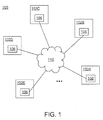
- a network 100 provides a shared communication medium 110 for a number of communication stations 102A - 102E (e.g., computing devices, or audiovisual devices) to communicate with each other.
- the communication medium 110 can include one or more types of physical communication media such as coaxial cable, unshielded twisted pair, power lines, or wireless channels for example.
- the network 100 can also include devices such as bridges or repeaters.
- the communication stations 102A - 102E communicate with each other using predetermined physical (PHY) layer and medium access control (MAC) layer communication protocols used by network interface modules 106.
- the MAC layer is a sub-layer of the data link layer and provides an interface to the PHY layer, according to the Open Systems Interconnection (OSI) network architecture standard, for example.
- the network 100 can have any of a variety of network topologies (e.g., bus, tree, star, mesh).
- the network interface modules 106 use protocols that include features to improve performance when the network 100 includes a communication medium 110 that exhibits varying transmission characteristics.
- the communication medium 110 may include AC power lines in a house, optionally coupled to other media (e.g., coaxial cable lines).
- Power-line communication systems use existing AC wiring to exchange information. Owing to their being designed for much lower frequency transmissions, AC wiring provides varying channel characteristics at the higher frequencies used for data transmission (e.g., depending on the wiring used and the actual layout). To increase the data rate between various links, stations adjust their transmission parameters dynamically. This process is called channel adaptation. Channel adaptation results in adaptation information specifying a set of transmission parameters that can be used on each link. Adaptation information includes such parameters as the frequencies used, their modulation, and the forward error correction (FEC) used.
- FEC forward error correction
- the communication channel between any two stations provided by the communication medium 110 may exhibit varying channel characteristics such as periodic variation in noise characteristics and frequency response.
- the stations can synchronize channel adaptation with the frequency of the AC line (e.g., 50 or 60 Hz).
- the frequency of the AC line e.g. 50 or 60 Hz.
- This synchronization enables the stations to use consistent channel adaptation optimize for a particular phase region of the AC line cycle.
- An example of such synchronization is described in U.S. Patent Application Publication No. 2007/0025391 A1 .
- Another aspect of mitigating potential impairments caused by the varying channel characteristics involves using a robust signal modulation format such as OFDM.
- An exemplary communication system that uses OFDM modulation is described below.
- a “MAC Protocol Data Unit” is a segment of information including overhead and payload fields that the MAC layer has asked the PHY layerto transport.
- An MPDU can have any of a variety of formats based an the type of data being transmitted.
- a “PHY Protocol Data Unit (MPDU)” refers to the modulated signal waveform representing an MPDU that is transmitted over the power line.
- each symbol has a predetermined time duration or symbol time T s .
- Each symbol is generated from a superposition of N sinusoidal carrier waveforms that are orthogonal to each other and form the OFDM carriers.
- Each carrier has a peak frequency f i and a phase ⁇ i measured from the beginning of the symbols
- f i peak frequency
- ⁇ i phase ⁇ i measured from the beginning of the symbols
- the phases ⁇ i and amplitudes A i of the carrier waveforms can be independently selected (according to an appropriate modulation scheme) without affecting the orthogonality of the resulting modulated waveforms.
- the carriers occupy a frequency range between frequcncies f i and f N referred to as the OFDM bandwidth.
- the stations use an adoptive carrier selection technique, described in more detail below, to select carriers for transmitting data based on monitoring electromagnetic spectral region and monitoring demand for communication capacity.
- a communication system 200 includes a transmitter 202 for transmitting a signal (eg., a sequence ofOFDM symbols) over a communication medium 204 to a receiver 206.
- the transmitter 202 and receiver 206 can both be incorporated into a network interface module 106 at each station.
- the communication medium 204 represents a path from one station to another over the communication medium 10 of the network 100.
- a wireless system 200 includes an antenna for transmitting and receiving signals over a free space path between stations. The antenna can also be used to enable a monitoring module 221 to monitor for received electromagnetic waves.
- a wired system 200 (e.g., that communicates over power lines) may not need an antenna tor transmitting signals, but can include an antenna 201 that enables a monitoring module 221 to monitor for received electromagnetic waves.
- modules implementing the PHY layer receive an MPDU from the MAC layer.
- the MPDU is sent to an encoder module 220 to perform processing such as scrambling, error correction coding and interleaving.
- the encoder module 220 can provide redundancy to enable each portion of an MPDU to be recovered from fewer than all of the modulated carriers or fewer than all of the modulated symbols.
- the encoded data is fed into a mapping module 222 that takes groups of data bits (e.g., 1, 2, 3, 4, 6, 8, or 10 bits), depending on the constellation used for the current symbol (e.g., a BPSK, QPSK, 8-QAM, 16-QAM constellation), and maps the data value represented by those bits onto the corresponding amplitudes of in-phase (I) and quadrature-phase (Q) components of a carrier waveform of the current symbol.
- any appropriate modulation scheme that associates data values to modulated carrier waveforms can be used.
- a carrier selection module 223 adaptively selects carrier frequencies f 1 ,..., f N (or “tones") within the OFDM bandwidth that are to be used by the system 200 to transmit information according to a "tone mask.”
- a default tone mask excludes carrier frequencies that are likely to interfere with licensed entities in a particular region (e.g., North America), Devices sold in a given region can be programmed to use a default tone mask configured for that region.
- the carrier selection module 223 can turn on any of a set of "reserved carriers" when there is no indication that a licensed entity is operating within a frequency interval that includes the reserved carrier frequency in the vicinity or the station.
- An "extended tone mask” is formed by turning on one or more of the reserved carriers.
- the carrier selection module 223 can send to the encoder module 220 and to the mapping module 222 any number of extended tone masks to be used at different times or for different symbols within an MPDU.
- the encoder module 220 can use the extended tone mask to determine how data is to be interleaved.
- the mapping module 222 can use the extended tone mask to determine how data values are to be mapped to carrier waveforms.
- the carrier selection module 223 receives input signals that are used to determine whether a given reserved carrier is to be used. One input signal indicates whether it is likely that a given reserved carrier can be used without causing interference to a licensed entity operating in the vicinity of the station. To determine this likelihood, the monitoring module 221 monitors reception of any electromagnetic waves that may be transmitted from such an entity within one or more "reserved frequency intervals" that include the reserved carrier frequencies.
- the reserved frequency intervals can be narrowband intervals surrounding each reserved carrier, or reserved frequency intervals can include multiple reserved carriers that are turned on or off in sets.
- the monitoring module 221 generates a signal S i for each monitored reserved frequency interval that indicates whether a "qualified electromagnetic wave" with a power above a predetermined threshold and a frequency in the reserved frequency interval has been received in the past Thours.
- the time window T is a short time interval such as 0.5 hour, 1 hour, 2 hours, etc.
- the time window T can be a longer time interval such as one or more days or weeks.
- the time window T can be different for different reserved frequency intervals.
- Another input signal S D characterizes a demand for communication capacity from one or more stations in the network.
- Each station can repeatedly broadcast information about whether the station has a request for transmission of data from the station at a rate that exceeds a currently available capacity over the shared communication medium 110 using the current tone mask(s). For example, a station may have a request to transmit or receive a video stream that would consume more capacity than is available.
- Each station can transmit a logical signal S d that is true if that station has a demand for communication capacity.
- the signal S D can then be calculated as the logical OR operation performed on the individual S d signals.
- the one or more carrier frequencies within the reserved frequency interval are added to an extended tone mask.
- the CCo station can make this determination and broadcast the new extended tone mask to the other stations in the network.
- the CCo station may broadcast the new extended tone mask to only those stations occupying significant portions of time on the shared communication medium 110 (e.g., to limit the use of the reserved carriers to those stations that would benefit most from the extra capacity provided by the reserved carriers). If the extended tone mask is sent to stations, those stations do not necessarily need to have a carrier selection module 223.
- the CCo station can broadcast the S j and S D input signals and each station can determine the extended tone mask based on these signals from the CCo station.
- multiple stations in the network can monitor reception of qualified electromagnetic waves in each reserved frequency interval and send the monitoring results to the CCo station to increase the reliability of detecting the waves (e.g., a wave may have a low power just above the threshold which can be detected by a station in one portion of the network, but not by the CCo station).
- CCo station e.g., a CSMA network
- stations can occasionally broadcast information characterizing reception of qualified electromagnetic waves and demand for capacity so that the decision about whether to include a given reserved carrier in the extended tone mask is made using a distributed algorithm (e.g., distributed consensus algorithms).
- a pair of stations in the network 100 may choose to use reserved carriers in an extended tone mask based on their reception (or lack thereof) of one or more qualified electromagnetic waves and their demand for capacity, independently of the other stations. It is not necessary that the stations inform other stations of the extended tone mask, but there may be cases where communicating the extended tone mask to other stations may be useful.
- the CCo in a network 100 that includes a CCo station, the CCo can allow the option for individual pairs of communicating stations to select an extended tone mask for use between that pair of stations.
- a new tone mask can be generated without those carriers. Also, if a qualified electromagnetic wave is received with a frequency in a reserved frequency interval while corresponding reserved carriers in that interval are being used in an extended tone mask, a new tone mask can be generated without the corresponding reserved carriers.
- certain communication symbols such as symbols carrying overhead information (e.g., preamble symbols and frame control symbols), and symbols carrying information broadcast to all stations (e.g., robust mode symbols) can be encoded and modulated using the default tone mask without any reserved carriers regardless of whether or not any other station is using an extended tone mask.
- certain communication symbols can be encoded and modulated to make use of the reserved carriers only for communicating redundant information that is not required for correctly demodulating and decoding the symbols.
- One technique that facilitates interoperability for certain communication symbols includes using a predetermined encoding that does not depend on which reserved carrier frequencies are selected for inclusion in the extended tone mask.
- the encoder module 220 interleaves data in a manner that does not depend on which reserved carrier frequencies are used.
- the interleaving can include all reserved carriers regardless of whether the carrier is selected, and can ensure that only redundant information (e.g., copies or parity bits) is mapped to the reserved carriers.
- a station can demodulate and decode information from a given default carrier frequency or a given reserved carrier frequency without necessarily knowing which reserved carriers may have been selected for modulating information in the extended tone mask.
- a station can demodulate and decode information without using any reserved carriers, or a station can use one or more reserved carriers to obtain redundant information that may be used, for example, to correct errors.
- the mapping module 222 also determines the type of modulation to be used on each of the carriers in the tone mask according to a "tone map."
- the tone map can be a default tone map (e.g., for redundant broadcast communication among multiple stations), or a customized tone map determined by a receiving station that has been adapted to characteristics of the communication medium 204 (e.g., for more efficient unicast communication between two stations).
- the tone map can specify that the carrier is not to be used to modulate data, but instead can use pseudorandom noise for that carrier (e.g., coherent BPSK modulated with a binary value from a Pseudo Noise (PN) sequence).
- pseudorandom noise e.g., coherent BPSK modulated with a binary value from a Pseudo Noise (PN) sequence.
- PN Pseudo Noise
- a pair of stations that performs channel adaptation do determine a tone map may also decide to turn on one or more reserved carriers in a reserved frequency interval in which no qualified electromagnetic wave has been detected to establish an extended tone mask to be used just for unicast communication between the two stations, as described above. Other stations using a different extended tone mask or the default tone mask would not need to know that extended tone mask established by those stations.
- a modulation module 224 performs the modulation of the resulting set of N complex numbers (some of which may be zero for unused carriers) determined by the mapping module 222 onto N orthogonal carrier waveforms having peak frequencies f 1 ,..., f N .
- the discrete Fourier transform corresponds to a fast Fourier transform (FFT) in which N is, a power of 2.
- a post-processing module 226 combines a sequence of consecutive (potentially overlapping) symbols into a "symbol set" that can be transmitted as a continuous block over the communication medium 204.
- the post-processing module 226 prepends a preamble to the symbol set that can be used for automatic gain control (AGC) and symbol timing synchronization.
- AGC automatic gain control
- the post-processing module 226 can extend each symbol with a cyclic prefix that is a copy of the last part of the symbol.
- the post-processing module 226 can also perform other functions such as applying a pulse shaping window to subsets of symbols within the symbol set (e.g., using a raised cosine window or other type of pulse shaping window) and overlapping the symbol subsets.
- An Analog Front End (AFE) module 228 couples an analog signal containing a continuous-time (e.g., low-pass filtered) version of the symbol set to the communication medium 204.
- a continuous-time (e.g., low-pass filtered) version of the symbol set to the communication medium 204.
- the communication medium 204 supports propagation of an electrical signal over a wire between stations
- the communication medium 204 supports propagation of electromagnetic waves through paths between antennas of stations.
- the effect of the transmission of the continuous-time version of the waveform S ( t ) over the communication medium 204 can be represented by convolution with a function g ( ⁇ , l ) representing an impulse response of transmission over the communication medium.
- the communication medium 204 may add noise n ( l ), which may be random noise and/or narrowband noise emitted by a jammer.
- modules implementing the PHY layer receive a signal from the communication medium 204 and generate an MPDU for the MAC layer.
- An AFE module 230 operates in conjunction with an Automatic Gain Control (AGC) module 232 and a time synchronization module 234 to provide sampled signal data and timing information to a discrete Fourier transform (DFT) module 236.
- AGC Automatic Gain Control
- DFT discrete Fourier transform
- the receiver 206 feeds the sampled discrete-time symbols into DFT module 236 to extract the sequence of N complex numbers representing the encoded data values (by performing an N -point DFT).
- Demodulator/Decoder module 238 maps the complex numbers onto the corresponding bit sequences and performs the appropriate decoding of the bits (including deinterleaving, error correction, and descrambling).
- the data that was modulated onto carriers that were subsequently attenuated by the spectral shaping module 400 can be recovered due to the redundancy in the encoding scheme.
- the adaptive carrier selection technique can be used in combination with the amplitude mask technique described in U.S. Application Publication No. 2007/0064788 A1 .
- the reserved carriers can be included in a master tone mask for all symbols and selectively turned on or off, as described herein, using the amplitude mask.
- the amplitude A' i is set below a predetermined amplitude that is normally used for modulating the information (e.g., according to a predetermined constellation) such that the resulting radiated power does not interfere with other devices.
- the amplitude mask entry may also indicate that a carrier is to be nulled completely with the corresponding amplitude set to zero. The attenuated carriers can still be processed by the receiving station even if they are transmitted with zero amplitude so that the modulation and encoding scheme is preserved.
- modules of the communication system 200 including modules in the transmitter 202 or receiver 206 can be implemented in hardware, software, or a combination of hardware and software.
Landscapes
- Engineering & Computer Science (AREA)
- Signal Processing (AREA)
- Computer Networks & Wireless Communication (AREA)
- Power Engineering (AREA)
- Mobile Radio Communication Systems (AREA)
- Cable Transmission Systems, Equalization Of Radio And Reduction Of Echo (AREA)
Claims (14)
- Un procédé de communication dans un réseau (100) de stations (102A-102E), comprenant :la surveillance de la réception de quelconques ondes électromagnétiques qualifiées qui ont eu une puissance au-dessus d'un seuil et une fréquence dans l'un parmi des intervalles de fréquences prédéterminés multiples dans un intervalle de temps prédéterminé ; etla sélection de fréquences porteuses pour moduler des informations sur des signaux émis dans le réseau,sur la base au moins en partie du point de savoir si des quelconques ondes électromagnétiques qualifiées ayant une puissance au-dessus du seuil et une fréquence dans l'intervalle de fréquences prédéterminé ont été ou non reçues dans l'intervalle de temps prédéterminé, etcaractérisé en ce que :la sélection est basée au moins en partie sur une exigence par une ou plusieurs stations du réseau d'une capacité de communiquer dans le réseau ;dans lequel une fréquence porteuse donnée dans un sous-ensemble de fréquences porteuses est sélectionnée pour moduler des informations sur des signaux émis dans le réseau si aucune onde électromagnétique qualifiée n'est reçue dans un intervalle de fréquences correspondant qui inclut la fréquence porteuse donnée et si au moins une station exige une capacité de communication dans le réseau.
- Le procédé de la revendication 1, dans lequel l'exigence de capacité par une station comprend une requête d'émission de données en provenance de la station à un débit qui dépasse une capacité disponible sur un medium de communication partagé par des stations multiples du réseau.
- Le procédé de la revendication 1, comprenant en outre le fait de s'assurer que les fréquences porteuses dans l'intervalle de fréquences prédéterminé ne sont pas sélectionnées pour moduler des informations sur des signaux émis dans le réseau si une onde électromagnétique qualifiée ayant une puissance au-dessus du seuil et une fréquence dans l'intervalle de fréquences prédéterminé a été reçue dans l'intervalle de temps prédéterminé.
- Le procédé de la revendication 1, comprenant en outre le fait de mettre fin à l'utilisation de la fréquence porteuse donnée pour moduler des informations sur des signaux émis dans le réseau si une onde électromagnétique qualifiée est reçue dans un intervalle de fréquences correspondant qui inclut la fréquence porteuse donnée ou si une exigence restante de capacité peut être satisfaite sans utiliser la fréquence porteuse donnée.
- Le procédé de la revendication 1, comprenant en outre l'émission à partir d'une première station du réseau vers au moins une autre station du réseau d'une information caractérisant l'exigence de capacité.
- Le procédé de la revendication 1, dans lequel la fréquence porteuse sélectionnée dans le sous-ensemble est utilisée pour moduler une première catégorie d'informations sur des signaux émis dans le réseau et n'est pas utilisée pour moduler une seconde catégorie d'informations sur des signaux émis dans le réseau, la première catégorie comprenant des informations qui sont diffusées en unicast vers une autre station et la seconde catégorie comprenant des informations de préambule ou de service modulées sur des signaux émis dans le réseau.
- Le procédé de la revendication 1, comprenant en outre l'émission à partir d'une première station du réseau vers au moins une autre station du réseau d'une information indiquant si une onde électromagnétique qualifiée ayant une puissance au-dessus du seuil et une fréquence dans l'intervalle de fréquences prédéterminé a été ou non reçue.
- Un équipement, comprenant :un module de surveillance (221) configuré pour surveiller la réception d'une quelconque onde électromagnétique qualifiée qui a une puissance au-dessus d'un seuil et une fréquence dans l'un parmi des intervalles de fréquences prédéterminés multiples dans un intervalle de temps prédéterminé ;un module de modulation (224) configuré pour moduler des informations sur des signaux émis dans un réseau ; etun module de sélection de porteuse (223) configuré pour sélectionner les fréquences porteuses à utiliser par le module de modulation,sur la base au moins en partie du point de savoir si des quelconques ondes électromagnétiques qualifiées ayant une puissance au-dessus du seuil et une fréquence dans l'intervalle de fréquences prédéterminé ont été ou non reçues dans l'intervalle de temps prédéterminé, etcaractérisé en ce que :la sélection est basée au moins en partie sur une exigence par une ou plusieurs stations du réseau d'une capacité de communiquer dans le réseau ;dans lequel une fréquence porteuse donnée dans un sous-ensemble de fréquences porteuses est sélectionnée pour moduler des informations sur des signaux émis dans le réseau si aucune onde électromagnétique qualifiée n'est reçue dans un intervalle de fréquences correspondant qui inclut la fréquence porteuse donnée et si au moins une station exige une capacité de communication dans le réseau.
- L'équipement de la revendication 8, dans lequel l'exigence de capacité par une station comprend une requête d'émission de données en provenance de la station à un débit qui dépasse une capacité disponible sur un medium de communication partagé par des stations multiples du réseau.
- L'équipement de la revendication 8, adapté en outre pour s'assurer que les fréquences porteuses dans l'intervalle de fréquences prédéterminé ne sont pas sélectionnées pour moduler des informations sur des signaux émis dans le réseau si une onde électromagnétique qualifiée ayant une puissance au-dessus du seuil et une fréquence dans l'intervalle de fréquences prédéterminé a été reçue dans l'intervalle de temps prédéterminé.
- L'équipement de la revendication 8, adapté en outre pour mettre fin à l'utilisation de la fréquence porteuse donnée pour moduler des informations sur des signaux émis dans le réseau si une onde électromagnétique qualifiée est reçue dans un intervalle de fréquences correspondant qui inclut la fréquence porteuse donnée ou si une exigence restante de capacité peut être satisfaite sans utiliser la fréquence porteuse donnée.
- L'équipement de la revendication 8, adapté en outre pour émettre à partir d'une première station du réseau vers au moins une autre station du réseau une information caractérisant l'exigence de capacité.
- L'équipement de la revendication 8, dans lequel la fréquence porteuse sélectionnée dans le sous-ensemble est utilisée pour moduler une première catégorie d'informations sur des signaux émis dans le réseau et n'est pas utilisée pour moduler une seconde catégorie d'informations sur des signaux émis dans le réseau, la première catégorie comprenant des informations qui sont diffusées en unicast vers une autre station et la seconde catégorie comprenant des informations de préambule ou de service modulées sur des signaux émis dans le réseau.
- L'équipement de la revendication 8, adapté en outre pour émettre à partir d'une première station du réseau vers au moins une autre station du réseau une information indiquant si une onde électromagnétique qualifiée ayant une puissance au-dessus du seuil et une fréquence dans l'intervalle de fréquences prédéterminé a été ou non reçue.
Applications Claiming Priority (2)
| Application Number | Priority Date | Filing Date | Title |
|---|---|---|---|
| US11/614,729 US7904021B2 (en) | 2006-12-21 | 2006-12-21 | Selecting carriers for modulating signals in a communication network |
| PCT/US2007/085189 WO2008079561A1 (fr) | 2006-12-21 | 2007-11-20 | Sélection de porteuses pour moduler des signaux dans un réseau de communication |
Publications (3)
| Publication Number | Publication Date |
|---|---|
| EP2095555A1 EP2095555A1 (fr) | 2009-09-02 |
| EP2095555A4 EP2095555A4 (fr) | 2013-09-25 |
| EP2095555B1 true EP2095555B1 (fr) | 2016-04-13 |
Family
ID=39543548
Family Applications (1)
| Application Number | Title | Priority Date | Filing Date |
|---|---|---|---|
| EP07864635.3A Not-in-force EP2095555B1 (fr) | 2006-12-21 | 2007-11-20 | Sélection de porteuses pour moduler des signaux dans un réseau de communication |
Country Status (3)
| Country | Link |
|---|---|
| US (1) | US7904021B2 (fr) |
| EP (1) | EP2095555B1 (fr) |
| WO (1) | WO2008079561A1 (fr) |
Families Citing this family (11)
| Publication number | Priority date | Publication date | Assignee | Title |
|---|---|---|---|---|
| US8090857B2 (en) | 2003-11-24 | 2012-01-03 | Qualcomm Atheros, Inc. | Medium access control layer that encapsulates data from a plurality of received data units into a plurality of independently transmittable blocks |
| US9172429B2 (en) * | 2004-12-01 | 2015-10-27 | At&T Intellectual Property Ii, L.P. | Interference control in a broadband powerline communication system |
| US8175190B2 (en) * | 2005-07-27 | 2012-05-08 | Qualcomm Atheros, Inc. | Managing spectra of modulated signals in a communication network |
| US8213868B2 (en) | 2009-04-17 | 2012-07-03 | Lingna Holdings Pte., Llc | Exploiting multiple antennas for spectrum sensing in cognitive radio networks |
| WO2011082145A2 (fr) * | 2010-01-04 | 2011-07-07 | Atheros Communications, Inc. | Réglage de la puissance à l'émission |
| JP5678171B2 (ja) | 2010-04-12 | 2015-02-25 | クゥアルコム・インコーポレイテッドQualcomm Incorporated | ネットワークにおける低オーバーヘッド通信のためのチャネル推定 |
| US8958464B2 (en) | 2011-06-09 | 2015-02-17 | Texas Instruments Incorporated | PHY payload over multiple tone masks using single tone mask PHY header information |
| US20130083786A1 (en) * | 2011-09-29 | 2013-04-04 | Motorola Solutions, Inc. | Method and apparatus for synchronization in a dynamic spectrum access (dsa) cognitive radio system |
| US9231657B2 (en) * | 2012-01-13 | 2016-01-05 | Texas Instruments Incorporated | Adaptive sub-band algorithm for point-to-point communication in PLC networks |
| US20150111583A1 (en) * | 2013-10-21 | 2015-04-23 | Qualcomm Incorporated | Communicating detection of controlled radio frequencies |
| US11329750B2 (en) * | 2019-06-07 | 2022-05-10 | Qualcomm Incorporated | Sequence transmission for sidelink communications |
Family Cites Families (19)
| Publication number | Priority date | Publication date | Assignee | Title |
|---|---|---|---|---|
| US6334219B1 (en) | 1994-09-26 | 2001-12-25 | Adc Telecommunications Inc. | Channel selection for a hybrid fiber coax network |
| US6061555A (en) | 1998-10-21 | 2000-05-09 | Parkervision, Inc. | Method and system for ensuring reception of a communications signal |
| US6278685B1 (en) | 1999-08-19 | 2001-08-21 | Intellon Corporation | Robust transmission mode |
| US6160443A (en) * | 1999-09-08 | 2000-12-12 | Atmel Corporation | Dual automatic gain control in a QAM demodulator |
| US7974255B2 (en) | 1999-09-15 | 2011-07-05 | Alcatel-Lucent Usa Inc. | Method and apparatus for multi-stream transmission with time and frequency diversity in an orthogonal frequency division multiplexing (OFDM) communication system |
| DE10014676C2 (de) * | 2000-03-24 | 2002-02-07 | Polytrax Inf Technology Ag | Datenübertragung über ein Stromversorgungsnetz |
| US6289000B1 (en) | 2000-05-19 | 2001-09-11 | Intellon Corporation | Frame control encoder/decoder for robust OFDM frame transmissions |
| US6721569B1 (en) * | 2000-09-29 | 2004-04-13 | Nortel Networks Limited | Dynamic sub-carrier assignment in OFDM systems |
| EP1207661B1 (fr) * | 2000-11-20 | 2012-04-18 | Sony Deutschland GmbH | Allocation adaptative de sous-porteuse |
| US7215715B2 (en) | 2001-02-06 | 2007-05-08 | Maxim Integrated Products, Inc. | System and method of signal wave shaping for spectrum control of an OFDM signal |
| JP3607643B2 (ja) * | 2001-07-13 | 2005-01-05 | 松下電器産業株式会社 | マルチキャリア送信装置、マルチキャリア受信装置、およびマルチキャリア無線通信方法 |
| US20030133473A1 (en) | 2001-08-04 | 2003-07-17 | Manis Constantine N. | Power line communication system |
| JP4078105B2 (ja) * | 2002-04-08 | 2008-04-23 | シャープ株式会社 | 無線通信システム |
| US7221680B2 (en) * | 2003-09-02 | 2007-05-22 | Qualcomm Incorporated | Multiplexing and transmission of multiple data streams in a wireless multi-carrier communication system |
| JP4490425B2 (ja) * | 2003-09-19 | 2010-06-23 | パナソニック株式会社 | マルチキャリア通信方法、システム及び装置 |
| US7411930B2 (en) | 2003-12-17 | 2008-08-12 | Qualcomm, Incorporated | Apparatus and method for prioritized apportionment of transmission power in a multi-carrier terminal |
| EP1643658A1 (fr) * | 2004-10-04 | 2006-04-05 | Sony Deutschland GmbH | Procede de communications par courant porteur |
| US9161231B2 (en) | 2004-10-14 | 2015-10-13 | Alcatel Lucent | Method and system for wireless networking using coordinated dynamic spectrum access |
| US7590183B2 (en) * | 2005-05-12 | 2009-09-15 | Intellon Corporation | Generating signals for transmission of information |
-
2006
- 2006-12-21 US US11/614,729 patent/US7904021B2/en not_active Expired - Fee Related
-
2007
- 2007-11-20 EP EP07864635.3A patent/EP2095555B1/fr not_active Not-in-force
- 2007-11-20 WO PCT/US2007/085189 patent/WO2008079561A1/fr not_active Ceased
Also Published As
| Publication number | Publication date |
|---|---|
| US20080153430A1 (en) | 2008-06-26 |
| EP2095555A4 (fr) | 2013-09-25 |
| US7904021B2 (en) | 2011-03-08 |
| EP2095555A1 (fr) | 2009-09-02 |
| WO2008079561A1 (fr) | 2008-07-03 |
Similar Documents
| Publication | Publication Date | Title |
|---|---|---|
| US8537705B2 (en) | Transmit power control | |
| WO2008079561A1 (fr) | Sélection de porteuses pour moduler des signaux dans un réseau de communication | |
| US8680706B2 (en) | Communicating over power distribution media | |
| US8416887B2 (en) | Managing spectra of modulated signals in a communication network | |
| US8320233B2 (en) | Transmitter and method for applying multi-tone OFDM based communications within a lower frequency range | |
| CN103931132B (zh) | 通信系统以及在通信系统中使用的比特加载方法 | |
| US8675754B1 (en) | Hybrid modulation schemes used in data communication | |
| US8614961B1 (en) | Efficient communication over a shared medium | |
| KR20130018296A (ko) | 네트워크에서 저-오버헤드 통신을 위한 구분문자들의 제공 | |
| US9306716B2 (en) | Carrier tracking without pilots | |
| Zhang et al. | FFT-based OFDM in broadband-PLC and narrowband-PLC |
Legal Events
| Date | Code | Title | Description |
|---|---|---|---|
| PUAI | Public reference made under article 153(3) epc to a published international application that has entered the european phase |
Free format text: ORIGINAL CODE: 0009012 |
|
| 17P | Request for examination filed |
Effective date: 20090615 |
|
| AK | Designated contracting states |
Kind code of ref document: A1 Designated state(s): AT BE BG CH CY CZ DE DK EE ES FI FR GB GR HU IE IS IT LI LT LU LV MC MT NL PL PT RO SE SI SK TR |
|
| DAX | Request for extension of the european patent (deleted) | ||
| RAP1 | Party data changed (applicant data changed or rights of an application transferred) |
Owner name: ATHEROS COMMUNICATIONS, INC. |
|
| RAP1 | Party data changed (applicant data changed or rights of an application transferred) |
Owner name: QUALCOMM ATHEROS, INC. |
|
| RAP1 | Party data changed (applicant data changed or rights of an application transferred) |
Owner name: QUALCOMM INCORPORATED |
|
| A4 | Supplementary search report drawn up and despatched |
Effective date: 20130822 |
|
| RIC1 | Information provided on ipc code assigned before grant |
Ipc: H04L 5/00 20060101ALN20130816BHEP Ipc: H04B 3/54 20060101AFI20130816BHEP |
|
| 17Q | First examination report despatched |
Effective date: 20130920 |
|
| REG | Reference to a national code |
Ref country code: DE Ref legal event code: R079 Ref document number: 602007045886 Country of ref document: DE Free format text: PREVIOUS MAIN CLASS: H04K0001100000 Ipc: H04B0003540000 |
|
| GRAP | Despatch of communication of intention to grant a patent |
Free format text: ORIGINAL CODE: EPIDOSNIGR1 |
|
| RIC1 | Information provided on ipc code assigned before grant |
Ipc: H04B 3/54 20060101AFI20151210BHEP Ipc: H04L 5/00 20060101ALN20151210BHEP |
|
| INTG | Intention to grant announced |
Effective date: 20160105 |
|
| GRAS | Grant fee paid |
Free format text: ORIGINAL CODE: EPIDOSNIGR3 |
|
| GRAA | (expected) grant |
Free format text: ORIGINAL CODE: 0009210 |
|
| AK | Designated contracting states |
Kind code of ref document: B1 Designated state(s): AT BE BG CH CY CZ DE DK EE ES FI FR GB GR HU IE IS IT LI LT LU LV MC MT NL PL PT RO SE SI SK TR |
|
| REG | Reference to a national code |
Ref country code: GB Ref legal event code: FG4D |
|
| REG | Reference to a national code |
Ref country code: AT Ref legal event code: REF Ref document number: 791097 Country of ref document: AT Kind code of ref document: T Effective date: 20160415 Ref country code: CH Ref legal event code: EP |
|
| REG | Reference to a national code |
Ref country code: IE Ref legal event code: FG4D |
|
| REG | Reference to a national code |
Ref country code: DE Ref legal event code: R096 Ref document number: 602007045886 Country of ref document: DE |
|
| REG | Reference to a national code |
Ref country code: LT Ref legal event code: MG4D |
|
| REG | Reference to a national code |
Ref country code: AT Ref legal event code: MK05 Ref document number: 791097 Country of ref document: AT Kind code of ref document: T Effective date: 20160413 |
|
| REG | Reference to a national code |
Ref country code: NL Ref legal event code: MP Effective date: 20160413 |
|
| REG | Reference to a national code |
Ref country code: FR Ref legal event code: PLFP Year of fee payment: 10 |
|
| PG25 | Lapsed in a contracting state [announced via postgrant information from national office to epo] |
Ref country code: PL Free format text: LAPSE BECAUSE OF FAILURE TO SUBMIT A TRANSLATION OF THE DESCRIPTION OR TO PAY THE FEE WITHIN THE PRESCRIBED TIME-LIMIT Effective date: 20160413 Ref country code: NL Free format text: LAPSE BECAUSE OF FAILURE TO SUBMIT A TRANSLATION OF THE DESCRIPTION OR TO PAY THE FEE WITHIN THE PRESCRIBED TIME-LIMIT Effective date: 20160413 Ref country code: FI Free format text: LAPSE BECAUSE OF FAILURE TO SUBMIT A TRANSLATION OF THE DESCRIPTION OR TO PAY THE FEE WITHIN THE PRESCRIBED TIME-LIMIT Effective date: 20160413 Ref country code: LT Free format text: LAPSE BECAUSE OF FAILURE TO SUBMIT A TRANSLATION OF THE DESCRIPTION OR TO PAY THE FEE WITHIN THE PRESCRIBED TIME-LIMIT Effective date: 20160413 |
|
| PG25 | Lapsed in a contracting state [announced via postgrant information from national office to epo] |
Ref country code: AT Free format text: LAPSE BECAUSE OF FAILURE TO SUBMIT A TRANSLATION OF THE DESCRIPTION OR TO PAY THE FEE WITHIN THE PRESCRIBED TIME-LIMIT Effective date: 20160413 Ref country code: GR Free format text: LAPSE BECAUSE OF FAILURE TO SUBMIT A TRANSLATION OF THE DESCRIPTION OR TO PAY THE FEE WITHIN THE PRESCRIBED TIME-LIMIT Effective date: 20160714 Ref country code: SE Free format text: LAPSE BECAUSE OF FAILURE TO SUBMIT A TRANSLATION OF THE DESCRIPTION OR TO PAY THE FEE WITHIN THE PRESCRIBED TIME-LIMIT Effective date: 20160413 Ref country code: LV Free format text: LAPSE BECAUSE OF FAILURE TO SUBMIT A TRANSLATION OF THE DESCRIPTION OR TO PAY THE FEE WITHIN THE PRESCRIBED TIME-LIMIT Effective date: 20160413 Ref country code: PT Free format text: LAPSE BECAUSE OF FAILURE TO SUBMIT A TRANSLATION OF THE DESCRIPTION OR TO PAY THE FEE WITHIN THE PRESCRIBED TIME-LIMIT Effective date: 20160816 Ref country code: ES Free format text: LAPSE BECAUSE OF FAILURE TO SUBMIT A TRANSLATION OF THE DESCRIPTION OR TO PAY THE FEE WITHIN THE PRESCRIBED TIME-LIMIT Effective date: 20160413 |
|
| PG25 | Lapsed in a contracting state [announced via postgrant information from national office to epo] |
Ref country code: IT Free format text: LAPSE BECAUSE OF FAILURE TO SUBMIT A TRANSLATION OF THE DESCRIPTION OR TO PAY THE FEE WITHIN THE PRESCRIBED TIME-LIMIT Effective date: 20160413 Ref country code: BE Free format text: LAPSE BECAUSE OF FAILURE TO SUBMIT A TRANSLATION OF THE DESCRIPTION OR TO PAY THE FEE WITHIN THE PRESCRIBED TIME-LIMIT Effective date: 20160413 |
|
| REG | Reference to a national code |
Ref country code: DE Ref legal event code: R097 Ref document number: 602007045886 Country of ref document: DE |
|
| PG25 | Lapsed in a contracting state [announced via postgrant information from national office to epo] |
Ref country code: SK Free format text: LAPSE BECAUSE OF FAILURE TO SUBMIT A TRANSLATION OF THE DESCRIPTION OR TO PAY THE FEE WITHIN THE PRESCRIBED TIME-LIMIT Effective date: 20160413 Ref country code: EE Free format text: LAPSE BECAUSE OF FAILURE TO SUBMIT A TRANSLATION OF THE DESCRIPTION OR TO PAY THE FEE WITHIN THE PRESCRIBED TIME-LIMIT Effective date: 20160413 Ref country code: RO Free format text: LAPSE BECAUSE OF FAILURE TO SUBMIT A TRANSLATION OF THE DESCRIPTION OR TO PAY THE FEE WITHIN THE PRESCRIBED TIME-LIMIT Effective date: 20160413 Ref country code: DK Free format text: LAPSE BECAUSE OF FAILURE TO SUBMIT A TRANSLATION OF THE DESCRIPTION OR TO PAY THE FEE WITHIN THE PRESCRIBED TIME-LIMIT Effective date: 20160413 Ref country code: CZ Free format text: LAPSE BECAUSE OF FAILURE TO SUBMIT A TRANSLATION OF THE DESCRIPTION OR TO PAY THE FEE WITHIN THE PRESCRIBED TIME-LIMIT Effective date: 20160413 |
|
| PLBE | No opposition filed within time limit |
Free format text: ORIGINAL CODE: 0009261 |
|
| STAA | Information on the status of an ep patent application or granted ep patent |
Free format text: STATUS: NO OPPOSITION FILED WITHIN TIME LIMIT |
|
| 26N | No opposition filed |
Effective date: 20170116 |
|
| PG25 | Lapsed in a contracting state [announced via postgrant information from national office to epo] |
Ref country code: SI Free format text: LAPSE BECAUSE OF FAILURE TO SUBMIT A TRANSLATION OF THE DESCRIPTION OR TO PAY THE FEE WITHIN THE PRESCRIBED TIME-LIMIT Effective date: 20160413 |
|
| REG | Reference to a national code |
Ref country code: CH Ref legal event code: PL |
|
| PG25 | Lapsed in a contracting state [announced via postgrant information from national office to epo] |
Ref country code: LI Free format text: LAPSE BECAUSE OF NON-PAYMENT OF DUE FEES Effective date: 20161130 Ref country code: CH Free format text: LAPSE BECAUSE OF NON-PAYMENT OF DUE FEES Effective date: 20161130 |
|
| REG | Reference to a national code |
Ref country code: IE Ref legal event code: MM4A |
|
| PG25 | Lapsed in a contracting state [announced via postgrant information from national office to epo] |
Ref country code: LU Free format text: LAPSE BECAUSE OF NON-PAYMENT OF DUE FEES Effective date: 20161130 |
|
| REG | Reference to a national code |
Ref country code: FR Ref legal event code: PLFP Year of fee payment: 11 |
|
| PG25 | Lapsed in a contracting state [announced via postgrant information from national office to epo] |
Ref country code: IE Free format text: LAPSE BECAUSE OF NON-PAYMENT OF DUE FEES Effective date: 20161120 |
|
| PGFP | Annual fee paid to national office [announced via postgrant information from national office to epo] |
Ref country code: FR Payment date: 20171018 Year of fee payment: 11 Ref country code: DE Payment date: 20171130 Year of fee payment: 11 |
|
| PGFP | Annual fee paid to national office [announced via postgrant information from national office to epo] |
Ref country code: GB Payment date: 20171026 Year of fee payment: 11 |
|
| PG25 | Lapsed in a contracting state [announced via postgrant information from national office to epo] |
Ref country code: HU Free format text: LAPSE BECAUSE OF FAILURE TO SUBMIT A TRANSLATION OF THE DESCRIPTION OR TO PAY THE FEE WITHIN THE PRESCRIBED TIME-LIMIT; INVALID AB INITIO Effective date: 20071120 Ref country code: CY Free format text: LAPSE BECAUSE OF FAILURE TO SUBMIT A TRANSLATION OF THE DESCRIPTION OR TO PAY THE FEE WITHIN THE PRESCRIBED TIME-LIMIT Effective date: 20160413 |
|
| PG25 | Lapsed in a contracting state [announced via postgrant information from national office to epo] |
Ref country code: TR Free format text: LAPSE BECAUSE OF FAILURE TO SUBMIT A TRANSLATION OF THE DESCRIPTION OR TO PAY THE FEE WITHIN THE PRESCRIBED TIME-LIMIT Effective date: 20160413 Ref country code: MC Free format text: LAPSE BECAUSE OF FAILURE TO SUBMIT A TRANSLATION OF THE DESCRIPTION OR TO PAY THE FEE WITHIN THE PRESCRIBED TIME-LIMIT Effective date: 20160413 Ref country code: IS Free format text: LAPSE BECAUSE OF FAILURE TO SUBMIT A TRANSLATION OF THE DESCRIPTION OR TO PAY THE FEE WITHIN THE PRESCRIBED TIME-LIMIT Effective date: 20160413 |
|
| PG25 | Lapsed in a contracting state [announced via postgrant information from national office to epo] |
Ref country code: BG Free format text: LAPSE BECAUSE OF FAILURE TO SUBMIT A TRANSLATION OF THE DESCRIPTION OR TO PAY THE FEE WITHIN THE PRESCRIBED TIME-LIMIT Effective date: 20160413 |
|
| PG25 | Lapsed in a contracting state [announced via postgrant information from national office to epo] |
Ref country code: MT Free format text: LAPSE BECAUSE OF NON-PAYMENT OF DUE FEES Effective date: 20161120 |
|
| REG | Reference to a national code |
Ref country code: DE Ref legal event code: R119 Ref document number: 602007045886 Country of ref document: DE |
|
| GBPC | Gb: european patent ceased through non-payment of renewal fee |
Effective date: 20181120 |
|
| PG25 | Lapsed in a contracting state [announced via postgrant information from national office to epo] |
Ref country code: DE Free format text: LAPSE BECAUSE OF NON-PAYMENT OF DUE FEES Effective date: 20190601 Ref country code: FR Free format text: LAPSE BECAUSE OF NON-PAYMENT OF DUE FEES Effective date: 20181130 |
|
| PG25 | Lapsed in a contracting state [announced via postgrant information from national office to epo] |
Ref country code: GB Free format text: LAPSE BECAUSE OF NON-PAYMENT OF DUE FEES Effective date: 20181120 |