EP2095672B1 - Ordre de recherche efficace de réseau mobile terrestre public - Google Patents
Ordre de recherche efficace de réseau mobile terrestre public Download PDFInfo
- Publication number
- EP2095672B1 EP2095672B1 EP07822516A EP07822516A EP2095672B1 EP 2095672 B1 EP2095672 B1 EP 2095672B1 EP 07822516 A EP07822516 A EP 07822516A EP 07822516 A EP07822516 A EP 07822516A EP 2095672 B1 EP2095672 B1 EP 2095672B1
- Authority
- EP
- European Patent Office
- Prior art keywords
- rat
- cell
- searching
- recently used
- frequency group
- Prior art date
- Legal status (The legal status is an assumption and is not a legal conclusion. Google has not performed a legal analysis and makes no representation as to the accuracy of the status listed.)
- Active
Links
Images



Classifications
-
- H—ELECTRICITY
- H04—ELECTRIC COMMUNICATION TECHNIQUE
- H04W—WIRELESS COMMUNICATION NETWORKS
- H04W48/00—Access restriction; Network selection; Access point selection
- H04W48/16—Discovering, processing access restriction or access information
-
- H—ELECTRICITY
- H04—ELECTRIC COMMUNICATION TECHNIQUE
- H04W—WIRELESS COMMUNICATION NETWORKS
- H04W48/00—Access restriction; Network selection; Access point selection
- H04W48/18—Selecting a network or a communication service
-
- H—ELECTRICITY
- H04—ELECTRIC COMMUNICATION TECHNIQUE
- H04W—WIRELESS COMMUNICATION NETWORKS
- H04W88/00—Devices specially adapted for wireless communication networks, e.g. terminals, base stations or access point devices
- H04W88/02—Terminal devices
Definitions
- This invention relates to communication systems and more particularly to mobile communication systems.
- UE user equipment
- PLMNs public land mobile networks
- Mobile communication systems include time-division multiple access (TDMA) systems, such as cellular radio telephone systems that comply with the GSM telecommunication standard and its enhancements like GSM/EDGE, and code-division multiple access (CDMA) systems, such as cellular radio telephone systems that comply with the IS-95, cdma2000, and wideband CDMA (WCDMA) telecommunication standards.
- Digital communication systems also include "blended" TDMA and CDMA systems, such as cellular radio telephone systems that comply with the universal mobile telecommunications system (UMTS) standard, which specifies a third generation (3G) mobile system being developed by the European Telecommunications Standards Institute within the International Telecommunication Union's IMT-2000 framework.
- UMTS universal mobile telecommunications system
- 3GPP Third Generation Partnership Project
- High-speed downlink packet access is an evolution of WCDMA that provides higher bit rates by using higher order modulation, multiple spreading codes, and downlink-channel feedback information.
- Another evolution of WCDMA is Enhanced Uplink (EUL), or High-Speed Uplink Packet Access (HSUPA), that enables high-rate packet data to be sent in the reverse, or uplink, direction.
- EUL Enhanced Uplink
- HSUPA High-Speed Uplink Packet Access
- New RATs are being considered for evolved-3G and fourth generation (4G) communication systems, although the structure of and functions carried out in such systems will generally be similar to those of earlier systems.
- orthogonal frequency division multiplexing is under consideration for evolved-3G and 4G systems.
- a cell belongs to a PLMN, and cell/PLMN selection has a number of objectives, which include connecting a UE to the cell(s)/PLMN(s) that will provide the highest quality of service (QoS), enable the UE to consume the least power, and/or generate the least interference.
- Cell/PLMN selection is usually based on the signal strength (signal to interference ratio (SIR) or signal to noise ratio (SNR)) of candidate cells.
- SIR signal to interference ratio
- SNR signal to noise ratio
- US 2002/0119774 for "Method for PLMN Selection” by Johannesson et al. describes how a UE receives a list of data associated with networks neighboring the PLMN currently serving the UE from a base station (BS) of the PLMN currently serving the UE. A new PLMN to serve the UE can be selected based upon the list.
- U.S. Patent Application Publication No. US 2004/0224689 for "Method for a Radiotelephone to Scan for Higher Priority Public Land Mobile Network” by Raghuram et al. describes how a radiotelephone can scan for available frequencies that are in use and supported by higher priority PLMNs and the radiotelephone.
- US Patent Publication No 6343070 B1 for "Methods for reducing channel acquisition times in a radio telephone communications system and related mobile terminals" by Klas et al. describes how the search can be prioritized by the most recently acquired channels.
- the PLMN selection process is specified in Section 4.4 of 3GPP Technical Specification (TS) 23.122, Non-Access-Stratum (NAS) functions related to Mobile Station (MS) in idle mode (Release 7), V7.5.0 (June 2006).
- TS Technical Specification
- NAS Non-Access-Stratum
- MS Mobile Station
- V7.5.0 V7.5.0
- the UE typically selects the registered PLMN (RPLMN) or equivalent PLMN (if it is available) using all access technologies that the UE is capable of.
- the RPLMN is the PLMN on which certain location registration outcomes have occurred for the UE. If successful registration is achieved, the UE indicates the selected PLMN. If there is no RPLMN, or if registration is not possible, the UE follows either an automatic or a manual specified selection procedure, depending on its operating mode.
- RATS e.g., WCDMA and GSM.
- a RAT device searches all frequency bands supported by a first RAT, e.g., WCDMA, and then switches to a second RAT, e.g., GSM, and searches again if nothing is found in the first search.
- a second RAT e.g., GSM
- the UE may waste time searching for cells/PLMNs in frequency bands that may not be valid when cells/PLMNs can be more readily found in a frequency band of the other RAT.
- a method in a UE of searching for a cell in a PLMN that includes the steps of searching for a cell in a most recently used frequency group of a RAT; and if a cell is not found in the most recently used frequency group of the first RAT, switching to a second RAT and searching for a cell in a most recently used frequency group of the second RAT.
- a UE for a communication system that includes means for selecting a RAT to use for communicating with the communication system from at least two RATs; and means for searching for a cell of the communication system using the selected RAT, wherein the searching means searches for a cell in a most recently used frequency group of a first RAT; and if a cell is not found in the most recently used frequency group of the first RAT, the searching means switches to a second RAT and searches for a cell in a most recently used frequency group of the second RAT.
- a computer-readable medium having stored thereon instructions which, when executed by a processor, cause the processor to perform a method of selecting a cell in a PLMN.
- the method includes searching for a cell in a most recently used frequency group of a first RAT; and if a cell is not found in the most recently used frequency group of the first RAT, switching to a second RAT and searching for a cell a most recently used frequency group of the second RAT.
- a UE can shorten the time needed to find a cell, such as a suitable or acceptable cell. It will be understood by the artisan that a "suitable” cell offers the UE normal service and that an "acceptable” cell offers the UE something less than normal service, e.g., emergency-only calls. After a first cell has been found, a UE can determine which group(s) of frequencies it will be worthwhile to search when another search is needed for a second cell/PLMN. The UE can thus avoid wasting time searching for cells in groups of frequencies of a RAT that may not be valid when cells can be found in a most recently used group of another RAT.
- a group of frequencies may be a Band Group (BG), which is simply a group that is treated as a unit from a cell/PLMN selection point of view.
- BG Band Group
- a typical characteristic of a BG is that the included frequencies are deployed in the same geographical area. Examples of BGs are GSM 900 / GSM1800 and GSM 850 /GSM 1900, respectively.
- the "most recently used group” is simply the frequency group in which a suitable cell was last found, e.g., the frequency group of the last RPLMN.
- the UE may maintain a list of recently used frequencies, e.g., a list of the last two or three bands in which cells were found, as such a list can be useful for prioritization when remaining frequencies are to be searched.
- FIG. 1 is a diagram of an exemplary mobile communication system 100 that includes a plurality of PLMNs 102a, 102b, 102c. It will be recognized that FIG. 1 depicts the PLMNs 102 as non-overlapping, but this is done only for clarity; in general, PLMNs can overlap to varying geographical extents.
- a conventional public switched telephone network (PSTN) 104 interfaces with the PLMNs through respective gateway mobile services switching centers (GMSCs) 106a, 106b, 106c.
- GMSCs gateway mobile services switching centers
- the PLMNs 102a, 102b, 102c have respective home location registers (HLRs) 108a, 108b,108c and gateway location registers (GLRs) 110a, 110b, 110c.
- HLRs home location registers
- LLRs gateway location registers
- the HLRs maintain subscription data and keep track of the current locations of user equipments (UEs), such as mobile telephones or terminals, of the PLMNs' mobile subscribers, such as the UEs 112a, 112b, 112c.
- UEs user equipments
- Each GLR maintains subscription data of mobile subscribers associated with other networks, i.e., UEs that are "visiting" the respective PLMN.
- the PLMN 102a is called the "home PLMN" of the UE 112a; in general, a home PLMN is a PLMN where the mobile country code (MCC) and mobile network code (MNC) of the PLMN identify are the same as the MCC and MNC of the UE. If the UE 112 roams to another PLMN 102b, 102c, then those PLMNs are called VPLMNs.
- MCC mobile country code
- MNC mobile network code
- a PLMN that provides services to a UE is called the UE's "serving PLMN", and occasionally the UEs initiate location registration procedures with respective VPLMN's visited mobile switching centers (VMSCs) 118a, 118b, 118c.
- the VMSCs inform the HLRs through the GLRs of the locations of the roaming mobile subscribers. For example, as UE 112a travels into the geographic area serviced by PLMN 102b, it registers with VMSC 118b and GLR 110b, which inform HLR 108a of the current location of UE 112a.
- FIG. 1 The artisan will understand that the components and arrangement depicted in FIG. 1 are examples and should not be construed as limiting the components and arrangement of an actual communication system.
- Each PLMN usually includes a respective number of base stations (not shown in FIG. 1 ) that are capable of communicating with the UEs.
- FIG. 2 depicts a PLMN 102, which may be, for example, a WCDMA communication system.
- Radio network controllers (RNCs) 202a, 202b control various radio network functions, including for example radio access bearer setup, diversity handover, etc. More generally, each RNC directs UE calls via the appropriate BSs, which communicate with UEs 112c, 112d through downlink (i.e., base-to-mobile, or forward) and uplink (i.e., mobile-to-base, or reverse) channels.
- downlink i.e., base-to-mobile, or forward
- uplink i.e., mobile-to-base, or reverse
- RNC 202a is shown coupled to BSs 204a, 204b, 204c, and RNC 202b is shown coupled to BSs 204d, 204e, 204f.
- Each BS which is called a Node B in 3GPP parlance, serves a geographical area that can be divided into one or more cell(s).
- BS 204f is shown as having five antenna sectors S1-S5, all or some of which can be said to make up the cell of the BS 204f.
- the BSs are coupled to their corresponding RNCs by dedicated telephone lines, optical fiber links, microwave links, etc.
- both RNCs 202a, 202b are connected with external networks such as the PSTN, the Internet, etc. through one or more core network nodes, such as an MSC and/or a packet radio service node (not shown).
- FIG. 3 depicts a UE 112 that communicates through a wireless link with a BS 204 of a PLMN 102.
- the UE determines what type of radio carrier, or RAT (e.g., UMTS, including GSM and WCDMA, GSM COMPACT, etc.), to search for when attempting to select a specific PLMN.
- RAT e.g., UMTS, including GSM and WCDMA, GSM COMPACT, etc.
- Information transmitted from the BS 204 to the UE 112 enables the UE 112 to select the PLMN and may be stored in a suitable memory or memories in the UE 112.
- the information may either be transmitted by the BS 204 on a suitable broadcast channel or selectively transmitted to the UE 112, for example, during registration of the UE with the serving PLMN.
- the information may include identification of neighboring cells of the current serving cell (within the same PLMN), and RAT information.
- the UE 112 includes one or more programmable processors 302 or suitable logic that processes information stored in one or more memories 304, 306.
- the stored information may include system information, e.g. RAT, of one or more cells and lists of available and neighboring PLMNs and most recently used frequency groups, such as BGs, which a processor 302 can use in determining and selecting cells/PLMNs in accordance with the features of this invention.
- the processor 302 typically includes timers, etc. that facilitate its operations.
- Transceiver (TRX) circuitry 308 provides for the reception and transmission of control and traffic signals on the link between the UE 112 and the BS 204, and is controlled by the processor 302. Similarly suitable transceiver circuitry is provided in the BS 204.
- the conventional PLMN selection procedure carried out in a UE involves scanning for available PLMNs; selecting the highest prioritized available PLMN; and searching for and selecting a suitable cell in the selected PLMN.
- the searching typically includes all BGs in the selected PLMN, which after a power-on or loss-of-service, is usually the last RPLMN. If a suitable cell/PLMN is not found, the UE starts the selection procedure anew, scanning for available PLMNs.
- a search for a cell/PLMN is conducted in the most recently used frequency group, e.g., BG, of the UE's currently active RAT.
- BG most recently used frequency group
- this BG and RAT may be those indicated by information stored in the UE, e.g., as the result of a power-down or before a loss of service.
- a cell/PLMN is not found in the most recently used BG of a current active RAT, e.g., RAT A, (No in step 404), the UE switches to another RAT that the UE can handle, e.g., RAT B, and searches for a cell/PLMN in the most recently used BG of RAT B (step 406) rather than searching the other BGs of RAT A. If no cell/PLMN is found in the most recently used BG of RAT B (no in step 408), the UE switches back to RAT A and searches for a cell/PLMN in remaining BGs of RAT A (step 410).
- the UE switches back to RAT B and searches for a cell/PLMN in remaining BGs of RAT B (step 414).
- the remaining BGs in RAT A or B may be searched in various ways, such as by searching the next most recently used BGs.
- Successful searches Yes in steps 404, 408, or 412 and the fall-back search in step 414 result in the UE's continuing its standard operations (step 416).
- the example described in the preceding paragraph involves two RATs, but that is done only for simplicity of explanation.
- There could be more than two most recently used RATs e.g., a RAT C (say, 4G, IEEE 802.11, or IEEE 802.16), in the example, in which case more complicated search orders could be used.
- the several most recently used RATs could be searched based on user, UE, system operator, or other preferences.
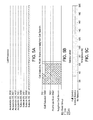
- FIG. 5 shows an example of a cell search using a conventional linear search strategy, with FIG. 5A indicating cell presence (acceptable or suitable, 2G or 3G), FIG. 5B indicating cell selection activity, and FIG. 5C indicating service level (full, limited, or none) over time.
- FIG. 5 cross-hatching relates to 2G cells and stippling relates to 3G cells, and the horizontal time axes of FIGs. 5A and 5C are of the same scale and aligned.
- the horizontal time axis of FIG. 5B is expanded for clarity.
- the UE is assumed to have been registered to a cell of a first RAT, e.g., a GSM cell, when the UE was last powered off.
- a cell of a first RAT e.g., a GSM cell
- 2G e.g., GSM
- a WCDMA BG 1 cell e.g., a WCDMA BG 1 cell (indicated by the hatched bar in FIG. 5A ).
- the UE starts searching for cells within GSM BG 1 (i.e., 900 MHz/1800 MHz) and then continues with GSM BG 2 (850 MHz/1900 MHz).
- This searching involves cell selection, PLMN list scan, and neighbor cell search procedures as indicated in the figure.
- the searches of the two 2G BGs are unsuccessful, and so after about 30 seconds the UE searches WCDMA BG 1 (indicated by the stippled bar in FIG. 5B ) and finds the available WCDMA cell. Thereafter, full communication services are available to the UE, as indicated by the stippled area in FIG. 5C . All of the searching in the conventional way requires about thirty seconds in the scenario depicted in FIG. 5 .
- FIG. 6 illustrates the behavior of the improved cell/PLMN search method for the same scenario as FIG. 5 , i.e., when a cell in the most recently used RAT (viz., the RPLMN), is not available.
- FIG. 6A indicates cell presence (acceptable or suitable, 2G or 3G)
- FIG. 6B indicates cell selection activity
- FIG. 6C indicates service level (full, limited, or none) over time.
- cross-hatching relates to 2G cells and stippling relates to 3G cells
- the horizontal time axes of FIGs. 6A and 6C are of the same scale and aligned.
- the horizontal time axis of FIG. 6B is expanded for clarity.
- the UE is assumed to have been registered in a GSM cell when last powered down.
- the UE When powered up, the UE again starts searching for cells within GSM BG 1 (indicated by the cross-hatched area in FIG. 6B ), but then after only about 15 seconds, the UE changes RAT in order to search for a cell in WCDMA BG 1 (indicated by the stippled area in FIG. 6B ).
- the available WCDMA cell is found and selected after a period much shorter than needed by the usual procedures depicted in FIG. 5 .
- the UE avoids searching GSM BG 2 and thus the UE obtains services faster than with the conventional method.
- the UE reduces its power consumption related to PLMN scan.
- the UE it is generally not necessary for the UE to have found a WCDMA cell at least once before, as it is enough for the UE to "know" that it can handle WCDMA, i.e., two or more RATs.
- WCDMA Wideband Code Division Multiple Access
- two or more RATs For a new UE that is powered up for the first time, finds a cell in a first RAT, and then is powered off. If the second time the UE is powered up it cannot find a cell in the BG of the previously found RAT, and if the UE can also handle a second RAT, the UE can search preconfigured BGs in the second RAT. In another arrangement, the UE can be preconfigured with what will be considered as the most recently used BG(s) of a RAT or RATs, which can depend on where the UE was sold, for example.
- a UE can change RATs after searching one frequency group, or in general fewer than all frequency groups of a RAT. For example, a UE may search through the most recently used BG in RAT A, and then switch to RAT B and search through a most recently used or otherwise prioritized BG in RAT B. If a cell is not found in that BG of RAT B, the UE can switch back to RAT A and search through a second BG of RAT A. If a cell is not found in the second BG of RAT A, the UE may switch back to RAT B and search through a second BG of RAT A, and so on.
- a memory in the UE can maintain a list of frequency groups in virtually any desired order of search.
- the PLMN search time is improved for relevant scenarios if the UE switches RAT after searching the most recently used frequency bands in one RAT.
- the expected improvement is valid as long as the UE remains in one geographic area, such as Europe or North America. It will be understood that if the UE moves between such geographic areas, the result of the improved method is increased search times rather than reduced ones, but these situations are less frequent and with lower priority compared to the situations where users benefit from the changed behavior.
- the invention described here can additionally be considered to be embodied entirely within any form of computer-readable storage medium having stored therein an appropriate set of instructions for use by or in connection with an instruction-execution system, apparatus, or device, such as a computer-based system, processor-containing system, or other system that can fetch instructions from a medium and execute the instructions.
- a "computer-readable medium” can be any means that can contain, store, communicate, propagate, or transport the program for use by or in connection with the instruction-execution system, apparatus, or device.
- the computer-readable medium can be, for example but not limited to, an electronic, magnetic, optical, electromagnetic, infrared, or semiconductor system, apparatus, device, or propagation medium.
- the computer-readable medium include an electrical connection having one or more wires, a portable computer diskette, a RAM, a ROM, an erasable programmable read-only memory (EPROM or Flash memory), and an optical fiber.
- any such form may be referred to as "logic configured to” perform a described action, or alternatively as “logic that” performs a described action.
Landscapes
- Engineering & Computer Science (AREA)
- Computer Networks & Wireless Communication (AREA)
- Signal Processing (AREA)
- Computer Security & Cryptography (AREA)
- Mobile Radio Communication Systems (AREA)
- Compression, Expansion, Code Conversion, And Decoders (AREA)
- Stabilization Of Oscillater, Synchronisation, Frequency Synthesizers (AREA)
- Liquid Crystal Substances (AREA)
- Radar Systems Or Details Thereof (AREA)
Claims (18)
- Procédé dans un équipement utilisateur UE destiné à chercher une cellule dans un réseau mobile terrestre public, comprenant les étapes qui consistent à :chercher une cellule dans le groupe des fréquences les plus récemment utilisées d'une première technologie d'accès radio RAT ; etsi on ne trouve pas de cellule dans le groupe des fréquences les plus récemment utilisées de la première RAT, basculer vers une deuxième RAT, caractérisé par, après le basculement, le fait de chercher une cellule dans le groupe des fréquences les plus récemment utilisées de la deuxième RAT.
- Procédé de la revendication 1, comprenant en outre l'étape qui consiste à revenir à la première RAT et chercher une cellule dans au moins un groupe de fréquences restantes de la première RAT, si on ne trouve pas de cellule dans le groupe des fréquences les plus récemment utilisées de la deuxième RAT.
- Procédé de la revendication 2, comprenant en outre les étapes qui consistent à revenir à la deuxième RAT et chercher une cellule dans au moins un groupe de fréquences restantes dans la deuxième RAT, si on ne trouve pas de cellule dans un groupe de fréquences restantes de la première RAT.
- Procédé de la revendication 1, dans lequel les groupes des fréquences les plus récemment utilisées sont indiqués par une information stockée dans l'UE.
- Procédé de la revendication 4, dans lequel l'information est stockée suite à une coupure d'alimentation ou avant une perte de service de l'UE.
- Equipement utilisateur UE pour un système de communication, comprenant:un moyen destiné à sélectionner une technologie d'accès radio RAT à utiliser pour communiquer avec le système de communication à partir d'au moins deux RAT ; etun moyen destiné à chercher une cellule du système de communication en utilisant la RAT sélectionnée, où le moyen de recherche cherche une cellule dans le groupe des fréquences les plus récemment utilisées d'une première RAT ; et si on ne trouve pas de cellule dans le groupe des fréquences les plus récemment utilisées de la première RAT, le moyen de recherche bascule vers une deuxième RAT, caractérisé par le fait de, après basculement, chercher une cellule dans le groupe des fréquences les plus récemment utilisées de la deuxième RAT.
- UE de la revendication 6, dans lequel si on ne trouve pas de cellule dans le groupe des fréquences les plus récemment utilisées de la deuxième RAT, le moyen de recherche revient à la première RAT et cherche une cellule dans au moins un groupe de fréquences restantes de la première RAT.
- UE de la revendication 7, dans lequel si on ne trouve pas de cellule dans les groupes de fréquences restantes de la première RAT, le moyen de recherche revient à la deuxième RAT et cherche une cellule dans au moins un groupe de fréquences restantes de la deuxième RAT.
- UE de la revendication 6, dans lequel au moins l'un du moyen de sélection et du moyen de recherche comporte une mémoire destinée à stocker une indication des groupes de fréquences les plus récemment utilisées.
- UE de la revendication 9, dans lequel l'indication est stockée suite à une coupure d'alimentation ou avant une perte de service de l'UE.
- UE de la revendication 6, dans lequel une information transmise d'une cellule à l'UE permet à l'UE de sélectionner le système de communication entre plusieurs systèmes de communication.
- UE de la revendication 6, dans lequel le système de communication comporte une pluralité de cellules, et chaque cellule utilise une RAT respective.
- UE de la revendication 12, dans lequel les RAT comportent des technologies d'accès radio de deuxième et de troisième génération.
- Support lisible par ordinateur sur lequel des instructions sont stockées, qui, lorsqu'elles sont exécutées par un processeur, amènent le processeur à mettre en oeuvre un procédé de recherche d'une cellule dans un réseau mobile terrestre public, le procédé comprenant les étapes qui consistent à:chercher une cellule dans le groupe des fréquences les plus récemment utilisées d'une première technologie d'accès radio RAT ; etsi on ne trouve pas de cellule dans le groupe des fréquences les plus récemment utilisées de la première RAT, basculer vers une deuxième RAT, caractérisé par, après basculement, le fait de chercher une cellule dans le groupe des fréquences les plus récemment utilisées de la deuxième RAT.
- Support de la revendication 14, dans lequel le procédé comprend en outre l'étape qui consiste à revenir à la première RAT et chercher une cellule dans au moins un groupe de fréquences restantes de la première RAT, si on ne trouve pas de cellule dans le groupe des fréquences les plus récemment utilisées de la deuxième RAT.
- Support de la revendication 15, dans lequel le procédé comprend en outre l'étape qui consiste à revenir à la deuxième RAT et chercher une cellule dans au moins un groupe de fréquences restantes de la deuxième RAT, si on ne trouve pas de cellule dans les groupes de fréquences restantes de la première RAT.
- Support de la revendication 14, dans lequel les groupes des fréquences les plus récemment utilisées sont indiqués par une information stockée.
- Support de la revendication 17, dans lequel l'information est stockée suite à une coupure d'alimentation ou avant une perte de service de l'équipement utilisateur.
Applications Claiming Priority (2)
| Application Number | Priority Date | Filing Date | Title |
|---|---|---|---|
| US11/615,162 US20080153486A1 (en) | 2006-12-22 | 2006-12-22 | Efficient PLMN Search Order |
| PCT/EP2007/062240 WO2008077682A1 (fr) | 2006-12-22 | 2007-11-13 | Ordre de recherche efficace de réseau mobile terrestre public |
Publications (2)
| Publication Number | Publication Date |
|---|---|
| EP2095672A1 EP2095672A1 (fr) | 2009-09-02 |
| EP2095672B1 true EP2095672B1 (fr) | 2010-06-02 |
Family
ID=38326486
Family Applications (1)
| Application Number | Title | Priority Date | Filing Date |
|---|---|---|---|
| EP07822516A Active EP2095672B1 (fr) | 2006-12-22 | 2007-11-13 | Ordre de recherche efficace de réseau mobile terrestre public |
Country Status (10)
| Country | Link |
|---|---|
| US (1) | US20080153486A1 (fr) |
| EP (1) | EP2095672B1 (fr) |
| KR (1) | KR101497720B1 (fr) |
| CN (1) | CN101584239B (fr) |
| AT (1) | ATE470331T1 (fr) |
| BR (1) | BRPI0720560B1 (fr) |
| CA (1) | CA2673178A1 (fr) |
| DE (1) | DE602007006986D1 (fr) |
| TW (1) | TW200841752A (fr) |
| WO (1) | WO2008077682A1 (fr) |
Cited By (1)
| Publication number | Priority date | Publication date | Assignee | Title |
|---|---|---|---|---|
| WO2022240188A1 (fr) * | 2021-05-13 | 2022-11-17 | Samsung Electronics Co., Ltd. | Procédé et système permettant de gérer une sélection de cellule dans un réseau cellulaire sur la base d'une caractéristique de mesure précoce |
Families Citing this family (31)
| Publication number | Priority date | Publication date | Assignee | Title |
|---|---|---|---|---|
| US8145214B2 (en) * | 2007-08-09 | 2012-03-27 | Motorola Mobility, Inc. | Raster skipping in co-banded mobile communication devices based on previous scans for any band |
| US7970361B2 (en) * | 2007-11-28 | 2011-06-28 | Telefonaktiebolaget L M Ericsson (Publ) | Frequency band recognition methods and apparatus |
| US20090156206A1 (en) * | 2007-12-18 | 2009-06-18 | Telefonaktiebolaget L M Ericsson (Publ) | Frequency Band Selection Methods and Apparatus |
| US8107955B2 (en) * | 2008-07-18 | 2012-01-31 | Research In Motion Limited | Apparatus and method for performing network scanning using black-list network information |
| US9019844B2 (en) * | 2008-09-22 | 2015-04-28 | Telefonaktiebolaget L M Ericsson (Publ) | Radio carrier identification methods and apparatus |
| US8611896B2 (en) * | 2008-12-01 | 2013-12-17 | Telefonaktiebolaget L M Ericssson (Publ) | Neighbor cell list compilation methods and apparatus |
| US8249591B2 (en) | 2009-01-21 | 2012-08-21 | Research In Motion Limited | Method and device for obtaining candidate information |
| EP2214441B1 (fr) | 2009-01-30 | 2012-05-02 | Research In Motion Limited | Procédé et appareil pour le balayage de réseau basé sur des informations concernant les voisins |
| US8311576B2 (en) * | 2009-01-30 | 2012-11-13 | Research In Motion Limited | Method and apparatus for network scanning based on neighbor information |
| FR2942933B1 (fr) * | 2009-03-04 | 2011-06-03 | St Nxp Wireless France | Procede de selection d'une cellule d'un reseau lors de la mise en marche d'un appareil de communication sans fil et appareil de communication sans fil correspondant. |
| TWI455633B (zh) * | 2009-11-05 | 2014-10-01 | Htc Corp | 長期演進網路中為緊急通話重建無線資源控制連線的方法 |
| WO2011088170A1 (fr) | 2010-01-14 | 2011-07-21 | Telcordia Technologies, Inc. | Procédures de sélection de réseau mobile terrestre public (plmn) pour une connectivité de réseau simultanée par accès multiples |
| KR101676306B1 (ko) * | 2010-01-25 | 2016-11-15 | 엘지전자 주식회사 | 무선 통신 시스템에서 셀 검색 방법 및 장치 |
| US20110195712A1 (en) * | 2010-02-05 | 2011-08-11 | Christian Mucke | Wireless network frequency scanning |
| US20110194630A1 (en) * | 2010-02-10 | 2011-08-11 | Yang Hua-Lung | Systems and methods for reporting radio link failure |
| CN102256257B (zh) * | 2010-05-17 | 2016-02-24 | 中兴通讯股份有限公司 | 基于感知技术的切换方法及系统 |
| US8868035B2 (en) * | 2010-12-30 | 2014-10-21 | Htc Corporation | Methods for access control with a back-off timer maintained for low priority devices or machine type communication (MTC) devices, and apparatuses using the same |
| US20120190361A1 (en) * | 2011-01-21 | 2012-07-26 | Samsung Electronics Co., Ltd. | Method and apparatus for searching and selecting a public land mobile network in a multiple radio access technology environment |
| US8463261B2 (en) | 2011-05-23 | 2013-06-11 | St-Ericsson Sa | Methods and systems for self-tuning network search algorithms |
| RU2621072C2 (ru) * | 2012-12-19 | 2017-05-31 | ЭлДжи ЭЛЕКТРОНИКС ИНК. | Способ осуществления связи в системе беспроводной связи, поддерживающий сеть множественного доступа, и поддерживающее это устройство |
| US9198088B2 (en) * | 2013-06-26 | 2015-11-24 | Qualcomm Incorporated | Method and apparatus for an optimized search for service when a multi-mode UE goes out of service |
| US9730147B2 (en) * | 2013-09-11 | 2017-08-08 | Blackberry Limited | Higher priority network scanning |
| US9705992B2 (en) * | 2014-11-06 | 2017-07-11 | General Motors Llc | Remote telematics unit band control with dynamic memory |
| US9408139B1 (en) | 2015-01-27 | 2016-08-02 | Mediatek Inc. | Multi-rat mobile communication devices and methods for network selection |
| US9706485B2 (en) * | 2015-09-30 | 2017-07-11 | Qualcomm Incorporated | Conducting public land mobile network (PLMN) searches in a multi-radio access technology (RAT) environment |
| US10805869B2 (en) * | 2017-08-25 | 2020-10-13 | Qualcomm Incorporated | Techniques and apparatuses for search, measurement, and icon display in new radio non-standalone mode |
| KR102395203B1 (ko) * | 2018-08-02 | 2022-05-06 | 삼성전자주식회사 | 무선 통신 시스템에서 plmn을 검색하기 위한 전자 장치 및 방법 |
| CN111698744A (zh) * | 2020-06-23 | 2020-09-22 | 广州三星通信技术研究有限公司 | 用于终端快速返回优选网络的方法和使用该方法的装置 |
| CN112040533B (zh) * | 2020-08-18 | 2023-06-27 | 广东小天才科技有限公司 | 一种终端设备的搜网控制方法、装置及终端设备 |
| US12477442B2 (en) | 2021-09-24 | 2025-11-18 | Apple Inc. | Multi-band multi-RAT cell search |
| WO2024063620A1 (fr) * | 2022-09-23 | 2024-03-28 | 삼성전자 주식회사 | Dispositif électronique utilisant des informations de cellule proche sur la base de mégadonnées, et son procédé de fonctionnement |
Family Cites Families (15)
| Publication number | Priority date | Publication date | Assignee | Title |
|---|---|---|---|---|
| US5845198A (en) * | 1996-06-28 | 1998-12-01 | At&T Wireless Services Inc. | Method for optimal selection among multiple providers in a wireless communications service environment |
| US6229996B1 (en) * | 1997-12-12 | 2001-05-08 | Nokia Mobile Phones Limited | Method and apparatus for increasing a probability that a dual-band mobile station will acquire a desired autonomous system |
| US6343070B1 (en) * | 1998-06-08 | 2002-01-29 | Ericcson Inc. | Methods for reducing channel acquisition times in a radiotelephone communications system and related mobile terminals |
| US6259917B1 (en) * | 1998-12-09 | 2001-07-10 | Sony Corporation | Apparatus and method for deriving a current network location from previously visited networks and movements between the previously visited networks |
| US20020077152A1 (en) * | 2000-12-15 | 2002-06-20 | Johnson Thomas J. | Wireless communication methods and systems using multiple overlapping sectored cells |
| US20020119774A1 (en) * | 2001-02-26 | 2002-08-29 | Regina Johannesson | Method for PLMN selection |
| US6766169B2 (en) * | 2001-10-30 | 2004-07-20 | Qualcomm Incorporated | Scheduling acquisition attempts of service providing systems |
| US6951566B2 (en) * | 2002-01-25 | 2005-10-04 | Scimed Life Systems, Inc. | Reciprocating cutting and dilating balloon |
| US6934544B2 (en) * | 2002-02-04 | 2005-08-23 | Qualcomm Incorporated | Method and apparatus for configurable selection and acquisition of a wireless communications system |
| AU2002255210A1 (en) * | 2002-04-26 | 2003-11-10 | Nokia Corporation | A method for speeding up synchronisation by having a search frequency list comprising a limited number of search frequencies |
| CN100379312C (zh) * | 2002-08-27 | 2008-04-02 | 高通股份有限公司 | 空闲模式小区的重新获取和重新选择 |
| GB2395619B (en) * | 2002-11-19 | 2004-09-29 | Nec Technologies | Cellular network acquisition method and apparatus |
| US20040224684A1 (en) * | 2003-05-07 | 2004-11-11 | Dorsey Donald A. | Method for a radiotelephone to search for higher priority networks |
| US6961569B2 (en) * | 2003-05-07 | 2005-11-01 | Motorola Inc | Method for a radiotelephone to scan for higher priority public land mobile network |
| US7680082B2 (en) * | 2005-11-29 | 2010-03-16 | Telefonaktiebolaget L M Ericsson (Publ) | Cell selection in high-speed downlink packet access communication systems |
-
2006
- 2006-12-22 US US11/615,162 patent/US20080153486A1/en not_active Abandoned
-
2007
- 2007-11-13 AT AT07822516T patent/ATE470331T1/de active
- 2007-11-13 BR BRPI0720560-0A patent/BRPI0720560B1/pt active IP Right Grant
- 2007-11-13 KR KR1020097012847A patent/KR101497720B1/ko active Active
- 2007-11-13 CN CN2007800477292A patent/CN101584239B/zh active Active
- 2007-11-13 DE DE602007006986T patent/DE602007006986D1/de active Active
- 2007-11-13 WO PCT/EP2007/062240 patent/WO2008077682A1/fr not_active Ceased
- 2007-11-13 CA CA002673178A patent/CA2673178A1/fr not_active Abandoned
- 2007-11-13 EP EP07822516A patent/EP2095672B1/fr active Active
- 2007-12-07 TW TW096146893A patent/TW200841752A/zh unknown
Cited By (2)
| Publication number | Priority date | Publication date | Assignee | Title |
|---|---|---|---|---|
| WO2022240188A1 (fr) * | 2021-05-13 | 2022-11-17 | Samsung Electronics Co., Ltd. | Procédé et système permettant de gérer une sélection de cellule dans un réseau cellulaire sur la base d'une caractéristique de mesure précoce |
| US12477408B2 (en) | 2021-05-13 | 2025-11-18 | Samsung Electronics Co., Ltd. | Method and system for managing cell selection in a cellular network based on early-measurement feature |
Also Published As
| Publication number | Publication date |
|---|---|
| CN101584239B (zh) | 2012-05-30 |
| BRPI0720560B1 (pt) | 2020-09-24 |
| TW200841752A (en) | 2008-10-16 |
| WO2008077682A1 (fr) | 2008-07-03 |
| BRPI0720560A2 (pt) | 2014-02-04 |
| HK1132874A1 (zh) | 2010-03-05 |
| CA2673178A1 (fr) | 2008-07-03 |
| EP2095672A1 (fr) | 2009-09-02 |
| US20080153486A1 (en) | 2008-06-26 |
| CN101584239A (zh) | 2009-11-18 |
| ATE470331T1 (de) | 2010-06-15 |
| DE602007006986D1 (de) | 2010-07-15 |
| KR20090100367A (ko) | 2009-09-23 |
| KR101497720B1 (ko) | 2015-03-02 |
Similar Documents
| Publication | Publication Date | Title |
|---|---|---|
| US20080153486A1 (en) | Efficient PLMN Search Order | |
| KR101528376B1 (ko) | 무선 액세스 기술 간 데이터 공유 | |
| EP1900237B1 (fr) | Procédé permettant d'éviter des interruptions de services dans des réseaux mobiles terrestres publics visités (vplmn) | |
| CN103237336B (zh) | 用于终端的网络选择和/或重新选择的方法和设备 | |
| US7957739B2 (en) | Method and apparatus for transmitting/receiving network sharing information about neighbor cells in a network sharing system | |
| US8611896B2 (en) | Neighbor cell list compilation methods and apparatus | |
| WO2009077372A1 (fr) | Procédés et appareil de sélection de bande de fréquence | |
| EP1993317B1 (fr) | Commande de la cellule à laquelle une station mobile est associée en mode répos | |
| US20060099943A1 (en) | Apparatus and method for receiving improved roaming service in a mobile terminal | |
| WO2005065135A2 (fr) | Selection de cellules lors de transition entre un mode dedie dans des dispositifs de communications sans fil | |
| KR100681898B1 (ko) | 멀티모드-멀티밴드(mm-mb) 이동 통신 단말의 동기-비동기 간 모드 전환 방법 | |
| HK1132874B (en) | Efficient plmn search order |
Legal Events
| Date | Code | Title | Description |
|---|---|---|---|
| PUAI | Public reference made under article 153(3) epc to a published international application that has entered the european phase |
Free format text: ORIGINAL CODE: 0009012 |
|
| 17P | Request for examination filed |
Effective date: 20090612 |
|
| AK | Designated contracting states |
Kind code of ref document: A1 Designated state(s): AT BE BG CH CY CZ DE DK EE ES FI FR GB GR HU IE IS IT LI LT LU LV MC MT NL PL PT RO SE SI SK TR |
|
| GRAP | Despatch of communication of intention to grant a patent |
Free format text: ORIGINAL CODE: EPIDOSNIGR1 |
|
| RIC1 | Information provided on ipc code assigned before grant |
Ipc: H04W 48/18 20090101AFI20091130BHEP |
|
| DAX | Request for extension of the european patent (deleted) | ||
| GRAS | Grant fee paid |
Free format text: ORIGINAL CODE: EPIDOSNIGR3 |
|
| GRAA | (expected) grant |
Free format text: ORIGINAL CODE: 0009210 |
|
| AK | Designated contracting states |
Kind code of ref document: B1 Designated state(s): AT BE BG CH CY CZ DE DK EE ES FI FR GB GR HU IE IS IT LI LT LU LV MC MT NL PL PT RO SE SI SK TR |
|
| REG | Reference to a national code |
Ref country code: GB Ref legal event code: FG4D |
|
| REG | Reference to a national code |
Ref country code: CH Ref legal event code: EP |
|
| REG | Reference to a national code |
Ref country code: IE Ref legal event code: FG4D |
|
| REF | Corresponds to: |
Ref document number: 602007006986 Country of ref document: DE Date of ref document: 20100715 Kind code of ref document: P |
|
| REG | Reference to a national code |
Ref country code: NL Ref legal event code: T3 |
|
| PG25 | Lapsed in a contracting state [announced via postgrant information from national office to epo] |
Ref country code: SE Free format text: LAPSE BECAUSE OF FAILURE TO SUBMIT A TRANSLATION OF THE DESCRIPTION OR TO PAY THE FEE WITHIN THE PRESCRIBED TIME-LIMIT Effective date: 20100602 Ref country code: LT Free format text: LAPSE BECAUSE OF FAILURE TO SUBMIT A TRANSLATION OF THE DESCRIPTION OR TO PAY THE FEE WITHIN THE PRESCRIBED TIME-LIMIT Effective date: 20100602 |
|
| LTIE | Lt: invalidation of european patent or patent extension |
Effective date: 20100602 |
|
| PG25 | Lapsed in a contracting state [announced via postgrant information from national office to epo] |
Ref country code: SI Free format text: LAPSE BECAUSE OF FAILURE TO SUBMIT A TRANSLATION OF THE DESCRIPTION OR TO PAY THE FEE WITHIN THE PRESCRIBED TIME-LIMIT Effective date: 20100602 Ref country code: LV Free format text: LAPSE BECAUSE OF FAILURE TO SUBMIT A TRANSLATION OF THE DESCRIPTION OR TO PAY THE FEE WITHIN THE PRESCRIBED TIME-LIMIT Effective date: 20100602 Ref country code: FI Free format text: LAPSE BECAUSE OF FAILURE TO SUBMIT A TRANSLATION OF THE DESCRIPTION OR TO PAY THE FEE WITHIN THE PRESCRIBED TIME-LIMIT Effective date: 20100602 |
|
| PG25 | Lapsed in a contracting state [announced via postgrant information from national office to epo] |
Ref country code: CY Free format text: LAPSE BECAUSE OF FAILURE TO SUBMIT A TRANSLATION OF THE DESCRIPTION OR TO PAY THE FEE WITHIN THE PRESCRIBED TIME-LIMIT Effective date: 20100616 Ref country code: PL Free format text: LAPSE BECAUSE OF FAILURE TO SUBMIT A TRANSLATION OF THE DESCRIPTION OR TO PAY THE FEE WITHIN THE PRESCRIBED TIME-LIMIT Effective date: 20100602 |
|
| PG25 | Lapsed in a contracting state [announced via postgrant information from national office to epo] |
Ref country code: EE Free format text: LAPSE BECAUSE OF FAILURE TO SUBMIT A TRANSLATION OF THE DESCRIPTION OR TO PAY THE FEE WITHIN THE PRESCRIBED TIME-LIMIT Effective date: 20100602 |
|
| PG25 | Lapsed in a contracting state [announced via postgrant information from national office to epo] |
Ref country code: CZ Free format text: LAPSE BECAUSE OF FAILURE TO SUBMIT A TRANSLATION OF THE DESCRIPTION OR TO PAY THE FEE WITHIN THE PRESCRIBED TIME-LIMIT Effective date: 20100602 Ref country code: SK Free format text: LAPSE BECAUSE OF FAILURE TO SUBMIT A TRANSLATION OF THE DESCRIPTION OR TO PAY THE FEE WITHIN THE PRESCRIBED TIME-LIMIT Effective date: 20100602 Ref country code: BE Free format text: LAPSE BECAUSE OF FAILURE TO SUBMIT A TRANSLATION OF THE DESCRIPTION OR TO PAY THE FEE WITHIN THE PRESCRIBED TIME-LIMIT Effective date: 20100602 Ref country code: IS Free format text: LAPSE BECAUSE OF FAILURE TO SUBMIT A TRANSLATION OF THE DESCRIPTION OR TO PAY THE FEE WITHIN THE PRESCRIBED TIME-LIMIT Effective date: 20101002 Ref country code: PT Free format text: LAPSE BECAUSE OF FAILURE TO SUBMIT A TRANSLATION OF THE DESCRIPTION OR TO PAY THE FEE WITHIN THE PRESCRIBED TIME-LIMIT Effective date: 20101004 Ref country code: RO Free format text: LAPSE BECAUSE OF FAILURE TO SUBMIT A TRANSLATION OF THE DESCRIPTION OR TO PAY THE FEE WITHIN THE PRESCRIBED TIME-LIMIT Effective date: 20100602 |
|
| PLBE | No opposition filed within time limit |
Free format text: ORIGINAL CODE: 0009261 |
|
| STAA | Information on the status of an ep patent application or granted ep patent |
Free format text: STATUS: NO OPPOSITION FILED WITHIN TIME LIMIT |
|
| PG25 | Lapsed in a contracting state [announced via postgrant information from national office to epo] |
Ref country code: DK Free format text: LAPSE BECAUSE OF FAILURE TO SUBMIT A TRANSLATION OF THE DESCRIPTION OR TO PAY THE FEE WITHIN THE PRESCRIBED TIME-LIMIT Effective date: 20100602 |
|
| 26N | No opposition filed |
Effective date: 20110303 |
|
| PG25 | Lapsed in a contracting state [announced via postgrant information from national office to epo] |
Ref country code: GR Free format text: LAPSE BECAUSE OF FAILURE TO SUBMIT A TRANSLATION OF THE DESCRIPTION OR TO PAY THE FEE WITHIN THE PRESCRIBED TIME-LIMIT Effective date: 20100903 |
|
| REG | Reference to a national code |
Ref country code: DE Ref legal event code: R097 Ref document number: 602007006986 Country of ref document: DE Effective date: 20110302 |
|
| PG25 | Lapsed in a contracting state [announced via postgrant information from national office to epo] |
Ref country code: MC Free format text: LAPSE BECAUSE OF NON-PAYMENT OF DUE FEES Effective date: 20101130 |
|
| REG | Reference to a national code |
Ref country code: FR Ref legal event code: ST Effective date: 20110801 |
|
| PG25 | Lapsed in a contracting state [announced via postgrant information from national office to epo] |
Ref country code: FR Free format text: LAPSE BECAUSE OF NON-PAYMENT OF DUE FEES Effective date: 20101130 |
|
| PG25 | Lapsed in a contracting state [announced via postgrant information from national office to epo] |
Ref country code: IT Free format text: LAPSE BECAUSE OF NON-PAYMENT OF DUE FEES Effective date: 20101113 Ref country code: MT Free format text: LAPSE BECAUSE OF FAILURE TO SUBMIT A TRANSLATION OF THE DESCRIPTION OR TO PAY THE FEE WITHIN THE PRESCRIBED TIME-LIMIT Effective date: 20100602 |
|
| REG | Reference to a national code |
Ref country code: CH Ref legal event code: PL |
|
| PG25 | Lapsed in a contracting state [announced via postgrant information from national office to epo] |
Ref country code: LI Free format text: LAPSE BECAUSE OF NON-PAYMENT OF DUE FEES Effective date: 20111130 Ref country code: CH Free format text: LAPSE BECAUSE OF NON-PAYMENT OF DUE FEES Effective date: 20111130 |
|
| PG25 | Lapsed in a contracting state [announced via postgrant information from national office to epo] |
Ref country code: LU Free format text: LAPSE BECAUSE OF NON-PAYMENT OF DUE FEES Effective date: 20101113 Ref country code: HU Free format text: LAPSE BECAUSE OF FAILURE TO SUBMIT A TRANSLATION OF THE DESCRIPTION OR TO PAY THE FEE WITHIN THE PRESCRIBED TIME-LIMIT Effective date: 20101203 Ref country code: BG Free format text: LAPSE BECAUSE OF FAILURE TO SUBMIT A TRANSLATION OF THE DESCRIPTION OR TO PAY THE FEE WITHIN THE PRESCRIBED TIME-LIMIT Effective date: 20100602 |
|
| PG25 | Lapsed in a contracting state [announced via postgrant information from national office to epo] |
Ref country code: TR Free format text: LAPSE BECAUSE OF FAILURE TO SUBMIT A TRANSLATION OF THE DESCRIPTION OR TO PAY THE FEE WITHIN THE PRESCRIBED TIME-LIMIT Effective date: 20100602 |
|
| PG25 | Lapsed in a contracting state [announced via postgrant information from national office to epo] |
Ref country code: BG Free format text: LAPSE BECAUSE OF FAILURE TO SUBMIT A TRANSLATION OF THE DESCRIPTION OR TO PAY THE FEE WITHIN THE PRESCRIBED TIME-LIMIT Effective date: 20100902 |
|
| PG25 | Lapsed in a contracting state [announced via postgrant information from national office to epo] |
Ref country code: ES Free format text: LAPSE BECAUSE OF FAILURE TO SUBMIT A TRANSLATION OF THE DESCRIPTION OR TO PAY THE FEE WITHIN THE PRESCRIBED TIME-LIMIT Effective date: 20100913 |
|
| PGFP | Annual fee paid to national office [announced via postgrant information from national office to epo] |
Ref country code: IT Payment date: 20221123 Year of fee payment: 16 Ref country code: IE Payment date: 20221128 Year of fee payment: 16 Ref country code: AT Payment date: 20221019 Year of fee payment: 16 |
|
| REG | Reference to a national code |
Ref country code: AT Ref legal event code: MM01 Ref document number: 470331 Country of ref document: AT Kind code of ref document: T Effective date: 20231113 |
|
| PG25 | Lapsed in a contracting state [announced via postgrant information from national office to epo] |
Ref country code: AT Free format text: LAPSE BECAUSE OF NON-PAYMENT OF DUE FEES Effective date: 20231113 |
|
| PG25 | Lapsed in a contracting state [announced via postgrant information from national office to epo] |
Ref country code: AT Free format text: LAPSE BECAUSE OF NON-PAYMENT OF DUE FEES Effective date: 20231113 |
|
| REG | Reference to a national code |
Ref country code: IE Ref legal event code: MM4A |
|
| PG25 | Lapsed in a contracting state [announced via postgrant information from national office to epo] |
Ref country code: IE Free format text: LAPSE BECAUSE OF NON-PAYMENT OF DUE FEES Effective date: 20231113 |
|
| PG25 | Lapsed in a contracting state [announced via postgrant information from national office to epo] |
Ref country code: IE Free format text: LAPSE BECAUSE OF NON-PAYMENT OF DUE FEES Effective date: 20231113 |
|
| PG25 | Lapsed in a contracting state [announced via postgrant information from national office to epo] |
Ref country code: IT Free format text: LAPSE BECAUSE OF NON-PAYMENT OF DUE FEES Effective date: 20231113 |
|
| PG25 | Lapsed in a contracting state [announced via postgrant information from national office to epo] |
Ref country code: IT Free format text: LAPSE BECAUSE OF NON-PAYMENT OF DUE FEES Effective date: 20231113 |
|
| PGFP | Annual fee paid to national office [announced via postgrant information from national office to epo] |
Ref country code: NL Payment date: 20251126 Year of fee payment: 19 |
|
| PGFP | Annual fee paid to national office [announced via postgrant information from national office to epo] |
Ref country code: DE Payment date: 20251128 Year of fee payment: 19 |
|
| PGFP | Annual fee paid to national office [announced via postgrant information from national office to epo] |
Ref country code: GB Payment date: 20251127 Year of fee payment: 19 |