EP2096101B1 - Verfahren zur Herstellung von Ketonen aus alpha-Oxocarboxylaten und Arylbromiden - Google Patents
Verfahren zur Herstellung von Ketonen aus alpha-Oxocarboxylaten und Arylbromiden Download PDFInfo
- Publication number
- EP2096101B1 EP2096101B1 EP09153525A EP09153525A EP2096101B1 EP 2096101 B1 EP2096101 B1 EP 2096101B1 EP 09153525 A EP09153525 A EP 09153525A EP 09153525 A EP09153525 A EP 09153525A EP 2096101 B1 EP2096101 B1 EP 2096101B1
- Authority
- EP
- European Patent Office
- Prior art keywords
- radical
- formula
- iii
- optionally substituted
- compounds
- Prior art date
- Legal status (The legal status is an assumption and is not a legal conclusion. Google has not performed a legal analysis and makes no representation as to the accuracy of the status listed.)
- Not-in-force
Links
- 150000002576 ketones Chemical class 0.000 title claims description 9
- 150000001499 aryl bromides Chemical class 0.000 title claims description 7
- 238000004519 manufacturing process Methods 0.000 title claims description 3
- -1 ketone compounds Chemical class 0.000 claims abstract description 31
- 239000003054 catalyst Substances 0.000 claims abstract description 11
- 150000001875 compounds Chemical class 0.000 claims abstract description 10
- 238000000034 method Methods 0.000 claims description 12
- KDLHZDBZIXYQEI-UHFFFAOYSA-N palladium Substances [Pd] KDLHZDBZIXYQEI-UHFFFAOYSA-N 0.000 claims description 12
- COIOYMYWGDAQPM-UHFFFAOYSA-N tris(2-methylphenyl)phosphane Chemical compound CC1=CC=CC=C1P(C=1C(=CC=CC=1)C)C1=CC=CC=C1C COIOYMYWGDAQPM-UHFFFAOYSA-N 0.000 claims description 12
- 125000004432 carbon atom Chemical group C* 0.000 claims description 11
- 230000008569 process Effects 0.000 claims description 10
- 239000003446 ligand Substances 0.000 claims description 9
- DGEZNRSVGBDHLK-UHFFFAOYSA-N [1,10]phenanthroline Chemical compound C1=CN=C2C3=NC=CC=C3C=CC2=C1 DGEZNRSVGBDHLK-UHFFFAOYSA-N 0.000 claims description 7
- 229910052763 palladium Inorganic materials 0.000 claims description 6
- 229910021589 Copper(I) bromide Inorganic materials 0.000 claims description 5
- NKNDPYCGAZPOFS-UHFFFAOYSA-M copper(i) bromide Chemical compound Br[Cu] NKNDPYCGAZPOFS-UHFFFAOYSA-M 0.000 claims description 5
- 125000004802 cyanophenyl group Chemical group 0.000 claims description 4
- 150000001768 cations Chemical class 0.000 claims description 3
- 125000001997 phenyl group Chemical group [H]C1=C([H])C([H])=C(*)C([H])=C1[H] 0.000 claims description 3
- 150000003254 radicals Chemical class 0.000 claims description 3
- 125000003944 tolyl group Chemical group 0.000 claims description 3
- IIVWHGMLFGNMOW-UHFFFAOYSA-N 2-methylpropane Chemical compound C[C](C)C IIVWHGMLFGNMOW-UHFFFAOYSA-N 0.000 claims description 2
- 229910052723 transition metal Inorganic materials 0.000 abstract description 3
- 150000003624 transition metals Chemical class 0.000 abstract description 3
- 238000006243 chemical reaction Methods 0.000 description 11
- SECXISVLQFMRJM-UHFFFAOYSA-N N-Methylpyrrolidone Chemical compound CN1CCCC1=O SECXISVLQFMRJM-UHFFFAOYSA-N 0.000 description 8
- SMWDFEZZVXVKRB-UHFFFAOYSA-N Quinoline Chemical compound N1=CC=CC2=CC=CC=C21 SMWDFEZZVXVKRB-UHFFFAOYSA-N 0.000 description 8
- 239000002253 acid Substances 0.000 description 8
- 238000002360 preparation method Methods 0.000 description 7
- IJGRMHOSHXDMSA-UHFFFAOYSA-N Atomic nitrogen Chemical compound N#N IJGRMHOSHXDMSA-UHFFFAOYSA-N 0.000 description 6
- RTZKZFJDLAIYFH-UHFFFAOYSA-N Diethyl ether Chemical compound CCOCC RTZKZFJDLAIYFH-UHFFFAOYSA-N 0.000 description 6
- ZMXDDKWLCZADIW-UHFFFAOYSA-N N,N-Dimethylformamide Chemical compound CN(C)C=O ZMXDDKWLCZADIW-UHFFFAOYSA-N 0.000 description 6
- JUJWROOIHBZHMG-UHFFFAOYSA-N Pyridine Chemical compound C1=CC=NC=C1 JUJWROOIHBZHMG-UHFFFAOYSA-N 0.000 description 6
- 150000007513 acids Chemical class 0.000 description 6
- 238000006880 cross-coupling reaction Methods 0.000 description 6
- 229910052799 carbon Inorganic materials 0.000 description 5
- VEXZGXHMUGYJMC-UHFFFAOYSA-N Hydrochloric acid Chemical compound Cl VEXZGXHMUGYJMC-UHFFFAOYSA-N 0.000 description 4
- 150000001408 amides Chemical class 0.000 description 4
- 239000000203 mixture Substances 0.000 description 4
- 239000000047 product Substances 0.000 description 4
- 239000000243 solution Substances 0.000 description 4
- ZBTMRBYMKUEVEU-UHFFFAOYSA-N 1-bromo-4-methylbenzene Chemical compound CC1=CC=C(Br)C=C1 ZBTMRBYMKUEVEU-UHFFFAOYSA-N 0.000 description 3
- WEVYAHXRMPXWCK-UHFFFAOYSA-N Acetonitrile Chemical compound CC#N WEVYAHXRMPXWCK-UHFFFAOYSA-N 0.000 description 3
- UHOVQNZJYSORNB-UHFFFAOYSA-N Benzene Chemical compound C1=CC=CC=C1 UHOVQNZJYSORNB-UHFFFAOYSA-N 0.000 description 3
- OKTJSMMVPCPJKN-UHFFFAOYSA-N Carbon Chemical compound [C] OKTJSMMVPCPJKN-UHFFFAOYSA-N 0.000 description 3
- XEKOWRVHYACXOJ-UHFFFAOYSA-N Ethyl acetate Chemical compound CCOC(C)=O XEKOWRVHYACXOJ-UHFFFAOYSA-N 0.000 description 3
- YXFVVABEGXRONW-UHFFFAOYSA-N Toluene Chemical compound CC1=CC=CC=C1 YXFVVABEGXRONW-UHFFFAOYSA-N 0.000 description 3
- 125000000217 alkyl group Chemical group 0.000 description 3
- 239000003153 chemical reaction reagent Substances 0.000 description 3
- 239000010949 copper Substances 0.000 description 3
- 229910052736 halogen Inorganic materials 0.000 description 3
- 150000002367 halogens Chemical class 0.000 description 3
- 229910052757 nitrogen Inorganic materials 0.000 description 3
- GJVFBWCTGUSGDD-UHFFFAOYSA-L pentamethonium bromide Chemical compound [Br-].[Br-].C[N+](C)(C)CCCCC[N+](C)(C)C GJVFBWCTGUSGDD-UHFFFAOYSA-L 0.000 description 3
- UMJSCPRVCHMLSP-UHFFFAOYSA-N pyridine Natural products COC1=CC=CN=C1 UMJSCPRVCHMLSP-UHFFFAOYSA-N 0.000 description 3
- 239000002904 solvent Substances 0.000 description 3
- 125000001424 substituent group Chemical group 0.000 description 3
- 238000003786 synthesis reaction Methods 0.000 description 3
- WXPWZZHELZEVPO-UHFFFAOYSA-N (4-methylphenyl)-phenylmethanone Chemical compound C1=CC(C)=CC=C1C(=O)C1=CC=CC=C1 WXPWZZHELZEVPO-UHFFFAOYSA-N 0.000 description 2
- 125000004454 (C1-C6) alkoxycarbonyl group Chemical group 0.000 description 2
- 125000000171 (C1-C6) haloalkyl group Chemical group 0.000 description 2
- ZYWGAHRBGCEFAO-UHFFFAOYSA-N 2,2-dimethyl-1-(4-methylphenyl)propan-1-one Chemical compound CC1=CC=C(C(=O)C(C)(C)C)C=C1 ZYWGAHRBGCEFAO-UHFFFAOYSA-N 0.000 description 2
- CPELXLSAUQHCOX-UHFFFAOYSA-M Bromide Chemical compound [Br-] CPELXLSAUQHCOX-UHFFFAOYSA-M 0.000 description 2
- IAZDPXIOMUYVGZ-UHFFFAOYSA-N Dimethylsulphoxide Chemical compound CS(C)=O IAZDPXIOMUYVGZ-UHFFFAOYSA-N 0.000 description 2
- YNQLUTRBYVCPMQ-UHFFFAOYSA-N Ethylbenzene Chemical compound CCC1=CC=CC=C1 YNQLUTRBYVCPMQ-UHFFFAOYSA-N 0.000 description 2
- CSNNHWWHGAXBCP-UHFFFAOYSA-L Magnesium sulfate Chemical compound [Mg+2].[O-][S+2]([O-])([O-])[O-] CSNNHWWHGAXBCP-UHFFFAOYSA-L 0.000 description 2
- XYFCBTPGUUZFHI-UHFFFAOYSA-N Phosphine Chemical compound P XYFCBTPGUUZFHI-UHFFFAOYSA-N 0.000 description 2
- WYURNTSHIVDZCO-UHFFFAOYSA-N Tetrahydrofuran Chemical compound C1CCOC1 WYURNTSHIVDZCO-UHFFFAOYSA-N 0.000 description 2
- 239000008346 aqueous phase Substances 0.000 description 2
- 150000004982 aromatic amines Chemical class 0.000 description 2
- 150000004945 aromatic hydrocarbons Chemical class 0.000 description 2
- 125000003118 aryl group Chemical group 0.000 description 2
- 150000001502 aryl halides Chemical class 0.000 description 2
- 238000006254 arylation reaction Methods 0.000 description 2
- 230000015572 biosynthetic process Effects 0.000 description 2
- 125000005620 boronic acid group Chemical class 0.000 description 2
- 150000001735 carboxylic acids Chemical class 0.000 description 2
- 238000001816 cooling Methods 0.000 description 2
- 230000008878 coupling Effects 0.000 description 2
- 238000010168 coupling process Methods 0.000 description 2
- 238000005859 coupling reaction Methods 0.000 description 2
- 125000004093 cyano group Chemical group *C#N 0.000 description 2
- 239000012039 electrophile Substances 0.000 description 2
- 125000000524 functional group Chemical group 0.000 description 2
- 238000011065 in-situ storage Methods 0.000 description 2
- 229910052751 metal Inorganic materials 0.000 description 2
- 239000002184 metal Substances 0.000 description 2
- 239000012038 nucleophile Substances 0.000 description 2
- 239000012074 organic phase Substances 0.000 description 2
- 125000002524 organometallic group Chemical group 0.000 description 2
- 229910052700 potassium Inorganic materials 0.000 description 2
- 239000011541 reaction mixture Substances 0.000 description 2
- 150000003839 salts Chemical class 0.000 description 2
- 229910052708 sodium Inorganic materials 0.000 description 2
- 239000011734 sodium Substances 0.000 description 2
- 238000004611 spectroscopical analysis Methods 0.000 description 2
- 125000004642 (C1-C12) alkoxy group Chemical group 0.000 description 1
- 125000006700 (C1-C6) alkylthio group Chemical group 0.000 description 1
- RYHBNJHYFVUHQT-UHFFFAOYSA-N 1,4-Dioxane Chemical compound C1COCCO1 RYHBNJHYFVUHQT-UHFFFAOYSA-N 0.000 description 1
- DURPTKYDGMDSBL-UHFFFAOYSA-N 1-butoxybutane Chemical compound CCCCOCCCC DURPTKYDGMDSBL-UHFFFAOYSA-N 0.000 description 1
- JWUJQDFVADABEY-UHFFFAOYSA-N 2-methyltetrahydrofuran Chemical compound CC1CCCO1 JWUJQDFVADABEY-UHFFFAOYSA-N 0.000 description 1
- RYGMFSIKBFXOCR-UHFFFAOYSA-N Copper Chemical compound [Cu] RYGMFSIKBFXOCR-UHFFFAOYSA-N 0.000 description 1
- VMQMZMRVKUZKQL-UHFFFAOYSA-N Cu+ Chemical compound [Cu+] VMQMZMRVKUZKQL-UHFFFAOYSA-N 0.000 description 1
- ZAFNJMIOTHYJRJ-UHFFFAOYSA-N Diisopropyl ether Chemical compound CC(C)OC(C)C ZAFNJMIOTHYJRJ-UHFFFAOYSA-N 0.000 description 1
- 238000005863 Friedel-Crafts acylation reaction Methods 0.000 description 1
- DGAQECJNVWCQMB-PUAWFVPOSA-M Ilexoside XXIX Chemical compound C[C@@H]1CC[C@@]2(CC[C@@]3(C(=CC[C@H]4[C@]3(CC[C@@H]5[C@@]4(CC[C@@H](C5(C)C)OS(=O)(=O)[O-])C)C)[C@@H]2[C@]1(C)O)C)C(=O)O[C@H]6[C@@H]([C@H]([C@@H]([C@H](O6)CO)O)O)O.[Na+] DGAQECJNVWCQMB-PUAWFVPOSA-M 0.000 description 1
- 238000000023 Kugelrohr distillation Methods 0.000 description 1
- BZLVMXJERCGZMT-UHFFFAOYSA-N Methyl tert-butyl ether Chemical compound COC(C)(C)C BZLVMXJERCGZMT-UHFFFAOYSA-N 0.000 description 1
- FXHOOIRPVKKKFG-UHFFFAOYSA-N N,N-Dimethylacetamide Chemical compound CN(C)C(C)=O FXHOOIRPVKKKFG-UHFFFAOYSA-N 0.000 description 1
- SUAKHGWARZSWIH-UHFFFAOYSA-N N,N‐diethylformamide Chemical compound CCN(CC)C=O SUAKHGWARZSWIH-UHFFFAOYSA-N 0.000 description 1
- ZLMJMSJWJFRBEC-UHFFFAOYSA-N Potassium Chemical compound [K] ZLMJMSJWJFRBEC-UHFFFAOYSA-N 0.000 description 1
- VYPSYNLAJGMNEJ-UHFFFAOYSA-N Silicium dioxide Chemical compound O=[Si]=O VYPSYNLAJGMNEJ-UHFFFAOYSA-N 0.000 description 1
- FAPWRFPIFSIZLT-UHFFFAOYSA-M Sodium chloride Chemical class [Na+].[Cl-] FAPWRFPIFSIZLT-UHFFFAOYSA-M 0.000 description 1
- NINIDFKCEFEMDL-UHFFFAOYSA-N Sulfur Chemical compound [S] NINIDFKCEFEMDL-UHFFFAOYSA-N 0.000 description 1
- 239000007983 Tris buffer Substances 0.000 description 1
- CUJRVFIICFDLGR-UHFFFAOYSA-N acetylacetonate Chemical compound CC(=O)[CH-]C(C)=O CUJRVFIICFDLGR-UHFFFAOYSA-N 0.000 description 1
- 230000004913 activation Effects 0.000 description 1
- 239000013543 active substance Substances 0.000 description 1
- 125000002252 acyl group Chemical group 0.000 description 1
- 150000001299 aldehydes Chemical class 0.000 description 1
- 150000001338 aliphatic hydrocarbons Chemical class 0.000 description 1
- 125000004453 alkoxycarbonyl group Chemical group 0.000 description 1
- 229910052782 aluminium Inorganic materials 0.000 description 1
- 150000001412 amines Chemical class 0.000 description 1
- 150000001413 amino acids Chemical class 0.000 description 1
- 150000008064 anhydrides Chemical class 0.000 description 1
- 150000001543 aryl boronic acids Chemical class 0.000 description 1
- 150000001503 aryl iodides Chemical class 0.000 description 1
- QVGXLLKOCUKJST-UHFFFAOYSA-N atomic oxygen Chemical compound [O] QVGXLLKOCUKJST-UHFFFAOYSA-N 0.000 description 1
- 238000010533 azeotropic distillation Methods 0.000 description 1
- 230000008901 benefit Effects 0.000 description 1
- 150000001559 benzoic acids Chemical class 0.000 description 1
- 150000008366 benzophenones Chemical class 0.000 description 1
- 150000005347 biaryls Chemical group 0.000 description 1
- 229910052796 boron Inorganic materials 0.000 description 1
- 229910052791 calcium Inorganic materials 0.000 description 1
- 150000001721 carbon Chemical group 0.000 description 1
- 125000002915 carbonyl group Chemical group [*:2]C([*:1])=O 0.000 description 1
- 150000001732 carboxylic acid derivatives Chemical class 0.000 description 1
- 230000003197 catalytic effect Effects 0.000 description 1
- 238000004587 chromatography analysis Methods 0.000 description 1
- 229910052802 copper Inorganic materials 0.000 description 1
- 125000004122 cyclic group Chemical group 0.000 description 1
- 125000000113 cyclohexyl group Chemical group [H]C1([H])C([H])([H])C([H])([H])C([H])(*)C([H])([H])C1([H])[H] 0.000 description 1
- 238000006114 decarboxylation reaction Methods 0.000 description 1
- 238000001212 derivatisation Methods 0.000 description 1
- SBZXBUIDTXKZTM-UHFFFAOYSA-N diglyme Chemical class COCCOCCOC SBZXBUIDTXKZTM-UHFFFAOYSA-N 0.000 description 1
- 150000002148 esters Chemical class 0.000 description 1
- 150000002170 ethers Chemical class 0.000 description 1
- 239000012065 filter cake Substances 0.000 description 1
- 125000002485 formyl group Chemical group [H]C(*)=O 0.000 description 1
- 125000005842 heteroatom Chemical group 0.000 description 1
- 125000004356 hydroxy functional group Chemical group O* 0.000 description 1
- 239000000543 intermediate Substances 0.000 description 1
- 229910052742 iron Inorganic materials 0.000 description 1
- 125000000959 isobutyl group Chemical group [H]C([H])([H])C([H])(C([H])([H])[H])C([H])([H])* 0.000 description 1
- LRDFRRGEGBBSRN-UHFFFAOYSA-N isobutyronitrile Chemical compound CC(C)C#N LRDFRRGEGBBSRN-UHFFFAOYSA-N 0.000 description 1
- 125000001449 isopropyl group Chemical group [H]C([H])([H])C([H])(*)C([H])([H])[H] 0.000 description 1
- 229910052744 lithium Inorganic materials 0.000 description 1
- 239000011777 magnesium Substances 0.000 description 1
- 229910052749 magnesium Inorganic materials 0.000 description 1
- 229910052943 magnesium sulfate Inorganic materials 0.000 description 1
- 235000019341 magnesium sulphate Nutrition 0.000 description 1
- 229910052748 manganese Inorganic materials 0.000 description 1
- 239000008204 material by function Substances 0.000 description 1
- 230000001404 mediated effect Effects 0.000 description 1
- AUHZEENZYGFFBQ-UHFFFAOYSA-N mesitylene Substances CC1=CC(C)=CC(C)=C1 AUHZEENZYGFFBQ-UHFFFAOYSA-N 0.000 description 1
- 125000001827 mesitylenyl group Chemical group [H]C1=C(C(*)=C(C([H])=C1C([H])([H])[H])C([H])([H])[H])C([H])([H])[H] 0.000 description 1
- 238000006263 metalation reaction Methods 0.000 description 1
- 150000002739 metals Chemical class 0.000 description 1
- 229910052750 molybdenum Inorganic materials 0.000 description 1
- SYSQUGFVNFXIIT-UHFFFAOYSA-N n-[4-(1,3-benzoxazol-2-yl)phenyl]-4-nitrobenzenesulfonamide Chemical class C1=CC([N+](=O)[O-])=CC=C1S(=O)(=O)NC1=CC=C(C=2OC3=CC=CC=C3N=2)C=C1 SYSQUGFVNFXIIT-UHFFFAOYSA-N 0.000 description 1
- 125000004108 n-butyl group Chemical group [H]C([H])([H])C([H])([H])C([H])([H])C([H])([H])* 0.000 description 1
- 125000000740 n-pentyl group Chemical group [H]C([H])([H])C([H])([H])C([H])([H])C([H])([H])C([H])([H])* 0.000 description 1
- 125000004123 n-propyl group Chemical group [H]C([H])([H])C([H])([H])C([H])([H])* 0.000 description 1
- 125000001624 naphthyl group Chemical group 0.000 description 1
- 229910052759 nickel Inorganic materials 0.000 description 1
- 150000002825 nitriles Chemical class 0.000 description 1
- 150000002902 organometallic compounds Chemical class 0.000 description 1
- 229910052760 oxygen Inorganic materials 0.000 description 1
- 239000001301 oxygen Substances 0.000 description 1
- 229910000073 phosphorus hydride Inorganic materials 0.000 description 1
- 239000011591 potassium Substances 0.000 description 1
- CLDDMKHLFNSQBU-UHFFFAOYSA-M potassium;2-oxo-2-phenylacetate Chemical compound [K+].[O-]C(=O)C(=O)C1=CC=CC=C1 CLDDMKHLFNSQBU-UHFFFAOYSA-M 0.000 description 1
- JPNMJTYOYCOVLR-UHFFFAOYSA-M potassium;3,3-dimethyl-2-oxobutanoate Chemical compound [K+].CC(C)(C)C(=O)C([O-])=O JPNMJTYOYCOVLR-UHFFFAOYSA-M 0.000 description 1
- FVSKHRXBFJPNKK-UHFFFAOYSA-N propionitrile Chemical compound CCC#N FVSKHRXBFJPNKK-UHFFFAOYSA-N 0.000 description 1
- RUOJZAUFBMNUDX-UHFFFAOYSA-N propylene carbonate Chemical compound CC1COC(=O)O1 RUOJZAUFBMNUDX-UHFFFAOYSA-N 0.000 description 1
- 229910052707 ruthenium Inorganic materials 0.000 description 1
- 238000007127 saponification reaction Methods 0.000 description 1
- 229910052709 silver Inorganic materials 0.000 description 1
- 238000001228 spectrum Methods 0.000 description 1
- 239000007858 starting material Substances 0.000 description 1
- HXJUTPCZVOIRIF-UHFFFAOYSA-N sulfolane Chemical compound O=S1(=O)CCCC1 HXJUTPCZVOIRIF-UHFFFAOYSA-N 0.000 description 1
- 229910052717 sulfur Inorganic materials 0.000 description 1
- 239000011593 sulfur Substances 0.000 description 1
- 238000010189 synthetic method Methods 0.000 description 1
- 125000000999 tert-butyl group Chemical group [H]C([H])([H])C(*)(C([H])([H])[H])C([H])([H])[H] 0.000 description 1
- YLQBMQCUIZJEEH-UHFFFAOYSA-N tetrahydrofuran Natural products C=1C=COC=1 YLQBMQCUIZJEEH-UHFFFAOYSA-N 0.000 description 1
- 125000001544 thienyl group Chemical group 0.000 description 1
- LENZDBCJOHFCAS-UHFFFAOYSA-N tris Chemical compound OCC(N)(CO)CO LENZDBCJOHFCAS-UHFFFAOYSA-N 0.000 description 1
- XLYOFNOQVPJJNP-UHFFFAOYSA-N water Substances O XLYOFNOQVPJJNP-UHFFFAOYSA-N 0.000 description 1
- 239000008096 xylene Substances 0.000 description 1
- 150000003738 xylenes Chemical class 0.000 description 1
Classifications
-
- C—CHEMISTRY; METALLURGY
- C07—ORGANIC CHEMISTRY
- C07C—ACYCLIC OR CARBOCYCLIC COMPOUNDS
- C07C45/00—Preparation of compounds having >C = O groups bound only to carbon or hydrogen atoms; Preparation of chelates of such compounds
- C07C45/61—Preparation of compounds having >C = O groups bound only to carbon or hydrogen atoms; Preparation of chelates of such compounds by reactions not involving the formation of >C = O groups
- C07C45/67—Preparation of compounds having >C = O groups bound only to carbon or hydrogen atoms; Preparation of chelates of such compounds by reactions not involving the formation of >C = O groups by isomerisation; by change of size of the carbon skeleton
- C07C45/68—Preparation of compounds having >C = O groups bound only to carbon or hydrogen atoms; Preparation of chelates of such compounds by reactions not involving the formation of >C = O groups by isomerisation; by change of size of the carbon skeleton by increase in the number of carbon atoms
-
- C—CHEMISTRY; METALLURGY
- C07—ORGANIC CHEMISTRY
- C07C—ACYCLIC OR CARBOCYCLIC COMPOUNDS
- C07C221/00—Preparation of compounds containing amino groups and doubly-bound oxygen atoms bound to the same carbon skeleton
-
- C—CHEMISTRY; METALLURGY
- C07—ORGANIC CHEMISTRY
- C07C—ACYCLIC OR CARBOCYCLIC COMPOUNDS
- C07C253/00—Preparation of carboxylic acid nitriles
- C07C253/30—Preparation of carboxylic acid nitriles by reactions not involving the formation of cyano groups
-
- C—CHEMISTRY; METALLURGY
- C07—ORGANIC CHEMISTRY
- C07D—HETEROCYCLIC COMPOUNDS
- C07D213/00—Heterocyclic compounds containing six-membered rings, not condensed with other rings, with one nitrogen atom as the only ring hetero atom and three or more double bonds between ring members or between ring members and non-ring members
- C07D213/02—Heterocyclic compounds containing six-membered rings, not condensed with other rings, with one nitrogen atom as the only ring hetero atom and three or more double bonds between ring members or between ring members and non-ring members having three double bonds between ring members or between ring members and non-ring members
- C07D213/04—Heterocyclic compounds containing six-membered rings, not condensed with other rings, with one nitrogen atom as the only ring hetero atom and three or more double bonds between ring members or between ring members and non-ring members having three double bonds between ring members or between ring members and non-ring members having no bond between the ring nitrogen atom and a non-ring member or having only hydrogen or carbon atoms directly attached to the ring nitrogen atom
- C07D213/24—Heterocyclic compounds containing six-membered rings, not condensed with other rings, with one nitrogen atom as the only ring hetero atom and three or more double bonds between ring members or between ring members and non-ring members having three double bonds between ring members or between ring members and non-ring members having no bond between the ring nitrogen atom and a non-ring member or having only hydrogen or carbon atoms directly attached to the ring nitrogen atom with substituted hydrocarbon radicals attached to ring carbon atoms
- C07D213/44—Radicals substituted by doubly-bound oxygen, sulfur, or nitrogen atoms, or by two such atoms singly-bound to the same carbon atom
- C07D213/46—Oxygen atoms
- C07D213/50—Ketonic radicals
-
- C—CHEMISTRY; METALLURGY
- C07—ORGANIC CHEMISTRY
- C07D—HETEROCYCLIC COMPOUNDS
- C07D307/00—Heterocyclic compounds containing five-membered rings having one oxygen atom as the only ring hetero atom
- C07D307/02—Heterocyclic compounds containing five-membered rings having one oxygen atom as the only ring hetero atom not condensed with other rings
- C07D307/34—Heterocyclic compounds containing five-membered rings having one oxygen atom as the only ring hetero atom not condensed with other rings having two or three double bonds between ring members or between ring members and non-ring members
- C07D307/38—Heterocyclic compounds containing five-membered rings having one oxygen atom as the only ring hetero atom not condensed with other rings having two or three double bonds between ring members or between ring members and non-ring members with substituted hydrocarbon radicals attached to ring carbon atoms
- C07D307/40—Radicals substituted by oxygen atoms
- C07D307/46—Doubly bound oxygen atoms, or two oxygen atoms singly bound to the same carbon atom
-
- C—CHEMISTRY; METALLURGY
- C07—ORGANIC CHEMISTRY
- C07D—HETEROCYCLIC COMPOUNDS
- C07D333/00—Heterocyclic compounds containing five-membered rings having one sulfur atom as the only ring hetero atom
- C07D333/02—Heterocyclic compounds containing five-membered rings having one sulfur atom as the only ring hetero atom not condensed with other rings
- C07D333/04—Heterocyclic compounds containing five-membered rings having one sulfur atom as the only ring hetero atom not condensed with other rings not substituted on the ring sulphur atom
- C07D333/06—Heterocyclic compounds containing five-membered rings having one sulfur atom as the only ring hetero atom not condensed with other rings not substituted on the ring sulphur atom with only hydrogen atoms, hydrocarbon or substituted hydrocarbon radicals, directly attached to the ring carbon atoms
- C07D333/22—Radicals substituted by doubly bound hetero atoms, or by two hetero atoms other than halogen singly bound to the same carbon atom
Definitions
- the present invention relates to a novel process for the preparation of ketones from alpha-oxocarboxylates and aryl bromides by Cu / Pd-catalyzed decarboxylative cross-coupling.
- Aryl ketones are important structural elements in active substances and functional materials (PJ Masson, D. Coup, J. Millet, NL Brown, J. Biol. Chem. 1994, 270, 2662-2668 ).
- acylations which are carried out on an industrial scale, but mostly lead disadvantageously to mixtures of isomers, are also used for their representation reactions of activated carboxylic acid derivatives with organometallic reagents such as Weinreb amides with Grignard compounds ( S. Nahm, SM Weinreb, Tetrahedron Lett. 1981, 22, 3815-3818 ).
- transition metal catalysts Through the use of transition metal catalysts, the efficiency of such cross-coupling can be further increased, so that even less reactive carbon nucleophiles are reacted, for example, organozinc compounds or boronic acids (US Pat. E. Negishi, V. Bagheri, S. Chatterjee, FT Luo, JA Miller, AT Stoll, Tetrahedron Lett. 1983, 24, 5181-5184 ; P. Knochel, MCP Yeh, SC Berk, J. Talbert, J. Org. Chem. 1988, 53, 2392-2394 ; M. Haddach, JR McCarthy, Tetrahedron Lett. 1999, 40, 3109-3112 ).
- organozinc compounds or boronic acids US Pat. E. Negishi, V. Bagheri, S. Chatterjee, FT Luo, JA Miller, AT Stoll, Tetrahedron Lett. 1983, 24, 5181-5184 ; P. Knochel, MCP Yeh, SC Berk, J. Talbert,
- a disadvantage of all reactions of this type are the additional derivatization and saponification steps, as well as Use of strong bases.
- Arylations of aldehydes under C [BOND] H activation offer an atom-economic alternative, but are only possible with a limited spectrum of expensive aryl iodides ( YC Huang, KK Majumdar, CH Cheng, J. Org. Chem. 2002, 67, 1682-1684 ; S. Ko, B. Kang, S. Chang, Angew. Chem. 2005, 117, 459-461 ; Angew. Chem. Int. Ed. 2005, 44, 455-457 ).
- the object of the present invention was to find a process for the preparation of ketones, in particular aryl ketones, in which, starting from easily accessible compounds, readily manageable and inexpensive catalysts are used.
- Tris (o-tolyl) phosphine (( o -tol) 3 P) is used.
- the catalyst system used for the process according to the invention is a combination of copper (I) bromide with 1,10-phenanthroline as ligand and Pd (F 6 acac) 2 with tris (o-tolyl) phosphine as ligand.
- both catalysts are used independently of one another in amounts of from 0.001 mol% to 100 mol%, based on the carbon electrophile (R 1 -Br), amounts of from 0.01 mol% to 15 mol% are preferably used.
- the inventive method is carried out at temperatures of 20 ° C to 220 ° C, preferably at 80 ° C to 200 ° C and more preferably at 120 ° C to 180 ° C.
- the process according to the invention is usually carried out in the presence of a solvent.
- aromatic hydrocarbons for example benzene, toluene, xylenes, ethylbenzene, mesitylene
- ethers for example 1,4-dioxane, tetrahydrofuran, methyltetrahydrofuran, dibutyl ether, methyl t-butyl ether, diisopropyl ether, diethylene glycol dimethyl ethers
- amides for example dimethylformamide, diethylformamide, N-methylpyrrolidone, dimethylacetamide
- aromatic amines quinoline, pyridine
- dimethyl sulfoxide for example benzene, toluene, xylenes, ethylbenzene, mesitylene
- ethers for example 1,4-dioxane, tetrahydrofuran, methyltetrahydrofuran, dibutyl
- the process according to the invention may preferably be carried out in such a way that traces of water can be removed by continuous azeotropic distillation during the reaction. To achieve the required reaction temperature can also be carried out under pressure.
- R and R 1 are preferably carbocyclic aromatic radicals having 6 to 24 skeletal carbon atoms or heteroaromatic radicals having 5 to 24 skeletal carbon atoms in which none, one, two or three skeletal carbon atoms per cycle, but at least one skeleton carbon atom in the entire molecule Heteroatoms selected from the group nitrogen, sulfur or oxygen, may be substituted.
- carbocyclic aromatic radicals or heteroaromatic radicals may be substituted with up to five identical or different substituents per cycle selected from the group hydroxy, halogen, nitro, amino, mercapto, cyano, free or protected formyl, C 1 -C 12 alkyl C 1 -C 12 -haloalkyl, C 1 -C 12 -alkylthio; C 5 -C 14 aryl, C 6 -C 15 arylalkyl, C 1 -C 12 alkoxy and C 1 -C 12 alkoxycarbonyl.
- R 1 is phenyl, tolyl, thienyl or naphthyl, which is optionally monosubstituted, disubstituted or trisubstituted by radicals each independently selected from the group consisting of C 1 -C 6 -alkyl, C 1 -C 6 -haloalkyl, C 1 -C 6 -alkylthio, C 5 -C 14 -aryl, C 1 -C 6 -alkoxy, C 1 -C 6 -alkoxycarbonyl, halogen, hydroxy, nitro, amino, mercapto and cyano.
- R 1 is a tolyl, cyanophenyl or methoxyphenyl radical.
- R is preferably in each case independently of alkyl an optionally substituted straight-chain, cyclic, branched or unbranched alkyl radical.
- suitable substituents for the alkyl radical are C 1 -C 6 -alkyl, C 1 -C 6 -haloalkyl, C 5 -C 14 -aryl, C 6 -C 15 -arylalkyl, C 1 -C 6 -alkoxy, C 1 -C 6 -aryloxy, C 1 -C 6 -alkoxycarbonyl, C 1 -C 6 -acyloxy or halogen in question.
- alkyl is particularly preferably n-propyl, isopropyl, n-butyl, tert-butyl, iso-butyl, n-pentyl, or cyclohexyl.
- R is a phenyl, cyanophenyl or tert-butyl radical.
- alpha-oxocarboxylic acid salts of formula (I) are optionally added in preformed form or generated in situ from the alpha-oxocarboxylic acids and suitable bases.
- Example 1 Preparation of tert- butyl (4-tolyl) ketone.
- the reaction mixture was refluxed (170 ° C) for 36 hours, filtered through celite after cooling, and the filter cake rinsed with diethyl ether.
- the resulting solution was washed three times with 1 M hydrochloric acid and the aqueous phases were extracted twice with diethyl ether.
- the combined organic phases were washed with 100 ml of saturated sodium chloride solution, dried over magnesium sulfate and filtered. After removal of the solvent, the product was purified by Kugelrohr distillation (105 ° C / 4 x 10 -3 mbar) and obtained as a yellow oil (3.17 g, 90% yield).
- the spectroscopic data correspond to those of tert- butyl (4-tolyl) ketone.
- the reaction mixture was refluxed for 16 hours (170 ° C), after cooling, 20 mL of 1 M hydrochloric acid was added and the aqueous phases were extracted three times with ethyl acetate. The combined organic phases were concentrated and the residue was purified by chromatography. The product was obtained as a yellow oil (163 mg, 83% yield).
- the spectroscopic data correspond to those of 4-methylbenzophenone.
- the substituent of the alpha-oxocarboxylic acid is shown in Table 1 on the left side of the carbonyl group.
Landscapes
- Chemical & Material Sciences (AREA)
- Organic Chemistry (AREA)
- Chemical Kinetics & Catalysis (AREA)
- Organic Low-Molecular-Weight Compounds And Preparation Thereof (AREA)
- Low-Molecular Organic Synthesis Reactions Using Catalysts (AREA)
- Heterocyclic Compounds Containing Sulfur Atoms (AREA)
- Furan Compounds (AREA)
- Pyridine Compounds (AREA)
Description
- Die vorliegende Erfindung betrifft ein neues Verfahren zur Herstellung von Ketonen aus alpha-Oxocarboxylaten und Arylbromiden durch Cu/Pd-katalysierte decarboxylierende Kreuzkupplung.
- Arylketone sind wichtige Strukturelemente in Wirkstoffen und funktionellen Materialien (P. J. Masson, D. Coup, J. Millet, N. L. Brown, J. Biol. Chem. 1994, 270, 2662-2668). Neben der klassische Friedel-Crafts-Acylierungen die im großtechnischen Maßstab durchgeführt werden, aber meist nachteilig zu Isomerengemische führen, werden zu ihrer Darstellung ebenfalls Umsetzungen aktivierter Carbonsäurederivate mit metallorganischen Reagenzien genutzt wie z.B. Weinreb-Amide mit Grignard-Verbindungen (S. Nahm, S. M. Weinreb, Tetrahedron Lett. 1981, 22, 3815-3818). Durch die Verwendung von Übergangsmetallkatalysatoren lässt sich die Effizienz solcher Kreuzkupplungen weiter erhöhen, sodass selbst wenig reaktive Kohlenstoffnucleophile umgesetzt werden, beispielsweise Organozinkverbindungen oder Boronsäuren (E. Negishi, V. Bagheri, S. Chatterjee, F. T. Luo, J. A. Miller, A. T. Stoll, Tetrahedron Lett. 1983, 24, 5181-5184 ;P. Knochel, M. C. P. Yeh, S. C. Berk, J. Talbert, J. Org. Chem. 1988, 53, 2392-2394; M. Haddach, J. R. McCarthy, Tetrahedron Lett. 1999, 40, 3109-3112).
- Bequemer sind Reaktionsvarianten, bei denen Carbonsäuren in situ aktiviert werden, wie z.B. bei palladiumkatalysierten Direktsynthesen von Arylketonen aus Arylboronsäuren und Carbonsäuren in Gegenwart von Anhydriden (L. J. Gooßen, L. Winkel, A. Döhring, K. Ghosh, J. Paetzold, Synlett 2002, 8, 1237-1240) oder Kupplungsreagenzien (L. J. Gooßen, K. Ghosh, Chem. Comm. 2001, 2084-2085). Durch diese Methoden wird die Toleranz funktioneller Gruppen zwar deutlich verbessert jedoch hat diese Vorgehensweise aufgrund der schwierigen Zugänglichkeit von Boronsäuren (Metallierung von Arylhalogeniden und nachfolgende Umsetzung mit Trialkylboraten) oder wegen der schlechte Handhabung von Organo-Zink-Verbindungen gravierende Nachteile.
- Eine umgekehrte Vorgehensweise, bei der Acylanionen-Äquivalente mit Kohlenstoffelektrophilen gekuppelt werden, wird vorwiegend bei der Synthese von Alkylketonen eingesetzt (E. J. Corey, D. Seebach, Angew. Chem. 1965, 77, 1134-1135; Angew. Chem. Int. Ed. 1965, 4, 1075-1077). Für die katalytische Arylierung von Acylanionen-Äquivalenten gibt es nur wenige Beispiele, darunter die von Hartwig et al. beschriebene Kupplung von Arylbromiden mit N-tert-Butylhydrazonen (A. Takemiya, J. F. Hartwig, J. Am. Chem. Soc. 2006, 128, 14800-14801). Nachteilig bei allen Reaktionen dieses Typs sind die zusätzlichen Derivatisierungs- und Verseifungsschritte, sowie die Verwendung starker Basen. Arylierungen von Aldehyden unter C-H-Aktivierung bieten eine atomökonomische Alternative, sind aber bisher nur mit einem eingeschränkten Spektrum an teuren Aryliodiden möglich (Y. C. Huang, K. K. Majumdar, C. H. Cheng, J. Org. Chem. 2002, 67, 1682-1684; S. Ko, B. Kang, S. Chang, Angew. Chem. 2005, 117, 459-461; Angew. Chem. Int. Ed. 2005, 44, 455-457).
- Bei der Biarylsynthese aus Benzoesäuresalzen und Arylhalogeniden gelang bereits der Nachweis, dass decarboxylierende Kreuzkupplungen wertvolle Alternativen zu entsprechenden Umsetzungen von Organometall-Verbindungen darstellen können (
WO 2006/136135 ). - Aufgabe der vorliegenden Erfindung war es, ein Verfahren zur Herstellung von Ketonen, insbesondere Arylketonen, aufzufinden, bei dem ausgehend von gut zugänglichen Verbindungen gut handhabbare und preiswerte Katalysatoren zum Einsatz kommen.
- Wird die Decarboxylierung von alpha-Oxocarbonsäuren der Formel (I) in Anwesenheit eines Cu-Katalysators durchgeführt und mit einer Pd-vermittelten Kreuzkupplung mit Arylbromiden der Formel (II) kombiniert, gelangt man zu den Ketonen der Formel (III):

- Vorteil dieser decarboxylierenden Kreuzkupplung zur Herstellung von Ketonen ist, dass im Gegensatz zu traditionellen Kreuzkupplung-Reaktionen keine metallorganischen Reagenzien erforderlich sind. Stattdessen werden einfach handhabbare, gut zugängliche stabile Salze von alpha-Oxocarbonsäuren, die zum Teil als Zwischenprodukte bei der Herstellung von Aminosäuren großtechnisch verfügbar sind, als Quelle von Acylnucleophilen genutzt.
- Gegenstand der Erfindung ist daher ein Verfahren zur Herstellung von Ketonen der allgemeinen Formel (III)

- R
- ein gegebenenfalls substituierter carbocyclischer aromatischer Rest mit 6 bis 24 Kohlenstoffatomen oder ein gegebenenfalls substituierter Alkylrest oder ein gegebenenfalls substituierter heteroaromatischer Rest mit 5 bis 24 Kohlenstoffatomen ist und
- R1
- ein gegebenenfalls substituierter carbocyclischer aromatischer Rest mit 6 bis 24 Kohlenstoffatomen oder ein gegebenenfalls substituierter heteroaromatischer Rest mit 5 bis 24 Kohlenstoffatomen ist,
- M(m+)
- ein Kation ist und
- R
- die für Formel (III) angegebene Bedeutung hat,
- R1
- die für Formel (III) angegebene Bedeutung hat,
- Durch Zusatz des Phosphinliganden wird die Umsetzung vorteilhaft beeinflusst. Es wird Tris(o-tolyl)phosphin ((o-Tol)3P) eingesetzt.
- Für das erfindungsgemäße Verfahren wird als Katalysatorsystem eine Kombination aus Kupfer(I)bromid mit 1,10-Phenanthrolin als Ligand und Pd(F6acac)2 mit Tris(o-tolyl)phosphin als Ligand eingesetzt.
- Gemäß dem erfindungsgemäßen Verfahren werden beide Katalysatoren unabhängig voneinander in Mengen von 0,001 mol% bis 100 mol% bezogen auf das Kohlenstoffelektrophil (R1-Br) eingesetzt, bevorzugt werden Mengen von 0,01 mol% bis 15 mol% eingesetzt.
- Das erfindungsgemäße Verfahren wird bei Temperaturen von 20 °C bis 220 °C, vorzugsweise bei 80 °C bis 200 °C und besonders bevorzugt bei 120 °C bis 180 °C durchgeführt.
- Das erfindungsgemäße Verfahren wird üblicherweise in Gegenwart eines Lösungsmittels durchgeführt. Beispielsweise können als Lösungsmittel einer oder Gemische der Einsatzstoffe, aromatische Kohlenwasserstoffe (beispielsweise Benzol, Toluol, Xylole, Ethylbenzol, Mesitylen), Ether (beispielsweise 1,4-Dioxan, Tetrahydrofuran, Methyltetrahydrofuran, Dibutylether, Methyl-t-butylether, Diisopropylether, Diethylenglycol-dimethylether), Amide (beispielsweise Dimethylformamid, Diethylformamid, N-Methylpyrrolidon, Dimethylacetamid), aromatische Amine (Chinolin, Pyridin), Dimethylsulfoxid, Sulfolan, Acetonitril, Isobutyronitril, Propionitril, Propylencarbonat und chlorierte aliphatische und aromatische Kohlenwasserstoffe eingesetzt werden. Bevorzugt werden Amide (beispielswiese Dimethylformamid, N-Methylpyrrolidon) und aromatische Amine (beispielsweise Chinolin, Pyridin) oder Gemische Amide/Amine eingesetzt.
- Das erfindungsgemäße Verfahren kann vorzugsweise so durchgeführt werden, dass während der Reaktion Spuren von Wasser durch kontinuierlich azeotrope Destillation entfernt werden können. Zur Erreichung der erforderlichen Reaktionstemperatur kann auch unter Druck gearbeitet werden.
- R und R1 stehen im Rahmen der Erfindung bevorzugt für carbocyclische aromatische Reste mit 6 bis 24 Gerüstkohlenstoffatomen oder heteroaromatische Reste mit 5 bis 24 Gerüstkohlenstoffatomen, in denen keines, ein, zwei oder drei Gerüstkohlenstoffatome pro Cyclus, im gesamten Molekül mindestens jedoch ein Gerüstkohlenstoffatom, durch Heteroatome, ausgewählt aus der Gruppe Stickstoff, Schwefel oder Sauerstoff, substituiert sein können. Weiterhin können die carbocyclischen aromatischen Reste oder heteroaromatische Reste mit bis zu fünf gleichen oder verschiedenen Substituenten pro Cyclus substituiert sein, ausgewählt aus der Gruppe Hydroxy, Halogen, Nitro, Amino, Mercapto, Cyano, freies oder geschütztes Formyl, C1-C12-Alkyl, C1-C12-Halogenalkyl, C1-C12-Alkylthio; C5-C14-Aryl, C6-C15-Arylalkyl, C1-C12-Alkoxy und C1-C12-Alkoxycarbonyl. Beispielsweise steht R1 für Phenyl, Tolyl, Thienyl oder Naphthyl, das gegebenenfalls einfach, zweifach oder dreifach durch Reste substituiert ist, die jeweils unabhängig voneinander ausgewählt sind aus der Gruppe C1-C6-Alkyl, C1-C6-Halogenalkyl, C1-C6-Alkylthio, C5-C14-Aryl, C1-C6-Alkoxy, C1-C6-Alkoxycarbonyl, Halogen, Hydroxy, Nitro, Amino, Mercapto und Cyano. Bevorzugt ist R1 ein Tolyl-, Cyanophenyl- oder Methoxyphenylrest.
- Zusätzlich steht R im Rahmen der Erfindung bevorzugt für Alkyl jeweils unabhängig für einen gegebenenfalls substituierten geradkettigen, cyclischen, verzweigten oder unverzweigten Alkyl-Rest. Als Substituenten für den Alkyl-Rest kommen beispielsweise C1-C6-Alkyl, C1-C6-Halogenalkyl, C5-C14-Aryl, C6-C15-Arylalkyl, C1-C6-Alkoxy, C1-C6-Aryloxy, C1-C6-Alkoxycarbonyl, C1-C6-Acyloxy oder Halogen in Frage. Beispielsweise steht Alkyl besonders bevorzugt für n-Propyl, Isopropyl, n-Butyl, tert.-Butyl, iso-Butyl, n-Pentyl, oder Cyclohexyl. Bevorzugt ist R ein Phenyl-, Cyanophenyl- oder tert.-Butylrest.
- Das Gegenion M(m+) aus der Formel (I) ist dabei ein Metallkation, das zum Ladungsausgleich führt, bevorzugt aus der Reihe der Metalle Li, Na, K, Mg, Ca, B, Al, Ag, Cu, Mn, Fe, Co, Ni, Mo, Ru, besonders bevorzugt aus der Reihe Natrium oder Kalium (n = 1).
- Die alpha-Oxocarbonsäuresalze der Formel (I) werden wahlweise in präformierter Form zugesetzt oder in situ aus den alpha-Oxocarbonsäuren und geeigneten Basen erzeugt.
- In einem Reaktionsgefäß wurden Kalium-3,3,3-trimethylpyruvat (5.05 g, 30.0 mmol), Bis(1,1,1,5,5,5-hexafluoracetylacetonato)palladium (104.1 mg, 0.20 mmol) und Kupfer(I)bromid (430.4 mg, 3.00 mmol) unter Stickstoff vorgelegt und mit einer Lösung von 4-Bromtoluol (3.42 g, 2.46 mL, 20 mmol), Tris(o-tolyl)phosphin (182.6 mg, 0.6 mmol) und 1,10-Phenanthrolin (541 mg, 3.0 mmol) in 36 mL NMP und 8.5 mL Pyridin versetzt. Die Reaktionsmischung wurde für 36 Stunden unter Rückfluss erhitzt (170 °C), nach dem Abkühlen durch Celite filtriert und der Filterkuchen mit Diethylether nachgewaschen. Die erhaltene Lösung wurde dreimal mit 1 M Salzsäure gewaschen und die wässrigen Phasen zweimal mit Diethylether extrahiert. Die vereinigten organischen Phasen wurden mit 100 mL gesättigter Natriumchloridlösung gewaschen, über Magnesiumsulfat getrocknet und filtriert. Nach Entfernen des Lösungsmittels wurde das Produkt mittels Kugelrohrdestillation gereinigt (105 °C / 4 x 10⁻³ mbar) und als gelbes Öl erhalten (3.17 g, 90% Ausb.). Die spektroskopischen Daten entsprechen denen von tert-Butyl-(4-tolyl)keton.
- In einem Reaktionsgefäß wurden Kalium-oxo-phenylacetat (225,9 mg, 1.2 mmol), Bis(1,1,1,5,5,5-hexafluoracetylacetonato)palladium (5,2 mg, 0.01 mmol) und Kupfer(I)bromid (21,5 mg, 0,15 mmol) unter Stickstoff vorgelegt und mit einer Lösung von 4-Bromtoluol (171,0 mg, 1,0 mmol), Tris(o-tolyl)phosphin (6,1 mg, 0.02 mmol) und 1,10-Phenanthrolin (27 mg, 0,15 mmol) in 1,5 mL NMP und 0,5 mL Chinolin versetzt. Die Reaktionsmischung wurde für 16 Stunden unter Rückfluss erhitzt (170 °C), nach dem Abkühlen wurden 20 mL 1 M Salzsäure zugegeben und die wässrigen Phasen dreimal mit Ethylacetat extrahiert. Die vereinigten organischen Phasen wurden eingeengt und der Rückstand chromatographisch gereinigt. Das Produkt wurde als gelbes Öl erhalten (163 mg, 83% Ausb.). Die spektroskopischen Daten entsprechen denen von 4-Methylbenzophenon.
- Es wurden zu den Beispielen 3 bis 28 nachstehende Katalysatorsysteme gefunden: 15 Mol-% Kupfer(I)bromid, 15 mol% 1,10-Phenanthrolin, 2 mol% (o-Tol)3P und 1 mol% Pd(F6-acac)2, bei 170°C in einem NMP/Chinolingemisch, das eine Vielzahl von Arylbromiden mit unterschiedlichen alpha-Oxocarbonsäuren zu Ketonen erfolgreich umsetzt (Tabelle 1).
-

Bsp. Produkt Ausb. /% Bsp. Produkt Ausb. /% 3 
83 16 
90 4 
82 17 
67 5 
59 18 
56 6 
83 19 
82 7 
99 20 
78 8 
70 21 
72 9 
57 22 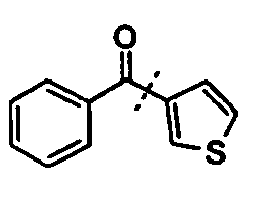
50 10 
73 23 
26 11 
72 24 
69 12 
64 25 
59 13 
96 26 
51 14 
45 27 
34 15 
52 28 
5 - Der Substituent aus der alpha-Oxocarbonsäure ist in Tabelle 1 auf der linken Seite der Carbonylgruppe gezeichnet.
- Aus der Tabelle 1 kann man erkennen, dass die alpha-Oxocarbonsäuren sowohl mit elektronenreichen wie -armen Aryl- und Heteroarylbromiden in guten Ausbeuten zu den Phenylketonen reagieren, wobei viele funktionelle Gruppen toleriert werden, u.a. Ester, Ketone und Nitrile. Andererseits ließ sich 4-Bromtoluol mit diversen alkyl-, aryl- und heteroarylsubstituierten alpha-Oxocarbonsäuren in guten Ausbeuten kuppeln und daher die breit anwendbare neue Synthesemethode zu Herstellung von Arylketonen belegt.

n und m eine Zahl im Bereich von 1 bis 6 ist,
R1-Br (II)
wobei
Claims (4)
- Verfahren zur Herstellung von Ketonen der allgemeinen Formel (III)
 R ein gegebenenfalls substituierter carbocyclischer aromatischer Rest mit 6 bis 24 Kohlenstoffatomen oder ein gegebenenfalls substituierter Alkylrest oder ein gegebenenfalls substituierter heteroaromatischer Rest mit 5 bis 24 Kohlenstoffatomen ist undR1 ein gegebenenfalls substituierter carbocyclischer aromatischer Rest mit 6 bis 24 Kohlenstoffatomen oder ein gegebenenfalls substituierter heteroaromatischer Rest mit 5 bis 24 Kohlenstoffatomen ist,durch Umsetzung von alpha-Oxocarboxylaten der allgemeinen Formel (I)
n und m eine Zahl im Bereich von 1 bis 6 ist,M(m+) ein Kation ist undR die für Formel (III) angegebene Bedeutung hat,mit Arylbromiden der allgemeinen Formel (II)
R1-Br (II)
wobeiR1 die für Formel (III) angegebene Bedeutung hat,dadurch gekennzeichnet, dass als Katalysator eine Kombination aus Kupfer(I)bromid mit 1,10-Phenanthrolin als Ligand und Bis(1,1,1,5,5,5-hexafluoroacetylacetonato)palladium mit Tris(o-tolyl)phosphin als Ligand eingesetzt wird. - Verfahren nach Anspruch 1, wobei von beiden Katalysatoren unabhängig voneinander Mengen von 0,001 mol% bis 100 mol% bezogen auf die Verbindung der Formel (II) eingesetzt werden.
- Verfahren nach einem der Ansprüche 1 bis 2, dadurch gekennzeichnet, dass der Rest R in Verbindung der Formel (III) ein Phenyl-, Cyanophenyl- oder tert.-Butylrest ist.
- Verfahren nach einem der Ansprüche 1 bis 3, dadurch gekennzeichnet, dass der Rest R1 in der Verbindung der Formel (III) ein Tolyl-, Cyanophenyl- oder Methoxyphenylrest ist.
Applications Claiming Priority (1)
| Application Number | Priority Date | Filing Date | Title |
|---|---|---|---|
| DE102008011685A DE102008011685A1 (de) | 2008-02-28 | 2008-02-28 | Verfahren zur Herstellung von Ketonen aus alpha-Oxycarboxylaten und Arylbromiden |
Publications (2)
| Publication Number | Publication Date |
|---|---|
| EP2096101A1 EP2096101A1 (de) | 2009-09-02 |
| EP2096101B1 true EP2096101B1 (de) | 2012-04-18 |
Family
ID=40602390
Family Applications (1)
| Application Number | Title | Priority Date | Filing Date |
|---|---|---|---|
| EP09153525A Not-in-force EP2096101B1 (de) | 2008-02-28 | 2009-02-24 | Verfahren zur Herstellung von Ketonen aus alpha-Oxocarboxylaten und Arylbromiden |
Country Status (6)
| Country | Link |
|---|---|
| US (1) | US8022255B2 (de) |
| EP (1) | EP2096101B1 (de) |
| JP (1) | JP5508738B2 (de) |
| AT (1) | ATE554063T1 (de) |
| DE (1) | DE102008011685A1 (de) |
| ES (1) | ES2383482T3 (de) |
Families Citing this family (8)
| Publication number | Priority date | Publication date | Assignee | Title |
|---|---|---|---|---|
| DE102005022362B4 (de) * | 2005-05-10 | 2016-12-15 | Studiengesellschaft Kohle Mbh | Verfahren zur decarboxylierenden C-C Verknüpfung von Carbonsäuren mit Kohlenstoffelektrophilen |
| EP2614053B1 (de) | 2010-09-08 | 2016-03-23 | Sumitomo Chemical Company Limited | Verfahren zur herstellung von pyridazinonverbindungen und zwischenprodukten davon |
| EP2455364A1 (de) * | 2010-11-19 | 2012-05-23 | Saltigo GmbH | Verfahren zur Herstellung von Azomethinen aus Alpha-Oxocarboxylaten, Aminen und Arylbromiden |
| CN105418393B (zh) * | 2015-11-27 | 2018-07-10 | 陕西师范大学 | 间位取代二苯甲酮类化合物的两步一锅合成方法 |
| CN108409604A (zh) * | 2018-03-05 | 2018-08-17 | 杭州中美华东制药有限公司 | 来曲唑关键中间体的制备方法 |
| CN108586340B (zh) * | 2018-03-30 | 2021-04-13 | 河南师范大学 | 一种3-酰基氢化吖庚因类化合物的合成方法 |
| CN113443974B (zh) * | 2021-07-07 | 2023-10-03 | 武汉理工大学 | 一种由联苯烯酮制备菲衍生物的方法 |
| CN114276244B (zh) * | 2021-10-29 | 2024-02-27 | 苏州汉酶生物技术有限公司 | 一种羧酸类化合物及其金属盐衍生物的制备方法 |
Family Cites Families (3)
| Publication number | Priority date | Publication date | Assignee | Title |
|---|---|---|---|---|
| JP2003073326A (ja) * | 2001-08-29 | 2003-03-12 | Japan Science & Technology Corp | ケトン類の製造法 |
| JP2004107246A (ja) * | 2002-09-18 | 2004-04-08 | Eisai Co Ltd | ケトン化合物の製造方法 |
| DE102005022362B4 (de) | 2005-05-10 | 2016-12-15 | Studiengesellschaft Kohle Mbh | Verfahren zur decarboxylierenden C-C Verknüpfung von Carbonsäuren mit Kohlenstoffelektrophilen |
-
2008
- 2008-02-28 DE DE102008011685A patent/DE102008011685A1/de not_active Withdrawn
-
2009
- 2009-02-19 US US12/388,779 patent/US8022255B2/en not_active Expired - Fee Related
- 2009-02-24 ES ES09153525T patent/ES2383482T3/es active Active
- 2009-02-24 EP EP09153525A patent/EP2096101B1/de not_active Not-in-force
- 2009-02-24 AT AT09153525T patent/ATE554063T1/de active
- 2009-02-27 JP JP2009046554A patent/JP5508738B2/ja not_active Expired - Fee Related
Also Published As
| Publication number | Publication date |
|---|---|
| JP5508738B2 (ja) | 2014-06-04 |
| JP2009221198A (ja) | 2009-10-01 |
| US8022255B2 (en) | 2011-09-20 |
| ATE554063T1 (de) | 2012-05-15 |
| EP2096101A1 (de) | 2009-09-02 |
| US20090221832A1 (en) | 2009-09-03 |
| DE102008011685A1 (de) | 2009-09-03 |
| ES2383482T3 (es) | 2012-06-21 |
Similar Documents
| Publication | Publication Date | Title |
|---|---|---|
| EP2096101B1 (de) | Verfahren zur Herstellung von Ketonen aus alpha-Oxocarboxylaten und Arylbromiden | |
| Qian et al. | A mild and efficient procedure for asymmetric Michael additions of cyclohexanone to chalcones catalyzed by an amino acid ionic liquid | |
| EP1200373A1 (de) | Verfahren zur herstellung von biarylen unter palladaphosphacyclobutan-katalyse | |
| EP1903023A1 (de) | Verfahren zur Herstellung von Arylaminen oder Arylamiden | |
| DE19503119A1 (de) | Verfahren zur Herstellung von aromatischen Olefinen unter Katalyse von Palladacyclen | |
| EP3215481B1 (de) | Verfahren zum herstellen von biphenylaminen aus azobenzolen durch rutheniumkatalyse | |
| Shanbhag et al. | Rauhut–Currier type homo-and heterocouplings involving nitroalkenes and nitrodienes | |
| Rapolu et al. | Silica sulfuric acid: a reusable solid catalyst for the synthesis of N-substituted amides via the Ritter reaction | |
| EP0972765A1 (de) | Verfahren zur Herstellung von Arylpyridinen | |
| EP0979809B1 (de) | Vefahren zur Herstellung von 4-Chlorbiphenylen | |
| EP1308157B1 (de) | Komplexe N-heterocyclischer Carbene und ihre Verwendung | |
| EP0970028B1 (de) | Verfahren zur synthese von aromatisch substituierten olefinen | |
| EP3095779B1 (de) | Kupplung von zwei arenen mit selendioxid zu einem selenobiarylether | |
| DE19815323C2 (de) | Verfahren zur Herstellung von Isochroman-3-onen | |
| DE112024000946T5 (de) | Phosphinliganden und deren Verwendung zur Carbonylierung von Acetylen/Ethylen zur Synthese von Acrylat-/Propionatestern | |
| EP3134383B1 (de) | Verfahren zum herstellen von biphenylaminen aus aniliden durch rutheniumkatalyse | |
| DE10111262A1 (de) | Verfahren zur Herstellung von Vinyl- Aryl- und Heteroarylessigsäuren und ihrer Devivate | |
| EP2526081B1 (de) | Verfahren zur herstellung von aryl- und heteroarylessigsäure-derivaten | |
| EP1115679A1 (de) | Verfahren zur herstellung von olefinen | |
| CH687877A5 (de) | 2,2-Difluorbenzo-1,3-dioxol-4-carbaldehyd. | |
| JP5110537B2 (ja) | ホモアリルエーテルの製造方法 | |
| EP1861343B1 (de) | Verfahren zur herstellung von alkylsubstituierten aromaten und heteroaromaten durch kreuzkupplung von alkylboronsäuren mit aryl- oder heteroarylhalogeniden oder -sulfonaten unter pd-katalyse in gegenwart eines liganden | |
| EP1799627B1 (de) | Eisen- oder kobalt-katalysierte kohlenstoff-kohlenstoff-kupplungsreaktion von arylen, alkenen und alkinen mit kupferreagenzien | |
| DE19515444C1 (de) | Verfahren zur Herstellung von aromatischen Acetylenen mit Palladazyklen als Katalysatoren | |
| Wang et al. | An efficient synthesis of symmetrical bisamides catalysed by molecular iodine under neutral conditions |
Legal Events
| Date | Code | Title | Description |
|---|---|---|---|
| PUAI | Public reference made under article 153(3) epc to a published international application that has entered the european phase |
Free format text: ORIGINAL CODE: 0009012 |
|
| AK | Designated contracting states |
Kind code of ref document: A1 Designated state(s): AT BE BG CH CY CZ DE DK EE ES FI FR GB GR HR HU IE IS IT LI LT LU LV MC MK MT NL NO PL PT RO SE SI SK TR |
|
| AX | Request for extension of the european patent |
Extension state: AL BA RS |
|
| 17P | Request for examination filed |
Effective date: 20100302 |
|
| AKX | Designation fees paid |
Designated state(s): AT BE BG CH CY CZ DE DK EE ES FI FR GB GR HR HU IE IS IT LI LT LU LV MC MK MT NL NO PL PT RO SE SI SK TR |
|
| 17Q | First examination report despatched |
Effective date: 20101122 |
|
| REG | Reference to a national code |
Ref country code: DE Ref legal event code: R079 Ref document number: 502009003281 Country of ref document: DE Free format text: PREVIOUS MAIN CLASS: C07C0045680000 Ipc: C07C0253300000 |
|
| GRAP | Despatch of communication of intention to grant a patent |
Free format text: ORIGINAL CODE: EPIDOSNIGR1 |
|
| RIC1 | Information provided on ipc code assigned before grant |
Ipc: C07C 253/30 20060101AFI20110811BHEP Ipc: C07C 221/00 20060101ALI20110811BHEP Ipc: C07D 307/46 20060101ALI20110811BHEP Ipc: C07C 255/22 20060101ALI20110811BHEP Ipc: C07D 213/50 20060101ALI20110811BHEP Ipc: C07D 333/22 20060101ALI20110811BHEP Ipc: C07C 45/68 20060101ALI20110811BHEP Ipc: C07C 255/56 20060101ALI20110811BHEP |
|
| GRAS | Grant fee paid |
Free format text: ORIGINAL CODE: EPIDOSNIGR3 |
|
| GRAA | (expected) grant |
Free format text: ORIGINAL CODE: 0009210 |
|
| AK | Designated contracting states |
Kind code of ref document: B1 Designated state(s): AT BE BG CH CY CZ DE DK EE ES FI FR GB GR HR HU IE IS IT LI LT LU LV MC MK MT NL NO PL PT RO SE SI SK TR |
|
| REG | Reference to a national code |
Ref country code: GB Ref legal event code: FG4D Free format text: NOT ENGLISH |
|
| REG | Reference to a national code |
Ref country code: CH Ref legal event code: EP |
|
| REG | Reference to a national code |
Ref country code: IE Ref legal event code: FG4D Free format text: LANGUAGE OF EP DOCUMENT: GERMAN |
|
| REG | Reference to a national code |
Ref country code: AT Ref legal event code: REF Ref document number: 554063 Country of ref document: AT Kind code of ref document: T Effective date: 20120515 |
|
| REG | Reference to a national code |
Ref country code: DE Ref legal event code: R096 Ref document number: 502009003281 Country of ref document: DE Effective date: 20120614 |
|
| REG | Reference to a national code |
Ref country code: ES Ref legal event code: FG2A Ref document number: 2383482 Country of ref document: ES Kind code of ref document: T3 Effective date: 20120621 |
|
| REG | Reference to a national code |
Ref country code: NL Ref legal event code: T3 |
|
| LTIE | Lt: invalidation of european patent or patent extension |
Effective date: 20120418 |
|
| PG25 | Lapsed in a contracting state [announced via postgrant information from national office to epo] |
Ref country code: IS Free format text: LAPSE BECAUSE OF FAILURE TO SUBMIT A TRANSLATION OF THE DESCRIPTION OR TO PAY THE FEE WITHIN THE PRESCRIBED TIME-LIMIT Effective date: 20120818 Ref country code: LT Free format text: LAPSE BECAUSE OF FAILURE TO SUBMIT A TRANSLATION OF THE DESCRIPTION OR TO PAY THE FEE WITHIN THE PRESCRIBED TIME-LIMIT Effective date: 20120418 Ref country code: NO Free format text: LAPSE BECAUSE OF FAILURE TO SUBMIT A TRANSLATION OF THE DESCRIPTION OR TO PAY THE FEE WITHIN THE PRESCRIBED TIME-LIMIT Effective date: 20120718 Ref country code: SE Free format text: LAPSE BECAUSE OF FAILURE TO SUBMIT A TRANSLATION OF THE DESCRIPTION OR TO PAY THE FEE WITHIN THE PRESCRIBED TIME-LIMIT Effective date: 20120418 Ref country code: PL Free format text: LAPSE BECAUSE OF FAILURE TO SUBMIT A TRANSLATION OF THE DESCRIPTION OR TO PAY THE FEE WITHIN THE PRESCRIBED TIME-LIMIT Effective date: 20120418 Ref country code: CY Free format text: LAPSE BECAUSE OF FAILURE TO SUBMIT A TRANSLATION OF THE DESCRIPTION OR TO PAY THE FEE WITHIN THE PRESCRIBED TIME-LIMIT Effective date: 20120418 |
|
| PG25 | Lapsed in a contracting state [announced via postgrant information from national office to epo] |
Ref country code: LV Free format text: LAPSE BECAUSE OF FAILURE TO SUBMIT A TRANSLATION OF THE DESCRIPTION OR TO PAY THE FEE WITHIN THE PRESCRIBED TIME-LIMIT Effective date: 20120418 Ref country code: HR Free format text: LAPSE BECAUSE OF FAILURE TO SUBMIT A TRANSLATION OF THE DESCRIPTION OR TO PAY THE FEE WITHIN THE PRESCRIBED TIME-LIMIT Effective date: 20120418 Ref country code: PT Free format text: LAPSE BECAUSE OF FAILURE TO SUBMIT A TRANSLATION OF THE DESCRIPTION OR TO PAY THE FEE WITHIN THE PRESCRIBED TIME-LIMIT Effective date: 20120820 Ref country code: GR Free format text: LAPSE BECAUSE OF FAILURE TO SUBMIT A TRANSLATION OF THE DESCRIPTION OR TO PAY THE FEE WITHIN THE PRESCRIBED TIME-LIMIT Effective date: 20120719 Ref country code: SI Free format text: LAPSE BECAUSE OF FAILURE TO SUBMIT A TRANSLATION OF THE DESCRIPTION OR TO PAY THE FEE WITHIN THE PRESCRIBED TIME-LIMIT Effective date: 20120418 |
|
| PG25 | Lapsed in a contracting state [announced via postgrant information from national office to epo] |
Ref country code: RO Free format text: LAPSE BECAUSE OF FAILURE TO SUBMIT A TRANSLATION OF THE DESCRIPTION OR TO PAY THE FEE WITHIN THE PRESCRIBED TIME-LIMIT Effective date: 20120418 Ref country code: DK Free format text: LAPSE BECAUSE OF FAILURE TO SUBMIT A TRANSLATION OF THE DESCRIPTION OR TO PAY THE FEE WITHIN THE PRESCRIBED TIME-LIMIT Effective date: 20120418 Ref country code: SK Free format text: LAPSE BECAUSE OF FAILURE TO SUBMIT A TRANSLATION OF THE DESCRIPTION OR TO PAY THE FEE WITHIN THE PRESCRIBED TIME-LIMIT Effective date: 20120418 Ref country code: EE Free format text: LAPSE BECAUSE OF FAILURE TO SUBMIT A TRANSLATION OF THE DESCRIPTION OR TO PAY THE FEE WITHIN THE PRESCRIBED TIME-LIMIT Effective date: 20120418 |
|
| PLBE | No opposition filed within time limit |
Free format text: ORIGINAL CODE: 0009261 |
|
| 26N | No opposition filed |
Effective date: 20130121 |
|
| REG | Reference to a national code |
Ref country code: DE Ref legal event code: R097 Ref document number: 502009003281 Country of ref document: DE Effective date: 20130121 |
|
| PG25 | Lapsed in a contracting state [announced via postgrant information from national office to epo] |
Ref country code: BG Free format text: LAPSE BECAUSE OF FAILURE TO SUBMIT A TRANSLATION OF THE DESCRIPTION OR TO PAY THE FEE WITHIN THE PRESCRIBED TIME-LIMIT Effective date: 20120718 |
|
| PG25 | Lapsed in a contracting state [announced via postgrant information from national office to epo] |
Ref country code: MC Free format text: LAPSE BECAUSE OF NON-PAYMENT OF DUE FEES Effective date: 20130228 |
|
| REG | Reference to a national code |
Ref country code: IE Ref legal event code: MM4A |
|
| PG25 | Lapsed in a contracting state [announced via postgrant information from national office to epo] |
Ref country code: IE Free format text: LAPSE BECAUSE OF NON-PAYMENT OF DUE FEES Effective date: 20130224 |
|
| PLAA | Information modified related to event that no opposition was filed |
Free format text: ORIGINAL CODE: 0009299DELT |
|
| PLBE | No opposition filed within time limit |
Free format text: ORIGINAL CODE: 0009261 |
|
| STAA | Information on the status of an ep patent application or granted ep patent |
Free format text: STATUS: NO OPPOSITION FILED WITHIN TIME LIMIT |
|
| PG25 | Lapsed in a contracting state [announced via postgrant information from national office to epo] |
Ref country code: MT Free format text: LAPSE BECAUSE OF FAILURE TO SUBMIT A TRANSLATION OF THE DESCRIPTION OR TO PAY THE FEE WITHIN THE PRESCRIBED TIME-LIMIT Effective date: 20120418 |
|
| R26N | No opposition filed (corrected) |
Effective date: 20130121 |
|
| RIN2 | Information on inventor provided after grant (corrected) |
Inventor name: GOOSSEN, LUKAS Inventor name: RUDOLPHI, FELIX Inventor name: OPPEL, CHRISTOPH Inventor name: GARRIDO, NURIA RODRIGUEZ Inventor name: COTTE, ALAIN Inventor name: GOTTA, MATTHIAS |
|
| PGFP | Annual fee paid to national office [announced via postgrant information from national office to epo] |
Ref country code: ES Payment date: 20150113 Year of fee payment: 7 Ref country code: FI Payment date: 20150209 Year of fee payment: 7 Ref country code: CZ Payment date: 20150205 Year of fee payment: 7 |
|
| PGFP | Annual fee paid to national office [announced via postgrant information from national office to epo] |
Ref country code: AT Payment date: 20150126 Year of fee payment: 7 |
|
| PG25 | Lapsed in a contracting state [announced via postgrant information from national office to epo] |
Ref country code: TR Free format text: LAPSE BECAUSE OF FAILURE TO SUBMIT A TRANSLATION OF THE DESCRIPTION OR TO PAY THE FEE WITHIN THE PRESCRIBED TIME-LIMIT Effective date: 20120418 |
|
| PGFP | Annual fee paid to national office [announced via postgrant information from national office to epo] |
Ref country code: BE Payment date: 20150211 Year of fee payment: 7 |
|
| PG25 | Lapsed in a contracting state [announced via postgrant information from national office to epo] |
Ref country code: LU Free format text: LAPSE BECAUSE OF NON-PAYMENT OF DUE FEES Effective date: 20130224 Ref country code: HU Free format text: LAPSE BECAUSE OF FAILURE TO SUBMIT A TRANSLATION OF THE DESCRIPTION OR TO PAY THE FEE WITHIN THE PRESCRIBED TIME-LIMIT; INVALID AB INITIO Effective date: 20090224 Ref country code: MK Free format text: LAPSE BECAUSE OF FAILURE TO SUBMIT A TRANSLATION OF THE DESCRIPTION OR TO PAY THE FEE WITHIN THE PRESCRIBED TIME-LIMIT Effective date: 20120418 |
|
| REG | Reference to a national code |
Ref country code: FR Ref legal event code: PLFP Year of fee payment: 8 |
|
| PGFP | Annual fee paid to national office [announced via postgrant information from national office to epo] |
Ref country code: CH Payment date: 20160211 Year of fee payment: 8 Ref country code: IT Payment date: 20160222 Year of fee payment: 8 Ref country code: DE Payment date: 20160216 Year of fee payment: 8 |
|
| PG25 | Lapsed in a contracting state [announced via postgrant information from national office to epo] |
Ref country code: BE Free format text: LAPSE BECAUSE OF NON-PAYMENT OF DUE FEES Effective date: 20160229 |
|
| PGFP | Annual fee paid to national office [announced via postgrant information from national office to epo] |
Ref country code: NL Payment date: 20160210 Year of fee payment: 8 Ref country code: GB Payment date: 20160224 Year of fee payment: 8 Ref country code: FR Payment date: 20160108 Year of fee payment: 8 |
|
| REG | Reference to a national code |
Ref country code: AT Ref legal event code: MM01 Ref document number: 554063 Country of ref document: AT Kind code of ref document: T Effective date: 20160224 |
|
| PG25 | Lapsed in a contracting state [announced via postgrant information from national office to epo] |
Ref country code: FI Free format text: LAPSE BECAUSE OF NON-PAYMENT OF DUE FEES Effective date: 20160224 |
|
| PG25 | Lapsed in a contracting state [announced via postgrant information from national office to epo] |
Ref country code: CZ Free format text: LAPSE BECAUSE OF NON-PAYMENT OF DUE FEES Effective date: 20160224 Ref country code: AT Free format text: LAPSE BECAUSE OF NON-PAYMENT OF DUE FEES Effective date: 20160224 |
|
| PG25 | Lapsed in a contracting state [announced via postgrant information from national office to epo] |
Ref country code: ES Free format text: LAPSE BECAUSE OF NON-PAYMENT OF DUE FEES Effective date: 20160225 |
|
| REG | Reference to a national code |
Ref country code: DE Ref legal event code: R119 Ref document number: 502009003281 Country of ref document: DE |
|
| REG | Reference to a national code |
Ref country code: CH Ref legal event code: PL |
|
| REG | Reference to a national code |
Ref country code: NL Ref legal event code: MM Effective date: 20170301 |
|
| GBPC | Gb: european patent ceased through non-payment of renewal fee |
Effective date: 20170224 |
|
| PG25 | Lapsed in a contracting state [announced via postgrant information from national office to epo] |
Ref country code: CH Free format text: LAPSE BECAUSE OF NON-PAYMENT OF DUE FEES Effective date: 20170228 Ref country code: LI Free format text: LAPSE BECAUSE OF NON-PAYMENT OF DUE FEES Effective date: 20170228 |
|
| PG25 | Lapsed in a contracting state [announced via postgrant information from national office to epo] |
Ref country code: NL Free format text: LAPSE BECAUSE OF NON-PAYMENT OF DUE FEES Effective date: 20170301 |
|
| REG | Reference to a national code |
Ref country code: FR Ref legal event code: ST Effective date: 20171031 |
|
| PG25 | Lapsed in a contracting state [announced via postgrant information from national office to epo] |
Ref country code: DE Free format text: LAPSE BECAUSE OF NON-PAYMENT OF DUE FEES Effective date: 20170901 Ref country code: FR Free format text: LAPSE BECAUSE OF NON-PAYMENT OF DUE FEES Effective date: 20170228 |
|
| PG25 | Lapsed in a contracting state [announced via postgrant information from national office to epo] |
Ref country code: IT Free format text: LAPSE BECAUSE OF NON-PAYMENT OF DUE FEES Effective date: 20170224 Ref country code: GB Free format text: LAPSE BECAUSE OF NON-PAYMENT OF DUE FEES Effective date: 20170224 |