EP2096401A2 - Verfahren zur Bereitstellung eines Keramikpanzerungssystems - Google Patents
Verfahren zur Bereitstellung eines Keramikpanzerungssystems Download PDFInfo
- Publication number
- EP2096401A2 EP2096401A2 EP20090002879 EP09002879A EP2096401A2 EP 2096401 A2 EP2096401 A2 EP 2096401A2 EP 20090002879 EP20090002879 EP 20090002879 EP 09002879 A EP09002879 A EP 09002879A EP 2096401 A2 EP2096401 A2 EP 2096401A2
- Authority
- EP
- European Patent Office
- Prior art keywords
- armor layer
- ceramic
- recited
- armor
- layer
- Prior art date
- Legal status (The legal status is an assumption and is not a legal conclusion. Google has not performed a legal analysis and makes no representation as to the accuracy of the status listed.)
- Withdrawn
Links
Images

Classifications
-
- F—MECHANICAL ENGINEERING; LIGHTING; HEATING; WEAPONS; BLASTING
- F41—WEAPONS
- F41H—ARMOUR; ARMOURED TURRETS; ARMOURED OR ARMED VEHICLES; MEANS OF ATTACK OR DEFENCE, e.g. CAMOUFLAGE, IN GENERAL
- F41H5/00—Armour; Armour plates
- F41H5/02—Plate construction
- F41H5/04—Plate construction composed of more than one layer
- F41H5/0414—Layered armour containing ceramic material
- F41H5/0428—Ceramic layers in combination with additional layers made of fibres, fabrics or plastics
Definitions
- This disclosure relates to an armor system and, more particularly, to a method of processing an armor system having multiple ceramic layers.
- a variety of configurations of projectile resistant armor are known. Some are used on vehicles while others are specifically intended to protect an individual. Some materials or material combinations have proven useful for both applications; however, there is a continuing need for providing methods of manufacturing relatively lightweight armor systems with improved ballistic performance that are useful for a variety of applications.
- An example method of manufacturing an armor system includes providing a first armor layer comprised of a densified ceramic material and forming a second armor layer of a fiber reinforced ceramic composite on the first armor layer to bond the first armor layer and the second armor layer together.
- the densified ceramic material is a monolithic ceramic and the fiber-reinforced ceramic composite comprises reinforcement fibers within a silicate glass matrix or a glass-ceramic matrix.
- the armor system may be manufactured using hot press molding or transfer molding to chemically bond the first armor layer and the second armor layer together.
- Using ceramic layers that are strongly bonded together provides an armor system that facilitates energy absorption to resist ballistic projectile impacts.
- the disclosed examples thereby provide methods of manufacturing a relatively lightweight armor system that may be used in a variety of different applications.
- FIG 1 illustrates an example armor system 10 for resisting impact of a ballistic projectile.
- the armor system 10 may be utilized in a variety of different applications for defeating ballistics, such as armor piercing projectiles at or near muzzle velocity.
- the armor system 10 includes an aerial density that is at least equal to or lighter than known armor systems, when measured against a common threat level, and that may be used as a plate in a personal body armor vest.
- the armor system 10 may also be used as an add-on or integral armor panel in a vehicle, such as a ground vehicle, sea vehicle, air vehicle, or the like. That is, one or more panels may be attached over or included within a vehicle structure, such as doors, floors, walls, engine panels, fuel tanks areas and the like but need not be integrated into the vehicle structure itself.
- the armor system 10 is a multilayer structure that includes a first armor layer 12 and a second armor layer 14. It is to be understood however, that the armor layers 12 and 14 of the armor system 10 may be used alone or in combination with other armor layers, depending on the needs of an intended use.
- the armor layers 12 and 14 may be any suitable thickness for resisting a ballistic impact. For example, the armor layers 12 and 14 may be several hundredths of an inch thick to several inches thick, depending upon an intended use of the armor system 10.
- the armor layers 12 and 14 are arranged relative to an expected projectile direction 16.
- the first armor layer 12 includes a projectile strike face 18 for initially 5receiving a projectile.
- a back face 20 is opposed from the projectile strike face 18 and is bonded to the second armor layer 14 at location 22.
- the armor layers 12 and 14 are directly bonded to one another, as will be described below, and need not include any layers of adhesive that would add thickness and/or diminish the impedance of the structure.
- the first armor layer 12 includes a first ceramic material
- the second armor layer 14 includes a second ceramic material that is different than the first ceramic material.
- Sound impedance refers to the speed of sound through the ceramic materials.
- an impact between a projectile and the projectile strike face 18 of the first armor layer 12 causes compressive stress waves to move through the first armor layer 12 toward the back face 20.
- At least a portion of the compressive stress waves reflect off of the front face 22 of the second armor layer 14 as tensile stress waves.
- a second portion travels through the armor layer 14 and reflects off a rear face 25.
- the tensile stress waves destructively interfere with the compressive stress waves, to reduce the total stress within at least the first armor layer 12 to thereby facilitate energy absorption of the armor system 10.
- the impedance of the second ceramic material of the second armor layer 14 facilitates efficient and quick reflection of the compressive and tensile stress waves. That is, the second ceramic material reflects relatively larger portions of the compressive stress waves over a relatively shorter period of time compared to conventional polymeric-based materials.
- the impedance of each of the first ceramic material and the second ceramic material may be in a range of 15 - 40 x 10 6 kilogram-seconds per square meter (kg-m -2 -s). In a further example, the impedance of each of the ceramic materials is about 25 - 35 x 10 6 kg-m -2 -s.
- the polymer matrix of a polymer matrix composite backing has an impedance of about 1 - 3 x 10 6 kg-m -2 -s
- the first ceramic material and the second ceramic material may be any suitable type of ceramic material for an intended use.
- the first ceramic material of the first armor layer 12 is a monolithic ceramic and the second ceramic material of the second armor layer 14 is a ceramic composite.
- the monolithic ceramic of the first armor layer 12 initially receives a ballistic projectile and absorbs a portion of the energy associated with the ballistic projectile through fracture and stress wave cancellation.
- the ceramic composite of the second armor layer 14 reflects a portion of the stress waves as discussed above and absorbs a portion of the energy associated with the ballistic projectile through fiber debinding and pullout.
- the ceramic composite facilitates energy absorption through fiber debonding and pullout, as well as shear failure.
- the ceramic composite also facilitates reduction in the degree of fragmentation of the monolithic ceramic exhibits, compared to conventional polymer or bonded metallic back face materials.
- the ceramic composite may include reinforcement fibers 24 disposed within a ceramic matrix 26.
- the monolithic ceramic may be, for example only, silicon nitride, silicon aluminum oxynitride, silicon carbide, silicon oxynitride, aluminum nitride, aluminum oxide, hafnium oxide, zirconia, siliconized silicon carbide, or boron carbide. Given this description, one of ordinary skill in the art will understand that other oxides, carbides, nitrides, or other types of ceramics may be used to suit a particular need.
- the ceramic composite may include any of a variety of different types of the fibers 24 or different types of materials for the matrix 26.
- the fibers 24 may include fibers of silicon carbide, silicon nitride, aluminum oxide, silicon aluminum oxynitride, aluminum nitride, carbon, or combinations thereof.
- the reinforcement fibers 24 include fibers of NICALON®, SYLRAMIC®, TYRANNO®, HPZTM, pitch derived carbon, or polyacronitrile derived carbon, fibers, respectively.
- the matrix 26 may include a silicate glass material, such as magnesium aluminum silicate, magnesium barium aluminum silicate, lithium aluminum silicate, borosilicate, or barium aluminum silicate.
- a silicate glass material such as magnesium aluminum silicate, magnesium barium aluminum silicate, lithium aluminum silicate, borosilicate, or barium aluminum silicate.
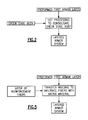
- FIG 2 illustrates a process flow diagram of an example hot press molding process for forming the armor system 10. It is to be understood that variations of the process may be used and that variations of hot press molding may alternatively be used, such as hot isostatic pressing or semi-continuous pressing.
- the armor system 10 is formed in a hot press die 38 as illustrated schematically in Figure 3 , such as a graphite die.
- the hot press die 38 may include one or more die pieces that form a cavity 40 to form the armor system 10.
- the first armor layer 12 is previously densified, and placed into the cavity 40.
- the first armor layer 12 may be formed in a prior process, such as by hot pressing, sintering or other suitable process for forming a monolithic ceramic layer.
- the second armor layer 14 will then be consolidated, and bonded on the previously formed first armor layer 12 using hot press molding.
- the second armor layer 14 is formed during the hot press molding from a green state body 42 that is placed on top of the first armor layer 12. It is to be understood that reference to orientations such as “top” or “bottom” is relative and may be different than the illustrated example, depending upon the arrangement of the die 38 or the desired structure of the armor system 10, for example. Furthermore, it is to be understood that the die 38 may be formed in a different shape than illustrated to make armor systems having other desired shapes, such as curved or clam-shell style shapes.
- the first armor layer 12 and the green state body 42 are heated to a predetermined temperature, and a ram 44 exerts a predetermined amount of pressure on the first armor layer 12 and the green state body 42.
- the magnitudes of the predetermined temperature and the predetermined pressure may depend upon the types of ceramic materials used to form the first armor layer 12 and the second armor layer 14.
- the temperature may be in a range of 1400 - 1600 degrees centigrade (2552 - 2912 degrees Fahrenheit), and the pressure may be in a range of 500-5000 pounds per square inch (3.4 - 10.3 megapascals).
- the pressure and temperature may be held for a predetermined amount of time, such as between 20 and 60 minutes.
- the amount of time may vary depending upon the types of materials selected for the first armor layer 12 and the second armor layer 14.
- the pressure is then released and the armor system 10 is cooled.
- the application of the heat and pressure consolidates the green state body 42 to form the second armor layer 14.
- the green state body 42 may be formed in any suitable manner and include any desired structure.
- the green state body 42 includes a layer of the reinforcement fibers 24 that is infiltrated with a material 46 that forms the matrix 26 during the hot press molding process.
- the material 46 may be a slurry that includes a carrier fluid 48 having suspended ceramic particles 50.
- the ceramic particles 50 may be particles of the material desired for the matrix 26.
- the layer of the reinforcement fibers 24 may be soaked, dipped, or otherwise exposed to the slurry such that the glass or ceramic particles 50 are deposited among the reinforcement fibers 24.
- the carrier fluid 48 may then be removed, such as by using evaporation or heating, to deposit the ceramic particles 50 among the fibers 24 to form the green state body 42.
- the green state body 42 may include multiple layers of reinforcement fibers, and that a variety of fiber architectures may be employed. 24.
- the carrier fluid 48 may be any type of suitable carrier fluid for infiltrating the layer of reinforcement fibers 24.
- the carrier fluid 48 may include a solvent, such as isopropyl alcohol or water, that is mixed with a predetermined amount of the glass or ceramic particles 50, such as 30 wt% (weight percent).
- the ceramic particles and carrier fluid 48 may be mixed, such as by using a magnetic stirrer.
- attrition milling or ball milling may be used to mix the carrier fluid 48 and the glass or ceramic particles 50.
- the attrition milling may break down agglomerates of the ceramic particles 50 and facilitate uniform distribution of the ceramic particles 50 around the reinforcement fibers 24 to thereby result in enhanced mechanical properties of the second armor layer 14.
- suitable types of carrier fluids may meet their particular needs.
- other types of processing methods may be available for forming green state perform bodies that are suitable for being hot pressed as described above.
- Figure 5 illustrates another process flow diagram of an example transfer molding process for forming the armor system 10.
- the transfer molding is conducted in a transfer molding die 58 and may include multiple die pieces that form molding cavities 60 and 62.
- the molding cavities 60 and 62 are separated by a slot plate 64.
- the slot plate 64 includes passages 66 that fluidly connect the cavities 60 and 62.
- Seals 67 may be used at edges of the cavity 60 to limit leaking of material from the die 58.
- the seals 67 may include a high melting point sealing material, such as molybdenum foil.
- the first armor plate 12 is pre-formed as described above and placed within the first molding cavity 60.
- a layer of the reinforcement fibers 24, or alternatively multiple layers, is placed on top of the first armor layer 12.
- the layer of reinforcement fibers 24 is a pre-formed arrangement of the fibers 24, such as a two-dimensional fabric, a unidirectional tape, a three-dimensional weave, or other desired fiber arrangement.
- the layer of reinforcement fibers 24 does not yet include the matrix 26 (in Figure 1 ), which will be formed during the transfer molding process.
- a material 70 that will form the matrix 26 is contained within the second reservoir cavity 62.
- the material 70 may be a powder, such a powder or cullet of the material such as a glass that is desired for the matrix 26.
- the material 70 is heated to a predetermined temperature to fluidize the material 70 to a desired viscosity for transfer molding.
- the die 58 and material 70 may be heated in a suitable heating unit.
- a ram 68 then applies a predetermined amount of pressure at a predetermined rate on the material 70 such that the material 70 flows through the passages 66 of the slot plate 64 and infiltrates the layer of reinforcement fibers 24.
- the predetermined temperature may be selected based upon a desired viscosity of the material 70. For example, a target viscosity may be suitably low such that the material 70is able to flow between the reinforcement fibers 24 to form a solid body.
- the pressure and rate may be selected based upon manufacturing considerations, such as to facilitate low cycle times and complete infiltration of the reinforcement fiber 24 without fiber wash (i.e., fiber movement).
- the transfer molding process may be conducted under a vacuum.
- the vacuum is a lower pressure than a surrounding ambient atmosphere.
- the die 58 may be encased in a vacuum type of heating unit that permits the die 58 and surroundings to be maintained at a desired vacuum level to prevent undesired reactions or oxidation of the constituents, and/or die materials.
- Transfer molding may also be performed under an inert atmosphere, again to prevent oxidation of constituent materials (e.g. fibers) or tooling, such as graphite tooling.
- the armor system 10 may subsequently be heat treated for various reasons.
- the armor system 10 may be heated to a crystallization temperature in a suitable heating unit under a suitable atmosphere to obtain a desired microstructure of the matrix of the second ceramic material.
- suitable heat treatment temperatures and times for their particular needs.
- the second armor layer 14 is formed on the first armor layer 12 to bond the first armor layer 12 and the second armor layer 14 together.
- Forming the armor system 10 in this manner facilitates strong bonding between the armor layers 12 and 14, which facilitates efficient reflection of the stress waves and absorption of energy.
- the matrix 26 of the second armor layer chemically bonds to the first ceramic material of the first armor layer 12.
- the monolithic ceramic of the first armor layer 12 is thought to include a silica scale on the back face 20 that chemically bonds with the silicate glass material of the matrix 26.
- the chemical bonding between the first armor layer 12 and the second armor layer 14 is not fully understood and may also comprise other reactions or chemical interactions between the ceramic material of the matrix 26 and the ceramic material of the first armor layer 12 that facilitate chemical bonding.
Landscapes
- Engineering & Computer Science (AREA)
- Chemical & Material Sciences (AREA)
- Ceramic Engineering (AREA)
- General Engineering & Computer Science (AREA)
- Aiming, Guidance, Guns With A Light Source, Armor, Camouflage, And Targets (AREA)
- Laminated Bodies (AREA)
Applications Claiming Priority (1)
| Application Number | Priority Date | Filing Date | Title |
|---|---|---|---|
| US3985108A | 2008-02-29 | 2008-02-29 |
Publications (2)
| Publication Number | Publication Date |
|---|---|
| EP2096401A2 true EP2096401A2 (de) | 2009-09-02 |
| EP2096401A3 EP2096401A3 (de) | 2013-06-05 |
Family
ID=40579029
Family Applications (1)
| Application Number | Title | Priority Date | Filing Date |
|---|---|---|---|
| EP20090002879 Withdrawn EP2096401A3 (de) | 2008-02-29 | 2009-02-27 | Verfahren zur Bereitstellung eines Keramikpanzerungssystems |
Country Status (1)
| Country | Link |
|---|---|
| EP (1) | EP2096401A3 (de) |
Citations (1)
| Publication number | Priority date | Publication date | Assignee | Title |
|---|---|---|---|---|
| US20070089596A1 (en) * | 2005-07-22 | 2007-04-26 | Huber Christopher A | Ballistic resistant devices and systems and methods of manufacture thereof |
Family Cites Families (5)
| Publication number | Priority date | Publication date | Assignee | Title |
|---|---|---|---|---|
| US4626515A (en) * | 1985-04-15 | 1986-12-02 | Corning Glass Works | Reinforced alkaline earth aluminosilicate glasses |
| US4719151A (en) * | 1986-05-09 | 1988-01-12 | Corning Glass Works | Laminated ceramic structure |
| US6451416B1 (en) * | 1999-11-19 | 2002-09-17 | United Technologies Corporation | Hybrid monolithic ceramic and ceramic matrix composite airfoil and method for making the same |
| DE10157487C1 (de) * | 2001-11-23 | 2003-06-18 | Sgl Carbon Ag | Faserverstärkter Verbundkörper für Schutzpanzerungen, seine Herstellung und Verwendungen |
| US9097496B2 (en) * | 2006-04-20 | 2015-08-04 | Sikorsky Aircraft Corporation | Lightweight projectile resistant armor system with surface enhancement |
-
2009
- 2009-02-27 EP EP20090002879 patent/EP2096401A3/de not_active Withdrawn
Patent Citations (1)
| Publication number | Priority date | Publication date | Assignee | Title |
|---|---|---|---|---|
| US20070089596A1 (en) * | 2005-07-22 | 2007-04-26 | Huber Christopher A | Ballistic resistant devices and systems and methods of manufacture thereof |
Also Published As
| Publication number | Publication date |
|---|---|
| EP2096401A3 (de) | 2013-06-05 |
Similar Documents
| Publication | Publication Date | Title |
|---|---|---|
| US7238414B2 (en) | Fiber-reinforced composite for protective armor, and method for producing the fiber-reinforced composition and protective armor | |
| US6609452B1 (en) | Silicon carbide armor bodies, and methods for making same | |
| US7104177B1 (en) | Ceramic-rich composite armor, and methods for making same | |
| Gooch et al. | Development and ballistic testing of a functionally gradient ceramic/metal applique | |
| US9103633B2 (en) | Lightweight projectile resistant armor system | |
| US8128861B1 (en) | Composite materials and methods for making same | |
| US9097496B2 (en) | Lightweight projectile resistant armor system with surface enhancement | |
| US8869673B2 (en) | Structural panel with ballistic protection | |
| US20140109756A1 (en) | Composite materials and methods for making same | |
| US20110259184A1 (en) | Multi-structure metal matrix composite armor with integrally cast holes | |
| CA2428958A1 (en) | Boron carbide composite bodies, and methods for making same | |
| US20120055327A1 (en) | Armor system having ceramic matrix composite layers | |
| WO2003084872A2 (en) | Toughness enhanced silicon-containing composite bodies, and methods for making same | |
| US20090324966A1 (en) | Multilayer armor plating, and process for producing the plating | |
| WO2005079207A2 (en) | Boron carbide composite bodies, and methods for making same | |
| CN107675058A (zh) | 一种宽体积分数层状梯度碳化硼铝基复合材料及其制备方法 | |
| US20160375648A1 (en) | Structural panel insert having encapsulated filler materials | |
| JP2001192275A (ja) | セラミックマトリックスを含む繊維強化複合材料からなる要素 | |
| JP2025163059A (ja) | 珪素含侵反応結合した混合セラミック材料の複合成形体 | |
| US8640590B2 (en) | Armor system having ceramic composite with improved architecture | |
| WO2006078411A2 (en) | Metal-ceramic materials | |
| Stupar | Ballistic composites, the present and the future | |
| US20120247312A1 (en) | Structural panel insert with honeycomb core | |
| Chabera et al. | Fabrication and characterization of composite materials based on porous ceramic preform infiltrated by elastomer | |
| US20080060508A1 (en) | Lightweight armor composite, method of making same, and articles containing the same |
Legal Events
| Date | Code | Title | Description |
|---|---|---|---|
| PUAI | Public reference made under article 153(3) epc to a published international application that has entered the european phase |
Free format text: ORIGINAL CODE: 0009012 |
|
| AK | Designated contracting states |
Kind code of ref document: A2 Designated state(s): AT BE BG CH CY CZ DE DK EE ES FI FR GB GR HR HU IE IS IT LI LT LU LV MC MK MT NL NO PL PT RO SE SI SK TR |
|
| AX | Request for extension of the european patent |
Extension state: AL BA RS |
|
| PUAL | Search report despatched |
Free format text: ORIGINAL CODE: 0009013 |
|
| AK | Designated contracting states |
Kind code of ref document: A3 Designated state(s): AT BE BG CH CY CZ DE DK EE ES FI FR GB GR HR HU IE IS IT LI LT LU LV MC MK MT NL NO PL PT RO SE SI SK TR |
|
| AX | Request for extension of the european patent |
Extension state: AL BA RS |
|
| RIC1 | Information provided on ipc code assigned before grant |
Ipc: F41H 5/04 20060101AFI20130426BHEP |
|
| 17P | Request for examination filed |
Effective date: 20131204 |
|
| RBV | Designated contracting states (corrected) |
Designated state(s): AT BE BG CH CY CZ DE DK EE ES FI FR GB GR HR HU IE IS IT LI LT LU LV MC MK MT NL NO PL PT RO SE SI SK TR |
|
| AKX | Designation fees paid |
Designated state(s): AT BE BG CH CY CZ DE DK EE ES FI FR GB GR HR HU IE IS IT LI LT LU LV MC MK MT NL NO PL PT RO SE SI SK TR |
|
| 17Q | First examination report despatched |
Effective date: 20150422 |
|
| STAA | Information on the status of an ep patent application or granted ep patent |
Free format text: STATUS: THE APPLICATION IS DEEMED TO BE WITHDRAWN |
|
| 18D | Application deemed to be withdrawn |
Effective date: 20180901 |