EP2096513A1 - Glaubwürdigkeitsbeurteilung von Sensordaten aus drahtlosen Sensornetzwerken für Geschäftsanwendungen - Google Patents
Glaubwürdigkeitsbeurteilung von Sensordaten aus drahtlosen Sensornetzwerken für Geschäftsanwendungen Download PDFInfo
- Publication number
- EP2096513A1 EP2096513A1 EP08290188A EP08290188A EP2096513A1 EP 2096513 A1 EP2096513 A1 EP 2096513A1 EP 08290188 A EP08290188 A EP 08290188A EP 08290188 A EP08290188 A EP 08290188A EP 2096513 A1 EP2096513 A1 EP 2096513A1
- Authority
- EP
- European Patent Office
- Prior art keywords
- sensor data
- value
- trust
- sensor
- operator
- Prior art date
- Legal status (The legal status is an assumption and is not a legal conclusion. Google has not performed a legal analysis and makes no representation as to the accuracy of the status listed.)
- Granted
Links
Images




Classifications
-
- G—PHYSICS
- G05—CONTROLLING; REGULATING
- G05B—CONTROL OR REGULATING SYSTEMS IN GENERAL; FUNCTIONAL ELEMENTS OF SUCH SYSTEMS; MONITORING OR TESTING ARRANGEMENTS FOR SUCH SYSTEMS OR ELEMENTS
- G05B23/00—Testing or monitoring of control systems or parts thereof
- G05B23/02—Electric testing or monitoring
- G05B23/0205—Electric testing or monitoring by means of a monitoring system capable of detecting and responding to faults
- G05B23/0218—Electric testing or monitoring by means of a monitoring system capable of detecting and responding to faults characterised by the fault detection method dealing with either existing or incipient faults
- G05B23/0221—Preprocessing measurements, e.g. data collection rate adjustment; Standardization of measurements; Time series or signal analysis, e.g. frequency analysis or wavelets; Trustworthiness of measurements; Indexes therefor; Measurements using easily measured parameters to estimate parameters difficult to measure; Virtual sensor creation; De-noising; Sensor fusion; Unconventional preprocessing inherently present in specific fault detection methods like PCA-based methods
Definitions
- the description is directed generally to wireless sensor networks (WSN) and in particular to a computer-implemented method, computer system, and computer program product for trust evaluation of sensor data in a sensor data life-cycle.
- WSN wireless sensor networks
- Wireless sensor networks are sensor networks empowered with short wireless communication capabilities. WSNs enable random and dense deployment of smart and low-cost devices in physical areas such as battlefield and body. The ability of WSNs to monitor and control physical environments makes WSN attractive for a lot of different application domains such as military, health care or traffic control.
- WSN Wireless sensor networks
- the integration of WSN into (complex) computer or software applications raises technical challenges such as data routing and processing (e.g. data aggregation and data fusion).
- data routing and processing e.g. data aggregation and data fusion
- the integration of WSN into software applications raise technical challenges regarding security and trust issues.
- such software applications require secured and trusted sensor data processing as well as secured and trusted delivery of sensor data e.g. form a WSN to a software application.
- software applications may, for example, require trust mechanisms for establishing their confidence in the delivered sensor data from the WSN.
- a computer-implemented method for trust evaluation of (physical or electronic) sensor data during at least part of a sensor data life-cycle may comprise:
- a sensor data life-cycle comprises acquiring sensor data from one or more sensor nodes in a WSN, processing (comprising aggregation and fusion) and routing the sensor data within the WSN towards at least one sink of the WSN and from there to a middleware.
- the middleware then performs processing (comprising aggregation and fusion) on the sensor data not supported by the one or more sensor nodes and then delivers the sensor data to at least one software application.
- a sensor data life-cycle comprises sensor data acquisition, sensor data delivery, and sensor data processing including sensor data aggregation and sensor data fusion.
- An entity in such a sensor data life-cycle performing one or more of said (sensor data) operating or processing steps may be a sensor node of a WSN, a sink of a WSN, a middleware, or a software application.
- the middleware is in charge of integrating the WSN into a software application.
- Trust or trustworthiness in such a sensor data life-cycle may be then evaluated (assessed, determined or computed) by computing corresponding trust values in each of the processing steps of the sensor data life-cycle.
- the corresponding trust value i.e. ATV, DTV, PTV
- a trust value may be a real number between 0 and 1 excluding 0 and 1 themselves, wherein a trust value closer to 0 is less true (i.e. the sensor data is rather not trustworthy) than a value closer to 1 (i.e. the sensor data is rather trustworthy).
- a sensor node acquiring sensor data has a ATV in said sensor data.
- the sensor node or a middleware processing the sensor data has a PTV in said sensor data.
- a receiving entity has a DTV in said sensor data received from a sending entity.
- a trust value may be expressed or specified in terms of a fuzzy logic value assigned to a proposition.
- a proposition may be any event occurring in a sensor data life-cycle such as sensor data "pulse of 90" acquired from a sensor node.
- each trust value on a proposition is computed according to an entity, which has the computed trust value in said proposition.
- a trust model is determined for sensor data processing in a sensor data life-cycle by computing appropriate trust values each of the participating entities has in the sensor data at or during a specific processing step of the life-cycle.
- the present application is directed to trustworthiness assessment or trust evaluation of sensor data processing during their complete life-cycle.
- evaluating a processing trust value may comprise:
- the processing entity may either involves (particularly be) the at least one sensor node or a middleware.
- the sending entity may involve (particularly be) the at least one sensor node and the receiving entity may involve (particularly be) the at least one sink or the sending entity may involve (particularly be) the at least one sink and the receiving entity may involve (particularly be) a middleware or the sending entity may involve (particularly be) the middleware and the receiving entity may involve (particularly be) at least one software application.
- evaluating an acquisition trust value may further comprise:
- trustworthiness of sensor data acquired from a sensor node may be based on the trustworthiness of their sensor data attributes, wherein also an impact of sensor data attribute confidence or trust is captured.
- the notion of weight defined for each of the sensor data attributes is considered when evaluating or computing an ATV.
- a weighting value is a real number between 0 and 1, wherein a proposition (e.g. of a sensor data attribute) has a higher weight the higher its corresponding weighting value is.
- Considering a weighting value for each of the sensor data attributes it enables, for example, to leverage impact or influence of an origin or accuracy of the sensor data on the ATV.
- evaluating a delivery trust value may further comprise:
- Sensor data may be transferred or routed from sensor node to sink, from sink to middleware, and from middleware to software application, i.e. among entities related to a sensor data life-cycle.
- Each entity has a confidence or trust in another entity delivering sensor data to said entity, denoted ⁇ ( P f ,e ) .
- the entity delivering the sensor data itself has a confidence in the sensor data to be delivered, denoted ⁇ ( P s , f ) .
- Trustworthiness of the delivered sensor data from the sending entity to the receiving entity is then expressed or specified by the corresponding DTV which is computed based on said two trust values.
- evaluation of an aggregation trust value may further comprise:
- Aggregation of sensor data may be a collection of (pieces of) sensor data which is neither modified nor inferred when compared to the (pieces of) sensor data comprised in the aggregation.
- an influence or impact of each piece of sensor data in trustworthiness of the corresponding aggregated sensor data is captured or considered. Furthermore, the aggregated sensor data is weighted in the AgTV.
- evaluation a fusion trust value may further comprise:
- sensor data fusion comprises modification and/or inference of pieces of sensor data included in the fused sensor data.
- FTV an influence or impact of each piece of sensor data in trustworthiness of the corresponding fused sensor data is captured or considered.
- the fused sensor data is weighted in the FTV, i.e. each piece of sensor data included in evaluation of the fusion trustworthiness is weighted (or has a corresponding weighting value).
- the method may further comprise:
- the method may further comprise:
- the method may further comprise:
- the method may further comprise:
- the trust model may be implemented by mapping trust (or trustworthiness) assessment (or evaluation) to subjective logic opinion.
- An opinion is expressed by a 4-tuple (b, d, u, a), i.e. belief, disbelief, uncertainty, and atomicity.
- An opinion is determined for a proposition (i.e. any event occurring in a sensor data life-cycle).
- Opinions are used to assess (or evaluate) trustworthiness of sensor data using subjective logic comprising the notion of opinions, trust values (i.e. ATV, DTV, AgTV, and FTV) can be computed while taking into account belief and uncertainty an entity has in sensor data. Opinions on sensor data can be subsumed or interrelated using different operators on opinions.
- the subject-logic operator discount is re-used during sensor data delivery, i.e. when assessing a DTV of a receiving entity in the received sensor data.
- the subjective logic operator average is modified or adapted in order to consider (or additionally handle) weighting values on corresponding pieces of sensor data when aggregating said pieces of sensor data during sensor data aggregation in order to compute an AgTV.
- a new operator on subjective logic opinions, combine is implemented.
- implementing the combine operator may further comprise:
- a computer-program product comprising computer readable instructions, which when loaded and run in a computer system and/or computer network system, cause the computer system and/or the computer network system to perform a method as described.
- a computer system for trust evaluation of sensor data during a sensor data life-cycle may comprise:
- the computer system is further operable to perform operations according to any one of the described methods.
- the subject matter described in this specification can be implemented as a method or as a system or using computer program products, tangibly embodied in information carriers, such as a CD-ROM, a DVD-ROM, a semiconductor memory, and a hard disk.
- Such computer program products may cause a data processing apparatus to conduct one or more operations described in this specification.
- the subject matter described in this specification can also be implemented as a system including a processor and a memory coupled to the processor.
- the memory may encode one or more programs that cause the processor to perform one or more of the method acts described in this specification.
- the subject matter described in this specification can be implemented using various MRI machines.
- WLAN wireless sensor network
- a wireless sensor network may be understood as any (possibly self-organized) wireless network typically involving low-cost and low-power sensor devices which are capable of physically and/or chemically sensing, processing, routing and disseminating data toward special sensor nodes, so-called sinks, in a very efficient way, by saving sensor node battery or WSN bandwidth.
- a sensor data device is, for example, a pulse sensor, a blood pressure sensor and further physiological (e.g. received from body tissue or fluids such as blood, blood products, urine, and/or bile), psychological, and/or behavioral data sensors, a room temperature sensor, or sensors for retrieving weather data.
- a sink (collecting or transmitting sensor node) is a specific sensor node in a WSN which may be capable of receiving and/or collecting sensor data acquired from other sensor nodes in the WSN and of transmitting collected sensor data, e.g. in packed form, to other software components.
- a sensor data life-cycle in a sensor data routing and processing system may be the complete process from the acquisition of data and/or information from a (sensor) node in a WSN, to its delivery to software applications through a middleware, including data processing such as (data) aggregation and/or (data) fusion at sensor nodes and/or the middleware.
- Crash or omission may imply no response from the sensor to sensor data request.
- Timing may refer to time-out during request processing.
- Value failure may deal with delivering incorrect or compromised sensor nodes.
- Arbitrary failure may comprise one or more further kinds of failure which may not be classified in one of the previously described categories or classes of failure.
- Trustworthiness of computer systems and/or software applications in data, system entities, and/or data processing may be described as the expectation of cooperative behavior of a computer-implemented entity such as a sensor node, a software component, a web service.
- Trust may encompass objective and subjective aspects on such an entity including reputation.
- trust may be defined as the belief of a computer entity (e.g. sensor node, sink, middleware, applications) in the observation of a given event (occurring in a computer system or software application such as data acquired from a sensor node).
- Trust may be then evaluated or computed (by a computer program) as the probability expectation that a given event would occur or is true.
- Such a probability expectation may be expressed as a real number between 0 and 1, wherein a value closer to 0 is less probable to be true (hence, less trustworthy) than a value closer to 1.
- Middleware is a particular software component that may aim at providing a seamless integration of WSN into software applications.
- the middleware may hide complexity of data routing or heterogeneity of sensor networks to software applications, in favor of a simplified interface to preprocessed and standardized sensor data.
- Middleware may be distinguished among middleware for WSN and middleware for distributed context-aware systems.
- Sensor data may be or refer to a composition of a type or sensor type (e.g. ambient, temperature, pulse) and a finite list of attributes or sensor data attributes.
- An attribute may be any information which characterizes sensor data or a piece of sensor data.
- a sensor data attribute may be defined as a pair of an attribute (data) type and its value and (a piece of) sensor data may be then defined as a pair of a sensor data type and a finite list of sensor data attributes, wherein for each attribute type there exists at most one sensor data attribute.
- Sensor data acquisition may comprise acquisition of (analog/digital) signals and/or waveforms received at a sensor device and processing the received signals to obtain desired information and/or data.
- the received signals may be based on or relate to measurements of physical phenomenon or physical property of an object such as the temperature change of a room, the intensity or intensity change of a light source or various physiological parameters of a human being such as heart rate and blood pressure.
- On or more transducers may be used to convert the physical property or phenomenon into corresponding measurable electrical signals such as voltage.
- appropriate sensors may convert any measurement parameter to an electrical and/or optical signal, which may be acquired by data acquisition hardware. Acquired data may be displayed, analyzed, and stored on a computer or computer system.
- Sensor data fusion may relate to an automated computing process of combining data or information to estimate or predict one or more entity states.
- Sensor data fusion may be substantially equivalent to any reasoning or statistical analysis about sensor data which may result in a more abstract or complex contextual information.
- Sensor data fusion may imply a relationship (e.g. inference, rule, similarity) between information and/or data involved in the fusion.
- sensor data fusion may comprise automatic (or automated) reasoning on a set of sensor data based on computer-implemented inference rules resulting in a single sensor data.
- Sensor data aggregation may consist of gathering information and/or data from different sources such as sensor nodes, middleware, and/or data fusion. Within a WSN, sensor data aggregation may support reduction of resource consumption. At middilware level, (sensor data) aggregation may provide software applications with a single collection of sensor data of interest for the software applications. In other words, sensor data aggregation may be an automated collection of sensor data without any modification or inference on the data.
- Logics in particular propositional logics may be formalisms used to describe the truth values (i.e. true and false) of propositions in a computer system.
- a proposition may be any event and/or data occurring in a computer system such as a sensor node has received the event that a measured pulse is 90; i.e. "pulse is 90" is a proposition.
- Probabilistic logics (or probability logics) may aim at combining the capacity of probability theory to handle uncertainty within the capacity of deductive logic. Probabilistic logics may make traditional (propositional) logics truth tables redundant because the results they define are derived through probabilistic expressions instead. In particular, probabilistic logics may assign to each logical proposition a probabilistic truth value in the closed real interval between 0 and 1, i.e.
- Subjective logic may be a type of probabilistic logic that explicitly takes uncertainty and belief ownership into account in order to represent, model or analyze aspects in a computer system involving uncertainty and incomplete knowledge.
- Arguments in subjective logics may be opinions about proposition (e.g. an opinion about the truth of the sensor data "pulse 90" acquired from a sensor node in a WSN and or an opinion about the trustworthiness of the sensor node itself).
- An implementation of a logic in a computer system may be realized by a set of inference rules according to the characteristics of the logic to be implemented which may be considered as a function from sets of logical formulae to formulae.
- a computer system may automatically reason (i.e. automatically derive or compute conclusions) about propositions made in the system in terms of inference rules.
- Fig. 1 shows an exemplary life-cycle of sensor data in a sensor data routing and processing system.
- a life-cycle of sensor data or a sensor data life-cycle is established from a wireless sensor network (WSN) 100 over a middleware 200 to a (complex software) system 300.
- WSN wireless sensor network
- the WSN 100 comprises one or more sensor nodes 101, 102, 103, 104, 110, 120 representing electric, electronic or digital sensor devices, wherein at least one of the sensor nodes 101, 102, 103, 104, 110, 120 is a sink 110, 120.
- Sensor devices may be any kind of electric, electronic or digital sensor such as physical, chemical, biological sensors for retrieving physiological (e.g. received from body tissue or fluids such as blood, blood products, urine, and/or bile), psychological, and/or behavioral data such as blood pressure, body temperature, pulse, blood sugar level, etc. from human beings or sensors for measuring environmental or weather data, and others.
- the sink (receiving or collecting sensor node) 110, 120 is a special sensor node which is (beyond measuring of sensor data) capable of receiving sensor data from one or more sensor nodes 101, 102, 103, 104 in the WSN 100 and to transport the received sensor data to a further application such as the middleware 200 using appropriate transport protocols.
- a sink 110, 120 supports routing and transport or delivery of sensor data acquired from one or more sensor nodes 101, 102, 103, 104 within a WSN 100 and to a further application such as a middleware 200.
- the middleware 200 enables or allows for a seamless integration of the WSN 100 into software application 310, 320 in order to assess a sensor data life-cycle.
- the middleware 200 is a common or standard middleware for WSN.
- the middleware 200 hides complexity of data-routing or heterogeneity of sensor networks to software applications, in favor of a simplified interface to preprocessed and standardized sensor data.
- the software applications 310, 320 are (complex) front-end systems which are capable of further processing and/or representing sensor data received from the one ore more sensor nodes 101, 102, 103, 104, 110, 120 in the sensor data system establishing a sensor data life-cycle as shown in Fig. 1 .
- Examples of such software applications 310, 320 are a medical emergency response center, weather forecasting systems such as a gale or storm warning system, or a traffic management system.
- sensor data is acquired 210 from one or more sensor nodes 101, 102, 103, 104. Sensor data is then routed and processed within a WSN 100 towards at least one sink 110, 120 in the WSN 100 and further to a middleware 200.
- the middleware 200 is in charge of performing data processing unsupported by the sensor nodes 101, 102, 103, 104 in a sensor data processing system 230.
- Sensor data processing 230 comprises sensor data aggregation 232 and sensor data fusion 234.
- the middleware stores received (and possibly processed) sensor data in a sensor data storage device 220 such as a database.
- the middleware 200 delivers (transports, transmits, or transfers) the sensor data to one or more software applications 310, 320 possibly through a standardized or common interface.
- a sensor data life-cycle in a sensor data processing system as shown in Fig. 1 comprises sensor data acquisition 210 at sensor nodes 101, 102, 103, 104, sensor data processing at sensor nodes of the acquired sensor data, routing (transport, delivery or transfer) of the (acquired and at least partly processed) sensor data to at least one sink 110, 120 in a WSN 100, delivery (transport or transfer) of the sensor data to a middleware 200 for sensor data processing 230 comprising sensor data aggregation 232 and sensor data fusion 234, and, finally, delivery (transport or transfer) of the sensor data 240 to at least one software application 310, 320.
- a sensor data life-cycle comprises sensor data acquisition 210, sensor data processing 230 including aggregation 232 and fusion 234, and sensor data delivery 240. Those steps of a life-cycle of sensor data are detailed described in the following.
- Fig. 2 shows an example of sensor data 111 acquired from a sensor node 110 of a WSN 100.
- the sensor data 111 has a type 111 a such as ambient, temperature, or pulse corresponding to the sensor node 110 (e.g. an ambient sensor, a temperature sensor, or a pulse sensor, respectively) from which the sensor data 111 is acquired or retrieved.
- the sensor data type 111 a may correspond to the kind of sensor device (e.g. a blood pressure sensor or a pulse sensor) from which the sensor data is acquired or retrieved.
- the sensor data 111 has one or more sensor data attributes 112 such as accuracy, origin, value, metric, or type of measurement.
- a sensor data attribute 112 can be any information and/or data characterizing or describing the sensor data 111.
- a sensor data attribute 112 is formally defined as below in definition 1.
- a sensor data attribute 112 comprises a (sensor data attribute) type 112a, 112b, 112c, 112d such as accuracy, origin, value, metric, or type of measurement describing or characterizing data which could be retrieved from a corresponding sensor node 110.
- a sensor data type body-temperature 111 a i.e. specifying a body temperature sensor
- sensor data attributes 112 Based on definition 1 of sensor data attributes 112, (a piece of) sensor data 111 acquired from a sensor node 110 in a WSN 100 is formally defined below in definition 2:
- sensor data 111 or a piece of sensor data 111 received or acquired from a sensor node 110 has a sensor (data) type 111 a such as body temperature and a finite list of sensor data attributes 112, wherein each of the sensor data attributes 112 has a different sensor (data) attribute type 112a, 112b, 112c, 112d.
- sensor data 111 acquired from a sensor node 110 e.g. a temperature sensor device
- sensor type bodytemperature e.g. a temperature sensor device
- sensor data attributes 112 each having a different attribute type 112a, 112b, 112c, 112d is shown below.
- sensor data s acquired from a sensor node 110 has sensor type 111 bodytemperature and a finite list of sensor data attributes 112, each having a different sensor data attribute type 112a, 112b, 112c, 112d: value, metric, typeofmeasurement, origin, accuracy and a corresponding value: "37.5", "celsius”, “behind ears", "sensor1234", “+-0.5", respectively.
- Different modeling and/or programming languages can be used to represent or specify sensor data 111 acquired from a sensor node 110 comprising a sensor type 111 a and one or more sensor data attributes 112 in a computer or machine readable and processable format such as XML.
- the sensor data 111 is acquired from one or more sensor nodes 101, 102, 103, 104, 110, 120 of a WSN 100.
- the acquired data is routed or forwarded from the sensor nodes 101, 102, 103, 104 to at least one sink 110, 120, from there delivered (or transmitted) to a middleware 200, and finally delivered to one or more software applications 310, 320.
- sensor data 111 is delivered from a first entity to a second entity.
- the first entity may be a sensor node 101, 102, 103, 104 within a WSN 100 and the second entity a sink 110, 120 of the WSN 100.
- the first entity may be a sink 110, 120 and the second entity a middleware200.
- the first entity may be a middleware 200 and the second entity a software application 310, 320.
- sensor data 111 is delivered between each of the system entities or components (WSN 100, middleware 200, software applications 310, 320) of a sensor data processing system during the sensor data's 111 life cycle as shown in Fig. 1 .
- Sensor data processing or processing of sensor data 230 both at one or more sensor nodes 101, 102, 103, 104 of a WSN 100 and/or at a middleware 200 comprises sensor data fusion 234 and sensor data aggregation 232.
- Sensor data fusion 234 may be a process of combining data or information to estimate or predict entity states such as states of a sensor node 101, 102, 103, 104, 110, 120 or a middleware 200.
- Sensor data fusion 232 comprises automatic (or automated) reasoning and/or statistical analysis (e.g. using inference rules and/or statistical analysis functions) about sensor data 111 which results in more abstract contextual information.
- sensor data fusion 234 implies a relationship between information and/or data involved in the fusion.
- sensor data fusion of physiological data acquired from corresponding sensor devices for a patient is fused in order to determine an overall health status or health condition of the patient based on relationships among the acquired physiological data.
- Sensor data fusion 234 involves automatic reasoning on a set or collection of sensor data 111 based on computer-implemented inference rules.
- the result or outcome of such automatic inferences on the sensor data 111 may be a single sensor data.
- sensor data fusion using such inference rules for automatic reasoning enables to transmit a single sensor data 111 to a sink 110, 120 and/or a middleware 200 instead of a possibly large set of a collection of sensor data.
- sensor data fusion 234 aims at delivering high level contextual information and/or data from a WSN 100 to a software application 310, 320.
- the high level contextual information may be inferred or computed depending on requirements of the receiving software application 310, 320.
- a health care monitoring system with an appropriate software application 310, 320 for a rehabilitation center for heart disease patients requires complex contextual information which may be automatically inferred from different sensor data relating to a patient's heart rate and blood pressure through sensor data fusion.
- sensor data fusion is defined by a specific function, denoted ⁇ , over a collection or a set of sensor data 111 acquired or collected from one or more sensor nodes 101, 102, 103, 104, 110, 120 which resulted in a single fused sensor data.
- the function ⁇ may be any specific function corresponding to requirements of a particular WSN 100 and/or the requirements of a specific software application 310, 320 receiving the fused data which may be implemented as a computer program by a set of automatic inference rules using any known programming language (e.g. Prolog, CHR, Java, Haskell).
- sensor data fusion 234 of sensor data types 111 a bodytemperature and pulse acquired from corresponding sensor nodes 101, 102 results in a sensor type 111 a healthcondition having a sensor data attribute 112 value having the value "critical":
- Sensor Data Aggregation 232 either at WSN level 100 or at middleware level 200 may consist of gathering information and/or data from different sources including sensor nodes 101, 102, 103, 104, 110, 120, a middleware 200, and/or sensor data fusion 234.
- sensor data aggregation aims at reduction of resource consumption.
- sensor data aggregation 200 provides one or more software applications 310, 320 with a single collection or set of sensor data 111 which may be of interest for the specific software application 310, 320.
- sensor data aggregation 232 does not imply any kind of relationship among aggregated sensor data.
- Sensor data aggregation 232 is formally defined as follows:
- sensor data aggregation 234 is defined by a specific function, denoted ⁇ , over a collection or a set of sensor data 111 acquired or collected from one or more sensor nodes 101, 102, 103, 104, 110, 120 which resulted in a single aggregated sensor data.
- the function ⁇ may be any specific function corresponding to requirements of a particular WSN 100 and requirements of a specific software application 310, 320 receiving the aggregated data.
- Sensor data aggregation may be implemented as a computer program by a specific aggregation function using any known programming language (e.g. Prolog, CHR, Java, Haskell).
- sensor data aggregation of two different sensor data attributes 112 of sensor data type 111 a bodytemperature and a sensor data attribute 112 of sensor data type 111 a ambienttemperature is implemented by the aggregation function ⁇ as follows:
- a trust model for sensor data is implemented.
- the trust model is implemented for each of the above introduced sensor data processing steps in each of the layers of a sensor data life-cycle, i.e. the WSN 100, the middleware 200, and the software applications 310, 320 in the observation of a given event.
- Such an event may be sensor data acquired from a sensor node 101, 102, 103, 104, sensor data delivered from a first entity 101-104, 110, 120, 200, 310, 320 to a second entity 110, 120, 200, 310, 320, or sensor data processing.
- the trust model may be implemented by a finite set of inference rules for a logic which is able to deal with beliefs and uncertainty expressed in terms of probabilities.
- Trust may be specified or defined as the belief of an entity (e.g. a sensor node 101, 102, 103, 104, a sink 110, 120, a middleware 200, a software application 310, 320) in an observation of a given event.
- an event may be that a sensor node has measure a patient's body temperature of 38°C or a pulse of 90.
- Trust is then evaluated or computed as the probability expectation that a given event would occur, i.e. that a given even is expected to be true or is probably true.
- a probability expectation may be expressed by a real number between 0 and 1 wherein a value closer to 1 is more trustworthy than a value closer to 0.
- an automated inference system based on implementing a probabilistic logic or a logic of beliefs is implemented in each of the sensor data processing steps (i.e. sensor data acquisition 210, sensor data delivery 240, sensor data aggregation 232, and sensor data fusion 234) among each of the layers (i.e. the WSN 100, the middleware 200, the software applications 310, 320) of a sensor data life-cycle.
- Sensor data 111 and its corresponding sensor data attributes 112 is exemplarily shown in Fig. 2 .
- An entity e may be a sensor node 101, 102, 103, 104, a sink 110, 120, a middleware 200, or a software application 310, 320 as shown in Fig. 1 .
- a proposition P x may be an event, e.g. that a pulse sensor has measured a pulse of 90 or that a blood sugar sensor has measured a value of 97.
- trust evaluation at an entity e 101-104, 110, 120, 200, 310, 320 in a sensor data life cycle according to Fig. 1 is defined by an operator ⁇ applied to a proposition P x and an entity e 101-104, 110, 120, 200, 310, 320 which results in a logical or truth value expressed by a real number between 0 and 1 denoting a probability, wherein a value approximating 0 is less trustworthy than a value approximating 1.
- Such an expectation probability may be determined or evaluated by a specific implementation of the operator ⁇ , e.g. depending on the measured value itself (e.g. a body temperature of 27°C might be less realistic than a body temperature of 38°C) or a trustworthiness of the senor node 101, 102, 103, 104 from which the data is retrieved or acquired.
- Trustworthiness of sensor data acquisition 210 from sensor nodes 101, 102, 103, 104 in a WSN 100 is evaluated or computed according to formal definition 6 given below.
- ⁇ ( P s ,e ) is called trustworthiness evaluation of sensor data s .
- trust evaluation during sensor data acquisition 210 is determined by evaluating an acquisition trust value (ATV) of sensor data s acquired from an entity e , e.g. a sensor node 101, 102, 103, 104, which is formally denoted ⁇ ( P s , e ).
- ATV acquisition trust value
- the operator ⁇ is applied to the proposition P s (e.g. "pulse is 90" acquired from a sensor node 110) and the entity e (e.g. said sensor node 110) and evaluates e' s expectation probability that P s is true.
- the acquisition trust value (ATV) (or ⁇ ( P s , e )), i.e. trust or trustworthiness evaluation of sensor data s 111 acquired from one or more sensor nodes 101, 102, 103, 104 is determined or computed based on trust or trustworthiness in the sensor data's s 111 sensor data attributes a i 112. Furthermore, the impact of sensor data attributes a i 112 confidences or trustworthiness of the acquired sensor data s 111 is captured. To that effect, a notion of weight ⁇ i is introduced for each of the sensor data attributes a i 112 of the sensor data s 111.
- each of the evaluated trust values ⁇ ( P a i , e ) , or ⁇ i for short, on the corresponding sensor data attributes a i 112 is weighted by a corresponding weighting value ⁇ i .
- the weighting value ⁇ i may be a predetermined value represented by a real number between 0 and 1 expressing how much impact or influence a single sensor data attribute a i 112 (or its corresponding trust value) should have on a trust value of the sensor data s 111 itself. For example, a value attribute of a body temperature acquired from a body temperature sensor node might have a greater or larger impact on the trust in the sensor data than a metric attribute.
- the weighting values ⁇ i for the corresponding trust values ⁇ i of the sensor data attributes a i 112 enable, for example, to leverage (influence, affect, effect, manipulate, or force) impact of the origin or accuracy on the acquisition trust value (ATV) ⁇ ( P s , e ) .
- a trust value ⁇ i (or ⁇ i ( P a i , e)) is determined or computed for each of the sensor data attributes a i 112 of the sensor data s 111 acquired from one or more sensor nodes 110 in a WSN 100.
- the acquisition trust value (ATV) ⁇ ( P s , e ) is then evaluated by means of an operator ⁇ acqu applied to the trust values ⁇ i determined for each of the sensor data attributes a i 112 and corresponding weighting values ⁇ i .
- sensor data s 111 is acquired from a sensor node 110:
- Trustworthiness of sensor data delivery 240 from a first entity f to a second entity e between the different layers according to Fig. 1 e.g. from a sensor node 101, 102, 103, 104 to a sink 110, 120, from a sink 110, 120 to the middleware 200, or form the middleware 200 to a software application 310, 320, is evaluated or computed according to definition 7 as given below.
- Trustworthiness of sensor data delivery 240 is evaluated when transmitting or transporting sensor data 111 from sensor node 101, 102, 103, 104 to sink 110, 120, from sink 110, 120 to middleware 200, and from middleware 200 to application 310, 320 as shown in Fig. 1 .
- trust or trustworthiness in delivered sensor data s 111 from entity f to entity e is evaluated based on two trust values ⁇ ( P s , f ) and ⁇ ( P f , e ) .
- ⁇ ( P s , f ) denotes an expectation probability of the sending entity f in the truth (or trustworthiness) of the sensor data s 111.
- ⁇ ( P f , e ) denotes an expectation probability the receiving entity e has in the truth or trustworthiness of the delivering or sending entity f .
- a trust value ⁇ ( P s , f ) an entity f has in sensor data s 111 is evaluated, for example according to definition 6 given above. Furthermore, a trust value ⁇ ( P f , P e ) a receiving entity e has in the delivering entity f is determined. Based on these two trust values, a delivery trust value (DTV) ⁇ P s
- DTV delivery trust value
- Trustworthiness of sensor data aggregation 232 either at a sensor node 101, 102, 103, 104 in a WSN 100 or at middleware level 200 is evaluated or computed according to the following formal definition:
- trust in aggregated sensor data s 111 is evaluated by determining an entity e' s expectation probability that aggregated sensor data s 111 aggregated from one or more pieces of sensor data s i is true.
- Aggregation of sensor data s i is a collection or set of sensor data s i without any modification or inference of the sensor s i data being aggregated.
- the impact of each piece of sensor data s i is captured in the aggregation.
- each trust value in each piece of sensor data s i is weighted.
- AgTV aggregation trust value
- Trustworthiness of sensor data fusion 234 either at a sensor node 101, 102, 103, 104 in a WSN 100 or at middleware level 200 is evaluated or computed according to the following formal definition:
- trust in fused sensor data s 111 is evaluated by determining an entity e' s expectation probability that fused sensor data s 111 fused from one or more pieces of sensor data s i is true.
- the impact of each piece of sensor data s i in the fusion is captured.
- each trust value in each piece of sensor data s i is weighted.
- FTV fusion trust value
- Figs. 3A to 3C an exemplary implementation of the trust evaluation at each step of data processing within a sensor data life-cycle in accordance with Fig. 1 using subjective logic is shown.
- the previously described trust model is implemented mapping trust evaluation or trust assessment to subjective logic opinions.
- the trust model specifies trust (or trustworthiness) assessment (or evaluation) of sensor data during sensor data acquisition 210, sensor data delivery 240, sensor data aggregation 232, and sensor data fusion 234.
- Subjective logic is a logic-based framework based on Dempster-Schafer theory of evidence.
- opinions ⁇ about propositions P are expressed and manipulated.
- An opinion ⁇ is represented by a 4-tuple (b, d, u, a), wherein a represents a base rate or atomicity, i.e. the a priori probability in the absence of evidence.
- the values b, d, and u represent the belief that a specific proposition is true, the belief that the specific proposition is false (i.e. the disbelief that the specific proposition is true), and the uncertainty is the amount of uncommitted belief (i.e. the amount of belief that is not committed to the truth and falsehood of the specific proposition), respectively.
- the framework of subjective iogic provides a set of logical operators for combining (integrating, subsuming, joining, or relating) opinions ⁇ such as conjunction, disjunction and negation in addition to non-traditional operators for consensus or discount of opinions.
- Subjective logic may be implemented in a computer by a set of corresponding inference rules which allow for automatic reasoning on opinions w about propositions P .
- a is set to 1 ⁇ 2 since only binary state spaces for propositions P are considered.
- trust evaluation of a sensor data attribute a 112 by an entity e is defined as ⁇ a e in one implementation.
- a trust value an entity e has in a sensor data attribute a 112 is computed by determining an opinion ⁇ a e , the entity e has in the trustworthiness of the attribute a 112.
- trust evaluation of an entity f by an entity e i.e.
- ⁇ ( P f ,e )) is defined as ⁇ f e .
- the expectation probability or value of an entity e in the trustworthiness sensor data attribute a and another entity f is implemented by determining or evaluating opinions ⁇ on sensor data attributes a 112 and entities e 110, 200, 310 according to subjective logic.
- Such an implementation of a trust model for a sensor data life-cycle using subjective logic may have the advantage that uncertainty with respect to sensor data acquired from sensor nodes can be expressed such as uncertainty in the accuracy of a sensor node. Furthermore, specific operators of subjective logic can be used to combine opinions on sensor data which is aggregated or fused during sensor data processing 230 according to the applied aggregation and/or fusion functions. Hence, also for processed sensor data, uncertainty can be expressed in order to more precisely determine a trust value in the processed and routed sensor data, which is in particular necessary for sensitive data such as physiological data routed and processed in a sensor-based health care monitoring system.
- trust values or opinions in sensor data attributes 112 and entities 101-104, 110, 120 200, 310, 320 of a sensor data processing system as shown in Fig. 1 are determined or computed based on a combination of subjective and measurable criteria. Therefore, subjective aspects of sensor data attributes 112 and entities 101-104, 110, 120, 200, 310, 320 (such as a sensor node 101, 102, 103, 104, a sink 110, 120, a middleware 200, or software application 310, 320) reputation are distinguished from measurable aspects such as accuracy and freshness.
- subjective aspects of an opinion are based on past experiences with a given entity 101-104, 110, 120, 200, 310, 320 while measurable aspects are derived from elements or aspects characterizing sensor data attributes 112 and/or entities 101-104, 110, 120, 200, 310, 320.
- Some subjective and measurable aspects for opinion determination of sensor data attributes 112 and entities 101-104, 110, 120, 200, 310, 320 is shown below in table 1.
- Table 1 Opinion Determination Subjective Measurable Attribute Reputation of Origin Thrust Accuracy Type of measurement Value Entify Reputation Thrust Communication protocol Entity credentials
- reputation of a sensor node 101-104, 110, 120 can be considered as a subjective element or aspect of an origin sensor data attribute 112 of sensor data 111.
- credential of an entity 101-104, 110, 120 200, 310, 320 and its used communication protocol are measurable elements or aspects which support the determination of trustworthiness of an entity 101-104, 110, 120 200, 310, 320.
- belief b is defined as a combination of subjective aspects s and measurable aspects m .
- Uncertainty u is defined as the opposite of measurable aspects (1 - m)
- disbelief d is defined as a combination of subjective aspects s and the opposite of measurable aspects (1 - m). Based on this combination of subjective aspects s and measurable aspects m , trustworthiness in sensor data attributes 112 and entities 101-104, 110, 120 200, 310, 320 are determined or evaluated.
- trust evaluation of a sensor data s 111 of an entity e 101-104, 110, 120 200, 310, 320, i.e. ⁇ ( P s ,e ) during sensor data acquisition 210 is defined as ⁇ s e in one implementation.
- An opinion of entity e 111 about sensor data s 101-104, 110, 120, 200, 310, 320 is then computed or evaluated by means of a combine operator.
- the combine operator computes ⁇ s e based on opinions on the sensor data's s 111 sensor data attributes a i 112 which are denoted by ⁇ a i e .
- the combine operator extends the subjective logic framework.
- the combine operator is introduced to the subjective logic framework in order to implement trust evaluation of sensor data s 111 acquired from one or more sensor nodes 101, 102, 103, 104 as defined in definition 6.
- an acquisition trust value (ATV) (i.e. ⁇ ( P s ,e )) is computed by means on an operator ⁇ acqu which aims at combining opinions of a single entity (sensor node) e 101, 102, 103, 104 about different propositions P a i while leveraging (affecting, effecting, manipulating, or forcing) the influence of most weighted opinions of the sensor node 101, 102, 103, 104 on the sensor data attributes a i 112.
- an opinion of an entity e (e.g. a sensor node 101, 102, 103, 104) on sensor data s 111 is computed by combining opinions of the entity e on sensor data attributes a i 112 of the sensor data s 111 by considering an influence or impact of a weighing value ⁇ i corresponding to the sensor data attributes a i 112.
- an opinion ⁇ is specified by a 4-tuple ( b, d, u, a ) comprising belief b , disbelief d , uncertainty u , and atomicity a .
- Atomicity a is set to 1 ⁇ 2 of a given proposition trustworthiness.
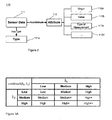
- the operator combineb is applied to each belief value of each attribute a i of sensor data s while considering corresponding weighting values.
- Uncertainty u is defined by means of an operator combineu applied to each belief value of each attribute a i of sensor data s while considering corresponding weighting values, wherein the minimum of the opposite of belief and the result of applying the combineu is determined.
- uncertainty u is defined in such manner that the influence of uncertainty on combination of opinion is minimized in comparison with belief.
- the constraint b + d + u 1 of subjective logic is considered or respected. This constraint is then used to define disbelief d .
- the combineb operator is defined for two beliefs. Subsequently, it is extend to more than two beliefs.
- a combination of two beliefs b e and b f consists of a smooth increase of their maximum, depending on the distance
- the combineb operator has then to fulfill the following requirements:
- RE2 reflects the fact that the closer the min(b e , b f ) is to max(b e , b f ), the bigger the combination acceleration has to be. In other words, the combineb operator tends to reward the combination of beliefs which are close to each other.
- RE3 is to reward the combination of high beliefs b e and b f .
- the combination of two beliefs 0.5 and 0.9 is preferred rather than 0.5 and 0.5, even if they are close to each other.
- Fig. 3A depicts the fact that a combination of two low beliefs b e and b f leads to almost no belief b e and b f increases. On the contrary, the combination with two strong beliefs b e and b f pads to a quick increase of combined belief b e and b f . In addition, the combination of two high beliefs b e and b f is to be bigger than combination of high and low beliefs.
- Fig. 3B shows an exemplary evolution of combineb(b e , b f ) for five values of the maximum between beliefs b e and b f .
- This evolution of combineb(b e , b f ) corresponds to the three requirements RE1 to RE3 as introduced above.
- the increase of combineb(b e , b f ) is smaller than the one with the maximum equals to 0.9 (RE1 and RE3).
- combineb(b e , b f ) increases progressively while the distance between the two beliefs b e and b f
- Fig. 3C shows an evolution of a combination of two opinions, ⁇ e and ⁇ f , equally weighted.
- Three fixed values of belief and uncertainty of ⁇ f are set.
- (a), (b) and (c) it is shown that combination of opinions smoothly increase up to 1.
- (a) and (c) the impact of high uncertainty of combination of opinions is shown.
- comparing (a) and (b) combined belief in comparison to uncertainty is leveraged.
- f ⁇ e e during sensor data delivery 240 is defined as ⁇ s
- f ⁇ e e ⁇ delivery ⁇ P s f , ⁇ P f e ⁇ s
- f ⁇ e e discount ⁇ s f ⁇ f e
- the discount operator perfectly fits, by definition, to compute ⁇ s
- the discount operator enables any entity e 101-104, 110, 120, 200, 310, 320 to form an opinion on a proposition P s by discounting opinion ⁇ s f and ⁇ f e .
- the combine operator In order to determine trustworthiness of sensor data fusion 234, the combine operator is used in one implementation. As previously defined, the combine operator combines opinions of an entity e 101-104, 110, 120, 200, 310, 320 in a single opinion. In the case of fusion of data, opinions of a single entity e 101-104, 110, 120, 200, 310, 320 is combined on different propositions used to infer on a single proposition.
- an average on opinion on sensor data 111 of sensor data aggregation 232 is computed.
- This average computation has to involve weight of aggregated sensor data, as expressed in the following definition of the average operator.
- a trust model for trust evaluation in each step 210, 230, 240 of a sensor data life-cycle as shown in Fig. 1 is implemented by means of subjective logic.
- the notion of opinion is then used to assess the trustworthiness of sensor data 111.
- the subjective logic framework supports the combination of opinions with several operators (e.g. discount, consensus).
- the combine operator is introduced by extending the subjective logic framework. The latter is used to determine opinions of sensor data acquisition 210 and sensor data fusion 234.
- the average operator defined by subjective logic is adapted in order to consider weight of opinions.
- the discount operator for sensor data delivery 240 is re-used.
- Fig. 5 shows an exemplary remote health care monitoring system illustrating an exemplary implementation of the above introduced trust model implemented using subjective logic opinions.
- patient activities such as a patient's hydration or awakening schedule and/or physiological data relating to patients (e.g. blood pressure, pulse, body temperature) are monitored 24 hours a day via a (wireless) body sensor network (BSN) 100.
- BSN body sensor network
- the BSN 100 may be a combination of any kind of wearable and/or implemental sensor devices and exemplary comprises a pulse sensor node 110 and a blood pressure sensor node 120, both having functionality of a sink.
- the BSN 100 is connected to a Medical Emergency Response Center (MERC) 300 comprising appropriate response software 310 through a patient's PDA 200.
- MEC Medical Emergency Response Center
- the PDA 200 is in charge of detecting any kinds of irregularities in the patient's health condition and of aggregating physiological patient information.
- the PDA 200 can trigger an alert in case of emergency to the MERC software 310 that, in turn, contacts a physician close to the patient's home.
- the physician may also request for aggregation of physiological information for a better diagnostic.
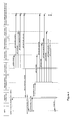
- Fig. 4 shows a flow diagram of exemplary trust evaluation at acquisition, aggregation, and fusion of physiological sensor data from the BSN 100 via the PDA 200 to the MERC software 310.
- Fig. 5 shows exemplary trust evaluation of pulse and blood pressure from sensor nodes 110 and 120 to a MERC software application 310. Applying the corresponding trust operators for computing acquisition trust values, delivery trust values, aggregation trust values, and fusion trust values incorporating the notion of opinion and weight as introduced above with reference to Figs. 1 to 3 , confidence or trust evaluation in sensor data and their processing is shown.
- Fig. 6 shows an exemplary trust evaluation using the mechanisms as introduced with reference to Figs. 1 to 3 in a system for monitoring and detecting any diseases in a herd of a farmer. Based on information or data such as milk temperature, body temperature or pulse history retrieved from one or more sensors. Similar to the remote health care system shown in Figs. 4 and 5 , trustworthiness is assessed of physiological data, aggregation, and7 or fusion of said data.
- farmers aims at monitoring and detecting any diseases in his herd. Based on information such as milk temperature, body temperature or pulse history, the farmer or veterinarian can infer on health condition of the herd. Similar to the remote health care monitoring introduced in section 6.1, we then assess trustworthiness of physiological information, aggregation or fusion of information.
- an exemplary system for implementing the invention includes a general purpose computing device in the form of a conventional computing environment 420 (e.g. personal computer), including a processing unit 422, a system memory 424, and a system bus 426, that couples various system components including the system memory 424 to the processing unit 422.
- the processing unit 422 may perform arithmetic, logic and/or control operations by accessing system memory 424.
- the system memory 424 may store information and/or instructions for use in combination with processing unit 422.
- the system memory 424 may include volatile and non-volatile memory, such as random access memory (RAM) 428 and read only memory (ROM) 430.
- a basic input/output system (BIOS) containing the basic routines that helps to transfer information between elements within the personal computer 420, such as during start-up, may be stored in ROM 430.
- the system bus 426 may be any of several types of bus structures including a memory bus or memory controller, a peripheral bus, and a local bus using any of a variety of bus architectures.
- the personal computer 420 may further include a hard disk drive 432 for reading from and writing to a hard disk (not shown), and an external disk drive 434 for reading from or writing to a removable disk 436.
- the removable disk may be a magnetic disk for a magnetic disk driver or an optical disk such as a CD ROM for an optical disk drive.
- the hard disk drive 432 and external disk drive 434 are connected to the system bus 426 by a hard disk drive interface 438 and an external disk drive interface 440, respectively.
- the drives and their associated computer-readable media provide nonvolatile storage of computer readable instructions, data structures, program modules and other data for the personal computer 420.
- the data structures may include relevant data of the implementation of the method for trustworthiness assessment of sensor data processing during a sensor data life-cycle, as described in more details below.
- the relevant data may be organized in a database, for example a relational or object database.
- a number of program modules may be stored on the hard disk, external (removable) disk 436, ROM 430 or RAM 428, including an operating system (not shown), one or more application programs 444, other program modules (not shown), and program data 446.
- the application programs may include at least a part of the functionality as detailed in Figs. 1 to 6 .
- a user may enter commands and information, as discussed below, into the personal computer 420 through input devices such as keyboard 448 and mouse 450.
- Other input devices may include a microphone (or other sensors), joystick, game pad, scanner, or the like.
- These and other input devices may be connected to the processing unit 422 through a serial port interface 452 that is coupled to the system bus 426, or may be collected by other interfaces, such as a parallel port interface 454, game port or a universal serial bus (USB). Further, information may be printed using printer 456.
- the printer 456, and other parallel input/output devices may be connected to the processing unit 422 through parallel port interface 454.
- a monitor 458 or other type of display device is also connected to the system bus 426 via an interface, such as a video input/output 460.
- computing environment 420 may include other peripheral output devices (not shown), such as speakers or other audible output.
- the computing environment 420 may communicate with other electronic devices such as a computer, telephone (wired or wireless), personal digital assistant, television, or the like. To communicate, the computer environment 20 may operate in a networked environment using connections to one or more electronic devices.
- Fig. 7 depicts the computer environment networked with remote computer 462.
- the remote computer 462 may be another computing environment such as a server, a router, a network PC, a peer device or other common network node, and may include many or all of the elements described above relative to the computing environment 420.
- the logical connections depicted in Fig. 7 include a local area network (LAN) 464 and a wide area network (WAN) 466.
- LAN local area network
- WAN wide area network
- the computing environment 420 When used in a LAN networking environment, the computing environment 420 may be connected to the LAN 464 through a network I/O 468. When used in a WAN networking environment, the computing environment 420 may include a modem 470 or other means for establishing communications over the WAN 466.
- the modem 470 which may be internal or external to computing environment 420, is connected to the system bus 426 via the serial port interface 452.
- program modules depicted relative to the computing environment 420, or portions thereof may be stored in a remote memory storage device resident on or accessible to remote computer 462.
- data relevant to the application of the insurance claim management evaluation method (described in more detail further below) may be resident on or accessible via the remote computer 462.
- the data may be stored for example in an object or a relation database. It will be appreciated that the network connections shown are exemplary and other means of establishing a communications link between the electronic devices may be used.
- the above-described computing system is only one example of the type of computing system that may be used to implement the method for trustworthiness assessment of sensor data processing during a sensor data life-cycle.
Landscapes
- Physics & Mathematics (AREA)
- General Physics & Mathematics (AREA)
- Engineering & Computer Science (AREA)
- Automation & Control Theory (AREA)
- Measuring And Recording Apparatus For Diagnosis (AREA)
- Arrangements For Transmission Of Measured Signals (AREA)
- Mobile Radio Communication Systems (AREA)
Priority Applications (4)
| Application Number | Priority Date | Filing Date | Title |
|---|---|---|---|
| AT08290188T ATE475920T1 (de) | 2008-02-28 | 2008-02-28 | Glaubwürdigkeitsbeurteilung von sensordaten aus drahtlosen sensornetzwerken für geschäftsanwendungen |
| DE602008001963T DE602008001963D1 (de) | 2008-02-28 | 2008-02-28 | Glaubwürdigkeitsbeurteilung von Sensordaten aus drahtlosen Sensornetzwerken für Geschäftsanwendungen |
| EP08290188A EP2096513B1 (de) | 2008-02-28 | 2008-02-28 | Glaubwürdigkeitsbeurteilung von Sensordaten aus drahtlosen Sensornetzwerken für Geschäftsanwendungen |
| US12/394,175 US8775127B2 (en) | 2008-02-28 | 2009-02-27 | Trustworthiness assessment of sensor data processing |
Applications Claiming Priority (1)
| Application Number | Priority Date | Filing Date | Title |
|---|---|---|---|
| EP08290188A EP2096513B1 (de) | 2008-02-28 | 2008-02-28 | Glaubwürdigkeitsbeurteilung von Sensordaten aus drahtlosen Sensornetzwerken für Geschäftsanwendungen |
Publications (2)
| Publication Number | Publication Date |
|---|---|
| EP2096513A1 true EP2096513A1 (de) | 2009-09-02 |
| EP2096513B1 EP2096513B1 (de) | 2010-07-28 |
Family
ID=39720122
Family Applications (1)
| Application Number | Title | Priority Date | Filing Date |
|---|---|---|---|
| EP08290188A Active EP2096513B1 (de) | 2008-02-28 | 2008-02-28 | Glaubwürdigkeitsbeurteilung von Sensordaten aus drahtlosen Sensornetzwerken für Geschäftsanwendungen |
Country Status (4)
| Country | Link |
|---|---|
| US (1) | US8775127B2 (de) |
| EP (1) | EP2096513B1 (de) |
| AT (1) | ATE475920T1 (de) |
| DE (1) | DE602008001963D1 (de) |
Cited By (4)
| Publication number | Priority date | Publication date | Assignee | Title |
|---|---|---|---|---|
| CN101867960A (zh) * | 2010-06-08 | 2010-10-20 | 江苏大学 | 一种无线传感器网络性能综合评价方法 |
| CN104410981A (zh) * | 2014-11-06 | 2015-03-11 | 广东工业大学 | 一种无线传感器网络中信标节点可信度评估方法 |
| CN107750053A (zh) * | 2017-05-25 | 2018-03-02 | 天津大学 | 基于多因素的无线传感器网络动态信任评价系统及方法 |
| CN113015195A (zh) * | 2021-02-08 | 2021-06-22 | 安徽理工大学 | 一种无线传感器网络数据采集方法和系统 |
Families Citing this family (34)
| Publication number | Priority date | Publication date | Assignee | Title |
|---|---|---|---|---|
| US8099206B2 (en) * | 2008-10-24 | 2012-01-17 | GM Global Technology Operations LLC | Combined evidence vehicle health monitoring |
| DE102009006560B4 (de) * | 2009-01-27 | 2011-06-16 | Freie Universität Berlin | Verfahren und Sensornetz zur Merkmalsauswahl für eine Ereigniserkennung |
| US8393207B2 (en) * | 2009-02-16 | 2013-03-12 | Schlumberger Technology Corporation | Methods and apparatus to use multiple sensors to measure downhole fluid properties |
| FR2953305A1 (fr) * | 2009-11-27 | 2011-06-03 | Thales Sa | Procede, dispositif et systeme pour la fusion d'informations provenant de plusieurs capteurs |
| CN102255779A (zh) * | 2010-05-18 | 2011-11-23 | 昆明优冠网络系统有限公司 | 物联网通用上网组件 |
| US20120158446A1 (en) * | 2010-12-20 | 2012-06-21 | Jochen Mayerle | Determining Impacts Of Business Activities |
| WO2012095860A2 (en) * | 2011-01-13 | 2012-07-19 | Tata Consultancy Services Limite | Method and system for trust management in distributed computing systems |
| US8983914B2 (en) | 2011-09-22 | 2015-03-17 | Business Objects Software Ltd. | Evaluating a trust value of a data report from a data processing tool |
| US9531588B2 (en) | 2011-12-16 | 2016-12-27 | Microsoft Technology Licensing, Llc | Discovery and mining of performance information of a device for anticipatorily sending updates to the device |
| GB2505208A (en) * | 2012-08-22 | 2014-02-26 | Ibm | Node attribute validation in a network |
| CN103095589B (zh) * | 2013-01-17 | 2016-08-03 | 电子科技大学 | 基于IPv6的树形拓扑结构的无线传感器网络中传感器节点信任值管理方法 |
| CN103986743A (zh) * | 2013-02-07 | 2014-08-13 | 伊姆西公司 | 用于在物联网中采集数据的方法、装置和系统 |
| US9350749B2 (en) | 2014-10-06 | 2016-05-24 | Sap Se | Application attack monitoring |
| US10038674B2 (en) | 2014-10-17 | 2018-07-31 | Sap Se | Secure mobile data sharing |
| US9894090B2 (en) | 2015-07-14 | 2018-02-13 | Sap Se | Penetration test attack tree generator |
| US10089254B2 (en) | 2016-06-20 | 2018-10-02 | Telefonaktiebolaget Lm Ericsson (Publ) | Methods and apparatus for dynamically selecting an instruction set |
| US12181333B2 (en) * | 2018-05-04 | 2024-12-31 | United States Postal Service | Systems and methods for accurate measurement of items in a distribution network |
| US11586961B2 (en) | 2018-08-16 | 2023-02-21 | Raytheon Company | System and method for identifying a preferred sensor |
| CN109561432A (zh) * | 2019-01-24 | 2019-04-02 | 深圳市腾远智拓电子有限公司 | 基于wifi cofdm的远距离自组网无线传输系统 |
| CN110213736B (zh) * | 2019-04-29 | 2022-03-04 | 华侨大学 | 一种基于众包的传感云底层节点信任评价方法 |
| US11425166B2 (en) | 2019-08-27 | 2022-08-23 | Sap Se | Identifier-based application security |
| US11546378B2 (en) | 2019-08-27 | 2023-01-03 | Sap Se | Smart exposure of data to known attacker sessions |
| US11010385B2 (en) | 2019-10-10 | 2021-05-18 | Sap Se | Data security through query refinement |
| US11539742B2 (en) | 2019-11-26 | 2022-12-27 | Sap Se | Application security through multi-factor fingerprinting |
| US11429716B2 (en) | 2019-11-26 | 2022-08-30 | Sap Se | Collaborative application security |
| CN111310198B (zh) * | 2020-01-15 | 2022-08-16 | 华南理工大学 | 移动群体感知中异构数据隐私保护及可靠性判断方法 |
| US11979395B2 (en) | 2020-09-28 | 2024-05-07 | Sap Se | Application security through deceptive authentication |
| US11729213B2 (en) | 2020-10-05 | 2023-08-15 | Sap Se | Automatic generation of deceptive API endpoints |
| CN114403826B (zh) * | 2020-10-28 | 2024-02-23 | 深圳市科瑞康实业有限公司 | 一种血压测量方法和装置 |
| CN112381128B (zh) * | 2020-11-06 | 2022-06-21 | 中国人民解放军空军预警学院雷达士官学校 | 一种基于目标特征分集评选的多传感器动态融合识别方法 |
| CN112903008B (zh) * | 2021-01-15 | 2023-01-10 | 泉州师范学院 | 基于多传感数据融合技术的山体滑坡预警方法 |
| WO2023114352A1 (en) * | 2021-12-15 | 2023-06-22 | Fort Robotics, Inc. | Method for scalable integrity encapsulation |
| CN114817216B (zh) * | 2022-03-24 | 2024-09-06 | 西北工业大学 | 基于设备指纹识别的感知数据可信度评估方法及系统 |
| CN119085735B (zh) * | 2024-11-06 | 2025-02-21 | 山东交通学院 | 一种用于水下爆炸检测的传感器数据分析系统 |
Citations (4)
| Publication number | Priority date | Publication date | Assignee | Title |
|---|---|---|---|---|
| US20030186663A1 (en) * | 2002-03-26 | 2003-10-02 | Hai-Wen Chen | Method and system for multi-sensor data fusion |
| US20060195201A1 (en) | 2003-03-31 | 2006-08-31 | Nauck Detlef D | Data analysis system and method |
| US20060224357A1 (en) * | 2005-03-31 | 2006-10-05 | Taware Avinash V | System and method for sensor data validation |
| US20070005172A1 (en) | 2005-06-30 | 2007-01-04 | Hans-Juergen Malig | Method and system for advanced process control using measurement uncertainty as control input |
Family Cites Families (5)
| Publication number | Priority date | Publication date | Assignee | Title |
|---|---|---|---|---|
| US8116243B2 (en) * | 2006-10-05 | 2012-02-14 | Electronics And Telecommunications Research Institute | Wireless sensor network and adaptive method for monitoring the security thereof |
| KR100842260B1 (ko) * | 2006-11-08 | 2008-06-30 | 한국전자통신연구원 | 센서 네트워크 상의 각 센서 노드들에 의한 독립적클러스터 구성 방법 |
| US7804962B2 (en) * | 2006-12-13 | 2010-09-28 | Honeywell International Inc. | Modeling a sensor network design to secure a network against attack |
| KR100969158B1 (ko) * | 2008-06-30 | 2010-07-08 | 경희대학교 산학협력단 | 무선 센서 네트워크에서의 신뢰성 관리 방법 |
| US8023501B1 (en) * | 2010-03-15 | 2011-09-20 | Samsung Electronics Co., Ltd. | Techniques for self-organizing activity-diffusion-based wireless sensor network |
-
2008
- 2008-02-28 AT AT08290188T patent/ATE475920T1/de not_active IP Right Cessation
- 2008-02-28 EP EP08290188A patent/EP2096513B1/de active Active
- 2008-02-28 DE DE602008001963T patent/DE602008001963D1/de active Active
-
2009
- 2009-02-27 US US12/394,175 patent/US8775127B2/en active Active
Patent Citations (4)
| Publication number | Priority date | Publication date | Assignee | Title |
|---|---|---|---|---|
| US20030186663A1 (en) * | 2002-03-26 | 2003-10-02 | Hai-Wen Chen | Method and system for multi-sensor data fusion |
| US20060195201A1 (en) | 2003-03-31 | 2006-08-31 | Nauck Detlef D | Data analysis system and method |
| US20060224357A1 (en) * | 2005-03-31 | 2006-10-05 | Taware Avinash V | System and method for sensor data validation |
| US20070005172A1 (en) | 2005-06-30 | 2007-01-04 | Hans-Juergen Malig | Method and system for advanced process control using measurement uncertainty as control input |
Cited By (7)
| Publication number | Priority date | Publication date | Assignee | Title |
|---|---|---|---|---|
| CN101867960A (zh) * | 2010-06-08 | 2010-10-20 | 江苏大学 | 一种无线传感器网络性能综合评价方法 |
| CN101867960B (zh) * | 2010-06-08 | 2013-03-13 | 江苏大学 | 一种无线传感器网络性能综合评价方法 |
| CN104410981A (zh) * | 2014-11-06 | 2015-03-11 | 广东工业大学 | 一种无线传感器网络中信标节点可信度评估方法 |
| CN104410981B (zh) * | 2014-11-06 | 2017-12-29 | 广东工业大学 | 一种无线传感器网络中信标节点可信度评估方法 |
| CN107750053A (zh) * | 2017-05-25 | 2018-03-02 | 天津大学 | 基于多因素的无线传感器网络动态信任评价系统及方法 |
| CN113015195A (zh) * | 2021-02-08 | 2021-06-22 | 安徽理工大学 | 一种无线传感器网络数据采集方法和系统 |
| CN113015195B (zh) * | 2021-02-08 | 2022-04-19 | 安徽理工大学 | 一种无线传感器网络数据采集方法和系统 |
Also Published As
| Publication number | Publication date |
|---|---|
| US20090222399A1 (en) | 2009-09-03 |
| DE602008001963D1 (de) | 2010-09-09 |
| US8775127B2 (en) | 2014-07-08 |
| EP2096513B1 (de) | 2010-07-28 |
| ATE475920T1 (de) | 2010-08-15 |
Similar Documents
| Publication | Publication Date | Title |
|---|---|---|
| EP2096513B1 (de) | Glaubwürdigkeitsbeurteilung von Sensordaten aus drahtlosen Sensornetzwerken für Geschäftsanwendungen | |
| Gottesman et al. | Evaluating reinforcement learning algorithms in observational health settings | |
| Singh et al. | Generalizability challenges of mortality risk prediction models: A retrospective analysis on a multi-center database | |
| Bhatia | Fog computing-inspired smart home framework for predictive veterinary healthcare | |
| US12614630B2 (en) | Systems and methods for processing electronic images for health monitoring and forecasting | |
| EP2727033A1 (de) | Mobiles patientenrechnersystem und verfahren zur verschlimmerungsvorhersage | |
| JP6494775B2 (ja) | 弾性検出装置のデータ解析処理方法及び弾性検出装置 | |
| Gentyala | Bridging the Semantic Gap: A Lightweight Ontological Framework for Real-Time Harmonization of Consumer Wearable Data with FHIR-Based EHR Systems | |
| Michael et al. | The ROC curve for regularly measured longitudinal biomarkers | |
| WO2018201083A1 (en) | System and method for predicting survival time | |
| Nisar | Smart home: Multisensor information fusion towards better healthcare | |
| Ali et al. | Evaluation of AI model performance | |
| US7877341B2 (en) | Self-adaptive data pre-fetch by artificial neuron network | |
| CN117809847A (zh) | 一种车内健康监测方法、系统、电子设备和车辆 | |
| Rahman et al. | Incorporating metabolic information into llms for anomaly detection in clinical time-series | |
| JP7420753B2 (ja) | 臨床アセスメントへのコンテキストデータの組み込み | |
| US20230268042A1 (en) | Blockchain based healthcare management network | |
| Al Sayed et al. | Integrating Neutrosophic Theory for Improved Decision-Making in Wireless Body Area Networks: Enhancing Accuracy and Efficiency in Health Monitoring. | |
| Li et al. | Test-time confidence quantification using Q-ensembles for offline RL | |
| Khan et al. | Uncertainty Estimation in Deep Learning Models for Reliable Autism Detection: Enhancing Clinical Trust Through Probabilistic Confidence Measures | |
| Ketfi et al. | MS-DQI: A methodology for data quality assessment in medical sensor networks with a case study on a temperature sensor network for breast cancer detection | |
| Gopalappa et al. | Mechanistic modeling of social conditions into disease predictions for public health intervention-analyses: application to HIV | |
| Yuen et al. | Are Bayesian approaches useful in plant pathology? | |
| Singh et al. | Generalizability challenges of mortality risk prediction models: A retrospective analysis on a multi-center database. PLOS Digit Health 1 (4): e0000023 | |
| Lawry | Incorporating memory into bounded confidence models of probabilistic social learning |
Legal Events
| Date | Code | Title | Description |
|---|---|---|---|
| PUAI | Public reference made under article 153(3) epc to a published international application that has entered the european phase |
Free format text: ORIGINAL CODE: 0009012 |
|
| 17P | Request for examination filed |
Effective date: 20081127 |
|
| AK | Designated contracting states |
Kind code of ref document: A1 Designated state(s): AT BE BG CH CY CZ DE DK EE ES FI FR GB GR HR HU IE IS IT LI LT LU LV MC MT NL NO PL PT RO SE SI SK TR |
|
| AX | Request for extension of the european patent |
Extension state: AL BA MK RS |
|
| GRAP | Despatch of communication of intention to grant a patent |
Free format text: ORIGINAL CODE: EPIDOSNIGR1 |
|
| GRAS | Grant fee paid |
Free format text: ORIGINAL CODE: EPIDOSNIGR3 |
|
| RIN1 | Information on inventor provided before grant (corrected) |
Inventor name: SORNIOTTI, ALESSADRO Inventor name: GOMEZ, LAURENT Inventor name: HEBERT, CEDRIC Inventor name: ULMER, CEDRIC |
|
| AKX | Designation fees paid |
Designated state(s): AT BE BG CH CY CZ DE DK EE ES FI FR GB GR HR HU IE IS IT LI LT LU LV MC MT NL NO PL PT RO SE SI SK TR |
|
| GRAA | (expected) grant |
Free format text: ORIGINAL CODE: 0009210 |
|
| AK | Designated contracting states |
Kind code of ref document: B1 Designated state(s): AT BE BG CH CY CZ DE DK EE ES FI FR GB GR HR HU IE IS IT LI LT LU LV MC MT NL NO PL PT RO SE SI SK TR |
|
| REG | Reference to a national code |
Ref country code: GB Ref legal event code: FG4D |
|
| REG | Reference to a national code |
Ref country code: CH Ref legal event code: EP Ref country code: CH Ref legal event code: NV Representative=s name: E. BLUM & CO. AG PATENT- UND MARKENANWAELTE VSP |
|
| REG | Reference to a national code |
Ref country code: IE Ref legal event code: FG4D |
|
| REF | Corresponds to: |
Ref document number: 602008001963 Country of ref document: DE Date of ref document: 20100909 Kind code of ref document: P |
|
| RIN2 | Information on inventor provided after grant (corrected) |
Inventor name: SORNIOTTI, ALESSADRO Inventor name: HEBERT, CEDRIC Inventor name: GOMEZ, LAURENT Inventor name: ULMER, CEDRIC |
|
| REG | Reference to a national code |
Ref country code: NL Ref legal event code: VDEP Effective date: 20100728 |
|
| LTIE | Lt: invalidation of european patent or patent extension |
Effective date: 20100728 |
|
| PG25 | Lapsed in a contracting state [announced via postgrant information from national office to epo] |
Ref country code: NL Free format text: LAPSE BECAUSE OF FAILURE TO SUBMIT A TRANSLATION OF THE DESCRIPTION OR TO PAY THE FEE WITHIN THE PRESCRIBED TIME-LIMIT Effective date: 20100728 Ref country code: FI Free format text: LAPSE BECAUSE OF FAILURE TO SUBMIT A TRANSLATION OF THE DESCRIPTION OR TO PAY THE FEE WITHIN THE PRESCRIBED TIME-LIMIT Effective date: 20100728 Ref country code: LT Free format text: LAPSE BECAUSE OF FAILURE TO SUBMIT A TRANSLATION OF THE DESCRIPTION OR TO PAY THE FEE WITHIN THE PRESCRIBED TIME-LIMIT Effective date: 20100728 Ref country code: AT Free format text: LAPSE BECAUSE OF FAILURE TO SUBMIT A TRANSLATION OF THE DESCRIPTION OR TO PAY THE FEE WITHIN THE PRESCRIBED TIME-LIMIT Effective date: 20100728 Ref country code: NO Free format text: LAPSE BECAUSE OF FAILURE TO SUBMIT A TRANSLATION OF THE DESCRIPTION OR TO PAY THE FEE WITHIN THE PRESCRIBED TIME-LIMIT Effective date: 20101028 |
|
| PG25 | Lapsed in a contracting state [announced via postgrant information from national office to epo] |
Ref country code: SI Free format text: LAPSE BECAUSE OF FAILURE TO SUBMIT A TRANSLATION OF THE DESCRIPTION OR TO PAY THE FEE WITHIN THE PRESCRIBED TIME-LIMIT Effective date: 20100728 Ref country code: BG Free format text: LAPSE BECAUSE OF FAILURE TO SUBMIT A TRANSLATION OF THE DESCRIPTION OR TO PAY THE FEE WITHIN THE PRESCRIBED TIME-LIMIT Effective date: 20101028 Ref country code: CY Free format text: LAPSE BECAUSE OF FAILURE TO SUBMIT A TRANSLATION OF THE DESCRIPTION OR TO PAY THE FEE WITHIN THE PRESCRIBED TIME-LIMIT Effective date: 20100728 Ref country code: HR Free format text: LAPSE BECAUSE OF FAILURE TO SUBMIT A TRANSLATION OF THE DESCRIPTION OR TO PAY THE FEE WITHIN THE PRESCRIBED TIME-LIMIT Effective date: 20100728 Ref country code: IS Free format text: LAPSE BECAUSE OF FAILURE TO SUBMIT A TRANSLATION OF THE DESCRIPTION OR TO PAY THE FEE WITHIN THE PRESCRIBED TIME-LIMIT Effective date: 20101128 Ref country code: PL Free format text: LAPSE BECAUSE OF FAILURE TO SUBMIT A TRANSLATION OF THE DESCRIPTION OR TO PAY THE FEE WITHIN THE PRESCRIBED TIME-LIMIT Effective date: 20100728 |
|
| PG25 | Lapsed in a contracting state [announced via postgrant information from national office to epo] |
Ref country code: BE Free format text: LAPSE BECAUSE OF FAILURE TO SUBMIT A TRANSLATION OF THE DESCRIPTION OR TO PAY THE FEE WITHIN THE PRESCRIBED TIME-LIMIT Effective date: 20100728 Ref country code: LV Free format text: LAPSE BECAUSE OF FAILURE TO SUBMIT A TRANSLATION OF THE DESCRIPTION OR TO PAY THE FEE WITHIN THE PRESCRIBED TIME-LIMIT Effective date: 20100728 Ref country code: GR Free format text: LAPSE BECAUSE OF FAILURE TO SUBMIT A TRANSLATION OF THE DESCRIPTION OR TO PAY THE FEE WITHIN THE PRESCRIBED TIME-LIMIT Effective date: 20101029 Ref country code: SE Free format text: LAPSE BECAUSE OF FAILURE TO SUBMIT A TRANSLATION OF THE DESCRIPTION OR TO PAY THE FEE WITHIN THE PRESCRIBED TIME-LIMIT Effective date: 20100728 |
|
| PG25 | Lapsed in a contracting state [announced via postgrant information from national office to epo] |
Ref country code: DK Free format text: LAPSE BECAUSE OF FAILURE TO SUBMIT A TRANSLATION OF THE DESCRIPTION OR TO PAY THE FEE WITHIN THE PRESCRIBED TIME-LIMIT Effective date: 20100728 |
|
| PG25 | Lapsed in a contracting state [announced via postgrant information from national office to epo] |
Ref country code: RO Free format text: LAPSE BECAUSE OF FAILURE TO SUBMIT A TRANSLATION OF THE DESCRIPTION OR TO PAY THE FEE WITHIN THE PRESCRIBED TIME-LIMIT Effective date: 20100728 Ref country code: CZ Free format text: LAPSE BECAUSE OF FAILURE TO SUBMIT A TRANSLATION OF THE DESCRIPTION OR TO PAY THE FEE WITHIN THE PRESCRIBED TIME-LIMIT Effective date: 20100728 Ref country code: EE Free format text: LAPSE BECAUSE OF FAILURE TO SUBMIT A TRANSLATION OF THE DESCRIPTION OR TO PAY THE FEE WITHIN THE PRESCRIBED TIME-LIMIT Effective date: 20100728 Ref country code: IT Free format text: LAPSE BECAUSE OF FAILURE TO SUBMIT A TRANSLATION OF THE DESCRIPTION OR TO PAY THE FEE WITHIN THE PRESCRIBED TIME-LIMIT Effective date: 20100728 Ref country code: SK Free format text: LAPSE BECAUSE OF FAILURE TO SUBMIT A TRANSLATION OF THE DESCRIPTION OR TO PAY THE FEE WITHIN THE PRESCRIBED TIME-LIMIT Effective date: 20100728 |
|
| PLBE | No opposition filed within time limit |
Free format text: ORIGINAL CODE: 0009261 |
|
| STAA | Information on the status of an ep patent application or granted ep patent |
Free format text: STATUS: NO OPPOSITION FILED WITHIN TIME LIMIT |
|
| PG25 | Lapsed in a contracting state [announced via postgrant information from national office to epo] |
Ref country code: ES Free format text: LAPSE BECAUSE OF FAILURE TO SUBMIT A TRANSLATION OF THE DESCRIPTION OR TO PAY THE FEE WITHIN THE PRESCRIBED TIME-LIMIT Effective date: 20101108 |
|
| 26N | No opposition filed |
Effective date: 20110429 |
|
| REG | Reference to a national code |
Ref country code: DE Ref legal event code: R097 Ref document number: 602008001963 Country of ref document: DE Effective date: 20110429 |
|
| PG25 | Lapsed in a contracting state [announced via postgrant information from national office to epo] |
Ref country code: MC Free format text: LAPSE BECAUSE OF NON-PAYMENT OF DUE FEES Effective date: 20110228 |
|
| REG | Reference to a national code |
Ref country code: IE Ref legal event code: MM4A |
|
| PG25 | Lapsed in a contracting state [announced via postgrant information from national office to epo] |
Ref country code: MT Free format text: LAPSE BECAUSE OF FAILURE TO SUBMIT A TRANSLATION OF THE DESCRIPTION OR TO PAY THE FEE WITHIN THE PRESCRIBED TIME-LIMIT Effective date: 20100728 |
|
| PG25 | Lapsed in a contracting state [announced via postgrant information from national office to epo] |
Ref country code: IE Free format text: LAPSE BECAUSE OF NON-PAYMENT OF DUE FEES Effective date: 20110228 |
|
| PG25 | Lapsed in a contracting state [announced via postgrant information from national office to epo] |
Ref country code: LU Free format text: LAPSE BECAUSE OF NON-PAYMENT OF DUE FEES Effective date: 20110228 |
|
| PG25 | Lapsed in a contracting state [announced via postgrant information from national office to epo] |
Ref country code: PT Free format text: LAPSE BECAUSE OF NON-PAYMENT OF DUE FEES Effective date: 20100728 |
|
| PG25 | Lapsed in a contracting state [announced via postgrant information from national office to epo] |
Ref country code: TR Free format text: LAPSE BECAUSE OF FAILURE TO SUBMIT A TRANSLATION OF THE DESCRIPTION OR TO PAY THE FEE WITHIN THE PRESCRIBED TIME-LIMIT Effective date: 20100728 |
|
| PG25 | Lapsed in a contracting state [announced via postgrant information from national office to epo] |
Ref country code: HU Free format text: LAPSE BECAUSE OF FAILURE TO SUBMIT A TRANSLATION OF THE DESCRIPTION OR TO PAY THE FEE WITHIN THE PRESCRIBED TIME-LIMIT Effective date: 20100728 |
|
| REG | Reference to a national code |
Ref country code: DE Ref legal event code: R082 Ref document number: 602008001963 Country of ref document: DE Representative=s name: MUELLER-BORE & PARTNER PATENTANWAELTE PARTG MB, DE |
|
| REG | Reference to a national code |
Ref country code: DE Ref legal event code: R082 Ref document number: 602008001963 Country of ref document: DE Representative=s name: MUELLER-BORE & PARTNER PATENTANWAELTE PARTG MB, DE Effective date: 20141210 Ref country code: DE Ref legal event code: R081 Ref document number: 602008001963 Country of ref document: DE Owner name: SAP SE, DE Free format text: FORMER OWNER: SAP AG, 69190 WALLDORF, DE Effective date: 20141210 |
|
| REG | Reference to a national code |
Ref country code: FR Ref legal event code: PLFP Year of fee payment: 9 |
|
| REG | Reference to a national code |
Ref country code: FR Ref legal event code: PLFP Year of fee payment: 10 |
|
| REG | Reference to a national code |
Ref country code: FR Ref legal event code: PLFP Year of fee payment: 11 |
|
| REG | Reference to a national code |
Ref country code: CH Ref legal event code: U11 Free format text: ST27 STATUS EVENT CODE: U-0-0-U10-U11 (AS PROVIDED BY THE NATIONAL OFFICE) Effective date: 20260301 |
|
| PGFP | Annual fee paid to national office [announced via postgrant information from national office to epo] |
Ref country code: GB Payment date: 20260219 Year of fee payment: 19 |
|
| PGFP | Annual fee paid to national office [announced via postgrant information from national office to epo] |
Ref country code: DE Payment date: 20260218 Year of fee payment: 19 |
|
| PGFP | Annual fee paid to national office [announced via postgrant information from national office to epo] |
Ref country code: FR Payment date: 20260218 Year of fee payment: 19 |
|
| PGFP | Annual fee paid to national office [announced via postgrant information from national office to epo] |
Ref country code: CH Payment date: 20260301 Year of fee payment: 19 |