EP2096631A1 - Tondekodierungsvorrichtung und leistungseinstellungsverfahren - Google Patents
Tondekodierungsvorrichtung und leistungseinstellungsverfahren Download PDFInfo
- Publication number
- EP2096631A1 EP2096631A1 EP07859788A EP07859788A EP2096631A1 EP 2096631 A1 EP2096631 A1 EP 2096631A1 EP 07859788 A EP07859788 A EP 07859788A EP 07859788 A EP07859788 A EP 07859788A EP 2096631 A1 EP2096631 A1 EP 2096631A1
- Authority
- EP
- European Patent Office
- Prior art keywords
- calculation value
- coefficient
- post filter
- power
- adjusting
- Prior art date
- Legal status (The legal status is an assumption and is not a legal conclusion. Google has not performed a legal analysis and makes no representation as to the accuracy of the status listed.)
- Withdrawn
Links
Images



Classifications
-
- G—PHYSICS
- G10—MUSICAL INSTRUMENTS; ACOUSTICS
- G10L—SPEECH ANALYSIS TECHNIQUES OR SPEECH SYNTHESIS; SPEECH RECOGNITION; SPEECH OR VOICE PROCESSING TECHNIQUES; SPEECH OR AUDIO CODING OR DECODING
- G10L19/00—Speech or audio signals analysis-synthesis techniques for redundancy reduction, e.g. in vocoders; Coding or decoding of speech or audio signals, using source filter models or psychoacoustic analysis
- G10L19/04—Speech or audio signals analysis-synthesis techniques for redundancy reduction, e.g. in vocoders; Coding or decoding of speech or audio signals, using source filter models or psychoacoustic analysis using predictive techniques
- G10L19/26—Pre-filtering or post-filtering
-
- H—ELECTRICITY
- H03—ELECTRONIC CIRCUITRY
- H03G—CONTROL OF AMPLIFICATION
- H03G3/00—Gain control in amplifiers or frequency changers
- H03G3/20—Automatic control
- H03G3/30—Automatic control in amplifiers having semiconductor devices
- H03G3/3005—Automatic control in amplifiers having semiconductor devices in amplifiers suitable for low-frequencies, e.g. audio amplifiers
Definitions
- the present invention relates to a speech decoding apparatus and power adjusting method for decoding an encoded speech signal.
- performance of the speech coding technique has significantly improved thanks to the fundamental scheme “CELP (Code Excited Linear Prediction) " of ingeniously applying vector quantization by modeling the vocal tract system.
- performance of a sound coding technique such as audio coding has improved significantly thanks to transform coding techniques (MPEG standard ACC, MP3 and the like).
- post-filtering is generally applied to synthesized sound before the synthesized sound is outputted.
- Almost all standard codecs for mobile telephones use this post filtering.
- Post filtering for CELP uses a pole-zero type (i.e. ARMA type) pole emphasis filter using LPC parameters, high frequency band emphasis filter and pitch filter.
- the power of this output signal of the post filter is adjusted by finding the power ratio of the input signal and the output signal of a post filter, finding adjusting coefficients based on the power ratio and multiplying the output signal of the post filter by the adjusting coefficients.
- Patent Document 1 and Patent Document 2 disclose techniques of finding adjusting coefficients and using smoothing coefficients such that power is adjusted gradually on a per sample basis. Further, when the smoothing coefficients are ⁇ , (1- ⁇ ) are accelerating coefficients.
- a post filter provides a significant filter gain in the portion where power rises such as the onset portion of speech, and the power of the output signal of the post filter is likely to suddenly increase significantly than the power of the input signal, and, therefore, the power adjusting coefficients need to be adapted promptly in this case. Further, when the input/output power ratio of the post filter fluctuates significantly over time, adjustment is necessary promptly. By contrast with this, if adjusting coefficients are changed suddenly in a period in which input/output power fluctuation of the post filter is little or in a period of stationary speech such as vowels, distortion of sound quality causes a problem and, consequently, the adjusting coefficients are preferably adapted slowly.
- a speech decoding apparatus employs a configuration including: a post filter that applies filtering to a signal of a subframe length at predetermined sample timing intervals; a calculating section that calculates a first calculation value and a second calculation value on a per subframe basis, the first calculation value including an amplitude ratio or a power ratio of an input signal and an output signal of the post filter, the second calculation value including an amount of fluctuation of the first calculation value; a smoothing coefficient setting section that sets a smoothing coefficient on a per subframe basis based on the first calculation value and the second calculation value; an adjusting coefficient setting section that sets an adjusting coefficient on a per sample basis based on the first calculation value and the smoothing coefficient; and a power adjusting section that acquires a decoded speech signal by multiplying the output signal of the post filter by the adjusting coefficient.
- a power adjusting method for an output signal of a post filter for applying filtering to a signal of a subframe length at predetermined sample timing intervals, includes: calculating a first calculation value and a second calculation value on a per subframe basis, the first calculation value including an amplitude ratio or a power ratio of an input signal and the output signal of the post filter, the second calculation value including an amount of fluctuation of the first calculation value; setting a smoothing coefficient on a per subframe basis based on the first calculation value and the second calculation value; setting an adjusting coefficient on a per sample basis based on the first calculation value and the smoothing coefficient; and multiplying the output signal of the post filter by the adjusting coefficient.
- the present invention it is possible to adjust power promptly when a post filter changes power significantly or fluctuates the power ratio significantly over time, and realize smooth power adjustment without discontinuity in a period in which the post filter fluctuates power little or in a stationary period of, for example, vowels. Consequently, it is possible to produce good synthesized sound with a stable sound volume according to the present invention.
- FIG.1 is a block diagram showing a configuration of a speech encoding apparatus that transmits encoded data to a speech decoding apparatus according to the present embodiment.
- Pre-processing section 101 performs high pass filtering processing for removing the DC components and waveform shaping processing or pre-emphasis processing for improving the performance of subsequent encoding processing, with respect to an input speech signal, and outputs the signal (Xin) after these processings, to LPC analyzing section 102 and adding section 105.
- LPC analyzing section 102 performs a linear prediction analysis using Xin, and outputs the analysis result (i.e. linear prediction coefficients) to LPC quantization section 103.
- LPC quantization section 103 carries out quantization processing of linear prediction coefficients (LPC's) out putted from LPC analyzing section 102, and outputs the quantized LPC' s to synthesis filter 104 and a code (L) representing the quantized LPC's to multiplexing section 114.
- LPC's linear prediction coefficients
- Synthesis filter 104 carries out filter synthesis for an excitation outputted from adding section 111 (explained later) using filter coefficients based on the quantized LPC's, to generate a synthesized signal and output the synthesized signal to adding section 105.
- Adding section 105 inverts the polarity of the synthesized signal and adds the signal to Xin to calculate an error signal, and outputs the error signal to perceptual weighting section 112.
- Adaptive excitation codebook 106 stores past excitations outputted from adding section 111 in a buffer, clips one frame of samples from the past excitations as an adaptive excitation vector that is specified by a signal outputted from parameter determining section 113, and outputs the adaptive excitation vector to multiplying section 109.
- Gain codebook 107 outputs the gain of the adaptive excitation vector that is specified by the signal outputted from parameter determining section 113 and the gain of a fixed excitation vector to multiplying section 109 and multiplying section 110, respectively.
- Fixed excitation codebook 108 stores a plurality of pulse excitation vectors of a predetermined shape in a buffer, and outputs a fixed excitation vector acquired by multiplying by a dispersion vector a pulse excitation vector having a shape that is specified by the signal outputted from parameter determining section 113, to multiplying section 110.
- Multiplying section 109 multiplies the adaptive excitation vector outputted from adaptive excitation codebook 106, by the gain outputted from gain codebook 107, and outputs the result to adding section 111.
- Multiplying section 110 multiplies the fixed excitation vector outputted from fixed excitation codebook 108, by the gain outputted from gain codebook 107, and outputs the result to adding section 111.
- Adding section 111 receives as input the adaptive excitation vector and fixed excitation vector after gain multiplication, from multiplying section 109 and multiplying section 110, adds these vectors, and outputs an excitation representing the addition result to synthesis filter 104 and adaptive excitation codebook 106. Further, the excitation inputted to adaptive excitation codebook 106 is stored in a buffer.
- Perceptual weighting section 112 applies perceptual weighting to the error signal outputted from adding section 105, and outputs the error signal to parameter determining section 113 as coding distortion.
- Parameter determining section 113 searches for the codes for the adaptive excitation vector, fixed excitation vector and quantization gain that minimize the coding distortion outputted from perceptual weighting section 112, and outputs the searched code (A) representing the adaptive excitation vector, code (F) representing the fixed excitation vector and code (G) representing the quantization gain, to multiplexing section 114.
- Multiplexing section 114 receives as input the code (L) representing the quantized LPC's from LPC quantization section 103, receives as input the code (A) representing the adaptive excitation vector, the code (F) representing the fixed excitation vector and the code (G) representing the quantization gain, and multiplexes these items of information to output encoded information.
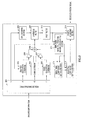
- FIG.2 is a block diagram showing a configuration of the speech decoding apparatus according to the present embodiment.
- the encoded information is demultiplexed in demultiplexing section 201 into individual codes (L, A, G and F).
- the code (L) representing the quantized LPC's is outputted to LPC decoding section 202
- the code (A) representing the adaptive excitation vector is outputted to adaptive excitation codebook 203
- the code (G) representing the quantization gain is outputted to gain codebook 204
- the code (F) representing the fixed excitation vector is outputted to fixed excitation codebook 205.
- LPC decoding section 202 decodes a quantized LSP parameter from the code (L) representing the quantized LPC's, retransforms the resulting quantized LSP parameter to a quantized LPC parameter, and outputs the quantized LPC parameter to synthesis filter 209.
- Adaptive excitation codebook 203 stores past excitations used in synthesis filter 209, extracts one frame of samples as an adaptive excitation vector from the past excitations that are specified by an adaptive codebook lag associated with the code (A) representing the adaptive excitation vector and outputs the adaptive excitation vector to multiplying section 206. Further, adaptive excitation codebook 203 updates the stored excitations using the excitation outputted from adding section 208.
- Gain codebook 204 decodes the gain of the adaptive excitation vector that is specified by the code (G) representing the quantization gain and the gain of the fixed excitation vector, and outputs the gain of the adaptive excitation vector and the gain of the fixed excitation vector to multiplying section 206 and multiplying section 207, respectively.
- Fixed excitation codebook 205 stores a plurality of pulse excitation vectors of a predetermined shape in the buffer, generates a fixed excitation vector obtained by multiplying by a dispersion vector a pulse excitation vector having a shape that is specified by the code (F) representing the fixed excitation vector, and outputs the fixed excitation vector to multiplying section 207.
- Multiplying section 206 multiplies the adaptive excitation vector by the gain and outputs the result to adding section 208.
- Multiplying section 207 multiplies the fixed excitation vector by the gain and outputs the result to adding section 208.
- Adding section 208 adds the adaptive excitation vector and fixed excitation vector after gain multiplication outputted from multiplying sections 206 and 207 to generate an excitation, and outputs this excitation to synthesis filter 209 and adaptive excitation codebook 203.
- Synthesis filter 209 carries out filter synthesis of the excitation outputted from adding section 208 using the filter coefficients decoded in LPC decoding section 202, and outputs the resulting signal (hereinafter "first synthesized signal") to post filter 210 and amplitude ratio/fluctuation amount calculating section 211.
- Post filter 210 carries out processing for improving the subjective quality of speech such as formant emphasis and pitch emphasis, and processing for improving the subjective quality of stationary noise, with respect to the signal outputted from synthesis filter 209, and outputs the resulting signal (hereinafter "second synthesized signal") to amplitude ratio/fluctuation amount calculating section 211 and power adjusting section 214. Further, there may be cases where post filter 210 skips a pitch analysis to reduce the amount of calculation and applies filtering utilizing the adaptive codebook lag and the gain of the adaptive excitation vector of adaptive excitation codebook 203.
- Amplitude ratio/fluctuation amount calculating section 211 calculates on a per subframe basis the amplitude ratio of the first synthesized signal of the input signal of post filter 210 and the second synthesized signal of the output signal of post filter 210, and the amount of fluctuation of the amplitude ratio, outputs the calculated amplitude ratio to smoothing coefficient setting section 212 and adjusting coefficient setting section 213, and outputs the amount of fluctuation of the calculated amplitude ratio to smoothing coefficient setting section 212.
- Smoothing coefficient setting section 212 sets the smoothing coefficients on a per subframe basis using the amplitude ratio of the first synthesized signal and the second synthesized signal, and the amount of fluctuation of the amplitude ratio, and outputs the set smoothing coefficients to adjusting coefficient setting section 213.
- Adjusting coefficient setting section 213 sets the adjusting coefficients on a per sample basis using the amplitude ratio of the first synthesized signal and the second synthesized signal and the smoothing coefficients, and outputs the set adjusting coefficients to power adjusting section 214.
- Power adjusting section 214 multiplies the second synthesized signal by the adjusting coefficients to adjust the power of the second synthesized signal and acquires the final decoded speech signal.
- FIG.3 and FIG.4 the values used in the algorithm shown in FIG.3 and FIG.4 will be represented by the following symbols. Further, in FIG.3 and FIG.4 , the numerical values of constants are set assuming the sampling rate is 8 kHz and the subframe length is 5 ms, which are the units used in general low bit rate codecs for telephones.
- n the sample value p0: the power of the first synthesized signal p1: the power of the second synthesized signal g s : the amplitude ratio of the current subframe g s-1 : the amplitude ratio of the previous subframe g: the adjusting coefficient ⁇ : the smoothing coefficient ⁇ : the stationary scale sy[n]: the first synthesized signal in sample n pf[n]: the second synthesized signal in sample n q[n]: the decoded speech signal
- the adjusting coefficients g and the amplitude ratio g s-1 of the previous frame are initialized to 1.0 before the operation of the speech decoding apparatus starts (ST 300 and ST 301).
- the first synthesized signals and the second synthesized signals of all sampling timings are inputted on a per subframe basis (ST 302), the power p0 of the first synthesized signals, the power p1 of the second synthesized signals and the sample value n are initialized to 0 (ST 303) and the power p0 of the first synthesized signal and the power p1 of the second synthesized signal in the current subframe are determined (ST 304, ST 305 and ST 306).
- the mode enters exceptional mode, the value of the adjusting coefficient g updating the past adjusting coefficients is assigned to the amplitude ratio g s of the current frame, and the smoothing coefficients ⁇ is set to 1.0 (ST 308). Further, only one of these two processings in ST 308 needs to be carried out.
- the smoothing coefficients ⁇ are set closer to 1.0.
- the smoothing coefficients ⁇ become closer to 1.0, the accelerating coefficients (1- ⁇ ) become closer to 0.0.
- the stationary scale ⁇ is set small and, when the absolute value
- is equal to or less than 0.5, ⁇ 1.0 is set (ST 317, ST 318 and ST 319).
- new smoothing coefficients ⁇ are acquired by multiplying the smoothing coefficients ⁇ by the stationary scale ⁇ (ST 320). In this way, it is possible to provide an advantage of adjusting the power promptly by multiplying the smoothing coefficients ⁇ by the stationary scale ⁇ when fluctuation over time is significant.
- the adjusting coefficients g are calculated based on the determined amplitude ratio g s of the current subframe and smoothing coefficients ⁇ .
- new adjusting coefficients g are calculated by multiplying the adjusting coefficients g of the previous sample by smoothing coefficients ⁇ , multiplying the amplitude ratio g s of the current subframe by the accelerating coefficients (1- ⁇ ) and adding the multiplication results.
- the final decoded speech signal q[n] is acquired by multiplying the second synthesized signal pf[n] by the adjusting coefficients g (ST 321, ST 322, ST 323 and ST 324).
- next subframe ST 326.
- the adjusting coefficients g that are used lately are used as is in the next subframe.
- the amplitude ratio g s of the current subframe determined in ST 308 and ST 309 is used as the amplitude ratio g s-1 of the previous subframe in processing of the next subframe.
- the present embodiment it is possible to adjust the power promptly when the post filter changes the power significantly or fluctuates the amplitude ratio significantly over time, and realize smooth power adjustment without discontinuity in a period in which the post filter fluctuates power little or in a period which is stationary over time. Consequently, it is possible to produce good synthesized sound with a stable sound volume according to the present embodiment.
- the sampling frequency and the subframe length of the present invention are not limited to these and other sampling frequencies and subframe lengths are also effective.
- the subframe unit is 80 samples and good performance is achieved by setting values of the smoothing coefficients greater.
- the present invention is not limited to this and it is possible to provide the same advantage even when the power ratio is used instead of the amplitude ratio. Further, the power ratio is highly correlated with the square of the amplitude ratio.
- the present invention is not limited to this, and it is possible to provide the same advantage even when the ratio of the sums of the absolute values of the signals is used.
- the present invention is not limited to the post filter and is effective when input/output power fluctuates.
- vocal sound emphasis processing used in hearing instrument and the like requires power adjustment to prevent sudden power fluctuation
- the present invention is substantially effective in this case, so that it is possible to realize smooth perceptual sound quality of speech that is easy to hear.
- the present embodiment is used for CELP, the present invention is also effective for other codecs. This is because the power adjusting section of the present invention is used in processing subsequent to decoder processing and does not depend on the types of codecs.
- a fixed excitation vector is generated by multiplying a pulse excitation vector by a dispersion vector in a fixed excitation codebook with the present embodiment
- the present invention is not limited to this, and the pulse excitation vector may be used as is for the fixed excitation vector.
- the speech decoding apparatus can be provided in a communication terminal apparatus and base station apparatus in a mobile communication system, so that it is possible to provide a communication terminal apparatus base station apparatus and mobile communication system having the same operations and advantages as explained above.
- the present invention can also be realized by software.
- Each function block employed in the explanation of each of the aforementioned embodiment may typically be implemented as an LSI constituted by an integrated circuit. These may be individual chips or partially or totally contained on a single chip.
- LSI is adopted here but this may also be referred to as “IC,” “system LSI,” “super LSI,” or “ultra LSI” depending on differing extents of integration.
- circuit integration is not limited to LSI's, and implementation using dedicated circuitry or general purpose processors is also possible.
- LSI manufacture utilization of a programmable FPGA (Field Programmable Gate Array) or a reconfigurable processor where connections and settings of circuit cells within an LSI can be reconfigured is also possible.
- FPGA Field Programmable Gate Array
- the present invention is suitable for use in a speech decoding apparatus and the like for decoding an encoded speech signal.
Landscapes
- Engineering & Computer Science (AREA)
- Computational Linguistics (AREA)
- Signal Processing (AREA)
- Health & Medical Sciences (AREA)
- Audiology, Speech & Language Pathology (AREA)
- Human Computer Interaction (AREA)
- Physics & Mathematics (AREA)
- Acoustics & Sound (AREA)
- Multimedia (AREA)
- Compression, Expansion, Code Conversion, And Decoders (AREA)
Applications Claiming Priority (2)
| Application Number | Priority Date | Filing Date | Title |
|---|---|---|---|
| JP2006336272 | 2006-12-13 | ||
| PCT/JP2007/073968 WO2008072671A1 (ja) | 2006-12-13 | 2007-12-12 | 音声復号化装置およびパワ調整方法 |
Publications (2)
| Publication Number | Publication Date |
|---|---|
| EP2096631A1 true EP2096631A1 (de) | 2009-09-02 |
| EP2096631A4 EP2096631A4 (de) | 2012-07-25 |
Family
ID=39511688
Family Applications (1)
| Application Number | Title | Priority Date | Filing Date |
|---|---|---|---|
| EP07859788A Withdrawn EP2096631A4 (de) | 2006-12-13 | 2007-12-12 | Tondekodierungsvorrichtung und leistungseinstellungsverfahren |
Country Status (5)
| Country | Link |
|---|---|
| US (1) | US20100332223A1 (de) |
| EP (1) | EP2096631A4 (de) |
| JP (1) | JPWO2008072671A1 (de) |
| BR (1) | BRPI0720266A2 (de) |
| WO (1) | WO2008072671A1 (de) |
Families Citing this family (10)
| Publication number | Priority date | Publication date | Assignee | Title |
|---|---|---|---|---|
| JP5245622B2 (ja) * | 2008-07-31 | 2013-07-24 | 富士通株式会社 | ノイズ検出装置及びノイズ検出方法 |
| CN105551497B (zh) | 2013-01-15 | 2019-03-19 | 华为技术有限公司 | 编码方法、解码方法、编码装置和解码装置 |
| US9728200B2 (en) | 2013-01-29 | 2017-08-08 | Qualcomm Incorporated | Systems, methods, apparatus, and computer-readable media for adaptive formant sharpening in linear prediction coding |
| US9042462B2 (en) | 2013-04-24 | 2015-05-26 | Commscope Technologies Llc | Differential signal transmission |
| US9620134B2 (en) | 2013-10-10 | 2017-04-11 | Qualcomm Incorporated | Gain shape estimation for improved tracking of high-band temporal characteristics |
| US10614816B2 (en) | 2013-10-11 | 2020-04-07 | Qualcomm Incorporated | Systems and methods of communicating redundant frame information |
| US10083708B2 (en) | 2013-10-11 | 2018-09-25 | Qualcomm Incorporated | Estimation of mixing factors to generate high-band excitation signal |
| US9384746B2 (en) | 2013-10-14 | 2016-07-05 | Qualcomm Incorporated | Systems and methods of energy-scaled signal processing |
| US10163447B2 (en) | 2013-12-16 | 2018-12-25 | Qualcomm Incorporated | High-band signal modeling |
| CN110689488B (zh) * | 2019-08-22 | 2022-03-04 | 稿定(厦门)科技有限公司 | 图像调色方法、介质、设备及装置 |
Family Cites Families (25)
| Publication number | Priority date | Publication date | Assignee | Title |
|---|---|---|---|---|
| JP3274451B2 (ja) * | 1990-02-23 | 2002-04-15 | 株式会社東芝 | 適応ポストフィルタ及び適応ポストフィルタリング方法 |
| JP3076086B2 (ja) * | 1991-06-28 | 2000-08-14 | シャープ株式会社 | 音声合成装置用ポストフィルタ |
| JP3024468B2 (ja) * | 1993-12-10 | 2000-03-21 | 日本電気株式会社 | 音声復号装置 |
| GB9512284D0 (en) * | 1995-06-16 | 1995-08-16 | Nokia Mobile Phones Ltd | Speech Synthesiser |
| JP3319556B2 (ja) * | 1995-09-14 | 2002-09-03 | 株式会社東芝 | ホルマント強調方法 |
| US6064962A (en) * | 1995-09-14 | 2000-05-16 | Kabushiki Kaisha Toshiba | Formant emphasis method and formant emphasis filter device |
| US5864798A (en) * | 1995-09-18 | 1999-01-26 | Kabushiki Kaisha Toshiba | Method and apparatus for adjusting a spectrum shape of a speech signal |
| JP3426871B2 (ja) | 1995-09-18 | 2003-07-14 | 株式会社東芝 | 音声信号のスペクトル形状調整方法および装置 |
| JP3653826B2 (ja) | 1995-10-26 | 2005-06-02 | ソニー株式会社 | 音声復号化方法及び装置 |
| US5890138A (en) * | 1996-08-26 | 1999-03-30 | Bid.Com International Inc. | Computer auction system |
| US6092041A (en) * | 1996-08-22 | 2000-07-18 | Motorola, Inc. | System and method of encoding and decoding a layered bitstream by re-applying psychoacoustic analysis in the decoder |
| JPH1084284A (ja) * | 1996-09-06 | 1998-03-31 | Sony Corp | 信号再生方法および装置 |
| JPH10214100A (ja) * | 1997-01-31 | 1998-08-11 | Sony Corp | 音声合成方法 |
| US6691082B1 (en) * | 1999-08-03 | 2004-02-10 | Lucent Technologies Inc | Method and system for sub-band hybrid coding |
| KR20020052203A (ko) * | 2000-09-08 | 2002-07-02 | 요트.게.아. 롤페즈 | 오디오 신호 압축 |
| WO2002045078A1 (en) * | 2000-11-30 | 2002-06-06 | Matsushita Electric Industrial Co., Ltd. | Audio decoder and audio decoding method |
| CA2388439A1 (en) * | 2002-05-31 | 2003-11-30 | Voiceage Corporation | A method and device for efficient frame erasure concealment in linear predictive based speech codecs |
| CA2457988A1 (en) * | 2004-02-18 | 2005-08-18 | Voiceage Corporation | Methods and devices for audio compression based on acelp/tcx coding and multi-rate lattice vector quantization |
| JP2007538282A (ja) * | 2004-05-17 | 2007-12-27 | ノキア コーポレイション | 各種の符号化フレーム長でのオーディオ符号化 |
| US7596486B2 (en) * | 2004-05-19 | 2009-09-29 | Nokia Corporation | Encoding an audio signal using different audio coder modes |
| CN101006495A (zh) * | 2004-08-31 | 2007-07-25 | 松下电器产业株式会社 | 语音编码装置、语音解码装置、通信装置以及语音编码方法 |
| BRPI0515551A (pt) * | 2004-09-17 | 2008-07-29 | Matsushita Electric Industrial Co Ltd | aparelho de codificação de áudio, aparelho de decodificação de áudio, aparelho de comunicação e método de codificação de áudio |
| JP4732730B2 (ja) * | 2004-09-30 | 2011-07-27 | パナソニック株式会社 | 音声復号装置 |
| US7676362B2 (en) * | 2004-12-31 | 2010-03-09 | Motorola, Inc. | Method and apparatus for enhancing loudness of a speech signal |
| US20090018824A1 (en) * | 2006-01-31 | 2009-01-15 | Matsushita Electric Industrial Co., Ltd. | Audio encoding device, audio decoding device, audio encoding system, audio encoding method, and audio decoding method |
-
2007
- 2007-12-12 WO PCT/JP2007/073968 patent/WO2008072671A1/ja not_active Ceased
- 2007-12-12 BR BRPI0720266-0A patent/BRPI0720266A2/pt not_active IP Right Cessation
- 2007-12-12 US US12/517,603 patent/US20100332223A1/en not_active Abandoned
- 2007-12-12 JP JP2008549343A patent/JPWO2008072671A1/ja not_active Withdrawn
- 2007-12-12 EP EP07859788A patent/EP2096631A4/de not_active Withdrawn
Also Published As
| Publication number | Publication date |
|---|---|
| BRPI0720266A2 (pt) | 2014-01-28 |
| JPWO2008072671A1 (ja) | 2010-04-02 |
| EP2096631A4 (de) | 2012-07-25 |
| US20100332223A1 (en) | 2010-12-30 |
| WO2008072671A1 (ja) | 2008-06-19 |
Similar Documents
| Publication | Publication Date | Title |
|---|---|---|
| EP2099026A1 (de) | Nachfilter und filterverfahren | |
| EP2096631A1 (de) | Tondekodierungsvorrichtung und leistungseinstellungsverfahren | |
| EP1273005B1 (de) | Breitband-sprach-codec mit verschiedenen abtastraten | |
| EP2235719B1 (de) | Audiokodierer und audiodekodierer | |
| KR100915733B1 (ko) | 음성 신호들의 대역폭의 인공 확장을 위한 방법 및 장치 | |
| RU2414010C2 (ru) | Трансформация шкалы времени кадров в широкополосном вокодере | |
| EP1744139B1 (de) | Dekodierungsvorrichtung und verfahren dafür | |
| EP3567589B1 (de) | Sprachcodierer und sprachcodierungsverfahren | |
| US8909539B2 (en) | Method and device for extending bandwidth of speech signal | |
| US20110004469A1 (en) | Vector quantization device, vector inverse quantization device, and method thereof | |
| EP1096476B1 (de) | Sprachdekodierung | |
| EP1881487B1 (de) | Audiocodierungsvorrichtung und spektrum-modifikationsverfahren | |
| EP1619666B1 (de) | Sprachdecodierer, sprachdecodierungsverfahren, programm,aufzeichnungsmedium | |
| EP2051244A1 (de) | Audiocodierungseinrichtung und audiocodierungsverfahren | |
| EP1872364B1 (de) | Quellencodierung und/oder -decodierung | |
| US20100153099A1 (en) | Speech encoding apparatus and speech encoding method | |
| EP2515299B1 (de) | Vektorquantisierungsvorrichtung, sprachkodierungsvorrichtung, vektorquantisierungsverfahren und sprachkodierungsverfahren | |
| US6983241B2 (en) | Method and apparatus for performing harmonic noise weighting in digital speech coders | |
| CN1190773A (zh) | 语音编码的波形增益估测方法 | |
| Rämö et al. | Segmental speech coding model for storage applications. | |
| KR100624545B1 (ko) | 티티에스 시스템의 음성압축 및 합성방법 | |
| Liang et al. | A new 1.2 kb/s speech coding algorithm and its real-time implementation on TMS320LC548 | |
| Al-Naimi et al. | Improved line spectral frequency estimation through anti-aliasing filtering | |
| US20030163318A1 (en) | Compression/decompression technique for speech synthesis | |
| Humphreys et al. | Improved performance Speech codec for mobile communications |
Legal Events
| Date | Code | Title | Description |
|---|---|---|---|
| PUAI | Public reference made under article 153(3) epc to a published international application that has entered the european phase |
Free format text: ORIGINAL CODE: 0009012 |
|
| 17P | Request for examination filed |
Effective date: 20090520 |
|
| AK | Designated contracting states |
Kind code of ref document: A1 Designated state(s): AT BE BG CH CY CZ DE DK EE ES FI FR GB GR HU IE IS IT LI LT LU LV MC MT NL PL PT RO SE SI SK TR |
|
| DAX | Request for extension of the european patent (deleted) | ||
| A4 | Supplementary search report drawn up and despatched |
Effective date: 20120622 |
|
| RIC1 | Information provided on ipc code assigned before grant |
Ipc: H03G 3/30 20060101ALI20120618BHEP Ipc: G10L 11/00 20060101ALI20120618BHEP Ipc: G10L 19/14 20060101AFI20120618BHEP |
|
| STAA | Information on the status of an ep patent application or granted ep patent |
Free format text: STATUS: THE APPLICATION HAS BEEN WITHDRAWN |
|
| 18W | Application withdrawn |
Effective date: 20120806 |