EP2096779A2 - Optische Add/Drop-Einrichtung und optische Übertragungsvorrichtung - Google Patents
Optische Add/Drop-Einrichtung und optische Übertragungsvorrichtung Download PDFInfo
- Publication number
- EP2096779A2 EP2096779A2 EP09150424A EP09150424A EP2096779A2 EP 2096779 A2 EP2096779 A2 EP 2096779A2 EP 09150424 A EP09150424 A EP 09150424A EP 09150424 A EP09150424 A EP 09150424A EP 2096779 A2 EP2096779 A2 EP 2096779A2
- Authority
- EP
- European Patent Office
- Prior art keywords
- light
- optical
- multiplexer
- ports
- dropping device
- Prior art date
- Legal status (The legal status is an assumption and is not a legal conclusion. Google has not performed a legal analysis and makes no representation as to the accuracy of the status listed.)
- Withdrawn
Links
Images








Classifications
-
- H—ELECTRICITY
- H04—ELECTRIC COMMUNICATION TECHNIQUE
- H04J—MULTIPLEX COMMUNICATION
- H04J14/00—Optical multiplex systems
- H04J14/02—Wavelength-division multiplex systems
- H04J14/0201—Add-and-drop multiplexing
- H04J14/0202—Arrangements therefor
- H04J14/0213—Groups of channels or wave bands arrangements
-
- H—ELECTRICITY
- H04—ELECTRIC COMMUNICATION TECHNIQUE
- H04J—MULTIPLEX COMMUNICATION
- H04J14/00—Optical multiplex systems
- H04J14/02—Wavelength-division multiplex systems
- H04J14/0201—Add-and-drop multiplexing
- H04J14/0202—Arrangements therefor
- H04J14/0205—Select and combine arrangements, e.g. with an optical combiner at the output after adding or dropping
-
- H—ELECTRICITY
- H04—ELECTRIC COMMUNICATION TECHNIQUE
- H04J—MULTIPLEX COMMUNICATION
- H04J14/00—Optical multiplex systems
- H04J14/02—Wavelength-division multiplex systems
- H04J14/0201—Add-and-drop multiplexing
- H04J14/0202—Arrangements therefor
- H04J14/0206—Express channels arrangements
-
- H—ELECTRICITY
- H04—ELECTRIC COMMUNICATION TECHNIQUE
- H04J—MULTIPLEX COMMUNICATION
- H04J14/00—Optical multiplex systems
- H04J14/02—Wavelength-division multiplex systems
- H04J14/0201—Add-and-drop multiplexing
- H04J14/0202—Arrangements therefor
- H04J14/0208—Interleaved arrangements
-
- H—ELECTRICITY
- H04—ELECTRIC COMMUNICATION TECHNIQUE
- H04J—MULTIPLEX COMMUNICATION
- H04J14/00—Optical multiplex systems
- H04J14/02—Wavelength-division multiplex systems
- H04J14/0201—Add-and-drop multiplexing
- H04J14/0202—Arrangements therefor
- H04J14/021—Reconfigurable arrangements, e.g. reconfigurable optical add/drop multiplexers [ROADM] or tunable optical add/drop multiplexers [TOADM]
- H04J14/0212—Reconfigurable arrangements, e.g. reconfigurable optical add/drop multiplexers [ROADM] or tunable optical add/drop multiplexers [TOADM] using optical switches or wavelength selective switches [WSS]
-
- H—ELECTRICITY
- H04—ELECTRIC COMMUNICATION TECHNIQUE
- H04J—MULTIPLEX COMMUNICATION
- H04J14/00—Optical multiplex systems
- H04J14/02—Wavelength-division multiplex systems
- H04J14/0201—Add-and-drop multiplexing
- H04J14/0202—Arrangements therefor
- H04J14/021—Reconfigurable arrangements, e.g. reconfigurable optical add/drop multiplexers [ROADM] or tunable optical add/drop multiplexers [TOADM]
- H04J14/02122—Colourless, directionless or contentionless [CDC] arrangements
Definitions
- This application relates to an optical adding and dropping device and an optical transmission apparatus suitable for use with an optical communication system.
- Colorless Mini OADM (hereinafter referred to simply as colorless OADM) is demanded.
- the colorless OADM has a function of making it possible to add (that is, insert) and drop (that is, branch) an optical signal of an arbitrary wavelength from each port although the number of Add and Drop ports is as small as, for example, eight and is smaller than the number of wavelengths to be multiplexed, and it is expected that the colorless OADM contributes to improvement of the network (wavelength routing), enhancement of the flexibility of apparatus arrangement (reduction in space by reduction of mounting slots) and reduction in cost.
- optical adding and dropping device and the optical transmission apparatus there is an advantage that, while they have adding and dropping functions, reduction of the cost of the device and the apparatus can be achieved and signal deterioration of a comparatively high bit rate signal can be suppressed significantly.
- FIG. 1 illustrates an optical transmission apparatus according to a first embodiment of the present invention.
- the optical transmission apparatus 1 shown is provided in an optical network which transmits wavelength division multiplexed (WDM) optical signals.
- the optical transmission apparatus 1 includes an optical add/drop section 2 and transponders (TRPN) 3-1 to 3-N and 4-1 to 4-N.
- TRPN transponders
- the transponders 3-1 to 3-N are optical reception sections which individually receive optical signals in a unit of a channel dropped by the optical add/drop section 2. Meanwhile, the transponders 4-1 to 4-N are optical transmission sections which output (transmit) light to be added by the optical add/drop section 2. It is to be noted that the transponders 4-1 to 4-N are set so as to vary the output optical wavelength under the control of a network management and control section (NMS) 5.
- NMS network management and control section
- the installation number (N) of the transponders 3-1 to 3-N and the transponders 4-1 to 4-N provided as light reception sections corresponds to the number of channels which can be dropped (branched) and added (inserted) by the optical add/drop section 2.
- transmission wavelengths at every N-channel interval of wavelength allocates ⁇ 1 to ⁇ m (m > N) as wavelength division multiplex signals are allocated.
- N the number of the wavelengths ⁇ 1, ⁇ 9, ⁇ 17, ... are allocated to the transponder 4-1; the wavelengths ⁇ 2, ⁇ 10, ⁇ 18, ... are allocated to the transponder 4-2; and the wavelengths ⁇ 8, ⁇ 16, ⁇ 24, ... are allocated to the transponder 4-8.
- the optical add/drop section 2 is provided as a colorless OADM described hereinabove in the optical network and includes a wavelength selective optical switch (WSS) 2a, an optical coupler 2b, and a colorless AWG (Colorless Arrayed Waveguide Grating) 2c.
- the optical add/drop section 2 can arbitrarily switch output optical wavelengths to be outputted from the transit port OT and the drop ports OD thereof from within the multiplexed wavelengths in the WDM optical signal inputted from the input port 1.
- the wavelength selective optical switch 2a can set an optical wavelength to be transmitted and outputted through the transit port OT from within the multiplexed wavelengths in the WDM optical signal inputted from the input port 1 and set optical wavelengths to be dropped through the drop ports OD under the control of the network management and control section 5. It is to be noted that optical signals dropped through the drop ports OD are received by the transponders 3-1 to 3-N as corresponding optical reception sections.
- the wavelength selective optical switch 2a is an example of a dropping section which arbitrarily switches light inputted thereto from the input port 1 in a unit of a wavelength so as to be outputted to one of the transit port OT and the drop ports OD serving as output ports.
- the dropping section may have some other configuration than the wavelength selection optical switch.
- the optical coupler 2b multiplexes light outputted through the transit port OT of the WSS 2a and light from the colorless AWG 2c described below and outputs the multiplexed light.
- the optical coupler 2b is a first multiplexer for multiplexing light from the transit port of the WSS 2a and light from the add ports of the optical add/drop section 2.
- the add ports (which compose the optical add/drop section 2) connected to the transponders 4-1 to 4-8 are associated with the eight input ports of the colorless AWG 2c.
- the colorless AWG 2c is configured such that the FSR (cyclic intervals of wavelengths) of the eight input ports is equal to eight times the channel interval of the wavelength division multiplex signal.
- input wavelengths to the eight input ports have an 8-channel interval from each other.
- Optical signals inputted from the input ports serving as add ports are multiplexed and outputted to the optical coupler 2b. Consequently, light of all channels in the channel allocations forming the wavelength division multiplex signal from the eight input ports can be added.
- the input ports of the colorless AWG 2c have a transmission bandwidth (Passband). Consequently, in a process wherein optical signals of the channels from the transponders 4-1 to 4-8 are wavelength division multiplexed by the colorless AWG 2c and outputted to the optical coupler 2b in order to carry out an adding process, the feet of a spectrum of the optical signals of the channels of the add light can be deleted.
- Passband transmission bandwidth
- an optical phase modulation signal has a spread of a spectrum of a width corresponding to a frequency difference corresponding to a bit rate on the opposite sides of a center frequency.
- a signal having a bit rate of 10 Gb/s has a spread of a spectrum of a frequency difference of 10 Gb/s
- an optical phase modulation signal of another bit rate of 40 Gb/s or the like has a spread of a spectrum corresponding to a frequency difference of 40 GHz corresponding to the bit rate on the opposite sides of a center frequency.
- the optical phase modulation signal further has, on the opposite outer sides of the spreads of the spectrum, such a sideband as denoted by a double-sided arrow mark B in FIG. 4(a) .
- the optical signal has a bit rate of 10 Gb/s as seen in FIG. 3
- crosstalk between adjacent channels does not become a significant problem, where the bit rate becomes as high as approximately 40 Gb/s, it is estimated that occurrence of crosstalk between adjacent channels makes a cause of degradation of the transmission quality.
- the colorless AWG 2c described above is a spectrum foot removing section provided on the input side of the optical coupler 2b and adapted to remove the feet of the spectra of light inputted from the add ports to the optical coupler 2b.
- an optical amplifier 6a amplifies an optical signal inputted thereto through an input side transmission line not shown and introduces the amplified optical signal to the WSS 2a
- another optical amplifier 6b amplifies an optical signal outputted from the optical coupler 2b and outputs the amplified optical signal to an output side transmission line not shown.
- optical transmission apparatus 1 configured in such a manner as described above, light of a preset wavelength from within wavelength division multiplexed signal light from the input side optical transmission line not shown is branched (dropped) by the WSS 2a and is outputted to the transponders 3-1 to 3-N through the drop ports OD.
- light of wavelengths to be outputted to the optical transmission light on the downstream side is outputted through the through port OT.
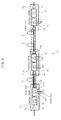
- FIG. 2 illustrates an optical network 9 wherein OADM devices 7-1 to 7-5 are connected through an optical transmission line 8 as an example of a configuration in contrast to the optical add/drop section 2 of the first embodiment.
- a transmission interval over which adjacent ones of the OADM devices 7-1 to 7-5 are connected to each other by the optical transmission line 8 is represented as one span
- the optical network 9 has transmission intervals of five spans from the OADM device 7-1 to the CAROM device 7-5. It is to be noted that the OADM devices 7-3 and 7-4 are omitted in FIG. 2 .
- each of the OADM devices 7-1 to 7-5 illustrated in FIG. 2 includes a WSS 7a for separating drop light to drop ports not illustrated and through-light to a through-port from input light, and an optical coupler 7b for multiplexing light from the through-port and light from the channels from the add ports.
- WSS 7a for separating drop light to drop ports not illustrated and through-light to a through-port from input light
- optical coupler 7b for multiplexing light from the through-port and light from the channels from the add ports.
- the optical network 9 is set such that light of the channels #19 and #21 is transmitted through the transmission intervals of five spans from the OADM device 7-1 to the OADM device 7-5 while light of the channel #20 which is adjacent the channels #19 and #21 is dropped and added for each of the transmission intervals of the spans.
- Such waveform degradation by crosstalk as just described above becomes prominent particularly as the transmission intervals increase like the channels #19 and #21 and as the frequency in which light of adjacent channels is to be dropped and added increases (refer to FIG. 4 (c) ). Also regarding the signal quality (Q penalty), the degradation degree increases as the number of transmission intervals increases and as the number of adjacent channels increases similarly as seen in FIG. 5 .
- optical add/drop section 2 has a simplified configuration composed of the colorless AWG 2c and the optical coupler 2b without provision of a separate WSS in order to multiple add light with light from the through port, the production cost of the apparatus and so forth can be suppressed significantly.
- FIG. 6 illustrates an optical adding and dropping device 10 according to a second embodiment of the present invention.
- the optical adding and dropping device 10 shown in FIG. 6 can be applied in place of the optical add/drop device 2 in the optical transmission apparatus 1 described hereinabove with reference to FIG. 1 .
- the optical adding and dropping device 10 shown in FIG. 6 is different from that of the first embodiment described hereinabove in that it includes a number of cyclic filters (CF) 10a-1 to 10a-N equal to the number of add ports as a spectrum foot removing section in place of the colorless AWG 2c.
- CF cyclic filters
- the cyclic filters 10a-1 to 10a-N are a plurality of optical filters which transmit therethrough light from a plurality of add ports and are cyclic filters having periodic transmission characteristics for every one interval of channels which can be wavelength division multiplexed in light inputted to the input port 1 of the WSS 2a.
- the cyclic filters 10a-1 to 10a-N for example, an etalon (Fabry-Perot) type filter, a Mach-Zehnder type filter and so forth are known.
- the cyclic filters 10a-1 to 10a-N are set in an associated relationship such that the bandwidth (pass band) of the transmission wavelength characteristic coincides with the channel allocation of the wavelength division multiplexed optical signal, and the characteristics of the cyclic filters 10a-1 to 10a-N such as the transmission wavelength width and so forth are set such that the spectrum feet can be deleted sufficiently although the degradation of optical signals from the transponders is comparatively small.
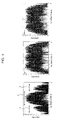
- FIGS. 7(a) to 9(d) illustrate application effects (optical spectra) of the present invention to a DPSK signal wavelength division multiplexed at intervals of 50 GHz and having a bit rate of 40 Gbit/s.
- FIG. 7(a) illustrates an optical spectrum characteristic of simple add channel light at a preceding stage to multiplexing by the optical coupler 2b where the configuration of FIG. 2 which does not include the cyclic filters 10a-1 to 10a-N is used.
- FIGS. 7(b) to 7(d) illustrate optical spectrum characteristics of simple add channel light at a preceding stage to multiplexing by the optical coupler 2b where the filter band width of the cyclic filters 10a-1 to 10a-N is set to 20 GHz, 40 GHz and 60 GHz, respectively.
- FIGS. 8(a) to 8(d) illustrate optical spectrum characteristics after multiplexing by the optical coupler 2b as light to which three successive channels (refer to, for example, the channels #19 to #21 shown in FIG. 2 ) are added by the optical coupler 2b.
- FIG. 8 (a) illustrates an optical spectrum characteristic where the configuration of FIG. 2 which does not include the cyclic filters 10a-1 to 10a-N is used
- FIGS. 8(b) to 8(d) illustrate optical spectrum characteristics where the cyclic filters 10a-1 to 10a-N wherein the filter bandwidth is set to 20 GHz, 40 GHz and 60 GHz, respectively, are included.
- FIGS. 9(a) to 9(d) illustrate optical spectrum characteristics of light of three successive channels when light is transmitted through five spans after it is multiplexed by the optical coupler 2b.
- FIG. 9(a) illustrates an optical spectrum characteristic where the configuration of FIG. 2 which does not include the cyclic filters 10a-1 to 10a-N is used
- FIGS. 9(b) to 9(d) illustrate optical spectrum characteristics where the cyclic filters 10a-1 to 10a-N wherein the filter bandwidth is set to 20 GHz, 40 GHz and 60 GHz, respectively, are included.
- an optimum filter width in this example is in the proximity of 40 GHz.
- the cyclic filters 10a-1 to 10a-N whose filter characteristic is set optimally, even if the number of spans increases, waveform degradation can be suppressed as seen from FIGS. 7(c) , 8(c) and 9(c) .
- the filter optimum value may vary depending upon the bit rate, modulation method, wavelength interval and so forth, it can be set suitably.
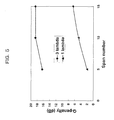
- FIG. 10 illustrates variations of the Q penalty by the transmission span number for comparison between a case (B) wherein the cyclic filters 10a-1 to 10a-N (bandwidth: 40 GHz) are applied to a DPSK signal wavelength division multiplexed at 50 GHz intervals and having a bit rate of 40 Gbit/s and another case (A) wherein the cyclic filters 10a-1 to 10a-N are not applied.
- the Q penalty exhibits comparatively high values.
- the cyclic filters 10a-1 to 10a-N are applied, the Qpenal ty is improved significantly as seen from the curve B in FIG. 10 , and the transmission quality can be improved significantly.
- the second embodiment exhibits, in addition to advantages similar to those of the first embodiment described hereinabove, an advantage that light of an arbitrary wavelength can be introduced to an add port without being restricted by the position of the port and the degree of freedom in utilization of the add ports of the optical adding and dropping device can be enhanced.
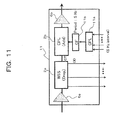
- FIG. 11 illustrates an optical adding and dropping device 11 according to a first modification to the second embodiment.
- the optical adding and dropping device 11 shown includes an optical coupler 11a and a single cyclic filter 11b as a spectrum foot removing section in place of the number of cyclic filters 10a-1 to 10a-N equal to the number of add ports described hereinabove with reference to FIG. 6 .
- the optical coupler 11a is a second multiplexer for multiplexing light from a plurality of add ports
- the cyclic filter 11b is an optical filter which transmits light from the optical coupler 11a therethrough and particularly is a periodic filter having a periodic transmission characteristic for each interval of adjacent channels.
- the cyclic filter 11b may be configured similarly to one of the number of cyclic filters 10a-1 to 10a-N equal to the number of add ports described hereinabove.
- the spectrum feet of add light multiplexed by the optical coupler 11a can be removed collectively. Consequently, while the waveform degradation can be reduced from that in the case the device of FIG. 2 (refer to reference numeral 7), the installation number of cyclic filters can be reduced from that in the case of FIG. 6 described hereinabove and reduction of the apparatus scale and reduction of the cost can be achieved.
- FIG. 12 illustrates an optical adding and dropping device 12 according to a second modification to the second embodiment.
- the optical adding and dropping device 12 shown may include multiplexers 12a and 12b and cyclic filters 12c and 12d for odd-numbered and even-numbered channels as a spectrum foot removing section such that light of odd-numbered channels and light of even-numbered channels are multiplexed separately from each other to remove the spectrum feet.
- the odd-numbered channel multiplexer 12a and the even-numbered channel multiplexer 12b multiplex light of odd-numbered channels and light of even-numbered channels, respectively, from within light from a plurality of add ports.
- the cyclic filter 12c is an optical filter which transmits light from the odd-numbered channel multiplexer 12a therethrough and particularly is an odd-numbered channel filter having a periodictransmission characteristic for each wavelength interval of the odd-numbered channels.
- the cyclic filter 12d is an optical filter which transmits light from the even-numbered channel multiplexer 12b therethrough and particularly is an even-numbered channel filter having a periodic transmission characteristic for each interval of the even-numbered channels.
- both of the cyclic filters 11a and 11b described hereinabove with reference to FIGS. 6 and 11 respectively, have a periodic transmission characteristic for each unit channel interval (frequency difference: S [Hz])
- both of the cyclic filters 12c and 12d shown in FIG. 12 have a periodic transmission characteristic for each two-channel interval (frequency difference: 2S [Hz]).
- characteristics of the cyclic filters 12c and 12d such as the transmission wavelength width are set such that the spectrum feet can be deleted sufficiently although the degradation of optical signals of corresponding wavelengths from the transponders is comparatively small.
- light outputted from the cyclic filter 12c to the optical coupler 2b can be formed as light obtained by wavelength division multiplexing light of odd-numbered channels after the spectrum feet thereof are removed.
- light outputted from the cyclic filter 12d to the optical coupler 2b can be formed as light obtained by wavelength divisionmultiplexing light of even-numbered channels after the spectrum feet thereof are removed.
- the optical coupler 2b multiplexes the optical signals from the cyclic filters 12c and 12d together with the optical signal from the through port OT. Consequently, the optical coupler 2b can output a wavelength division multiplexed signal from which overlaps of the spectra between adj acent channels are removed similarly as in the case of the second embodiment described hereinabove.
- the cyclic filters 12c and 12d are disposed in a state wherein the interval between adjacent channels is comparatively great, the feet of the optical spectrum can be deleted with a higher degree of efficiency. Further, since the installation number of cyclic filters is reduced from that shown in FIG. 6 , there is an advantage also in that the cost required for the apparatus can be reduced. However, it is necessary to allocate odd-numbered signals to those add ports to which the inputs of the odd-numbered channel multiplexer 12a are connected and allocate even-numbered wavelengths to those add ports to which the inputs of the even-numbered channel multiplexer 12b are connected.
- FIG. 13 illustrates an optical adding and dropping device 13 according to a third modification to the second embodiment.
- the optical adding and dropping device 13 shown is different from the optical adding and dropping device 11 described hereinabove with reference to FIG. 11 in that it includes two cyclic filters 13a and 13b wherein the center wavelength of the transmission characteristic thereof is shifted to the longer wavelength side and the shorter wavelength side from the optical wavelength allocation of the wavelength division multiplex signal, respectively.
- the two cyclic filters 13a and 13b and the optical coupler 11a cooperate to configure a spectrum foot removing section.
- like reference characters denote like elements to those of FIG. 11 .
- the cyclic filter 13a is a first filter which receives multiplexed light of light from the plural add ports as an input thereto from the optical coupler 11a and transmits the light from the plural add ports therethrough, and has a transmission characteristic whose center wavelength is shifted by ⁇ f, for example, in the shorter wavelength direction from the wavelength allocation of the wavelength division multiplexing (CF - ⁇ f).
- the transmission center wavelength of the cyclic filter 13a is shifted by the predetermined value ⁇ F to the shorter wavelength side while the shape itself of the filter transmission characteristic of the cyclic filter 13a is same as that of the cyclic filter 11b shown in FIG. 11 .
- the cyclic filter 13b is a second filter which transmits output light from the cyclic filter 13a therethrough and has a transmission characteristic whose center wavelength is shifted by the same amount ( ⁇ f) but in the opposite direction to that of the cyclic filter 13a (in this instance, in the direction toward the longer wavelength side) from the wavelength allocation of the wavelength division multiplexing (CF + ⁇ f).
- the transmission center wavelength of the cyclic filter 13b is shifted by the predetermined value ⁇ f to the longer wavelength side while the shape itself of the filter transmission characteristic of the cyclic filter 13b is same as that of the cyclic filter 11b shown in FIG. 11 .
- the light intensity characteristic of light of optical wavelengths which is transmitted through both of the cyclic filters 13a and 13b becomes such a characteristic C as seen in FIG. 14 which is an overlap of transmission wavelength characteristics indicated by curves A and B in FIG. 14 .
- the transmission wavelength characteristic C provided by the cooperation of the cyclic filters 13a and 13b can be adjusted to remove the feet of the spectrum of the optical signal with a higher degree of efficiency.
- the cyclic filter 13a is configured such that the transmission center wavelength is shifted to the longer wavelength side conversely to that in the case described above
- the cyclic filter 13b is configured such that the transmission center wavelength is shifted to the shorter wavelength side.
- the bandwidth of the cyclic filters 13a and 13b By varying the bandwidth of the cyclic filters 13a and 13b in this manner, the spectrum of the optical signal can be optimized. It is to be noted that, since the optimum value of the bandwidth of the cyclic filters 13a and 13b varies depending upon such conditions as the bit rate, modulation method and wavelength interval, the bandwidth of the filters is adjusted in response to the conditions. While, in the example of FIG. 13 , two wavelength periodic filters are disposed at different stages and have center wavelengths displaced from each other to vary the total wavelength bandwidth, the bandwidth of the filters may be adjusted by some other configuration.
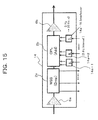
- FIG. 15 illustrates an optical adding and dropping device 14 according to a third embodiment of the present invention.
- the optical adding and dropping device 14 shown includes, in place of a number of cyclic filters 10a-1 to 10a-N equal to the number of add ports described hereinabove with reference to FIG. 6 , a number of interleavers 14a-1 to 14a-N equal to the number of add ports serving as a spectrum foot deletion section.
- the N interleavers 14a-1 to 14a-N accept light from a plurality of (N) add ports.
- like reference characters denote like elements to those of FIG. 6 .
- the interleavers 14a-1 to 14a-N have two outputs of 2S hertz with respect to one input of S hertz where S is the channel interval of wavelength division multiplexing.
- the interleavers 14a-1 to 14a-N accept light from corresponding add ports to the one input thereof and output, where the light from the add port is of an odd-numbered channel, the light from one of the two outputs thereof but output, where the light from the add port is of an even-numbered channel, the light from the other one of the two outputs thereof.
- the interleavers 14a-1 to 14a-N can separate even-numbered channel light and odd-numbered channel light from each other using the output destinations of the two outputs.
- the two outputs of the interleavers 14a-1 to 14a-N have a pass band for removing the feet of a spectrum. Accordingly, light from corresponding add ports outputted from the interleavers 14a-1 to 14a-N is outputted to the optical coupler 2b at the succeeding stage after the feet thereof are removed.
- the optical coupler 2b multiplexes light from the through port of the WSS 2a and light of the two outputs from the N interleavers 14a-1 to 14a-N and outputs the multiplexed light as light to be outputted to the output side transmission line to the optical amplifier 6b.
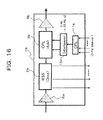
- FIG. 16 illustrates an optical adding and dropping device 15 according to a first modification to the third embodiment.
- the optical adding and dropping device 15 shown includes an interleaver 15a in place of the cyclic filter 11b described hereinabove with reference to FIG. 11 .
- the interleaver 15a and the optical coupler 11a which serves as a second multiplexer cooperate to implement a function as a spectrum foot removing section.
- like reference characters to those in FIG. 11 denote substantially like elements.
- the interleaver 15a has two outputs of twice 2S hertz with respect to one input of S hertz where S is the channel interval of wavelength division multiplexing.
- the interleaver 15a accepts light from the optical coupler 11a at the one input thereof and outputs light of the odd-numbered channels from one of the two outputs thereof but outputs light of the even-numbered channels from the other one of the two outputs thereof, to the optical coupler 2b which serves as a first multiplexer.
- the interleaver 15a can separate even-numbered channel light and odd-numbered channel light from each other depending upon the output destination of one of the two outputs.
- the two outputs of the interleaver 15a have a pass band for removing the feet of a spectrum. Accordingly, light from the add ports outputted from the interleaver 15a is outputted to the optical coupler 2b at the succeeding stage after the feet thereof are removed in a unit of an optical wavelength component of each channel.
- FIG. 17 illustrates an optical adding and dropping device 16 according to a second modification to the third embodiment.
- the optical adding and dropping device 16 shown includes an odd-numbered channel multiplexer 12a and an even-numbered channel multiplexer 12b similar to those described hereinabove with reference to FIG. 12 , and an interleaver 16a.
- the multiplexers 12a and 12b and the interleaver 16a cooperate to implement a function as a spectrum foot removing section. It is to be noted that, in FIG. 17 , like reference characters to those in FIG. 12 denote substantially like elements.
- the interleaver 16a has an output of S hertz with respect to two inputs of twice 2S hertz where S is the channel interval of wavelength division multiplexing.
- the interleaver 16a accepts light from the odd-numbered channel multiplexer 12a and the even-numbered channel multiplexer 12b at the two inputs thereof described hereinabove and outputs light of the channels from the one output thereof to the optical coupler 2b which serves as a first multiplexer.
- multiplexed light of light of the channels inputted from the add ports is outputted from the interleaver 16a to the optical coupler 2b.
- the spectrum feet are removed in a unit of an optical wavelength component of each channel depending upon the pass band which the interleaver 16a has.
- FIG. 18 illustrates an optical adding and dropping device 17 according to a third modification to the third embodiment.
- the optical adding and dropping device 17 shown includes an interleaver 17a having a different function from that of the interleaver 15a described hereinabove with reference to FIG. 16 .
- the interleaver 17a and the optical coupler 11a which serves as a second multiplexer cooperate to implement a function as a spectrum foot removing section.
- like reference characters to those in FIG. 16 denote substantially like elements.
- the interleaver 17a has two outputs of S hertz with respect to one input of S/2 hertz where S is the channel interval of wavelength division multiplexing.
- the interleaver 17a accepts light from the optical coupler 11a at the one input thereof and outputs light of the channels from one of the two outputs thereof. From the two outputs of the interleaver 17a, even-numbered grids at intervals of S/2 hertz are introduced to the optical coupler 2b while odd-numbered grids ( ⁇ 2i-1) are used as a cutoff region. Therefore, the optical adding and dropping device 17 is effective where the feet of an optical spectrum are reduced steeply with a smaller bandwidth.
- FIG. 19 illustrates an optical adding and dropping device 18 according to a fourth modification to the third embodiment.
- the optical adding and dropping device 18 shown includes an interleaver 18a which is reversed in regard to a relationship of an input and an output from the interleaver 17a described hereinabove with reference to FIG. 18 .
- the interleaver 18a and the optical coupler 11a which serves as a second multiplexer cooperate to implement a function as a spectrum foot removing section.
- like reference characters to those in FIG. 18 denote substantially like elements.
- the interleaver 18a has one output of S/2 hertz with respect to two inputs of S hertz.
- the interleaver 18a accepts light from the optical coupler 11a as an input to one of the two inputs thereof and outputs light of each channel from the one output thereof to the optical coupler 2b. Also in this instance, for even-numbered grids of S/2 hertz, the two inputs to the interleaver 18a are introduced to the optical coupler 2b while, for odd-numbered grids, the two inputs to the interleaver 18a are used as a cutoff region. Therefore, the present fourth modification is effective where the feet of an optical spectrum are deleted steeply with a comparatively small bandwidth similarly to the third modification.
- FIG. 20 illustrates an optical transmission apparatus 19 according to a fourth embodiment of the present invention.
- the optical transmission apparatus 19 shown is different from that described hereinabove with reference to FIG. 2 in that it includes an optical adding and dropping device 7 similar to that described hereinabove with reference to FIG. 2 and transponders 20-1 to 20-N having a function as the cyclic filters 10a-1 to 10a-N provided in the optical adding and dropping device 10 in the second embodiment described hereinabove with reference to FIG. 6 .
- the number of transponders (optical transmission sections) 20-1 to 20-N is equal to the plural number (N) of add ports provided for the optical adding and dropping device 7.
- Each transponder 20 includes a light source 20a capable of outputting an optical signal of a variable wavelength to be added from a corresponding add port, and a cyclic filter 20b serving as a spectrum foot removing section for removing the feet of a spectrum of light from the light source 20a and outputting the resulting light through the add port for transmission.
- the cyclic filters 20b of the transponders 20-1 to 20-N individually correspond to the cyclic filters 10a-1 to 10a-N shown in FIG. 6 and have a basically similar function to that of the cyclic filters 10a-1 to 10a-N.
Landscapes
- Engineering & Computer Science (AREA)
- Computer Networks & Wireless Communication (AREA)
- Signal Processing (AREA)
- Optical Communication System (AREA)
Applications Claiming Priority (1)
| Application Number | Priority Date | Filing Date | Title |
|---|---|---|---|
| JP2008050867A JP5176598B2 (ja) | 2008-02-29 | 2008-02-29 | 光分岐挿入装置および光伝送装置 |
Publications (2)
| Publication Number | Publication Date |
|---|---|
| EP2096779A2 true EP2096779A2 (de) | 2009-09-02 |
| EP2096779A3 EP2096779A3 (de) | 2016-06-15 |
Family
ID=40343632
Family Applications (1)
| Application Number | Title | Priority Date | Filing Date |
|---|---|---|---|
| EP09150424.1A Withdrawn EP2096779A3 (de) | 2008-02-29 | 2009-01-13 | Optische Add/Drop-Einrichtung und optische Übertragungsvorrichtung |
Country Status (3)
| Country | Link |
|---|---|
| US (1) | US8958695B2 (de) |
| EP (1) | EP2096779A3 (de) |
| JP (1) | JP5176598B2 (de) |
Cited By (1)
| Publication number | Priority date | Publication date | Assignee | Title |
|---|---|---|---|---|
| WO2013186677A1 (en) * | 2012-06-13 | 2013-12-19 | Telefonaktiebolaget L M Ericsson (Publ) | Methods and apparatus for a passive access subnetwork |
Families Citing this family (22)
| Publication number | Priority date | Publication date | Assignee | Title |
|---|---|---|---|---|
| JP4819107B2 (ja) * | 2008-08-20 | 2011-11-24 | 日本電信電話株式会社 | 光伝送装置 |
| US8538267B2 (en) * | 2009-10-09 | 2013-09-17 | Nec Laboratories America, Inc. | ROADM transponder aggregator systems and methods of operation |
| JP5666690B2 (ja) * | 2010-04-21 | 2015-02-12 | エヌイーシー ラボラトリーズ アメリカ インクNEC Laboratories America, Inc. | トランスポンダアグリゲータシステムおよび動作方法 |
| US20110262143A1 (en) * | 2010-04-21 | 2011-10-27 | Nec Laboratories America, Inc. | Roadm systems and methods of operation |
| JP5633252B2 (ja) * | 2010-08-31 | 2014-12-03 | 日本電気株式会社 | 波長多重光伝送システムの波長多重部及び波長多重方法 |
| JP5617503B2 (ja) * | 2010-09-30 | 2014-11-05 | 富士通株式会社 | 光ネットワーク中継装置 |
| JP5682256B2 (ja) | 2010-11-24 | 2015-03-11 | 富士通株式会社 | 光挿入装置および光分岐装置 |
| US8542999B2 (en) * | 2011-02-01 | 2013-09-24 | Vello Systems, Inc. | Minimizing bandwidth narrowing penalties in a wavelength selective switch optical network |
| JP5772107B2 (ja) | 2011-03-17 | 2015-09-02 | 富士通株式会社 | 波長選択スイッチおよび光伝送装置 |
| US8842947B2 (en) * | 2011-06-03 | 2014-09-23 | Futurewei Technologies, Inc. | Method and apparatus for colorless add |
| JP5904320B2 (ja) | 2011-09-22 | 2016-04-13 | 日本電気株式会社 | 光通信装置、光通信システム、および経路制御方法 |
| US20130077973A1 (en) * | 2011-09-26 | 2013-03-28 | Alcatel-Lucent Usa Inc. | Spectrally efficient modulation for an optical-transport system |
| JP6040598B2 (ja) * | 2012-07-04 | 2016-12-07 | 富士通株式会社 | 光分岐挿入装置、ネットワーク管理装置、及び波長選択スイッチ |
| JP6015365B2 (ja) | 2012-11-06 | 2016-10-26 | 富士通株式会社 | 伝送装置及び伝送方法 |
| JP5911104B2 (ja) * | 2012-12-26 | 2016-04-27 | Necエンジニアリング株式会社 | 光多重分離伝送装置、制御方法および光多重分離伝送制御システム |
| EP2757714A1 (de) * | 2013-01-18 | 2014-07-23 | Xieon Networks S.à.r.l. | Photonische Kreuzverbindung mit rekonfigurierbarer Hinzufügen-Dropfunktion |
| US9215028B2 (en) * | 2013-09-09 | 2015-12-15 | Huawei Technologies Co., Ltd. | Photonic switch chip for scalable reconfigurable optical add/drop multiplexer |
| EP3203660B1 (de) * | 2014-10-01 | 2020-02-19 | Nec Corporation | Knotenvorrichtung und verfahren zur steuerung der knotenvorrichtung |
| EP3425827B1 (de) * | 2016-02-29 | 2021-01-20 | Nec Corporation | Vorrichtung für optische übertragungen |
| US20180367234A1 (en) * | 2017-06-15 | 2018-12-20 | Fujitsu Limited | Route and collect reconfigurable optical add/drop multiplexer |
| JP7243364B2 (ja) * | 2019-03-26 | 2023-03-22 | 日本電信電話株式会社 | 光分岐挿入装置及び光分岐挿入装置を使用した光伝送システム |
| JP7243365B2 (ja) * | 2019-03-26 | 2023-03-22 | 日本電信電話株式会社 | 光分岐挿入装置及び光分岐挿入装置を使用した光伝送システム |
Citations (1)
| Publication number | Priority date | Publication date | Assignee | Title |
|---|---|---|---|---|
| JP2006087062A (ja) | 2004-08-16 | 2006-03-30 | Fujitsu Ltd | 光分岐挿入装置 |
Family Cites Families (10)
| Publication number | Priority date | Publication date | Assignee | Title |
|---|---|---|---|---|
| JPH04185132A (ja) * | 1990-11-20 | 1992-07-02 | Matsushita Electric Ind Co Ltd | 波長多重光通信システム |
| JP2002116341A (ja) * | 2000-10-05 | 2002-04-19 | Sun Tec Kk | 波長合分波器 |
| US20020131111A1 (en) * | 2001-03-16 | 2002-09-19 | Hait John N. | Hyper-dense, multi-wavelength packet method |
| IL143368A (en) * | 2001-05-24 | 2006-07-05 | Shlomo Orbach | Multiply up and down optical signals |
| JP3808734B2 (ja) * | 2001-08-10 | 2006-08-16 | 富士通株式会社 | ラマン増幅器 |
| US6871023B2 (en) * | 2001-12-03 | 2005-03-22 | The Boeing Company | Spread polarization transmitter and associated system and method of operation |
| JP2003244102A (ja) | 2002-02-20 | 2003-08-29 | Hitachi Ltd | 光帯域狭窄化送信装置および光残留サイドバンド送信装置 |
| US7181095B1 (en) * | 2003-07-29 | 2007-02-20 | Cisco Technology, Inc. | Low loss, noise filtering multiplexer/demultiplexer for reconfigurable OADMs |
| US7425696B2 (en) * | 2004-02-19 | 2008-09-16 | National Institute Of Information And Communications Technology Incorporated Administrative Agency | Photoelectric oscillator |
| WO2006035520A1 (ja) * | 2004-09-29 | 2006-04-06 | Fujitsu Limited | 光挿入分岐装置及び光ネットワークシステム |
-
2008
- 2008-02-29 JP JP2008050867A patent/JP5176598B2/ja not_active Expired - Fee Related
- 2008-12-18 US US12/338,123 patent/US8958695B2/en active Active
-
2009
- 2009-01-13 EP EP09150424.1A patent/EP2096779A3/de not_active Withdrawn
Patent Citations (1)
| Publication number | Priority date | Publication date | Assignee | Title |
|---|---|---|---|---|
| JP2006087062A (ja) | 2004-08-16 | 2006-03-30 | Fujitsu Ltd | 光分岐挿入装置 |
Cited By (1)
| Publication number | Priority date | Publication date | Assignee | Title |
|---|---|---|---|---|
| WO2013186677A1 (en) * | 2012-06-13 | 2013-12-19 | Telefonaktiebolaget L M Ericsson (Publ) | Methods and apparatus for a passive access subnetwork |
Also Published As
| Publication number | Publication date |
|---|---|
| EP2096779A3 (de) | 2016-06-15 |
| JP5176598B2 (ja) | 2013-04-03 |
| US20090220242A1 (en) | 2009-09-03 |
| JP2009212584A (ja) | 2009-09-17 |
| US8958695B2 (en) | 2015-02-17 |
Similar Documents
| Publication | Publication Date | Title |
|---|---|---|
| EP2096779A2 (de) | Optische Add/Drop-Einrichtung und optische Übertragungsvorrichtung | |
| JP6015365B2 (ja) | 伝送装置及び伝送方法 | |
| US10200145B2 (en) | Flexible grid optical spectrum transmitter, receiver, and transceiver | |
| EP2946506B1 (de) | Photonische kreuzverbindung mit rekonfigurierbarer hinzufügen-dropfunktion | |
| CA2528199A1 (en) | Flexible banded mux/demux architecture for wdm systems | |
| EP1638232A2 (de) | Optisches Demultiplexverfahren und Multiplexverfahren und diese verwendende, optische Übertragungsvorrichtung | |
| EP2090007A1 (de) | Verfahren und system zur bandabblockung in einem optischen telekommunikationsnetz | |
| US7085447B2 (en) | System for optically demultiplexing wavelength bands | |
| KR100640456B1 (ko) | 누화없는 파장분할다중방식 수동형 광 가입자망과 그 누화제거 방법 | |
| JPWO2019021972A1 (ja) | 光波長分離装置及び光波長分離方法 | |
| US8849113B2 (en) | Wavelength selective switch and optical transmission apparatus | |
| EP3051719B1 (de) | Verfahren zur Übertragung optischer Signale in einem bidirektionalen Wellenleiter | |
| EP2134007B1 (de) | Verfahren und Geräte zur Verringerung von Übersprechen in optischen Netzwerken | |
| US20250105940A1 (en) | Partially Colored Flexgrid Wavelength-Division Multiplexer/Demultiplexer | |
| Strasser et al. | Programmable filtering devices in next generation ROADM networks | |
| EP2117148A1 (de) | Multiplexer mit zusätzlicher optischer Filterung | |
| Gumaste | Reach Optimized Architecture for Multi-Rate Transport System (ROAMTS)-the Case for Non-ITU. T Compliant Optics |
Legal Events
| Date | Code | Title | Description |
|---|---|---|---|
| PUAI | Public reference made under article 153(3) epc to a published international application that has entered the european phase |
Free format text: ORIGINAL CODE: 0009012 |
|
| AK | Designated contracting states |
Kind code of ref document: A2 Designated state(s): AT BE BG CH CY CZ DE DK EE ES FI FR GB GR HR HU IE IS IT LI LT LU LV MC MK MT NL NO PL PT RO SE SI SK TR |
|
| AX | Request for extension of the european patent |
Extension state: AL BA RS |
|
| PUAL | Search report despatched |
Free format text: ORIGINAL CODE: 0009013 |
|
| AK | Designated contracting states |
Kind code of ref document: A3 Designated state(s): AT BE BG CH CY CZ DE DK EE ES FI FR GB GR HR HU IE IS IT LI LT LU LV MC MK MT NL NO PL PT RO SE SI SK TR |
|
| AX | Request for extension of the european patent |
Extension state: AL BA RS |
|
| RIC1 | Information provided on ipc code assigned before grant |
Ipc: H04J 14/02 20060101AFI20160506BHEP |
|
| 17P | Request for examination filed |
Effective date: 20161213 |
|
| RBV | Designated contracting states (corrected) |
Designated state(s): AT BE BG CH CY CZ DE DK EE ES FI FR GB GR HR HU IE IS IT LI LT LU LV MC MK MT NL NO PL PT RO SE SI SK TR |
|
| AKX | Designation fees paid |
Designated state(s): DE FR GB |
|
| AXX | Extension fees paid |
Extension state: RS Extension state: AL Extension state: BA |
|
| 17Q | First examination report despatched |
Effective date: 20170830 |
|
| STAA | Information on the status of an ep patent application or granted ep patent |
Free format text: STATUS: THE APPLICATION HAS BEEN WITHDRAWN |
|
| 18W | Application withdrawn |
Effective date: 20171218 |