EP2096801B1 - Procédé d'interrogation portant sur une voie d'acheminement unique dans un réseau optique à commutation automatique - Google Patents
Procédé d'interrogation portant sur une voie d'acheminement unique dans un réseau optique à commutation automatique Download PDFInfo
- Publication number
- EP2096801B1 EP2096801B1 EP06817913.4A EP06817913A EP2096801B1 EP 2096801 B1 EP2096801 B1 EP 2096801B1 EP 06817913 A EP06817913 A EP 06817913A EP 2096801 B1 EP2096801 B1 EP 2096801B1
- Authority
- EP
- European Patent Office
- Prior art keywords
- route
- domain
- request
- query
- route query
- Prior art date
- Legal status (The legal status is an assumption and is not a legal conclusion. Google has not performed a legal analysis and makes no representation as to the accuracy of the status listed.)
- Active
Links
Images


Classifications
-
- H—ELECTRICITY
- H04—ELECTRIC COMMUNICATION TECHNIQUE
- H04L—TRANSMISSION OF DIGITAL INFORMATION, e.g. TELEGRAPHIC COMMUNICATION
- H04L45/00—Routing or path finding of packets in data switching networks
- H04L45/42—Centralised routing
-
- H—ELECTRICITY
- H04—ELECTRIC COMMUNICATION TECHNIQUE
- H04B—TRANSMISSION
- H04B10/00—Transmission systems employing electromagnetic waves other than radio-waves, e.g. infrared, visible or ultraviolet light, or employing corpuscular radiation, e.g. quantum communication
- H04B10/25—Arrangements specific to fibre transmission
-
- H—ELECTRICITY
- H04—ELECTRIC COMMUNICATION TECHNIQUE
- H04L—TRANSMISSION OF DIGITAL INFORMATION, e.g. TELEGRAPHIC COMMUNICATION
- H04L45/00—Routing or path finding of packets in data switching networks
- H04L45/02—Topology update or discovery
- H04L45/04—Interdomain routing, e.g. hierarchical routing
-
- H—ELECTRICITY
- H04—ELECTRIC COMMUNICATION TECHNIQUE
- H04L—TRANSMISSION OF DIGITAL INFORMATION, e.g. TELEGRAPHIC COMMUNICATION
- H04L45/00—Routing or path finding of packets in data switching networks
- H04L45/44—Distributed routing
-
- H—ELECTRICITY
- H04—ELECTRIC COMMUNICATION TECHNIQUE
- H04L—TRANSMISSION OF DIGITAL INFORMATION, e.g. TELEGRAPHIC COMMUNICATION
- H04L45/00—Routing or path finding of packets in data switching networks
- H04L45/56—Routing software
-
- H—ELECTRICITY
- H04—ELECTRIC COMMUNICATION TECHNIQUE
- H04L—TRANSMISSION OF DIGITAL INFORMATION, e.g. TELEGRAPHIC COMMUNICATION
- H04L45/00—Routing or path finding of packets in data switching networks
- H04L45/62—Wavelength based
-
- H—ELECTRICITY
- H04—ELECTRIC COMMUNICATION TECHNIQUE
- H04L—TRANSMISSION OF DIGITAL INFORMATION, e.g. TELEGRAPHIC COMMUNICATION
- H04L45/00—Routing or path finding of packets in data switching networks
- H04L45/64—Routing or path finding of packets in data switching networks using an overlay routing layer
-
- H—ELECTRICITY
- H04—ELECTRIC COMMUNICATION TECHNIQUE
- H04Q—SELECTING
- H04Q11/00—Selecting arrangements for multiplex systems
- H04Q11/0001—Selecting arrangements for multiplex systems using optical switching
- H04Q11/0062—Network aspects
-
- H—ELECTRICITY
- H04—ELECTRIC COMMUNICATION TECHNIQUE
- H04Q—SELECTING
- H04Q11/00—Selecting arrangements for multiplex systems
- H04Q11/0001—Selecting arrangements for multiplex systems using optical switching
- H04Q11/0062—Network aspects
- H04Q2011/0073—Provisions for forwarding or routing, e.g. lookup tables
Definitions
- the present invention refers to the optical network field, specifically to a joint route query method in an automatic switched optical network (ASON).
- ASON automatic switched optical network
- Optical network such as OTN (Optical Transmission Network), WDM (Wavelength-Division Multiplexing), SDH (Synchronous Digital Hierarchy) or SONET (Synchronous Optical Network) transmission network has already been widely used in the telecommunication field.
- OTN Optical Transmission Network
- WDM Widelength-Division Multiplexing
- SDH Synchronous Digital Hierarchy
- SONET Synchronous Optical Network
- ITU-T G.8080 proposed the concept of ASON, wherein the function of an ASON is performed by setting special Control Plane (CP).
- ITU-T G.7713 standard provides the realization framework of distributed call and connection in an ASON network and provides the realization specification for the automatic establishment, modification and deletion of call and connection.
- Standard such as ITU-T G.7715 provides the realization model and method for the route query of the connection (the description about the route query in the rest part of the invention refers to the route query of the connection, unless declared particularly).
- the published ITU-T G.7715 and ITU-T G.7715.1 both employ the model in FIG.1 .
- the Connection Controller (CC) that is responsible for the connection control (including establishment, deletion, modification, etc.) initiates a route query request (shortly, Route Request) of the connection to the Route Controller (RC) that is responsible for route query and calculation.
- RC Route Controller
- a routing algorithm one in common use is the Constrained Shortest Path First, CSPF
- CSPF Constrained Shortest Path First
- the RDB of a node usually hardly owns complete routing information of the entire ASON network; especially when the ASON network includes multiple route domains, the RDB of a node usually only owns information of the local domain.
- the model method in fig. 1 can not satisfy the route query and calculation requirements of said connection, therefore, a new route query method in ASON is needed.
- this document discloses information exchange between hierarchical levels for resolving end-point addresses, wherin when the child RC does not know the destination, the parent RC shall be requested to develop a path to the destination; if the parent RC is able to develop a path, the first link end of the path returned will identify the SNPP used to exit the child routing area; the child RC will next be consulted for a route to the SNPP; the path that is returned by the child RC is then prepended to the path that is returned from the parent RC.
- the document US 2006/039391 A1 discloses systems and methods for computing the paths of MPLS Traffic Engineering LSPs across Autonomous System and/or area boundaries.
- a distributed path computation algorithm exploits multiple path computation elements (PCEs) to develop a virtual shortest path tree (VSPT) resulting in computation of an end-to-end optimal (shortest) path.
- PCEs path computation elements
- VSPT virtual shortest path tree
- the VSPT is computed recursively across all the Autonomous Systems and/or areas between the head-end and tail-end of the Traffic Engineering LSP.
- the technical problem that needs to be solved in the present invention is to provide a joint route query method in an automatic switched optical network (ASON), that solves the problem of route query in a cross-domain connection while being compatible with the route query within domains.
- ASON automatic switched optical network
- the current invention provides a joint route query method in an automatic switched optical network (ASON) according to claims 1 to 6.
- ASON automatic switched optical network
- the joint route query method in the present invention completes the route query, which can not be done by the ASON network element of the local domain, through the interaction between RCs of route domains of the same layer and different layers; based on the route query conditions, the route query will be done by the RC in its parent domain, and finally the query result will be returned to the RC of the network element that initiates the request.
- the method has advantages of succinctness and trustiness.
- the present invention provides a realization strategy based on the current technology.
- the present invention provides a route query method based on the source route and hierarchy route model suggested by ITU-T G.8080, and the method solves the route query problem within domain as well as the route query problem of cross-domain connection.
- the key of the present invention is based on the joint route model, wherein the route query is performed through the interaction between RCs of ASON network elements between related parent domain and other domains of the same layer as well as between the parent domain and the sub-domains contained therein.
- the method that is employed in the present invention is as follows:
- the RC of each route domain can obtain the information of RCs, including addresses, of the upstream domain (parent domain in short, and in corresponding to the parent domain, the domains that are included are called as sub-domains in short) and other domains of the same layer.
- the local route domain RC calls a routing algorithm (such as the CSPF) based on the route request, and completes the route calculation based on the route database RDB of the current node. If a complete route is not obtained, then said RC forwards the request to the RC of the upstream domain (parent domain), and completes the route query based on the interaction between the RC in the parent domain and the ones in other domains of the same layer.
- a routing algorithm such as the CSPF
- the method in the first technical solution of the present invention comprises steps as follows:
- the route query is done through the interaction between RC in each parent domain and the sub-domain RC that is contained in the parent domain.
- the first solution is as follows: the RC in the parent domain interacts with each sub-domain RC to complete the route query, namely, the RC in the parent domain sends out the route query request to each sub-domain RC and each sub-domain RC returns the route query result of the local domain to the RC in the parent domain.
- the RC in the parent domain will combine to obtain a complete route of the parent domain.
- the second solution is as follows: the RC in the parent domain interacts with one of the sub-domains and the sub-domains interact with each other to fulfill the route query, namely, the RC in the parent domain forwards the route query request to one of the subdomains, which first calculates the route within the domain, if the calculation succeeds, it returns the result to the parent domain, otherwise, the route query result will be forwarded to the subdomain of the same layer that is connected with the exit node of the local domain. This action will be repeated till the route query succeeds and the route query result is returned to the RC in the parent domain in the original path level by level.
- the present invention does not limit the specific query method of route within the domain.
- Step 4 the RCs in other domains ( if the RCs include other sub-domains, the RCs are called the RCs in parent domains as well), execute the route query (if it is the parent domain, the same method in step 3 can be employed) and return the route query result to the RC in the parent domain of the same layer that initiates the route query request.
- Step 5 based on the route query result returned by the RC of other domain of the same layer in step 4, if there is a complete route query result ( some parent domain RC may have the capability of route query through the entire network) or the RC in the parent domain can combine the results returned from other domains of the same layer to obtain a complete route, then the RC in the parent domain returns the result to the RC that initiates the request and the current query is done; if no complete route can be obtained and there are still other RCs of the same layer that are not queried by the RC in the parent domain, then the RC in the parent domain forwards said route query request to the other RCs of the same layer which has not been queried, and step 4 is executed. If no complete route can be obtained and all the RCs of the same layer of this parent domain have been queried without reasonble result, then the route query failure message will be returned to the requester through the RC that initiates the request, this current query is done.
- Step 5 after other domains that are of the same layer as the parent domain of the route entry receive the route query result returned from the route query downstream domain, if the calculation succeeds, i.e., a complete route for the downstream domain is obtained, then combined with the result calculated in the local domain in step 4, the route calculation result is returned to the upstream domain continuouslly, after the results reach the RC of the entry parent domain described in step 3, then a complete route will be returned to the requester through the RC that initiates the request, the current query is done. If the route query failure message is received, the message will be passed to the upstream domain, after the results reach the RC of entry parent domain described in step 3, the route query failure message will be returned to the requester through the RC that initiates the request, the current query is done.
- FIG. 1 is a schematic diagram for the single ASON network element in completing route query through local CC and RC interaction;
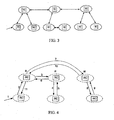
- FIG. 2 describes the situation where an ASON network includes a plurality of route domains;
- FIG. 3 is a modeling diagram of RC interaction in which joint route query method of the present invention is employed;
- FIG 4 is a flow chart of the interaction of the individual RCs in the first technical solution of the present invention;
- FIG. 5 is a flow chart of the interaction of the individual RCs in the second technical solution of the present invention;
- FIG. 6 is a flow chart of the interaction of the individual RCs in the third technical solution of the invention embodiments;
- FIG. 7 is a schematic diagram of the final route calculation result of the present invention based on the ASON network in FIG 2 ;
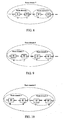
- FIG. 8 is a schematic diagram for the RC in parent domain 7 calculating the routes between sub-domains as well as the parent domain exit routes based on the third technical solution of the present invention in the ASON network shown in FIG 2 ;
- FIG. 9 is a schematic diagram for the RC in parent domain 8 calculating the routes between sub-domains as well as the parent domain exit routes based on the third technical solution of the present invention in the ASON network shown in FIG. 2 ;
- FIG 10 is a schematic diagram for the RC in parent domain 9 calculating the routes between sub-domains based on the third technical solution of the present invention in the ASON network shown in FIG. 2 .
- route domain ASON network element A only has the information of route domain 1;
- ASON network element B is the route controller that belongs to the route domain 7 (parent domain),
- ASON network element H is the route controller that belongs to the route domain 8 (the other domains that are of the same layer as the parent domain);
- ASON network element M is the route controller that belongs to the route domain 9 (the other domains that are of the same layer as the parent domain), the details for the technical solution 1 will be described.
- FIG. 7 After the route query is performed based on the above first techncial solution, the successful route is shown in FIG. 7 , in which a route from A to Q is shown.
- route domain ASON network element A only has the information of route domain 1;
- ASON network element B is the route controller that belongs to the route domain 7 (parent domain),
- ASON network element H is the route controller that belongs to the route domain 8 (the other domains that are of the same layer as the parent domain);
- ASON network element M is the route controller that belongs to the route domain 9 (the other domains that are of the same layer as the parent domain), the details for the technical solution 2 will be described.
- the RC of the route domain 7 (the parent domain) employs the parallel mechnism, and simultaneously sends out the route query request to each RC in different domains of the same layer (domains 8 and 9).
- the query is performed by applying the second technical solution, the route after successfully querying is shown in FIG. 7 , which shows the route from A to Q.
- FIG. 1 the route domain ASON network element A only has the information of route domain 1;
- ASON network element B is the route controller that belongs to the route domain 7 (parent domain),
- ASON network element H is the route controller that belongs to the route domain 8 (the other domains that are of the same layer as the parent domain);
- ASON network element M is the route controller that belongs to the route domain 9 (the other domains that are of the same layer as the parent domain), the third technical solution will be described in detail.
- the method of the third technical solution 3 comprises the following steps:
- the present invention uses the model of source route and hierarchy route recommended by ITU-T G.8080 as the basis.
- the route epecially the cross-domain route query, is completed corporately. It has the advantages of simplicity and reliability.
- the present invention discloses a joint route query method in the ASON network. It uses the model of source route and hierarchy route recommended by ITU-T G8080 as the basis. Through the RC interaction of related network elements between parent domain and each sub-domain, as well as between different domains of the same layer, the route is completed corporately. A complete query result or one after combination will be returned to the RC that initiates the route query request through the parent domain. It has the advantages of succinctness and trustiness, especially for the task of cross-domain route query.
Landscapes
- Engineering & Computer Science (AREA)
- Computer Networks & Wireless Communication (AREA)
- Signal Processing (AREA)
- Physics & Mathematics (AREA)
- Electromagnetism (AREA)
- Data Exchanges In Wide-Area Networks (AREA)
Claims (6)
- Procédé d'interrogation portant sur une voie d'acheminement unique dans un réseau optique à commutation automatique, ASON, comprenant les étapes suivantes :(1) après qu'un organe de commande de voie d'acheminement, RC, dans un domaine de voie d'acheminement appartenant à un domaine parent reçoit une demande d'interrogation de voie d'acheminement de la part d'un demandeur, il appelle un algorithme d'acheminement sur la base de la demande d'interrogation de voie d'acheminement, il calcule une voie d'acheminement sur la base d'une base de données de voie d'acheminement d'un noeud actuel ; si une voie d'acheminement complète est obtenue, un résultat d'interrogation de voie d'acheminement est retourné au demandeur ; si aucune voie d'acheminement complète ne peut être obtenue, la demande d'interrogation de voie d'acheminement est transférée à un RC dans le domaine parent ; caractérisé en ce qu'il comprend en outre :(2) après la réception de la demande d'interrogation de voie d'acheminement, le RC dans le domaine parent, qui est responsable de l'interrogation de voie d'acheminement et du calcul dans le domaine parent, calcule une voie d'acheminement de domaine local ou interagit avec les RC dans d'autres domaines qui sont dans la même couche que le domaine parent et responsables de l'interrogation de voie d'acheminement et du calcul dans les autres domaines ; si une voie d'acheminement complète peut être obtenue par le RC dans le domaine parent par calcul ou combinaison, le résultat d'interrogation de voie d'acheminement est retourné au demandeur par l'intermédiaire du RC qui a lancé la demande ; sinon, un message d'échec est retourné au demandeur par l'intermédiaire du RC qui a lancé la demande ;dans lequel l'étape (2) comprend les étapes suivantes :A1) après que le RC dans le domaine parent a reçu la demande d'interrogation de voie d'acheminement, il effectue une interrogation de voie d'acheminement de hiérarchie dans le domaine local ; si une voie d'acheminement complète est obtenue par calcul, alors le résultat d'interrogation de voie d'acheminement est retourné au demandeur par l'intermédiaire du RC qui a lancé la demande ; sinon, la demande d'interrogation de voie d'acheminement est transférée aux RC dans d'autres domaines de la même couche que ledit RC dans le domaine parent ;A2) après que les RC dans d'autres domaines ont reçu la demande d'interrogation de voie d'acheminement, ils effectuent l'interrogation de voie d'acheminement dans le domaine local, et le résultat d'interrogation de voie d'acheminement est retourné au RC dans le domaine parent qui a lancé la demande ;A3) le RC dans le domaine parent qui a lancé la demande décide si une voie d'acheminement complète a été obtenue ou peut être obtenue par la combinaison ; si oui, le résultat d'interrogation de voie d'acheminement est retourné au demandeur par l'intermédiaire du RC qui a lancé la demande ; sinon, l'étape suivante est effectuée ;A4) le RC dans le domaine parent qui a lancé la demande détermine s'il existe des RC dans d'autres domaines de la même couche que ledit domaine parent qui n'ont pas encore été interrogés ; s'il en existe, ladite demande d'interrogation de voie d'acheminement est transférée à un RC qui n'a pas encore été interrogé dans d'autres domaines de la même couche et le procédé revient à l'étape A2 ; sinon, un message d'échec est retourné au demandeur par l'intermédiaire du RC qui a lancé la demande ;ou l'étape (2) comprend les étapes suivantes :B1) après que le RC dans le domaine parent a reçu la demande d'interrogation de voie d'acheminement, il effectue l'interrogation de voie d'acheminement dans le domaine local ; si une voie d'acheminement complète est obtenue par calcul, alors le résultat d'interrogation de voie d'acheminement est retourné au demandeur par l'intermédiaire du RC qui a lancé la demande ; sinon, la demande d'interrogation de voie d'acheminement est diffusée aux RC dans tous les autres domaines de la même couche ;B2) les RC dans les autres domaines de la même couche exécutent l'interrogation de voie d'acheminement dans le domaine local et retournent le résultat d'interrogation de voie d'acheminement au RC dans le domaine parent qui a lancé la demande ;B3) le RC dans le domaine parent reçoit un ou plusieurs résultats d'interrogation de voie d'acheminement de la part des RC dans d'autres domaines de la même couche ; si une voie d'acheminement complète peut être sélectionnée ou peut être obtenue par la combinaison de plusieurs résultats, alors le résultat d'interrogation de voie d'acheminement est retourné au demandeur par l'intermédiaire du RC qui a lancé la demande ; sinon, le message d'échec est retourné au demandeur par l'intermédiaire dudit RC qui a lancé la demande ;ou l'étape (2) comprend les étapes suivantes :C1) le RC dans le domaine parent détermine si ladite demande d'interrogation de voie d'acheminement est une demande d'interrogation de domaines croisés ; s'il ne s'agit pas de la demande d'interrogation de domaines croisés, le RC dans le domaine parent exécute l'interrogation de voie d'acheminement de hiérarchie dans le domaine local et le résultat d'interrogation de voie d'acheminement est retourné au demandeur par l'intermédiaire du RC qui a lancé la demande ; s'il s'agit de la demande d'interrogation de domaines croisés, le procédé effectue l'étape suivante ;C2) le RC dans le domaine parent détermine une frontière de sortie de la voie d'acheminement dans le domaine local sur la base de la destination de voie d'acheminement ; après le calcul réussi de la voie d'acheminement du domaine local, il envoie la demande d'interrogation de voie d'acheminement au RC dans un autre domaine de la même couche en liaison avec la frontière de sortie et le procédé effectue l'étape suivante ; si le calcul de la voie d'acheminement dans le domaine local échoue, le message d'échec d'interrogation de voie d'acheminement est retourné au demandeur par l'intermédiaire du RC qui a lancé la demande ;C3) après que le RC dans un autre domaine de la même couche reçoit la demande d'interrogation de voie d'acheminement, ledit RC détermine si un noeud de destination de voie d'acheminement se trouve dans le domaine local ; si oui, après le calcul de la voie d'acheminement dans le domaine local, ledit RC retourne le résultat de calcul de voie d'acheminement au RC dans le domaine parent qui a lancé la demande, et le procédé effectue l'étape C4 ; sinon, ledit RC détermine la frontière de sortie de la voie d'acheminement sur la base de la destination de voie d'acheminement et calcule la voie d'acheminement dans le domaine local ; après le calcul réussi, ledit RC continue d'envoyer la demande d'interrogation de voie d'acheminement à un RC de la même couche en liaison avec la frontière de sortie, et le procédé effectue l'étape suivante ; si le calcul de la voie d'acheminement échoue, le message d'échec d'interrogation de voie d'acheminement est retourné au dit RC dans le domaine parent qui a lancé la demande ;
le procédé est effectué jusqu'à ce que le RC dans le domaine dans lequel se trouve le noeud de destination retourne le résultat de calcul de voie d'acheminement à un domaine en amont ;C4) le RC dans chaque domaine sur la voie d'acheminement reçoit le résultat de calcul de voie d'acheminement réussi qui est retourné d'un domaine en aval puis transfère le résultat de calcul de voie d'acheminement réussi avec le résultat d'interrogation de voie d'acheminement calculé dans le domaine local au RC dans un domaine en amont duquel la demande d'interrogation de voie d'acheminement a été reçue ; une telle opération est répétée jusqu'à ce que le résultat d'interrogation de voie d'acheminement soit retourné au RC dans le domaine parent qui est l'entrée de l'interrogation de voie d'acheminement ; ledit RC du domaine parent retourne le résultat d'interrogation de voie d'acheminement complet au demandeur par l'intermédiaire du RC qui a lancé la demande. - Procédé selon la revendication 1, dans lequel, à l'étape (1), ledit RC dans un domaine de voie d'acheminement peut obtenir des informations comprenant des informations d'adresse des RC dans le domaine parent et dans d'autres sous-domaines de la même couche.
- Procédé selon la revendication 1, dans lequel, à l'étape (1), sur la base de la demande d'interrogation de voie d'acheminement, l'algorithme d'acheminement appelé par ledit RC dans un domaine de voie d'acheminement est CSPF (Constrained Shortest Path First - plus court chemin avec contraintes).
- Procédé selon la revendication 1, dans lequel, à l'étape C4, si le RC dans chaque domaine sur le chemin de voie d'acheminement reçoit un résultat d'échec de calcul de voie d'acheminement qui est retourné d'un domaine en aval, il transfère le message d'échec à un domaine en amont pour atteindre le RC dans le domaine parent qui est l'entrée de l'interrogation de voie d'acheminement ; le message d'échec d'interrogation de voie d'acheminement est retourné au demandeur par l'intermédiaire du RC qui a lancé la demande.
- Procédé selon la revendication 1, dans lequel, à l'étape (2), le RC dans chaque domaine parent effectue l'interrogation de voie d'acheminement dans le domaine local par interaction avec chaque RC de sous-domaine ; en l'occurrence, le RC dans le domaine parent envoie la demande d'interrogation de voie d'acheminement à chaque RC de sous-domaine ; chaque RC de sous-domaine retourne le résultat d'interrogation de voie d'acheminement du domaine local au RC dans le domaine parent, et le RC dans le domaine parent obtient la voie d'acheminement complète du domaine parent par combinaison.
- Procédé selon la revendication 1, dans lequel, à l'étape (2), le RC dans chaque domaine parent effectue l'interrogation de voie d'acheminement dans le domaine local par interaction avec l'un de ses RC de sous-domaine ; en l'occurrence, ledit RC dans le domaine parent transfère la demande d'interrogation de voie d'acheminement à l'un des sous-domaines ; le RC de sous-domaine calcule d'abord la voie d'acheminement à l'intérieur du domaine ; si le calcul est réussi, le résultat est retourné au RC dans le domaine parent ; sinon, le résultat d'interrogation de voie d'acheminement est transféré au sous-domaine de la même couche en liaison avec le noeud de sortie du domaine local jusqu'à ce que l'interrogation de voie d'acheminement soit réussie ; enfin, le résultat d'interrogation est retourné au RC dans le domaine parent en fonction du chemin d'origine niveau par niveau.
Applications Claiming Priority (1)
| Application Number | Priority Date | Filing Date | Title |
|---|---|---|---|
| PCT/CN2006/003194 WO2008064518A1 (fr) | 2006-11-28 | 2006-11-28 | Procédé d'interrogation portant sur une voie d'acheminement unique dans un réseau optique à commutation automatique |
Publications (3)
| Publication Number | Publication Date |
|---|---|
| EP2096801A1 EP2096801A1 (fr) | 2009-09-02 |
| EP2096801A4 EP2096801A4 (fr) | 2011-03-09 |
| EP2096801B1 true EP2096801B1 (fr) | 2013-06-19 |
Family
ID=39467405
Family Applications (1)
| Application Number | Title | Priority Date | Filing Date |
|---|---|---|---|
| EP06817913.4A Active EP2096801B1 (fr) | 2006-11-28 | 2006-11-28 | Procédé d'interrogation portant sur une voie d'acheminement unique dans un réseau optique à commutation automatique |
Country Status (5)
| Country | Link |
|---|---|
| US (1) | US8121039B2 (fr) |
| EP (1) | EP2096801B1 (fr) |
| KR (1) | KR101139896B1 (fr) |
| CN (1) | CN101341694B (fr) |
| WO (1) | WO2008064518A1 (fr) |
Families Citing this family (5)
| Publication number | Priority date | Publication date | Assignee | Title |
|---|---|---|---|---|
| CN101938426B (zh) * | 2010-09-16 | 2015-06-10 | 中兴通讯股份有限公司 | 用于自动交换光网络的路由查询方法及系统 |
| CN102469012B (zh) * | 2010-11-12 | 2016-03-30 | 中兴通讯股份有限公司 | 路由查询装置及方法 |
| CN102130810A (zh) * | 2011-01-27 | 2011-07-20 | 电子科技大学 | 一种树形拓扑的同层域内互联结构的实现方法 |
| CN104365072B (zh) * | 2012-04-05 | 2018-11-06 | 瑞典爱立信有限公司 | 计算通过包括多个网络域的网络的端到端路径的装置和方法 |
| CN105007220B (zh) * | 2015-04-20 | 2018-09-21 | 中国电信股份有限公司 | 域间路由管理系统、方法、域适配器以及传输网络 |
Family Cites Families (16)
| Publication number | Priority date | Publication date | Assignee | Title |
|---|---|---|---|---|
| AU2001284907A1 (en) * | 2000-08-15 | 2002-02-25 | Nortel Networks Limited | System, device, and method for managing communication services in an optical communication system |
| US7339889B2 (en) * | 2002-06-20 | 2008-03-04 | Nortel Networks Limited | Control plane architecture for automatically switched optical network |
| US7215644B2 (en) * | 2003-03-19 | 2007-05-08 | Alcatel Lucent | Inter-domain constraint-based shortest path first technique for supporting hierarchical routing in interconnected multi-domain optical transport networks |
| US7860392B2 (en) * | 2003-06-06 | 2010-12-28 | Dynamic Method Enterprises Limited | Optical network topology databases based on a set of connectivity constraints |
| CN100341276C (zh) | 2003-08-19 | 2007-10-03 | 华为技术有限公司 | 业务平台对外开放业务能力的方法 |
| CN100452732C (zh) * | 2003-08-19 | 2009-01-14 | 华为技术有限公司 | 路由查找方法及其系统 |
| US7599349B2 (en) * | 2004-01-29 | 2009-10-06 | Cisco Technology, Inc. | Computing inter-autonomous system MPLS traffic engineering LSP paths |
| CN1305280C (zh) | 2004-09-17 | 2007-03-14 | 清华大学 | 层次光网络中的并行层次光标记交换通道的建立方法 |
| CN1780251A (zh) * | 2004-11-19 | 2006-05-31 | 华为技术有限公司 | 基于自动交换光网络的域间链路识别方法 |
| US8320255B2 (en) * | 2005-02-02 | 2012-11-27 | Cisco Technology, Inc. | Inter-domain path computation technique |
| CN100428736C (zh) * | 2005-02-02 | 2008-10-22 | 华为技术有限公司 | 一次路由计算实现层次路由的拓扑方法 |
| US7814227B2 (en) * | 2005-03-04 | 2010-10-12 | Cisco Technology, Inc. | Computation of a shortest inter-domain TE-LSP across a set of autonomous systems |
| CN100417117C (zh) * | 2005-06-15 | 2008-09-03 | 华为技术有限公司 | 自动交换光网络中节点可达性的识别方法 |
| CN100512192C (zh) * | 2006-01-28 | 2009-07-08 | 中兴通讯股份有限公司 | 自动交换光网络跨域呼叫和连接的控制方法 |
| KR101021621B1 (ko) * | 2006-09-29 | 2011-03-17 | 지티이 코포레이션 | 자동교환 광 네트웍 라우트 조회방법 |
| ES2372541T3 (es) * | 2006-12-01 | 2012-01-23 | Zte Corporation | Procedimiento de consulta de enrutado jerárquico para red óptica de conmutación automática. |
-
2006
- 2006-11-28 WO PCT/CN2006/003194 patent/WO2008064518A1/fr not_active Ceased
- 2006-11-28 KR KR1020097013360A patent/KR101139896B1/ko active Active
- 2006-11-28 EP EP06817913.4A patent/EP2096801B1/fr active Active
- 2006-11-28 US US12/514,508 patent/US8121039B2/en active Active
- 2006-11-28 CN CN2006800478801A patent/CN101341694B/zh active Active
Also Published As
| Publication number | Publication date |
|---|---|
| EP2096801A4 (fr) | 2011-03-09 |
| CN101341694A (zh) | 2009-01-07 |
| EP2096801A1 (fr) | 2009-09-02 |
| KR20090094326A (ko) | 2009-09-04 |
| US8121039B2 (en) | 2012-02-21 |
| US20100054736A1 (en) | 2010-03-04 |
| CN101341694B (zh) | 2011-09-14 |
| WO2008064518A1 (fr) | 2008-06-05 |
| KR101139896B1 (ko) | 2012-04-30 |
Similar Documents
| Publication | Publication Date | Title |
|---|---|---|
| EP1395003B1 (fr) | Procédé de routage selon le plus court chemin à base de contraintes pour des réseaux optiques de transport commutés dynamiquement | |
| EP2878100B1 (fr) | Système, procédé et appareil pour signaler et répondre à l'échec de l'expansion de ero dans le domaine inter lsp | |
| KR101643911B1 (ko) | 원격통신 네트워크에서 링크―다이버스 트래픽 경로들을 확립하기 위한 방법 및 관련 장치 | |
| CN101227377B (zh) | 一种实现跨域路径的共享风险链路组分离的方法 | |
| US20120124238A1 (en) | Prioritization of routing information updates | |
| CN101296178B (zh) | 域间流量工程路径计算方法和路径计算装置 | |
| CN110099002B (zh) | 一种路径计算方法及装置 | |
| EP2096802B1 (fr) | Procédé de demande de routage hiérarchique de réseau optique à commutation automatique | |
| US20070047465A1 (en) | Path setting method and communication device in network segmented into plurality of areas | |
| EP2096801B1 (fr) | Procédé d'interrogation portant sur une voie d'acheminement unique dans un réseau optique à commutation automatique | |
| CN1330141C (zh) | 光网络的路由选择方法 | |
| JP6377738B2 (ja) | Rsvp−teシグナリングを処理するための方法及びシステム | |
| CN101197756B (zh) | 一种自动交换光网络的层次路由查询方法 | |
| Xia et al. | A dual-weight recovery scheme in multi-domain optical network | |
| WO2008037124A1 (fr) | Procédé de requête de recherche dans un réseau optique à commutation automatique | |
| Aguirre-Torres et al. | Performance modelling of IP-centric lambda switched optical networks |
Legal Events
| Date | Code | Title | Description |
|---|---|---|---|
| PUAI | Public reference made under article 153(3) epc to a published international application that has entered the european phase |
Free format text: ORIGINAL CODE: 0009012 |
|
| 17P | Request for examination filed |
Effective date: 20090626 |
|
| AK | Designated contracting states |
Kind code of ref document: A1 Designated state(s): AT BE BG CH CY CZ DE DK EE ES FI FR GB GR HU IE IS IT LI LT LU LV MC NL PL PT RO SE SI SK TR |
|
| DAX | Request for extension of the european patent (deleted) | ||
| A4 | Supplementary search report drawn up and despatched |
Effective date: 20110208 |
|
| 17Q | First examination report despatched |
Effective date: 20110823 |
|
| REG | Reference to a national code |
Ref country code: DE Ref legal event code: R079 Ref document number: 602006036911 Country of ref document: DE Free format text: PREVIOUS MAIN CLASS: H04L0012560000 Ipc: H04L0012721000 |
|
| GRAP | Despatch of communication of intention to grant a patent |
Free format text: ORIGINAL CODE: EPIDOSNIGR1 |
|
| RIC1 | Information provided on ipc code assigned before grant |
Ipc: H04Q 11/00 20060101ALI20130122BHEP Ipc: H04L 12/715 20130101ALI20130122BHEP Ipc: H04L 12/717 20130101ALI20130122BHEP Ipc: H04L 12/721 20130101AFI20130122BHEP |
|
| GRAS | Grant fee paid |
Free format text: ORIGINAL CODE: EPIDOSNIGR3 |
|
| GRAA | (expected) grant |
Free format text: ORIGINAL CODE: 0009210 |
|
| AK | Designated contracting states |
Kind code of ref document: B1 Designated state(s): AT BE BG CH CY CZ DE DK EE ES FI FR GB GR HU IE IS IT LI LT LU LV MC NL PL PT RO SE SI SK TR |
|
| REG | Reference to a national code |
Ref country code: GB Ref legal event code: FG4D |
|
| REG | Reference to a national code |
Ref country code: CH Ref legal event code: EP |
|
| REG | Reference to a national code |
Ref country code: AT Ref legal event code: REF Ref document number: 618173 Country of ref document: AT Kind code of ref document: T Effective date: 20130715 |
|
| REG | Reference to a national code |
Ref country code: IE Ref legal event code: FG4D |
|
| REG | Reference to a national code |
Ref country code: DE Ref legal event code: R096 Ref document number: 602006036911 Country of ref document: DE Effective date: 20130814 |
|
| PG25 | Lapsed in a contracting state [announced via postgrant information from national office to epo] |
Ref country code: SE Free format text: LAPSE BECAUSE OF FAILURE TO SUBMIT A TRANSLATION OF THE DESCRIPTION OR TO PAY THE FEE WITHIN THE PRESCRIBED TIME-LIMIT Effective date: 20130619 Ref country code: SI Free format text: LAPSE BECAUSE OF FAILURE TO SUBMIT A TRANSLATION OF THE DESCRIPTION OR TO PAY THE FEE WITHIN THE PRESCRIBED TIME-LIMIT Effective date: 20130619 Ref country code: GR Free format text: LAPSE BECAUSE OF FAILURE TO SUBMIT A TRANSLATION OF THE DESCRIPTION OR TO PAY THE FEE WITHIN THE PRESCRIBED TIME-LIMIT Effective date: 20130920 Ref country code: ES Free format text: LAPSE BECAUSE OF FAILURE TO SUBMIT A TRANSLATION OF THE DESCRIPTION OR TO PAY THE FEE WITHIN THE PRESCRIBED TIME-LIMIT Effective date: 20130930 Ref country code: LT Free format text: LAPSE BECAUSE OF FAILURE TO SUBMIT A TRANSLATION OF THE DESCRIPTION OR TO PAY THE FEE WITHIN THE PRESCRIBED TIME-LIMIT Effective date: 20130619 Ref country code: FI Free format text: LAPSE BECAUSE OF FAILURE TO SUBMIT A TRANSLATION OF THE DESCRIPTION OR TO PAY THE FEE WITHIN THE PRESCRIBED TIME-LIMIT Effective date: 20130619 |
|
| REG | Reference to a national code |
Ref country code: AT Ref legal event code: MK05 Ref document number: 618173 Country of ref document: AT Kind code of ref document: T Effective date: 20130619 |
|
| REG | Reference to a national code |
Ref country code: LT Ref legal event code: MG4D |
|
| REG | Reference to a national code |
Ref country code: NL Ref legal event code: VDEP Effective date: 20130619 |
|
| PG25 | Lapsed in a contracting state [announced via postgrant information from national office to epo] |
Ref country code: LV Free format text: LAPSE BECAUSE OF FAILURE TO SUBMIT A TRANSLATION OF THE DESCRIPTION OR TO PAY THE FEE WITHIN THE PRESCRIBED TIME-LIMIT Effective date: 20130619 |
|
| PG25 | Lapsed in a contracting state [announced via postgrant information from national office to epo] |
Ref country code: EE Free format text: LAPSE BECAUSE OF FAILURE TO SUBMIT A TRANSLATION OF THE DESCRIPTION OR TO PAY THE FEE WITHIN THE PRESCRIBED TIME-LIMIT Effective date: 20130619 Ref country code: CY Free format text: LAPSE BECAUSE OF FAILURE TO SUBMIT A TRANSLATION OF THE DESCRIPTION OR TO PAY THE FEE WITHIN THE PRESCRIBED TIME-LIMIT Effective date: 20130807 Ref country code: CZ Free format text: LAPSE BECAUSE OF FAILURE TO SUBMIT A TRANSLATION OF THE DESCRIPTION OR TO PAY THE FEE WITHIN THE PRESCRIBED TIME-LIMIT Effective date: 20130619 Ref country code: IS Free format text: LAPSE BECAUSE OF FAILURE TO SUBMIT A TRANSLATION OF THE DESCRIPTION OR TO PAY THE FEE WITHIN THE PRESCRIBED TIME-LIMIT Effective date: 20131019 Ref country code: SK Free format text: LAPSE BECAUSE OF FAILURE TO SUBMIT A TRANSLATION OF THE DESCRIPTION OR TO PAY THE FEE WITHIN THE PRESCRIBED TIME-LIMIT Effective date: 20130619 Ref country code: AT Free format text: LAPSE BECAUSE OF FAILURE TO SUBMIT A TRANSLATION OF THE DESCRIPTION OR TO PAY THE FEE WITHIN THE PRESCRIBED TIME-LIMIT Effective date: 20130619 Ref country code: BE Free format text: LAPSE BECAUSE OF FAILURE TO SUBMIT A TRANSLATION OF THE DESCRIPTION OR TO PAY THE FEE WITHIN THE PRESCRIBED TIME-LIMIT Effective date: 20130619 Ref country code: PT Free format text: LAPSE BECAUSE OF FAILURE TO SUBMIT A TRANSLATION OF THE DESCRIPTION OR TO PAY THE FEE WITHIN THE PRESCRIBED TIME-LIMIT Effective date: 20131021 |
|
| PG25 | Lapsed in a contracting state [announced via postgrant information from national office to epo] |
Ref country code: PL Free format text: LAPSE BECAUSE OF FAILURE TO SUBMIT A TRANSLATION OF THE DESCRIPTION OR TO PAY THE FEE WITHIN THE PRESCRIBED TIME-LIMIT Effective date: 20130619 Ref country code: NL Free format text: LAPSE BECAUSE OF FAILURE TO SUBMIT A TRANSLATION OF THE DESCRIPTION OR TO PAY THE FEE WITHIN THE PRESCRIBED TIME-LIMIT Effective date: 20130619 Ref country code: RO Free format text: LAPSE BECAUSE OF FAILURE TO SUBMIT A TRANSLATION OF THE DESCRIPTION OR TO PAY THE FEE WITHIN THE PRESCRIBED TIME-LIMIT Effective date: 20130619 |
|
| PG25 | Lapsed in a contracting state [announced via postgrant information from national office to epo] |
Ref country code: CY Free format text: LAPSE BECAUSE OF FAILURE TO SUBMIT A TRANSLATION OF THE DESCRIPTION OR TO PAY THE FEE WITHIN THE PRESCRIBED TIME-LIMIT Effective date: 20130619 |
|
| PLBE | No opposition filed within time limit |
Free format text: ORIGINAL CODE: 0009261 |
|
| STAA | Information on the status of an ep patent application or granted ep patent |
Free format text: STATUS: NO OPPOSITION FILED WITHIN TIME LIMIT |
|
| PG25 | Lapsed in a contracting state [announced via postgrant information from national office to epo] |
Ref country code: DK Free format text: LAPSE BECAUSE OF FAILURE TO SUBMIT A TRANSLATION OF THE DESCRIPTION OR TO PAY THE FEE WITHIN THE PRESCRIBED TIME-LIMIT Effective date: 20130619 |
|
| 26N | No opposition filed |
Effective date: 20140320 |
|
| PG25 | Lapsed in a contracting state [announced via postgrant information from national office to epo] |
Ref country code: IT Free format text: LAPSE BECAUSE OF FAILURE TO SUBMIT A TRANSLATION OF THE DESCRIPTION OR TO PAY THE FEE WITHIN THE PRESCRIBED TIME-LIMIT Effective date: 20130619 |
|
| REG | Reference to a national code |
Ref country code: DE Ref legal event code: R097 Ref document number: 602006036911 Country of ref document: DE Effective date: 20140320 |
|
| REG | Reference to a national code |
Ref country code: CH Ref legal event code: PL |
|
| PG25 | Lapsed in a contracting state [announced via postgrant information from national office to epo] |
Ref country code: CH Free format text: LAPSE BECAUSE OF NON-PAYMENT OF DUE FEES Effective date: 20131130 Ref country code: LI Free format text: LAPSE BECAUSE OF NON-PAYMENT OF DUE FEES Effective date: 20131130 Ref country code: MC Free format text: LAPSE BECAUSE OF FAILURE TO SUBMIT A TRANSLATION OF THE DESCRIPTION OR TO PAY THE FEE WITHIN THE PRESCRIBED TIME-LIMIT Effective date: 20130619 |
|
| REG | Reference to a national code |
Ref country code: FR Ref legal event code: ST Effective date: 20140731 |
|
| REG | Reference to a national code |
Ref country code: IE Ref legal event code: MM4A |
|
| PG25 | Lapsed in a contracting state [announced via postgrant information from national office to epo] |
Ref country code: IE Free format text: LAPSE BECAUSE OF NON-PAYMENT OF DUE FEES Effective date: 20131128 |
|
| PG25 | Lapsed in a contracting state [announced via postgrant information from national office to epo] |
Ref country code: FR Free format text: LAPSE BECAUSE OF NON-PAYMENT OF DUE FEES Effective date: 20131202 |
|
| PG25 | Lapsed in a contracting state [announced via postgrant information from national office to epo] |
Ref country code: HU Free format text: LAPSE BECAUSE OF FAILURE TO SUBMIT A TRANSLATION OF THE DESCRIPTION OR TO PAY THE FEE WITHIN THE PRESCRIBED TIME-LIMIT; INVALID AB INITIO Effective date: 20061128 Ref country code: LU Free format text: LAPSE BECAUSE OF NON-PAYMENT OF DUE FEES Effective date: 20131128 |
|
| REG | Reference to a national code |
Ref country code: DE Ref legal event code: R079 Ref document number: 602006036911 Country of ref document: DE Free format text: PREVIOUS MAIN CLASS: H04L0012721000 Ipc: H04L0045000000 |
|
| P01 | Opt-out of the competence of the unified patent court (upc) registered |
Effective date: 20230530 |
|
| PGFP | Annual fee paid to national office [announced via postgrant information from national office to epo] |
Ref country code: BG Payment date: 20250916 Year of fee payment: 20 |
|
| PGFP | Annual fee paid to national office [announced via postgrant information from national office to epo] |
Ref country code: DE Payment date: 20250930 Year of fee payment: 20 |
|
| PGFP | Annual fee paid to national office [announced via postgrant information from national office to epo] |
Ref country code: GB Payment date: 20251001 Year of fee payment: 20 |
|
| PGFP | Annual fee paid to national office [announced via postgrant information from national office to epo] |
Ref country code: TR Payment date: 20251121 Year of fee payment: 20 |