EP2096831A1 - Procédé et dispositif pour la gestion de trafic vidéo - Google Patents
Procédé et dispositif pour la gestion de trafic vidéo Download PDFInfo
- Publication number
- EP2096831A1 EP2096831A1 EP08290182A EP08290182A EP2096831A1 EP 2096831 A1 EP2096831 A1 EP 2096831A1 EP 08290182 A EP08290182 A EP 08290182A EP 08290182 A EP08290182 A EP 08290182A EP 2096831 A1 EP2096831 A1 EP 2096831A1
- Authority
- EP
- European Patent Office
- Prior art keywords
- video data
- line
- access node
- data packets
- video
- Prior art date
- Legal status (The legal status is an assumption and is not a legal conclusion. Google has not performed a legal analysis and makes no representation as to the accuracy of the status listed.)
- Withdrawn
Links
- 238000000034 method Methods 0.000 title claims abstract description 20
- 230000005540 biological transmission Effects 0.000 claims abstract description 6
- 239000003550 marker Substances 0.000 claims description 6
- 230000000750 progressive effect Effects 0.000 claims description 3
- 238000007726 management method Methods 0.000 description 4
- 230000007246 mechanism Effects 0.000 description 4
- 239000000835 fiber Substances 0.000 description 3
- 230000000295 complement effect Effects 0.000 description 2
- 230000007423 decrease Effects 0.000 description 2
- 238000012986 modification Methods 0.000 description 2
- 230000004048 modification Effects 0.000 description 2
- 230000011664 signaling Effects 0.000 description 2
- 230000003139 buffering effect Effects 0.000 description 1
- 230000006835 compression Effects 0.000 description 1
- 238000007906 compression Methods 0.000 description 1
- 239000000796 flavoring agent Substances 0.000 description 1
- 235000019634 flavors Nutrition 0.000 description 1
- 230000006872 improvement Effects 0.000 description 1
- 230000003287 optical effect Effects 0.000 description 1
- 239000013307 optical fiber Substances 0.000 description 1
- 230000009467 reduction Effects 0.000 description 1
Images
Classifications
-
- H—ELECTRICITY
- H04—ELECTRIC COMMUNICATION TECHNIQUE
- H04L—TRANSMISSION OF DIGITAL INFORMATION, e.g. TELEGRAPHIC COMMUNICATION
- H04L65/00—Network arrangements, protocols or services for supporting real-time applications in data packet communication
- H04L65/60—Network streaming of media packets
- H04L65/61—Network streaming of media packets for supporting one-way streaming services, e.g. Internet radio
- H04L65/613—Network streaming of media packets for supporting one-way streaming services, e.g. Internet radio for the control of the source by the destination
-
- H—ELECTRICITY
- H04—ELECTRIC COMMUNICATION TECHNIQUE
- H04L—TRANSMISSION OF DIGITAL INFORMATION, e.g. TELEGRAPHIC COMMUNICATION
- H04L65/00—Network arrangements, protocols or services for supporting real-time applications in data packet communication
- H04L65/60—Network streaming of media packets
- H04L65/70—Media network packetisation
Definitions
- the present invention generally relates to the field of traffic management of video streams.
- VBR variable bit rate
- Service providers control the likelihood of congestion by allocating more resources to the individual video streams (thus reducing the number of concurrent video streams), by increasing the line rate (thus reducing the reach) and/or by increasing the compression of the video stream (thus reducing the quality).
- Complementary, selective packet discarding may be applied. Instead of dropping video packets randomly when congestion occurs, the video packets are discarded selectively for example based upon a priority marker.
- the priority level should be proportional to the Quality-of-Experience (QoE) impact.
- the performance gain of selective packet discarding depends upon the granularity of the packet classification (e.g. per picture, per slice group, per content type), which in turn increases the complexity and decreases the efficiency of the (re-)packetisation of the video data (e.g. in the head-end). Although selective packet discarding reduces the QoE impact of congestion on the QoE, it will not reduce it to zero.
- the congestion problem can be reduced by increasing the size of the video queues in the access node. This, however, increases the delay.
- EP1811780-A1 and US6278965 it is known to provide in an access node a cache buffer for video data. In US6278965 this was done for increasing the zapping or channel changing speed.
- the video cache function proposed in EP1811780-A1 serves the additional purposes of providing channel quality improvement through fast retransmission functionality and increased flexibility in selecting video channels to be cached.
- the present invention relates to a method for managing video data in an access node.
- the method comprises the steps of receiving a stream of video data packets at the access node and receiving status information at the access node indicative of the on-line or off-line character of the video data.
- a subsequent step for further transmission priority is given to video data packets that, from said status information, are found to have the on-line status.
- the method may comprise an explicit step of determining the on-line or off-line status of the received video data packets from the status information.
- the management of video traffic so differentiates between video streams that are displayed 'on the fly' and streams that are not displayed 'on the fly'.
- video data packets which have been found to have the off-line status are temporarily cached.
- the cached video data packets are then forwarded when the congestion is resolved.
- the cached video data packets are forwarded after having been reordered.
- video data packets with the off-line status are selectively discarded.
- the method preferably comprises a step of applying error-correction for recovering the video data packets that are discarded.
- the video data packets with on-line status form a broadcast TV stream, a video-on-demand stream or progressive download stream.
- the video data packets with an off-line status typically form a broadcast TV stream being recorded or a video-on-demand stream or progressive-download stream being prefetched.
- the video data packets further comprise a marker allowing selective packet discarding based on a priority level indicated by the marker.
- the method is so combined with a mechanism for dealing with traffic congestion as known in the prior art.
- a plurality of video data packets streams is received at the access node.
- the invention in another aspect relates to an access node for managing video data.
- the access node comprises receiver means for receiving a stream of video data packets and is characterised in that it is arranged for receiving status information indicative of the on-line or off-line displaying of the video data and in that it is arranged for giving priority for further transmission to video data packets that from the status information are found to have the on-line status.
- the invention in a further aspect relates to a device for receiving video data at the customer premises, i.e. a so called CPE or remote terminal.
- the device is arranged for transmitting status information, whereby the status information is indicative of the on-line or off-line displaying of video data.
- the online/offline displaying of the video data is determined by an access node coupled to the device.
- this device can be coupled directly to an access node. Alternatively, it can also be coupled to a video server.
- the term 'access node' is intended to mean any type of access node that can be used in telecommunication networks. Examples include but are not limited to a DSL Access Multiplexer (DSLAM), a CMTS or Cable Modem Termination System for cable based or Hybrid Fibre Coax (HFC) based access networks, a DLC or Digital Loop Carrier, an Optical Fibre Aggregator for fibre based access networks like PONs or Passive Optical Networks, a node B or Radio Network Controller (RNC) for radio based systems or the airborne node in satellite based access systems, etc...
- DSL Access Multiplexer DSL Access Multiplexer
- CMTS Cable Modem Termination System for cable based or Hybrid Fibre Coax (HFC) based access networks
- DLC or Digital Loop Carrier a DLC or Digital Loop Carrier
- an Optical Fibre Aggregator for fibre based access networks like PONs or Passive Optical Networks
- RNC Radio Network Controller
- the access network could be a point-to-point access network (as is the case for the different DSL flavours), or a point-to-multipoint access network (as is the case for cable or fibre based systems). It is further noticed that anywhere this patent application mentions 'TV' or 'video' or 'IPTV', any type of video content is intended to be covered, irrespective of its origin, its nature (live content, scheduled on-demand content, %) and its intended audience (e.g. nation-wide, community-restricted, etc.).
- video streams' covers any type of packet based delivery of video content or TV content, like for instance nation-wide IPTV channels offering live content, community TV channels restricted to members of a community, and (less likely) video-on-demand (VoD) channels or near video-on-demand (NVoD) channels, etc.
- the present invention proposes to differentiate the management of video traffic in the access node for video streams - denoted on-line streams - that are "displayed on-the-fly" (or “consumed live") in the home on one hand, and video streams - denoted off-line streams - that are "not displayed on-the-fly” on the other hand.
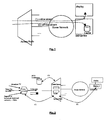
- Fig.1 illustrates the distinction between an on-line and an off-line stream.
- On-line streams can be broadcast TV as well as Video On Demand. Examples of off-line streams are broadcast TV being recorded or time-shifted in the home, or Video On Demand being pre-fetched.
- This approach is based on an indication of the on-line/off-line character of the video data packets received in the access node.
- the end-user's actions (such as play, pause, stop, record, play and record, etc.), entered using a remote TV control or other means, determine the on-line/off-line status of the video stream.
- the end-user device that interfaces with the end-user, and also receives and displays the video - today this is typically a STB at the customer premise but in future this may be integrated in a device at the service provider premise - must be arranged to relay this on-line/off-line status information to the access node, either directly or indirectly as is described below. Three possible ways of relaying such status information are shown in Fig.2 .
- the end-device is arranged to directly transmit to the access node (see (2) in Fig.2 ) via the signalling or the control plane status information indicative of the on-line or off-line status of the video data.
- the end-user device is arranged to transmit this status information to the video streamer, and the video streamer is arranged either to mark the video packets or to forward this status information to the access node via the signalling or the control plane. If the video streamer marks the video packets, the access node must be arranged to detect and monitor the marker in the video packets, and deduce the status information accordingly.
- the end-device is arranged to communicate the status information to the IPTV middleware platform, and the IPTV middleware platform is arranged to forward this status information to the access node via, for example, a management and operations interface.
- the exchange of the on-line/off-line status information between the end-device and the access node, via one of the three options described above, is part of the present invention, and requires dedicated arrangements.
- the IGMP join messages that are used to tune into a Broadcast TV channel, do not reflect the on-line/off-line character of a stream.
- the RTSP protocol to stream Video on Demand. Although it includes play, pause and stop commands (among others), further arrangements are needed to support a prefetching scenario in which the end-user pauses the display, the end-device continues receiving and buffering the video packets and the network manages the related traffic differently than normally (i.e., when displayed).
- the on-line or off-line status of the received video data packets is determined from the received status information.
- the packets from off-line streams are temporarily cached upon congestion on the last mile. They are forwarded as soon as possible, i.e., as soon as the traffic level decreases.
- larger queues can be used for off-line streams.
- the off-line packets may be reordered.
- Error-correcting mechanisms e.g. reliable UDP for broadcast TV, TCP acknowledgement (ACK) for Video On Demand, advanced PLC (Packet Loss Concealment) in the end device (e.g. a set top box (STB)
- STB set top box
- the solution of the present invention is different from a Network Personal Video Recorder (PVR).
- the service provider does not archive complete/partial video streams upon request of the end-user.
- top, bottom, over, under, and the like are introduced for descriptive purposes and not necessarily to denote relative positions. It is to be understood that the terms so used are interchangeable under appropriate circumstances and embodiments of the invention are capable of operating according to the present invention in other sequences, or in orientations different from the one(s) described or illustrated above.
Landscapes
- Engineering & Computer Science (AREA)
- Multimedia (AREA)
- Computer Networks & Wireless Communication (AREA)
- Signal Processing (AREA)
- Data Exchanges In Wide-Area Networks (AREA)
Priority Applications (1)
| Application Number | Priority Date | Filing Date | Title |
|---|---|---|---|
| EP08290182A EP2096831A1 (fr) | 2008-02-26 | 2008-02-26 | Procédé et dispositif pour la gestion de trafic vidéo |
Applications Claiming Priority (1)
| Application Number | Priority Date | Filing Date | Title |
|---|---|---|---|
| EP08290182A EP2096831A1 (fr) | 2008-02-26 | 2008-02-26 | Procédé et dispositif pour la gestion de trafic vidéo |
Publications (1)
| Publication Number | Publication Date |
|---|---|
| EP2096831A1 true EP2096831A1 (fr) | 2009-09-02 |
Family
ID=40083609
Family Applications (1)
| Application Number | Title | Priority Date | Filing Date |
|---|---|---|---|
| EP08290182A Withdrawn EP2096831A1 (fr) | 2008-02-26 | 2008-02-26 | Procédé et dispositif pour la gestion de trafic vidéo |
Country Status (1)
| Country | Link |
|---|---|
| EP (1) | EP2096831A1 (fr) |
Cited By (1)
| Publication number | Priority date | Publication date | Assignee | Title |
|---|---|---|---|---|
| CN107426278A (zh) * | 2017-04-24 | 2017-12-01 | 阿里巴巴集团控股有限公司 | H5应用的调用方法、装置和移动终端 |
Citations (4)
| Publication number | Priority date | Publication date | Assignee | Title |
|---|---|---|---|---|
| US6081505A (en) * | 1997-03-20 | 2000-06-27 | Nokia Telecommunications, Oy | Cell scheduling system and method for networks nodes |
| US6278965B1 (en) | 1998-06-04 | 2001-08-21 | The United States Of America As Represented By The Administrator Of The National Aeronautics And Space Administration | Real-time surface traffic adviser |
| EP1777962A1 (fr) * | 2005-10-24 | 2007-04-25 | Alcatel Lucent | Noeud d'accès avec support de services multiples de vidéo en mode continu par un seul protocole de requête |
| EP1811780A1 (fr) | 2006-01-24 | 2007-07-25 | Alcatel Lucent | Point d'accès avec des fonctions de cache / tampon / antémémoire pour des chaînes vidéo |
-
2008
- 2008-02-26 EP EP08290182A patent/EP2096831A1/fr not_active Withdrawn
Patent Citations (4)
| Publication number | Priority date | Publication date | Assignee | Title |
|---|---|---|---|---|
| US6081505A (en) * | 1997-03-20 | 2000-06-27 | Nokia Telecommunications, Oy | Cell scheduling system and method for networks nodes |
| US6278965B1 (en) | 1998-06-04 | 2001-08-21 | The United States Of America As Represented By The Administrator Of The National Aeronautics And Space Administration | Real-time surface traffic adviser |
| EP1777962A1 (fr) * | 2005-10-24 | 2007-04-25 | Alcatel Lucent | Noeud d'accès avec support de services multiples de vidéo en mode continu par un seul protocole de requête |
| EP1811780A1 (fr) | 2006-01-24 | 2007-07-25 | Alcatel Lucent | Point d'accès avec des fonctions de cache / tampon / antémémoire pour des chaînes vidéo |
Non-Patent Citations (2)
| Title |
|---|
| SCHULZRINNE H ET AL: "RFC 2326: Real time streaming protocol", NETWORK WORKING GROUP REQUEST FOR COMMENTS, XX, XX, 1 April 1998 (1998-04-01), pages 1 - 41, XP002230868 * |
| THOMSON ET AL: "RTSP for IMS IPTV;WG3IPTV35_WI3127_RTSP_for_IMS_IPTV", ETSI DRAFT; WG3IPTV35_WI3127_RTSP_FOR_IMS_IPTV, EUROPEAN TELECOMMUNICATIONS STANDARDS INSTITUTE (ETSI), 650, ROUTE DES LUCIOLES ; F-06921 SOPHIA-ANTIPOLIS ; FRANCE, vol. zArchive, 19 October 2007 (2007-10-19), pages 1 - 4, XP014142775 * |
Cited By (1)
| Publication number | Priority date | Publication date | Assignee | Title |
|---|---|---|---|---|
| CN107426278A (zh) * | 2017-04-24 | 2017-12-01 | 阿里巴巴集团控股有限公司 | H5应用的调用方法、装置和移动终端 |
Similar Documents
| Publication | Publication Date | Title |
|---|---|---|
| US10419783B2 (en) | System and method of providing video content | |
| US8625455B2 (en) | System and method for handling streaming media | |
| US8819269B2 (en) | Adaptive bit rate method and system using retransmission and replacement | |
| US8971184B2 (en) | Latency based random early discard for network packets | |
| US7729381B2 (en) | In-band media performance monitoring | |
| EP3183884B1 (fr) | Qualité d'expérience vidéo basée sur une estimation de qualité vidéo | |
| US7965771B2 (en) | Method and apparatus for immediate display of multicast IPTV over a bandwidth constrained network | |
| US9148237B2 (en) | Digital television channel trending | |
| US8661486B2 (en) | System and method of delivering video content | |
| US8474001B2 (en) | Near real time delivery of variable bit rate media streams | |
| US8621544B2 (en) | Mitigatation of video artifacts | |
| US20070223475A1 (en) | Access node with caching function for video channels | |
| US20150113571A1 (en) | Methods and apparatus for content switching | |
| EP2148475A2 (fr) | Appareil et procédé pour cartographier les canaux dynamiques et planification optimisée de paquets de données | |
| EP3503475A1 (fr) | Procédé de gestion à distance d'un dispositif et dispositif correspondant | |
| JP2012527164A (ja) | 遅いマルチキャスト加入の高速チャネル変更処理 | |
| US20080084821A1 (en) | Method and devices for adapting the transmission rate of a data stream when there is interference | |
| Houze et al. | Applicative-layer multipath for low-latency adaptive live streaming | |
| CN103329558A (zh) | 单播多播iptv网络中实现快速信道更改的方法和服务器 | |
| US20130262554A1 (en) | Method and apparatus for managing content distribution over multiple terminal devices in collaborative media system | |
| EP2096831A1 (fr) | Procédé et dispositif pour la gestion de trafic vidéo | |
| JP2012231445A (ja) | パケット配信装置およびパケット配信方法 | |
| JP2009500975A (ja) | リアルタイムコンテンツ配信におけるクライアント入力バッファの使用率を測定するための装置及び方法 | |
| US20100214912A1 (en) | Mitigating network impairments | |
| EP3973686A1 (fr) | Dispositif, procédé et programme pour ordinateur et système de distribution de contenu sur la base de la qualité d'expérience |
Legal Events
| Date | Code | Title | Description |
|---|---|---|---|
| PUAI | Public reference made under article 153(3) epc to a published international application that has entered the european phase |
Free format text: ORIGINAL CODE: 0009012 |
|
| AK | Designated contracting states |
Kind code of ref document: A1 Designated state(s): AT BE BG CH CY CZ DE DK EE ES FI FR GB GR HR HU IE IS IT LI LT LU LV MC MT NL NO PL PT RO SE SI SK TR |
|
| AX | Request for extension of the european patent |
Extension state: AL BA MK RS |
|
| 17P | Request for examination filed |
Effective date: 20100302 |
|
| AKX | Designation fees paid |
Designated state(s): AT BE BG CH CY CZ DE DK EE ES FI FR GB GR HR HU IE IS IT LI LT LU LV MC MT NL NO PL PT RO SE SI SK TR |
|
| RAP1 | Party data changed (applicant data changed or rights of an application transferred) |
Owner name: ALCATEL LUCENT |
|
| 111Z | Information provided on other rights and legal means of execution |
Free format text: AT BE BG CH CY CZ DE DK EE ES FI FR GB GR HR HU IE IS IT LI LT LU LV MC MT NL NO PL PT RO SE SI SK TR Effective date: 20130410 |
|
| 17Q | First examination report despatched |
Effective date: 20140620 |
|
| RAP1 | Party data changed (applicant data changed or rights of an application transferred) |
Owner name: ALCATEL LUCENT |
|
| D11X | Information provided on other rights and legal means of execution (deleted) | ||
| STAA | Information on the status of an ep patent application or granted ep patent |
Free format text: STATUS: THE APPLICATION IS DEEMED TO BE WITHDRAWN |
|
| 18D | Application deemed to be withdrawn |
Effective date: 20141031 |