EP2096877A1 - Système de communication d'accès multiple par répartition de code à large bande (w-cdma) et procédé de commande de cycle de transmission à indication de qualité de canal (cqi) - Google Patents
Système de communication d'accès multiple par répartition de code à large bande (w-cdma) et procédé de commande de cycle de transmission à indication de qualité de canal (cqi) Download PDFInfo
- Publication number
- EP2096877A1 EP2096877A1 EP07806694A EP07806694A EP2096877A1 EP 2096877 A1 EP2096877 A1 EP 2096877A1 EP 07806694 A EP07806694 A EP 07806694A EP 07806694 A EP07806694 A EP 07806694A EP 2096877 A1 EP2096877 A1 EP 2096877A1
- Authority
- EP
- European Patent Office
- Prior art keywords
- cqi
- transmission cycle
- base station
- mobile station
- scch
- Prior art date
- Legal status (The legal status is an assumption and is not a legal conclusion. Google has not performed a legal analysis and makes no representation as to the accuracy of the status listed.)
- Granted
Links
- 230000005540 biological transmission Effects 0.000 title claims abstract description 221
- 238000000034 method Methods 0.000 title claims description 33
- 238000004891 communication Methods 0.000 title claims description 24
- 238000013507 mapping Methods 0.000 claims description 6
- 230000008569 process Effects 0.000 description 20
- 238000010586 diagram Methods 0.000 description 7
- 238000010295 mobile communication Methods 0.000 description 3
- 101000741965 Homo sapiens Inactive tyrosine-protein kinase PRAG1 Proteins 0.000 description 2
- 108010003272 Hyaluronate lyase Proteins 0.000 description 2
- 102100038659 Inactive tyrosine-protein kinase PRAG1 Human genes 0.000 description 2
- 230000004913 activation Effects 0.000 description 2
- 239000000470 constituent Substances 0.000 description 2
- 230000000694 effects Effects 0.000 description 2
- 230000006870 function Effects 0.000 description 2
- 238000003908 quality control method Methods 0.000 description 2
- 230000009467 reduction Effects 0.000 description 2
- 230000003213 activating effect Effects 0.000 description 1
- 230000008901 benefit Effects 0.000 description 1
- 230000008859 change Effects 0.000 description 1
- 238000005457 optimization Methods 0.000 description 1
Images






Classifications
-
- H—ELECTRICITY
- H04—ELECTRIC COMMUNICATION TECHNIQUE
- H04L—TRANSMISSION OF DIGITAL INFORMATION, e.g. TELEGRAPHIC COMMUNICATION
- H04L1/00—Arrangements for detecting or preventing errors in the information received
- H04L1/0001—Systems modifying transmission characteristics according to link quality, e.g. power backoff
- H04L1/0023—Systems modifying transmission characteristics according to link quality, e.g. power backoff characterised by the signalling
- H04L1/0027—Scheduling of signalling, e.g. occurrence thereof
-
- H—ELECTRICITY
- H04—ELECTRIC COMMUNICATION TECHNIQUE
- H04L—TRANSMISSION OF DIGITAL INFORMATION, e.g. TELEGRAPHIC COMMUNICATION
- H04L1/00—Arrangements for detecting or preventing errors in the information received
- H04L1/0001—Systems modifying transmission characteristics according to link quality, e.g. power backoff
- H04L1/0023—Systems modifying transmission characteristics according to link quality, e.g. power backoff characterised by the signalling
- H04L1/0026—Transmission of channel quality indication
-
- H—ELECTRICITY
- H04—ELECTRIC COMMUNICATION TECHNIQUE
- H04L—TRANSMISSION OF DIGITAL INFORMATION, e.g. TELEGRAPHIC COMMUNICATION
- H04L1/00—Arrangements for detecting or preventing errors in the information received
- H04L1/12—Arrangements for detecting or preventing errors in the information received by using return channel
- H04L1/16—Arrangements for detecting or preventing errors in the information received by using return channel in which the return channel carries supervisory signals, e.g. repetition request signals
- H04L1/18—Automatic repetition systems, e.g. Van Duuren systems
- H04L1/1829—Arrangements specially adapted for the receiver end
- H04L1/1854—Scheduling and prioritising arrangements
Definitions
- the present invention relates to a W-CDMA (Wide band Code Division Multiple Access) communication system for controlling a transmission cycle of a CQI (Channel Quality Indicator) to be regularly transmitted from a mobile station to a base station, and a method of controlling a CQI transmission cycle.
- W-CDMA Wideband Code Division Multiple Access
- CQI Channel Quality Indicator
- HSDPA High Speed Downlink Packet Access
- a W-CDMA communication system comprises a mobile station and a base station.
- the base station transmits packet data to the mobile station by an HS-PDSCH (High Speed Physical Downlink Shared Channel). Further, before transmitting the packet data by the HS-PDSCH, the base station transmits control information (packet control information) used for demodulation and decoding of the packet data to the mobile station by an HS-SCCH (High Speed Shared Control Channel).
- the control information (packet control information) includes information on channelization codes (a multicode number indicating the number of channelization codes assigned to one mobile station and a code offset indicating an offset value of a channelization code).
- the mobile station calculates a status of a propagation path, which changes minute by minute, as an index value of a CQI, maps the calculated CQI on an HS-DPCCH (High Speed Dedicated Physical Control Channel), and regularly transmits it to the base station.
- HS-DPCCH High Speed Dedicated Physical Control Channel
- the base station can grasp the latest status of the propagation path, it is possible to obtain a merit that a transmission rate of the HS-PDSCH can be optimized in a time unit of two milliseconds of the shortest period, which is a subframe. Further, by optimization of the transmission rate of the HS-PDSCH, it is possible to obtain a merit that a channel resource of the HS-PDSCH can be used effectively.
- Patent Document 1 International Publication No. 2004/077871 pamphlet discloses a base station and a terminal (mobile station) that can achieve reduction of collision of cycle information transmitted from the terminal (mobile station) to the base station, and restrain interference of communication as much as possible.
- the base station includes a receiving section for receiving quality information (CQI) indicating a current communication state, which is periodically transmitted from the terminal (mobile station) to the base station, and a cycle processing section for calculating and adding a time offset variable with respect to reception timing of the quality information.
- the terminal (mobile station) includes a transmitting section for transmitting the quality information (CQI), and a cycle processing section for calculating and adding a time offset variable with respect to transmission timing of the quality information.
- Patent Document 1 is one that discloses a technical idea to achieve reduction of collision of a CQI (cycle information) regularly transmitted from a mobile station to a base station by shifting transmission/reception timing of the CQI. Therefore, Patent Document 1 fails to disclose control for stopping or starting transmission of the CQI itself, and has no description that suggests it.
- CQI cycle information
- Patent Document 2 discloses a technical idea to carry out the optimum scheduling according to data of each mobile station in an up line.
- a mobile station comprises a buffer for storing transmission data, a CQI generating section for generating a CQI according to communication quality, and a transmission control section for controlling a transmission interval for transmitting the CQI in accordance with one of the amount of transmission data stored in the buffer and a value related to the transmission data.
- a base station comprises a CQI extracting section for extracting a CQI from reception data, an observing section for observing the number of reception slots of the CQI, a scheduler for carrying out scheduling on the basis of the CQI extracted by the CQI extracting section and the number of reception slots in a predetermined period of time, and a data generating section for generating transmission data with scheduling in this scheduler.
- Patent Document 2 discloses a technical idea to control a transmission interval for transmitting the CQI in accordance with the amount of transmission data stored in the buffer. However, in Patent Document 2, it is not considered whether or not the base station carries out transmission to the mobile station when the transmission interval of the CQI is controlled.
- Patent Document 3 discloses a mobile communication system capable of reducing delay of packet transmission effectively.
- the mobile communication system comprises a base station and a mobile station.
- a radio link is set up between the base station and the mobile station.
- a packet is transmitted from the base station to the mobile station using the radio link.
- the base station comprises a base station transmitting and receiving section for setting up a radio link in the mobile station, a base station state updating section for generating transmission and reception state updating information indicating a packet receivable state in the mobile station and for notifying this transmission and reception state updating information to the base station, and a base station memory section for continuously holding individual physical channel setting information in the radio link at a suspended state.
- the mobile station comprises a mobile station transmitting and receiving section for setting up a radio link in the base station, a mobile station state updating section for setting up one of an active state in which reception of a packet is possible and a suspended state in which reception of a packet is impossible on the basis of transmission and reception state updating information, and a base station memory section for continuously holding individual physical channel setting information in the radio link at the suspended state.
- Patent Document 3 merely discloses a technical idea to notify the transmission and reception state updating information from the base station to the mobile station using the HS-SCCH (High Speed Shared Control Channel). Patent Document 3 fails to disclose a technique to control a transmission cycle of a CQI, and has no description that suggests it.
- HS-SCCH High Speed Shared Control Channel
- the transmission cycle of the CQI is defined in TS25.331 of 3GPP.
- the base station specifies any of 0, 2, 4, 8, 10, 20, 40, 80 and 160 (unit is milliseconds) as a transmission cycle of a CQI against the mobile station before starting communication of HSDPA.
- the base station makes a transmission cycle longer in the case where it is determined that a propagation path status at this time is stable. It makes the transmission cycle shorter in the case where it is determined that it is unstable. Further, once this transmission cycle is set up in the mobile station, it is used until it is reset up. In the case where it is to be reset up, it is necessary to carry out a setting process using an upper layer against the mobile station.
- Fig. 1 in the base station, there is a period when transmission of packet data by the HS-PDSCH is not carried out.
- subframes shown with half-tone dot meshing indicate that the base station does not carry out transmission by the HS-SCCH and the HS-PDSCH for the mobile station.
- Patent Document 4 discloses a mobile communication system that can reduce power consumption of a mobile station, reduce interference wave power of an up line and increase capacity of the up line.
- a base station sets up an upward control channel with the mobile station to transmit a pilot signal.
- the mobile station measures reception quality of this pilot signal, and transmits quality information (CQI) to the base station using an upward quality control channel (HS-DPCCH: High Speed-Dedicated Physical Control Channel).
- the base station carries out transmission control of data to the mobile station using this quality information (CQI).
- the mobile station is set up so as to carry out transmission start and stop control of the quality information, and the quality information is transmitted only if needed.
- Patent Document 4 discloses a technical idea to control transmission of the quality information (CQI) from the mobile station to the base station only if needed. In order to achieve this, transmission start and stop control of the quality information (CQI) are carried out during setting of the upward quality control channel (HS-DPCCH) in the mobile station.
- the base station in order to stop transmission of the quality information (CQI), the base station carries out notification of termination of data transmission to the mobile station using an individual channel DL DPCH (Dedicated Physical Channel), the mobile station determines whether final packet data are received or not, or the base station determines whether off of a Request Indicator to be transmitted is received for the predetermined number of times or not. In any case, in Patent Document 4, it is required to use the individual channel, or carry out complicated determination in the mobile station.
- DL DPCH Dedicated Physical Channel
- a W-CDMA communication system comprising a base station and a mobile station that transmits a CQI to the base station at a transmission cycle set up by the base station
- the base station and the mobile station have CQI transmission cycle registering means for preliminarily registering the transmission cycle of the CQI associated with every free space, in which channelization codes are not defined in a channelization code set of an HS-SCCH
- the base station has identification information transmitting means for transmitting, in the case of setting of a transmission cycle of the COI, identification information on the free space associated with the transmission cycle to be set up to the mobile station by the HS-SCCH
- the mobile station has identification information receiving means for receiving the identification information of the free space by the HS-SCCH, and CQI transmitting means for transmitting the CQI to the base station at the transmission cycle associated with the free space.
- a method of controlling a CQI transmission cycle is a method of controlling a CQI transmission cycle by a base station and a mobile station that transmits a CQI to the base station at a transmission cycle set up by the base station, wherein the base station and the mobile station have a registering step of preliminaliry registering a transmission cycle of the CQI associated with every free space, in which channelization codes are not defined in a channelization code set of an HS-SCCH; the base station has a CQI transmission cycle setting step of transmitting, in the case of setting of a transmission cycle of the CQI, identification information of the free space associated with the transmission cycle to be set up to the mobile station by the HS-SCCH; and the mobile station has a CQI transmission step of transmitting, when the identification information of the free space is received by the HS-SCCH, the CQI to the base station at the transmission cycle associated with the free space.
- a W-CDMA communication system comprises a mobile station 10 and a base station 20.
- a mobile station 10 and a base station 20 are respectively shown in Fig. 2 for the sake of convenience of explanation, a plurality of mobile stations 10 and a plurality of base stations 20 are provided in practice.
- a radio link is set up between the mobile station 10 and the base station 20.
- a line from the mobile station 10 to the base station 20 is called an up line (uplink)
- a line from the base station 20 to the mobile station 10 is called a down line (downlink).
- HSDPA High Speed Downlink Packet Access
- HSDPA High Speed Downlink Packet Access
- HS-DPCCH High Speed Dedicated Physical Control Channel
- HS-SCCH High Speed Shared Control Channel
- HS-PDSCH High Speed Physical Downlink Shared Channel
- the HS-PDSCH is used for transmitting packet data from the base station 20 to the mobile station 10. By being temporally shared with a plurality of base stations (time-sharing), it is possible to share one HS-PDSCH.
- the HS-SCCH is used for transmitting packet control information (control information used for demodulation and decoding of packet data) from the base station 20 to the mobile station 10.
- the HS-DPCCH is an individual channel for transmitting a CQI (Channel Quality Indicator) determined from a quality measured result of a CPICH (Common Pilot Channel) and ACK (Acknowledgment) / NACK (Negative Acknowledgement), which is message confirming information on the received packet, from the mobile station 10 to the base station 20.
- CQI Channel Quality Indicator
- CPICH Common Pilot Channel
- ACK Acknowledgment
- NACK Negative Acknowledgement
- the mobile station 10 maps a CQI, which becomes an index of a status of a propagation path, on the HS-DPCCH at a transmission cycle set up by the base station 20, and transmits it to the base station 20.
- the base station 20 optimizes a transmission rate of the HS-PDSCH on the basis of the CQI received from the mobile station 10, and then transmits packet data to the mobile station 10 by the HS-PDSCH.
- the base station 20 transmits control information (packet control information) used for demodulation and decoding of the packet data to the mobile station 10 by the HS-SCCH before the packet data are transmitted by the HS-PDSCH.
- control information packet control information
- information on the channelization code is included.
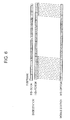
- a subframe of the HS-SCCH is provided so as to become a pair with a subframe of the HS-PDSCH immediately before that, and the control information (packet control information) used for demodulation and decoding of the packet data to be transmitted with the subframe of the HS-PDSCH to become the pair is transmitted.
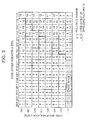
- a channelization code set (Channelisation Code set) of the HS-SCCH is defined.
- the base station 20 transmits, as information on a channelization code, identification information (information with total seven bits consisting of three bits of a code group and four bits of a code offset) of a region in which the channelization code is defined to the mobile station 10 by the HS-SCCH.
- identification information information with total seven bits consisting of three bits of a code group and four bits of a code offset
- This causes a multicode number of the channelization code and a code offset of the channelization code when a spreading factor (SF: Spreading Factor) is sixteen from the base station 20 to the mobile station 10 to be notified.
- SF Spreading Factor
- a multicode number of a channelization code is "5", and a code offset is "5".
- the base station 20 transmits information with total seven bits consisting of a code group "100" and a code offset "0100" as identification information of the region in which the channelization code is defined to the mobile station 10 by the HS-SCCH.
- the mobile station 10 determines that the multicode number of the channelization code is "5" and the code offset is "5" on the basis of the identification information received from the base station 20. The mobile station 10 then carries out decoding and demodulation of packet data to be transmitted by the HS-PDSCH using the channelization code.
- the base station 20 carries out setting of a transmission cycle of a CQI for the mobile station 10 using the free spaces.
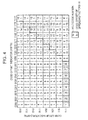
- labels 1 to 8 are preliminarily respectively assigned into free spaces in a channelization code set of the HS-SCCH, and transmission cycles of a CQI are associated with the respective labels 1 to 8. Association between the labels and the CQI transmission cycles is preliminarily registered in both the base station 20 and the mobile station 10.
- the base station 20 transmits, to the mobile station 10 by the HS-SCCH, identification information of a free space into which a label associated with the transmission cycle to be set up is assigned.
- a label "1" is assigned into a free space with a code group “111” and a code offset "0000”, and is associated with a transmission cycle "0 milliseconds" of the CQI.
- a label "2” is assigned into a free space with a code group “111” and a code offset "0001”, and is associated with a transmission cycle "two milliseconds" of the CQI.
- Fig. 5 shows a configuration of the base station 20 and the mobile station 10 used in the W-CDMA communication system shown in Fig. 2 .
- the base station 20 comprises a base station CQI transmission cycle registering section 202 and an identification information transmitting section 204.
- the base station CQI transmission cycle registering section 202 preliminarily registers transmission cycles of CQIs respectively associated with free spaces in each of which a channelization code in a channelization code set of the HS-SCCH is not defined (association table between labels and CQI transmission cycles).
- the identification information transmitting section 204 transmits identification information on the free space associated with the transmission cycle to be set up to the mobile station 10 by the HS-SCCH by referring to the base station CQI transmission cycle registering section 202.
- the mobile station 10 comprises a mobile station CQI transmission cycle registering section 102, an identification information receiving section 104, and a CQI transmitting section 106.
- the mobile station CQI transmission cycle registering section 102 preliminarily registers the transmission cycles of the CQI respectively associated with the free spaces in each of which a channelization code in the channelization code set of the HS-SCCH is not defined (the association table between the labels and the CQI transmission cycles).
- the identification information receiving section 104 receives the identification information of the free space from the base station 20 by the HS-SCCH.
- the CQI transmitting section 106 transmits the CQI to the base station 20 at the transmission cycle associated with this free space by referring to the mobile station CQI transmission cycle registering section 102.
- the identification information transmitting section 204 of the base station 20 transmits the identification information with the code group "111" and the code offset "0000", which indicates the free space of the label "1" in order to set up 0 milliseconds as the transmission cycle of the CQI.
- the identification information receiving section 104 of the mobile station 10 receives this identification information.
- the CQI transmitting section 106 of the mobile station 10 refers to the mobile station CQI transmission cycle registering section 102 from this identification information, and transmits the CQI to the base station 20 at the transmission cycle associated with this free space. In this case, inasmuch as the transmission cycle of the CQI is 0 milliseconds, the CQI transmitting section 106 does not transmit the CQI.
- the identification information transmitting section 204 of the base station 20 transmits the identification information with the code group "111" and the code offset "0001", which indicates the free space of the label "2", in order to set up two milliseconds as the transmission cycle of the CQI.
- the identification information receiving section 104 of the mobile station 10 receives this identification information.
- the CQI transmitting section 106 of the mobile station 10 refers to the mobile station CQI transmission cycle registering section 102 from this identification information, and transmits the CQI to the base station 20 at the transmission cycle associated with this free space. In this case, inasmuch as the transmission cycle of the CQI is two milliseconds, the CQI transmitting section 106 transmits the CQI at the transmission cycle of two milliseconds.
- the mobile station 10 stops transmission by the HS-DPCCH in a period of time other than during reception of packet data by the HS-PDSCH, in transmission of a CQI is not always necessary, it is possible to reduce redundant process in which the CQI is continued to be transmitted.
- the transmission cycle of the CQI is se HS-SCCH from the base station 20 to the mobile station 10, it is possI a channel resource of the HS-SCCH effectively.
- the transmission cycle of the be set up by the HS-SCCH from the base station to the mobile station
- the mo station 10 can adjust the transmission cycle of the COI set up by the b station 20 in accordance with a state of the mobile station 10.
- the mobile station 10 comprises an HSDP reception control section 11, an HS-SCCH decoding processing section download speed determination processing section 13, a CQI transmission determination processing section 14, and an HS-DPCCH generation processing section 15.
- Fig. 7 only constituent elements for carrying out a process from reception of notification of a transmission cycle of a CQI by the HS-SCCH to transmission of the CQI are shown, but constituent elements for carrying out a process of packet data received by the HS-PDSCH are omitted.
- the CQI transmitting section 16 is constructed by the CQI transmission determination processing section 14 and the HS-DPCCH generation processing section 15. This CQI transmitting section 16 corresponds to the CQI transmitting section 106 of Fig. 5 .
- the HS-SCCH decoding processing section 12 comprises a decoding section 122 and a decoded result outputting section 124.
- the decoding section 122 decodes the control information received by the HS-SCCH.
- the decoded result outputting section 124 outputs the decoded result a to the HSDPA reception control section 11.
- This HS-SCCH decoding processing section 12 corresponds to the identification information receiving section 104 of Fig. 5 .
- the download speed determination processing section 13 comprises a recommended download speed level determining section 132 and a speed level information outputting section 134.
- the recommended download speed level determining section 132 determines a recommended download speed level when to download packet data from the base station 20 by the HS-PDSCH on the basis of inputted information on a usage status of a mobile station by a user.
- the speed level information outputting section 134 outputs information b on the determined recommended download speed level to the HSDPA reception control section 11.
- the HSDPA reception control section 11 controls the HS-SCCH decoding processing section 12, the download speed determination processing section 13, the CQI transmission determination processing section 14, and the HS-DPCCH generation processing section 15 on the basis of control signals from the outside.
- the HSDPA reception control section 11 can provide parameters necessary for an operation of each of the processing sections, and can also control activation, stop, and initialization of each of the processing sections.
- the HSDPA reception control section 11 comprises a CQI transmission cycle determining section 112, a CQI transmission cycle adjusting section 114, and a CQI transmission cycle outputting section 116.
- the CQI transmission cycle determining section 112 determines a transmission cycle of the CQI set up by the base station 20 on the basis of the decoded result a of the control information from the HS-SCCH decoding processing section 12.
- the CQI transmission cycle adjusting section 114 adjusts the transmission cycle of the CQI set up by the base station 20 on the basis of the information b on the recommended download speed level from the download speed determination processing section 13.
- the CQI transmission cycle outputting section 116 outputs information c on the adjusted transmission cycle of the CQI to the CQI transmission determination processing section 14.
- the CQI transmission determination processing section 14 comprises a CQI effectiveness/ineffectiveness determining section 142 and a CQI effectiveness information outputting section 144.
- the CQI effectiveness/ineffectiveness determining section 142 determines for every subframe whether a CQI to be mapped on the HS-DPCCH is set to effectiveness or not on the basis of the information c on the transmission cycle of the CQI from the HSDPA reception control section 11.
- the CQI effectiveness information outputting section 144 outputs information d on the determined CQI effectiveness to the HS-DPCCH generation processing section 15.
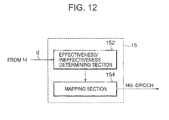
- the HS-DPCCH generation processing section 15 comprises an effectiveness/ineffectiveness determining section 152 and a mapping section 154.
- the effectiveness/ineffectiveness determining section 152 determines for every subframe whether the information d of the CQI effectiveness from the CQI transmission determination processing section 14 indicates effective or not.
- the mapping section 154 maps the CQI on the HS-DPCCH.
- the HSDPA reception control section 11 first initializes the HS-SCCH decoding processing section 12, the download speed determination processing section 13, the CQI transmission determination processing section 14 and the HS-DPCCH generation processing section 15 when to start communication of HSDPA (Step S1).
- the HSDPA reception control section 11 supplies parameters necessary for the operations to the HS-SCCH decoding processing section 12, the download speed determination processing section 13, the CQI transmission determination processing section 14 and the HS-DPCCH generation processing section 15, and activates each of the processing sections at the appropriate timing (Step S2).
- the decoding section 122 decodes the control information received by the HS-SCCH, and the decoded result outputting section 124 outputs the decoded result a to the HSDPA reception control section 11. This process is periodically repeated in a subframe unit.
- the recommended download speed level determining section 132 determines a recommended download speed level when to download packet data from the base station 20 by the HS-PDSCH on the basis of information on a usage status of the mobile station by the user, and the speed level information outputting section 134 outputs the information b on the determined recommended download speed level to the HSDPA reception control section 11. This process is periodically repeated in a subframe unit.
- Table 1 it is assumed that the mobile station 10 has a folding shape. Further, for example, although there is the case where a different recommended download speed level is set up depending on the usage status of the mobile station 10 (for example, the case where the mobile station 10 is connected to a USB with a closed state), it is to be changed which is adopted in such a case depending on initial setting.
- the CQI transmission cycle determining section 112 determines whether a channelization code is one for a free space or not on the basis of the control information.
- the CQI transmission cycle determining section 112 of the HSDPA reception control section 11 outputs the decoded result of the control information to the HS-PDSCH decoding processing section (not shown in the drawings).
- the CQI transmission cycle determining section 112 of the HSDPA reception control section 11 determines which of the labels 1 to 8 preliminarily assigned the free space corresponds to, and confirms the transmission cycle of the CQI associated with the determined label (Step S5).
- transmission cycles of the CQI as shown in Table 2 are associated with the labels 1 to 8, respectively.
- Table 2 Label CQI reporting cycle 1 0 milliseconds 2 2 milliseconds 3 4 millisecond 4 8 millisecond 5 10 milliseconds 6 20 milliseconds 7 80 milliseconds 8 160 milliseconds
- the above Table 2 is preliminarily registered in the mobile station CQI transmission cycle registering section 102 shown in Fig. 5 , and the CQI transmission cycle determining section 112 includes this mobile station CQI transmission cycle registering section 102.
- the CQI transmission cycle adjusting section 114 adjusts the transmission cycle of the CQI set up by the base station 20 on the basis of the information b on the recommended download speed level from the download speed determination processing section 13, and the CQI transmission cycle outputting section 116 outputs the information c on the adjusted transmission cycle of the CQI to the CQI transmission determination processing section 14 (Step S6).
- the CQI transmission cycle adjusting section 114 of the HSDPA reception control section 11 makes the transmission cycle of the CQI shorter.
- the recommended download speed level indicates medium speed, it holds the transmission cycle of the CQI as it is.
- the recommended download speed level indicates low speed, it makes the transmission cycle of the CQI longer. It is to be changed how long or short the transmission cycle of the CQI is made depending on the initial setting.
- the CQI effectiveness/ineffectiveness determining section 142 determines for every subframe whether a CQI to be mapped on the HS-DPCCH is made effective or not on the basis of the information c on the transmission cycle of the CQI set as an initial value by the HSDPA reception control section 11 immediately after activation, and the CQI effectiveness information outputting section 144 outputs the information d on the determined CQI effectiveness to the HS-DPCCH generation processing section 15 (Step S7). This process is periodically repeated in a subframe unit.
- the CQI effectiveness/ineffectiveness determining section 142 determines for every subframe whether the CQI to be mapped on the HS-DPCCH is made effective or not on the basis of the information c on a new transmission cycle of the CQ I, and the CQI effectiveness information outputting section 144 outputs the information d on the determined CQI effectiveness to the HS-DPCCH generation processing section 15 (Step S7). This process is periodically repeated in a subframe unit.
- the effectiveness/ineffectiveness determining section 152 determines for every subframe whether the information d on the CQI effectiveness from the CQI transmission determination processing section 14 indicates effective or not, and the mapping section 154 maps the CQI on the HS-DPCCH in the case where the information d on the CQI effectiveness indicates effective (Step S8). This process is periodically repeated in a subframe unit.
- the mobile station 10 determines recommended download speed in accordance with a status of use of a mobile station by a user, and adjusts a transmission cycle of the CQI set up in the base station 20 in accordance with the recommended download speed.
- the mobile station 10 can flexibly change the transmission cycle of the CQI during HS-PDSCH reception in accordance with the recommended download speed, the download speed can be changed at the initiative of the mobile station 10 due to real-time need of an HSDPA packet.
- the present invention is not limited to the embodiment described above, of course.
- a report of the CQI in the case where it is notified from the base station 20 that a reporting cycle of the CQI is 0 milliseconds, a report of the CQI is completely stopped.
- a report of the CQI not only a report of the CQI but also a report of the ACK (Acknowledgment) and NACK (Negative Acknowledgment) may be stopped.
- connection status or an open/close status of the mobile station 10 has been used as a tool for determining a status of use of a mobile station by a user, a fee structure signed by the user, a remaining battery level when a battery charger is not connected to the mobile station 10, or the like may be used in the present invention.
Landscapes
- Engineering & Computer Science (AREA)
- Quality & Reliability (AREA)
- Computer Networks & Wireless Communication (AREA)
- Signal Processing (AREA)
- Mobile Radio Communication Systems (AREA)
Applications Claiming Priority (2)
| Application Number | Priority Date | Filing Date | Title |
|---|---|---|---|
| JP2006235687 | 2006-08-31 | ||
| PCT/JP2007/067239 WO2008026762A1 (fr) | 2006-08-31 | 2007-08-29 | Système de communication d'accès multiple par répartition de code à large bande (w-cdma) et procédé de commande de cycle de transmission à indication de qualité de canal (cqi) |
Publications (3)
| Publication Number | Publication Date |
|---|---|
| EP2096877A1 true EP2096877A1 (fr) | 2009-09-02 |
| EP2096877A4 EP2096877A4 (fr) | 2013-04-03 |
| EP2096877B1 EP2096877B1 (fr) | 2014-08-20 |
Family
ID=39136037
Family Applications (1)
| Application Number | Title | Priority Date | Filing Date |
|---|---|---|---|
| EP07806694.1A Not-in-force EP2096877B1 (fr) | 2006-08-31 | 2007-08-29 | Appareil de communication d'accès multiple par répartition de code à large bande (w-cdma) et procédé de commande de cycle de transmission à indication de qualité de canal (cqi) |
Country Status (5)
| Country | Link |
|---|---|
| US (1) | US8948140B2 (fr) |
| EP (1) | EP2096877B1 (fr) |
| JP (1) | JP4998752B2 (fr) |
| CN (1) | CN101512950B (fr) |
| WO (1) | WO2008026762A1 (fr) |
Cited By (1)
| Publication number | Priority date | Publication date | Assignee | Title |
|---|---|---|---|---|
| US9473958B2 (en) | 2011-12-30 | 2016-10-18 | Huawei Technologies Co., Ltd. | Method, apparatus, and system for adjusting CQI feedback cycle |
Families Citing this family (8)
| Publication number | Priority date | Publication date | Assignee | Title |
|---|---|---|---|---|
| JP2009296537A (ja) * | 2008-06-09 | 2009-12-17 | Fujitsu Ltd | 無線リソース割当要求送信周期の制御方法 |
| US20100110964A1 (en) * | 2008-11-04 | 2010-05-06 | Motorola, Inc. | Method for Relays within Wireless Communication Systems |
| CN102648644B (zh) | 2009-10-19 | 2015-11-25 | 爱立信(中国)通信有限公司 | 无线通信系统中的方法和装置 |
| CN102098583A (zh) * | 2009-12-11 | 2011-06-15 | Tcl集团股份有限公司 | 一种网络节目交互系统及其节目交互方法 |
| WO2011162519A2 (fr) * | 2010-06-22 | 2011-12-29 | Pantech Co., Ltd. | Procédé et appareil d'envoi et de réception d'informations d'attribution de ressources pour transmission apériodique de signal de référence de sondage |
| US9722712B2 (en) * | 2011-05-09 | 2017-08-01 | Centre Of Excellence In Wireless Technology | Interference management for a distributed spatial network |
| US9357420B2 (en) | 2011-07-15 | 2016-05-31 | Lg Electronics Inc. | Method and apparatus for reporting channel state |
| CN104115538B (zh) * | 2012-02-06 | 2019-03-22 | 诺基亚技术有限公司 | 用于上行链路通信的方法和装置 |
Family Cites Families (11)
| Publication number | Priority date | Publication date | Assignee | Title |
|---|---|---|---|---|
| JPH03199173A (ja) | 1989-12-28 | 1991-08-30 | Daihen Corp | 窒化ケイ素セラミックス用接合剤 |
| CA2408423C (fr) * | 2001-10-17 | 2013-12-24 | Nec Corporation | Systeme de communication mobile, methode de controle des communications, et station de base et station mobile utilisees dans ce systeme |
| KR100837351B1 (ko) * | 2002-04-06 | 2008-06-12 | 엘지전자 주식회사 | 이동통신 시스템의 무선링크 파라미터 갱신 방법 |
| JP3512783B1 (ja) | 2002-10-08 | 2004-03-31 | 松下電器産業株式会社 | 通信端末装置及び基地局装置 |
| JP4013729B2 (ja) | 2002-10-24 | 2007-11-28 | 日本電気株式会社 | 移動通信システム、移動局、基地局及びそれらに用いるパケット通信方法 |
| WO2004077871A1 (fr) | 2003-02-27 | 2004-09-10 | Mitsubishi Denki Kabushiki Kaisha | Station de base, terminal et systeme de communication |
| JP4363170B2 (ja) * | 2003-12-11 | 2009-11-11 | 日本電気株式会社 | 移動通信システムおよび移動無線端末 |
| WO2005079095A1 (fr) * | 2004-02-16 | 2005-08-25 | Nokia Corporation | Procede et programme d'ordinateur permettant de commander des ressources radio, equipement utilisateur, unite de commande de reseau radio et station de base |
| WO2006065181A1 (fr) * | 2004-12-17 | 2006-06-22 | Telefonaktiebolaget L M Ericsson (Publ) | Appareil et procede mis en oeuvre dans un reseau cellulaire |
| FI20055009A0 (fi) * | 2005-01-05 | 2005-01-05 | Nokia Corp | Datan lähettäminen matkaviestinjärjestelmässä |
| BRPI0616542B1 (pt) | 2005-08-24 | 2019-07-16 | Interdigital Technology Corporation | Método e aparelho de ajuste do período de retroalimentação do indicador de qualidade de canais para aumentar a capacidade do link superior |
-
2007
- 2007-08-29 JP JP2008532147A patent/JP4998752B2/ja not_active Expired - Fee Related
- 2007-08-29 US US12/438,779 patent/US8948140B2/en not_active Expired - Fee Related
- 2007-08-29 CN CN200780032033.2A patent/CN101512950B/zh not_active Expired - Fee Related
- 2007-08-29 EP EP07806694.1A patent/EP2096877B1/fr not_active Not-in-force
- 2007-08-29 WO PCT/JP2007/067239 patent/WO2008026762A1/fr not_active Ceased
Cited By (1)
| Publication number | Priority date | Publication date | Assignee | Title |
|---|---|---|---|---|
| US9473958B2 (en) | 2011-12-30 | 2016-10-18 | Huawei Technologies Co., Ltd. | Method, apparatus, and system for adjusting CQI feedback cycle |
Also Published As
| Publication number | Publication date |
|---|---|
| CN101512950A (zh) | 2009-08-19 |
| JP4998752B2 (ja) | 2012-08-15 |
| WO2008026762A1 (fr) | 2008-03-06 |
| US20090316662A1 (en) | 2009-12-24 |
| JPWO2008026762A1 (ja) | 2010-01-21 |
| US8948140B2 (en) | 2015-02-03 |
| EP2096877A4 (fr) | 2013-04-03 |
| EP2096877B1 (fr) | 2014-08-20 |
| CN101512950B (zh) | 2012-11-14 |
Similar Documents
| Publication | Publication Date | Title |
|---|---|---|
| EP2096877B1 (fr) | Appareil de communication d'accès multiple par répartition de code à large bande (w-cdma) et procédé de commande de cycle de transmission à indication de qualité de canal (cqi) | |
| EP1400049B1 (fr) | Procede permettant de regler de maniere adaptative des parametres de transmission destines a une procedure de sens montant de transmission sur un canal d'acces aleatoire dans un systeme de communication sans fil | |
| EP2146439B1 (fr) | Réception discontinue pour équipement utilisateur | |
| CN101238688B (zh) | 增加高速上行链路分组接入容量的方法、用户设备、网元以及系统 | |
| EP1911317B1 (fr) | Portillonnage de voie de controle de liaison montante dynamique pour l'augmentation de la capacite | |
| EP1374625B1 (fr) | Transmissions dans un systeme de communication | |
| EP2595442B1 (fr) | Signalisation coordonnée d'informations de programmation pour communications en liaison montante et descendante | |
| US7593363B2 (en) | Data transmission method | |
| EP3295701B1 (fr) | Procédé et appareil d'attribution de ressources pour un duplexage par répartition en fréquence en semi-duplex dans un système de communication sans fil | |
| US20080043681A1 (en) | Gap and preamble parameters for control channel transmission | |
| EP2765728A2 (fr) | Signalisation de commande l1 améliorée pour HSDPA UTRAN | |
| CN103209469A (zh) | 用于减少移动通信网络中的功耗的方法和设备 | |
| AU2002304333A1 (en) | Transmissions in a communication system | |
| CN104871611A (zh) | 功率余量的报告方法和装置 | |
| EP2819338A1 (fr) | Procédé, dispositif et système pour envoyer, recevoir et établir des informations de référence de synchronisation | |
| EP2731290A1 (fr) | Procédé, équipement utilisateur et dispositif de station de base pour transmettre des informations d'indication | |
| KR101160604B1 (ko) | 통신 시스템 동작 방법, 통신 시스템 및 이동국 | |
| JP4645208B2 (ja) | 無線通信装置 | |
| WO2016122394A1 (fr) | Procédé permettant d'améliorer l'efficacité en liaison montante de dispositifs à couverture limitée | |
| EP1626535B1 (fr) | Méthode et dispositif pour un réseau de communication sans fil fonctionnant en mode compressé | |
| CN105830505A (zh) | 通信设备和非连续传输的方法 | |
| CN106793102B (zh) | 系统配置指示方法及装置 | |
| KR101368647B1 (ko) | 고속 무선통신 네트워크에서 상향링크 음성패킷 재전송 방법 및 시스템 | |
| AU2008200143A1 (en) | Transmissions in a communication system | |
| JP4793500B2 (ja) | 無線通信システム |
Legal Events
| Date | Code | Title | Description |
|---|---|---|---|
| PUAI | Public reference made under article 153(3) epc to a published international application that has entered the european phase |
Free format text: ORIGINAL CODE: 0009012 |
|
| 17P | Request for examination filed |
Effective date: 20090327 |
|
| AK | Designated contracting states |
Kind code of ref document: A1 Designated state(s): AT BE BG CH CY CZ DE DK EE ES FI FR GB GR HU IE IS IT LI LT LU LV MC MT NL PL PT RO SE SI SK TR |
|
| AX | Request for extension of the european patent |
Extension state: AL BA HR MK RS |
|
| RIC1 | Information provided on ipc code assigned before grant |
Ipc: H04W 4/00 20090101AFI20090731BHEP |
|
| DAX | Request for extension of the european patent (deleted) | ||
| REG | Reference to a national code |
Ref country code: DE Ref legal event code: R079 Ref document number: 602007038246 Country of ref document: DE Free format text: PREVIOUS MAIN CLASS: H04W0004000000 Ipc: H04L0001000000 |
|
| A4 | Supplementary search report drawn up and despatched |
Effective date: 20130228 |
|
| RIC1 | Information provided on ipc code assigned before grant |
Ipc: H04L 1/00 20060101AFI20130222BHEP |
|
| GRAP | Despatch of communication of intention to grant a patent |
Free format text: ORIGINAL CODE: EPIDOSNIGR1 |
|
| INTG | Intention to grant announced |
Effective date: 20140314 |
|
| RBV | Designated contracting states (corrected) |
Designated state(s): DE FR GB IT |
|
| GRAS | Grant fee paid |
Free format text: ORIGINAL CODE: EPIDOSNIGR3 |
|
| GRAA | (expected) grant |
Free format text: ORIGINAL CODE: 0009210 |
|
| AK | Designated contracting states |
Kind code of ref document: B1 Designated state(s): DE FR GB IT |
|
| REG | Reference to a national code |
Ref country code: GB Ref legal event code: FG4D |
|
| REG | Reference to a national code |
Ref country code: DE Ref legal event code: R096 Ref document number: 602007038246 Country of ref document: DE Effective date: 20141002 |
|
| RAP2 | Party data changed (patent owner data changed or rights of a patent transferred) |
Owner name: LENOVO INNOVATIONS LIMITED (HONG KONG) |
|
| REG | Reference to a national code |
Ref country code: DE Ref legal event code: R097 Ref document number: 602007038246 Country of ref document: DE |
|
| PLBE | No opposition filed within time limit |
Free format text: ORIGINAL CODE: 0009261 |
|
| STAA | Information on the status of an ep patent application or granted ep patent |
Free format text: STATUS: NO OPPOSITION FILED WITHIN TIME LIMIT |
|
| 26N | No opposition filed |
Effective date: 20150521 |
|
| PGFP | Annual fee paid to national office [announced via postgrant information from national office to epo] |
Ref country code: IT Payment date: 20150827 Year of fee payment: 9 |
|
| REG | Reference to a national code |
Ref country code: FR Ref legal event code: PLFP Year of fee payment: 10 |
|
| PGFP | Annual fee paid to national office [announced via postgrant information from national office to epo] |
Ref country code: DE Payment date: 20160823 Year of fee payment: 10 Ref country code: GB Payment date: 20160824 Year of fee payment: 10 |
|
| PGFP | Annual fee paid to national office [announced via postgrant information from national office to epo] |
Ref country code: FR Payment date: 20160712 Year of fee payment: 10 |
|
| PG25 | Lapsed in a contracting state [announced via postgrant information from national office to epo] |
Ref country code: IT Free format text: LAPSE BECAUSE OF NON-PAYMENT OF DUE FEES Effective date: 20160829 |
|
| REG | Reference to a national code |
Ref country code: DE Ref legal event code: R119 Ref document number: 602007038246 Country of ref document: DE |
|
| GBPC | Gb: european patent ceased through non-payment of renewal fee |
Effective date: 20170829 |
|
| REG | Reference to a national code |
Ref country code: FR Ref legal event code: ST Effective date: 20180430 |
|
| PG25 | Lapsed in a contracting state [announced via postgrant information from national office to epo] |
Ref country code: DE Free format text: LAPSE BECAUSE OF NON-PAYMENT OF DUE FEES Effective date: 20180301 Ref country code: GB Free format text: LAPSE BECAUSE OF NON-PAYMENT OF DUE FEES Effective date: 20170829 |
|
| PG25 | Lapsed in a contracting state [announced via postgrant information from national office to epo] |
Ref country code: FR Free format text: LAPSE BECAUSE OF NON-PAYMENT OF DUE FEES Effective date: 20170831 |