EP2096879A2 - Drahtlose Datenübertragung einer gekühlten Behältereinheit - Google Patents
Drahtlose Datenübertragung einer gekühlten Behältereinheit Download PDFInfo
- Publication number
- EP2096879A2 EP2096879A2 EP09002551A EP09002551A EP2096879A2 EP 2096879 A2 EP2096879 A2 EP 2096879A2 EP 09002551 A EP09002551 A EP 09002551A EP 09002551 A EP09002551 A EP 09002551A EP 2096879 A2 EP2096879 A2 EP 2096879A2
- Authority
- EP
- European Patent Office
- Prior art keywords
- reefer
- data
- accordance
- mode
- unit
- Prior art date
- Legal status (The legal status is an assumption and is not a legal conclusion. Google has not performed a legal analysis and makes no representation as to the accuracy of the status listed.)
- Withdrawn
Links
- 230000005540 biological transmission Effects 0.000 title claims 3
- 230000006854 communication Effects 0.000 claims abstract description 24
- 238000004891 communication Methods 0.000 claims abstract description 24
- 238000012544 monitoring process Methods 0.000 claims abstract description 24
- 238000000034 method Methods 0.000 claims abstract description 16
- 238000011156 evaluation Methods 0.000 claims abstract description 11
- 230000004044 response Effects 0.000 claims description 6
- 230000002457 bidirectional effect Effects 0.000 claims description 2
- 238000012360 testing method Methods 0.000 claims 2
- 238000005516 engineering process Methods 0.000 claims 1
- 230000006870 function Effects 0.000 description 6
- 230000008569 process Effects 0.000 description 6
- 230000007704 transition Effects 0.000 description 5
- 230000008859 change Effects 0.000 description 4
- 238000001816 cooling Methods 0.000 description 4
- 230000007175 bidirectional communication Effects 0.000 description 3
- 238000001514 detection method Methods 0.000 description 3
- 238000013461 design Methods 0.000 description 2
- 238000010586 diagram Methods 0.000 description 2
- 238000006467 substitution reaction Methods 0.000 description 2
- 238000013519 translation Methods 0.000 description 2
- 230000000007 visual effect Effects 0.000 description 2
- 125000004122 cyclic group Chemical group 0.000 description 1
- 230000002939 deleterious effect Effects 0.000 description 1
- 239000000446 fuel Substances 0.000 description 1
- 230000010354 integration Effects 0.000 description 1
- 238000012423 maintenance Methods 0.000 description 1
- 238000004519 manufacturing process Methods 0.000 description 1
- 230000007246 mechanism Effects 0.000 description 1
- 238000005057 refrigeration Methods 0.000 description 1
- 238000013024 troubleshooting Methods 0.000 description 1
- XLYOFNOQVPJJNP-UHFFFAOYSA-N water Substances O XLYOFNOQVPJJNP-UHFFFAOYSA-N 0.000 description 1
Images

Classifications
-
- H—ELECTRICITY
- H04—ELECTRIC COMMUNICATION TECHNIQUE
- H04Q—SELECTING
- H04Q9/00—Arrangements in telecontrol or telemetry systems for selectively calling a substation from a main station, in which substation desired apparatus is selected for applying a control signal thereto or for obtaining measured values therefrom
Definitions
- the present invention is directed to temperature controlled containers, and in particular, to two way wireless monitoring and controlling of Reefer Units associated with temperature controlled containers.
- Temperature controlled containers are used to ship or transport assets requiring temperature controlled environments such as, but not limited to, perishable food. Such temperature controlled containers are typically mobile, for example, being transported via road, railroad or water.
- the present invention concerns a "Reefer Tag", which will connect to temperature controlled containers via a serial device such as an RS232 interface.
- a serial device such as an RS232 interface.
- the Reefer Tag Periodically and/or on command from an RFID Reader/Transmitter, the Reefer Tag establishes communications with a Reefer Unit and retrieves reefer or container information about a corresponding temperature controlled container.
- Each Reefer Unit has an associated controller or microprocessor (4b, 5b, 6b). Accordingly, the Reefer Tag and controller or microprocessor of the associated Reefer Unit communicates with one another.
- the Reefer Tag is preferably compatible with multiple protocols and different baud rates that are used with existing and/or future controllers or microprocessors of the Reefer Units.
- the Reefer Tag preferably automatically detects the proper baud rate from a group of predetermined speeds, for example, a group of baud rates including approximately 1200 Baud, 2400 Baud, 4800 Baud, 9600 Baud, or 19.2 kilo Baud or higher.
- One embodiment of the present invention is directed to a system for monitoring data associated with a temperature controlled container with a Reefer Unit.
- the monitored data retrieved from the Reefer Unit is wirelessly transmitted to an evaluation unit via at least one transponder.
- the transponder is connected via a wireless interface of an antenna with a reader/transmitter.
- the wireless interface transmits the monitored data via a bus from the reader/transmitter to a converter which then transmits the converted monitored data via a communication interface to the evaluation unit.
- the system can also issue remote forward commands to provide full automation and control of such containers.
- Another embodiment of the present invention is directed to a method for evaluating information associated with and control of at least one Reefer Unit for at least one temperature controlled container.
- Data associated with at least one temperature controlled container with the at least one Reefer Unit is retrieved and transmitted wirelessly from at least one transponder to at least one reader/transmitter.
- the received data is transmitted to a host computer via the at least one reader/transmitter.
- Host software is used to evaluate the data received by the host computer and display the evaluated data.
- the invention further relates to the generation by the host software at the host computer of at least one of a command, control and programming signal which is transmitted from the host computer to the at least one reader/transmitter.
- This at least one command, control and programming signal is passed from the at least one reader/transmitter to the at least one Reefer Unit, with or without the at least one transponder interpreting the data.
- the at least one transponder will preferably receive the response from the at least one Reefer Unit to this at least one command, control and programming signal and transmit it to the host computer using the at least one reader/transmitter.
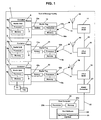
- FIG. 1 depicts an exemplary yard or storage facility which includes three temperature controlled containers 1, 2, 3 in which a product, item, object, cargo or asset is housed or contained during shipment or transport.
- the temperature controlled containers may be mobile and transportable via a vehicle, ship, railroad car or other means of transport.
- Three temperature controlled container units 1, 2, 3 are illustrated, however, any number of one or more temperature controlled containers are contemplated and within the intended scope of the present invention.
- Each temperature controlled container 1, 2, 3 has a corresponding Reefer Unit (e.g., refrigeration or cooling device) 4, 5, 6 mounted to or disposed at least partially in the temperature controlled container.
- Reefer Unit e.g., refrigeration or cooling device
- Reefer Units 4, 5, 6 use sensors to measure physical environment parameters, for example, interior temperature of the container is detected by sensor T1, ambient temperature is detected by sensor T0, interior humidity of the container, ambient humidity, close/open state of the door of the temperature controlled container) and transmits this data via the respective serial bus 7, 8, 9 to Reefer Tags 10, 11, 12.
- a Reefer Tag 10, 11, 12 is a transponder or radio frequency identification (RFID) tag electrically connected to each Reefer Unit 4, 5, 6 by way of a communication interface, preferably a bi-directional serial bus 7, 8, 9 such as an RS232.
- RFID radio frequency identification
- Both the Reefer Tags and Reefer Units preferably have corresponding internal memory devices (10a, 11a, 12a)(4a, 5a, 6a).
- Each Reefer Tag is a self-powered, autonomous two-way communications device that attaches to an existing data port connection present on all temperature controlled containers.
- the electronic circuitry for operating the Reefer Tag including the processor (10b, 11 b, 12b) is enclosed in a housing such as plastic.
- Each Reefer Tag is mounted to a Reefer Unit either permanently or via a standardized releasable connector (e.g., magnetic mounting pad).
- the Reefer Tag is an active tag self-powered by a replaceable internal battery (10c, 11c, 12c), preferably having a lifetime of approximately 3 years. Since the Reefer Tag is self-powered, there is no need for an external power source. Communication range is preferably relative long (e.g., up to approximately 500 m) and depends on such factors as the battery lifetime and system features.
- Each Reefer Tag is programmed to: (i) identify and communicate with the Reefer Unit; (ii) detect if a Reefer Unit or other serial device is connected to the Reefer Tag and, if so, determine whether the Reefer Unit or other serial device is powered ON; (iii) monitor information associated with the Reefer Unit without requiring continuous communication beteen the Reefer Unit and Host Computer (such monitoring is flexibly configured by the Host Computer (e.g., set monitoring interval and/or specify data to be monitored); (iv) establish bidirectional communication between the Reefer Unit and Host Computer.
- the Reefer Tag Since the Reefer Tag is self-powered, even if the Reefer Unit is powered OFF and communication is disabled, the Reefer Tag is still able to detect whether a Reefer Unit is connected to the Reefer Tag and, if so, its power status. In addition, any previously reported information prior to powering OFF of the Reefer Unit will be able to be obtained by the Reefer Tag.
- Reefer Tags 10, 11, 12 send data to and receive data from a corresponding RFID antenna 16 via bidirectional wireless interfaces 13, 14, 15.
- Each antenna 16 is electrically connected with a corresponding RFID reader/transmitter 17, 18, 19 such as an i-Port M350.
- a Compact flash reader/transmitter may be used in integration with a handheld RFID reader/transmitter.
- the Reefer Tag and the corresponding antenna are preferably separated by up to approximately 500 m. The number of RFID readers/transmitters used per site will depend on the site size and configuration of the RFID readers/transmitters.
- three RFID readers/transmitters 17, 18, 19 are daisy chained via bus 20 and connected to the host computer or server 23 via a single converter 21 (e.g., RS422 converter) and interface 22 (e.g., Ethernet, LAN, WLAN, USB, or wireless interface).
- a single converter 21 is shown more than one may be provided, one per each reader/transmitter.
- Evaluation host software such as a web based software application in a computer readable medium and stored in a memory device associated with the host computer or server 23 collects, analyzes, disseminates & displays (e.g., in the form of graphs and/or reports) the received reefer information. The final data may be pushed through to be accessible by user interfaces.
- Associated application programming interface (API) 25 is provided for the host software 24 stored in an internal memory 23a and run on a processor 23b associated with the host computer 23.
- the host software 24 uses the API 25 to access all functionalities of the system thereby simplifying implementation of the host software.
- Those API provide a high level of interface and abstraction for all available features. For example, the host software automatically receives an event if something has changed, while a command sent to a Reefer Unit even if composed of multiple data exchange between Reefer Tag and RFID transmitter/reader will be a simple command for the host software.
- the API implements all functionalities including, but not limited to:
- the reefer or container information may include, for example, set temperature, detected temperature, alarm conditions, door status, asset location, gate movements, preventative maintenance, and fuel levels.
- the host software may be used to wirelessly transmit forward command, programming or control signals back to the Reefer Unit to adjust one or more physical parameters based on the received reefer information thereby providing full automation and control.
- Some functions that may be controlled by the host computer 23 include, but are not limited to: (i) alarm clearing; (ii) pre-trip start/stop, and (iii) set point changes to a physical parameter. Such adjustment may be controlled either automatically based on preset physical condition threshold parameters, or alternatively may be controlled based on operator or user input.
- the RFID reader/transmitter 17, 18, 19 receives broadcast messages from Reefer Tags 10, 11, 12, and process command, control and/or programming signals generated by the host software using the API and circuitry associated with the host computer 23.
- the daisy chain of RFID readers/transmitters can be connected via cables (e.g., CAT 5 cable) with the power to the RFID readers/transmitters transmitted over the communication cable.
- cables e.g., CAT 5 cable
- Some limitations apply based on the cable length, number of readers/transmitters per bus and power supply used to power the RFID readers/transmitters.
- Each Reefer Tag 10, 11, 12 preferably has an associated audible and/or visual display (e.g., one or more LEDs) for identifying the status of one or more functions of the Reefer Tag.
- an associated audible and/or visual display e.g., one or more LEDs
- such function is not limited to but may include: (i) battery life status; (ii) power status (e.g., ON/OFF) of the Reefer Tag, and (iii) whether the Reefer Tag is physically connected to a serial port and communication has been established with a Reefer Unit.
- the status of one or more Reefer Tag functions is preferably checked either periodically or continuously while the Reefer Tag is connected to a Reefer Unit 4, 5, 6.
- the status of one or more Reefer Tag functions may also be checked upon receiving a request from an operator such as by pushing a button associated with the Reefer Tag.
- each Reefer Tag 10, 11, 12 may have three LEDs that will blink for a predetermined period of time, e.g., approximately 5 seconds.
- the three exemplary LEDs are programmed as follows:
- Reefer Tag 10, 11, 12 broadcasts to the host computer 23 on a predetermined configurable interval (e.g., approximately every 20 to 60 seconds) a message including, but not restricted to:
- Each Reefer Tag 10, 11, 12 is programmed to operate in one of five modes including: (i) standby mode; (ii) standard mode; (iii) monitoring mode; (iv) connecting mode, and (v) transparent or pass-through mode.
- Figure 2 is an exemplary flow diagram representing the transition conditions between Reefer Tag modes.
- Reefer Tag 10, 11, 12 is not connected to a corresponding Reefer Unit 4, 5, 6.
- the Reefer Tag 10, 11, 12 clears from memory all information regarding the Reefer Unit 4, 5, 6 to which it was previously connected.
- Reefer Tag 10, 11, 12 remains in standby mode 24 as long as it does not detect any serial device (e.g., RS232) connection to the serial port depicted by step 24a.
- a connection of a serial device to the serial port is determined by checking the Reefer Tag RX pin and/or power pin state. If The RX pin is active, then a device is connected and powered ON. But if RX pin is not active then the state of the power pin is checked. If the power pin state is active this means a device is connected but not powered, and if the power pin state is not active this indicates that no device is connected.
- Reefer Tag 10, 11, 12 is placed in connecting mode in step 25.
- the connecting mode is only a transition state while an operator physically connects the Reefer Tag 10, 11, 12 to the corresponding Reefer Unit 4, 5, 6. If the connection to the serial device is lost while in connecting mode, at step 25a, the Reefer Tag 10, 11, 12 is again disconnected and returns to standby mode in block 24. Otherwise, while in the connecting mode depicted by block 25 with the serial device connection in place the Reefer Tag 10, 11, 12 attempts to establish communication and retrieve container or reefer information, at step 26.
- the Reefer Tag 10, 11, 12 sends a signal identifying the type of Reefer Unit controller/microprocessor (e.g., CarrierTM, Thermo KingTM) and its unique serial number at the proper baud rate for that particular controller/microprocessor.
- the Reefer Tag is preferably compatible with multiple types of controllers/microprocessors having different protocols and baud rates. In such a situation, the Reefer Tag preferably automatically detects the proper baud rate, typically, from among approximately 1200 Baud, 2400 Baud, 4800 Baud, 9600 Baud, 19.2 kilo Baud, for the particular type of Reefer Unit controller/microprocessor.
- a unique serial number and associated information of the Reefer Unit controller is stored in memory at the time of manufacture. This information is retrieved by the Reefer Tag using the controller specific command. To retrieve the correct controller type/baud rate the Reefer Tag attempts to communicate with the controller using all known type/baud rate configurations. Once communication is successful and the baud rate has been found, the Reefer Tag retrieves the unique serial number and information using the command or set of commands specific to the controller type connected to the Reefer Tag.
- the Reefer Tag 10, 11, 12 attempts all supported baud rates for a particular type of controller/microprocessor and if communication fails it will again try all supported controller type/baud rates, reattempting preferably approximately every 5 minutes.
- the reefer or container information once it has been successfully read, at step 26, is stored in an internal or associated memory and the Reefer Tag 10, 11, 12 is placed into standard mode, at step 28. While in the standard mode (block 28), the Reefer Tag 10, 11, 12 is connected to and retrieves from the Reefer Unit 4, 5, 6 information regarding its type of controller/microprocessor and unique serial number.
- the host software configures the Reefer Tag to monitor the Reefer Unit.
- Monitoring includes reading on a predetermined configurable time interval one or more specific tables and blocks from the memory associated with the Reefer Unit. Some Reefer Units may not have their memory configured as tables and blocks so monitoring may be done by other mechanism.
- the beacon message is configured so that one or more specified monitored bytes based on its position is transmitted in the message. In a preferred embodiment, a maximum of 32 bytes may be monitored. Successfully monitored data is always included in the beacon message, the monitoring mode only updates the monitored data with new data read from the Reefer Unit in order to be later broadcasted.
- the Reefer Tag reads table 15 block 1 of the Reefer Unit controller memory and adds to the broadcast monitoring message 2 bytes starting from position 0 15 1 10 5 Identical to that in the first row but adds to the broadcast monitoring message 5 bytes starting from position 10 11 2 5 1
- the Reefer Tag reads table 11 block 2 of the Reefer Unit controller memory and adds to the broadcast monitoring message 1 byte starting from position 5
- the beacon message reported to the host computer 23 is composed of 8 bytes including:
- the Reefer Tag cannot read all the data specified to be monitored only that data successfully read will be returned. If the connection to the serial device, which is checked continuously or periodically, for example at step 28a, is lost the Reefer Tag will disconnect at step 30 and return to standby mode 24. While monitoring the Reefer Unit, additional errors can be reported, for example, if a requested byte position is out of range. While in monitoring mode, if the Reefer Tag detects a disconnected RS232 interface (by checking the connection at the RX and power pin of the Reefer Tag)(step 29a), it will disconnect, at step 30, and return to standby mode 24. Furthermore, if there is a communication failure with the Reefer Unit while in monitoring mode the Reefer Tag will revert back to standard mode 28.
- the host computer or server 23 In addition to receiving container information from the Reefer Unit the host computer or server 23 is programmed to transmit back to the Reefer Unit command, control and/or programming signals during a transparent or pass-through mode (block 31).
- the transition from transparent mode to standard mode occurs at the end of execution of a transparent command. The end is either when the Reefer Tag has sent the transparent command it received from the host to the controller or when a response to the transparent command has been received by the Reefer Tag from the controller or when a timeout occurs.
- the command, control and/or programming signal generated by the host software of the host computer 23 is transmitted to the Reefer Unit, with or without the Reefer Tag interpreting the data. While in the transparent or pass-through mode the Reefer Tag will preferably only retransmit messages received with a destination address other than the Reefer Tag without interpreting the data. This does not preclude some type of protocol translation, for example, adding a cyclic redundancy check (CRC) or other error detection scheme if the translation is common to all types of Reefer Units.
- CRC cyclic redundancy check
- the transparent or pass-through mode thereby allows the host computer 23 to issue any specific command, control and/or programming signal back to the Reefer Unit.
- a single command, control and/or programming signal such as to read or write a single table block is issued via this transparent mode, not a time sequenced or complex command representing a succession of commands with a time restriction between commands.
- the reason for preferably restricting command, control and/or programming signals to a single command is because a predetermined maximum time restriction is set between 2 consecutive commands that may not be adhered to if the time between 2 consecutive commands is too short (which is usually the case with complex commands). Accordingly, single rather than complex commands are preferred.
- the preferred maximum message length of all communications is 255 Byte + Header.
- the Reefer tag has the following specifications: Identification code 32 bit fixed ID Read rate Up to 100 tags/s (only Identification Code) Up to 35 tags/s @ 128 bit data reading Response time ⁇ 300 ms (single tag) Multiple tags handling Up to 2,000 tags in the read zone Read/write range 200 m (656 ft) @ free air Line of sight at 19.2 Kbit/s Operating frequency 902 - 928 MHz (NA) ISM Band (narrow band). Data rate (upload to Reefer Tag) 19.2 up to 115.2 kbits/s Data rate (download to RFID reader/transmitter) 19.2 up to 115.2 kbits/s
- RFID readers/transmitters e.g., i-Port M350 reader/transmitter
- Read rate Up to 100 tags/s (only Identification Code) Up to 35 tags/s @ 128 bit data reading Response time ⁇ 300 ms (single tag) Multiple tags handling Up to 2,000 tags in the read zone Read/write range 500 m (650 ft) @ free air, Line of sight at 19.2 Kbit/s
- Data rate download to reader/transmitter) 19.2 up to 115.2 kbits/s
- communication from the Reefer Tag to the Reefer Unit is selected at one from a predetermined range of speeds: 9600 baud (by default) or 1200 baud. As indicated above, the Reefer Tag automatically determines the correct communication speed.
- the container information in this example is located in table 5, block 1, as follows:
- An application programming interface (API) 25 is provided to interface with the host software 24 as well as convert all communication between the host computer 23 and all RFID readers/transmitters and Reefer Tags on site.
- the Application Programming Interface will provide a method to be called by the host software at a predetermined interval of preferably approximately 2 seconds. This call will poll all RFID readers/transmitters for all Reefer Tag broadcast events received and process all events to report such events back to the host software. This tag event collection method is preferably not called simultaneously with any other commands.
- the application programming interface upon reception of events the application programming interface will define if the status of the Reefer Tag has changed and report any changes to the host computer.
- the Reefer/container information will be read and reported to the host software.
- the Reefer Tag will broadcast on a predefined interval this information but the event will only be reported once to the host software.
- the Reefer Tag reports such disconnected status to the host software.
- the Reefer Tag will broadcast on a predefined interval this information but this event will only be reported once to the host software. Detection of an error condition during monitoring of the Reefer Unit will also be reported to the host software.
- All monitored data read from the Reefer Unit on a configurable interval will continuously be sent by the Reefer Tag in the broadcast message.
- the API will check the monitored data and report to the host software any change in the data (change of at least 1 byte or change in data length).
- Those messages or events may include, but are not limited to:
- the host software may establish the monitoring configuration of the Reefer Tag. This monitoring configuration may be modified, as desired, at any time and as many times as needed via the host software.
- the Application Programming Interface will store internally in the host computer memory a list of all Reefer Tags in the field (including their status and other associated information) and all RFID readers/transmitters detected. All information regarding the Reefer Tag will be used to generate various alarm or event or to define which RFID reader/transmitter to use in order to communicate with a Reefer Tag.
- a reader has at least 2 connections, e.g., a master bus and a slave bus. Communication is received on the master bus and can be forwarded to the slave bus. The slave bus can be connected or disconnected by sending a configuration command. When the slave port is disconnected, data received on the master bus will not be forwarded to the slave bus.
- a device is given a configurable address, a special address is reserved for the device with the slave port disconnected. When using the special address for the device with disconnected slave port, no device or only 1 device will respond to the communication. Another special address is reserved for broadcasting so all readers will process the command but they will not acknowledge it. By default when a device starts it connects the slave port.
- the discovery process consists of:
- a configured bus is defined as a communication interface configured by the host software. Based on the type of RS422 converter it can be a serial port or an IP address. All physical communication interfaces shall be provided by the host software to the API.
Landscapes
- Engineering & Computer Science (AREA)
- Computer Networks & Wireless Communication (AREA)
- Arrangements For Transmission Of Measured Signals (AREA)
- Devices That Are Associated With Refrigeration Equipment (AREA)
Applications Claiming Priority (1)
| Application Number | Priority Date | Filing Date | Title |
|---|---|---|---|
| US3194308P | 2008-02-27 | 2008-02-27 |
Publications (2)
| Publication Number | Publication Date |
|---|---|
| EP2096879A2 true EP2096879A2 (de) | 2009-09-02 |
| EP2096879A3 EP2096879A3 (de) | 2013-03-06 |
Family
ID=40886626
Family Applications (1)
| Application Number | Title | Priority Date | Filing Date |
|---|---|---|---|
| EP09002551A Withdrawn EP2096879A3 (de) | 2008-02-27 | 2009-02-24 | Drahtlose Datenübertragung einer gekühlten Behältereinheit |
Country Status (2)
| Country | Link |
|---|---|
| US (1) | US8374824B2 (de) |
| EP (1) | EP2096879A3 (de) |
Cited By (2)
| Publication number | Priority date | Publication date | Assignee | Title |
|---|---|---|---|---|
| ES2428222A1 (es) * | 2013-06-26 | 2013-11-06 | Grup Maritim Tcb, S.L. | Sistema y método para el tratamiento y control de la temperatura en contenedores de transporte refrigerados |
| US9766600B2 (en) | 2011-08-17 | 2017-09-19 | Apm Terminals Management B.V. | Management system for refrigerated containers |
Families Citing this family (23)
| Publication number | Priority date | Publication date | Assignee | Title |
|---|---|---|---|---|
| CN101715583A (zh) * | 2007-01-09 | 2010-05-26 | 斯塔尔特拉克系统有限公司 | 冷藏航运集装箱与发运单的关联 |
| US8334781B2 (en) * | 2007-03-30 | 2012-12-18 | Mark-It Services | Apparatus and method for wireless monitoring |
| KR101548959B1 (ko) * | 2008-06-04 | 2015-09-01 | 삼성전자주식회사 | 패킷 통신 시스템에서 네트워크 주소 설정을 위한 장치 및방법 |
| US8680966B2 (en) * | 2009-02-19 | 2014-03-25 | FP Wireless, LLC | Long range radio frequency identification system |
| US8310344B2 (en) * | 2009-02-19 | 2012-11-13 | FP Wireless, LLC | Long range radio frequency identification system |
| TWI541766B (zh) * | 2010-03-10 | 2016-07-11 | 美國總統輪船股份有限公司 | 貨物運送之即時監視 |
| FR2987471B1 (fr) * | 2012-02-23 | 2015-03-27 | Edevice | Equipement electronique pour la replication de ports et le routage de signaux numeriques |
| US20140018015A1 (en) * | 2012-03-21 | 2014-01-16 | Robertshaw Controls Company | Methods and systems for preserving the power source life of a wireless end node prior to deployment in a transport refrigeration system |
| US9747540B2 (en) | 2014-09-30 | 2017-08-29 | Aktiebolaget Skf | Magnet mounting pad with RFID tag |
| US9939327B2 (en) * | 2015-06-26 | 2018-04-10 | Walmart Apollo, Llc | Method and apparatus to dynamically control how often temperature readings are received |
| US10093232B2 (en) | 2015-09-16 | 2018-10-09 | Truck-Lite Co., Llc | Telematics road ready system |
| US10388161B2 (en) | 2015-09-16 | 2019-08-20 | Truck-Lite Co., Llc | Telematics road ready system with user interface |
| EP3390934B1 (de) | 2015-12-18 | 2023-08-23 | Carrier Corporation | Steuerung einer kälteeinheit als reaktion auf eine spezifische frachtladung |
| SG11201902971QA (en) | 2016-10-12 | 2019-05-30 | Carrier Corp | Coordination of refrigerated storage containers |
| US20190268675A1 (en) | 2017-03-15 | 2019-08-29 | Scott Troutman | Telematics Road Ready System including a Bridge Integrator Unit |
| DE102017214941A1 (de) | 2017-08-25 | 2019-02-28 | Dometic Sweden Ab | Freizeitfahrzeug, Kühlvorrichtung, Steuerungssystem und Verfahren zur Steuerung der Kühlvorrichtung |
| WO2019082168A1 (en) | 2017-10-27 | 2019-05-02 | Dometic Sweden Ab | SYSTEMS, METHODS AND APPARATUSES FOR PROVIDING COMMUNICATIONS BETWEEN AIR CONDITIONING DEVICES IN A RECREATIONAL VEHICLE |
| US11125493B2 (en) | 2018-03-07 | 2021-09-21 | Carrier Corporation | Method and system for controlling use of a portable cooling container |
| EP3824611A1 (de) | 2018-07-19 | 2021-05-26 | Maersk Container Industry A/S | Sicherer fernzugriff auf ein kühlraumsteuersystem |
| EP3971691A1 (de) | 2020-09-18 | 2022-03-23 | Dometic Sweden AB | Wohnmobilbenutzerschnittstelle |
| EP3971661A1 (de) | 2020-09-18 | 2022-03-23 | Dometic Sweden AB | System und verfahren zur steuerung mindestens einer funktion eines fahrzeugs |
| EP3972314A1 (de) | 2020-09-18 | 2022-03-23 | Dometic Sweden AB | Vorrichtungen und verfahren zur sicherung der kommunikation zwischen einem sensor und einer vorrichtung |
| KR102586881B1 (ko) * | 2023-01-03 | 2023-10-06 | 신석주 | 스마트 냉동 컨테이너의 모니터링 시스템 |
Citations (1)
| Publication number | Priority date | Publication date | Assignee | Title |
|---|---|---|---|---|
| US20070040647A1 (en) * | 2005-08-17 | 2007-02-22 | Wireless Data Solutions, Llc | System for monitoring and control of transport containers |
Family Cites Families (6)
| Publication number | Priority date | Publication date | Assignee | Title |
|---|---|---|---|---|
| EP1246094A1 (de) * | 2001-03-27 | 2002-10-02 | TELEFONAKTIEBOLAGET L M ERICSSON (publ) | System und Verfahren zum Überwachen von Behältern |
| CA2704041C (en) * | 2001-03-30 | 2013-09-03 | M&Fc Holding, Llc | Enhanced wireless packet data communication system, method, and apparatus applicable to both wide area networks and local area networks |
| US7129837B2 (en) * | 2003-04-09 | 2006-10-31 | Savi Technology, Inc. | Continuous security state tracking for intermodal containers transported through a global supply chain |
| US7394381B2 (en) * | 2004-05-06 | 2008-07-01 | Ut-Battelle, Llc | Marine asset security and tracking (MAST) system |
| US7414527B2 (en) * | 2005-07-07 | 2008-08-19 | Mcnay James H | Security, tracking, and damage control system for cargo containers |
| US8334781B2 (en) | 2007-03-30 | 2012-12-18 | Mark-It Services | Apparatus and method for wireless monitoring |
-
2009
- 2009-02-23 US US12/390,594 patent/US8374824B2/en active Active
- 2009-02-24 EP EP09002551A patent/EP2096879A3/de not_active Withdrawn
Patent Citations (1)
| Publication number | Priority date | Publication date | Assignee | Title |
|---|---|---|---|---|
| US20070040647A1 (en) * | 2005-08-17 | 2007-02-22 | Wireless Data Solutions, Llc | System for monitoring and control of transport containers |
Cited By (2)
| Publication number | Priority date | Publication date | Assignee | Title |
|---|---|---|---|---|
| US9766600B2 (en) | 2011-08-17 | 2017-09-19 | Apm Terminals Management B.V. | Management system for refrigerated containers |
| ES2428222A1 (es) * | 2013-06-26 | 2013-11-06 | Grup Maritim Tcb, S.L. | Sistema y método para el tratamiento y control de la temperatura en contenedores de transporte refrigerados |
Also Published As
| Publication number | Publication date |
|---|---|
| EP2096879A3 (de) | 2013-03-06 |
| US20090216497A1 (en) | 2009-08-27 |
| US8374824B2 (en) | 2013-02-12 |
Similar Documents
| Publication | Publication Date | Title |
|---|---|---|
| US8374824B2 (en) | Wireless data transmission of a refrigerated container unit | |
| US10318769B2 (en) | Wireless tag apparatus and related methods | |
| JP5011395B2 (ja) | バルブを監視するための装置およびシステム | |
| US8502661B2 (en) | Container tracking | |
| US9030315B2 (en) | Binding methods and devices in a building automation system | |
| US7116230B2 (en) | Asset location system | |
| US6624760B1 (en) | Monitoring system including an electronic sensor platform and an interrogation transceiver | |
| US20100277283A1 (en) | Systems and methods for RFID tag operation | |
| US20100277285A1 (en) | Systems and methods for communication with RFID tags | |
| US20100277280A1 (en) | Systems and methods for relaying information with RFID tags | |
| US20070267509A1 (en) | Environmental condition monitoring of a container | |
| RU2015141017A (ru) | Устройство управления, компоненты и мобильное сервисное устройство для hvac-системы | |
| WO2009075785A2 (en) | Redundant monitoring | |
| CN102673923A (zh) | 一种实现远程监测与控制的终端配送柜、配送柜系统及通信方法 | |
| CN109379724A (zh) | 一种资产管理方法和系统 | |
| US20150358697A1 (en) | Satellite Based Tracking and Data Device with Multi-Function Radio Frequency Interface | |
| CN107544360A (zh) | 一种基于rfid的冷链运输监测系统 | |
| Abarca et al. | Intelligent sensor for tracking and monitoring of blood temperature and hemoderivatives used for transfusions | |
| EP3326125A1 (de) | Intelligente drahtlose assetverfolgung | |
| CN108830360A (zh) | 基于rfid的涉密管理方法及系统 | |
| CN203673312U (zh) | 一种冷链物流用主从式无线传感节点监控系统 | |
| CN207571514U (zh) | 一种基于电子标签的冷链物流运输监控装置 | |
| RU2009125022A (ru) | Устройство и способ управления конфигурацией и управления техническим обслуживанием оборудования | |
| CN202043138U (zh) | 一种农资物流监控系统 | |
| GB2410553A (en) | Power saving in wireless sensor monitoring systems |
Legal Events
| Date | Code | Title | Description |
|---|---|---|---|
| PUAI | Public reference made under article 153(3) epc to a published international application that has entered the european phase |
Free format text: ORIGINAL CODE: 0009012 |
|
| AK | Designated contracting states |
Kind code of ref document: A2 Designated state(s): AT BE BG CH CY CZ DE DK EE ES FI FR GB GR HR HU IE IS IT LI LT LU LV MC MK MT NL NO PL PT RO SE SI SK TR |
|
| AX | Request for extension of the european patent |
Extension state: AL BA RS |
|
| PUAL | Search report despatched |
Free format text: ORIGINAL CODE: 0009013 |
|
| AK | Designated contracting states |
Kind code of ref document: A3 Designated state(s): AT BE BG CH CY CZ DE DK EE ES FI FR GB GR HR HU IE IS IT LI LT LU LV MC MK MT NL NO PL PT RO SE SI SK TR |
|
| AX | Request for extension of the european patent |
Extension state: AL BA RS |
|
| RIC1 | Information provided on ipc code assigned before grant |
Ipc: H04Q 9/00 20060101AFI20130130BHEP |
|
| 17P | Request for examination filed |
Effective date: 20130614 |
|
| RBV | Designated contracting states (corrected) |
Designated state(s): AT BE BG CH CY CZ DE DK EE ES FI FR GB GR HR HU IE IS IT LI LT LU LV MC MK MT NL NO PL PT RO SE SI SK TR |
|
| AKX | Designation fees paid |
Designated state(s): AT BE BG CH CY CZ DE DK EE ES FI FR GB GR HR HU IE IS IT LI LT LU LV MC MK MT NL NO PL PT RO SE SI SK TR |
|
| 17Q | First examination report despatched |
Effective date: 20150911 |
|
| STAA | Information on the status of an ep patent application or granted ep patent |
Free format text: STATUS: THE APPLICATION IS DEEMED TO BE WITHDRAWN |
|
| 18D | Application deemed to be withdrawn |
Effective date: 20160122 |