EP2097428B1 - Pseudocholinesterase-hemmer und ihre verwendung bei der behandlung neurodegenerativer erkrankungen - Google Patents
Pseudocholinesterase-hemmer und ihre verwendung bei der behandlung neurodegenerativer erkrankungen Download PDFInfo
- Publication number
- EP2097428B1 EP2097428B1 EP07868639.1A EP07868639A EP2097428B1 EP 2097428 B1 EP2097428 B1 EP 2097428B1 EP 07868639 A EP07868639 A EP 07868639A EP 2097428 B1 EP2097428 B1 EP 2097428B1
- Authority
- EP
- European Patent Office
- Prior art keywords
- chlorophenyl
- phosphate
- butyl
- nmr
- cdcl
- Prior art date
- Legal status (The legal status is an assumption and is not a legal conclusion. Google has not performed a legal analysis and makes no representation as to the accuracy of the status listed.)
- Active
Links
- 0 *OP(Oc(ccc(Cl)c1)c1Cl)(Oc(c(Cl)c1)ccc1Cl)=O Chemical compound *OP(Oc(ccc(Cl)c1)c1Cl)(Oc(c(Cl)c1)ccc1Cl)=O 0.000 description 7
- BQPNRYSMYWYIDU-UHFFFAOYSA-N CCCCOP(OCCCC)(Oc(cccc1)c1Br)=O Chemical compound CCCCOP(OCCCC)(Oc(cccc1)c1Br)=O BQPNRYSMYWYIDU-UHFFFAOYSA-N 0.000 description 2
- ZRINTDONCVETIF-UHFFFAOYSA-N CC(C)CCCCNP(Oc(cccc1)c1Cl)(Oc(cccc1)c1Cl)=O Chemical compound CC(C)CCCCNP(Oc(cccc1)c1Cl)(Oc(cccc1)c1Cl)=O ZRINTDONCVETIF-UHFFFAOYSA-N 0.000 description 1
- JTMBJAWVDUIJAU-UHFFFAOYSA-N CC(C)COP(OCC(C)C)(Oc(cccc1)c1Cl)=O Chemical compound CC(C)COP(OCC(C)C)(Oc(cccc1)c1Cl)=O JTMBJAWVDUIJAU-UHFFFAOYSA-N 0.000 description 1
- IVAMMGVVTOEODB-UHFFFAOYSA-N CC(C)OP(OCCC=C)(Oc(cccc1)c1Cl)=O Chemical compound CC(C)OP(OCCC=C)(Oc(cccc1)c1Cl)=O IVAMMGVVTOEODB-UHFFFAOYSA-N 0.000 description 1
- APFSULGLRSHAEZ-UHFFFAOYSA-N CCCCCCNP(Oc(cccc1)c1Cl)(Oc(cccc1)c1Cl)=O Chemical compound CCCCCCNP(Oc(cccc1)c1Cl)(Oc(cccc1)c1Cl)=O APFSULGLRSHAEZ-UHFFFAOYSA-N 0.000 description 1
- TVUNAXWNJVEOLD-UHFFFAOYSA-N CCCCCCP(OCCCC)(Oc(cccc1)c1Cl)=O Chemical compound CCCCCCP(OCCCC)(Oc(cccc1)c1Cl)=O TVUNAXWNJVEOLD-UHFFFAOYSA-N 0.000 description 1
- PPIONVCSUIULEQ-UHFFFAOYSA-N CCCCOP(CC)(Oc1ccccc1)=O Chemical compound CCCCOP(CC)(Oc1ccccc1)=O PPIONVCSUIULEQ-UHFFFAOYSA-N 0.000 description 1
- MRYOHEUMIMESNY-UHFFFAOYSA-N CCCCOP(NCCCCCCc(cc1)cc(Cl)c1OP(OC)(OCCC=C)=O)(Oc1ccccc1Cl)=O Chemical compound CCCCOP(NCCCCCCc(cc1)cc(Cl)c1OP(OC)(OCCC=C)=O)(Oc1ccccc1Cl)=O MRYOHEUMIMESNY-UHFFFAOYSA-N 0.000 description 1
- HJIIQBBTDGGFEG-WYMLVPIESA-N CCCCOP(OCCC=C)(Oc1ccc(/C=C/CCOP(OC(C)C)(Oc2ccccc2)=O)cc1)=O Chemical compound CCCCOP(OCCC=C)(Oc1ccc(/C=C/CCOP(OC(C)C)(Oc2ccccc2)=O)cc1)=O HJIIQBBTDGGFEG-WYMLVPIESA-N 0.000 description 1
- SYGNAIVBBLSRJL-UHFFFAOYSA-N CCCCOP(OCCCC)(Oc(cc1)ccc1Br)=O Chemical compound CCCCOP(OCCCC)(Oc(cc1)ccc1Br)=O SYGNAIVBBLSRJL-UHFFFAOYSA-N 0.000 description 1
- PTBKMQHYBIACJA-UHFFFAOYSA-N CCCCOP(OCCCC)(Oc(cc1)ccc1Cl)=O Chemical compound CCCCOP(OCCCC)(Oc(cc1)ccc1Cl)=O PTBKMQHYBIACJA-UHFFFAOYSA-N 0.000 description 1
- PTCKMDYGUUXEJW-UHFFFAOYSA-N CCCCOP(OCCCC)(Oc(ccc(CC(C)OP(OC(C)C)(Oc(cccc1)c1Cl)=O)c1)c1Cl)=O Chemical compound CCCCOP(OCCCC)(Oc(ccc(CC(C)OP(OC(C)C)(Oc(cccc1)c1Cl)=O)c1)c1Cl)=O PTCKMDYGUUXEJW-UHFFFAOYSA-N 0.000 description 1
- BIWUWNPNYHGDAF-UHFFFAOYSA-N CCCCOP(OCCCC)(Oc1cc(Br)ccc1)=O Chemical compound CCCCOP(OCCCC)(Oc1cc(Br)ccc1)=O BIWUWNPNYHGDAF-UHFFFAOYSA-N 0.000 description 1
- QBVCMKQLEWUTFB-UHFFFAOYSA-N CCCOP(OCCC)(Oc(ccc(CCOP(OCC)(Oc(cccc1)c1Cl)=O)c1)c1Cl)=O Chemical compound CCCOP(OCCC)(Oc(ccc(CCOP(OCC)(Oc(cccc1)c1Cl)=O)c1)c1Cl)=O QBVCMKQLEWUTFB-UHFFFAOYSA-N 0.000 description 1
- UISNVTYBJZAZAS-UHFFFAOYSA-N CCOP(OCCC=C)(Oc(cccc1)c1Cl)=O Chemical compound CCOP(OCCC=C)(Oc(cccc1)c1Cl)=O UISNVTYBJZAZAS-UHFFFAOYSA-N 0.000 description 1
- KRSVVVOASDBJNO-UHFFFAOYSA-N COP(OC)(Oc(cccc1)c1Cl)=O Chemical compound COP(OC)(Oc(cccc1)c1Cl)=O KRSVVVOASDBJNO-UHFFFAOYSA-N 0.000 description 1
Images




Classifications
-
- C—CHEMISTRY; METALLURGY
- C07—ORGANIC CHEMISTRY
- C07F—ACYCLIC, CARBOCYCLIC OR HETEROCYCLIC COMPOUNDS CONTAINING ELEMENTS OTHER THAN CARBON, HYDROGEN, HALOGEN, OXYGEN, NITROGEN, SULFUR, SELENIUM OR TELLURIUM
- C07F9/00—Compounds containing elements of Groups 5 or 15 of the Periodic Table
- C07F9/02—Phosphorus compounds
- C07F9/28—Phosphorus compounds with one or more P—C bonds
- C07F9/46—Phosphinous acids [R2POH], [R2P(= O)H]: Thiophosphinous acids including[R2PSH]; [R2P(=S)H]; Aminophosphines [R2PNH2]; Derivatives thereof
-
- A—HUMAN NECESSITIES
- A61—MEDICAL OR VETERINARY SCIENCE; HYGIENE
- A61P—SPECIFIC THERAPEUTIC ACTIVITY OF CHEMICAL COMPOUNDS OR MEDICINAL PREPARATIONS
- A61P25/00—Drugs for disorders of the nervous system
- A61P25/28—Drugs for disorders of the nervous system for treating neurodegenerative disorders of the central nervous system, e.g. nootropic agents, cognition enhancers, drugs for treating Alzheimer's disease or other forms of dementia
-
- C—CHEMISTRY; METALLURGY
- C07—ORGANIC CHEMISTRY
- C07F—ACYCLIC, CARBOCYCLIC OR HETEROCYCLIC COMPOUNDS CONTAINING ELEMENTS OTHER THAN CARBON, HYDROGEN, HALOGEN, OXYGEN, NITROGEN, SULFUR, SELENIUM OR TELLURIUM
- C07F9/00—Compounds containing elements of Groups 5 or 15 of the Periodic Table
- C07F9/02—Phosphorus compounds
- C07F9/06—Phosphorus compounds without P—C bonds
- C07F9/08—Esters of oxyacids of phosphorus
- C07F9/09—Esters of phosphoric acids
- C07F9/12—Esters of phosphoric acids with hydroxyaryl compounds
-
- C—CHEMISTRY; METALLURGY
- C07—ORGANIC CHEMISTRY
- C07F—ACYCLIC, CARBOCYCLIC OR HETEROCYCLIC COMPOUNDS CONTAINING ELEMENTS OTHER THAN CARBON, HYDROGEN, HALOGEN, OXYGEN, NITROGEN, SULFUR, SELENIUM OR TELLURIUM
- C07F9/00—Compounds containing elements of Groups 5 or 15 of the Periodic Table
- C07F9/02—Phosphorus compounds
- C07F9/06—Phosphorus compounds without P—C bonds
- C07F9/22—Amides of acids of phosphorus
- C07F9/24—Esteramides
- C07F9/2404—Esteramides the ester moiety containing a substituent or a structure which is considered as characteristic
- C07F9/242—Esteramides the ester moiety containing a substituent or a structure which is considered as characteristic of hydroxyaryl compounds
-
- C—CHEMISTRY; METALLURGY
- C07—ORGANIC CHEMISTRY
- C07F—ACYCLIC, CARBOCYCLIC OR HETEROCYCLIC COMPOUNDS CONTAINING ELEMENTS OTHER THAN CARBON, HYDROGEN, HALOGEN, OXYGEN, NITROGEN, SULFUR, SELENIUM OR TELLURIUM
- C07F9/00—Compounds containing elements of Groups 5 or 15 of the Periodic Table
- C07F9/02—Phosphorus compounds
- C07F9/28—Phosphorus compounds with one or more P—C bonds
- C07F9/38—Phosphonic acids [RP(=O)(OH)2]; Thiophosphonic acids ; [RP(=X1)(X2H)2(X1, X2 are each independently O, S or Se)]
- C07F9/40—Esters thereof
- C07F9/4003—Esters thereof the acid moiety containing a substituent or a structure which is considered as characteristic
- C07F9/4006—Esters of acyclic acids which can have further substituents on alkyl
-
- C—CHEMISTRY; METALLURGY
- C07—ORGANIC CHEMISTRY
- C07F—ACYCLIC, CARBOCYCLIC OR HETEROCYCLIC COMPOUNDS CONTAINING ELEMENTS OTHER THAN CARBON, HYDROGEN, HALOGEN, OXYGEN, NITROGEN, SULFUR, SELENIUM OR TELLURIUM
- C07F9/00—Compounds containing elements of Groups 5 or 15 of the Periodic Table
- C07F9/02—Phosphorus compounds
- C07F9/28—Phosphorus compounds with one or more P—C bonds
- C07F9/38—Phosphonic acids [RP(=O)(OH)2]; Thiophosphonic acids ; [RP(=X1)(X2H)2(X1, X2 are each independently O, S or Se)]
- C07F9/40—Esters thereof
- C07F9/4071—Esters thereof the ester moiety containing a substituent or a structure which is considered as characteristic
- C07F9/4084—Esters with hydroxyaryl compounds
Definitions
- the present disclosure relates to inhibitors of butyrylcholinesterase.
- Neurodegenerative diseases result from deterioration of neurons which over time will lead to neurodegeneration and disabilities.
- AD Alzheimer's disease
- acetylcholinesterase activity acetylcholinesterase activity
- BuChase butyrylcholinesterase
- Beta-amyloid plaque formation is associated with BuChase activity. Therefore, BuChase inhibitors can have a significant effect on preventing or retarding the formation of beta-amyloid plaques.
- WO 99/58555 discloses water- soluble prodrugs and pharmaceutical preparations of propofol prodrugs, which are formulated to deliver the beneficial effects of propofol without harmful side effects arising from earlier formulations.
- the water-soluble prodrugs of propofol such as those disclosed in the above-referenced PCT application, are useful in methods of treating or preventing migraine in subjects suffering from or prone to this condition.
- Certian organophosphorous compounds have been shown to bind to and inactivate several target molecules other than acetylcholinesterase (see for example, PRUETT S BET AL: "A comparative study of inhibition of acetylcholinesterase, trypsin, neuropathy target esterase, and spleen cell activation by structurally related organophosphorus compounds" JOURNAL OF BIOCHEMICAL TOXICOLOGY, vol. 9, no. 6, December 1994, pages 319-327 ).
- WO 99/52516 shows that cognitive enhancement noted in mammalian subjects upon consumption of certain organophosphorous substances is due, not to inhibition of acetylcholinesterase as is conventionally suggested, but due to inhibition of a different enzyme, acylpeptide hydrolase.
- BuChase specific inhibitors are used in various biochemical, pharmacological, and cell biology applications to study the role of BuChase in normal cell growth and development, e.g., stem cell differentiation. Therefore, there is an unmet need for specific inhibitors of butyrylcholinesterase.
- One aspect of the disclosure relates to inhibitors of butyrylcholinesterase for the treatment of neurodegenerative diseases. These inhibitors have the following general formulas: wherein
- compositions containing a pharmaceutical carrier and a therapeutically effective amount of these inhibitors of butyrylcholinesterase.
- Another aspect of the disclosure relates to the use of these inhibitors of butyrylcholinesterase in the mannufacture of a medicament for the treatment of a neurodegenerative disease.
- One aspect of the disclosure relates to inhibitors of butyrylcholinesterase (BuChase).
- butyrylcholinesterase inhibitors can be represented by a compound of Formula 1 or Formula 2 wherein
- R 1 and/or R 2 is phenyl
- the phenyl maybe substituted at least once wherein each substituent is independently selected from the group consisting of H, methyl, methoxy, F, Cl, Br, I and NO 2 .
- the C 1-6 alkyl is selected from the group consisting of methyl, ethyl, n-propyl, isopropyl, n-butyl, isobutyl, cyclohexyl and n-pentyl.
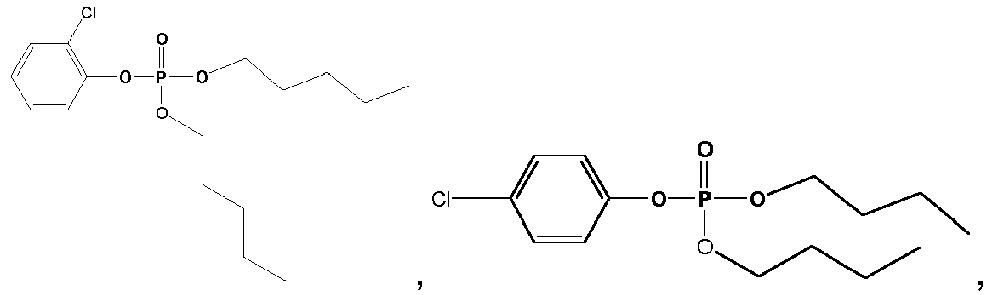
- Exemplary compounds of Formulas 1 and 2 include but are not limited to: and
- a “pharmaceutically acceptable salt” as used herein is any salt that retains at least some of the activity of the parent compound and without imparting any additional deleterious or untoward effects on the subject to which it is administered and in the context in which it is administered compared to the parent compound.
- a pharmaceutically acceptable salt also refers to any salt which may form in vivo as a result of administration of an acid, another salt, or a prodrug which is converted into an acid or salt.
- Pharmaceutically acceptable salts of acidic functional groups may be derived from organic or inorganic bases.
- the salt may comprise a mono or polyvalent ion.
- the inorganic ions lithium, sodium, potassium, calcium, and magnesium.
- Organic salts may be made with amines, particularly ammonium salts such as mono-, di- and trialkyl amines or ethanol amines. Salts may also be formed with caffeine, tromethamine and similar molecules.
- Hydrochloric acid or some other pharmaceutically acceptable acid may form a salt with a compound that includes a basic group, such as an amine or a pyridine ring.
- compositions comprising the presently disclosed compounds and a pharmaceutically acceptable carrier.
- the carrier may be any solid, semi-solid, or liquid material that acts as an excipient or vehicle for the active compound.
- the formulations may also include wetting agents, emulsifying agents, preserving agents, sweetening agents, bulking agents, coatings and/or flavoring agents. If used in an ophthalmic or infusion format, the formulation will usually contain one or more salts to adjust the osmotic pressure of the formulation.
- the present disclosure provides for inhibitors of butyrylcholinesterase for use in the treatment of a condition or disease which is ameliorated by cholinesterase inhibition.
- cholinesterase inhibition can be helpful in the treatment of a neurodegenerative disease is by eliminating, reducing, or preventing the formation of beta amyloid plaques.
- the diseases or conditions which can be treated by the presently disclosed inhibitors of butyrylcholinesterase include neurodegenerative diseases including, but not limited to, Alzheimer's disease and Lou Gherig's disease.
- butyrylcholinesterase inhibitors may be generally useful for performing various chemical, biochemical, pharmacological and cellular studies. For example, it may be useful to knock out the activity of butyrylcholinesterase by using the presently disclosed inhibitors and observing the effects.
- the presently disclosed compounds may be useful in stem cell research.
- the present disclosure also provides for methods of treating neurodegenerative diseases with a therapeutically effective amount of a butyrylcholinesterase inhibitor.
- the compounds of the present disclosure may be formulated for oral, buccal, transdermal (e.g., patch), intranasal, parenteral (e.g., intravenous, intramuscular or subcutaneous), ophthalmic or rectal administration or in a form suitable for administration by inhalation or insufflation.
- the compounds may take the form of, for example, tablets or capsules prepared by conventional means with pharmaceutically acceptable excipients such as binding agents (e.g., pregelatinised maize starch, polyvinylpyrrolidone or hydroxypropyl methylcellulose); fillers (e.g., lactose, microcrystalline cellulose or calcium phosphate); lubricants (e.g., magnesium stearate, talc or silica); disintegrants (e.g., potato starch or sodium starch glycollate); or wetting agents (e.g., sodium lauryl sulphate).
- binding agents e.g., pregelatinised maize starch, polyvinylpyrrolidone or hydroxypropyl methylcellulose
- fillers e.g., lactose, microcrystalline cellulose or calcium phosphate
- lubricants e.g., magnesium stearate, talc or silica
- disintegrants e.g., potato starch or sodium star
- Liquid preparations for oral administration may take the form of, for example, solutions, syrups or suspensions, or they may be presented as a dry product for constitution with water or other suitable vehicle before use.
- Such liquid preparations may be prepared by conventional means with pharmaceutically acceptable additives such as suspending agents (e.g., sorbitol syrup, methyl cellulose or hydrogenated edible fats); emulsifying agents (e.g., lecithin or acacia); non-aqueous vehicles (e.g., almond oil, oily esters or ethyl alcohol); and preservatives (e.g., methyl or propyl p-hydroxybenzoates or sorbic acid).
- suspending agents e.g., sorbitol syrup, methyl cellulose or hydrogenated edible fats
- emulsifying agents e.g., lecithin or acacia
- non-aqueous vehicles e.g., almond oil, oily esters or ethyl alcohol
- the compounds may take the form of tablets or lozenges formulated in conventional manner.
- the compounds of the present disclosure may be formulated for parenteral administration by injection, including using conventional catheterization techniques or infusion.
- the compounds may also be formulated for topical ophthalmic administration.
- Formulations for injection or topical ophthalmic administration may be presented in unit dosage form, for example in ampules, or in multi-dose containers, optionally with an added preservative.
- the compounds may take such forms as suspensions, solutions or emulsions in oily or aqueous vehicles, and may contain formulating agents such as suspending, stabilizing and/or dispersing agents.
- the active ingredient may be in powder form for reconstitution with a suitable vehicle, e.g., sterile pyrogen-free water, before use.
- the compounds of the present disclosure may also be formulated in rectal compositions such as suppositories or retention enemas, e.g., containing conventional suppository bases such as cocoa butter or other glycerides.
- the compounds of the present disclosure are conveniently delivered in the form of a solution or suspension from a pump spray container that is squeezed or pumped by the patient.
- the compounds of the disclosure can also be delivered in the form of an aerosol spray presentation from a pressurized container or a nebulizer, with the use of a suitable propellant, e.g., dichlorodifluoromethane, trichlorofluoromethane, dichlorotetrafluoroethane, carbon dioxide or other suitable gas.
- a suitable propellant e.g., dichlorodifluoromethane, trichlorofluoromethane, dichlorotetrafluoroethane, carbon dioxide or other suitable gas.
- the dosage unit may be determined by providing a valve to deliver a metered amount.
- the pressurized container or nebulizer may contain a solution or suspension of the active compound.
- Capsules and cartridges made, for example, from gelatin
- an inhaler or insufflator may be formulated containing a powder mix of a compound of the disclosure and a suitable powder base such as lactose or starch.
- the term "effective amount” means an amount of a compound of the present disclosure that is capable of inhibiting the symptoms of a pathological condition described herein by modulation of butyrylcholinesterase activity.
- the specific dose of a compound administered according to the present disclosure will be determined by the particular circumstances such as the compound administered, the route of administration, the state of being of the patient, and the severity of the pathological condition.
- a proposed dose of a compound of the present disclosure for oral, parenteral, buccal or topical ophthalmic administration to the average adult human for the treatment of the conditions referred to above is about 0.01 to 50 mg/kg of the active ingredient per unit dose which could be administered, for example, 1 to 4 times per day.
- Aerosol formulations for treatment of the conditions referred to above in the average adult human are preferably arranged so that each metered dose or "puff" of aerosol contains 20 ⁇ g to 1000 ⁇ g of the compound of the disclosure.
- the overall daily dose with an aerosol will be within the range a 100 ⁇ g to 10 mg.
- Administration may be several times daily, for example 2, 3, 4 or 8 times, giving for example, 1, 2 or 3 doses each time.
- 2-Chlorophenyl dimethyl phosphate Following the representative procedure described above and using methanol, 2-chlorophenyl dimethyl phosphate was obtained as a clear oil: 80% yield; b.p.183 oC/0.2 mm Hg; 1 H NMR (400 MHz, CDCl 3 ) ⁇ 3.92 (d, 6H, 11.4 Hz, CH 3 ), 7.11-7.15 (m, 1H, Ar-H), 7.52 (td, 1H, 8.2, 1.7 Hz, Ar-H), 7.41-7.42 (m, 1H, Ar-H), 7.43-7.44 (m, 1H, Ar-H); 13 C NMR (100 MHz, CDCl 3 ) ⁇ 55.22, 55.28, 121.32, 121.34, 125.30, 125.38, 126.03, 128.02, 128.03, 130.65, 146.59, 146.65.
- 2-Chlorophenyl di- n -pentyl phosphate Following the general procedure described above and using n -pentanol, 2-chlorophenyl di- n -pentyl phosphate was obtained as a clear oil: 88 %; b.p.
- a solution of dibutyl phosphite (0.73 g, 3.8 mmol) in 3 mL CCl 4 was added dropwise to a stirring solution containing the substituted phenol (3.0 mmol), 5mL CCl 4 , tetra- n -butylammonium bromide (0.095 g, 0.3 mmol), NaOH (0.18g, 4.4 mmol) and 5 mL water; it was stirred for an indicated amount of time at room temperature.
- the reaction mixture was dissolved in 10 mL of CCl 4 , extracted with ice-cold distilled water (3 x 10 mL), and each of the aqueous layer was washed with 10mL CCl 4 .
- the combined organic layer was dried under MgSO 4 , concentrated in vacuo, and purified by evaporative distillation, flash or gravity chromatography.
- n - Butyl bis(2,4-dichlorophenyl) phosphate To a round bottom flask charged with pyridine (0.06 mL, 0.00073 mol) in 2 mL dry CH 2 Cl 2 was added n-butyl alcohol (0.067 mL, 0.00073 mol). This solution was added drop-wise via cannulation at 0°C to a solution of bis(2,4dichlorophenyl) phosphorochloridate (0.15g, 0.00036 mol) in 3 mL dry CH 2 Cl 2 . The reaction was allowed to react for 24 hrs at room temperature.
- reaction was quenched by extracting with 2 mL 10 % HCl, 5 mL saturated NaHCO 3 and 10 mL ethyl ether.
- the aqueous phase was extracted 3X5 mL with diethyl ether.
- the combined organic layer was dried over MgSO 4 , filtered and concentrated in vacuo.
- Butyl bis(2-chlorophenyl) phosphate A mixture containing n -butanol (0.17 mL, 1.86 mmol), and distilled pyridine (0.15 mL, 1.86 mmol) in 5 mL CH 2 Cl 2 was added dropwise to bis(2-chlorophenyl) chlorophosphate (0.63 g, 1.56 mmol) dissolved in 15 mL dry CH 2 Cl 2 , The reaction mixture was allowed to stir for 24 hours, followed by dilution with 15 mL CH 2 Cl 2 , extraction with 10% HCl (1 x 20 mL) and saturated NaHCO 3 (3 x 15 mL), and was dried under MgSO 4 .
- Bis(2-chlorophenyl) ethylphosphonate A dried round bottom flask was charged with 0.60 mL (0.81 g, 5.5 mmol) of ethyl phosphonic dichloride and 9 mL of dry THF. To another dried round bottom flask sodium hydride (0.558 g of a 60% dispersion in mineral oil, approximately 14 mmol), 7 mL of dry THF and 2.1 equivalents (1.20 mL, 11.6 mmol) of 2-chlorophenol were added. The sodium 2-chlorophenoxide was added to the stirring phosphonic dichloride solution via cannulation. The mixture was allowed to react overnight at room temperature.
- reaction mixture was dissolved in 50 mL of diethyl ether and washed three times with 10 mL of saturated sodium bicarbonate. The organic layer was then washed three times with 10 mL of saturated sodium chloride solution, dried over magnesium sulfate, filtered, and concentrated in vacuo to give 2.08 g of a pale yellow oil.
- Butyl 2-chlorophenyl ethylphosphonate To a dried round bottom flask 0.420 g (1.27 mmol) of bis(2-chlorophenyl) ethylphosphonate in 10 mL of dry THF with stirring was added. To another dried round bottom flask sodium hydride (0.0645 g of a 60% dispersion in mineral oil, approximately 1.6 mmol) and 3 mL of dry THF were added, followed by 1.1 equivalents (0.125 mL, 1.37 mmol) of anhydrous 1-butanol. The sodium butoxide was added to the stirring phosphonate solution via cannulation.
- Butyl p-nitrophenyl ethylphosphonate To a round bottom flask with NaH (0.007g of a 60% dispersion in mineral oil, approximately 0.18 mmol) in 1mL dry THF was added dry 1-butanol (0.016mL, 0.18 mmol). This solution was added drop wise via cannulation to a solution of bis(p-nitrophenyl) ethylphosphonate (0.093mg, 0.26 mmol) in 3mL dry THF in an ice/water bath. The mixture was allowed to react at room temperature overnight. The reaction was quenched by adding 5 mL of methylene chloride and 5 mL of NaHCO 3 .
- Phenyl di - n - pentylphosphinate Into a dried three-neck 100 mL round bottom flask was added 1.5 equivalents of magnesium turnings and 4 ml of dry THF. This mixture was stirred at room temperature. To a second dried round bottom flask was added 1.5 equivalents of 1-bromopentane diluted in 4 mL of THF. This mixture was stirred for five minutes and transferred to an addition funnel. The 1-bromopentane was added to the magnesium turnings drop wise over a thirty minute period at room temperature. The Grignard reagent begin to form fifteen minutes after the addition was completed.
- phenyl dichlorophosphate dissolved in 1 ml of THF and transferred to the addition funnel.
- the phenyl dichlorophosphate/THF was added to the 1-bromopentane mixture over a fifteen minute period at 0 °C.
- the reaction mixture was stirred at 0 °C for 35 minutes and then removed from the ice bath and allowed to continue stirring for 1.5 hours at room temperature.
- a golden liquid was obtained and was worked up using saturated NH 4 Cl.
- Bis(2-chlorophenyl) ethylphosphonate A dried round bottom flask was charged with 0.60 mL (0.81 g, 5.5 mmol) of ethyl phosphonic dichloride and 9 mL of dry THF. To another dried round bottom flask sodium hydride (0.558 g of a 60% dispersion in mineral oil, approximately 14 mmol), 7 mL of dry THF and 2.1 equivalents (1.20 mL, 11.6 mmol) of 2-chlorophenol were added. The sodium 2-chlorophenoxide was added to the stirring phosphonic dichloride solution via cannulation. The mixture was allowed to react overnight at room temperature.
- reaction mixture was dissolved in 50 mL of diethyl ether and washed three times with 10 mL of saturated sodium bicarbonate. The organic layer was then washed three times with 10 mL of saturated sodium chloride solution, dried over magnesium sulfate, filtered, and concentrated in vacuo to give 2.08 g of a pale yellow oil.
- Acetylcholinesterase from electric eel
- butyrylcholinesterase from horse serum
- DTNB buyyrylthiocholine
- acetylthiocholine and BSA were purchased from Sigma.
- the dialkyl 2-chlorophenyl (and 4-chlorophenyl) phosphates were solubilized in reagent grade methanol.
- Butyrylcholinesterase was pre-incubated at room temperature with inhibitor in the assay cocktail minus substrate for varying periods of time at 25°C. Substrate was then added and the activity measured as described above. The relative rates of enzyme inactivation were determined by plotting enzyme activity versus time of pre-incubation with inhibitor. Results were expressed as the rate constant for the rate of enzyme inactivation. In the case of AcChase, results were expressed as the % of activity remaining relative to the enzyme incubated only with solvents.
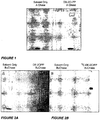
- Enzyme activity was also measured by native gel electrophoresis.
- proteins (10 ⁇ g of both acetylcholinesterase and butyrylcholinesterase) were fractionated on Novex precast 10% Tris glycine gels (Invitrogen). Enzyme activity was detected by first incubating the gels in a solution of 5 mM substrate then staining with a solution of copper sulfate/potassium ferricyanide.
- the first series of experiments determined the effect of the dialkyl 2-chlorophenyl (and 4-chlorophenyl) phosphates on both AcChase and BuChase. None of the compounds had any inhibitory effect on AcChase (See Table 1).
- Table 1 AcChase was incubated with 100 ⁇ M of the indicated phenyl phosphate for 60 minutes at 25°C and then assayed as described above. Results were expressed as the % activity relative to enzyme incubated with solvent ⁇ SD (standard deviation). Table 1. Effect of dialkyl 2-chlorophenyl phosphates on acetylcholinesterase activity.
- Table 3 depicts reactivation of inactive butyrylcholinesterase.
- BuChase was incubated with excess di-butyl 2-chlorophenyl phosphate for 60 min at 4°C. The excess phosphate was removed using a desalting column. The inactivated BuChase was incubated at 4°C for various periods of time and then assayed for activity. Results were expressed as percent inhibition and calculated using the following formula; [(activity with solvent only) - (activity with DB-2Cl-PP)] / (activity with solvent only) x 100 %. There is no significant reactivation over 24 hours as the % remaining activities are statistically the same.
- the cholinesterases were pre-incubated with 14 C-di-ethyl-2-chlorophenyl phosphate and then fractionated by native gel electrophoresis as described above.
- the proteins were fixed in the gel with 10% acetic acid/30% methanol.
- the fixative was removed and replaced with 100 mL of EN 3 HANCE.
- the gel was incubated for 60 minutes at room temperature with gentle agitation and then placed in 5% PEG and incubated for 30 minutes at room temperature with gentle agitation.
- the gel was then dried down on a piece of 3MM filter paper, exposed to X-ray film at -80°C for 2 weeks, and then developed.
- Pre-incubation of BuChase with 14 C-labeled di-ethyl 2-chlorophenyl phosphate and gel electrophoresis of the mixture showed that the compound had been covalently modified by the compound ( Figure 2B ).
- Tables 4 below shows the relative inhibitory activity of exemplary compounds of the present disclosure.
- the results were obtained by pre-incubating the enzyme with the compound (final concentration 10 -7 M) for various periods of time and measuring the remaining enzyme activity. The results are shown as the change in absorbance at 412 nm / minute.
- the enzyme activities were normalized to 2-chlorophenyl-di-n-butyl phosphate which was set as 1.0. Since two different preparations of enzyme were used, the normalization procedure would adjust for any differences in the amount of enzyme.
- Several of the compounds are potent inhibitors, i.e., the rates of inactivation are so fast that they were not measurable under these conditions.
- DB-2Cl-PP di-n-butyl 2-chlorophenyl phosphate
- PKA protein kinase A
- GST-S6 glutathione-S-transferase-S6
- Enzyme was pre-incubated with substrate and varying concentrations of inhibitor on ice for 30 minutes.
- the control sample contained solvent (methanol).
- ATP was then added to each sample and the cocktail incubated at 30°C for 15 minutes.
- Equal amounts of each mixture were fractionated by SDS-PAGE on a 10% acrylamide gel. The gel was fixed in 50% methanol/10% acetic acid, washed with water, and then stained in Pro-Q Stain in the dark for 60 minutes. The gel was then destained, washed, and scanned on a Typhoon Imager ( Figure 5 ).
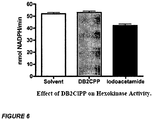
- DB2CIPP di-n-butyl 2-chlorophenyl phosphate
- Trypsin was incubated with solvent, 10 ⁇ M DB2CPP, or 10 ⁇ M DIFP (a known inhibitor of trypsin) for 60 minutes at 25°C to determine any inhibitory effect of DB2CPP on enzymatic activity.
- Enzyme activity is given as nmoles of BAEE hydrolyzed per minute at 25°C. Data shown are the mean of three replicates ⁇ SEM. ( Figure 3 )
- DB2CIPP The effect of DB2CIPP on the activity of chymotrypsin was assayed. Trypsin was incubated with solvent, 10 ⁇ M DB2CPP, or 10 ⁇ M PMSF (a known inhibitor of chymotrypsin) for 60 minutes at 25°C to determine any inhibitory effect of DB2CPP on enzymatic activity. Enzyme activity is given as nmoles of ATEE hydrolyzed per minute at 25°C. Data shown are the mean of three replicates ⁇ SEM. ( Figure 4 )
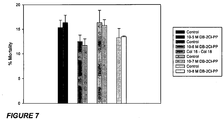
- Porcine umbilical stem cells were cultured in Neurobasal Medium supplemented with B27 (Invitrogen) and antibiotics for various periods of with varying concentrations of din-butyl-2-chlorophenyl phosphate. Cells were collected, washed, counted, and analyzed for viability by Trypan Blue staining. Di-n-butyl-2-chlorophenyl phosphate did not have any significant effect on mortality of the porcine umbilical stem cells ( Figure 7 ).
- ICM PocketFinder was used to identify and define the receptor target region for docking.
- the enzyme structures used for docking were human AcChase (PDB ID: 1B41) and BuChase (PDB ID: 1P0l).
- the result for one compound in the library is shown as a stick rendering in Figure 8 . Shown is best ranked pose by binding energy. Protein side chains are rendered as thin sticks. Ligand is shown in ball and stick representation, with sticks widened for emphasis. Only polar hydrogens are shown for clarity. Known active site residues are identified.
- Modeling of a library of dialkyl phenyl and diphenyl alkyl phosphonates, and flexible docking with AcChase and BuChase were accomplished using ICM-Pro.
- ICM PocketFinder was used to identify and define the receptor target region Modeling of a library of dialkyl phenyl phosphates and flexible docking with AcChase and BuChase were accomplished using ICM-Pro.
- ICM PocketFinder was used to identify and define the receptor target region for docking.
- the enzyme structures used for docking were human AcChase (PDB ID: 1B41) and BuChase (PDB ID: 1P0l).
- the result for one compound in the library is shown as a stick rendering in Figure 9 . Shown is best ranked pose by binding energy. Protein side chains are rendered as thin sticks. Ligand is shown in ball and stick representation, with sticks widened for emphasis. Only polar hydrogens are shown for clarity. Known active site residues are identified.
- ICM PocketFinder was used to identify and define the receptor target region for docking.
- the enzyme structures used for docking were human AcChase (PDB ID: 1B41) and BuChase (PDB ID: 1P0l).
- the result for one compound in the library is shown as a stick rendering in Figure 10 . Shown is best ranked pose by binding energy. Protein side chains are rendered as thin sticks. Ligand is shown in ball and stick representation, with sticks widened for emphasis. Only polar hydrogens are shown for clarity. Known active site residues are identified.
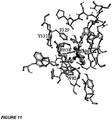
- ICM PocketFinder was used to identify and define the receptor target region for docking.
- the enzyme structures used for docking were human AcChase (PDB ID: 1B41) and BuChase (PDB ID: 1P0I).
- the result for one compound in the library is shown as a stick rendering in Figure 11 . Shown is best ranked pose by binding energy. Protein side chains are rendered as thin sticks. Ligand is shown in ball and stick representation, with sticks widened for emphasis. Only polar hydrogens are shown for clarity. Known active site residues are identified.
Landscapes
- Chemical & Material Sciences (AREA)
- Organic Chemistry (AREA)
- Health & Medical Sciences (AREA)
- General Health & Medical Sciences (AREA)
- Life Sciences & Earth Sciences (AREA)
- Molecular Biology (AREA)
- Biochemistry (AREA)
- Neurology (AREA)
- Neurosurgery (AREA)
- Engineering & Computer Science (AREA)
- Bioinformatics & Cheminformatics (AREA)
- Biomedical Technology (AREA)
- Medicinal Chemistry (AREA)
- Nuclear Medicine, Radiotherapy & Molecular Imaging (AREA)
- Pharmacology & Pharmacy (AREA)
- Hospice & Palliative Care (AREA)
- Animal Behavior & Ethology (AREA)
- Psychiatry (AREA)
- Public Health (AREA)
- Veterinary Medicine (AREA)
- General Chemical & Material Sciences (AREA)
- Chemical Kinetics & Catalysis (AREA)
- Pharmaceuticals Containing Other Organic And Inorganic Compounds (AREA)
Claims (9)
- Verwendung einer Verbindung bei der Herstellung eines Arzneimittels zum Hemmen von Pseudocholinesterase, wobei die Verbindung die Struktur einer der Formeln 1 und 2 hat:
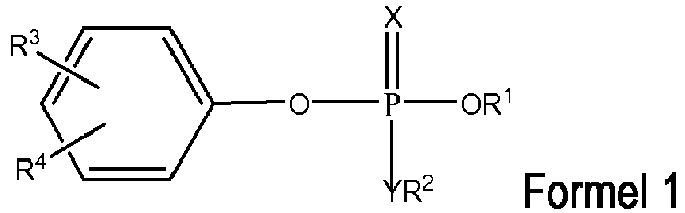
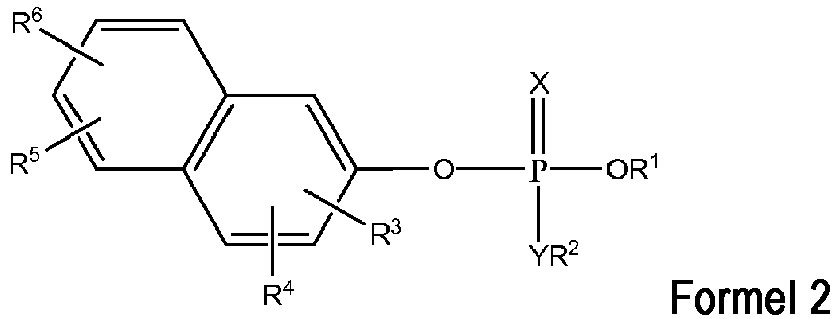 X O oder S ist;Y O oder N ist;R1 und R2 gleich oder verschieden sein können und unabhängig voneinander aus der Gruppe, bestehend aus H, C1-6-Alkyl, C1-6-Alkenyl und unsubstituiertem oder substituiertem Phenyl, ausgewählt sind;wobei die potentiellen Substituenten der substituierten Phenylgruppe aus F, Cl, Br, I oder NO2 ausgewählt sind;R3 und R4 in Formel I gleich oder verschieden sein können und unabhängig aus der Gruppe, bestehend aus H, Methyl, Methoxy, F, Cl, Br und I, ausgewählt sind; undR3 bis R6 in Formel II gleich oder verschieden sein können und unabhängig aus der Gruppe, bestehend aus H, Methyl, Methoxy, F, Cl, Br und NO2, ausgewählt sind;oder ein pharmazeutisch verträgliches Salz davon.
 - Verwendung nach Anspruch 1, wobei das Phenyl mindestens einmal substituiert ist, wobei jeder Substituent unabhängig aus der Gruppe, bestehend aus H, Methyl, Methoxy, F, Cl, Br oder I in Formel I, ausgewählt ist; und das Phenyl mindestens einmal substituiert ist, wobei jeder Substituent unabhängig aus der Gruppe, bestehend aus H, Methyl, Methoxy, F, Cl, Br, I und NO2 in Formel II, ausgewählt ist.
- Verwendung nach Anspruch 1, wobei das C1-6-Alkyl aus der Gruppe, bestehend aus Methyl, Ethyl, n-Propyl, Isopropyl, n-Butyl, Isobutyl, Cyclohexyl und n-Pentyl, ausgewählt ist.
- Verwendung nach Anspruch 1, wobei die Verbindung aus der Gruppe ausgewählt ist, die aus Folgendem besteht:








- Verwendung einer Verbindung bei der Herstellung eines Arzneimittels zur Behandlung einer neurodegenerativen Erkrankung, wobei die Verbindung die Struktur von Formel 1 oder 2 aufweist:

 X O oder S ist;Y O oder N ist;R1 und R2 gleich oder verschieden sein können und unabhängig voneinander aus der Gruppe, bestehend aus H, C1-6-Alkyl, C1-6-Alkenyl und unsubstituiertem oder substituiertem Phenyl, ausgewählt sind;wobei die potentiellen Substituenten der substituierten Phenylgruppe aus F, Cl, Br, I oder NO2 ausgewählt sind;R3 und R4 in Formel I gleich oder verschieden sein können und unabhängig von der Gruppe, bestehend aus H, Methyl, Methoxy, F, Cl, Br und I, ausgewählt sind; undR3 bis R6 in Formel II gleich oder verschieden sein können und unabhängig von der Gruppe, bestehend aus H, Methyl, Methoxy, F, Cl, Br, I und NO2, ausgewählt sind;oder ein pharmazeutisch verträgliches Salz davon; und
wobei Pseudocholinesterase gehemmt wird. - Verwendung von Anspruch 5, wobei das Phenyl mindestens einmal substituiert ist, wobei jeder Substituent unabhängig aus der Gruppe, bestehend aus H, Methyl, Methoxy, F, Cl, Br oder I in Formel I, ausgewählt ist; und das Phenyl mindestens einmal substituiert ist, wobei jeder Substituent unabhängig aus der Gruppe, bestehend aus H, Methyl, Methoxy, F, Cl, Br, I und NO2 in Formel II, ausgewählt ist.
- Verwendung nach Anspruch 5, wobei das C1-6-Alkyl aus der Gruppe, bestehend aus Methyl, Ethyl, n-Propyl, Isopropyl, n-Butyl, Isobutyl, Cyclohexyl und n-Pentyl, ausgewählt ist.
- Verwendung nach Anspruch 5, wobei die Verbindung aus der Gruppe ausgewählt ist, die aus Folgendem besteht:














- Verwendung nach Anspruch 5, wobei die neurodegenerative Erkrankung die Alzheimer-Krankheit ist.
Applications Claiming Priority (2)
| Application Number | Priority Date | Filing Date | Title |
|---|---|---|---|
| US86376406P | 2006-10-31 | 2006-10-31 | |
| PCT/US2007/083262 WO2008055249A2 (en) | 2006-10-31 | 2007-10-31 | Butyrylcholinesterase inhibitors and their use in the treatment of neurodegenerative diseases |
Publications (2)
| Publication Number | Publication Date |
|---|---|
| EP2097428A2 EP2097428A2 (de) | 2009-09-09 |
| EP2097428B1 true EP2097428B1 (de) | 2018-02-28 |
Family
ID=39316409
Family Applications (1)
| Application Number | Title | Priority Date | Filing Date |
|---|---|---|---|
| EP07868639.1A Active EP2097428B1 (de) | 2006-10-31 | 2007-10-31 | Pseudocholinesterase-hemmer und ihre verwendung bei der behandlung neurodegenerativer erkrankungen |
Country Status (5)
| Country | Link |
|---|---|
| US (1) | US20100069337A1 (de) |
| EP (1) | EP2097428B1 (de) |
| AU (1) | AU2007313639A1 (de) |
| CA (1) | CA2704145C (de) |
| WO (1) | WO2008055249A2 (de) |
Families Citing this family (1)
| Publication number | Priority date | Publication date | Assignee | Title |
|---|---|---|---|---|
| US9757399B2 (en) | 2006-10-31 | 2017-09-12 | Jal Therapeutics, Inc. | Butyrylcholinesterase inhibitors |
Family Cites Families (4)
| Publication number | Priority date | Publication date | Assignee | Title |
|---|---|---|---|---|
| US2944937A (en) * | 1958-07-22 | 1960-07-12 | Dow Chemical Co | Phosphoramidates |
| CZ297533B6 (cs) * | 1997-07-09 | 2007-01-03 | Axonyx | Použití inhibitorů butyrylcholinesterázy pro léčbu a diagnostiku Alzheimerovy choroby a demence |
| GB9807931D0 (en) * | 1998-04-15 | 1998-06-10 | Medical Res Council | Improvements in or relating to protease inhibitors |
| US6254853B1 (en) * | 1998-05-08 | 2001-07-03 | Vyrex Corporation | Water soluble pro-drugs of propofol |
-
2007
- 2007-10-31 WO PCT/US2007/083262 patent/WO2008055249A2/en not_active Ceased
- 2007-10-31 CA CA2704145A patent/CA2704145C/en active Active
- 2007-10-31 EP EP07868639.1A patent/EP2097428B1/de active Active
- 2007-10-31 AU AU2007313639A patent/AU2007313639A1/en not_active Abandoned
- 2007-10-31 US US12/447,862 patent/US20100069337A1/en not_active Abandoned
Also Published As
| Publication number | Publication date |
|---|---|
| EP2097428A2 (de) | 2009-09-09 |
| US20100069337A1 (en) | 2010-03-18 |
| AU2007313639A1 (en) | 2008-05-08 |
| CA2704145C (en) | 2017-03-21 |
| CA2704145A1 (en) | 2008-05-08 |
| WO2008055249A3 (en) | 2008-09-25 |
| WO2008055249A2 (en) | 2008-05-08 |
Similar Documents
| Publication | Publication Date | Title |
|---|---|---|
| US4372894A (en) | Phosphonoformic acid esters | |
| Hengge et al. | Physical organic perspectives on phospho group transfer from phosphates and phosphinates | |
| Grembecka et al. | The most potent organophosphorus inhibitors of leucine aminopeptidase. Structure-based design, chemistry, and activity | |
| EP1263752B1 (de) | Agonisten und antagonisten für den lpa-rezeptor und anwendungsmethoden | |
| Yokomatsu et al. | Synthesis of non-competitive inhibitors of sphingomyelinases with significant activity | |
| Quistad et al. | Insecticidal, anticholinesterase, and hydrolytic properties of phosphoramidothiolates | |
| CA2517281A1 (en) | Phosphate/sulfate ester compounds and pharmaceutical compositions for inhibiting protein interacting nima (pin1) | |
| Roodsari et al. | A new approach to the stereospecific synthesis of phospholipids. The use of L-glyceric acid for the preparation of diacylglycerols, phosphatidylcholines, and related derivatives | |
| Boltneva et al. | Alkyl 2-arylhydrazinylidene-3-oxo-3-polyfluoroalkylpropionates as new effective and selective inhibitors of carboxylesterase | |
| EP2097428B1 (de) | Pseudocholinesterase-hemmer und ihre verwendung bei der behandlung neurodegenerativer erkrankungen | |
| US9757399B2 (en) | Butyrylcholinesterase inhibitors | |
| Munier et al. | Synthesis and biological evaluation of aryl phosphoramidate prodrugs of fosfoxacin and its derivatives | |
| Leigh et al. | Substrate stereospecificity of phosphatidylinositol-specific phospholipase C from Bacillus cereus examined using the resolved enantiomers of synthetic myo-inositol 1-(4-nitrophenyl phosphate) | |
| US20140073608A1 (en) | Butyrylcholinesterase Inhibitors | |
| US20030130237A1 (en) | LPA receptor agonists and antagonists and methods of use | |
| Chung et al. | Divergent Syntheses of All Possible Optically Active Regioisomers of m yo-Inositol Tris-and Tetrakisphosphates | |
| US20260015372A1 (en) | Organophosphorous Compounds and Uses Thereof | |
| RU2754133C1 (ru) | Гидрохлориды замещенных 2-[(диметиламино)метил]арилдиметилкарбаматов, обладающие антихолинэстеразной активностью | |
| KR0151799B1 (ko) | D-만노피라노스 화합물과 그의 제조방법 | |
| US20050250742A1 (en) | Phosphate/sulfate ester compounds and pharmaceutical composition for inhibiting protein interacting NIMA (PIN1) | |
| Chen et al. | The study of phosphoramidite as O-phosphitylation agent and its reactivity | |
| Sanllehi et al. | Studies on the inhibition of sphingosine-1-phosphate lyase by stabilized reaction intermediates and stereodefined azido phosphates | |
| Kanda et al. | Synthesis of sn-glycero-1-phosphocholine. | |
| Kley et al. | Synthesis of isosteric phosphono analogs of biologically active alkylphosphocholines | |
| Motola | Chemical synthesis of analogs of platelet activating factor and antihypertensive polar renomedullary lipid |
Legal Events
| Date | Code | Title | Description |
|---|---|---|---|
| PUAI | Public reference made under article 153(3) epc to a published international application that has entered the european phase |
Free format text: ORIGINAL CODE: 0009012 |
|
| 17P | Request for examination filed |
Effective date: 20090528 |
|
| AK | Designated contracting states |
Kind code of ref document: A2 Designated state(s): AT BE BG CH CY CZ DE DK EE ES FI FR GB GR HU IE IS IT LI LT LU LV MC MT NL PL PT RO SE SI SK TR |
|
| DAX | Request for extension of the european patent (deleted) | ||
| 17Q | First examination report despatched |
Effective date: 20100511 |
|
| STAA | Information on the status of an ep patent application or granted ep patent |
Free format text: STATUS: EXAMINATION IS IN PROGRESS |
|
| RIC1 | Information provided on ipc code assigned before grant |
Ipc: C07F 9/24 20060101ALI20170803BHEP Ipc: C07F 9/12 20060101AFI20170803BHEP Ipc: C07F 9/46 20060101ALI20170803BHEP Ipc: C07F 9/40 20060101ALI20170803BHEP |
|
| GRAP | Despatch of communication of intention to grant a patent |
Free format text: ORIGINAL CODE: EPIDOSNIGR1 |
|
| STAA | Information on the status of an ep patent application or granted ep patent |
Free format text: STATUS: GRANT OF PATENT IS INTENDED |
|
| INTG | Intention to grant announced |
Effective date: 20170921 |
|
| GRAS | Grant fee paid |
Free format text: ORIGINAL CODE: EPIDOSNIGR3 |
|
| GRAA | (expected) grant |
Free format text: ORIGINAL CODE: 0009210 |
|
| STAA | Information on the status of an ep patent application or granted ep patent |
Free format text: STATUS: THE PATENT HAS BEEN GRANTED |
|
| AK | Designated contracting states |
Kind code of ref document: B1 Designated state(s): AT BE BG CH CY CZ DE DK EE ES FI FR GB GR HU IE IS IT LI LT LU LV MC MT NL PL PT RO SE SI SK TR |
|
| REG | Reference to a national code |
Ref country code: GB Ref legal event code: FG4D Ref country code: CH Ref legal event code: EP |
|
| REG | Reference to a national code |
Ref country code: AT Ref legal event code: REF Ref document number: 973998 Country of ref document: AT Kind code of ref document: T Effective date: 20180315 |
|
| REG | Reference to a national code |
Ref country code: IE Ref legal event code: FG4D |
|
| REG | Reference to a national code |
Ref country code: DE Ref legal event code: R096 Ref document number: 602007054099 Country of ref document: DE |
|
| RAP2 | Party data changed (patent owner data changed or rights of a patent transferred) |
Owner name: JAL THERAPEUTICS, LLC |
|
| REG | Reference to a national code |
Ref country code: DE Ref legal event code: R081 Ref document number: 602007054099 Country of ref document: DE Owner name: JAL THERAPEUTICS, LLC, IRVINE, US Free format text: FORMER OWNER: MGP BIOTECHNOLOGIES, INC., IRVINE, CALIF. 92614, US |
|
| REG | Reference to a national code |
Ref country code: GB Ref legal event code: 732E Free format text: REGISTERED BETWEEN 20180531 AND 20180606 |
|
| REG | Reference to a national code |
Ref country code: NL Ref legal event code: MP Effective date: 20180228 |
|
| REG | Reference to a national code |
Ref country code: LT Ref legal event code: MG4D |
|
| REG | Reference to a national code |
Ref country code: AT Ref legal event code: MK05 Ref document number: 973998 Country of ref document: AT Kind code of ref document: T Effective date: 20180228 |
|
| PG25 | Lapsed in a contracting state [announced via postgrant information from national office to epo] |
Ref country code: FI Free format text: LAPSE BECAUSE OF FAILURE TO SUBMIT A TRANSLATION OF THE DESCRIPTION OR TO PAY THE FEE WITHIN THE PRESCRIBED TIME-LIMIT Effective date: 20180228 Ref country code: LT Free format text: LAPSE BECAUSE OF FAILURE TO SUBMIT A TRANSLATION OF THE DESCRIPTION OR TO PAY THE FEE WITHIN THE PRESCRIBED TIME-LIMIT Effective date: 20180228 Ref country code: NL Free format text: LAPSE BECAUSE OF FAILURE TO SUBMIT A TRANSLATION OF THE DESCRIPTION OR TO PAY THE FEE WITHIN THE PRESCRIBED TIME-LIMIT Effective date: 20180228 Ref country code: CY Free format text: LAPSE BECAUSE OF FAILURE TO SUBMIT A TRANSLATION OF THE DESCRIPTION OR TO PAY THE FEE WITHIN THE PRESCRIBED TIME-LIMIT Effective date: 20180228 Ref country code: ES Free format text: LAPSE BECAUSE OF FAILURE TO SUBMIT A TRANSLATION OF THE DESCRIPTION OR TO PAY THE FEE WITHIN THE PRESCRIBED TIME-LIMIT Effective date: 20180228 |
|
| PG25 | Lapsed in a contracting state [announced via postgrant information from national office to epo] |
Ref country code: BG Free format text: LAPSE BECAUSE OF FAILURE TO SUBMIT A TRANSLATION OF THE DESCRIPTION OR TO PAY THE FEE WITHIN THE PRESCRIBED TIME-LIMIT Effective date: 20180528 Ref country code: AT Free format text: LAPSE BECAUSE OF FAILURE TO SUBMIT A TRANSLATION OF THE DESCRIPTION OR TO PAY THE FEE WITHIN THE PRESCRIBED TIME-LIMIT Effective date: 20180228 Ref country code: LV Free format text: LAPSE BECAUSE OF FAILURE TO SUBMIT A TRANSLATION OF THE DESCRIPTION OR TO PAY THE FEE WITHIN THE PRESCRIBED TIME-LIMIT Effective date: 20180228 Ref country code: SE Free format text: LAPSE BECAUSE OF FAILURE TO SUBMIT A TRANSLATION OF THE DESCRIPTION OR TO PAY THE FEE WITHIN THE PRESCRIBED TIME-LIMIT Effective date: 20180228 Ref country code: GR Free format text: LAPSE BECAUSE OF FAILURE TO SUBMIT A TRANSLATION OF THE DESCRIPTION OR TO PAY THE FEE WITHIN THE PRESCRIBED TIME-LIMIT Effective date: 20180529 |
|
| PG25 | Lapsed in a contracting state [announced via postgrant information from national office to epo] |
Ref country code: PL Free format text: LAPSE BECAUSE OF FAILURE TO SUBMIT A TRANSLATION OF THE DESCRIPTION OR TO PAY THE FEE WITHIN THE PRESCRIBED TIME-LIMIT Effective date: 20180228 Ref country code: RO Free format text: LAPSE BECAUSE OF FAILURE TO SUBMIT A TRANSLATION OF THE DESCRIPTION OR TO PAY THE FEE WITHIN THE PRESCRIBED TIME-LIMIT Effective date: 20180228 Ref country code: IT Free format text: LAPSE BECAUSE OF FAILURE TO SUBMIT A TRANSLATION OF THE DESCRIPTION OR TO PAY THE FEE WITHIN THE PRESCRIBED TIME-LIMIT Effective date: 20180228 Ref country code: EE Free format text: LAPSE BECAUSE OF FAILURE TO SUBMIT A TRANSLATION OF THE DESCRIPTION OR TO PAY THE FEE WITHIN THE PRESCRIBED TIME-LIMIT Effective date: 20180228 |
|
| REG | Reference to a national code |
Ref country code: DE Ref legal event code: R097 Ref document number: 602007054099 Country of ref document: DE |
|
| PG25 | Lapsed in a contracting state [announced via postgrant information from national office to epo] |
Ref country code: CZ Free format text: LAPSE BECAUSE OF FAILURE TO SUBMIT A TRANSLATION OF THE DESCRIPTION OR TO PAY THE FEE WITHIN THE PRESCRIBED TIME-LIMIT Effective date: 20180228 Ref country code: SK Free format text: LAPSE BECAUSE OF FAILURE TO SUBMIT A TRANSLATION OF THE DESCRIPTION OR TO PAY THE FEE WITHIN THE PRESCRIBED TIME-LIMIT Effective date: 20180228 Ref country code: DK Free format text: LAPSE BECAUSE OF FAILURE TO SUBMIT A TRANSLATION OF THE DESCRIPTION OR TO PAY THE FEE WITHIN THE PRESCRIBED TIME-LIMIT Effective date: 20180228 |
|
| PLBE | No opposition filed within time limit |
Free format text: ORIGINAL CODE: 0009261 |
|
| STAA | Information on the status of an ep patent application or granted ep patent |
Free format text: STATUS: NO OPPOSITION FILED WITHIN TIME LIMIT |
|
| 26N | No opposition filed |
Effective date: 20181129 |
|
| PG25 | Lapsed in a contracting state [announced via postgrant information from national office to epo] |
Ref country code: SI Free format text: LAPSE BECAUSE OF FAILURE TO SUBMIT A TRANSLATION OF THE DESCRIPTION OR TO PAY THE FEE WITHIN THE PRESCRIBED TIME-LIMIT Effective date: 20180228 |
|
| REG | Reference to a national code |
Ref country code: DE Ref legal event code: R119 Ref document number: 602007054099 Country of ref document: DE |
|
| REG | Reference to a national code |
Ref country code: CH Ref legal event code: PL |
|
| GBPC | Gb: european patent ceased through non-payment of renewal fee |
Effective date: 20181031 |
|
| REG | Reference to a national code |
Ref country code: BE Ref legal event code: MM Effective date: 20181031 |
|
| PG25 | Lapsed in a contracting state [announced via postgrant information from national office to epo] |
Ref country code: MC Free format text: LAPSE BECAUSE OF FAILURE TO SUBMIT A TRANSLATION OF THE DESCRIPTION OR TO PAY THE FEE WITHIN THE PRESCRIBED TIME-LIMIT Effective date: 20180228 Ref country code: LU Free format text: LAPSE BECAUSE OF NON-PAYMENT OF DUE FEES Effective date: 20181031 |
|
| REG | Reference to a national code |
Ref country code: IE Ref legal event code: MM4A |
|
| PG25 | Lapsed in a contracting state [announced via postgrant information from national office to epo] |
Ref country code: DE Free format text: LAPSE BECAUSE OF NON-PAYMENT OF DUE FEES Effective date: 20190501 |
|
| PG25 | Lapsed in a contracting state [announced via postgrant information from national office to epo] |
Ref country code: FR Free format text: LAPSE BECAUSE OF NON-PAYMENT OF DUE FEES Effective date: 20181031 Ref country code: LI Free format text: LAPSE BECAUSE OF NON-PAYMENT OF DUE FEES Effective date: 20181031 Ref country code: CH Free format text: LAPSE BECAUSE OF NON-PAYMENT OF DUE FEES Effective date: 20181031 Ref country code: BE Free format text: LAPSE BECAUSE OF NON-PAYMENT OF DUE FEES Effective date: 20181031 |
|
| PG25 | Lapsed in a contracting state [announced via postgrant information from national office to epo] |
Ref country code: IE Free format text: LAPSE BECAUSE OF NON-PAYMENT OF DUE FEES Effective date: 20181031 Ref country code: GB Free format text: LAPSE BECAUSE OF NON-PAYMENT OF DUE FEES Effective date: 20181031 |
|
| PG25 | Lapsed in a contracting state [announced via postgrant information from national office to epo] |
Ref country code: MT Free format text: LAPSE BECAUSE OF NON-PAYMENT OF DUE FEES Effective date: 20181031 |
|
| PG25 | Lapsed in a contracting state [announced via postgrant information from national office to epo] |
Ref country code: TR Free format text: LAPSE BECAUSE OF FAILURE TO SUBMIT A TRANSLATION OF THE DESCRIPTION OR TO PAY THE FEE WITHIN THE PRESCRIBED TIME-LIMIT Effective date: 20180228 |
|
| REG | Reference to a national code |
Ref country code: DE Ref legal event code: R073 Ref document number: 602007054099 Country of ref document: DE |
|
| PG25 | Lapsed in a contracting state [announced via postgrant information from national office to epo] |
Ref country code: PT Free format text: LAPSE BECAUSE OF FAILURE TO SUBMIT A TRANSLATION OF THE DESCRIPTION OR TO PAY THE FEE WITHIN THE PRESCRIBED TIME-LIMIT Effective date: 20180228 |
|
| REG | Reference to a national code |
Ref country code: DE Ref legal event code: R074 Ref document number: 602007054099 Country of ref document: DE |
|
| PG25 | Lapsed in a contracting state [announced via postgrant information from national office to epo] |
Ref country code: HU Free format text: LAPSE BECAUSE OF FAILURE TO SUBMIT A TRANSLATION OF THE DESCRIPTION OR TO PAY THE FEE WITHIN THE PRESCRIBED TIME-LIMIT; INVALID AB INITIO Effective date: 20071031 |
|
| REG | Reference to a national code |
Ref country code: GB Ref legal event code: S28 Free format text: APPLICATION FILED |
|
| PG25 | Lapsed in a contracting state [announced via postgrant information from national office to epo] |
Ref country code: DE Free format text: LAPSE BECAUSE OF NON-PAYMENT OF DUE FEES Effective date: 20190501 Ref country code: IS Free format text: LAPSE BECAUSE OF FAILURE TO SUBMIT A TRANSLATION OF THE DESCRIPTION OR TO PAY THE FEE WITHIN THE PRESCRIBED TIME-LIMIT Effective date: 20180628 |
|
| PGRI | Patent reinstated in contracting state [announced from national office to epo] |
Ref country code: DE Effective date: 20200617 |
|
| REG | Reference to a national code |
Ref country code: GB Ref legal event code: S28 Free format text: RESTORATION ALLOWED Effective date: 20200925 |
|
| PGFP | Annual fee paid to national office [announced via postgrant information from national office to epo] |
Ref country code: DE Payment date: 20251031 Year of fee payment: 19 |
|
| PGFP | Annual fee paid to national office [announced via postgrant information from national office to epo] |
Ref country code: GB Payment date: 20251031 Year of fee payment: 19 |